Part 1
The phone rang at 4:17 in the morning.
I knew before I answered it that something was wrong.
There are certain calls a person never forgets. They arrive in the dark, when the rest of the world is sleeping, and before the voice on the other end even speaks, something inside you already understands.
I reached for my phone on the nightstand.
Rui was sleeping beside me.
“Hello?”
There was silence.
Then my mother’s voice.
“Inês…”
She said my name once, and then she began to cry.
My heart dropped.
“Mom? What happened?”
She tried to speak, but her voice broke.
“Your father…”
I sat upright.
“What about Dad?”
“He’s gone.”
For several seconds, I couldn’t breathe.
The room seemed to tilt around me.
“No,” I whispered.
My mother cried harder.
“He passed away twenty minutes ago.”
I pressed my hand against my mouth.
My father.
My father was gone.
I had spoken to him three days earlier. He had sounded tired, but he had still joked with me about how terrible Rui was at fixing things around the house.
“Tell your husband,” he had laughed, “that if he breaks another cupboard, he should at least stop pretending he knows what he’s doing.”
I had laughed too.
I had told him I would call again the next morning.
I never did.
Now there would be no next morning.
I climbed out of bed, my legs shaking.
“I’m coming home,” I said.
My mother sobbed.
“The funeral is tomorrow afternoon.”
“I’ll be there.”
I ended the call and stood frozen beside the bed.
Rui opened his eyes.
“What happened?”
“My father died.”
He stared at me.
For a moment, there was something almost human in his expression.
Then it disappeared.
“I’m sorry.”
I expected him to sit up.
I expected him to hold me.
I expected him to say, “We need to get you home.”
Instead, he rolled onto his back and looked at the ceiling.
“When is the funeral?”
“Tomorrow.”
“You can’t get there that quickly.”
“I can.”
I turned toward the wardrobe.
“I’ll take the first flight.”
“Inês.”
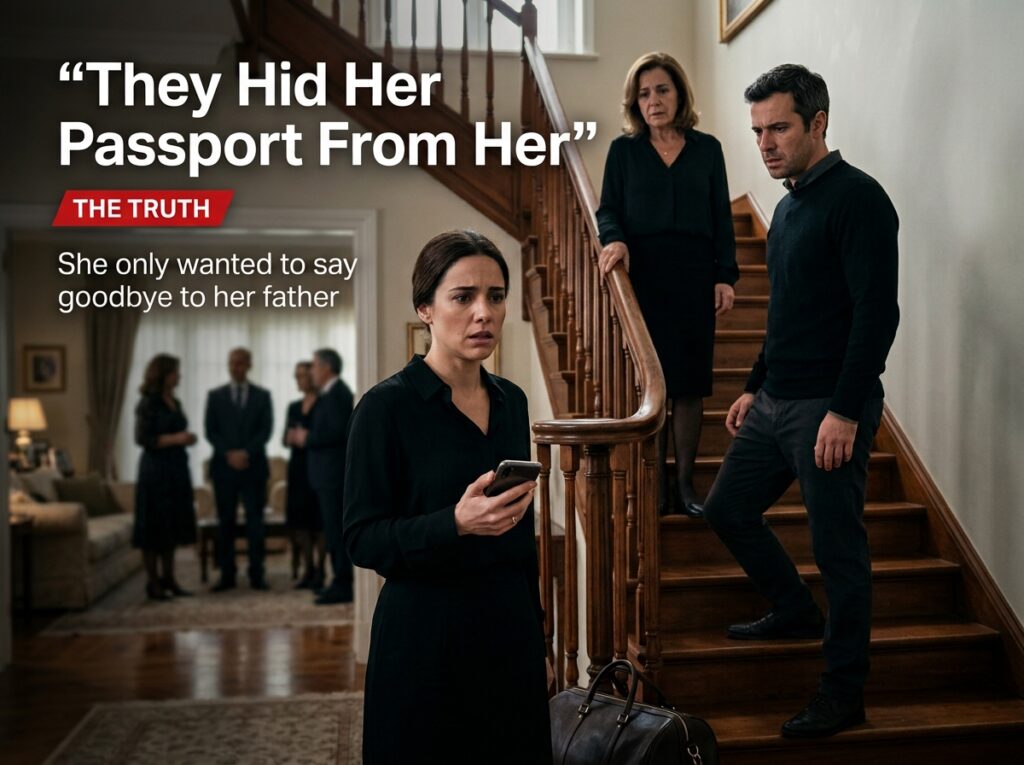
“I need my passport.”
He didn’t answer.
I stopped.
Slowly, I turned around.
“Rui?”
He looked away.
“My mother has it.”
I frowned.
“Why?”
“She needed it for the hotel arrangements.”
“What hotel arrangements?”
“The family gathering.”
I stared at him.
“My passport?”
“Yes.”
“Why would your mother need my passport?”
Rui sighed.
“Inês, not now.”
“My father just died.”
“I know.”
“Then tell me where my passport is.”
He sat up.
“You can deal with it in the morning.”
“No.”
My voice shook.
“I need it now.”
I walked out of the bedroom.
The house was quiet.
Rui’s mother, Helena, had arrived two days earlier because she was hosting a large family celebration that weekend. Nearly forty relatives were expected to arrive.
My father’s funeral was supposed to happen tomorrow.
My husband’s family celebration was supposed to happen tomorrow.
And somehow, my passport was in my mother-in-law’s hands.
I went downstairs.
Helena was sitting at the kitchen table.
She was already awake.
When she saw my face, she knew.
“Oh,” she said softly. “You heard.”
I stopped.
“You knew?”
She looked down.
“I knew your father was very ill.”
“You knew he died?”
She didn’t answer.
“Where is my passport?”
Helena slowly folded the napkin in front of her.
“Inês, this is a terrible time to make accusations.”
“Where is my passport?”
Her eyes hardened.
“You are not going anywhere tonight.”
I stared at her.
“My father is dead.”
“And my entire family is arriving in a few hours.”
I couldn’t believe what I was hearing.
“My father is dead.”
“I heard you.”
“Then give me my passport.”
She stood.
“You have responsibilities here.”
“No.”
I shook my head.
“My only responsibility right now is to bury my father.”
Helena’s face changed.
For the first time, I saw something underneath the sadness she was pretending to feel.
Fear.
She was afraid.
But I didn’t yet know why.
I went upstairs to pack.
Rui followed me.
“Inês, don’t make this worse.”
I turned toward him.
“Where is my passport?”
He said nothing.
“Rui.”
He looked at the floor.
Then he said quietly:
“My mother put it somewhere safe.”
“Where?”
“I don’t know.”
I laughed once.
It wasn’t because anything was funny.
It was because the alternative was screaming.
“You don’t know?”
“No.”
“You expect me to believe that?”
“I’m telling you what I know.”
I opened the wardrobe.
“My father is dead, and your mother has my passport.”
“Inês…”
“No.”
I turned toward him.
“You don’t get to tell me to calm down.”
He stared at me.
“I’m going to find it.”
And that was when I realized something.
Rui wasn’t trying to help me leave.
He was trying to stop me.
I just didn’t know why.
Not yet.
Part 2
I searched every drawer in the bedroom.
Nothing.
I opened the small cabinet where Rui kept his documents.
Nothing.
I checked my handbag.
Nothing.
My passport was gone.
Completely gone.
Rui stood near the door watching me.
“Stop,” he said.
I looked at him.
“Stop what?”
“Making this into something it isn’t.”
“My passport disappeared the night my father died.”
“My mother took it.”
“And you think that’s normal?”
“She didn’t mean anything by it.”
“Then why won’t she give it back?”
He didn’t answer.
I picked up my phone.
“I’m calling the airline.”
“You can’t fly without your passport.”
“I know.”
“I told you.”
“I wasn’t asking you.”
I walked into the hallway.
Rui grabbed my wrist.
I froze.
“Let go.”
“Inês, please.”
“Let go of me.”
He released me.
His face looked angry now.
“You are humiliating me.”
I stared at him.
“My father is dead.”
“You’re acting irrationally.”
“My father is dead.”
“You keep saying that.”
“Because you keep forgetting it.”
He looked away.
Downstairs, I could hear voices.
Guests were beginning to arrive.
Laughter.
Suitcases.
Children running through the hallway.
Someone turned on music.
It felt grotesque.
My father’s death had happened in the same house where Rui’s family was preparing to celebrate.
I walked downstairs.
Helena was greeting relatives near the front entrance.
She smiled.
She hugged people.
She laughed.
Then she saw me.
Her smile vanished.
“Where are you going?”
“To find my passport.”
“You should go back upstairs.”
“No.”
Several relatives looked toward us.
I didn’t care.
“Give me my passport.”
Helena lowered her voice.
“Not in front of everyone.”
“You took it.”
“I borrowed it.”
“You stole it.”
A woman nearby gasped.
Helena’s face went pale.
Rui came down the stairs.
“Inês.”
I turned toward him.
“My passport.”
He walked toward me.
“Please.”
“Tell your mother to give it to me.”
“My mother said she doesn’t know where it is.”
“Then help me find it.”
“You’re creating a scene.”
“A scene?”
I almost laughed.
“My father is dead.”
Rui’s jaw tightened.
“Sit down.”
“No.”
“Sit down, Inês.”
“I am leaving.”
He stepped closer.
“Not now.”
“Move.”
His voice dropped.
“You have forty guests downstairs.”
“I don’t care.”
“My mother has spent months planning this.”
“My father spent his whole life raising me.”
Silence.
The room became painfully quiet.
Rui looked at me with an expression I had never seen before.
Then he hissed:
“Sit down and stop embarrassing us in front of my family.”
Something inside me went completely still.
I looked at him.
I didn’t cry.
I didn’t scream.
I simply looked at the man I had married.
The man who had once held my hand in a hospital corridor when my father was sick.
The man who had promised me that my family would always be his family too.
Now he was asking me to sit quietly because my grief was embarrassing him.
I stepped backward.
“I understand.”
He seemed relieved.
“Good.”
I nodded.
Then I turned away.
I didn’t say another word.
I went upstairs.
But I didn’t sit down.
I didn’t pack.
Instead, I closed the bedroom door and locked it.
Then I called my father’s closest friend.
His name was Manuel.
He answered immediately.
“Inês?”
“Uncle Manuel, I need help.”
“What happened?”
I explained everything.
There was silence.
Then he said something that made my blood run cold.
“Your father told me something before he died.”
“What?”
“He said if anything happened to him, I should make sure you received the envelope he left for you.”
“What envelope?”
“I don’t know.”
“Where is it?”
“With me.”
I closed my eyes.
“Can you bring it?”
“I’m already on my way.”
“Thank you.”
I ended the call.
Then my phone rang again.
A number I didn’t recognize.
I answered.
“Hello?”
A woman’s voice whispered:
“Inês, it’s Clara.”
Helena’s favorite cousin.
I had met her many times.
“Clara?”
“You need to listen to me carefully.”
My heart started beating faster.
“Why?”
“Because what they are telling you about your passport isn’t true.”
I sat down.
“What do you mean?”
“I saw Helena take it.”
I said nothing.
“She didn’t hide it because of the party.”
“Then why?”
Clara hesitated.
“I think you should record this.”
I opened my phone recorder.
“I’m recording.”
Her voice became quieter.
“Good.”
Then she said:
“I heard Helena talking to Rui last night.”
My stomach tightened.
“What did they say?”
Clara took a breath.
“They were talking about your father.”
And suddenly, I knew my passport wasn’t the only thing they were hiding.
Part 3
Clara didn’t speak for several seconds.
I could hear traffic in the background.
“Tell me,” I whispered.
“She said you couldn’t be allowed to go home.”
“Why?”
“Because if you went, you would find out what your father left you.”
I frowned.
“What did he leave me?”
“I don’t know.”
“Clara, please.”
“I only heard pieces.”
“What pieces?”
“She mentioned a house.”
My breath caught.
“My father’s house?”
“I think so.”
“What about it?”
“She said your father had changed something.”
I stood.
“Changed what?”
“I don’t know.”
There was a pause.
Then Clara said:
“Your husband knew about it.”
I sat back down.
“No.”
“Inês…”
“No. Rui would have told me.”
“I’m sorry.”
“Rui wouldn’t hide something like that from me.”
Clara didn’t respond.
That silence told me more than words could.
I thought about the past six months.
My father had been sick.
I had traveled home twice.
Each time, Rui had complained about the cost.
Each time, Helena had reminded me that “a married woman’s first duty was to her husband’s household.”
I had ignored it.
I thought it was simply old-fashioned thinking.
Now it felt different.
“Clara,” I said, “where is my passport?”
“I don’t know.”
“Can you find out?”
“I can try.”
“Please.”
She agreed.
Before hanging up, she said:
“Inês, be careful.”
“With what?”
“With everyone downstairs.”
The call ended.
I stared at the recording on my phone.
For years, I had thought Helena disliked me because I was different from her.
She preferred obedience.
I preferred independence.
She believed family decisions should be made by elders.
I believed adults should make their own choices.
But I had never imagined she could deliberately keep me from my father’s funeral.
I opened the bedroom door.
Rui was standing outside.
He had been listening.
“Who were you talking to?”
“Clara.”
His expression changed.
“What did she want?”
I looked at him.
“What did my father leave me?”
His face went completely blank.
“What?”
“You heard me.”
“I don’t know what you’re talking about.”
“Clara says my father left something for me.”
“She’s confused.”
“Is there a house?”
Rui didn’t answer.
“Rui.”
He walked past me.
“You’re grieving. You’re imagining things.”
I followed him.
“Is there a house?”
He stopped.
Then he turned.
“Your father owned a house.”
“I know.”
“What’s your point?”
“Did he change something?”
Rui rubbed his face.
“Inês, please stop.”
“Did he leave me something?”
“I don’t know.”
“You’re lying.”
His expression hardened.
“You have no idea what you’re talking about.”
“Then give me my passport.”
He stared at me.
“I don’t have it.”
“Your mother does.”
“I told you, she doesn’t know where it is.”
“You know.”
“No.”
“You know.”
He walked away.
I followed.
“Rui!”
He stopped at the top of the stairs.
Below us, dozens of relatives were talking.
He looked at me.
His face was cold.
“If you step out that door, Inês, don’t expect a husband when you come back!”
Everything became silent inside me.
I looked down the stairs.
Forty guests.
His mother.
His cousins.
His uncles.
All watching.
Rui continued.
“Do you hear me?”
I said nothing.
“Forty guests are downstairs, my mother is crying, and you want to make a scene over one stupid trip when the truth is that…”
He stopped.
I waited.
He didn’t finish.
Then his phone rang.
He looked at it.
The name on the screen was Helena.
He walked away to answer.
I remained on the stairs.
My hands were shaking.
But not from fear.
Something had changed.
I was no longer trying to understand how my husband could behave this way.
I was beginning to understand that he had been part of the plan.
I went back into the bedroom.
I opened the recording.
Clara’s voice filled the room.
I listened again.
Then I heard something I hadn’t noticed the first time.
In the background, a man’s voice.
Rui.
His words were faint.
But clear enough.
“She can’t know until after tomorrow.”
I stopped the recording.
My heart pounded.
Tomorrow.
The day of my father’s funeral.
The day I was supposed to be here entertaining his family.
The day they had chosen to keep me away.
I listened again.
There was another voice.
Helena.
“She’ll find out eventually.”
Rui answered:
“Not if she never gets there.”
I covered my mouth.
My husband knew.
My mother-in-law knew.
And my father’s funeral had become something they were deliberately preventing me from attending.
I didn’t know what my father had left me.
But suddenly, I knew one thing.
Whatever it was, they were terrified that I would discover it.
Part 4
Uncle Manuel arrived forty minutes later.
He didn’t come through the front door.
He called me from outside.
I went through the back entrance.
He was holding a brown envelope.
The moment he saw my face, he pulled me into a hug.
“My girl.”
I cried against his shoulder.
For the first time since my mother called, someone had hugged me without asking me to stop crying.
“I’m sorry,” he whispered.
“Please give me the envelope.”
He handed it to me.
My father’s handwriting was on the front.
For Inês.
My hands trembled.
I opened it.
Inside was a letter.
My father’s handwriting filled three pages.
I read the first line.
My dearest daughter,
If you are reading this, I am no longer here to tell you what I should have told you years ago.
I had to stop.
My eyes filled with tears.
Manuel looked away.
I continued.
Your mother knows some of this. Rui knows more than he has admitted.
My heart stopped.
Rui.
I read faster.
The house in Serra Azul belongs to you.
It has always been intended for you.
I looked up.
“The house?”
Manuel nodded.
“Keep reading.”
The letter explained that my father had transferred ownership of the house into my name months earlier.
But there was more.
He had discovered that Rui had approached him about selling it.
My father had refused.
He had written that Rui had told him our marriage was struggling financially and that selling the house would solve everything.
My father hadn’t believed him.
Then he discovered something worse.
Rui had debts.
Large ones.
Some were related to business investments.
Others were personal.
My father had refused to give him money.
He had instead placed the house beyond Rui’s control.
I couldn’t breathe.
At the bottom of the letter, my father had written:
I love you too much to let anyone use you for what you own.
I folded the letter.
“Did he know?”
Manuel nodded.
“Your father suspected your husband was planning something.”
“Why didn’t he tell me?”
“He tried.”
I looked at him.
“What do you mean?”
“He called me two weeks before he died.”
Manuel lowered his voice.
“He said you had become distant.”
I looked down.
“I wasn’t distant.”
“You were busy.”
“I was trying to care for him and manage my marriage.”
“I know.”
He handed me another document.
“This was attached to the letter.”
I unfolded it.
It was a copy of the property transfer.
My name was there.
Sole owner.
I stared at it.
The house was mine.
Not Rui’s.
Not Helena’s.
Mine.
Suddenly, Clara’s words made sense.
“She took my passport because she didn’t want me to go home.”
Manuel nodded.
“And because if you went home, you would speak to the lawyer.”
“Which lawyer?”
“Your father’s lawyer.”
I looked at him.
“He’s expecting you.”
“When?”
“Tomorrow morning.”
My heart raced.
“Before the funeral?”
“Yes.”
I folded the document.
“I have to go.”
Manuel looked toward the house.
“Can you?”
“My passport is hidden.”
He smiled sadly.
“Then we find it.”
We searched the guest rooms first.
Nothing.
Then the office.
Nothing.
Finally, Manuel noticed a small drawer beneath Helena’s desk.
It was locked.
I looked at him.
“She keeps spare keys in the kitchen.”
We went there.
I found the key.
The drawer opened.
Inside were passports.
Three of them.
Mine was on top.
I picked it up.
For a moment, I simply held it.
Something so small.
Something so ordinary.
Yet my entire freedom had been reduced to whether another person decided to let me have it.
I put it in my bag.
Then I saw something else.
A folder.
My name was written on it.
I opened it.
Bank statements.
Loan documents.
Copies of Rui’s signatures.
And one document that made my stomach turn.
A proposed sale agreement for my father’s house.
The buyer’s name was listed.
The price was far below market value.
The seller’s section was prepared for my signature.
I had never seen it.
I had never agreed to it.
And yet someone had prepared everything.
I took pictures of every page.
Then I heard footsteps.
Helena appeared in the doorway.
She looked at the folder.
Then at me.
Her face changed.
“You weren’t supposed to see that.”
I slowly closed the folder.
“Neither was I supposed to attend my father’s funeral?”
She said nothing.
“Why?”
Her eyes filled with tears.
“I was trying to protect my son.”
I looked at her.
“From what?”
“From losing everything.”
I shook my head.
“He was trying to take everything from me.”
“No.”
“Yes.”
She stepped closer.
“Your father poisoned you against him.”
I almost laughed.
“My father died knowing his daughter was being lied to.”
“You don’t understand.”
“Then explain it.”
She looked toward the hallway.
“I can’t.”
“You can.”
“No.”
“Why?”
Her lips trembled.
“Because if I tell you everything, you will never forgive me.”
I stared at her.
Then I said quietly:
“I already know enough.”
And for the first time, Helena looked genuinely afraid.
Part 5
I left the house before sunrise.
Rui was asleep.
Or pretending to be.
I didn’t wake him.
I didn’t leave a note.
I simply walked out with my passport, my father’s letter, and the documents I had photographed.
Manuel drove me to the airport.
For the first time in hours, I could breathe.
I sat beside the window and watched the city disappear behind us.
I thought about my father.
When I was little, he used to take me to the train station on Sunday mornings.
He would buy two pastries.
One for me.
One for him.
I always ate mine before we reached the platform.
Then I would stare at his.
He would pretend not to notice.
Eventually, he would sigh dramatically and hand it to me.
“You’re going to make me poor one pastry at a time.”
I smiled through tears.
Those were the memories I wanted.
Not arguments.
Not lawyers.
Not property documents.
Not Rui.
My father.
I arrived at his lawyer’s office shortly after eight.
His name was Dr. Almeida.
He stood when I entered.
His expression told me he already knew everything.
“Inês.”
“Did my father tell you?”
“Yes.”
“About Rui?”
He nodded.
“Your father was very concerned.”
I sat down.
“Why didn’t anyone tell me?”
“Because your father wanted to give you the choice to decide what to do.”
“What did he know?”
Dr. Almeida opened a file.
“Your husband had approached him several times.”
“For money?”
“Yes.”
“How much?”
He told me.
I stared at the number.
It was enormous.
“He said he needed it to save his company.”
“Was that true?”
“Partially.”
“What does that mean?”
“He had debts unrelated to the company.”
I closed my eyes.
“Gambling?”
“No.”
“Another woman?”
“No.”
“Then what?”
“Loans. Private lenders. Investments that failed.”
I looked at the table.
“Why did he want my father’s house?”
“Because he believed it could be sold quickly.”
“Could he legally sell it?”
“Not without your consent.”
“And that’s why they hid my passport.”
Dr. Almeida didn’t answer immediately.
“That is one possibility.”
I looked at him.
“Don’t protect me from the truth.”
He nodded.
“Your father believed your husband intended to pressure you into selling the property.”
My hands tightened.
“Did my father know Helena?”
“Yes.”
“Did he trust her?”
“Not toward the end.”
I remembered Helena’s face.
Her tears.
Her words.
I was trying to protect my son.
I wondered how long she had known.
Dr. Almeida handed me another document.
“Your father also established a trust.”
“For me?”
“For you and any children you may have in the future.”
I stared at him.
“Rui can’t access it?”
“No.”
“Can he challenge it?”
“He can try.”
I laughed bitterly.
“Of course he can.”
Dr. Almeida looked at me.
“There’s something else.”
“What?”
“Your father left a letter specifically for your husband.”
I looked up.
“Where is it?”
“He asked me to give it to Rui only if you were present.”
I didn’t know whether I wanted to see it.
But I nodded.
“Keep it.”
“I will.”
“Do you want to read it?”
“No.”
Not yet.
I had a funeral to attend.
My father’s funeral began at two.
When I arrived, my mother saw me and ran toward me.
She held me so tightly that I felt like a child again.
“You came.”
“I promised.”
She cried into my shoulder.
“I thought they wouldn’t let you.”
I pulled away.
“What?”
My mother looked confused.
“Your husband called last night.”
I froze.
“What did he say?”
“He said you were too upset to travel.”
I stared at her.
“He called you?”
“Yes.”
“And told you I wouldn’t come?”
“He said you needed rest.”
My mother’s expression changed.
“You’re shaking.”
I didn’t tell her everything.
Not yet.
I couldn’t turn my father’s funeral into a courtroom.
I walked toward the coffin.
The world disappeared.
I touched the wood.
“I’m sorry, Dad.”
My voice broke.
“I should have called you.”
My mother stood behind me.
“He knew you loved him.”
I cried.
For the first time, I allowed myself to grieve without worrying about anyone else’s feelings.
The funeral was quiet.
Afterward, relatives gathered at my mother’s home.
Then I saw Rui.
He stood across the street.
He had come alone.
When our eyes met, he crossed toward me.
“Inês.”
I didn’t answer.
“Can we talk?”
“No.”
“Please.”
“You told me not to expect a husband if I left.”
“I was angry.”
“You meant it.”
“I didn’t.”
“You said it in front of your family.”
“I was scared.”
“Of what?”
He looked at me.
“Losing you.”
I stared at him.
“No.”
He swallowed.
“Then what?”
“You were afraid of losing the house.”
His face changed.
That was enough.
He didn’t deny it.
I walked away.
But he followed.
“Inês, please listen.”
“No.”
“Your father misunderstood.”
“Stop.”
“He hated me.”
“No.”
“He never trusted me.”
“He didn’t trust you because he knew you.”
Rui looked wounded.
But I was no longer responsible for making him feel better.
Then his phone rang.
He looked at it.
Helena.
He answered.
I couldn’t hear everything.
But I heard enough.
“What?”
A pause.
Then Rui said:
“She’s here.”
Another pause.
His face went pale.
“What do you mean the documents are missing?”
I looked at him.
He looked back at me.
And I realized the fight had only just begun.
Part 6
The next morning, Rui came to my mother’s house.
I refused to see him.
He called twenty-three times.
Then he sent messages.
I didn’t answer.
Finally, Clara called.
“Inês.”
“What?”
“I need to tell you something.”
I sat on the edge of my mother’s bed.
“What?”
“Helena knows I spoke to you.”
“How?”
“She saw me leaving the house.”
“Are you okay?”
“Yes.”
She hesitated.
“She blamed me for everything.”
“Clara, you helped me.”
“I know.”
“What else happened?”
“She told Rui to destroy the documents.”
My heart stopped.
“What documents?”
“The loan papers.”
I stood.
“Did he?”
“I don’t know.”
I immediately called Dr. Almeida.
He told me not to confront them alone.
That afternoon, I met him with my mother.
We discussed everything.
He advised me to preserve every document, message, recording, and photograph.
I had never imagined my life would become a collection of evidence.
But it had.
The recording from Clara was saved in three places.
The photographs were backed up.
The property documents were secured.
For the first time, I wasn’t afraid.
I was angry.
That evening, Rui came again.
This time, he brought Helena.
My mother opened the door.
Helena stood there crying.
“Inês, please.”
I walked into the living room.
“What do you want?”
Helena clasped her hands.
“I made mistakes.”
“You stole my passport.”
“Yes.”
“You tried to keep me from my father’s funeral.”
“I was desperate.”
“You helped prepare a sale agreement for my property.”
She looked down.
“I didn’t sign it.”
“But you knew.”
“Yes.”
I looked at Rui.
“And you?”
He said nothing.
“Did you know?”
“Yes.”
“How long?”
“Months.”
My heart sank.
Months.
All the dinners.
All the mornings.
All the nights.
Every “I love you.”
Every kiss.
Every time he had asked me to trust him.
He had known.
I sat down.
“How much did you owe?”
He gave me the amount.
I closed my eyes.
“Did you marry me because of my father’s money?”
“No.”
“Did you stay with me because of it?”
He couldn’t answer.
That silence was worse than any confession.
Helena started crying.
“I wanted to save my son.”
I looked at her.
“You tried to destroy me to save him.”
“I didn’t know what else to do.”
“You could have told me.”
She shook her head.
“You would have left him.”
“Yes.”
She looked at me.
“That’s what I feared.”
I stared at her.
There it was.
The truth.
She hadn’t hidden my passport because of the party.
She hadn’t cared about the guests.
She had hidden it because she knew that if I reached my father’s lawyer, I would learn the truth.
And once I knew, the marriage might end.
Rui sat across from me.
“Give me one chance.”
I looked at him.
“One chance to do what?”
“To fix this.”
“You can’t fix what you chose to do.”
“I was desperate.”
“So was I.”
He lowered his head.
“I love you.”
I felt tears rise in my eyes.
I hated that those words still hurt.
“Maybe you do.”
He looked up.
“But love without honesty isn’t enough.”
He started crying.
“I was afraid.”
“I was too.”
“I thought if I lost the house, I would lose everything.”
“You never owned it.”
“I know.”
“You were willing to let me miss my father’s funeral.”
He looked away.
“I know.”
“That is the part I can’t forgive.”
He covered his face.
Helena began crying again.
I stood.
“Go home.”
“Inês…”
“Go.”
Rui looked at me.
“Are you ending our marriage?”
I thought about it.
Then I said:
“I don’t know yet.”
His eyes lifted.
“But I know one thing.”
“What?”
“You don’t get to decide anymore.”
I walked to the door.
He left.
Helena stayed for a moment.
She looked at me.
“I am sorry.”
I believed that she was.
But forgiveness wasn’t something she could demand.
I closed the door.
Then I returned to my father’s room.
My mother had kept a box of his belongings.
Inside was his old watch.
His reading glasses.
A photograph of me at twelve.
And one final envelope.
My name was written on it.
I opened it.
The letter was short.
My daughter,
Never confuse keeping peace with keeping love.
Sometimes the people who love us most will ask us to stay quiet because they are afraid of what happens when the truth comes out.
But truth is not your enemy.
Read it.
Face it.
Then choose your life.
I pressed the letter against my chest.
For the first time since my father died, I smiled.
He had known me.
Even at the end.
Part 7
Three months passed.
I moved back into my mother’s house.
Rui and I lived separately.
He began therapy.
He sold what he could.
He paid back some of his debts.
But none of that automatically repaired what he had broken.
We spoke occasionally.
Sometimes about practical matters.
Sometimes about the marriage.
Never about pretending nothing had happened.
Helena stopped calling.
Then one afternoon, she sent me a letter.
I almost threw it away.
Instead, I opened it.
She apologized.
She admitted she had known about Rui’s debts.
She admitted she had encouraged him to hide them.
She admitted she had taken my passport.
She admitted she had lied to my mother.
She wrote that she had convinced herself she was protecting her son.
But protecting someone from consequences, she finally understood, was not the same as protecting them.
I read the letter twice.
Then I put it away.
I didn’t reply.
Not yet.
My life slowly became my own again.
I returned to work.
I started visiting my father’s house.
The house in Serra Azul was beautiful.
It sat on a hill overlooking a valley.
My father had spent years repairing it.
There was a garden in the back.
A small workshop.
A wooden table where we used to eat lunch.
I found one of his old jackets hanging in the workshop.
I put it on.
It smelled faintly like him.
I cried for an hour.
Then I opened the windows.
For the first time, the house felt like mine.
Not because of the property documents.
Because my father had left his presence everywhere.
One afternoon, Rui arrived.
He stood outside the gate.
“I won’t come in unless you ask me.”
I looked at him.
“You can come in.”
He walked slowly toward the house.
He looked around.
“I’ve never really seen it.”
“You never asked.”
“I was too busy thinking about what it was worth.”
I said nothing.
He nodded.
“I deserved that.”
We sat outside.
He told me he had found another job.
He was rebuilding his finances.
He said he had finally told his family the truth.
Everyone.
No excuses.
No blaming my father.
No blaming me.
I listened.
Then he said:
“I don’t expect you to take me back.”
“Good.”
He smiled sadly.
“I know.”
“But I want you to understand something.”
He looked at me.
“What?”
“I loved you.”
His eyes filled with tears.
“I know.”
“I probably still do in some way.”
He looked down.
“But love doesn’t erase what happened.”
“I know.”
“You took away my choice.”
“I know.”
“You made me choose between my father and your family without telling me there was a choice.”
He nodded.
“I was wrong.”
We sat in silence.
Then I asked:
“Why didn’t you just tell me?”
He thought for a long time.
“Because I was ashamed.”
I looked at him.
“Of your debts?”
“Yes.”
“And you thought lying would protect you.”
“Yes.”
“It didn’t.”
“No.”
I stood.
“I need more time.”
“I’ll give you as much as you need.”
He left.
I watched him walk down the road.
I didn’t know whether we would ever be husband and wife again.
But for the first time, that uncertainty didn’t terrify me.
Because the choice belonged to me.
Part 8
Six months after my father’s funeral, I reopened the house.
I turned the workshop into a small office.
I planted flowers in the garden.
I repaired the old wooden table.
And on the wall, I placed my father’s photograph.
I started spending weekends there.
Sometimes friends visited.
Sometimes my mother came.
Sometimes I sat alone with coffee and listened to the wind.
One Saturday, Clara arrived.
She hugged me.
“I’ve missed you.”
“I’ve missed you too.”
We sat outside.
She looked at the house.
“Your father would be proud.”
I smiled.
“I hope so.”
She handed me an envelope.
“What is this?”
“It came to me by mistake.”
I opened it.
It was from Helena.
Another letter.
This one was different.
She wrote that she had finally understood what she had done.
She had spent her entire life believing that family meant protecting your own people at any cost.
But she had confused protection with control.
She had treated me like an obstacle instead of a daughter.
At the end, she wrote:
I don’t ask you to forgive me. I only ask that one day, when you remember me, you remember that I finally understood how wrong I was.
I folded the letter.
Clara watched me.
“Are you going to answer?”
“I don’t know.”
“That’s okay.”
I nodded.
Later that evening, Rui called.
He asked if he could visit.
I agreed.
When he arrived, he looked different.
Not physically.
Something in his manner had changed.
He didn’t walk into the house like it belonged to him.
He waited at the gate.
“Come in.”
He smiled.
“Thank you.”
We walked through the garden.
He stopped near the old tree.
“Your father planted this?”
“Yes.”
“He told me once that trees were the best investment.”
I looked at him.
“When?”
“Before we married.”
I smiled faintly.
“He was right.”
Rui nodded.
“He usually was.”
We sat beneath the tree.
He handed me a small box.
“What is it?”
“Your wedding ring.”
I stared at him.
“Why are you giving this to me?”
“Because I don’t want you to feel trapped by the promise you made to me when you didn’t know who I was.”
I opened the box.
My ring was inside.
“I kept it,” he said, “because I thought giving it back meant I was giving up.”
“And now?”
“Now I think giving it back means I’m finally respecting your choice.”
I closed the box.
He stood.
“I won’t ask you for an answer.”
“Rui.”
He looked at me.
“I need to tell you something.”
He waited.
“I don’t hate you.”
His eyes filled.
“But I don’t know if I can trust you again.”
“I understand.”
“I don’t know if trust can come back.”
“I understand.”
“And I don’t know if love is enough.”
“I know.”
He nodded.
Then he walked away.
I watched him until he disappeared beyond the gate.
I sat beneath the tree until sunset.
Then I looked at my father’s photograph through the window.
I remembered his final letter.
Never confuse keeping peace with keeping love.
I finally understood.
Part 9
A year after my father’s death, I received a phone call from the hospital.
It was Helena.
She had fallen.
She was not seriously injured, but she had been frightened.
“I don’t know who else to call,” she said.
I almost told her to call Rui.
Then I heard the tremble in her voice.
“I’ll come.”
When I arrived, she was sitting beside the window.
She looked smaller than I remembered.
Older.
Tired.
She looked at me.
“You came.”
“Yes.”
“I didn’t think you would.”
“Neither did I.”
She smiled sadly.
“I deserved that.”
I sat beside her.
For several minutes, neither of us spoke.
Then she said:
“I lost my son for a while.”
I looked at her.
“He stopped speaking to me.”
“I’m sorry.”
“He said I taught him that love meant fear.”
I looked down.
“He was right.”
She nodded.
“I know.”
She took my hand.
I almost pulled away.
But I didn’t.
“I was afraid,” she whispered.
“I know.”
“I thought if Rui lost you, he would lose everything.”
“He almost made me lose everything.”
“I know.”
Her eyes filled with tears.
“I cannot undo what I did.”
“No.”
“But I can admit it.”
I nodded.
“That matters.”
She looked at me.
“Do you still love him?”
I took a breath.
“Yes.”
Her face softened.
“But I don’t know what that means anymore.”
She squeezed my hand.
“Maybe love isn’t always about staying.”
I looked at her.
It was the first wise thing she had said to me.
I smiled.
“Maybe.”
When I left the hospital, Rui was waiting outside.
“You came.”
“Yes.”
“How is she?”
“Better.”
He nodded.
We stood there.
Then he said:
“I’ve been thinking.”
“About what?”
“About us.”
I waited.
“I don’t want you to come back because you feel sorry for me.”
“I won’t.”
“I don’t want you to come back because my mother wants it.”
“I won’t.”
“I don’t want you to come back because we were married.”
I looked at him.
“Then why do you want me to come back?”
He took a breath.
“Because I want to become someone you could choose again.”
I felt tears in my eyes.
“That isn’t something you can ask me for.”
“I know.”
“It’s something you have to become.”
“I know.”
“And even then, I may not choose you.”
His eyes filled with tears.
“I know.”
We stood there in silence.
Then he reached into his pocket.
He didn’t pull out a ring.
He pulled out a key.
“The house.”
I looked at it.
“I don’t need it.”
“I know.”
He held it toward me.
“I just wanted you to know that I finally understand.”
I took the key.
Not because I needed permission.
Because I understood what he was trying to say.
He was giving back control.
The thing he had taken from me.
My choice.
My freedom.
My life.
That night, I drove to Serra Azul.
I sat on the porch.
The valley was dark.
The stars were bright.
I took out my father’s letter.
I read it again.
Then I whispered:
“I finally understand, Dad.”
The wind moved through the trees.
For a moment, I could almost hear his voice.
I cried.
But this time, the tears were different.
They were not only grief.
They were release.
Part 10
Two years after my father’s funeral, I stood in the garden of the house in Serra Azul.
The flowers had grown wildly.
My father’s old workshop had become my office.
The wooden table had been restored.
And the tree he planted years ago had become enormous.
I was no longer the woman who stood at the top of the stairs with a hidden passport and a husband demanding that she sit down.
I was no longer waiting for someone else to decide what happened to my life.
Rui and I had spent a long time apart.
During that time, he changed.
Not because I demanded it.
Not because he wanted to win me back.
Because he finally understood that consequences were not punishment.
They were the result of choices.
We eventually began speaking again.
Then having coffee.
Then dinner.
Slowly.
Carefully.
There were no promises.
No dramatic proposal.
No sudden miracle.
Just two people trying to understand whether something broken could ever become something honest.
One evening, we sat beneath my father’s tree.
Rui looked at me.
“I still don’t know what you see when you look at me.”
I smiled.
“Someone who hurt me.”
He nodded.
“And?”
“Someone who finally stopped asking me to forget.”
He looked down.
“And what else?”
I took his hand.
“Someone I might be able to trust again.”
His eyes filled with tears.
“Might?”
“Might.”
He smiled.
“I’ll take might.”
I laughed.
It was the first time we had laughed together in a long time.
My mother watched us from the kitchen window.
She smiled.
Not because she knew what would happen.
No one did.
But because she knew I was making the choice myself.
Later that night, I walked into my father’s workshop.
His photograph hung above the desk.
I touched the frame.
“I went to your funeral,” I whispered.
Then I smiled.
“They tried to stop me.”
I paused.
“But they couldn’t.”
I looked around the room.
For years, I had believed that losing my father was the worst thing that had ever happened to me.
But now I understood something.
His death had taken him from me.
The betrayal afterward had taken away the version of myself who trusted everyone without question.
But somewhere in the middle of all that pain, I had found something else.
My own voice.
My own strength.
My own right to choose.
My father had not left me only a house.
He had left me the courage to walk through its doors alone.
And perhaps that was the inheritance that mattered most.
I closed the workshop door.
Outside, Rui was waiting.
He didn’t call my name.
He didn’t rush me.
He simply stood there.
Waiting.
For me to decide.
I looked at him.
Then I walked toward him.
Not because I had to.
Not because anyone told me to.
Not because I was afraid of being alone.
I walked toward him because, after everything, the choice was finally mine.
And that made all the difference.