Part 1
My name is Maya Castellano, and I’m thirty years old, and I want to start by saying that the speech itself did not surprise me nearly as much as it should have, given that I’d spent thirty years absorbing smaller, quieter versions of the exact same sentiment from the same two people, delivered in private, over holiday dinners and birthday phone calls and the particular silences that fall over a room when a favored child walks in and an unfavored one doesn’t.
My younger sister Jocelyn married her longtime boyfriend, Trent, on a Saturday evening in early June, at a vineyard venue outside Charlottesville that had cost, I later learned, considerably more than either of them could comfortably afford, a fact our parents had covered without hesitation, the way they’d covered every significant expense in Jocelyn’s life since she was seventeen. I had been asked, months earlier, to give a short toast during the reception, a request I’d accepted with the particular cautious hope I’d never quite managed to fully extinguish, the hope that this occasion, finally, might be the one where my family’s careful, decades-long calculus of who deserved warmth and who deserved tolerance might shift, even briefly, in my favor.
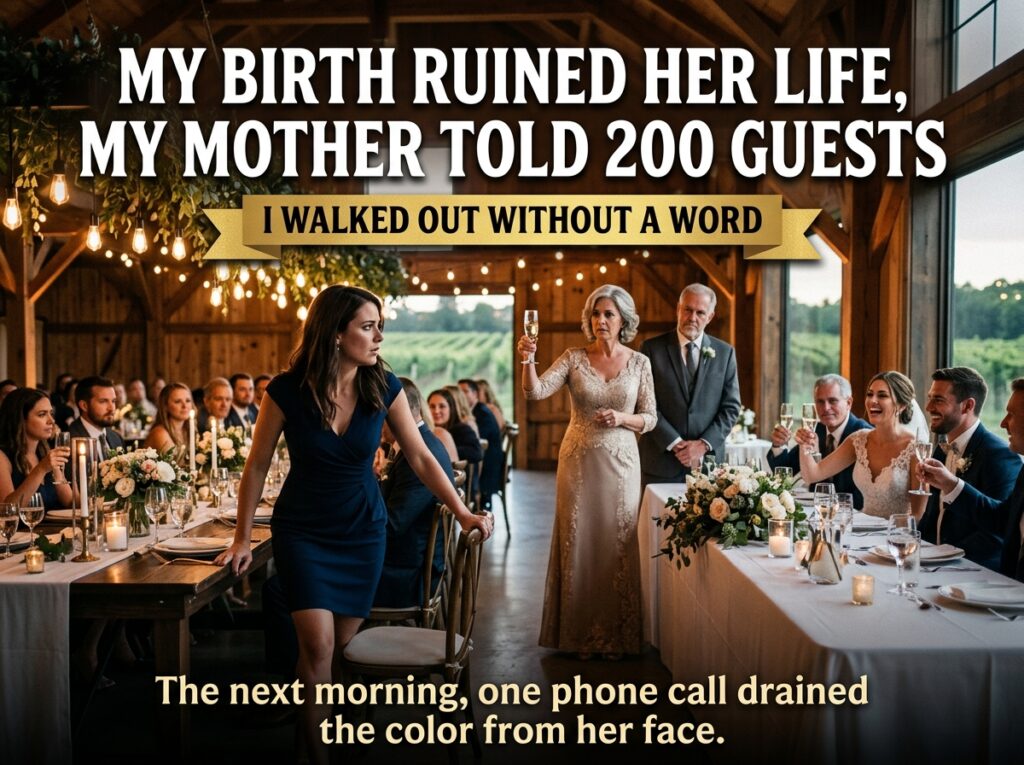
I want to be honest that I don’t fully understand, even now, what prompted my mother, Rosalind, to stand up during the toasts, somewhere in the reception’s second hour, champagne glass in hand, and deliver the speech she delivered. I have turned it over many times since, searching for some triggering comment, some slight I might have unknowingly committed that evening, and I’ve found nothing beyond the ordinary friction of existing, visibly, in a room where my sister had always occupied the entire available warmth.
“I want to say something,” my mother announced, her voice carrying easily across the two hundred assembled guests, tapping her glass with a fork in the traditional call for attention, “about how proud I am of Jocelyn tonight. She has never once given me a single day of worry in thirty years.” She paused, and I watched her eyes find me, seated at a table near the back with my husband, Elias, and something in her expression, a particular cold satisfaction I recognized from childhood, told me, a half second before she said it, that whatever came next was not going to be kind.
“At least she wasn’t a complete failure like my other daughter,” my mother said, her voice carrying no hesitation at all. “Even her birth ruined my life and destroyed my dreams.”
The room did not go silent immediately. It took a beat, the particular delayed comprehension of two hundred people processing something too openly cruel to seem, at first, entirely real. My father, Grant, seated beside my mother, gave a slow, approving nod, the specific gesture of a man agreeing with a sentiment he’d apparently held privately for a considerable time.
“Some children are just born wrong,” he added.
Part 2
I sat very still, my hand finding Elias’s under the table, feeling him go rigid beside me with a fury I could sense radiating off him even without looking at his face directly. I want to describe what I actually felt in that moment, because it wasn’t, primarily, the raw shock a stranger might expect. It was something closer to a terrible, exhausted confirmation, the particular vertigo of finally hearing, out loud, in front of two hundred witnesses, words I had suspected, in some quiet corner of my own mind, for the better part of three decades.
Jocelyn, seated at the head table in her wedding gown, laughed. It was not a nervous laugh, not the reflexive sound of someone uncomfortable with her mother’s cruelty. It was genuine, easy laughter, the particular relaxed sound of someone hearing a sentiment she’d long privately shared finally spoken aloud.
“Finally,” she said, lifting her own champagne glass toward our mother in a small, delighted toast. “Someone said what we’ve all been thinking.”
The wedding party, seated at the tables closest to the head table, Jocelyn’s bridesmaids, Trent’s groomsmen, several cousins I’d grown up alongside, burst into laughter, the particular ugly, contagious laughter of a crowd that has decided, collectively and without much individual thought, that cruelty aimed at someone outside their immediate circle of concern is simply entertainment rather than harm.
I stood up. I did not say anything. I have replayed, many times since, all the things I might have said in that moment, the devastating retorts I’ve constructed in the weeks and months following, but in the actual moment itself, standing at that table with two hundred faces either laughing or carefully avoiding my eyes, I found I had nothing at all I wanted to say to any of them. I simply gathered my purse, took Elias’s hand, and walked out of that reception hall without a single backward glance, the sound of my family’s laughter following us through the venue’s tall glass doors and out into the warm June evening.
I did not cry until we were in the car. Elias drove, his own hands tight on the wheel, and I sat in the passenger seat and let three decades of careful, accumulated hurt finally break loose all at once, a grief that felt, in its intensity, considerably larger than the single evening that had triggered it.
“I’m done,” I told him, once I could speak again. “I mean it, Elias. I am completely and entirely done with all of them. Tonight was the last time any of them will ever get to speak to me that way.”
Part 3
I did not sleep that night, and I did not, in the days that followed, reach out to my mother, my father, or my sister, a silence I maintained with a discipline I hadn’t previously known I possessed, given three decades of habitually smoothing over exactly this kind of family cruelty in the interest of preserving some fragile, ongoing peace.
What I did do, in the raw, sleepless hours following the reception, was finally call my aunt Yolanda, my mother’s older sister, a woman I’d always found warmer and considerably more honest than my own parents, though our relationship had grown distant over the years, largely due to my mother’s careful, ongoing efforts to keep her own sister at arm’s length from whatever version of family history she preferred circulating.
“Maya,” Yolanda said, once I’d finished describing the entire reception, her voice carrying a particular grim weariness that told me this account hadn’t entirely surprised her. “I need to tell you something I probably should have told you years ago, and I think tonight, of all nights, you finally deserve to hear it.”
“What is it?”
“Your mother’s dreams, the ones she claims your birth destroyed,” Yolanda said carefully. “I want you to understand exactly what those dreams actually were, because I don’t believe she’s ever told you the truth about them, and I think the truth changes the shape of everything she said tonight considerably.”
I sat very still, gripping my phone, some instinct telling me I was about to learn something that would reorganize a great deal of what I understood about my own childhood.
“Your mother was engaged, before your father, to a man named Desmond Kellerman,” Yolanda said. “A considerably wealthier man, from a prominent family in Richmond, and she was, by every account I remember from that time, genuinely, deeply in love with him. She got pregnant with you unexpectedly, before they married, and Desmond’s family, learning of the pregnancy, insisted he end the engagement rather than marry a woman already carrying another man’s child.”
“I don’t understand,” I said slowly. “Whose child was I, if not Desmond’s?”
“You were Desmond’s child, Maya,” Yolanda said gently. “Your biological father. Your mother married Grant Castellano less than a year later, a man she’d previously dated only casually, specifically because she needed a husband quickly, someone willing to raise another man’s child as his own, before the pregnancy became visible enough to fully destroy her reputation in the social circles she’d been raised to value above almost everything else.”
Part 4
I sat with that revelation for a long moment, feeling several pieces of my own childhood, previously scattered and confusing, suddenly click into a shape that made a terrible, coherent sense.
“Grant isn’t my biological father,” I said slowly.
“He is not,” Yolanda confirmed. “And I believe, though I’ve never had direct confirmation from either of them, that he has known this for your entire life, and has resented you for it in exactly the particular way a man resents a child he was pressured into raising as a condition of a marriage he entered mostly out of your mother’s desperate necessity rather than genuine choice.”
“And Jocelyn?”
“Jocelyn is Grant’s biological daughter,” Yolanda said. “Born two years after you, once your mother’s marriage to Grant had settled into something considerably more genuine than its original, transactional beginning. I believe, watching your parents over the decades since, that Jocelyn became, for both of them, a kind of do-over, a chance to build the family they’d originally wanted before circumstances forced them into a marriage neither of them had chosen freely.”
“So I’ve spent thirty years being punished,” I said, my voice coming out considerably steadier than I actually felt, “for the fact that my mother lost a wealthy fiancé and had to marry a man she didn’t fully want, and that man has spent thirty years resenting me for not actually being his.”
“I believe that’s a fair, if painful, summary,” Yolanda said. “I’m sorry, Maya. I should have told you this years ago, rather than letting you spend three decades believing whatever cruelty you experienced was somehow a fair response to something you’d actually done wrong.”
I hung up the phone that evening with a considerably clearer understanding of my entire childhood, though the clarity brought, alongside a certain grim relief, an entirely new grief of its own: the understanding that I had never, in thirty years, had any real chance of earning the warmth my parents extended so freely to my sister, because that warmth had never actually been about anything I’d done or failed to do. It had been about a man named Desmond Kellerman, and a broken engagement, and a marriage entered under duress, decades before I was old enough to have any say in any of it at all.
Part 5
I want to explain what happened the following morning, because I did not, in fact, orchestrate the phone call that drained the color from my mother’s face. I learned about it only afterward, pieced together through several conversations that unfolded, over the following weeks, in ways I hadn’t remotely anticipated when I walked out of that reception hall.
Elias, it turned out, unbeknownst to me at the time, had made a decision of his own that same night, sitting in our darkened living room while I slept fitfully upstairs, finally exhausted enough to briefly escape my own churning thoughts. He is a corporate attorney, careful and methodical by both training and temperament, and he had spent those late hours doing something I hadn’t asked him to do and wouldn’t have thought to ask him to do myself: researching, through the careful, legal channels his profession made available to him, the full financial picture of my parents’ household, curious, he later told me, whether there existed any formal or informal financial arrangement connecting my own upbringing to whatever guilt or resentment had apparently shaped my parents’ treatment of me.
What he found, and what he brought to my attention only after several days of his own careful verification, was considerably more significant than either of us had expected.
Desmond Kellerman, my biological father, had died eight years earlier, unmarried and without other children, having apparently never fully recovered, according to the small amount Elias could piece together from public records and a discreet conversation with a former colleague who’d once worked briefly for the Kellerman family’s law firm, from the abrupt end of his engagement to my mother decades earlier. He had left, in a will filed shortly before his death, a modest but genuine bequest, held in a dormant trust for over eight years, to “any biological child of Rosalind Castellano, née Whitfield, born in the spring of 1996,” a bequest the estate’s attorneys had apparently been unable to formally execute, because they’d had no confirmed way to locate or identify me, my mother having never once, in thirty years, updated any official record connecting my birth to Desmond Kellerman rather than to Grant Castellano.
Part 6
“There’s a trust,” Elias told me, four days after the wedding, sitting me down at our kitchen table with a folder of documents he’d assembled with the particular careful thoroughness his profession had trained into him. “In your biological father’s name, established years before his death, meant specifically for you, that’s been sitting dormant because the estate’s attorneys never had confirmation of your identity or your legal relationship to him.”
“How much,” I asked, though the amount, I understood even asking, mattered considerably less to me than the underlying revelation that a man I’d never known had, apparently, thought of me at all, had left something behind specifically intended for a daughter he’d apparently never been permitted to know.
“Two hundred and forty thousand dollars,” Elias said. “Plus accumulated interest over eight years, which brings the current total closer to three hundred thousand.”
I sat with that number for a long moment, feeling considerably less triumphant than I might have expected, given everything my mother had said at that reception only days earlier. “He knew about me,” I said slowly. “He knew, and he still left something for me, even after all those years, even after never meeting me even once.”
“According to the trust documents,” Elias said gently, “he attempted, twice, in the years before his death, to reach out to your mother directly, requesting some form of contact or acknowledgment. Both times, based on the correspondence his attorneys kept on file, she declined firmly, informing him that Grant Castellano was your legal father in every capacity that mattered, and that any attempt at contact would only complicate a family situation that had, by then, fully settled into its current arrangement.”
I understood, hearing that, something that landed considerably harder than the trust’s actual dollar amount: my mother had known, for decades, that my biological father wanted some form of connection with me, and had actively, repeatedly, refused it on my behalf, without ever once asking me whether I might have wanted that connection myself.
Elias contacted the estate’s attorneys the following morning, a formal process requiring DNA verification and considerable documentation, a process that would take several weeks to fully resolve. But the initial contact itself, a formal letter sent by Elias’s own firm to the Kellerman estate’s law office confirming my identity and intent to claim the trust, triggered, within twenty-four hours, a callback to a number listed as my emergency contact on some decade-old form, a number that happened to belong, still, to my mother.
Part 7
I learned, later, exactly what that phone call contained, pieced together from my mother’s own account, delivered weeks afterward in a conversation I hadn’t initially planned to have with her at all.
The Kellerman estate’s attorney, a careful, formal man named Bertram Osei, had called my mother’s number, listed still, apparently, from decades-old paperwork nobody had ever bothered to update, to confirm certain identifying details before finalizing the trust’s release, a routine verification call that had, instead, delivered to my mother the sudden, unexpected news that her biological daughter, whose existence she had spent thirty years carefully managing and minimizing, had just formally claimed a trust from the very man whose lost engagement had shaped, in ways my mother had apparently never fully processed, the entire subsequent architecture of our family’s cruelty.
“I need to tell you something, and I need you to understand it’s true,” she told me, weeks later, her voice carrying a rawness I had genuinely never heard from her in thirty years, “the moment that attorney said Desmond’s name, I felt the entire floor of my own life drop out from under me. I have spent thirty years building a careful story where I chose Grant, where our family happened the way it was always supposed to happen, and I have never once, until that phone call, had to actually sit with the reality that Desmond thought about you, wanted you, tried more than once to know you, while I was busy deciding you didn’t deserve that connection.”
“You decided I didn’t deserve a lot of things,” I said, my voice considerably steadier than I expected it to be. “You decided, thirty years ago, that I would spend my entire childhood paying for a choice you made before I was even born. And then you stood up in front of two hundred people at Jocelyn’s wedding and said it out loud, for the first time, where I finally couldn’t pretend I’d imagined the way you and Dad actually feel about me.”
“Grant isn’t your father,” my mother said quietly. “I understand you know that now.”
“I know that now,” I confirmed. “And I understand, finally, exactly why nothing I ever did was going to change how either of you treated me. It was never actually about me at all, was it? It was about Desmond, and the life you thought you were supposed to have, and every single time you looked at me, you were looking at the wreckage of that instead of an actual child who deserved to be loved on her own terms.”
Part 8
My mother did not have an adequate response to that, and I did not expect one. What followed, over the subsequent months, was not the dramatic reconciliation certain kinds of stories might promise, nor the clean, satisfying severance I’d initially imagined walking out of that reception hall. It was something considerably messier and more honest than either extreme: a careful, incomplete process of my parents beginning, gradually and imperfectly, to reckon with thirty years of a cruelty they’d apparently never fully examined even to themselves, layered against my own gradual understanding that some of that reckoning would arrive too slowly, or too incompletely, to ever fully repair what had already been broken.
Grant, for his part, requested a single meeting with me, roughly six weeks after the wedding, a conversation that unfolded with considerably more difficulty than my mother’s own halting attempts at explanation.
“I want you to understand something,” he told me, sitting across from me in a coffee shop neither of us had ever previously visited, a neutral location he’d apparently chosen deliberately. “I made a choice, thirty-one years ago, to marry your mother knowing she was carrying another man’s child, and I told myself, at the time, that I could genuinely love that child as my own, the way a decent man should. I failed at that, Maya. I failed badly, for reasons that had everything to do with my own resentment and nothing to do with anything you ever actually did. I don’t have a good explanation for why I said what I said at that wedding, beyond the fact that thirty years of carefully suppressed resentment apparently doesn’t stay suppressed forever, and it finally came out in the ugliest possible way, in front of the worst possible audience.”
“That’s not an apology,” I said. “That’s an explanation. Those aren’t the same thing.”
“I know,” he said. “I’m sorry, Maya. I am genuinely, deeply sorry, though I understand that sorry, arriving three decades late, in the wake of the specific public humiliation I helped inflict on you, isn’t worth nearly what it should be worth.”
I accepted that acknowledgment, such as it was, without immediately deciding what it meant for whatever relationship, if any, might exist between us going forward. Some wounds, I was learning, didn’t resolve into either forgiveness or permanent severance so cleanly as either option might suggest. They simply required, instead, a longer, more careful accounting than a single conversation, however sincere, could ever fully provide.
Part 9
Jocelyn’s own reckoning arrived considerably more slowly, and with, I’ll admit, considerably less genuine remorse than either of our parents eventually managed. She called me twice in the weeks following the wedding, both times to insist that I was “overreacting” and “making things weird” by refusing to simply move past what she characterized as “Mom just being blunt at a party,” a framing that told me, clearly, exactly how little she’d actually absorbed about the specific cruelty she’d participated in.
“You laughed,” I told her, during our second call, my patience finally exhausted. “You lifted your glass and toasted to it, Jocelyn. That’s not something I can simply move past because you’d like your wedding day to remain uncomplicated by the fact that you actively enjoyed watching our mother humiliate me in front of two hundred people.”
“I was just caught up in the moment,” she said, though something in her voice suggested even she didn’t fully believe that explanation.
“You were caught up in thirty years of watching me be treated as something less than you,” I said, “and it apparently felt good, finally, to have that confirmed openly rather than just quietly understood. I don’t think you’re ready to actually sit with that yet, Jocelyn, and I don’t think I’m willing to keep having this conversation until you are.”
I did not speak with Jocelyn again for the better part of a year, a silence that felt, at various points, both painfully lonely and genuinely necessary, the particular difficult work of finally protecting myself from a relationship that had never once, in thirty years, actually operated on equal terms.
The trust from Desmond Kellerman’s estate finalized six months after that initial phone call, the full verification process, DNA testing and legal confirmation, resolving in my favor without any genuine dispute, since my mother, whatever else she’d done, had never once denied the biological facts once they’d been directly raised. I received the full amount, considerably more than I’d need for any single purpose, and I used a portion of it, deliberately and with Elias’s full support, to establish a small scholarship fund at the university where I’d struggled, financially, throughout my own undergraduate years without any meaningful support from either parent, a fund specifically designated for students whose own families had failed to provide the support their education required, a decision that felt, to me, like the only truly satisfying use of money that had arrived from a father I’d never known, carrying with it a story I was still, slowly, learning to fully hold.
Part 10
I am thirty-one now, a year and some months past that reception, and my relationship with my parents remains complicated in ways I no longer expect to fully resolve into any single, clean category. I speak with my mother perhaps once a month, careful, tentative conversations that carry genuine effort on both sides without yet arriving at anything resembling the warmth she extended so freely, for thirty years, to my sister instead. I speak with Grant less often, though our few conversations have carried a considerably more direct honesty than anything we managed before that wedding forced everything into the open.
Jocelyn and I have begun, slowly, tentatively, speaking again, though our relationship now carries a wariness that I suspect will never fully disappear, a permanent reminder of exactly how quickly she was willing to join in my humiliation when the opportunity presented itself. She apologized, eventually, roughly ten months after the wedding, a conversation that felt, finally, like something closer to genuine understanding rather than simple self-defense, though I’ve told her clearly that rebuilding trust will take considerably longer than a single sincere conversation, however welcome.
I think, often, about the particular strangeness of learning, at thirty years old, that an entire childhood’s worth of confusing, painful treatment had never actually been about anything I’d done, had been, instead, about a broken engagement decades before my birth, a marriage entered under pressure rather than genuine choice, and a biological father I never had the chance to know, who nonetheless, apparently, thought of me across all those silent years, enough to leave something behind specifically for a daughter he’d been actively prevented from ever meeting.
I keep, in a small frame on my own writing desk now, the single photograph Bertram Osei’s office eventually located and passed along to me during the trust’s finalization: Desmond Kellerman, young and smiling, at some event decades before his death, a face I recognize, uncomfortably and movingly, in certain features of my own reflection I’d never previously had any explanation for. I did not know him. I will never know him, beyond whatever careful account others can offer of a man I only learned existed after thirty years of being punished, indirectly, for the simple fact of my own birth.
But I understand, now, something I didn’t understand walking out of that reception hall in silent fury: that the cruelty I endured for thirty years was never actually a verdict on my own worth, however thoroughly my parents dressed it up as exactly that. It was the residue of choices made before I could speak, grief misdirected onto a child who had done nothing more than exist as evidence of a life my mother had once wanted and lost. I did not deserve any of it. I understand that now, clearly, in a way thirty years of careful, hopeful effort to earn my parents’ love had never quite allowed me to fully believe before that particular June evening finally broke everything open into the light.