Part 1
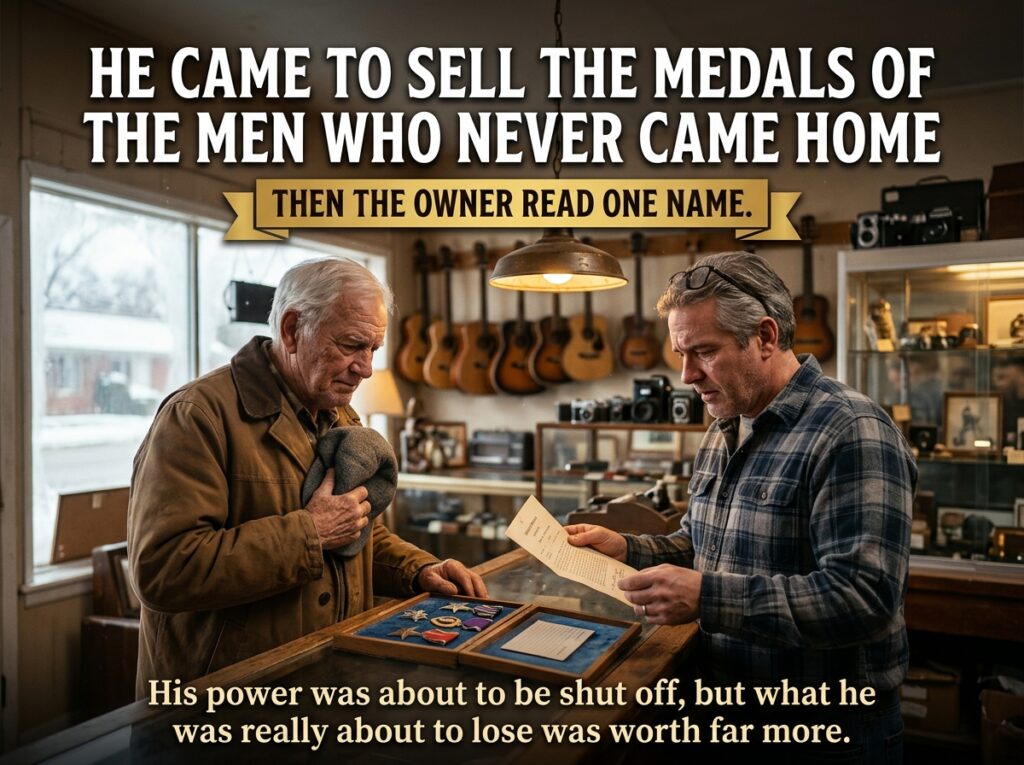
The bell over the door of Ferreira Pawn & Loan had a cracked note that regulars said sounded like a tired man clearing his throat. It rang at 1:40 on a gray Thursday afternoon in February, and Gil Ferreira, who was fifty-two and had heard that bell roughly a quarter of a million times, did not look up from the ring he was testing under the loupe.
“Be right with you.”
“Take your time,” said a voice, dry as paper. “I’m not going anywhere fast.”
When Gil finally looked, he saw an old man standing very straight just inside the door, the way men stand who were taught once, long ago, that posture was a kind of promise. He wore a brown overcoat with one button replaced by a different brown button, a gray wool cap held in both hands, and shoes that had been polished so many times the leather had gone thin at the toes. He was perhaps seventy-seven. His hands were large and spotted and not entirely steady, and they were holding a flat wooden case, the kind a good watch might come in, against his chest.
Toledo in February takes something out of people. Gil had learned to spot the ones who came in because they wanted a deal and the ones who came in because they had run out of other doors. This man was the second kind, and he was trying hard to look like the first.
“What can I do for you, sir?”
“My name is Raymond Tull.” He crossed the floor slowly, past the guitars hanging like sleeping bats, past the glass cases of wedding bands and watches and somebody’s grandmother’s silver. He set the wooden case on the counter with the care of a man putting down a sleeping child. “I’d like to know what you’d give me for these.”
He opened the lid.
Gil had seen medals before. In thirty years of the business, men and their widows had brought in plenty of them, and Gil’s father had taught him exactly how to handle those moments. But he had never seen a case laid out like this one. On faded blue velvet, each piece squared with the edge, lay a Silver Star, a Bronze Star with a small V, a Purple Heart with two oak leaf clusters, and a row of ribbons gone soft with handling. Beside them, tucked into the corner, was a folded index card with three names printed in pencil.
“These are yours?” Gil asked quietly.
“They were given to me,” said Raymond. “I never thought of them as mine. I’ve been holding them for some other men.” He cleared his throat. “Electric company’s going to shut off my power tomorrow at five o’clock. Four hundred twelve dollars and eighty-six cents. My pension check got hung up in some kind of bank business, and the woman on the phone says maybe ten days. It’s twenty-two degrees out, Mr. Ferreira. I’m not a young man.”
“You don’t have to explain yourself,” Gil said.
“I’d rather. Then you know I’m not doing this lightly.” The old man’s jaw tightened. “Four hundred fifty would see me through the month. I understand it’s worth more. I don’t need more.”
Gil reached into the case to lift the Silver Star, and a folded paper slid out from beneath its velvet, soft as cloth from years of unfolding. Without meaning to, he opened it.
It was a citation, typed on onionskin, dated March 1968. His eyes moved down the lines out of pure habit until they reached a single name in the third paragraph.
His hands went completely still.
Part 2
Gil did not say anything for what felt like a very long time. Somewhere in the back of the shop, the old refrigerator he kept for his lunch shuddered on and began to hum.
“Mr. Ferreira?” Raymond asked. “Is something wrong with the medals?”
“No.” Gil’s voice came out wrong, and he tried again. “No, sir. They’re in remarkable shape.”
He folded the citation back along its old creases and set it carefully on the counter, then made himself slow down, the way his father had taught him to do when a customer’s face gave away too much. *Never let the man see what he’s worth to you,* Manny used to say. *And never let him see what he’s worth to himself, either, because that’s when it gets hard.*
“Can I ask you something, Mr. Tull? It’s not part of the appraisal.”
Raymond’s eyes narrowed slightly, but he nodded.
“The card with the three names. Who are they?”
The old man was quiet. His thumb moved over the brim of his cap. “Danny Whitcomb. Luther Odom. Teddy Ramirez.” He said them the way a man reads names off a wall he has stood in front of a thousand times. “They were in my squad. Fourteenth of March, 1968, a hill outside Quang Tri. We went up with eleven. I brought down eight.”
“And the Silver Star,” Gil said. “That’s for that day.”
“That’s the paper’s version.” Raymond’s mouth twisted, not quite a smile. “They give you the medal for the men you carried, and they never mention the men you didn’t. I’ve never been able to look at that thing without seeing three faces I left up there. That’s what I’m selling, Mr. Ferreira. That’s the trouble. I can’t decide whether I’m getting rid of it or finally putting it down.”
“The citation says you carried a wounded man off that hill under fire.” Gil kept his voice even with an effort. “A radio operator.”
“A kid.” Raymond’s gaze drifted somewhere far behind the counter. “Nineteen, maybe. Toledo boy, like me. His leg was torn up bad and he’d taken shrapnel in the back. He kept apologizing the whole way down. Said he was sorry to be so heavy.” His voice roughened. “I never found out what happened to him. They flew him out, and I was in the field hospital two weeks myself, and by the time I could ask, the paperwork had swallowed him. I wrote to the Army a dozen times. Nobody would tell me.”
Gil put both hands flat on the glass to steady them.
“Do you remember his name?” he asked.
Raymond frowned as if the question were unkind. “Manny. Manuel something. Italian, or Portuguese, I always thought, though I never had the right of it. Why?”
Gil looked at the old man across the counter, at the thin overcoat and the polished shoes, at the seventy-seven years and the fifty-six of them he had spent wondering.
“Mr. Tull,” Gil said, and his voice finally cracked, “he lived.”
Part 3
Raymond Tull did not fall, and he did not gasp. He simply stood very still, the way a man stands when the ground has shifted beneath him and he has decided not to move until it settles. His cap slipped from his fingers and landed on the counter.
“Say that again.”
“Manuel Ferreira,” Gil said. “Manny. He came home to Toledo in the summer of 1968 with a steel rod in his left leg and a Purple Heart he kept in a sock drawer. He married my mother, Rosa, in ’71. He opened this shop in ’79.” Gil gestured helplessly at the walls, the guitars, the cases. “He was my father.”
The old man’s mouth opened and closed.
“He died six years ago in October,” Gil went on, because if he stopped he wasn’t sure he could start again. “Heart. It was quick. But every March fourteenth of my whole life, my father sat at the kitchen table after dinner with a glass of whiskey and a letter, and he wouldn’t say a word. My mother would leave him alone. When I was a boy I asked him once what the date meant, and he said, ‘A man carried me down a hill, Gilberto. A man named Tull. And I never got to say thank you.'”
The shop was very quiet. Outside, a bus ground its gears at the corner of Broadway.
“He looked for you,” Gil said. “For years. He wrote to the Army, to the VA, to every Tull in the Toledo phone book. My mother says he must have sent thirty letters. Nobody could tell him where you’d gone.”
“I moved to Dayton in ’72,” Raymond said hoarsely. “Then Columbus. I came back here in ’09 when my wife got sick.” He pressed the back of his hand against his mouth. “I’ve been living eleven blocks from this shop for fifteen years.”
“He didn’t know,” Gil said. “Neither did I.”
Raymond sat down. There was a stool behind him, a battered one Gil kept for customers who needed to think, and he lowered himself onto it as if his knees had simply been withdrawn. He looked at the medals, then at the index card, then at the man across the counter, and something in his weathered face slowly came apart.
“Fifty-six years,” he whispered. “I thought he’d died in the helicopter. I’ve thought it every day. I’ve carried that boy on my back every night since March of 1968, thinking I’d carried him to nothing.”
“You carried him to a wife and a son and a granddaughter,” Gil said. “And a pawn shop he was very proud of, if you can believe it.”
Raymond laughed, a wet, broken sound, and wiped his eyes with a handkerchief he pulled from his sleeve. Then he went very still again.
“Mr. Ferreira,” he said slowly, “there’s something I’ve kept all these years. It belongs to your father. I’ve been meaning to get it to him for fifty-six years, and I never knew how.”
Part 4
Gil closed the shop.
He hadn’t done that on a weekday afternoon since his father’s funeral. He flipped the sign, locked the register, and told the teenager who worked the back counter to go home with pay, then loaded Raymond Tull into his truck with the wooden case on the old man’s lap and the heater running full blast.
Raymond lived on Lagrange Street in a second-floor apartment above a shuttered dry cleaner, up a set of stairs with a handrail that wobbled in Gil’s grip. It was twenty-eight degrees in the apartment. Gil knew because there was a thermometer on the wall, and because he could see his own breath in the front room.
He didn’t say anything. He looked at the sagging armchair with an afghan folded on its arm, at the small kitchen with one plate in the drying rack, at the framed photograph of a smiling woman with gray curls that sat on top of the television. He looked at the past-due notice from Toledo Edison stuck to the refrigerator with a magnet shaped like a pineapple, and at the refrigerator itself, which Raymond opened, perhaps from habit, to reveal a jar of mustard and half a loaf of bread.
“Gladys,” Raymond said, following his glance to the photograph. “Fifty-one years. She had the cancer in ’09. I moved us back to Toledo for the hospital. The bills ate the rest.” He shrugged with an old man’s terrible ease. “It’s all right. I get by.”
He went into the bedroom and came back carrying a green cigar box, the wood worn dark at the corners. He set it on the kitchen table and lifted the lid.
Inside, wrapped in a square of olive drab cloth, lay a pair of dog tags on a bent chain. The stamping had gone dark with age.
FERREIRA MANUEL J
USA 52 481 337
CATHOLIC
“They came off when I got him up on my shoulder,” Raymond said quietly. “I found them in my pocket at the field hospital. I meant to hand them to him when he was well. Then I couldn’t find him, and after a while I couldn’t bring myself to throw them out.” He touched the chain with one finger. “I figured, if I ever found the boy, I’d owe him this. If I never did, well. Somebody ought to keep them.”
Gil picked up the tags. They were surprisingly light. He thought of his father’s hands, the big square hands that had fixed a thousand watches and never once, that Gil could remember, trembled, and of the way they had trembled every March fourteenth.
“Mr. Tull,” he said thickly. “I want to take care of this.”
“Care of what?”
“The electric bill. The groceries. All of it. You saved my father’s life. Whatever else is true, I owe you that.”
Raymond’s face closed like a door.
“Son,” he said, and though his voice was gentle, there was granite under it, “I didn’t come into your shop for charity. I came in to make a sale. I’ll thank you to treat me like a customer, or I’ll take my medals down the street to the next fellow, who I’m sure will be less sentimental.”
Part 5
Gil stood in the freezing kitchen with a dead man’s dog tags in his hand and understood, in a way he never had in thirty years behind that counter, exactly why his father had been so careful with old soldiers.
*Never hand a proud man money,* Manny used to say. *Hand him a reason.*
“All right,” Gil said slowly. “A customer.”
Raymond’s shoulders eased a fraction.
“Then here’s my offer, as a customer would get it. Pawn shops don’t buy medals, Mr. Tull, not in Ohio, not if they’re doing it right. Federal law makes it a mess. But we can do a loan. You leave the case with me as collateral, I lend you five hundred dollars, no interest, and you redeem it whenever you’re able. There’s no deadline. My father set that policy a long time ago for veterans. Nobody’s ever missed the ticket.”
It was a lie in one respect, and Gil felt it sit in his chest like a stone. There was no such policy. But he had a feeling, looking at the old man’s careful face, that a lie which let a proud man keep his dignity was, in the end, a fair kind of collateral.
Raymond studied him for a long moment with the eyes of a man who had been lied to by experts.
“No interest.”
“None.”
“And the medals stay safe.”
“In my father’s own safe, in the back of the shop, behind a steel door that’s been there since 1981.”
Slowly, the old man nodded. “That I’ll take.” He picked up the cigar box and pressed it into Gil’s hands. “And you’ll take these, as a gift to your mother. That’s not a loan. That’s not a sale. That’s something I owe her husband.”
Gil could not answer. He nodded.
He paid the electric bill from the truck, sitting in the cold cab with the phone against his ear while a cheerful voice confirmed the balance and the reconnection. Then, because the pension bothered him, he called the number on the letter Raymond had shown him, and spent forty minutes moving through a phone tree at the Department of Veterans Affairs until a tired woman named Ms. Bellamy finally found his file.
“The direct deposit account was closed in December when the bank merged,” she said. “The payment’s been held while we wait for updated information.”
“Nobody told him.”
“A letter went out,” she said. “To an address that turned out to be wrong.” There was a pause, a shuffling of papers, and then a different sound in her voice. “Mr. Ferreira, are you a family member?”
“A friend.”
“Then I can’t share details. But I’ll tell you this.” She lowered her voice. “I’ve been doing this eighteen years, and I’ve never seen a file like Mr. Tull’s. He hasn’t been underpaid by a check. He’s been underpaid by a decade.”
Part 6
Lucia Ferreira was seventeen and did not believe in sentiment, a stance she had adopted around the age of fourteen and defended with the fierce consistency of a young person who is secretly all sentiment. She came home from school that evening to find her father at the kitchen table with a green cigar box, red-eyed, and did not know whether to be alarmed or embarrassed.
“Dad. Are you okay?”
“Sit down, Lu.”
He told her the whole story, and by the end of it she was sitting very quietly with a dishtowel twisted in her hands.
“So Grandpa,” she said slowly, “spent his whole life looking for the guy who saved him.”
“Yes.”
“And the guy lives eleven blocks from the shop.”
“Yes.”
“And he was going to *sell his medals* for a light bill.” She said it in the tone of someone reading a crime aloud. Then she stood up abruptly and opened the refrigerator. “Okay. What does he eat?”
“Lucia—”
“Dad. What does he eat?”
Within the hour they were standing in Raymond’s icy apartment for the second time that day, with two bags of groceries and a pot of Rosa Ferreira’s chicken soup, which Gil’s mother had insisted on making the moment he called her, because Rosa did not know how to receive news of any kind without immediately cooking.
Raymond stood in the doorway of his own kitchen with the expression of a man being ambushed by kindness and unable to locate the retreat. The lights were on. The radiator had begun to knock and hiss. Lucia set the soup on the stove and turned on the burner without asking permission.
“You’re going to eat this,” she informed him, “and then you’re going to tell me everything about my grandfather when he was nineteen, because nobody ever told me anything, and I’m mad about it.”
Raymond looked at her for a long moment, and then, unexpectedly, he smiled. It changed his whole face.
“He was scared to death,” he said. “And funny as hell. He told jokes the whole way up that hill so nobody would notice how scared he was. Bad ones. About a priest and a rabbi and an Italian who couldn’t find the church.”
“He told me that joke,” Lucia said, stunned. “When I was eight. It was terrible.”
“It was the same joke,” Raymond said. “Word for word.”
Later, driving home in the dark with Lucia asleep against the truck window, Gil’s phone buzzed. It was his mother, calling from her room at St. Clare’s, where she’d lived since her hip surgery.
“Gilberto.” Rosa’s voice was small and very steady. “I’ve been sitting here for three hours thinking about your father’s letters. The ones that came back. Do you know what he wrote on the last one, before he stopped trying?”
“No, Ma.”
“He wrote, ‘If I ever find him, I’ll owe him my whole life.'” A pause. “You bring that man to me, Gil. You bring him to me tomorrow.”
Part 7
St. Clare’s Senior Living had a sunroom with a piano nobody played and a bird feeder outside the window that a volunteer kept stocked. It was in that room, at ten o’clock on a bright cold Saturday morning, that Raymond Tull met the widow of the man he had carried down a hill.
Rosa Ferreira was seventy-nine, small and upright in her wheelchair, with a cardigan the color of plums and white hair set in soft waves. She held a rosary in one hand and did not look at Gil or Lucia when they wheeled her in. She looked past them, at the door, and when Raymond came through it in his best overcoat with his cap in his hands, she took a very deep breath.
“Sergeant Tull,” she said.
“Ma’am.” He seemed unable to move. “I’m sorry. I don’t know what to say.”
“Then don’t say anything yet.” She held out her hand. “Come here. I’ve been waiting a long time to hold your hand.”
He crossed the sunroom slowly and knelt beside her chair, an old man kneeling on an old floor with a bad knee, and she took his hand between both of hers. For a while, neither of them spoke.
“He talked about you every March,” Rosa said at last. “He never told me your name until 1990. Twenty years of marriage, and then one night he said, ‘His name was Tull. I want you to know it, in case I ever go and you find him.’ I said, ‘Manny, what do you mean, in case?’ And he said, ‘In case I don’t get the chance to thank him.'”
Raymond’s shoulders began to shake.
“Ma’am, I have something of his.”
He drew the dog tags from his coat pocket, the ones he had insisted on carrying himself one last time, and laid them across her palm. Rosa looked at them for a long moment. Then she closed her fingers around them and pressed her fist to her heart.
“Fifty-six years,” she whispered. “He lost these in Vietnam. He used to say his whole life started when they came off. He never understood why.”
“I took them off by accident,” Raymond said. “Getting him on my back.”
“No.” She shook her head, smiling through tears. “No, Sergeant. You took them off because he was leaving one life and starting another. That’s what he always said. I think he was right.”
Then she reached into the pocket of her cardigan and drew out an envelope, cream-colored and creased, with a single word written across the front in blocky handwriting Raymond had not seen in five and a half decades.
*TULL.*
“He wrote this the year before he died,” Rosa said. “He said if I ever found you, I should give it to you. He said not to mail it. He said he’d been mailing letters to the wrong address for forty years and he wasn’t going to risk another.”
Raymond took the envelope in both hands. His fingers trembled so badly that Lucia gently reached over and helped him break the seal. He unfolded a single sheet of paper, and read the first line aloud in a voice that wobbled and held.
Part 8
*Sergeant Tull,*
*If you’re reading this, then Rosa found you, and I’m either dead or too much of a coward to have delivered this in person. Probably both. I want you to know it took me forty years to write this and about ten minutes to realize I had nothing clever to say.*
*You carried me down a hill. That’s the whole story. That’s the only story I’ve got. Everything after that was a gift, and I didn’t earn any of it. I got a wife who tells me when I’m wrong. I got a boy who’s better than I deserved. I got a shop full of other people’s treasures, and a life that was mostly ordinary, which is a thing I prayed for on that hill with my face in the dirt.*
*I want you to know I never stopped looking. And I want you to know I understand if you never wanted to be found. Some men carry things they can’t put down, and I suspect you’re one of them. If that’s true, I want to tell you something my father told me before he passed, which I didn’t understand until much later.*
*He said, “Manny, a debt like that isn’t paid back. It’s paid forward.”*
*So here’s what I did, Sergeant. I’ve never told my son, because he’d want to make it complicated. In the back of my shop, behind the steel door, there’s a cabinet. Forty-one sets of medals. Every one of them was brought in by a veteran who needed money and couldn’t ask anyone for it. I lent them what they needed and I kept the medals safe. I never sold one. I never will. Most of them never came back to redeem them, and I don’t hold that against them. I figure some men need to know their medals are somewhere safe more than they need them on the wall.*
*Every one of those envelopes has a note in it. It says: HOLD. HE’LL BE BACK.*
*I like to think you’re one of them, in a way. I like to think somewhere out there is a man who carried me down a hill and wound up in a place where somebody, someday, might be kind to him in return. That’s the only payment I could ever think to make. I hope it gets to you.*
*Thank you, Ray. I never got to say it out loud.*
*Manny*
When Raymond finished reading, the sunroom was completely quiet. Outside, a chickadee landed on the feeder and took a seed and flew away.
Gil, standing behind his mother’s wheelchair with his hand pressed over his mouth, understood two things at once. The first was that his father had spent thirty years keeping a secret that Gil had never suspected. The second was that Gil had been standing inches from that cabinet for six years, and had never once opened it.
“Ma,” he said hoarsely. “Is that true? The cabinet?”
Rosa nodded, tears running down her powdered cheeks. “He made me swear never to tell you. He said you’d turn it into a business plan.” She smiled tremulously. “Go and look, Gilberto. I think it’s time.”
Part 9
The cabinet stood in the back corner of the shop’s stockroom behind a curtain of hanging coats, an old oak apothecary chest with narrow drawers Gil had always assumed held spare watch parts. He had dusted its top a thousand times without ever opening a single drawer.
He opened them now, one by one, with Raymond and Lucia standing behind him in the dim stockroom light.
Each drawer held a row of manila envelopes, soft with age, each marked with a name and a date in his father’s blocky hand. Inside each envelope was a set of medals wrapped in tissue paper, and folded around each set was a small note. *HOLD. HE’LL BE BACK.* Forty-one of them, going back to 1981, some of the ink faded almost to nothing. One was from a Korean War pilot, another from a man who had served on a destroyer at Iwo Jima. There were two from the Gulf War, both dated within the last decade.
“Forty-one,” Lucia whispered. “Dad. Grandpa was keeping forty-one soldiers’ medals.”
“And I’ve been running this shop for six years,” Gil said, his voice shaking, “and I never even opened the drawers.”
Raymond touched the edge of the open cabinet with the tips of his fingers, the way a man touches a wall in a church. “Your father,” he said quietly, “was a better man than I ever gave him credit for, and I gave him a great deal.”
Gil turned around and looked at him.
“Mr. Tull,” he said, “you’re not going to redeem those medals, because I’m never going to sell them. But I’m going to ask you to do something for me, and I need you to hear it as a request, not charity.”
“Go on.”
“There are forty-one names in this cabinet. Every one of them is a veteran who, at one point in his life, was where you were on Thursday. I don’t know how many are still alive. I don’t know how many have families waiting for something they never knew existed. But I think my father would want somebody to find out. And I think the man he wrote that letter to might be the right person to help me do it.”
Raymond looked at the cabinet for a long time. Then he looked at the young woman beside him, who had already pulled out her phone and was scrolling through what looked like a spreadsheet.
“I’ll need a good pair of shoes,” he said finally. “I’ve got a lot of walking to do.”
The next three weeks moved with a speed that surprised everyone. Gil connected Raymond with a veterans service officer named Denise Okafor, a wiry woman with a laminated badge and a formidable stare, who read through his VA file in a single afternoon and pushed her glasses up her nose.
“Mr. Tull,” she said, “you were wounded twice and never filed for the second injury. They rated you at thirty percent in 1969 and nobody ever looked again. I’m going to file for a review, and I want you to be sitting down when it comes back.”
Raymond nodded politely, the way a man agrees to an eye exam.
Six weeks later, he called Gil at seven in the morning, and Gil could hear his own name in the old man’s shaking breath before he said a word.
“Gil,” Raymond said. “They’ve raised the rating. Retroactive to 1969. There’s a letter. There’s a number. I don’t know if I’m reading it right.”
“Read it to me.”
He did. Gil sat down on the edge of his bed. It was a figure that would have paid Raymond’s electric bill until the end of the century.
“What are you going to do?” Gil asked.
Raymond was quiet. “I know what I’d like to do,” he said. “I’d like to find the families. Danny Whitcomb. Luther Odom. Teddy Ramirez. I know where two of them live. I’ve known for forty years and never had the nerve.” His voice caught. “The third, I’ve never been able to find.”
Part 10
Lucia found the third family in eleven minutes.
She sat in the back of the pawn shop with her laptop on a stack of old amplifiers and a can of soda going warm beside her, and she typed the name *Theodore Ramirez, Sgt., KIA 14 March 1968* into a database Raymond had never known existed. A memorial page came up, built by a niece in San Antonio. There was a photograph of a grinning boy in a dress uniform, a paragraph about his love of baseball, and a contact form at the bottom.
“Mr. Tull,” she said softly, “I think you should call her.”
He did, that same evening, sitting in Gil’s kitchen with Rosa’s soup steaming in front of him. The woman on the other end of the phone, Marisol Ramirez-Vega, was fifty-eight and had been waiting her whole life for someone to tell her how her uncle died. She cried. Raymond cried. Gil and Lucia stood at the counter and pretended to wash dishes that were already clean.
In April, on a soft spring Saturday, forty-three people gathered in the parking lot of Ferreira Pawn & Loan. Some had driven from San Antonio and Cleveland and a small town in western Pennsylvania. Some were the grandchildren of men who had once stood at that counter, borrowing against the only thing they had left. There were flags. There was a folding table with a white cloth. And there, in rows on the table, were forty-one sets of medals laid out on velvet, each with a small card bearing a name, a date, and a note in Lucia’s careful handwriting.
Raymond Tull stood at the end of the table in his best suit, the one that had seen better decades, with a small paper folded in his hand. He had been asked to say a few words. He had written and rewritten them for a week.
“I’m not a speaker,” he told the crowd. “So I’ll say this, and then I’ll sit down. Fifty-six years ago, I carried a boy down a hill, and I spent most of my life believing it hadn’t mattered. I believed the medal was for something I hadn’t done. The men who mattered were the ones who stayed up there.” He stopped and pressed his lips together. “Then a stranger looked at a name on a piece of paper and decided not to let me sell my past. And a man I never got to meet, who kept forty-one strangers’ medals safe in a cabinet for thirty years, taught me the thing I’d been too proud to learn. A debt like that isn’t paid back. It’s paid forward.”
He looked at Rosa in her wheelchair at the front, holding her husband’s dog tags, and at Gil beside her, and at Lucia, who had given up pretending she wasn’t crying.
“Manny Ferreira wrote me a letter,” Raymond said. “It said thank you. I want to thank him back, out loud, where it counts.” He raised his voice, and it carried to the back of the lot. “Thank you, Manny. I heard you. It took me a while, but I heard you.”
They came forward, one by one, to claim what had been kept for them.
Raymond’s electricity has never been shut off again. He lives in a warm apartment two blocks from the shop, and on Thursdays at 1:40, when the cracked bell rings over the door, Gil doesn’t look up from his work. He just says, “Be right with you,” and Raymond says, “Take your time,” and pulls up the battered stool beside the counter, and stays until closing.
The medals never left the case. On the wall above the register, next to a framed photograph of a grinning young radio operator on a hill outside Quang Tri, is a new card in Gil’s handwriting, tucked in the corner of the frame.