Part 1
I have worked in intensive care long enough to know that paperwork can lie without a single false word appearing on the page.
A box gets checked.
A name gets entered.
A relationship gets simplified.
A sentence gets repeated until everyone assumes it must be true.
But a body is different.
A body keeps its own records.
That was what bothered me about Sophia Walker.
She came into our ICU just after midnight on a Tuesday in November.
I remember the time because the digital clock above the medication cabinet read 12:17 when the emergency physician came through the doors with the trauma team behind him.
“Female, thirty-two,” he said. “Unconscious. Multiple fractures. Significant blunt-force trauma. Possible internal injuries.”
Sophia was small.
That was my first thought.
Not fragile. Not weak. Just smaller than the amount of damage her body had absorbed.
There were bruises along her arms, ribs, shoulders, thighs, and jaw. Her left wrist was swollen badly. Two fingers on her right hand were broken. There were abrasions around both knees and deep bruising across her upper back.
She was intubated before they brought her upstairs.
I was assigned to her room.
“Any family?” I asked.
The emergency physician glanced at the chart.
“Father is here.”
“Spouse?”
He hesitated.
“Father says husband is deployed.”
That sentence stayed with me.
Not because it was unusual for a military spouse to be deployed.
That happened all the time.
It was the way he said it.
As if the information had been supplied by one person and accepted without question.
I pulled up the registration screen.
Emergency contact: Daniel Walker.
Relationship: Father.
Secondary contact: None.
Spouse: Ethan Walker.
Military status: Deployed.
Unable to reach.
I stared at the last line.
“Do we have a unit contact?” I asked.
The resident shook his head.
“Father said there isn’t one.”
There was a pause.
Then he added, “He says Ethan is somewhere overseas and doesn’t have regular access.”
I nodded and went back to work.
That was what nurses do.
We don’t always have the luxury of stopping when something feels strange.
There were medications to hang.
Lines to check.
Ventilator settings to monitor.
Neurological responses to document.
Blood pressure dropping.
Oxygen saturation fluctuating.
A chest tube producing more blood than anyone wanted to see.
The night became a sequence of numbers.
But every time I looked at Sophia, I remembered that line.
Husband deployed.
Unable to reach.
At 2:43 a.m., Daniel Walker came into the ICU waiting area.
He was a broad-shouldered man in his late fifties with gray hair, a heavy brown coat, and the exhausted face of someone who had been awake for too long.
He approached the desk.
“How is my daughter?”
“She is critical,” I said. “The doctors are working on stabilizing her.”
“Will she wake up?”
“I can’t promise that.”
He looked directly at me.
“Her husband doesn’t need to be called.”
I stopped typing.
“I’m sorry?”
“Ethan. Her husband. Don’t waste time trying to find him. He’s deployed.”
“I understand.”
“He can’t come.”
I looked at the chart.
“Do you have contact information for him?”
Daniel’s expression tightened.
“No.”
“Okay.”
“And if he somehow calls, tell him she’s being treated.”
That sentence bothered me more than it should have.
Because he had just told me not to contact him.
Then he had told me to tell him.
I made a note.
Not an accusation.
Not a conclusion.
Just a note.
At 4:11 a.m., Sophia’s condition worsened.
At 5:02, surgery took her downstairs.
At 6:47, she came back.
And at 7:15, I saw something on her left wrist.
A faint band of bruising.
Not a single bruise.
A pattern.
Four narrow marks running almost parallel around the wrist.
Finger marks.
Someone had held her.
Hard.
I wrote it in the chart.
At 8:06 a.m., Daniel came back.
“Any improvement?”
“She is stable for now.”
He nodded.
Then he asked something that made me look up.
“Did she say anything?”
“She hasn’t regained consciousness.”
“I mean before.”
“I wasn’t there when she arrived.”
He looked toward Sophia’s room.
“She knows better than to get involved with people.”
I didn’t respond.
“What people?” I asked.
His face changed.
“Nothing.”
Then he walked away.
I watched him disappear toward the elevators.
I remember thinking that there were two stories in that hospital room.
One was written in the chart.
The other was written on Sophia’s skin.
I just didn’t know yet who had written either one.
Part 2
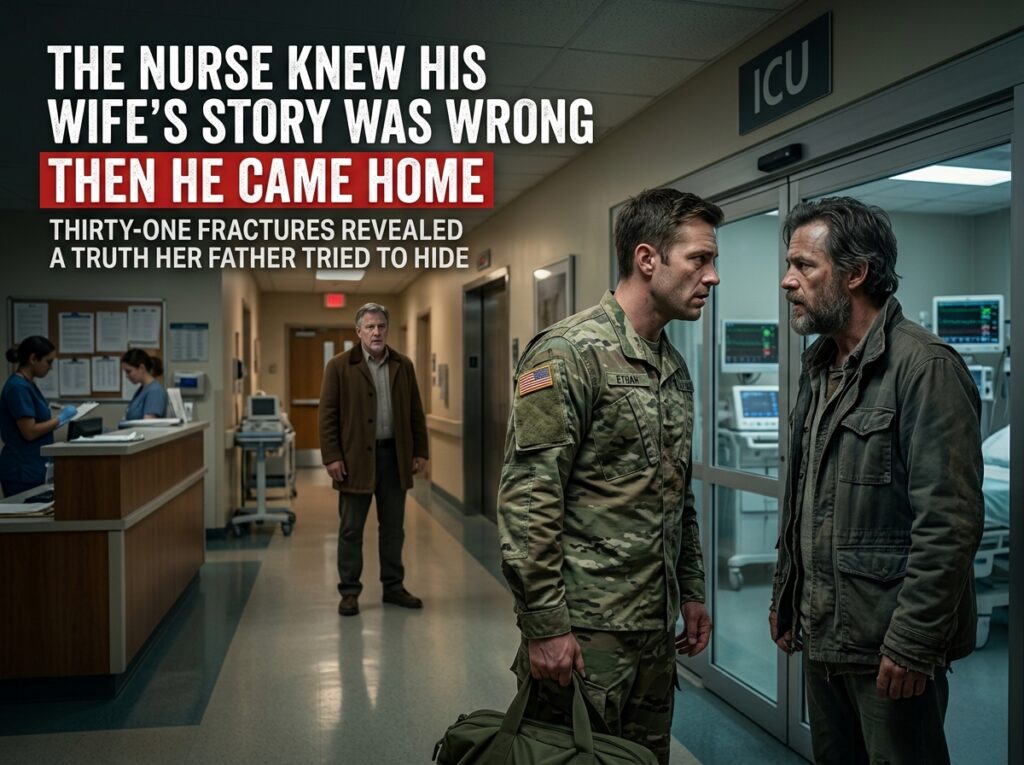
Two days later, Ethan Walker arrived.
He came through the ICU doors wearing a military uniform, carrying a duffel bag over one shoulder.
He looked exhausted.
Not the ordinary exhaustion of someone who had traveled.
The kind that makes a person’s eyes look older than their face.
A hospital administrator met him in the lobby.
I was walking toward the medication room when I heard him.
“My wife. Sophia Walker.”
The administrator asked for identification.
“I already gave it to security.”
“Sir, we need to verify—”
“I’m her husband.”
His voice cracked on the last word.
I stepped closer.
“Mr. Walker?”
He turned.
His eyes landed on my badge.
“Are you Sophia’s nurse?”
“Yes.”
He swallowed.
“How is she?”
“She’s still unconscious.”
He closed his eyes.
Just for a second.
Then he opened them.
“Can I see her?”
I nodded.
As we walked toward the ICU, he asked the question.
“Who found her?”
I looked at him.
“The report says an alley off Route 9.”
“Who found her?”
“That’s what the report says.”
He stopped walking.
“I know what the report says.”
I felt the hairs rise along my arms.
“What do you mean?”
“Who found my wife?”
I checked the chart.
“An unidentified caller reported her.”
“Unidentified?”
“Yes.”
“Where exactly?”
“An alley off Route 9.”
“Which alley?”
I frowned.
“The report doesn’t specify.”
He stared at me.
Then he whispered, “That doesn’t make sense.”
We continued walking.
He saw Sophia through the glass.
His entire face collapsed.
Not dramatically.
There was no shout.
No falling to his knees.
Just a quiet devastation that I had seen before in families.
He put one hand against the glass.
“I’m here, Soph.”
I stepped back.
He remained there for almost a minute.
Then he turned.
“Why wasn’t I called?”
I hesitated.
“Your father-in-law said you were deployed and unreachable.”
Ethan stared at me.
“I’ve been calling her every week for seven months.”
I felt something cold settle in my stomach.
“You’ve been calling?”
“Yes.”
“Do you have records?”
He gave a humorless laugh.
“Of course I have records.”
He pulled out his phone.
There were missed calls.
Video calls.
Messages.
Emails.
Seven months of them.
Some unanswered.
Some marked delivered.
Some never opened.
But there were dozens.
Then he showed me a message.
Sent three weeks earlier.
*I know you’re busy. Just wanted to hear your voice.*
Another.
*Please tell Dad to stop answering your phone.*
Another.
*Soph, I’m worried. Please call me.*
I looked at him.
“Your father-in-law said—”
“I know what he said.”
His jaw tightened.
“I was deployed. I wasn’t unreachable.”
He looked back through the glass.
“Someone wanted me to think she didn’t need me.”
I didn’t answer.
Because suddenly the chart didn’t feel incomplete.
It felt manipulated.
Later that afternoon, the trauma surgeon reviewed Sophia’s injuries with the team.
Thirty-one fractures.
Three broken ribs.
Fractured left wrist.
Two broken fingers.
Hairline fracture to the jaw.
Fractured orbital bone.
Multiple contusions.
Deep soft-tissue trauma.
Defensive wounds.
I asked the surgeon something I had been thinking since the first night.
“Could all of this happen in an alley attack?”
He looked at the imaging.
“Technically?”
He paused.
“Almost anything is technically possible.”
“And realistically?”
He sighed.
“Not like this.”
I waited.
“These injuries weren’t caused by one impact.”
He pointed toward the scans.
“Different force patterns. Different locations. Different stages of bruising.”
“How long?”
“We can’t give an exact timeline.”
“But?”
He looked at me.
“This looks prolonged.”
The word landed heavily.
Prolonged.
Not seconds.
Not one blow.
Not a single accident.
Hours.
The kind of violence that required someone to keep choosing to hurt her.
I went back to Sophia’s room.
Her father was there.
Standing beside her bed.
Ethan was outside the room, speaking with the social worker.
Daniel looked at me.
“You’ve been asking questions.”
It wasn’t a question.
“I document injuries.”
“You’re a nurse.”
“Yes.”
“Then nurse.”
I held his gaze.
“I am.”
He stepped closer.
“You don’t know my family.”
“No.”
“You don’t know what Sophia gets herself into.”
I looked at his daughter.
Then back at him.
“No. I don’t.”
He lowered his voice.
“But you will.”
That evening, security called the ICU.
There was a man in the hallway.
Again.
They had nearly removed him twice already.
He wasn’t threatening anyone.
He simply kept appearing.
Standing near the vending machines.
Waiting beside the elevators.
Watching the ICU doors.
His clothes were worn.
His beard was uneven.
He looked like someone who had been sleeping outside.
When Ethan stepped out of Sophia’s room, the man approached him.
I couldn’t hear what he said.
But I saw Ethan’s face change.
And across the hallway, Daniel Walker froze.
For the first time since I’d met him, he looked afraid.
Part 3
The man reached into his coat.
Security moved immediately.
“Sir, step back.”
“I just need to talk to him.”
Ethan raised a hand.
“It’s okay.”
The security guard hesitated.
The man looked at Ethan.
“My name is Marcus Bell.”
Ethan stared at him.
“Do I know you?”
“No.”
Marcus swallowed.
“But your wife does.”
Ethan went completely still.
I was standing behind the nurses’ station, close enough to hear them now.
Marcus glanced toward Sophia’s room.
“She told me your name.”
“When?”
“Before.”
“Before what?”
Marcus looked down.
“Before they took her.”
Ethan’s face drained of color.
“What did she tell you?”
Marcus looked toward Daniel.
That was when I understood.
This wasn’t random.
Marcus knew something.
And Daniel knew Marcus knew.
“I don’t want trouble,” Marcus said.
“Then tell me what happened.”
Marcus shook his head.
“Not here.”
Ethan stepped closer.
“You came into my wife’s hospital. You’ve been here for days. You keep watching the ICU. Now you tell me she knows you.”
“I was trying to find out if she was alive.”
“Why?”
Marcus’s eyes filled with tears.
“Because she saved my life.”
Nobody spoke.
Daniel walked toward them.
“You need to leave.”
Marcus looked at him.
“No.”
Daniel stopped.
Marcus’s voice trembled.
“You don’t get to tell me to leave anymore.”
Ethan turned.
“What does he mean?”
Daniel didn’t answer.
I watched Marcus reach into his coat again.
This time he pulled out a small plastic bag.
Inside was a silver key.
And a folded piece of paper.
“She gave me this.”
Ethan took the paper.
His hands shook as he opened it.
There were only six words.
*If something happens, find Ethan.*
Underneath was a phone number.
Ethan stared at it.
“Where did you get this?”
Marcus looked at Sophia’s room.
“She gave it to me six months ago.”
Six months.
I remembered the seven months of unanswered calls.
I remembered Daniel insisting Ethan was unreachable.
Marcus continued.
“She was scared.”
Daniel stepped forward.
“That’s enough.”
Ethan turned on him.
“No.”
The word was quiet.
But everyone heard it.
“No more.”
Daniel’s face hardened.
“You don’t know what you’re talking about.”
“Then explain it.”
“She had problems.”
“What problems?”
Daniel said nothing.
Marcus looked at Ethan.
“She was trying to leave.”
Ethan’s eyes closed.
“Leave who?”
Marcus looked at Daniel.
“Her father.”
The hallway went silent.
Daniel laughed.
It was a short, bitter sound.
“This man is unstable.”
Marcus flinched.
“I know what I am.”
Then he looked at Ethan.
“But I’m not lying.”
Ethan turned toward me.
“Can you get someone?”
“Who?”
“Social work. Police. Anyone.”
I nodded.
Within minutes, hospital social work and hospital security were involved.
The police were called because Marcus’s information suggested a potential criminal investigation.
Daniel objected.
Repeatedly.
He said Marcus was homeless.
He said Marcus was mentally unstable.
He said Sophia had always been difficult.
He said Ethan was exhausted and being manipulated.
But facts have a way of becoming louder when several people hear them at once.
Marcus told investigators that he had met Sophia behind a community center.
He had been living in his car.
Sophia had brought him food.
Then clothes.
Then money.
Eventually, she told him she was afraid of her father.
She said Daniel controlled her finances.
Controlled the house.
Controlled who she spoke to.
And every time Ethan called, Daniel was there.
Marcus had seen him answer.
Had heard him tell Ethan that Sophia was sleeping.
Had watched him delete messages.
Then Marcus said something that changed the entire direction of the investigation.
“She told me she had proof.”
“What kind?”
“Recordings.”
“Where?”
Marcus pointed toward the silver key.
“Storage unit.”
Ethan stared at the key.
“What unit?”
Marcus shook his head.
“She never told me the number.”
“Then why give me the key?”
“Because she said if she disappeared, you’d know where to look.”
I looked at Daniel.
He had gone completely pale.
That was the moment I knew the hallway conversation wasn’t about a stranger.
It was about a secret that had been moving around this family for years.
The police took Marcus to a quiet room.
Ethan stayed beside Sophia.
Daniel disappeared.
Not physically.
He was still in the building.
But something about him had changed.
He stopped asking about Sophia.
He stopped demanding information.
He stopped speaking.
He simply stood near the elevators.
Watching everyone.
At 11:36 p.m., I checked Sophia’s pupils.
Still unresponsive.
I adjusted her medication.
Then I noticed something.
Her right hand moved.
Barely.
One finger.
I froze.
“Sophia?”
Nothing.
I leaned closer.
“Can you hear me?”
Her finger moved again.
Once.
Then again.
I called the physician.
For the first time in two days, I allowed myself to believe she might be fighting her way back.
But before the physician arrived, Sophia’s heart rate suddenly jumped.
Her blood pressure rose.
Her eyes remained closed.
I held her hand.
“You’re safe,” I whispered.
“You’re in the hospital.”
I didn’t know if she could hear me.
But I repeated it anyway.
“You’re safe.”
Outside the room, someone began pounding on the ICU doors.
It was Daniel.
And he was shouting one sentence over and over.
“Find the key!”
Part 4
The police moved quickly after that.
Daniel was escorted away from the ICU.
He didn’t resist.
He didn’t have to.
The fear on his face was enough to tell us that the silver key mattered.
The next morning, investigators located the storage unit.
The key opened it.
Inside were boxes.
Not weapons.
Not stolen property.
Paper.
Photographs.
Letters.
Bank statements.
Printed emails.
Copies of medical records.
And dozens of audio files on an old laptop.
Sophia had been documenting everything.
For years.
The recordings were difficult to listen to.
There were arguments.
Threats.
Daniel shouting.
Sophia crying.
A recording of Daniel telling her that Ethan would never believe her because “a deployed husband doesn’t know what happens at home.”
Another recording captured him telling her that if she ever left, he would make sure everyone believed she was unstable.
And then there was a recording from six months earlier.
Sophia’s voice was barely above a whisper.
“If you’re hearing this, something happened.”
There was a long silence.
Then she said:
“Ethan, I’m sorry.”
The investigator stopped the recording.
Ethan looked away.
“Keep going.”
Sophia continued.
“I kept thinking I could fix it myself.”
Her voice broke.
“I thought Dad would stop.”
A breath.
“He won’t.”
Ethan covered his mouth.
“I know he told you I was unreachable.”
A pause.
“He lies.”
Ethan closed his eyes.
“He has been answering your calls.”
The room went completely silent.
Then Sophia said something that nobody expected.
“I didn’t stop loving you.”
Ethan’s shoulders shook.
“I just got scared that loving you would make him hurt you too.”
The recording ended.
For several minutes, nobody spoke.
Then the investigator found another file.
Dated three weeks before Sophia was hospitalized.
It contained a conversation between Daniel and another man.
The man’s identity was unknown at first.
But Marcus recognized the voice.
A man who had worked with Daniel.
Someone who had been paid to frighten Sophia into staying quiet.
The investigation became larger.
The alley story began to fall apart.
There had been no random attack.
The location in the report was real, but Sophia had not been found there.
She had been moved.
The anonymous caller had been one of Daniel’s associates.
The injuries had occurred elsewhere.
Daniel had tried to make the scene look like a street assault.
He had also tried to control the hospital narrative from the moment Sophia arrived.
Only one thing remained uncertain.
Why had he done it?
The answer came from financial records.
Daniel had taken out loans using Sophia’s identity.
He had transferred money from accounts she didn’t know existed.
He owed people money.
A lot of it.
Sophia had discovered the fraud.
She had confronted him.
And she had threatened to tell Ethan.
Daniel believed exposure would destroy him.
So he tried to destroy her credibility first.
Then he tried to make her disappearance look like random violence.
But there was something else in the evidence.
Something that made the investigators look at each other.
A second person had been present the night Sophia was attacked.
Marcus.
Except Marcus hadn’t been involved.
He had tried to intervene.
He had arrived after hearing Sophia scream.
He had fought with one of the men.
That explained the bruises on his face.
That explained why he’d been sleeping near the hospital.
He had been terrified to leave.
Because he believed the people responsible would come after Sophia again.
And because he had no one else to tell.
Ethan found Marcus in the hospital cafeteria.
He sat across from him.
“You saved her.”
Marcus shook his head.
“I tried.”
“You did more than most people would have.”
Marcus looked down.
“I couldn’t stop them.”
Ethan didn’t respond.
After a moment, Marcus asked:
“Is she going to live?”
Ethan looked toward the ICU.
“I don’t know.”
Marcus nodded.
“Then I’ll stay.”
“You don’t have to.”
“Yes.”
He looked Ethan directly in the eyes.
“I told her I wouldn’t disappear.”
Meanwhile, Sophia remained unconscious.
But her neurological responses were improving.
The doctors reduced sedation.
The ICU became a strange place where everyone waited for one small movement.
A blink.
A squeeze.
A breath.
On the fifth day, I was checking her medications when her eyes opened.
At first, they barely moved.
Then they focused.
I leaned closer.
“Sophia?”
Her eyes filled with confusion.
I pressed the call button.
“You’re in the hospital.”
She tried to speak.
The ventilator made it impossible.
“Don’t try.”
Her eyes moved toward the doorway.
Then toward the chair beside her bed.
Ethan wasn’t there.
He had gone to speak with the investigators.
I saw fear enter her expression.
I touched her hand.
“He’s here.”
Her eyes widened.
I said it again.
“Your husband is here.”
A tear rolled down her cheek.
Then her fingers closed around mine.
She squeezed once.
Weakly.
But deliberately.
I leaned closer.
“You’re safe.”
Her lips moved around the tube.
I couldn’t understand.
Then she squeezed again.
Three times.
I watched her eyes.
She was trying to tell me something.
“What is it?”
Her gaze moved toward the hallway.
I followed it.
Daniel was standing behind the glass.
Even with police officers beside him, he was watching her.
Sophia’s fingers tightened around mine.
And for the first time since she arrived, I understood that surviving the attack was only the beginning.
She was going to have to survive what came after.
Part 5
Sophia spent the next three weeks in the ICU.
Healing was not dramatic.
It was slow.
Painful.
Unpredictable.
Some mornings she opened her eyes and recognized Ethan immediately.
Other mornings she stared at the ceiling as though she were still somewhere else.
She had nightmares.
She woke screaming without making a sound.
She would grab the sheets and look toward the door.
Every time, Ethan was there.
He never asked her to remember.
He never demanded explanations.
He simply said:
“You’re here.”
Sometimes she believed him.
Sometimes she didn’t.
One afternoon, after she had been transferred out of intensive care, I visited her room.
She was sitting in a chair beside the window.
Her left arm was in a brace.
There were still bruises along her jaw.
She looked smaller than she had before.
But her eyes were different.
Clearer.
“You came,” she said.
I smiled.
“Of course.”
She looked at me.
“You believed me.”
I sat beside her.
“You hadn’t told me anything.”
“I know.”
She looked toward the window.
“But you noticed.”
“Yes.”
Her eyes filled.
“The wrist?”
“The wrist.”
She nodded.
“Dad used to grab me there.”
She took a breath.
“Whenever I tried to leave.”
I didn’t say anything.
She continued.
“I thought if I stayed quiet, he’d stop.”
“He didn’t.”
“No.”
She looked down at her hands.
“He got worse after Ethan deployed.”
I asked carefully, “Why didn’t you tell your husband?”
“I tried.”
She laughed softly.
“But Dad was always there.”
She explained that Ethan had called every Sunday.
Daniel would answer.
Sometimes he’d tell Ethan she was sleeping.
Sometimes he’d say she was at work.
Sometimes he’d say she was angry and didn’t want to talk.
Once, he told Ethan that Sophia had asked for space.
Ethan believed him because Daniel was her father.
Because families are complicated.
Because lies are often easier to accept when they arrive wrapped in something familiar.
Sophia had tried to leave twice.
The first time, Daniel threatened to hurt himself.
The second time, he threatened Ethan.
So she stayed.
Then she met Marcus.
Marcus had been sleeping near the community center.
Sophia brought him food.
He noticed her bruises.
She told him the truth.
He became the first person outside her family to know.
She began storing evidence in the unit.
Then she discovered the financial fraud.
That was when everything changed.
Daniel realized she knew too much.
“He wasn’t trying to scare me anymore,” Sophia said.
“He was trying to erase me.”
I looked at her.
She nodded.
“The night it happened, I knew.”
Her voice became quiet.
“I thought I was going to die.”
I reached for her hand.
“You didn’t.”
She looked at me.
“No.”
A small smile appeared.
“I didn’t.”
The police eventually arrested Daniel.
The charges were extensive.
Fraud.
Conspiracy.
Assault.
Evidence tampering.
And other charges connected to the attack.
His associates were arrested too.
But the trial would take months.
Possibly longer.
And Sophia still had to live with what had happened.
One morning, Ethan came to the nurses’ station.
He looked exhausted.
“How is she?”
“Better.”
He smiled.
Then his expression changed.
“Can I ask you something?”
“Sure.”
“Why did you question the chart?”
I looked at him.
“Because something didn’t fit.”
“What?”
“The injuries.”
He nodded slowly.
“Thirty-one fractures.”
“Yes.”
He looked toward Sophia’s room.
“I keep thinking about that.”
I didn’t respond.
He continued.
“I keep thinking about how close I came to believing the story.”
“You didn’t.”
“Not at first.”
He looked down.
“I wanted to believe there was an explanation.”
I understood.
Sometimes the mind tries to protect us by making terrible things seem less terrible.
A random attack is easier to imagine than betrayal by someone who shares your blood.
Ethan looked at me.
“Thank you.”
“You don’t have to thank me.”
“I do.”
He swallowed.
“If you hadn’t noticed…”
He couldn’t finish.
I didn’t make him.
That afternoon, Marcus came to visit.
He stood awkwardly at the door.
Sophia saw him.
“Marcus.”
He smiled.
“Hey.”
She held out her hand.
He approached carefully.
“You stayed.”
“I said I would.”
Sophia smiled.
“I remember.”
Marcus looked at Ethan.
Then at Sophia.
“I should probably go.”
Sophia shook her head.
“No.”
Marcus looked surprised.
“You saved me too,” she said.
He looked away.
“No, I didn’t.”
“You did.”
He wiped his eyes.
Then he laughed.
“Okay.”
He sat down.
For the first time, the three people who had been separated by lies were in the same room.
Ethan.
Sophia.
Marcus.
And none of them needed to explain why they were there.
Part 6
Recovery changed Sophia.
Not in the way people usually mean when they say someone has changed.
She didn’t become stronger because suffering magically made her stronger.
She became different because she learned she didn’t have to carry everything alone.
Physical therapy began with standing.
Then walking.
Then climbing stairs.
Every movement hurt.
Some days she hated therapy.
Some days she cried afterward.
One afternoon she threw her walker across the room.
“I can’t do this.”
Ethan stood quietly.
“Yes, you can.”
“No.”
She looked at him angrily.
“You don’t understand.”
“I don’t.”
“Then stop saying it.”
He nodded.
“Okay.”
That surprised her.
He sat down.
“I don’t understand.”
She stared at him.
“But I can sit here while you don’t understand it.”
Her expression softened.
Then she cried.
He held her.
That became their rhythm.
Not fixing.
Not pretending.
Just staying.
The trial began almost eight months later.
Sophia testified.
She told the truth.
She described the control.
The threats.
The financial manipulation.
The attack.
The hospital.
She described waking up unable to speak.
She described seeing her father behind the glass.
And she described the nurse who told her she was safe.
I was called to testify too.
The attorneys asked me about the original paperwork.
“Did the father list himself as the only contact?”
“Yes.”
“Did he say the husband was unreachable?”
“Yes.”
“Did you later learn that wasn’t true?”
“Yes.”
“Why did you question the original account?”
I looked toward the jury.
“Because the injuries didn’t match the story.”
That sentence stayed with me.
The prosecution introduced medical evidence.
Thirty-one fractures.
Defensive wounds.
Multiple stages of bruising.
Evidence of prolonged trauma.
The defense tried to suggest uncertainty.
But uncertainty about one detail couldn’t erase the whole pattern.
The recordings couldn’t be explained away.
The financial records couldn’t be explained away.
The storage unit couldn’t be explained away.
And Marcus couldn’t be explained away.
He testified too.
His voice shook.
But he told the truth.
When the verdict finally came, Sophia wasn’t in the courtroom.
She couldn’t bear it.
She was sitting outside with Ethan.
When the attorney came out, he didn’t need to say much.
Sophia understood.
She closed her eyes.
Then she exhaled.
For years, she had believed freedom would feel like triumph.
Instead, it felt quiet.
Like being able to breathe.
That evening, she asked Ethan to take her somewhere.
He drove her to the hospital.
She sat in the passenger seat looking up at the building.
“Why here?”
“I want to see someone.”
We were finishing shift when I heard she was downstairs.
I went to the lobby.
Sophia stood there.
She was walking without a brace.
Slowly.
Carefully.
But on her own.
She hugged me.
I held her.
“You look good.”
She laughed.
“I look tired.”
“You look alive.”
She pulled back.
“That too.”
Then she handed me something.
A small framed photograph.
It was the three of us from the rehabilitation center.
Sophia.
Ethan.
Marcus.
On the back, she had written:
*Thank you for noticing what the paperwork couldn’t say.*
I looked at her.
“You didn’t have to give me this.”
“I know.”
She smiled.
“That’s why I wanted to.”
Part 7
Months passed.
The hospital changed the way it handled domestic violence cases.
Not because one nurse noticed one strange chart.
Because dozens of people finally understood how easily a controlling person could manipulate a system by appearing cooperative.
Staff received new training.
Emergency contacts were verified independently.
Private patient interviews became routine when abuse was suspected.
And the hospital created a protocol for situations in which family members might be involved in the injury.
I was asked to participate in the training.
During one session, a young nurse raised her hand.
“How do you know when something is wrong?”
I thought about Sophia.
“You don’t always know.”
The room became quiet.
“You notice.”
I continued.
“You ask questions.”
“And you don’t dismiss something just because it doesn’t fit neatly into the chart.”
The nurse nodded.
I looked at the room.
“Sometimes the most important thing you can do is believe that a patient deserves to be heard.”
I didn’t tell them that sometimes the patient can’t speak.
Sometimes they’re unconscious.
Sometimes they’re sedated.
Sometimes someone else is speaking for them.
That’s why documentation matters.
That’s why observation matters.
That’s why we must notice.
A year after Sophia left the hospital, she returned.
She wasn’t a patient.
She came to visit.
She brought coffee for the ICU staff.
Marcus came with her.
He had found work.
He had an apartment.
He had started taking classes at the community college.
He joked that Sophia had become impossible to argue with.
“She always wins.”
Sophia rolled her eyes.
“I do not.”
“You absolutely do.”
Ethan laughed.
The three of them looked different.
Not healed in some perfect movie-ending way.
Just alive.
Moving forward.
Sophia had started volunteering with a domestic violence support organization.
She didn’t speak publicly about every detail.
She didn’t have to.
She helped women understand that control was still abuse even when there were no visible bruises.
She helped them make safety plans.
She helped them understand that isolation was not love.
One evening, she sent me a message.
*I heard someone today say they thought nobody would believe them.*
I replied:
*What did you tell her?*
Sophia answered:
*I told her to keep talking.*
I smiled.
Then another message appeared.
*And I told her someone will notice.*
I stared at the screen for a long time.
Because that was the part of Sophia’s story that stayed with me.
Not the courtroom.
Not the arrests.
Not the thirty-one fractures.
It was the hallway.
The chart.
The question.
Who found her?
Where?
Why didn’t the story fit?
Those questions had opened a door.
And behind that door was a truth that had almost been buried.
Part 8
Two years after Sophia’s hospitalization, I received an invitation.
It was for a small ceremony at the hospital.
The administration had created a new annual award for nurses who identified situations where a patient’s safety concerns had been overlooked.
They named it after Sophia.
Not because she had been a victim.
Because she survived.
Sophia stood at the podium.
She looked stronger.
Not physically alone.
Emotionally.
She spoke about what happened without allowing it to define her entire life.
“My story began with paperwork,” she said.
“Someone wrote down that my husband was unreachable.”
She paused.
“He wasn’t.”
A few people smiled.
“He was calling me every week.”
Then she looked at me.
“And someone in this hospital noticed that something didn’t make sense.”
I looked down.
Sophia continued.
“That person didn’t know me.”
“She didn’t know my family.”
“She didn’t know what happened.”
“She just noticed.”
Her voice trembled.
“And sometimes noticing is where saving someone begins.”
The room was silent.
Then she said something I will never forget.
“People think survivors need someone to rescue them.”
She shook her head.
“Sometimes we need someone to leave the door open long enough for us to walk through it ourselves.”
After the ceremony, I found her outside.
“You did well.”
She smiled.
“I almost threw up.”
“You couldn’t tell.”
“Good.”
We laughed.
Then she became quiet.
“I used to think about that night every day.”
“Do you still?”
“Yes.”
I waited.
“But differently.”
“How?”
She looked through the hospital windows.
“I used to think about how close I came to dying.”
“And now?”
She smiled.
“I think about how close I came to being believed.”
That sentence stayed with me.
Because belief had not been one dramatic moment.
It had been a series of small decisions.
A nurse documenting a bruise.
A doctor questioning an injury pattern.
A husband refusing to accept a convenient explanation.
A stranger keeping a promise.
An investigator opening a storage unit.
A woman finding the courage to speak.
No single person had saved Sophia.
Many people had simply refused to look away.
Later that night, I walked through the ICU.
The beds were full.
Monitors beeped.
Ventilators breathed.
Families waited.
Another night.
Another set of patients.
I stopped beside the medication cabinet.
The digital clock read 12:17.
For a second, I was back there.
Sophia arriving.
Daniel filling out paperwork.
A story being written before anyone knew the truth.
Then I remembered something else.
Sophia’s hand closing around mine.
Three squeezes.
A message without words.
I am here.
I am still here.
I need you to know.
I walked back to the nurses’ station.
A new chart appeared on my screen.
I opened it.
Read it carefully.
Then I looked toward the patient’s room.
And I reminded myself of something I had learned that night.
The chart is important.
The paperwork matters.
But sometimes, the truth is hiding in what the paperwork leaves out.
Part 9
Five years after Sophia came into the ICU, I saw her name again.
Not on a chart.
Not in a court document.
On a hospital newsletter.
The headline said she had helped launch a regional program for survivors of family violence.
I read the article during my lunch break.
There was a photograph of Sophia standing beside a group of women.
She looked directly at the camera.
Underneath the photograph was a sentence:
*She believes safety begins when someone is willing to ask one more question.*
I smiled.
Then my phone rang.
It was Sophia.
“Hi,” I said.
“Are you working?”
“Yes.”
“I knew it.”
“You always know.”
“I have a gift.”
We laughed.
Then she said:
“I wanted to tell you something.”
“What?”
“I finally deleted the old recording.”
I knew exactly which one she meant.
The recording she had made in case she disappeared.
The one that had contained the truth she thought nobody would hear.
“How did that feel?”
“Scary.”
“And?”
“Free.”
There was silence.
Then she said:
“I kept it for years because I thought I needed proof that it happened.”
I listened.
“But I don’t need it anymore.”
I felt something tighten in my chest.
“You know it happened.”
“Yes.”
“You survived it.”
“Yes.”
“And now?”
She laughed softly.
“Now I have a life.”
That was the sentence I wanted for her all along.
Not revenge.
Not a perfect ending.
A life.
She had married Ethan again, in a small ceremony with only friends and a few people who had stood beside them.
Marcus had been there.
He had given a speech that made everyone laugh.
Sophia had danced.
She had taken a vacation.
She had adopted a dog.
She had complained about the dog destroying a pair of expensive shoes.
Ordinary things.
Beautiful things.
The things trauma tries to convince you are impossible.
Before we ended the call, Sophia said:
“Do you remember what you told me?”
“What?”
“The first time I woke up.”
I thought.
“You’re safe.”
“Yes.”
She paused.
“I didn’t believe you.”
“I know.”
“But I do now.”
After the call ended, I sat quietly.
The ICU around me continued moving.
A monitor alarmed.
A physician hurried past.
A patient’s family asked for directions.
Someone laughed at the nurses’ station.
Life.
Messy.
Loud.
Ordinary.
I looked at the clock.
Then I looked at the chart in front of me.
I thought about the night Sophia arrived.
The injuries.
The paperwork.
The lie.
The stranger in the hallway.
The husband who came home two days early.
And the father who froze when the truth finally walked through the hospital doors.
For years, I believed the most important thing I had done that night was notice.
I was wrong.
Noticing was only the beginning.
The important thing was what happened after.
Someone asked a question.
Someone listened.
Someone brought evidence.
Someone stayed.
And Sophia spoke.
That was how the truth survived.
Not because it was loud.
Because enough people refused to let it disappear.
Part 10
People sometimes ask me what I remember most about Sophia Walker.
They expect me to say the number.
Thirty-one fractures.
They expect me to mention the bruises.
The broken fingers.
The fractured ribs.
The ventilator.
The ICU.
The courtroom.
The arrest.
But those aren’t the details I remember most.
I remember a hand.
A small hand resting beneath hospital blankets.
I remember the first time Sophia squeezed my fingers.
Once.
Twice.
Three times.
She couldn’t speak.
She couldn’t tell us what happened.
She couldn’t correct the chart.
She couldn’t explain why her father was lying.
She couldn’t tell her husband that she had never stopped waiting for him.
But her body had already been telling us.
The bruises had told us.
The fractures had told us.
The defensive wounds had told us.
And somewhere beneath all of it, Sophia herself was still there.
Waiting for someone to listen.
Years later, I ran into Ethan and Sophia at a grocery store.
I almost didn’t recognize them.
Sophia was wearing jeans and a sweatshirt.
Ethan was pushing a cart.
There was a child sitting inside it, arguing passionately about cereal.
Sophia saw me first.
She smiled.
“Hey.”
“Hey.”
The little girl looked at me.
“Do you know my mom?”
I smiled.
“I do.”
Sophia put her hand on her daughter’s shoulder.
“This is the nurse I told you about.”
The little girl looked impressed.
“Did you save Mommy?”
I looked at Sophia.
She looked back at me.
Then she shook her head.
“No.”
The little girl frowned.
“Why not?”
Sophia smiled.
“Because Mommy saved herself.”
I felt my eyes burn.
The little girl seemed satisfied.
Then she returned to arguing about cereal.
Ethan laughed.
Sophia hugged me.
“Thank you,” she whispered.
“For what?”
“For noticing.”
I hugged her tighter.
“You made it easy.”
She pulled back.
“No.”
She looked at me.
“I didn’t.”
She was right.
She hadn’t.
She had hidden her pain because she was afraid.
She had been manipulated.
Silenced.
Isolated.
She had been told nobody would believe her.
But somebody noticed.
Then somebody else listened.
And another person stayed.
That is how stories like Sophia’s change.
Not all at once.
Not with one heroic moment.
With small acts of attention.
A question asked twice.
A bruise documented.
A husband who keeps calling.
A stranger who keeps his promise.
A nurse who refuses to click past something that doesn’t make sense.
I still work in the ICU.
I still see charts every night.
I still read the paperwork.
But now, whenever something doesn’t fit, I stop.
I look again.
Because I learned something from Sophia that I will carry for the rest of my career.
Paper can describe a patient.
It cannot always tell you who hurt them.
It cannot always tell you who loves them.
And it cannot always tell you who is waiting silently for someone to notice.
Sophia’s story began with a lie written on a hospital form.
It ended with a woman walking through a grocery store beside her husband and daughter, arguing about cereal like any other family.
That was the ending I wanted for her.
Not that her past disappeared.
Not that the scars vanished.
But that her past stopped deciding what her future would be.
And if there is one thing I hope people remember from that night, it isn’t the thirty-one fractures.
It’s the question that came before everything changed:
Who found her?
Because sometimes, one honest question is enough to make a carefully constructed lie begin to fall apart.
And sometimes, when someone finally asks it—
the truth has been waiting all along.