Part 1
I’ve spent twelve years watching other people’s lives through security cameras.
Most people think that means I spend my days staring at screens and waiting for something to happen.
They imagine alarms.
Trespassers.
Broken gates.
Cars arriving at strange hours.
They don’t understand that security is mostly about patterns.
A person who normally parks in one place starts parking somewhere else.
A guard who always checks a door twice suddenly checks it once.
A light that turns on at 2:14 every morning doesn’t turn on at 2:14 one morning.
You notice.
You remember.
And eventually, you learn that the smallest irregularity can matter more than the biggest emergency.
The estate where I worked sat on several hundred acres outside Westchester.
The main house was old enough to have its own stories, but expensive enough that nobody talked about them.
Stone walls.
Long gravel drives.
Iron gates.
A greenhouse.
A guesthouse.
A carriage house converted into staff quarters.
And, behind the main kitchen, a climate-controlled cold storage room used for wine, produce, specialty ingredients, and the kind of food wealthy people order when ordinary groceries aren’t good enough.
The family was the Whitakers.
My employer, Jonathan Whitaker, was a successful investor who preferred privacy to publicity.
His wife, Claire, managed most of the household.
Their son, Oliver, had just turned eight.
The birthday party was enormous.
About a hundred guests.
Caterers.
Musicians.
Servers.
Security.
Family friends.
Business associates.
Children running through the gardens.
Adults drinking champagne under heated tents.
It was the kind of party where everyone looked happy because everyone had somewhere else they could be unhappy later.
I managed the security team.
We had cameras covering every entrance, the driveway, the service corridors, the kitchen, the ballroom, the pool area, and the cold storage corridor.
There was one camera outside the cold storage room.
Camera C-17.
It had never failed.
Until that night.
At 6:42 the next morning, I noticed the timestamp.
6:31 p.m.
Then 6:42.
Eleven minutes.
Missing.
I rewound it.
Same thing.
6:31.
Black screen.
6:42.
I checked the recording server.
No corrupted file.
No system warning.
No power interruption.
Nothing.
The camera hadn’t gone offline.
Someone had removed eleven minutes.
I was still staring at the screen when I heard footsteps.
It was Maria Alvarez, our head housekeeper.
She looked exhausted.
“You’re here early.”
“So are you.”
She gave me a tired smile.
“After a party like that, early is not optional.”
I almost told her about the footage.
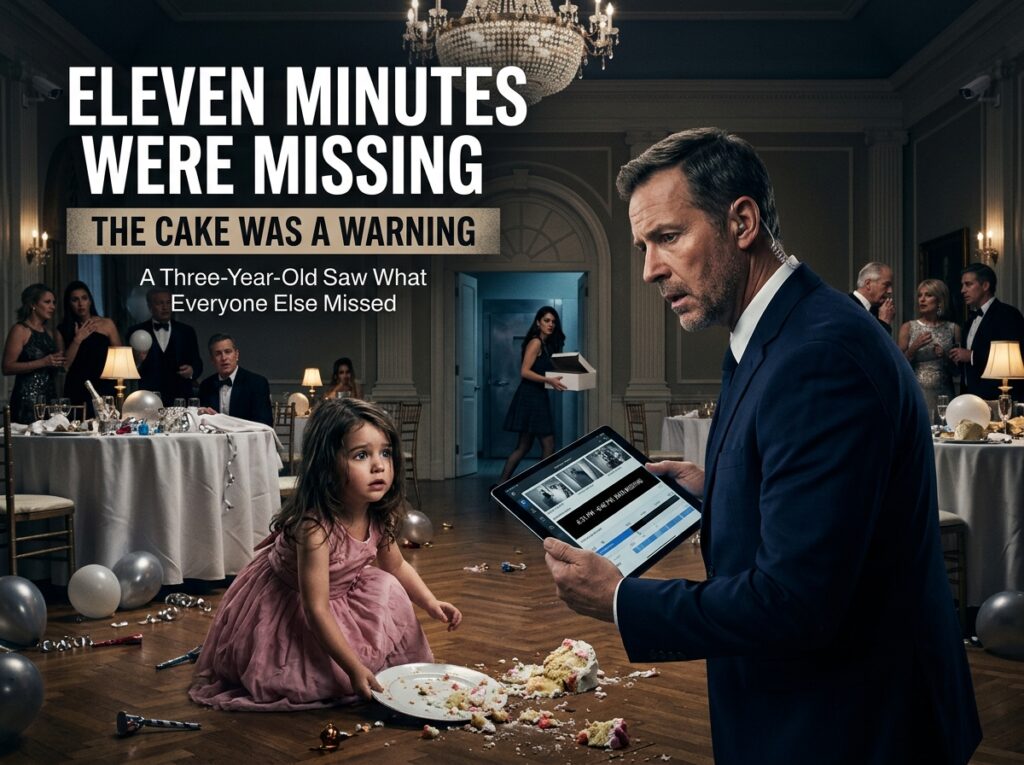
Then I saw the little girl walking behind her.
Sofia.
Three years old.
Maria’s daughter.
She was still wearing a pink dress from the party.
Her hair was tangled.
She carried a stuffed rabbit under one arm.
Sofia looked at the monitor.
Then at me.
Then she said something I didn’t understand.
“What?”
Maria gently touched her shoulder.
“She doesn’t talk much around strangers.”
Sofia looked toward the hallway.
Then back at the screen.
She pointed.
At C-17.
My stomach tightened.
“What did she see?”
Maria laughed nervously.
“Probably nothing.”
But Sofia didn’t look away.
She pointed again.
Then whispered one word.
“Cold.”
I stared at the monitor.
The cold storage room.
The missing eleven minutes.
I didn’t know it yet, but that word would become the first clue.
Part 2
By nine in the morning, the birthday party had become a story everyone was telling differently.
Adults remembered the speeches.
Children remembered the magician.
The chef remembered running out of strawberry mousse.
The musicians remembered a drunk uncle requesting the same song three times.
Maria remembered her daughter knocking a plate out of another child’s hands.
That was the detail that mattered.
The plate belonged to Oliver.
His birthday cake had been cut into small slices and served on white porcelain plates.
Oliver had invited three children to sit with him near the ballroom windows.
One of those children had a severe nut allergy.
The kitchen staff had been told.
The caterer had been told.
The parents had been told.
Everything was supposed to be controlled.
Then Sofia walked over.
She looked at the plate.
And without warning, she slapped it from the boy’s hands.
The plate hit the floor.
Cake everywhere.
The boy started crying.
His mother shouted.
Maria apologized.
Sofia cried too.
Nobody understood why.
Until the boy’s mother noticed something.
There were tiny crushed pieces mixed into the frosting.
The emergency kit came out.
The boy had not eaten the cake.
A sample was sent to a lab.
The results came back the next morning.
Concentrated almond protein.
Far beyond accidental cross-contamination.
The room went silent when Jonathan heard.
“Where was the cake made?” he asked.
“The main kitchen,” the chef said.
“Who handled it?”
“Several people.”
“Who had access?”
The chef hesitated.
“Staff. Caterers. And whoever was authorized near the kitchen.”
Jonathan looked at me.
“Find out.”
I nodded.
I pulled the badge logs.
Every employee entering the kitchen.
Every catering worker.
Every delivery.
Every security officer.
Nothing unusual.
Then I checked the cold storage room.
The cake ingredients had been stored there before the party.
Again, nothing.
Except C-17.
Eleven missing minutes.
Jonathan came into the security office.
He closed the door.
“Show me.”
I brought up the footage.
6:31.
Black.
6:42.
Back again.
“Can it be restored?”
“No.”
“Why?”
“Because it wasn’t lost.”
He looked at me.
“What does that mean?”
“It means someone deleted it.”
Jonathan stared at the screen.
“Can you prove that?”
“Not yet.”
He rubbed his forehead.
“Don’t tell the staff.”
“I wasn’t planning to.”
“Don’t tell the police either.”
I looked at him.
“Not yet,” he added.
That bothered me.
“You think someone inside the estate did this?”
“I think someone knew exactly what they were doing.”
He paused.
“Check the guests.”
I thought he meant background checks.
He didn’t.
“Which guests were dressed for the party rather than working in it?”
I understood.
We had spent the night watching staff.
Maybe that was the mistake.
He wanted me to identify everyone who had no legitimate reason to be near the service corridors.
“And find out who left the ballroom during those eleven minutes.”
I opened the event access logs.
Guests weren’t supposed to trigger staff badge systems.
But cameras tracked movement.
I pulled the ballroom footage.
At 6:30, almost everyone was inside.
At 6:31, a group of guests moved toward the terrace.
At 6:33, one person disappeared from view.
At 6:35, another.
At 6:38, someone returned.
At 6:41, another person came back.
Then the camera outside the cold room resumed.
I enlarged the footage.
And recognized the first face.
It was Jonathan’s younger brother.
Daniel.
He had arrived late to the party.
And according to the footage, he had spent seven minutes somewhere he had no reason to be.
Part 3
Daniel Whitaker was forty-six and disliked being questioned.
That was the polite version.
The less polite version was that he believed the family name made him immune to ordinary inconvenience.
When I asked where he’d been between 6:31 and 6:38, he laughed.
“Bathroom.”
“Seven minutes?”
“Do you time people?”
“Sometimes.”
He looked at me.
“Is this about the cake?”
“Yes.”
“Ridiculous.”
“Why?”
“Because a three-year-old knocked it over.”
“She knocked it over before anyone ate it.”
“And?”
“And the cake contained a concentrated allergen.”
His expression changed.
Only slightly.
But I saw it.
“I didn’t touch the cake.”
“I didn’t ask if you did.”
He stared at me.
Then he walked away.
I watched him go.
There was something about his answer.
Not the words.
The timing.
People who are innocent often answer the question asked.
People who are hiding something answer the question they think you’re going to ask next.
I went back through the footage.
Daniel left the ballroom at 6:31.
He didn’t go toward the bathrooms.
He went toward the service corridor.
At 6:34, he disappeared around a corner.
At 6:38, he came back.
But he wasn’t alone.
A woman followed him.
I froze the image.
Elena Price.
Jonathan’s financial adviser.
She was one of the family’s oldest friends.
She had been seated near Claire during dinner.
I checked another camera.
At 6:29, Elena had been talking to Jonathan.
At 6:30, she looked toward the service corridor.
At 6:31, she followed Daniel.
Then both disappeared.
I printed the images.
Jonathan came back into the room.
“Anything?”
I put them on the desk.
He stared.
“Daniel?”
“And Elena.”
His face hardened.
“Why would they be together?”
“I don’t know.”
“Find out.”
I continued reviewing.
At 6:42, Daniel returned to the ballroom.
Elena returned thirty seconds later.
But there was something else.
A catering server named Luis had crossed the service hallway at 6:40.
He stopped.
Looked toward the cold room.
Then kept walking.
I brought him in.
He looked terrified.
“Did you see Daniel?”
“Yes.”
“Did you see Elena?”
He hesitated.
“Yes.”
“What were they doing?”
“I don’t know.”
“Luis.”
He looked at me.
“I saw them arguing.”
“About what?”
“I couldn’t hear.”
“Did they enter the cold room?”
He shook his head.
“No.”
I showed him the footage.
“You’re sure?”
“Yes.”
“Then why did you look toward the cold room?”
His eyes dropped.
“Because Elena told me not to go there.”
That was the first moment the case changed.
“Why?”
“I don’t know.”
“What did she say?”
He swallowed.
“She said there had been a spill.”
“Did you see one?”
“No.”
“Then why believe her?”
Luis looked toward the door.
“Because she gave me money.”
“How much?”
“Two hundred dollars.”
“For what?”
“To stay away from that hallway.”
I leaned back.
“Did you tell anyone?”
He shook his head.
“I’m supporting my mother.”
I understood.
Fear wasn’t always about guilt.
Sometimes it was about survival.
I told him he had done the right thing by talking.
Then I asked the question that mattered.
“What happened in the eleven minutes?”
Luis shook his head.
“I don’t know.”
But as he stood to leave, he turned.
“There was someone else.”
“Who?”
“I don’t know.”
“Male or female?”
“Female.”
“What did she look like?”
He hesitated.
“Small.”
“Age?”
“Maybe twenty.”
“Hair?”
“Dark.”
“Anything else?”
Luis frowned.
“She was carrying a white box.”
I looked at the security footage.
There was no woman carrying a white box.
Not in the ballroom.
Not in the service hallway.
Not near the cold room.
Which meant someone had either missed her—
or someone had made sure the cameras didn’t see her.
Part 4
I went back to the missing footage.
Eleven minutes.
I slowed the frames before the gap.
At 6:30:59, a server passed the camera.
At 6:31:00, the recording ended.
At 6:42:01, the image returned.
There was something on the floor.
A small smear near the cold storage door.
I zoomed in.
White.
Powdery.
I called the estate’s environmental safety officer.
He tested it.
Sugar.
At first.
Then we found another trace.
Almond protein.
I stared at the result.
Someone had handled the allergen near the cold storage room.
But why?
The cake had been made in the kitchen.
Unless the contaminated ingredient had been brought in separately.
I checked delivery records.
Nothing.
Then I remembered Sofia’s word.
Cold.
I found Maria.
“Sofia keeps saying cold.”
Maria looked confused.
“She says it sometimes.”
“Does she know what the cold room is?”
“She follows me everywhere. Of course.”
“Was she near it last night?”
Maria hesitated.
“She wasn’t supposed to be.”
“But was she?”
Maria sighed.
“She wandered.”
“Did she see anything?”
“I don’t know.”
I crouched down.
Sofia was sitting on the floor coloring.
I held up a piece of paper.
“Can you draw the room?”
She looked at me.
Then she drew a square.
A door.
A stick figure.
Then another figure.
Then a white box.
I felt my stomach tighten.
“Who’s this?”
She pointed to the second figure.
“Lady.”
“Did you see her?”
Sofia nodded.
“What was she doing?”
Sofia drew a line.
Then another.
Then she made a motion with her hands.
Opening something.
A box.
I showed Maria.
“She was near the cold room?”
Maria looked at the drawing.
Then at her daughter.
“Sofia, did you see someone put something in the cake?”
Sofia nodded.
Maria’s face went pale.
“What?”
Sofia pointed toward the kitchen.
Then she pointed at herself.
Then she shook her head.
She was trying to explain something.
She had seen someone.
And the adults had ignored her because she was three.
I went back to the footage.
This time, I checked every camera outside the ballroom.
Not the main cameras.
The secondary angles.
At 6:28, Elena entered the service corridor.
At 6:29, she met Daniel.
At 6:30, a third person appeared.
A young woman.
Dark hair.
White box.
She came through the side entrance.
No staff badge.
No guest registration.
No visible invitation.
I followed her.
She entered through a blind spot between two cameras.
Then disappeared.
At 6:42, she emerged from the same blind spot.
I froze the image.
She was carrying an empty white box.
I enhanced the frame.
I knew her.
Not personally.
But I had seen her photograph during the guest check-in.
It was Jonathan’s niece.
Maya.
Twenty-one.
A college student.
I called Jonathan.
He answered immediately.
“I found the woman.”
“Who?”
“Maya.”
Silence.
Then:
“No.”
“You know her?”
“Of course.”
“She was near the cold storage room.”
“No.”
“I have footage.”
Another silence.
Then Jonathan said:
“Don’t confront her.”
“Why?”
“Because I need to know why first.”
I understood.
There was something bigger here.
He asked me to come to his office.
When I arrived, Claire was already there.
She was crying.
Jonathan closed the door.
“I need you to hear this before anyone else does.”
I waited.
“Maya is my daughter.”
I looked at him.
“Your daughter?”
“Not legally.”
Claire looked at the floor.
“She was born before we married.”
Jonathan’s voice became quieter.
“She has struggled for years.”
“With what?”
“Money.”
I waited.
“Her mother died last year.”
Claire finally looked at me.
“Maya believes Jonathan abandoned her.”
I didn’t respond.
“Did she?”
Jonathan looked away.
“That isn’t the point.”
“No,” I said. “The point is whether she put something in that cake.”
Claire started crying.
Jonathan said nothing.
Then his phone rang.
He looked at the screen.
It was Maya.
Part 5
Jonathan put the phone on speaker.
“Maya.”
There was silence.
Then a young woman’s voice.
“Did you find the footage?”
Jonathan looked at me.
“Yes.”
Another silence.
“Then you know.”
“I know you were near the cold room.”
“I didn’t hurt Oliver.”
Her voice broke.
“I would never hurt him.”
“Then explain.”
“I was trying to stop it.”
I leaned forward.
“What?”
Maya heard my voice.
“Who is that?”
“Security.”
“Oh.”
She sounded relieved.
“Good.”
Jonathan’s face tightened.
“Maya, what happened?”
“I found out someone was going to put the allergen in the cake.”
“Who?”
“I don’t know.”
“Then why were you there?”
“Because I was looking for proof.”
“Proof of what?”
“That they were going to blame me.”
The room went silent.
“What are you talking about?” Jonathan asked.
Maya began crying.
“I didn’t know what to do.”
“Who was going to blame you?”
“I heard Daniel talking.”
Jonathan’s expression changed.
“About what?”
“He said if anything happened to Oliver, everyone would think it was me.”
“Why?”
“Because I was angry.”
She took a breath.
“Because I had asked you for money.”
Jonathan closed his eyes.
Maya continued.
“I found out you had changed your will.”
Claire looked at Jonathan.
“What?”
He didn’t answer.
Maya did.
“He told me I wasn’t family.”
Jonathan looked devastated.
“That isn’t what I said.”
“You said I wasn’t your responsibility.”
A long silence.
Then Maya whispered:
“I wanted you to be scared.”
Jonathan sat down.
“But I didn’t want Oliver hurt.”
I asked:
“Who was in the cold room?”
“I don’t know.”
“You saw someone?”
“Yes.”
“Who?”
“Daniel.”
“And Elena.”
“What did they do?”
“They were arguing.”
“About what?”
“I couldn’t hear.”
“Did you see the allergen?”
“Yes.”
“Where?”
“In a white container.”
“Did Daniel have it?”
“I think so.”
“Did you touch it?”
“No.”
“Did you remove it?”
“Yes.”
That explained the white box.
Maya had taken the container.
But if she had removed the allergen, why had the cake still tested positive?
“Where did you put it?”
“In the trash.”
I looked at Jonathan.
“Did anyone retrieve it?”
Maya was silent.
Then she said:
“I saw Elena take it.”
My stomach dropped.
“What?”
“She went back after I left.”
That explained the eleven minutes.
The missing footage hadn’t hidden the entire plan.
It had hidden the second visit.
I asked Maya:
“Why didn’t you tell anyone?”
“Because I was scared.”
“Of Daniel?”
“Yes.”
“Why?”
“Because I heard him say that if the cake wasn’t eaten, he would find another way to make your family look like it was falling apart.”
Jonathan looked at me.
“Another way?”
Maya started crying.
“I don’t know.”
Then the line went dead.
Jonathan immediately called her back.
No answer.
We found her car abandoned near the estate gate.
The police were called.
This time, Jonathan didn’t ask me to wait.
He told them everything.
And the investigation moved fast.
Daniel was questioned.
Elena was questioned.
Luis gave his statement.
The white container was recovered.
It contained the same concentrated allergen found in the cake.
But the most important evidence came from the security server.
The eleven minutes hadn’t been deleted manually.
They had been overwritten remotely.
Someone had accessed the security system from inside the estate.
The login belonged to a guest network.
And only one guest had been connected to that network during the missing window.
Elena Price.
Part 6
Elena denied everything.
She said she had been in the ballroom.
Then she said she had gone outside.
Then she said she didn’t remember.
The problem with lies is that they require memory.
Truth doesn’t.
Investigators recovered messages between Elena and Daniel.
They had been planning something for months.
Not Oliver’s death.
Something more complicated.
Jonathan had been preparing to remove Daniel from the family business.
Daniel had discovered it.
Elena had financial ties to Daniel.
Together, they had planned to create a scandal.
The contaminated cake was supposed to trigger a medical emergency.
Then Daniel would publicly accuse Maya.
He knew she had argued with Jonathan.
He knew she had money problems.
He knew the family already considered her unstable.
If Oliver became sick, Maya would look like the obvious suspect.
The plan wasn’t simply to hurt a child.
It was to destroy someone else while creating enough chaos to protect themselves.
Maya had discovered the plan.
She had taken the allergen.
Then she had tried to erase the evidence.
That was why the footage mattered.
Daniel and Elena had returned during the missing eleven minutes to retrieve the container and clean the area.
But they had missed one thing.
Sofia.
A three-year-old child had been watching.
She didn’t understand the crime.
She didn’t understand the motive.
She only knew that something about that cake was wrong.
When Oliver picked up his plate, Sofia had reacted.
Instinctively.
She knocked it away.
People called it bad behavior.
A tantrum.
A toddler being difficult.
But it wasn’t.
She had saved him.
When we learned that, Maria broke down.
She sat in the kitchen with her daughter asleep against her shoulder.
“She doesn’t even know what she did.”
I looked at Sofia.
“She knows she saw something.”
Maria kissed her forehead.
“She saved him.”
“Yes.”
Maria began crying.
“I almost punished her.”
That sentence stayed with me.
Because sometimes courage doesn’t look brave.
Sometimes it looks like a three-year-old making a mess.
Sometimes it looks like a child doing something that makes no sense.
Sometimes the person who prevents disaster is the one everyone is annoyed with for five minutes.
The police arrested Daniel and Elena.
Maya was found that night at a friend’s apartment.
She was safe.
She returned to the estate the following morning.
Jonathan met her in the driveway.
I watched from a distance.
He didn’t know what to say.
Neither did she.
Finally, he opened his arms.
Maya stood still.
Then she stepped forward.
He hugged her.
She cried against his shoulder.
“I thought you hated me.”
“I never did.”
“You said I wasn’t family.”
“I was wrong.”
She pulled away.
“You should have told me.”
“I know.”
There are apologies that fix things.
And there are apologies that simply begin the process.
This was the second kind.
But it was enough for that morning.
Part 7
The estate was quieter after the arrests.
The party decorations came down.
The tents disappeared.
The flowers were thrown away.
The ballroom returned to being a ballroom instead of a place where a hundred people had laughed.
But everyone remembered the cake.
Oliver remembered it most of all.
He asked his mother why Sofia had knocked it away.
Claire told him the truth.
“She thought something was wrong.”
Oliver thought about that.
Then he asked:
“Is she a superhero?”
Claire smiled.
“Maybe.”
When Maria brought Sofia into the kitchen a few days later, Oliver ran toward her.
“You saved me.”
Sofia stared at him.
She didn’t answer.
Oliver hugged her.
Sofia looked at Maria.
Then she smiled.
That was the first time I saw her understand that something good had come from what she had done.
Later that afternoon, Jonathan called me into his office.
“I owe you an apology.”
I shook my head.
“For what?”
“For telling you to look at the guests instead of the footage.”
I smiled.
“You were right.”
He looked at me.
“No.”
He shook his head.
“You were right to question the gap.”
He handed me a folder.
“What is this?”
“Your new security protocol.”
I opened it.
It was a complete overhaul.
No guest would ever again be able to access the estate network.
All camera systems would be isolated.
Backup recordings would be stored separately.
Blind spots would be eliminated.
And every security gap would trigger an automatic alert.
“This is expensive.”
“I know.”
“Why do it?”
He looked toward the window.
“Because eleven minutes almost became a tragedy.”
I nodded.
Before I left, he said:
“One more thing.”
“What?”
“Thank you for not assuming Maya was guilty.”
I thought about it.
“I almost did.”
He looked surprised.
“Why?”
“Because she was the easiest explanation.”
He nodded slowly.
“And the easiest explanation is dangerous.”
“Yes.”
That sentence became one of the most important lessons of my career.
Security isn’t about finding the easiest suspect.
It’s about finding the truth.
Part 8
A month later, I reviewed the footage again.
Not because I needed evidence.
The case was over.
But because I wanted to understand the eleven minutes.
At 6:31, Maya entered the corridor.
She carried the white box.
At 6:33, she reached the cold room.
At 6:35, she removed the container.
At 6:37, she left.
Then came the gap.
6:31 to 6:42 had become a single black hole in the estate’s history.
But the cameras around it told the story.
At 6:38, Daniel entered.
At 6:39, Elena followed.
At 6:40, Luis saw them.
At 6:41, Elena returned to the ballroom.
At 6:42, the camera resumed.
Eleven minutes.
Eleven minutes that had looked like nothing.
But within them were decisions.
Fear.
Greed.
Courage.
And a child who had understood something adults missed.
I closed the footage.
Then I noticed Sofia standing behind me.
She had come into the security office with Maria.
She pointed at the monitor.
“Cold.”
I smiled.
“Yes.”
She looked at the screen.
Then she pointed at herself.
“You.”
“You?”
She nodded.
Then she pointed toward the kitchen.
“Cake.”
I laughed.
“Yes.”
She smiled.
Then she held up both hands.
“Boom.”
Maria laughed.
“What does that mean?”
Sofia giggled.
“She says the cake was bad.”
I looked at the little girl.
She had no idea how close that cake had come to changing several lives.
Maybe that was a blessing.
She didn’t need to carry the weight of it.
Adults could carry it.
Adults could remember.
Adults could learn.
Part 9
Years later, Oliver turned thirteen.
Sofia was eight.
The family still held birthday parties, but they were different now.
Smaller.
Simpler.
No hundred-person guest lists.
No strangers wandering through service corridors.
No unrestricted access.
And every year, Oliver made the same request.
“Sofia has to be here.”
She always was.
By then, she had become fearless in the strange, ordinary way children do.
She asked too many questions.
She climbed trees.
She hated vegetables.
She loved dogs.
She still remembered the cold room.
One afternoon, she found me checking the cameras.
“Are you looking for bad people?”
I smiled.
“Not today.”
“What are you looking for?”
“Anything unusual.”
She thought about that.
Then said:
“Like the cake?”
“Exactly like the cake.”
She nodded seriously.
“Sometimes things look normal but aren’t.”
I stared at her.
Those were not the words of a child who understood security.
But they were true.
“Where did you learn that?”
She shrugged.
“Mommy.”
I smiled.
Her mother had learned it too.
Everyone had.
The estate had changed.
The family had changed.
And so had I.
I stopped thinking of security as preventing bad things.
Now I thought of it as protecting the small moments when people were vulnerable.
A child picking up a plate.
A housekeeper’s daughter noticing something adults ignored.
A young woman trying to stop a crime even though she was afraid.
A man finally admitting he had made a terrible mistake.
The cameras had recorded almost everything.
But they had not recorded the most important moment.
The moment Sofia decided to act.
There was no camera angle for instinct.
No badge log for courage.
No security report that could explain why a three-year-old child suddenly knew something was wrong.
Sometimes the most important evidence is human.
Part 10
I still manage security at the Whitaker estate.
I still review thousands of hours of footage.
I still watch people enter gates, cross hallways, open doors, carry boxes, leave rooms, and return to them.
Most of it means nothing.
That is the nature of the job.
But every now and then, I see something that doesn’t fit.
A person takes a different route.
A door stays open too long.
Someone looks over their shoulder.
A camera skips.
When that happens, I stop.
I look again.
Because once you’ve seen eleven minutes disappear, you learn never to assume missing time means nothing happened.
Sometimes, eleven minutes can contain an entire crime.
Sometimes, they can contain the evidence that exposes it.
And sometimes, the person who saves everyone isn’t the detective.
It isn’t the security manager.
It isn’t the police officer.
Sometimes it’s a three-year-old girl in a pink dress who sees a birthday cake and simply knows—
No.
Not that.
She doesn’t know why.
She doesn’t know how.
She just knows.
So she knocks the plate away.
The plate crashes.
The cake hits the floor.
A room full of adults becomes angry.
And for a few seconds, nobody understands.
Until the laboratory report arrives.
Until the security footage disappears.
Until the guest list is examined.
Until the missing eleven minutes become the center of an investigation.
Until the truth finally has nowhere left to hide.
Years after that night, I asked Maria whether Sofia remembered what happened.
She smiled.
“She remembers the cake.”
“Does she remember saving Oliver?”
“No.”
I laughed.
“Of course not.”
Maria looked toward the garden where Sofia and Oliver were playing.
“She says she just didn’t want him to eat something bad.”
I looked at them.
Oliver was chasing Sofia through the grass.
She was laughing.
No fear.
No knowledge of what might have happened.
Just childhood.
And maybe that was the best ending of all.
The cake was gone.
The cameras were upgraded.
The people responsible were held accountable.
Maya had found her place in the family.
Maria’s daughter grew up knowing that her instincts mattered.
And Oliver got to become thirteen.
Then fourteen.
Then fifteen.
Ordinary birthdays.
The kind nobody remembers because nothing terrible happens.
I think that’s what security is really for.
Not to make sure nothing ever goes wrong.
That’s impossible.
It’s to give ordinary life a chance to continue.
And every time I walk past Camera C-17, I remember those eleven missing minutes.
I remember how cold my hands felt when I first saw the gap.
I remember the little girl pointing at the screen.
And I remember something I didn’t understand until much later:
The footage wasn’t the only thing that mattered.
Someone was watching.
Someone noticed.
Someone acted.
And sometimes, that’s all it takes to change the ending.