
Part 1
I’ve balanced my own checkbook every month for forty years.
Not approximately. Not whenever I remembered. Every single month, without fail.
I learned to do it from my mother, who kept a small black ledger beside the telephone and believed that a woman who understood her money could never be completely at someone else’s mercy.
When I was twenty-three, I thought she was being dramatic.
By the time I turned forty, I understood.
By the time I turned sixty-five, I had learned that the smallest numbers sometimes carried the biggest consequences.
That was why, on an ordinary Tuesday morning in October, I noticed the $38,000 withdrawal before I had finished my first cup of coffee.
The bank statement lay open on my kitchen table.
I had been sorting through the mail, putting the grocery coupons aside and stacking the utility bills beside my checkbook. Outside, the maple tree at the end of the driveway had begun losing its leaves. A delivery truck passed the house, and somewhere down the street, a dog barked twice.
It was a perfectly ordinary morning.
Then I saw the transaction.
**HOME EQUITY LINE OF CREDIT — DRAW: $38,000.00.**
I read it once.
Then again.
I checked the account number.
Correct.
I checked the statement period.
Correct.
I checked the balance.
Correct.
My home equity line had been open for years, established when my husband, Thomas, and I decided it was sensible to have access to emergency funds. We had never treated it like extra spending money. It was a reserve, something we hoped we would never need.
The last time I had drawn from it was six years earlier, when Thomas needed an unexpected medical procedure. We repaid the balance, closed out the borrowing period for our own purposes, and left the available credit untouched.
I knew exactly what the account was supposed to look like.
I knew how much remained available.
I knew the monthly interest rate.
I even knew the last four digits of the account number without looking.
Thirty-eight thousand dollars did not simply appear because a computer had made a mistake.
Someone had requested it.
Someone had authorized it.
Someone had decided that money secured against my home could be taken.
I set down my coffee.
My first thought was my son, Michael.
My second was Dana, his wife.
Eighteen months earlier, I had undergone hip surgery. The recovery had been slower than I expected, and for several weeks I struggled to get from the bedroom to the kitchen without help. My doctor had advised me not to drive until I could move safely and react quickly enough to operate a vehicle.
Michael worked full-time. Dana had offered to help.
She had been kind about it, at least on the surface.
“Let me handle the mail, Margaret,” she had said. “You need to concentrate on getting better.”
I had been grateful.
She collected the envelopes, sorted the bills, and brought me anything that required my attention. When the bank needed confirmation that someone could help me with routine account correspondence, I had followed the instructions and authorized limited assistance.
I thought I was making life easier for everyone.
I had not given Dana ownership of my home.
I had not given her permission to borrow against it.
And I certainly had not agreed to withdraw $38,000.
I picked up the statement and carried it to my desk.
There, in the bottom drawer, I kept the original paperwork for the home equity line. I pulled out the folder and checked the documents against the statement.
Everything looked familiar.
Except the new balance.
I could feel my heartbeat in my throat, but I forced myself to slow down.
Anger would not return the money.
Panic would not tell me who had requested it.
And calling Michael before I knew what had happened would give someone an opportunity to explain before I understood the facts.
I had learned that lesson long before I became a mother-in-law.
So I picked up the telephone.
I called the bank.
Part 2
The woman who answered introduced herself as Rachel.
She sounded cheerful, professionally patient, and entirely unaware that the next few minutes might change the way I looked at my family.
“How can I help you today?”
“I need information about a thirty-eight-thousand-dollar draw against my home equity line.”
“Certainly. Are you calling about a recent transaction?”
“Yes.”
She asked me to verify my identity.
I answered every question correctly.
Then she placed me on hold.
I sat at my kitchen table, looking at the statement while instrumental music played through the telephone.
When Rachel returned, her voice had changed slightly.
“I can confirm that a draw in that amount was processed on September twenty-third.”
“Who requested it?”
“Let me review the authorization record.”
I waited.
“Mrs. Ellis, the request was submitted electronically.”
“From which device?”
“I can see that the request was made through the online account, but I need to transfer you to our account security department for additional details.”
“Please do.”
Another transfer.
Another round of identity verification.
Another hold.
I was beginning to understand why people gave up when a bank made something difficult. The process seemed designed to wear down anyone who lacked patience.
Fortunately, I had spent forty years balancing a checkbook.
Patience was one of the few things I had accumulated more reliably than money.
A man named Patrick finally came on the line.
I explained the transaction again.
He asked whether I had authorized the draw.
“No.”
“Did you request anyone to make it on your behalf?”
“No.”
“Did you knowingly approve a withdrawal of $38,000?”
“No.”
He paused.
“Was another person authorized to access the account?”
I closed my eyes briefly.
“My daughter-in-law was authorized to help handle correspondence while I recovered from surgery.”
“Do you know whether she had online access?”
“She may have had access to the account information. I did not authorize this withdrawal.”
Patrick explained that the bank would need to investigate. He asked me several questions about my online banking credentials and whether I had received security notifications.
I had received an email about a transaction.
I had assumed it was an ordinary account alert until I opened the statement.
He asked me to forward the notification.
Then he said something that made me sit straighter.
“The funds were disbursed to an external account.”
“Whose account?”
“I can’t disclose the receiving account details without completing the appropriate investigation.”
“Can you tell me whether it was an account in my name?”
“I can’t confirm that at this stage.”
I looked at the window.
The maple leaves were moving in the wind.
“Mr. Patrick, I need you to understand something. I have not borrowed against this property in six years. I did not request this draw. I did not authorize anyone to request it for me. I need the account protected immediately.”
He assured me that he would document my report and explain the available security measures.
By the end of the call, the bank had restricted further draws while it reviewed the disputed transaction. I was given a case number and told to preserve every statement, email, and document connected to the account.
I wrote the case number in my black ledger.
Then I called my attorney.
Her name was Helen Brooks, and she had represented me for nearly fifteen years.
Helen was the kind of woman who listened without interrupting. She never confused a loud voice with a convincing argument, and she had once told me that the first version of a family dispute was usually the version someone wanted you to believe.
I explained the withdrawal.
She asked whether I had authorized it.
“No.”
“Has the bank confirmed the transaction?”
“Yes.”
“Do you have a copy of the original loan documents?”
“Yes.”
“Have you spoken with Michael or Dana?”
“No.”
“Good.”
I almost laughed.
“You’re the second person today to tell me that.”
“Then perhaps we’re both thinking clearly.”
She told me to email her the statement and every relevant document. She would review the account records and contact the bank’s security department.
“Margaret,” she said before we ended the call, “don’t accuse anyone yet. We need to establish what happened before we decide what it means.”
“I understand.”
“And don’t sign anything that anyone brings you concerning this transaction.”
“I won’t.”
When the call ended, I remained at my desk.
The house was quiet.
I thought about Dana bringing me soup after surgery.
I remembered Michael adjusting the pillows behind my back.
I remembered telling my friends how fortunate I was to have family who stepped in when I needed help.
I had not invented those memories.
They had happened.
But so had the withdrawal.
Both things could be true.
That afternoon, I put the statement, the account agreement, and the bank’s case number into a folder.
On the front, I wrote three words.
**The Thirty-Eight Thousand.**
I did not yet know where the money had gone.
I did not know who had initiated the draw.
But I knew I would not allow anyone to convince me that a transaction I had never authorized was simply a misunderstanding.
Not without evidence.
Not even if the person asking me to believe it was my own son.
Part 3
Michael called me the following evening.
“Hi, Mom. How are you feeling?”
It was such an ordinary question that, for a moment, I nearly forgot the statement sitting in my desk drawer.
“I’m fine.”
“Good. Dana said she might stop by this weekend to see if you need anything.”
“That’s kind of her.”
There was a pause.
“Everything all right?”
“Why wouldn’t it be?”
“Nothing. You just sound different.”
I looked at the kitchen clock.
“I’ve had a busy couple of days.”
“Anything I can help with?”
There it was.
A simple question.
I could have asked him about the withdrawal right then.
I could have said his wife’s name and watched for a reaction.
Instead, I asked about his work.
He told me about a project that was running behind schedule. He complained about a colleague who never submitted paperwork on time. I listened and made the appropriate noises.
For several minutes, we sounded like a mother and son having an ordinary conversation.
Then he said, “Dana mentioned that you were going through some bank paperwork.”
My fingers tightened around the telephone.
“Did she?”
“She said there might be something confusing on your statement.”
I looked at the folder in my desk.
“That’s interesting.”
“What?”
“I haven’t discussed my statement with Dana.”
Silence.
It lasted only a second, but I noticed it.
“Oh,” Michael said. “Maybe she was talking about something else.”
“Maybe.”
He changed the subject.
We spoke for another few minutes before saying goodbye.
I sat at the table long after the call ended.
Michael had known about the statement before I had mentioned it.
That did not prove he had taken the money.
Dana might have seen the bank notification. Perhaps the transaction had been discussed between them. Perhaps he had heard something and was trying to understand it.
There were innocent explanations.
I wrote down the date and the exact wording of the conversation.
Then I called Helen.
“He mentioned my bank statement.”
“How did he know about it?”
“He said Dana had told him there might be something confusing on it.”
“Had you spoken to Dana?”
“No.”
“Then we should find out what information she has.”
Helen asked me to send her a copy of the authorization form I had signed during my recovery.
I found it in the same folder as my loan documents.
The form was straightforward. It allowed Dana to help with account correspondence and certain routine administrative matters.
It did not authorize her to borrow money against my home.
It did not transfer ownership of the account.
It did not grant her the right to make major financial decisions on my behalf.
I emailed the document to Helen.
Then I did something I had not done in years.
I changed every banking password I could change, reviewed the contact details on my accounts, and made a list of the people who had access to my personal information.
It took most of the afternoon.
By dinner, the list was three pages long.
I was surprised by how much information I had shared over the years without thinking about it.
Insurance documents.
Tax records.
Medical forms.
Utility accounts.
Copies of identification.
I had given these things to people because I trusted them.
Trust had made my life easier.
It had also made me careless in ways I had never fully considered.
That evening, Helen called.
“I’ve reviewed the documents.”
“And?”
“The authorization you signed does not appear to give Dana the authority to make this draw.”
I exhaled.
“Can the bank still hold me responsible?”
“That depends on the account agreement, the method of authorization, and what the investigation establishes. We shouldn’t assume the outcome yet.”
“What do you think happened?”
“I think we need the original draw request and the associated verification records.”
“Can we get them?”
“We’ve requested them.”
I looked toward the hallway.
Thomas’s old coat still hung in the closet. I had kept it because I couldn’t bear to give it away.
He had died four years earlier, after a brief illness that left both of us unprepared for the speed with which an ordinary life could become a series of hospital visits and difficult decisions.
He had always been the one who handled major repairs around the house.
I handled the finances.
That division of responsibility had worked for decades.
After his death, I became even more careful about my accounts.
I thought I was protecting myself.
I had never considered that the greatest risk might come from someone who already knew where I kept the paperwork.
Helen interrupted my thoughts.
“Margaret?”
“I’m here.”
“One more thing. Has anyone suggested that you transfer ownership of the house or change the terms of your home equity line?”
“No.”
“Has anyone asked you to sign a document recently?”
I thought for a moment.
“Not that I remember.”
“Keep it that way until we understand the transaction.”
After we hung up, I went upstairs and opened the small safe in my bedroom.
My deed was there.
So were my insurance documents and the original loan agreement.
I checked each one.
Nothing appeared to be missing.
But as I put everything back, I noticed an empty space where I used to keep a folder of old financial correspondence.
I searched the drawer.
Then the filing cabinet downstairs.
Then the box in the closet.
I couldn’t find it.
I told myself I might have moved it during my recovery.
Still, I wrote it down.
Missing folder: old financial correspondence.
I had a feeling I would need that information later.
Part 4
Three days after I discovered the withdrawal, Michael arrived at my house carrying a paper bag from the bakery.
He had always done that when he wanted to make an awkward conversation easier.
As a boy, he would bring me flowers after getting into trouble at school. As an adult, he preferred pastries.
He knew I liked cinnamon rolls.
He also knew I found it difficult to stay angry when someone brought me one.
That afternoon, however, the bag remained untouched on the counter.
“How’s the hip?” he asked.
“Fine.”
“Still giving you trouble?”
“Only when it rains.”
He nodded and looked around the kitchen.
“House looks good.”
“Thank you.”
We sat at the table.
He placed the bakery bag between us.
For a few minutes, he talked about work, the children, and a new restaurant Dana wanted to try.
Then he leaned back.
“So, Mom, I heard there was some confusion with your home equity account.”
I folded my hands.
“Where did you hear that?”
“Dana.”
“What did she tell you?”
“That there was a withdrawal you didn’t recognize.”
“Thirty-eight thousand dollars.”
He nodded quickly.
“Right.”
“Did you know about it?”
He looked directly at me.
“I know it was connected to some renovation costs.”
“What renovation costs?”
He hesitated.
“The house.”
“Whose house?”
“Ours.”
I waited.
He rubbed his forehead.
“I mean, the renovation we were doing.”
“What renovation were you doing?”
“The one Dana told you about.”
I stared at him.
“Dana has never told me about a renovation.”
His expression shifted.
For the first time since he had arrived, he looked uncertain.
“Well, she must have forgotten.”
“Forgotten to tell me about a thirty-eight-thousand-dollar withdrawal against my house?”
“Mom, it’s not like that.”
“Then explain it to me.”
He leaned forward.
“It was supposed to be temporary.”
“What was?”
“The money.”
I felt my stomach tighten.
“Did you receive it?”
He looked down at the table.
“Yes.”
The answer was so quiet I almost didn’t hear it.
“How much?”
“Thirty-eight thousand.”
“All of it?”
“Yes.”
I sat back.
For several seconds, neither of us spoke.
Then I asked, “Did I give you permission to take it?”
He shook his head.
“Not directly.”
“There’s no indirectly about it, Michael. Did I authorize the withdrawal?”
He looked at me.
“No.”
“Did you ask me?”
“No.”
“Then why did you take it?”
He exhaled sharply.
“Dana said you’d agreed.”
“Agreed to what?”
“That we could use the money and pay it back.”
“When?”
“I don’t know. She said you’d talked about helping us.”
“I have helped you.”
“I know.”
“I paid part of your college tuition. I helped you when you bought your first house. I helped when the children were born.”
“I know, Mom.”
“Then why would you think I had agreed to a loan I never discussed with you?”
He had no answer.
I looked at the bakery bag.
A cinnamon roll had begun to stain the paper with butter.
“Michael, I need you to tell me the truth.”
He looked exhausted.
“We were in trouble.”
“What kind of trouble?”
“Financial trouble.”
“How much?”
He shook his head.
“It’s complicated.”
“Try me.”
He looked at his hands.
“Dana and I borrowed money for the house.”
“What house?”
“Our house.”
I frowned.
“You told me you had refinanced last year.”
“We did.”
“And?”
“We borrowed more than we should have.”
“How much?”
He didn’t answer.
“Michael.”
“More than we could comfortably repay.”
I felt a deep sadness settle over me.
Not because my son had financial problems.
People had financial problems.
Families lost jobs.
Businesses failed.
Unexpected bills arrived.
I would have helped him look for solutions if he had come to me honestly.
What hurt was that he had apparently chosen to take money from my home equity line instead of telling me the truth.
“Did you know the withdrawal was unauthorized?”
He swallowed.
“I knew you hadn’t signed anything in front of me.”
“That’s not what I asked.”
He looked away.
“I knew we hadn’t asked you.”
I nodded slowly.
“That’s better.”
He reached for the bakery bag.
“Mom, please. I can explain.”
“Then explain.”
He told me that he and Dana had been behind on several payments. They had borrowed money to renovate their kitchen and replace part of their roof. When unexpected expenses arrived, they had used credit cards to cover them.
The balances grew.
Interest accumulated.
Their monthly payments became harder to manage.
Dana had suggested asking me for a loan.
Michael had refused.
He said he didn’t want me worrying about their problems.
Then, according to him, Dana had told him that I had already agreed to help.
He had accepted that explanation because he wanted it to be true.
“Did you know she was using my account?” I asked.
He stared at the table.
“Yes.”
The word was barely audible.
I felt something inside me go still.
“You knew.”
“I thought it was temporary.”
“That doesn’t answer the question.”
He rubbed his eyes.
“I knew the money came from your account.”
“And you knew I hadn’t agreed.”
He said nothing.
I stood and walked to the sink.
I needed something solid beneath my hands.
For forty years, I had taught my son that if he made a mistake, he should admit it.
Now he was sitting at my kitchen table, surrounded by the smell of cinnamon and fresh coffee, trying to find a way to make a decision he had already made sound less serious.
When I turned around, he was looking at me.
“Mom, it was just a misunderstanding.”
I shook my head.
“No, Michael.”
His face fell.
“A misunderstanding is when two people remember a conversation differently.”
I paused.
“This was money taken from an account I never authorized you to use.”
He looked down.
“And until we know exactly how it happened, I won’t pretend it’s something smaller.”
Part 5
Helen arrived the following afternoon.
She carried a leather briefcase and a thin folder.
Michael was already at my house.
I had asked him to come because I wanted the conversation to happen with everyone hearing the same facts.
Dana had declined my invitation.
She said she was busy with the children.
I didn’t insist.
Helen sat at the head of the kitchen table.
Michael sat across from me.
I placed my bank statement beside the folder.
For a few minutes, Helen asked questions about the account, the authorization I had given Dana, and the circumstances surrounding my recovery from surgery.
Michael answered most of them.
He said Dana had handled the mail.
He said she had helped organize financial paperwork.
He said they had been under pressure because of the renovation costs.
He repeated that he believed I had agreed to help.
Helen listened without interruption.
Then she opened her briefcase.
“I’ve received the bank’s preliminary records,” she said.
Michael straightened.
“Good.”
Helen took out two pages.
“The bank has confirmed that the draw was requested electronically using credentials associated with the account.”
Michael nodded.
“That’s what I said.”
“That is one part of the record,” Helen replied. “It does not establish that Margaret authorized the transaction.”
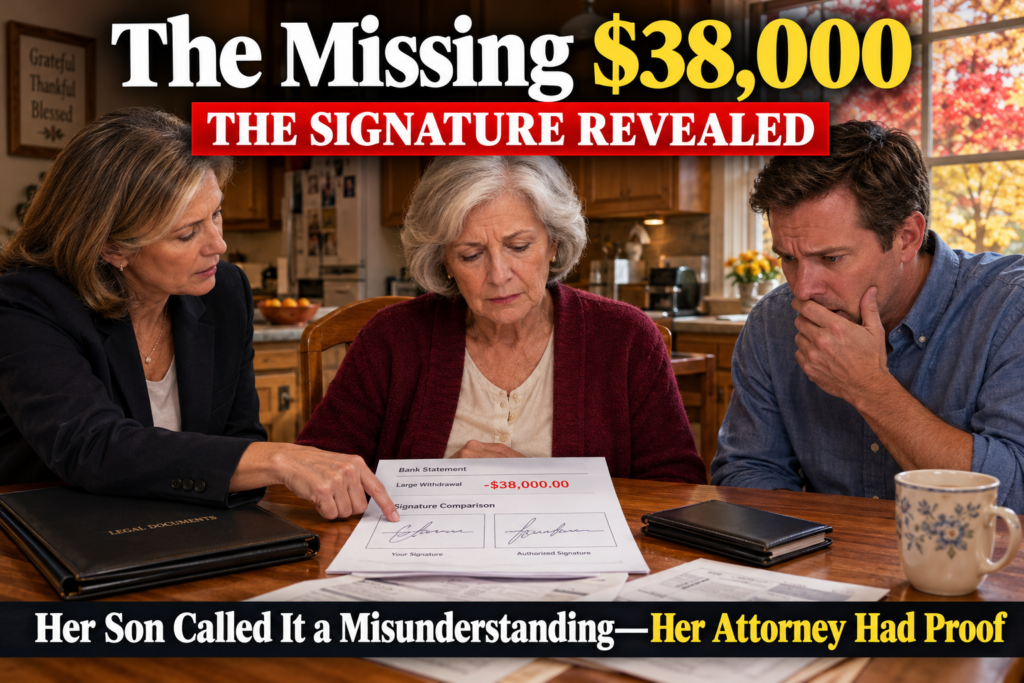
She placed the first page in front of him.
It contained a copy of the signature associated with the disputed request.
Then she placed a second page beside it.
That page showed my signature from the original home equity loan documents.
“These are the signatures we have so far,” she said.
Michael glanced at the first page.
Then the second.
His expression changed.
Helen waited until he had looked at both.
“Do you recognize the signature on the disputed document?”
He swallowed.
“It looks like Mom’s.”
“Does it look like her original signature?”
He studied the pages more closely.
The signature on the disputed document was close enough to fool someone who glanced at it quickly.
But the differences were obvious when the two were placed side by side.
My name usually leaned slightly to the right. I connected the final letters in a particular way, and I had always crossed the first letter of my surname with a short, sharp stroke.
The disputed signature was more upright.
The spacing was different.
The final letters were disconnected.
Helen pointed to the comparison.
“These differences need to be evaluated properly. I’m not asking you to make a technical determination. I’m asking whether Margaret signed this document in your presence.”
Michael shook his head.
“No.”
“Did you see her sign it at any time?”
“No.”
“Did she tell you she had signed it?”
He hesitated.
“No.”
Helen folded her hands.
“Then on what basis did you believe the withdrawal was authorized?”
Michael opened his mouth, then closed it again.
I watched him.
I had seen that expression when he was a child and had been caught breaking something he wasn’t supposed to touch.
But he was forty-three now.
He had children of his own.
He had a mortgage, a career, and responsibilities that no longer belonged to anyone else.
He could not rely on the same excuses he had used at twelve.
Helen slid another document across the table.
“This is the authorization Margaret signed eighteen months ago.”
Michael glanced at it.
“It permitted Dana to assist with correspondence and routine administrative matters. It did not grant authority to borrow against Margaret’s property.”
He looked at me.
“Mom, I didn’t know that.”
“You never asked.”
“I thought—”
“You thought I had agreed because Dana said so.”
He lowered his eyes.
Helen continued.
“The bank is investigating how the transaction was submitted and verified. We have also requested records concerning the receiving account. Until that investigation is complete, no one should make assumptions about who performed each step.”
Michael nodded.
Then Helen opened the last section of her folder.
“There is another issue.”
I felt my shoulders tighten.
“What issue?” I asked.
“Someone submitted a document stating that Margaret had verbally approved the draw and had given permission for the funds to be used for renovation expenses.”
I stared at her.
“I never said that.”
“I know.”
“Who submitted it?”
Helen turned to Michael.
He looked at the document.
His face lost its color.
I watched him read the first few lines.
Then he whispered, “Dana.”
Helen didn’t respond.
Michael looked up.
“She must have written that.”
“Do you recognize the statement?”
He swallowed.
“Yes.”
“Did you know she had submitted it?”
“No.”
Helen closed the folder.
“Then we have more questions to answer.”
Michael sat motionless.
For the first time, he seemed to understand that this was no longer a family disagreement that could be solved by promising to repay the money.
There were records.
There were statements.
There was a disputed transaction.
And there was a document claiming I had agreed to something I had never discussed.
I looked at my son.
“Michael, I want you to understand something.”
He raised his eyes.
“I love you.”
His face crumpled slightly.
“But loving you doesn’t mean I can ignore what happened.”
He nodded.
“I know.”
“Do you?”
He looked at the signature comparison again.
“I think I do now.”
Part 6
The following week was the longest I could remember.
I had always imagined that serious financial trouble would announce itself loudly.
A phone call in the middle of the night.
A stranger at the door.
An envelope stamped with a warning.
Instead, it arrived quietly, printed on a bank statement between an interest charge and a routine account notice.
The investigation continued.
Helen coordinated with the bank and requested additional documentation. The bank reviewed the electronic authorization records, the destination of the funds, and the access history associated with the account.
I kept every message.
Every letter.
Every phone call was recorded in my black ledger, along with the date, the name of the person I spoke with, and the details they provided.
The habit that had once seemed old-fashioned now gave me a sense of control.
I was no longer guessing.
I was building a record.
Michael called almost every evening.
Sometimes he apologized.
Sometimes he asked whether Helen had received anything new.
Once, he asked if I would consider telling the bank that I had agreed to help him.
I stared at the telephone.
“Why would I do that?”
“Because it might make this easier.”
“Easier for whom?”
He didn’t answer.
“Michael, I cannot tell the bank something that isn’t true.”
“I know.”
“Then don’t ask me again.”
He apologized and ended the call.
I sat quietly for several minutes afterward.
I knew my son was frightened.
I knew his marriage was under pressure.
I knew the possibility of legal consequences was becoming real.
But I also knew that every time I softened the facts to protect him, I would be making it harder to establish what had actually happened.
A week later, Helen called me into her office.
She had received additional records from the bank.
“Margaret, we have a clearer picture now.”
I sat down.
“What happened?”
“The funds were transferred to an account that Michael and Dana controlled.”
I had suspected as much.
Still, hearing it confirmed made my hands cold.
“Did the money go toward the renovation?”
“Some of it did.”
“Some?”
Helen opened a spreadsheet.
She explained that the available records showed several payments connected to their home renovation, along with payments toward other outstanding obligations.
Not every dollar could yet be traced with certainty, but enough information had emerged to establish that the entire amount had not been spent on the work Michael described.
I stared at the figures.
“How much went to the renovation?”
“Approximately twenty-four thousand dollars, based on the documents we have.”
“And the rest?”
“Some appears to have gone toward other debts. We are still verifying the transactions.”
I leaned back.
“Then the renovation explanation was only part of the story.”
“Yes.”
I thought of the confidence in Michael’s voice when he had first sat across from me.
He had spoken about renovation costs as though he were discussing a forgotten utility bill.
Now I understood why he had wanted me to accept that explanation quickly.
It was easier to call something a misunderstanding than to explain why money had been moved between accounts without permission.
Helen placed another document in front of me.
“This is the statement Dana submitted.”
I read it carefully.
It claimed that I had discussed a temporary family loan with her and had agreed that the money could be taken from the home equity line.
It included an approximate date.
A date when I had been recovering from surgery.
I remembered that week.
I had been taking medication that made me sleepy.
Dana had brought groceries and collected the mail.
I had spent much of the day resting in the living room.
But I had never discussed a $38,000 loan.
“Who signed this statement?” I asked.
“Dana.”
“Was it notarized?”
“No. It was submitted as supporting information during the initial inquiry.”
I put the page down.
“Then why did the bank accept it?”
“They haven’t accepted it as proof that you authorized the withdrawal. They are investigating the claim.”
I nodded.
That distinction mattered.
I didn’t want to accuse the bank of wrongdoing simply because it was reviewing a statement. I wanted the records to establish what had happened.
Helen leaned forward.
“Margaret, I need to ask you something. Did you ever tell Dana that she could use the equity in your house to help Michael?”
“No.”
“Did you ever discuss a loan of that amount?”
“No.”
“Did you ever agree to repay the draw yourself?”
“No.”
“Then we will state those facts clearly.”
I signed an affidavit confirming what I remembered and what I had not authorized.
Helen explained each section before I signed.
I read every line.
I checked the dates.
I checked the names.
I checked the wording.
Then I signed.
My real signature.
The one I had used on thousands of documents throughout my life.
When I finished, Helen placed the affidavit in her folder.
“That was important.”
I nodded.
On the drive home, I looked out the window and thought about how strange it was to have to prove something so basic.
I had not taken the money.
I had not approved the loan.
I had not given anyone permission to use my house as collateral for their expenses.
Those facts had been true from the beginning.
But truth, I was learning, sometimes needed paperwork before other people were willing to act on it.
Part 7
Dana called me on a Thursday afternoon.
I almost let the phone ring.
Then I decided I would rather hear what she had to say than spend the evening imagining it.
“Hello, Dana.”
“Margaret.”
Her voice was tight.
“Do you have a minute?”
“Yes.”
“I wanted to talk about the bank situation.”
I sat down.
“All right.”
She took a breath.
“Michael tells me you’ve hired an attorney.”
“Yes.”
“Do you really think that’s necessary?”
I looked at the black ledger beside me.
“I believe it is.”
“But we’re family.”
“That doesn’t change the bank records.”
She was quiet.
Then she said, “I think there’s been a misunderstanding.”
I had heard those words so many times that they no longer sounded reassuring.
“What misunderstanding?”
“I thought you had agreed to help us.”
“I did not.”
“You said you wanted to help Michael.”
“I have said that many times.”
“Exactly.”
“But wanting to help someone is not the same as authorizing a $38,000 withdrawal.”
Her voice sharpened.
“We were going to pay it back.”
“That doesn’t answer my question.”
“We were under a lot of pressure.”
“I understand that.”
“Then why are you treating us like criminals?”
I closed my eyes.
Because I was tired.
Because I had spent weeks reviewing records that should never have existed.
Because the money had been taken against the value of the house where I intended to spend the rest of my life.
Because my daughter-in-law was asking me to focus on her intentions instead of the actions that had placed me in this position.
“I am not making a legal judgment about you, Dana,” I said. “The bank and the appropriate professionals are reviewing the transaction. I am telling them what I know.”
“But you could tell them you agreed to help.”
“I did not agree to this.”
She sighed.
“You know Michael is struggling.”
“I do.”
“And you know how hard things have been for us.”
“I know more now than I knew a month ago.”
She fell silent.
Then she said, “We didn’t have another choice.”
I felt a sudden sadness.
There were always choices.
Some were painful.
Some were embarrassing.
Some required admitting that a person had made a mistake.
But there had been choices.
They could have told me the truth.
They could have asked for a loan.
They could have sold something, reduced their expenses, or spoken with a financial counselor.
They could have allowed me to say no.
Instead, they had made a decision on my behalf.
“Dana, I wish you had come to me honestly.”
“We thought you’d refuse.”
I let the silence remain.
Finally, I said, “Then you should have allowed me to make that decision.”
She began to cry.
I didn’t feel triumphant.
I didn’t feel angry in the way I had expected.
I felt sad for all of us.
After the call, I sat in the kitchen and looked at the place where Michael had sat when he tried to explain the withdrawal.
I remembered him as a small boy, bringing home school projects and asking me to help him finish them.
I remembered teaching him how to balance a checkbook.
He had been impatient at first.
“Why do I have to write everything down?” he had asked.
“So you know where your money went.”
“What if I remember?”
“Then you’ll remember it correctly when the numbers matter.”
He had laughed.
I had laughed too.
Now I wished I could return to that afternoon and explain something else.
That knowing where your money goes is important.
But knowing where your decisions lead is even more important.
The next day, Michael came over.
He looked as though he hadn’t slept.
“Dana told me about your conversation.”
I nodded.
“She was upset.”
“I imagine she was.”
He sat down.
“Mom, we’re going to repay you.”
“How?”
He explained that they were discussing a repayment plan.
They had begun reviewing their expenses and speaking with a financial adviser. They might sell one of their vehicles. They were considering other changes as well.
I listened.
Then I asked, “Have you told the children?”
He looked startled.
“No.”
“Will you?”
“I don’t want to frighten them.”
“You don’t need to frighten them. But they deserve parents who understand what happened.”
He nodded.
For a long time, he said nothing.
Then he whispered, “I don’t know how I let this happen.”
I looked at my son.
“That is a question you need to answer honestly.”
He wiped his face.
“I know.”
“Not for me.”
I paused.
“For yourself.”
Part 8
The bank’s final review took several more weeks.
During that time, Helen advised me to keep the home equity account restricted and to avoid making any informal repayment agreements that might confuse the record of the disputed withdrawal.
I followed her advice.
The account remained under review.
The interest charges were documented.
Every payment and communication was preserved.
I also arranged for a separate financial review of my accounts, not because I had discovered another suspicious transaction, but because I wanted to be certain that the problem was limited to the one I knew about.
The review found no other unauthorized withdrawals.
That was a relief.
But it did not erase what had happened.
One afternoon, Michael arrived with a folder.
“I brought something.”
I looked at it.
“What is it?”
“Our repayment proposal.”
He sat down and opened the folder.
The plan was straightforward.
They intended to repay the full amount, along with any charges they were responsible for, under a written schedule reviewed by their financial adviser and attorney.
They would begin with an initial payment after selling a vehicle they no longer needed.
The remaining balance would be paid in monthly installments.
I read the proposal carefully.
It was not perfect.
Some of the dates depended on the sale.
Some figures still needed to be confirmed.
But it was a beginning.
“Did Helen review this?” I asked.
“She reviewed the legal wording.”
“Good.”
He looked at me.
“Are you going to accept it?”
“I’m going to have her review the final version before I agree to anything.”
He nodded.
“I expected that.”
I studied his face.
He no longer looked confident.
He looked tired, embarrassed, and older than he had a month earlier.
“Michael, why didn’t you ask me?”
He stared at the folder.
“Because I was ashamed.”
“Of needing money?”
“Of failing.”
I waited.
He continued.
“Dad always made things look easy. He worked hard, but he never seemed worried about money. I thought that when I was his age, I’d have everything figured out.”
I felt a pang of recognition.
Thomas had rarely discussed his worries with the children. He believed he was protecting them by keeping his concerns to himself.
Perhaps we had taught Michael that financial difficulty was something to hide.
But I had never taught him that he could take what he needed.
“I wish you had told me,” I said.
“I know.”
“I might have said yes to a loan.”
He looked up.
“Really?”
“Possibly. I would have wanted to see your budget. I would have wanted to understand how you planned to repay it. I might have suggested another solution.”
He lowered his eyes.
“But I would have had the choice.”
He nodded.
“That’s what I took away from you.”
I sat quietly.
“Yes.”
He began to cry.
Not loudly.
He covered his face with one hand and tried to stop.
I wanted to comfort him.
I wanted to tell him that everything would be fine.
But I had learned that reassurance could become another way of avoiding a difficult truth.
So I waited.
When he finally looked up, I said, “I love you, Michael.”
He nodded.
“But we have to separate two things.”
“What?”
“My love for you, and the money.”
He looked at me.
“I can love you without pretending the withdrawal was acceptable.”
He nodded slowly.
“And I can give you the opportunity to make things right without pretending nothing happened.”
For the first time in weeks, he seemed to understand what I meant.
“I want to make it right.”
“Then start by following through.”
He closed the folder.
“All right.”
After he left, I called Helen.
We reviewed the proposal together.
She suggested a few changes, clarified the repayment terms, and explained how the agreement should address the disputed balance and any interest or fees.
Nothing would be finalized until the appropriate parties had reviewed and signed it.
I agreed.
For the first time since the statement arrived, I felt that the situation was moving toward something concrete.
Not forgiveness.
Not yet.
But accountability.
And accountability, I was beginning to understand, was the only foundation on which forgiveness could safely stand.
Part 9
Winter arrived.
The maple tree outside my kitchen window stood bare, its branches dark against the pale sky.
I continued my monthly checkbook routine.
I reviewed the statements.
I recorded the figures.
I checked every transaction.
The $38,000 draw remained in my ledger, marked with the case number and the date I had first discovered it.
Beside the entry, I had written a small note.
**Never ignore what the numbers tell you.**
The repayment agreement was completed after review by the attorneys.
Michael and Dana made the initial payment from the proceeds of the vehicle sale.
The remaining amount was scheduled for repayment according to the signed terms.
The bank’s investigation and the legal review proceeded separately, because repaying money did not automatically resolve every question about how the withdrawal had been authorized.
I understood that distinction now.
Money could be returned.
Records could be corrected.
But trust was more complicated.
Michael began visiting regularly.
At first, our conversations were awkward.
He asked about my hip.
I asked about the children.
We discussed the weather, the cost of groceries, and whether the roads would be icy.
We avoided the subject that had brought us to this point.
Then, one afternoon, he arrived carrying a small box.
“What’s that?” I asked.
He placed it on the table.
“Your old paperwork.”
I opened the box.
Inside were the financial correspondence folders I had searched for weeks earlier.
Every envelope was there.
Some were from the bank.
Some were old insurance notices.
One contained a copy of the original home equity agreement.
I looked at him.
“Where did you find these?”
“In our storage room.”
“How did they get there?”
He hesitated.
“Dana had taken some of the papers home when she was helping you after surgery. She said she wanted to organize them.”
I closed the box.
“Did you know she had them?”
“Not until recently.”
I studied his face.
“Why didn’t she return them?”
“I don’t know.”
He sat down.
“Mom, I need to tell you something else.”
I felt my stomach tighten.
“What?”
“Before the withdrawal, I knew we were in financial trouble. I knew Dana was looking for ways to cover the bills.”
I said nothing.
“I knew she had talked about asking you for help.”
“Did you know she had accessed the home equity account?”
He looked down.
“Not at first.”
“And later?”
“Later, I knew the money had come from your account.”
I let the silence remain.
He swallowed.
“I should have stopped everything. I should have told you immediately.”
“Yes.”
“I was afraid.”
“Of what?”
“Of losing Dana. Of losing the house. Of having to explain to the children that we’d made a mess of everything.”
I nodded.
“And you thought letting me believe the money had been taken without your knowledge would make things easier?”
He closed his eyes.
“I didn’t think clearly.”
I believed him.
But I also knew that not thinking clearly did not make the consequences disappear.
“Michael, you don’t have to tell me that you’re a bad person.”
He looked at me.
“I don’t?”
“No. I don’t think that helps anyone.”
I paused.
“But you do have to be honest about the decisions you made.”
He nodded.
“I know.”
“Because if you aren’t honest about those decisions, you’ll repeat them when you’re frightened again.”
He sat quietly.
Then he said, “I don’t want to be that person.”
“Then don’t be.”
It was not a dramatic moment.
There were no tears.
No embrace.
No promise that everything would be different forever.
Just a mother and her son sitting at a kitchen table, speaking honestly for the first time in months.
Sometimes, that is how a family begins to heal.
Not by forgetting.
By telling the truth without looking away.
Part 10
A year after I discovered the withdrawal, I balanced my checkbook on the first Saturday of October.
The kitchen looked much the same as it had the morning the statement arrived.
The same table.
The same coffee cup.
The same black ledger.
The maple tree had turned red and gold again.
I checked each transaction and matched it against the bank statement.
The figures balanced.
They always did.
When I reached the final page, I stopped at the entry for the home equity line.
The repayment process was underway according to the agreement.
The account remained subject to the protections and terms established after the investigation.
There were still documents to keep.
There were still records to review.
But I no longer felt as though I was waiting for another surprise to arrive in the mail.
I closed the ledger.
Then I opened the drawer where I kept the original loan agreement.
I took out the signature page.
My name was there in my own handwriting.
I traced it lightly with my finger.
I thought about the woman who had signed that document years earlier.
She had been younger, stronger, and certain that the hardest financial decisions of her life were already behind her.
She had no idea that one day her son would sit across from her and try to explain why money had been taken against her home without her permission.
She had no idea that a document bearing a familiar name could make her question the people she loved most.
But she had known one thing.
The numbers mattered.
The records mattered.
And when something did not make sense, she had to keep asking questions until it did.
My telephone rang.
It was Michael.
“Hi, Mom.”
“Hello, sweetheart.”
“Are you busy?”
“Just finished balancing my checkbook.”
He laughed.
“Of course you did.”
“Someone has to keep the banks honest.”
We both smiled.
Then he became serious.
“I wanted to tell you that the next repayment went through.”
“Good.”
“I checked it twice.”
“Did you?”
“Three times, actually.”
I laughed.
“Your father would be proud.”
There was a pause.
“I hope so.”
I knew what he meant.
Michael still carried shame about what had happened. I suspected he would for a long time.
I could not remove that feeling for him.
Nor could I make the past different.
But I could acknowledge the work he was doing now.
“Your father believed people should be judged by what they do after making a mistake,” I told him. “Not just by the mistake itself.”
Michael was quiet.
“Do you believe that?”
“Yes.”
“Even about me?”
I looked at the signature page on my desk.
“Especially about you.”
He exhaled.
“Thank you, Mom.”
We talked about the children, his work, and a small repair he was planning at home.
Before we hung up, he asked whether he could come for dinner on Sunday.
“Of course,” I said.
“Can I bring Dana?”
The question surprised me.
Our relationship was still strained. Dana and I had spoken only briefly since the investigation began. We had not returned to the easy conversations we once shared.
But I had no desire to turn my home into a place where people were permanently forbidden from returning.
“She can come,” I said. “But I want us to be honest with each other.”
“I understand.”
“And I don’t want to discuss the money at dinner unless there’s something important we need to address.”
“All right.”
When we ended the call, I sat quietly for a moment.
Forgiveness, I had discovered, was not a single decision made in one emotional afternoon.
It was a process.
It required honesty.
It required boundaries.
It required the willingness to see whether someone’s actions changed after the apologies were finished.
And it required accepting that love could survive without pretending everything was acceptable.
On Sunday, Michael arrived with the children.
Dana came a few minutes later.
She stood in the doorway holding a pie.
“Hello, Margaret.”
“Hello, Dana.”
For a moment, neither of us moved.
Then I stepped aside.
“Come in.”
She placed the pie on the counter.
“I brought apple.”
“Thank you.”
We sat at the table.
The children talked about school.
Michael told a story about a customer who had mistaken his car for someone else’s.
Dana asked about my hip.
I answered.
The conversation was cautious, but it was civil.
After dinner, while Michael helped the children put on their coats, Dana approached me.
“I owe you another apology,” she said.
I looked at her.
“I know you’ve apologized before,” I replied.
“I have.”
She folded her hands.
“But I don’t think I really understood what I was asking you to carry.”
I waited.
“I was frightened about our finances. I thought if we could get through the immediate problem, we’d figure everything else out later.”
She swallowed.
“I told myself that because you had helped Michael before, it would be all right. I made your decision for you.”
I said nothing.
She continued.
“I was wrong. And I know returning the money doesn’t automatically make you trust me again.”
“No,” I said quietly. “It doesn’t.”
She nodded.
“I understand.”
I studied her face.
For the first time, she wasn’t asking me to call the situation a misunderstanding.
She wasn’t asking me to protect her from the consequences.
She was acknowledging what she had done.
That mattered.
“I hope you make different decisions in the future,” I said.
“I will.”
“I hope so.”
We stood there for a moment.
Then I gave her a small hug.
It was not the embrace of the relationship we had once shared.
It was the beginning of something new, and neither of us knew exactly what that would look like.
After they left, I returned to the kitchen.
I washed the dishes, wiped the counter, and put away the remaining food.
Then I sat at the table with my black ledger.
I opened to a fresh page.
At the top, I wrote the date.
Below it, I recorded the balance of my checking account.
I checked the arithmetic.
Everything matched.
I closed the book and placed it in the drawer.
For forty years, I had balanced my checkbook because I believed financial independence was a form of security.
I still believed that.
But I had learned something else.
You can protect your accounts with passwords.
You can protect your home with legal documents.
You can protect your savings with careful records and sensible boundaries.
What you cannot do is protect a relationship by pretending that trust means never asking questions.
Trust means being able to ask those questions and receive an honest answer.
And when that trust is broken, love alone cannot repair it.
People must do the work.
They must acknowledge what happened.
They must make things right where they can.
And they must accept that forgiveness belongs to the person who was hurt.
I switched off the kitchen light.
Tomorrow, there would be bills to pay, groceries to buy, and another ordinary day to live.
I would continue balancing my checkbook.
I would continue checking my statements.
I would continue loving my son.
But I would never again confuse giving someone a hand with handing them control of my life.
The $38,000 had taught me a lesson I should have learned long before that October morning.
**Family deserves love. Trust deserves honesty. And neither one requires you to surrender your right to protect what is yours.**