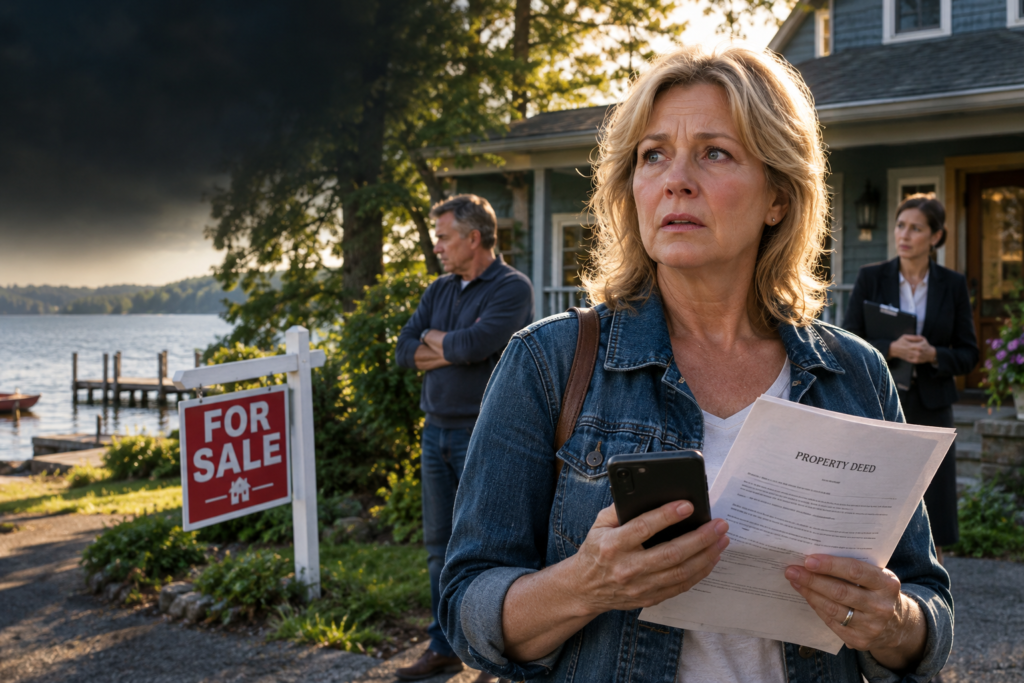
Part 1
The first thing I noticed was the photograph of the porch.
Not the price. Not the realtor’s name. Not even the words *Coming Soon*, which sat beneath the address in clean black letters.
It was the porch.
My mother had painted those floorboards a pale blue in 1998 because she believed blue paint discouraged insects. I had spent three weekends helping her scrape the old layers away before we applied the new coat. She had insisted on doing the final brushstrokes herself, even though her knees were already giving her trouble.
In the listing photograph, the boards were still that same faded blue.
The white wicker chair near the railing was the one my father used to sit in every evening with a glass of iced tea. The crooked flowerpot beside the front door was the one my mother had refused to replace because, as she always said, a little crookedness gave a house character.
I knew every inch of that porch.
And I knew the house was not for sale.
I sat at my kitchen table with my laptop open, reading the listing again.
**$410,000. Three bedrooms. Two bathrooms. Private lake access. Original family ownership. Excellent potential as a vacation property.**
The description made the place sound like an investment opportunity.
It did not mention the pencil marks inside the pantry where my brother Daniel and I had measured our heights as children. It did not mention the shallow scratch in the kitchen table where our father had accidentally dragged a pocketknife. It did not mention the small brass bell my mother rang from the back steps whenever she wanted us to come inside for dinner.
Those things would not have mattered to a buyer.
But they mattered to me.
The listing identified Daniel as the seller.
I stared at his name until the letters seemed to lose their shape.
My brother had spent three summers acting as though the lake house was his personal inheritance. He brought his grandchildren every June, stored fishing equipment in the garage, and invited friends without asking me first.
At family gatherings, he spoke about the property with the confidence of someone discussing his own home.
“We’ll replace the dock next spring,” he would say.
Or, “I’m thinking about putting a proper fire pit behind the house.”
Sometimes he referred to the place as *our lake house*, which was technically true in the sentimental sense but not in the legal one.
I had always let him talk.
After our mother died, I had learned that correcting Daniel in front of relatives created arguments that lasted longer than the original disagreement. He had a talent for making himself sound wounded whenever anyone challenged him.
He would sigh, lower his eyes, and remind everyone that he was the older brother.
Our father had been gone for six years by the time our mother passed. Daniel was fifty-seven then, married to Susan, with grown children and grandchildren of his own. I was fifty-three, unmarried, and living three hours away in the small house I had bought after my divorce.
Our mother had spent her final years at the lake house whenever her health allowed. She loved the quiet mornings, the smell of wet pine trees, and the way sunlight moved across the water just before sunset.
In her final year, she asked me to handle the paperwork for the property.
“Your brother has his own life,” she told me one afternoon while we sat at the kitchen table. “And you have always been the one who takes care of the details.”
I had not understood then how important those words would become.
The deed was transferred into my name alone after her death. The taxes, insurance, repairs, and legal expenses became my responsibility.
Daniel knew this. He had been present when our mother explained her decision, and he had signed the documents acknowledging the estate distribution.
Still, I had never treated the house as something that separated us.
Daniel was my brother. The lake house was where we had spent childhood summers, where our parents had celebrated anniversaries, and where our children had learned to swim.
I wanted him to feel welcome there.
So I gave him a key.
I told him he could bring his grandchildren whenever he liked, provided he let me know when he planned to visit.
For years, it worked.
Then Daniel stopped asking.
He began telling people when he would be at the house rather than asking whether the dates were convenient. He installed a new television in the living room without consulting me. He replaced two bedroom mattresses and told the family he was improving the property.
I reimbursed him for a few expenses because I wanted the house maintained, but I never asked him to keep records.
When he told our cousins he had plans to renovate the kitchen, I quietly reminded him that I would need to approve any major work.
He laughed.
“You worry too much,” he said. “It’s staying in the family.”
I wanted to believe him.
Now I was looking at a public listing that treated my mother’s home as though Daniel had every right to sell it.
I checked the address twice. I opened the photographs one by one. The kitchen, the dock, the upstairs bedrooms, the stone path beside the garage.
Every image was recent.
Someone had walked through the house, opened doors, moved curtains, and photographed rooms filled with my family’s memories.
Someone had given a realtor permission to market my property.
And my brother had apparently convinced that person he was the only living relative with a claim to it.
I closed the laptop.
For several minutes, I sat without moving.
Then I opened it again, copied the realtor’s number into my phone, and pressed call.
Part 2
The realtor answered on the fourth ring.
“Good afternoon, this is Claire Bennett with Bennett Lakeside Realty.”
Her voice was professional and warm, the sort of voice that made people feel their questions were welcome.
“My name is Margaret Ellis,” I said. “I’m calling about the property you have listed at 18 Willow Point Road.”
“Of course. It’s a beautiful home. Are you interested in arranging a showing?”
“No,” I replied. “I’m the owner of record.”
The silence lasted long enough for me to hear a faint rustle on the other end.
“I’m sorry?”
“The deed is in my name. Margaret Ellis. My mother left the property to me eleven years ago.”
Another pause.
“Mrs. Ellis, I may need to ask you a few questions. My understanding was that Daniel Ellis was the owner and that he was the only living relative with a claim to the property.”
“Daniel is my brother.”
“I see.”
“He does not own the house.”
Claire did not argue. She did not become defensive or try to explain away the discrepancy. Instead, I heard the soft tapping of a keyboard.
“Would you be able to provide documentation showing your ownership?”
“Yes. I have the recorded deed, the estate paperwork, and eleven years of property tax records.”
“Thank you. Please don’t send anything sensitive through an unsecured email. I’ll give you our office’s secure contact information. In the meantime, I need to place the listing on hold while I verify the ownership.”
“Has anyone made an offer?”
“Not a formal offer, but we’ve had inquiries. One prospective buyer requested additional information about the dock and shoreline access.”
My stomach tightened.
“Did you receive written authorization from Daniel to list the property?”
“Yes. We have a signed listing agreement.”
“Did he provide a deed?”
“He provided documents that he represented as evidence of his authority to sell. I haven’t completed an independent title review yet. That is part of our process before closing, but I normally rely on the seller’s representations during the initial marketing stage.”
I appreciated her honesty, though it did little to calm me.
“Claire, did my brother tell you I existed?”
There was a brief pause.
“He told me there were no other relatives with a claim to the property. He described himself as the only remaining family member responsible for it.”
I looked toward the window above my sink.
Outside, the branches of an old maple tree moved in the wind. I had planted that tree with my husband years before our marriage ended. It had survived storms, drought, and one terrible winter when half its branches broke beneath the ice.
I had always thought families were supposed to survive things in much the same way.
“I understand,” I said.
“Mrs. Ellis, I want to be very clear. I will not proceed with marketing or any transaction until the ownership issue is resolved. If your documentation confirms what you’re telling me, the listing cannot continue under the current authorization.”
“Thank you.”
“I’ll also review the materials Daniel provided and document this conversation. If you believe someone entered the property without authorization, please tell me.”
“I don’t know yet who had permission to enter. My brother has a key.”
“All right. Please send me the recorded deed through our secure office channel. I’ll contact you once I’ve reviewed it.”
We ended the call politely.
I remained at the table, holding the phone in my hand.
There was a strange difference between suspecting that someone had betrayed you and hearing a stranger describe the betrayal as an established fact.
Daniel had not simply made an assumption about the lake house.
He had presented himself as the only person with a legitimate claim to it.
I walked to the filing cabinet in my spare bedroom. The deed was in a blue folder, along with the probate papers, insurance policies, and the property tax receipts I had organized every year.
The document was exactly where I had left it.
My name appeared on the first page and again beneath the county recorder’s stamp.
There was no ambiguity.
I scanned the pages and sent them to Claire through the secure portal she provided.
Then I called the county recorder’s office to request a current copy of the property record. I wanted confirmation that no new deed or transfer had been filed without my knowledge.
The clerk said she would prepare the records and send instructions for obtaining a certified copy.
I thanked her and hung up.
Only then did I call Daniel.
He answered cheerfully.
“Margaret! Perfect timing. I was just talking to Susan about the lake house.”
“Were you?”
“Yeah. We’ve got some exciting things happening. The market is strong, and I think we might finally be able to get a good price for the place.”
I closed my eyes.
“Daniel, why is the house listed for sale?”
He gave a short laugh, as though I had asked something amusing.
“Because it’s time.”
“Time for what?”
“To let it go. Nobody uses it enough anymore. The upkeep is ridiculous, and I have a buyer who might be interested.”
“You listed it for four hundred and ten thousand dollars.”
“That seems to be the market price.”
“You don’t own it.”
His voice changed.
Not dramatically. Not all at once.
The cheerfulness simply disappeared.
“Don’t start this, Margaret.”
“I called the realtor. She told me you represented yourself as the only living relative with a claim to the property.”
A heavy breath came through the phone.
“That’s not what I said.”
“Then tell me what you said.”
“I told her I was handling the property.”
“Handling it is not the same as owning it.”
“You know what I meant.”
“I know what the deed says.”
He was quiet for several seconds.
Then he said the sentence I had heard in a hundred different forms over the years.
“You always have to make everything difficult.”
I looked down at the deed beside my phone.
“No, Daniel. I have to make sure my property isn’t sold without my permission.”
He hung up.
I did not call him back.
Instead, I placed the deed in its folder, wrote down the time of our conversation, and opened a notebook.
At the top of the page, I wrote three words.
**Find out everything.**
Part 3
Daniel did not call the next morning.
He did not call that afternoon, either.
Instead, Susan sent me a text.
*Margaret, Daniel is upset. You know how much the lake house means to him. I hope we can discuss this without turning it into a legal battle.*
I read the message twice.
There was no mention of the listing. No question about why the property was being sold. No acknowledgment that I had not authorized it.
The only problem, apparently, was that Daniel was upset.
I typed a reply, deleted it, and started again.
*I am willing to discuss the lake house. I am not willing to have my property listed for sale without my consent.*
Susan responded with a single sentence.
*He always believed it would eventually be his.*
I stared at the screen.
That was the first time anyone had said it so plainly.
Not that Daniel had been confused. Not that a realtor had misunderstood. Not that the paperwork had been mishandled.
He had believed the house would eventually be his.
Perhaps he had believed it for years.
I went back to the summer after our mother died.
Daniel had stood beside me at the funeral reception, accepting condolences from relatives and telling them he would make sure the lake house stayed in the family.
I remembered the way he had placed his hand on my shoulder.
“Don’t worry,” he had said. “I’ll take care of the place.”
I had been exhausted. Our mother’s final months had been difficult, and I was still trying to understand a world in which I could no longer call her when I needed advice.
So I had nodded.
I had not realized that he might interpret my silence as an agreement.
Over the following years, small things had changed.
Daniel began referring to the property as his retirement plan. He mentioned that the lake house could be sold someday to fund travel for Susan and him. He talked about dividing the proceeds among his children.
I had always corrected him privately.
“It’s not something we can plan to sell,” I would say. “It’s my property.”
He would wave away the conversation.
“I’m talking about the future.”
And I would let it go.
I told myself he was speaking casually. I told myself that family members sometimes imagined things without intending to act on them.
Now I wondered whether every one of those conversations had been a rehearsal.
At noon, Claire called.
“I’ve reviewed the documents you sent,” she said. “Your name appears on the recorded deed, and the county record confirms that you are the current owner. I have suspended the listing.”
“Thank you.”
“I also spoke with my managing broker. We’re reviewing the listing agreement and the supporting documents Daniel supplied. I can’t share every detail of that review yet, but I want you to know that we will not accept an offer or proceed toward a sale.”
“Did he provide you with anything other than his identification and the listing agreement?”
“He provided a document he described as a family authorization.”
My fingers tightened around the phone.
“What kind of authorization?”
“It appears to be a statement concerning his use and management of the property. I need to review it more carefully before I characterize it. At this stage, it does not replace the recorded deed.”
“Can you send me a copy?”
“I’ll check what I can lawfully share and have our office contact you.”
After we hung up, I called Helen Brooks, the attorney who had handled our mother’s estate.
Helen had known our family for almost twenty years. She had sat with our mother during the final planning meetings, explained the paperwork to Daniel and me, and made certain the property transfer was completed correctly.
When I told her about the listing, she did not interrupt.
She listened until I finished.
“Margaret,” she said, “I want you to take a breath. The deed is the first thing we need to protect. Then we need to find out what Daniel submitted and whether he has attempted to create any additional documents.”
“Do you think he could sell it?”
“Not lawfully without the authority required to transfer it. But we shouldn’t assume that everyone involved will catch a problem before it causes trouble. We’ll document the situation and notify the appropriate parties.”
She asked me to send the listing, Claire’s contact information, and the timeline of events.
Then she asked a question that unsettled me more than anything else that morning.
“Has Daniel ever asked you to sign a document concerning the lake house in the last year?”
I thought carefully.
“No.”
“Has he ever asked for a copy of your deed?”
“Not recently.”
“Has he asked you to sign anything by email or through an electronic signature service?”
“No.”
“Good. Don’t sign anything he sends you now without letting me review it first.”
I agreed.
Helen promised to request the estate file and compare it with the current county records. She also advised me to secure the house, inventory the contents, and preserve every message related to the attempted sale.
Before ending the call, she said, “I know this is your brother. But for the moment, treat this as a property matter, not a family argument.”
I understood what she meant.
Family arguments were emotional. They were filled with old memories, old obligations, and old accusations.
Property records were different.
They did not care who was older, who had children, who had visited most often, or who had spent the last three summers telling everyone a house was basically his.
They recorded ownership.
And for eleven years, that ownership had been mine.
Part 4
On Thursday morning, I drove to the lake house.
I had not visited since early spring, when I went up to inspect a leak beneath the upstairs bathroom. I usually spent a week there in May, preparing the place for summer, but work and a stubborn case of bronchitis had delayed my trip.
The drive took almost three hours.
As the road narrowed near Willow Point, familiar landmarks appeared: the old bait shop with its faded green awning, the church where our parents had celebrated their fortieth anniversary, and the small grocery store where my mother bought peaches every July.
I felt the familiar anticipation of returning home.
Then I saw the real estate sign.
It had been placed beside the driveway.
**FOR SALE.**
A white sign with bold blue lettering, standing on the same patch of grass where my father had once planted a row of marigolds.
I parked and sat behind the steering wheel.
For eleven years, I had maintained that property through grief, illness, financial strain, and a marriage that eventually ended. I had paid for a new roof after a hailstorm, replaced the water heater, repaired the dock, and covered every property tax bill.
I had never asked Daniel to contribute to those expenses.
I had considered the house a responsibility my mother had entrusted to me.
And now a stranger’s sign stood in my yard.
I got out of the car and removed it from the ground.
Then I carried it to the garage and placed it beside the workbench.
The house smelled faintly of cedar and closed windows. Dust had settled on the living room shelves, but everything looked familiar.
I walked through each room slowly.
In the kitchen, I found a stack of fishing magazines on the table. In the downstairs bedroom, a drawer stood half open, filled with children’s swimsuits and old board games.
Daniel’s family had been using the place as usual.
On the refrigerator was a handwritten calendar showing his planned visits for the coming summer.
June 8–15: Daniel and Susan.
June 22–29: Daniel’s grandchildren.
July 4 weekend: family cookout.
The calendar extended into August.
There was no entry for me.
That shouldn’t have hurt as much as it did.
I went into the small office beside the living room. My mother had used it to pay bills and keep family photographs. After her death, I had preserved the desk and the filing cabinet, though I had moved most of the important paperwork to my own home.
The top drawer contained old pens, envelopes, and a packet of photographs.
Beneath them lay a folded sheet of paper.
I opened it.
It was a handwritten list in Daniel’s familiar block lettering.
**Lake House Sale — Things to Handle**
* Confirm market value.
* Arrange photographs.
* Clear personal items.
* Discuss proceeds with Susan.
* Contact bank.
* Notify family after agreement.
At the bottom, he had written:
**Margaret shouldn’t need to be involved.**
I read that sentence again.
He had not written, *Ask Margaret what she wants.*
He had not written, *Check the deed.*
He had written that I should not need to be involved.
I photographed the page, then placed it in a folder and took the folder with me.
I was checking the desk again when my phone rang.
Claire.
“Mrs. Ellis, I wanted to update you. Our review is continuing, and the listing remains suspended. My managing broker has instructed us not to accept offers or schedule showings until the matter is resolved.”
“Thank you. I found a note in the house indicating that my brother had been planning the sale for some time.”
“Please preserve it. If your attorney needs a copy of our file, she can contact our office directly.”
“I will.”
There was a brief pause.
“May I ask you something?” Claire said.
“Of course.”
“Did Daniel tell you he was planning to sell the property?”
“No.”
“Did he tell you he was preparing to meet with us?”
“No.”
“I thought that might be the case. He presented the situation as though all the family members involved had already agreed.”
I looked at the paper in my hand.
“All the family members?”
“He said the family wanted to simplify things and that you were comfortable with him handling the sale.”
The words made me feel colder than the spring air coming through the open window.
He had not merely failed to mention me.
He had used my supposed agreement to make his story more convincing.
“Claire,” I said, “I want you to understand that I never gave him permission to sell the house.”
“I understand. Your documentation is clear on ownership. We are taking the matter seriously.”
When the call ended, I went outside and stood on the dock.
The lake was calm, reflecting the gray sky. A pair of ducks moved between the reeds, leaving thin ripples behind them.
I remembered my father teaching Daniel and me to fish there. Daniel had always wanted the biggest catch. If I caught a fish first, he would insist mine did not count because it was too small.
Our father would laugh and tell us that the lake had room for both of us.
I wondered when Daniel had decided there was room for only one.
Part 5
Helen called me on Friday with the first significant update.
“I’ve reviewed the estate documents,” she said. “Your mother transferred the property to you through a properly recorded deed. Daniel acknowledged the distribution. I also found a letter from your mother explaining why she wanted the property placed in your name.”
I sat down.
“What did it say?”
“She wrote that you had agreed to take responsibility for the property’s taxes, insurance, maintenance, and long-term expenses. She also expressed the hope that you would allow Daniel and his family to continue enjoying the house, provided the arrangement remained respectful.”
My eyes filled before I could stop them.
That sounded exactly like my mother.
She had never wanted to use the house to punish anyone. She wanted the family to have a place where they could gather without worrying about who had brought the most food or who had paid for the boat fuel.
“Did she say anything about Daniel owning it someday?”
“No. The letter makes no promise of a future transfer. The deed is clear.”
I wiped my eyes.
“Then why would he think he could sell it?”
“I can’t tell you what he believes,” Helen replied. “But I can tell you what the documents establish. He has no recorded ownership interest based on the estate records I’ve reviewed.”
“What about the family authorization Claire mentioned?”
“I’ve requested a copy of any document used to support the listing. We need to see exactly what it says before drawing conclusions.”
That afternoon, Claire’s office provided Helen with a copy of the document Daniel had submitted.
Helen called me back after reviewing it.
“It appears to be a statement signed by Daniel claiming he had authority to manage and sell the property on behalf of the family. It refers to his long-term use of the house and his role in maintaining it.”
“Did he forge my signature?”
“Not on this document. It appears to contain only his signature. But it makes claims about authority that are not supported by the deed or the estate paperwork.”
I felt both relieved and frightened.
Relieved because he had not, at least in that document, tried to imitate my signature.
Frightened because he had apparently convinced himself that years of using the house gave him the right to sell it.
Helen continued.
“The document may be relevant to the realtor’s understanding of the situation, but it does not convey ownership. I’ve advised the brokerage in writing that the property is not authorized for sale by Daniel and that no transaction should proceed without your written consent.”
“What happens now?”
“We preserve the evidence, confirm that no transfer or lien has been recorded, and determine whether any additional protective steps are needed. If Daniel continues to claim authority he does not have, we can consider the appropriate legal remedies.”
I thanked her.
Before we ended the call, she added, “Margaret, don’t contact him to argue about the document. Let me handle the formal communication.”
That evening, Daniel called.
I nearly let it go to voicemail, but I answered.
“What are you doing?” he demanded.
“I’m at home.”
“Don’t play games with me. Helen sent me a letter.”
“Then you should read it.”
“You went to a lawyer behind my back?”
I looked at the kitchen clock.
“Daniel, I called the realtor after discovering that my house was listed for sale. I contacted my attorney because you tried to sell property you don’t own.”
“You make it sound criminal.”
“I am telling you what happened.”
He laughed sharply.
“You have no idea what this house has cost me in time. I’ve been the one taking care of it. I’ve been the one bringing the kids up there. I’ve been the one making sure the family still has somewhere to go.”
“I have paid the taxes, insurance, repairs, and major maintenance.”
“I never asked you to do that.”
“No. You simply assumed I would.”
He fell silent.
Then he said, “Mother never intended for you to keep it forever.”
I felt something inside me settle.
“Did she tell you that?”
“She didn’t have to. You know how she felt about family.”
“Then why did she put the deed in my name?”
“Because you were the one who handled the paperwork!”
“She had an attorney. She had years to change her mind. She didn’t.”
He started talking over me, bringing up childhood memories, my divorce, the fact that I lived alone, and the number of times he had driven his grandchildren to the lake.
Each accusation seemed designed to make me forget the original question.
Why had he listed my house without asking me?
Finally, I interrupted him.
“Daniel, I am not discussing the ownership of my property over the phone while you shout at me. Helen has sent you the documentation. If you have a legal response, send it to her.”
“You’d really choose a building over your own brother?”
“No,” I said quietly. “I’m choosing not to pretend that you have a right to take something that belongs to me.”
He hung up.
I stood in the kitchen for a long time afterward.
Then I took my mother’s old photograph from the shelf above the desk.
She was sitting on the dock, wearing a straw hat and smiling at whoever held the camera.
I touched the frame.
“I tried to keep the peace,” I whispered.
For the first time, I understood that keeping the peace and keeping a secret were not always the same thing.
Sometimes silence simply gave another person more room to take what they wanted.
Part 6
The family learned about the listing on Sunday.
I did not tell them.
Daniel did.
He called our cousin Patricia first, then sent a long message to the family group chat. By the time I opened my phone that afternoon, there were eleven unread messages.
Daniel’s message was the longest.
He explained that he had been exploring options for the lake house because the property was expensive to maintain and the family had become scattered. He said he believed selling it would be a practical decision that benefited everyone.
He described the listing as a misunderstanding caused by different expectations about the future.
He did not mention that he had signed a listing agreement without my permission.
He did not mention the statement claiming authority to sell.
And he did not mention that he had told the realtor I was comfortable with his decision.
Instead, he wrote:
*Margaret has decided to make this a legal issue. I am disappointed that we can’t resolve it as a family.*
I read the message twice.
Then I put my phone down.
Within minutes, Patricia called.
“Margaret, what’s going on?”
I explained the situation calmly, beginning with the listing and ending with the deed.
Patricia listened without interrupting.
“So the house is legally yours?”
“Yes.”
“And Daniel listed it without telling you?”
“Yes.”
“Did he think you had agreed?”
“He told the realtor that I was comfortable with him handling the sale. I never said that.”
Patricia sighed.
“Oh, Margaret.”
I could hear her trying to reconcile the brother she knew with the man described by my words.
“Daniel says he’s been taking care of that house for years.”
“He has used it for years. I have never denied that. But I have paid the expenses and held the legal responsibility.”
“He also says Mother wanted him to have it eventually.”
“Mother had eleven years to make that arrangement. She didn’t.”
Patricia was quiet.
Then she asked, “Why didn’t you correct him when he started calling it his?”
The question landed harder than I expected.
I could have listed a dozen reasons. I wanted to avoid arguments. I wanted Daniel’s grandchildren to enjoy the lake. I wanted our mother’s final wishes to bring the family together rather than split it apart.
But none of those reasons changed the fact that my silence had allowed a false story to grow.
“Because I thought he knew the difference between being welcome and being the owner,” I said.
Patricia exhaled.
“I understand.”
Not everyone did.
That evening, my niece Emily sent a private message.
*Aunt Margaret, Dad says you’re trying to take the lake house away from him. Is that true?*
I sat with the phone in my hand.
Emily had been a child when our grandmother died. She had grown up hearing her father talk about summer plans, dock repairs, and the years he expected to spend at the lake after retirement.
She had no reason to question what she had been told.
I replied:
*No, Emily. I am not taking the house away from your father. The house has been in my name since your grandmother passed. Your father was always welcome to use it, and I have never tried to stop him. I discovered last week that he had listed it for sale without asking me.*
She did not respond immediately.
When she did, her message was short.
*He told us Grandma wanted it to be his.*
I closed my eyes.
*Your grandmother’s estate documents say otherwise. I can show you the records if you want to understand what happened.*
Emily thanked me.
For the first time, I realized how many people might have believed Daniel’s version of the story.
He had repeated it so often that it had become family history.
The house was his because he used it.
The house was his because he brought the grandchildren.
The house was his because he was the older brother.
The house was his because our mother would have wanted it.
And I had allowed those statements to go unchallenged because I believed the truth was obvious.
It was not obvious to people who had never seen the deed.
The following morning, Helen advised me not to debate the matter in the family chat.
“Send the facts once, if necessary,” she said. “Then let the documents speak for themselves.”
So I wrote a brief message.
*For clarity, the lake house at 18 Willow Point Road has been legally owned by me since our mother’s estate was settled eleven years ago. I have never authorized its sale. I have always allowed Daniel and his family to use it, but permission to visit is not permission to sell. The listing has been suspended while the realtor and my attorney address the matter. I will not discuss private legal correspondence in this group, but I am willing to provide the recorded ownership documents to any family member who genuinely wants to understand the situation.*
I sent it.
Then I muted the conversation.
I did not need to convince every relative at once.
I needed to stop allowing a lie to determine what happened to my mother’s house.
Part 7
Two days later, Helen called with news that made the situation more serious.
“The county search is complete,” she said. “There is no new deed transferring the property out of your name. We also found no recorded mortgage or lien arising from this attempted sale.”
I let out a breath I had been holding.
“That’s good.”
“Yes. But we need to address the fact that Daniel represented himself as having authority to sell. I’ve sent a formal notice to him and his attorney, if he has retained one, directing him to stop presenting himself as the owner or authorized seller.”
“Has he hired an attorney?”
“Not that I’m aware of.”
Helen paused.
“There is one more issue. Claire’s office provided additional correspondence showing that Daniel had asked about the possibility of receiving a deposit before the final closing process.”
My stomach tightened again.
“Did anyone pay him?”
“No deposit was accepted. The brokerage had not reached that stage, and the listing has been suspended. But this is another reason to keep the documentation organized.”
I thanked her.
After the call, I sat at my desk and looked at the family photographs arranged along the wall.
There was Daniel at ten years old, holding a fishing pole almost as tall as he was. There was Daniel at twenty-five, carrying his first daughter through the front door of the lake house. There was Daniel at forty, standing beside our father at the dock.
I loved those photographs.
I also hated the idea that I might never look at them without remembering what had happened.
That afternoon, I received an unexpected call from Susan.
Her voice was quieter than usual.
“Margaret, can we talk?”
“Of course.”
“Daniel is furious. He says you’re trying to ruin his plans.”
“I didn’t know he had plans to sell the house until I saw the listing.”
“I know.”
I waited.
Susan took a breath.
“He told me he thought you would eventually agree.”
“Did he tell you he had already listed it?”
“Yes.”
“Did he tell you he said I was comfortable with the sale?”
She hesitated.
“He said you didn’t use the house much anymore and that you would understand once he explained the financial side of it.”
“That is not the same as asking me.”
“No,” she said softly. “It isn’t.”
For a moment, neither of us spoke.
Then Susan said, “I want you to know that I never intended to take anything from you.”
“I don’t know what you intended, Susan. But the listing was real.”
“I know.”
She sounded exhausted.
“Daniel has always believed that because he is the oldest, he should be the one making decisions for the family. Sometimes I think he believes it so completely that he doesn’t notice when he’s stopped asking other people what they want.”
I looked toward the window.
“That may be true. But he still needs to take responsibility for what he did.”
“I agree.”
It was the first time anyone in Daniel’s household had said that plainly.
Susan told me she would not interfere with the legal process. She also said she would encourage Daniel to speak with Helen rather than trying to settle the matter through angry phone calls.
Before we hung up, she added, “I hope we can get back to being family.”
“So do I,” I replied. “But we can’t do that by pretending nothing happened.”
The following afternoon, a registered letter arrived from Daniel.
Helen had advised me to forward any correspondence directly to her, so I did not open it until she confirmed I could review it with her.
Inside was a short letter.
Daniel wrote that he had acted because he believed the property should remain available to his children and grandchildren. He said he had not intended to cause distress and that he had assumed his long-standing use of the property gave him sufficient authority to explore a sale.
He requested that I reconsider and allow him to purchase the house at a reduced price.
I read the letter twice.
There it was.
Beneath all the anger, all the accusations about family, and all the claims that our mother had intended something different, Daniel wanted the property for himself.
He was not merely trying to simplify maintenance.
He was trying to turn years of free access into ownership.
Helen explained that I was not obligated to negotiate a sale. She advised me to respond only through the appropriate legal channel and to make my position clear.
I thought about selling the house myself.
For a few minutes, the idea felt almost comforting. I could sell it, settle the matter financially, and stop worrying about what Daniel might do next.
But then I remembered the porch.
The crooked flowerpot.
The pencil marks in the pantry.
The dock where my mother had sat with her feet dangling above the water.
I realized I did not want to sell the house.
I wanted the freedom to decide what happened to it.
Those were not the same thing.
I told Helen that I intended to retain the property.
She nodded, as if she had expected that answer.
“Then that is the position we will protect.”
Part 8
The family meeting took place three weeks later.
It was not my idea.
Patricia suggested that the family gather at her home to discuss the situation without shouting, accusations, or messages passed through relatives. Helen advised me that I could attend if I wished, provided I did not feel pressured to negotiate away my rights.
I agreed.
I arrived carrying a folder with copies of the deed, the estate distribution, and the relevant property records.
Daniel was already there.
He sat at the far end of the dining table, his arms folded. Susan sat beside him, looking down at her hands.
Several relatives had come, including Emily and her younger brother, Mark.
Patricia opened the meeting.
“We are here because there has been confusion about the lake house, and I would like us to hear the facts before this family gets divided any further.”
Daniel leaned back.
“There is no confusion. Margaret knows what Mother wanted.”
I placed the folder on the table.
“Then let’s look at what Mother signed.”
He did not touch it.
Helen was not present to turn the meeting into a legal hearing, but she had helped me organize the documents and advised me not to argue about anyone’s motives.
So I spoke calmly.
“The deed was transferred into my name after Mother died. The estate paperwork records that transfer. Daniel acknowledged the distribution. I have paid the taxes, insurance, and major maintenance costs since then. I allowed Daniel to use the house because I wanted the family to enjoy it.”
I looked around the table.
“Last month, I discovered that the property had been listed for $410,000 without my permission. The realtor was told Daniel was the only living relative with a claim to the house. That was not true.”
Emily reached for the documents.
She read the first page, then the second.
Mark leaned over to look.
Daniel finally spoke.
“You’re leaving out everything I’ve done for that place.”
“No,” I replied. “I’m saying that what you’ve done does not make you the owner.”
“I’ve brought the kids there every summer.”
“Yes.”
“I’ve paid for things.”
“I have never denied that. If you have receipts for expenses you believe I owe you, we can review them separately. But that does not give you the right to sell the house.”
He shook his head.
“You’ve always been like this. You make everything about paperwork.”
I looked at him for a long moment.
“Paperwork is how Mother made her wishes clear when she could no longer explain them herself.”
The room went quiet.
Daniel looked away.
Patricia turned to him.
“Why didn’t you ask Margaret before listing the property?”
He rubbed his forehead.
“Because I knew she’d say no.”
The words came out so quickly that he seemed surprised to hear himself say them.
Nobody spoke.
Then Susan lifted her head.
“Daniel.”
He glanced at her.
She looked at him with an expression I had never seen before—not anger exactly, but disappointment that had finally found words.
“You told me Margaret was comfortable with the sale.”
“I said I thought she’d come around.”
“No. You told me she was comfortable.”
Daniel said nothing.
Susan’s voice trembled.
“You let me tell the children that this was happening. You let them make plans. You told the realtor that the family agreed.”
He looked down at the table.
“I thought I could work it out.”
“By selling her house?”
“I thought she’d accept a share of the proceeds.”
The sentence seemed to drain the air from the room.
I felt a strange sadness, because it revealed how little Daniel had considered me in his calculations.
He had imagined the sale, divided the money in his mind, and decided what I might receive.
He had made every decision except asking the person whose name was on the deed.
Emily put the papers down.
“Dad, did you really think Grandma wanted Aunt Margaret to lose the house?”
Daniel’s face reddened.
“That isn’t what I said.”
“Then what did you think would happen?”
He opened his mouth, but no answer came.
For the first time, he seemed to understand that the family was not simply choosing between his version and mine.
They were looking at the documents.
And they were asking questions he could not answer with stories about the past.
Patricia ended the meeting after another twenty minutes. There was no dramatic reconciliation, no sudden confession, and no promise that everything would return to normal.
But something had changed.
The story Daniel had told for years no longer stood unchallenged.
As I gathered my folder, he spoke quietly from the other end of the table.
“Margaret, can we talk alone?”
I hesitated.
Then I nodded.
We stepped onto Patricia’s back porch.
For several seconds, Daniel watched cars pass along the street.
“I didn’t think it would go this far,” he said.
“You listed my house.”
“I know.”
“You told a realtor I had agreed.”
“I thought you would agree eventually.”
“That isn’t the same thing.”
He pressed his lips together.
“I wanted the money.”
The honesty surprised me.
“For what?”
He looked toward the yard.
“Retirement. Helping the kids. Getting things settled before Susan and I get older. I thought the house was sitting there, and I thought I was the one who had kept it going.”
“I have kept it going, too.”
“I know.”
His voice was quieter now.
“I suppose I didn’t think about how much you had paid over the years.”
I wanted to believe that was the beginning of understanding.
But understanding was not the same as accountability.
“Daniel, I need you to understand something. You were welcome at that house because I trusted you. You were never entitled to sell it because you had a key.”
He nodded slowly.
“I know.”
I looked at my brother, the boy who had raced me down the dock, the man who had stood beside me at our parents’ funerals, and the person who had nearly turned our mother’s home into a financial transaction without my consent.
“I don’t want to punish you,” I said. “But I won’t pretend this was harmless.”
He did not ask me to change my mind again.
For that afternoon, it was enough.
Part 9
The weeks that followed were quieter.
The listing remained suspended while the brokerage completed its review. Helen handled the formal correspondence, and Daniel was instructed not to represent himself as the owner or authorized seller.
There was no accepted offer to unwind, and no deed had been transferred. The house remained legally mine.
Those facts brought relief, but they did not repair the damage.
Daniel stopped calling.
Susan sent one message asking whether she could collect a few belongings from the house. I told her she could arrange a time, and I made sure the visit would be straightforward.
When she arrived, she brought a small cardboard box and a list of items.
“I don’t want to take anything that belongs to you,” she said.
“Thank you.”
She walked through the living room slowly.
For years, Susan had been part of the summers at Willow Point. She had helped my mother prepare meals, organized birthday parties for the grandchildren, and sat beside me on the dock during the difficult summer after our father died.
I had never considered her an enemy.
“I am sorry,” she said.
I looked at her.
“For what?”
“For allowing Daniel to believe that using the house meant he could make decisions about it. I knew he talked as if it belonged to him. I should have asked more questions.”
I appreciated her honesty.
“I wish you had.”
She nodded.
Then she looked toward the kitchen.
“Your mother loved this place.”
“She did.”
“She used to say the lake made people slow down enough to remember what mattered.”
I smiled sadly.
“She said that every summer.”
Susan touched the back of a dining chair.
“I hope you keep it.”
“I intend to.”
She collected her belongings and left without asking about the sale again.
A few days later, Emily came to visit.
She brought a pie from a bakery near her home and apologized for believing her father without checking the facts.
“You don’t need to apologize for not knowing,” I told her. “You were told a story by someone you trusted.”
“But I repeated it.”
“That happens. What matters is what you do once you know the truth.”
We sat at the kitchen table and talked about her grandmother. Emily remembered the way our mother let the children stay up late on summer evenings, even when they had sand in their hair and wet towels scattered across the porch.
“Dad always said Grandma wanted him to keep the house,” she said.
“I think Grandma wanted all of us to enjoy it. That’s different from giving it to one person.”
Emily nodded.
“Will you still let us come?”
I considered the question.
For eleven years, I had said yes without hesitation.
Now I understood that generosity needed boundaries if it was going to remain generous.
“Yes,” I said. “But we need to make a few things clear. Visits have to be arranged with me. Major changes need my approval. And nobody is allowed to promise the property to someone else.”
“That’s fair.”
I wrote down the conditions later that evening and sent them to the family members who regularly used the house.
I also made a reservation system for summer visits, arranged for a local caretaker to check the property, and updated the locks.
I did not do those things to punish Daniel.
I did them because the responsibility had always been mine, and I could no longer afford to treat that responsibility as an informal arrangement that everyone understood.
Helen reviewed the final legal correspondence with me the following month.
Daniel had agreed in writing that he had no authority to sell or transfer the property and that the listing had been made without my authorization. The brokerage had withdrawn the listing entirely and confirmed that no sale had occurred.
There were still family conversations to have. There were expenses to review and feelings that would not disappear because a document had been signed.
But the immediate threat was over.
I drove to the lake house on a cool Friday afternoon and spent the weekend there alone.
I opened the windows, washed the curtains, and swept the porch. I replaced the old flowerpot beside the front door—not because it was crooked, but because the clay had finally cracked.
On Saturday morning, I sat in my father’s wicker chair and watched sunlight move across the water.
For the first time in weeks, I did not think about the listing.
I thought about my mother.
I wondered whether she had known that giving me the house would eventually place me in this position. Perhaps she had simply trusted that I would do what was right.
I could not know.
But I knew what I wanted to do now.
I wanted the house to remain a place where family members could gather without one person claiming more than everyone else.
I wanted the grandchildren to remember the dock, the blue porch, and the long summer evenings.
I wanted to keep the memories without allowing those memories to become an excuse for dishonesty.
And I wanted to stop confusing peace with silence.
Before I left on Sunday, I walked through every room and turned off the lights.
At the front door, I looked back at the living room one last time.
My mother had not left me a fortune.
She had left me a home, a responsibility, and a choice.
I could continue pretending that nothing had happened, or I could protect what she had entrusted to me.
For once, the choice was easy.
Part 10
The following June, I returned to Willow Point with a car full of groceries and a small bundle of fresh flowers.
The lake house was no longer listed online. The real estate sign was gone, and the front yard had grown thick with grass after the spring rains.
I had arranged for the dock to be inspected and repaired, replaced two broken window screens, and hired a local carpenter to fix the loose railing on the porch.
The expenses were mine, as they had always been.
But this time, I kept every receipt.
I had learned that being generous did not mean being careless with my own responsibilities.
On Saturday morning, Emily arrived with her children. They ran through the front door carrying beach towels and arguing about who would get the upstairs bedroom.
Their laughter filled the house.
For a moment, I saw them as their father had once been: barefoot, impatient, and convinced that summer would never end.
I stood in the doorway and smiled.
Later that afternoon, Daniel arrived.
He had called the week before to ask whether he could visit for the weekend. His voice had been awkward, and he had waited for my answer instead of announcing his plans.
I told him he could come.
When he stepped onto the porch, he stopped beside the blue floorboards and looked toward the lake.
“Still looks the same,” he said.
“Mostly.”
He glanced at the new flowerpot beside the door.
“Mother would have liked that.”
“I think so.”
He carried a bag inside and put it in the downstairs bedroom. Then he returned to the kitchen, where I was preparing sandwiches.
For several minutes, we spoke about ordinary things: the drive, the weather, the children, and the fishing conditions.
It was almost comfortable.
Then Daniel set his glass down.
“Margaret, I owe you an apology.”
I stopped cutting tomatoes.
He looked uncomfortable, but he did not look away.
“I had no right to list the house. I knew it was in your name. I told myself that because I had been using it for years, I should have a say in what happened to it. I let that idea become something bigger than it was.”
I put down the knife.
“Why didn’t you ask me?”
He looked toward the window.
“Because I thought you’d say no.”
“That would have been my decision to make.”
“I know.”
He rubbed his hands together.
“I was thinking about retirement. About the kids. About money. I convinced myself that selling the house was practical, and I started treating it as if it were already mine.”
I waited.
“I also told people things that weren’t true,” he continued. “I told them you were comfortable with the sale. I shouldn’t have done that.”
“No,” I said. “You shouldn’t have.”
He nodded.
“I am sorry.”
The apology did not erase the listing or restore the trust I had lost. It did not undo the embarrassment of discovering that my brother had described himself as the only person with a claim to our mother’s home.
But it was the first time he had acknowledged what he had actually done without blaming me for his disappointment.
I accepted the apology.
“I want us to be able to come here as a family,” I said. “I want your grandchildren to have the memories we had. But I need you to respect that the house is mine.”
“I will.”
“If you want to make repairs, we’ll discuss them. If you want to bring everyone up for a holiday, you’ll ask first. And if you ever think the house should be sold, you talk to me before you talk to a realtor.”
He gave a small, embarrassed smile.
“Fair enough.”
I returned to the sandwiches.
A little later, the children called us outside because they had found a frog beside the dock. Daniel went with them, and I watched from the porch as he crouched in the grass, listening to his grandson explain the creature’s supposed plans for the summer.
The sight brought back a memory of our father kneeling beside us in the same spot, telling us to put the frog back where we found it.
For a moment, the years seemed to fold together.
I could see the family we had been, the family we had become, and the family we might still be if we learned to treat one another with honesty.
That evening, we ate dinner on the porch.
Nobody talked about selling the house.
Nobody called it Daniel’s property.
When one of the children asked who owned the lake house, Emily answered simply.
“Aunt Margaret does. Grandma left it to her.”
Then she passed the potatoes and continued eating.
The conversation moved on.
It was such a small thing, but I felt the weight of eleven years lift from my shoulders.
The truth did not need to be announced dramatically. It did not need to win an argument or humiliate my brother in front of the family.
It simply needed to be spoken.
After dinner, I sat alone by the water.
The sun had dropped behind the trees, leaving a band of gold across the lake. Somewhere behind me, the children were laughing, and Daniel was helping Susan carry dishes into the kitchen.
I thought about the realtor’s call that Tuesday.
I remembered the long silence after I told Claire Bennett that I was the actual owner of record. I remembered the careful question she had asked about a dispute regarding ownership.
At the time, I thought the most important thing was proving that the house belonged to me.
I was wrong.
Proving ownership was necessary, but it was only the first step. The harder work was learning how to protect that ownership without letting resentment consume every memory attached to it.
I had spent years believing that correcting Daniel would hurt the family.
But silence had not protected us. It had allowed a misunderstanding to become an expectation, an expectation to become entitlement, and entitlement to become an attempt to sell a home that was never his to sell.
I could not change the years that had passed.
I could, however, change what happened next.
The lake house would remain in my name. The family would be welcome under clear and respectful arrangements. Any future decision about the property would be mine to make, and I would make it when I was ready—not because someone else had decided my time was up.
I rose from the dock and walked back toward the house.
The blue porch boards creaked beneath my feet.
Inside, the kitchen lights were warm against the darkening windows. My mother’s old photograph still stood on the shelf above the desk, showing her smiling beside the water.
I stopped to look at it.
“I’ve got it, Mom,” I whispered.
Then I closed the door behind me.
The house was still there.
The family was still there.
And, at last, I understood that protecting what I had been given did not make me selfish.
It made me responsible.