Part 1
The neighbor said it the way people mention the weather.
“Oh, I meant to ask you,” Dolores said through the phone, her voice crackling across the ocean. “Are you having work done? I saw a moving truck parked at your place on Tuesday.”
I was standing on my sister’s balcony in Lisbon, a cup of coffee going cold in my hand. Below me, a tram rattled up a cobbled hill, and the whole city smelled of salt and grilled sardines and warm stone. For nine days I had not thought about my house once. That was the point of the trip. It was the first real vacation I had taken in over a decade, and Marguerite had practically dragged me onto the plane.
“A moving truck?” I said.
“A big one. White, with a ramp. Men carrying boxes in.” Dolores paused. “I assumed you knew. I assumed it was family.”
Family. The word settled in my chest like a stone dropped into a well.
Years ago, after her divorce, my niece had turned up on my porch with two suitcases and a face I barely recognized. She had always been the bright one, the girl who sang in the car and talked too fast when she was happy. That night she was quiet and hollow, like someone who had been wrung out and hung up to dry. I held her while she shook. A few weeks later I had a spare key cut and pressed it into her palm.
“For emergencies,” I told her. “Only emergencies. So you always have somewhere to land.”
She had cried and promised. She had said, “Aunt, I would never take advantage of you.”
I remembered that sentence now, standing in the Portuguese sun, and my mouth went dry.
“Thank you for telling me, Dolores,” I said, and I was proud of how steady I sounded. “I’ll look into it.”
“You’re not upset, are you? I didn’t mean to stir anything.”
“Not at all.”
I ended the call and stood there a long time. Behind me, the balcony door slid open.
“You’ve gone pale,” Marguerite said. “Who was that?”
“The neighbor.” I set the cup down because my hand had begun to tremble. “She says there was a moving truck at my house.”
My sister frowned. “Call Nora. Ask her.”
I looked at my phone, at my niece’s name sitting there in my contacts, and something in me refused. If I called, she would have time. Time to explain, time to soften it, time to arrange her face and her words into something I would be tempted to believe.
“No,” I said slowly. “Not yet.”
“Why on earth not?”
“Because if there is an explanation, it will still be there when I land. And if there isn’t one…” I could not finish the sentence.
Marguerite studied me with the same sharp eyes our mother used to have. “What are you going to do?”
I was already opening the airline app. My thumb hovered over the screen, and the earliest flight home was leaving in six hours.
I pressed the button before I could talk myself out of it.
Part 2
I told no one.
Not Nora, not the neighbors, not the friends who had promised to water my plants and check my mail. I packed in twenty minutes while Marguerite stood in the doorway of the guest room with her arms crossed, saying nothing, which was how I knew she was frightened for me.
“You’re being dramatic,” she said at last, though her voice lacked conviction. “Maybe she’s storing something. Maybe a friend needed a place for a few days.”
“With a moving truck?”
“People do strange things when they’re desperate.”
“I know,” I said, folding a blouse I would never wear now. “That’s what worries me. I know exactly how desperate she was. I just never thought she would be desperate at my expense.”
She drove me to the airport in her little blue Fiat, the radio murmuring some fado song about longing. At the curb she gripped my hand through the open window.
“Call me the moment you know anything.”
“I will.”
“And Ines?” She only used my name when she was serious. “Whatever you find, don’t let it make you smaller. You’ve spent your whole life being generous. That is not a flaw.”
I kissed her knuckles and walked into the terminal without turning around.
The flight was a long gray smear of hours. I did not sleep. I watched the little airplane icon crawl across the map and replayed every conversation Nora and I had shared in the past year. The way she had asked, lightly, how long I would be gone. The way she had said, “You deserve this trip, Aunt,” with a brightness that had seemed so loving at the time. Had she smiled too widely? Had her eyes slid away?
I could not tell. Love makes terrible evidence. It rewrites everything in its own favor.
The woman beside me offered a mint. I took it and could not taste it.
Somewhere over the Atlantic, I let myself remember the good years. Nora at nine, missing her front teeth, building a fort out of my couch cushions and declaring me the queen of it. Nora at sixteen, sneaking into my kitchen at midnight to confess her first heartbreak over tea. Nora at thirty, standing in my doorway with those two suitcases, whispering, “I don’t know who I am anymore.”
I had told her, “You are my family. That is who you are.”
Had I meant it too much? Had I handed her a key and a belief that I would never be hurt by her, and was that the real mistake?
We landed at dawn, a full day ahead of schedule. The airport was nearly empty, and my footsteps echoed on the polished floor. I took a taxi but had the driver stop at the corner of my street. I could not explain why. Some part of me needed to arrive quietly, on foot, like a stranger.
The street looked exactly as I had left it. The maple trees were turning gold. Mr. Alvarez’s sprinkler ticked across his lawn. A school bus groaned at the far corner.
Ordinary. So terribly ordinary.
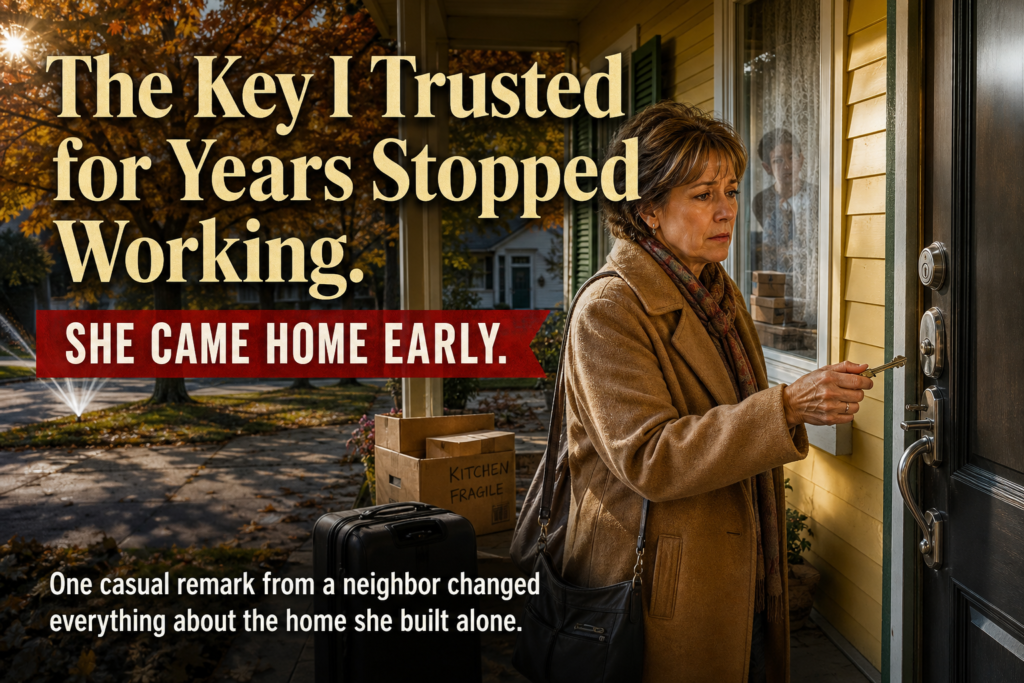
Then I rounded the bend and saw my house, the little yellow one with the green shutters I had painted myself the summer I turned fifty. A cardboard box sat on the porch. And another beside it, flattened and tossed against the railing, with a label printed in handwriting I did not recognize.
My knees went soft.
I turned back and walked to where I had left my rental car arranged for the airport lot, and I sat inside it, my hands locked on the wheel. From there I could see the front window. And through the window, plain as a photograph, I could see boxes stacked in my living room.
None of them were mine.
Part 3
I sat there for nearly twenty minutes.
I know because I watched the clock on the dashboard, the green numbers flicking forward one by one while my heart beat so hard I felt it in my teeth. Twice I reached for the door handle. Twice I let go.
It is a strange thing to be afraid of your own front door.
I had bought that house at forty-four, alone, with money I had saved one careful dollar at a time. I had worked double shifts at the hospital billing office for years, eating crackers for dinner, turning down trips and dresses and dinners out. When the papers were signed and the realtor handed me the keys, I sat on the empty living room floor and wept with a joy so large it frightened me. Nobody had given me that house. I had built it, brick by patient brick, out of my own tired hands.
And now there were strangers’ boxes in it.
A curtain moved in the upstairs window. Just a flicker, a shift of fabric, and then stillness.
Someone was home.
I thought about calling the police. I thought about calling Marguerite. I thought about turning the car around and driving until the whole thing dissolved into a bad dream. But underneath all of it, steady as a pulse, was a single stubborn thought: I need to hear it from her. I need to see her face.
Because I still hoped. That was the humiliating part. Even then, with the evidence stacked in my living room like a verdict, I hoped there was a version of this story where I would laugh at myself afterward. Where Nora would open the door with flour on her hands and say, “Surprise! I was going to redo the whole place for you.”
I knew better. But hope does not ask permission.
I stepped out of the car. The air smelled of cut grass and woodsmoke. My legs carried me up the sidewalk as though they belonged to someone braver, past Mr. Alvarez’s waving sprinkler, past the mailbox with its faded brass numbers, up the three concrete steps I had scrubbed a thousand times.
The boxes on the porch were closer now. One had a label that read KITCHEN, FRAGILE in thick black marker. My kitchen. My fragile things.
I took out my keys. The little brass one, worn smooth by eleven years of use, slid into the lock the way it always had, with that familiar small click of welcome.
I turned it.
Nothing.
I tried again, gentler, as though the lock were an animal I had startled. The key went in but would not turn. I pulled it out and stared at it, and then at the door, and I noticed something I had missed in my fear. The deadbolt was new. Bright, unscratched steel, gleaming where the old one had been dull and dark.
Someone had changed it.
The cold that moved through me then was unlike anything I had felt before. It was not anger, not yet. It was the deep, quiet understanding that the ground beneath me had never been solid.
I lifted my hand to knock, and before my knuckles touched the wood, I heard footsteps inside. Slow ones, crossing my hardwood floor. The footsteps stopped just on the other side of the door.
The lock turned, but the door did not open.
Instead a voice called out, muffled and wary. “Hello? Who is that?”
I knew that voice. I had known it for years.
But it was not Nora’s.
Part 4
“Who is it?” the voice called again, sharper now.
My mouth opened, but nothing came out. The voice was older than Nora’s, rougher at the edges, with a tremor I had once known as well as my own pulse. I pressed my palm flat against the wood as if I could feel the answer through it.
“Celeste?” I whispered.
Silence. Then the sound of the chain sliding free, and the door opened four inches, no more.
My younger sister looked out at me. Her hair was grayer than I remembered, pulled into a careless knot, and she wore a cardigan I had given her ten Christmases ago. For a moment neither of us moved. We had not shared a room in almost six years, not since the funeral, not since the argument over our mother’s things that had turned two grown women into strangers.
“Ines,” she said. The color left her face. “You’re not supposed to be home until tomorrow.”
“No,” I said. “I imagine I’m not.”
She glanced past me toward the street, as though checking for witnesses, and then opened the door the rest of the way. I stepped across my own threshold like a guest.
The living room had been rearranged. My reading chair was pushed against the far wall, my mother’s old quilt folded over its arm. In its place stood a narrow bed frame without a mattress, and everywhere, boxes. Some were taped shut, some gaping. I saw a lamp I did not own, a stack of framed photographs turned face-down, a kettle wrapped in newspaper.
“Where is Nora?” I asked.
“Gone out. Back soon, I think.” Celeste hugged her elbows. “Ines, please. Before you say anything, let me explain.”
“I would like that very much.” My voice sounded calm and distant, like a stranger’s. “Start with why my lock has been changed.”
Her eyes dropped to the floor. “Nora said it was safer. She said the old one was loose and anyone could get in.”
“The old one worked for eleven years.”
“I didn’t know that.”
“And the moving truck? The boxes? Celeste, what are you doing in my house?”
She lifted her face then, and I saw that her eyes were red, the rims swollen as though she had been crying for days. It stopped the anger in my throat. I had braced myself for a thief, a schemer, a stranger. I had not braced myself for my sister looking like a woman at the end of her rope.
“She told me you knew,” Celeste said quietly. “She told me you offered.”
The room seemed to tilt.
“Offered what?”
“A place to stay. For as long as I needed. She said you had been worried about me and wanted it kept quiet, so I wouldn’t feel ashamed. She said you were away and that she would handle everything.” Her voice cracked on the last word. “I thought you had forgiven me, Ines. After all this time. I thought that was what it meant.”
I stared at her. Outside, a car slowed on the street, and then rolled on.
“I never offered you anything,” I said, very softly. “I haven’t spoken to you in six years.”
Celeste pressed her hand to her mouth. Behind her, on the kitchen counter, I noticed a phone charger plugged in beside my toaster, and next to it a sheet of paper covered in Nora’s looping handwriting. I could read the first line from where I stood.
What to say if Aunt Ines comes home early.
Part 5
I crossed the room before I could think.
The paper was a page torn from one of my own kitchen notepads, the ones with the little cardinal printed in the corner. Nora’s handwriting slanted across it, quick and rounded, the same handwriting that had once signed birthday cards to me with hearts over the i’s.
Celeste stepped forward. “Ines, don’t.”
I read it anyway.
1. Don’t open the door unless it’s me. 2. If she calls, say everything is fine. 3. Keep Aunt calm. Don’t argue. She’ll come around once she sees you’re settled. 4. Do NOT mention the money.
I read the last line twice.
“What money?” I said.
Celeste said nothing. She had gone very still, like a deer at the edge of a road.
“Celeste. What money?”
“I don’t know what she means.” The answer came too fast. She lowered herself onto the edge of the bare bed frame, and the metal creaked under her. “I swear to you, I don’t. Nora said she was helping me. I had lost the apartment. The landlord sold the building and I had nowhere, and I was too proud to call you. Nora found me. She was kind. She said she would fix it.”
“By moving you into my home without asking me.”
“By moving me into a place where I would be safe.” Her chin trembled. “I should have asked questions. I know that. But when someone offers you a door after years of closed ones, Ines, you do not stand in the doorway interrogating it.”
That sentence landed somewhere deep. I sat down on a box marked BOOKS, because my legs had stopped being reliable.
For a while neither of us spoke. The old clock in the hallway ticked out its slow, patient seconds. Somewhere upstairs a pipe knocked, a sound I had heard ten thousand times and never once noticed until now.
“Tell me about the day she came to you,” I said at last.
Celeste wiped her eyes with the cuff of her cardigan. “Three weeks ago. A Thursday. I was sitting in a diner trying to make a cup of tea last two hours, because it was warmer than my car.” She let out a shaky, humorless laugh. “Nora walked in like she had been looking for me all along. She sat down across from me and said, ‘Aunt Celeste, I think we can fix a lot of things.’ She said you were going on a trip, and that the timing was a sign.”
“A sign.”
“Her word.” She looked at me, and the shame in her face was so raw I almost wanted to look away. “She was so convincing, Ines. She cried a little. She said the family had been broken too long, and that she was the only one who could stitch it together. I believed her because I wanted to.”
I knew that feeling. God help me, I knew it intimately. I had been sitting in my car twenty minutes ago wanting to believe the very same thing.
“Did she ask you for anything?” I said. “Papers? Signatures? Any money?”
“She asked me to sign a few forms. She said they were for the move. For the utilities and the mail.” Celeste’s eyes widened as she heard her own words. “I didn’t read them. I didn’t read them, Ines.”
The air in the room thickened. I looked at the neat stacks of boxes, the face-down photographs, the new lock gleaming on a door I had thought belonged to me, and I felt something shift inside the story I had been telling myself. This was bigger than a spare key. This had been built carefully, patiently, with a plan in numbered steps.
“Where did you put them?” I asked. “The forms.”
She pointed with a shaking finger toward the dining room table, where a manila folder sat beneath a bowl of plastic fruit.
I rose and walked toward it. My hand had just closed around the folder’s edge when I heard a sound that made every muscle in my body go rigid.
A key was turning in the front door.
Not mine. Not Celeste’s. A new key, in a new lock, turned by someone who had every reason to believe the house was hers.
Part 6
The door swung open, and the morning light fell across the floor in a long gold rectangle.
Nora stood in it with a paper bag from the bakery on the corner in one hand and a tray of coffees in the other. She was humming. I want to remember that clearly, because the memory still has the power to turn my stomach. She was humming, the way she used to hum in my kitchen when she was happy.
She was wearing the green scarf I had given her two birthdays ago.
She saw Celeste first, pale on the edge of the bed. Then she saw me, standing by the dining table with the folder in my hands.
The humming stopped.
For a long moment nobody breathed. The coffee cups trembled slightly in the tray, and I watched my niece’s face do something I will never forget. It did not crumple with guilt. It did not flare with anger. It went smooth, perfectly smooth, like a lake sealing itself over a dropped stone.
“Aunt Ines,” she said warmly. “You’re home early.”
“I am.”
“You should have called. I would have picked you up.” She stepped inside and set the bakery bag on the counter with the ease of someone who lived there. “I brought your favorite. The almond ones. I was going to surprise you tomorrow.”
“I’m surprised,” I said.
She laughed, a small, bright sound. It was the laugh I had loved since she was a child, and now it made my skin crawl. “Oh, Aunt. You look so tired. Sit down. Let me explain everything, because I know how this must look.”
“Then explain it.”
“Not with Mama Celeste standing there looking like she’s seen a ghost.” She turned toward my sister with a tender, practiced smile. “Why don’t you go upstairs and rest? Let me talk to Aunt alone.”
Celeste half rose, glancing at me. I saw the question in her face, and I realized she was waiting for permission from one of us. Two women, two years of silence, and a girl standing between them holding all the strings.
“Stay,” I said.
Nora’s smile did not change, but something behind it tightened. “Aunt, I really think—”
“I said stay, Celeste.”
My sister sat back down.
Nora set the coffee tray on the counter, slowly. She straightened the cups into a neat row. Then she looked at the folder in my hands, and for the first time since she had walked in, the lake rippled.
“You’ve been going through my things,” she said.
“Your things?” I felt the words come up out of me like something I had been swallowing for years. “Nora. This is my house. My lock. My kitchen. My table. I have been standing in my own living room for fifteen minutes, and I do not see a single thing in it that is yours.”
“I didn’t want you to find out like this.”
“How did you want me to find out?”
“Gently.” Her voice softened, wounded and wet, and I could see tears gathering as though she had summoned them. “Aunt, I was trying to help everyone. You have this whole big house and all this space, and Mama Celeste had nothing, and I had nothing. You’ve always said family comes first. I thought you would be proud of me.”
It was a beautiful performance. If I had not read that list on the counter, I might have believed every word. I might have gathered her into my arms and apologized for the harshness of my face.
Instead I opened the folder.
The first page was a form I recognized from my years in the hospital billing office, because it was the kind of document that moves money and property from one name to another. At the top, in the box marked Owner, someone had typed my name.
At the bottom, in the box marked Signature, was a signature that looked exactly like mine.
I had never signed it.
I raised my eyes to my niece. She was no longer crying. She was watching me with a stillness so complete that I understood, with a cold, clean clarity, that the girl who had once built forts in my living room had been gone a very long time, and I had been the last to know.
“Aunt Ines,” she said quietly, “put it down.”
And from the hallway behind her, where I had not seen anyone standing, a man’s voice said, “Nora, is that her?”
Part 7
The man stepped out of the hallway shadow, and I saw that he was young, perhaps thirty-two, in a rumpled work shirt with a lanyard still hanging around his neck. He had the open, slightly dazed face of someone who had been woken from a nap. In one hand he held a power drill, and in the other a small plastic bag of screws.
“Nora?” he said again. “Is this the aunt?”
“Gavin, go back upstairs,” Nora said, without turning her head.
“You said she wasn’t coming until tomorrow.”
“Gavin.”
He did not go. He looked at me, then at the folder in my hands, then at Celeste, who was gripping the edge of the bed frame as though it might carry her out of the room. I watched his gaze travel across the boxes, the new deadbolt, the coffee cups lined up like soldiers, and I saw something change in him. It was not guilt. It was the first faint, sick flutter of doubt.
“Ma’am,” he said carefully, “I’m sorry. I didn’t know there’d be a problem. Nora told me the house was hers. She said her aunt had signed it over, that it was all done, and that she only needed some help getting settled.”
“Did she.”
“I installed the lock,” he said, and his ears turned red. “She said the old one was a safety issue.”
I looked at my niece. She stood with her hands folded in front of her, quite calm, as though we were discussing a casserole.
“Gavin,” I said, “do you know what a deed is?”
“Sort of.”
“Then you know it isn’t finished until it is notarized and filed with the county. I spent twenty-two years in a billing office. I have watched people lose homes and keep them over a single missing stamp.” I turned the page toward him so he could see the blank line at the bottom. “This has a signature. It does not have a notary seal. It has not been recorded anywhere. It is a piece of paper that wants very badly to be something else.”
“Aunt, you are overreacting,” Nora said.
“And the signature?” I held it up beside my own driver’s license, which I had pulled from my purse with fingers that finally had stopped trembling. “Look at the tail on the s. I have never in my life made a tail like that. But somebody practiced it. Somebody practiced it many times.”
Gavin leaned over, and I heard him exhale. A long, slow breath, like air leaving a tire.
“Nora,” he said. “What is this?”
“It’s a formality. It’s what she would have wanted if she’d been thinking clearly.” Her voice rose for the first time, brittle at the edges. “She has no children, Gavin. Who does she think gets this house? Who has been there when she was lonely? Me. Only me.”
The words hung in the sunlit air. I felt Celeste flinch beside me, as though they had struck her, too.
“I was lonely,” I said quietly. “But I was never yours to inherit early.”
Nora’s face finally cracked. Not into tears, but into something harder and more naked, the face of a person whose careful machinery has jammed. She took one step toward me, and I saw her eyes drop, deliberately, to the folder.
“Give me that.”
“No.”
“Aunt Ines, give it to me.”
She lunged. Not violently, but fast, her hand closing over the edge of the paper. For a moment we stood tugging at it like two children over a toy, my niece and I, her perfume rising between us, the same lavender I had given her every Christmas. The page tore with a soft, dry sound.
And in the silence after it, Celeste said, in a voice I had not heard from her since we were girls, “Nora. Tell her about the four thousand dollars.”
Part 8
Nora froze with half the page in her fist.
“What four thousand dollars?” I asked.
Celeste had risen from the bed. She was a small woman, smaller than I remembered, but she stood now with her shoulders drawn back and her cardigan sleeves pushed to her elbows. It was the posture she used to take as a child before telling our mother the truth about a broken dish.
“I remembered it while you were reading that list,” she said. “Number four. Do not mention the money. I told you I didn’t know what it meant. That wasn’t quite honest. I was ashamed.” She swallowed. “Last Friday, Nora drove me to my bank. She said the new utilities needed a deposit and that you would pay me back the moment you returned. I had a little left from selling Mama’s brooch. Four thousand dollars. It was all I had in the world.”
“Celeste,” I said.
“I withdrew it in cash because she asked me to. She said it was simpler.” Celeste’s mouth twisted. “I handed it over in the car. She counted it twice and kissed my cheek.”
Gavin put down the drill. He set it on the arm of my reading chair, very gently, as though it had become dangerous. “Nora, you told me you had a settlement coming through. You told me that’s how we were paying for everything.”
“It was coming,” Nora said. “It was almost there.”
“From what?”
She did not answer. She looked from him to Celeste to me, and I watched her search the room for an exit and find none. Then, slowly, like a woman lowering herself into cold water, she sat down on a box of my books.
“The divorce took everything,” she said. Her voice had flattened, stripped of its music. “Not just the money. The lawyers, the debts he left in my name, the credit cards I didn’t know existed. I’ve been drowning for three years, Aunt. Three years. I smiled at every dinner and lay awake every night doing sums.”
“You could have told me.”
“And watched your face?” She laughed, ragged and dry. “You would have helped. You always help. And I would have had to be the girl you had to rescue forever. The one on your porch with two suitcases. I hated her, Aunt. I hated every minute of being her.”
Something broke open in my chest then, painfully, like a window forced after being painted shut. I understood her. That was the cruelest part. I understood the shame, the pride, the terrible arithmetic of a person who cannot bear to be pitied. I had made the same arithmetic myself, crackers for dinner, double shifts, never asking anyone for anything.
But understanding is not the same as permission.
“I would have helped you,” I said, “if you had asked me. I would have sat at this table with you and gone through every bill until midnight. Instead you forged my name, and you took money from a woman who had nothing, and you used my sister’s loneliness as a ladder.”
“I was going to pay it back.”
“With what? With my house?”
Nora’s lips parted, and closed again.
The old clock in the hallway struck the half hour, a single bright note, and in that quiet I heard something I had not noticed before. A faint, rhythmic tapping from the front porch. Someone was knocking, patiently, politely, the way people knock when they already know no one will be surprised to see them.
Gavin looked at Nora. Nora looked at me.
“Aunt Ines,” she whispered, “what did you do?”
I had not done anything. Not yet. But through the front window, past the stacked boxes and the lace of the curtain, I saw a white patrol car parked at the curb, and beside it, stepping out of Mr. Alvarez’s driveway with his phone still pressed to his ear, my neighbor, who had watched a stranger carry my life up the porch steps and had finally decided to ask whose it was.
Part 9
The officer who came in was a woman about my niece’s age, with a calm, unhurried voice and a notebook she did not open right away. Her name tag read Okafor. Mr. Alvarez hovered on the porch behind her, wringing his cap in both hands.
“I’m sorry, Ines,” he said through the doorway. “I saw you pull up and sit in your car, and I thought, that’s not right. Dolores told me about the truck, and I’ve felt sick about it all week.”
“You did exactly right,” I said, and meant it.
Officer Okafor asked who owned the home. I said I did, and showed her my identification and the folder of mortgage papers I kept in the hall cabinet, where they had always been, behind the winter scarves. I told her about the key, the lock, the torn page, the signature. I was surprised by my own voice. It stayed level, almost professional, as though I were explaining an error on a patient’s account.
She listened without interrupting. When I finished, she turned to the room.
“Who changed the lock?”
“I did,” Gavin said at once. “I’m so sorry, officer. I thought it was her house. I’ll tell you everything I know.”
“And you, ma’am?” She looked at Celeste.
“I’m her sister,” Celeste said. “I was told I was invited. I wasn’t. I’d like to go wherever I’m supposed to go, and I’ll answer anything you ask.”
The officer’s glance settled last on Nora, still seated on my box of books with half a page crumpled in her lap.
“Ms. Hale,” she said, “do you want to tell me your side?”
Nora stood. She smoothed her green scarf, an automatic gesture, a girl getting ready for a photograph. And then she looked at me, really looked, for the first time since the door had opened.
“Are you going to do this?” she asked. Her voice was small. “To your own niece? To the girl who used to fall asleep on your couch with her shoes on?”
The question was a hand reaching into the oldest part of me. For one second I was back in that doorway, years ago, with two suitcases and a hollow, trembling child, and every instinct I owned told me to open my arms.
“Nora,” I said, “I am not doing this. You did.”
“I was desperate.”
“I know.”
“Then forgive me. Please. Say it was a misunderstanding, and I’ll leave right now, and you’ll never hear about it again.”
Officer Okafor said nothing. She was watching me, with the careful stillness of someone who has seen this exact moment many times and knows it belongs to the person standing in it.
I thought of Marguerite on the curb in Lisbon, gripping my hand. Don’t let it make you smaller.
I thought of Celeste in the diner, nursing one cup of tea for two hours because it was warmer than her car.
“I will not say it was a misunderstanding,” I said. “Because it wasn’t, and because if I do, I will be teaching you that love has no edges. And you will do this again. To someone who may not have a neighbor like Mr. Alvarez.”
Nora’s face did something then that I can still see when I close my eyes. It did not harden. It did not break. It simply went still, like a child hearing a door shut gently down the hall.
Officer Okafor stepped forward. “Ms. Hale, I’m going to ask you to come outside with me, please.”
Nora walked toward the door. At the threshold she stopped, her back to me, and spoke without turning around.
“There’s something in the upstairs closet,” she said. “Behind the winter coats. I didn’t buy it to sell. Look at it before you decide what I am.”
Then she was gone, and the door closed softly behind her, and I stood in my silent living room with my sister and a stranger’s drill and a mystery climbing the stairs ahead of me.
Part 10
I climbed the stairs alone.
Celeste offered to come with me, but I shook my head, and she understood. The third step creaked, as it always had. The hallway smelled of cedar and the lavender sachets I tucked into every drawer. My bedroom door stood open. The bed had been slept in, and a coat of Nora’s hung on the chair, and I felt a strange, aching tenderness for that coat, and I let myself feel it, because grief and anger can share a house.
The closet was at the end of the hall. I pushed aside my winter coats, the gray wool, the old camel one I had worn to my mother’s funeral, and found, leaning against the back wall, a flat rectangle wrapped in brown paper and tied with kitchen string.
I carried it to the bed and untied the knot.
It was a framed photograph. Nora at nine, missing her front teeth, standing in a fort of couch cushions, a paper crown on her head. Beside her, laughing at the camera, was me, younger, in an apron dusted with flour. Someone had cleaned the glass. Someone had replaced the cracked backing with new cardboard. Tucked behind the frame was a receipt from a repair shop, dated eleven days ago, and a small card in that looping, familiar handwriting.
I wanted you to have it fixed when you came home. I don’t know when I started becoming someone else. I’m sorry. I think I was always going to be.
I sat on the edge of the bed with the photograph in my lap and cried for a long time. Not delicately. I cried the way I had on the empty living room floor the day I got the keys, with my whole body, with a sound I had never made in front of another human being. Downstairs, I heard Celeste’s footsteps pause at the bottom of the stairs, and then stay there, and I loved her for not climbing them.
The card did not undo the forged page. It did not return the four thousand dollars, or erase the lie, or unlock the door she had locked. It did something smaller and truer. It told me the girl in the fort had not vanished. She had only become lost inside someone who could not ask for help.
Both things were real. I decided I could carry both.
The weeks that followed were long and plain and unglamorous. I met with a lawyer and a clerk at the county office, who confirmed that nothing had been filed. Gavin gave a full statement and moved out that same night, sheepish and ashamed, leaving the new lock’s spare keys on my counter. Marguerite called every day until I made her stop. Celeste’s four thousand dollars came back in installments, through a settlement arrangement I will not describe, and the day the last payment arrived, she pressed the envelope into my hands and I pressed it right back.
“Keep it,” I said. “Find a place. A real one. Close by.”
“Ines, I don’t deserve—”
“Six years is long enough to be strangers,” I said. “Mama would have hated what we let happen.”
She wept, and I held her, and the sound of her crying was the sound of a window opening in a house that had been shut too long.
I changed the locks again, properly this time. The locksmith asked how many keys I wanted cut.
“Two,” I said. “One for me. One for my sister.”
On the first Sunday of autumn, I stood on the porch with a cup of tea, watching the maples burn gold along the street. Mr. Alvarez’s sprinkler ticked across his lawn. The photograph hung in my hallway now, in its mended frame, where I would pass it every morning.
Nora wrote to me once, months later, a short letter from a city I did not know, in handwriting that had settled and steadied. She did not ask for anything. She said she was working, that she was learning to read the forms before she signed them. I have not yet answered. But I have not thrown it away. It rests in the drawer beside my bed, and some nights I take it out, and some nights I do not.
I learned something at fifty-four that I should have known at twenty. Generosity is not a flaw, as Marguerite said. But a key, however lovingly given, is not the same as a heart, and a door that can never be closed is not kindness. It is only an absence of walls.
I still believe in giving people somewhere to land.
I just make sure, now, that I am still standing inside the house when they do.