Part 1
The first thing I noticed was the sound of the kitchen.
For fourteen years, our dinners had been loud. Valeria narrated her day with her fork in the air, doing impressions of her teachers, arguing with her little brother over the last tortilla. I used to tell her to let me get a word in. I used to say that, as a joke.
Then one Tuesday in the autumn, the noise thinned out. Her chair was still at the table, but she sat in it like a guest waiting for a bus.
“You’re not eating, mija,” I said.
“I’m not hungry.” She didn’t look up. “I had a big lunch.”
I let it go. A mother learns which battles to pick, and that one seemed small. The next night it was a stomachache. The night after that, homework she needed to finish upstairs. By the end of the first month, her plate had become a thing she moved around rather than something she ate from, and her chair was empty more often than not.
I told myself what mothers tell themselves. She’s growing. She’s fourteen. Girls her age go through strange seasons.
My sister called on a Sunday and asked, carefully, whether Valeria was okay. “She looks smaller,” she said. “Her face.”
“It’s a phase,” I said, a little too sharply. “You don’t live here.”
But that night, I stood in the hallway outside the bathroom while my daughter was in the shower. Through the gap under the door I could see her sweater folded on the floor. It looked like it belonged to a child half her size. I put my hand over my mouth and stood there until the water shut off.
I did not say anything. I want that on the record, because I have gone over it a thousand times since. I stood in that hallway, and I was afraid of the answer, so I did not ask the question.
The next morning I made her favorite breakfast, eggs with chorizo, and the smell filled the whole house. She came downstairs in her school uniform, kissed my cheek, and said, “Thanks, Mami, but I’m late.”
The front door closed. The eggs went cold on the stove.
I stood there for a long time, listening to the quiet she had left behind. Then I did something I had never done in fourteen years of raising her. I went upstairs, into her room, and I began to look.
Part 2
I told myself I was only going to change her sheets.
That was the lie I carried up the stairs, a clean set of pillowcases folded over my arm like proof of innocence. Her room smelled like vanilla body spray and the particular dust of teenage things. Posters curled at the corners. A hairbrush lay on the dresser with her dark strands still caught in the bristles. Everything was in its place, almost too much in its place. Valeria had never been a tidy girl.
I pulled back the comforter. I tugged at the corner of the mattress to lift it, and my hand brushed something stiff and flat that was not supposed to be there.
A notebook. Purple cover, a small brass lock hanging open, broken or never fastened. The corners were soft from handling. It had been opened many, many times.
I sat down on the edge of her bed with it in my lap.
“Don’t,” I whispered to myself. “She’ll never forgive you.”
But I thought of the sweater on the bathroom floor. I thought of the empty chair. I thought of my sister’s voice saying her face. I turned back the cover.
The first page was written in her neat, round handwriting, the same handwriting that had once labeled her school folders with hearts over the i’s. The ink was darker at the start of each line, as if she had pressed hard.
“Day 1 of not eating. If I’m thin enough, maybe he’ll stop.”
I read it once. Then the words stopped being words. The room tilted, the edges of the page swam, and I realized I was not breathing. I pressed the heel of my hand against my mouth so the sound that wanted out would not wake a house that was empty anyway.
He.
Who was he?
I stared at that one small word until it felt like a hand around my throat. Maybe he’ll stop. Stop what? Stop doing what? My mind ran through every face in my daughter’s life like a deck of cards thrown across a table, and I hated myself for every single one.
I wanted to read the next page. I needed to, the way you need to put pressure on a wound. But my eyes would not focus, and my fingers would not turn the paper. Something deep in me understood that if I read another line alone in that quiet room, I would come apart and not be able to put myself back together in time.
Time. It was suddenly the only word that mattered. Valeria would be home from school in a few hours, and she would sit at our table and say she wasn’t hungry, and I would know.
I closed the diary. I held it against my chest, and I felt my own heart pounding against the cover.
Then I grabbed my keys, and I did not even stop to put on my shoes properly.
Part 3
I do not remember the drive.
I remember pieces. A red light I ran. The steering wheel slick under my palms. The diary on the passenger seat, face down, as if it might bite. At one point I said out loud, to no one, “Please let me be wrong,” and my voice cracked in the empty car.
Valeria’s school sat behind a black iron fence at the top of a hill, all clean brick and trimmed hedges. The banner over the entrance read EXCELLENCE IN EVERY STUDENT. I had cried happy tears under that banner at her eighth-grade awards night. Now it looked like a lie painted in school colors.
The woman at the front desk was mid-sentence when I walked in. “Ma’am, you need to sign in, and—”
“I need the principal,” I said. “Now.”
“Do you have an appointment?”
“I have a daughter.”
Something in my face must have stopped her. She picked up the phone without another word.
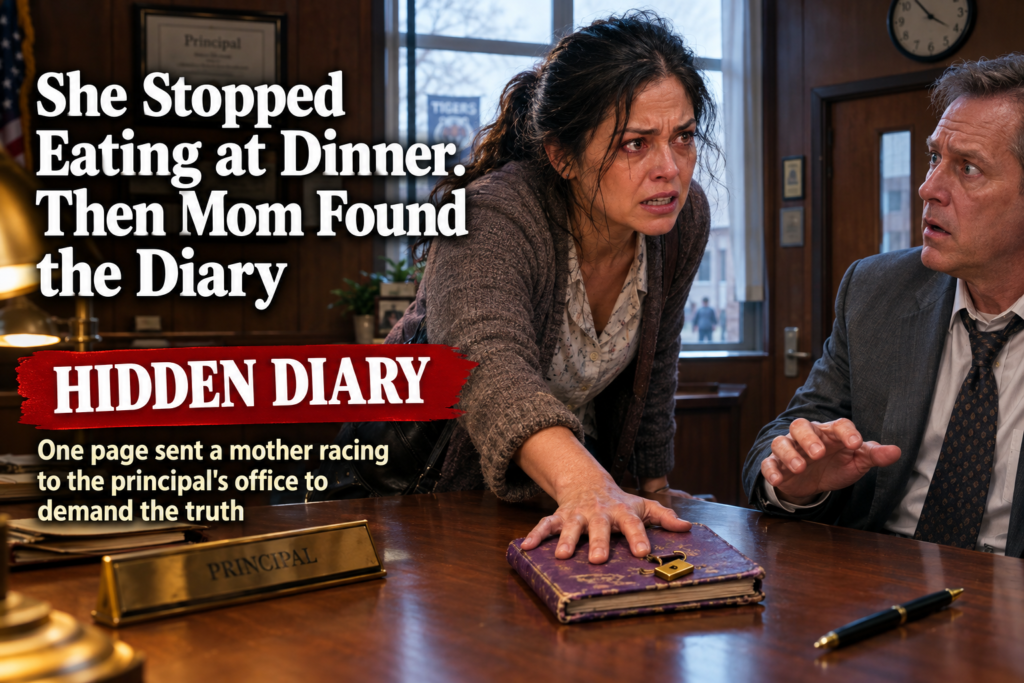
The principal’s office was paneled in dark wood. Framed certificates lined the walls, and a small brass plaque on the desk read his name beside the word PRINCIPAL. He rose when I came in, buttoning his jacket, and offered a hand and the practiced smile of a man who had greeted a thousand worried parents.
I did not take his hand.
“Mrs. Torres,” he said. “Please, sit. What can I do for you?”
“Something is happening to my daughter in this school.”
The smile stayed, but it thinned. He lowered himself back into his chair and folded his hands. “I understand you’re worried. But Valeria is one of our best students. Her grades are exceptional. Her teachers adore her. Nothing is wrong, Mrs. Torres.”
“Nothing is wrong,” I repeated.
“I would know.”
“She stopped eating three months ago.” My voice shook, and I hated that it shook. “She’s disappearing in front of me. You would know?”
“Children go through adjustments,” he said gently, and the gentleness was the worst part. It was the voice you use on someone you have already decided is overreacting. “Perhaps a conversation with her pediatrician would—”
I did not let him finish.
I reached into my bag, pulled out the purple notebook, and slammed it onto his desk so hard that his pen jumped and rolled off the edge. The sound cracked through the quiet office like a gunshot.
“Read it,” I said.
“Mrs. Torres, I really don’t think—”
“Read the first page.”
For a moment he only looked at me. Then, slowly, as if humoring a woman who might still be talked down, he pulled the notebook toward him and opened the cover.
I watched his eyes move across the page. Left to right. Then back to the start, and across again.
I have thought a great deal about that moment. I have never forgotten what I saw happen to his face. The patient, practiced warmth did not fade. It fell away all at once, like a mask cut loose from its strings. The color left his skin. His mouth opened slightly, and no words came out of it.
“Where,” he said, and his voice was nothing like it had been. “Where did you find this?”
“Under her mattress.”
He read another line. His hand, the one holding the page flat, had begun to tremble.
“Who is he?” I said. “You know something. Tell me who he is.”
He did not answer. He did not look at me. He reached for the phone on his desk with a hand that did not seem to belong to him, and he pressed three numbers, slowly, as though each button weighed more than the last.
The line clicked. Someone picked up on the other end.
And when the principal finally spoke, he did not say my daughter’s name. He did not say the name of any student at all.
Part 4
“This is Daniel Reyes,” the principal said into the phone. “I need you to come to my office. Yes, now. Bring the file.” He paused, listening. “No. Not the district. Just come.”
He set the receiver down with great care, the way you set down something that might break, and he did not pick up his pen from the floor.
“Mrs. Torres,” he said. “Who did you call? Who was that?”
“Someone who needs to see this.” He pressed two fingers against his eyelids. “Please. I am asking you to give me five minutes before I say anything I cannot take back.”
“You’ve had three months,” I said. “I have had none.”
He flinched. It was small, but I saw it.
The clock above his door ticked, loud as a hammer. I stood because I could not sit. Through the narrow window beside his bookshelf I could see the courtyard, where a few students crossed the grass with their backpacks hanging off one shoulder. Children. Just children. I searched every one of them for my daughter’s face.
“Is she here?” I asked. “Right now, is she in this building?”
“She’s in third period. She’s safe.”
“Safe.” I laughed, and the sound scared me. “Mr. Reyes, my daughter wrote that she is starving herself so someone will stop hurting her. Do not use that word with me.”
He opened his mouth, and I thought he might finally say it. Instead he looked down at the notebook, and his eyes went to the second page. I saw his throat move.
“Did you read past the first line?” he asked quietly.
“I couldn’t.”
Something crossed his face then that I did not expect. It was not guilt, exactly. It was closer to dread, the look of a man watching a door he has leaned against for a long time begin to give way.
“Then I need you to prepare yourself,” he said. “Because I don’t think this is the first time I’ve seen his name.”
My knees went soft. I gripped the back of the chair.
“His name,” I said. “It’s written there?”
Before he could answer, there were footsteps in the corridor, quick and heavy, and the frosted glass of the office door darkened with a shape. A hand knocked twice.
Mr. Reyes closed his eyes for a single second, like a man saying a prayer he did not believe in.
Then he said, “Come in.”
Part 5
The door opened, and a woman stepped inside.
She was about fifty, with gray threaded through her dark hair and a lanyard around her neck that read COUNSELING. She carried a thick manila folder against her chest the way I had carried the diary. When she saw me, she stopped. Her eyes went to the notebook on the desk, and her face did what the principal’s had done. It fell open.
“Oh,” she said. “Oh, no. She found it herself.”
“Ms. Alvarado,” Mr. Reyes said. “This is Valeria’s mother.”
“I know who she is.” Her voice was soft and unsteady. She set the folder down and turned to me with both hands slightly raised, the way you approach an animal in pain. “Mrs. Torres. I am so sorry. I have wanted to call you for weeks.”
“Weeks,” I said.
“Please sit. Please.”
“I will not sit.” I heard my own voice climbing. “Somebody tell me what is happening to my child. Right now. Somebody say it out loud.”
Ms. Alvarado glanced at the principal. Something passed between them, an argument they had clearly had before, in other rooms, with the doors closed.
“I tried to bring it to you,” she said to him, and her voice finally hardened. “Twice. You told me there was no evidence.”
“I told you we needed more than a feeling.”
“She is a fourteen-year-old girl who started flinching when a certain person walked past her in the hallway. What more did you want?”
“Stop,” I said. “Both of you.”
The room went still.
“Who,” I said, and I made each word separate, “is he.”
Ms. Alvarado’s eyes filled. She pressed her lips together, then nodded, as if she had finally given herself permission.
“Three months ago, Valeria came to my office on her own,” she said. “She sat in that chair by the window and did not say a word for forty minutes. She only asked if what she told me could ever be repeated. I explained that some things I am required to report. She stood up, said never mind, and left.”
“You let her leave?”
“I followed the rules I was given.” Her voice broke on the last word. “That is not the same as doing right by her, and I have known the difference every night since.”
I thought of the empty chair at our table. Three months. Ninety dinners.
“She came back, didn’t she?” I whispered.
“Once. Two weeks ago.” Ms. Alvarado opened the folder with shaking fingers. “She didn’t speak. She slid a note across my desk and walked out. I have kept it ever since, because I did not know who I could trust with it.”
She drew out a small square of lined paper, folded many times, and laid it on the desk beside the diary. Three words were written on it, in the same round handwriting that once put hearts over the i’s.
I leaned in to read them, and the whole room seemed to tip.
Part 6
*Please help Mami.*
That was what the note said. Not help me. Help Mami.
I read it four times. Each time the words rearranged themselves into something I could not hold, until my legs finally gave out and I sank into the chair I had refused. Ms. Alvarado knelt beside me and put her hand over mine. I did not push it away.
“Why would she write that?” My voice was barely there. “Why me? Why would she be asking for help for me?”
“I don’t know,” Ms. Alvarado said. “I have asked myself every night. But I think she was afraid of something happening to you, Mrs. Torres. I think whatever she is carrying, she believes it protects you.”
Protects me.
The diary sat open on the desk, one page turned toward the ceiling lights. I could not stand not knowing for one more second. I reached across and pulled it toward me, and this time my eyes held.
The second page was shorter. Valeria had written it in smaller letters, as if she wanted the words to take up less room.
“Day 9. Mami asked why I’m not eating. I almost told her. Then he looked at me from across the kitchen and I couldn’t. He said if I ever tell, she’ll lose everything. The house. Alex’s school. Her job. I don’t want Mami to lose everything. So I’ll just get smaller. If I’m small enough, maybe he won’t want to look at me.”
The kitchen.
The word hit me like cold water. He had been in our kitchen. At our table, while I passed bowls and refilled glasses and laughed. A man my daughter was afraid of had sat in my home, and I had handed him a plate.
“Who comes to our house?” I said, and I did not recognize my own voice. It had gone flat and low, a voice from some older place in me. “Mr. Reyes. Look at me. Who comes to my house, and also walks these halls?”
The principal had gone gray. He lowered himself slowly into his chair, and when he spoke, he looked at the notebook instead of at me.
“Mrs. Torres,” he said. “There is a name in the file Ms. Alvarado brought. A name that appears next to your daughter’s, in a report from last spring. I did not want to believe it, because I have known this person for eleven years. I trusted him. I put him in charge of things.”
“Say it.”
“I need you to remember that I did not know what he was.”
“Say his name.”
Ms. Alvarado’s grip tightened on my hand. Mr. Reyes lifted his eyes at last, and what I saw in them was not an excuse. It was shame, huge and naked.
He spoke the name.
And the strangest thing happened. The room did not tilt, and my vision did not blur. Everything went perfectly, terribly clear, because I knew that name. I had said it a hundred times. I had thanked him for it.
He had eaten at my table only last Sunday.
Part 7
Gerald Pruitt.
Athletic director. Volunteer coach. The man who had driven Alex home from soccer practice in the rain the year my car died. He had stood in my kitchen at Christmas wearing a paper crown from a cracker and told me I was doing a wonderful job on my own. When Valeria’s father left, Gerald was the one who showed up with a toolbox and fixed the back gate without being asked. I had told people, actually told them, that God sends us the right person at the right time.
Last Sunday he had brought a flan from the bakery on Fourth Street. I had cut it into slices and handed the first one to him.
“No,” I said. It was not an answer to anything anyone had asked. “No. He sat next to her.”
Nobody spoke. Ms. Alvarado’s hand tightened around mine.
I remembered it all at once, the way you remember a house fire once you have smelled smoke. Valeria pushing back her chair before dessert. Gerald saying, “Let her go, Rosa, teenagers,” with that warm, easy laugh. Me nodding, grateful for his understanding. I had thanked him for it.
“Mrs. Torres,” Mr. Reyes said. “Breathe, please.”
“Don’t tell me to breathe.” I stood, and the chair scraped backward. “He has been in my house. He has been alone with my children.”
“I know.”
“You put him in charge of things. You said it yourself.”
“I did.” He did not look away this time. “And I will spend the rest of my life answering for that. But right now, the most useful thing I can do is make a call I should have made months ago.”
He lifted the receiver again. This time his hand did not shake. He dialed, and I heard him say, in a voice stripped of every polite habit, “This is Daniel Reyes at the high school. I need to report suspected abuse of a minor by a staff member. I need officers here, and I need someone from child protective services. Yes. Today. Now.”
The principal, who an hour earlier had told me nothing was wrong, was saying it all aloud in plain words. I do not know what I expected to feel. Relief, maybe. Instead there was only a terrible, ringing hollowness, because hearing it said made it real.
“Where is Valeria?” I asked Ms. Alvarado. “I want her. I want to see her face.”
“Officers will want to handle that carefully,” she said. “She has been afraid for a long time. We have to let her come to us safely, without anyone alarming her.”
“She is my daughter.”
“I know. And I promise you will be the first person she sees. But Mrs. Torres, please listen. If he is in this building, he must not know what we know. Not yet.”
I opened my mouth to answer, and my phone buzzed in my bag.
I pulled it out with numb fingers. The screen lit up with a name I had saved years ago, with a small smiling photo beside it.
Gerald: Hey Rosa, saw your car in the lot. Everything okay? Heading to the front office now, want to make sure you’re alright.
I read it twice. Then I looked up at the frosted glass of the office door.
A shadow was moving down the corridor toward us, unhurried, and it was whistling.
Part 8
I knew that whistle.
He whistled at my stove while he waited for coffee. He whistled when he carried groceries in from my car. It was a cheerful, tuneless sound, and for years I had taken it as proof of a man at peace with the world.
Mr. Reyes moved faster than I would have believed. He crossed the room in three strides and turned the lock on the door. Ms. Alvarado pulled me back from the glass by the elbow.
“Do not make a sound,” she whispered. “Please.”
The shadow stopped outside. The whistling stopped with it.
A soft knock came, two taps, polite as a neighbor’s.
“Daniel?” His voice came through the wood, easy and friendly. “You in there? Rosa Torres is here, I just got a text from her. Everything all right?”
I could not breathe. My own phone was still in my hand, and I realized he had texted me from the other side of that door.
Mr. Reyes stood very straight. When he answered, his voice was almost steady. “I’m in a meeting, Gerald. I’ll find you later.”
“No rush. I’ll wait.”
“I said later.”
A pause. It was brief, but I felt it in my teeth. Then the handle turned, once, testing, and I heard the lock hold.
“Sure,” Gerald said, still pleasant. “Sure thing.”
His footsteps moved away. They were slow, and they were not the footsteps of a man who suspected anything. They were the footsteps of a man who believed he had never been caught at anything in his life.
I slid down the paneled wall until I was sitting on the floor with the diary pressed to my chest. Ms. Alvarado crouched beside me. I could hear the principal breathing hard through his nose, like a man who had just run a mile.
“He doesn’t know,” I whispered.
“Not yet,” Mr. Reyes said.
It felt like hours. It was eleven minutes. I counted them on the clock above the door. Then there were new voices in the hallway, firm and low, and the click of a radio. A uniformed officer knocked and said Mr. Reyes’s name. When he opened the door, two officers stood there with a woman in a plain blazer who carried a lanyard of her own.
“Where is he?” one of them asked quietly.
“Heading toward the gym,” Mr. Reyes said. “Blue jacket. Gerald Pruitt.”
The officers were gone before the sentence was finished. I heard their boots cross the tile, fading, and then, far away, a door banging open. I pressed both hands over my mouth and listened to the sound of a man I had trusted being walked out of my daughter’s school.
The woman in the blazer knelt in front of me. “Mrs. Torres, my name is Dana Whitfield. I’m with child protective services. I know this is the worst day of your life. I need to ask you something very gently.”
“Where is my daughter?”
“She’s being brought to the counseling suite now. A teacher told her there was a family matter. She doesn’t know it’s you.” Her eyes held mine. “She’s going to be frightened when she sees you. I need you to be the strongest you have ever been.”
I stood. My legs shook, but they held.
We walked down a hallway that smelled of floor wax and old lockers. Ms. Alvarado opened a door at the end, and the room beyond was small, with a couch, a lamp, and a box of tissues.
On the couch, with her backpack clutched to her stomach and her knees drawn up, sat my daughter.
She lifted her eyes and saw me. Her whole face went white.
“Mami,” she said. “No. You weren’t supposed to find out.”
Part 9
I had imagined many things on the drive to that school. I had never imagined she would be afraid for me.
She was already half off the couch, backpack sliding to the floor, her eyes darting from my face to the door behind me. “Where is he? Is he here? Mami, you have to go home. Please. You have to take Alex and go home before—”
“Valeria.” I crossed the room in two steps and knelt in front of her, and for the first time in months I could really see her. The hollows under her cheekbones. The wrist bones like small stones beneath the skin. The shadows under her eyes, which were my mother’s eyes, wide and dark and far too old. “Mija. Look at me. He is not here. He cannot come near you. He is never coming near you again.”
“You don’t know him.” Her voice cracked and split. “He said. He said you’d lose everything.”
“I know what he said.”
“The house. Alex’s school. Your job. He knows people, Mami, he said he has friends who—”
“Mija.” I took her face in both my hands. They were shaking, but I held her anyway. “Do you hear me? I do not care about the house.”
She stared at me.
“I do not care about the house,” I said again, slowly. “I do not care about my job, or the school, or one single thing that man ever told you I would lose. I would sleep on the floor of a bus station with you and Alex and count myself rich. You are the only thing I have ever been afraid of losing. And I almost did, and I did not even know it.”
Something in her face began to give way. It started at the chin, a tremor she tried to bite back, and then her whole body folded forward into my arms, and the sound she made was not crying. It was something older and lower, a sound that had been waiting inside her for months for permission to come out.
I held her. I rocked her the way I had when she was small and woke from nightmares, and I said the only words I had. “I’ve got you. I’ve got you. I am here.”
Ms. Alvarado had turned away to give us privacy, her shoulders trembling. Dana Whitfield stood by the door, very still, her eyes wet.
“I wrote it so you’d find it,” Valeria said into my shoulder. “I think I wrote it so you’d find it. I couldn’t say it. But I didn’t know how to want you to know.”
“You said it in the only way you could,” I told her. “You asked for help. You wrote it down, and you asked a counselor to help me. Do you know how brave that is?”
“I stopped eating,” she whispered. “I thought if I was small enough, I’d disappear, and he wouldn’t see me.”
“You never have to disappear.” I pulled back to look at her, brushing wet hair from her cheeks. “Not from me. Not ever.”
She nodded, breathing in ragged pieces. Then she looked past me, toward the woman at the door, and I saw her sit up straighter, wiping her face with her sleeve.
“Is she here to ask me questions?” she said.
“She is,” I said. “Only when you’re ready. And I will be right beside you for every word. You do not have to do this today, mija.”
Valeria looked down at her hands. Then she looked at the purple notebook, still clutched in mine, and at the small brass lock that had never held.
“I want to tell it myself,” she said. “From the beginning. And I want you to hear it, Mami. Even the parts that are going to hurt.”
I took her hand. It was so thin in mine. I held on to it with everything I had.
“Then start,” I said. “I’m listening.”
She drew one long breath, as if she were about to dive into deep water, and opened her mouth.
Part 10
It took her three hours. I will not write down what she told us, because those words belong to her, and she has earned the right to decide who hears them. I will say only that I did not look away. I held her hand through every sentence, and when she apologized for how long it was taking, I told her she could take all the time in the world.
Gerald Pruitt was arrested that afternoon, at the edge of the gym parking lot, with his keys in his hand and an expression I am told was one of honest bewilderment. The investigation took many months. There were other people who came forward once they heard, quiet people with old stories and heavy silences. I will not pretend that part was easy for anyone. But it was done properly and thoroughly, by people who took Valeria seriously from the first minute, and for that I will be grateful to the end of my life.
We did lose some things. I took a leave from work and did not mind it. We sold the house a year later, not because anyone made us, but because I could not walk past the kitchen without seeing a man’s hand on the back of her chair. Alex changed schools too. I explained to him, in words I chose with great care, that his sister had been hurt and that she was safe now. He listened with his serious little face, and then he climbed into her lap on the couch and fell asleep there, and she let him.
Mr. Reyes resigned before he could be asked. He wrote us a letter. I read it once and kept it, though I have not decided yet what I feel about it. Ms. Alvarado stayed, and she and Valeria still meet every Thursday, in the room with the lamp and the box of tissues. She calls it their appointment. Valeria calls it their tradition.
The real work came slowly, and it came at our table.
The first night after everything, I set out three plates and did not say a word about food. Valeria sat down, looked at hers for a long time, and pushed a single grain of rice from one side to the other. I did not tell her to eat. I peeled an orange and ate a piece of it myself, slowly, and told her about the day my mother taught me to make tamales with burned fingers and a stubborn heart. She laughed once, a small, startled sound, like a window opening in a house that had been shut up for years.
There were setbacks. There were nights she could not manage more than a few bites, and mornings I found her standing at the bathroom mirror, hating what she saw. On those days I sat beside her on the edge of the tub and did not offer solutions. I only stayed. A counselor taught us both that recovery is not a straight road, and that love, most days, looks like simply refusing to leave.
Three months to the day after I found the diary, we sat down to dinner, the three of us, in our new, smaller kitchen. It was Tuesday. Alex was arguing about the last tortilla.
“You always get it,” he complained. “It’s not fair.”
“I’m older,” Valeria said. “It’s the law.”
“That’s not a law!”
“Ask Mami.”
I looked at my daughter, her fork in the air, a little color in her cheeks, a bite of food in her mouth. The kitchen was loud again. I had to look down at my plate for a moment so neither of them would see my face.
“Let me get a word in,” I said, and my voice broke on the joke.
Valeria grinned at me, and it was her real grin, the one I thought I had lost forever. Then she reached across the table, took the last tortilla, tore it neatly in half, and handed one piece to her brother.
That night she brought me the purple notebook. She had written a new page, the first in months, and she set it in my hands without a word and went to brush her teeth.
I read it by the light of the stove.
“Day 1 of eating again. I told. And Mami stayed.”
I closed the diary. I held it against my chest, as I had that terrible morning, and felt my heart pounding against the cover. But this time it was not the sound of fear.
It was the sound of a home with all its voices in it, together, finally, at the table.