Part 1
The house next door had been silent for eleven days before anyone noticed.
I noticed first, though I told myself it was nothing. Her porch light stayed on through the afternoon. Her newspaper curled yellow on the step. For twenty-three years Mrs. Alder had raised one hand from that porch every morning at seven, a small wave, like a woman signaling a ship she knew would never dock. Now the hand was gone.
I called the sheriff’s office on a Thursday. Two deputies came, then a man from the county, then a van with no windows. I stood at my fence in my work boots and watched them carry her out under a gray blanket, and I felt something I had no right to feel. I felt like I had lost a relative.
“Any family you know of?” one deputy asked me.
“No,” I said. “She never had visitors. Not once. Not at Christmas, not on her birthday. I used to leave tomatoes on her step in August, and she’d leave the empty bowl back on mine, washed. That was the whole of it.”
He wrote something down. “Then it goes to the county.”
It went to the county. Eighty-two years old, and her whole life fit inside a single line on a form: no next of kin.
The funeral was a Tuesday at a graveside the county paid for. Four people came. The minister, a clerk, a gravedigger leaning on his shovel, and me. I held my hat in both hands and tried to think of something to say, and all I could manage was, “She waved at me every morning. I never waved first. I’m sorry.”
The minister gave me a kind look and said nothing.
Three months later, the county listed her house for auction. I told myself I was only going to watch. My wife, Dana, had left two years before, the kids were grown and scattered, and my own house had gotten too large and too quiet. I told myself I was curious. I told myself a lot of things.
When the auctioneer’s gavel came down, my paddle was in the air.
“Sold,” he said, “for one hundred eighty-seven thousand dollars.”
I sat in that folding chair with my heart pounding, wondering what on earth I had just done. I had bought a dead woman’s life. I did not yet understand that she had been expecting me.
The keys came in a manila envelope. They were cold and heavier than they should have been. I stood on her porch that evening, in the exact spot where she had always stood, and looked across at my own house.
From here, I realized, she had been able to see every window of it.
I turned the key. The door opened with a long sigh, and the smell of lavender and old paper rolled out to meet me, as though the house had been holding its breath.
Then I heard it. From somewhere deep inside, a soft electric hum that did not belong to an empty home.
Part 2
The hum came from the kitchen.
I followed it down a hallway lined with framed pressed flowers, hundreds of them, each labeled in careful blue ink. Tulip, 1998. Foxglove, 2004. Rose, 2011. There were no photographs anywhere. No wedding portrait, no graduation, no faded snapshot of a mother or a sister. Only flowers, as if she had decided that people were too dangerous to remember and blossoms were safe.
The kitchen was spotless. A single teacup sat upside down on a dish towel. A calendar from the year she died hung beside the refrigerator, and every square was empty except one, three weeks before her death. In that square she had written a single word: *Ready.*
The hum was the freezer. It was a tall chest model, older than my marriage, and it shuddered every few minutes like something breathing. The county had left the power on to keep the pipes from freezing in winter, and no one had thought to look inside.
I should have called someone to haul it away. Instead I stood there with my hand on the cold lid, and a feeling crept up my arm that I can only describe as being watched, gently, by someone who loved me.
“It’s just a freezer,” I said out loud, and my voice sounded foolish in that quiet room.
I lifted the lid.
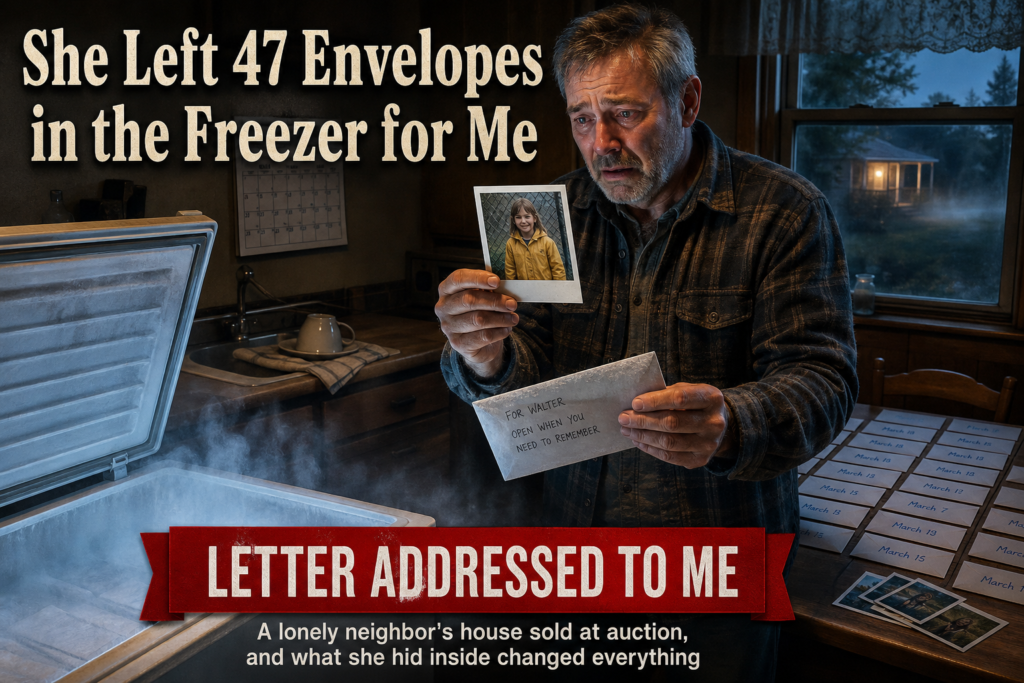
No meat. No frozen vegetables. No forgotten casserole. Cold fog rolled over the edge and, when it cleared, I saw rows of white envelopes standing upright, packed tight like files in a drawer. Each one was sealed. Each one had a date written across the front in that same blue ink.
I took one out. The date read *March 9, 2002.* The paper was stiff with frost and heavy for its size.
My thumbnail slid under the flap. Inside were bundles of cash, crisp and banded, and behind the cash a single Polaroid.
A little girl, maybe six years old, stood in front of a chain-link fence. She wore a yellow raincoat too big in the shoulders. Her front teeth were missing, and she was trying hard not to smile, the way children do when someone has told them to hold still. On the white border at the bottom, someone had written a name in pencil, and then, I saw, tried to erase it.
I put the envelope down. I took out another. *November 21, 2009.* Cash again. A Polaroid again, this time a boy of about four with a bandage on his chin, clutching a stuffed rabbit missing one ear.
A different child. Always a different child.
I stopped counting aloud somewhere past twenty. I laid the envelopes across her kitchen table in rows, and by the time I finished the table was covered and the window had gone dark. Forty-seven envelopes. Twenty-three years. Five thousand dollars in each, which my shaking brain finally multiplied into a number I could not hold: more than two hundred thousand dollars, sitting in a freezer, next door to a man who sometimes skipped lunch to save money.
Every Polaroid showed a child in the quiet moment before something ended or began. None of them were smiling for the camera.
I pulled out a chair and sat. My hands would not stop trembling. I looked at the faces, all forty-seven of them fanned out across the wood, and a sentence formed in my mind that I did not want to think.
Mrs. Alder had no children. So who were these children to her?
Then I saw that the last envelope, the one still at the bottom of the freezer, was thicker than the others. And unlike all the rest, it had no date.
Part 3
I did not touch the thick envelope that night.
I told myself it was because I was exhausted. The truth was simpler. I was afraid of it. Some part of me understood that everything on that table was a question, and the envelope in the freezer was where the answers lived.
I called the police instead.
The dispatcher asked if I was in danger. I said no. She asked if anyone was hurt. I said I didn’t know, and heard how strange that sounded as I said it. Twenty minutes later a patrol car idled in front of the house with its lights off, and a tall man in a rumpled gray coat came up the walk with a notebook already open.
“Detective Marcus Reyes,” he said, shaking my hand. His grip was dry and steady. “You said you found something in the freezer?”
I led him to the kitchen. He stopped in the doorway and said nothing for a long moment. Forty-seven white envelopes lay in rows across the table, and the Polaroids stared up at the ceiling.
“Did you touch all of these?” he asked quietly.
“Yes. I’m sorry. I didn’t know what I was looking at.”
“Nobody would.” He pulled on gloves and bent over the nearest photograph. “Cash in every one?”
“Five thousand. Every time.”
He exhaled through his nose. “Mr. Hollis, I need you to tell me what you think this is.”
I had practiced an answer on the walk from the freezer to the front door, something reasonable, something that would let me sleep. “Probably grandchildren,” I said. “She must have had family she lost touch with. Maybe she was sending money to them. Saving it for them.”
“Did she have children?”
“No.” The word came out smaller than I intended. “She had no children. That’s what everyone said. That’s what the county said.”
Reyes nodded slowly, as if I had just confirmed something he hoped was not true. He lifted the photograph of the girl in the yellow raincoat and held it under the kitchen light. Then he turned the Polaroid over and studied the back, where a faint pencil mark had been pressed hard enough to leave a ghost.
“Somebody wrote on this and rubbed it out,” he said. “People don’t erase a name unless they’re protecting someone. Or protecting themselves.”
“From what?”
“That’s what I’d like to know.”
He photographed every envelope, every date, every face. It took more than two hours. Near midnight, a younger officer arrived with an evidence case, and I stood at the sink with a glass of water I never drank, watching them seal each Polaroid into its own clear sleeve. The ritual of it made my throat tighten. They were handling the photographs the way you handle something that might still be warm.
“I’ll run these through the missing persons database in the morning,” Reyes said at the door. “Faces, approximate ages, any background details we can pull. It’s a long shot.”
“And if it isn’t a long shot?”
He studied me for a second, and the tiredness in his eyes was the kind that comes from having seen the worst of people. “Then your neighbor was carrying something very heavy, Mr. Hollis. And she carried it alone for a very long time.”
He left. The house settled around me, creaking, and I stood in the dim hallway among the pressed flowers, wondering how a woman who waved every morning could have been hiding an entire world behind that smile.
My phone rang at six the next morning. It was Reyes, and his voice was different, stripped of its steadiness.
“Mr. Hollis, I need you to sit down,” he said. “The database matched them. Every single photo. Not one of those children has ever been found.”
I heard paper moving on his end of the line.
“And there’s something else. When my officer went back to the freezer to log the last item, he found it wasn’t empty. There’s an envelope we missed. It’s numbered forty-eight. And it has your name on it.”
Part 4
I do not remember driving the forty feet from my own front door to hers. I only remember standing in the kitchen again, in the same spot as the night before, with the morning sun lying across the table where the Polaroids had been.
Detective Reyes was waiting beside the freezer. He had a paper cup of coffee he hadn’t touched, and the same rumpled gray coat, as if he had never gone home. On the table, inside a clear evidence sleeve, lay the envelope.
It was thicker than the others. The paper was the same white stock, but the ink was different. Where every other envelope carried a date, this one carried a name in careful blue letters.
*Walter Hollis.*
“We found it taped beneath the bottom rack,” Reyes said. “Flat against the metal. Easy to miss. Whoever put it there wanted it found, but only by the right person.”
“I’m the right person?”
“It has your name on it. I’d say that’s a reasonable conclusion.”
My mouth had gone dry. “She never spoke to me. Not once in twenty-three years. A wave. A washed bowl. That’s all I ever had from her.”
“Then she paid attention anyway.” He nodded at the window. From where we stood, my own kitchen was clearly visible across the yard, my own table, my own chair. “People who wave every morning at seven tend to be watching for something.”
He asked whether I would rather open it alone. I told him no. I did not trust my hands. He slid on fresh gloves, photographed the envelope from three angles, and lifted the flap with a steadiness I envied.
Inside was a single folded sheet and, beneath it, a smaller piece of paper, brittle and creased. Reyes unfolded the larger sheet first and laid it flat.
It was a map. A pencil sketch of a backyard, drawn with the patient precision of someone who had measured every distance. I recognized the shape at once. The crooked back fence. The oak with the split trunk. The shed with the sagging roof.
And six small X’s, each one pressed so hard into the paper it had nearly torn through.
“Six,” I whispered.
“Mr. Hollis.” Reyes did not look up. “Is there anything in that yard I should know about?”
“A rose garden,” I said. “She kept a rose garden. Red ones, along the back. I used to smell them from my porch in June.” Something cold turned over in my chest. “Every one of those X’s is inside it.”
Reyes was quiet. Then he picked up the second piece of paper, the brittle one, and I saw that it was a newspaper clipping, so old the fold lines had turned brown. He read it silently, and his jaw tightened.
“What does it say?”
He turned it toward me. It was an article dated twenty-three years earlier, the same year the first envelope had been sealed. The headline was only six words long, and across the top, in blue ink, she had written a single line.
*Read this before you read my letter.*
I leaned closer and read the headline. My knees nearly gave out beneath me.
Part 5
The headline read: *Search Suspended for Missing Girl, Age Six.*
Beneath it, grainy and gray, was a photograph I knew. A little girl with missing front teeth. A chain-link fence. A raincoat too big in the shoulders.
It was the child from the very first envelope.
“March 9, 2002,” Reyes said softly. “The date on the envelope. That’s the day this ran.”
I sat down hard on one of the kitchen chairs. “Then she knew about this girl. She knew she was missing. And she kept her photograph.”
“Or she was given it.” He read further down the article, and I watched the lines gather between his eyebrows. “The girl vanished from a bus stop on the east side. Three towns over. No witnesses. The case went cold within a year.” He set the clipping down gently, as though it might bruise. “I worked a case like it, early in my career. We never closed it. You don’t forget the ones you couldn’t close.”
“Are you saying Mrs. Alder had something to do with it?”
“I’m saying I don’t know.” He rubbed his eyes with the heel of his hand. “A woman with no family keeps photographs of missing children and pays five thousand dollars a year into a freezer. Either she was guilty of something terrible, or she was trying to make up for something terrible. I can’t tell yet which.”
“She wasn’t guilty,” I said, and I surprised myself with how fiercely it came out. “You didn’t see her. She’d stop to move a snail off the sidewalk. She cried at the funeral of a man she’d never met, and I know that because I watched her do it from my window.”
“Then let’s find out what she wanted you to know.” Reyes picked up the letter and held it out to me. “It’s addressed to you, Mr. Hollis. I can’t read it first. But I’ll be standing right here.”
I took the page. The paper was soft from handling, as if she had written it, folded it, unfolded it, and rewritten it a hundred times.
The handwriting was small and slanted. The first line was my name, and under it she had written:
*Walter, if you are reading this, then the county did what I hoped. It sold my house to the one person who ever left tomatoes on my step.*
My breath caught.
*You will want to know why I never spoke to you. I wanted to. Every August I stood behind my curtain and listened to you set down that bowl, and I wanted to open the door and say thank you. But I had made a promise long ago that no one would ever be close enough to be hurt by what I knew.*
Reyes shifted his weight. I kept reading.
*I did not take those children, Walter. I need you to believe that first. But I know what happened to them. I have known for twenty-three years, and I was too afraid to say it aloud. So I did the only thing a coward can do. I saved what I could and I kept their faces.*
The page trembled in my hands.
*The money is not mine to keep. It belongs to the families, though they will not want to take it when they learn where it came from. Give it to them anyway. And when you are ready, go out to my garden. Start digging where the roses are. What you’ll find there is not what you fear. It is worse, and it is also the only chance any of them have of coming home.*
I read the last line and the room tilted around me.
*Do not dig alone. And do not trust the man who comes to buy my roses.*
I looked up. Reyes was already watching the window. Through the glass, in the front yard I had not yet crossed that morning, a black sedan had pulled up to the curb, and a man in a pressed gray suit was stepping out with a bouquet of fresh white lilies in his hand.
Part 6
“Stay here,” Reyes said.
He did not say it loudly. He said it the way you speak to an animal you do not want to startle. Then he crossed the kitchen, slid the evidence sleeve into his coat, and motioned me away from the window.
I stayed. I could not have moved if I tried.
The man in the gray suit came up the front walk slowly. He was perhaps sixty, silver-haired, with the careful posture of someone who has been told his whole life that he is respectable. He stopped at the bottom of the porch steps and looked up at the house with an expression I could not read. It was not grief, exactly. It was closer to ownership.
Reyes opened the front door before the man could knock.
“Can I help you?”
“Good morning.” The voice was warm, practiced. “I’m so sorry to intrude. My name is Philip Cardwell. I knew Mrs. Alder many years ago. I only heard last week that she had passed, and I wanted to pay my respects.” He lifted the lilies slightly. “I understand the house has a new owner. I hoped to leave these in her garden.”
“In the garden,” Reyes repeated.
“Roses were her passion. It seemed fitting.”
I stood in the hallway behind Reyes, between the pressed foxglove and the pressed tulip, and watched Cardwell’s eyes slide past the detective’s shoulder and settle on me. They stayed a half second too long. Then he smiled.
“You must be Mr. Hollis. Mrs. Alder spoke of you.”
My skin went cold. “She never spoke to me at all.”
“Ah. Well.” The smile did not move. “She spoke of you to others.”
“What others?” Reyes asked.
“Old friends. Church people.” Cardwell turned the lilies in his fingers. “Detective, forgive me, is something wrong? I see the police car and I worry.”
“A routine inspection of the property,” Reyes said. “New owners find all sorts of things in old houses. I’m sure you understand.”
“Of course.” A pause. “Might I still see the garden? Only for a moment.”
“Not today, Mr. Cardwell. Leave me a number and I’ll see that Mr. Hollis reaches you.”
The silence lasted three heartbeats. I counted them. Something moved behind Cardwell’s eyes then, something flat and measuring, and I understood with perfect certainty that Mrs. Alder had not been afraid of an abstraction. She had been afraid of this man.
He placed the lilies on the porch rail, gave a small bow, and wrote a number on the back of a card. He walked to his sedan without looking back. The engine started without a sound.
Reyes shut the door and turned the deadbolt. When he faced me, the steadiness had left his face completely.
“Do you know him?”
“I’ve never seen him in my life.”
“He knew your name before you spoke it.” Reyes pulled out his phone and typed rapidly. “Mrs. Alder never told anyone about you, Mr. Hollis. Not a friend, not a neighbor. She had no friends. So how did he know?”
I had no answer. I looked down the hallway toward the kitchen, toward the table where forty-seven faces had lain in rows, and an unwelcome thought came to me, quiet and terrible.
“Detective,” I said. “If she was afraid of him for twenty-three years, and he only showed up now, after she died…”
“Then he’s been waiting for someone to inherit that yard.” Reyes did not look away from his screen. “And he just found out it’s you.”
Outside, an engine started again. I turned toward the sound and saw the black sedan had not left at all. It had only pulled around the corner, to the back of the property, where the rose garden ran along the fence. Through the kitchen window I watched the driver’s door open.
Cardwell was not carrying lilies anymore. He was carrying a shovel.
Part 7
I was out the back door before Reyes could stop me.
The morning air hit my face like cold water. The grass between our houses was still wet, and I ran across it in my work boots, past the sagging shed, past the oak with the split trunk, toward the long row of roses along the fence. They had not bloomed yet. They were only thorny canes and dark leaves, but I knew every one of them by heart. I had smelled them from my porch for twenty-three summers.
Cardwell stood in the middle of the garden with the shovel planted in the soil beside his polished shoes. His suit jacket was off and folded over the fence. He had already turned over one patch of earth, a ragged dark wound beneath the third bush from the corner.
“Step away from there,” Reyes called, one hand on his coat. “Right now, Mr. Cardwell.”
Cardwell looked up. He did not look startled. He looked like a man interrupted at a mildly tedious task.
“Detective, I think there’s been a misunderstanding. Mrs. Alder owed me a considerable debt. I’m simply recovering personal property that was left on the premises.”
“The premises belong to Mr. Hollis.”
“Then Mr. Hollis will be happy to hear my offer.” He turned to me, and his voice dropped into something almost gentle. “Five hundred thousand dollars, Walter. For a house you bought for less than half of that. You get to walk away tonight. You never have to think about any of this again.”
I stood there with my chest heaving. Somewhere behind me, the kitchen window was full of forty-seven faces I could no longer see.
“Why does a man pay five hundred thousand dollars to dig up some roses?” I asked.
The smile slipped. Only a fraction, but I saw it.
“Because I’m sentimental,” he said.
“Put the shovel down,” Reyes said, and now his hand held something that caught the light. “Last time.”
Cardwell looked at the gun, then at me, and then he laughed. It was a soft, dry laugh with no humor in it. He set the shovel down on the grass as if laying a baby in a crib and raised both hands.
“You’ll want to hold me for trespassing, I suppose. Go ahead. I’ll be home for supper, Detective. I know people. Judge Haskell and I have shared a boat for fifteen years.”
Reyes cuffed him and walked him to the front, where a second patrol car had arrived. I trailed behind, unsteady, as the officer folded Cardwell into the back seat. Through the glass, Cardwell’s eyes found mine, and he mouthed three words I could not quite hear.
“What did he say?” I asked when Reyes came back.
“I don’t know. I’m not a lip reader.”
“I think it was her name.”
Reyes didn’t answer. He walked back to the garden and crouched beside the hole Cardwell had dug, looking down into the damp black soil. Then he stayed there, very still, with his head tilted.
“Mr. Hollis,” he said. “Come look at this.”
I knelt beside him. The shovel had gone down about a foot, and at the bottom of the hole, pale against the dirt, was the edge of something that was not stone and not root.
It was a corner of rusted metal. And someone had scratched into it, with a nail or a knife, the number six.
Part 8
They brought a crime scene team that afternoon, and by dusk my neighbor’s backyard looked like an archaeological dig.
White tents went up along the fence. Technicians in coveralls knelt over grids of string and measured the soil in careful squares. A county forensic anthropologist, a small gray-haired woman named Dr. Ines Okafor, walked the row of rose bushes with the map in her gloved hand, comparing each X to the shape of the earth. She said little. Every few minutes she looked at the sky as if asking permission.
I stood at my own back fence because Reyes would not let me closer. I watched six places on the ground become six small, deliberate holes. Nobody spoke the word I was afraid of. I could see it in the way they worked, slowly, with soft brushes instead of shovels, the way you work when you expect to find a person.
Near seven o’clock, Dr. Okafor lifted her head and called out to Reyes. He crossed the yard. They bent over the third hole together. I held onto the fence rail until the wood printed itself into my palms.
When Reyes came back to me, he was carrying a metal box.
It was a heavy steel document case, the kind banks used decades ago, wrapped in oilcloth and sealed along the edges with melted wax. The number six was scratched into the lid. Rust had eaten the corners, but the oilcloth had held.
“No remains,” Reyes said before I could ask. “Not in this one. Not in any of the six. I’m sorry. I know you’ve been carrying that thought all day.”
I let out a breath that felt like it came from my knees. “Then what is it?”
“I think it’s what she meant by worse.”
We carried the box inside to the kitchen table, the same table where the Polaroids had lain, and Reyes cut the wax with a pocketknife. Inside, wrapped in more oilcloth, were bound ledgers. Dozens of them, thin and green, the kind used in old accounting offices. The first page of the top one was stamped in faded gold: Harbor Light Family Services.
“That’s a private adoption agency,” Reyes said slowly. “Shut down about twenty years ago. Quietly. Supposedly a licensing issue.” He turned the pages with two fingers. Names, dates, dollar amounts. Columns of them, in a neat clerk’s hand. “Every row is a child. Date of intake. Where the child came from. Where the child went. And a payment from the receiving family.”
I read over his arm. The amounts were obscene. Twenty thousand dollars. Forty. Sixty.
“They weren’t kidnapped by strangers in vans,” Reyes said, and his voice had gone hollow. “They were taken from bus stops and playgrounds and the back seats of cars, and then they were sold. To families who believed they were adopting legally. Birth certificates altered. Records scrubbed. Somebody invented a paper life for each of them so no one could ever trace the first one.”
“Somebody,” I said.
Reyes turned the ledger toward me and pointed to the bottom corner of the page. Beside every entry, in the same blue ink I had seen on forty-seven envelopes, was a signature.
Margaret Alder. Witness.
Every single line. Every single child.
I felt the floor go out from under me. I thought of her hand rising from that porch every morning at seven. I thought of the empty bowl returned washed. I thought of a woman moving a snail off the sidewalk.
“She signed them,” I said. “She helped him.”
“Mr. Hollis.” Reyes closed the ledger, and I saw that his hands were shaking too. “I don’t know yet. But the last box has something the others don’t.”
He lifted a thin envelope from the bottom of box six. On the front, in her small slanting hand, were four words.
For when you are brave.
Part 9
I did not feel brave. I felt like a man standing at the edge of a frozen lake, listening to the ice speak.
But Reyes sat across from me in that kitchen with the lamp burning low, and Dr. Okafor waited at the door, and the ledgers lay stacked between us like a verdict. So I opened the second letter.
It was longer than the first. The paper had been written on and rewritten, with whole lines crossed out and begun again.
Walter, it began. By now you have read the ledgers, and you have seen my name on every page. I will not ask you to forgive that. I will only tell you how it came to be.
I read aloud, because Reyes asked me to, and because my voice was the only thing steady enough to carry the words.
She had been a records clerk at Harbor Light for eleven years. She was a widow then, newly forty-six, grateful for the work. The agency placed children with families who could not have their own, and she believed in it. She believed in it the way you believe in a church. She typed the forms. She witnessed the signatures. She went home to a quiet house and slept well.
Then one winter afternoon, a little girl in a yellow raincoat was brought into the office, and she would not stop asking for her mother.
I had seen children cry before, she wrote. Children always cry on the first day. But this child did not cry like a stranger. She cried by name. She said her mother’s name, and her street, and the color of her front door. And I looked down at the intake form and saw that every word on it was false.
I stopped reading. The kitchen was silent except for the hum of the freezer, which someone had finally unplugged and which now felt strangely absent.
“Keep going,” Reyes said quietly.
I went to Philip Cardwell, she had written. I was a fool. I thought he would be horrified. He was patient instead. He told me that I had signed forty-one of those papers, that every signature was mine, and that if the truth came out, I would be the only one standing there. Then he told me where the girl was going. Which house. Which street. And he said that if I ever spoke, he would know where to find her, and where to find the others.
My voice cracked. I kept reading.
So I stayed silent. I hated myself for it, and I stayed silent. But every year I took five thousand dollars from what little I earned, and I put it in an envelope with one child’s photograph, because I wanted them to have something that was theirs. I took the pictures in secret, from the street, from the edges of the schoolyards, whenever I could learn where one of them had been sent. And I kept the true ledgers, hidden, because a lie only holds so long as no one has the other book.
Reyes had gone very still. “She copied the real records,” he said. “Under his nose. For years.”
I turned the page.
I could not give the children back. I could not leave a letter behind for the police, because I was a coward and because he watched me. But I could outlive my fear. I could wait for the one person who left tomatoes on my step. I could wait for you, Walter. A stranger with nothing to lose, in a house too quiet, who would see what I had seen and would not look away.
The last line was a single sentence.
The first photograph, the girl in the yellow raincoat, was named Josephine Marsh. She is alive. Her address is on the last page of box six.
Reyes was already on his feet. He turned to the final ledger and found the page, and I watched his face change as he read the street name.
“She’s forty minutes from here,” he said. “Her name has been Claire Bennett for twenty-three years.”
“She’ll be a grown woman now.”
“Twenty-nine.” He grabbed his keys. “And there’s a problem, Mr. Hollis. Cardwell made bail an hour ago. Judge Haskell signed the order himself.”
I did not remember deciding to follow him. I only remember the dark road, the rain starting on the windshield, and the porch light of a small blue house at the end of a quiet street. Reyes knocked. A woman opened the door with a dish towel in her hand. She was tall, with her hair tied back, and her eyes were wide in a way I knew from a Polaroid on my neighbor’s kitchen table.
Reyes held up the photograph of a six-year-old in a yellow raincoat.
The woman looked down at it, and her whole face came apart.
“That’s my coat,” she whispered. “I still have it in my closet. I’ve never known why I couldn’t throw it away. Where did you get that picture?”
Part 10
Her name was not Claire. It was Josephine, and she had been Josie to the mother who spent twenty-three years setting a place for her at Christmas.
I will not describe everything that happened in that small blue house, because some things belong only to the people they happened to. But I will tell you this. When Reyes said the name Josephine Marsh aloud, the woman in the doorway sat down on the porch step as if her legs had been cut. She pressed the dish towel to her mouth. She said, “I used to dream that name. I didn’t know it was mine.”
Then Reyes made a phone call, and in the gray hours before dawn, a woman in another town picked up and heard the words every mother of a missing child has rehearsed in her sleep. Her scream carried through the phone and into the rain.
They met two days later in a county office with bad coffee and bright fluorescent lights. I stood in the hallway because I did not belong in that room. Through the narrow window in the door I watched a gray-haired woman cross the floor with her hands out, trembling, and a tall young woman rise to meet her, and I turned away. Some light is too bright to look at directly.
After that, it unspooled. The ledgers were true. Dr. Okafor and the state investigators spent three months matching names, birthdays, and bus stops to forty-seven closed files. The agents who came to the house said the records were the most complete evidence of a trafficking ring they had ever seen, preserved by a woman who kept the real books in six rusted boxes under a rose garden. Philip Cardwell was arrested again before he reached the airport. Judge Haskell resigned within the week. The trial took a year, and in the end the jury was out for less than two hours.
Not every child was found alive. I will not pretend otherwise. Four of the files ended in graves that Margaret Alder had no way of knowing. But forty-three of those children, grown now, with children of their own, learned their real names. Forty-three families opened their doors to someone who had been gone for years. And the money she had saved, two hundred and thirty-five thousand dollars in crisp banded bills, I carried myself to every one of them. Some wept. Some refused to touch it. Josie’s mother, holding her daughter’s hand, put her palm over the envelope and said, “She didn’t have to do this.”
“No,” I said. “She didn’t.”
I thought about that for a long time. About a woman who was afraid for twenty-three years and who kept faith anyway, the only way she could, in small acts that no one saw. She was not an innocent. She had signed her name where she should not have, and she knew it, and she paid for it every day in a locked house. I do not think the law would have forgiven her. I am not sure I am the one to forgive her either. But I know that without her, forty-three families would still be waiting by their phones.
I sold my own house that spring, but I did not leave the neighborhood. I moved next door, into the house with the lavender smell and the long hallway of pressed flowers. I took down the labels one by one, and on the back of each I found a tiny pencil date, and I understood at last that the flowers had never been about flowers. Every bloom marked a child she had lost. Every year, she had pressed a new one.
I planted tomatoes along the back fence, where the rose garden used to be. The roses were gone, the soil dug up and carried away as evidence, but in June the ground sent up a single stubborn red bloom from a root no one had found. I left it where it was.
On the first morning I lived there, I woke at six-thirty and made coffee and carried it out to the porch. The sun was just clearing the roofline of my old house. A young couple had moved in, with a baby, and the mother was standing on her step in a bathrobe, rocking the child against her shoulder.
It was seven o’clock. I stood in the place where Margaret Alder had stood every day for twenty-three years.
And for the first time in my life, I raised my hand and waved first.
The young mother looked up, startled. Then, slowly, she smiled and waved back.
I held my hand there a moment longer, up in the morning light, and I said quietly to the empty air beside me, “I see you, Margaret. I’m sorry it took me so long.”
A breeze moved through the tomato leaves. Somewhere behind me, in the house that was now mine, a pressed rose lifted gently on its wall.
And the porch light, which I had never once switched off since the day I moved in, hummed on in the daylight, steady and warm, the way a light does for someone who is finally coming home.