Part 1
The night Mom died, the house on Alder Street went so quiet that I could hear the refrigerator humming from my bedroom. I was twelve. I lay on top of my blankets with my shoes still on, because nobody had told me to take them off, and I listened to the sound of grown-ups talking low in the kitchen. A neighbor. A woman from the church. A man in a gray suit who kept saying “arrangements.”
Then I heard my sister’s voice, and it was the only one that did not sound like a whisper.
“No,” Marianne said. “He stays with me.”
“Honey, you’re nineteen,” the woman from the church said gently. “You have your whole life ahead of you. There are families who…”
“He’s my brother. He stays with me.”
I crept to the hallway and peeked around the corner. Marianne stood at the counter in Mom’s old cardigan, the sleeves hanging past her wrists. Her hands were shaking, so she gripped the edge of the counter until her knuckles went white. She did not cry. Not then. She looked at that man in the gray suit as if she could hold the whole house up by staring at him.
When the kitchen finally emptied, she found me in the hallway. She did not ask how long I had been standing there. She just knelt down and straightened my collar, though I was wearing a pajama shirt and it had no collar to straighten.
“Hey, Danny,” she said softly. “Did you eat anything?”
I shook my head.
“Okay. Let’s fix that.”
She made scrambled eggs at eleven o’clock at night. They were rubbery and a little burnt, and I ate every bite while she sat across from me and watched, her chin resting on her fist. When I finished, she took my plate and turned toward the sink so I would not see her face. Her shoulders shook once, hard. Then she turned the water on loud.
“Marianne?” I said.
“Yeah, bud?”
“Are you going to leave too?”
The water kept running. She stood very still. Then she shut off the tap, dried her hands on the dish towel, and came back to sit beside me instead of across from me.
“Look at me,” she said. “I am not going anywhere. Not ever. You hear me?”
I nodded. I believed her. I was twelve, and I believed her the way you believe the sun will come up.
What I did not understand was what that promise would cost her. I did not see the acceptance letter from the nursing program, folded small and tucked into the drawer beside the stove. I did not see her slide it under a stack of takeout menus the next morning. I was too busy being a child who had lost his mother.
I would only learn about that letter much later. And by then, I would have already said the words that broke her heart.
But that morning, the first morning of our new life, I woke to the smell of toast and the sound of my sister humming off-key in the kitchen, trying so hard to make the world feel normal again. And I let her.
I let her, and I never once asked what it was costing her.
On the kitchen table, beside my plate, sat a small envelope with my name on it in Mom’s handwriting. Marianne was standing over it, not touching it, as if it might break.
“She left this for you,” she whispered. “I couldn’t open it. I think it should be you.”
Part 2
I did not open Mom’s envelope that morning. I carried it around for three days, in my backpack and then in my pillowcase, before I finally worked up the nerve. Inside was a single index card. It said: *Be good to your sister. She will pretend she’s fine. Don’t believe her.*
I was twelve, and I read it as a rule rather than a warning. I would remember it for years, usually at the worst possible moments.
Those first years were thin ones. Marianne took a job at the diner on Fifth Street, working double shifts, then a third job cleaning offices at night. She came home smelling of fryer oil and bleach, kicked her shoes off at the door, and still checked my homework before she let herself sit down.
“Show me,” she would say, holding out her hand.
“You don’t even know fractions,” I teased her once.
“I know when you’re hiding a bad grade.” She raised an eyebrow. “Hand it over, Doctor.”
That was her nickname for me. She started it when I was thirteen and had taken apart a clock to see how it worked. “Look at you,” she said, watching me lay the tiny gears out on the table. “Our little doctor, fixing things.”
“Clocks aren’t people,” I said.
“Same idea. Figure out what’s broken, then fix it.” She ruffled my hair. “You’re going to be somebody, Danny. I can feel it.”
She said it so often that I stopped noticing how she said it, with a kind of hunger, as though she were saying it for both of us.
By high school, I noticed other things. Her one good winter coat vanished, and she told me she had “gotten too warm in it.” My field trip fees were paid on time, but her car stayed broken in the driveway for a year. Her friends stopped calling. At first they invited her out on Friday nights, then on birthdays, and then not at all, because she always said no.
“You should go,” I told her once. “Tonight. I’ll be fine.”
“And leave you alone with a chemistry test tomorrow?” She laughed and shook her head. “Not a chance. I’d rather be here.”
I believed that too. It was easier to believe.
The day my scholarship letter came, she screamed so loud that Mrs. Patterson next door knocked to check on us. Marianne spun me around the kitchen in a circle, laughing and crying together, flour on her apron and tears running into her smile.
“Full ride,” she kept saying. “Full ride, Danny. Do you know what this means?”
“It means I have to leave,” I said quietly.
She stopped spinning. For one second, something flickered across her face, a shadow I would not understand for ten more years. Then it was gone, and she cupped my cheeks in her rough, chapped hands.
“It means you get to *go*,” she said. “That’s all I ever wanted. For one of us to get out and go.”
*One of us.* I heard it, and I let it slide past me.
She drove me to campus in a borrowed car, and when we hugged goodbye she held on longer than I wanted her to. I was eighteen and embarrassed, already half in a new life. I pulled away first.
“Call me,” she said.
“I will.”
“Every Sunday.”
“Okay, okay.”
I watched her taillights disappear down the road. Then I turned toward the dorms and did not look back.
That was the last time, for a long while, that I thought of her as anything other than a person who was always going to be there. A fixed point. A porch light left on.
I did call, at first. Every Sunday, then every other Sunday, then whenever I remembered. Medical school swallowed me whole. There were exams, rotations, and long nights in the library. Marianne’s voice on the phone began to feel like something from a quieter, smaller world, one I was proud to have escaped.
And pride, I would learn, can curdle into something ugly when no one is watching it grow.
On the morning of my graduation, a thick envelope arrived at my apartment with no return address. I almost threw it away unopened.
Part 3
The envelope held a ticket. Not a plane ticket, but a bus ticket, one-way, from our hometown to the university city. Clipped to it was a note in Marianne’s slanted handwriting: *Couldn’t afford the train. Hope you save me a seat. Proud of you, Doctor.*
I stared at it longer than I should have. Then I shoved it into my jacket pocket, because I had a gown to pick up and a speech to rehearse, and I was already late.
I remember that morning in strange, sharp pieces. The polyester gown smelling of plastic. My classmates’ parents in good suits, holding flowers and cameras. The sun glaring off a hundred mortarboards. And me, scanning the crowd for a face I was not sure I wanted to find.
I found her anyway.
She stood near the back, apart from everyone else, in a faded blue dress I recognized from my high school graduation. It had been let out at the seams. She had a bouquet of grocery-store carnations wrapped in newspaper, and she was holding them in both hands like a child holding a trophy. When she saw me looking, she waved, a small, shy wave, and her whole face lit up.
Something twisted inside me. It was not love. It was embarrassment.
Around me, my classmates introduced their families. A surgeon father. A mother with a pearl necklace. A grandfather who had flown in from Zurich. I stood there with my sister’s carnations and her bus-ticket handwriting, and I felt, God forgive me, ashamed.
After the ceremony, she pushed through the crowd to reach me. “Danny!” She threw her arms around my neck, and I felt the flowers crush between us. “Dr. Danny. Look at you. Mom would have…”
“Marianne,” I said, stepping back. “Not here.”
Her smile wavered. “Not here, what?”
A few of my classmates had drifted close, curious. One of them, a tall guy named Preston whose father ran a hospital board, glanced at her dress and then at me.
“This your sister?” he asked.
“Yeah,” I said.
“Cute flowers,” he said, and smirked.
I should have laughed it off. I should have put my arm around her. Instead I felt the heat rise in my face, and the words came out of my mouth like something that had been waiting there for years.
“See?” I said, louder than I meant to. “I climbed the ladder, Marianne. I studied. I sacrificed. I became a doctor.” I gestured at her dress, her flowers, her worn shoes. “And you took the easy road and became a nobody.”
The silence that followed was the loudest I have ever heard.
Preston looked away. Someone coughed. Marianne stood frozen, the carnations hanging limp at her side. I waited for her to shout, to cry, to slap me. I almost wanted her to. It would have been easier than what she did.
She smiled.
It was a small, gentle smile, the same one she had given me over rubbery eggs at eleven o’clock at night. She looked at me for a long moment, as if memorizing my face. Then she reached into her purse, took out a small white envelope, and pressed it into my hand.
“Congratulations, Danny,” she said quietly. “I really am proud of you.”
She turned and walked away through the crowd, her blue dress swaying, her shoulders held very straight. She did not look back. I stood there with the envelope in my hand, telling myself she was overreacting, that she would call by evening, that I would apologize when I was ready.
I did not open the envelope. I put it in my gown pocket, and in the chaos of photographs and celebrations, I forgot it was there.
She did not call that night. Or the next day. Or the next week.
By the end of the first month, I had stopped checking my phone. By the second, I told myself that she was simply punishing me, and that I would not be the one to blink first. By the third, a strange unease had begun to settle in my chest, and I could not explain it.
On the ninety-first day of silence, I finally pulled my graduation gown out of the closet to send it to the cleaners. Something small and white slid out of the pocket and landed on the floor.
Her envelope. Still sealed.
My hands felt cold as I picked it up.
Part 4
I sat down on the edge of the bed with the envelope in my lap and did not open it. I told myself I was tired. I had just come off a thirty-hour shift, and my eyes burned, and a man in his state of exhaustion should not read anything important. That was a lie, and I knew it even as I told it.
The truth was that I was afraid. Whatever was inside had been written by a woman I had humiliated in front of strangers, and some part of me understood that it would not be an insult. Marianne had never once insulted me. It would be something worse. It would be kindness.
I turned the envelope over. On the back, in her slanted handwriting, she had written: *Open when you’re ready. No rush.*
Ninety-one days, and she had still not rushed me.
I slid my thumb under the flap. Inside was a folded sheet of lined paper, torn from a diner order pad, and behind it a smaller piece of card stock. The card was worn soft at the corners, as if it had been handled a thousand times.
It was the acceptance letter from the nursing program. The one from the drawer beside the stove.
My throat closed. I had never seen it before, and I knew exactly what it was the moment I saw the faded university crest. The date at the top was the summer Mom died. Beneath it, in Marianne’s pen, one line had been added across the bottom: *Deferred. Someday.*
I unfolded the order pad page and read it standing up, because I could not stay seated.
*Danny,*
*If you’re reading this, you got your diploma, and I got to see it. That’s more than I ever hoped for.*
*I don’t want you to feel bad about anything you said today, if you said anything. You’ve worked harder than anyone I know. You’re allowed to be proud.*
*There’s something I should have told you a long time ago. I just didn’t want you carrying it. Maybe I was wrong about that. Come home when you can. Not for me. Just come home.*
*Love, Marianne*
*P.S. Mom’s card. Did you keep it?*
I read it three times. Then I sat on the floor with my back against the bed, the way I used to sit in the hallway on Alder Street, and I pressed the heel of my hand against my mouth.
*Did you keep it?*
I had. It was in my wallet, behind my medical license, soft as cloth from years of being touched. *She will pretend she’s fine. Don’t believe her.*
I had believed her. For ten years, I had believed every single time.
I called her number at two in the morning. It rang six times and went to a recording, a flat electronic voice informing me that the voicemail box was full. I tried again at six. Then at noon. Then I called the diner on Fifth Street, and a girl I did not know answered over the clatter of plates.
“Marianne? Oh. She doesn’t work here anymore, hon. Not since, gosh, maybe the spring?”
“Do you know where she is?”
“I couldn’t say.” Her voice dropped, uncertain. “Are you family?”
I opened my mouth to say *brother*, and the word stuck. What kind of brother was I?
“Yes,” I said finally. “I’m her brother.”
“Then you should go see her,” the girl said quietly. “Somebody should.”
I hung up and stood in my kitchen, staring at the phone. Outside, the afternoon was bright and ordinary, with traffic and a dog barking and someone laughing on the sidewalk, as if nothing in the world had changed.
I booked the first ticket I could find. Then I opened my closet, took out the old duffel bag, and found tucked inside it, folded small, the bus ticket she had mailed me. I had never even used it.
I held it for a long time.
When I zipped the bag shut, my hands were shaking, and I did not yet know that the worst part was waiting for me at the end of Alder Street.
Part 5
The bus pulled into our hometown a little after dusk. I had not taken a bus in years, and I had forgotten how it smelled, of old vinyl and exhaust and other people’s tired lives. I sat by the window the whole way, watching fields give way to gas stations and gas stations give way to the faded water tower I had once been dared to climb.
It was smaller than I remembered. Everything was. The main street had lost its bakery and gained a vape shop. The movie theater was boarded over. Mrs. Patterson’s old porch swing sat empty in the yard next to ours, one chain snapped, tilting sideways.
I had not been back in six years. I had told myself it was because of my schedule.
I walked the last half mile from the bus stop because I wanted the time. My duffel bag knocked against my leg with every step. The streetlights were coming on one by one, humming, and I rehearsed apologies under them. *I’m sorry about graduation.* Too small. *I was cruel and I was wrong.* Too rehearsed. *I read your letter.* Perhaps that one.
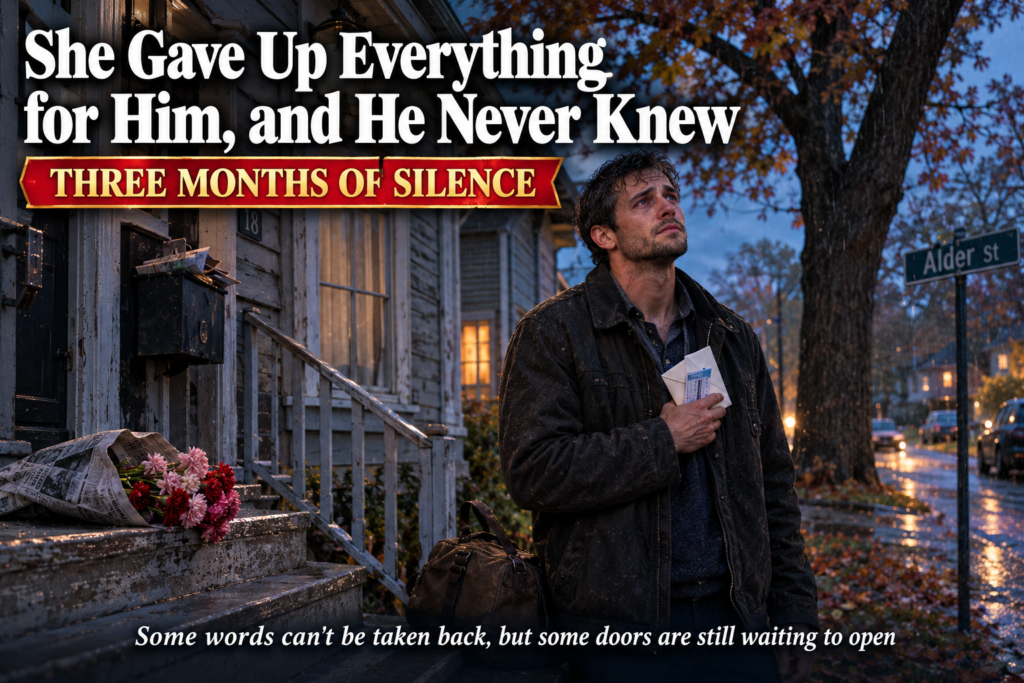
Alder Street was just as I remembered it, and also not. The maple in front of our house had grown enormous. The paint on the porch had gone gray. And the porch light, the one Marianne always left burning, the one I had once compared to a fixed point in my own mind, was dark.
I stopped at the bottom of the steps.
The curtains in the front window were drawn. The mailbox was stuffed so full that envelopes had slid out onto the welcome mat. A flyer for a pizza place was stuck to the door with old tape, its corners curled and yellowed.
My heart began to pound.
“Marianne?” I called, climbing the steps. I knocked. “Marianne, it’s Danny.”
Nothing. I knocked again, harder, and the sound echoed through the house in a way that made my skin prickle. When I tried the knob, it turned.
She had never left the door unlocked in her life.
“Hello?” I pushed it open. The air that rolled out was stale and cool and smelled faintly of medicine, a smell I knew better than any other, because it was the smell of my profession. Antiseptic. Something sweeter under it. Something I did not want to name.
I set my bag down in the hall.
“Marianne?”
The living room was neat, too neat, the way a room is when someone has cleaned it with the last of their strength. The couch had a folded blanket across the arm. On the coffee table stood a row of amber pill bottles, lined up by size, their labels turned outward as if someone had wanted them easy to read.
I picked one up. Then another. My training took over before my feelings could, and I read the names the way I would read a chart.
The third bottle made my knees give out.
I knew that drug. I had prescribed it, to strangers, in a hospital that smelled exactly like this house. It was not something a person took for a cold, or for stress, or for being tired. It was something you took when the time for being tired had passed.
“No,” I whispered. “No, no, no.”
I turned in a circle, calling her name louder now, my voice cracking on the second syllable. The kitchen was empty. The little table where she had once watched me eat rubbery eggs was bare except for a single coffee mug, rinsed and upside down on a towel.
Then I saw the hallway, and the line of light under the door at the very end.
It was my old bedroom.
I walked toward it slowly, the way you approach something you have already guessed. The floorboards creaked in all the same places. On the wall hung the school photographs Marianne had framed over the years, me at eight with a gap in my teeth, me at fourteen with terrible hair, me in my cap and gown, cropped so tightly that you could not tell who had taken the picture.
I put my hand on the door.
I heard something on the other side. A small sound. A cough, thin and dry, and then a voice so weak that I almost did not know it.
“Danny?” it said. “Is that you, bud?”
I pushed the door open.
Part 6
She was lying in my childhood bed, beneath the same quilt Mom had sewn, propped against a mound of pillows. At first my mind refused to make the picture add up. This could not be Marianne. Marianne was strong. Marianne carried groceries up three flights and worked three jobs and never once sat down before I did.
The woman in the bed was so thin that the quilt barely rose over her. Her cheekbones stood out sharply. A pale scarf was wrapped around her head, and beneath it her face was the color of candle wax. But her eyes were the same. Warm, tired, brown, and looking at me as if I were the best thing she had seen in months.
“You came,” she said.
I could not speak. I stood in the doorway with my hand still on the frame, a doctor with ten years of training, unable to move my feet.
“Don’t just stand there,” she said, and her mouth curved into the ghost of her old smile. “You’ll let the heat out.”
That broke something in me. I crossed the room in three strides and dropped to my knees beside the bed, and I took her hand. It weighed almost nothing. I could feel every small bone.
“Marianne.” My voice came out in pieces. “What happened? How long have you…”
“Shh.” She squeezed my fingers with what little strength she had. “You look tired. Have you eaten?”
A laugh escaped me, wet and terrible. “Are you serious? You’re asking me if I’ve eaten?”
“Somebody has to.” She tried to shift against the pillows and winced, and instinctively I reached to help her. My hands knew what to do. They adjusted the pillow and checked her pulse before my mind caught up with them, and she watched me do it with something very like wonder.
“Look at that,” she whispered. “My doctor.”
“Stop calling me that.” I pressed my forehead against the back of her hand. “Please. I don’t deserve it.”
“Danny.”
“I said the worst thing I could think of, and I said it in front of everyone. After everything you did. After you gave up…” I could not finish. “I read your letter. I saw the nursing letter. I didn’t know. I swear to you I didn’t know.”
“I know you didn’t.” Her fingers moved gently through my hair, the way they had when I was small and feverish. “I made sure of it.”
I lifted my head. “Why? Why wouldn’t you tell me?”
She was quiet for a moment. Out in the hall, the old clock ticked, the one I had taken apart as a boy and she had never let me throw away.
“Because you were twelve,” she said at last. “And then you were fifteen, and then eighteen, and every single time you looked at me, I saw you looking at your whole future. I wasn’t going to stand in front of it, Danny. I wasn’t going to be the reason you hesitated.”
“You should have let me hesitate.”
“No.” She said it softly, but with the old iron underneath. “That was the one thing I got to choose. Everything else was taken. That, I got to choose.”
I stared at her. Tears were running down my face, and I did not wipe them away.
“How long have you known you were sick?” I asked, though part of me already understood.
Her eyes slid away from mine, toward the window, where the maple’s branches scratched gently at the glass.
“Since before graduation,” she said.
The room tilted. I felt the floor go out from under my knees.
“You knew,” I whispered. “You stood there in that dress. You knew, and I…”
“Danny, look at me.”
“I called you a nobody.” The words tore out of my chest. “You were dying, and I called you a nobody.”
“I’m not dead yet, bud,” she said, with a faint spark of dry humor that nearly undid me. Then her face softened. “And you didn’t know. That’s what I wanted. I wanted one day, just one, where you got to be happy and proud, and I got to watch. I’d have paid anything for it. I think I did.”
I pressed her hand to my cheek and wept the way I had not wept since I was twelve years old, on the other side of a running tap, with a woman who had turned her face away so I would not see.
When I had no tears left, she nodded toward the nightstand.
“Open the drawer,” she said. “The top one.”
“Marianne, you should rest.”
“Please. There’s one more thing. Something I wanted you to find yourself, and I think I’ve run out of time to wait.”
My hands trembled as I slid the drawer open. Inside lay a thick stack of papers bound with a rubber band, and on top of them a photograph I did not recognize. It showed a young woman in a nursing school sweatshirt, grinning, with her arm around a boy of twelve who was scowling at the camera.
On the back, in Mom’s handwriting, were five words that made my heart stop.
*For Danny, when she’s gone.*
Part 7
I carried the stack of papers to the chair beside the bed and sat down with it in my lap. The rubber band had gone brittle and snapped the moment I touched it. The photograph lay on top, face up, the two of us staring at me across a decade.
“Where did you get this?” I asked.
“Mom had it in her Bible,” Marianne said. “I found it the week after the funeral. She must have taken it at the open house at my school. You were so mad about wearing a collared shirt.”
I turned the photograph over again and read the five words. For Danny, when she’s gone. I had assumed Mom meant herself. Then I saw the date under it, in the same hand, and my stomach dropped. It was written only a few weeks before she died.
“She wasn’t talking about herself,” I said slowly. “She knew she was dying. She was talking about you. About the day you’d leave, or the day…”
“The day I’d be too tired to pretend,” Marianne said. “Mom always saw straight through me. It was infuriating.”
Beneath the photograph lay a small spiral notebook, the kind that costs a dollar at the pharmacy. The cover was soft with handling. I opened it and found rows of Marianne’s handwriting, columns of dates and amounts. Fifteen dollars. Forty dollars. Twelve fifty. Some entries had a note beside them. Danny, chemistry fee. Danny, bus fare for the science fair. Danny, white coat.
I turned the pages faster. They went on for ten years.
“You kept a ledger,” I said.
“I wasn’t keeping score.” She almost laughed. “I just wanted to know I’d made it count. Some nights, when I was cleaning offices at two in the morning, I’d think of the notebook, and it made the mop feel lighter.”
My eyes blurred over the numbers. On the last page, the final entry was dated four months earlier. It read: Graduation dress, let out at seams. Free. Then, beneath it: Bus ticket, 31.50. Worth it.
“You sewed it yourself,” I whispered.
“The seams were the one thing I could still do.” She turned her hand over in mine. “Danny, the doctors told me in the winter. They gave me a number of months, and I didn’t want to spend them in a hospital. I wanted to see you walk across that stage first. Then I wanted to come home and be quiet for a while.”
“Why didn’t you let me help? I’m a doctor, Marianne. I could have…”
“You could have done what? Moved in? Put your residency on hold?” She shook her head against the pillow. “You’d have stayed, and you’d have hated it a little, and I’d have known. I couldn’t have borne that.”
“I would never have hated it.”
“You said I was a nobody in front of two hundred people,” she said gently, without any sting at all. “You were twenty-six and scared and surrounded by money, and it came out wrong. I knew it was wrong the second you said it. I could see it in your face.”
I bent forward until my forehead rested on the edge of the mattress. Her fingers settled on the back of my neck, light as a bird.
“I’m so sorry,” I said into the quilt. “I’m so sorry.”
“I forgave you before you finished the sentence,” she murmured. “That’s how it works when you love somebody. You don’t get to choose it.”
We stayed like that for a long time. The clock ticked in the hall. The maple scraped at the window. When I finally lifted my head, Marianne’s eyes had drifted shut, and her breathing had gone shallow and uneven.
Panic closed around my chest. I put two fingers to her wrist, and the pulse under them was faint and thready, far too fast.
“Marianne?” I said sharply. “Marianne, stay with me.”
Her eyelids fluttered. “Just tired, bud.”
“No. Look at me. Stay awake.”
I reached for my phone with shaking hands, and in the same moment, a knock sounded at the front door, three slow, deliberate raps. Whoever it was did not wait. I heard the door open and footsteps cross the hall, unhurried and sure, like someone who had done this many times before.
Part 8
A woman appeared in the bedroom doorway, gray-haired, in blue scrubs and a cardigan, with a canvas bag over one shoulder. She stopped when she saw me kneeling at the bed with my phone raised like a weapon.
“You must be Danny,” she said.
“Who are you?”
“Ruth. I’m the hospice nurse.” She set her bag down calmly, and the calm steadied me more than any words could have. “I come by every evening. She’s been telling me about you for three months. Hand me that chair, would you?”
I stared at her. Hospice. The word I had avoided saying aloud, even in my own head.
“She’s tachycardic,” I said, in my hospital voice, the one that comes out when everything else has failed. “Her pulse is thready, she’s…”
“I know, honey.” Ruth put a gentle hand on my arm. “It’s the evening dip. Her body does this. Let me do my work, and then you can do yours, which is sitting next to her.”
She moved around the bed with a practiced economy that I recognized and envied. She adjusted the pillows, checked a small device on the nightstand, and murmured something soft to Marianne, who answered with a drowsy hum. Within minutes, the sharp edges had gone out of the room. Marianne’s breathing slowed and deepened.
“There,” Ruth said. “Comfortable. That’s all we’re after now.”
I followed her into the hallway, where the framed photographs watched us from the wall. Keeping my voice low, I asked the question I already knew the answer to.
“How long?”
Ruth studied me for a moment, weighing the doctor against the brother. “You know I can’t give you a day. Days, maybe weeks. She’s held on longer than anyone expected.” She tilted her head toward the bedroom. “I think she was waiting.”
“For me.”
“She never said so. But she’d keep the porch light on every night until her legs wouldn’t carry her to the switch.” Ruth’s mouth tightened. “I turned it off myself last week. I should have told her I was doing it.”
I thought of the dark porch, the stuffed mailbox, and the unlocked door, and I understood that I had been wrong about every sign. None of it was neglect. She had simply run out of strength.
“Why didn’t anyone call me?” I asked. “Surely somebody had my number.”
“She wouldn’t allow it.” Ruth’s voice was kind and unyielding. “She made us promise. She said you’d come when you were ready, and not a day before, because a person who comes out of guilt arrives with their hands full of it, and she wanted yours empty.”
I leaned my back against the wall and slid down until I sat on the floor, my knees pulled up like the boy I had been in this very hallway.
“I don’t know how to do this,” I admitted. “I’ve told families. I’ve sat in the little room with the tissue box. I never once knew what it was.”
Ruth lowered herself beside me with a small groan, and for a moment we sat like old friends.
“Nobody does,” she said. “Here’s what I tell the families. You don’t need to fix anything. You just need to be in the room.”
From inside the bedroom, Marianne’s voice drifted out, faint and clear. “Danny? Is Ruth bullying you?”
I laughed, and it broke in the middle. “A little.”
“Good. Someone should.” A pause. “Come back in, bud. I have to tell you the rest of it.”
“The rest?”
“Mom’s papers,” she said. “You’ve only read the top.”
I got to my feet. Ruth gave me a nod, and I went back in, picked up the stack from the chair, and slid out the next item beneath the notebook. It was an envelope, thick and yellowed, addressed in Mom’s hand to Marianne.
It had been opened and refolded so many times that the creases had turned white. And across the front, in a different, newer ink, Marianne had written two words that made my breath stop.
Read it, Danny.
Part 9
I sat on the edge of the bed with the envelope in both hands and looked at my sister. She was watching me with a patient, almost shy expression, as though I were about to open a present she had wrapped badly.
“Go on,” she said. “It’s yours as much as mine.”
Inside was a letter in Mom’s looping hand, written in blue ballpoint on pages torn from a hospital pad. The ink was smudged in places, and I did not need to ask why. I read it aloud, because Marianne asked me to, and because my voice, shaking as it was, felt like the only way to bring our mother back into the room.
My darling Marianne,
If you are reading this, I am gone, and you are standing in our kitchen with that stubborn look you get. Please sit down.
I know what you will decide. You will decide to give up everything for your brother, and you will not ask anyone’s permission, because that is who you are. I am proud of you for it, and I am also heartbroken, because I would give anything to spare you the choosing.
So I am asking you one thing, and it is not what you expect. Do not give up everything. Keep one thing for yourself. A dream, a letter in a drawer, a small door left open. Danny will grow, and he will fly, and one day he will look down and wonder who held the ladder. When he does, you must let him find out. Do not hide it from him forever. Love that hides itself too well can look, from the outside, like love that was never there.
Tell him I said to be kind. Tell him I said he was always the best part of every day.
I love you both past all counting.
Mom
My voice gave out on the last line. I set the pages in my lap and pressed my palms against my eyes. A long, ragged breath shuddered out of me.
“She told you not to hide it,” I said finally.
“She did.” Marianne’s voice was thin but steady. “And I tried. I kept the nursing letter, didn’t I? I kept one door open. But I couldn’t make myself walk through it, and I couldn’t make myself tell you. Ten years went by. Every time I picked up the phone, I thought, not yet, he’s got an exam. Not yet, he’s on rotation. And then I ran out of yets.”
“I should have asked.” The words scraped my throat. “Mom told me. The card. Be good to your sister. She will pretend she’s fine. Don’t believe her. I read it a hundred times, and I still believed you.”
“That’s not your fault, bud. I was very convincing.” A faint smile touched her mouth. “I’m a professional.”
“Marianne.” I took her hand and held it against my chest, where she could feel how hard my heart was pounding. “You are not a nobody. You never were. You are the reason there’s a doctor standing here at all. Every patient I’ll ever save, you saved first. Do you understand that? Every single one.”
Her eyes filled, and at last, for the first time since the night in the kitchen on Alder Street, I watched my sister cry in front of me without turning away.
“I never wanted thanks,” she whispered.
“I know. That’s exactly why you’re getting it.”
I stayed beside her through the long blue evening. Ruth slipped in and out like a quiet tide. Somewhere around midnight, Marianne asked me to open the window a little, so she could hear the maple, and I did, and the cool air smelled of rain and cut grass and every summer of my childhood.
“Danny?” she said, very softly, as the clock in the hall chimed one.
“I’m here.”
“Will you do something for me?”
“Anything.”
She turned her head on the pillow and looked at me with an expression of such peace that something in my chest finally loosened.
“Turn the porch light on,” she said. “So you can find your way home.”
Part 10
I turned the porch light on that night, and I left it burning for every night that followed.
Marianne lived eleven more days. They were the best and hardest days of my life, and I would not trade a minute of them. I called the hospital and told them, in plain words, that my sister was dying and I would not be back until it was over. No one argued. For the first time since I was twelve years old, I put down every ambition I owned and simply stayed.
I learned to make her tea the way she liked it, weak, with too much honey. I learned the sound of her sleep. I read to her from the old paperbacks on the shelf, and she corrected my pronunciation of the hard words and then admitted, with a grin, that she had never finished any of those books herself. We watched the maple through the window. We talked about Mom. We talked about the eggs.
“They were terrible,” I confessed on the sixth night. “I ate every bite.”
“I know you did.” She laughed until it turned into a cough, and then she laughed again. “I burned them on purpose, you know. Then you’d eat slowly, and I’d get to watch you for longer.”
Ruth came every evening. Mrs. Patterson’s daughter brought soup. A few of Marianne’s old friends, the ones who had stopped calling, appeared on the porch one by one, holding casseroles and apologies. She forgave every one of them, because that was who she was.
On the last afternoon, the light came through the window gold and slanting, the way it does in late summer. Marianne lay quiet against her pillows, and her hand rested in mine.
“Danny,” she said. Her voice was barely a thread now.
“I’m right here.”
“You were a good brother.”
“I was a terrible brother.”
“You were twelve,” she whispered. “And then eighteen. And then twenty-six. And now you’re here.” Her eyes found mine, warm and clear and brown. “That’s the only part that counts.”
“I love you,” I said. “I should have said it every Sunday. I should have said it every day.”
“You’re saying it now.” She smiled, the old crooked smile from the kitchen, from the diner, from the faded blue dress. “Be good to yourself, Doctor. Mom’s rule. Not just me.”
She closed her eyes. Her fingers loosened slowly in mine, and the breath that left her was soft and unhurried, like someone setting down a heavy bag at the end of a very long road. Outside, the maple stirred, and the porch light, still burning in the daylight, glowed pale against the leaves.
I did not let go of her hand for a long time.
We buried her beside Mom, under the oak at the edge of the cemetery. The whole town came, more people than I would have believed. I stood at the grave in the same suit I had worn to my graduation, and I did not make a speech. Instead I laid a bouquet of grocery-store carnations on the earth, wrapped in newspaper, held in both hands the way she had held them.
In the weeks that followed, I did something I had never imagined doing. I went back through the notebook, page by page, every dollar she had spent on me, and I added up the total. Then I wrote a check for that amount, plus every year it had waited, and sent it to the nursing program at the university whose crest had faded on her letter. In her name, I started a scholarship for students who were raising younger siblings alone. The first recipient was a nineteen-year-old girl who turned up to the interview in a borrowed blazer, her hands shaking, a boy of eleven waiting in the hallway.
I told her I would be honored to hold the ladder.
I still carry Mom’s index card in my wallet, behind my license, soft as cloth. And on my desk at the hospital sits a framed photograph of a young woman in a nursing school sweatshirt, grinning, with her arm around a scowling boy.
Sometimes a patient asks who she is. I tell them the truth.
She is my sister. She raised me. She was never a nobody, not for a single day of her life. She was the whole ladder, and I only ever climbed it because she held it steady.
And every night when I come home, I turn on the porch light.