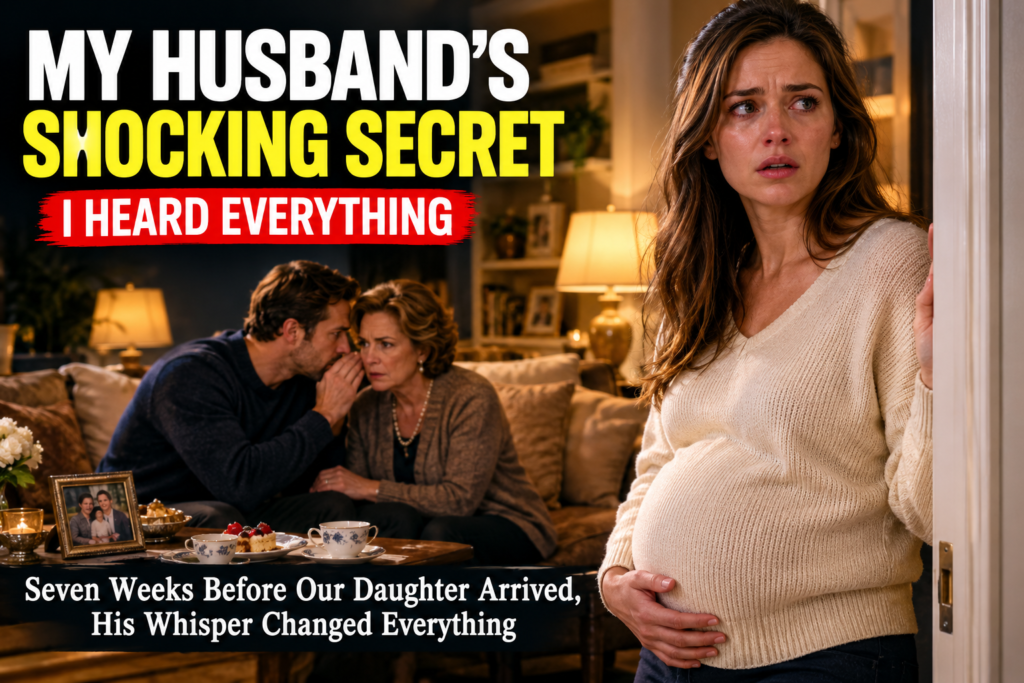
Part 1
The first thing I noticed was the smell of cinnamon.
My mother-in-law, Patricia, had baked an apple pie that afternoon, filling the house with the warm, sweet scent of apples, butter, and brown sugar. It drifted through the living room and mingled with the smell of roasted chicken, garlic potatoes, and the vanilla candle burning on the mantel.
It was the sort of evening I had imagined when I was a little girl and thought about having a family of my own.
The dining table was covered with Patricia’s cream-colored tablecloth. Small plates of olives and cheese sat between the serving dishes. My father-in-law, Robert, was telling one of his familiar stories about a fishing trip that had gone wrong, while my husband, Daniel, sat beside me with his hand resting protectively on my stomach.
Our daughter was due in seven weeks.
Seven weeks.
Sometimes I repeated the number silently because I still couldn’t quite believe it. After months of watching the pregnancy test turn positive in disbelief, counting appointments, buying tiny clothes, and waking up in the middle of the night to check whether the baby was moving, we were finally close to meeting her.
Daniel had been wonderful throughout most of the pregnancy. He came to appointments when work allowed. He learned how to install the car seat after watching three different videos. He had spent an entire Saturday assembling a white crib and then insisted on tightening every screw twice.
He even talked to my stomach.
Every evening, he would lean down, press his lips against the curve beneath my shirt, and whisper, “Daddy’s here, little girl.”
I used to laugh at him.
“She can’t understand you yet.”
“She knows my voice,” he would reply. “Besides, I’m practicing.”
Then he would look up at me with those warm brown eyes that had made me fall in love with him six years earlier.
I believed him when he said he couldn’t wait to become a father.
I believed everything about us was finally falling into place.
That night, his mother kept asking about the nursery.
“Did you settle on the curtains?” Patricia asked, passing me a bowl of vegetables. “I still think pale yellow would be lovely. Pink is so predictable.”
“We chose cream,” I answered. “It matches the furniture.”
“Cream?” She looked mildly disappointed. “For a little girl?”
Daniel squeezed my knee under the table.
“We like cream, Mom.”
Patricia smiled, but it was the sort of smile that didn’t quite reach her eyes.
“Of course. It’s your home.”
I had learned that Patricia often used the word *your* when she meant *my way would have been better.*
She had opinions about everything: the name we had chosen, the stroller, the baby monitor, the hospital bag, even the number of newborn outfits we needed. She had once told me that I was being overly cautious by reading ingredient labels on baby products.
“Children survived perfectly well before everybody started researching everything,” she’d said.
I tried not to take her comments personally. She had raised Daniel, and I knew becoming a grandmother was a big adjustment. I wanted us to get along.
Besides, Daniel usually stood up for me when she crossed a line.
That was what mattered.
After dinner, Robert moved to his favorite armchair, and Patricia brought out the pie. Daniel helped clear the plates while I sat on the sofa, my back aching from carrying the extra weight of our daughter.
He came over with a glass of water.
“How are you feeling?”
“Like this baby is practicing for a gymnastics competition.”
He laughed and placed his palm against my belly.
“Listen to that, sweetheart. Your mother says you’re showing off.”
A small movement pressed against his hand.
His face changed instantly.
“There!” he exclaimed. “Did you feel that?”
“I’ve been feeling it all afternoon.”
“That was definitely a kick.”
“It was definitely a foot in my ribs.”
He bent down and kissed my forehead.
“I love you.”
“I love you, too.”
It was such an ordinary moment that I didn’t know I would spend the next several months remembering it, searching it for clues I should have recognized.
A little later, I realized I had left my phone in the living room.
I’d been taking pictures of the nursery to send to my sister, and I wanted to show her the new shelf Daniel had installed. I stood up slowly, one hand on my lower back.
“I’m going to the bathroom,” I announced.
Patricia waved toward the hallway.
“Take your time, honey.”
I made it halfway down the hall before remembering the phone.
Of course.
Classic me.
I turned around, intending to slip into the living room, grab it from the side table, and return before anyone noticed.
As I approached the doorway, I heard Daniel’s voice.
“Mom, I can’t wait to become a dad. I’m already head over heels for our little girl.”
I stopped.
A ridiculous smile spread across my face.
I pressed my fingertips to my mouth, trying not to make a sound. My husband was talking about our baby when he thought I wasn’t listening. It was adorable. It was exactly the sort of thing I wanted to remember forever.
I leaned against the wall and decided to listen for a few more seconds.
Then Daniel’s voice changed.
It grew quieter.
His next words came out in a whisper so different from the happy voice I’d just heard that my smile slowly disappeared.
“Mom, I just need you to promise me you won’t tell her.”
Patricia didn’t answer immediately.
Then she asked, “You haven’t changed your mind, have you?”
My fingers tightened against the wall.
Daniel sighed.
“No. That’s why I’m telling you now. Once the baby arrives, everything gets complicated.”
I felt my legs stiffen.
Patricia lowered her voice even further.
“And what happens if she finds out before then?”
Daniel’s answer was almost too quiet to hear.
“Then I could lose both of them.”
I should have stepped into the room.
I should have asked him what he meant.
Instead, I stood motionless in the hallway, listening to the two people I trusted most discuss my future as though I were not even in the house.
Then Daniel said the words that changed the meaning of every promise he’d made me.
“Mom, I don’t know how I’m going to tell her that this baby wasn’t supposed to be ours.”
Part 2
For a moment, I couldn’t understand what I had heard.
The sentence seemed to hang in the air without connecting to anything real.
*This baby wasn’t supposed to be ours.*
I looked down at my stomach. Our daughter shifted beneath my palm, a familiar, gentle movement that had become one of the most reassuring parts of my day.
What did he mean?
Had he made a mistake? Was there some medical information I didn’t know? Had he and Patricia been discussing another family? The thoughts came so quickly that I couldn’t hold on to a single one.
Then Patricia spoke.
“You promised me you’d tell her before the wedding.”
My heart slammed against my ribs.
“The wedding was years ago,” Daniel replied. “We were barely managing our own lives then. We were talking about children someday, not dealing with this.”
“This is exactly why I told you to think carefully.”
“I did think carefully.”
“Then why are you acting surprised that it’s becoming difficult?”
There was a silence.
I wanted to run. I wanted to rush in and demand an explanation. But I was afraid that if I moved, I would miss the one sentence that might make all of this understandable.
Daniel rubbed his face. I could hear the exhaustion in his voice.
“I love my wife, Mom. I love my daughter already. That’s what makes this so hard.”
“Then you should have told her the truth.”
“I know.”
“Does she still think everything happened naturally?”
I stopped breathing.
Daniel didn’t answer.
Patricia continued, “Because if she does, you’re the one who allowed her to build her whole future around a lie.”
“I didn’t lie about loving her.”
“That isn’t what I asked.”
The silence that followed was worse than an argument.
I pressed my hand over my mouth to keep from making a sound.
Daniel finally spoke.
“She believes what we agreed to tell everyone.”
*We.*
The word hit me like a slap.
What had I agreed to tell everyone?
I had never knowingly agreed to anything like this.
My mind raced backward through the past six years. Our wedding. Our first apartment. The night Daniel told me he wanted children. The difficult months when we had discussed whether we were financially ready. The moment I had shown him the positive pregnancy test.
He had cried.
I remembered that clearly.
He had sat on the edge of our bed, holding the test in both hands, his shoulders shaking. I had thought he was overwhelmed with happiness. He had pulled me into his arms and whispered that we were going to be a family.
Had those tears meant something else?
“Daniel,” Patricia said, “you cannot keep pretending that the truth will disappear because you love her.”
“I know.”
“Then you have to decide what matters more: keeping your wife comfortable or protecting the child.”
“The child is my daughter.”
“And the other child?”
My stomach tightened so sharply that I had to grip the wall.
There was another child?
Daniel spoke quickly.
“Don’t say that.”
“Why? Because hearing it makes it real?”
“Because I don’t want to talk about this here.”
“Where would you like to talk about it? You have been avoiding it for months.”
I heard a chair creak.
Then Daniel said, “I am going to tell her. I just need to figure out how.”
“When?”
“After the birth.”
“No.”
“Mom—”
“Absolutely not. You cannot bring a baby into this world and expect a secret like this to stay buried. You have to tell her before she signs anything else.”
Signs anything?
I felt cold all over.
My phone sat only a few feet away, on the little table beside the sofa. I could see its dark screen from the hallway. I could have walked in, picked it up, and asked them what they were talking about.
Instead, I backed away.
One step.
Then another.
My heel caught the edge of a runner rug, and I nearly lost my balance. I grabbed the wall, swallowing a gasp.
Neither of them noticed.
I made it to the bathroom and locked the door.
For several seconds, I stared at myself in the mirror.
My face was pale. My eyes looked enormous. A strand of hair had fallen loose beside my cheek, and my hand was trembling so badly that I had to brace it against the sink.
I looked pregnant.
I looked like a woman who had spent seven months preparing for the happiest moment of her life.
I did not look like a woman whose husband had just admitted that the story of her unborn daughter was a lie.
I turned on the faucet so they wouldn’t hear me crying.
Then I sat on the closed toilet lid and tried to remember every conversation Daniel and I had ever had about becoming parents.
There had been one thing, years earlier, that I had almost forgotten.
Before our wedding, Daniel had told me he wanted a large family. I had wanted children, too, but I was nervous about timing. My career had only just begun to stabilize, and we were still paying off debts from the wedding.
He had held my hands and said, “We have time. We’ll figure it out together.”
A year later, he changed the subject whenever I mentioned children.
Another year passed.
Then, one night, after a long conversation about our future, he said he had been thinking about adoption.
I remembered asking why.
He had kissed my forehead and said, “Because there are so many ways to become a family.”
I had thought he meant adoption in the abstract.
We had never pursued it.
Or so I believed.
A knock sounded on the bathroom door.
“Sweetheart?” Daniel called. “Are you okay?”
I closed my eyes.
“Yes.”
“You’ve been in there a while.”
“My stomach feels strange.”
His voice softened immediately.
“Do you need me to call the doctor?”
“No. I just need a minute.”
“Okay. I’ll bring you some water.”
His footsteps moved away.
I looked at the door and felt something inside me shift.
He had sounded so loving.
So concerned.
How could the same man who checked my seat belt and warmed my side of the bed be hiding something this enormous?
I wiped my face, stood up, and tried to steady my breathing.
I couldn’t confront him yet. I didn’t even know what I was confronting.
But I knew one thing with absolute certainty.
I could not spend the next seven weeks smiling at nursery furniture and pretending that nothing had happened.
I needed the truth.
And if Daniel wouldn’t give it to me, I would find it myself.
Part 3
I returned to the living room with a headache and a smile I barely recognized.
Daniel was standing near the sofa, holding a glass of water. Patricia sat with her hands folded in her lap, watching me with an expression that looked almost sympathetic.
Almost.
“Here you go,” Daniel said, passing me the glass. “You look tired.”
“I am tired.”
He placed a hand on my shoulder.
“Maybe we should head home early.”
I wanted to ask him whether he was tired of lying.
Instead, I drank the water.
Patricia rose to her feet. “You need your rest, dear. The last few weeks can be exhausting.”
Her tone was gentle. Her eyes were not.
I looked at her, searching for some sign that she regretted what I had overheard. She didn’t flinch. She didn’t look away. She simply smiled as though we had spent the evening discussing recipes and baby names.
I wondered how many times she had sat across from me while keeping this secret.
“Thank you for dinner,” I said.
“Anytime,” she replied. “You’re family.”
The words nearly made me laugh.
On the drive home, Daniel kept one hand on the steering wheel and the other near my knee. He asked whether I wanted music. He complained about a driver who cut in front of us. He reminded me that we needed to buy newborn diapers.
Every ordinary sentence felt like a piece of scenery painted on a wall.
I answered when I had to.
At a red light, he glanced at me.
“Are you sure you’re okay?”
“Why wouldn’t I be?”
He frowned slightly.
“I don’t know. You’ve been quiet.”
“I’m thinking about the baby.”
His face softened.
“Me too.”
He reached over and squeezed my hand.
“She’s going to have the best life, you know.”
I turned toward the window before he could see my expression.
“How do you know that?”
“Because we’ll give it to her.”
The light turned green.
He drove on, unaware that every reassuring word was making the distance between us feel wider.
When we got home, Daniel carried the pie leftovers inside and put them in the refrigerator. I went straight to the bedroom and changed into my pajamas.
He appeared in the doorway a few minutes later.
“Come here,” he said.
I was sitting on the edge of the bed, folding a tiny yellow blanket we’d bought that afternoon. He crossed the room and knelt in front of me.
“What’s wrong?”
“Nothing.”
“Please don’t do that.”
“Do what?”
“Say nothing when something is bothering you.”
I looked down at him.
For six years, I had loved that he could recognize my silences. I had considered it proof that he knew me better than anyone.
Now I wondered whether he could recognize fear, guilt, or suspicion just as easily.
“I’m just overwhelmed,” I said. “Everything is getting close.”
He nodded.
“That’s normal.”
“Is it?”
“Of course. We’re about to become parents.”
He rested his hands on my knees.
“You’re going to be an amazing mother.”
I wanted to ask why his mother had mentioned another child. I wanted to ask what I was supposed to sign. I wanted to ask what he meant when he said our baby wasn’t supposed to be ours.
Instead, I said, “Daniel, is there anything about the baby I should know?”
His face changed.
It was subtle, but I saw it. The muscles around his mouth tightened. His fingers went still.
“What do you mean?”
“I mean medically. Anything the doctor told you. Anything you haven’t told me.”
“No.” He answered too quickly. “Why would you ask that?”
“I don’t know. I’m thinking about everything.”
He stood and walked toward the dresser.
“There’s nothing you don’t know.”
The lie was so direct that I almost forgot to breathe.
I watched him open a drawer and take out a pair of socks.
“Daniel.”
He turned.
“Do you trust me?”
The question startled me.
He looked almost offended that I might doubt him.
“Of course I trust you.”
“That’s not what I asked.”
He stared at me for a moment, then crossed the room and sat beside me.
“Yes,” he said. “I trust you. I love you. I don’t want you worrying about things that aren’t important.”
Things that weren’t important.
My unborn daughter’s origin. A secret involving another child. Documents I had apparently signed.
He kissed my temple.
“Get some sleep. Tomorrow will feel better.”
He switched off the lamp and climbed into bed.
I lay beside him in the darkness, listening to his breathing gradually slow. When I was certain he had fallen asleep, I quietly got out of bed and went to the spare room.
I shut the door and sat on the edge of the sofa.
My phone was still in his pocket.
I had left it at his parents’ house, and he had picked it up when we were gathering our things. I didn’t have my contacts or the photographs I wanted, but I had my laptop.
I opened it and stared at the screen.
I didn’t know what I was searching for. I only knew I couldn’t sleep until I understood what I had heard.
I checked the shared calendar. Nothing unusual.
I checked our family email account. Bills, appointment reminders, a confirmation for the crib mattress.
Then I remembered something Daniel had said months earlier.
He had complained that a folder on his laptop was taking up too much space. He’d mentioned moving old paperwork to our shared cloud drive so that he could clear it out.
I searched the drive for the word *adoption.*
Nothing.
I searched for *family.*
Hundreds of files appeared.
Then I tried *agreement.*
One result stopped me.
**Family Placement Consultation — Confidential.**
The document had been uploaded six months earlier.
I clicked it.
A preview appeared, showing a list of appointment dates, a social worker’s name, and several pages of forms. Most of the text was too small to read in the preview.
But one phrase was clear.
**Intended parents: Daniel and [my name].**
My hands began to shake.
I opened the file.
The first page described a private adoption consultation. The second listed our contact information. The third included a note about a possible placement involving an infant whose birth mother had not yet made a final decision.
At the bottom of the page was a typed statement about the intended parents’ willingness to undergo screening and counseling.
My name appeared beneath it.
But I had never attended a consultation.
I had never met the social worker.
And I had never agreed to adopt a child.
I scrolled farther down.
There were email exchanges between Daniel and a woman named Melissa Grant, a licensed adoption professional. The earliest message was dated nearly a year earlier.
Daniel had written that he and his wife were interested in learning about adoption.
Melissa had replied that both spouses needed to participate in the process.
Daniel’s answer was short.
**I’ll speak to her when the time is right. For now, please keep our preliminary conversations private.**
I stared at the words until they blurred.
The baby I was carrying was our biological daughter. I had no doubt about that. I had seen the scans, heard the heartbeat, and watched her grow on every ultrasound.
So why had Daniel been discussing adoption?
Why had his mother mentioned another child?
And why had my name been placed on paperwork I had never seen?
I copied the file to a new folder and saved the email thread.
Then I noticed a second document with a more recent date.
Its title was **Placement Options — Follow-Up.**
I clicked it.
The first paragraph mentioned a baby boy.
My heart began to pound.
I read the sentence again.
A baby boy whose birth mother was considering an adoption plan.
The date was only three weeks old.
I leaned back in the chair, pressing one hand over my stomach.
Daniel wasn’t just hiding an old conversation.
He was still involved in something.
And whatever it was, it had continued even after he knew we were expecting our daughter.
Part 4
I barely slept that night.
Every time I closed my eyes, I saw the words on the document. *A baby boy.* I kept trying to place them into a story that made sense.
Perhaps Daniel had been helping someone else. Perhaps the adoption consultation was for a relative. Perhaps my name had been added by mistake.
But the email made those explanations difficult to believe.
He had referred to *his wife* as the other intended parent. He had discussed our home, our finances, and the possibility of becoming parents to an adopted child.
He had done all of it without telling me.
At six in the morning, I heard him moving around in the kitchen.
I shut the laptop and returned to our bedroom before he noticed I was gone.
When he came in carrying coffee, he smiled.
“Morning, beautiful.”
He placed my cup on the nightstand and leaned down to kiss me.
I held still.
“Did you sleep?”
“Not much.”
“Baby keeping you up?”
“Something like that.”
He brushed my hair away from my face.
“Maybe we should cancel your afternoon plans and have a quiet day.”
I had been planning to meet my sister, Claire, for lunch. She lived twenty minutes away and had been helping me prepare for the baby.
“I think I’ll still go.”
“Are you sure?”
“Yes.”
He looked as though he wanted to argue, but he only nodded.
“All right. Text me when you get there.”
I watched him leave the room.
The moment his footsteps faded, I reached for my phone. He had placed it on the nightstand beside the coffee.
I unlocked it and checked the messages.
Nothing obvious.
There were affectionate texts to me, work conversations, and a group chat with his college friends. I searched Melissa’s name and found a handful of messages, but the newest conversation had been deleted.
I didn’t know whether he had deliberately removed it or whether the messages had disappeared for another reason.
I hated that I was thinking like a detective.
I hated even more that I had a reason.
At lunch, Claire noticed something was wrong before the server had finished pouring our water.
“What’s going on?”
“Nothing.”
She gave me a look.
“You’re my sister. You have never been able to say ‘nothing’ convincingly.”
I stared at the menu.
“I overheard Daniel talking to his mother last night.”
Her expression changed.
“About what?”
“The baby.”
She waited.
I told her the words I’d heard. I explained the adoption file, the emails, and the references to a baby boy.
By the time I finished, Claire had stopped touching her food.
“Did you ask him about it?”
“No.”
“Why not?”
“Because I don’t know what I’m asking. I don’t know whether he’s planning to adopt a child, whether his mother is involved in something, or whether there’s an explanation I haven’t considered.”
Claire reached across the table and took my hand.
“Listen to me. You’re not wrong for wanting answers. And you don’t have to protect him from the consequences of telling you the truth.”
I swallowed.
“What if there’s a reason?”
“Then he can explain it.”
“What if it’s something terrible?”
“Then you deserve to know before your daughter is born.”
The certainty in her voice nearly made me cry.
Claire had always been more direct than I was. I had spent years trying to smooth over disagreements, finding reasonable explanations for other people’s behavior, and convincing myself that patience could solve almost anything.
She had spent years telling me that understanding someone did not mean accepting everything they did.
“Don’t confront him when you’re alone and overwhelmed,” she said. “Save the documents. Talk to someone qualified if this involves legal paperwork. And please don’t let his mother make you feel guilty for asking questions.”
I nodded.
Then Claire asked, “Did you sign anything related to adoption?”
“No.”
“Are you sure?”
“Completely.”
“Good. Don’t sign anything else until you understand what’s happening.”
On the drive home, I stopped at a pharmacy and bought prenatal vitamins. I sat in the parking lot afterward, unable to start the engine.
I thought about Daniel assembling the crib. About the way he had cried when we saw the first ultrasound. About his hand on my stomach at dinner.
Were those moments false?
I couldn’t make myself believe that every good thing between us had been a lie. But I could no longer use the good things as proof that the secret was harmless.
When I arrived home, Daniel was in the nursery.
He was standing beside the crib, tightening a bolt on the side rail. The room looked beautiful. Cream curtains hung neatly at the windows. Tiny clothes were arranged by size in the dresser. A stuffed rabbit sat beside a stack of storybooks.
He looked up and smiled.
“Perfect timing. I think I’ve finally finished.”
I stood in the doorway.
“Daniel, can we talk?”
He put the tool down.
“Of course.”
I walked toward the rocking chair and lowered myself into it.
“Have you been discussing adoption?”
His face went completely still.
For a long moment, he didn’t move.
Then he asked, “Why would you ask me that?”
I held his gaze.
“Because I found a document on our shared drive.”
He looked toward the dresser, then back at me.
“What document?”
“The adoption consultation. The one where you listed me as an intended parent.”
He sat down slowly on the edge of the crib mattress box.
I had never seen him look so unprepared.
“How much did you read?”
“Enough to know that you’ve been talking to an adoption professional for almost a year. Enough to know that you discussed a baby boy three weeks ago. And enough to know that you used my name without telling me.”
He rubbed both hands over his face.
“Okay.”
“Okay?”
“I can explain.”
“Then explain.”
He opened his mouth, but no words came.
I waited.
At last, he said, “Before you got pregnant, I thought we might adopt someday.”
“That isn’t what the emails say.”
“I know.”
“Then what do they say, Daniel?”
He stood and walked toward the window.
“My mother knows a family that has been going through a difficult situation. They were looking at adoption, and I wanted to understand the process.”
“Why was my name on the forms?”
“Because I thought you might eventually agree.”
“You thought I might agree to adopt a child, so you listed me as a participant without asking me?”
“I wasn’t trying to hurt you.”
“That’s not an answer.”
He turned around.
“I was trying to help.”
“Who?”
He looked at me, and I saw fear in his face.
Not anger. Not confusion.
Fear.
“Daniel,” I whispered. “Who were you trying to help?”
He swallowed.
“My mother.”
The room seemed to tilt.
I stared at him.
“What does your mother have to do with a baby boy?”
He sat down again, elbows on his knees, his hands clasped so tightly that his knuckles turned white.
“There’s something I should have told you a long time ago.”
I felt my daughter move beneath my ribs.
I placed my hand over her and waited.
Daniel lifted his eyes.
“The baby boy in those emails,” he said, “is my brother’s son.”
Part 5
I stared at him, waiting for the rest.
Daniel had an older brother, Michael, whom he rarely discussed. I knew they had been close as children, but their relationship had fractured years before I met Daniel. According to the version I had been given, Michael had borrowed money from their parents, made a series of irresponsible decisions, and eventually moved away.
I had met him only twice.
He had seemed quiet, polite, and uncomfortable around his family. The last time I saw him, he left dinner early after Patricia criticized his job.
I had assumed their distance was the result of old arguments.
Now Daniel was telling me his brother had a baby boy.
“Michael has a son?” I asked.
Daniel nodded.
“His name is Noah.”
“How old is he?”
“Four months.”
I felt a strange mixture of relief and dread.
A nephew. A family situation. An adoption conversation.
It was still a secret, but at least it was a secret I could begin to understand.
“Why didn’t you tell me?”
Daniel stared at the floor.
“Because things were complicated.”
“That isn’t enough.”
He drew a breath.
“Michael and his girlfriend, Lauren, weren’t planning to have a child. They weren’t in a good place financially, and they were having problems before Noah was born. My mother got involved. She thought they should consider adoption.”
“Consider adoption for their own son?”
“She thought it would give him a better chance.”
“And you agreed?”
“No. I didn’t agree. I listened.”
I looked at him carefully.
“Then why were you discussing placement options?”
He closed his eyes.
“Because Lauren was considering it.”
“Did she ask you to help?”
“She asked whether we might be willing to take Noah if she couldn’t raise him.”
The room became very quiet.
I tried to imagine a young mother, exhausted and frightened, wondering whether she could provide for her baby. I imagined Patricia offering advice, Daniel trying to help his brother, and a family facing a painful decision.
That was a difficult situation.
It was not, by itself, a betrayal.
But my name had been placed on paperwork without my consent. Daniel had hidden the conversations for months. And last night, he had said the baby I was carrying wasn’t supposed to be ours.
“What did you mean when you told your mother our baby wasn’t supposed to be ours?” I asked.
Daniel’s face crumpled.
“I didn’t mean it the way it sounded.”
“Then tell me what you meant.”
He stood, walked to the dresser, and picked up a folded piece of paper. He held it for a moment before placing it on the chair beside me.
“Before you became pregnant, Lauren asked me to consider raising Noah if she couldn’t. Mom thought it was the only responsible solution. She wanted him to stay in the family.”
“And you?”
“I said I’d talk to you.”
“But you didn’t.”
“No.”
“Why?”
He looked at me.
“Because I knew you wanted a baby of your own. And I knew you might feel that taking Noah would mean giving up the chance to have the family we’d planned.”
I stared at him.
“That was a conversation we could have had.”
“I know.”
“Instead, you decided what I would feel before I had a chance to speak.”
He nodded, looking ashamed.
“Yes.”
I wanted to be relieved. Part of me was. The secret was no longer an unidentifiable monster. There was a child, a struggling mother, and a family trying to decide what to do.
But the explanation raised another question.
“Why did your mother ask whether you had changed your mind?”
Daniel looked away.
“Because she thinks we should take Noah.”
“Take him how?”
“Raise him.”
“Adopt him?”
“Possibly.”
I sat back in the rocking chair.
“Our daughter is due in seven weeks. You’re telling me your mother has been planning for us to adopt a four-month-old baby without ever discussing it with me.”
“I wasn’t planning it without you.”
“You listed me on the forms.”
“Preliminary forms. Nothing was finalized.”
“You still used my name.”
He didn’t argue.
I felt tears gathering, but I refused to let them fall until I understood the whole truth.
“Does Michael want you to raise his son?”
Daniel hesitated.
That hesitation was enough to frighten me.
“Daniel.”
“Michael doesn’t think he can do it.”
“That wasn’t my question.”
He rubbed his forehead.
“He wants Noah to have a stable home. He thinks Lauren might choose adoption. He doesn’t want the baby to end up with strangers.”
“And does Lauren want that?”
“I don’t know.”
“You don’t know?”
“They’ve been arguing. Mom has been speaking with Lauren more than I have.”
“Then why are you involved in placement discussions?”
“Because if they decide they can’t raise him, Mom wants us to be ready.”
I looked at the crib behind him.
Our daughter’s crib.
The room we had prepared for her.
I imagined a second infant sleeping there, another child requiring attention, another life that would change our household completely. There was nothing wrong with adopting a child. I had always believed that families could be built in many ways.
But adoption wasn’t a favor one spouse could promise on behalf of the other.
It required honesty, agreement, and the willingness to take responsibility for a child whose life had already been complicated by adult decisions.
“Did you tell Lauren that I had agreed?” I asked.
“No.”
“Did you tell your mother?”
He hesitated again.
“I told her you would probably come around.”
I felt as though someone had pulled the air from the room.
“You told her I would come around.”
“I thought if we had the conversation properly—”
“You already had the conversation. You had it with her. You had it with the adoption professional. You had it with everyone except me.”
“I know.”
“No, I don’t think you do.”
My voice shook.
“You made me the final obstacle in a plan that you were already treating as decided. You used my name to make the plan look more real. And now you expect me to believe this was all because you wanted to help a child?”
Daniel’s eyes filled with tears.
“I do want to help Noah.”
“Then help him honestly.”
I stood carefully, supporting my stomach.
“I need time to think.”
He stepped toward me.
“Please don’t walk away. There’s more.”
I stopped.
“What more?”
He looked as though he wished he could take the words back before saying them.
“Mom believes that if we take Noah, she should be able to help raise him.”
I frowned.
“What does that mean?”
“She wants him to spend a lot of time at her house.”
“That’s normal for a grandmother.”
“She wants him to have his own room there. She wants to be involved in every decision.”
I stared at him.
“Why?”
He looked down.
“Because she thinks she missed her chance to raise a son the way she wanted.”
I could hardly believe what I was hearing.
“Daniel, Noah already has parents.”
“I know.”
“Your mother doesn’t get to treat him like a second chance at motherhood.”
“I know.”
“Then why are you letting her?”
He didn’t answer.
I looked at the nursery, the crib, the neatly folded blankets, the tiny clothes waiting for our daughter.
Suddenly, I understood why Patricia had seemed so interested in our home, our schedule, and our plans. She wasn’t simply excited to be a grandmother.
She had imagined a future in which our family would revolve around the children she believed she could direct.
And Daniel had allowed her to imagine it.
I walked to the doorway.
“Where are you going?” he asked.
“To sit somewhere I can think.”
“Can we please finish this?”
“We’ve been finishing this for months, Daniel. You just forgot to invite me.”
I left him standing beside the crib.
In the hallway, I stopped and took a slow breath.
Then I heard his phone buzz in the nursery.
He picked it up.
A moment later, he called after me.
“Wait. It’s my mother.”
I turned around.
His face had gone pale as he read the message.
“What is it?” I asked.
He looked at me, and for the first time since I had known him, he seemed genuinely afraid of the next thing he would have to say.
“She wants us to come over tomorrow,” he whispered. “She says Lauren has made a decision about Noah.”
Part 6
I didn’t go to Patricia’s house the next day.
I told Daniel I needed time to process what he had confessed, and I meant it. I was not going to walk into a family meeting where everyone already knew the plan except me.
Daniel went alone.
Before he left, he stood in the kitchen holding his car keys, looking like a man who had rehearsed several apologies but couldn’t decide which one to use.
“Do you want me to ask them to wait?” he said.
I looked up from the tea I hadn’t touched.
“I want you to stop making decisions about my life before asking me.”
He nodded.
“I understand.”
“Do you?”
“Yes.”
“Then go and listen. Don’t promise anything on my behalf. Don’t tell your mother I’ll agree later. Don’t make me the reason for whatever happens.”
His jaw tightened.
“I won’t.”
I watched him leave.
The moment the door closed, I sat at the kitchen table and cried.
Not because I thought Noah was a problem. He was a baby. He hadn’t asked to be born into uncertainty, and he certainly hadn’t asked adults to argue over his future.
I cried because I had believed my marriage was a place where difficult things could be spoken aloud.
Daniel had taken that possibility away from me, one withheld conversation at a time.
I called Claire.
She came over with sandwiches, ginger tea, and a notebook. She didn’t tell me what to do. She simply sat beside me while I explained what I knew, and then helped me separate facts from fears.
“We know he’s been discussing adoption,” she said. “We know he used your name without permission. We know his mother has been pushing for an arrangement. We don’t know what Lauren wants now, and we don’t know whether anything has been formally agreed.”
“That’s a lot of things not to know.”
“It is. So your job isn’t to solve the entire family’s situation today. Your job is to protect your ability to make an informed decision.”
She encouraged me to contact the adoption professional directly, using the contact information in the emails. I hesitated.
“What if I’m overreacting?”
Claire’s expression hardened.
“You’re pregnant, not incapable of understanding what is happening. You found paperwork with your name on it that you never signed. Asking for clarification is reasonable.”
I emailed Melissa Grant that afternoon.
I explained that I had discovered preliminary adoption documents naming me as an intended parent, but I had not participated in the consultation or authorized anyone to represent me. I asked her to clarify the status of the discussions and to confirm that no decision would be recorded as my agreement without my direct participation.
I kept the message factual.
I didn’t accuse Daniel of fraud. I didn’t speculate about anyone’s motives. I simply stated the truth.
Then I saved a copy.
By early evening, Daniel returned.
He walked into the kitchen, placed his keys on the counter, and stood silently.
“How did it go?” I asked.
He pulled out a chair.
“Lauren hasn’t decided.”
“Your mother said she had.”
“She said Lauren was leaning toward adoption. That’s not the same thing.”
I folded my hands.
“What does Lauren want?”
“She wants help. She doesn’t know whether she can raise Noah alone.”
“Where is Michael?”
“He’s trying to get his life together.”
“That sounds like something he should have started before becoming a father.”
Daniel flinched.
I regretted the sharpness, but I didn’t take it back.
“Sorry,” I said. “I’m angry, and I don’t want that anger directed at Noah.”
He nodded.
“You’re right.”
I waited for him to continue.
“Mom offered to take Noah herself,” he said. “Lauren doesn’t want that. She thinks Mom would make every decision for him.”
I almost laughed at the irony.
“And your mother wants us to adopt him because she can influence us more easily?”
“She says she only wants what’s best.”
“Those things aren’t mutually exclusive. Someone can believe they’re helping and still be controlling.”
Daniel looked at the table.
“She told me you were selfish for not agreeing immediately.”
My stomach tightened.
“She said that about me?”
“Yes.”
“What did you say?”
He closed his eyes.
“I told her you needed time.”
“That’s all?”
“I said she couldn’t pressure you.”
I studied his face.
“Did you tell her that you were wrong to use my name?”
He was quiet.
“Daniel.”
“No.”
“Why not?”
“Because I didn’t want to start another fight.”
I stared at him in disbelief.
“You were willing to let her think I was the problem because confronting her was uncomfortable.”
“I didn’t say you were the problem.”
“You didn’t correct her, either.”
He put his hands over his face.
“I know. I keep making it worse.”
For the first time, he seemed to understand that an apology wasn’t the same thing as repairing the damage.
I sat across from him.
“What happens now?”
“I told Mom that nothing will happen unless you and I agree. I also told her I won’t make any promises.”
“And what do you want?”
He looked at me for a long time.
“I want to help Noah. I want my brother to get his life together. I want our daughter to grow up with her cousin. But I don’t want to lose you.”
“Those are all understandable wishes. They still don’t answer the question of what you intend to do.”
He nodded slowly.
“I don’t know yet.”
“Then you need to stop pretending you do.”
He reached across the table, but I pulled my hand back.
Not dramatically. Not to punish him.
I simply wasn’t ready.
He let his hand fall.
That night, he slept in the spare room.
For the first time in six years, we were separated by a closed door.
I lay in bed with one hand on my stomach, listening to the quiet sounds of the house. I felt my daughter move, and I whispered to her that she was loved.
I promised her that the adults in her life would have to learn to tell the truth, even when it was uncomfortable.
I didn’t know whether Daniel and I would remain married. I didn’t know what would happen to Noah. I didn’t know whether Patricia would ever accept that her wishes did not give her authority over everyone else’s lives.
But I knew I would not agree to anything simply because the people I loved had already decided it was easier if I did.
The next morning, an email arrived from Melissa Grant.
She confirmed that the file was still preliminary and that no adoption plan had been finalized. She also explained that my name had been entered as Daniel’s spouse during the initial inquiry, but she had not received a signed consent or completed assessment from me.
At the end, she wrote:
**I would be happy to speak with you directly. You have every right to understand the process and to decide whether you wish to participate.**
I read the message twice.
Then I forwarded it to Daniel.
He replied within minutes.
**I’m sorry. I should have told you everything.**
I stared at the screen.
For once, I wanted more than an apology.
I wanted to know whether he could change the behavior that had made the apology necessary.
I typed one sentence.
**Then start by telling me the whole truth, even if it makes you look bad.**
His reply came several minutes later.
**There’s one more thing about the paperwork you need to know.**
Part 7
Daniel came home from work early that afternoon.
He didn’t bring flowers or food. He didn’t try to distract me with plans for the nursery. He walked into the living room, sat opposite me, and placed a thick folder on the coffee table.
“I need to show you something,” he said.
I looked at the folder.
“What is it?”
“Copies of the emails and the documents I kept at Mom’s house.”
“Why were they at your mother’s house?”
“Because she was helping me organize the preliminary information.”
I felt my shoulders tense.
“Your mother has been involved in every part of this.”
“Yes.”
He opened the folder and spread several pages across the table.
The first documents were familiar: consultation notes, basic financial information, and a list of questions about raising an adopted child. But there were also handwritten notes in Patricia’s familiar slanted script.
One read: *Need to make sure they understand that family comes first.*
Another said: *She will feel differently once the baby arrives.*
I stared at that sentence.
“She will feel differently,” I repeated.
Daniel looked down.
“Mom thought that when you met Noah, you’d want him to stay with us.”
“So she thought she could arrange the whole thing, wait until I was emotionally attached, and let me feel too guilty to say no.”
“She didn’t put it exactly like that.”
“She didn’t have to.”
I turned another page.
There was a list of potential expenses: childcare, medical costs, clothing, and adjustments to the home. Someone had written a note about converting the small guest room into a second nursery.
Our guest room.
The room where we had planned to put a desk and a daybed for family visits.
I looked at Daniel.
“Did you agree to this?”
“I said we could discuss it.”
“With me?”
“No.”
He didn’t attempt to soften the answer.
I took a slow breath.
“Keep going.”
He showed me another email, this one from Patricia to him.
She had written that Michael was unlikely to become a dependable parent soon, that Lauren was frightened, and that Noah needed a stable home. She also said that the family would be disappointed if Daniel refused to step up.
At the end, she had added:
*Your wife is kind. Once she understands how much this means to you, she’ll come around. Don’t make it sound like a choice between her and the baby.*
I read the line several times.
That was the part that hurt most.
Patricia had understood exactly what she was doing. She knew that I was compassionate. She knew I would never want an infant to suffer because adults couldn’t agree. She had treated those qualities as weaknesses she could use to push me toward a decision.
“Did you know she was writing about me like this?” I asked.
“Not until recently.”
“But you knew she expected me to agree.”
“Yes.”
“And you let her believe that.”
“Yes.”
He looked exhausted, but I wasn’t ready to comfort him.
“Why?”
He swallowed.
“Because I wanted to be the good son.”
The answer was so simple that it left me speechless.
He continued.
“Michael has always been the one Mom worried about. He struggled in school, changed jobs, got into debt, and fought with our father. I was the one who followed the rules. I did well at work. I paid my bills. I didn’t cause trouble.”
He rubbed his hands together.
“When Noah was born, Mom saw it as another chance to fix things. She thought if I helped raise him, she could finally make sure one of her grandchildren had everything she believed Michael couldn’t provide.”
“And you wanted her approval.”
“Yes.”
“So you decided that our home, our money, and my time could be part of the solution.”
He looked at me, eyes shining.
“I didn’t think of it that way.”
“But that’s what you did.”
He nodded.
I leaned back against the sofa.
I could understand the shape of his problem. Daniel had spent his life trying to be the dependable child. He wanted to rescue his brother, reassure his mother, and keep everyone happy.
But he had tried to do it by making me the person who would absorb the consequences.
“Do you love Noah?” I asked.
“Yes.”
“Do you want him to have a safe home?”
“Of course.”
“Do you think I would ever want him to be unsafe?”
“No.”
“Then why didn’t you trust me enough to have the conversation?”
Daniel looked at the folder.
“Because I knew you might say no.”
I felt a painful clarity settle over me.
There it was.
Not a complicated misunderstanding. Not a lost email. Not a problem that had grown beyond his control.
He had been afraid I would disagree with him, so he tried to create a situation in which disagreement would be harder.
I stood and walked to the window.
Outside, a neighbor was pushing a stroller along the sidewalk. The afternoon sunlight fell across the pavement. Everything looked ordinary, and I wondered how many other families were quietly dealing with choices that could change their lives.
“I need you to understand something,” I said.
Daniel rose behind me but kept his distance.
“Okay.”
“I am not opposed to helping Noah. I’m not opposed to adoption. I’m not even saying that I would never consider raising him. But I will not be manipulated into becoming a parent to a second child before our first is even born.”
“I understand.”
“No. Listen to all of it.”
He fell silent.
“If we ever consider this, it has to be because we both freely choose it. We need honest information about what Lauren wants, what Michael is willing to do, and what Noah needs. We need professional guidance. We need to think about our daughter and what we can realistically manage. And your mother does not get to control the arrangement.”
Daniel nodded.
“I agree.”
“You also need to correct the impression you gave her. I am not the obstacle. You were the one who kept me out of the conversation.”
“I’ll tell her.”
“Today.”
He nodded again.
Then he hesitated.
“What if she gets angry?”
I turned to him.
“She is allowed to be angry. She is not allowed to make my choices for me.”
He lowered his head.
“You’re right.”
For a moment, neither of us spoke.
Then he said, “I don’t know how to fix this.”
I believed him.
That was the first time I had believed him completely in days.
“You can’t fix it in one conversation,” I said. “You can start by being honest. Then you can keep being honest when it’s uncomfortable.”
He stepped closer.
“Can I ask you something?”
“What?”
“Do you still love me?”
The question hurt because I knew he was frightened of the answer.
“I love the man I thought I married,” I said. “I still love parts of you. But I don’t know how much of our marriage I can trust right now.”
He looked as though I had struck him.
I didn’t apologize.
I was tired of making the truth gentler for everyone else.
That evening, Daniel called his mother while I sat in the kitchen. He put the call on speaker because I asked him to.
Patricia answered cheerfully.
“Hello, darling. How did your wife take the news?”
Daniel closed his eyes.
“Mom, we need to talk about what you’ve been saying to people.”
“What do you mean?”
“You told me she would come around. You wrote that we should prepare the house before she became attached to the idea. You treated her agreement like a formality.”
“I was trying to help.”
“You used that as an excuse to pressure her.”
There was a sharp silence.
“I did no such thing.”
“Yes, you did.”
Patricia’s voice rose.
“Daniel, you’re making me sound like some kind of villain. I am trying to protect my grandson.”
“Noah is your grandson, but that doesn’t mean you can decide who raises him.”
“I never said—”
“You said enough.”
I sat perfectly still.
I had never heard Daniel speak to his mother like that.
Patricia took a breath.
“So now your wife has turned you against me.”
Daniel’s face tightened.
“No. I am responsible for my choices. I should have told her the truth months ago. I should never have used her name without her consent. And I should have stopped you from assuming she would agree.”
The silence on the line was long.
Then Patricia said, coldly, “If that’s how you feel, perhaps you don’t need my help anymore.”
Daniel looked down at the phone.
“Maybe we need a different kind of help.”
He ended the call.
His hands were shaking.
I didn’t rush to reassure him. I didn’t tell him he had done a wonderful job. I simply reached for my tea and took a sip.
After a moment, he looked at me.
“I should have done that a long time ago.”
“Yes,” I said.
It wasn’t cruel.
It was true.
And for once, we allowed the truth to remain in the room without rushing to cover it with an apology.
Part 8
The next few days were quieter than I expected.
Patricia didn’t call. Robert sent a brief message asking whether I was feeling well, but he didn’t mention the adoption discussions. Daniel told me that his mother had been upset after their conversation and had complained to several relatives.
I refused to respond to rumors I hadn’t heard firsthand.
My attention was on the baby, my health, and the decisions that still needed to be made.
Daniel began attending counseling sessions on his own. He told me he wanted to understand why he found it so difficult to disagree with his mother and why he had treated secrecy as a way to avoid conflict.
I didn’t promise that counseling would save our marriage.
I told him I was glad he was taking responsibility.
Those were different things.
A week later, Melissa Grant arranged a call with me. Daniel joined only after I said I was comfortable with it. Melissa explained the general process involved in adoption, emphasizing that no one could treat me as a willing participant without my direct consent.
She also made it clear that Noah’s parents had the right to explore their options without pressure from extended family.
“An adoption decision is not something that should be made to satisfy a grandparent,” she said. “The child’s needs matter, but so do the rights and informed choices of the people directly involved.”
I felt a little of the tension leave my shoulders.
For the first time, someone outside the family was describing the situation in language that didn’t make me feel selfish for asking questions.
Melissa also encouraged us to separate two questions that Patricia had repeatedly blurred together.
First: What support did Noah and his parents need right now?
Second: Were Daniel and I willing and able to become Noah’s adoptive parents?
The answer to the first question did not automatically determine the answer to the second.
We could offer practical support without promising adoption. We could care about Noah without deciding that he must live with us. We could encourage Michael and Lauren to seek counseling, financial guidance, and family support without taking over their responsibilities.
That distinction mattered.
After the call, Daniel and I sat at the kitchen table.
“I think I’ve been treating every problem in my family as something I have to solve,” he said.
“Why?”
He considered the question.
“Because when I was growing up, Mom would tell me that I was the dependable one. If Michael got into trouble, I was supposed to help. If Dad was angry, I was supposed to calm things down. If Mom was upset, I was supposed to make her feel better.”
“That sounds exhausting.”
“It was normal to me.”
I thought about all the times he had changed plans because his mother needed something. The weekends we had canceled because Patricia was upset with Robert. The holidays when Daniel had spent hours mediating arguments while I sat quietly at the table.
I had told myself that he was a caring son.
He was.
But caring had become a role he couldn’t put down, even when it hurt the people closest to him.
“I don’t want our daughter to grow up thinking love means giving up your own voice,” I said.
“Neither do I.”
“Then we have to model something different.”
He nodded.
For a while, we talked about boundaries. We agreed that major decisions about our home, finances, and children would be made by the two of us, not by extended family. We agreed that neither of us would promise another person something that required the other’s consent. We agreed that a difficult conversation could be delayed until we were calm, but not buried indefinitely.
These were simple rules.
The fact that we had to make them explicit showed how far we had drifted.
Then Daniel received a message from Michael.
He read it twice before speaking.
“Michael wants to meet us.”
I felt a knot form in my stomach.
“What does he want?”
“He wants to explain what’s happening with Noah.”
“Is Lauren coming?”
“He says she will.”
I looked at Daniel.
“Do you think your mother will be there?”
“I don’t know.”
“Then tell him we’re willing to meet with them, but not as part of a family meeting where decisions are made for us.”
Daniel sent the message while I watched.
Michael replied that he understood.
We met two days later at a quiet café. I was thirty-five weeks pregnant and uncomfortable in every chair, so we chose a booth near the window.
Michael arrived first, carrying a diaper bag. He looked thinner than I remembered, with dark circles under his eyes and a nervousness that made him keep checking the door.
When Lauren arrived, she held Noah against her chest.
The baby was tiny, with a soft cap pulled over his head and one fist tucked beside his cheek. He slept through the introductions.
I felt my heart soften immediately.
He was beautiful.
He was also a child whose future was being discussed by adults who were frightened, exhausted, and sometimes selfish.
I didn’t want to add to his uncertainty.
Lauren sat opposite us.
“I’m sorry,” she said before anyone could speak. “I know this has become a mess.”
Michael looked down.
“I should have handled things better.”
Daniel leaned forward.
“We need to understand what you both want, not what our mother wants.”
Lauren’s eyes filled with tears.
“I love Noah. I never wanted anyone to think I didn’t.”
“No one should think that,” I said gently.
She wiped her cheek.
“I’ve been struggling. Michael and I weren’t ready. I had a difficult birth, and I haven’t slept properly in months. My parents live far away. I went back to work sooner than I wanted because I was scared about money. Some days, I feel like I’m barely keeping everything together.”
I listened without interrupting.
“Patricia told me you and Daniel would take him,” she continued. “She said you had a big house, stable jobs, and a baby on the way. She made it sound like everything was already arranged.”
I looked at Daniel.
He looked devastated.
“I’m sorry,” he said. “Nothing was arranged. I shouldn’t have let my mother give you that impression.”
Lauren nodded.
“I know that now.”
Michael took a shaky breath.
“I thought if Noah went to you, he would stay close. I could still see him. I could get myself together. I could be a better father later.”
“Do you want to stop being his father now?” I asked.
He looked at Noah, then at me.
“No. I don’t. I just don’t know how to be the father he needs.”
It was the first honest thing I had heard from him.
I didn’t tell him that love would solve everything. It wouldn’t. I didn’t tell him that he would figure it out eventually. He might, but Noah needed more than a promise.
I said, “Then you need help, and you need a realistic plan. But adoption shouldn’t be the automatic answer just because you’re overwhelmed.”
Lauren nodded slowly.
“We’ve been talking about getting support. My sister said Noah and I could stay with her for a while if we needed to. Michael has been looking into a more stable job.”
“Those are good steps,” Daniel said.
Michael looked at his brother.
“Mom doesn’t agree.”
Daniel’s expression tightened.
“This isn’t Mom’s decision.”
“No,” Michael said. “I know that now.”
We spent the next hour discussing practical support. Claire had offered to help Lauren find local parent groups and childcare resources. Daniel offered to help Michael review his budget and job applications, but he made it clear that help would not come with promises about Noah’s future.
I offered to bring over a meal after the baby arrived, once I had recovered enough.
It wasn’t a grand solution.
It was a beginning.
When we stood to leave, Lauren held Noah close and looked at me.
“Can I ask you something?”
“Of course.”
“Are you angry with me?”
I shook my head.
“I’m angry that people made decisions without telling the truth. I’m not angry with you for struggling.”
Her eyes filled again.
“Thank you.”
I touched the baby’s tiny hand. His fingers curled around mine for one brief moment before he settled back against her shoulder.
I felt tenderness, not obligation.
That distinction was important.
On the drive home, Daniel was quiet.
Finally, he said, “I thought taking Noah would prove that I was a good brother.”
“And a good son.”
He nodded.
“I didn’t think enough about what it would mean for you.”
I looked out at the passing houses.
“That is what has to change.”
“I know.”
I turned toward him.
“And if we ever decide to adopt, I want it to be because we both want to become his parents. Not because we feel guilty. Not because your mother expects it. Not because anyone thinks our daughter needs a sibling.”
He reached for my hand, then waited until I placed mine in his.
“Agreed,” he said.
For the first time since that night at his parents’ house, I believed he understood the difference between choosing love and being pressured into sacrifice.
But understanding was only the beginning.
Trust would take longer.
Part 9
Our daughter arrived twelve days earlier than expected.
It happened on a rainy Tuesday morning, when I was standing in the kitchen trying to decide whether I wanted toast or cereal.
At first, I thought I had pulled a muscle. Then the pain came again, stronger this time, and I had to grip the counter.
Daniel looked up from his coffee.
“What is it?”
I took a breath.
“I think we need to go to the hospital.”
He stared at me.
“Now?”
I almost laughed despite the pain.
“No, Daniel. Next Thursday.”
He sprang into action so quickly that he nearly forgot his shoes. He grabbed the hospital bag, checked the car seat, returned for my phone, and then asked three times whether I had everything I needed.
On the drive, he kept looking at me.
“Are you okay?”
“I’m having a baby.”
“I know. I just—”
He stopped himself and took a breath.
“Sorry. I’m nervous.”
“So am I.”
He reached over and held my hand at the next red light.
“I love you.”
I squeezed his fingers.
“I love you, too.”
The words were still true.
They were also no longer enough on their own.
At the hospital, the hours became a blur of bright lights, medical staff, whispered instructions, and Daniel standing beside me with tears in his eyes. When our daughter finally arrived, the room filled with the sound of her first cry.
I had imagined that moment so many times that I thought I would be prepared.
I wasn’t.
The nurse placed her against my chest, and I looked at her tiny face. Her eyes were squeezed shut. Her mouth trembled. Her hand opened and closed against my skin.
“Hello, sweetheart,” I whispered.
Daniel stood beside the bed, crying openly.
“She’s beautiful,” he said.
I looked at him.
“She is.”
He touched her cheek with one finger.
“Hi, little girl. Daddy’s here.”
For a moment, the world became very small.
There was only our daughter, warm and breathing against me, and the man beside the bed who had loved her before he ever saw her face.
I wanted that moment to mean that everything was forgiven.
But forgiveness couldn’t be measured by how deeply I loved my child or how happy Daniel looked holding her. It would have to be built through the choices we made after leaving the hospital.
We named her Lily.
Daniel held her for hours, learning how to support her head, how to settle her when she cried, and how to change a diaper without looking as though he was defusing a bomb.
He was gentle with her.
That mattered to me.
I watched him whisper to Lily in the middle of the night, telling her about the life he hoped she would have. He spoke about kindness, courage, and the importance of telling the truth.
I wondered whether he heard the irony.
Perhaps he did.
On our third day at the hospital, Patricia arrived carrying a bouquet of flowers and a pink knitted blanket.
She stopped in the doorway when she saw me holding Lily.
“My granddaughter,” she whispered.
I waited.
She came closer, tears in her eyes.
“May I hold her?”
I looked at Daniel.
He didn’t answer for me. He waited.
That small gesture mattered more than he probably realized.
“Yes,” I said. “You may hold her.”
Patricia took Lily carefully, her face softening as she looked down at the baby.
“She’s perfect,” she said.
“She is.”
For several minutes, Patricia simply held her granddaughter. Then she looked at me.
“I know things have been difficult.”
I said nothing.
“I never wanted to hurt you.”
“I believe you may not have wanted to hurt me,” I replied. “But you still did.”
Her expression tightened.
“I was trying to help Noah.”
“So was everyone. But you treated my agreement like a problem to overcome.”
She looked down at Lily.
“I thought you would understand once you met him.”
“I might have considered adoption. I still might someday. But that decision belonged to Daniel and me, and you knew that.”
Patricia’s eyes filled with tears.
“I was afraid Noah would end up with strangers.”
“I understand that fear. But fear doesn’t give you permission to make decisions for other people.”
She nodded, though I couldn’t tell whether she agreed or simply wanted the conversation to end.
Then she handed Lily back to me.
“I am sorry,” she said.
It wasn’t a complete apology. She didn’t name every thing she had done, and she didn’t admit how much she had pressured Daniel. But it was the first time she had apologized without immediately defending herself.
I accepted the words without pretending that everything was repaired.
“Thank you.”
She stayed for another twenty minutes, then left the flowers and blanket beside the bed.
When the door closed, Daniel sat down next to me.
“That was hard,” he said.
“Yes.”
“Thank you for letting her hold Lily.”
I looked at him.
“I wasn’t going to punish your mother by keeping her away from her granddaughter. But being a grandmother doesn’t give her control over our family.”
“I know.”
“And I need you to remember that when she’s upset.”
He nodded.
“I will.”
The following weeks were exhausting.
Lily woke every few hours. I learned how to feed her while half asleep. Daniel learned how to make coffee one-handed and how to recognize the difference between a hungry cry and a tired one.
We were happy.
We were also tired, vulnerable, and learning how to care for a newborn while navigating a marriage that still needed repair.
Daniel continued counseling. He stopped automatically answering every call from his mother. When Patricia asked whether she could take Lily for an afternoon, he told her we weren’t ready for that yet and that we would decide together.
He didn’t ask me to deliver the message.
He said it himself.
That was progress.
Michael and Lauren began receiving practical support from family and local services. They worked out a plan for childcare and finances, and Michael took a job with more stable hours. The arrangement wasn’t perfect, and there were difficult days, but they were making decisions about Noah as his parents.
No adoption was finalized.
Daniel and I did not promise that we would never consider it. We simply stopped treating the possibility as a debt we owed anyone.
One evening, about a month after Lily’s birth, Daniel came into the bedroom carrying her.
She had fallen asleep against his chest, one tiny hand curled into his shirt.
He sat beside me and looked at her for a long time.
“I need to tell you something,” he said.
I felt my body tense.
He noticed.
“I’m not hiding another secret. I just need to say this properly.”
I waited.
“I used to think being a good person meant making everyone happy. My mother, my brother, you. I thought if I could keep everyone from being upset, I was doing the right thing.”
He swallowed.
“But I wasn’t keeping everyone happy. I was avoiding the consequences of my choices and leaving you to deal with them.”
I looked at him.
“Yes.”
“I made you feel like you were the last person who deserved the truth about your own life.”
My eyes filled with tears.
He continued, his voice shaking.
“I’m sorry. Not because you found the paperwork. Not because my mother got angry. I’m sorry because you trusted me, and I treated that trust like something I could risk without asking you.”
I looked down at Lily.
She was breathing softly, her lips moving in a dream.
“I don’t know if I can forget what happened,” I said.
“I don’t expect you to.”
“I need time.”
“I’ll give you time.”
“And I need you to keep choosing honesty when the easier thing would be to stay quiet.”
He nodded.
“I will.”
I reached for his free hand.
It wasn’t a declaration that everything was healed. It wasn’t a promise that we would never struggle again.
It was simply a choice to see whether we could begin again.
Daniel leaned his head against mine, careful not to disturb Lily.
For a long time, we sat together in silence.
Then he whispered to our daughter, “You deserve a family that tells the truth.”
I closed my eyes.
For the first time in weeks, I felt that the words might become more than a promise.
Part 10
By the time Lily was three months old, our home had found a new rhythm.
The nursery was no longer a room full of carefully arranged objects waiting for a baby. It was a place where clean laundry appeared in uneven piles, where a bottle sometimes sat forgotten on the dresser, and where a stuffed rabbit had become Lily’s favorite thing to stare at while Daniel changed her clothes.
Our lives were messier than we had planned.
They were also more real.
Daniel still made mistakes. Sometimes he agreed to something before thinking it through. Sometimes he became defensive when I asked a question that touched the shame he felt about the past.
The difference was that he had begun to notice those habits.
He would stop, take a breath, and say, “Let me think about that before I answer.”
It wasn’t a magical transformation.
It was effort.
And effort, repeated often enough, began to feel like something I could trust.
We continued talking about the adoption discussions. We didn’t pretend they had disappeared simply because Lily was healthy and Noah was receiving support from his parents. We spoke openly about what had happened, what it had revealed about our marriage, and what we would do differently if another difficult decision ever came along.
Daniel apologized to me more than once.
He also apologized to Michael and Lauren for allowing them to believe that our home was a guaranteed option. He told his mother that any future discussion involving our family would require our direct agreement, not her interpretation of what she thought we should want.
Patricia struggled with that boundary.
For a while, she called less often. When she did call, she sometimes sounded wounded, as though our refusal to let her direct our choices meant we no longer valued her.
Daniel no longer rushed to fix her feelings.
He could love his mother without making her happiness the responsibility of his wife.
That was a lesson he had needed to learn long before I became pregnant.
One Saturday afternoon, Patricia came to visit Lily. She brought a small board book and a knitted hat. She asked before picking Lily up, and when I said Lily needed to finish feeding first, Patricia nodded and waited.
It was a small moment.
But small moments were where trust had to be rebuilt.
As she held Lily, she looked at me.
“I’ve been thinking about what you said at the hospital.”
I kept folding laundry.
“Which part?”
“That being afraid doesn’t give me permission to make decisions for other people.”
I looked up.
She adjusted Lily’s blanket.
“I thought I was protecting Noah. I was frightened that if I didn’t act, nobody would. And I convinced myself that because I knew what I wanted, I knew what everyone else needed.”
I waited.
Patricia took a slow breath.
“I should have spoken to you honestly. I should never have assumed that your kindness meant you would agree with me.”
It was the clearest apology she had offered.
“Thank you for saying that,” I replied.
“I hope you can forgive me someday.”
“I hope we can build a better relationship,” I said. “But it will take time.”
She nodded.
For once, she didn’t ask me to make her feel better about the answer.
After she left, I sat beside Lily’s crib and watched her sleep. Her chest rose and fell beneath the soft cotton blanket. A tiny fist rested beside her cheek.
I thought about the woman I had been on the night of that dinner.
I had walked into Patricia’s house believing I was surrounded by people who loved me and wanted the same future I did. I had returned from the hallway believing my marriage might be built on a secret I couldn’t even name.
The words Daniel had whispered had changed everything.
But not because they proved that he had never loved me.
The truth was more complicated than that.
He had loved me. He had loved our daughter before she was born. He had wanted to help his brother and protect his nephew. He had also been afraid of disappointing his mother, and he had allowed that fear to shape decisions that should never have been made without me.
Love had existed alongside cowardice.
Care had existed alongside control.
Good intentions had existed alongside choices that caused real harm.
Understanding that did not erase what happened. It simply allowed me to stop dividing the people I loved into perfect heroes and terrible villains.
People could love you and still hurt you.
They could mean well and still be wrong.
And if a relationship was going to survive, love had to be accompanied by honesty, accountability, and respect for the other person’s right to choose.
That evening, Daniel found me in the nursery.
He stood in the doorway for a moment before coming closer.
“She’s asleep?”
“Finally.”
He smiled.
“She fought that nap like it was a personal insult.”
I laughed softly.
He sat beside me on the floor, resting his back against the wall.
For a while, we watched Lily breathe.
Then Daniel said, “Do you ever wish you hadn’t overheard that conversation?”
I thought about it.
There had been nights when I wished I could return to the version of my life in which I believed everything was simple. I had missed the comfort of trusting him without effort. I had missed the ease of hearing him say he loved me and accepting the words without searching for what he wasn’t saying.
But I didn’t wish I had remained ignorant.
“No,” I answered. “I wish you had told me the truth before I had to discover it myself.”
He nodded.
“I wish that, too.”
I turned toward him.
“Do you understand why those words hurt so much?”
He looked at me.
“Because I made you feel like you weren’t part of a decision that could change your life.”
“Yes. And because you made me question whether the future we were preparing for was really ours to choose.”
He swallowed.
“I understand now.”
I studied his face.
I couldn’t know whether he understood every part of it. Some lessons took years to absorb. But I could see that he was no longer trying to rush me toward forgiveness.
He was allowing the truth to be difficult.
That mattered.
I leaned my head against his shoulder.
He rested his cheek against my hair.
We sat there until Lily stirred in her crib. Daniel stood and lifted her carefully, settling her against his chest. She opened her eyes for a moment, then relaxed when she heard his voice.
“Hello, little girl,” he whispered. “Daddy’s here.”
The words were the same ones I had heard so many times during my pregnancy.
But now they meant something different.
Not because the love behind them had changed, but because I had learned that love was not enough if it stayed only in the tender moments. It had to appear when someone was frightened, when a parent demanded loyalty, when a difficult answer might cause an argument, and when telling the truth threatened to disappoint someone.
Daniel kissed Lily’s forehead.
I watched him and felt a quiet sadness for the weeks we had lost to secrecy. I also felt gratitude that the truth had come before we made a decision none of us was ready to make.
Noah was still growing. Michael and Lauren were still learning how to be parents. Patricia was still learning to respect boundaries. Daniel and I were still learning how to rebuild a marriage after trust had been damaged.
There were no perfect endings waiting for us.
There was only the work of becoming more honest than we had been before.
Later that night, after Lily was asleep and the house had grown quiet, Daniel found me in the kitchen.
He wrapped his arms around me from behind, then loosened them when I turned.
“Is this okay?” he asked.
I looked at him.
“Yes.”
He held me gently.
“I love you.”
I rested my forehead against his chest.
“I love you, too.”
This time, I didn’t say it to reassure him.
I said it because it was true.
And because I understood that loving him did not mean forgetting what had happened, surrendering my boundaries, or promising that I would never be hurt again.
It meant choosing to see whether the man I loved could continue becoming the man our family needed.
I had not found out that my husband was incapable of love.
I had discovered that he could be loving and still be wrong, that his fear of disappointing his mother had nearly cost him the trust of his wife, and that our future depended on what he chose to do after the truth was exposed.
I thought back to the hallway at his parents’ house, to the forgotten phone on the table, to the moment my legs had stiffened when I heard him whisper that our baby wasn’t supposed to be ours.
I had believed those words meant my entire life was a lie.
They hadn’t meant that.
They had revealed the lie he had been telling himself: that he could keep everyone happy by making decisions in secret, that he could protect the people he loved by withholding the truth, and that a good intention would excuse the damage caused by a dishonest choice.
I couldn’t change what I had overheard.
I couldn’t reclaim the months when I had trusted him without knowing what he was hiding.
But I could decide what happened next.
And I could make one promise to Lily that I intended to keep for the rest of my life.
In our family, no one would have to stand outside a doorway, listening to the people they loved decide their future without them.
We would speak.
We would ask.
We would listen.
And even when the truth was frightening, we would tell it before silence turned it into something that hurt everyone.
That was the family I wanted for my daughter.
Not a perfect one.
An honest one.