Part 1
My grandmother was seventy-three years old, and if you asked her what made her happiest, she would not mention money, vacations, or the things most people spent their lives trying to acquire.
She would tell you about baking.
For as long as I could remember, Grandma had measured her days in cups of flour, teaspoons of vanilla, and the quiet satisfaction of watching something beautiful emerge from an oven. Her kitchen was her favorite room in the house. The windowsills were lined with small jars of sprinkles, the cupboards held mixing bowls she had owned for decades, and a faded floral apron hung beside the pantry door.
Even after her hands began to ache with arthritis, she continued baking.
She made birthday cakes for the neighbors, cookies for the children who lived down the street, and cinnamon rolls whenever someone in the family had a difficult week. She never needed a special occasion. If she heard that someone was sad, she baked. If someone was celebrating, she baked even more.
Her pension was modest. Most months, she carefully calculated how much she could spend on groceries after paying her bills and purchasing the medication she needed. She never complained about it, at least not where the rest of us could hear.
But I knew.
I knew because I had seen her standing in the pharmacy, quietly checking the price of a prescription before handing over her card. I knew because she sometimes repaired the same kitchen towel instead of buying a new one. And I knew because, despite all of that, she would still send me home with a container of homemade cookies and insist that I take the larger portion.
“Growing children need to eat,” she would say, even though I was well into adulthood.
That was Grandma. She could deny herself something without a second thought if it meant making someone else happy.
My brother knew that about her, too. He had grown up eating her cakes and celebrating birthdays beneath the elaborate frosting roses she piped by hand. Some of his happiest childhood memories involved standing beside her kitchen counter, watching her decorate desserts while she told him stories.
So when he announced his engagement to Ashley, nobody was surprised when Grandma began talking about the wedding cake.
She was excited in a way I had not seen in years.
“I wonder what kind they’ll want,” she said one Sunday afternoon, sitting at the kitchen table with a cup of tea. “Something simple, perhaps. Or maybe white roses. I could make the flowers a little more delicate than the ones I used to make for your brother’s birthdays.”
She smiled to herself.
I watched her fingers move as she imagined the decorations. Her hands were no longer as steady as they had once been, but when she talked about baking, she seemed to forget every ache and limitation.
“You should ask them what they want,” I told her.
“Oh, I don’t want to interfere. It’s their wedding.” She took a sip of tea. “But if they ask, I’d love to help.”
A few weeks later, Ashley did ask.
She arrived at Grandma’s house one afternoon with her phone in her hand and a frustrated expression on her face. She had been looking at wedding expenses, she explained, and she could not believe how much bakeries charged for wedding cakes.
“It’s ridiculous,” Ashley declared, dropping into a chair at the kitchen table. “They want hundreds of dollars for something people are just going to cut up and eat.”
Grandma listened patiently.
Ashley turned toward her.
“You make cakes, don’t you?”
Grandma smiled. “I do, sweetheart.”
“Then why don’t you make ours?”
For a moment, Grandma looked almost too surprised to answer.
“Our wedding cake?” Ashley asked, as if the idea had only just occurred to her. “You could make it exactly how we want it, and we wouldn’t have to deal with some overpriced bakery.”
Grandma’s eyes brightened.
“Well, I’d certainly be happy to help if that’s what you both want.”
“Perfect!” Ashley exclaimed.
She immediately began discussing colors, layers, and decorations. She wanted a tall cake with several tiers, smooth white frosting, delicate sugar flowers, and elegant details that would look beautiful in photographs.
Grandma listened to every instruction. She even took a little notebook from a drawer and began writing everything down.
Then Ashley made a promise.
“Of course, we’ll cover the ingredients and pay you for your time,” she said casually. “That’s only fair. I wouldn’t expect you to do all that work for nothing.”
Grandma hesitated, almost embarrassed by the conversation.
“Oh, you don’t have to worry about paying me a fortune,” she replied. “Just enough to cover what I spend and a little for the work. My pension doesn’t stretch very far these days, especially with my medication.”
“Absolutely,” Ashley said. “Don’t worry about it. We’ll settle everything when I pick it up.”
I was standing near the doorway when she said it.
I heard every word.
And because Ashley had made the promise so naturally, I had no reason to believe she would break it.
Neither did Grandma.
She closed her notebook, smiled at Ashley, and began planning the cake that would soon become the center of a celebration attended by one hundred and fifty people.
She had no idea that the hardest part of the entire project would have nothing to do with flour, frosting, or sugar flowers.
It would have to do with the person she was making it for.
Part 2
For the next several days, Grandma’s kitchen became a workshop.
She cleared the small table beside the window and covered it with parchment paper, cake pans, measuring cups, and bowls of frosting. She wrote the dimensions of each tier in her notebook and drew little sketches of how the sugar flowers should sit against the white icing.
She wanted everything to be perfect.
Not because Ashley had demanded perfection, although she certainly had, but because Grandma believed that food made for someone you loved deserved care.
The first morning, she started before sunrise.
When I stopped by on my way to work, the kitchen smelled of butter, vanilla, and freshly baked sponge. Grandma stood at the counter wearing her faded apron, her silver hair pinned back with two clips.
“Look at these,” she said proudly, pointing toward a cooling rack.
Several layers of cake rested beneath clean tea towels.
“I made a little extra in case one breaks while I’m assembling everything.”
“You’ve barely started, and you’re already making extras?”
She laughed.
“You don’t want to be halfway through a wedding cake and discover you have nothing to replace a damaged layer.”
I looked at the notebook beside her. The ingredient list was longer than I expected. Flour, eggs, butter, sugar, cream, vanilla, white chocolate, fondant, and several ingredients I could barely pronounce.
There were also special molds for the sugar flowers and edible decorations Ashley had requested.
“Did Ashley give you the money for the ingredients?” I asked.
Grandma paused.
“Not yet, sweetheart. She said we’d settle up when she collects the cake.”
“Did you tell her how much everything would cost?”
“I gave her an estimate.”
“And she agreed?”
“She said it sounded reasonable.”
Grandma returned to her mixing bowl, apparently satisfied that everything was settled.
I was less certain.
Still, I did not want to create a problem where there might not be one. Ashley was marrying my brother. Weddings were stressful, expenses piled up quickly, and perhaps she simply intended to pay when the work was finished.
I decided to wait.
That afternoon, Grandma began making the sugar flowers.
I had watched her decorate cakes countless times, but I had never understood how much work went into those delicate little creations. Each flower began as a small piece of colored sugar paste. Grandma rolled it until it was thin, cut out the petals, and shaped each one individually with a tool barely larger than a pencil.
She made them in different sizes so they would look natural when arranged together.
Some had five petals. Others had layers of smaller petals tucked inside larger ones. She added tiny centers, shaped leaves, and laid everything out to dry.
When I returned the following morning, the table was covered in white and ivory flowers.
They looked almost real.
“You made all those yesterday?” I asked.
“Not all of them. Some still need their centers finished.” She flexed her fingers, then rubbed her right wrist with her left hand. “My hands aren’t as quick as they used to be.”
“You should take a break.”
“I will.”
She said it the way she always did, with the cheerful confidence of someone who had no intention of stopping.
On the second day, she assembled the cake layers, filled them, and carefully coated each tier. She chilled them between stages, checking the surfaces with a ruler and adjusting the frosting until everything was smooth.
It was physically demanding work.
She had to lift the heavier cake boards, reach across the counter, and lean close to inspect tiny imperfections. Several times, I saw her stop and close her eyes while the pain passed through her fingers.
Each time, she started again.
I offered to help, but she insisted that the delicate decorations were her responsibility.
“You can carry the finished tiers,” she told me. “That’s the part where I need strong arms.”
By the evening of the second day, the cake was beginning to resemble the design in her notebook.
It stood tall on the counter, its white tiers separated by careful supports, its surface smooth and elegant. The sugar flowers were arranged in small clusters that seemed to spill naturally down one side.
Grandma stepped back and examined it.
“Oh,” she whispered.
It was the same sound she made whenever something turned out better than she had expected.
For a moment, she looked younger.
I realized then that this cake was not merely a favor to her grandson’s fiancée. It was something she wanted to give her family, a way of participating in a day she knew everyone would remember.
She had baked for our birthdays, our graduations, our ordinary Sundays, and the difficult days when we needed comfort more than celebration.
Now she was making something that would stand in front of one hundred and fifty guests.
She wanted her grandson to look at it and remember her.
On the third morning, I found her attaching the final sugar flowers with a small brush and a little edible adhesive.
She had slept poorly. I could tell from the shadows beneath her eyes and the way she leaned against the counter whenever she thought I wasn’t looking.
“Grandma, please tell me you’re nearly finished.”
She smiled without looking up.
“Almost.”
Then she carefully attached one last flower near the top tier.
“There,” she said.
She stepped back.
The cake was beautiful.
Not merely good for something homemade, and not merely impressive for a woman of seventy-three. It was beautiful by any standard. The tiers were straight, the frosting was flawless, and the handmade flowers gave it a softness that expensive decorations often lacked.
Grandma stood in front of it with her hands folded over her apron.
“I hope they like it,” she said.
“They’ll love it.”
She nodded, but I noticed something else in her expression.
She was already imagining Ashley’s reaction, the surprise on my brother’s face, and the photographs people would take.
She imagined someone asking who had made the cake.
And she imagined being able to say that she had.
Before I left, she opened a drawer and removed an envelope containing her receipts.
“I’ll add everything up when Ashley arrives,” she said. “I don’t want to charge her too much.”
I looked at the envelope.
“Grandma, you shouldn’t have to worry about charging too little.”
She gave me a gentle smile.
“I know, sweetheart. But it’s a wedding. I want them to have a lovely day.”
Then she returned to the kitchen to finish packing the decorations that would travel with the cake.
I should have stayed longer.
I should have asked Ashley directly whether she intended to keep her promise.
Instead, I kissed Grandma on the cheek, told her I would see her later, and walked out the door believing that everything would work itself out.
The next morning, Ashley arrived to collect the cake.
And within minutes, the beautiful little world Grandma had built around that kitchen table began to fall apart.
Part 3
I wasn’t there when Ashley first arrived, but Grandma told me what happened later, and I could picture every moment because I knew them both.
Ashley arrived late in the morning, wearing sunglasses pushed up into her hair and carrying her phone in one hand. She was already talking about the wedding reception when she stepped inside.
“Sorry I’m a little late,” she said. “Things have been crazy.”
“That’s all right, sweetheart,” Grandma replied. “Come and have a look.”
She led Ashley into the kitchen.
The cake was waiting on the largest counter, protected by a clear cover. Beside it sat the remaining sugar flowers, packed separately in small containers, along with instructions for transporting and assembling the decorations if necessary.
Ashley stopped.
For a moment, she said nothing.
Then she walked around the counter, taking photographs from different angles.
“Oh, wow,” she said. “It actually looks really good.”
Grandma’s face brightened.
“I’m glad you like it.”
“Those flowers are real?”
“They’re made from sugar. I shaped each one by hand.”
Ashley leaned closer to inspect them.
“That’s a lot of flowers.”
“Yes,” Grandma said softly. “It took a little longer than I expected, but I wanted them to look natural.”
Ashley continued taking pictures.
I imagine Grandma was pleased. After three days of careful work, she was finally seeing the excitement she had hoped for.
Then came the conversation about payment.
Grandma had placed the envelope of receipts on the table. She had added everything together the previous evening, checking each figure twice.
She waited until Ashley finished taking photographs before gently bringing it up.
“Now, sweetheart, I wrote down what I spent on the ingredients and supplies. I also included a little for the three days of work. I tried to keep it reasonable.”
She slid the paper toward Ashley.
“I hope that’s all right.”
Ashley glanced at it.
Her expression changed.
“What is this?”
“Just the cost of everything for the cake.”
Ashley looked at the paper again, then let out a short laugh.
“You’re actually charging me?”
Grandma blinked.
“Well, yes, sweetheart. We talked about that before I started.”
“No, I mean, I know we talked about ingredients, but I thought you were doing us a favor.”
“I am.”
Grandma’s voice remained gentle.
“I wanted to make the cake for you. I was only asking you to cover what I spent and something for my time, just as we agreed.”
Ashley placed her phone on the counter.
“Honestly, Grandma, I can’t believe this.”
For a moment, Grandma seemed unable to understand what she was hearing.
Ashley shook her head.
“We’re family. Can’t you just do this for free?”
The words landed harder than Ashley probably realized.
Grandma stood perfectly still.
Her hands rested against the edge of the table, and her eyes moved from Ashley’s face to the envelope of receipts.
“I bought everything myself,” she said quietly. “The ingredients were more expensive than I expected.”
“So?”
Ashley shrugged.
“You wanted to make the cake. Nobody forced you.”
Grandma’s lips parted, but no answer came.
Ashley continued.
“And you didn’t have to spend three days on it. You could have made something simpler if you were worried about the cost.”
That was when Grandma’s eyes began to fill with tears.
She looked away, trying to compose herself.
“I only thought we understood each other.”
Ashley gave another little laugh.
“Oh, come on. Please don’t make this dramatic. It’s a wedding cake, not a business transaction.”
I later learned that Grandma tried one more time to explain.
She told Ashley that her pension barely covered her regular expenses and that she had purchased everything with money she had set aside for the month.
She did not demand extra compensation. She did not raise her voice. She simply asked Ashley to honor the promise she had made.
Ashley refused.
Instead, she picked up her phone and began discussing the arrangements for collecting the cake.
“Can you have someone help me load it?” she asked. “I don’t want it getting damaged on the way.”
Grandma stared at her.
“You still want to take it?”
“Of course. It’s our wedding cake.”
“But the payment—”
“Please, Grandma. We have enough to worry about without arguing over this.”
Then Ashley smiled, as though she had settled a minor inconvenience, and started moving the containers of sugar flowers toward the door.
Grandma did not stop her.
She helped Ashley pack the cake carefully, explaining how to keep it level and warning her not to leave it in a hot car. She even gave her a small container of spare decorations in case anything broke during transportation.
That was the part that hurt me most when I heard the story.
Even after Ashley had humiliated her, Grandma was still trying to make sure the cake arrived safely.
When Ashley finally left, the kitchen became silent.
The counter was empty except for a few crumbs of sugar paste and the folded paper where Grandma had written the costs.
Grandma picked it up.
She looked at it for a long time.
Then she folded it again and placed it inside the envelope.
She didn’t throw it away.
She didn’t complain about Ashley.
She simply sat down at the kitchen table, pressed a tissue against her eyes, and tried to stop herself from crying.
When I arrived later that afternoon, I found her there.
She had made herself a cup of tea, but it had gone cold.
“Grandma?”
She quickly wiped her face.
“Oh, hello, sweetheart.”
I set my things down.
“What’s wrong?”
“Nothing. I’m all right.”
But her voice broke on the final word.
I crossed the kitchen and sat beside her.
For a while, she said nothing. Then she told me what Ashley had said, repeating the words as though she still couldn’t understand why anyone would speak to her that way.
When she finished, I felt a heat rise in my chest that I struggled to control.
“She promised you,” I said.
Grandma nodded.
“I know.”
“She promised to pay for the ingredients and your time.”
“I know, sweetheart.”
“And she laughed at you?”
Grandma looked down at her hands.
“Maybe she was stressed about the wedding.”
I could hardly believe it.
Even then, Grandma was making excuses for Ashley.
She was seventy-three years old. She had spent three days creating something beautiful for our family, and the person who had requested it had treated her kindness as an entitlement.
I wanted to call Ashley immediately.
I wanted to tell my brother exactly what had happened.
I wanted to demand that someone make it right.
But Grandma reached across the table and touched my arm.
“Please don’t make trouble for your brother,” she said. “The wedding is so close.”
I looked at her tearful eyes.
She wasn’t protecting Ashley.
She was protecting the day her grandson had been looking forward to.
And that was when I understood that saying nothing would not help Grandma. It would only leave her believing that everyone could treat her this way and still expect her to smile.
I squeezed her hand.
“All right,” I told her.
I didn’t call Ashley.
I didn’t confront my brother.
I didn’t argue with anyone.
Instead, I went home and thought about the wedding gift box we had already prepared.
And before the day was over, I decided to add one small detail to it.
\
Part 4\
The wedding gift box had been sitting on my dining room table for nearly a week.
My brother and Ashley had registered for gifts, but Grandma and I had decided to give them something personal as well. We had chosen a beautiful wooden keepsake box, lined with soft ivory fabric and tied with a cream ribbon.
Inside were several small presents: a framed photograph of my brother as a little boy, a handwritten family recipe book, and a letter wishing them happiness in their marriage.
Grandma had written the letter herself.
She had spent an entire evening working on it, crossing out words whenever she thought they sounded too formal. She wanted the message to feel warm and sincere.
I remembered her reading it aloud to me.
“May your home always be a place where people feel welcome,” she had written. “May you never be too busy to listen, too proud to apologize, or too comfortable to forget the kindness of others.”
She had paused after that sentence.
“Do you think that’s too much?” she asked.
“No,” I told her. “It’s lovely.”
She smiled and folded the letter carefully.
I had planned to place everything in the box the night before the wedding. But after hearing what Ashley had done, I couldn’t stop thinking about the contrast between Grandma’s words and Ashley’s behavior.
Grandma had made a wedding cake with the expectation that her family would honor a simple promise.
Ashley had accepted three days of labor and then acted as though the person who performed it had no right to ask for anything in return.
And now we were preparing to give her a box filled with reminders of family, generosity, and love.
I couldn’t pretend that nothing had happened.
I sat at my dining room table and took out my phone.
The first thing I did was open the family group chat. There were dozens of messages about the wedding: arrangements for the reception, reminders about arrival times, discussions about photographs, and questions about who would be sitting where.
I scrolled back through the conversation until I found the messages about the cake.
Ashley had written that a bakery was charging far too much. She had asked whether Grandma might make one instead.
Then came the message that mattered.
Ashley had written, in her own words, that she would cover the ingredients and Grandma’s time.
She had even added that it was only fair.
I read the message several times.
There was no ambiguity. No misunderstanding about what had been agreed. No suggestion that Grandma had volunteered to work for nothing.
Ashley had made a promise, and she had broken it.
I took a screenshot.
Then I went to Grandma’s house and asked whether she still had the list of expenses.
She looked surprised when I mentioned it.
“Why do you need that, sweetheart?”
“I want to make sure you haven’t lost money on the cake.”
“Oh, don’t worry about me.”
“I am worried about you.”
She studied my face for a moment before opening the drawer where she had placed the envelope.
Inside were receipts from the grocery store and the baking supply shop, along with her handwritten calculations. Every amount was carefully recorded.
I took photographs of the receipts and added them to the folder on my phone.
Grandma watched me quietly.
“Please don’t turn this into a big argument,” she said.
“I’m not going to argue with anyone.”
“Promise me?”
I hesitated.
She looked so tired that I couldn’t bring myself to explain what I was considering.
“I promise I won’t ruin your grandson’s wedding.”
That was the truth.
I wasn’t planning to interrupt the ceremony, confront Ashley in front of her family, or embarrass my brother during the reception.
But I was also not willing to let Grandma’s pain disappear simply because everyone else wanted a perfect wedding day.
When I returned home, I printed the screenshot and the receipts.
I placed them together in a simple white envelope. On the front, I wrote three words:
**A Promise Remembered.**
I stared at the envelope for a long time.
It wasn’t an insult. It wasn’t a threat. It wasn’t even a demand for payment.
It was simply a record of what had happened.
I placed the envelope inside the wooden gift box, beneath the framed photograph and the family recipe book. I left Grandma’s handwritten letter on top, exactly where she had intended it to be.
Then I closed the lid and tied the ribbon.
For a few minutes, I wondered whether I was doing the right thing.
Perhaps I should have called my brother privately. Perhaps I should have asked Ashley to reconsider. Perhaps the mature thing would have been to let the incident pass and protect everyone’s feelings.
But then I remembered Grandma sitting at her kitchen table, trying to defend the person who had made her cry.
I remembered the pain in her hands after three days of work.
And I remembered Ashley’s words.
*We’re family. Can’t you just do this for free?*
Family was the reason Grandma had agreed to bake the cake.
Family was the reason she had bought the ingredients with her own money.
Family was the reason she had continued helping Ashley after being humiliated.
If family meant anything at all, it had to mean more than taking whatever someone was willing to give.
I put the box in a safe place and went to bed.
The next morning, my brother called to confirm that I would be attending the wedding.
“Of course,” I told him.
“Great. Ashley’s really excited. Everything’s finally coming together.”
I looked toward the gift box on the table.
“I’m glad,” I said.
Then my brother added something that made me tighten my grip on the phone.
“Ashley says Grandma’s cake turned out amazing. Everyone is going to love it.”
I took a slow breath.
“I’m sure they will.”
He sounded relieved.
Neither of us mentioned the payment.
Neither of us mentioned the tears.
And neither of us knew exactly what would happen when Ashley finally opened the gift box.
\
Part 5\
The morning of the wedding arrived bright and warm.
I woke early, dressed carefully, and placed the wooden gift box in the passenger seat of my car. The cream ribbon was still perfectly tied, and the small card attached to it read, *With love to the happy couple.*
For a moment, I considered removing the envelope.
I could still give them the original gift, keep the evidence at home, and speak to Ashley privately after the honeymoon. Nobody would know that anything had happened. Grandma could avoid further embarrassment, and my brother could enjoy his wedding without an uncomfortable confrontation.
It would be easy.
But I knew what would happen afterward.
Ashley would remember that she had received the cake without paying. She might even tell the story as an amusing example of how family members were supposed to help one another. Grandma would be left with the expense, the exhaustion, and the knowledge that her kindness had been taken for granted.
Nothing would change.
I started the car.
The wedding ceremony was being held at a beautiful venue with a large garden and a reception hall decorated in white and soft gold. When I arrived, staff members were carrying flowers through the entrance while guests gathered in small groups, greeting one another and taking photographs.
My brother stood near the entrance, looking handsome in his suit and slightly overwhelmed by everything happening around him.
When he saw me, he smiled.
“You made it!”
“Wouldn’t miss it.”
He hugged me and looked toward the back seat.
“Is that the gift?”
I nodded.
“It’s from Grandma and me.”
His expression softened.
“She must have put a lot of work into it.”
I thought of the three days she had spent baking, but I only said, “She certainly did.”
He took the box and examined the ribbon.
“This is beautiful. Ashley will love it.”
I wanted to tell him what had happened. I wanted to ask whether he knew that his fiancée had refused to pay Grandma. But there were people waiting for him, and an organizer was calling his name from the entrance.
He squeezed my shoulder.
“Thank you for being here.”
Then he hurried away.
I carried Grandma’s letter with me to the ceremony area and found her sitting in the second row. She wore a pale blue dress, a small silver necklace, and the pearl earrings she had saved for special occasions.
She looked lovely.
When I sat beside her, she reached for my hand.
“Is everything all right?” she asked.
“Yes.”
“And the gift?”
“It’s ready.”
She nodded, though her eyes lingered on my face as if she suspected there was something I wasn’t telling her.
“I hope they like the letter.”
“They will.”
Grandma looked toward the garden, where guests were beginning to take their seats.
“I hope your brother has a happy marriage,” she said.
There was no bitterness in her voice. No desire for revenge. She genuinely wanted him to be happy.
That made everything harder.
Because Grandma wasn’t interested in punishing Ashley. She didn’t want to spoil the wedding or force anyone to take sides. All she had wanted was for a promise to be kept.
The ceremony began shortly afterward.
My brother stood at the front beside the officiant. When Ashley appeared, everyone turned to look at her. Her dress was elegant, her hair was carefully styled, and she carried a bouquet of white roses.
She looked radiant.
As she walked toward my brother, the guests smiled and lifted their phones to take photographs.
Grandma watched with tears in her eyes.
When the vows were exchanged, she pressed a tissue to her cheek. When my brother kissed Ashley, she applauded with everyone else.
I watched her rather than the couple.
I wondered whether she was remembering the little boy who used to stand on a chair beside her kitchen counter, waiting for the first taste of frosting.
I wondered whether she was thinking about the cake.
When the ceremony ended, the guests gathered around the couple. Photographs followed, then congratulations, then a procession toward the reception hall.
Ashley was surrounded by friends and relatives, laughing as people admired her dress.
At one point, she spotted Grandma.
She approached her with a bright smile.
“Grandma! You came!”
“Of course, sweetheart. It’s a very special day.”
Ashley hugged her briefly.
“Thank you again for the cake. It looks amazing. The photographer is going to get some beautiful pictures.”
Grandma smiled.
“I’m glad you’re happy with it.”
Ashley was already turning toward someone calling her name.
“It’s perfect,” she said over her shoulder. “Absolutely perfect.”
Then she disappeared into the crowd.
Grandma lowered her hands into her lap.
She didn’t say anything, but I could see that the exchange had affected her. Ashley had thanked her for the cake in front of other people, yet she had not acknowledged the broken promise.
I leaned closer.
“You don’t have to pretend you’re not hurt.”
Grandma looked at me.
“It’s her wedding day.”
“That doesn’t mean what happened was all right.”
She gave my hand a small squeeze.
“Just let the day unfold, sweetheart.”
I nodded.
Across the room, the wedding cake stood on a decorated table. Its white tiers gleamed beneath the lights, and the handmade flowers were arranged exactly as Grandma had planned.
Guests stopped to admire it. Several asked who had made it, and someone took a close-up photograph of the sugar flowers.
Grandma watched from a distance.
For the first time that day, I saw a little pride return to her face.
Whatever Ashley had said, the cake itself was beautiful. No one could take that away from her.
The reception was about to begin.
And the gift box was waiting on the table where the couple would open their presents.
I could only hope that the truth would finally have a chance to speak for itself.
\
Part 6\
By the time dinner was served, the reception hall had filled with conversation, laughter, and the clinking of glasses.
There were one hundred and fifty guests, just as Ashley had planned. Tables were covered with white linens, small floral arrangements, and candles that reflected warmly against the glassware. The newlyweds sat at the center table, greeting relatives and posing for photographs between courses.
The cake stood near the far wall, where the photographer could capture it without guests blocking the view.
Every time I looked at it, I thought of Grandma’s kitchen.
I imagined her working late into the evening, carefully placing each sugar flower. I remembered the envelope of receipts, the way her voice had broken, and how she had apologized for asking to be paid.
She had done nothing wrong.
Yet she was the one who had felt ashamed.
At our table, Grandma tried to enjoy the meal. She spoke with an elderly cousin about the weather, complimented the decorations, and laughed when someone told a story about my brother as a child.
She never mentioned Ashley.
Then the speeches began.
My brother’s best friend spoke first, telling stories about their school years. Another relative talked about the couple’s first meeting. Everyone laughed when the speaker described my brother’s nervous attempts to impress Ashley.
Finally, my brother stood.
He thanked the guests for coming and spoke about how grateful he was to have so many people supporting their marriage.
He mentioned his parents, his friends, and the relatives who had helped make the day possible.
Then he looked toward the cake.
“And a special thank-you to Grandma for making this incredible wedding cake,” he said. “We know how much work went into it, and we’re lucky to have someone so talented in the family.”
The room applauded.
Grandma’s eyes widened.
She placed one hand against her chest, visibly surprised by the attention.
My brother smiled toward her.
“Thank you, Grandma. We love you.”
She waved shyly, and people at the surrounding tables turned to look at her.
For a moment, I thought perhaps this was enough. Perhaps my brother would discover what had happened and make things right after the reception. Perhaps Ashley would hear the applause, recognize the generosity she had received, and feel moved to apologize.
But when I looked toward the couple, Ashley was smiling for the photographer.
She accepted the applause as though everything had been settled.
The speeches ended, and the music resumed.
Later, the organizer announced that the couple would begin opening a selection of gifts before the cake-cutting photographs. Ashley had apparently wanted to share a few meaningful presents with everyone, especially those from close family members.
A table was brought forward, and several boxes were placed beside the couple.
My brother sat down first.
Ashley joined him, gathering the edge of her dress beneath the chair.
The photographer moved into position.
People began to gather around them.
I felt Grandma’s hand touch my arm.
“Is that our box?” she whispered.
“Yes.”
She smiled nervously.
“I hope they like the photograph.”
“They will.”
The first few gifts were opened to laughter and applause. Someone had given the couple a set of crystal glasses. Another guest had chosen a framed print. Ashley thanked everyone enthusiastically, lifting each present so the photographer could capture it.
Then my brother reached for the wooden box.
“This one is from my sister and Grandma,” he announced.
Ashley leaned forward.
“Oh, I love the ribbon.”
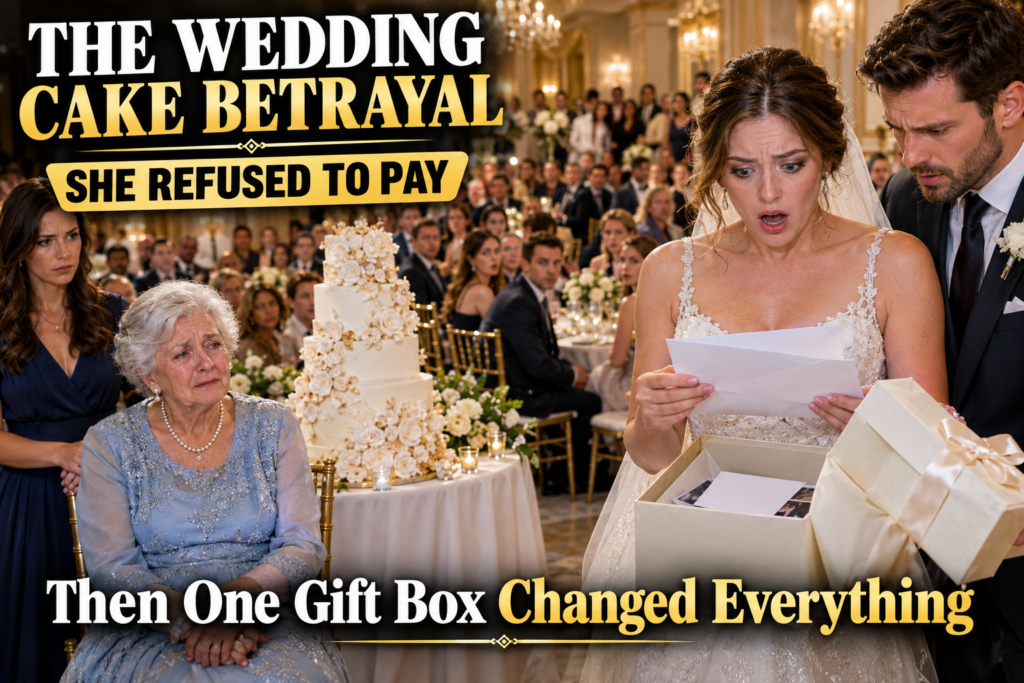
My brother carefully untied it.
The room grew quieter as people watched.
He lifted the lid and removed the framed childhood photograph. His face changed immediately.
“Look at this,” he said to Ashley. “I remember that day.”
The photograph showed him standing on a chair beside Grandma in her old kitchen. He was small enough that his chin barely reached the counter, and he was grinning at the camera with frosting on his cheek.
Grandma had taken the photograph decades earlier.
My brother laughed.
“I completely forgot about this.”
He turned it toward the guests, who responded with affectionate laughter.
Then he removed the recipe book.
“This is wonderful,” he said. “Grandma’s recipes!”
He opened it and began reading the names of a few familiar cakes and biscuits.
Ashley smiled for the cameras.
“This is so thoughtful,” she said.
I watched her carefully.
She had not yet noticed the white envelope beneath the recipe book.
My brother lifted the book, and the envelope appeared.
He glanced at the words written across the front.
**A Promise Remembered.**
His smile faded slightly.
“What is this?”
Ashley leaned closer.
“What’s inside?”
My brother opened the envelope.
He removed the first sheet of paper.
At the top was a printed screenshot from the family group chat.
He began reading.
Then he stopped.
For a moment, he looked confused. He glanced at the paper, then toward Ashley.
She reached for it.
“Let me see.”
He handed it to her.
She read the message.
Her expression changed so quickly that I almost missed it.
First came recognition.
Then disbelief.
Then something much closer to fear.
She turned the page, revealing the receipts and Grandma’s handwritten calculations.
Around them, the guests were still smiling, waiting for the couple to explain the surprise.
Ashley stared at the papers.
My brother looked from her to the envelope.
“What is this supposed to mean?” he asked.
Ashley didn’t answer.
She turned another page, her fingers suddenly unsteady.
Then she reached the short note I had placed at the bottom.
It contained no accusation, no insult, and no demand.
Only one sentence:
*Grandma kept her promise to make your wedding beautiful. This box remembers the promise made to her.*
Ashley read it once.
Then again.
Her face went completely pale.
\
Part 7\
For several seconds, nobody spoke.
The photographer lowered his camera.
A few guests exchanged puzzled looks, and someone near the back of the room stopped talking in the middle of a sentence.
My brother held out his hand.
“Ashley, let me see.”
She hesitated.
“It’s nothing,” she said, but her voice sounded unfamiliar even to her.
“Then let me see it.”
He took the papers and read the printed conversation himself.
I watched his face as he reached the part where Ashley had promised to cover the ingredients and Grandma’s time.
He read it again.
Then he looked at the receipts.
“What is this?”
Ashley swallowed.
“It’s just a misunderstanding.”
My brother stared at her.
“What misunderstanding?”
“She offered to make the cake, and I thought—”
“You told her you’d pay for the ingredients and her time.”
Ashley lowered her voice.
“Can we please talk about this later?”
He glanced toward Grandma.
She was sitting at our table, perfectly still.
I had never seen her look so uncomfortable. She had not expected the gift to be opened in front of so many people, and she certainly had not asked for the truth to become a public conversation.
She looked as though she wanted to disappear into her chair.
I immediately regretted not giving my brother the envelope privately.
That had never been my intention. I had wanted Ashley to confront the promise she had broken, but I had not anticipated the moment becoming part of the reception.
My brother stood and walked toward Grandma.
“Grandma, is this true?”
She looked up at him.
For a moment, she tried to smile.
“It’s all right, sweetheart. Please don’t worry about it today.”
“Did she tell you she would pay?”
Grandma glanced at Ashley, then back at him.
“Yes. We discussed it before I started.”
“And she didn’t pay you?”
Grandma’s eyes filled.
“I didn’t want to make a fuss.”
My brother’s expression tightened.
“That’s not what I asked.”
She took a slow breath.
“No, sweetheart. She didn’t.”
He looked genuinely stunned.
I knew my brother well enough to understand that he had not expected this. He had grown up watching Grandma bake for the family, and he had probably assumed that the cake was another gift she had freely offered.
He had not seen the receipts.
He had not watched her struggle with her aching hands.
And he had not been there when Ashley laughed at her.
But now he was looking at the evidence.
He turned toward his bride.
“You knew she was paying for the ingredients herself?”
Ashley pressed her lips together.
“I didn’t realize it would cost so much.”
“That’s why she gave you the receipts.”
“Please don’t do this here.”
My brother looked around the room.
“I didn’t do anything. I just opened a gift.”
Nobody laughed.
The atmosphere had changed completely. The cheerful anticipation surrounding the gift opening had become an uncomfortable silence, broken only by the faint music playing from the speakers.
Ashley looked at me.
For the first time since I had known her, she seemed to have no prepared response.
“You could have spoken to me privately,” she said.
I stood.
“You’re right. I could have.”
Her eyes narrowed slightly, as though she expected me to apologize.
“But I also could have pretended nothing happened,” I continued. “I could have watched Grandma lose money she needed for her medication and then helped everyone congratulate you for receiving a beautiful cake.”
Ashley opened her mouth.
I held up my hand.
“I didn’t come here to ruin your wedding. I didn’t ask the photographer to take pictures of this. I didn’t announce what happened in a speech. I placed the truth inside a gift box that you were going to open anyway.”
She looked away.
I continued, keeping my voice low.
“You told Grandma you would pay her. She believed you. She spent three days making something beautiful for you, and when she asked you to honor your promise, you laughed at her.”
Grandma touched my arm.
“Please, sweetheart.”
I stopped.
I wasn’t going to turn the moment into a shouting match. That wasn’t what Grandma wanted, and it wasn’t what I wanted either.
My brother looked down at the papers again.
“Why didn’t you tell me?” he asked Grandma.
She gave a small, sad smile.
“Because I didn’t want to cause problems between you and Ashley.”
He closed his eyes briefly.
“Grandma, you didn’t cause this.”
Ashley stood abruptly.
“I cannot believe we’re doing this at my wedding.”
The words came out louder than she intended.
Several guests looked at her.
My brother turned toward her.
“Then tell me what happened.”
She stared at him.
“I told you. I thought she was helping us.”
“You said you would pay.”
“I was going to!”
“Then why didn’t you?”
Ashley had no immediate answer.
For the first time that afternoon, the beautiful cake, the expensive decorations, and the carefully planned celebration seemed to mean very little.
The question was simple.
She had made a promise.
Why hadn’t she kept it?
\
Part 8\
Ashley sat down again, but she didn’t touch the papers.
The guests gradually returned to their tables, although the conversation around the room had changed. People spoke in quieter voices, and the photographer stepped away to give the family some privacy.
My brother remained standing beside the gift table.
I could see that he was struggling to understand what had happened. He had entered his wedding reception believing that everything was going well. Now he was discovering that someone he loved had treated his grandmother’s generosity as something she was entitled to take.
“Tell me what happened at her house,” he said.
Ashley shook her head.
“It’s not that simple.”
“Then explain it.”
She looked toward the guests.
“Everyone is watching us.”
“I’m asking you a question.”
Ashley took a breath.
“She gave me the cake, and then she asked for money. I thought we had agreed it was a family gift.”
My brother lifted the printed screenshot.
“This says you promised to cover the ingredients and her time.”
“She made it sound as if she didn’t mind helping.”
“That isn’t the same thing.”
Ashley rubbed her forehead.
“I was stressed. There were so many expenses. I didn’t think she would expect that much.”
Grandma quietly spoke from her chair.
“I wasn’t asking for that much, sweetheart.”
Everyone turned toward her.
She looked nervous, but she continued.
“I only wanted to cover what I spent. I know you have a wedding to pay for. I wasn’t trying to make things difficult.”
My brother looked at the receipts.
“How much did you spend?”
Grandma hesitated.
“I wrote it all down.”
He studied the figures, then looked at Ashley.
“This is what she spent on ingredients and supplies. And she worked for three days.”
Ashley folded her arms.
“I never said her work wasn’t worth anything.”
“You told her she should do it for free.”
“I was upset.”
“Grandma was upset, too.”
For a moment, Ashley looked as if she might argue again. Then she glanced around the room and seemed to realize that there was no explanation that could make the printed messages disappear.
My brother lowered his voice.
“Did you laugh at her?”
Ashley looked down.
“I didn’t mean to hurt her.”
“That’s not what I asked.”
The silence stretched.
Finally, she said, “Yes.”
Grandma closed her eyes.
I felt a knot tighten in my chest.
There was something especially painful about hearing someone admit to hurting a person who had already tried so hard to forgive them.
My brother sat beside Ashley.
“I need you to understand something,” he said. “Grandma has spent her whole life helping this family. She has made cakes for birthdays, brought food when people were sick, and given us things she couldn’t really afford to give.”
Ashley said nothing.
“She doesn’t have a lot of money. You know that. And she told you she needed to cover her medication.”
“I know.”
“Then why would you treat her like that?”
Ashley looked toward Grandma.
“I thought she would let it go.”
The words were quiet, but everyone close enough to hear them understood what she meant.
She had expected Grandma’s kindness to protect her from consequences.
She had assumed that because Grandma loved the family, she would accept the loss without complaint. She had counted on the older woman’s reluctance to cause trouble.
My brother stared at her.
“You thought she’d let it go?”
Ashley began to cry.
“I didn’t think everyone would find out like this.”
That was the first thing she had said that made me angry all over again.
Not that she regretted hurting Grandma.
Not that she was sorry she had broken her promise.
She was upset because other people now knew.
Grandma rose slowly from her chair.
“Please,” she said. “I don’t want anyone to fight.”
My brother immediately moved toward her.
“I’m sorry, Grandma.”
She shook her head.
“You haven’t done anything to me.”
“But I should have asked what happened.”
She touched his cheek.
“You’re getting married. Today should be a happy day.”
He looked at her for a long moment.
“Your happiness matters, too.”
Grandma’s face crumpled slightly.
She turned away to wipe her eyes.
Ashley watched them, and for the first time, I saw something in her expression that might have been genuine shame.
But shame alone could not repair what had happened.
A person could feel embarrassed about being exposed and still refuse to accept responsibility. The real test was what came next.
My brother returned to the table and picked up the envelope.
He folded the papers carefully and placed them back inside.
Then he turned toward Ashley.
“We’re going to settle this properly.”
She nodded faintly.
He walked over to Grandma and asked for her bank details so he could reimburse her for the expenses and the work she had done.
Grandma resisted at first.
“Oh, sweetheart, you don’t have to—”
“Yes, I do,” he said gently. “Please let me do this.”
She finally agreed.
He took out his phone and began arranging the payment.
Ashley remained seated, her hands clasped tightly in her lap.
Around us, the wedding continued in a strange, uneasy pause. The music played, servers carried plates, and guests tried to return to their conversations.
Then my brother said something that made Ashley look up sharply.
“Paying Grandma back is the first step,” he told her. “But I need to know whether you understand why this happened.”
Ashley stared at him.
He continued.
“Because if you think the only problem is that we were embarrassed in front of everyone, then we haven’t solved anything.”
For once, Ashley didn’t interrupt.
She looked at the envelope in his hand, then toward Grandma.
And she finally seemed to understand that the question was no longer about the price of a wedding cake.
It was about the kind of person she had chosen to be when she thought nobody would hold her accountable.
\
Part 9\
The reception resumed slowly.
The organizer, clearly uncertain about how to handle the interruption, announced that the couple would take a short break before the cake-cutting ceremony. Guests returned to their tables, and the photographer moved toward the garden to capture a few pictures of the decorations.
Grandma asked if she could go outside for some fresh air.
I accompanied her.
We walked along a stone path beside the garden, where the noise from the reception hall became softer. A gentle breeze moved through the trees, and the late-afternoon sunlight fell across the flowers bordering the walkway.
Grandma sat on a bench.
For a while, she said nothing.
Then she looked at me.
“Did you really need to put those papers in the box?”
I sat beside her.
“I wanted Ashley to remember what she promised.”
She nodded slowly.
“I understand.”
“Are you angry with me?”
She looked surprised.
“Oh, sweetheart. No.”
I waited.
She folded her hands in her lap.
“I was embarrassed when everyone started looking at us. I didn’t want people talking about the family.”
“I know.”
“But I was also hurt when Ashley said those things.”
Her voice trembled.
“I kept thinking that perhaps I had done something wrong. Perhaps I shouldn’t have asked her for the money. Perhaps I should have made the cake simpler.”
My throat tightened.
“Grandma, you did nothing wrong.”
She stared at the garden.
“I know that now. I think I knew it all along, but sometimes you can hear something often enough that you begin to wonder whether it’s true.”
I took her hand.
“You were generous. That doesn’t mean you have to let people take advantage of you.”
She gave a small smile.
“You sound like your mother.”
We both laughed quietly.
For a few minutes, we sat together without discussing the wedding. Then Grandma asked whether my brother was all right.
I told her he was speaking with Ashley.
She nodded.
“I hope they can work things out.”
“You don’t have to worry about their marriage right now.”
“Perhaps not,” she said. “But I do love him.”
“I know you do.”
She squeezed my fingers.
“And I don’t hate Ashley.”
I looked at her.
“Even after today?”
“Even after today.”
That was the difference between Grandma and the person who had hurt her. Grandma could recognize wrongdoing without deciding that the person who committed it was beyond forgiveness.
But forgiveness, I was beginning to understand, was not the same as pretending nothing had happened.
It did not erase the broken promise.
It did not make the money disappear from Grandma’s account.
And it certainly did not mean that Ashley should be allowed to repeat the behavior without consequence.
When we returned to the reception hall, my brother was waiting near the entrance.
He looked tired.
“Grandma, can I talk to you for a moment?”
She nodded.
He led us to a quieter corner of the room.
“I’ve transferred the money,” he said. “It covers the ingredients, the supplies, and the work you put into the cake.”
Grandma’s eyes widened.
“You didn’t have to pay for my time.”
“Yes, I did. You worked for it.”
He showed her the payment confirmation on his phone.
She studied it for a moment, then began to cry.
Not the quiet, wounded tears she had shed in her kitchen, but tears of relief.
“Oh, sweetheart.”
My brother hugged her.
“I’m sorry I didn’t know what happened.”
She held him tightly.
“You’re here now.”
He closed his eyes.
“I should have asked more questions.”
Grandma shook her head.
“You can’t know everything people say when you’re not there.”
Then he turned toward me.
“Thank you for putting the papers in the box.”
I hadn’t expected that.
“I wasn’t sure you would feel that way.”
He glanced toward Ashley, who was standing several feet away.
“I wish I’d known privately, but I’m glad I know the truth.”
Ashley approached us.
She looked different now. The confidence she had worn earlier in the day had disappeared, and her eyes were red.
She stopped in front of Grandma.
“Can I speak to you?”
Grandma nodded.
Ashley took a breath.
“I’m sorry.”
The words were quiet.
Grandma waited.
Ashley looked down at her hands.
“I shouldn’t have spoken to you that way. You worked so hard on the cake, and I promised I would pay you. Then I acted as if you were wrong for asking.”
Her voice broke.
“I was thinking about the money and the wedding expenses, and I convinced myself that because we were family, you should just help us. I didn’t think about what it cost you.”
Grandma listened without interrupting.
Ashley continued.
“And when you asked me to pay, I was embarrassed. Instead of admitting I couldn’t handle the expenses, I made you feel as though you were asking for something unreasonable.”
She wiped her eyes.
“I’m sorry I laughed at you. I’m sorry I hurt you.”
The room around us seemed to grow quieter, although the conversation was not loud enough for most guests to hear.
Grandma looked at Ashley for a long moment.
Then she reached out and took her hand.
“Thank you for apologizing.”
Ashley began to cry harder.
“I don’t expect you to forgive me immediately.”
Grandma squeezed her hand.
“Then don’t expect it. Just show me that you mean what you say.”
Ashley nodded.
For the first time, her apology seemed to be about more than the embarrassment of being exposed.
She had acknowledged the promise, the work, and the way she had treated the person who helped her.
It wasn’t a perfect ending.
The hurt was still there. Grandma would remember the moment in her kitchen, and Ashley would have to live with the knowledge that a wedding gift had forced her to face her own behavior.
But something important had changed.
The truth was no longer hidden behind a polite smile.
And now Ashley had a choice: she could learn from what happened, or she could return to the same habits once the wedding was over.
Grandma released her hand.
Then she looked toward the cake.
“It’s getting late,” she said softly. “You should probably cut it before the guests start wondering when dessert is coming.”
For the first time that afternoon, Ashley smiled without posing for a camera.
“Yes, Grandma.”
She turned toward the reception hall.
But before she walked away, she looked back and added, “And I really do mean it. I’m sorry.”
Grandma nodded.
“I hope you remember that feeling.”
Ashley stood still for a moment, then returned to her husband.
The cake-cutting ceremony was about to begin.
And this time, when everyone looked at the beautiful cake, they would know exactly how much love—and how much work—had gone into making it.
\
Part 10\
When the couple returned to the cake table, the photographer was ready.
My brother stood beside Ashley, and Grandma took a place near the front so she could see them clearly. The white cake rose between the couple, its handmade sugar flowers catching the light.
Ashley looked at it for a long moment.
Then she turned toward Grandma.
“Would you come stand with us for the photograph?”
Grandma hesitated.
“Are you sure, sweetheart?”
“Please.”
Ashley reached for her hand.
Grandma walked to the cake table, and the photographer asked everyone to move closer together. My brother stood on one side of his grandmother, Ashley on the other.
“Beautiful,” the photographer said. “Now, everyone look this way.”
The camera clicked.
For a moment, the three of them stood together beside the cake.
I watched from a few feet away, thinking about how different the afternoon might have been if Ashley had simply kept her original promise. There would have been no envelope, no uncomfortable questions, and no painful conversation in front of the gift table.
Grandma would have received her payment, Ashley would have received her cake, and everyone could have celebrated without the shadow of a broken promise.
But perhaps the most important part of the day was not the photograph.
It was what happened afterward.
During the cake-cutting ceremony, my brother handed Ashley the knife. They carefully cut the first slice together, laughing when the frosting caught on the blade. The photographer took several more pictures, and the guests applauded.
Then my brother turned to Grandma.
“Would you like the first piece after ours?”
Grandma smiled.
“Oh, no. You two should have it.”
He shook his head.
“I’m serious.”
He asked a server to bring her a slice from one of the tiers, and Grandma accepted it with a shy smile.
She took a small bite.
“Well?” my brother asked.
Grandma considered it thoughtfully.
“The filling could have been a little lighter.”
He stared at her in mock disbelief.
“Grandma!”
She burst into laughter.
For the first time all day, her laugh sounded completely natural.
Ashley laughed, too, and the tension that had followed the gift opening finally began to ease.
The cake was served to the guests. People complimented the flavor and the decorations, and several asked Grandma how she had made the flowers look so realistic.
She explained her process with the enthusiasm of someone discussing her favorite subject.
A young woman at one of the tables asked whether Grandma ever taught baking classes.
“I don’t teach classes,” Grandma replied, “but you’re welcome to come to my kitchen sometime. I’ll show you how to make a few things.”
The young woman smiled.
“I’d love that.”
Watching them, I realized that the cake had not lost its meaning because of what Ashley had done. Its beauty was still there. The hours of careful work were still there. The love Grandma had poured into every layer had not disappeared.
What had changed was our understanding of the people surrounding it.
My brother had learned that he could not assume everything was fine simply because everyone smiled at family gatherings.
Ashley had learned that a promise did not become optional just because the person receiving it was kind.
And I had learned that protecting someone’s feelings was not always the same as protecting them.
Sometimes, silence allows a hurtful act to become a habit.
Sometimes, the most loving thing you can do is refuse to pretend that something wrong was right.
Later that evening, I found Grandma sitting beside the garden doors, resting her feet.
She looked tired, but the sadness I had seen in her kitchen was no longer written across her face.
I sat beside her.
“Are you ready to go home?”
“In a little while.”
She watched the guests dancing.
“Your brother looks happy.”
“He does.”
“And Ashley seems calmer.”
“She does.”
Grandma nodded.
“I hope they learn to talk to each other when things become difficult.”
I smiled.
“That sounds like you.”
She laughed softly.
“I suppose old women are allowed to have a little wisdom.”
We sat together for several minutes.
Then Grandma looked at me.
“I’m glad you didn’t shout at Ashley.”
I thought about the words I had wanted to say when I first heard what happened.
“I was angry.”
“I know.”
“I still am, a little.”
Grandma nodded.
“That’s all right. You can be angry when someone hurts a person you love. Just don’t let anger make you forget what you wanted to protect in the first place.”
I looked at her.
“What did I want to protect?”
She took my hand.
“My dignity. And yours.”
I felt tears prick my eyes.
She smiled.
“You didn’t need to destroy anyone’s happiness to remind them that I mattered.”
I leaned against her shoulder.
“I just didn’t want you to think you had done something wrong.”
She squeezed my hand.
“I don’t anymore.”
That was all I needed to hear.
We stayed until the music slowed and the reception began winding down. Before leaving, Grandma said goodbye to my brother and Ashley. They thanked her for the cake, and my brother promised to visit her the following week.
Ashley hugged Grandma carefully.
“Thank you for everything,” she said.
Grandma returned the hug.
“Take care of each other.”
When we finally reached the car, Grandma settled into the passenger seat and looked back at the venue.
“Do you think they liked the gift?”
I laughed.
“I think they’ll remember it.”
She smiled.
Then, after a moment, she asked whether I thought the cake had been worth all the work.
I considered the question.
“It was beautiful,” I said. “And you deserved to be paid for making it.”
She nodded.
“That would have been nice.”
We drove home beneath the evening sky.
The next morning, I visited her kitchen again. The counters were clean, the mixing bowls had been put away, and the faded apron hung beside the pantry door.
Grandma was making tea.
For a moment, I thought about the cake and the envelope and the way Ashley’s face had gone pale when she read the note.
But Grandma didn’t seem interested in reliving the embarrassment.
Instead, she asked whether I wanted to help her make biscuits.
“I thought you might need a rest,” I said.
“I’ve rested enough.”
She opened the cupboard and reached for her favorite mixing bowl.
I watched her work, measuring flour and cutting butter into small pieces. Her hands were still stiff, and she moved more slowly than she once had, but the familiar pleasure had returned to her face.
She was baking because she loved it.
Not because someone had pressured her.
Not because she needed to prove her worth.
And not because she was afraid that refusing would make someone love her less.
Before I left, she packed a few biscuits into a container for me.
“Take these home.”
I smiled.
“You know you don’t have to feed everyone who walks through your door.”
She gave me the same look she had given me since childhood.
“Of course I do. What else would I do with all this baking?”
We laughed.
As I stepped outside, I glanced back through the kitchen window. Grandma was already returning to her mixing bowl, humming quietly to herself.
I knew she would continue baking for birthdays, holidays, neighbors, and people who needed a little kindness.
That was who she was.
But I hoped she would also remember that kindness did not require her to sacrifice her own needs. She could love people without paying for their choices. She could give generously without agreeing to be used.
And the rest of us could help her remember that.
I still think about the wedding sometimes, especially the moment Ashley opened the box and read the words I had written.
I didn’t put the envelope there to humiliate her. I put it there because a promise had been made, and the person who made it had acted as though it meant nothing.
The truth was simple.
My grandmother had spent three days making a wedding cake for someone she welcomed into the family.
She had worked with aching hands, spent money she could hardly spare, and trusted a promise made to her face.
She deserved to have that promise honored.
And if the little envelope in the gift box taught us anything, I hope it was this:
**Being family is never an excuse to take someone’s kindness for granted. It is a reason to treat that kindness with even greater care.**