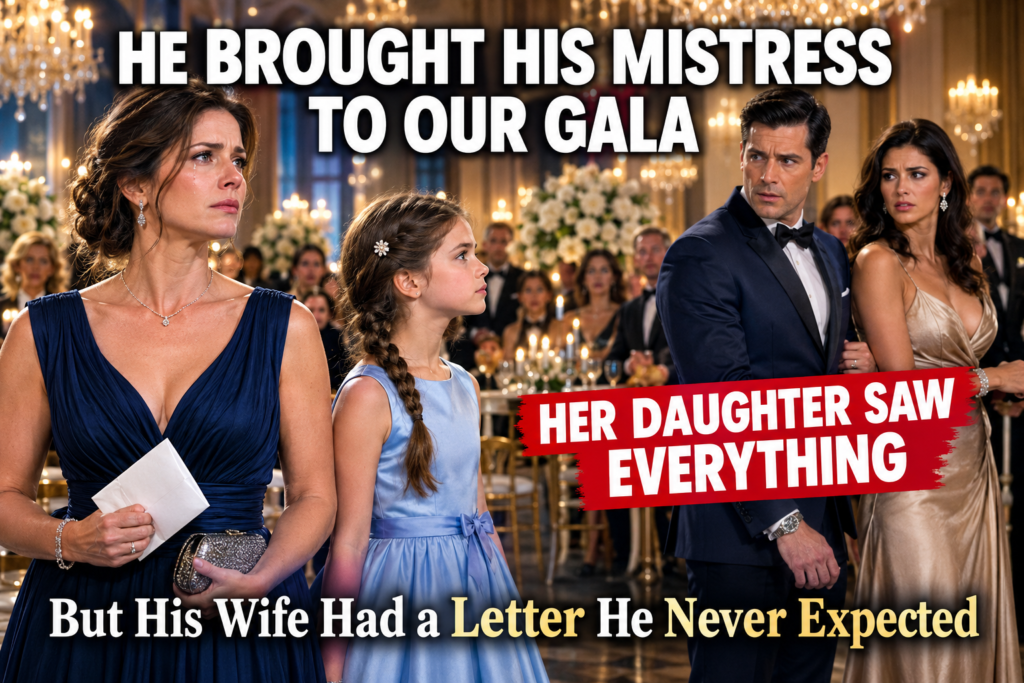
Part 1
The moment Derek walked through the ballroom doors, the conversations around me seemed to lose their sound.
For a second, I thought I had imagined what I was seeing.
The man approaching the grand staircase wore the midnight-blue tuxedo I had helped him choose three weeks earlier. His black hair was neatly combed, his silver watch gleamed beneath the chandelier lights, and his familiar smile rested comfortably on his face.
But the woman holding his arm was not me.
She wore a champagne-colored evening gown that caught the light with every step. Her dark hair fell in soft waves over her shoulders, and a diamond bracelet circled her wrist. She leaned toward Derek as he whispered something in her ear, then laughed with the effortless confidence of someone who believed she belonged exactly where she was.
Her name was Sienna.
I knew it because I had seen it on the restaurant reservation in the photograph my friend had sent me a week earlier.
At the time, I had stared at that photograph until the screen dimmed. Derek had been sitting across from Sienna in an expensive restaurant, his hand resting beneath hers on the table. They had looked comfortable, intimate, and completely unaware that someone had captured the moment.
I had wanted to believe there was an innocent explanation.
I had wanted to believe my husband, the man who had stood beside me for twelve years, would never humiliate our family so carelessly.
Instead, I had hired a discreet investigator and spoken with my lawyer.
By Thursday, the evidence was organized in a folder.
And tonight, beneath the glittering chandeliers of the charity gala, Derek had decided to make his own announcement.
He had brought Sienna into a room filled with our friends, business associates, neighbors, and people who had watched us build what they believed was a happy life together.
My fingers tightened around my champagne glass.
Beside me, my nine-year-old daughter, Grace, noticed.
“Mom?”
I looked down.
Grace wore a pale-blue dress with a satin ribbon tied around her waist. Her brown hair had been carefully braided, and a small silver clip held back the strands that kept falling across her forehead.
I had spent nearly an hour helping her get ready.
She had twirled in front of the mirror, asking whether her shoes matched her dress. She had talked about the charity’s work with children and whether the chocolate fountain would still be open when dinner ended.
She had been excited to attend this event with both her parents.
Now she was watching her father approach with a woman neither of us had expected to meet.
“Mom,” she whispered again.
I forced myself to look at her.
“I’m okay, sweetheart.”
Her small hand slipped into mine.
“No, you’re not.”
The honesty in her voice nearly broke me.
Before I could answer, she squeezed my fingers.
“Don’t cry. Just look at me.”
I did.
And somehow, for those few seconds, I could breathe again.
I didn’t make a scene. I didn’t throw my glass or demand an explanation. I didn’t cross the ballroom and ask Derek whether he had forgotten that his wife and daughter were standing less than twenty feet away.
I reached into my purse and touched the folded letter my lawyer had prepared.
The paper felt surprisingly ordinary.
It was strange how something so small could represent so many sleepless nights, unanswered questions, and painful realizations.
Derek had once promised me that we would never become the kind of couple who smiled for photographs while quietly destroying each other behind closed doors.
We had made that promise in a little restaurant on our third wedding anniversary. Grace hadn’t been born yet. We had been young enough to believe that love and honesty would protect us from everything.
Now I watched him guide Sienna toward a group of people we both knew.
He introduced her to a business associate.
Then to the chairman of the charity.
Then to a woman who had attended our wedding.
Each introduction seemed to chip away at something inside me.
Finally, Derek looked across the room and saw me.
His smile faltered.
Only for a second.
Then he lifted his glass as if acknowledging an acquaintance across a crowded room.
I stared at him, wondering whether he understood what I knew.
Wondering whether he had any idea that the woman he had married was no longer waiting helplessly for him to tell the truth.
Grace released my hand.
“Stay here, Mom,” she said softly.
Before I could ask where she was going, she turned and began walking toward her father.
My heart lurched.
“Grace?”
She didn’t stop.
Her little blue dress moved through the crowd, past the tables decorated with white roses and candles, past the guests who turned to watch her.
Derek saw her coming.
For the first time that evening, his expression changed completely.
And when Grace stopped in front of him, looked up at the woman on his arm, and asked a question loud enough for the nearest guests to hear, the entire room seemed to hold its breath.
Part 2
“Dad, who is she?”
Grace’s voice wasn’t loud, but the people nearest to Derek heard every word.
Sienna’s smile disappeared.
Derek glanced around the ballroom before looking down at our daughter.
“Grace, sweetheart. What are you doing over here?”
“Mom is waiting for you.”
“I know, honey.”
“Then why are you holding her hand?”
Sienna immediately released his arm.
It was such a small movement, almost graceful, but I noticed the way her fingers lingered against his sleeve before dropping to her side.
Derek crouched slightly, attempting to bring himself to Grace’s eye level.
“This is Sienna. She’s a friend.”
Grace studied him.
“A friend you take to restaurants when you have late meetings?”
The silence that followed was sharper than any accusation I could have made.
A waiter carrying a tray of sparkling water slowed beside a table. Two women standing near the staircase exchanged a glance. The charity chairman turned toward us, his expression growing uncertain.
Derek’s face tightened.
“Where did you hear that?”
Grace’s lower lip trembled, but she didn’t look away.
“You told Mom you were working late. But when you came home, your jacket smelled like the restaurant near your office.”
I remembered that evening.
Derek had returned after ten, kissed the top of Grace’s head, and told me he had eaten a sandwich between meetings.
Grace had been sitting at the kitchen island doing a school project.
She hadn’t said anything then.
She had simply watched him hang up his jacket.
At the time, I had been too exhausted to notice the way her little face had changed.
Now, standing in front of her father, she looked older than nine.
Derek straightened.
“This isn’t the place to discuss this.”
“Then where is the place?” Grace asked.
Her question was so sincere that it hurt more than anger would have.
“Grace, please.”
“Mom always waits for you.”
Sienna shifted uncomfortably.
“Derek, perhaps we should—”
“Not now,” he interrupted.
The words came out more harshly than he intended.
Grace flinched.
That was when something inside me finally overcame the instinct to protect Derek from embarrassment.
I crossed the ballroom.
I had spent the past week telling myself that whatever happened, I would remain calm. I would protect Grace, let my lawyer handle the legal matters, and refuse to become part of a public spectacle.
But I couldn’t stand there while my daughter carried the burden of questions that belonged to adults.
I reached her side and placed a hand on her shoulder.
“Sweetheart, you don’t have to explain anything.”
She turned toward me.
“I’m not explaining, Mom. I’m asking.”
Derek stood up fully.
His eyes moved from Grace to me, and I saw a flicker of uncertainty that hadn’t been there when he entered the room.
“Can we talk privately?” he asked.
“Of course,” I replied.
He seemed relieved.
Then I added, “But first, I think you should introduce your friend properly.”
His jaw tightened.
“Claire.”
He said my name as a warning.
I had heard that tone countless times over the years. It was the tone he used when he wanted me to stop asking questions, stop pressing an uncomfortable subject, or accept an explanation that didn’t quite make sense.
Once, I had mistaken it for authority.
Now I recognized it for what it was: a request for silence disguised as certainty.
I turned to Sienna.
“I’m Claire. Derek’s wife.”
Sienna’s face drained of color.
“I know who you are.”
“Then you understand why this is an uncomfortable introduction.”
“I didn’t intend to cause a scene.”
“Neither did I.”
My voice remained steady, and that seemed to unsettle Derek more than shouting would have.
He stepped between us slightly.
“Claire, this is a charity event. There are people here who don’t need to be involved in our private life.”
I looked at him.
“You brought your private life into the ballroom when you walked in holding her arm.”
Someone behind us quietly set down a glass.
Derek’s eyes flashed.
“That’s not fair.”
“Neither is asking your daughter to pretend she doesn’t see what is happening.”
Grace’s hand found mine again.
I felt her fingers trembling.
I bent down and whispered, “You can go sit with Aunt Melissa if you want.”
Melissa was my closest friend and had been helping the charity organize the evening. She was standing near the entrance, watching us with an expression that told me she understood more than she was saying.
Grace shook her head.
“I want to stay with you.”
“All right.”
I kissed her forehead.
When I straightened, Derek was watching us.
For a moment, I saw the man I had married. The man who had once stayed awake all night beside Grace’s hospital bed when she was a baby. The man who had carried groceries in the rain because I had a fever. The man who had promised that our family would always come first.
I wondered whether he remembered that person.
Then he looked toward the surrounding guests and lowered his voice.
“Whatever you think is happening, you’re making it worse.”
I almost laughed.
Not because anything was funny, but because I had spent seven days trying to find an explanation that would make his behavior less painful.
Now he was standing in front of our daughter, with another woman beside him, and still suggesting that my reaction was the real problem.
I reached into my purse.
The folded letter was still there.
But I didn’t take it out yet.
Instead, I looked at Derek and said, “You should ask your lawyer to call mine tomorrow.”
His expression changed.
“What?”
“Tomorrow,” I repeated. “My lawyer will be expecting the call.”
For the first time that evening, Derek seemed unable to find the right words.
Grace looked up at me.
I squeezed her hand.
Then Derek glanced toward Sienna, and she looked back at him with an expression I couldn’t quite read.
Whatever he had promised her, whatever story he had told her about his marriage, it was becoming clear that she hadn’t expected to meet the truth in front of a room full of witnesses.
And as the orchestra began playing again, Derek realized that the evening was no longer going according to his plan.
Part 3
The gala continued around us, but the atmosphere had changed.
Conversations resumed in fragments. Guests pretended to be interested in the auction displays while repeatedly glancing in our direction. The orchestra played a soft instrumental piece, yet the music seemed strangely distant.
I wanted to take Grace home.
I wanted to remove her from the room, make her hot chocolate, tuck her into bed, and reassure her that none of this was her fault.
But I also knew that leaving immediately would mean spending the entire drive listening to her ask questions I wasn’t ready to answer.
So I took her hand and led her toward a quieter seating area beside the ballroom windows.
Melissa joined us a moment later.
“Claire,” she whispered, “are you all right?”
I looked at her.
“No.”
Her eyes softened.
“Do you want me to take Grace for a while?”
Grace shook her head before I could answer.
“I’m staying with Mom.”
Melissa crouched in front of her.
“That’s fine, sweetheart. I just wanted to make sure you knew you had options.”
Grace nodded.
Melissa touched my shoulder.
“I’ll be nearby.”
When she walked away, Grace climbed onto the upholstered chair beside me.
“Are you going to divorce Dad?”
The question came so suddenly that I forgot how to breathe.
I had known it was coming.
Still, hearing those words from my nine-year-old daughter made my chest ache.
“Why are you asking me that?”
She looked down at her shoes.
“Because you have a letter in your purse. And you said Dad should call your lawyer.”
I hadn’t realized she had noticed.
Children noticed more than adults wanted to believe. They collected the small details we thought we had hidden: the unanswered phone calls, the long pauses at dinner, the way a parent stopped asking about the other parent’s day.
Grace had been collecting those details for weeks.
I moved closer to her.
“Sweetheart, your dad and I have some grown-up problems to work through.”
“Because of Sienna?”
I hesitated.
“I think your dad has made choices that have hurt our family.”
“Does that mean he doesn’t love us anymore?”
My eyes filled before I could stop them.
Grace immediately reached for my hand.
“Mom, don’t cry.”
I drew her against me.
“Listen to me carefully. Whatever happens between your dad and me, you are loved. Nothing about this is your fault, and you will never have to earn my love by choosing sides.”
She buried her face against my shoulder.
“I don’t want you to be alone.”
That was when the tears finally fell.
Not because Derek had brought another woman to the gala.
Not because the guests were whispering.
Not even because I was frightened of what the coming months might bring.
I cried because my daughter had begun worrying about whether her mother would be alone, when she should have been worrying about spelling tests, birthday parties, and which book to read before bed.
I held her until she relaxed.
Then I wiped my cheeks and looked through the window at the dark garden beyond the terrace.
A week earlier, I had sat at our kitchen table staring at the photograph my friend had sent me.
Derek had been smiling in it.
His hand rested beneath Sienna’s, and he was leaning toward her as though the rest of the world had disappeared.
I remembered enlarging the photograph, looking at the restaurant’s name, and wondering whether there was some explanation I had overlooked.
I remembered calling Derek that night.
He hadn’t answered.
When he finally came home, he had kissed my cheek and complained about traffic.
I had wanted to believe him so badly that I nearly did.
The next morning, I called the lawyer Melissa recommended.
Her name was Evelyn Hart.
She listened without interrupting while I described what I knew. She didn’t tell me to leave my husband or promise that everything would work out. She asked practical questions about our marriage, our daughter, our finances, and the records I had already found.
Then she said something I had written down.
“Claire, you don’t need to make every decision today. You need reliable information, a clear understanding of your rights, and a plan that protects you and your child.”
Those words had become my anchor.
Over the next several days, I gathered the financial records I could lawfully access. I saved messages that were already on our shared devices and organized documents relating to our household expenses. I hired a professional investigator after discussing the matter with Evelyn, who explained what kinds of evidence could be useful and what methods should be avoided.
I didn’t want revenge.
I wanted the truth.
And I wanted to know whether the man I had married had been making decisions that could affect Grace’s future.
By Thursday afternoon, Evelyn had reviewed the material and prepared a letter outlining the next steps.
It wasn’t a dramatic document.
It didn’t contain a grand accusation or a demand for immediate punishment.
It simply established that I had sought legal advice, that I intended to protect my interests, and that further communication about our marriage and finances should take place through the appropriate channels.
But Derek didn’t know that.
He had spent years assuming I would always be willing to talk things through privately, often accepting his version of events because I trusted him.
Tonight, for the first time, he had discovered that I was prepared to ask questions he couldn’t answer with a reassuring smile.
“Mom?”
Grace’s voice brought me back to the present.
“Yes, sweetheart?”
“Can we go home now?”
I kissed her forehead.
“Yes. We can go home.”
As I reached for my purse, my phone vibrated.
A message from Evelyn appeared on the screen.
*Claire, I have reviewed the additional financial records you sent. Please do not confront Derek about the accounts until we speak. There is something important we need to discuss.*
I read it twice.
Then I looked across the ballroom.
Derek was standing near the auction table, speaking with the charity chairman. Sienna was beside him, but neither of them seemed comfortable.
For a moment, I considered opening the message and calling Evelyn immediately.
Instead, I put the phone away.
Whatever else I had to face, I would face it after Grace was safely home.
But as I helped my daughter put on her coat, I couldn’t shake the feeling that the affair was only one part of a much larger problem.
Part 4
The drive home was quiet.
Grace sat in the back seat, her blue dress gathered around her knees, watching the city lights slide across the window. I kept both hands on the steering wheel and tried to concentrate on the road.
At a red light, I glanced at her in the rearview mirror.
“Would you like some music?”
She shook her head.
“Can I ask you something?”
“Anything, sweetheart.”
“Did you know about Sienna before tonight?”
I took a breath.
“I suspected something.”
“How long?”
“A little while.”
She considered that.
“Why didn’t you tell me?”
Because I had been afraid, I thought.
Because I hadn’t known what was true.
Because I had wanted to protect her childhood, even while the tension in our home was already beginning to affect it.
But I couldn’t place all of those explanations on her shoulders.
“Because some things are difficult for adults to understand, too,” I said. “And I wanted to be sure before I talked about them.”
Grace watched the passing lights.
“Dad always tells me to tell the truth.”
“He should.”
“Then why doesn’t he?”
I swallowed.
“I don’t know, sweetheart.”
It was the most honest answer I could give her.
When we arrived home, Grace changed into her pajamas and brushed her teeth without being reminded. She climbed into bed while I sat beside her, smoothing the blanket over her legs.
“Will Dad come home tonight?” she asked.
“I don’t know.”
“Will he be angry?”
“I can’t promise how he’ll feel. But you don’t have to manage his feelings, Grace. That’s not your job.”
She nodded slowly.
I read two pages of her favorite book before she interrupted me.
“Mom?”
“Yes?”
“If Dad says he loves me, does that mean everything is okay?”
I closed the book.
“No. Loving someone doesn’t mean every choice you make is right. But it does mean you have a responsibility to treat them with care.”
She was quiet for a long moment.
“Then I hope Dad remembers that.”
So did I.
After she fell asleep, I went downstairs and sat at the kitchen table.
The house felt unfamiliar without the ordinary sounds of family life. The refrigerator hummed. A clock ticked above the doorway. Somewhere outside, a car passed over the wet pavement.
I opened my laptop and reviewed the financial records Evelyn had asked me to organize.
Derek and I had maintained a joint household account for years. We used it for the mortgage, Grace’s school expenses, groceries, utilities, and family holidays.
We also had individual accounts and savings set aside for future expenses.
I had never thought of our finances as something that required suspicion.
Derek handled many of the investment discussions because his work involved business development and financial planning. I managed our household expenses, kept track of school payments, and maintained the records we used when filing our taxes.
We had different responsibilities, but I had always believed we shared the same goals.
That belief had begun to fracture when I noticed several transfers I couldn’t immediately explain.
At first, the amounts had seemed ordinary. A payment here, a withdrawal there, a transaction labeled with an unfamiliar abbreviation.
I asked Derek about one of them over breakfast.
“It’s an investment expense,” he replied, barely looking up from his phone.
“What kind of investment?”
“Nothing you need to worry about.”
I had frowned.
“If it’s coming from our shared savings, I think I should understand it.”
He put down his coffee.
“Claire, I know what I’m doing.”
The conversation ended there.
At the time, I had let it go.
Now I understood why Evelyn wanted me to stop asking questions until we had reviewed the records properly.
I sent her a message confirming that I was available for a call the following morning.
Then I closed the laptop.
I was tired enough to feel every muscle in my shoulders.
As I stood to turn off the kitchen light, I noticed something on the counter.
A small paper envelope.
Grace’s name was written across the front in Derek’s handwriting.
I picked it up.
Inside was a birthday card he had bought for her several weeks earlier. Her birthday was still months away, and I couldn’t remember seeing the envelope before.
There was a short note inside.
*To my favorite girl. Never forget that no matter what happens, Dad will always love you.*
I sat down again.
Why had he written that?
Had he known I was beginning to investigate?
Had he been planning to leave?
Or was it simply an ordinary card he had written early, before the truth of our marriage became impossible to ignore?
I couldn’t know.
And I refused to invent an answer simply because uncertainty was painful.
I placed the card back in its envelope and set it aside.
Then I went upstairs.
For the first time in years, I slept in the guest room.
At six thirty the next morning, my phone rang.
Evelyn’s name appeared on the screen.
I answered immediately.
“Good morning,” she said. “I’ve reviewed the records more closely. We need to discuss what I found before you speak with Derek again.”
My stomach tightened.
“Is it about Sienna?”
“Partly. But I don’t want you to assume that the relationship explains every transaction.”
I sat on the edge of the bed.
“What does that mean?”
There was a pause.
“It means we need to establish whether your shared finances have been affected, what the records actually prove, and what remains uncertain.”
I looked toward Grace’s bedroom.
The morning sun was beginning to appear beyond the curtains.
For years, I had believed the hardest thing I might ever have to do was tell my daughter that her parents could no longer live together.
Now I wasn’t even sure I understood the full shape of the problem.
And before Evelyn could explain further, another call appeared on my phone.
Derek.
Part 5
I let Derek’s call ring twice before answering.
“Claire.”
His voice sounded tired.
“Good morning.”
“Where are you?”
“At home.”
“Is Grace there?”
“Yes. She’s getting ready for school.”
He exhaled.
“Good. I need to talk to you.”
“So do I.”
“Not over the phone.”
“Then you can speak with Evelyn.”
Silence.
“You actually hired a lawyer?”
“Yes.”
“Without even talking to me?”
I closed my eyes.
“I tried talking to you. I asked about the late meetings. I asked about the restaurant. I asked about the transfers from our savings. Every time, you told me not to worry.”
“That doesn’t mean you should drag lawyers into our marriage.”
“You brought another woman to a public event where our daughter was standing beside me.”
“I made a mistake.”
The words came so quickly that I almost missed them.
For a moment, I could hear only the sound of my own breathing.
“You made a mistake?”
“Yes.”
“Which one, Derek? The relationship? The lies? Or bringing her to the gala?”
He didn’t answer immediately.
“I didn’t plan for Grace to be there.”
I stared at the wall.
“She is your daughter. She belongs at family events.”
“I know that.”
“Then stop talking as if her presence was an inconvenience.”
He sighed.
“Claire, I’m trying to keep this from getting worse.”
“No. You’re trying to control how much of it I know.”
“That isn’t fair.”
I almost smiled at the familiarity of the sentence.
He had used it at the gala, too.
I had begun to wonder whether he understood that repeating the same words didn’t make them true.
“Evelyn will contact your lawyer,” I said. “Until then, I don’t want to discuss the finances or our marriage without proper advice.”
“Your lawyer is going to turn this into a war.”
“My lawyer is going to help me understand my options.”
“And what about Grace?”
I straightened.
“Grace is the reason I’m being careful.”
He went quiet.
Then he said, “I want to see her.”
“You can arrange that through me, provided we keep her out of our disagreements.”
“She’s my daughter.”
“Yes, Derek. She is.”
I ended the call before the conversation could become another argument about his rights without any acknowledgment of his responsibilities.
A moment later, Grace appeared in the doorway wearing her school uniform.
“Was that Dad?”
“Yes.”
“Is he coming home?”
“I don’t know yet.”
She looked down at her shoes.
“Can I still call him tonight?”
“Of course. We’ll work out a time.”
She nodded and walked into the kitchen.
I followed her and made breakfast.
We talked about a class project, a spelling test, and whether she could invite her friend Olivia over on Saturday. I deliberately kept our conversation ordinary.
She needed ordinary.
She needed to know that even when adults made painful decisions, the rest of her life didn’t have to stop.
After dropping her at school, I met Evelyn at her office.
She was a calm woman in her early fifties, with short silver-streaked hair and a habit of listening to a question all the way through before answering.
She placed a folder on the table between us.
“I want to be very clear,” she said. “These records raise questions. They do not, by themselves, establish that Derek has committed a crime or that every unexplained payment is improper.”
I nodded.
“What do they show?”
“Several transfers from the joint savings account to an account you don’t recognize. We need the statements and supporting documents to determine who controls that account, where the money went, and whether the transfers were authorized under your existing arrangements.”
“Could the money have gone to Sienna?”
“Possibly. But we should not assume that without evidence.”
I appreciated her honesty.
I had spent enough time trying to guess what Derek was thinking. I didn’t want to build my future around assumptions.
Evelyn opened another document.
“There are also business-related payments. Some appear to have been made through an account connected to Derek’s professional activities. I want a qualified financial professional to review the relevant records if necessary.”
“Does this mean our savings are gone?”
“I can’t tell you that yet.”
The answer frightened me more than a dramatic accusation would have.
I had imagined betrayal as a single event, a photograph, a confession, a moment in a ballroom when a marriage became something different.
But marriage was also paperwork, obligations, shared accounts, and years of decisions made on the assumption that both people were acting in good faith.
Evelyn continued.
“For now, keep copies of records you are entitled to access. Don’t alter anything, don’t attempt to enter accounts that aren’t yours, and don’t confront Derek with conclusions we haven’t verified. We’ll take this one step at a time.”
I nodded.
Then I asked the question I had been avoiding.
“If the relationship ends, can I protect Grace’s home and education?”
“We can explore the legal and practical options available to you. The answer will depend on your circumstances, the relevant law, and the complete financial picture.”
I looked down at my hands.
“I don’t want to punish him.”
“Then don’t make punishment your objective,” Evelyn said. “Make stability your objective. Protect your daughter. Understand your rights. Let the facts guide your decisions.”
Those words settled something inside me.
When I left her office, I felt neither victorious nor relieved.
I felt prepared to continue.
That afternoon, I received a message from Sienna.
*Claire, I think you deserve to hear my side of the story. Derek told me your marriage had been over for a long time.*
I stared at the message.
A second one appeared.
*He said you were staying together only for Grace.*
I read both messages twice.
I didn’t know whether Sienna was telling the truth about what Derek had said. I didn’t know how much she knew about our marriage or whether she had been given a carefully constructed version of events.
But I understood something important.
Derek might have been telling different stories to different people.
And if I wanted the truth, I would have to resist the temptation to accept whichever version hurt the least.
I put my phone down.
Then another message arrived.
This one was from Derek.
*We need to talk tonight. There’s something I should have told you months ago.*
Part 6
Derek came home on Friday evening.
I had asked Melissa to take Grace to the park for an hour so that our daughter wouldn’t have to sit through a difficult conversation. I told Grace that her father and I needed to discuss some adult matters, and that she could call me whenever she wanted.
She had hugged me before leaving.
“Promise you’ll tell me if anything changes?”
“I promise I’ll always tell you what you need to know.”
I didn’t promise that nothing would change.
That would have been a lie.
Derek arrived shortly after seven. He was no longer wearing his gala tuxedo. Instead, he had on a gray sweater and dark trousers, the sort of clothes he usually wore on a quiet evening at home.
For one disorienting moment, I remembered him coming home from work years earlier, carrying takeout because I had been too tired to cook.
We had eaten on the living-room floor while talking about our future.
I had believed that future was something we were building together.
Now he stood in the doorway, looking at the house as if he wasn’t sure whether he still belonged there.
“Can we sit down?” he asked.
I gestured toward the living room.
He chose the sofa. I took the chair opposite him.
For a few seconds, neither of us spoke.
Then Derek rubbed his palms together.
“I know what you saw at the gala.”
“Do you?”
He looked up.
“I know it looked terrible.”
“It looked exactly like what it was.”
He flinched.
“I didn’t intend to humiliate you.”
“But you did.”
“I know.”
“Did you think about Grace before you brought Sienna?”
He lowered his eyes.
“No.”
The admission surprised me.
At least he wasn’t trying to make that part of the story sound better than it was.
“Why did you bring her?”
He stared at the floor.
“She wanted to come.”
“And you agreed.”
“Yes.”
“Did she know I would be there?”
“Yes.”
I felt something cold settle in my chest.
“So both of you knew.”
Derek shook his head.
“It wasn’t supposed to happen like that.”
“What was supposed to happen?”
He opened his mouth, then closed it.
For once, he seemed to understand that he couldn’t answer a difficult question by changing the subject.
“I’ve been seeing Sienna for several months,” he said finally.
I had suspected as much.
Hearing him say it still hurt.
“How many?”
“Claire—”
“How many months?”
He swallowed.
“About seven.”
Seven months.
I thought about the school concert he had missed in the spring. The weekend he had said he needed to visit a client. The anniversary dinner he had canceled because an urgent meeting had supposedly come up.
I didn’t know whether any of those events were connected to Sienna.
I didn’t want to assume.
But suddenly, the past seven months felt like a room I had been living in without realizing someone had quietly moved all the furniture.
“Did you tell her you were separated?”
He hesitated.
“I told her things were complicated.”
“That isn’t an answer.”
He looked at me.
“I told her we weren’t happy.”
“Were we unhappy, Derek?”
He opened his hands helplessly.
“Things had changed.”
“Of course they had. We had a child. Jobs. Responsibilities. We were no longer the two people who could spend an entire Sunday in bed and order dinner whenever we felt like it.”
“That isn’t what I meant.”
“Then tell me what you meant.”
He looked exhausted.
“I felt like I had become someone who worked, paid bills, attended meetings, and came home to a list of things I hadn’t done. I didn’t know how to talk to you about it.”
I listened without interrupting.
Part of me wanted to tell him that I had felt exhausted, too. That I had balanced school schedules, household responsibilities, and my own work while assuming we were both trying to keep our family functioning.
But I didn’t want our conversation to become a competition over who had been more unhappy.
“You could have talked to me,” I said.
“I know.”
“You could have asked for counseling.”
“I know.”
“You could have told me you wanted to leave.”
His eyes filled.
“I didn’t want to lose Grace.”
I felt my throat tighten.
“Then you should have thought about Grace before making choices that might hurt her.”
He leaned forward.
“I made a terrible mistake.”
“You made a series of choices.”
He looked at me for a long time.
Then he said, “I didn’t know how to stop.”
I believed that he might have felt trapped by his own decisions.
But feeling trapped didn’t make those decisions harmless.
I took a breath.
“What did you mean when you said there was something you should have told me months ago?”
His face changed.
For the first time since he arrived, he seemed genuinely afraid.
“There’s a problem with the money.”
I remained still.
“What kind of problem?”
He looked toward the hallway, then back at me.
“Some of the investments didn’t work out.”
“How much money?”
“I don’t know the exact amount yet.”
“You don’t know?”
“I need to reconcile everything.”
“Derek, Evelyn has already found transfers from our joint savings that I don’t recognize.”
He closed his eyes.
“So you’ve seen them.”
“Yes.”
He rubbed his forehead.
“I was going to replace the money.”
“When?”
“After a deal closed.”
“What deal?”
He didn’t answer.
I thought about the unexplained transfers, the business-related payments, and the message Evelyn had sent.
“Did you use our savings to cover business losses?”
“Some of it.”
“How much?”
“I need to check.”
“Were the transfers connected to Sienna?”
“No,” he said quickly. “Not directly.”
I stared at him.
“What does ‘not directly’ mean?”
He stood up and began pacing.
“I wasn’t paying for her lifestyle with our money. I wasn’t doing that.”
“I didn’t ask whether you were paying for her lifestyle. I asked whether the transfers were connected to her.”
He stopped.
“I invested in something through a business contact. It didn’t work out the way I expected. I moved money around to cover some obligations. I thought I could fix it before you noticed.”
I felt the room tilt.
For years, I had trusted him with our family’s financial future.
Now he was telling me that he had used shared savings without giving me a complete explanation and had hoped to replace the money before I discovered what had happened.
“Did you borrow money in my name?”
“No.”
“Did you sign anything on my behalf?”
“No.”
“Are you certain?”
He looked away.
“I’m certain I didn’t forge your signature.”
That was not quite the same answer.
I reached for my phone.
“I’m going to ask Evelyn to review everything.”
“Claire, please. Don’t make this bigger than it is.”
I stood.
“You don’t get to decide how big it is. Not when I don’t know how much money is missing, what obligations exist, or whether our family’s financial security has been affected.”
He stared at me.
“I never wanted to hurt you.”
“But you were willing to risk our security to avoid admitting you had made a mistake.”
He said nothing.
When Melissa returned with Grace, Derek had already left the house.
Grace came into the kitchen carrying a paper bag from the bakery.
“Dad wasn’t here?”
“He was, sweetheart. He had to leave.”
“Did you fight?”
I knelt beside her.
“We had a difficult conversation. But you didn’t cause it, and you don’t need to fix it.”
She studied my face.
“Are we going to be okay?”
I held her hand.
“We’re going to work through this one step at a time.”
That night, after Grace went to bed, I opened the message from Sienna again.
I didn’t reply.
Instead, I forwarded it to Evelyn with a note explaining what Derek had told me.
Then I placed the phone beside my bed.
The affair had hurt me.
The financial uncertainty frightened me.
But what unsettled me most was the realization that Derek had been making decisions that affected our family while assuming he would have time to explain them later.
He had mistaken my trust for an endless supply of second chances.
I was beginning to understand that protecting Grace might require me to stop giving him those chances without accountability.
Part 7
The following Monday, Evelyn arranged a meeting with a financial professional who could review the records and help establish what had happened.
I took every document I had collected, including the statements from our shared account, the transfer records, and the correspondence Derek had sent me about certain investments.
I didn’t bring the photograph of Derek and Sienna.
It no longer seemed necessary.
The photograph had answered one question.
The records were beginning to raise several more.
Over the next two weeks, I learned that some of the transfers had gone toward business obligations Derek had not discussed with me. Others required further investigation before anyone could determine their purpose.
The total amount affected was significant enough that Evelyn advised me to take the situation seriously, but she warned me against assuming that every unexplained payment represented a loss.
Some money had been moved between accounts. Some had been used to meet expenses. Some was connected to investments whose value had changed.
The complete picture would take time to establish.
I wanted certainty immediately.
I wanted someone to tell me exactly what had happened, how much had been lost, and whether our home and Grace’s future were safe.
Instead, I had to learn patience.
The truth was arriving in pieces, and every piece required careful examination.
Meanwhile, Derek began calling more often.
Sometimes he asked about Grace’s school day. Sometimes he wanted to know whether I had spoken to Evelyn. Once, he called simply to say that he missed the house.
I didn’t know what to do with that last admission.
I missed the version of our family that had existed before the lies.
I missed the ordinary evenings when we cooked together, the Saturday mornings when Grace climbed into our bed, and the holidays when Derek took photographs of us laughing.
But missing those moments didn’t mean I could return to a marriage in which important truths were withheld until I discovered them myself.
One afternoon, Derek came to collect a few things he needed for work.
Grace was at a friend’s house, so I let him in.
He stood in the hallway, looking at the framed family photographs on the wall.
There was one from Grace’s sixth birthday, when she had insisted that both of us wear paper crowns. Another showed us standing beside the sea during a holiday we had taken two summers earlier.
Derek touched the edge of the frame.
“I never thought we’d end up here.”
“Neither did I.”
He turned toward me.
“Do you think there’s any chance we can fix this?”
I didn’t answer immediately.
There had been a time when I would have said yes before he finished asking.
I would have told him that every marriage had difficult seasons, that we had built too much together to give up, and that Grace deserved to grow up with both parents under one roof.
Now I understood that the question was not whether I could forgive him.
It was whether he was willing to become someone I could trust.
“I don’t know,” I said honestly.
He looked wounded.
“After twelve years, that’s all you can say?”
“After twelve years, I need more than a promise.”
“What do you want me to do?”
“Tell the truth. All of it. Cooperate with the financial review. Stop asking me to protect you from the consequences of your choices. And make sure Grace doesn’t become the person who has to comfort either of us.”
He lowered his head.
“I can do that.”
“Then do it.”
He nodded.
Before leaving, he paused beside the front door.
“Claire, I do love you.”
The words hurt because part of me still wanted them to mean everything.
“I believe you may feel that,” I said. “But love cannot be the only evidence I have that our marriage is safe.”
He looked at me for a long moment.
Then he left.
That evening, Grace asked whether she could call him.
I handed her the phone.
She spoke to him for fifteen minutes about a class assignment, an upcoming school event, and a book she wanted him to read with her.
I stayed in the kitchen, giving her privacy while remaining close enough to hear if she needed me.
When the call ended, she placed the phone on the counter.
“Dad sounded sad.”
“He might be.”
“Should I tell him it’s okay?”
I turned toward her.
“You can tell him you love him, if that’s what you feel. But you don’t have to tell him everything is okay when it isn’t.”
She considered that.
“Can I love him and still be angry?”
“Yes.”
“Can you?”
I sat beside her.
“Yes, sweetheart. I can love someone and still be hurt by what they’ve done.”
She leaned against me.
“That’s confusing.”
“It is.”
For a while, we sat together without speaking.
Then Grace asked whether we could make pancakes on Saturday morning.
I smiled.
“Of course.”
It wasn’t a solution to our problems.
It was simply something good we could still do together.
And I began to understand that rebuilding our lives would not happen in one dramatic moment. It would happen through small decisions, ordinary routines, and the steady work of helping Grace feel safe again.
The next morning, Evelyn called.
“We’ve made progress,” she said. “The financial review has identified several transactions that need a fuller explanation. Derek has agreed to provide additional documents through his representative.”
“Does that mean we know what happened?”
“Not completely. But we’re getting closer.”
I thanked her.
Before ending the call, she added, “There is one other thing. Derek’s lawyer has asked whether you would consider a meeting to discuss the future of the marriage.”
I looked out the kitchen window.
A school bus passed at the end of the street.
“I’ll consider it,” I said. “But I want the financial issues addressed separately and properly.”
“That is reasonable.”
After the call, I stood for a long time with my phone in my hand.
The gala had begun as a public humiliation.
Now it had become the moment when I stopped accepting uncertainty as the price of keeping my marriage intact.
I didn’t know whether Derek and I would reconcile.
I didn’t know how long the financial review would take.
But I knew that whatever happened next, I would no longer confuse silence with peace.
Part 8
The meeting took place in Evelyn’s office on a rainy Thursday afternoon.
Derek arrived with his lawyer. I sat beside Evelyn, a notebook resting on my lap.
No one raised their voice.
No one made accusations that couldn’t be supported.
The lawyers reviewed the process for exchanging financial information, establishing temporary arrangements, and communicating about Grace.
Derek looked tired.
His usual confidence had given way to something more subdued. He listened while the lawyers spoke, occasionally rubbing the side of his thumb with his forefinger.
When the formal discussion ended, he asked whether he could speak to me for a few minutes.
Evelyn looked at me.
I agreed, provided we remained in the office.
Derek’s lawyer stepped outside with Evelyn.
For the first time in weeks, Derek and I were alone without our daughter, a ballroom full of witnesses, or a phone ringing between us.
He looked at the notebook in my lap.
“You’ve written everything down.”
“I don’t want to forget anything important.”
He nodded slowly.
“I suppose I gave you plenty to write about.”
I didn’t answer.
He leaned back in his chair.
“I’ve been thinking about what you said. About trust.”
I waited.
“I keep wanting you to understand why I did what I did. I keep explaining how unhappy I felt, how much pressure I was under, how I thought I could fix the financial problems before they became serious.”
He looked at me.
“But every explanation sounds like an excuse.”
I was surprised by the admission.
“Because an explanation doesn’t erase the choice,” I said.
“I know.”
He rubbed his hands together.
“I think I kept telling myself that if I could solve the money problem, I could deal with everything else later. I thought I could end the relationship, put the finances right, and come home as though none of it had happened.”
“And what about the truth?”
He looked away.
“I was afraid of what would happen if I told you.”
“So you decided for both of us that I didn’t need to know.”
He nodded.
“Yes.”
The honesty was painful, but it was different from the explanations he had given me before.
For the first time, he wasn’t telling me that I had misunderstood him.
He was acknowledging that he had withheld information because he feared the consequences.
“I don’t know whether I can forgive you,” I said.
His eyes filled.
“I understand.”
“Do you? Because forgiveness isn’t something you can ask me to provide on a schedule. And it doesn’t mean I have to remain married to you.”
He looked down at the table.
“I know.”
I studied him.
I had once imagined that if Derek ever admitted the truth, I would feel some great release. I had expected anger to give way to clarity, and clarity to bring a decision I could make without hesitation.
Instead, I felt grief.
I grieved the marriage I thought I had.
I grieved the years when I believed we were making decisions together.
I grieved the fact that Grace had learned to watch our faces for signs of trouble.
And I grieved the possibility that the person I loved might never become the person I needed him to be.
“Have you spoken to Sienna?” I asked.
“Yes.”
“Are you still seeing her?”
He hesitated.
“No.”
I held his gaze.
“Is that the truth?”
“Yes.”
I didn’t ask him to prove it in that moment. The relationship was one part of the situation, and the financial questions still needed to be resolved.
But I made a note to myself that promises alone would not be enough.
Derek leaned forward.
“She asked me about the gala afterward. She said she didn’t understand why I had brought her into a situation that was clearly unresolved.”
“What did you tell her?”
“That I had been selfish. That I hadn’t been honest with either of you.”
I said nothing.
He continued.
“I told her I needed to deal with my marriage properly, whatever that meant for us.”
I thought about Sienna’s message.
She had said Derek told her our marriage was already over.
Perhaps she had believed him. Perhaps she had chosen to believe what suited her. I couldn’t know, and I no longer felt responsible for solving every question about her motives.
My responsibility was to myself and Grace.
“Derek, I need you to understand something. I will not use Grace to punish you. I won’t tell her she has to choose between us. But I also won’t pretend that everything is normal simply to protect your reputation.”
He nodded.
“You shouldn’t.”
“If we separate, we’ll need to make decisions about her school, her schedule, and where she spends her time. We’ll do that carefully. And if you want to repair your relationship with her, you’ll have to be consistent.”
“I want that.”
“Then show her.”
He looked toward the window.
“I hate that she saw me at the gala.”
“So do I.”
“I never wanted her to think I didn’t love her.”
“Then don’t make her responsible for proving that you do.”
He closed his eyes.
For a moment, I saw him not as the man who had humiliated me, but as a father who had made choices that he now regretted.
I felt compassion for him.
But compassion didn’t change the facts.
When Evelyn returned, the meeting continued. The lawyers confirmed the next steps, and we agreed to communicate through the appropriate channels while the financial review proceeded.
Nothing was resolved that afternoon.
There was no dramatic confession that repaired our marriage. No final declaration that erased the past.
There was only a plan.
And, for the first time in months, the plan was based on information rather than hope.
That evening, Grace sat at the kitchen table doing her homework while I prepared dinner.
She looked up from her notebook.
“Did you see Dad today?”
“Yes.”
“Was he angry?”
“No. We talked.”
“About me?”
“About lots of things, including how to make sure you’re taken care of.”
She returned to her homework.
After a few minutes, she asked, “Do you think Dad will come to my school concert?”
The question stopped me.
Her concert was scheduled for the following month. She had been practicing a short piano piece for weeks.
“I’ll ask him to keep the date free,” I said.
She nodded.
Then she went back to writing.
I watched her for a moment and realized that she wasn’t asking me to save our marriage.
She was asking whether the ordinary parts of her life could continue.
I would do everything I could to make sure they did.
Part 9
The weeks that followed were quieter than the night of the gala, but they were not easy.
Derek moved into a temporary apartment while we worked through the next steps. We established a schedule for Grace’s time with him, making sure she knew when he would call and when he would see her.
At first, she asked whether he was coming home every evening.
I answered honestly.
“Not tonight, sweetheart.”
“Tomorrow?”
“We’ll check the schedule.”
She would nod and return to whatever she was doing, but I noticed how carefully she listened whenever my phone rang.
So I made a small change.
We put a calendar on the refrigerator.
On it, I marked school events, visits with her father, homework deadlines, and the days when Melissa would take her to her art class.
Grace liked having something she could see.
“Now I don’t have to keep asking,” she said.
That simple sentence told me how much uncertainty she had been carrying.
The financial review continued.
Derek provided additional records through his lawyer, and the professionals involved worked to reconcile the transactions. Some questions were answered. Others required more documentation.
I refused to speculate about the results before the review was complete.
There were days when I wanted to confront Derek and demand that he explain every decision he had made. But I had learned that anger could push me toward conclusions that the evidence didn’t yet support.
I kept my appointments with Evelyn, maintained copies of the records I was entitled to possess, and made practical plans for our household.
I reviewed the family budget.
I checked our recurring expenses.
I spoke with Grace’s school about the procedures for updating contact information if necessary.
I also began doing something I hadn’t done in years.
I made plans for myself.
Not grand plans.
I started walking in the mornings before work. I met Melissa for coffee without spending the entire conversation discussing Derek. I signed up for a weekend pottery class I had once considered but abandoned because family schedules always seemed to come first.
The first time I went, I felt guilty for leaving Grace with Melissa for two hours.
Then I remembered what I had told my daughter.
She didn’t have to manage my feelings.
And I didn’t have to stop being a person simply because my marriage was in trouble.
One afternoon, Grace came home from school carrying a drawing.
It showed three figures standing beneath a yellow sun. One was tall with brown hair, one was tall with black hair, and one was small in a blue dress.
I recognized us immediately.
“That’s beautiful,” I said.
She held it against her chest.
“I’m going to give it to Dad.”
“I’m sure he’ll like it.”
She hesitated.
“Is it okay if I draw all three of us together?”
I sat beside her.
“Of course. You can draw your family however you want.”
“Even if Dad doesn’t live here?”
“Yes.”
She looked relieved.
“Because he’s still my dad.”
“Yes, sweetheart. He is.”
I framed the drawing after she gave it to him.
Derek called that evening to thank her. I could hear the emotion in his voice as he told her he loved it.
Grace smiled after the call.
“He sounded happy.”
“He did.”
She went upstairs to finish her homework.
I remained in the kitchen, thinking about the difference between preserving a family and preserving the appearance of one.
Our family was changing.
That didn’t mean Grace had to lose her father. It didn’t mean I had to hate Derek. And it didn’t mean every good memory we had shared was suddenly false.
But it did mean we had to stop pretending that love could make every decision harmless.
A few days later, Derek asked whether we could meet for coffee.
I agreed to a short conversation in a public place while Grace was at school.
He arrived early and had already ordered my usual drink.
For years, that small gesture would have softened me immediately.
This time, I thanked him and sat down.
“How are you?” he asked.
“I’m managing.”
He nodded.
“Grace seems more settled.”
“She likes knowing what to expect.”
“I’m glad.”
He stared at his cup.
“I’ve been thinking about the gala.”
“So have I.”
“I should never have brought Sienna.”
“No.”
“I should never have let Grace walk into that room and see me like that.”
I looked at him.
“You could have avoided that by making different choices long before the gala.”
He accepted the answer without arguing.
“I know.”
He took a breath.
“I also want you to know that I’m cooperating with the financial review. I’ve given them the documents they requested.”
“Evelyn will let me know when the review is complete.”
“Of course.”
For a while, we talked about Grace’s school concert and the schedule for the next few weeks.
Then Derek asked the question I had been expecting.
“Do you think there’s still a chance for us?”
I looked through the window at people walking along the pavement.
“I think the answer depends on what happens next.”
“I’m willing to do whatever it takes.”
“Then keep doing the things you said you would do. Be honest. Follow through. Take responsibility for the financial questions. Be a consistent father.”
“And us?”
“I can’t promise you an answer before I’ve had time to understand what I want.”
He looked disappointed, but he nodded.
For the first time, I didn’t feel responsible for making that disappointment disappear.
When I returned home, I found a message from Evelyn asking me to call her.
I did.
“The financial review has reached an important stage,” she said. “We have a clearer picture of the transfers and the outstanding questions. I want to explain what has been established and what options you should consider.”
I sat down at the kitchen table.
“Is our home at risk?”
“I don’t want to give you an incomplete answer over the phone. We have enough information to plan carefully, and I’ll go through the details with you.”
I thanked her and wrote down the meeting time.
Then I looked at the calendar on the refrigerator.
Grace’s school concert was circled in blue.
Beside it, in her handwriting, were the words: *Mom and Dad, please come.*
I touched the paper.
Whatever happened between Derek and me, I wanted Grace to grow up knowing that she was never the reason her parents struggled, never responsible for keeping them together, and never required to pretend that painful things didn’t hurt.
The following week, Evelyn would explain the results of the financial review.
And I would finally have to decide what kind of future I was prepared to build.
Part 10
The morning of the meeting, I woke before my alarm.
For a few minutes, I lay still, listening to the quiet house.
There had been a time when waking early meant preparing breakfast before Derek left for work, packing Grace’s lunch, and checking the day’s schedule.
Now I woke early because I had learned that uncertainty was easier to face when I gave myself time to breathe.
I made coffee and sat beside the kitchen window.
The financial review had taken weeks. The professionals had examined the available statements, reconciled transfers, and identified which questions had been answered and which required further action.
I still didn’t know exactly what the future would look like.
But I knew more than I had known on the night of the gala.
That mattered.
At Evelyn’s office, we went through the findings carefully.
She explained which transactions had been accounted for, which obligations still needed to be addressed, and what steps were available to protect my interests.
She did not promise that every problem would disappear.
She did not tell me that Derek’s conduct had one simple explanation.
Instead, she helped me understand the practical decisions ahead.
We discussed the household budget, the information that still needed to be exchanged, and the arrangements that would help Grace maintain stability while Derek and I decided whether our marriage could continue.
I asked questions.
I took notes.
And when I didn’t understand something, I asked Evelyn to explain it again.
I had spent too much of my marriage accepting vague answers because I wanted to believe the person giving them.
I wasn’t going to repeat that mistake.
When the meeting ended, I walked outside and stood beneath the trees for a moment.
The air was cool.
People hurried along the pavement, carrying coffee cups and briefcases, absorbed in lives that had nothing to do with mine.
I thought about the woman I had been when Derek first brought Sienna into that ballroom.
I had stood beneath the chandeliers, holding a champagne glass, trying to understand how my husband could look so comfortable beside another woman while our daughter watched.
I had believed that if I remained calm enough, perhaps I could prevent the evening from becoming something Grace would remember forever.
But Grace had already noticed the cracks in our marriage.
She had noticed the late meetings, the unexplained absences, and the way her father returned home smelling of restaurants rather than offices.
She had noticed my sadness, too.
And she had tried to comfort me.
That was what I wanted to change most of all.
I wanted her to know that she could be a child.
That she could love both parents without becoming responsible for their choices.
That she could ask difficult questions without feeling she had to solve the answers.
When I returned home, she was sitting at the kitchen table drawing a picture for her school concert.
“Mom!” she said. “Look what I made.”
She held up a sheet of paper showing a piano beneath a bright yellow sun.
Beside it were three people.
Me.
Derek.
Grace.
We were standing together, smiling.
“That’s lovely,” I said.
She studied my face.
“Did you talk to Evelyn?”
“Yes.”
“Do you know what’s going to happen now?”
I pulled out the chair beside her.
“I know some of the things we need to do next. I don’t know every answer yet.”
She looked at the drawing.
“Are you and Dad going to live together again?”
I took her hand.
“I can’t promise that, sweetheart.”
Her eyes lowered.
“But I can promise that we’ll both keep working to take care of you. You won’t have to choose between us. And you can always tell me how you feel, even if you’re sad or angry or confused.”
She was quiet for a moment.
“I’m still angry with Dad.”
“That’s okay.”
“But I love him.”
“That’s okay, too.”
She leaned against me.
“Sometimes I wish everything could go back to how it was.”
I held her close.
“So do I.”
It was the truth.
I wished we could return to the years when I believed Derek’s promises without hesitation, when our biggest family disagreement was which holiday destination to choose, and when Grace thought every late meeting meant her father was working hard to provide for us.
But wishing couldn’t change what had happened.
And I had finally learned that moving forward didn’t require me to deny the past.
The school concert took place the following Thursday.
Grace wore her pale-blue dress again, the same one she had worn to the gala. She had asked for it herself.
“It’s my lucky dress,” she explained.
I helped her fasten the buttons and braid her hair.
When she looked in the mirror, she smiled.
“Do I look okay?”
“You look wonderful.”
She hugged me.
Then she asked, “Will Dad sit with us?”
“We’ve arranged for him to be there. You’ll know where everyone is sitting.”
That answer seemed to satisfy her.
At the school, parents filled the rows of chairs. Children hurried backstage with sheet music and nervous smiles. The auditorium smelled faintly of polished wood and paper programs.
Derek arrived a few minutes before the performance.
He wore a simple dark jacket and carried a small bouquet of flowers for Grace.
For a moment, we looked at one another without speaking.
“Hello, Claire.”
“Hello, Derek.”
He glanced toward the stage.
“She’s going to do well.”
“She has practiced a lot.”
He nodded.
We took our seats with space between us, but close enough that Grace could see both of us when she came onto the stage.
When her turn arrived, she walked to the piano with careful steps.
She sat down, adjusted herself on the bench, and looked out into the audience.
Her eyes found mine first.
I smiled.
Then she looked toward Derek.
He raised his hand slightly.
Grace took a breath and began to play.
The music was simple, a short melody she had practiced at home until she could play it without looking at her fingers. She made one small mistake halfway through, paused, and continued.
When she finished, the audience applauded.
Derek stood with the others.
I watched Grace bow, her cheeks flushed with pride.
She looked happier than she had on the night of the gala.
Not because our problems had disappeared.
Not because her parents had suddenly become the couple she remembered.
But because she had accomplished something she had worked hard to do, and both of us were there to witness it.
After the concert, she ran toward us.
“Did you hear me?”
“We heard every note,” I said.
Derek knelt to hug her.
“You were wonderful, sweetheart.”
She wrapped her arms around his neck.
Then she turned toward me and reached for my hand.
For one brief moment, we stood together.
A mother.
A father.
A daughter.
Not the perfect family people had assumed we were at the gala, but a family still learning how to move through a painful change without asking its youngest member to carry the weight.
Derek looked at me.
“Thank you for bringing her.”
“She wanted you here.”
He nodded.
“I know.”
There was no grand reconciliation.
No dramatic promise that we would be together again by Christmas.
No declaration that one conversation had repaired twelve years of marriage and seven months of dishonesty.
We still had difficult decisions ahead. The financial matters needed to be handled properly. Our relationship required more honesty than either of us had shown during the months leading up to the gala.
And I still didn’t know whether forgiveness would eventually lead me back to Derek or simply allow me to move forward without carrying so much anger.
But I knew something I hadn’t known that night.
I could survive the truth.
I could protect my daughter without teaching her to hate her father.
I could acknowledge the good memories without using them to excuse the painful choices that had followed.
And I could build a life that did not depend on Derek becoming the person I had once believed he was.
As we left the auditorium, Grace slipped her hand into mine.
“Mom?”
“Yes, sweetheart?”
“Are you happy?”
I thought about the question.
I wasn’t happy about the affair.
I wasn’t happy about the uncertainty or the months of conversations that still lay ahead.
But I was relieved to be living without pretending that everything was fine.
“I think I’m learning how to be,” I told her.
She considered that, then nodded.
“Okay.”
We walked toward the parking lot together.
At the car, Grace hugged me once more before climbing into her seat.
I fastened her seat belt and kissed her forehead.
“Ready to go home?”
She smiled.
“Ready.”
I closed the door gently.
For a moment, I stood beside the car and looked back at the school, where families were gathering their children and carrying bouquets through the evening air.
I remembered the ballroom, the chandeliers, Sienna’s hand on Derek’s arm, and the way the room had gone quiet when Grace asked her father who she was.
I remembered reaching into my purse for the lawyer’s letter.
I had thought that letter was the thing that would change everything.
In reality, it had simply marked the moment I stopped waiting for Derek to tell me what my life was worth.
The real change had begun when I decided that my daughter’s security, my own dignity, and the truth mattered more than preserving the appearance of a perfect marriage.
I got into the car.
Grace began telling me about a classmate who had forgotten her music and a teacher who had accidentally called the wrong student’s name.
I listened.
I laughed when she laughed.
And as we drove home beneath the fading evening light, I understood that healing did not always arrive as a dramatic victory.
Sometimes it began with a child playing a piano.
Sometimes it began with a mother asking the right questions.
And sometimes it began when a woman finally understood that she could love someone, grieve what they had done, and still choose a different future.
I didn’t know what Derek and I would become.
But I knew who I needed to be.
I needed to be the mother who showed Grace that heartbreak was not the end of a person’s story.
I needed to be the woman who could face uncertainty without surrendering her judgment.
And I needed to remember that a family was not defined only by whether two adults remained married.
It was also defined by how they treated one another when love became difficult, by whether they protected their children from the burdens that belonged to adults, and by whether they had the courage to tell the truth even when it changed everything.
That night, when I tucked Grace into bed, she reached for my hand.
“Mom?”
“Yes?”
“I’m glad you didn’t cry at the gala.”
I brushed a strand of hair away from her forehead.
“I did cry, sweetheart. Just not where you could see.”
She looked surprised.
“Why?”
“Because sometimes grown-ups need a little time to be brave.”
She thought about that.
“Were you brave?”
I kissed her forehead.
“I tried to be.”
She squeezed my hand, just as she had in the ballroom.
“Then keep trying.”
I smiled through the tears that finally came.
“I will.”
And when Grace closed her eyes, I stayed beside her until her breathing grew slow and peaceful.
For the first time in a long while, I didn’t reach for my phone to check whether Derek had called.
I didn’t reopen the photographs.
I didn’t reread the messages.
I simply sat in the quiet room, holding my daughter’s hand, allowing myself to feel the sadness without mistaking it for defeat.
Tomorrow would bring more questions.
There would be paperwork, difficult conversations, and decisions that could not be made in a single evening.
But tomorrow could wait.
Tonight, Grace was safe.
Tonight, I had told the truth.
And tonight, that was enough.