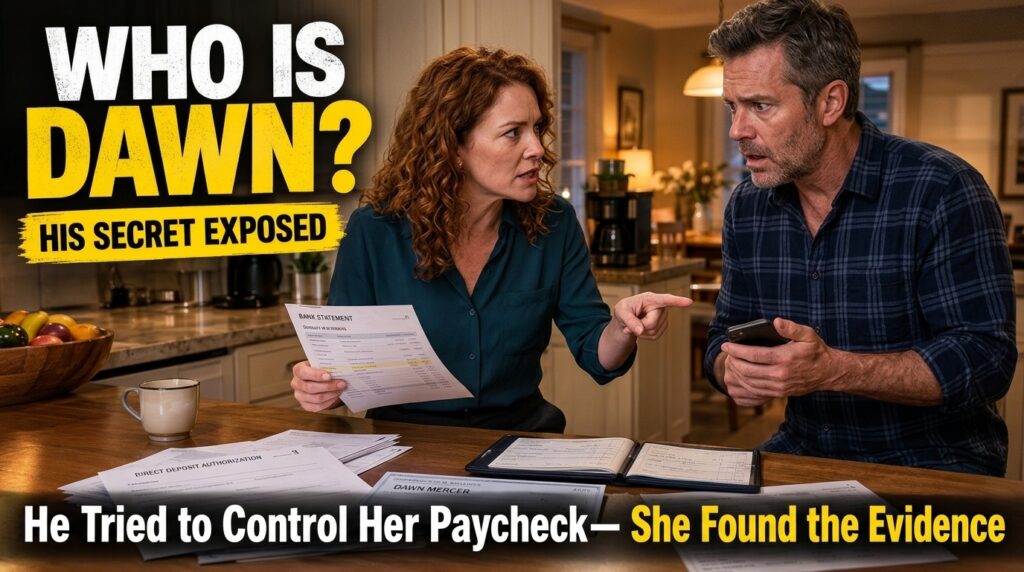
Part 1
The first time my husband told me he wanted control of my paycheck, he was standing in our kitchen holding a mug of coffee and wearing the same relaxed smile he used whenever he believed he had already won an argument.
“My paycheck goes into my account from now on,” Cliff announced.
I looked up from the lunch I was packing for work.
He set his mug beside the fruit bowl and leaned against the counter, perfectly comfortable.
“One account,” he continued. “I manage it. You get a weekly allowance for the small stuff.”
For a second, I thought he was joking.
Cliff had always liked being in charge of things. He preferred driving when we went somewhere together. He handled conversations with mechanics, made most of the decisions about home repairs, and insisted that he was better at negotiating prices.
I had never considered those habits dangerous. I worked full-time as an administrative coordinator at a dental supply company, earned a steady salary, and paid my share of our expenses. We had separate checking accounts, a joint account for the mortgage and utilities, and a small savings account we both contributed to.
Our arrangement wasn’t perfect, but it worked.
Or I had believed it worked.
“An allowance?” I asked.
He smiled as if I had misunderstood a simple explanation.
“Not like you’re a child. I’m talking about organizing things properly. We waste money because everything is scattered across different accounts. If we put our paychecks together, I can manage the bills and make sure we’re actually saving.”
“Why do I need an allowance if my paycheck is going into your account?”
“Our account,” he corrected.
“Your account, the way you just described it.”
He laughed.
“You’re getting caught up in the wording. It’s practical, sweetheart. You buy things without thinking sometimes. Coffee, lunch, little things at the store. They add up.”
I put the sandwich into my lunch bag.
“I work too, Cliff.”
“I know you work.”
“And I earn my own money.”
“Nobody said otherwise.”
“You just said I should receive an allowance from it.”
His smile thinned.
“Why does everything have to become a fight with you?”
There it was.
The familiar turn. He would make a demand, I would ask a reasonable question, and somehow I would end up defending myself for asking it.
I had spent seven years learning how to navigate that pattern. At first, I would argue until we were both exhausted. Later, I learned to explain myself more carefully. Eventually, I began choosing my words so that disagreements wouldn’t ruin an entire evening.
That morning, I didn’t argue.
I looked at my husband and smiled.
“That’s fair.”
He blinked.
“Really?”
“Sure. One account. You manage it.”
The relief on his face was immediate.
“See? I knew you’d understand.”
He walked over, kissed my cheek, and picked up his keys.
“I’ll put together a budget this weekend. You’ll see how much easier things become when we stop making everything complicated.”
He left the kitchen whistling.
I stood beside the counter until I heard his car pull out of the driveway.
Then I opened my lunch bag, took out the sandwich, and sat down.
I wasn’t smiling anymore.
Six months earlier, my direct deposit had mysteriously changed.
At the time, I hadn’t understood what had happened. My paycheck had arrived, but the amount deposited into my usual checking account was smaller than expected. I assumed there had been a payroll error. When I contacted the bank, the representative told me the deposit had been redirected to a different account.
I asked which account.
She could only provide limited information because the destination account wasn’t in my name.
I contacted payroll, and they told me a change request had been submitted using my employee information.
The signature looked like mine.
It wasn’t.
I knew my own signature. I had signed enough invoices, insurance forms, and conference reimbursements over the years to recognize the difference between my normal handwriting and the awkward imitation on that form.
But the change had occurred during a hectic month, and I had convinced myself there had to be an innocent explanation.
Maybe a clerical mistake.
Maybe an outdated form.
Maybe someone had accidentally entered the wrong account number.
I had asked payroll to investigate, but the employee handling the case had been out sick. Then I had gone to a dental conference two thousand miles away, and the problem had slipped beneath everything else demanding my attention.
Or perhaps I had deliberately allowed it to slip away because I wasn’t ready to consider the alternative.
My husband might have had something to do with it.
The thought had appeared once, briefly, then disappeared beneath the weight of all the reasons I didn’t want to believe it.
Cliff knew my employee number. He had access to our shared filing cabinet. He knew where I kept old tax documents and copies of our insurance paperwork.
He also knew my signature.
That morning, after he announced his new paycheck arrangement, I finally understood why I couldn’t dismiss the old form any longer.
He wasn’t proposing something new.
He was trying to make permanent something he had already started doing in secret.
I closed my lunch bag, picked up my keys, and headed for the door.
Before I went to work, I was going to visit HR.
And this time, I wasn’t leaving until I knew exactly where my money had gone.
\
Part 2\
The human resources office occupied a narrow hallway at the back of our building, between the conference rooms and the accounting department.
I had worked at the company for eleven years. I knew the receptionist, knew which printer jammed every Monday morning, and knew that the small plant beside the window survived almost entirely because one of the payroll clerks remembered to water it.
I had never felt nervous walking into that office.
That morning, my hands were cold.
“Good morning,” the receptionist said. “What can I do for you?”
“I need to review a direct-deposit change from March.”
She glanced at her screen.
“Employee number?”
I gave it to her.
She typed for a moment, then looked up.
“Oh, your husband dropped that form off.”
Everything inside me went still.
I gripped the edge of the counter.
“My husband?”
“Yes. Cliff, right?”
I nodded slowly.
“He said you were traveling and wanted to make sure payroll received it before the cutoff. He was very helpful, actually. He waited while I checked that everything was filled in.”
The room seemed to grow smaller.
“What date was that?”
She looked back at the screen.
“March fourteenth.”
I had been in Phoenix on March fourteenth, attending a professional conference. I had flown out two days earlier and returned the following weekend.
I had the hotel receipt. The conference registration. The flight confirmation. I even had a photograph of myself standing beside the event banner that morning.
There was no possibility that I had signed that form in the HR office.
“Do you still have a copy?” I asked.
“I believe so. Let me check.”
She disappeared into the back office.
I stood motionless, listening to the hum of the air conditioner.
I thought about the weeks after March. The strange bank balance. Cliff telling me not to worry because payroll mistakes happened all the time. His suggestion that we should simplify our finances. His sudden interest in how much I earned and when my paycheck arrived.
Every memory seemed to rearrange itself.
The receptionist returned with a printed copy.
“This is the form we received,” she said. “It was processed that afternoon.”
I looked down.
My name was printed in the employee information section. My employee number was correct. My usual bank had been crossed out and replaced with another account.
The signature at the bottom resembled mine from a distance.
Up close, the differences were obvious.
The capital letter was too tall. The final stroke was too short. The signature leaned in a direction mine never did.
And the date was March 14.
“Can I have a copy of this?” I asked.
“Of course. I’ll make one for you.”
I took the paper with both hands.
“Did Cliff say anything else when he brought it in?”
The receptionist thought for a moment.
“He said you were changing banks and that you had authorized him to handle the paperwork because you were busy with the conference.”
I thanked her and walked to the small meeting room at the end of the hallway.
I needed to sit down.
For eleven years, I had been the person people came to when something went wrong. I organized schedules, tracked orders, corrected billing errors, and made sure no one missed an important deadline.
I was good at noticing details.
Yet somehow, when the missing money belonged to me, I had spent six months explaining away the evidence.
I took out my phone and opened my banking application.
My original account showed the reduced deposits beginning in March. I scrolled through the transactions, comparing the amounts with my pay stubs.
The numbers matched.
My full paycheck had been deposited somewhere else. Only a portion had reached my own account, and the amount varied slightly because the transfer arrangement had apparently been adjusted more than once.
I opened the account history for our joint checking account.
There was no matching deposit.
That was the first clue that the money hadn’t gone where I thought it had.
I called the bank and explained that my employer had confirmed an unauthorized direct-deposit change. After verifying my identity, the representative helped me review the records available to me.
The destination account was not one of our joint accounts.
It wasn’t my savings account.
It wasn’t an account I recognized.
The representative couldn’t disclose another account holder’s private information, but she confirmed that the account number on the payroll form did not match any account in my name.
I thanked her and ended the call.
Then I sat in silence.
The next step was obvious.
I needed to redirect my paycheck to an account only I controlled, notify payroll in writing, and secure the documents that showed what had happened.
I didn’t need to announce any of it to Cliff.
Not yet.
I returned to the receptionist and asked for the correct form to restore my original direct deposit.
She printed it immediately.
“I’m sorry,” she said quietly. “I thought everything was authorized.”
“You couldn’t have known.”
“Your husband seemed so confident.”
I looked at the old form again.
“Yes,” I replied. “He does.”
I filled out the new paperwork, attached the required bank verification, and confirmed the change directly with payroll.
I asked them to document the earlier form as disputed and to preserve the original submission records. I also requested that future banking changes require direct verification from me.
The HR manager came out to speak with me before I left.
She explained that the company would review its internal process and that I should provide any additional information I had about the unauthorized change. She didn’t promise an immediate resolution, and I didn’t ask her to. I wanted a clear record of what had happened.
When I finally walked back to my desk, my legs felt unsteady.
I had come to work expecting to confirm a payroll mistake.
Instead, I had discovered that my husband had delivered a form bearing my forged signature while I was hundreds of miles away.
And I still didn’t know where the money had gone.
At lunch, I sat in my car and opened my personal email.
I searched for the word *Dawn*.
I wasn’t sure why I chose that name. Perhaps I had seen it somewhere before. Perhaps my mind was connecting details I hadn’t consciously registered.
At first, the search returned nothing.
Then I remembered a small transaction I had noticed on our joint account the previous month.
A payment labeled simply **D. Mercer Services**.
Cliff had told me it was related to a repair at the house.
I searched the joint account statements for the same name.
There were three transactions.
One for $480.
One for $725.
And one for $1,200.
None had receipts attached.
None appeared on the household budget.
I opened the oldest statement and stared at the first payment.
The date was April 2.
Nineteen days after Cliff had submitted the direct-deposit form.
I took a screenshot.
Then another.
Then I searched for every payment with the same description.
There were more.
And the next transaction made my stomach drop.
It wasn’t a payment to a business.
It was a transfer labeled **Dawn Mercer — Monthly Support**.
\
Part 3\
I spent the rest of my lunch break looking at the name.
Dawn Mercer.
I had never heard Cliff mention a Dawn Mercer. I had never seen the name on a holiday card, a wedding invitation, or a family message. It wasn’t the name of a contractor we had used. It wasn’t a name I recognized from his workplace.
Yet money had been going to her for months.
I searched the statements again, this time recording every payment in a private spreadsheet. The first transfer I found was $350. Later payments were larger. Some were labeled as services, some as reimbursements, and some had no description at all.
The total from our joint account alone was several thousand dollars.
I sat in the car with the engine off, watching people cross the parking lot.
I didn’t want to jump to conclusions.
Dawn could be a relative. A friend. Someone Cliff had been helping. The money could have been connected to a legitimate obligation he hadn’t explained properly.
But if it was innocent, why had he redirected my paycheck to an account I didn’t recognize?
Why had he forged my signature?
And why was he suddenly demanding that I surrender control of my earnings?
I needed more than a name.
That evening, I went home and acted as though nothing had changed.
Cliff was at the kitchen table with his laptop open, studying a spreadsheet.
“How was work?” he asked.
“Busy.”
“Did you think about what we discussed this morning?”
I put my bag down.
“The account arrangement?”
“Yes. I want us to get started right away. We can set everything up this weekend.”
I poured myself a glass of water.
“I thought you wanted to manage the money.”
“I do.”
“Then why don’t you show me the budget first?”
He looked up.
“Why?”
“Because if we’re changing our finances, I want to understand the plan.”
His expression became guarded.
“We’ve been married for years. You should trust me.”
“I do trust you to discuss it with me.”
“That’s not what I said.”
I sat across from him.
“Cliff, I’m asking to see a budget.”
He closed the laptop.
“Fine. I’ll put one together. But you have to stop acting like I’m trying to take something away from you.”
I looked at him for a long moment.
Then I nodded.
“Okay.”
He seemed satisfied and returned to his laptop.
I went upstairs to change.
In the bedroom, I opened the bottom drawer of my dresser and took out the small checkbook I kept for household expenses.
I rarely used paper checks anymore, but I had held on to the account because it was useful for occasional payments that didn’t accept cards. It was connected to an old checking account I had opened before we married, and I had never closed it.
For years, it had sat in a drawer with spare keys, warranty cards, and instruction manuals.
Three weeks earlier, I had taken it out because I needed to pay a local repair company. The checkbook register was still open to a page where I had written the last few transactions.
I had noticed something strange then, too.
Several checks had been written to Dawn Mercer.
I hadn’t thought much of it at the time because I assumed I was looking at an old account record from before Cliff and I combined our finances.
But now I knew the dates were recent.
I opened the checkbook and studied the entries.
Check 1841: $600.
Check 1845: $900.
Check 1850: $1,250.
The handwriting in the register was mine because I had written the notes myself, but the check numbers and amounts were unfamiliar.
I flipped to the back of the checkbook, where I had tucked a few canceled checks after receiving them in the mail.
The first one was made payable to Dawn Mercer.
The signature was Cliff’s.
I checked the date.
April 19.
The check had been drawn from my old account.
I stared at the paper.
I had barely used that account in years. There was still a small balance in it, but I had never authorized Cliff to use it, and he wasn’t a named account holder.
I turned over the check.
On the back, the endorsement was difficult to read, but the name was clear.
Dawn Mercer.
The checkbook was no longer just a collection of strange transactions.
It was evidence that Cliff had been using an account he had no permission to access.
I took photographs of every check and every page of the register. Then I put everything back exactly as I had found it.
I wasn’t going to confront him until I understood the full picture.
The next morning, I called my bank.
I explained that I had discovered checks written from my account without my authorization. The representative helped me secure the account, change the access credentials, and request a review of the disputed transactions. I also asked for copies of the checks and the account history.
The bank advised me to keep my records and follow its formal dispute process.
I did.
I didn’t tell the representative what I suspected about Dawn. I didn’t need to.
The facts were enough.
When I finished the call, I sat at my desk and opened a new folder on my laptop.
I named it **Financial Records**.
Inside, I saved the payroll form, bank statements, check images, and the spreadsheet listing every transfer I could verify.
Then I made a second copy on a secure personal drive.
I was careful not to access Cliff’s private accounts or messages. I didn’t need to. The records available to me already showed that money had moved in ways I had never approved.
I wanted to know where the money had gone, but I also wanted to protect myself if the situation became more complicated.
At work, I requested a copy of the conference travel record confirming that I had been out of state on March 14. I saved my flight itinerary and hotel invoice with the other documents.
That afternoon, HR emailed me to confirm that the direct-deposit change had been disputed and that the original form was being retained for review.
The message was brief and professional.
I read it twice.
Then I closed the email and leaned back in my chair.
For months, I had thought the missing money was a mistake.
Now I knew someone had changed the destination of my earnings, and the person responsible had counted on me not asking too many questions.
I couldn’t yet prove every part of Cliff’s involvement. I couldn’t say what his relationship with Dawn was, or whether the payments were connected to the redirected paycheck.
But I knew the story he had told me about our finances was incomplete.
That evening, Cliff came home carrying takeout.
“I thought we could have a relaxed night,” he said. “No bills, no spreadsheets, no stress.”
He placed the food on the counter and kissed my cheek.
I watched him unpack the containers.
“That sounds nice.”
He smiled.
“See? This is what I mean. We should be enjoying our life instead of worrying about every little thing.”
I thought about the forged signature.
The unexplained transfers.
The checks written to a woman whose name I had never heard.
I picked up my fork.
“You’re right,” I said. “We should be able to enjoy our life without worrying about money disappearing.”
His hand stopped above the container.
“What did you say?”
I looked at him calmly.
“Nothing. I’m hungry.”
He stared at me for another second, then forced a laugh.
“You’re funny sometimes.”
He turned away.
I watched his shoulders tense as he reached for the plates.
He knew something was wrong.
He just didn’t know how much I had already discovered.
\
Part 4\
The following Friday, Cliff came home early.
I heard his car in the driveway just after five. Usually, he didn’t return until nearly six, and he often stopped at the grocery store on the way home.
That evening, the front door opened so hard that it struck the wall.
He walked into the kitchen holding his phone.
“The deposit didn’t hit.”
I was standing at the counter, cutting vegetables for dinner.
I put the knife down.
“What deposit?”
“My paycheck transfer. The one we talked about. The money isn’t where it should be.”
I wiped my hands on a towel.
“I changed it.”
He stared at me.
“You did what?”
“I changed my direct deposit back to my own bank.”
His face went white.
For a moment, he looked less angry than frightened.
Then the anger arrived.
“Why would you do that without talking to me?”
I looked at him.
“Why would you change it without talking to me?”
He opened his mouth, then shut it.
“That’s completely different.”
“How?”
“Because we’re married.”
“So am I.”
He paced across the kitchen.
“You don’t understand what you’re doing. I had a plan for our money.”
“Your plan involved a bank account I don’t recognize.”
He stopped.
“What?”
I held his gaze.
“Where was my paycheck going, Cliff?”
His expression shifted. He tried to look confused, but the reaction came too quickly.
“It was going into our financial account.”
“Our financial account isn’t listed on the direct-deposit form.”
He rubbed his forehead.
“You must have misunderstood something.”
“No. I have the form.”
He looked at me sharply.
“What form?”
“The one you delivered to HR on March 14.”
The color drained from his face again.
I continued before he could interrupt.
“I was in Phoenix that day. I have my flight records, my hotel invoice, and the conference registration. But someone submitted a direct-deposit change using my employee information and a signature that looks like mine.”
Cliff didn’t move.
I could hear the refrigerator humming behind me.
“You took the form to HR,” I said. “The receptionist remembered you. She told me you said I had authorized you to handle the paperwork.”
He swallowed.
“That’s not how it happened.”
“Then explain how it happened.”
He looked toward the hallway.
“I was trying to simplify things.”
“By signing my name?”
“I didn’t forge anything.”
The denial came so quickly that I knew he had prepared it in his mind before I had even asked.
I took a breath.
“Then you won’t mind if HR investigates the form.”
He stared at me.
“You went to HR?”
“Yes.”
“You went behind my back?”
I almost laughed.
“You changed my paycheck behind my back, Cliff. I went to the people responsible for paying me.”
He slammed his phone onto the counter.
“This is ridiculous. I was trying to get us organized.”
“Why was the destination account not one of our joint accounts?”
He didn’t answer.
“Why did the deposits begin going there six months ago?”
Silence.
“And why did you tell me this morning that you wanted to control my paycheck if you had already redirected it?”
His jaw tightened.
“Because you don’t know how to manage money.”
I looked at him.
For the first time, he said the quiet part aloud.
“You spend too much,” he continued. “You don’t think about the future. Someone has to be responsible.”
“I’ve paid my share of the mortgage for seven years.”
“That’s not the point.”
“I’ve paid for groceries, utilities, insurance, and repairs. I’ve saved money every month. What exactly have I failed to manage?”
He looked away.
“You don’t see the whole picture.”
“Then show it to me.”
He said nothing.
I walked to the table and picked up a folder I had placed there earlier.
I didn’t open it yet.
Instead, I looked at my husband and asked the question I had been waiting to ask since I found the first transfer.
“So, Cliff … who is Dawn?”
He froze.
It was a small reaction, but unmistakable.
His shoulders stiffened. His lips parted. His eyes flicked toward the folder in my hand.
For several seconds, he didn’t speak.
Then he laughed.
It was an awful sound.
“Dawn? What are you talking about?”
“Dawn Mercer.”
He stared at me.
“Where did you hear that name?”
“I found payments to her in our joint account.”
He shook his head.
“Those were business expenses.”
“What business?”
“Just a side arrangement.”
“What arrangement?”
He ran a hand through his hair.
“Why are you digging through everything?”
“Because money has been disappearing.”
“It hasn’t been disappearing.”
“Then tell me where it went.”
He looked toward the front door as if he were considering leaving.
I placed the folder on the table.
“I also found checks made payable to Dawn from my old checking account.”
He turned back to me.
“You went through my things?”
“My old checking account is in my name. The checks were written from it without my permission.”
His face went pale again.
I opened the folder and laid out the copies.
The first check.
The second.
The third.
The amounts were clearly visible, along with the dates and his signature.
Cliff stared at the papers.
He didn’t try to pick them up.
He didn’t ask whether the copies were real.
He simply stared.
I watched him carefully.
“How did you get access to my checkbook?” I asked.
He swallowed.
“I don’t know what you’re talking about.”
“Your signature is on the checks.”
“I didn’t write those.”
I tapped the paper.
“Then why does the bank have a record of them?”
He looked at me with something close to desperation.
“You need to stop. You’re making a huge mistake.”
I felt a chill run through me.
“What mistake?”
“You’re turning something simple into something ugly.”
I looked at the documents spread across the table.
A forged payroll form.
An unfamiliar bank account.
Months of unexplained transfers.
Checks written from an account I had never authorized him to use.
“What exactly is simple about this?” I asked.
He opened his mouth, but no answer came.
For the first time, I understood that the money wasn’t the only thing he wanted to control.
He wanted to control the story.
He wanted to decide which questions were reasonable, which facts mattered, and when I was allowed to know the truth.
He wanted me to believe that the problem was my reaction rather than his actions.
I closed the folder.
“I’m not arguing with you tonight.”
He stepped toward me.
“You can’t just walk away from this.”
“I’m not walking away. I’m giving myself time to decide what to do next.”
“We can fix this.”
“Then tell me the truth.”
He stared at me.
And in that silence, I knew the next answer would change everything.
\
Part 5\
Cliff didn’t sleep in our bedroom that night.
He stayed downstairs, turning the television up loud enough that I could hear it through the floor. At two in the morning, I heard him walking through the kitchen. At three, a cupboard slammed.
I lay awake, staring at the ceiling.
Part of me wanted to go downstairs and demand the truth until he finally gave it to me.
Another part of me understood that I had already asked.
He knew what I wanted.
He had chosen silence.
The next morning, I found him sitting at the kitchen table with two cups of coffee. He looked exhausted, his eyes red around the edges.
“I think we need to start over,” he said.
I poured myself a cup.
“Start over with what?”
“Our finances. Our marriage. Everything.”
I sat across from him.
“That sounds good. Where do you want to start?”
He looked down at his hands.
“I made some decisions that weren’t fair to you.”
“Which decisions?”
He sighed.
“The direct deposit. The checks. I should have discussed everything with you.”
“Why didn’t you?”
“I thought you would disagree.”
“About what?”
He rubbed his face.
“Helping someone.”
“Dawn?”
He didn’t answer.
I waited.
Finally, he said, “Dawn is someone I know from work.”
“What does she need money for?”
“She’s going through a difficult time.”
“What kind of difficult time?”
He stared into his coffee.
“She has a daughter. The girl’s father left, and Dawn was struggling to keep up with expenses.”
I felt a small wave of sympathy despite everything.
A woman struggling to raise a child alone was not an unreasonable person to help.
But that didn’t explain the deception.
“Why didn’t you tell me?”
“Because I knew you’d ask questions.”
“I am asking questions now.”
He flinched.
“I didn’t want you to think I was irresponsible.”
“Cliff, you redirected my paycheck without permission. You wrote checks from my account. You hid transfers from our joint account. What did you think I would think?”
He rubbed his forehead.
“I thought I could handle it.”
“With my money.”
“With our money.”
“You keep saying that as if the words make it true.”
He looked at me.
I continued.
“Helping Dawn was your decision. You made it without me, using money I earned and money I never agreed to give away. Then you tried to take control of my paycheck because you didn’t want me to see where it was going.”
He didn’t deny it.
That was almost worse.
“How much money have you given her?” I asked.
“I don’t know exactly.”
“Estimate.”
He stared at the table.
“Maybe twelve thousand.”
I felt the number land in my chest.
Twelve thousand dollars.
That was more than our emergency savings had grown in the previous year. It was nearly enough to replace our aging car. It was money we had discussed using to repair the roof before the next rainy season.
“Where did it come from?”
“Different places.”
“Be specific.”
He looked irritated.
“Some from my paycheck. Some from the joint account. Some from your account.”
“My account?”
He looked away.
I stood up so quickly that my chair scraped the floor.
“You said you would tell me the truth.”
“I am telling you.”
“Then explain the checks.”
He closed his eyes.
“I used the old account because it had money in it.”
“That money was mine.”
“I planned to replace it.”
“When?”
He had no answer.
I felt my hands begin to tremble.
“Did Dawn know you were using my money?”
“I don’t know.”
“Did you tell her it came from me?”
“I told her I was helping.”
“That isn’t what I asked.”
He stood.
“Why are you doing this? I’m trying to explain.”
“No, Cliff. You’re trying to make me feel guilty for asking you to explain.”
He looked genuinely angry now.
“I didn’t have to help her. I chose to. I thought I was doing the right thing.”
“Doing the right thing with someone else’s money isn’t generosity.”
He stared at me.
I picked up my cup and carried it to the sink.
“I’m going to work.”
“We’re not finished.”
“No. We’re not. But I’m not going to keep having the same conversation while you refuse to answer basic questions.”
I left before he could respond.
At work, I contacted my bank again and asked how to proceed with the disputed checks. I also scheduled an appointment with a lawyer who handled financial and family matters.
I wasn’t filing for divorce that morning. I wasn’t making a decision about the rest of my life.
I was gathering information.
The lawyer listened as I explained the payroll change, the checks, and the transfers. She asked me to bring copies of the records and avoid signing any new financial documents until I understood their implications.
She also advised me to keep my personal accounts secure and maintain a clear record of communications.
I followed her advice.
Over the next several days, I organized everything chronologically. I kept copies of the relevant bank statements, the HR correspondence, and the check images. I wrote down what Cliff had said while the conversations were still fresh in my memory.
I didn’t embellish anything.
I didn’t need to.
The facts were troubling enough on their own.
Then, on Wednesday afternoon, I received a call from an unfamiliar number.
The woman introduced herself as Dawn Mercer.
My heart began beating faster.
“How did you get my number?” I asked.
“Cliff gave it to me,” she said. Her voice was cautious. “He said you wanted to talk.”
I hadn’t told Cliff that I wanted to speak to her.
“Why would he say that?”
There was a pause.
“Because he told me you knew about everything.”
I gripped the edge of my desk.
“Everything about what?”
“The money.”
I closed my office door.
“Dawn, I need you to be very clear with me. What money are you talking about?”
She took a shaky breath.
“Cliff said he was helping me pay some bills. He told me he had money set aside for it. He said you both understood.”
I closed my eyes.
“He told you I agreed?”
“Yes.”
“Did he tell you where the money came from?”
“He said it was his.”
I felt sick.
“How much has he given you?”
“I don’t know the exact amount. I kept records of the payments because I wanted to repay him when I could.”
“Why would you repay him?”
“Because he told me it was a loan.”
I was silent.
Dawn continued, her voice growing more anxious.
“Look, I don’t want trouble. I didn’t know anything was wrong. He said you were fine with it. He told me he was handling your finances because you were busy with work.”
I looked at the payroll form lying beside my laptop.
“He told you he was managing my finances?”
“Yes.”
I felt a wave of anger so intense that I had to sit down.
“Did you know he had changed my direct deposit?”
“No.”
“Did you know he had written checks from an account in my name?”
“No. What?”
Her voice cracked.
I took a slow breath.
“I’m not calling to accuse you of anything. I need to understand what happened.”
“I swear I didn’t know.”
“Then I need you to preserve any messages, payment records, or documents you have involving Cliff. Don’t delete anything. If a bank or lawyer asks you about the payments, tell the truth.”
She began to cry.
“I never wanted to be part of someone’s marriage falling apart.”
I looked out the window.
“Neither did I.”
Before ending the call, Dawn gave me the dates of several payments and confirmed that Cliff had told her the money was a loan from his personal funds.
She also told me something I hadn’t expected.
Cliff had promised to help her rent a small apartment for herself and her daughter.
The money had not simply been paying occasional bills.
He had been helping her build a separate life.
And he had done it while telling me that our finances needed to be placed under his control.
\
Part 6\
I didn’t tell Cliff about Dawn’s call immediately.
I needed time to process what she had said, and I wanted to confirm the details through records rather than rely on a conversation made under emotional pressure.
Dawn sent me copies of the payment receipts she had kept. I saved them with the rest of my documents and forwarded them to my lawyer.
The receipts confirmed several of the transfers I had already found.
They also revealed that Cliff had described the money as a personal loan, with repayment expected once Dawn’s circumstances improved.
Dawn’s account matched the basic timeline.
She had been under financial pressure. Cliff had offered to help. He had told her he had enough savings to do so and that I knew about the arrangement.
She had accepted the money believing that he had the right to give it.
I still didn’t know whether she had been told the full truth about his finances, and I wasn’t going to assume she had. I had no evidence that she had helped him redirect my paycheck or write the checks.
The person who had signed my name was the person who had access to my paperwork.
The person who had made the decisions about my income was my husband.
Those facts remained the center of the problem.
That evening, I asked Cliff to sit down with me.
He arrived in the living room holding his phone.
“What now?”
“I spoke to Dawn.”
His face changed.
“You called her?”
“She called me.”
He looked toward the window.
“What did she say?”
“That you told her I knew about the money.”
He said nothing.
“She said you told her the payments were loans from your personal funds.”
“They were.”
“Some of them came from my account.”
He rubbed his forehead.
“I planned to replace that money.”
“You keep saying that as if the intention to replace it erases the fact that you took it.”
“I wasn’t stealing from you.”
“Then what do you call writing checks from my account without permission?”
He looked at me.
“I made a mistake.”
“One mistake?”
He lowered his head.
I continued.
“You changed my direct deposit. You gave HR a form with a signature I didn’t write. You used my old checking account. You moved money from our joint account. You concealed the transactions. Then you told me I needed an allowance because I couldn’t manage money.”
He covered his face.
“I know how it sounds.”
“It sounds like you were trying to make sure I couldn’t see what you were doing.”
He didn’t respond.
I sat down across from him.
“Did you have a relationship with Dawn?”
He looked up sharply.
“What?”
“Did you have a romantic relationship with her?”
“No.”
His answer was immediate.
I studied him.
“Have you ever been romantically involved with her?”
“No. Absolutely not.”
“Have you told her things about our marriage that you haven’t told me?”
He hesitated.
“Cliff.”
“I told her we were having financial problems.”
“We were having financial problems because you were moving money without telling me.”
“I didn’t tell her all that.”
“What did you tell her?”
He looked down.
“That you didn’t understand my responsibilities. That I was under pressure. That I needed to keep things stable at home.”
I felt a cold ache in my chest.
“You told another woman that I was the problem.”
“I didn’t mean it like that.”
“But you said it.”
He nodded.
For a moment, I couldn’t find the right words.
I had spent years supporting Cliff when he felt overwhelmed. I had listened when work was difficult. I had helped him revise his résumé when he considered changing jobs. I had encouraged him to take a training course that eventually led to a promotion.
He had been allowed to struggle in front of me.
He had been allowed to admit fear, confusion, and failure.
He had not needed to invent a story in which I was the reason he couldn’t manage his life.
“Why didn’t you talk to me?” I asked.
He looked at me with red eyes.
“Because I didn’t want you to think I was weak.”
I stared at him.
“So you decided to make me powerless instead.”
He flinched.
“I never wanted that.”
“Then why did you demand control of my paycheck?”
He was silent for so long that I thought he might refuse to answer.
Finally, he said, “Because I was running out of money.”
I waited.
He explained that he had promised Dawn more help than he could afford. At first, he had used money from his own savings. Then he began drawing from the joint account. When the balance started falling, he moved my direct deposit to an account he could access.
He had told himself he would replace the money before I noticed.
When I asked questions, he reassured me that everything was fine.
When he realized I might examine the records more closely, he decided the simplest solution was to combine our finances under his control.
“An allowance would have made it easier to track everything,” he said.
“For whom?”
He looked at me.
“For me.”
The honesty was so late and so incomplete that it almost felt insulting.
“You wanted to control what I could see,” I said.
He nodded.
“I wanted to stop you from finding out.”
There it was.
The truth, finally stripped of all the excuses.
I stood up and walked to the window.
I could see our reflection in the dark glass. We looked like a couple standing in an ordinary living room after an ordinary argument.
But nothing about our marriage felt ordinary anymore.
“How much money is left?” I asked.
He gave me a number.
It was lower than I had expected.
“How much do you owe Dawn?”
He told me.
The amount was substantial, but it was a separate issue from the money he had moved without authorization. Dawn believed she had a loan agreement. Cliff had promised repayment. That arrangement would need to be reviewed properly, with all the relevant records.
I wasn’t going to decide what anyone owed based on a confession in our living room.
“What happens now?” he asked.
I turned toward him.
“Now, I protect my accounts. I work with the bank on the disputed transactions. I follow the lawyer’s advice. And you stop making financial decisions on my behalf.”
He looked frightened.
“Are you leaving me?”
“I haven’t decided.”
“How can you not know?”
“Because I am trying to make a decision based on what has actually happened, not on how frightened you are that there might be consequences.”
He began to cry.
“I love you.”
I believed that he might.
But I had learned that love and trust were not interchangeable.
“I can’t make this disappear because you love me,” I said. “And you can’t ask me to surrender control of my life because you’re afraid.”
He nodded, wiping his face.
For once, he didn’t argue.
That night, I slept in the spare bedroom.
I locked the door, placed my phone on the nightstand, and kept the folder of financial records beside my bag.
I wasn’t doing it to frighten him.
I was doing it because I needed one place where I could think without being asked to soothe the person who had hurt me.
And I knew the next conversation would have to include something Cliff had been avoiding from the beginning.
The truth about the checkbook.
\
Part 7\
The checkbook was the part Cliff feared most.
I understood that after I met with my lawyer and learned how important it was to keep the different financial issues separate.
The unauthorized payroll change was one matter. The disputed checks were another. The transfers from our joint account required their own review. And the money Cliff had given Dawn under the impression that it was a personal loan raised questions that could not be answered simply by calling the whole thing a misunderstanding.
My lawyer advised me not to make accusations I couldn’t support. She also advised me not to sign any agreement that attempted to settle everything before the records had been reviewed.
I followed her instructions.
I contacted the bank through its official dispute process, submitted the check copies, and provided the account history. I explained that I had not authorized Cliff to write checks from my account.
The bank began its review.
HR also confirmed that the direct-deposit form had been submitted by Cliff while I was out of state. The company preserved the document and recorded my dispute.
I didn’t demand that anyone reach a particular conclusion before the review was complete.
I wanted the facts established properly.
Meanwhile, Cliff moved between anger and desperation.
One day, he told me I was destroying our marriage over money.
The next, he brought home dinner and asked whether we could sit together like we used to.
I refused to argue about whether the amount mattered.
It wasn’t only about the money.
It was about the decision he had made to take control of something that belonged to me, then convince me that surrendering even more control would be good for our marriage.
On Saturday morning, he approached me while I was sorting laundry.
“I want to explain the checkbook.”
I put the towels down.
“Go ahead.”
He sat on the edge of the bed.
“When we first got married, I helped you organize your accounts. You gave me access to some of the paperwork.”
“That doesn’t mean I authorized you to write checks.”
“I know.”
“Then why did you?”
He stared at the carpet.
“I found the checkbook when I was looking for the old insurance documents. I remembered the account was still open, and I thought I could use it temporarily.”
“You thought you could use my account without asking.”
“Yes.”
“How many checks did you write?”
He gave me a number.
I had found most of them, but not all.
I wrote it down.
“Where did the money go?”
“To Dawn.”
“All of it?”
“Most of it.”
“What about the rest?”
He said some of the money had covered expenses he had already promised to pay on her behalf. He couldn’t immediately identify every transaction.
I told him that the bank would need accurate information and that he should gather every record he had.
He nodded.
Then he said, “I never meant for you to find out like this.”
I looked at him.
“How did you expect me to find out?”
He opened his mouth.
No answer came.
“Cliff, you didn’t simply forget to tell me. You made a deliberate effort to keep me from knowing. You signed my name. You moved the paycheck. You wrote checks. You kept records away from me. You told Dawn I had agreed. Then you announced that I should receive an allowance.”
He looked at the floor.
“When you put all of that together, what did you expect me to think?”
“I thought I could fix it before it became a problem.”
“It was already a problem. You just hoped I wouldn’t notice.”
He rubbed his eyes.
“I know.”
I sat beside the dresser.
“I need you to understand something. I am not responsible for making your choices look less serious than they were. I am not going to tell the bank that I authorized something I didn’t authorize. I am not going to sign an agreement saying I approved the transfers. And I am not going to lie to protect you from the consequences.”
He nodded slowly.
“I understand.”
“If you want to repair this marriage, you need to cooperate with the reviews and tell the truth.”
“I will.”
“Not just when it’s convenient.”
“I know.”
I watched him for a moment.
Then I asked the question that had been sitting in my mind since the night he demanded control of my paycheck.
“Did you ever plan to tell me about Dawn?”
He looked up.
“Yes.”
“When?”
He was silent.
“Before or after you took control of my paycheck?”
He lowered his head.
“I don’t know.”
I felt a quiet sadness settle over me.
He had not been working toward a clear moment of honesty. He had been hoping the problem would disappear before he had to face it.
That was different.
A few days later, Dawn contacted me again.
She said she had been gathering her records and had realized that Cliff’s promises had become difficult to understand. He had told her he would repay certain amounts, then asked her to wait. He had also said that once our finances were combined, everything would become easier.
She had begun to suspect that he was in more trouble than he had admitted.
“I should have asked more questions,” she told me.
“Perhaps,” I said. “But you were told the money was his and that I knew about it. You need to preserve your records and be honest about what you received. The bank and the appropriate professionals can determine what happens next.”
She agreed.
I didn’t promise her that she would be protected from every consequence. I couldn’t make that promise.
But I also refused to turn her into a villain simply because she was the other person receiving money.
Cliff had made the decisions that brought us to this point.
He was responsible for explaining them.
The following week, the bank requested additional information about the checks. I supplied it. Cliff was asked to provide his own account of the transactions.
For the first time, he could not rely on a reassuring conversation to make the problem go away.
He had to answer questions in writing.
He had to distinguish between what he remembered and what he could prove.
He had to confront the fact that money could not be made legitimate simply by intending to replace it later.
One evening, he sat across from me with a stack of papers.
“I’ve started putting together a repayment plan,” he said.
“Have you reviewed it with your lawyer?”
“No.”
“Then do that first.”
He looked disappointed.
“I thought you might want to see it.”
“I will look at it when it’s complete and properly reviewed. I’m not going to make financial decisions in a hurry just because you’re anxious.”
He nodded.
I watched him collect the papers.
There was a time when I would have rushed to help him organize everything. I would have made a spreadsheet, calculated what we could afford, and found a way to keep the household running while he worked through the problem.
I wasn’t going to do that this time.
Not because I wanted him to suffer.
Because if I continued taking responsibility for the consequences of his decisions, he would never have to learn how to take responsibility himself.
The checkbook had shown me where some of the money went.
It had also shown me something about my own habits.
I had mistaken being supportive for being responsible for everything.
That was a mistake I could correct.
\
Part 8\
Three weeks after the confrontation, Cliff agreed to attend a meeting with me and our financial adviser.
The meeting was not about deciding whether we would stay married. It was about establishing the current state of our finances, separating verified facts from assumptions, and making sure neither of us could quietly change the other’s accounts again.
We brought bank statements, pay stubs, mortgage records, and the documents relating to the disputed checks.
Our adviser reviewed the information and asked questions neither of us enjoyed answering.
How much had been transferred?
Which payments were supported by receipts?
What money remained in each account?
Which expenses were shared obligations, and which had been made without the other’s consent?
Cliff struggled with some of the questions because he hadn’t kept a complete record of what he had promised Dawn.
I answered only for the accounts I knew.
Where I didn’t know something, I said so.
For once, I didn’t fill in the gaps to make the situation look more organized than it was.
By the end of the meeting, we had a clearer picture of our finances. The full amount still needed to be reconciled, and the bank’s review of the disputed checks was ongoing, but we had enough information to understand the seriousness of the situation.
We also established immediate safeguards.
My paycheck would continue going into my personal account. Our joint account would be used only for agreed household expenses. Neither of us would change the other’s banking information. We would both receive statements for shared accounts, and any substantial payment outside the household budget would require a conversation before it was made.
The arrangement wasn’t a punishment.
It was a way to restore transparency.
Cliff signed the written plan.
As we left the office, he held the door open for me.
“That was humiliating,” he said.
I stopped beside the car.
“Which part?”
“Having to explain everything.”
I looked at him.
“Imagine how it felt to discover that my paycheck had been redirected without my permission.”
He looked down.
“I know.”
“No, Cliff. You know now because you had to sit in a room and answer questions. I knew something was wrong for months, and you kept telling me I was imagining it.”
He didn’t argue.
That afternoon, he began calling the institutions involved to correct the information he had provided and to cooperate with the reviews. He also contacted Dawn to clarify the amounts he believed he owed her and to stop making promises he couldn’t support with records.
I didn’t supervise those conversations.
They were his responsibility.
At home, we began sleeping in separate rooms. We still spoke about practical matters, and we continued attending the occasional appointment together, but I wasn’t ready to return to the marriage we had before.
That marriage had depended on assumptions I could no longer make.
I couldn’t assume that Cliff would tell me the truth when he was embarrassed.
I couldn’t assume that a shared account meant shared decisions.
I couldn’t assume that an affectionate gesture would be followed by honest behavior.
Those assumptions had to be replaced with evidence.
Cliff started counseling.
He told me he wanted to understand why he had become so focused on controlling our finances and why he had been unable to admit that he was overwhelmed.
I encouraged him to continue, but I didn’t make his progress my responsibility.
Some evenings, he would tell me what he had discussed with his counselor. He spoke about his fear of failure, his desire to be seen as dependable, and the way he had confused being in charge with being responsible.
I listened.
But I also reminded him that understanding his behavior did not excuse it.
He had made choices.
Those choices had consequences for me, for our finances, and for the future of our marriage.
A few weeks later, he asked whether I would consider going to counseling together.
I agreed to one session.
During that meeting, the counselor asked me what had hurt me most.
I thought about the question for a long time.
“The money mattered,” I finally said. “But the worst part was that he made a plan for my life without me. He took control of my paycheck, then told me I should be grateful because he was going to give me an allowance. He made it sound like he was helping me when he was actually trying to keep me from seeing what he had done.”
Cliff stared at his hands.
The counselor asked him what he heard in my answer.
He took a breath.
“That I treated her like someone I needed to manage instead of someone I was supposed to trust.”
I felt tears rise in my eyes.
It was the first time he had described the problem without blaming my questions, my spending, his mother, or Dawn.
The counselor asked what he intended to do differently.
Cliff said he would no longer make financial decisions for me. He would disclose the relevant transactions, cooperate with the bank’s review, and stop treating disagreement as a threat to his authority.
Those were reasonable commitments.
They were also only the beginning.
Trust wasn’t going to return because he had finally found the correct words.
It would return, if it returned at all, through what he did next.
After the session, we sat in the car without speaking.
Finally, Cliff said, “I don’t know whether you’ll ever trust me again.”
I looked through the windshield.
“I don’t know either.”
He nodded.
“I wish I could go back and change it.”
“So do I.”
“I thought I was helping Dawn. I thought I could keep everything under control.”
“You were trying to control the consequences instead of telling the truth.”
He accepted that without arguing.
Then he asked, “Is there anything I can do right now?”
I considered the question.
“Yes. Keep doing what you said you would do, even if I don’t reward you for it. Don’t expect me to forgive you on a schedule. Don’t make me responsible for reassuring you that we’re going to be okay.”
He swallowed.
“All right.”
“And if you want to help someone in the future, tell me. If I disagree, we can discuss it. You don’t get to decide that my disagreement is a problem you need to work around.”
He nodded.
“I understand.”
For the first time, I believed he was beginning to understand.
That didn’t mean I trusted him yet.
It meant I could see the possibility that he might learn to behave differently.
And for now, that was enough.
\
Part 9\
The bank’s review took longer than either of us wanted.
There were forms to complete, transactions to identify, and questions about the checks written from my old account. I provided the documents I had collected and responded to every request as accurately as I could.
I didn’t assume the review would end in my favor simply because I was upset. I knew that the bank would have to examine its records and apply its procedures.
I also knew I had done the right thing by reporting the transactions rather than allowing them to disappear into a vague promise that Cliff would replace the money someday.
The direct-deposit issue was easier to document. HR had retained the original form and confirmed the date it was submitted. My travel records showed that I had been out of state. The account number on the form did not belong to an account I recognized.
The checkbook issue was more complicated, but I had preserved the original register and the canceled checks. I had also kept copies of every relevant statement.
The records spoke for themselves.
Meanwhile, Dawn continued cooperating with requests for information about the payments she had received. She provided the receipts she had kept and clarified what Cliff had told her about the arrangement.
I didn’t become her friend.
There was too much uncertainty, and I had no desire to turn an uncomfortable situation into a new relationship.
But I no longer thought of her as the central figure in the story.
She had received money.
Cliff had decided to give it.
He had also decided to hide the transactions from me and use my accounts without permission.
Those were separate facts, and I wasn’t going to blur them because it was emotionally easier to blame another woman.
One Saturday morning, I found Cliff at the kitchen table sorting receipts.
He had created a spreadsheet listing the money he had given Dawn, the dates of the payments, and the source of each transfer. He had marked which transactions were supported by records and which still needed confirmation.
He slid the folder toward me.
“I’ve tried to reconstruct everything.”
I looked through the pages.
“Have you sent this to your lawyer?”
“Yes. I’m waiting for feedback.”
“Good.”
He watched me.
“Do you think I’m doing enough?”
I closed the folder.
“I think you’re doing something you should have done before. Whether it’s enough depends on what happens next.”
He nodded slowly.
“I understand.”
I studied him.
For months, I had wanted him to admit that he had been wrong. Now that he was finally doing it, I realized that an admission was only one part of accountability.
He also had to accept that I might choose to leave.
He had to accept that the bank might reach conclusions he didn’t like.
He had to accept that the money would need to be accounted for, and that his intention to help someone would not erase the fact that he had used funds without authorization.
He had to accept that I was no longer willing to organize my life around his comfort.
One evening, he came home and found me sitting at the dining table with my laptop.
“Can we talk?”
I closed the screen.
“Yes.”
He sat opposite me.
“I want you to know that I’ve stopped trying to convince myself that I was doing the right thing.”
I waited.
“I wanted to help Dawn. But I also wanted her to see me as someone who could solve her problems. I wanted to feel needed. I kept promising more than I could afford because I didn’t want to admit that I couldn’t do everything.”
He looked down.
“Then I started hiding it from you. Every time I moved money, I told myself I’d fix it later. Every time you asked a question, I thought I could get through one more week without telling you. Eventually, I convinced myself that controlling the accounts would solve the problem.”
He lifted his eyes.
“It didn’t. It just made me lie to you more.”
I felt a painful lump in my throat.
“Why didn’t you ask me for help?”
“Because I was ashamed.”
“You could have been ashamed and honest.”
“I know.”
He took a breath.
“I treated your independence like a threat because I knew you would see what I was doing. I wanted to keep you from looking closely. I hate admitting that, but it’s true.”
I sat quietly.
It was the clearest explanation he had given me.
Not an excuse.
An explanation.
I could understand how fear had driven him to make one bad decision after another. I could understand how the desire to be needed had become something he couldn’t control.
But understanding did not make me responsible for fixing it.
“I appreciate you telling me the truth,” I said.
He nodded.
“Does that mean you think we can work this out?”
I looked at him carefully.
“I think we can only work it out if you accept that I may not decide to stay.”
His face fell.
“I don’t want to lose you.”
“I know.”
“I love you.”
“I know that, too.”
He waited.
I continued.
“But love isn’t the only thing a marriage needs. It needs honesty. It needs respect. It needs both people to have a say in decisions that affect their lives. I can’t build a future with someone who believes he has the right to manage me when he’s frightened.”
He nodded, tears filling his eyes.
“I understand.”
I hoped he did.
Over the following weeks, he continued cooperating with the financial review. He followed the written safeguards we had established. He no longer asked to see my paycheck before I could use it. He stopped describing our finances as something he needed to control.
The changes were small, but they were consistent.
I began to feel less afraid of ordinary conversations.
I still checked my account statements. I still kept my financial documents secure. I still asked questions when something didn’t make sense.
That wasn’t paranoia.
It was a reasonable response to what had happened.
One evening, while we were putting away groceries, Cliff asked whether I would consider sharing a meal with him at our favorite restaurant.
“Just dinner,” he said. “No pressure.”
I thought about it.
Then I agreed.
We talked about ordinary things at first. Work. The neighbors. A television show we had both been watching. The conversation felt familiar, but I noticed that Cliff no longer tried to steer every subject away from uncomfortable questions.
Before the meal ended, he put down his fork.
“I want to apologize for something else.”
I waited.
“When I told you that you spent too much money, I was trying to make you doubt yourself. I wanted you to believe you were the reason we needed a new arrangement.”
I stared at him.
“I knew that wasn’t fair,” he continued. “I just needed a reason that made my decision seem reasonable.”
I felt my eyes burn.
“Thank you for admitting that.”
He nodded.
“I should have trusted you enough to tell you I was struggling.”
“Yes.”
We finished dinner quietly.
On the drive home, I looked out the window and watched the streetlights pass.
I didn’t know whether our marriage would survive.
But I no longer felt trapped inside a story Cliff had written for me.
I had my paycheck.
I had my records.
I had the right to ask questions and the ability to make my own decisions.
Whatever happened next, I would not surrender those things again.
\
Part 10\
Six months after I changed my direct deposit back, Cliff and I sat down to make a final decision about our marriage.
The financial reviews had clarified much of what had happened. We had reconciled the available records, addressed the disputed transactions through the appropriate processes, and established a repayment plan for the amounts Cliff had agreed he needed to restore. Any remaining questions were being handled through the bank and professional advice rather than through private promises.
Dawn had provided the records she had. She was working to stabilize her own finances, and Cliff had stopped making commitments he could not support.
There had been no dramatic courtroom scene, no sudden confession in front of the entire family, and no single moment when every problem vanished.
Real consequences had been quieter than that.
They had arrived through statements, meetings, forms, hard conversations, and the slow recognition that money could not be rebuilt faster than trust.
Cliff had continued counseling. He had become more honest about his finances and more willing to admit when he felt overwhelmed. He no longer insisted that his way was the only sensible way to manage a household.
But the most important change was that he had stopped asking me to reassure him that I would stay.
He understood that the decision belonged to me.
We sat at the kitchen table where he had first announced that my paycheck should go into an account he controlled.
The same fruit bowl sat between us. The same refrigerator hummed in the background. Sunlight fell across the counter where I had once stood, cutting vegetables while he shouted that the deposit hadn’t arrived.
Cliff folded his hands.
“I know I can’t ask you to forget what happened,” he said.
“No, you can’t.”
“I also know that I’ve made changes, but I don’t get to decide whether those changes are enough for you.”
I looked at him.
“That’s true.”
He swallowed.
“I want to stay married. I want to keep working on this. But I know I can’t make that decision for both of us.”
For a long moment, I didn’t answer.
I thought about the years we had shared. The good holidays. The ordinary evenings. The way he used to bring me coffee when I worked late. The times he had made me laugh so hard that I couldn’t finish a sentence.
Those memories were real.
So was the forged signature.
So were the checks.
So was the moment he told me that I should receive an allowance from money I had earned myself.
I didn’t need to erase the good years to acknowledge the harm. And I didn’t need to pretend the harm was small simply because the good years existed.
“Cliff,” I said, “I believe you’ve started to understand what you did. I believe you’re trying to change. But I don’t feel safe trusting you with my financial life, and I don’t know whether that feeling will change.”
He nodded, tears shining in his eyes.
“I understand.”
“I also don’t want to spend the rest of my life checking every statement because I’m afraid of what I might find.”
“I don’t want that for you either.”
I took a breath.
“I think we need to separate.”
He closed his eyes.
For a moment, he looked as though he might argue. I saw the old instinct rise in him—the urge to persuade, to explain, to ask me to wait until he could make things right.
Then he let it go.
“Okay,” he whispered.
The word hurt more than I expected.
Not because I wanted him to fight me, but because it made the ending real.
We discussed the practical arrangements with professional guidance. We separated our personal accounts, addressed shared obligations, and made sure the household expenses were handled transparently while we worked through the next steps.
There were difficult conversations. There were days when I wondered whether I had made the right decision. There were moments when I missed the comfort of believing that our marriage could protect me from the world.
But I never regretted restoring control of my paycheck.
That was the first step toward finding my footing again.
The week I moved into my own apartment, Cliff helped carry several boxes to the car. He didn’t try to turn the move into a reconciliation. He didn’t ask me to promise that I would come back.
Before I left, he stood beside the open trunk.
“I’m sorry,” he said.
I looked at him.
“I know.”
“I wish I had told you the truth when I first got into trouble.”
“So do I.”
He nodded.
“I hope you find some peace.”
I felt tears gather in my eyes.
“I hope you do, too.”
Then I got into the car and drove away.
My new apartment was smaller than our house, but it was bright and quiet. The windows faced a row of trees, and the kitchen had just enough counter space for a coffee maker and a bowl of fruit.
I set up my accounts, changed my passwords, and arranged my documents in a locked drawer.
Every Friday, my paycheck arrived in the bank account I had chosen.
The first time I saw the full deposit, I sat at my kitchen table and cried.
Not because I was suddenly wealthy. Not because the money could undo what had happened.
I cried because the number was exactly what it should have been.
My work had produced my pay.
My name was on the account.
My permission had been given.
For the first time in months, I didn’t have to wonder whether someone else had decided where my earnings belonged.
I began rebuilding my savings. I made a realistic budget. I paid my bills and set aside money for emergencies. I didn’t need an allowance, and I didn’t need someone else to decide what I was allowed to spend.
I needed information, stability, and the freedom to make choices about my own life.
Those things had seemed ordinary before.
Now I understood their value.
Sometimes, people asked what had happened between Cliff and me. I didn’t tell everyone the details. I didn’t need to turn my private pain into a public explanation.
When I did talk about it, I kept the story simple.
My husband had redirected my paycheck without permission, used accounts I controlled, and hidden payments from me. When I discovered what had happened, I chose to protect my finances and make decisions based on the facts.
That was enough.
I didn’t need to make Dawn a villain. I didn’t need to portray Cliff as someone who had never loved me. I didn’t need to convince anyone that every moment of our marriage had been false.
I only needed to stop pretending that love made dishonesty harmless.
Cliff had wanted to control my paycheck because he believed that controlling the money would allow him to control the consequences of his choices.
He had been wrong.
The money had been important, but it wasn’t the thing that finally changed my life.
It was the moment I realized that I didn’t have to accept someone else’s explanation for what was happening to me.
I could ask questions.
I could verify the answers.
I could protect what belonged to me.
And I could walk away from a situation that required me to surrender my independence in order to prove that I loved someone.
One Friday afternoon, nearly a year after that first confrontation, I was sitting at my kitchen table when my phone rang.
It was Cliff.
I considered letting it go to voicemail, but I answered.
“Hello?”
“Hi,” he said. His voice was quieter than I remembered. “I hope I’m not interrupting.”
“I’m working on my budget.”
He gave a small, sad laugh.
“Of course you are.”
I smiled faintly.
“What do you need?”
“I wanted to tell you that I finally understand something.”
I waited.
“When I said I wanted to manage your paycheck, I told myself I was being responsible. I convinced myself that I was protecting us. But I wasn’t protecting our marriage. I was protecting myself from having to admit what I’d done.”
I looked out the window.
“Yes.”
“I thought if I could control the money, I could control the story. I could make the problem disappear before you found out.”
He paused.
“But you found out anyway. And by then, the money wasn’t the only thing I’d lost.”
I felt a quiet ache in my chest.
“I’m sorry,” he said. “I know that doesn’t change anything. I just wanted you to know that I finally understand why you left.”
I took a breath.
“Thank you for telling me.”
We didn’t talk much longer. There was no dramatic reconciliation, no promise that we would start over, and no request that I reconsider the decision I had made.
When the call ended, I placed my phone beside my laptop and opened my budget again.
The numbers were ordinary.
Rent. Utilities. Groceries. Savings.
My paycheck had arrived that morning, and I had already assigned the money to the things I needed and the goals I had chosen.
Everything was clear.
Everything was mine to decide.
I thought about the woman I had been when Cliff first smiled across the kitchen and told me I would receive a weekly allowance. I had smiled back because I knew something he didn’t.
I had already found the records.
I had already seen the signature.
I had already discovered Dawn.
And I had already begun to understand that the problem was never simply that money had gone missing.
The problem was that my husband believed he could make decisions about my life without my knowledge, then call those decisions love.
I couldn’t change what he had done.
I couldn’t make him understand sooner.
But I could decide what I would accept from that point forward.
I closed the budget, carried my coffee to the window, and watched the afternoon sunlight move across the trees.
For the first time in a long time, the future felt like something I could choose for myself.
And I would never again confuse an allowance with love, secrecy with protection, or control with care.