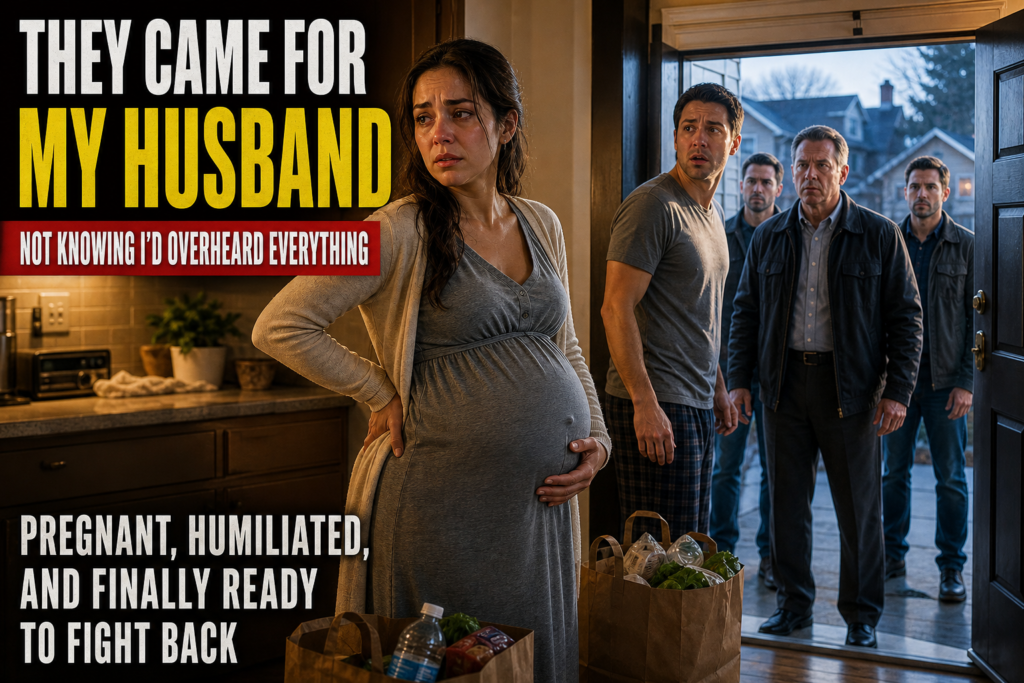
PART 1 — THE BAGS I CARRIED ALONE
The grocery bags cut into my fingers before I had even reached the front steps.
I was eight months pregnant, my ankles were swollen, and the baby had been pressing against my ribs all afternoon. Every step from the car to the house felt longer than it should have. The bags were heavier than I expected, filled with milk, vegetables, rice, canned food, and the things my mother-in-law had added to the shopping list at the last minute.
My husband, Michael, walked a few feet ahead of me with his phone in his hand.
He had not offered to help when I came out of the supermarket. He had not offered when I struggled to open the car door. And now, as I tried to balance the bags against my stomach, he was reading something on his screen as if we were taking a leisurely walk instead of trying to get home before my back gave out.
“Michael,” I called softly. “Could you carry some of these, please?”
He glanced over his shoulder.
“How many did you buy?”
“Just the things your mom asked for. I can’t carry them all comfortably.”
He opened his mouth as though he might answer, but before he could say anything, his mother appeared in the doorway.
Evelyn had been watching us through the front window. She stood with her arms folded across her chest, wearing the same disapproving expression she seemed to reserve especially for me.
“The world doesn’t spin around your belly,” she said sharply. “Pregnancy isn’t sickness.”
For a moment, I thought I had misunderstood her.
I looked at Michael, waiting for him to say something. Anything. I wanted him to remind his mother that I was carrying his child, that I was exhausted, or simply that asking for help with heavy groceries was not unreasonable.
Instead, he lowered his eyes to his phone.
“Mom’s right that you’re not helpless,” he murmured. “Just take your time.”
The words hurt more than his silence would have.
I adjusted the bags and continued toward the kitchen. One handle slipped from my fingers, and a can struck the pavement. I bent instinctively to pick it up, but the pressure in my abdomen made me stop halfway.
Evelyn sighed loudly.
“Careful. You’ll make a production out of everything if you keep acting like that.”
I straightened slowly, retrieved the can, and walked inside without answering.
I had learned that arguing with Evelyn rarely accomplished anything. She had a way of turning every disagreement into a story about how ungrateful I was, how sensitive I had become, and how her sons had never been so demanding when they were children.
Michael usually listened to her.
That evening, I put away the groceries while he showered. I prepared dinner, washed the dishes, and folded the baby clothes stacked beside our bed. My lower back ached, and the baby moved restlessly whenever I sat down.
At nine o’clock, I finally lowered myself onto the couch.
Michael joined me a few minutes later.
“Mom thinks you were rude today,” he said.
I stared at him.
“Rude?”
“You asked me for help in front of her. She thinks you were trying to make me look bad.”
I let out a small, disbelieving laugh.
“I was carrying six grocery bags at eight months pregnant. I wasn’t trying to make you look like anything. I was asking my husband to help me.”
He rubbed his forehead.
“Why does everything have to become an argument?”
“Because every time your mother says something cruel to me, you pretend she hasn’t.”
He looked away.
I waited for him to respond, but he picked up the television remote instead.
That was the moment I understood how lonely a marriage could become without anyone actually leaving.
I went to bed before him, placing one hand over my stomach and whispering to the baby that I was sorry. I did not know what I was apologizing for. Perhaps for bringing the baby into a home where kindness seemed to depend on whether I had earned it.
Sometime after midnight, I woke with a dull ache in my back. I shifted onto my side and listened to Michael breathing beside me.
I wondered whether he remembered the promises he had made when we first learned we were expecting. He had cried when he saw the first ultrasound. He had held my hand and said we would do everything together.
Back then, I had believed him.
Now, I was afraid that our child would arrive and discover the same thing I had: that a person could be surrounded by family and still have nobody willing to stand beside them.
The next morning, I would discover just how wrong Michael had been to believe his silence carried no consequences.
PART 2 — THE KNOCK BEFORE SUNRISE
The knock came at 6:17 in the morning.
It was not the polite tap of a neighbor asking to borrow something. It was a hard, urgent pounding that shook the front door and startled me awake.
Michael sat up beside me.
“What is that?”
Before I could answer, the knocking came again.
Three heavy blows.
Then a man’s voice called from outside.
“Michael! Open this door.”
My husband went still.
I recognized the voice, though I had not heard it in months.
His father, Robert.
Michael threw back the covers and hurried into the hallway. He was still wearing his sleeping clothes when he reached the front door. I followed more slowly, one hand resting beneath my stomach.
When he opened the door, the color drained from his face.
Robert stood on the porch, his expression severe. Beside him were Michael’s older brother, David, and his younger brother, Andrew.
The three men rarely visited together. In fact, they could barely remain in the same room without finding something to argue about.
Robert and David had not spoken properly for almost a year. Andrew had stopped attending family dinners after a dispute involving their late grandmother’s estate. Michael usually stayed out of their disagreements, claiming that his family had too many old wounds for anyone to repair.
Yet there they stood, together before sunrise.
Robert stepped forward and moved Michael aside without asking permission.
“Where is she?” he demanded.
Michael blinked.
“Who?”
Robert looked past him and saw me standing in the hallway.
His expression changed.
Not into a smile. Not into the cold disapproval I had come to expect from the family.
It became something much more difficult to understand.
Concern.
He approached me carefully.
“Are you all right?”
The question was so unexpected that I did not answer immediately.
“I’m fine,” I said automatically.
Robert looked down at my swollen feet, then at my hand resting against my belly.
“Have you been carrying heavy things?”
I glanced at Michael.
He looked as though he wanted to interrupt, but David stepped into the doorway behind his father.
“Let her answer, Michael.”
The sharpness in David’s voice made my husband flinch.
Andrew closed the door behind them and placed a thick folder on the entryway table. None of the men removed their coats.
Something had happened.
I could feel it in the air.
Robert turned back to his youngest son.
“Tell me what happened yesterday.”
Michael’s mouth opened, then closed.
“Nothing happened.”
“Don’t lie to me.”
“She’s pregnant, Dad. She’s emotional. We had a disagreement about groceries, that’s all.”
I felt my cheeks grow hot.
A disagreement.
That was what he called it when I asked for help and his mother told me my pregnancy did not matter.
Robert stared at him.
“Groceries?”
David gave a humorless laugh.
“That’s what you’re calling it now?”
Michael’s eyes moved between his brothers.
“What are you talking about?”
Robert lifted one hand.
“Yesterday morning, I received a phone call that made me question everything I thought I knew about this family. Last night, I spoke to your brothers. This morning, we came here because we needed to see the truth for ourselves.”
My heart began to pound.
I had no idea what phone call he meant, or why a disagreement over grocery bags would bring three estranged brothers to our doorstep.
Robert turned to me again.
“I want you to sit down. Please. You shouldn’t have to stand here while we discuss this.”
For the first time that morning, someone had noticed that I was eight months pregnant.
I sat carefully on the couch.
Michael remained by the door, his face pale and his hands trembling slightly.
Robert took a breath.
“Now,” he said, looking directly at his son, “I want you to explain why your wife has been telling people she’s afraid to ask you for help.”
I stared at him.
I had not told anyone that.
Not my friends. Not my parents. Not even my sister, who had called twice that week asking whether I was doing well.
Michael looked at me with something close to panic.
And I realized that whatever had brought his father and brothers to our house, it was not just about yesterday’s groceries.
PART 3 — THE SECRET I NEVER TOLD THEM
I could not understand how Robert knew I was afraid to ask Michael for help.
The truth was that I had not described my marriage that way to anyone. I had told people I was tired. I had said pregnancy was harder than I expected. When my sister asked whether Michael was helping, I answered that he was busy with work.
I had become very good at making other people’s lives sound easier than my own.
Robert sat in the chair across from me. David stood near the window, his arms crossed. Andrew remained beside the entryway table, watching Michael with a look I could not interpret.
My husband kept glancing toward the kitchen.
“Can we talk about this privately?” he asked his father.
“No.”
“You’re embarrassing me.”
Robert’s expression hardened.
“You’re worried about embarrassment? Your wife is carrying your child, and you’re worried about how this conversation makes you look?”
Michael swallowed.
I wanted to disappear into the couch.
I had spent months trying to prevent exactly this kind of confrontation. I did not want his family to fight because of me. I did not want to become the reason the brothers stopped speaking again. I wanted a peaceful home, a healthy baby, and a husband who noticed when I was struggling.
Instead, I had become the center of a family meeting I had never asked for.
“Mr. Hayes,” I said quietly, “I appreciate you coming, but I don’t want anyone fighting because of me.”
Robert looked at me with surprising gentleness.
“You’re not the reason we’re here. Whatever is happening in this family started long before yesterday.”
David nodded.
“That’s the part Michael never understood.”
Michael turned toward him.
“What does that mean?”
“It means you keep thinking that if you ignore a problem long enough, someone else will pay the price for it.”
“You’re one to talk,” Michael snapped. “You haven’t spoken to Dad in almost a year.”
“And I was wrong about plenty of things,” David replied. “But I never pretended my wife was asking too much when she needed me.”
The room fell silent.
Andrew lowered his eyes.
Robert rubbed a hand across his jaw, as though deciding how much he should reveal.
“Yesterday, your mother called me,” he said at last.
Michael’s shoulders relaxed a fraction.
“Mom? What does she have to do with this?”
“She told me that you and your wife had been having problems. She said your wife was becoming difficult, demanding, and unreasonable because of the pregnancy.”
I closed my eyes.
Of course Evelyn had called him.
Michael straightened.
“That’s what I’ve been trying to explain. She’s been very sensitive lately.”
Robert ignored him.
“At first, I believed your mother was exaggerating. Then she told me something that made me uncomfortable. She said you were planning to make a major decision about your household before the baby arrived.”
Michael’s expression changed again.
“What decision?”
Robert looked at him for a long moment.
“That’s what I came here to find out.”
David reached for the folder Andrew had placed on the table. He opened it, removed several pages, and handed them to Robert.
My husband stared at the papers.
“What is that?”
“Read it,” Andrew said.
Michael did not move.
Robert placed the pages on the coffee table.
“They concern the financial arrangement your mother has been discussing with you. The arrangement you apparently thought nobody else knew about.”
I looked from one man to another.
I had no idea what they were talking about.
Michael finally picked up the papers. His eyes moved quickly across the first page, then slowed. The blood drained from his face.
“Where did you get this?”
Andrew answered.
“From the person who was supposed to help you keep it secret.”
Michael’s hands tightened around the pages.
I felt a cold sensation settle in my stomach.
“What is it?” I asked.
Nobody answered me immediately.
Then Robert leaned forward.
“It’s a proposal involving the house, your husband’s money, and a decision that could affect where you and your baby live.”
I stared at Michael.
He would not look at me.
“Michael?”
He folded the papers together.
“It’s not what it looks like.”
The words came out so quickly that I knew he had rehearsed them before.
Robert stood.
“Then explain what it is.”
Michael looked at his father, then at his brothers, and finally at me.
For the first time since I had known him, he seemed to realize that silence would not be enough to save him.
But when he finally began to explain, he revealed something that made even his father sit back in disbelief.
PART 4 — THE HOUSE THAT WAS NEVER REALLY OURS
The house had always felt like Evelyn’s house, even though Michael and I lived in it.
She had a key. She came over without calling. She rearranged the kitchen cabinets because she believed I stored things incorrectly. She opened the refrigerator and criticized the food I bought. If I disagreed, she reminded me that the house had once belonged to her parents and that family should not need permission to visit.
Michael told me to ignore it.
“It’s just how Mom is,” he would say.
I tried.
When we first married, I imagined that the house would become ours through the small things couples build together. We would paint the spare bedroom, choose curtains, plant flowers in the front garden, and create a home that reflected both of us.
Instead, Evelyn chose the paint colors. She selected the curtains. She decided which furniture could stay and which should be replaced.
Whenever I suggested a change, she said we should wait until we could afford something better.
Whenever Michael suggested a change, she told him how much she had sacrificed for him.
Eventually, we stopped discussing changes at all.
Now, sitting on the couch with three men watching my husband, I learned that the house was part of a financial arrangement I had never been told about.
Robert placed the documents in front of me.
“You deserve to know what you’re living in,” he said.
The first page contained a property description and several financial figures. I did not understand all the legal language, but I understood enough to see that Michael had been discussing a loan secured against the house.
The property was not solely in his name.
It had been transferred to a family holding arrangement after his father’s retirement, with Robert retaining certain rights and responsibilities. Michael had permission to live there, but he did not have the authority to make every decision about it alone.
I looked at my husband.
“You told me the house was ours.”
“I said we lived here.”
“No. You told me we were building our future here.”
He rubbed the back of his neck.
“We are.”
“Then why is there a loan proposal with my name listed as a household occupant but no mention of me being consulted?”
He looked at Robert.
“Because the bank needed a complete household record. It doesn’t mean anything.”
Andrew leaned forward.
“Then why did you tell Mom that your wife wouldn’t need to know until after the paperwork was approved?”
My breath caught.
Michael’s face twisted.
“That’s not what I said.”
“Those were your words,” Andrew replied. “I was on the call.”
I turned toward Andrew.
“You heard him say that?”
He nodded reluctantly.
“I didn’t know the whole situation at the time. Mom said it was a temporary arrangement. She said Michael was trying to get ahead financially before the baby came.”
“Temporary for how long?” I asked.
Nobody answered.
Robert picked up another page.
“The proposal would have used the property’s value to secure a loan. Part of the money was intended to cover debts and expenses that your husband and his mother had been discussing.”
Michael stood abruptly.
“Enough. This is a private financial matter.”
Robert’s voice became quiet.
“Not when it could affect a pregnant woman and a newborn child who live in the house.”
My hands began to shake.
I had thought our financial struggles came from ordinary things: rising bills, the cost of preparing for the baby, and Michael’s complaints that his paycheck never stretched far enough.
I had cut back on clothes, skipped meals out, and bought secondhand baby furniture because I believed we were saving for our child’s future.
All the while, my husband and his mother had been discussing a loan without me.
“How much?” I asked.
Michael stared at the floor.
“How much money were you planning to borrow?”
He gave me a figure.
It was more than I had ever seen in our savings account.
“Where would the money go?”
“Some of it would cover expenses.”
“Which expenses?”
He did not answer.
Robert did.
“Your mother has been dealing with several financial problems. Michael agreed to help her.”
I looked at my husband, trying to recognize the man I had married.
“You were going to borrow money against our home to help your mother, and you didn’t tell me?”
“It’s not like that,” he said. “She raised me. She’s done everything for this family.”
“And what about the family you’re creating?”
He flinched.
For a moment, I thought he might finally understand.
Then he said, “You don’t know how much pressure I’ve been under.”
I looked at the grocery bags still sitting beside the kitchen counter. One of them had tipped over, and a few onions had rolled onto the floor.
I had carried those bags because asking for help had become more difficult than enduring the pain.
Now I understood that the problem was not simply that Michael refused to carry groceries.
It was that he had been making decisions about our future while treating me as though I were too fragile to handle a disagreement and too unimportant to deserve the truth.
I placed the documents on the table.
“I need to know everything,” I said.
Michael’s face tightened.
Robert nodded once.
“That’s exactly why we’re here.”
PART 5 — THE WOMAN WHO ALWAYS GOT HER WAY
Evelyn arrived less than an hour later.
She did not knock. She used her key, opened the door, and walked into the living room carrying her handbag as if she were arriving for a routine family visit.
Her eyes moved from Robert to David, then to Andrew.
“What is this?”
Nobody greeted her.
She looked at Michael.
“Why didn’t you tell me they were coming?”
Michael’s jaw tightened.
“Because I didn’t know they were coming.”
Evelyn turned toward me, and her expression changed immediately.
“What have you been telling them?”
I stared at her.
“Nothing.”
“Don’t lie to me. Robert has been calling me all morning, asking questions about private family matters.”
Robert rose from his chair.
“They stopped being private when you started making financial arrangements that could affect other people without telling them.”
Evelyn’s face hardened.
“I have done nothing wrong.”
David let out a short breath.
“Then this should be an easy conversation.”
She ignored him.
“This is between Michael and me. I don’t know why everyone feels entitled to interfere.”
“Because you involved all of us,” Andrew said. “You asked Michael to help you secure a loan using a property he doesn’t own outright. You told him not to discuss it with his wife. You made it our business.”
Evelyn looked at Michael.
“Is that what you told them?”
He hesitated.
That hesitation was enough.
She turned toward me.
“You’re the one who has caused all this trouble. Ever since you became pregnant, you’ve expected everyone to wait on you. You think a baby gives you the right to control this family.”
I felt the familiar urge to apologize.
It rose automatically, like a reflex I had developed after years of trying to keep the peace.
But before I could speak, Robert stepped between us.
“Do not speak to her like that.”
Evelyn stared at him.
“Excuse me?”
“You heard me.”
For a moment, the room was completely silent.
I had never seen Robert challenge her so directly. In family gatherings, he usually avoided arguments by changing the subject or leaving the room. He had once told Michael that some people were impossible to reason with, and that peace sometimes meant allowing them to have the last word.
Now he stood with his shoulders squared, refusing to move.
Evelyn laughed in disbelief.
“So this is what we’re doing? Everyone is suddenly against me?”
“No,” Robert said. “We’re asking you to explain your decisions.”
She dropped her handbag onto the chair.
“I have spent my entire life taking care of this family. When Michael needed help, I helped him. When you were struggling, Robert, I kept this household together. And now, because I asked my own son to assist me, I’m being treated like a criminal.”
“Nobody called you a criminal,” David said. “But you cannot demand loyalty while hiding the consequences from everyone else.”
Evelyn’s eyes flashed.
“You have always hated me.”
“I hated the way you treated people and called it love,” David replied.
Michael stepped between them.
“Can everyone stop? Please? This is getting out of control.”
I looked at him.
He had found his voice at last, but not to defend me. He wanted everyone to stop questioning his mother.
Evelyn noticed my expression.
“There,” she said, pointing at me. “Look at her. She wants you all to think she’s a victim.”
I stood slowly, supporting my back with one hand.
“I didn’t ask anyone to come here.”
“Then perhaps you should have kept your mouth shut.”
The words struck the room like a slap.
Robert’s expression changed.
“That’s enough.”
He turned to Michael.
“I want you to answer one question honestly. Did you agree to help your mother obtain this loan without discussing it with your wife?”
Michael’s eyes dropped.
“Yes.”
“And did you agree to keep the proposal from her until the paperwork was nearly complete?”
He swallowed.
“Yes.”
Evelyn closed her eyes as if his admission had personally wounded her.
Robert continued.
“Then you have a responsibility to correct this. You cannot make a decision that affects your wife and child and expect everyone to pretend it doesn’t matter.”
Evelyn shook her head.
“You are all making a terrible mistake.”
She picked up her handbag and turned toward the door.
But before she left, she looked at me one last time.
“You think you’ve won something today,” she said. “You haven’t. You have no idea what this family has sacrificed for you.”
I watched her walk out.
The door closed behind her.
For the first time in months, nobody told me to apologize for upsetting her.
Yet I did not feel victorious.
I felt frightened.
Because the financial documents were still on the table, Michael still had not explained where the money would go, and I could not shake the feeling that Evelyn’s anger was hiding something far more serious than wounded pride.
PART 6 — THE PRICE OF KEEPING PEACE
After Evelyn left, the house became strangely quiet.
Robert asked whether I needed anything. David offered to make breakfast. Andrew gathered the scattered papers and placed them in a neat stack.
Their kindness made me uncomfortable at first.
I had become accustomed to asking for very little. When someone offered to help, I instinctively looked for the hidden cost. I wondered whether I would be expected to repay the favor with gratitude, silence, or obedience.
But David simply went into the kitchen and started making toast.
Andrew brought me a glass of water.
Robert sat beside me and asked whether I had been feeling well during the pregnancy.
I answered honestly.
My back hurt most evenings. My feet were swollen. I had trouble sleeping. Sometimes I felt dizzy if I stood too quickly.
He listened without interrupting.
Then he asked, “Has your doctor told you to avoid heavy lifting?”
“Yes.”
“Did Michael know?”
“Of course.”
Robert closed his eyes briefly.
I felt compelled to defend my husband.
“He works long hours,” I said. “He gets tired, too.”
Robert looked at me.
“Being tired doesn’t excuse treating someone badly.”
I had no answer.
Across the room, Michael paced near the window. He had barely spoken since his father confronted him. Every few minutes, he looked at his phone, perhaps hoping his mother would call and tell him what to do.
Finally, he turned toward me.
“Can we talk alone?”
I looked at Robert.
He stood immediately.
“Of course. We’ll be in the kitchen.”
David and Andrew followed him, leaving the room.
Michael sat in the chair opposite me.
“I never wanted this to happen.”
“What did you want to happen?”
He rubbed his hands together.
“I wanted to help Mom without creating another fight between everyone.”
“So you decided to keep it from me.”
“I thought I could sort everything out before it became a problem.”
“But it was already a problem. You just decided I didn’t need to know.”
He sighed.
“You don’t understand how she gets when she’s desperate. She makes everything feel like an emergency.”
I studied his face.
“Then why didn’t you tell her no?”
He looked away.
“She’s my mother.”
“And I’m your wife.”
“I know.”
“Do you?”
The question came out more quietly than I expected.
Michael stared at his hands.
“I’ve spent my whole life trying to keep her happy. When Dad and my brothers fought with her, I was the one who tried to calm everyone down. I learned that if I agreed with her, things stayed quiet.”
I listened, waiting.
He continued.
“When she started talking about the loan, she said it was temporary. She told me that if I refused, she’d lose everything. I didn’t know what else to do.”
“You could have talked to me.”
“I was afraid you’d say no.”
I felt something inside me grow still.
“That was exactly why you should have talked to me.”
He looked up.
“I know.”
I wanted to believe him. I wanted his regret to mean that something would change.
But regret was not the same as responsibility.
“What happens now?” I asked.
“We’ll figure it out.”
“That isn’t an answer.”
He looked frustrated.
“What do you want me to say?”
I placed one hand over my belly.
“I want you to tell me whether our home is safe, whether we owe money we cannot repay, and whether you are going to keep making decisions about our child without including me.”
He opened his mouth, then stopped.
That was when I realized he did not have the answers.
He had agreed to the proposal because his mother had asked. He had avoided the difficult questions because he hoped someone else would solve them. And he had allowed me to believe everything was fine because the truth might force him to choose between the comfort of obedience and the responsibilities of adulthood.
I stood carefully.
“I’m going to call my doctor,” I said. “Then I’m going to call my sister.”
His face tightened.
“Why your sister?”
“Because I need someone I trust to know what’s happening.”
“You make it sound like I’m dangerous.”
“No,” I replied. “I’m saying I don’t feel safe relying on your promises right now.”
He stared at me as if I had spoken a language he did not understand.
I walked toward the kitchen.
For once, I did not turn around to see whether he was following.
PART 7 — WHAT HIS BROTHERS HAD BEEN HIDING
My sister, Claire, answered on the second ring.
I tried to sound normal when I told her about the morning’s events, but my voice broke before I reached the end of the first sentence.
She did not ask why I had waited so long to call.
She did not tell me I should have spoken up sooner.
She simply said, “I’m coming.”
After I hung up, I found Robert and his sons at the kitchen table. The folder was open between them, and the three men were discussing the financial documents in low voices.
They stopped when I entered.
“Please don’t stop on my account,” I said. “I need to understand what’s happening.”
Robert gestured toward an empty chair.
“Then sit with us.”
Andrew explained that he had discovered the loan proposal while helping their father organize some property records. At first, he had assumed Michael had already discussed the arrangement with me. When he learned that I knew nothing about it, he became concerned.
David had initially refused to get involved.
He and Michael had a long history of disagreements, and he did not want another family argument. But after speaking with Andrew, he decided that staying out of the situation would mean allowing a potentially serious mistake to continue.
“I should have checked with you sooner,” Andrew admitted. “I thought Michael would do the right thing once he understood what the paperwork meant.”
“What did it mean?” I asked.
Robert answered carefully.
“The proposal was not a completed loan. It was a plan to use the property’s value as security, subject to the necessary approvals. Nothing should proceed without the proper authority and review.”
I felt a little relief, though not enough to settle my nerves.
“So the house hasn’t been taken from us?”
“No,” Robert said. “But the arrangement needs to be stopped until everyone understands the legal and financial implications.”
I looked at the papers again.
“And the money?”
Andrew explained that Evelyn had been struggling with debts. Some came from expenses she had taken on after Robert began living separately from her. Others were related to a business investment that had not worked out as she expected.
Michael had agreed to help because she told him the situation was temporary and that the family would lose everything if he refused.
“Did she tell him how much she owed?” I asked.
David nodded.
“She showed him some of it. We don’t know whether he saw the complete picture.”
“Why didn’t you tell your father earlier?”
Andrew lowered his eyes.
“Because this family has spent years choosing sides instead of solving problems. I thought if I stayed quiet, I wouldn’t make things worse.”
I understood that feeling too well.
Silence often looked like peace from the outside. It was only when the consequences arrived that people discovered how much damage had been accumulating beneath it.
Robert folded his hands.
“I need you to understand something. You are not responsible for fixing Evelyn’s debts. Neither is your baby. Michael can choose to help his mother, but he cannot make that choice by putting your security at risk without your knowledge.”
I nodded slowly.
For months, I had wondered why money always seemed to be tight even when Michael said we were managing. I had blamed myself for buying the wrong groceries, choosing the wrong baby products, or asking for things we could not afford.
Now I realized I had been making sacrifices without knowing what we were sacrificing for.
My phone vibrated.
Claire had sent a message saying she was ten minutes away.
I looked at Robert.
“Thank you for telling me the truth.”
He gave a tired smile.
“I wish I could tell you that we handled everything correctly. We didn’t. This family has a long history of letting problems grow because nobody wants to confront them.”
He glanced toward the living room, where Michael stood alone.
“But this time, we have a chance to do things differently.”
I wanted to believe him.
Then Andrew turned to another page in the folder, and his expression changed.
“There is something else,” he said.
Robert leaned over to see what he had found.
David’s face grew tense.
I felt my stomach tighten.
“What is it?”
Andrew tapped a paragraph near the bottom of the page.
“The loan wasn’t the only thing Michael and Evelyn had discussed.”
PART 8 — THE DECISION ABOUT MY BABY
Andrew did not explain immediately.
He read the paragraph again, then passed the document to Robert. My father-in-law studied it carefully before setting it down.
Michael appeared in the doorway.
“What now?”
Andrew looked at him.
“You should tell her.”
Michael’s face went pale.
“Tell her what?”
David pushed his chair back.
“Don’t do that. We all know what the document says.”
I looked from one brother to the other.
“Somebody please tell me.”
Robert took a breath.
“Your husband and his mother had discussed how the household would operate after the baby arrived. Some of it concerned expenses and living arrangements. But one part of the conversation involved Evelyn taking a leading role in caring for the baby.”
I frowned.
“Taking a leading role?”
Michael rubbed his forehead.
“Mom was only trying to help.”
“Help with what?”
“With the baby. You might need rest. She raised three children. She knows what she’s doing.”
I waited for him to continue.
He did not.
“So what exactly did you agree to?”
He looked at the floor.
“She wanted to stay here for a while after the birth.”
“That isn’t a problem by itself.”
“I know.”
“Then what is the problem?”
Andrew answered quietly.
“Evelyn wanted Michael to agree that she would make the main decisions about the baby’s routine and care while you recovered. The proposal also suggested that you spend some time with your sister if you needed additional rest.”
I stared at him.
“Spend time with my sister?”
Michael hurried to explain.
“It wasn’t meant to be permanent. Mom thought you might feel overwhelmed. She said having another person in charge would make things easier.”
I felt as though the room had tilted.
“Another person in charge of my baby?”
“That’s not how she meant it.”
“Then why did you agree to it?”
He looked helpless.
“Because I thought she knew more than I did.”
I could not believe what I was hearing.
I had spent months preparing to become a mother. I had attended appointments, read books, washed tiny clothes, and learned what to expect during labor and recovery. I was frightened, but I was also excited. I wanted support, not someone to take my place.
I looked at Michael.
“Did you think I would be unable to care for our child?”
“No.”
“Did you think I wanted to be sent away from my own home?”
“Of course not.”
“Then why did you agree to a plan that treated me like a problem to be managed?”
His eyes filled with tears.
“I didn’t think about it that way.”
That was the answer I had heard in different forms for years.
He had not thought about how the grocery bags felt against my fingers. He had not thought about how humiliating it was to be criticized in front of him. He had not thought about how frightened I felt when he made financial decisions without me.
He had not thought about it because he had become accustomed to letting his mother do the thinking for him.
I pressed my lips together to stop them from trembling.
“I want you to understand something. I may need help after the baby is born. I may need rest. I may cry, feel overwhelmed, or ask questions because I’ve never done this before. But that does not mean I should lose my voice as a mother.”
Michael nodded.
“I understand.”
“No. You understand now because your father and brothers are sitting in our living room. I need to know what you would have done if they had never come.”
He had no answer.
A knock sounded at the door.
Claire had arrived.
When I opened it, she took one look at my face and wrapped her arms around me. I began to cry against her shoulder, not because I wanted anyone to rescue me, but because I had been holding everything inside for too long.
She led me to the couch and sat beside me.
Robert explained the situation without making excuses for anyone. Claire listened carefully, her expression growing more serious with every detail.
When he finished, she looked at Michael.
“My sister doesn’t need a family committee to decide whether she’s allowed to be a mother.”
Michael lowered his head.
For the first time that morning, nobody contradicted her.
PART 9 — THE FIRST TIME I SAID NO
Claire stayed with me through the afternoon.
She helped me prepare a small bag in case my doctor recommended that I rest somewhere else for a few days. We packed comfortable clothes, my medical documents, the baby’s hospital bag, and the small blanket I had folded carefully beside the crib.
I did not know whether I would leave the house.
But knowing I had a choice made it easier to breathe.
Michael followed me from room to room, asking whether I wanted tea, whether my back hurt, whether he should call the doctor, and whether we could please talk privately.
His sudden attention was almost painful.
I had asked for help for months. Now that other people had witnessed my distress, he seemed desperate to prove that he could be the husband I had needed all along.
I appreciated the effort.
But I could not pretend that one difficult morning had erased everything that came before it.
When I finished packing, he stood beside the bedroom door.
“Are you leaving me?”
I looked at him.
“I’m going to stay with Claire for a little while.”
“That’s not what I asked.”
“I know.”
His eyes were red.
“I love you.”
I believed that he felt love for me. What I no longer knew was whether he understood that love required more than feeling something when the consequences of his choices finally became impossible to ignore.
“I need time to think,” I said.
“Can’t we fix this together?”
“Maybe. But I cannot fix it for both of us.”
He looked down.
I took a breath.
“Michael, I need three things. First, the financial proposal must be reviewed properly, and nothing involving our home can proceed without full disclosure and the necessary consent. Second, your mother cannot make decisions about our baby or our household without our agreement. Third, I need you to stop treating my requests for help as attacks against your family.”
He nodded quickly.
“Okay.”
“I don’t want you to agree because you’re afraid I’ll leave. I want you to understand why these things matter.”
He swallowed.
“I’ll try.”
“Trying means telling your mother no when you believe she’s wrong. It means helping me when I’m struggling, even if she thinks I should do everything myself. It means telling me the truth before someone else has to reveal it.”
He covered his face with both hands.
“I know I’ve failed you.”
I stood quietly beside him.
Part of me wanted to comfort him. That instinct was familiar. Whenever he felt guilty, I rushed to reassure him that he was a good person and that everything would be all right.
But I had spent too long comforting the person whose choices were hurting me.
This time, I let him sit with his feelings.
Downstairs, Robert and his sons were preparing to leave. Before they did, Robert asked to speak with me.
“I am sorry,” he said. “I should have paid closer attention to what was happening. I knew your mother-in-law could be difficult, but I didn’t understand how much you were carrying.”
I appreciated his honesty.
“Thank you for coming.”
He nodded.
“I cannot promise that this family will suddenly become easy. But I can promise that I will not support any arrangement that puts you or the baby at risk.”
David apologized for staying away for so long. Andrew promised to help ensure that the property documents were reviewed by a qualified professional.
Their apologies did not repair the marriage, but they helped me understand that I did not have to accept every burden simply because it belonged to the family I had married into.
At the front door, Michael asked one final time whether I would stay.
I looked at him, then at the grocery bags still sitting beside the kitchen counter.
“No,” I said gently. “Not today.”
The word felt unfamiliar.
It was not loud. It was not cruel. It did not require me to insult anyone or explain myself a dozen times.
It was simply a boundary.
Claire helped me into the car. Before I closed the door, Michael appeared on the porch.
“I’ll call you tonight,” he said.
“All right.”
“And I’ll come to the next appointment if you want me there.”
“I want you there if you’re coming because you want to be a father, not because you’re trying to prove something to everyone else.”
He nodded.
I closed the door.
As Claire drove away, I watched the house disappear behind us. I did not know whether my marriage would survive. I did not know whether Michael would finally learn to stand on his own feet or whether he would return to the familiar comfort of his mother’s approval.
But I knew something I had not known the day before.
I was allowed to protect my peace.
And I was allowed to expect my husband to protect it with me.
PART 10 — THE HOME WE CHOSE TO BUILD
My doctor reassured me that day that the discomfort I had described did not, by itself, indicate that something was wrong with the baby. She reminded me to rest, avoid heavy lifting, and seek urgent medical advice if I experienced warning signs such as bleeding, fluid leakage, severe pain, or reduced fetal movement.
I listened carefully, grateful for the chance to focus on something that did not involve Michael’s family.
Claire made me soup that evening. We sat at her kitchen table while rain tapped against the windows, and for the first time in weeks, I ate without feeling rushed.
I slept in her guest room with the baby blanket folded beside me.
Michael called at eight o’clock.
He did not ask me to come home. He did not blame his mother. He did not say that I was making things difficult.
Instead, he told me that he had contacted a lawyer to understand the property arrangement and had asked his father to help him review the financial proposal. He said he had also told Evelyn that she would not be making decisions about the baby without our agreement.
“How did she take it?” I asked.
“Badly.”
I waited.
“She said I was choosing you over her.”
“What did you say?”
He was quiet for a moment.
“I told her I wasn’t choosing between you. I was choosing to be responsible for my own family.”
I closed my eyes.
It was the first time I could remember him saying something like that.
I did not congratulate him. I did not tell him everything was forgiven.
I simply said, “That’s a good start.”
Over the next few weeks, we spoke regularly. Michael attended my appointments and helped prepare for the baby’s arrival. He learned how to install the car seat, organized the nursery, and carried the shopping bags without waiting to be asked.
More importantly, he began to question the habits he had once defended.
When Evelyn criticized my choices, he no longer automatically agreed. When she tried to make plans for the baby without asking us, he reminded her that we would decide together. Sometimes he handled those conversations well. Sometimes he became defensive and needed to think before responding.
Change was not a straight line.
We also met with a counselor, because I did not want us to return to our old habits simply because the immediate crisis had passed. Michael had to learn that being a husband did not mean keeping everyone happy at my expense. I had to learn that speaking honestly about my needs did not make me selfish.
The financial review revealed that the proposed loan had not been finalized. The family property arrangement required additional legal steps, and Robert made it clear that no decision would be rushed. Michael and I agreed that we would not take on financial obligations we did not understand or accept responsibilities that threatened our child’s security.
Evelyn did not apologize immediately.
For a while, she barely spoke to me. When she did, her words were stiff and formal. I stopped trying to win her approval. I could be respectful without pretending her behavior had been acceptable.
A few weeks later, she asked whether she could visit after the baby arrived.
I told her we would let her know when we were ready.
It was a small answer, but it represented a change in me. I no longer felt compelled to say yes simply because someone might be offended by no.
Our daughter arrived on a quiet morning near the end of the month.
Michael was beside me throughout the labor. He held my hand, followed the medical team’s instructions, and cried when the baby finally cried.
When the nurse placed our daughter against my chest, I looked down at her tiny face and felt a love so fierce that it frightened me.
I also felt a promise forming inside me.
She would grow up knowing that love did not require her to disappear. She would learn that kindness was not weakness, that asking for help was not failure, and that family should be a place where people could speak honestly without fear of humiliation.
Michael sat beside the bed, watching us.
“I’m sorry,” he whispered.
I looked at him.
“I know you’re sorry.”
He nodded, tears running down his cheeks.
“I should have helped you that day. I should have listened. I should have protected you from being treated that way.”
“Yes,” I said.
He did not ask me to soften the truth.
That mattered.
He began to understand that an apology was not a request for the other person to stop feeling hurt. It was an acknowledgment that the hurt had happened, followed by the difficult work of making sure it did not become a pattern again.
We did not rebuild our marriage in a single conversation.
We rebuilt it through ordinary decisions: telling the truth about money, sharing the work at home, discussing family boundaries before a crisis, and learning to disagree without treating one another as enemies.
When Evelyn visited, we agreed on the length of the visit beforehand. She held her granddaughter and cried quietly. She did not offer a grand apology, and I did not pretend that everything between us had been repaired.
But she asked before giving advice.
For that day, it was enough.
Months later, I thought again about the grocery bags.
I remembered the way the handles had cut into my fingers, the way I had waited for Michael to defend me, and the terrible loneliness of realizing he would rather keep his mother happy than acknowledge my pain.
I used to believe that the worst part of that day was having to carry the bags alone.
Now I understood that the bags were only the visible part of the burden. The heavier burden was the belief that I had to accept everything quietly to keep my marriage intact.
I no longer believed that.
One Saturday morning, Michael came home with groceries. He carried the bags into the kitchen, put the milk away, and asked what I wanted for breakfast. Our daughter slept nearby, wrapped in the blanket I had packed when I left.
The moment was ordinary.
There were no witnesses, no arguments, and no family members waiting to judge his behavior.
He was helping because the work belonged to both of us.
I watched him for a moment, then went to stand beside him.
We were not perfect. We still had difficult conversations ahead of us. Trust would take time, and there would be days when old habits returned.
But the home we were building no longer depended on my silence.
It depended on both of us showing up.
And that, I finally understood, was what a family should have been all along.