Part 1
The letter was small enough to disappear inside my husband’s jacket pocket, yet the moment it fell onto the laundry room floor, it felt as though it had torn twenty-one years of my life apart.
I had been sorting Daniel’s clothes on a Thursday afternoon, separating his work shirts from the trousers he wore on weekends. It was an ordinary chore, one I had performed thousands of times since we married. Outside, rain tapped against the kitchen window. The washing machine hummed, and somewhere upstairs, our youngest daughter, Sophie, was arguing with a friend over the phone.
Nothing about that afternoon suggested my life was about to change.
Then I unfolded the letter.
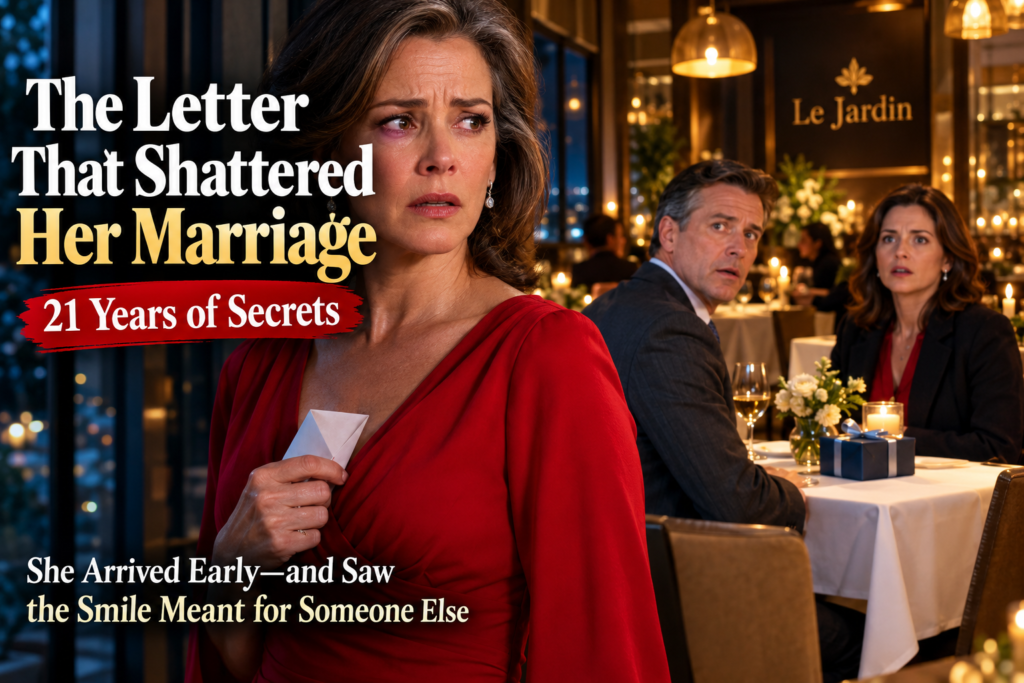
“Happy anniversary Darling. These 9 years have been the best of my life. Meet me at Le Jardin on Friday 7 p.m. Wear red.”
I read it once.
Then again.
The words remained the same, no matter how many times I blinked.
Happy anniversary, Darling.
These nine years have been the best of my life.
Daniel and I had been married for twenty-one years. We had celebrated birthdays, survived financial difficulties, raised two children, buried his father, and spent countless evenings sitting across from each other at our kitchen table. Nine years could mean many things, but none of them made sense to me.
Unless the nine years belonged to someone else.
My fingers tightened around the paper. For a moment, I couldn’t hear the washing machine or the rain. I could only hear the steady pounding of my heart.
I wanted to call him immediately.
Daniel was at work, probably sitting in his office with his reading glasses balanced on his nose, answering emails as though nothing in his world could possibly be wrong. I imagined his voice when he answered my call.
“What’s up, sweetheart?”
He had called me sweetheart that morning before leaving for work. He had kissed my forehead, complained about the traffic, and reminded me to pick up milk.
Had he kissed another woman goodbye, too?
I sat on the edge of the laundry basket and pressed the letter against my knee.
There were explanations, I told myself. Perhaps it was a joke. Perhaps a colleague had slipped the letter into his pocket by mistake. Perhaps the anniversary belonged to a friend who had asked Daniel to arrange something.
But why would another woman call my husband darling?
And why would she ask him to wear red?
I thought about the little things I had dismissed during the past few months. The phone calls he took in the garage. The evenings when he came home later than usual. The new habit of keeping his phone face down on the dining table.
Whenever I asked whether something was wrong, Daniel smiled and told me I was imagining things.
“You worry too much, Emma,” he would say.
I had believed him because believing him was easier than questioning the man I had built my life around.
That afternoon, I nearly tore the letter into pieces.
Instead, I folded it along its original creases and slipped it into the pocket of my cardigan.
When Daniel came home, I was preparing dinner. He entered the kitchen, loosened his tie, and kissed my cheek.
“Something smells wonderful.”
“Roast chicken,” I answered.
He opened the refrigerator. “Perfect. I’m starving.”
I watched him pour himself a glass of water. His wedding ring caught the kitchen light as he lifted the glass.
“How was your day?” I asked.
“Busy. Exhausting, actually.”
“Anything interesting happen?”
He glanced at me. “Why?”
“No reason.”
He smiled and touched my shoulder. “You look tired, sweetheart. You should sit down for a while.”
The tenderness in his voice nearly broke me.
I wanted to pull the letter from my cardigan and place it on the counter between us. I wanted to ask who she was, how long he had known her, and whether every anniversary we had celebrated meant as little to him as those nine years seemed to mean.
But I didn’t.
Instead, I stirred the gravy and asked whether he wanted more potatoes.
That night, Daniel fell asleep quickly. I lay beside him, staring at the ceiling while the minutes crawled past.
At two in the morning, I finally reached for my phone and searched for Le Jardin.
It was an elegant restaurant in the city center, known for its candlelit tables, flower arrangements, and quiet garden terrace. Daniel had taken me there once, years ago, when he wanted to impress me after a difficult argument.
I remembered the evening clearly. He had held my hand across the table and promised that whatever happened in life, we would always tell each other the truth.
I had believed that promise.
Now, I was looking at the restaurant’s photographs, wondering whether he had taken another woman there during the years I thought belonged to us.
Friday was tomorrow.
I could confront him before then. I could demand an explanation and insist that he show me his phone. I could call a lawyer, tell my sister, or spend the next twenty-four hours crying in a locked bedroom.
Instead, I made a decision that frightened me with its calmness.
I would go to Le Jardin.
I would see the woman with my own eyes.
And for the first time in twenty-one years, I would let Daniel discover that I was capable of finding the truth without his permission.
Part 2
The following morning, I woke before Daniel.
For several seconds, I forgot about the letter. Then I saw his jacket hanging over the chair, and the memory returned so sharply that I had to grip the edge of the mattress.
Daniel was already awake, checking his phone.
“Morning,” he said, leaning over to kiss me. “Did you sleep well?”
“Not particularly.”
“You should go to bed earlier tonight.”
He said it casually, without looking up from the screen.
I wondered whether the woman had already messaged him. I wondered whether she had sent him a heart, a photograph, or another reminder about their anniversary.
“Daniel?”
“Hmm?”
“Do we have anything planned for tonight?”
He finally looked at me. “Tonight?”
“Friday. I thought we might go out for dinner.”
Something flickered across his face, but it disappeared so quickly that I couldn’t identify it.
“Tonight won’t work, sweetheart. I’ve got a few things to finish at the office.”
“Important things?”
“Nothing you need to worry about.”
There it was again. The gentle dismissal, delivered in the same reassuring voice that had worked on me for years.
I nodded and watched him button his shirt.
“What about Saturday?”
“Maybe. Let me see how things go.”
He kissed my forehead, picked up his jacket, and left.
I waited until I heard his car disappear down the street before going downstairs.
My first call was to my older sister, Laura.
“Emma? What’s wrong?” she asked as soon as she heard my voice.
“Why do you think something is wrong?”
“Because you never call me this early unless somebody is in the hospital or you’ve had a fight with Daniel.”
I almost laughed. Instead, I sat at the kitchen table and unfolded the letter.
“I found something in his jacket.”
“What kind of something?”
I read it aloud.
Laura said nothing for several seconds.
“Tell me you aren’t alone,” she finally whispered.
“I’m alone.”
“Emma, that letter—”
“I know what it looks like.”
“Then confront him.”
“I can’t.”
“Why not?”
Because I was afraid, I wanted to say. Because if I asked him and he denied it, I might believe him. Because twenty-one years of marriage had taught me how to explain away almost anything if the alternative meant watching my entire life collapse.
But I couldn’t put those feelings into words.
“I need to see her,” I said.
Laura sighed. “Then don’t go alone.”
“I’ll be fine.”
“That isn’t what I said.”
For the next ten minutes, she tried to persuade me to let her come with me. I refused, although I promised to call her if anything went wrong.
After we hung up, I studied my reflection in the kitchen window.
At fifty, I had developed the faint lines around my eyes that came from years of laughing, worrying, and squinting into sunlight. My hair had begun to silver at the temples. I was no longer the twenty-nine-year-old woman who had married Daniel in a simple white dress, convinced that love could withstand anything.
But I was still the woman who deserved honesty.
I repeated that sentence until it stopped sounding like something I was borrowing from somebody else’s life.
At lunchtime, I arranged for a sitter to stay with Sophie, who was sixteen and old enough to notice that something was wrong but young enough that I didn’t want to involve her.
When she came downstairs, she found me standing beside the kitchen counter, staring at my phone.
“Mom, are you okay?”
I put on a smile. “Of course. Why?”
“You look like you’re about to cry.”
The observation pierced me more deeply than I expected.
I reached for her hand. “I’m just tired, sweetheart.”
She studied me with the same serious expression Daniel wore when he was trying to decide whether to tell me something.
“If something’s wrong, you can talk to me.”
I squeezed her fingers. “I know. And I promise I’ll tell you if I need to.”
She hugged me before going back upstairs.
Afterward, I went into our bedroom and opened the wardrobe.
I passed the dresses I wore to family gatherings, the comfortable clothes I kept for ordinary days, and the navy-blue dress Daniel had once said made me look elegant.
Then I found the red dress.
It had been hanging untouched for nearly two years. I had bought it for our twentieth anniversary, intending to wear it to a restaurant Daniel had promised to book. He had canceled that evening at the last minute because of a supposed emergency at work.
We had eaten takeaway at home instead.
I had told myself it didn’t matter.
Now, I lifted the dress from its hanger and held it against my body.
The color was bold, almost defiant. It reminded me of the woman I had been before life taught me to put everyone else’s comfort ahead of my own.
I laid it on the bed.
At four o’clock, Daniel called.
“Hi, sweetheart. Just checking in.”
“Everything all right?”
“Of course. I’ll probably be late tonight.”
“How late?”
“Not sure. Don’t wait up.”
I closed my eyes.
“All right.”
“I love you.”
The words came easily. They always had.
“I love you, too,” I replied, because the truth was complicated. I still loved the man I had married. I simply no longer knew whether that man existed.
When the call ended, I stood motionless beside the bed.
Then I began getting ready.
I took a long shower, dried my hair, and applied my makeup carefully. I chose simple earrings and the shoes that made me stand a little taller. I didn’t dress to compete with another woman. I dressed because I wanted to remember what it felt like to make a decision for myself.
At six fifteen, I checked on Sophie, explained that I would be out for dinner, and reminded the sitter where everything was.
At six thirty, I stepped outside.
The evening air was cool, and the sky had the pale gray color that sometimes preceded rain.
I drove toward the city with the letter tucked inside my handbag.
Every traffic light seemed to take too long. Every passing car reminded me that somewhere, another woman was preparing for an anniversary dinner with my husband.
When I finally turned onto the street where Le Jardin stood, I could see the warm glow of its windows.
I parked across the road and sat with both hands resting on the steering wheel.
For one last moment, I considered going home.
Then I opened the car door.
I was going to find out who had been sharing my marriage.
And I was going to hear the truth, even if it was the last thing I wanted to hear.
Part 3
Le Jardin looked exactly as I remembered it.
Small lights hung among the trees outside the entrance. Through the tall windows, I could see white tablecloths, polished glasses, and waiters moving between tables with the quiet confidence of people accustomed to serving expensive dinners.
A couple stood near the entrance, laughing as the man helped the woman remove her coat. Their easy affection made me look away.
I checked my phone.
Six forty-two.
I had arrived eighteen minutes early.
For a moment, I stood on the pavement, unsure whether I could make myself walk through the door. My reflection appeared in the restaurant window, the red of my dress bright against the evening darkness.
I looked composed.
Inside, I felt as though I were standing at the edge of a cliff.
The hostess greeted me with a pleasant smile.
“Good evening. Do you have a reservation?”
“Not exactly. I’d like a table for one, if possible.”
“Certainly. Would you prefer the dining room or the terrace?”
“The dining room.”
She led me to a small table near the back, where a decorative screen separated my seating area from another table. From there, I could see the entrance without being immediately visible to everyone who walked in.
I thanked her and sat down.
A waiter offered me water and a menu. I ordered sparkling water and told him I would decide on dinner later.
My hands were cold.
I took the letter from my handbag, unfolded it beneath the table, and read it again.
Happy anniversary Darling.
I tried to imagine the woman who had written those words. Was she young? Was she beautiful? Did she know Daniel was married? Had he told her that our relationship was over, that we lived together only because of the children, or that I was a difficult woman he could never leave?
Perhaps she believed she was the only person who truly understood him.
Perhaps she had been waiting for him to choose her for years.
I hated that my mind kept inventing explanations for a woman whose face I had never seen.
At six fifty, a woman entered the restaurant.
She appeared to be in her early forties, with shoulder-length brown hair and a graceful, understated style. She wore a dark coat over a red blouse and carried a small handbag. Her eyes moved around the room before settling on a table near the window.
She spoke briefly with the hostess, then sat down.
My stomach tightened.
The woman checked her phone and smiled at something on the screen. A moment later, she tucked the device into her handbag and looked toward the entrance.
She was waiting for someone.
I lowered my eyes to the menu.
At six fifty-five, the waiter returned.
“Have you decided, madam?”
“Not yet, thank you.”
He glanced toward the entrance. “Are you expecting someone?”
“No,” I said. “Just waiting for my appetite to return.”
He gave me a sympathetic smile and left.
The woman by the window looked toward the door again.
I studied her hands. She wore a delicate silver bracelet and a ring on her right hand. There was no obvious sign of nervousness, no guilty glance toward the other tables.
She looked like a woman expecting a pleasant evening.
That ordinary appearance disturbed me more than anything else.
How could someone who might have been involved in my husband’s secret life look so completely unremarkable?
At seven o’clock, the restaurant door opened.
Daniel walked in.
For a moment, the sight of him nearly undid me. He wore the charcoal suit I had helped him choose for a business dinner several months earlier. His hair was neatly combed, and he had shaved that morning. He looked younger than he had when he left the house.
He paused at the entrance, searching the room.
Then he saw the woman by the window.
His face transformed.
A smile spread across his features, warm and unguarded. It was the kind of smile I remembered from our early years together, when he would see me waiting outside the university library or catch sight of me across a crowded room.
He walked toward her.
She rose from her chair.
Daniel reached for her hands, and she laughed softly. He leaned forward and kissed her cheek.
I gripped the edge of the table.
The woman said something that made him smile again.
He pulled out her chair, sat opposite her, and began talking with the ease of a man who had been looking forward to this moment all day.
I couldn’t hear their conversation clearly, but I could see enough.
The way he leaned toward her.
The way she touched his wrist.
The way he listened.
For twenty-one years, I had told myself that love wasn’t always dramatic. Sometimes it was a quiet hand on your shoulder, a shared cup of coffee, or a familiar voice asking whether you had eaten.
Watching Daniel across the restaurant, I realized that I had never stopped wanting to believe in those ordinary gestures.
Perhaps that was why the sight hurt so much.
It wasn’t simply that he had come to meet another woman.
It was that he looked happy.
He looked like a man who had found a place where he could breathe.
And I had spent years wondering why he seemed increasingly distant at home.
The waiter approached their table with menus. Daniel said something to the woman, and she laughed again.
Then she reached into her handbag and produced a small, neatly wrapped package.
Daniel’s expression softened.
He accepted it with both hands.
My throat tightened.
Whatever their relationship was, it was not a casual meeting.
I looked down at my wedding ring and turned it slowly around my finger.
Then Daniel lifted his head.
His eyes traveled across the dining room, passed the windows, and settled on the table where I sat.
At first, he looked confused.
Then he recognized me.
The smile disappeared so completely that it seemed to have been erased.
His face went pale.
He froze with the package still in his hands.
And for the first time since I had known him, my husband looked genuinely afraid.
Part 4
For several seconds, neither of us moved.
Daniel stared at me as though I had appeared from nowhere. His mouth opened slightly, but no words came out. Across from him, the woman followed his gaze.
She turned in her chair.
Her eyes met mine.
I watched recognition, confusion, and something resembling alarm cross her face. She looked back at Daniel, then at me again, as though she were trying to understand why the man sitting opposite her had suddenly forgotten how to breathe.
I could have remained at my table.
I could have let him come to me, watched him struggle to explain himself, and waited for the first lie to escape his mouth.
Instead, I stood.
My knees felt weak, but I kept my back straight as I crossed the dining room. The sound of conversation seemed to fade around me. A waiter stepped aside to let me pass, and someone at a nearby table stopped speaking.
Daniel rose so quickly that his chair scraped against the floor.
“Emma.”
My name sounded strange in his voice.
“Hello, Daniel.”
The woman remained seated, clutching the edge of the table.
Daniel glanced at her, then back at me.
“What are you doing here?”
The question was so absurd that I almost laughed.
“I could ask you the same thing.”
His face tightened. “Can we talk privately?”
“Why? Is there something you don’t want her to hear?”
The woman flinched.
Daniel lowered his voice. “Please don’t do this here.”
I looked at him for a long moment.
“You invited someone to celebrate an anniversary. I thought it was only fair that I join the celebration.”
He closed his eyes briefly.
“Emma, please.”
The woman stood.
“Daniel,” she said quietly, “who is she?”
I turned toward her.
“I’m Emma. His wife.”
The silence that followed was absolute.
The woman stared at me.
“His wife?”
“Twenty-one years,” I replied. “We’ve been married for twenty-one years.”
She looked at Daniel as though she had never seen him before.
He rubbed his forehead. “This isn’t what you think.”
I had heard those words so many times in television dramas that I never imagined they would one day be spoken to me.
“Then tell us what it is,” I said.
Daniel looked toward the other diners. “We need to leave.”
“No,” I answered. “I’ve already arranged a sitter for my daughter. I’ve driven across the city. I’ve spent the last twenty-four hours wondering who you are and why you’re celebrating nine years with another woman. I’m not leaving until I get an answer.”
The woman slowly pulled her chair out and sat down again.
Daniel remained standing.
“Emma, I can explain.”
“Then explain.”
He looked at the woman, and I noticed something I had not expected: he seemed worried about her feelings.
That small detail hurt more than the letter.
For years, I had assumed that if Daniel ever betrayed me, his first concern would be his own reputation. I had imagined excuses, denials, perhaps even anger.
I had not imagined him looking at another woman with concern while his wife stood before him, struggling not to fall apart.
The woman spoke first.
“You said you were divorced.”
Her voice was quiet, but every word landed clearly.
I felt the room tilt.
Daniel turned toward her. “Claire—”
“You told me your marriage ended years ago.”
I stared at him.
Daniel looked down at the table.
“Emma, please let me explain everything.”
“Everything?” I repeated. “How long have you been telling her that you’re divorced?”
He swallowed.
Claire looked between us, her face growing paler.
“Nine years,” she whispered.
I turned toward her.
She pressed a hand against her mouth, then lowered it.
“He told me he had been separated for years before we met. He said the paperwork took time because of financial matters and the children.”
My fingers went numb.
Daniel and I had celebrated our twelfth anniversary nine years earlier. We had taken the children to the coast, rented a small house, and spent an entire weekend laughing at the rain that had ruined our plans.
That same year, he had apparently begun building another life.
“Did he tell you about our children?” I asked.
Claire nodded slowly. “He told me he had two children.”
“And did he tell you their names?”
She shook her head.
Something in that answer caught my attention.
Daniel had never hidden our children’s names from anyone. He spoke proudly about our son, Michael, and our daughter, Sophie. Their photographs filled his office, and he had never missed a school performance unless work made it impossible.
If Claire had known him for nine years, why didn’t she know their names?
“Did he ever show you a photograph of them?” I asked.
Claire looked down.
“No.”
Daniel stepped forward. “Emma, this has gone far enough.”
I faced him.
“You don’t get to decide when this ends.”
His expression hardened, and for a moment I recognized the man who had argued with me about money, parenting, and the endless responsibilities of adult life.
Then he looked at Claire.
“Can you give us a minute?”
She shook her head.
“No. I want to hear the truth, too.”
Daniel sat down heavily.
For the first time that evening, he looked older than his years.
Claire removed the wrapped package from the table and placed it between them.
“What is this?” I asked.
She looked at Daniel before answering.
“An anniversary gift.”
“Nine years?”
She nodded.
I glanced at the package. It was small, wrapped in dark blue paper, with a silver ribbon tied around it.
My hands began to shake again.
I had given Daniel a similar package on our twentieth anniversary. It had contained a watch he had admired for months. He had hugged me, kissed my cheek, and told me I knew him better than anyone.
I wondered whether he had worn that watch while meeting Claire.
I wondered whether he had looked at me across our dinner table and thought about her.
Then Claire said something that made the room feel colder.
“Emma, there’s something else you need to know. Daniel didn’t tell me to wear red because he wanted me to look beautiful.”
She reached into her handbag and took out a folded piece of paper.
“He told me to wear red because it was the color of the dress his wife wore when he first fell in love with her.”
I looked at Daniel.
He could not meet my eyes.
And suddenly, I understood that the letter had not revealed the whole truth.
It had only opened the door.
Part 5
Claire placed the folded paper on the table.
I didn’t touch it.
“What is that?” I asked.
“A note Daniel wrote to me a long time ago.”
Her fingers trembled as she unfolded it.
“He told me about a woman he had loved when he was younger. He said she wore a red dress the first time he realized he wanted to spend his life with her.”
I stared at my husband.
Daniel had once told me that exact story.
We had met at a friend’s birthday party. I had arrived late, wearing a red dress I had borrowed from my sister because I couldn’t afford to buy something new. Daniel had been standing near the window, talking to a group of friends.
When he saw me, he stopped speaking.
Later that evening, he told me he had forgotten what he was saying because he couldn’t stop looking at me.
Years afterward, when we were already married, he would tease me about that dress.
“You should wear red more often,” he would say. “It reminds me of the first night I knew you were going to change my life.”
Now he had shared that memory with another woman.
I felt a strange numbness settle over me.
It was as though the memories themselves had become unreliable. The birthday party, our first date, the proposal, the wedding, the birth of our children—all the moments I had carried so carefully were suddenly surrounded by questions.
Had he meant what he said back then?
Had he simply learned how to make a woman feel special?
Claire folded the paper again.
“I didn’t know he was still married,” she said. “I swear to you, Emma, I didn’t.”
I wanted to believe her.
I also wanted to hate her, because hating her would have been easier than facing the possibility that she had been deceived just as thoroughly as I had.
“How did you meet?” I asked.
“At a professional conference. I was working for an organization that partnered with his company. We started talking during a reception, and he asked me to have coffee with him the following week.”
She looked down at her hands.
“He told me he was single. When I asked about his previous marriage, he said the relationship had ended years earlier.”
“Did you ever visit his house?”
“No.”
“Did you meet his family?”
“No.”
“Did you know where he lived?”
She hesitated. “He told me he lived outside the city.”
“Did you ever ask why you couldn’t visit?”
“Yes. He said his work required privacy because of the projects he handled. He said he didn’t want personal matters becoming office gossip.”
I almost laughed.
Daniel worked in management at a company that sold industrial equipment. His job could be stressful, but it had never required secrecy.
For years, he had complained that I didn’t understand his work. Perhaps he had been right. Perhaps I had never understood how easily he could use it as an excuse.
“Did you ask him to marry you?” I said.
Claire shook her head quickly.
“No. I told him I wouldn’t move forward until he showed me the divorce papers. He promised he would.”
“Nine years ago?”
“No. About two years into our relationship. He said the process was complicated, and I believed him. Then there was always another reason.”
She looked toward the window.
“I should have walked away. I know that now.”
Daniel finally spoke.
“Claire, please.”
She turned on him.
“Don’t tell me to be quiet. You told me you were free to love me. You told me your marriage had ended long before we met. You let me spend nine years believing we were building a future together.”
Her voice broke.
“And now I find out your wife is sitting ten feet away from me, wearing the dress you told me about.”
I lowered my eyes.
I had never thought about what betrayal might look like from the other side. I had imagined another woman who knew exactly what she was doing, someone who had knowingly accepted stolen evenings and secret promises.
Claire did not look like that woman.
She looked devastated.
But her pain did not erase mine.
“Daniel,” I said, “I need you to answer one question.”
He looked at me.
“Did you ever intend to leave me?”
His silence lasted too long.
I felt my heart sink.
“Answer me.”
He rubbed his hands together. “I didn’t know how to handle the situation.”
“That isn’t an answer.”
“I cared about both of you.”
The words were quiet.
For a moment, I couldn’t breathe.
Cared about both of us.
As though love were a collection of possessions he could divide between two homes. As though the years I had spent trusting him could be placed beside the years he had spent deceiving Claire and weighed on the same scale.
I stood up.
“Don’t call this love.”
Daniel rose as well. “Emma, please. I know I’ve made mistakes.”
“Mistakes are forgetting a birthday. Mistakes are buying the wrong groceries. You made decisions, Daniel. You made them again and again, for nine years.”
He looked as though he wanted to reach for me.
I stepped back.
“Don’t touch me.”
The words came out more sharply than I intended, but I didn’t take them back.
Claire wiped her eyes.
“I never wanted to hurt you.”
“I believe you,” I said.
Daniel stared at me in disbelief.
I turned toward him.
“But you did hurt me. And you don’t get to use her ignorance as an excuse for your choices.”
He lowered his head.
For the first time, I saw him not as my husband, not as the father of my children, but as a man who had spent years believing he could control what everyone else knew.
I took the letter from my handbag and placed it on the table.
“Keep it,” I said. “You might want to remember what nine years of lying looks like.”
Then I walked toward the exit.
Behind me, I heard Daniel call my name.
I didn’t stop.
Outside, the night air struck my face, and I realized that I had been holding my breath for most of the evening.
I reached my car, unlocked the door, and sat behind the steering wheel.
My phone began vibrating.
Daniel.
Then Daniel again.
Then Laura.
I answered my sister’s call.
“Emma? Are you all right?”
I looked through the windshield at the restaurant’s glowing windows.
“No,” I whispered. “But I know the truth now.”
And as I drove home, I realized that knowing the truth was only the beginning.
Part 6
Daniel arrived home twenty minutes after me.
I heard his car pull into the driveway, followed by the familiar sound of the front door opening. For years, those sounds had meant safety. They meant the day was over, the family was together, and whatever problems waited outside could be dealt with tomorrow.
That night, they made my stomach tighten.
I was sitting at the kitchen table with a cup of tea I hadn’t touched. Sophie’s sitter had left, and our daughter was upstairs, unaware that the foundation of our family had shifted beneath our feet.
Daniel entered the kitchen and stopped when he saw me.
“Emma.”
I didn’t answer.
He removed his coat and draped it over a chair.
“Can we talk?”
I looked at him. “We have twenty-one years to talk about.”
He sat opposite me.
For a long moment, he stared at his hands.
“I never wanted things to happen this way.”
“Then how did you want them to happen?”
He rubbed his forehead.
“I thought I could find a way to end the situation without destroying everything.”
“What situation, Daniel? Your marriage? Your relationship with Claire? Your responsibility to tell the truth?”
He winced.
“I know how this looks.”
“Do you?”
I leaned forward.
“Do you know what it felt like to watch you smile at her? I haven’t seen you smile at me like that in months. Maybe years. And the worst part is that you didn’t even have to think about it. You saw her, and your whole face changed.”
He looked away.
“I didn’t stop loving you.”
I closed my eyes.
Those words had once been enough to soothe every doubt.
“Then why did you do it?”
He was silent.
“Was something missing from our marriage?” I asked. “Were you unhappy? Did you want something I couldn’t give you?”
“No.”
“Then why?”
He finally looked at me.
“Because I was selfish.”
The answer was so simple that I almost wished he had given me another excuse.
He continued, speaking slowly.
“I liked the way things were at home. I loved the children. I loved our life. And I cared about Claire. When I met her, I told myself it was harmless. I thought I could keep the two parts of my life separate.”
“Nine years isn’t harmless.”
“I know.”
“No, Daniel. You know that I found out. That’s different.”
He looked down.
I wanted to shout. I wanted to demand every detail of every lie, every dinner, every holiday, every time he had looked me in the eyes and told me he loved me.
Instead, I asked the question that frightened me most.
“Did you ever plan to leave me?”
He took a long breath.
“I don’t know.”
I stared at him.
“You don’t know?”
“I kept thinking I would make a decision. Then there was another family event, another school year, another reason to wait. Every time I thought about changing things, I imagined losing the children or hurting you.”
“You were already hurting me.”
He nodded.
“I know that now.”
I shook my head.
“You knew it then. You simply didn’t have to see it.”
He covered his face with his hands.
For the first time that evening, I felt no desire to comfort him.
I had spent years being the person who made difficult things easier for Daniel. When he was exhausted, I took on more responsibilities. When he worried about money, I reassured him. When he was angry, I waited until he was ready to speak.
I had mistaken patience for strength and silence for peace.
Now I understood that my silence had made it easier for him to avoid difficult conversations.
“Where is Claire now?” I asked.
“I don’t know.”
“Did you leave her at the restaurant?”
He nodded.
I looked at him in disbelief.
“You left her there?”
“She told me to go.”
“And you did.”
He had no answer.
I rose and carried my untouched tea to the sink.
“Emma, please don’t make a decision tonight.”
I turned toward him.
“You made decisions for nine years without asking me. You don’t get to tell me when I can make mine.”
He stood.
“I want to fix this.”
“Can you give me back those nine years?”
“No.”
“Can you make it so I never sat at that restaurant watching you love another woman?”
His eyes filled with tears.
“No.”
“Then stop asking me to make this easy for you.”
I walked upstairs.
In our bedroom, I opened the wardrobe and removed a pillow and blanket. Daniel appeared in the doorway as I carried them toward the guest room.
“You’re not making me sleep somewhere else, are you?”
I stopped.
The question was so ordinary, so disconnected from what had happened, that I almost laughed.
“Where do you think I should sleep?”
He looked at the bed.
I followed his gaze.
The sheets were still the ones we had changed that morning. His side was neatly made, and my red dress hung over the back of a chair.
For years, I had slept beside him without questioning whether I knew the man whose breathing I listened to in the dark.
Now the bed felt like a place I had never truly understood.
“I can’t sleep beside you tonight,” I said.
He stepped aside.
I went into the guest room and closed the door.
Only then did I allow myself to cry.
I cried for the young woman who had believed that a promise could protect her. I cried for the birthdays, anniversaries, and ordinary mornings that would never look quite the same again.
Most of all, I cried because I still loved him.
Love did not disappear simply because trust had been broken. It lingered in memories, in habits, in the instinct to reach for someone when something frightened you.
That was the cruelest part.
I wanted the man who had betrayed me to comfort me about the betrayal.
But I knew that if I opened the door, I might spend the rest of the night listening to his explanations instead of my own heart.
So I locked it.
And for the first time in twenty-one years, I let my husband spend the night without me.
Part 7
The next morning, I found Daniel sitting at the kitchen table.
He hadn’t shaved. His coffee was untouched, and his eyes were red.
“Good morning,” he said.
I reached for a mug.
“Morning.”
He watched me make coffee, waiting for me to say something that might suggest the previous evening had been a terrible misunderstanding.
When I sat down, he pushed a folded sheet of paper across the table.
“What is this?”
“Everything I could remember. The dates. The trips. The times I told you I was working late.”
I didn’t touch it.
“Why are you giving me this?”
“Because you deserve to know.”
I looked at him.
“Do I deserve to know, or do you want to confess enough to feel better?”
He flinched.
“I don’t know how to do this.”
“Start by telling the truth without deciding which parts I can handle.”
He nodded and began speaking.
He told me that he had met Claire at a conference nine years earlier. They had exchanged contact information, then begun meeting for coffee. He said the relationship had become emotional before it became physical, although he admitted that he had hidden the details from her as well as from me.
He described the lies he had used to keep us separate. Work trips that had lasted longer than necessary. Evenings when he had said he was meeting colleagues. Phone calls taken outside the house.
Every new detail felt like another small object being placed on a table already crowded with broken things.
“Did you ever bring her to our city?” I asked.
“Yes.”
“How many times?”
“Several.”
I stared at him.
“While I was here?”
“Yes.”
I gripped my mug until my fingers hurt.
“Did you ever take her to places we used to go?”
He hesitated.
“Daniel.”
“Once or twice.”
I looked out the window.
There was the bakery where we bought birthday cakes. The park where we had taken the children when they were small. The little restaurant where Daniel had proposed after a disastrous first attempt at cooking dinner in his apartment.
Places that had belonged to our history now seemed to contain rooms I had never entered.
“Did you tell her you loved her?”
He nodded.
I felt the answer before he spoke.
“Yes.”
“Did you tell me you loved me on the same days?”
His silence was enough.
I placed my mug on the table.
“I need you to understand something. This isn’t only about whether you slept with another woman. It’s about the life I believed we were sharing. Every time you lied, you took away my ability to choose what I wanted for myself.”
He began to cry.
“I know.”
“You don’t know. You were the person making the choices. I was the person living inside the story you invented.”
For a moment, the kitchen was silent.
Then he asked, “What do you want me to do?”
I thought about the question.
For years, I had been the person who knew what the family needed. I had organized appointments, remembered birthdays, balanced the household budget, and made sure everyone had what they required.
I had become so accustomed to anticipating other people’s needs that I had almost forgotten how to identify my own.
“I want you to leave me alone long enough to think,” I said.
He nodded.
“I can do that.”
“And I want you to tell the children the truth. Not every intimate detail. But no more lies about why things are changing.”
He looked frightened.
“Do we have to tell them now?”
“We have to stop pretending everything is normal.”
That afternoon, our son Michael came home from work.
He was twenty-four, living in a small apartment across town and working his first full-time job. He had always been observant, the sort of person who noticed when someone at the dinner table went quiet.
He found Daniel packing a bag.
“What’s going on?” he asked.
Neither of us answered immediately.
I invited him to sit in the living room.
Daniel sat beside me, leaving a small space between us.
“Your mother and I have been having serious problems,” he began.
Michael looked from him to me.
“What kind of problems?”
I took a breath.
“Your father has been involved with another woman for nine years. He told her that our marriage was over, but it wasn’t.”
Michael went completely still.
“What?”
Daniel bowed his head.
“It’s true.”
Michael stood up so suddenly that the coffee table shook.
“Nine years?”
Daniel nodded.
“While Sophie was growing up? While we were all living here?”
“Yes.”
Michael stared at his father with an expression I had never seen before.
“How could you do that to Mom?”
Daniel opened his mouth, but no answer came.
Michael turned toward me.
“Are you okay?”
The question broke something inside me.
I reached for his hand.
“I’m going to be.”
He sat beside me and pulled me into his arms.
For a few moments, I was not a wife whose marriage had collapsed. I was simply a mother being held by her son.
Daniel quietly left the room.
Later that evening, we told Sophie together. She cried, became angry, and asked whether the family would ever be the same again.
I couldn’t promise her that it would.
But I could promise her that the truth would no longer be hidden.
When everyone had gone upstairs, I stood alone in the living room.
Our family photographs still lined the shelves. In one, Daniel and I stood on a beach with our children between us, all four of us squinting into the sunlight.
I picked up the frame.
We looked happy.
And perhaps we had been.
That was what made everything so difficult. The past was not suddenly meaningless simply because the future had changed.
But neither could I use our happy memories to excuse the choices Daniel had made.
I placed the photograph back on the shelf.
For the first time, I understood that saving a family and saving a marriage were not necessarily the same thing.
Part 8
The days that followed were quieter than I expected.
There were no dramatic confrontations, no shouting matches that lasted until dawn, and no sudden declarations that everything could be repaired if we simply tried harder.
Instead, there were small, painful adjustments.
Daniel moved into the guest room. He began coming home directly from work. He stopped taking his phone into the bathroom, although I no longer felt the urge to check where he left it.
The damage had gone beyond suspicion.
I no longer wanted to become a detective in my own marriage.
Claire contacted me three days after the dinner at Le Jardin.
Her message was brief.
“Emma, I am deeply sorry. I understand if you never want to hear from me again, but there is something I would like to tell you. I have ended my relationship with Daniel. I won’t contact him again. I hope one day you find peace.”
I read it twice before replying.
“Thank you for telling me the truth. I hope you find peace, too.”
I did not ask her to explain further. I did not need another account of Daniel’s lies.
For nine years, Claire had believed in a future he had described to her. I could not erase what she had lost, any more than she could erase what I had lost.
We were two women who had been given different versions of the same man.
Neither of us had asked to become part of this story.
One afternoon, Laura came over with a container of soup and a bag of groceries.
“You look exhausted,” she said.
“I am exhausted.”
“Then stop trying to make everything look normal.”
I sat at the kitchen table while she put the groceries away.
“What if I don’t know what I want?”
“Then you don’t have to decide today.”
She placed a bowl of soup in front of me.
“You’ve spent twenty-one years thinking about what everyone else needs. Give yourself permission to think about what you need.”
I stirred the soup.
“What if I still love him?”
Laura sat opposite me.
“Then you still love him. That doesn’t mean you have to stay married to him.”
I looked at her.
She reached across the table and covered my hand.
“Love is a feeling, Emma. A marriage is also a choice. You can love someone and still decide that what they’ve done has made the relationship impossible for you.”
I wanted to argue, but I couldn’t find the words.
That evening, I went for a walk.
The weather had cleared, leaving the pavement damp and the air smelling of rain. I passed the bakery where Daniel used to buy croissants on Sunday mornings. I passed the little park where our children had learned to ride their bicycles.
At the edge of the park, I sat on a bench and watched a young couple push a stroller along the path.
The woman leaned against the man’s shoulder. He adjusted the blanket around their baby, then kissed her forehead.
I looked away.
It wasn’t that I had stopped believing in love. It was that I no longer knew what love could promise.
When I returned home, Daniel was waiting in the living room.
“I’ve been thinking,” he said.
“So have I.”
He gestured toward the sofa.
“Would you sit down?”
I remained standing.
“I need to tell you something.”
He looked at me carefully.
“I don’t expect you to forgive me. I know I don’t deserve that. But I want you to know that I’m willing to do whatever it takes to repair what I’ve broken.”
I felt a familiar ache at the sincerity in his voice.
For years, I had wanted him to take responsibility without being prompted. Now he was doing it, and I could not tell whether the change had come from genuine understanding or from the fear of losing the life he had taken for granted.
“Why now?” I asked.
He lowered his eyes.
“Because you found out.”
The honesty surprised me.
He continued.
“I wish I could tell you I was about to confess. I wasn’t. I kept telling myself I would find the right time, but there was always another reason to wait. I was afraid of what would happen if you knew.”
“So you let me live without knowing.”
“Yes.”
He sat down heavily.
“I thought I could keep everything from falling apart if I kept everything separate. I told myself that I was protecting the children, protecting you, protecting Claire. But I was really protecting myself.”
I studied him.
“Do you understand that you took away my choice?”
He nodded.
“I do now.”
“And do you understand that I may never trust you again?”
He swallowed.
“Yes.”
I sat down at the opposite end of the sofa.
For a while, we said nothing.
Then I asked him about our anniversary, the one we had celebrated the year before. I wanted to know whether he had been seeing Claire that week.
He told me he had not.
I asked about the year before that.
He answered honestly, even when the answers hurt.
By the time we finished, I felt hollow.
“I don’t know whether I can forgive you,” I said.
“I understand.”
“And I don’t know whether I want to try.”
He looked at me, his eyes wet.
“I understand that, too.”
I stood up.
For once, I believed that he understood at least a small part of what I was saying.
But understanding was not repair.
It was only the beginning of taking responsibility.
And I had not yet decided whether I wanted to walk that road with him.
Part 9
Three weeks after the dinner at Le Jardin, Daniel asked me to meet him in the garden.
It was a Saturday morning, and the sunlight fell across the grass in pale gold patches. He had made coffee and set two cups on the small table beneath the tree where we used to sit when the children were young.
For years, that garden had been our refuge from the noise of family life. We had talked there about school fees, holidays, work problems, and the ordinary worries that seemed enormous when we were younger.
Now I wondered whether we would ever be able to sit there without remembering what had happened.
Daniel stood when I approached.
“Thank you for coming.”
I took the chair opposite him.
“What do you want to talk about?”
He looked at the coffee cups.
“I’ve arranged to see a counselor.”
I nodded.
“That’s good.”
“I know it doesn’t fix anything. I just need to understand why I made the choices I made. I don’t want to keep pretending that I can explain them away.”
For a moment, I said nothing.
He continued.
“I’ve also told my manager that I won’t be traveling for a while. I want to be present for the children. And for you, if you’ll let me.”
“Daniel, being present isn’t the same as being trustworthy.”
“I know.”
“Do you? Because for years, you were physically present. You came home, ate dinner with us, attended school events, and sat beside me on the sofa. You were part of our lives, but you were keeping an entire part of yourself hidden.”
He looked down.
“I know I can’t undo that.”
“No, you can’t.”
He took a breath.
“I still love you, Emma.”
The words hung between us.
I had heard them countless times before. Yet now they sounded less like a promise and more like a question he was afraid to ask.
I looked at the man sitting across from me.
His face was familiar. I knew the small scar near his eyebrow, the way his left hand trembled slightly when he was anxious, and the habit he had of rubbing his thumb against the side of his coffee cup.
I knew how he took his tea, which foods he disliked, and what kind of music he played when he was trying to concentrate.
I knew so much about him.
And I had not known about nine years of his life.
“I believe you may love me,” I said slowly. “But I don’t know what your love means anymore.”
He closed his eyes.
“I don’t know how to prove it.”
“That isn’t something you can prove in a single conversation.”
“I know.”
I looked toward the house.
Sophie was inside, doing homework at the dining table. Michael had called earlier to check on us. Laura had promised to come over the following weekend.
Our family was still here.
But the shape of it had changed.
“I need time,” I said.
“Take as much as you need.”
“And I need you to stop asking me whether things are getting better.”
He nodded.
“All right.”
“Some days, I may laugh with you. Other days, I may remember something you said three years ago and wonder whether you were lying. I can’t promise that I’ll recover on a schedule that makes you comfortable.”
“I understand.”
I studied him.
“Then you need to accept that I may choose to leave.”
His face tightened, but he did not argue.
“If that’s what you decide, I won’t stop you.”
I wasn’t certain whether I believed him. But I appreciated that he had finally stopped asking me to make decisions based on his fears.
That afternoon, I went into the wardrobe and took out the red dress.
I had not worn it since the night at Le Jardin.
For several minutes, I held it against my body, remembering the woman who had put it on with shaking hands and driven into the city to face the truth.
I had thought that evening would reveal whether Daniel loved another woman.
Instead, it had revealed how much of myself I had neglected while trying to preserve the life we had built.
I had become the dependable wife, the patient mother, the person who could handle one more disappointment without making anyone else uncomfortable.
I had believed that being strong meant enduring.
Now I was beginning to understand that strength could also mean refusing to endure what was destroying me.
I hung the dress back in the wardrobe.
Then I opened the curtains and let the afternoon light into the room.
Daniel knocked on the door.
“Emma?”
“Yes?”
“Would you like to go for a walk?”
I thought about saying no.
Then I realized that I did not have to decide the future of our marriage every time he asked me a simple question.
“Not today,” I answered.
He nodded.
“All right.”
He began to walk away.
“Daniel?”
He turned.
“I appreciate that you asked.”
A faint, uncertain smile crossed his face.
I did not smile back immediately. But I did not look away, either.
For the first time in weeks, the silence between us did not feel like a battle.
It felt like space.
Space for the truth.
Space for grief.
And perhaps, one day, space for a decision that belonged entirely to me.
Part 10
Six months later, I found the letter again.
It was tucked inside a drawer where I had placed the things I could not yet bring myself to throw away. The paper had softened along its folds, and the ink looked less threatening than it had on the afternoon it fell from Daniel’s jacket.
I sat on the edge of the bed and read it one last time.
“Happy anniversary Darling. These 9 years have been the best of my life. Meet me at Le Jardin on Friday 7 p.m. Wear red.”
I no longer felt the same shock.
The pain was still there, but it had changed. It no longer swallowed every thought or turned every memory into a question. I had learned that healing did not mean forgetting. It meant being able to remember without losing myself all over again.
Daniel and I were still living in the same house, but we had stopped pretending that a few quiet dinners could restore what had been broken.
We attended counseling. We talked honestly, sometimes painfully, about the choices he had made and the ways we had grown distant over the years. Daniel learned to answer difficult questions without becoming defensive. I learned to speak about my anger without apologizing for having it.
Neither of those things erased the betrayal.
There were days when I looked at him and remembered the man who had once promised to love me for the rest of his life. There were other days when I remembered him at Le Jardin, smiling at Claire with a tenderness I had not seen in years.
On those days, I needed distance.
Daniel had learned not to demand reassurance.
He had also stopped treating my uncertainty as a problem he could solve by saying the right words.
One evening, while we were washing dishes, he asked whether I wanted to celebrate our next anniversary.
I turned off the tap.
“Why?”
He looked at me for a long moment.
“Because it’s our anniversary. And because I know I hurt you on the last one.”
I dried my hands.
“What would celebrating it mean to you?”
He thought carefully before answering.
“I don’t know. Maybe nothing if you don’t want it to. I just wanted to ask.”
I appreciated that he had left the decision with me.
“Let’s not make plans yet,” I said.
He nodded.
“All right.”
That was the first time I realized how much had changed between us. In the past, I would have rushed to reassure him that everything was fine. I would have suggested a restaurant, chosen an outfit, and worked to make the evening pleasant for both of us.
Now I could let a question remain unanswered.
I could choose not to know what came next.
And the world did not end.
A few weeks later, Claire sent me a final message. She told me she had accepted a new position in another city and was moving at the end of the month. She wished me well and apologized once more for the pain I had experienced.
I thanked her.
I did not ask whether she had found someone new or whether she still thought about Daniel. Her life was no longer something I needed to understand.
She had been part of a truth I never wanted to discover, but she was not responsible for every choice my husband had made.
That responsibility belonged to him.
And the responsibility for my future belonged to me.
On a quiet Sunday morning, I took the letter into the garden.
The air was cool, and the leaves moved gently above the table. I sat in the chair where I had listened to Daniel speak about counseling, responsibility, and the possibility of rebuilding a life that no longer felt familiar.
I unfolded the paper one final time.
Then I placed it inside an envelope and carried it back into the house.
I did not burn it.
I did not tear it apart.
I put it away because I no longer needed to prove to myself that it had happened.
The truth was not inside that piece of paper anymore. It lived in the choices I made, in the boundaries I had learned to set, and in the quiet knowledge that I could survive something I had once believed would destroy me.
That afternoon, I took the red dress from the wardrobe.
I put it on, stood before the mirror, and looked at the woman who stared back.
She was older than the young bride who had worn red to a birthday party twenty-one years earlier. Her face carried the marks of ordinary life and extraordinary disappointment. Her eyes were not as trusting as they had once been.
But they were clear.
I walked downstairs, picked up my keys, and told Daniel I was going out.
“Would you like me to come with you?” he asked.
“No, thank you.”
He nodded.
“Have a good time.”
I stepped outside.
I drove into the city, parked near a small bookstore, and spent an hour browsing shelves without checking my phone. Afterward, I bought myself dinner at a quiet café and sat by the window, watching the evening settle over the street.
For the first time in months, I did not wonder where Daniel was or whether he was telling the truth.
I was simply there.
I ate slowly. I enjoyed my coffee. I watched a little girl press her hands against the window while her father made funny faces at her from the pavement.
And I felt something I had not expected to feel so soon.
Peace.
It was not the peace of a marriage restored or a betrayal forgotten. It was the peace of knowing that whatever happened next, I would no longer abandon myself to keep someone else comfortable.
I still did not know whether Daniel and I would remain married. We were learning how to speak honestly, but I had stopped treating reconciliation as an obligation. If trust returned, it would have to grow through years of consistent choices, not a single apology.
If it did not return, I would find a way to live with that truth, too.
When I returned home, Daniel was sitting in the living room with a book in his hands.
He looked up.
“How was your evening?”
I thought about the question before answering.
“Good,” I said. “It was really good.”
He smiled faintly.
“I’m glad.”
I went upstairs, removed the red dress, and hung it carefully in the wardrobe.
Then I turned off the light and stood for a moment beside the window.
The city glowed in the distance. Somewhere, people were making promises, celebrating anniversaries, falling in love, and believing that the future would unfold exactly as they imagined.
I hoped their promises would be kept.
But I knew now that love was not proved by beautiful words written on paper. It was proved by the ordinary decisions people made when nobody was watching, by the truth they chose to tell when a lie would have been easier, and by the respect they showed the people who trusted them most.
Twenty-one years of marriage had taught me how to love another person.
The letter had taught me something I should never have needed to learn so painfully: I had to love myself enough to face the truth.
And whatever the future held, that was a promise I could finally make without waiting for anyone else to keep it.