Part 1: The Man at the Door
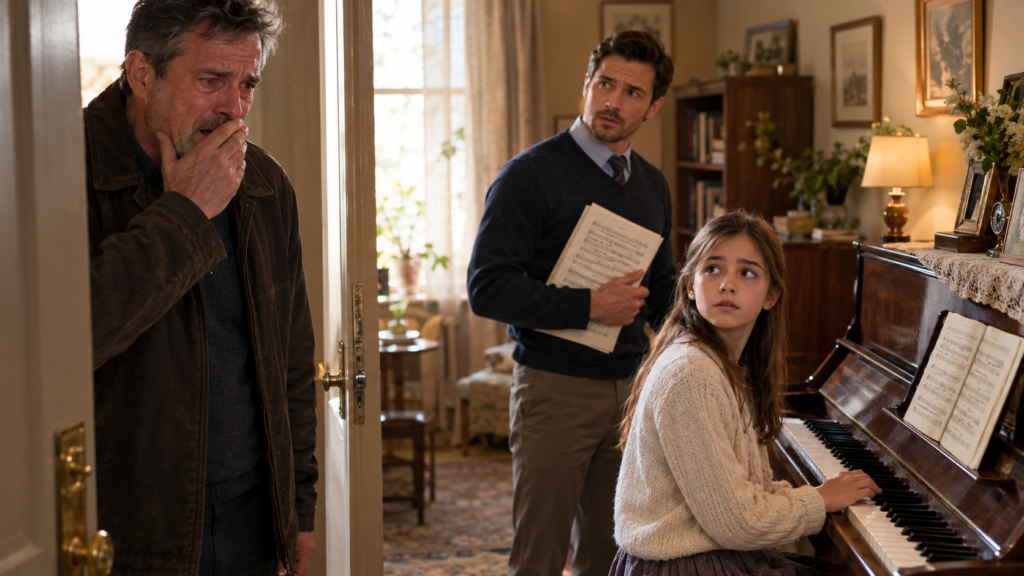
For a few seconds, nobody moved.
The man stood in the doorway with a sheaf of sheet music tucked under one arm. He was probably in his early forties, with rolled-up sleeves and reading glasses balanced on top of his head. There was nothing threatening about him. He looked like someone who had been interrupted in the middle of an ordinary afternoon.
That somehow made it worse.
Behind him, Josie sat on a padded bench in front of a dark wooden upright piano. Her hair was longer than I remembered. She had grown out of the uneven bangs Carmen used to trim in our kitchen and into a style that framed her face. She wore a pale blue sweater and had one foot tucked beneath her on the bench.
Her hands hovered above the keys.
I had imagined this moment dozens of times during the drive.
In some versions, Josie ran into my arms. In others, she stood there with her arms crossed and demanded an explanation. I had prepared apologies, jokes, and even a speech about how people made mistakes and families could heal.
I had not prepared for the way she looked at me.
She wasn’t angry.
She was uncertain.
“Dad?” she asked again.
I swallowed. “Hey, peanut.”
The nickname slipped out automatically. I hadn’t called her that in two years, but I had used it since she was a toddler. It was the word I reached for when I didn’t know what else to say.
Josie glanced at the man in the doorway, then back at me.
“Why are you here?”
There was no accusation in her voice. That would have been easier. She sounded as if she were asking why a delivery driver had come to the wrong apartment.
“I wanted to see you.”
The man shifted his weight.
“I’m sorry,” he said quietly. “I didn’t realize you were coming.”
“You’re not the one who needs to apologize,” I replied, too quickly.
He studied me for a moment. Then he stepped aside, leaving the doorway open without inviting me in.
“My name is Daniel,” he said. “I’m Josie’s piano teacher.”
“Piano teacher?”
Josie lowered her hands into her lap.
“Yeah.”
I looked at the instrument. It was old but beautiful, with a few scratches along the side and a framed photograph resting on top. The photograph showed Josie standing beside the piano, grinning with a gap where one of her front teeth had been.
She must have been nine.
I remembered that smile. I remembered the little girl who used to run to the door when I came home from work, carrying drawings and school papers, desperate to tell me every detail of her day.
I also remembered the day she’d asked me for a piano.
She had been seven, maybe eight. She’d come home from school with a flyer about beginner lessons and laid it beside my dinner plate.
“Could we get one, Daddy? Just a little one?”
I had told her pianos were expensive.
She’d said she’d practice every day.
I had told her that was what every kid said.
She had promised she was different.
I’d laughed, kissed the top of her head, and gone back to my phone.
Now she was sitting at a piano I had never bought her, playing music I had never heard.
“How long have you been taking lessons?” I asked.
Josie glanced at Daniel before answering.
“Almost two years.”
Almost two years.
The exact amount of time I’d been gone.
I wanted to ask who had paid for it, who had encouraged her, who had sat through her first recital. I wanted to ask why nobody had told me.
Then I remembered that nobody had stopped me from leaving.
Carmen had asked only one thing when I packed my suitcase.
Would I at least call Josie on her birthday?
I’d promised I would.
I missed the first birthday because I was “in the middle of something.”
I missed the second because by then, calling felt too awkward. I told myself I’d explain everything when I was ready. I told myself Josie was young and would understand one day.
She was eleven now.
And I was standing outside her apartment, wondering whether I still had the right to call myself her father.
“Is your mom home?” I asked.
“She’s at work,” Josie replied.
“Could I come in for a minute?”
She looked at Daniel again.
He immediately lowered the sheet music.
“It’s your home, Josie. You decide.”
That sentence told me more about the man than a dozen introductions could have.
He hadn’t answered for her. He hadn’t tried to protect her from me by making the decision himself. He had simply reminded her that she had a choice.
I had spent years making choices for my family and calling it responsibility.
Now a stranger was teaching my daughter that she could make her own.
Josie slid off the piano bench.
“You can come in,” she said. “But I have a lesson in twenty minutes.”
“Of course.”
I stepped over the threshold.
The apartment smelled faintly of cinnamon and furniture polish. A pair of small sneakers sat beside the door. A school backpack rested beneath a coat hook. On the wall was a calendar covered in colorful handwriting.
There were piano lessons, school events, dentist appointments, and something labeled **JOSIE’S SPRING RECITAL**.
I stared at the calendar longer than I should have.
Carmen used to keep a calendar like that in our old kitchen. She’d mark every important date in red and remind me about each one until I finally acknowledged it.
I used to joke that she was my personal assistant.
I hadn’t understood that she was the person keeping our lives from falling apart.
“Do you want some water?” Josie asked.
“No, thank you.”
“Okay.”
She walked back to the piano and sat down again.
I remained standing.
There was no easy place for me in that room. The couch was occupied by a stack of library books. The armchair held a folded blanket. Every surface seemed to belong to a life that had continued without me.
Finally, I pointed toward the piano.
“Can you play something for me?”
Josie looked at the keys.
“I was practicing that.”
“Then play that.”
She hesitated, then placed her fingers on the keyboard.
The melody began softly, a little hesitant at first. Then it opened into something gentle and complicated, with a rising phrase that made me think of sunlight moving across a room.
I didn’t recognize the piece.
I didn’t know whether she had learned it recently or had been practicing it for months. I didn’t know how difficult it was or how many mistakes she’d made before getting it right.
I only knew that the child who once begged me for a piano was now playing one beautifully in front of a man who had helped her learn.
And I had no idea how she had gotten there.
When she finished, I clapped.
It sounded ridiculous in the quiet apartment. Two sharp claps, then a third.
“That’s amazing,” I said.
“Thanks.”
“I’m proud of you.”
Josie looked at me for a long moment.
Then she asked the question I had been dreading.
“Why didn’t you call?”
I had an answer prepared. I’d rehearsed it on the drive. I was going to tell her that things had been complicated, that I had made mistakes, that I had missed her every day.
But the truth was much simpler.
I hadn’t called because I was ashamed.
I hadn’t called because I was afraid she would ask questions I couldn’t answer.
I hadn’t called because every day I waited made the next day harder, and I kept choosing the easier thing.
“I was wrong,” I said.
Josie lowered her eyes.
“That doesn’t tell me why.”
I looked at her, at the girl who had once believed every promise I made.
“No,” I admitted. “It doesn’t.”
For the first time since I’d arrived, she looked almost angry.
“Mom says people can be sorry and still not be ready to change.”
I felt those words like a hand closing around my throat.
“She’s right.”
Josie nodded, as if she’d expected me to argue.
Then she turned back to the piano.
“Daniel says I need to work on the left hand.”
The conversation was over.
I stood there another minute, listening to her practice the same four measures. When Daniel returned from the kitchen, he glanced at me with a quiet, sympathetic expression.
I hated him for that expression.
Not because he had done anything wrong, but because he was looking at me with the kind of understanding I had once expected from my wife.
“I should go,” I said.
Josie didn’t turn around.
“Okay.”
I walked to the door, my heart pounding with the desperate need to say something that would make the afternoon mean more than it did.
“Josie?”
She stopped playing.
“Can I take you for pizza sometime?”
She turned on the bench.
“Maybe.”
It wasn’t a yes.
But it wasn’t a no.
I held on to that single word all the way down the stairs.
Part 2: The Life I Thought I Wanted
Two years earlier, I had convinced myself that leaving Carmen and Josie was the bravest thing I’d ever done.
I was thirty-eight, exhausted, and resentful of a life that seemed to have been decided for me.
We had a mortgage, a daughter who needed rides to school and help with homework, and a calendar that dictated nearly every evening. My job in commercial sales had become a treadmill of meetings, client calls, and performance reviews. I was always tired. Always behind. Always hearing about something I had forgotten to do.
Carmen wasn’t cruel. That was part of the problem.
If she’d been cruel, I could have blamed her.
Instead, she was dependable. She paid the bills on time, remembered birthdays, packed Josie’s lunches, and made sure the refrigerator contained food I liked. She worked part-time as a bookkeeper and did most of the household planning because I claimed my job was too demanding.
When I complained about feeling trapped, she asked what I wanted to change.
I never had an answer.
Then I met Vanessa.
She worked in marketing at a company that shared two major clients with mine. We met at a conference where she laughed at my jokes, asked about my ambitions, and seemed genuinely impressed by the stories I told about my younger days.
With Vanessa, I became the version of myself I missed.
I was funny again. Adventurous. Spontaneous.
We went out after work. We talked about travel and music and the places we’d visit if we weren’t tied down. She didn’t ask me to pick up groceries or remind me about parent-teacher conferences.
She didn’t have a mortgage.
She didn’t have a child who needed help memorizing spelling words.
She didn’t know how often I had disappointed my wife.
At first, I told myself our friendship was harmless. Then I began deleting messages. Then I started inventing reasons to stay late at the office.
Eventually, Vanessa told me she had feelings for me.
I should have walked away.
Instead, I treated her confession as proof that my life had been waiting for me to make a different choice.
When I told Carmen, I expected tears. I expected accusations. I expected her to ask what Vanessa had that she didn’t.
Carmen stood at the kitchen counter with a dish towel in her hands.
“Are you leaving us?” she asked.
I looked at the floor.
“I think I need to find out who I am outside this marriage.”
She was quiet for so long that I finally looked up.
“And Josie?” she asked.
“I’ll always be her father.”
“That wasn’t what I asked.”
I felt cornered. I hated that she could make me feel guilty without raising her voice.
“I’ll see her. I’ll call. We’ll figure it out.”
Carmen nodded slowly.
“Will you at least call her on her birthday?”
The question should have stopped me.
Instead, I mistook her calmness for permission.
“Yes,” I said. “Of course.”
I packed two suitcases and left the next morning.
Josie was at school. I told myself that was better. I couldn’t bear the thought of seeing her face when I walked out.
That was the first selfish thing I called kindness.
There would be many more.
Vanessa’s apartment was bright and modern, with white walls and enormous windows. There were no toys on the floor, no permission slips on the counter, no laundry waiting in baskets.
For the first few weeks, I felt as though I had escaped a life that had slowly been suffocating me.
We ordered takeout at midnight. We slept late on Saturdays. We booked a weekend trip without checking a school calendar.
I told myself this was what being alive felt like.
When Carmen sent a message asking whether I could take Josie for an afternoon, I said work was busy.
When Josie sent a photograph of a drawing she’d made, I replied with a heart emoji.
When Carmen reminded me about the birthday promise, I wrote, **I haven’t forgotten. I’ll call her tonight.**
I didn’t.
I had planned to call after dinner. Then Vanessa suggested we go to a concert. By the time we got home, it was late. I told myself Josie would be asleep.
The next morning, I sent Carmen a message saying I was sorry.
She didn’t reply.
I was relieved.
I didn’t understand that her silence wasn’t an invitation to keep going.
It was the beginning of her learning to live without expecting anything from me.
Part 3: The Cost of Starting Over
Vanessa and I lasted eight months.
The end wasn’t dramatic. There was no slammed door or screaming match. It was a slow discovery that the person who had seemed to represent freedom was also a person with bills, frustrations, and expectations.
Vanessa wanted a partner who could travel at short notice. I wanted to keep my job.
She wanted to move to another city. I wanted to stay close enough to see Josie, even though I had barely made the effort to do so.
She wanted to know why I still checked Carmen’s social media. I told her it was because of our daughter.
She said I was still married in every way that mattered.
I told her that wasn’t fair.
She asked whether I’d been fair to Carmen.
I had no answer.
The relationship began to unravel around the same time my professional life did.
I had been chasing a regional sales manager position for years. It came with a significant raise and a bonus large enough to pay down my debts. I had convinced myself that getting it would prove I had made the right decision.
Instead, I started missing deadlines. I arrived late to meetings. I spent too much time trying to maintain a life that looked exciting from the outside.
My manager warned me twice.
The third time, I lost a major account after failing to follow up on a contract renewal.
I was demoted.
Three months later, the company eliminated my position.
I told Vanessa I would find something better.
I told myself the same thing.
But the job market was rough, and I had become accustomed to spending money as if my future earnings were guaranteed. I had a car payment, credit card balances, and rent that had seemed reasonable when I was making commissions.
I took a job in another sales office, then lost it after missing targets.
My savings disappeared.
Vanessa moved out while I was interviewing for a position I didn’t get. She said she couldn’t build a future with someone who was always waiting for his life to return to normal.
I accused her of abandoning me.
She stared at me with a weary expression.
“You left a family because you wanted a life without responsibilities,” she said. “Now you’re angry that I have expectations.”
I wanted to tell her she was wrong.
Instead, I watched her carry her last suitcase to the car.
A year after leaving Carmen, I was living alone in a rented apartment, making minimum payments on debts I could no longer manage.
I had missed Josie’s birthday again.
This time, I had a reason that sounded legitimate in my own head. I had been working temporary shifts and had planned to call after I got home. Then the phone rang with a collection notice, and I spent the evening arguing with a creditor.
By the time I looked at the clock, the day was over.
I could have called the next morning.
I didn’t.
I told myself that Josie was probably angry and that calling would only upset her. I told myself I would reach out when I had a stable job and a proper place for her to visit.
I kept waiting until I could offer her something impressive.
I never considered that what she had needed was simply me.
The bankruptcy came a few months later.
It was humiliating to sit in a small office and explain how a man with a decent education and years of work experience had managed to lose nearly everything.
The attorney asked whether I had dependents.
I said I had a daughter who lived with her mother.
He asked how often I saw her.
I looked at my hands.
“Not often enough.”
He didn’t comment.
After the bankruptcy, I moved into my sister Melissa’s basement.
Melissa had two teenagers, a noisy washing machine, and a dog that barked whenever I walked through the kitchen. She gave me a small room with a narrow bed, a dresser, and a window that looked out at the concrete steps leading to the backyard.
She never made me feel unwelcome.
That somehow made my shame worse.
One evening, I came upstairs and found her sorting old photographs at the dining table. She was making an album for our mother’s seventieth birthday.
A picture of Josie sat near her elbow.
It was from the summer before I left. Josie was wearing a yellow sundress and holding up a paper crown she’d made at camp.
I picked it up.
“Where did you get this?”
“Carmen sent it to Mom a while back.”
I stared at the photograph.
“She’s grown.”
“Of course she’s grown,” Melissa said.
I put it down.
“Does Carmen ever ask about me?”
Melissa continued sorting photographs.
“Sometimes.”
“What does she say?”
“She asks whether you’re working. Whether you’re okay.”
I felt a strange rush of relief.
“Really?”
Melissa finally looked at me.
“She doesn’t ask because she wants you back. She asks because she doesn’t want Josie to have to wonder whether you’re alive.”
The words landed hard.
I sat down across from her.
“Do you think Josie hates me?”
“I don’t know.”
“You’re supposed to say no.”
“Why?”
“Because she’s my daughter.”
Melissa set the photographs aside.
“She’s your daughter whether she hates you or not. That doesn’t mean you get to decide what she feels.”
I rubbed my face.
“I made mistakes.”
“Yes.”
“I know I did.”
“Do you?”
I looked up sharply.
Melissa didn’t flinch.
“You keep calling it a mistake, like you took a wrong turn and ended up somewhere you didn’t mean to go. You made a decision. Then you made another one every time you didn’t call her.”
I wanted to be angry with her.
Instead, I stared at the photograph until the edges blurred.
For the first time, I understood that losing my money and my relationship hadn’t been the real consequence of leaving.
Those were just the things that happened to me.
The real consequence had been happening to Josie, whether I was there to witness it or not.
Part 4: The Apartment I Didn’t Recognize
I found Carmen’s new address through an old message thread.
I had been scrolling through our conversations, looking for a photograph of Josie, when I noticed that the last address she’d sent me belonged to our old house.
I knew she’d moved. My mother had mentioned it in passing months earlier, saying Carmen had found a smaller apartment closer to Josie’s school.
I had never asked where.
Now I typed a message.
**I’d like to see Josie. Would that be okay?**
I watched the screen for nearly an hour.
No reply came.
I told myself that was fair. I had no right to demand an answer after two years of silence.
Then, in the evening, Carmen responded.
**You can come by Saturday at two. Josie knows you’re coming. Please don’t promise her anything you aren’t certain you can do.**
I read the message several times.
There was no warmth in it. No anger, either.
Just a boundary.
I agreed.
On Saturday, I bought a small box of chocolates from a supermarket. I stood in the aisle for nearly ten minutes, wondering whether Josie still liked the caramel ones.
I couldn’t remember.
I put the chocolates back and bought a card instead. Inside, I wrote that I was proud of her, that I hoped she was happy, and that I was sorry for the time we’d lost.
I crossed out the last sentence.
We hadn’t simply lost time. I had given it away.
I drove to the address Carmen had sent.
The apartment building was smaller than I expected, with a narrow stairwell and a row of bicycles chained near the entrance. I checked the number twice before knocking.
Daniel opened the door.
That was the beginning of the moment I couldn’t stop replaying.
He wasn’t a new boyfriend standing in my place. He wasn’t some man who had swept in and stolen the family I’d abandoned.
He was a piano teacher holding sheet music, with a lesson scheduled and a student waiting behind him.
When he realized who I was, his expression changed.
Not with hostility.
With concern.
He knew enough about me to understand that my arrival could hurt the girl in the next room.
That was the first time I considered that someone might know my daughter’s fears better than I did.
After Josie played, I left without making plans.
On the drive back to Melissa’s, I replayed her question.
Why didn’t you call?
I had spent two years imagining the explanation I would give her. I had thought I could tell the story in a way that would make me understandable, maybe even forgivable.
But a child didn’t need a beautifully arranged explanation.
She needed a father who showed up.
That evening, I wrote Carmen a message.
**Thank you for letting me come. I know I haven’t earned your trust. I would like to see Josie again if she’s willing. I won’t pressure her.**
Carmen replied the next morning.
**Ask Josie what she wants. Don’t ask me to convince her.**
I sat with that for a long time.
Then I sent Josie a message.
**Hi, peanut. I had a really nice time hearing you play. If you’d like to get pizza sometime, I’d love that. It’s okay if you don’t want to.**
I didn’t add a heart emoji.
I didn’t say I missed her, because I didn’t want those words to become another demand for reassurance.
I waited.
Two days passed.
Then three.
On the fourth day, a message appeared.
**Can we go Saturday? Mom says I can decide.**
I stared at the screen.
**Absolutely. What time works for you?**
Her reply came a minute later.
**After my lesson. Daniel says it ends at 12:30.**
I typed, **I’ll be there at 12:30.**
Then I checked my calendar and set three reminders.
One for Friday evening.
One for Saturday morning.
One for fifteen minutes before I needed to leave.
It was a small thing.
It was also the first promise I’d made to Josie in two years that I had a concrete plan to keep.
Part 5: Pizza and Questions
I arrived at the apartment at 12:20.
Daniel answered the door and called for Josie. She appeared wearing jeans, sneakers, and the same pale blue sweater I’d seen the week before.
“You’re early,” she said.
“I didn’t want to be late.”
She studied me.
“Okay.”
We walked to a pizza place three blocks away. The weather was cool, and Josie kept her hands in her pockets. I tried to think of things to ask her, but every question sounded like an interview.
How was school?
Fine.
What were you learning on the piano?
Songs.
Did you have friends?
Yes.
The conversation limped along until the waiter brought our drinks.
Then Josie looked at me and asked, “Are you still with Vanessa?”
“No.”
“Why?”
I considered giving her the simple answer. We wanted different things. It didn’t work out.
But she’d already lived through my simple answers.
“She and I weren’t good for each other,” I said. “And I made choices that hurt people who hadn’t done anything wrong.”
“Like Mom?”
“Yes.”
“And me?”
I looked down at the table.
“Yes. You, too.”
She traced a circle on the condensation beneath her glass.
“Was she more important than us?”
There it was.
The question I’d feared since the day I left.
I could have told her that relationships were complicated. I could have said I had been unhappy, that I had felt lost, that I believed leaving would make me a better person.
All of those things might have explained my state of mind.
None of them would have answered her question.
“At the time, I acted like she was,” I said. “I told myself I was looking for happiness, but I didn’t think enough about what I was doing to you. I was selfish, Josie. You didn’t deserve that.”
She looked at me for a long time.
“Mom said it wasn’t my fault.”
“It wasn’t.”
“I thought maybe I was annoying you.”
My stomach tightened.
“What?”
“Sometimes I’d ask you to watch me do something, and you’d say you were busy. Or I’d talk about school and you’d look at your phone. I thought maybe you didn’t like being around me anymore.”
I reached for my glass, then put my hand back on the table.
“I’m so sorry.”
She shrugged, but it wasn’t a casual shrug. It was the movement of a child trying to make a painful thing seem small enough to carry.
“I don’t think about it all the time now.”
The fact that she had needed to learn not to think about her father abandoning her was almost more than I could bear.
“I wish I could go back,” I said.
“Can you?”
“No.”
“Then what are you going to do?”
I took a breath.
“I’m going to try to be here now. I know I can’t make up for everything. I know you might not trust me. I’m not going to ask you to pretend none of it happened.”
She picked at the edge of her napkin.
“Mom says trust is like a piano. You can’t just say you know how to play. You have to practice.”
I almost laughed, but I saw she was serious.
“Your mom’s right.”
“Daniel says the same thing.”
“Daniel sounds like a smart man.”
“He is.”
There was no triumph in her voice. She wasn’t trying to hurt me by praising another adult. She was simply telling the truth about someone who had become important in her life.
I ordered a small pizza and let her choose the toppings. She picked mushrooms and extra cheese.
I remembered that she used to hate mushrooms.
“Since when do you like those?”
“Since last year.”
I nodded.
It was a tiny detail, but it made the distance between us feel enormous. I had missed entire seasons of her life. I had missed the small changes that make a child familiar.
After lunch, we walked back toward the apartment.
At the corner, she stopped in front of a music shop window. A row of keyboards stood on display beneath bright lights.
“Do you think I’ll ever get really good?” she asked.
“At piano?”
She nodded.
“You already sound good to me.”
“Daniel says I need to keep practicing. He says I’m better when I listen instead of trying to play fast.”
“That sounds right.”
She glanced at me.
“Did you know I wanted a piano when I was little?”
I felt the question in my chest.
“Yes.”
“You said they were too expensive.”
“I did.”
“Mom said you weren’t wrong about the money. She said you were wrong about thinking it was a waste.”
I looked through the glass at the keyboards.
“I was wrong about that, too.”
Josie didn’t say anything.
I wanted to tell her I would buy her a piano now. I wanted to solve the memory by offering something tangible. A new instrument, a stack of lessons, a recital outfit. Something that could make me look like a father who had finally understood.
But I had learned enough to know that a purchase couldn’t repair what I had broken.
“Would you like me to come to your next recital?” I asked.
She considered it.
“It’s in six weeks.”
“I’d like to come.”
“It’s on a Thursday.”
“I can make that work.”
She tilted her head.
“Are you sure?”
The question was quiet, almost apologetic.
“Yes,” I said. “And if something changes, I’ll tell you before the day. But I’m planning to be there.”
She nodded.
“Okay.”
That was all she gave me.
It was enough to make me go home and put the date in my calendar.
Part 6: The Recital
The next six weeks were the hardest kind of waiting.
I wanted to message Josie every day. I wanted to ask about school, hear about her lessons, know what she’d eaten for lunch. I wanted to recover the ordinary conversations I’d abandoned.
But I had no idea how much contact she wanted.
So I followed her lead.
Sometimes she sent me a photograph of a worksheet. Sometimes she asked whether I’d heard a particular song. Once, she sent me a voice message that was only seven seconds long.
It was a recording of her practicing a passage on the piano.
I listened to it twelve times.
Then I replied, **I love hearing you play. Thank you for sending that to me.**
She sent a thumbs-up.
I took it as a gift.
I also started making changes that had nothing to do with whether Josie would notice.
I found steady work at a small supply company. The salary was lower than what I’d once earned, but the hours were predictable. I made a budget and followed it. I stopped buying things to impress people who weren’t paying attention.
I began seeing a counselor through a community program. At first, I thought the sessions would help me explain why I’d left. Instead, they forced me to examine the way I had treated discomfort as proof that I deserved to escape.
When family life felt repetitive, I called it suffocating.
When Carmen asked for help, I called it nagging.
When Josie wanted my attention, I called it one more demand.
I had confused being needed with being trapped.
I wasn’t a victim of my family. I had been a participant in building that family, and I had walked away when it stopped making me feel special.
The counselor asked me what I wanted from Josie.
I said I wanted her to forgive me.
“That’s about what you want,” she replied. “What do you think she needs?”
I sat with that question.
“Consistency,” I finally said. “Someone who shows up.”
“Then start there.”
The recital was held in a small community music room with folding chairs and a low stage. I arrived twenty-five minutes early and took a seat near the back.
I didn’t want Josie to feel watched.
Carmen arrived with her a few minutes later. She looked different from the woman I’d left, though I couldn’t have explained exactly how. Her hair was shorter, and she wore a green blouse I’d never seen before. She looked rested.
Not carefree. Not untouched by what had happened.
Just steadier.
She noticed me and gave a small nod.
I returned it.
We didn’t sit together.
Josie performed fourth.
When her name was called, she walked to the piano and adjusted the bench. She looked toward the audience once, found Carmen, and smiled.
Then her eyes moved farther back.
She saw me.
For a moment, her hands paused above the keys.
I wanted to stand up and wave. I wanted to tell her I was proud before she played a single note.
Instead, I stayed still and nodded.
She turned back to the piano.
The piece began with a delicate melody, followed by a series of quick passages that made her hands seem to float across the keyboard. I couldn’t tell whether she made mistakes. I only knew that she looked comfortable, that she had found a rhythm that belonged to her.
When she finished, the room filled with applause.
I clapped until my palms stung.
Josie bowed.
After the recital, parents gathered around their children with flowers and cameras. I stayed near the doorway, unsure whether I should approach.
Carmen came over first.
“Thank you for coming,” she said.
“I wouldn’t have missed it.”
She studied me.
“You did miss it,” she said. “You missed the first one. And the second.”
“I know.”
“I’m not saying that to punish you.”
“I know.”
“I’m saying it because you sometimes talk as if the last two years happened to you. They happened to Josie, too.”
I nodded.
“I understand that better now.”
“Good.”
She looked past me, toward Josie, who was talking to Daniel and another student.
“She’s worked hard.”
“She has.”
“Daniel has been wonderful with her.”
“I can see that.”
Carmen folded her arms.
“I want you to understand something. Daniel isn’t her father. He’s her teacher. He’s a kind adult who has been there when she needed one. You don’t need to compete with him.”
“I wasn’t going to.”
“Maybe not consciously. But you might feel it anyway. You might see how comfortable she is with him and start trying to prove you’re better. Don’t do that.”
I looked at the man across the room, helping a younger student gather her music.
“I don’t want to take anything away from her,” I said.
“Then don’t.”
Josie came over carrying a small bouquet of yellow flowers.
“Did you hear me?” she asked.
“I heard every note.”
“Even the fast part?”
“Especially the fast part.”
She smiled a little.
“Daniel said I rushed the ending.”
“I didn’t notice.”
“You weren’t supposed to notice. You’re not the teacher.”
For the first time, I laughed with her rather than at something she’d said.
She looked pleased with herself.
Then she held out one of the yellow flowers.
“This one’s for you.”
I took it carefully.
“Thank you.”
“Mom bought them.”
“Then thank your mom for me.”
Josie glanced at Carmen.
“You can thank her yourself.”
There was a small challenge in that sentence, a reminder that she wasn’t going to manage the adults’ feelings for us.
I nodded.
“I will.”
We walked outside together. Carmen stayed behind to help Daniel pack the music stands.
At the entrance, Josie turned toward me.
“Are you going to come to the next one?”
“If you want me to.”
She thought about it.
“I think so.”
“Then I will.”
She gave me a quick hug.
It lasted perhaps two seconds.
Then she stepped back and hurried toward her mother.
I stood on the sidewalk with a yellow flower in my hand, feeling the strange weight of something I had once taken for granted.
A child had chosen to hug me.
I understood that I had no right to assume she would choose it again.
Part 7: The Conversation with Carmen
A week after the recital, Carmen asked if we could meet for coffee.
I arrived early and ordered two drinks, though I had no idea what she liked anymore. I chose a plain latte for myself and a tea for her, hoping I remembered correctly.
She arrived, saw the cups, and smiled faintly.
“I still drink coffee.”
“I wasn’t sure.”
“That seems to be a recurring theme.”
I winced.
“Fair enough.”
She sat across from me and wrapped both hands around the cup.
For a while, we talked about ordinary things. Josie’s school project. The weather. My new job. Carmen’s work.
Then she set her cup down.
“Why now?”
I knew what she meant.
“Why did I come back?”
She nodded.
I considered giving her the answer that sounded best. Because I’d realized what mattered. Because I missed my daughter. Because I wanted to repair the damage.
All of those things were true.
They weren’t the whole truth.
“At first, I think I came because my life fell apart,” I said. “I was lonely, embarrassed, and living in my sister’s basement. I wanted something familiar. I thought seeing Josie might make me feel less like a failure.”
Carmen watched me without interrupting.
“Then I saw her at the piano,” I continued. “And I realized she had been living a whole life while I was busy feeling sorry for myself. She’d learned things. She’d grown. She’d found people who encouraged her. And she hadn’t needed me to do any of it.”
“She needed you,” Carmen said. “But she learned how to keep going without you.”
I nodded.
“I know.”
“Do you want to come back because you’re sorry you left me?”
I looked at her.
The question was more complicated than I wanted it to be.
“I am sorry I hurt you,” I said. “But I don’t want to pretend we can go back to what we had. I don’t even know if that would be right for either of us.”
“Good.”
I blinked.
“Good?”
“I don’t want the man who left me to come back because he’s out of options. I don’t want to be your safe place after someone else didn’t work out.”
“You’re not.”
“Then don’t make me responsible for helping you feel like a good person again.”
I leaned back.
The words stung because they were true.
“I won’t.”
Carmen looked down at her hands.
“I loved you for a long time after you left,” she said. “Longer than I wanted to. I kept thinking there would be a phone call, an apology, something that would make it all make sense. Every time Josie asked whether you were coming, I had to decide how much truth to give her.”
My throat tightened.
“What did you tell her?”
“That you loved her. That you had made choices that hurt us. That she wasn’t responsible for fixing them.”
“Did you ever tell her I might come back?”
“No.”
I nodded.
“I wouldn’t want you to.”
She looked surprised.
“Why?”
“Because I don’t know what I’ll be able to offer. I don’t want her waiting for something I might not do.”
For the first time, Carmen seemed to look at me without the old disappointment.
Not trust.
Recognition, perhaps.
“That is the first time you’ve talked about this without asking me to reassure you,” she said.
I looked at the table.
“I’ve been learning how often I did that.”
“You wanted me to tell you that you were a good man, even when your actions made me feel like I was raising a child instead of sharing a life with a husband.”
I didn’t argue.
“You wanted me to forgive you before you had really understood what you were asking forgiveness for,” she continued. “And when I was tired or angry, you treated that as evidence that I didn’t appreciate you.”
“I did.”
“I know.”
Her voice softened, but she didn’t reach for my hand.
“I don’t hate you. I don’t spend my days wishing bad things would happen to you. I want you to do well, because Josie deserves a father who is doing well. But I have a life now. I’m not waiting for you to decide whether you want to be part of it.”
“I understand.”
“I’m not sure you do yet.”
“Then I’ll keep trying to.”
She took a sip of tea.
“Josie likes seeing you. She’s also afraid you’ll disappear again. She may test you. She may be distant for weeks. She may get angry about something that seems small. You cannot make her responsible for your guilt.”
“I won’t.”
“And if you miss a visit, you need to tell her the truth. Don’t invent a work emergency. Don’t send a gift instead of showing up. Don’t make me explain it for you.”
“I understand.”
Carmen looked at me for a long moment.
“Then perhaps there’s a way forward.”
It wasn’t a promise.
It was a possibility.
For the first time, I understood the difference.
Part 8: The Day I Almost Failed Again
Three months into rebuilding my relationship with Josie, I nearly ruined it.
My manager scheduled a last-minute inventory meeting on the same Saturday I had promised to take her to a small music museum. The meeting mattered. My company was short-staffed, and I was still on probation.
I stared at the email, trying to calculate whether I could do both.
If I attended the meeting, I would arrive at the museum late. If I skipped the meeting, I might jeopardize my job.
The old version of me would have chosen the meeting, sent Josie a vague apology, and told myself that work was a responsible reason to disappoint a child.
I sat at my desk for ten minutes, feeling the familiar panic rise.
Then I called my manager.
I explained that I had a family commitment scheduled before the meeting had been arranged. I asked whether I could complete the inventory report beforehand and join by phone for the final twenty minutes.
He wasn’t pleased.
He reminded me that the job required flexibility.
I told him I understood, and I offered a plan that would get the work done.
He finally agreed.
I arrived at the museum five minutes early.
Josie was waiting near the entrance with Carmen. She had a small backpack and a folded brochure in her hand.
When she saw me, she looked at the clock on her phone.
“You’re early.”
“I am.”
“Did you have work?”
“Yes. I had a meeting, but I arranged it so I could still come.”
She studied my face.
“Did you get in trouble?”
“Not exactly. My manager wasn’t thrilled, but we worked it out.”
Josie seemed to think about that.
“You could have canceled.”
“I could have.”
“Why didn’t you?”
I looked at her.
“Because I said I would be here.”
She didn’t smile immediately. I could see her measuring the answer against every time I had said something similar before.
Then she nodded.
“Okay. Let’s go.”
Inside, we listened to recordings of old pianos and learned how the instruments had changed over time. Josie asked the guide questions I couldn’t have answered. She pointed out differences in the sound and explained how her teacher had shown her to listen for the way a melody carried.
At one display, she stopped in front of a small upright piano with chipped ivory keys.
“This is the kind I wanted when I was little,” she said.
I stood beside her.
“I remember.”
She looked at me.
“I used to think if I got good enough, you’d buy me one.”
The room seemed to go quiet around us.
“I wish you hadn’t had to think that,” I said.
“I know now that it wasn’t about how good I was.”
“No. It wasn’t.”
She looked back at the piano.
“Mom found this one for me. Daniel helped fix it up. It was donated to the music program, and they let me use it for practice.”
I nodded.
“That was kind of them.”
“Mom saved for the bench. She said it was important for me to sit properly.”
I imagined Carmen measuring the bench, setting money aside, and helping Josie settle in front of an instrument she had once asked me for.
I had dismissed the dream because it didn’t fit conveniently into my budget.
Carmen had found a way to make it possible.
“Your mom has always been good at finding a way,” I said.
Josie turned toward me.
“You used to say that like it was a bad thing.”
I remembered.
I used to complain that Carmen worried too much, planned too much, and made everything complicated. I had mistaken her care for control because I didn’t want to admit how much work she was doing.
“I was wrong about a lot of things,” I said.
Josie looked at me, then slipped her hand into mine.
It was the first time she’d held my hand in public since I’d returned.
We walked through the rest of the exhibit that way.
I didn’t tell her how much it meant.
I didn’t want her to feel she had to keep doing it to make me happy.
I simply held her hand and tried to be worthy of the moment.
Part 9: The Question I Didn’t Deserve to Ask
By the time Josie’s next recital approached, our relationship had settled into a cautious rhythm.
I picked her up for pizza every other Saturday. Sometimes we went to the library or a park. Once, we spent an afternoon building a model airplane that ended up with one wing attached backward.
She laughed so hard at my attempt to fix it that she had to sit down.
I began to recognize the person she was becoming.
She was observant, stubborn, and funny in a dry way that reminded me of Carmen. She liked science fiction and hated being rushed. She could be affectionate one moment and intensely private the next.
I learned not to interpret every quiet day as rejection.
I also learned that showing up didn’t guarantee a reward.
Sometimes Josie barely spoke during our visits. Sometimes she wanted to go home early. Sometimes she asked questions about the past that I couldn’t answer without admitting how selfish I had been.
I tried to answer honestly.
One afternoon, while we were sitting in my car outside her apartment, she asked, “Do you think you’ll ever get married again?”
I looked at her.
“I don’t know.”
“Would you have another kid?”
The question surprised me.
“I don’t think that’s something I’m planning.”
“Would you leave them, too?”
I gripped the steering wheel.
“No.”
“How do you know?”
I wanted to tell her I was different now. That I had learned from my mistakes. That I understood what mattered.
But she had heard promises before.
“I can’t prove that to you with words,” I said. “I can only show you how I live.”
She looked out the window.
“Okay.”
A few minutes passed.
Then she asked, “Did you love me when you left?”
The question seemed to come from nowhere, but I knew it had been waiting a long time.
“Yes,” I said.
She turned back to me.
“Then why did you leave?”
I felt the old urge to explain myself. I wanted to tell her about the marriage that had grown stale, the pressure at work, the way Vanessa made me feel young again. I wanted to explain that I hadn’t planned to hurt her.
Then I realized that the details would only ask Josie to carry the burden of understanding my choices.
“I loved you,” I said. “And I still made a selfish decision. Loving you didn’t automatically make me act like a good father. I thought I could leave one part of my life behind and still keep the parts I wanted. I was wrong.”
She studied me.
“Did you think about me?”
“Not enough.”
“Did you miss me?”
“Every day.”
“Then why didn’t you call?”
I looked down.
“Because I was ashamed, and because I kept choosing what was easiest for me. I told myself I would call when I had a better explanation. But I didn’t need a better explanation. I needed to pick up the phone.”
Josie was quiet for a long time.
Then she said, “Sometimes I still don’t believe you when you say you’ll come.”
“I understand.”
“I want to believe you.”
“I know.”
She folded her hands in her lap.
“I’m not ready to say everything is okay.”
“You don’t have to.”
“And I’m not going to pretend I wasn’t hurt.”
“I wouldn’t ask you to.”
She nodded slowly.
Then she opened the car door.
“Thanks for telling me the truth.”
I watched her walk up the steps to her apartment.
I wanted to call after her, to tell her I loved her, to ask whether she would ever forgive me.
Instead, I stayed where I was.
For once, I understood that the conversation had been for her, not for me.
Part 10: The Piano I Never Bought Her
Josie’s spring recital was held on a rainy Thursday evening.
I left work early, changed in the restroom, and drove across town with enough time to spare that I sat in the parking lot for fifteen minutes before going inside.
I had bought flowers, but I left them in the car. I didn’t want to turn the evening into a gesture about me.
When I entered the music room, Carmen was helping Josie arrange her sheet music.
Josie looked up.
“You came.”
“I said I would.”
She smiled.
It was small, but it was real.
I took a seat near the back. Carmen sat several rows ahead, beside a woman I recognized as one of Josie’s school friends’ mothers. Daniel stood near the stage, checking the piano bench and talking quietly with the students.
When Josie’s turn came, she walked to the piano without looking nervous.
She adjusted the bench, placed her music on the stand, and took a breath.
Then she began to play.
The piece was more complicated than the one I’d heard at her apartment. It moved between quiet passages and quick, bright runs. Her left hand carried a steady rhythm while her right hand moved across the keys with a confidence that made the music feel effortless.
I thought about the little girl who had brought a flyer to my dinner plate.
I thought about the promise I hadn’t made, the instrument I hadn’t bought, the birthday calls I hadn’t placed.
I thought about all the things I had missed because I believed my own unhappiness was an emergency that mattered more than anyone else’s life.
Josie reached the final passage.
For a moment, I could see the concentration on her face. Her shoulders relaxed. Her hands moved together, then separated for the final notes.
The last chord lingered in the room.
She lifted her hands from the keys.
The audience applauded.
I stood with everyone else.
Josie bowed, then looked toward the back.
When she found me, she smiled.
Not the uncertain smile she’d given me at the apartment door. Not the cautious smile of a child checking whether an adult meant what he said.
It was simply a smile.
I felt tears gathering in my eyes, and I let them.
Afterward, I waited outside the room while Josie talked with her teacher. Carmen came to stand beside me.
“She did beautifully,” I said.
“She did.”
“I can’t believe how much she’s improved.”
“She practices.”
I nodded.
For a moment, we stood quietly together.
Then Carmen said, “You know, she used to ask me whether you would have liked her playing.”
I closed my eyes.
“What did you tell her?”
“That I couldn’t answer for you. I told her she should play because she loved it, not because she was trying to earn anyone’s attention.”
I swallowed.
“She shouldn’t have had to wonder.”
“No,” Carmen said. “She shouldn’t.”
Josie came out carrying her music folder.
“Daniel says I rushed one section,” she announced.
“I thought it sounded wonderful,” I said.
“That’s because you’re my dad.”
The words came out naturally.
She seemed surprised by them herself.
For one brief second, I couldn’t breathe.
Then she continued, as if she hadn’t just handed me something I had no right to expect.
“He said I should practice it slower this week.”
“That sounds like a good plan.”
She looked between Carmen and me.
“Can we get pizza? All three of us?”
Carmen’s expression changed.
Not dramatically. She didn’t look at me with renewed love or suddenly forget the years I had abandoned her. She simply looked at Josie and smiled.
“If that’s what you want,” she said.
Josie nodded.
We went to the same pizza place where she’d first asked me why I hadn’t called.
Carmen sat across from me, and Josie took the seat beside her. We talked about the recital, the music program, and a science project Josie was planning with two classmates. At one point, she made a joke about the model airplane we’d built, and Carmen laughed so hard she nearly spilled her drink.
I listened to them talk.
I wasn’t the center of the evening. I wasn’t the person holding the family together. I wasn’t entitled to anything beyond the chair I had been invited to occupy.
And for the first time, that was enough.
When dinner was over, I walked them back to the apartment.
At the door, Josie turned to me.
“Are you coming next Saturday?”
“Yes.”
“Even if you have work?”
“I’ll plan around it. If something truly unavoidable happens, I’ll tell you as soon as I know.”
She nodded.
“Okay.”
Then she hugged me.
This time, I didn’t count the seconds.
I didn’t try to make the moment mean more than she intended.
I simply hugged her back.
As I walked down the stairs, I could hear the faint sound of the piano from inside the apartment. Josie had apparently decided to practice before bed. The melody drifted through the hallway, clear and confident.
I stopped for a moment and listened.
It was the same piano I had seen on my first visit, the one I had never bought her. It had become part of her life without me. It had held her frustrations, her concentration, her small victories, and the hours of practice that had turned a child’s wish into something beautiful.
I used to think fatherhood meant providing the things a child needed.
A house. Money. Opportunities. A future.
Those things matter. But I had confused providing with being present. I had believed that because I worked hard and paid bills, I was entitled to be appreciated without having to participate in the ordinary, repetitive work of loving people.
I had wanted a life without obligations.
I had discovered that a life without obligations could become a life without anyone waiting for you.
I didn’t know whether Carmen would ever forgive me completely. I didn’t know whether Josie would someday trust me without hesitation. I couldn’t go back and give her the birthdays I had missed or sit beside her at the recitals I’d never attended.
I couldn’t buy her childhood back.
But I could show up on Saturday.
I could answer when she called.
I could listen when she spoke, even when I was tired. I could keep the promises I made, and when I couldn’t, I could tell the truth instead of hiding behind an excuse.
I could learn to be her father in the life she actually had, not the life I wished I’d chosen.
The piano played on above me.
I stepped outside into the cool night air and walked toward my car.
For two years, I had thought my greatest loss was the family I had left behind.
Now I understood that the greater loss would have been continuing to treat the past as an excuse to abandon the future.
I had missed so much.
But my daughter had asked whether I would come next Saturday.
And this time, I intended to be there.
—