Part 1
I’m forty-four, and I have worked the front counter at the Fresno County Clerk’s office for eleven years, long enough to know the particular tiredness that comes from stamping other people’s paperwork for a living. Daniel died in November of 2020, three weeks before Thanksgiving, of a heart that gave out on a loading dock at forty-one years old, and since then it has been Maya and me, holding the house together with my salary and whatever grace God sees fit to extend to a county employee’s checking account.
Maya is thirteen now. She was ten when her father died, old enough to remember him clearly and young enough that grief rearranged something permanent in her, the way it does in children who learn too early that the ground can open. She got quiet after Daniel died. Not sullen, not difficult. Just quiet, the way a house gets quiet after you take down the extra chair at the table.
Last spring, in April, she came to me at the kitchen table with a flyer from the community bulletin board at the library. Sunrise Thrift & Mission, two bus rides across town, was looking for a Saturday sorter, ages thirteen and up with a guardian’s signature. “I want to save for a laptop,” she said. “For school. Everybody uses them for the group projects and I always have to borrow one, and it’s embarrassing, Mom.” She said the last part fast, like she was ashamed of the whole sentence.
I signed the form. I want to be honest about why. Part of it was pride, real pride, the kind that makes your chest ache a little, watching your kid want to earn something instead of just wanting it handed over. But part of it, and I’ve had to sit with this since, was relief. One less Saturday I had to figure out childcare or worry about her sitting alone in the apartment while I picked up extra hours at the clerk’s office filing land records. I told myself it was a good thing for both of us. I still believe that was true, even though everything I believed about it was wrong.
For seven months, Maya left the house at six in the morning, in the dark, with a granola bar and her backpack, and caught the 6:20 bus, transferred downtown, and came home after dark, usually around 7:30, sometimes later. She was quiet on those evenings in a different way than her usual quiet, a heavier kind, like a phone battery running low. I’d ask how it went and she’d say, “Fine. Tiring. Lots of donations today,” and go straight to her room.
Every few weeks I’d ask about the laptop fund. “Almost there,” she’d say, or, “Beverly says I might get a raise soon,” and I believed her the way you believe your child when you have no particular reason not to and every reason, in your exhausted life, to want the easier answer to be the true one.
But the laptop never came. In October, I noticed she’d stopped taking her lunch money, saying she “wasn’t that hungry at school anymore,” which I now understand was a lie a thirteen-year-old tells a mother who is too stretched to hear it properly. In November, I went to the hall closet for the salt when the first cold snap hit, and Maya’s blue winter coat, the good one, with the fleece lining, wasn’t on its hook. When I asked her about it, she said she’d left it at a friend’s house and would get it back. I let it go. I had land records to file and a heater that needed a part I couldn’t yet afford, and I let it go.
I want you to understand that I am not a careless mother. I want you to understand that too, and I understand exactly how it sounds.
Then, on a Wednesday afternoon in December, while I was on my lunch break eating a sandwich at my desk, my cell phone rang with a number I didn’t recognize.
“Mrs. Reyes? My name is Beverly Okonkwo. I manage Sunrise Thrift, over on Blackstone.” A pause. “I’ve been trying to reach you for two weeks. I think we need to talk about Maya.”
Part 2
I set my sandwich down very carefully, the way you set down something you’re afraid of dropping.
“Is she all right?” I asked. “Did something happen at the store?”
“Mrs. Reyes.” Beverly’s voice was gentle in a way that made my stomach drop before she said another word. “Maya hasn’t worked here since the second week of September. She never gave notice. She just stopped showing up on the schedule, and when I called the number on her application, it went to a disconnected line. I found this cell number through the school directory, because I got worried.”
I looked down at my desk, at the county seal stamped into the corner of every form I’d processed that morning, and for one dizzy second the whole room tilted a half inch to the left.
“That’s not possible,” I said. “She hands me a pay stub every Saturday. She handed me one three days ago. A hundred and eighty-six dollars.”
There was a silence on the line that told me Beverly believed me completely, and that the two of us were now standing on either side of a hole that had just opened in the ground.
“I don’t issue pay stubs,” she said carefully. “We’re a nonprofit thrift store, Mrs. Reyes. Our volunteers get a fifteen percent discount card and a certificate for their school volunteer hours. Nobody gets a pay stub. I’ve never issued one in nine years running this place.”
I don’t remember standing up. I remember being in the parking lot behind the county building with my coat half on, one arm still in the sleeve, dialing Maya’s number. It rang through to voicemail. I called again. Voicemail. I called a third time, a fourth, a fifth, a sixth, standing in the cold with my breath coming out in ragged clouds, and by the sixth call Beverly was still on the line with me, patient, staying because she could hear, I think, exactly how alone I suddenly was.
“Mrs. Reyes,” she said finally, “there’s something else I should tell you, and I’ve gone back and forth about whether it’s my place.”
“Please,” I said. “Anything.”
“I know your daughter’s bus route, because I watch for it. I like to know when the kids I used to have on my Saturday crew are getting off safe, even after they’ve moved on. Maya gets off at the Blackstone stop every Saturday morning, right on schedule, same as always. I’ve seen her.” Beverly paused. “But she doesn’t come in the store anymore. She walks right past the front window and keeps going, toward Vine. I’ve watched her do it maybe a dozen times since September. I assumed, at first, she’d taken a job somewhere else nearby. I didn’t think much of it until I realized she was still telling people, including apparently you, that she worked here.”
“Where does she go?” My voice didn’t sound like mine.
“I don’t know for certain. But my cashier, Denise, lives over that way, and she mentioned seeing a girl matching Maya’s description getting dropped at a house on Larkspur Street most Saturdays. An older woman’s place. Denise didn’t think anything of it, just mentioned it in passing.” Beverly hesitated. “I have the cross street, if you want it. Larkspur, near Fig, in the Tower District area.”
I was already walking to my car.
“Mrs. Reyes,” Beverly said, before I hung up, “for what it’s worth, and I don’t know your family’s situation, but the girl I used to watch through my front window never looked like she was up to anything bad. She looked like she was in an awful hurry to get somewhere important. That’s all I’ve got for you.”
Part 3
I have to explain what happened after Daniel died, because none of what I found on Larkspur Street will make sense otherwise.
Daniel’s mother, Teresa Reyes, was seventy-one when her son died, a proud, sharp-tongued woman who had raised four children mostly alone in a rented house on the east side of Fresno after Daniel’s father left in the eighties. She and I had never been close in the easy way some mothers and daughters-in-law manage. She loved Daniel with a fierce, unmodulated love that left, I sometimes felt, not quite enough room for the rest of us, and I had spent fourteen years of marriage learning to love her from a respectful distance, the way you love a stove that runs hot.
When Daniel died, something in Teresa broke that never properly set again. At the funeral, in the receiving line, she took my hands and said, in front of forty relatives, “If you had made him see a doctor sooner, he would still be here.” I know now that grief says cruel, senseless things through people who would never otherwise say them. I did not know it then. I was thirty-eight years old, six days a widow, standing in a black dress that still had the department store tag half torn off in the lining, and I heard my mother-in-law tell a room full of people that I had killed her son.
I did not speak to Teresa again for three years. I blocked her number after she called drunk on Christmas Eve and said something to Maya on the phone that Maya wouldn’t repeat to me, only cried about for an hour in her room afterward. I told myself, and I told Maya, that we were protecting ourselves. I believe I was right to do it, and I also believe, now, that I built a wall higher and wider than the one thing that actually needed keeping out.
I hadn’t known Teresa still lived on Larkspur Street. I hadn’t known much about her at all in three years, only fragments passed along by Daniel’s sister at holidays I mostly avoided: that Teresa’s hip had gotten bad, that she’d had a small stroke in 2022 that left her right hand weaker than it used to be, that money was tight since she’d stopped being able to clean houses for a living.
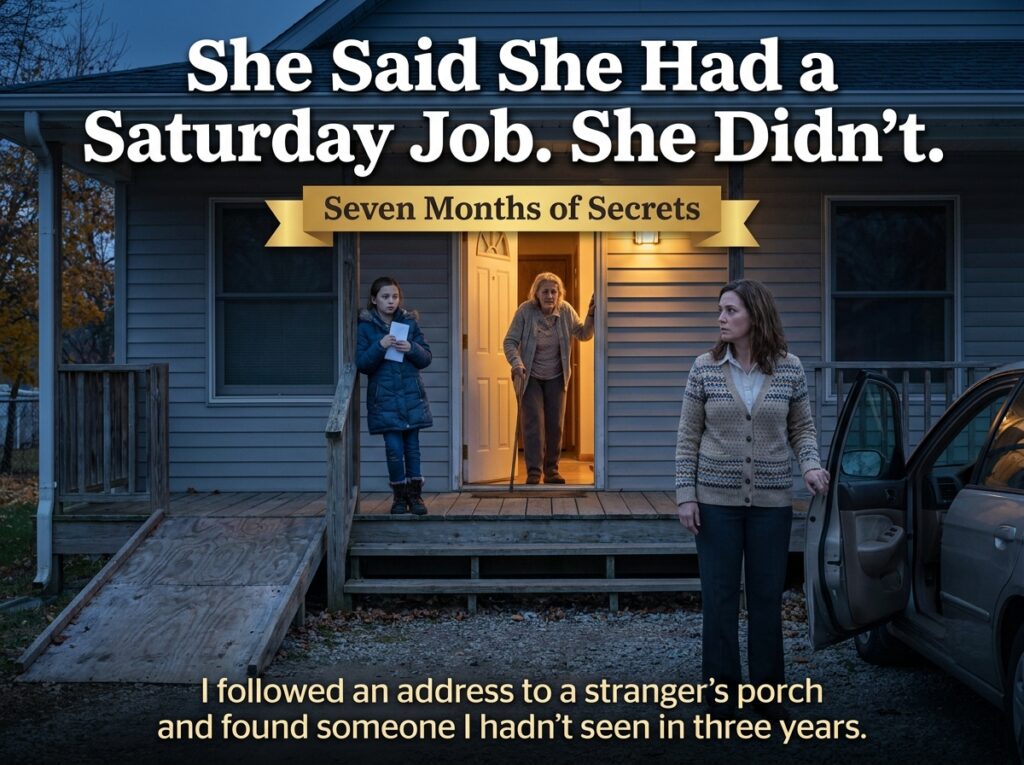
I parked crooked, two wheels up on the curb, in front of a small yellow house with a sagging porch and a wheelchair ramp built crudely out of plywood along one side. And there was Maya, standing at the top of the porch steps in her good blue coat, the one I thought was lost, holding a white envelope in both hands like it might blow away.
The door opened before I’d even gotten out of the car.
Teresa Reyes stood in the doorway. She had lost weight since I’d seen her last, and her hair, once dyed a deep, defiant black, had gone fully gray and was pulled back loosely from a face that looked older than seventy-four should look. She was leaning on a cane I’d never seen her need before. And she was looking past Maya, straight at me, standing frozen on the sidewalk with my car door still hanging open, and her face did something I hadn’t seen it do since Daniel’s wedding, twenty years earlier: it crumpled, all at once, like paper.
“Elena,” she said. My name, after three years of silence, sounded like an apology all by itself.
“Mom,” Maya said, turning around, and her voice broke in the middle of the word. “I can explain. Please don’t be mad at her. Please, this isn’t her fault, it’s all me, I made her let me come.”
Part 4
I walked up that cracked concrete path with my legs feeling like they belonged to someone else. Maya met me halfway, the envelope still clutched to her chest, and I saw, up close, how thin her face had gotten, how the winter coat I thought she’d lost hung a little looser on her than it should have.
“Start from the beginning,” I said. “Right now. All of it.”
Maya’s eyes filled. She looked back at Teresa, standing framed in the doorway with one hand braced against the frame, and something passed between them, a permission, maybe, or a shared decision made weeks ago that this moment would eventually come.
“Grandma Teresa called me in April,” Maya said. “Not you. Me. She got my number from Aunt Rosa, and she said she’d been trying to call your phone for months and it kept saying disconnected—”
“I blocked her,” I said quietly. “After Christmas.”
“I know. She told me that, eventually. She wasn’t trying to go around you to hurt you, Mom, she was just so sorry, and she didn’t know any other way to reach anybody in our family, and she was scared, because her hip surgery got canceled twice for insurance reasons and her hand doesn’t work right since the stroke and she couldn’t clean anymore, and Aunt Rosa has her own kids and can’t help much, and Grandma was…” Maya’s voice cracked. “She was going to lose the house, Mom. She was behind on everything. The electric got shut off in March for eleven days and she didn’t tell anybody, she just sat here in the dark and the cold because she didn’t want to be a burden on people who already thought she was a monster.”
I looked past my daughter to Teresa, who had not moved from the doorway, who was watching this unfold on her broken plywood ramp with an expression of such naked shame that I had never once, in fourteen years, seen cross her face.
“So I told her I’d help,” Maya said. “I told her I’d get a job. I made up the thrift store because I knew you’d never let me say I was going all the way across town to see Grandma, not after what she said to me on the phone that Christmas, not after everything. I figured if I said I was saving for a laptop, you’d say yes, and I could ride the same bus, and just… not go inside the thrift store. I’d walk past it to Larkspur instead.”
“The pay stubs,” I said. My voice sounded very far away to my own ears. “Maya, where did the pay stubs come from?”
She flinched. “I made them. On the library computer. I found a template online and I put in numbers that seemed believable, not too much, not too little, and I printed them at the library for ten cents a page and told you it was from work.” She was crying openly now. “I gave her almost all of it, Mom. Every Saturday. I did people’s yard work on the way, and I collected cans, and twice I sold some of my old books at the used bookstore, and I stopped buying lunch because I needed every dollar to matter, and I gave my coat to Grandma in October because her old one had a broken zipper and it was so cold in that house with the heat turned down to save money, and I told you I left it at a friend’s, and I am so sorry, I know I lied to you for seven months, I know that, but Mom, she’s your mother-in-law and she’s my grandma and she was sitting in the dark and I couldn’t just let that happen and do nothing.”
I stood on that cracked path with my daughter’s confession hanging in the cold December air, and for a long moment I could not make a single word come out of my mouth.
Part 5
“How much,” I finally managed, “were you giving her?”
Maya looked down at the envelope in her hands. “This is today’s. Forty dollars. I’ve been giving her between thirty and sixty most Saturdays, whatever I could scrape together after the bus fare.” She swallowed. “It’s not enough, Mom. I know it’s not enough. I did the math a hundred times. Even if I gave her everything, every single dollar, all year, it wasn’t going to be close to enough to fix her hip or catch up the house payment. I just… I didn’t know what else to do except keep trying.”
Teresa made a small, broken sound from the doorway, and I looked up at her properly for the first time since I’d stepped out of the car.
“Elena,” she said, and her hand, the weak one, trembled visibly against the doorframe. “I need you to know I did not ask that child for money. I want you to hear that clearly, before you decide what kind of woman I am. She showed up on my porch in April with forty dollars in an envelope and a look on her face like she’d rehearsed the speech the whole bus ride over, and I tried to send her home. I told her I didn’t want it, that I’d manage. She wouldn’t leave until I took it.” Her voice cracked wide open. “She has come back every single Saturday since, rain or shine, and half those Saturdays I have begged her to stop, and she just looks at me with your husband’s eyes and says, ‘Grandma, sit down, I’ll do the dishes,’ and I don’t have it in me to fight a thirteen-year-old who is more stubborn than her father ever was.”
I felt something give way in my chest, a wall I had built brick by careful brick for three years, not collapsing exactly, but shifting, the way a foundation shifts after a long-buried root finally finishes its slow work underneath it.
“You let her ride two buses alone across the city at six in the morning,” I said, and I heard my own voice shaking between fury and something else I wasn’t ready to name yet. “You let her lie to me for seven months. You let her skip lunch, give away her coat, forge pay stubs at the public library—”
“I didn’t know about the forging,” Teresa said quickly. “I swear to you, Elena, I didn’t know that part. I thought she had an actual job, same as she told you. I found out about the lie the same day you’re finding out, standing right here, because she is standing on this porch confessing it to both of us in the same breath.” She looked, suddenly, very old and very tired. “I have made a great many mistakes with your family. I said an unforgivable thing to you at my son’s funeral, and I have regretted it every day since, and I said something to Maya on the phone that Christmas that I will carry to my grave, something no grandmother should ever say to a grieving child, no matter how drunk or broken I was that night. I do not deserve what your daughter has been doing for me since April. I have told her that every single week. She keeps coming anyway.”
Maya stepped between us, small and fierce, the envelope still in her hands. “I’m not sorry I came,” she said, looking at me now, steady, older than thirteen in that moment in a way that hurt to see. “I’m sorry I lied to you, Mom. I hated lying to you. But I’m not sorry about her. She’s the only piece of Dad I have left besides you, and I couldn’t watch her sit in the dark and do nothing just because you two are still fighting about something that happened three years ago.”
Part 6
We didn’t stand on that porch much longer. It was thirty-four degrees, my daughter’s lips had gone a little blue, and whatever needed saying next was not going to happen on a broken plywood ramp with the neighbors’ porch lights coming on one by one down the street.
I asked Teresa if we could come inside. I watched her face do something complicated, hope and fear arriving at the same time, before she stepped back and held the door.
The house was worse than I’d let myself imagine on the walk up. The living room held a single space heater, unplugged, sitting cold in the corner. A stack of unopened envelopes sat on the kitchen counter, the kind with red lettering on the outside that everyone learns to recognize and dread. The refrigerator hummed with the particular labored sound of an appliance older than my marriage had been. On the counter, next to a chipped mug, sat a small stack of cash, rubber-banded, that I understood immediately was every dollar Maya had brought her since April, saved rather than spent, because Teresa had apparently been trying, in her own stubborn way, to give it back somehow, someday, when things got better.
“Sit down,” I told Teresa, and she did, carefully, favoring the hip that had been waiting eight months for a surgery date. Maya sat beside her, still in her coat, and I stood in the middle of that cold kitchen and made myself actually look at what three years of silence had allowed to happen.
“Tell me everything,” I said. “The house payment. The electric. The surgery. All of it. Don’t leave anything out to spare my feelings.”
It took forty minutes. Teresa’s pension from her years of cleaning houses had never been much, and after the stroke in 2022 left her right hand weakened, she’d had to stop taking clients entirely. Her Social Security covered the mortgage most months, barely, but not the property tax increase from last year, not the hip surgery’s out-of-pocket portion after insurance, not a water heater that had died in August and never been replaced, which meant she’d been heating water on the stove for cold showers since late summer. She hadn’t told her other children the full extent of it, she admitted, because Rosa had three kids of her own and a husband recovering from a layoff, and her son Michael lived in Sacramento and rarely called, and she had been too proud and too ashamed, after everything she’d said to me at the funeral, to ever imagine calling the one person in the family with a steady county paycheck and asking for help.
“So instead,” I said slowly, “you let a thirteen-year-old ride two buses across town alone at six in the morning to bring you forty dollars and do your dishes.”
“I told her not to,” Teresa said again, quietly, and this time I believed the shame in it completely. “I told her every week.”
I looked at Maya, who had gone very still, watching me with an expression braced for anger the way a kid braces for a slammed door. And I understood, sitting in that cold kitchen with the space heater unplugged in the corner and my mother-in-law’s weak hand trembling around a chipped mug, that the anger I’d been carrying toward this house, toward this woman, for three straight years, had cost my daughter something I could never fully get back: seven months of secrets, a missing coat, skipped lunches, a childhood spent managing two grown women’s unfinished grief instead of just being thirteen.
“I’m not angry at you,” I told Maya, and my voice broke on it. “I’m furious that you had to do this alone. That’s different. Do you understand the difference?”
She nodded, crying again, and I pulled her into my side the way I used to when she was small enough to carry.
Part 7
We didn’t fix it all that night. Some things don’t get fixed in a kitchen in one December evening, however much you might want them to.
But I called my supervisor from the car before we even left Larkspur Street and asked about the county’s emergency leave policy, because I already knew what the next two weeks were going to require. I called Rosa on the drive home, and we talked for forty minutes, both of us crying at different points, both of us admitting things we’d let slide for three years out of a mix of grief and pride and simple exhaustion. Rosa hadn’t known the full extent either. Nobody had, except Maya, who had been quietly carrying the entire weight of it since April, one forged pay stub at a time.
The first thing I did, the very next morning, was call the water heater company and put the replacement on my own credit card, the one I’d been keeping at zero balance out of sheer stubborn discipline since Daniel died. It felt like the smallest possible thing and also, somehow, like the first real thing I had done for Teresa Reyes in three years.
The second thing took longer and mattered more. I sat down with Teresa the following weekend, this time with Maya at school and Rosa on speakerphone, and we went through the stack of red-lettered envelopes together, one by one, the way you’d clean a wound before it can heal. The hip surgery, it turned out, wasn’t actually canceled for good, only pushed back twice due to a paperwork error in the insurance approval that took me, with my eleven years of experience navigating bureaucratic forms for a living, exactly one afternoon on the phone to untangle. The property tax situation qualified for a senior hardship deferral program Teresa hadn’t known existed, because nobody had ever told her, because the people whose job it was to tell her, people very much like me, had spent three years not speaking to her at all.
It wasn’t a fairy-tale fix. Money stayed tight. Rosa and I split what we could each month, modestly, sustainably, in a way that didn’t wreck either of our households, and it still wasn’t enough on its own, so I did something I’d resisted for years out of pride nearly as stubborn as Teresa’s own: I applied for, and got approved for, a county employee hardship assistance fund I’d processed applications for a dozen times over the years for other families and never once considered using myself.
Maya’s part in all of it changed too, but not in the way I expected. I didn’t forbid her from seeing her grandmother, though I’ll admit some ugly, frightened part of me wanted to, in that first raw hour on the porch. Instead, on the second Saturday after everything came out, I drove her to Larkspur Street myself, and I came inside, and I sat at that kitchen table with my daughter and my mother-in-law and a pot of coffee, and I stayed for three hours.
Teresa apologized to me that afternoon, fully, without excuses, for the funeral and for the Christmas Eve phone call, in a voice stripped of all its old defensiveness. I did not tell her it was all right, because it wasn’t, not entirely, not yet. But I told her I believed she meant it, and that I was tired of teaching my daughter that love only gets extended to people who’ve earned it back in full first.
“She earned it,” Teresa said, looking at Maya, who was elbow-deep in dish suds at the sink, humming something under her breath, safe and warm and thirteen years old in a house that finally had heat. “Every Saturday, in a coat two sizes too big, she earned it for both of us.”
Part 8
The forged pay stubs became, oddly, the smallest problem in the whole tangled mess, though I want to be honest that I didn’t let it go without consequences. Maya lost her phone privileges for a month, not for helping her grandmother, but specifically for the lying, the seven months of it, the careful construction of an alibi built to survive my questions. I told her that the two things, the kindness and the deception, had to be handled separately, because if I let one excuse the other, I’d be teaching her the wrong lesson entirely, and she needed both lessons, clearly and separately, to grow into the kind of person who could do hard, generous things honestly.
“You could have told me,” I said to her one night in January, both of us doing dishes together at our own sink, Teresa’s situation finally stabilized enough that the Saturday trips had become something closer to visits than rescue missions. “Even knowing how things were between me and Grandma. You could have told me the truth and let me be angry, instead of managing it all alone for seven months.”
“I know,” Maya said. “I was scared you’d say no. And then I’d already lied once, about the job, and it just kept getting bigger, and I didn’t know how to stop it without you finding out everything at once, which is exactly what happened anyway.” She dried a plate, considering. “I think I was more scared of you saying no than I was of getting caught, honestly. Because if you said no, that meant Grandma really was going to lose everything, and I couldn’t sit with that.”
I thought about that for a long time. I thought about all the ways grief makes people build walls that feel like protection and turn out, later, to be something closer to a trap, one that catches the people we love most on the wrong side of it without our ever quite meaning to leave them there.
Beverly Okonkwo, the thrift store manager, became an unlikely fixture in our lives after that December, not because Maya ever went back to work there, but because I drove to Sunrise Thrift the following Saturday, in person, to thank her properly. She waved off the thanks and instead told me something that stuck with me for months afterward.
“I’ve run that store nine years,” she said, ringing up a stranger’s donated coffee mugs while we talked. “You’d be amazed how many kids come through here, or walk past on their way to somewhere else, carrying weight that’s not supposed to be theirs to carry. Most of the time, nobody notices until it’s already broken something. I noticed because I happened to be looking out the right window on the right Saturday, that’s all. Anybody could have.”
“Nobody else did,” I told her.
“Then I’m glad I was paying attention,” she said, and handed the stranger his mugs in a paper bag, and that was that.
I think about that a lot now, how close the whole truth came to staying buried, how many Saturdays might have passed, how much colder Teresa’s house might have gotten, how much thinner Maya might have grown, if a thrift store manager hadn’t happened to glance out her front window at the right moment and care enough to make an uncomfortable phone call to a stranger.
Part 9
Spring came, the way it does, without waiting for anyone’s grief to finish sorting itself out. Teresa’s hip surgery finally happened in March, successful, and Maya and I sat in the surgical waiting room together, Maya gripping my hand so tightly my fingers went numb, until the surgeon came out and told us it had gone well.
“She asked for you both,” the surgeon said, a little puzzled by the arrangement, I think, a mother and daughter waiting together for a mother-in-law three years estranged. “First thing when she woke up in recovery. Said something about a coat.”
Maya laughed and cried at the same time. Teresa had apparently woken from anesthesia, groggy and confused, and the first coherent sentence she’d managed was to ask a nurse whether “the girl in the blue coat” had made it to the hospital yet.
She recovered well, slower than a woman half her age but steadily, and by May she was walking the length of Larkspur Street with her cane most mornings, waving to neighbors who had, I learned, quietly worried about her for longer than any of us in the family had known to.
I never did get Maya her laptop, not that spring, not with the extra money going toward Teresa’s mortgage and the hardship fund paperwork and a hundred smaller costs of simply keeping two households steady at once. I felt guilty about that for a while, until Maya told me, with the particular bluntness only a thirteen-year-old can manage, that she didn’t actually care about the laptop anymore and hadn’t, really, since sometime around June, when the lie had stopped being about a laptop at all and become about something else entirely.
She got the laptop eventually, in August, refurbished, three hundred dollars, paid for jointly by me and, over my initial objection and her insistence, by Teresa herself, who wired the exact amount from her first properly stabilized Social Security check in over a year and told me, when I tried to argue, that she had spent enough months taking from a child who had nothing to spare, and she would be damned if she didn’t get to give something back before she died.
“Let an old woman have this one,” she said. “I’ve earned it. So has she.”
I stopped arguing.
The thrift store coat, the blue one, came home for good that same August. Maya had left it at Teresa’s for the winter and part of spring, and when the weather finally turned warm enough that neither of them needed it, Teresa washed it herself, one-handed and stubborn about doing it without help, and folded it carefully into a paper bag with a note tucked into the pocket that Maya showed me later, written in Teresa’s looping, old-fashioned hand: *You gave me warmth all winter. Go be warm yourself now. I’ve got the heater fixed. Love, Grandma T.*
I keep that note in my nightstand drawer now, next to the small stack of forged pay stubs I found, eventually, folded in the back of Maya’s desk drawer, evidence of seven months of a lie I’ve come to think of less as a deception and more as a thirteen-year-old’s clumsy, brave attempt to hold two broken pieces of her family together with nothing but bus fare and stubbornness, while the adults around her sorted out their pride.
Part 10
We had Thanksgiving at Teresa’s this year, all of us, for the first time since Daniel died. Rosa came with her kids. Michael drove down from Sacramento, a little sheepish, a little late, but there. I brought two pies from a recipe Daniel used to make every November, and Teresa cried when she saw them, and said they tasted almost exactly right, which from her was the highest compliment available.
Maya sat at the head of the table, insisted on it, actually, claiming it as her spot because, she said, “I’m the one who got everybody back here in the first place,” and nobody argued with her, because it was true, and because watching a thirteen-year-old claim that particular seat with that particular confidence was, I think, the proudest moment I’ve had as her mother since the day she was born.
After dinner, while the others did dishes, Teresa found me alone on the back porch, the same porch, patched now, the plywood ramp replaced with a proper one I’d finally saved enough to build.
“I owe you something I haven’t said yet,” she told me, leaning on her cane, steadier now than she’d been in December. “I have spent three years hating myself for what I said to you at Daniel’s funeral, and I let that hatred keep me from ever calling to apologize, because some ugly part of me believed that if I stayed quiet long enough, it would hurt less than facing what I’d done. Your daughter is the one who taught me that’s backward. She showed up on my porch every single Saturday, in the cold, in a coat she gave away and shouldn’t have had to, and she never once made me earn her kindness first. She just gave it, and trusted the rest would work itself out eventually.” Her voice wavered. “I don’t know that I deserve a granddaughter like that. I know for certain I don’t deserve a daughter-in-law who’d forgive an old, bitter woman the way you’ve forgiven me this year.”
“I haven’t forgiven all of it,” I said honestly, because I owed her that much honesty back. “Some days I still think about that receiving line at the funeral and it still hurts. But I’ve stopped needing you to earn your way back into being family, Teresa. Maya taught me that too. She learned it before either of us did.”
Teresa laughed, wet and unsteady, and put her weak hand over mine on the porch railing.
“She’s got her father’s stubbornness,” she said, “and I think, if I’m honest, she’s got a good deal of yours too, whether either of you wants to admit it.”
Inside, through the kitchen window, I could see Maya drying dishes beside her aunt Rosa, laughing at something, her laptop bag hanging on the back of a kitchen chair, her blue coat draped over another. Seven months of secrets had nearly cost her a childhood’s worth of ease. But they had also, in the end, done something none of the rest of us had managed in three long years of silence: they had dragged two grieving, stubborn women back to the same Thanksgiving table, forced by nothing more than a thirteen-year-old’s refusal to let anyone she loved sit alone in the dark.
I think about Daniel sometimes, on Saturday mornings now, when I drive Maya to Larkspur Street myself, both of us in the car together, the radio low, the coffee thermos between us. I think he would have been furious at his mother, and heartbroken over his daughter carrying so much alone, and, underneath all of it, I think he would have been the proudest man alive to see the three of us, finally, back at one table.
The laptop sits on Maya’s desk now, a little scratched, entirely hers, earned honestly this time. But it’s the pay stubs in my nightstand drawer I keep coming back to, the crude little forgeries of a scared, determined kid trying to hold her family together with library printer paper and bus fare. I haven’t thrown them away. I don’t think I ever will. They’re proof, in a strange and backward way, of exactly the kind of person my daughter turned out to be, long before any of the rest of us were brave enough to be that person ourselves.