
Part 1
I’m forty-three years old, and I’ve worked the overnight desk at the Fairmont on Chicago’s Michigan Avenue for eleven years, the last nine of them under the same ownership group, a private holding company most guests knew only as a discreet gold plaque near the elevators. My name is Walter Iversen, though most regulars just call me Walt, and there is very little that happens in a hotel lobby between eleven at night and seven in the morning that surprises me anymore. Drunk businessmen. Runaway brides. A minor celebrity once, crying quietly into the lobby’s dry Christmas tree in July, for reasons nobody ever explained.
I had never, in eleven years, had a nine-year-old boy walk in alone at 11:40 on a Tuesday night in October, soaked through a gray hoodie two sizes too big, and stand at my desk like he’d rehearsed the moment the whole bus ride over.
He was small for what I guessed was nine or ten, with dark hair plastered flat against his forehead and sneakers that squelched with every step. He didn’t ask for a room. He didn’t ask for a phone or a bathroom or a parent. He walked straight up to the marble counter, set both hands flat on its edge, and asked, in a voice pitched carefully steady, “Does a lady with silver hair live here? Like, live here, on the top floor?”
I get asked strange questions on the overnight shift. I have a standard answer for nearly all of them. “I’m sorry, I can’t share information about our guests or residents,” I said, gentler than my usual delivery, because something about the way he was standing, dripping onto the marble, upright as a soldier, made gentleness feel necessary.
He nodded, like he’d expected exactly that answer and had already planned around it. He reached into the front pocket of his hoodie and drew out a photograph, small, the kind that used to come from drugstore developing counters, its corners gone soft and rounded from what looked like months, maybe years, of being carried in someone’s pocket. He held it against his chest, both hands over it, the way you’d hold something you were afraid a strong wind might take.
“Can you at least give her a message?” he asked. “The lady who owns the company. Not a guest. The owner. My mom said if anything happened, I should come here and ask for her, specifically. Nobody else.”
“What’s the message?”
“I have to give it to her myself.” He said this with a kind of exhausted patience, like he’d already had this exact conversation with someone else that night and lost. “My mom said only her. She said to say the name Voss, and that it was important, and that I shouldn’t leave until I talked to her.”
I felt the hair go up on the back of my neck. Voss was not a name we used with the public. It appeared on exactly one document I had ever seen, buried in a compliance binder I’d had to sign an acknowledgment for during onboarding, a name attached to the holding company several administrative layers above the general manager I answered to.
“Where’s your mom right now?” I asked, keeping my voice as even as I could manage.
He looked down at the marble floor, at his ruined sneakers, and when he looked back up his chin was trembling in the specific way children’s chins tremble when they are trying very hard to be brave in front of an adult.
“She’s in the hospital,” he said. “Northwestern Memorial. They said she won’t wake up. My aunt Denise is in the waiting room right now, she doesn’t know I left, I told her I was going to the bathroom and I took the bus instead, I had four dollars.” He swallowed hard. “I need to give the message before something bad happens. My mom said it had to be before, not after. She was really clear about that part.”
I looked at that soaked, exhausted, painfully composed little boy standing at my desk at 11:42 on a Tuesday night, and I understood, with the particular certainty you get eleven years into a job like mine, that I was about to break several rules I had never once broken before.
Part 2
The Fairmont’s after-hours protocol for the residential floors is simple and absolute: nothing gets forwarded to ownership without going through the general manager first, and after 10 p.m., that means a call to Ms. Whitfield, the executive assistant to the building’s principal owner, who fields every genuine emergency and quietly buries every false alarm. I had her direct line memorized, though I’d used it exactly twice in nine years, both times for burst pipes.
I told the boy, whose name I finally got out of him — Caleb, he said, just Caleb, like his last name was a separate conversation he wasn’t ready to have — to sit in the lobby chair nearest my desk, and I gave him a hotel bathrobe from the lost-and-found closet to wrap over his soaked hoodie, and I called Ms. Whitfield at 11:47 p.m.
She answered on the second ring, brisk and clearly awake, the way people who work for demanding principals learn to be at all hours.
“Walt,” she said, recognizing the desk line. “This had better be a burst pipe.”
“It’s not, ma’am. There’s a boy in the lobby. Nine, maybe ten years old. Soaked through, alone, says he took a bus here by himself. He’s asking specifically for Ms. Voss. He knows her name. He says his mother told him to come here and ask for her specifically, nobody else, and that it’s urgent.”
“Send him home, Walt. Call the non-emergency line if you’re worried about a minor being unsupervised, but we are absolutely not putting a child in front of Eleanor at midnight because he wandered off a bus with a story.”
“He’s holding a photograph, ma’am. Old one, drugstore print, corners gone soft like it’s been carried around a long time. He won’t let go of it. He says his mother told him it was important she see it before—” I hesitated, because saying the next part out loud made it real in a way I wasn’t prepared for. “Before something happens. His mother’s in a hospital bed right now, ma’am. Northwestern. He says the doctors told his aunt she might not wake up.”
There was a silence on the line, longer than the silence that usually follows bad news, the specific kind of silence that comes from someone recalculating everything they thought they knew about a situation.
“Describe the photograph to me,” Ms. Whitfield said, and her voice had changed entirely, gone tight and careful in a way I’d never once heard from her in nine years of burst pipes and complaint calls.
I walked back to the boy, who watched me with wary, exhausted eyes, and I asked, as gently as I could, if I could look at the picture, just to describe it, not to take it. He hesitated a long moment, and then, slowly, turned it around so I could see.
It showed a young woman, maybe twenty-five, standing on what looked like a hospital maternity ward hallway, laughing at whoever held the camera, holding a newborn wrapped in a pale blue blanket. Behind her, slightly out of focus, stood an older woman with silver hair pulled back severely, dressed in a suit rather than anything a new grandmother might wear to a hospital, her hand resting stiffly on the young woman’s shoulder like she wasn’t quite sure the gesture was hers to make.
I described all of it to Ms. Whitfield, as precisely as I could manage.
The silence on the other end of the line went on so long I thought the call had dropped.
“Don’t let him leave, Walt,” she said finally, her voice gone very quiet. “Don’t call the police. Don’t call his aunt yet. Give me twenty minutes.”
Part 3
Ms. Whitfield hung up before I could ask a single one of the dozen questions crowding my throat. I turned back to the boy, who had pulled the borrowed bathrobe tight around himself and was watching me with the particular stillness of a child who has learned, recently and painfully, how to wait for adults to decide things about his life.
“Someone’s coming down,” I told him. “Twenty minutes, she said. Can I get you something warm? Hot chocolate, from the kitchen?”
He nodded, careful, like accepting kindness from a stranger was a decision that required weighing.
While the kitchen ran his hot chocolate up, I sat in the chair across from him, close enough to make sure he was all right, far enough to give him room. “Caleb,” I said. “Can I ask you something? Just between us, while we wait.”
He looked at me steadily. He had, I noticed now, a way of holding eye contact that seemed too old for his face, the way children get when they’ve spent a lot of time recently in rooms full of adults discussing things over their heads in careful, lowered voices.
“How old are you?”
“Nine. Ten in December.” He said it automatically, the way kids recite their age when adults ask it as a placeholder for other, harder questions.
“And your mom’s name?”
He hesitated at that one, longer than at anything else. “Renata,” he said finally. “Renata Ashworth. But that’s not the name in the photo, if that’s what you’re asking. The lady in the photo is Renata’s mom. My grandma.” His jaw tightened, a flash of something older and angrier passing briefly across his face. “I never met her. My mom never talks about her. But when the ambulance came tonight, before they put her in, she grabbed my arm so hard it hurt, and she said, ‘Caleb, listen to me, if I don’t wake up, you go to the Fairmont on Michigan Avenue, you ask for the silver-haired woman who owns the company, you give her this picture, and you tell her it’s from Renata, and that I’m sorry, and that none of it was ever her fault, none of it, do you understand me,’ and I said yes even though I didn’t understand any of it, and then they closed the doors and I couldn’t ask her anything else.”
The hot chocolate arrived. He wrapped both hands around the mug but didn’t drink it, just held it like the warmth mattered more than the chocolate.
“What’s the other thing?” I asked carefully. “You mentioned two things when you first came in. A message, and something else.”
His hand, the one not holding the mug, closed slightly tighter around something in the pocket of the borrowed bathrobe, and for the first time since he’d walked in, his eyes filled, fast and sudden, the careful composure cracking all at once.
“My mom told me if she didn’t wake up, I had to give the lady the picture, and I had to give her the other thing too, and I had to tell her exactly what my mom said.” His voice dropped almost to a whisper. “She said, ‘Tell her I kept it the whole time. Tell her I never once thought about giving it back, not even when things were the hardest, not even when we had nothing. Tell her that’s how she’ll know I forgive her.'”
I sat very still in that lobby chair, eleven years into a job I thought had shown me every version of human strangeness a hotel could produce, and understood I had never once been this close to something this large.
The private elevator, the one that ran express to the residential floors and required a separate key most staff never touched, chimed softly across the lobby.
Part 4
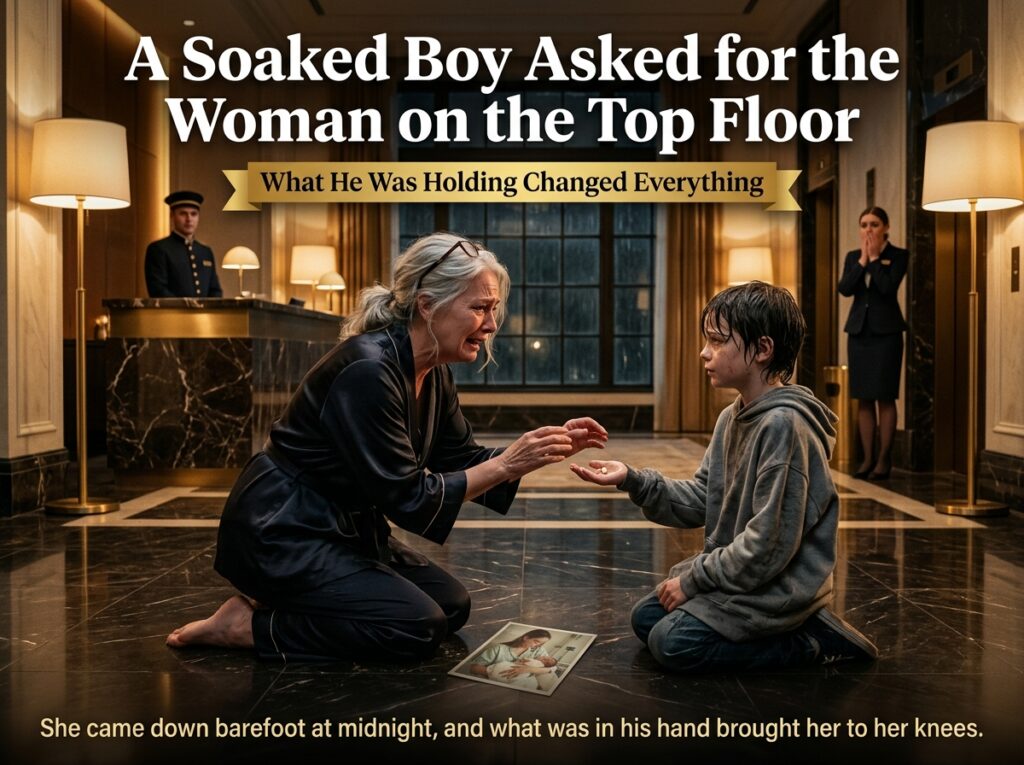
The doors opened, and Eleanor Voss walked out barefoot, her silk robe hastily belted, reading glasses pushed up into gray hair that had clearly been sleeping loose on a pillow twenty minutes earlier. I had worked for this woman, at several removes, for nine years, had seen her exactly four times in person, always in tailored suits, always composed to a degree that made the staff nervous around her without quite knowing why.
I had never seen her barefoot. I had never seen her hair down. I had certainly never seen her face look the way it looked crossing that lobby floor at midnight, stripped of every careful arrangement I’d come to associate with her.
She didn’t look at me. She didn’t look at Ms. Whitfield, who had arrived moments before her and now stood near the elevator bank with both hands pressed to her mouth. Eleanor Voss walked directly to the boy, and when she reached him, she did something I had never once imagined a woman like that doing in a public lobby: she got down on her knees, in her silk robe, on the cold marble floor, so that her face was level with his.
“Whose photograph is that?” she asked him. Her voice cracked clean through the middle of the sentence, a sound I’d never once heard from her in nine years of clipped, precise phone calls.
Caleb didn’t answer with words. He set the hot chocolate mug carefully on the floor beside him, and he opened his other hand, the one that had been closed tight in the pocket of the borrowed bathrobe this entire time.
In his palm sat a small gold ring, old, a thin band with a single tiny pearl, the kind of modest, sentimental piece that gets passed down rather than purchased new, its gold gone slightly dull from decades of being worn or carried rather than displayed.
Eleanor Voss made a sound I have no words for. It wasn’t quite a sob and wasn’t quite a gasp, something older and rawer than either, a sound that seemed to come from a much younger version of the composed woman kneeling on that marble floor. She reached out with one trembling hand, not quite touching the ring, hovering just above it, as if touching it too fast might make the whole moment collapse.
“That was my mother’s ring,” she whispered. “I gave it to Renata the day she was born. I told her it was the one thing in this world that was only ever hers, no matter what happened between us.” Her eyes lifted from the ring to the boy’s face, searching it with a desperate, cataloging intensity, looking, I understood suddenly, for pieces of a daughter she hadn’t seen in what must have been years. “You’re Caleb,” she said. “She named you Caleb. I knew that. I’ve known your name for nine years and I’ve never once said it out loud to anyone.”
“You knew about me?” Caleb’s voice cracked wide open, all the careful composure finally giving way. “My mom said you didn’t want anything to do with us. She said that’s why we never had any money, why we moved so much, why it was always just us. She said you chose the company over her a long time ago and never looked back.”
Eleanor Voss closed her eyes, and when she opened them, something in her face had gone very still and very old.
“That is not entirely true,” she said quietly. “And it is not entirely false either. I think, tonight, you deserve the whole of it, however long it takes to tell.”
Part 5
She did not tell it in the lobby. She had Ms. Whitfield call Northwestern Memorial first, get the direct line to the ICU nursing station, confirm what could be confirmed about Renata Ashworth’s condition, while she herself sat down, still on the cold marble floor, robe pooling around her, and pulled Caleb gently into the crook of her arm, the two of them a strange, sudden tableau in the middle of an otherwise empty five-star lobby at midnight.
Only once Ms. Whitfield had a car arranged, and hot food ordered up from the kitchen despite the hour, and a blanket brought down from the linen closet, did Eleanor finally begin to speak, quietly, mostly to Caleb, though I confess I never stopped listening from my post at the desk, and she never once asked me to.
“Your mother was born when I was twenty-six,” Eleanor said. “I was already running half of what would become this company by then, inherited it young, from my own father, who did not believe women belonged in boardrooms and left it to me anyway out of spite toward his brothers more than faith in me. I raised Renata mostly alone. Her father left when she was two. I was building something that consumed every hour I had, and I told myself, the way ambitious people always tell themselves, that I was building it *for* her, that the hours away were an investment in a future she’d thank me for eventually.”
Caleb sat very still against her side, listening with the same old-eyed intensity he’d shown me earlier.
“She grew up mostly raised by housekeepers and boarding schools and a mother who called nightly and visited rarely,” Eleanor continued. “By the time she was seventeen, she hated me, and I want you to know, Caleb, that her hatred was not unreasonable. It was earned, dollar by dollar, missed recital by missed recital. When she got pregnant with you at twenty, and the boy responsible disappeared the way boys like that sometimes do, I made the worst decision of my entire life. I told her that if she kept the child and didn’t finish the university degree I’d paid for, she would be doing it without another cent of my money, and without my name attached to any of it. I thought I was teaching her responsibility. I have had nine years since then to understand I was teaching her exactly what my own father taught me, and calling it love the whole time.”
“She kept me anyway,” Caleb said quietly.
“She kept you anyway,” Eleanor agreed, and her voice broke again. “And she never once, in nine years, called to ask me for a single dollar, though I know now, from things Ms. Whitfield has quietly confirmed over the years without my ever directly asking her to, that there were winters your mother went without heat rather than call this number.” She looked up at Ms. Whitfield, who nodded, confirming something clearly long understood between them and never spoken aloud until this moment.
“You knew where we were?” Caleb asked, and there was an edge in his young voice now, something sharper than grief.
“I have known your address every single year of your life,” Eleanor said, and did not look away from the shame of admitting it. “I told myself I was respecting her wishes, giving her the independence she’d asked for. The truth, Caleb, the whole truth, is that I was a coward. I was afraid that if I reached out and she said no, I would have to sit with the fact that I’d broken something I couldn’t fix. It was easier to stay silent and imagine, someday, some perfect future moment where reaching out would feel safe. I have been waiting nine years for a moment that was never going to arrive on its own.” Her hand tightened gently around his. “It took your mother nearly dying tonight to finally arrive for both of us.”
Part 6
The car took us all to Northwestern Memorial a little after one in the morning — Eleanor, Caleb, Ms. Whitfield, and, at Eleanor’s specific and slightly unusual request, myself, since Caleb had gripped my sleeve when the group started for the door and asked, quietly, if I could come too, because I was the only adult in the whole strange night who hadn’t yet let him down in some way. I called my shift supervisor, explained as much as I was permitted to, and she covered the desk without a single question, sensing correctly that this was not a night for hotel policy.
The ICU waiting room held a woman I took to be Aunt Denise, mid-thirties, pale with exhaustion and fear, who came out of her chair the moment Caleb walked through the doors.
“Caleb, my God, where have you *been*, I have been calling everyone, I thought—” She stopped short, seeing the small procession behind him: Eleanor Voss, silk robe now traded for a coat Ms. Whitfield had produced from somewhere, still barefoot beneath it, and a hotel concierge in uniform, and Ms. Whitfield herself, looking like a woman operating on pure adrenaline and old, complicated loyalty.
“Denise,” Eleanor said, and something in the way she said the name told me this wasn’t the first time these two had spoken, even if they’d never met. “I believe you’ve heard my name before, even if we’ve never been introduced properly.”
Denise’s face went through several visible stages of shock before settling on something wary. “Renata’s mother,” she said slowly. “The one who—”
“Yes,” Eleanor said simply, before Denise could finish whatever accusation was coming, an accusation Eleanor’s face suggested she believed she deserved in full. “That one. I’d like to see her, if the doctors will permit it, and I’d like to hear, from you, everything that’s happened tonight, and everything I’ve missed in the years before it, if you’re willing to tell me.”
The attending physician, when consulted, explained what he’d apparently already explained twice that night to an exhausted Denise: Renata had suffered a ruptured brain aneurysm at home, discovered only because Caleb had found her collapsed in the kitchen and, with a presence of mind that made the ER staff’s eyebrows lift when they heard the story, called 911 himself and gave the dispatcher the address in a clear, steady voice. She was alive, stabilized, in an induced coma to reduce swelling, and the next forty-eight hours would tell them more than anyone could currently promise.
“She’s not gone,” the doctor said carefully, to a room that had clearly been braced for the opposite news all night. “She’s fighting. That’s the honest answer I can give you right now.”
Eleanor closed her eyes at that, and I watched nine years of carefully maintained composure finally, completely, come apart in a hospital corridor at two in the morning, silent tears running down a face that Fairmont staff had spent nearly a decade describing to each other as unshakeable.
Part 7
They let Eleanor into the room an hour later, after the swelling scans came back stable enough to permit a short visit, and she asked, to everyone’s surprise, that Caleb come with her rather than wait outside.
I didn’t go in, of course. That wasn’t my place, and I knew it even then, standing in a hospital corridor in my Fairmont uniform at two in the morning, feeling like a man who had wandered several stories deep into someone else’s life by accident. But Ms. Whitfield told me, later, quietly, over coffee in the hospital cafeteria while we waited, what had happened in that room, because she’d stood in the doorway the whole time and hadn’t had the heart to look away.
Eleanor had sat beside the bed, taken her daughter’s unconscious hand in both of hers, and talked to her the way you talk to someone you believe, somewhere beneath the machines and the sedation, might still be listening. She told her she was sorry. She told her the ultimatum at twenty had been the cruelest thing she’d ever done to another human being, cloaked in language about responsibility that she now understood was really just fear, inherited fear, passed down from her own father like a family heirloom nobody wanted but everybody somehow kept. She told her that she had watched from a careful, cowardly distance for nine years, that she’d seen every school photo Caleb’s teachers had, by some quiet arrangement Ms. Whitfield had maintained without ever telling Eleanor she was doing it, forwarded along twice a year, and that she had kept every single one in a locked drawer in her office, unable to display them, unable to throw them away either.
Then she’d taken the small gold ring, still warm from where Caleb had carried it in his pocket for hours, and placed it gently back in Renata’s palm, and closed her daughter’s fingers around it.
“I don’t want it back,” she’d said, according to Ms. Whitfield, her voice barely above a whisper. “I never wanted it back, Renata. I think some part of me has been waiting nine years just to hear that you kept it, because it meant some part of you never fully let go of me either, even when I gave you every reason to. Your son just gave me the only gift I actually needed. Now I need you to wake up, so I can spend whatever years I have left proving I meant every word of what I’ve just said.”
Caleb, standing at the foot of the bed through all of it, had reportedly said very little, watching his grandmother with the same old, careful eyes he’d used on me at the front desk, until finally, near the end, he’d said one thing that Ms. Whitfield told me she would remember for the rest of her life.
“She kept your ring the whole time we didn’t have anything,” he’d said. “Even the year we didn’t have a car and had to walk to the food pantry. She never once thought about selling it. I asked her why, one time, and she said, ‘Because some things you keep even when it doesn’t make any sense to, because keeping them means you haven’t given up on the person yet.'” He’d looked at his grandmother then, steady, unflinching. “I don’t think she ever gave up on you. I think she just didn’t know how to say it.”
Part 8
Renata Ashworth woke up on the third day, groggy and disoriented, her speech slurred from the medication and the trauma, but present, alert enough within another day to recognize her son’s face bent anxiously over her hospital bed, and, a moment later, the second face beside him, silver-haired, unmistakably older than the last time she’d truly looked at it, standing there with an expression Renata had apparently never once, in thirty years, seen her mother wear.
I wasn’t in the room for that reunion either, and I’m glad of it, honestly. Some moments belong entirely to the people living them. But Eleanor came down to the lobby herself, four days later, to thank me personally, which she had never once done in nine years of my working, at several careful removes, for her company, and she told me a little of what had passed between her and her daughter in that hospital room, because, she said, I had been the one who hadn’t sent a soaked, frightened nine-year-old boy away at midnight, and she thought I deserved to know how the story had continued past the part I’d witnessed firsthand.
Renata, it turned out, had never stopped loving her mother, not really, only stopped believing that love could survive contact with her mother’s particular kind of fear, the fear that dressed itself up as high standards and turned every act of care into a transaction with strings still attached. She had built a hard, careful, independent life specifically to prove she didn’t need the Voss name or the Voss money, and she had, for nine years, nearly succeeded, at a cost that had nearly killed her the night an aneurysm found her alone in a kitchen with no family nearby and a nine-year-old son who had to learn, far too young, how to dial for help and keep his voice steady while doing it.
“She told me,” Eleanor said to me, standing in the lobby in a proper suit again, hair pinned back, reading glasses exactly where they belonged, though something in her face had changed permanently, some careful architecture quietly dismantled and not rebuilt, “that she kept the ring not because she still hoped I’d come back into her life, but because Caleb needed to grow up believing that somewhere, some version of family still existed, even if it was a version he’d never met. She said she planned on giving it to him herself, eventually, telling him the whole complicated story on her own terms, when he was old enough to understand it without hating either of us for it.” She paused. “She never got the chance to choose the timing. An aneurysm chose it for her. I think, in the end, I’m grateful it did, because I don’t know that either of us would have found the courage on our own.”
Part 9
The company changed in small, quiet ways over the following months, ways that eventually reached even a night concierge’s understanding of his own workplace. Eleanor Voss began appearing at the Fairmont more regularly, not as the barefoot, robed woman of that one extraordinary midnight, but as something between her old, composed public self and someone new, someone who occasionally stopped at my desk on her way through the lobby to ask, genuinely, how my night was going, a question she had never once asked in the nine years prior.
Renata’s recovery took the better part of six months, physical therapy and speech therapy and a long, slow return of full strength, all of it now taking place in a guest suite on the residential floor, at Eleanor’s insistence and, eventually, Renata’s grudging, healing acceptance. Caleb enrolled at a school four blocks from the hotel, and some afternoons, walking home, he’d stop at my desk just to say hello, sneakers dry now, hoodie replaced by an actual proper coat, the faded photograph no longer carried in a pocket but framed, I learned, and hung in the guest suite where his mother was recovering, alongside a new photograph, taken the week Renata first left the ICU: three generations of Voss women and one very serious nine-year-old boy, none of them quite smiling yet, all of them, unmistakably, still there.
“You were the one who didn’t send me away,” Caleb told me one afternoon, about four months after that first midnight, standing at my desk in his new coat with a school backpack slung over one shoulder. “My mom says that matters. She says most adults would’ve called security the second a kid walked in soaked and asking weird questions at midnight.”
“Most policies would have said to,” I admitted. “I broke about three of them that night.”
“My grandma says you should get a raise for that,” he said, with the particular bluntness only a ten-year-old, freshly turned since his December birthday, can manage.
I laughed, and told him I’d settle for the fact that his mother was alive and asking questions at all, which felt, some nights, like more reward than any raise could offer.
Part 10
Eleanor Voss retired from active management of the company the following spring, a decision that made minor financial news in Chicago’s business pages, quietly citing “a desire to focus on family” in the two-line statement her communications team released. She didn’t fully disappear from the building, though. She kept an office on the top floor, smaller than her old one, and spent most of her time, as far as the staff could tell, two floors down, in the guest suite that had slowly, unofficially, become simply “Renata and Caleb’s place,” a phrase the housekeeping staff used without anyone ever formally deciding it should be true.
I asked Renata once, months later, on one of the increasingly frequent evenings she came down to the lobby herself, steadier now, walking without the cane the doctors had first prescribed, whether she’d ever regretted sending Caleb to the hotel that night instead of simply calling her mother directly, the way anyone else might have.
She thought about it for a long moment, leaning against the marble counter the way her son once had, though considerably less soaked.
“I think some part of me always knew that if I called her myself, I’d lose my nerve halfway through the number and hang up, the way I’d tried and failed to do a hundred times over nine years,” she said. “But I couldn’t lose my nerve on Caleb’s behalf. If something happened to me, I needed him to have somewhere to go that wasn’t just an empty apartment and an aunt who was already stretched too thin. I needed him to have *family*, even a complicated, imperfect, nine-years-estranged version of it, rather than nothing at all.” She looked toward the elevator bank, where her mother happened to be stepping out at that exact moment, briefcase gone, cardigan instead of tailored suit, moving toward them both with an ease I’d genuinely never witnessed in her before that October night. “I think I sent my son to find the version of my mother I always believed was somewhere underneath the version I grew up with. I just needed almost losing my life to finally prove I was right.”
Eleanor reached them, put one hand briefly on her daughter’s shoulder, an easy, unremarkable gesture that would have meant nothing between most mothers and daughters and meant, I understood by then, nearly everything between these two.
“Caleb’s asking for you upstairs,” Eleanor said. “Something about a school project on family trees. He’s run into some complications he says only you can explain properly.”
Renata laughed, real and unguarded, and headed for the elevator, and Eleanor lingered a moment at my desk, watching her go.
“Nine years, Walt,” she said quietly, mostly to herself. “Nine years I told myself I was respecting her independence. It took one soaked, stubborn little boy walking four miles in the rain to show me what respecting her independence had actually cost all three of us.”
I still work the overnight desk at the Fairmont. I still see strange things pass through that lobby at hours most of the city never witnesses. But I keep, framed now in my own small apartment across town, a photograph Renata gave me the following Christmas: herself, her mother, and Caleb, all three actually smiling in that one, standing in the very spot in the lobby where a nine-year-old boy once stood soaked and determined, holding a photograph with soft, worn corners, refusing to leave until someone finally listened.
Some nights, working the desk past midnight, I look at that spot on the marble floor and think about how close the whole thing came to never happening at all, how easily I could have simply repeated hotel policy and sent a soaking-wet child back out into the rain. I think about it, and then I go back to my post, and I watch the lobby doors a little more closely than policy strictly requires, because you never really know, at midnight, exactly who might be about to walk through them, or what they might be carrying, held tight enough that the corners have gone soft.