
Part 1
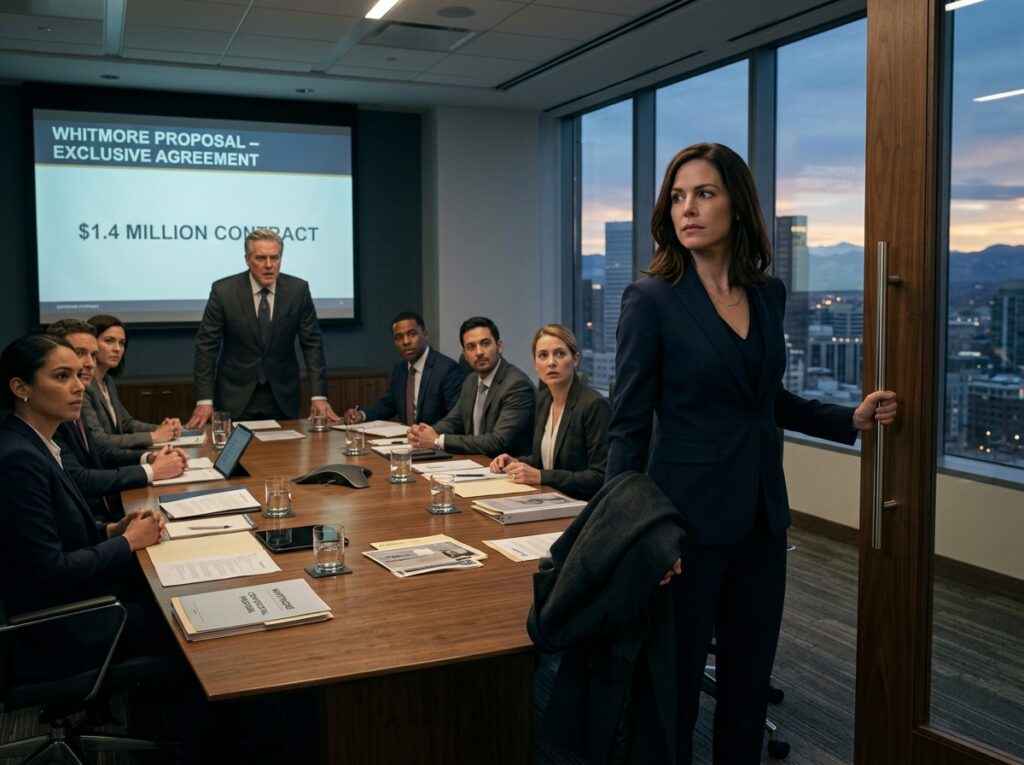
I didn’t sit down.
For fourteen months, I had sat down.
I had sat through eighteen presentations, thirty-two client calls, more spreadsheets than I could count, and enough late-night video meetings to make me forget what my own apartment looked like in daylight.
I had sat across from Whitmore Industries while they questioned every assumption in our proposal.
I had sat in conference rooms where men twice my age called my projections “ambitious” before repeating them three minutes later as though they had invented them.
I had sat beside Mr. Halloran while he nodded thoughtfully and said things like, “We’ll circle back.”
So when he shouted at me to sit down, something inside me became very calm.
“No,” I said.
The room went silent.
Mr. Halloran stared at me.
He was fifty-four, silver-haired, impeccably dressed, and famous within our Denver office for never sweating, even when everyone else was panicking.
That morning, however, a small muscle in his jaw was twitching.
The Whitmore client was still on the conference-room screen.
Three members of our board sat at the far end of the table.
My coworkers stared at their laptops.
Nobody wanted to look at me.
Nobody wanted to look at him either.
Halloran pointed toward the empty chair.
“Jenna.”
I picked up my coat.
He laughed once.
It wasn’t a friendly laugh.
It was the sound someone makes when they believe they still control the room.
“You’re making a serious mistake.”
“No,” I said.
“I don’t think you understand what you’re doing.”
“I understand exactly what I’m doing.”
He leaned forward.
“You walk out of here, and you’re finished.”
I looked at the screen.
The Whitmore representative, Daniel Price, was watching silently.
He had been watching Halloran take credit for my work for almost six months.
He knew.
That was the part Halloran didn’t understand.
The board didn’t know everything.
My coworkers didn’t know everything.
But the client knew.
And one other person knew.
I had spent the weekend speaking to that person.
Mr. Halloran pushed his chair back.
“Jenna, sit down.”
I put on my coat.
He lowered his voice.
“If you walk out of this meeting, I’ll make sure you never work in this city again.”
I looked at him.
“You’ve already said that.”
His expression changed.
“Excuse me?”
“You said it last Tuesday.”
Nobody moved.
I continued.
“And Thursday.”
Halloran’s face reddened.
“You recorded me?”
“No.”
“Then how can you prove it?”
I smiled.
“I don’t need to.”
I walked toward the door.
Behind me, Halloran said something that I will never forget.
“Nobody would believe you over me.”
I stopped.
Not because I was afraid.
Because I suddenly realized he was right about one thing.
If I tried to fight him with emotion, he would win.
So I turned around.
“You’re right.”
He smiled.
Then I added, “That’s why I stopped asking people to believe me.”
I opened the door.
“And started collecting documents.”
Part 2
Fourteen months earlier, Whitmore Industries had been little more than a name on a spreadsheet.
Our company, Northstar Systems, wanted the contract badly.
It was worth $1.4 million.
More importantly, it was the kind of contract that could lead to five more.
The problem was that Whitmore had been burned before.
They had hired another consulting firm, spent nearly a year implementing a new logistics system, and ended up with a project that cost more than expected and delivered less than promised.
They didn’t want another sales pitch.
They wanted someone to listen.
That was why I got involved.
I was thirty-six.
I had been with Northstar for seven years.
I wasn’t the loudest person in the room.
I wasn’t the most senior.
And I wasn’t interested in office politics.
I was good at understanding complicated projects and explaining them in ways people could actually use.
So when Halloran assigned me to the Whitmore account, I thought it was an opportunity.
I didn’t know it would become a test of how much credit a person could steal before everyone stopped noticing who had done the work.
My first meeting with Whitmore lasted three hours.
They told us what had gone wrong.
I took notes.
I asked questions.
I went back the next day.
Then again.
I met with their operations team.
Then finance.
Then warehouse managers.
Then regional directors.
I learned where their money disappeared.
I learned why their employees hated the software.
I learned which executives cared about efficiency and which cared about appearances.
Most importantly, I learned what they actually needed.
Halloran attended the first two meetings.
After that, he became “too busy.”
I didn’t mind.
It meant I could work.
For months, I built the proposal.
I developed the implementation timeline.
I negotiated the pricing.
I rewrote the technical scope after Whitmore rejected the first version.
I flew to Chicago to meet one of their regional directors.
I spent Christmas Eve reviewing their data.
I worked through New Year’s Day.
When Whitmore finally said they were ready to move forward, I called Halloran.
“Great work,” he told me.
“Thanks.”
“Send me the final package.”
I did.
Two days later, he presented it to the executive committee.
I wasn’t invited.
I assumed that was normal.
Then I received an email from Whitmore.
Daniel Price wrote:
“Congratulations, Jenna. We’re looking forward to working with you.”
I stared at the screen.
With you.
Not Halloran.
Not Northstar.
Me.
I should have known then.
Instead, I felt proud.
I thought the company would recognize the work.
I thought my promotion was obvious.
I was wrong.
The following Monday, Halloran called me into his office.
He closed the door.
“Whitmore signed.”
“I know.”
“We’ve got the contract.”
“I know.”
He smiled.
“You’re good, Jenna.”
I smiled back.
“Thank you.”
Then he leaned back.
“Don’t get ahead of yourself.”
I frowned.
“What do you mean?”
“This is a team win.”
“Of course.”
“And senior leadership will decide how to recognize contributions.”
I nodded.
At the time, I didn’t understand what he was warning me about.
I do now.
He wasn’t preparing me for recognition.
He was preparing to take it.
Part 3
The first time I realized Halloran was claiming my work, it was almost accidental.
There was a company-wide leadership meeting.
Whitmore was on the agenda.
Halloran stood at the front of the room.
He spoke for twenty minutes.
He explained the client’s problems.
He described the negotiation process.
He outlined the final pricing structure.
He even repeated a sentence I had written at 2:14 a.m. on a Sunday.
“Whitmore didn’t need another vendor,” he said.
“They needed a partner.”
I stared at him.
That was my sentence.
Not just the words.
The entire idea.
I had written it in a draft proposal after Daniel Price told me, “We don’t want another vendor.”
Halloran had been copied on the email.
He knew exactly where it came from.
I looked around the room.
No one said anything.
After the meeting, I approached him.
“That presentation went well.”
He smiled.
“It did.”
“You used my proposal language.”
“Of course.”
“Would you mind mentioning my role next time?”
He stared at me.
“Jenna, we’re not children.”
“What does that mean?”
“It means we’re all working toward the same goal.”
I nodded slowly.
“Right.”
He patted my shoulder.
“Don’t make this political.”
I walked away.
That night, I opened the Whitmore project folder.
I started making copies.
Not secret recordings.
Not manipulated documents.
Just the records I had legitimately created or had access to as part of my job.
Meeting agendas.
Email chains.
Drafts.
Client feedback.
Revision histories.
Travel records.
Calendar invitations.
Proposal versions.
Pricing worksheets.
Every document had dates.
Every document had authors.
Every conversation had a trail.
And suddenly I saw something I hadn’t noticed before.
The story wasn’t just that Halloran had taken credit.
He had started rewriting the history.
In one executive summary, he had written:
“I led the Whitmore engagement from discovery through final negotiation.”
That was false.
In another document:
“My team developed the pricing framework.”
Again, false.
Then I found something worse.
A version of the final proposal had been altered after I submitted it.
My name had been removed from the cover page.
My role had changed from “Account Lead” to “Project Support.”
I stared at the screen for a long time.
Then I printed everything.
Not because I knew what I would do.
Because I knew I needed to remember exactly what had happened.
Two weeks later, I asked Halloran about my promotion.
He laughed.
“Promotion?”
“Yes.”
“You’ve been here seven years.”
“And I built the Whitmore contract.”
He leaned back.
“You contributed.”
“I led it.”
“Jenna.”
His smile disappeared.
“You need to understand something about corporate life.”
I waited.
“People at your level don’t get to decide when they’re ready.”
I looked at him.
“And people at your level don’t get to erase who did the work.”
His expression hardened.
“Careful.”
I stood.
“Was that a threat?”
“No.”
He smiled again.
“Advice.”
I left.
That night, I opened a new folder on my personal computer.
I named it:
Whitmore — Timeline.
I didn’t know yet what I was going to do with it.
But I knew one thing.
If Halloran wanted to make this a contest of credibility, I wasn’t going to compete with his voice.
I was going to let the documents speak.
Part 4
For the next three months, I said almost nothing.
That confused people.
Halloran assumed silence meant surrender.
It didn’t.
It meant I was paying attention.
I watched him present my work to senior leadership.
I watched him receive praise.
I watched coworkers congratulate him.
Some knew what had happened.
Most didn’t.
One afternoon, my colleague Marcus stopped by my desk.
“You okay?”
“Why?”
“You’ve been quiet.”
“I’m working.”
He lowered his voice.
“Halloran’s telling people you were difficult during the Whitmore negotiation.”
I looked at him.
“Was I?”
“No.”
“Then why are you telling me?”
“Because I think you should know.”
I smiled.
“Thanks.”
He hesitated.
“Are you going to do anything?”
“Eventually.”
He looked nervous.
“Be careful.”
“I am.”
The next week, Halloran removed me from a Whitmore planning call.
I received the cancellation ten minutes before the meeting.
The note said:
“Leadership will handle this one.”
I forwarded it to myself.
Then I called Daniel Price.
“Did you know I wasn’t invited?”
There was a pause.
“No.”
“Are you okay continuing without me?”
Another pause.
“Jenna, you’re the person we’ve been working with.”
I closed my eyes.
“Thank you.”
“Is something wrong?”
I almost told him everything.
Instead, I said, “There may be some internal changes.”
“Do you need me to document anything?”
That question changed everything.
“Actually, yes.”
I explained that I wanted him to communicate only through normal business channels.
No secret emails.
No favors.
No confrontation.
Just accurate records.
He agreed.
Two weeks later, Halloran sent Whitmore a revised implementation plan.
They rejected it.
Daniel replied:
“This differs materially from the plan Jenna presented.”
Halloran responded:
“Jenna’s earlier version was preliminary.”
I saved the email.
Then Daniel forwarded me the original approval.
“We approved your version,” he wrote.
I saved that too.
By then, I had enough evidence to know I wasn’t imagining things.
But evidence wasn’t the same as justice.
Companies don’t automatically reward truth.
Sometimes they reward whoever tells the story first.
So I needed to understand the larger story.
I looked into the contract.
Whitmore had negotiated several unusual protections.
One clause required any material change in project leadership to be disclosed.
Another required written approval for modifications to the implementation plan.
Halloran had violated both.
And there was one more clause.
A clause I had helped negotiate.
If Whitmore believed Northstar had misrepresented who was responsible for the engagement, they could suspend the contract pending review.
I stared at that paragraph.
Then I understood why Halloran had been so desperate to control the story.
The contract wasn’t just worth $1.4 million.
It was vulnerable.
If Whitmore believed the company had misrepresented its leadership, the entire deal could be questioned.
I didn’t want the contract destroyed.
I wanted the truth documented.
That weekend, I made one phone call.
It wasn’t to the press.
It wasn’t to a lawyer.
It wasn’t to a competitor.
I called the person who had the authority to ask the one question Halloran couldn’t intimidate away.
Our company’s independent board chair.
Her name was Evelyn Whitmore.
Yes.
The same Whitmore family that owned the client.
I had met her once during the final negotiations.
She had asked me three questions.
I remembered all three.
And I remembered something else.
She had listened.
Part 5
Evelyn answered on the fourth ring.
“Jenna?”
“Yes.”
“Is everything okay?”
“No.”
There was silence.
“Tell me.”
I did.
Not emotionally.
Not dramatically.
I gave her dates.
Names.
Documents.
Versions.
Emails.
I explained what Halloran had claimed.
Then I explained what the records showed.
She asked questions for forty minutes.
At the end, she said something I hadn’t expected.
“Why didn’t you come to me sooner?”
“Because I didn’t want to destroy the contract.”
“Do you think you are?”
“No.”
“Then what do you want?”
I looked at the folder on my desk.
“I want the record corrected.”
She was silent.
Then she said, “Send me everything.”
I hesitated.
“Through the proper channel?”
“Yes.”
“Should I copy Halloran?”
“No.”
I swallowed.
“Why?”
“Because if the documents are authentic, I want to see them before anyone has an opportunity to explain them.”
That was the call.
The one Halloran didn’t know about.
The one I had spent the weekend making.
I sent her the timeline.
She reviewed it.
Then she contacted the board’s general counsel.
Within forty-eight hours, an internal review began.
Halloran knew nothing.
At least, not yet.
Then came the meeting.
The one where he stole credit for the contract in front of the board.
The one where he told me nobody would believe me.
The one where he threatened my career.
I walked out.
And twenty minutes later, I received an email.
“Please remain available. Do not delete or alter any project records.”
I sat in my car outside the building.
My hands were shaking.
Not from fear.
From relief.
For fourteen months, I had carried the weight of proving something everyone around me pretended not to see.
Now I didn’t have to prove it alone.
Three days later, Halloran was called into a board review.
I was there.
So was legal counsel.
So was Evelyn.
So were two representatives from Whitmore.
Halloran entered confidently.
He sat down.
“What’s this about?”
The board chair looked at him.
“The Whitmore engagement.”
Halloran smiled.
“Of course.”
Evelyn placed a binder on the table.
“We’ve reviewed the project history.”
Halloran glanced at me.
Then back at her.
“There’s been some confusion.”
Evelyn opened the binder.
“Then let’s clear it up.”
She began reading dates.
The first client meeting.
Jenna.
The discovery session.
Jenna.
The first proposal.
Jenna.
The pricing model.
Jenna.
The negotiation notes.
Jenna.
The final implementation plan.
Jenna.
Halloran shifted in his chair.
“I supervised the engagement.”
“That’s not what we asked,” Evelyn said.
Halloran frowned.
“What?”
“We asked who performed the work.”
Silence.
He looked at me.
Then at the board.
“Jenna was part of my team.”
Evelyn turned another page.
“Then why did you represent yourself as the person who personally developed the proposal?”
Halloran’s face changed.
“I didn’t.”
I almost laughed.
Not because it was funny.
Because the lie was now too small to survive the room.
Evelyn slid a printed copy toward him.
His own signature was at the bottom.
His own words.
His own claim.
He stared at it.
Then he looked at me.
For the first time since I had known him, he had nothing to say.
Part 6
The review lasted six weeks.
I was interviewed four times.
So were members of my team.
The board examined hundreds of documents.
Whitmore cooperated fully.
I was careful not to celebrate.
Nothing had been decided.
And I had learned something important.
Being right and being vindicated were two different things.
During the investigation, Marcus came to my office.
“I should have spoken up.”
I looked at him.
“Why didn’t you?”
He stared at the floor.
“Because I needed the job.”
I nodded.
“I understand.”
“No, you don’t.”
“I do.”
“I watched him take your work.”
“Yes.”
“I should have said something.”
“You don’t owe me a confession.”
“But I feel like I do.”
I closed my laptop.
“Then learn from it.”
He looked at me.
“What does that mean?”
“Next time you see someone being erased, don’t wait until it’s safe to say something.”
He nodded.
“Okay.”
The following week, another colleague came forward.
Then another.
They didn’t have evidence of the Whitmore project.
They had other examples.
Reports.
Presentations.
Performance reviews.
Ideas attributed upward.
Mistakes pushed downward.
Halloran had not started doing this with me.
He had simply done it long enough to believe nobody would stop him.
That changed the nature of the investigation.
It was no longer about one contract.
It was about leadership conduct.
When the board finally reached its decision, Halloran was removed from his position.
The company did not make a public spectacle of it.
There was no dramatic announcement.
No security escort.
No shouting.
He simply stopped being the person who ran our division.
His departure was announced in a short internal message.
“Effective immediately, Mr. Halloran will be leaving the company.”
I read it twice.
Then I closed the email.
Marcus came over.
“That’s it?”
“Apparently.”
“How do you feel?”
I thought about it.
“Relieved.”
“Not happy?”
“No.”
“Why?”
“Because I didn’t want him destroyed.”
Marcus frowned.
“You spent months proving he lied.”
“Yes.”
“But you didn’t want revenge?”
“No.”
“What did you want?”
I looked at the Whitmore file on my desk.
“I wanted my name back.”
He nodded slowly.
That was exactly it.
Not money.
Not humiliation.
Not revenge.
Ownership.
The right to have the work attached to the person who had actually done it.
A week later, Evelyn called me.
“The board wants to meet with you.”
I assumed it was about the contract.
It wasn’t.
“We’d like to offer you the position of Director of Client Strategy.”
I stared at her.
“That’s Halloran’s position.”
“It is now vacant.”
I swallowed.
“Why me?”
She smiled.
“Because when someone tried to make the story about personalities, you brought us documents.”
I didn’t know what to say.
She continued.
“And because Whitmore asked that you remain their primary relationship lead.”
That mattered more than the title.
I accepted.
Part 7
My promotion came with an unexpected responsibility.
I had to rebuild the team.
That was harder than removing Halloran.
People were tired.
Some were angry.
Some were embarrassed.
Some were afraid to speak.
The first thing I did was cancel the old weekly meeting.
Then I sent everyone a new invitation.
The title was simple:
“Who Did What?”
At the meeting, people laughed.
Then I explained it.
“Every project gets clear ownership.”
I put names beside responsibilities.
“Not because we’re policing each other. Because people deserve credit for their work.”
Marcus raised his hand.
“What happens when two people contribute equally?”
“We say so.”
“What if a manager improves someone else’s work?”
“We say so.”
“What if someone makes a mistake?”
“We say so.”
“And if a manager takes credit?”
I looked around the room.
“We document it.”
Nobody laughed.
The culture changed slowly.
Not because I had a magic formula.
Because people had learned what happened when nobody kept records.
Six months later, Whitmore renewed the contract.
Then expanded it.
The total value eventually grew far beyond the original $1.4 million.
Daniel Price sent me a message.
“Your team has been excellent.”
I smiled.
Not my team.
Our team.
That distinction mattered.
One afternoon, I received an email from Evelyn.
The subject line was:
“Whitmore.”
I opened it.
She had attached the original proposal.
At the bottom was my name.
She wrote:
“Keep this version.”
I smiled.
I printed it.
Then I framed it.
Not because it was a trophy.
Because it reminded me of the person I had been before the fight.
The woman who thought hard work would automatically be recognized.
I didn’t want to become bitter.
I wanted to become wiser.
There is a difference.
One evening, Marcus stayed late.
He stood in my doorway.
“Can I ask you something?”
“Sure.”
“Did you know you’d win?”
I laughed.
“No.”
“You looked calm.”
“I was terrified.”
“Really?”
“Absolutely.”
“Then why did you walk out?”
I thought about Halloran’s words.
Nobody would believe you over me.
“Because I finally understood that I didn’t need everyone to believe me.”
I pointed to the framed proposal.
“I needed the truth to survive long enough to be examined.”
Marcus nodded.
Then he smiled.
“You know what the strangest part is?”
“What?”
“I used to think the person who talks loudest wins.”
I looked at him.
“And now?”
“Now I think the person who keeps the receipts has a chance.”
I laughed.
“That’s a better lesson.”
Part 8
A year after the investigation, I was asked to speak at a company leadership conference.
The topic was not workplace betrayal.
It was “Building Trust Through Accountability.”
I almost declined.
Then I accepted.
The conference room was full.
Managers from different offices sat around tables.
I stood at the front.
For a moment, I saw Halloran.
Not literally.
In memory.
I heard his voice.
Nobody would believe you over me.
Then I looked at the people in front of me.
“I want to tell you about something that happened to me,” I began.
I didn’t mention his name.
I didn’t need to.
I explained how a major contract had been built over fourteen months.
I explained what happened when credit was redirected.
Then I said something I wish someone had told me years earlier.
“Documentation isn’t distrust.”
The room was quiet.
“Sometimes people think keeping records means you don’t trust your coworkers. It can mean the opposite. Clear records protect everyone.”
I continued.
“And speaking up isn’t the same as attacking someone.”
I paused.
“Sometimes speaking up is simply refusing to let the wrong story become the official one.”
A woman in the front row raised her hand.
“What if you’re afraid of retaliation?”
I answered honestly.
“Then don’t make the decision alone.”
She nodded.
“Find the appropriate channel. Use the policies available to you. Keep factual records. Separate what you know from what you suspect.”
Another person asked:
“What if nobody supports you?”
I thought about that conference room.
The silent team.
The empty chair.
My coat in my hand.
“Sometimes,” I said, “people won’t support you immediately.”
I paused.
“But silence isn’t always agreement. Sometimes people are scared.”
After the session, several people approached me.
One woman stayed behind.
She looked nervous.
“Can I speak to you privately?”
“Of course.”
She told me her manager had been taking credit for her work.
I listened.
Then I told her what I wished someone had told me.
“Start with facts.”
She nodded.
“Dates.”
Another nod.
“Documents.”
Another.
“Keep your emotions out of the record, even when your emotions are completely justified.”
She smiled faintly.
“That’s hard.”
“It is.”
Then I added:
“And don’t wait fourteen months to ask for help.”
She laughed.
“So that’s the lesson?”
“One of them.”
The other lesson was simpler.
Don’t let someone else’s confidence convince you that your own memory is wrong.
Sometimes the loudest person in the room is simply the person most comfortable being heard.
Part 9
Three years after I walked out of that conference room, I found myself standing in another one.
Different city.
Different company.
Different board.
Same kind of table.
Whitmore had become one of Northstar’s largest clients.
I was now responsible for the relationship.
Daniel Price was sitting across from me.
He smiled.
“Do you remember our first meeting?”
“Very clearly.”
“You asked questions nobody else asked.”
“I was trying to understand the problem.”
“That’s why we signed.”
I smiled.
He leaned forward.
“There’s something I’ve never told you.”
“What?”
“When Halloran presented the final proposal to us, I knew it wasn’t his.”
I stared at him.
“What?”
“I recognized your work.”
“Then why didn’t you say anything?”
“Because at the time, I thought it was an internal issue.”
I laughed softly.
“So you knew.”
“I knew.”
“Why didn’t you tell me?”
He looked embarrassed.
“I thought you knew how corporate politics worked.”
I shook my head.
“I was learning.”
He nodded.
“I regret that.”
I looked at him.
“You don’t have to.”
“I do.”
“Why?”
“Because silence can become part of the problem.”
I thought about Marcus.
About the team.
About that meeting.
About the years before it.
“You know what?” I said.
“What?”
“I understand now.”
He smiled.
The meeting ended.
I walked back to my hotel.
That night, I opened the original Whitmore proposal on my laptop.
My name was still at the bottom.
I had kept the file.
I had kept the frame.
I had kept the emails.
But I realized I no longer needed them to prove anything.
The people who mattered knew.
More importantly, I knew.
I thought that would feel like victory.
It didn’t.
It felt like peace.
There is a strange freedom that comes when you stop needing an apology from the person who hurt you.
Halloran never apologized.
Not to me.
Not publicly.
Maybe he believed his version to the end.
I don’t know.
And eventually, I stopped caring.
Because the story had moved on without him.
Whitmore remained.
The team grew.
People I had mentored became managers.
Some became directors.
One became a vice president.
And I started noticing something.
Whenever someone received credit in a meeting, they began saying who helped them.
“This came from Marcus.”
“Jenna helped build the model.”
“Sarah found the issue.”
“Tom stayed late to fix it.”
Small things.
But important ones.
Maybe that was the real legacy of what happened.
Not Halloran’s departure.
Not my promotion.
The fact that people started naming each other.
Part 10
I still have the coat.
The same coat I picked up from the back of my chair that morning.
It’s hanging in the closet of my house in Denver.
I don’t wear it often anymore.
But I keep it.
Not because it reminds me of Halloran.
It reminds me of the moment I chose not to stay in a room where someone was trying to convince me that my own work didn’t belong to me.
There are moments in life when leaving looks like losing.
Walking away from a job.
Ending a partnership.
Refusing to accept a lie.
Closing a door.
People watching from the outside may think you’re giving something up.
Sometimes you are.
But sometimes leaving is the first thing you do for yourself after spending too long trying to make someone else recognize your value.
I learned that at thirty-six.
I learned it again at thirty-seven.
And I still remind myself of it now.
Years later, I was cleaning out an old file cabinet when I found the first Whitmore timeline.
Fourteen months of work.
Every meeting.
Every revision.
Every decision.
Every late night.
I almost threw it away.
Then I stopped.
I read the first page.
At the top, I had written:
“Goal: Understand what Whitmore actually needs.”
I smiled.
That was who I had been.
And maybe that was the part Halloran could never steal.
He could take a slide.
He could repeat a sentence.
He could put his name on a document.
He could stand in front of a board and speak louder than me.
But he couldn’t take the fourteen months I spent listening.
He couldn’t take the relationships I built.
He couldn’t take the knowledge I earned.
And he couldn’t take the person I became afterward.
I put the timeline back in the drawer.
Then I walked to the window.
Denver was quiet that evening.
The mountains were barely visible beyond the buildings.
My phone rang.
It was Marcus.
“Hey,” I said.
“Do you remember that old Whitmore project?”
“Of course.”
“There’s a new manager here.”
“Okay.”
“He asked how the account became successful.”
I laughed.
“And?”
“I told him about you.”
I looked out the window.
“What did you tell him?”
“That you taught us something.”
“What?”
He paused.
“That nobody gets to own your work just because they have a louder voice.”
I smiled.
“That’s pretty good.”
“I’ve been practicing.”
We laughed.
After we hung up, I went to the closet.
I pulled out the old coat.
For a moment, I remembered that conference room.
Halloran shouting.
The client watching.
The board waiting.
My coworkers silent.
My hand reaching for the coat.
I remembered the fear.
Then I remembered something else.
The door.
How it felt when I opened it.
Not like failure.
Like air.
I put the coat back.
Then I closed the closet.
Some people spend years trying to prove they were wronged.
I understand why.
But eventually, if you’re lucky, you realize something better.
Your life doesn’t have to become a courtroom.
You don’t have to spend forever waiting for the person who hurt you to admit what they did.
Sometimes the strongest evidence is simply what happens after you stop letting them define the story.
I didn’t end Halloran’s career.
The evidence did.
I didn’t win because I shouted louder.
I won because the truth had a record.
And when he told me nobody would believe me over him, he made one mistake.
He assumed I was asking people to choose between us.
I wasn’t.
I was asking them to look.
So I picked up my coat.
I walked out.
And for the first time in fourteen months, the work I had built finally belonged to me again.