Part 1
The lobby of Ashgrove & Pryce Private Wealth occupied the ground floor of a limestone building on Park Avenue that had stood, largely unchanged in its marble and brass fittings, since 1931, a deliberate architectural choice meant to whisper permanence and discretion to the kind of clients who measured trust in the weight of a door handle. My name is Priya Anand, and I was nineteen years old that October morning, three months into my first real job as a junior client-services associate, a position I’d gotten through a scholarship program the firm ran, ostensibly, to bring “diverse talent” into private banking, though in practice it mostly meant I answered phones and fetched coffee and was reminded, gently but constantly, that I was there on the firm’s charity rather than its confidence.
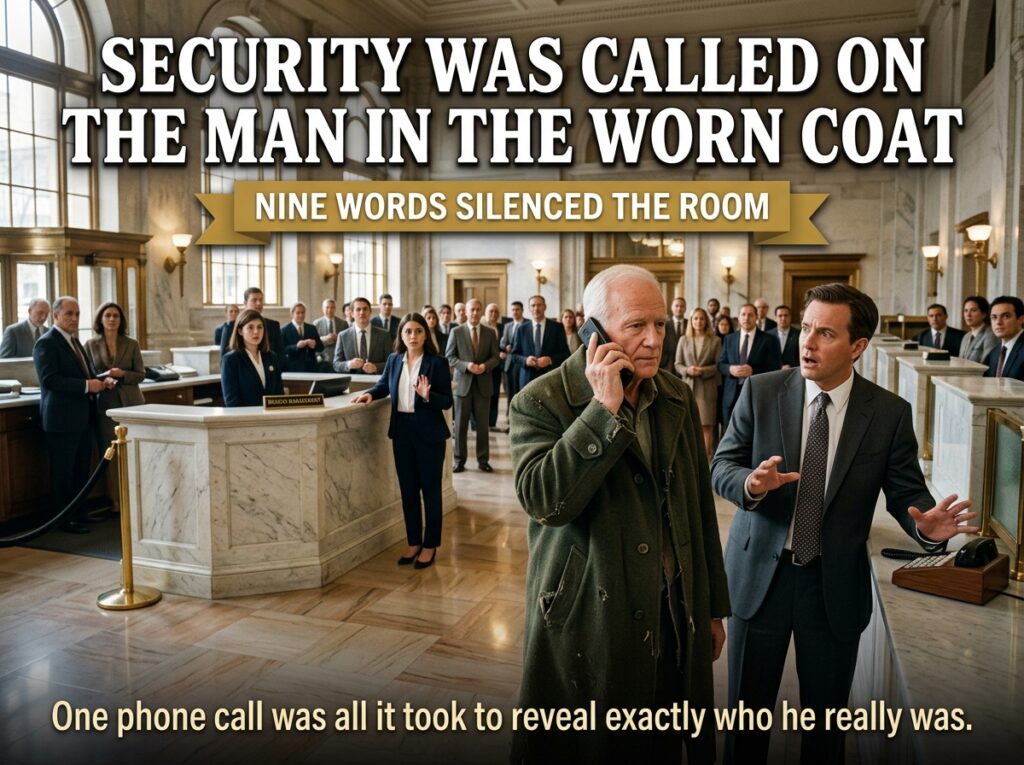
The man walked in a little after ten in the morning, and I noticed him before anyone else did, because I was the one stationed nearest the door that week, a rotation the more senior associates avoided when they could manage it. He was perhaps seventy-four, though I’d only learn that number later, with white hair cut close and unevenly, as though by his own hand rather than a barber’s, and a green wool coat that had clearly seen twenty winters or more, its cuffs frayed pale, a button missing near the collar and replaced with one that didn’t quite match. His shoes were scuffed brown leather, resoled at least once. He carried nothing, no briefcase, no folder, just his own two empty hands, which he kept folded in front of him with a stillness that struck me, even in that first glance, as somehow deliberate rather than nervous.
“I’d like to see the director, please,” he said, to me, since I was nearest. His voice was quiet, unhurried, with a faint accent I couldn’t immediately place, something Eastern European softened by what sounded like decades of English underneath it.
“Do you have an appointment, sir?” I asked, because that was the actual protocol, the same question I’d have asked anyone.
“No,” he said. “But I believe he’ll want to see me regardless.”
I was still deciding how to handle that, a homeless-looking man with no appointment asking for the firm’s most senior partner, when Gregory Croft, the branch manager, came around the corner from his office, drawn, I think, by some instinct branch managers develop for exactly this kind of moment. Croft was in his fifties, silver-templed, dressed in the particular expensive understatement of a man who wanted you to know his tailor was better than yours without ever naming the tailor directly. He took one look at the old man’s coat, at the mismatched button, at the scuffed shoes, and his whole face rearranged itself into an expression I’d already learned, in three months, to recognize as trouble for whoever he decided to aim it at.
“Sir, I’m going to need you to step outside,” Croft said, not to me, directly to the old man, his voice pitched at the particular register senior staff used when they wanted junior staff to understand a lesson was being delivered alongside the actual instruction. “This is a private facility. We’re not equipped to assist you here. There’s a shelter on—”
“I’m not looking for a shelter,” the old man said, still without any rise in his voice at all. “I’m looking for the director. My name is Bertram Kowalski.”
Croft did not react to the name, which told me, correctly, that it meant nothing to him.
“Mr. Kowalski,” Croft said, with the exaggerated patience people use on someone they’ve already decided is either confused or lying, “I’m going to have to ask you to leave the premises. If you don’t leave voluntarily, I’ll need to call building security.”
Part 2
“Please,” I said, before I’d fully decided to speak at all, the word simply arriving ahead of my judgment. “He’s just asking for a meeting, Mr. Croft. It costs us nothing to check whether Mr. Pryce has an opening, or to at least take a message.”
Croft turned that same rearranged expression on me now, and I felt, immediately, the specific chill of having said something that would be remembered against me later, regardless of how the next five minutes actually unfolded.
“Priya,” he said, using my first name the way people use a child’s name when they want to remind everyone in the room of the size difference between the two of them, “this isn’t your decision to make. This gentleman doesn’t have an appointment, doesn’t have identification he’s offered, and doesn’t have any business in this lobby. I’d suggest you get back to your desk and let me handle this.”
“I have identification,” Mr. Kowalski said mildly, reaching slowly, carefully, into an inside pocket of the green coat, a motion that made two other associates near the reception desk visibly tense, the particular jumpiness of people who’d sat through the mandatory security briefings about exactly this kind of situation. He produced, instead of a wallet, an old flip phone, the kind that had gone out of general circulation the better part of fifteen years earlier, its plastic casing scratched and yellowed at the edges.
“Sir, put that away,” Croft said sharply. “I’m calling security now.”
“You may call whomever you like,” Mr. Kowalski said, and there was, for the first time, something underneath the mildness of his voice, not anger exactly, more like the patient weariness of a man who had watched this particular scene play out many times before and had simply stopped being surprised by it. “But I’d suggest you wait ninety seconds before you do, because I believe this call will resolve the confusion faster than security will.”
Croft, to my genuine surprise, didn’t immediately pick up the desk phone. Something in the old man’s steadiness, I think, some quality that even Croft’s rehearsed dismissiveness couldn’t quite override, made him hesitate, watching, arms crossed, as Mr. Kowalski flipped open the old phone, pressed a single button that suggested speed dial rather than a number he needed to look up or remember, and lifted it to his ear.
The lobby had gone quieter by then, several other associates and two clients waiting in the seating area near the windows having noticed the tension building near the entrance, the particular hush that spreads through a room when people sense something is about to happen that they’ll want to have witnessed accurately later.
“It’s me,” Mr. Kowalski said into the phone, after a pause of perhaps three seconds, presumably while whoever answered greeted him. “I’m downstairs.” Another pause, listening. “Yes, I know I’m early. That’s rather the point.” A third pause, longer, his pale eyes drifting, without any particular malice, toward Croft, who stood very still now, arms still crossed but his posture subtly different than it had been thirty seconds earlier.
Then Mr. Kowalski said, into the phone, in the same quiet, unhurried voice he’d used for everything else that morning, nine words that seemed to physically displace the air in that marble lobby:
“Tell the board not to start without me.”
Part 3
The silence that followed lasted, by my own rough count, somewhere around four full seconds, an eternity in a room that size, before Croft’s phone, the actual desk phone on the reception counter, began to ring.
He answered it automatically, the reflex of a man who’d spent thirty years answering phones that rang, and I watched his face change over the following ninety seconds in a way I’d remember for the rest of my career, a slow-motion collapse of the confident dismissiveness he’d been wearing since Mr. Kowalski first walked through the door.
“Yes, this is Gregory Croft,” he said. “Yes. Yes, he’s here now, I was just—” A long pause, during which whatever voice was speaking on the other end of that line clearly did not permit interruption. “I understand. Yes, sir. Right away, sir.”
He set the phone down very carefully, the way you set down something you’re afraid might shatter if handled roughly, and turned to look at Mr. Kowalski, still standing exactly where he’d been standing, hands folded, green coat unchanged, expression entirely unbothered by whatever had just transpired.
“Mr. Kowalski,” Croft said, and his voice had lost every trace of the register he’d used ninety seconds earlier, replaced by something considerably closer to the tone he used, I’d noticed over my three months, exclusively with the firm’s largest clients. “I’m so sorry, sir, there’s clearly been some kind of misunderstanding. Please, right this way, Mr. Pryce is expecting you, if you’ll just—”
“I know the way,” Mr. Kowalski said mildly. “I’ve been coming to this building since before you were born, Mr. Croft, though I don’t believe we’ve had the pleasure of meeting directly before today.”
He began walking, unhurried, toward the private elevator bank at the rear of the lobby, the one reserved for board members and clients whose portfolios required a level of discretion that didn’t involve waiting in a public lobby at all. Croft moved to follow him, then hesitated, then, apparently deciding better of leaving the lobby entirely unattended, stopped and turned back toward the reception area instead, his face still working through whatever recalibration was happening behind it.
That was when he looked at me.
“Priya,” he said, and my stomach dropped at the particular flatness in his voice, “my office. Now.”
Part 4
I sat across from Croft’s desk for what felt like a very long time before he spoke, though it was probably closer to thirty seconds, his hands folded on the desk in a mirror of the stillness Mr. Kowalski had shown at the door, though his version carried none of the same calm underneath it.
“I want to be clear,” he said finally, “that what just happened downstairs was extraordinarily embarrassing, and I intend to figure out exactly how a man like that walked in here without any of our systems flagging him properly.”
“He’s a client?” I asked, though it wasn’t really a question.
“He’s on the board,” Croft said, and something in his voice suggested this fact troubled him considerably more than the embarrassment itself. “Bertram Kowalski has sat on the board of this firm for eleven years. He’s one of three living founding partners of Halvorsen Capital, which owns forty percent of this firm’s parent company. I have shaken that man’s hand exactly twice, both times at formal dinners where he was dressed, I assure you, nothing like he was dressed this morning.” He rubbed his temples. “I don’t know why he chose to walk in here looking like that, today of all days, but I intend to find out, and I intend to make sure this firm’s reception protocols are never put in this position again.”
“With respect, sir,” I said, gathering more courage than I actually felt, “the protocol problem isn’t that we didn’t recognize him. It’s that we decided, based entirely on his coat, that he didn’t deserve basic courtesy while we figured out who he was.”
Croft’s expression hardened. “That’s not the lesson I’d take from this morning, Priya, and I’d strongly suggest you reconsider drawing that conclusion, particularly out loud, particularly to me.” He leaned back slightly. “I’ll be direct with you, since you’re clearly inclined toward directness yourself. Your position here is part of a pilot program the partners are reviewing at the end of this quarter. I would hate for today’s incident, and your role in escalating it rather than deferring to my judgment as your supervisor, to become part of that review in a way that reflects poorly on your judgment rather than mine.”
I understood, sitting there, exactly what he was telling me, stripped of its careful corporate phrasing: defend the wrong person against the wrong manager, and my three-month scholarship position could quietly, deniably, disappear at the end of the quarter, filed away as a simple staffing decision rather than anything resembling retaliation.
“I understand,” I said, because there was, in that moment, nothing else useful to say.
I did not understand, however, what was happening two floors above us, where Bertram Kowalski was, at that exact moment, walking into a boardroom eleven minutes early, exactly as he’d intended.
Part 5
I learned what happened in that boardroom only later, in pieces, first from office rumor that traveled through the firm with the particular speed reserved for stories involving both money and public humiliation, and later, more completely, from Bertram Kowalski himself, in a conversation I never once expected to have.
The board meeting that morning had been called to finalize the firm’s five-year strategic plan, a document that included, buried in its middle sections, a modernization initiative that would eliminate the diversity scholarship program I’d been hired under, reallocating its modest budget toward what the proposal called “digital-first client acquisition tools,” a piece of corporate language that meant, in practice, replacing junior associates like me with software.
Bertram Kowalski, according to two people who were actually in that room, had walked in still wearing the green coat, had taken his seat at the head of the table without removing it, and had let the meeting proceed through its first twenty minutes of formalities before he’d interrupted, mid-presentation, to ask a single question of the managing partner, a polished, silver-haired man named Aldous Pryce who had run daily operations for the past six years.
“Before we proceed to page forty,” Kowalski had reportedly said, “I’d like to understand why the associate who greeted me downstairs this morning, the only person in this building who offered me a single ounce of courtesy without knowing who I was, works under a program this document proposes eliminating.”
The room, according to the same two witnesses, had gone very quiet, in the particular way rooms go quiet when someone senior has just revealed they know something the rest of the room assumed was too small for them to notice.
“I walked in this morning dressed exactly as I am dressed most mornings when I’m not required to perform wealth for a room full of people who’ve decided that’s the only language worth speaking,” Kowalski had continued. “Your branch manager took one look at my coat and decided I belonged outside. A nineteen-year-old girl three months into her first job took one look at the same coat and decided I deserved five minutes of basic human patience while the confusion sorted itself out. I would like the board to consider, very seriously, before we vote on eliminating the program that put her in this building, exactly which of those two responses we actually want this firm to be known for producing in its people.”
Part 6
I was called back into a conference room, not Croft’s office this time, but a larger room on the executive floor I’d never once had reason to enter, at 2:40 that same afternoon, four hours after the incident in the lobby. Aldous Pryce himself was there, along with two other board members I didn’t recognize, and, seated at the head of the table, still in the green coat, Bertram Kowalski.
“Ms. Anand,” Pryce said, and I noted, with some private, exhausted satisfaction, that he’d used my actual name rather than the diminutive Croft favored. “Please, sit down. Mr. Kowalski has asked to speak with you directly, and the board has agreed this conversation should happen with appropriate people present.”
I sat, feeling considerably smaller than I had all morning, acutely aware of the four hours of quiet dread I’d spent since Croft’s office, certain my job was already effectively over, that this meeting was simply the formality attached to my dismissal.
“Ms. Anand,” Kowalski said, and up close, in better light than the lobby’s marble gloom, I could see his eyes were pale blue, sharp despite the weathered lines around them, watching me with an attention that felt, oddly, entirely without judgment. “I want to thank you properly for this morning, and I want to explain, since you deserve the explanation, why I arrived the way I did.”
“You didn’t have to dress like that,” I said, before I could stop myself, the exhaustion of the day loosening whatever filter usually governed what I said to men who owned significant portions of the firm I worked for.
“No,” he agreed. “I didn’t. I could have arrived in a suit that cost more than most people’s cars, the way I do for every other formal occasion this firm requires of me, and I would have been shown into that boardroom without a single question asked, exactly the way I’m shown in every single time I dress that way.” He folded his hands on the table. “I am seventy-four years old, Ms. Anand, and I came to this country from Poland in 1974 with considerably less than what I was wearing this morning, and I have never fully lost the habit of testing, every so often, deliberately, whether the institutions I’ve helped build have retained any capacity to see a person clearly rather than simply pricing them by their coat.”
“Most of them fail that test,” said one of the other board members quietly, a woman I’d later learn was named Odalys Ferrer, the firm’s general counsel.
“Most of them fail it badly,” Kowalski agreed. “Mr. Croft failed it badly this morning, in a manner that will be addressed separately, through channels appropriate to his employment rather than this conversation.” He looked back at me. “You did not fail it, Ms. Anand. And I understand, from a brief conversation with Mr. Croft this afternoon that he did not enjoy having, that your defense of me this morning was met with a fairly explicit threat regarding your continued employment here.”
I felt heat rise in my face. “I don’t want to get anyone in trouble,” I said carefully. “I just did what seemed like basic decency.”
“Basic decency,” Kowalski repeated, something almost like a smile working at the corner of his mouth. “I have sat on the boards of four companies over the past thirty years, Ms. Anand, and I have watched a great many strategic plans, mission statements, and values documents produced by consultants paid enormous sums to define exactly the kind of culture firms like this one claim to want. I have rarely seen ‘basic decency’ actually demonstrated, unprompted, at personal professional risk, by anyone below the rank of partner. I would like to understand a great deal more about how you came to possess it so readily, because I suspect it is worth considerably more to this firm than whatever the consultants charged us to write it down.”
Part 7
I told him, because he asked, and because something about his patient attention made it feel less like an interview and more like an actual conversation, the kind I hadn’t had with anyone senior at the firm in three months of quietly fetching coffee and being reminded of my place.
I told him about my parents, who’d immigrated from Gujarat when I was four, my father working, for the first eight years I could remember, as a parking attendant at a building not unlike this one, a building where, I told Kowalski, he’d once mentioned being told to use the service entrance rather than the lobby, a small, ordinary cruelty he’d absorbed without much comment, because complaining, in his position, risked considerably more than a bruised feeling.
“He used to say,” I told Kowalski, surprising myself with how easily this came out, in a boardroom, to a man I’d known for six hours total, “that the people who decide who belongs in a room are almost never the people who actually understand what that room is for. He said the ones sweeping the floor usually understand a building better than the ones deciding who gets to walk through its front door.”
Kowalski was quiet for a long moment after that, his pale eyes fixed on some point slightly past my shoulder, and I understood, watching him, that I’d said something that had landed considerably harder than I’d intended.
“Your father sounds like a wise man,” he said finally. “I would like to meet him someday, if he’s willing.”
“He passed four years ago,” I said. “Heart attack. He was fifty-one.”
“I’m sorry,” Kowalski said, and it did not sound like the reflexive condolence people usually offer, but something considerably more weighted, the particular sorrow of a man who understood, in his own bones, exactly the kind of life that produces a heart attack at fifty-one in someone who spends decades absorbing small, ordinary cruelties without complaint.
“I came to this country,” he said, after a moment, “with a wife and an infant daughter and considerably less money than the coat I wore this morning would fetch at a resale shop. I worked, for the first several years, as a night janitor in a building three blocks from here, cleaning offices very much like this one, emptying wastebaskets belonging to men who never once looked at me directly, because looking at the man who empties your wastebasket requires acknowledging he’s a man in the first place, and that acknowledgment, for some people, comes at a cost they’re not willing to pay.” He looked at me steadily. “I built Halvorsen Capital, eventually, alongside two partners who understood something similar in their own histories, specifically because I never wanted to work again inside an institution that couldn’t tell the difference between a person’s coat and a person’s worth. I have spent thirty years, with mixed and imperfect success, trying to build firms that remember that difference. This morning, Ms. Anand, you reminded an entire lobby of it, at a cost to yourself that I intend to make sure this firm properly corrects.”
Part 8
What followed, over the next several weeks, unfolded with a speed that suggested Bertram Kowalski’s ninety-second phone call carried considerably more institutional weight than I’d fully appreciated in the moment.
Gregory Croft was placed on administrative leave within the week, officially for “a pattern of client-facing conduct inconsistent with firm standards,” a phrase that Odalys Ferrer explained to me, with careful legal precision, covered not just the incident with Kowalski but two prior, quieter complaints from junior staff that had apparently never been properly escalated before that morning gave the board sufficient reason to finally look closely at his full file.
The diversity scholarship program, rather than being eliminated in the strategic plan, was expanded, over the following quarter, into a formally endowed initiative, funded, I later learned, through a personal contribution from Kowalski himself rather than the firm’s general budget, structured specifically to survive future strategic plans regardless of which executives eventually cycled through the managing partner’s office.
I was offered, three weeks after that boardroom conversation, a formal analyst position, two full years ahead of the standard track for someone in my scholarship cohort, alongside a mentorship arrangement that placed me, one afternoon each week, in direct conversation with Kowalski himself, ostensibly to study the firm’s history and governance structure, though our conversations ranged, over the following year, considerably further than governance alone.
“I want to be honest with you,” I told him, during one of our early sessions, sitting in his considerably more modest office, two floors below the executive suite, in a building he apparently preferred to the one where Ashgrove & Pryce’s more polished operations took place, “that I still think about Mr. Croft sometimes, and I don’t feel entirely comfortable with how completely his career ended over one bad morning.”
Kowalski considered this seriously, the way he considered most things I said, with a patience I’d come to associate specifically with him, distinct from the performed patience I’d grown used to from most senior people at the firm.
“Croft did not lose his position over one bad morning,” he said. “He lost it because that morning revealed a pattern that had already been quietly damaging this firm’s junior staff for years, a pattern nobody with sufficient authority had bothered to look at closely until circumstances forced their hand. I understand the impulse toward mercy, Ms. Anand, and I don’t discourage it in general. But mercy extended toward the powerful, at the expense of protection owed to the vulnerable, is not actually mercy. It’s simply cowardice wearing a gentler name.”
Part 9
I asked him, eventually, nearly a year into our mentorship, why he still wore the green coat sometimes, on ordinary days, when he could easily have retired it entirely after that one morning made it, briefly, something of a minor legend around the firm.
“Because the coat was never the point,” he told me. “The coat is simply a test I run periodically, a small, private ritual I’ve maintained for decades, to make sure I haven’t fully lost touch with what it felt like to be judged by my clothing rather than my character. I worry, Ms. Anand, at my age, surrounded by the particular comforts this career has afforded me, that it would be very easy to forget that feeling entirely, to become, without ever quite noticing the transition, exactly the kind of man who looks at a coat and decides, immediately and thoughtlessly, everything he needs to know about the person wearing it.” He smiled, faintly. “The coat keeps me honest. Or at least it keeps me trying to be.”
I finished my analyst training eighteen months after that first morning in the lobby, and I was offered, at the end of it, a position in the firm’s client advisory division, a role considerably more senior than anything the original scholarship program had ever promised its participants. I took it, though I made, deliberately, one small change to how I’d approach it going forward, a change I explained to Kowalski over what had become our regular monthly lunch, well past the formal end of any mentorship structure.
“I want to train the front-desk staff myself,” I told him. “Whoever we hire for that rotation. Not just the standard onboarding materials. I want to actually sit with them, the way nobody sat with me, and tell them explicitly: whatever a person is wearing when they walk through that door, you treat them exactly the same until you have an actual reason not to. Not because it might turn out badly for the firm if you guess wrong. Because it’s the correct way to treat a person, full stop, regardless of what the consequences would or wouldn’t be.”
Kowalski was quiet for a moment, and then he did something I’d only seen him do a handful of times across our year and a half of conversations: he laughed, a genuine, surprised sound, warm in a way that briefly erased two decades from his weathered face.
“You know,” he said, “I believe I once told a nineteen-year-old associate that her instincts were worth more than whatever the consultants charged this firm to write down in a values document. I find myself, eighteen months later, entirely unsurprised to discover I was correct.”
Part 10
I am twenty-one now, and I still work at the firm, in the client advisory division, and I still, every quarter, spend one afternoon personally training whichever new front-desk associates the scholarship program has brought in that season, a small tradition I’ve maintained deliberately, the same way I understand Bertram Kowalski maintains his own tradition of occasionally, unpredictably, walking into rooms wearing a coat that costs less than the coffee served in them.
He retired fully from the board two years after that first morning, citing his age and a genuine desire, he told me over our final scheduled lunch before his retirement took effect, to spend more time with his granddaughter, a fact I hadn’t previously known about him, since our conversations had always drifted more toward institutions and history than toward his own family. He still calls, occasionally, to check on the scholarship program’s endowment, and on me, personally, in a friendship that has long since outgrown whatever mentorship structure originally created it.
I think, often, about the four seconds of silence that followed his nine words in that lobby, the particular quality of stillness that settles over a room when it realizes, all at once, that its careful assumptions have been catastrophically, publicly wrong. I think about how easily that morning could have gone differently, if I’d simply followed Croft’s instruction, gone back to my desk, let building security handle a confused-looking old man in a worn coat, the way protocol, and self-preservation, would have suggested was the safer path.
I keep, on my desk now, in the office I share with two other advisors on the fourteenth floor, a small photograph Kowalski gave me on his last day, of himself as a young man, freshly arrived from Poland, standing in front of the building where he’d once worked nights emptying wastebaskets, wearing a coat not unlike the green one, decades before either garment had accumulated the particular history that would eventually bring an entire Manhattan lobby to a standstill.
On the back, in handwriting considerably steadier than I’d expect from a man his age, he’d written a single line, the closest thing to a formal lesson he ever offered me across a year and a half of monthly lunches and quiet, patient conversation.
*The coat tells you nothing. The person who looks past it tells you everything you actually need to know.*
I think my father would have liked him enormously. I think, in some ways, without either of them ever meeting, they’d have recognized something familiar in each other immediately, the particular quiet dignity of men who’d spent decades being underestimated by rooms that mistook a uniform, or a coat, or an accent, for the full measure of a person’s worth. I like to think, some evenings, riding the elevator down through a lobby I once nearly lost my job for defending, that some version of both of them is still watching, quietly, to see whether the rest of us have finally learned to look past the coat on our own, without needing a single phone call to remind us how.