Part 1
Riverside, Pennsylvania, is the kind of small town where everybody’s car trouble becomes everybody’s business within a week, which is exactly why Dale Prescott’s Auto & Small Engine Repair had survived for eleven years on Fifth Street despite a reputation, quietly whispered but rarely challenged out loud, for charging certain customers considerably more than the job actually required.
I’m Malik Bennett, and I was seventeen that spring, three months into an apprenticeship I’d talked my way into the previous winter after my own mother’s ancient Honda finally gave out and I’d spent two weekends in Dale’s bay watching him work on it, asking enough sharp, useful questions that he’d offered me an unpaid trial that had, eventually, become a real, if modest, paycheck. I needed that paycheck badly. My mother worked double shifts at the regional hospital’s laundry facility, and between her income and mine, we were managing, barely, the rent on a two-bedroom apartment six blocks from the shop, the kind of managing that left no room at all for surprises.
Dale Prescott was, in most respects, a decent enough teacher, patient with my early mistakes, generous with his actual mechanical knowledge in a way that told me he’d once loved the work itself, before whatever had happened to him over eleven years of running a small business had curdled some of that love into something meaner and more calculating. He had a temper that surfaced unpredictably, over slow days, over customers who complained, over any perceived slight to his authority in his own shop. And he had, as I learned only gradually, watching him work over those first months, a habit of what he called “rounding up,” a practice he explained to me once, almost proudly, over a slow Tuesday afternoon.
“You look at who’s standing in front of you,” he’d told me, wiping his hands on a rag, “and you figure out what they can afford to lose without really noticing it’s gone. Rich guy in a nice truck, sure, charge him fair, he’ll shop around if you don’t. But you get somebody who’s grateful just to have their car running again, somebody who doesn’t know a spark plug from a starter motor, you round up. It’s not stealing, Malik. It’s just pricing according to what the market will bear.”
I hated that explanation from the first time I heard it, though I hadn’t yet found the courage, three months into my apprenticeship and desperately needing the paycheck, to say so out loud.
The woman came in on a Thursday afternoon in April, driving a mobility scooter that had begun cutting out intermittently on her, the front wheel occasionally freezing for a few seconds before releasing again, a problem that had clearly been frightening her, from the careful, anxious way she described it to Dale at the counter. Her name, I’d learn later, was Eleanor Voss, though at the time she was simply an elderly woman in a faded cardigan, perhaps mid-seventies, with silver hair pulled back neatly and hands that trembled slightly, whether from age or nervousness I couldn’t tell.
Dale examined the scooter for perhaps ten minutes, and I watched, from across the bay, as his expression shifted into the particular careful neutrality I’d already learned to associate with rounding up.
Part 2
“It’s the battery terminal connection,” Dale told her, his voice pitched into the gentle, patient register he reserved specifically for customers he’d already decided wouldn’t push back. “Corroded pretty badly, and there’s a wire that’s come loose from the motor housing too. This is going to need some real work, ma’am. Parts and labor, I’m looking at around four hundred and twenty-five dollars.”
I knew, standing perhaps eight feet away with a torque wrench still in my hand from the job I’d been working on, that this was not an accurate assessment. I had, by that point in my apprenticeship, replaced exactly this kind of corroded battery terminal on three separate occasions, a job that required a wire brush, a replacement terminal clamp costing perhaps six dollars in parts, and maybe fifteen minutes of actual labor. The loose wire Dale mentioned, when I glanced at the scooter’s exposed wiring, was a simple reconnection, another five minutes at most, requiring no parts whatsoever.
Eleanor Voss’s face, hearing that number, did something small and painful, a kind of visible mental recalculation of whatever fixed income was funding her month, before she nodded slowly.
“That will be all right,” she said, in a voice that suggested it would not, in fact, be entirely all right, but that she’d decided, the way people on fixed incomes learn to decide, that the scooter itself, her only reliable way of getting to the pharmacy and the grocery store three blocks from her apartment, mattered more than whatever the repair cost her elsewhere in her budget that month.
“I’ll get started on it,” Dale told her. “Should have it ready within the hour. There’s a diner two doors down if you’d like to wait somewhere more comfortable.”
She thanked him, twice, the particular over-thankfulness I’d already noticed in customers who suspected, on some level, they were being taken advantage of but felt they lacked the standing or the knowledge to challenge it, and made her slow way out of the shop toward the diner.
Dale disappeared into his office to handle paperwork for a delivery arriving that afternoon, leaving me and the two other mechanics on shift, a heavyset, quiet man named Ferris and a younger guy named Cody who’d been at the shop only slightly longer than I had, alone in the bay with Eleanor Voss’s scooter.
I looked at Ferris. Ferris looked at his own work, deliberately, the specific studied unconcern of a man who’d worked for Dale considerably longer than I had and had long since made his peace with exactly this kind of moment.
I could not make that same peace. I picked up the wire brush.
Part 3
It took me eleven minutes, start to finish, to clean the corroded terminal, replace the small connector clamp with one from our parts bin, six dollars retail, and reconnect the loose wire at the motor housing. I tested the scooter twice, running it forward and back across the bay floor, watching the front wheel engage smoothly both times with no hesitation at all.
Dale’s delivery truck arrived at that moment, a scheduled parts shipment that required him to personally sign for and inspect, a task that typically pulled him out to the loading dock behind the shop for twenty minutes or more. I watched him head out through the back, and something in me, some calculation I’d been quietly running since Eleanor Voss first described her fixed income situation to a customer she’d never met, finally resolved itself into action.
I went to the register, and I want to be honest that my hands were not entirely steady doing it, fully aware of exactly how this would look if Dale walked back in at the wrong moment. I pulled up the transaction Dale had already entered, four hundred twenty-five dollars charged to Eleanor Voss’s card, and I processed a partial refund of three hundred eighty dollars back onto that same card, leaving a final charge of forty-five dollars, which felt, to me, like a genuinely fair price for six dollars in parts and eleven minutes of straightforward labor, enough to cover the shop’s basic overhead without gouging a woman who’d flinched visibly at the original number.
Then I walked down to the diner, found Eleanor Voss at a small table by the window with a cup of tea she’d barely touched, and told her the scooter was ready.
“That was fast,” she said, surprised, gathering her things.
“Turned out to be simpler than we first thought,” I told her, which was true in the sense that mattered, if not in the sense Dale would have wanted described to a customer. “I already adjusted the charge on your card. It came to forty-five dollars instead of the original estimate.”
Her face, hearing that, went through several stages of confusion before settling into something like disbelief. “Forty-five dollars,” she repeated. “Are you certain? The gentleman at the counter said—”
“I’m certain,” I said. “The original estimate was based on a misread of what the scooter actually needed. Forty-five dollars covers the parts and the work fairly.”
She looked at me for a long moment, something careful and assessing in her expression that struck me, even then, as considerably sharper than the anxious, over-thankful woman who’d walked into the shop an hour earlier.
“What’s your name, young man?”
“Malik,” I told her. “Malik Bennett.”
She wrote it down, carefully, on a paper napkin from the diner’s dispenser, folding it once and tucking it into the small purse hanging from her scooter’s handlebar before thanking me twice, the same over-thankfulness from before, though something in her eyes now seemed different, more deliberate, though I registered it only as a small oddity at the time, nothing I had the space to examine closely with my shift not yet over and Dale due back from the loading dock any minute.
She drove off slowly down Fifth Street, the scooter’s front wheel engaging smoothly, exactly the way it should have all along.
Part 4
Dale found the discrepancy in the register log less than an hour later, pulling up the day’s transactions to reconcile the till before closing, a routine task that immediately flagged the partial refund I’d processed without any authorization to do so.
I want to describe exactly how he reacted, because it surprised me, at the time, more than shouting would have. Dale did not raise his voice at all. He called me into his small back office, closed the door, and turned his computer screen around so I could see the transaction record displayed clearly.
“You want to explain this to me,” he said, his voice perfectly level, in a way that felt considerably more frightening than his usual temper.
“The original charge wasn’t fair,” I said, deciding, in that moment, that there was no version of this conversation where lying or hedging would improve my position, and choosing honesty instead, whatever it cost me. “It was a corroded terminal and a loose wire. Six dollars in parts, maybe fifteen minutes of labor. I refunded the difference and charged her a fair price instead.”
“That wasn’t your money to refund,” Dale said. “That wasn’t your call to make. You work for me, Malik, in my shop, and every transaction that happens at that register happens according to my pricing, not your personal sense of fairness.”
“With respect, Dale,” I said, my voice shaking slightly despite my best effort to keep it steady, “your pricing on that job was rounding up on an elderly woman who could barely afford the original estimate. I watched her face when you told her the number. She was doing math in her head about what she’d have to skip this month to cover it.”
Dale’s expression, hearing that, went very still, the particular stillness of a man absorbing a direct challenge to something he’d built his entire business practice around, a stillness that felt considerably more dangerous than any shouting he might have done instead.
“Turn in your key,” he said finally, quietly. “Don’t bother coming back Monday.”
I stood there for a moment, feeling the full weight of what that sentence meant land somewhere in my chest, the paycheck my mother and I depended on evaporating in the space of a single quiet conversation.
“Dale—”
“Turn in your key, Malik,” he repeated, and something in the flatness of his voice told me there was no version of this conversation where continued argument would change the outcome.
I turned in my key. I walked out through the bay, past Ferris and Cody, both of whom had suddenly become extremely absorbed in their phones, unwilling to make eye contact with me on my way out, and I walked the six blocks home in my stained coveralls, feeling, with every step, the particular hollow dread of having done something I still believed was right, while watching it cost me something I genuinely could not afford to lose.
I did not tell my mother that night. Rent was due in eight days, and I could not yet find the words to explain that I had just lost the paycheck that was helping cover it, over a decision I still believed, even in that moment of dread, I would make exactly the same way again if given the choice.
Part 5
The three days that followed were, I want to be honest, some of the most anxious of my young life. I told my mother, finally, on the second night, unable to carry the secret any longer, watching her face cycle through worry, then anger at Dale, then a complicated, exhausted pride that made me feel worse rather than better, because I understood, watching her, exactly how much additional weight my decision had just placed on her own shoulders.
“You did the right thing,” she told me, sitting at our small kitchen table with the rent envelope already sitting, ominously, propped against the sugar jar where we kept bills we hadn’t yet found a way to cover. “I need you to know that clearly, Malik, whatever else happens with the rent. You did the right thing.”
“The right thing doesn’t pay rent,” I said, more bitterly than I intended.
“No,” she agreed. “It doesn’t. But I’d rather struggle with rent than raise a son who’d have looked away the way those other two mechanics did. I’ve met men like your old boss my whole life, Malik. The world has plenty of people willing to round up on somebody too tired or too scared to push back. It needs more people willing to notice when that’s happening and do something about it, even when doing something costs them.”
I spent those three days applying, without much success, for any other position in town that might take on a seventeen-year-old with three months of auto shop experience and no other reference than a former boss who’d fired me and would almost certainly not offer a glowing recommendation if anyone called him.
On the third day, a Sunday, I was in our apartment’s small kitchen helping my mother stretch what groceries we had left when my phone buzzed with a text from Cody, one of the two mechanics who’d avoided eye contact with me on my way out three days earlier.
*You need to see this. Come by the shop right now if you can.*
I walked the six blocks back to Fifth Street, uncertain what I was walking into, and found, parked directly outside Dale Prescott’s Auto & Small Engine Repair, a black sedan with heavily tinted windows, the kind of car that looked entirely out of place against the modest storefronts and cracked sidewalks of that particular block.
Part 6
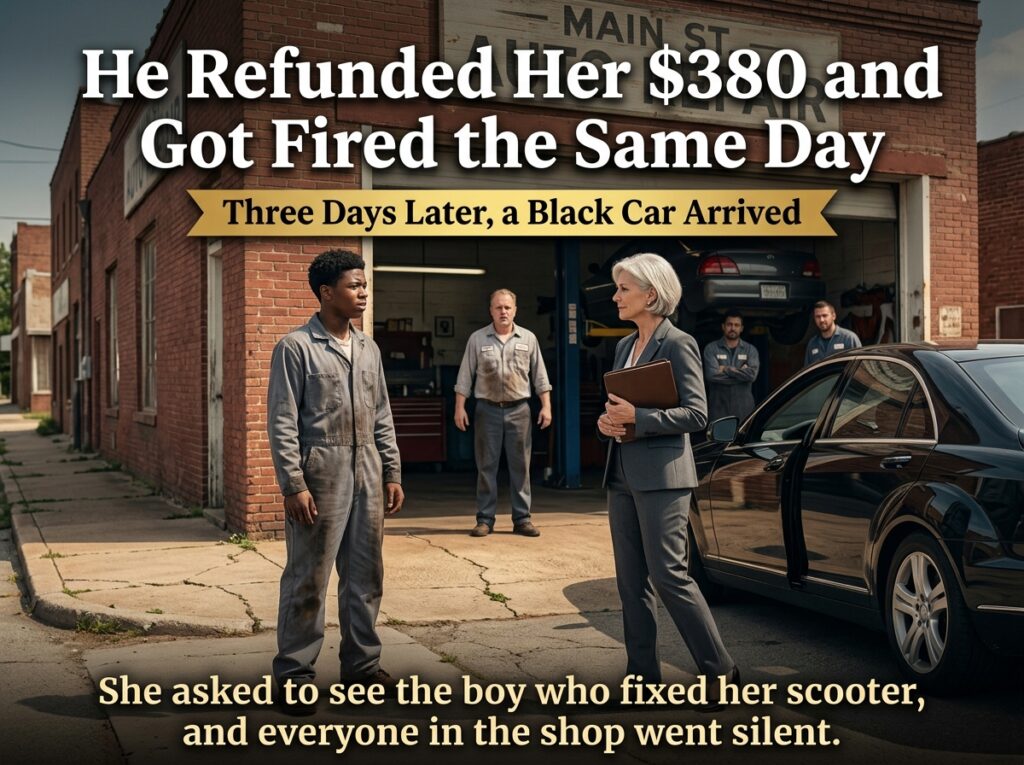
A woman stepped out of the car as I approached, dressed in a tailored charcoal-gray suit that fit her with the particular precision of genuinely expensive tailoring, carrying a leather folder with something printed across its front that I couldn’t quite make out from that distance. She was perhaps sixty, silver-haired, moving with an unhurried, deliberate confidence entirely unlike anyone I’d ever seen walk into that shop before.
Dale was standing near the entrance to the bay, and I watched, even from the sidewalk, his face go visibly pale as the woman approached, a reaction that told me, immediately, he recognized something about her presence that I did not yet understand.
“Mr. Prescott,” the woman said, her voice carrying easily across the distance, precise and unhurried. “My name is Renata Ashcombe. I represent the Voss Family Foundation.”
Dale’s mouth opened slightly, no sound coming out for a moment, before he managed, “I’m sorry, I don’t believe we’ve—”
“You serviced a mobility scooter belonging to Eleanor Voss four days ago,” Renata Ashcombe said, opening her folder, though she didn’t look down at it, the gesture more theatrical than genuinely necessary, the practiced move of someone who had memorized every detail already and simply wanted the visual weight of documentation present. “You quoted her four hundred twenty-five dollars for a repair that one of your own employees subsequently corrected to forty-five dollars, a price he assessed, correctly, as fair for the parts and labor actually required.”
I stood on the sidewalk, still several yards away, watching this unfold, feeling something cold and uncertain settle in my stomach, unsure whether whatever was happening represented rescue or considerably worse trouble than losing a job.
“I’d like to see the boy who fixed her scooter,” Renata Ashcombe said, and every mechanic visible in the open bay behind Dale, Ferris and Cody both, stopped whatever they were doing entirely, watching the exchange with the particular stillness of people who understood, without yet knowing details, that something significant was unfolding in front of them.
“That was Malik,” Dale said, his voice considerably smaller than I’d ever heard it. “Malik Bennett. He doesn’t work here anymore.”
“I’m aware,” Renata Ashcombe said. “I’d still like to see him. I understand he lives nearby.”
That was when Cody, standing in the bay, finally spotted me on the sidewalk and called out, loud enough for everyone to hear, “He’s right there, actually.”
Part 7
Every head turned toward me at once, and I felt, for a long moment, entirely frozen on that sidewalk, uncertain whether to approach or to quietly disappear back down the block the way I’d come.
Renata Ashcombe settled the question for me, walking directly toward me with the same unhurried confidence she’d shown crossing from her car, extending a hand once she was close enough.
“Malik Bennett,” she said. “Eleanor Voss asked me to find you personally, rather than simply mailing a thank-you card, which is what I initially suggested to her, before she made it clear that wouldn’t be sufficient for what she wanted to convey.”
“Is she all right?” I asked, my first genuine concern, still uncertain what exactly this well-dressed woman and her tinted-window car represented.
“She’s quite well,” Renata Ashcombe said, something almost like a smile working at the corner of her composed expression. “Though I suspect you don’t fully understand who it is you actually helped four days ago, which is, frankly, part of why she wanted you found and properly thanked rather than simply mailed a check that might have arrived without adequate context.”
“I don’t understand,” I admitted.
“Eleanor Voss,” Renata said, “is the founder and, until her retirement eleven years ago, the chief executive of Voss Regional Healthcare, a hospital system operating fourteen facilities across this part of Pennsylvania, including, I believe, the facility where your own mother currently works in the laundry department.”
I felt the ground shift slightly under that information, understanding, all at once, exactly why Dale’s face had gone so thoroughly pale watching this woman approach his shop.
“She lives modestly and dresses modestly by deliberate personal choice,” Renata continued, “a habit she’s maintained since her own childhood, growing up considerably poorer than most people would ever guess from meeting her today. She has spent a great deal of her adult life, and a considerable portion of her personal fortune, specifically testing whether the institutions and individuals she encounters treat her according to her actual bearing and behavior, or according to whatever assumptions they make based on her appearance and her apparent circumstances. Most people, Mr. Bennett, fail that test rather badly, precisely the way Mr. Prescott failed it four days ago, correctly assuming she wouldn’t push back against an inflated bill.”
“And I passed it,” I said slowly, understanding arriving in careful pieces.
“You passed it in a manner that cost you your position, according to what she was able to determine before sending me here,” Renata Ashcombe said. “Which is, specifically, the part she found unacceptable enough to insist on personal intervention rather than a simple thank-you note.”
Part 8
Dale, standing several yards away, had gone very quiet during this entire exchange, and I watched him now, understanding, with a certain grim satisfaction I wasn’t proud of but couldn’t entirely suppress, the particular horror of a man realizing exactly how badly he’d misjudged a customer’s actual standing and influence.
“Mr. Prescott,” Renata Ashcombe said, turning back toward Dale, her voice shifting into something considerably cooler and more precise than the warmth she’d shown me. “Mrs. Voss has asked me to convey several things to you directly, and I want to be clear that these are her words, communicated through me with her explicit authorization to share them exactly as given.”
Dale nodded, unable, it seemed, to produce actual speech.
“First,” Renata said, “she does not intend to pursue any formal complaint regarding the original overcharge itself, understanding that such practices, while ethically troubling, likely fall within some technical gray area of pricing discretion that would be difficult to challenge through consumer protection channels alone. Second, she is considerably more troubled by your decision to terminate an employee specifically for correcting that overcharge, a decision she views as retaliatory and, in her considered opinion, worth ensuring becomes known throughout this community’s business circles, through entirely legitimate means, meaning simply that she intends to mention it, accurately and without exaggeration, whenever your business practices come up in conversations she happens to be part of, which, given her standing in this region, may occur with some regularity.”
I watched Dale’s face as this landed, understanding, along with him, that Renata Ashcombe was describing something considerably more devastating to a small local business than any lawsuit could have been: the quiet, accurate word-of-mouth ruin of a reputation, delivered by someone whose opinion carried genuine weight in every room that mattered to Dale’s continued survival on Fifth Street.
“Third,” Renata continued, “Mrs. Voss would like to offer Mr. Bennett a position, effective immediately, in a program her foundation sponsors specifically for promising young mechanics and tradespeople, one that includes formal certification training, a genuine living wage considerably higher than whatever this shop was paying him, and, should he complete the program successfully, a recommendation toward continued education in automotive engineering, should that interest him.”
I stood on that sidewalk, feeling the full weight of the last three days, the anxious job applications, the rent envelope propped against our sugar jar, my mother’s exhausted, complicated pride, suddenly resolve into something I hadn’t allowed myself to fully hope for.
“I’d like that very much,” I said, my voice not entirely steady.
Part 9
The program, I learned over the following weeks, operated out of a training facility attached to one of Voss Regional Healthcare’s larger campuses, a partnership Eleanor Voss had established years earlier specifically to create pathways for young people in the region who showed genuine mechanical aptitude but lacked the financial resources to pursue formal certification on their own. I was, Renata Ashcombe told me during our first proper meeting there, exactly the kind of candidate the program had been designed for, though she added, with a small, dry smile, that Mrs. Voss had taken a considerably more personal interest in my specific case than she typically did with program candidates.
I met Eleanor Voss herself, properly, the following week, in an office at the training facility considerably more modest than I’d expected given everything Renata had told me about her actual wealth and influence. She was dressed, I noticed, exactly as she’d been dressed the day I’d fixed her scooter, a faded cardigan, no jewelry beyond a simple watch, nothing that would have told anyone in that room she represented the kind of resources capable of ending Dale Prescott’s business with a few well-placed conversations.
“I want to explain something to you, Malik,” she said, once the formal program paperwork had been settled and Renata had stepped out to handle another matter. “I did not create today’s test lightly, and I did not create it, either, purely out of some abstract philosophical interest in whether strangers would treat me fairly. I created it because I spent the first eighteen years of my own life being treated exactly the way your former employer treated me four days ago, by people who looked at my family’s circumstances and decided we could be charged more, offered less, spoken to with less patience, simply because they judged, correctly in most cases, that we lacked the resources or the standing to push back.”
“How did you get from that,” I asked, “to owning fourteen hospitals?”
“Slowly,” she said, something wry in her expression. “And with a great deal of help from people who, at crucial moments, chose not to look away. A nursing supervisor who mentored me through my first hospital job despite my lack of formal education. A bank loan officer who approved financing for my first small clinic despite my thin credit history, because he’d watched me work and decided my character mattered more than my paperwork. People like you, Malik, scattered across a lifetime, at moments when it would have cost them nothing at all to simply look away, the way your two coworkers did, and chose instead to do something small and difficult and correct.” She studied me for a long moment. “I have spent the better part of four decades trying to become, for other people, what those individuals were for me, at exactly the moments when it mattered most. I believe you’re going to do the same, eventually, for someone considerably further down whatever path you’re about to walk.”
Part 10
I completed the foundation’s certification program eighteen months later, graduating with credentials that would have taken years longer and considerably more money to obtain through any conventional path, and I took a position, at Eleanor Voss’s specific suggestion, at a full-service auto shop in the next town over, one owned by a woman named Colette Fournier who’d graduated from the very same program herself, a decade earlier, and who ran her business, I discovered within my first week, according to a pricing philosophy precisely opposite to Dale Prescott’s, transparent itemized estimates for every customer regardless of how they were dressed or how they carried themselves.
Dale Prescott’s shop, I learned through the particular grapevine that still connects Riverside’s small business community, closed permanently about eight months after that black car pulled up outside it, the quiet, accurate word of Eleanor Voss’s actual influence rippling through exactly the circles Renata Ashcombe had promised it would, without any single dramatic confrontation, simply the slow, cumulative erosion of a reputation finally catching up to years of quietly rounding up on customers who’d had no way, until that particular Thursday afternoon, to push back.
My mother still works at the hospital laundry facility, though she’s since been promoted to a supervisory position, a change she credits, at least partly, to Eleanor Voss having quietly mentioned, to the appropriate department head, that she’d taken a personal interest in the Bennett family and would appreciate her advancement being considered on the merits whenever opportunities arose, a piece of institutional weight I understand, now, considerably more clearly than I did as a seventeen-year-old standing on a sidewalk outside a repair shop.
I keep, still, a small item on the workbench at my current shop, something Eleanor Voss gave me on the day I completed my certification program: the same paper napkin from that diner, the one where she’d first written down my name, preserved now in a small plastic sleeve, her handwriting still legible after two years, *Malik Bennett*, written in a careful, deliberate hand that I understand, now, belonged to a woman considerably more accustomed to signing documents that moved millions of dollars than to writing a stranger’s name on a diner napkin.
I think, often, about the eleven minutes it took me to fix that scooter, and about how easily I could have looked away instead, the way Ferris and Cody did, the way most people, most days, quietly choose to do when the cost of noticing something wrong falls entirely on themselves rather than on the person actually being wronged. I think about my mother’s words, that second night, sitting at our kitchen table with the rent envelope propped against the sugar jar: *I’d rather struggle with rent than raise a son who’d have looked away.*
I did not know, standing in that bay with a wire brush in my hand, that eleven minutes of honest work would eventually lead to a certification, a new job, my mother’s promotion, and a woman in a tailored gray suit stepping out of a black car to make sure a seventeen-year-old apprentice understood exactly what his small, quiet decision had actually been worth. I only knew, in that moment, that I could not watch Dale round up on a woman doing careful, anxious math about her own fixed income, and call that acceptable simply because looking away would have been easier.
Some tests, I’ve come to understand, arrive wearing a faded cardigan and driving a broken-down mobility scooter, offering no advance warning at all that anything beyond fifteen minutes of straightforward mechanical work is actually being measured. I passed mine without ever knowing, until three days later, exactly what had been riding on the answer.