Part 1
My name is Celeste Abernathy, I’m thirty-four, and I want to describe exactly what Christmas morning looked like before everything went wrong, because I have spent the months since turning over every single detail, searching for some warning sign I somehow missed, some indication that dropping my daughters at my own parents’ front door would end with a stranger calling me from a hospital emergency room to say two little girls had been found collapsed on a frozen lawn three-quarters of a mile away.
My husband, Owen, had been admitted to St. Agatha’s Medical Center two days before Christmas, a sudden, severe case of pancreatitis that had put him in considerable pain and, by Christmas morning, had progressed to a point where his doctors wanted to discuss, with me directly and without our children present, whether surgical intervention would be necessary. I had explained this to my own mother, Marjorie, three separate times over the preceding two days: that I needed somewhere safe for my daughters, Juniper, eight, and Dahlia, three, while I met with Owen’s medical team on Christmas morning, and that I expected to be gone no more than two hours.
“Of course,” my mother had said, each time I’d raised it, with what I believed, at the time, was genuine warmth. “Bring them over. We’ll have Christmas snacks ready, and your father’s already set up the little train set in the living room for Dahlia.”
I drove to my parents’ house at nine o’clock that Christmas morning, both girls bundled in their coats and scarves against a cold that had dropped, overnight, into the single digits, a particularly brutal front that the local news had been warning about for days. Juniper sat in the back seat beside her little sister’s car seat, holding Dahlia’s mittened hand the way she always did on car rides, a protective, steady presence that I had, over eight years of parenting, come to rely on more than I probably should have for a child her age.
“Head inside,” I told them, pulling into my parents’ driveway, my own mind already racing ahead to the hospital, to whatever conversation awaited me with Owen’s surgical team. “I’ll be back in a couple of hours, I promise. Be good for Grandma and Grandpa.”
“Okay, Mommy,” Juniper said, already unbuckling her own seatbelt and reaching across to help with Dahlia’s. “Tell Daddy I love him.”
I watched them walk up the driveway toward my parents’ front door, Juniper’s hand wrapped around her sister’s, both of them small and bundled against the cold, and I believed, with the particular unquestioning faith you extend to your own parents, that I was watching them walk into warmth and safety.
I drove to the hospital without looking back.
Part 2
I spent the following two hours in a small consultation room with Owen’s surgical team, discussing risks and timelines and recovery expectations with a focus so complete that I did not check my phone a single time, a fact I have replayed, since, with a particular kind of horror I don’t know how to fully describe.
It was only once the consultation had ended, once I’d sat with Owen himself for nearly forty minutes, holding his hand while he drifted in and out of pain-medicated sleep, that I finally pulled out my phone and saw seven missed calls from a number I didn’t recognize, along with a voicemail that had been left eleven minutes earlier.
I want to describe, as precisely as I can, the particular sensation of listening to that voicemail, a stranger’s voice, calm but carrying an unmistakable urgency, explaining that she was calling from a residence on Thornbury Lane, that two young girls had been found in her front yard roughly twenty minutes earlier, one of them unconscious and showing signs of severe cold exposure, the other barely able to speak but coherent enough to recite a phone number from memory.
I do not remember the drive from Owen’s hospital room to my car. I do not remember most of the drive to Thornbury Lane, a street I had to look up with shaking hands because I had genuinely never heard of it before in my life, a full three-quarters of a mile from my parents’ own house in a direction that made no sense to me at all, until I understood, with a horror that still returns to me some nights, exactly what that distance actually meant.
An ambulance had already arrived by the time I pulled up, red and blue lights washing across a modest ranch house’s snow-covered lawn, a small cluster of EMTs working over what I could see, even from my car, was a very small, very still form on a stretcher, while a second EMT knelt beside my older daughter, wrapped in a thermal blanket, sitting upright on the porch steps.
“Mommy!” Juniper called out, the moment she saw me, her voice cracking with a combination of relief and the particular ragged exhaustion of a child who has pushed her own body considerably further than any eight-year-old should ever be asked to go.
I ran to her, dropping to my knees on that frozen lawn, and I want to be honest that in that first moment, my entire mind was consumed with Dahlia, with the stretcher being lifted into the ambulance, with the particular stillness of my three-year-old’s small form beneath a thermal blanket.
“Is she breathing,” I said, to anyone, to everyone, my voice coming out as something close to a scream.
“She’s breathing,” the nearest EMT said quickly. “Mild to moderate hypothermia, ma’am, she’s responsive. We need to transport both girls immediately.”
Part 3
I rode in the ambulance with Dahlia while a second ambulance, following close behind, carried Juniper, who had insisted, with a stubbornness that broke my heart even in the chaos of that moment, that she was “fine enough to wait” so that I could ride with her little sister instead.
Dahlia’s eyes fluttered open partway through the ride, her small body shaking despite the thermal blankets and the ambulance’s heater running at full capacity, and when she finally focused on my face, she didn’t cry or ask any of the questions I might have expected from a frightened three-year-old. She simply reached one small hand toward me and said, in a voice thinned by cold and exhaustion, “June carried me.”
I held her hand the rest of the way to the hospital, unable to speak, understanding only in fragments the full shape of what must have happened in the two hours I’d been sitting in a consultation room discussing my husband’s surgical risks.
Both girls were admitted for observation, Dahlia kept for considerably longer given the severity of her exposure, a frightening several hours where her core temperature remained low enough that the attending pediatrician, a careful, kind woman named Dr. Osei, kept her expression deliberately neutral in a way that told me, more than any direct statement could have, exactly how serious the situation had actually been.
It was Juniper, once she’d been warmed and stabilized and given something hot to drink, who finally told me what had happened, her small voice steady in the particular way children sometimes manage when they’ve already processed something terrible and simply need, now, to get the facts out in order.
“We knocked on Grandma’s door,” she said, “and she opened it and looked at us, and she said we should have called first before just showing up. I told her Daddy was in the hospital and you had to go talk to the doctors, and she said that wasn’t her problem today, that she and Grandpa had plans, and then she shut the door.”
“You waited,” I said carefully. “On the porch.”
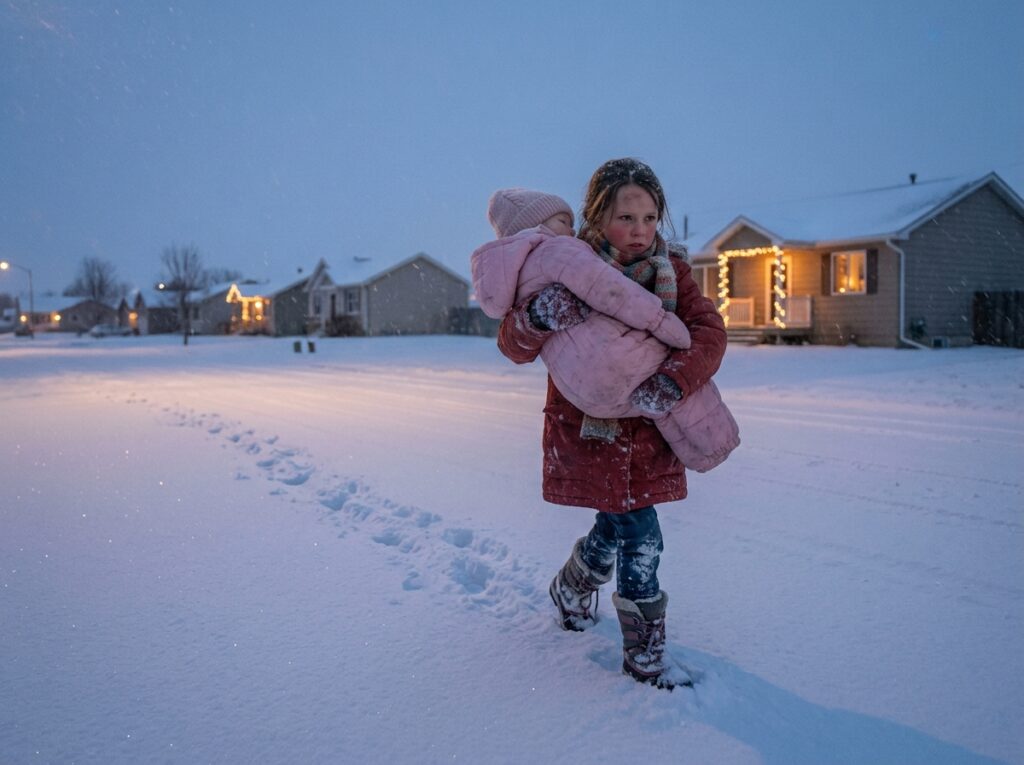
“I thought maybe she’d come back,” Juniper said, her composure finally beginning to crack. “I thought maybe she just needed a minute, or maybe Grandpa would come out instead. We waited a long time, Mommy. Nobody came back out. And it was so cold, and Dahlia started crying, and I didn’t know what else to do, so I thought, our house isn’t that far, I know the way, I’ve walked it with you before.”
I sat very still, my own heart breaking in a way I hadn’t known was possible, listening to my eight-year-old daughter describe, in careful, matter-of-fact detail, deciding to walk three-quarters of a mile home through single-digit temperatures because her grandmother had shut a door on her and her little sister and nobody had ever opened it again.
“When Dahlia couldn’t walk anymore,” Juniper said, “I carried her. I know I’m not supposed to be able to carry her that far, but I just kept thinking, we have to get home, we have to get somewhere warm, and I just kept walking until I couldn’t anymore either.”
Part 4
“Is Daddy okay?” she asked then, the question arriving with a particular shift in her voice, as though some internal accounting had finally cleared enough space for her own fear about her father to surface fully for the first time since the ambulance arrived.
“Daddy’s okay,” I told her, my voice breaking. “He’s going to need surgery, but he’s going to be okay, sweetheart.”
Juniper nodded, something in her small shoulders finally relaxing, and then, very quietly, almost as an afterthought, she said the sentence that I have not been able to stop hearing since.
“Grandma wouldn’t let us stay.”
I called my father that evening, sitting in a hospital hallway between my two daughters’ rooms, my hands shaking with a fury I had never, in thirty-four years, directed at either of my parents.
“Dad,” I said, “did you know they were walking away alone? Down the driveway, in this cold, on Christmas?”
There was a long pause on the line, long enough that I understood, before he even answered, that the answer was going to confirm something I desperately did not want confirmed.
“I saw them go down the driveway,” he said finally, his voice carrying something that sounded, horribly, more like resignation than horror.
“And you did nothing,” I said, my voice coming out very quiet now, considerably more frightening, I think, than if I’d been shouting. “You watched your own grandchildren, eight and three years old, walk away from your house alone, in single-digit weather, and you didn’t go after them. You didn’t call me. You didn’t call anyone.”
“Your mother told me not to interfere,” he said. “She said they’d figure it out, that it wasn’t that cold, that you’d probably just drive back and pick them up from the end of the street once you realized they weren’t there.”
“They nearly died, Dad,” I said. “Dahlia’s core temperature was low enough that the doctor wouldn’t give me a straight answer for three hours about whether she was going to be all right. Juniper carried her sister until her own body gave out, and the only reason either of them is alive right now is that a stranger happened to look out her window at exactly the right moment.”
My father was silent for a long time. “I should have gone after them,” he said finally, his voice breaking in a way I had genuinely never heard from him in my entire life. “I knew it the second they walked down that driveway, and I didn’t do it anyway, because I didn’t want to argue with your mother in front of the neighbors. I’ll carry that for the rest of my life, Celeste. I don’t expect you to forgive me for it.”
Part 5
I did not speak to my mother at all that night, a silence I maintained deliberately, understanding that whatever words I might find in that first raw hour would accomplish nothing beyond escalating a situation that had already nearly cost my daughters their lives.
The stranger who had found my girls, a retired nurse named Deborah Fennimore, visited the hospital the following day, bringing with her a level of careful, detailed account that proved, in the weeks that followed, considerably more useful than I could have anticipated in that first devastating moment.
“I was clearing snow off my own front steps,” she told me, sitting with me in the hospital’s small family waiting area, “when I saw the older girl come around the corner from Hadley Street, moving slowly, carrying what I thought at first was a large bundle of blankets. It took me a moment to realize it was actually her little sister, and by the time I understood that, she’d already made it about halfway up my own front walk before she simply sat down in the snow, still holding onto her sister, like her legs had just stopped working.”
“Thank you,” I said, my voice breaking, “for finding them. For calling. I don’t know how to properly thank you for what you did.”
“She gave me your number before she lost consciousness,” Deborah said. “Recited it from memory, twice, to make sure I had it right, and then she said, ‘Please call my mom, she’s at the hospital with my dad,’ and then she just closed her eyes. I want you to know, before anything else gets said about that day, that your daughter is one of the most remarkable children I’ve encountered in forty years of nursing. She never once panicked, even half-frozen herself. She simply made sure I had what I needed to help her sister before she allowed herself to stop fighting.”
I sat with that account for a long time after Deborah left, understanding, with a particular painful clarity, exactly how close I had come to losing both of my daughters on a stranger’s front lawn, three-quarters of a mile from a grandmother’s house where a door had simply closed and stayed closed.
Part 6
My mother called me four times over the following three days, calls I did not answer, before finally sending a text message that read, in its entirety: *I think you’re overreacting. They were fine. Kids walk places all the time. You’re acting like I tried to hurt them.*
I read that message perhaps a dozen times, feeling something harden in my chest with each reading, a particular cold clarity replacing whatever remaining instinct I might have had to simply smooth this over the way families sometimes do, folding genuine harm into the comfortable, forgiving language of misunderstanding.
I did not respond to that text. Instead, I consulted a family law attorney, a careful, direct woman named Priscilla Ohanzee, laying out the full sequence of events: my explicit, repeated requests for safe childcare, my mother’s explicit refusal to let my children inside despite being told my husband was hospitalized, my father’s admission that he’d watched them leave and done nothing, and the medical outcome that had resulted from both decisions.
“I want to understand my options,” I told Priscilla, “not necessarily to pursue anything immediately, but I need to know what exists, because I am not currently willing to simply trust my parents with my children’s safety again, and I expect that decision is going to create considerable conflict within my family.”
Priscilla outlined, carefully, the various paths available: a formal report to child protective services, documenting what had occurred, which she noted would create an official record regardless of whether any further action followed; the theoretical possibility, though she assessed it as unlikely to succeed given the specific circumstances, of some form of civil liability claim; and, considerably more practically, a clear legal basis for formalizing, through our own family court system if necessary, specific restrictions on unsupervised contact between my parents and my children going forward.
“I don’t necessarily want to destroy my relationship with my parents entirely,” I told her, my voice catching. “But I need my daughters to be safe first, before any question of repairing that relationship even becomes relevant.”
“That’s an entirely reasonable position,” Priscilla said. “I’d recommend filing the CPS report regardless of what else you decide, both because what occurred genuinely does constitute a reportable incident of child endangerment, and because having that official record will considerably strengthen your position if your mother or father ever contest any boundaries you choose to put in place going forward.”
Part 7
The CPS report, once filed, triggered a formal investigation that unfolded over the following six weeks, a process that proved, I want to be honest, considerably more painful and invasive than I had anticipated, even though I understood, intellectually, exactly why each step of it was necessary.
My mother, interviewed by a caseworker named Rosalind Achebe, offered an account that differed substantially from what my daughters had described, insisting that she had simply asked the girls to wait on the porch “for just a minute” while she finished a phone call, and that she had no idea they had left until considerably later, when she’d gone to check on them and found the porch empty.
My father, interviewed separately, contradicted this account directly, confirming, under Rosalind’s careful, professional questioning, that he had personally witnessed both girls walking down the driveway and away from the house, and that my mother had explicitly instructed him not to intervene.
The investigation’s final determination, delivered to me in a careful, formal letter roughly six weeks after that Christmas morning, substantiated a finding of child endangerment connected to the incident, a determination that did not result in any criminal charges, given my parents’ advanced age and lack of any prior history, but that did create a permanent record and resulted in a formal recommendation that my children not be left in my parents’ unsupervised care going forward.
I used that finding, alongside Priscilla’s careful guidance, to establish, through a formal written agreement rather than any court order, clear boundaries for my family going forward: my parents could see my daughters only with me or Owen present, a restriction I presented not as a punishment but as simply the only arrangement I was currently capable of trusting, given what had already happened once.
My mother received that boundary with a fury that unfolded, over the following months, into a prolonged, painful estrangement, one she characterized, to anyone in our extended family willing to listen, as my own overreaction to “a simple misunderstanding” rather than an appropriate response to a decision that had nearly cost both my daughters their lives.
Part 8
My father, in contrast, responded to the boundary with a particular quiet, sustained effort that surprised me, given how passively he had behaved on that Christmas morning itself.
He began requesting supervised visits considerably more frequently than my mother did, arriving each time with a genuine, careful attentiveness toward both girls that felt, gradually, like actual repair rather than simply performance aimed at restoring his own access.
“I think about that day constantly,” he told me, roughly four months after Christmas, sitting in my own living room while Juniper and Dahlia played nearby, a supervised visit he had specifically requested without my mother present. “I’ve gone over it in my mind more times than I can count, and every single time, I arrive at the same conclusion: I knew, in the moment, that watching them walk away was wrong. I knew it with absolute certainty. And I let your mother’s preference for avoiding an argument override something I knew, instinctively, was dangerous. I don’t know how to properly apologize for that, Celeste. I don’t think there’s an apology adequate to what actually happened.”
“I appreciate you saying that,” I told him, “and I want you to understand that I believe you, that you genuinely regret it. But I need you to understand something else too, Dad. Regret doesn’t undo the fact that my eight-year-old nearly died carrying her little sister through the snow because the two adults responsible for their safety that morning chose, separately, not to act. I’m not asking you to carry guilt forever. I’m asking you to understand why rebuilding trust is going to take considerably longer than a single conversation, however sincere.”
He nodded slowly, accepting that without argument, and continued, over the following year, to show up for every supervised visit with a patient, consistent effort that eventually, gradually, began to earn back something closer to the relationship we’d had before that Christmas morning.
My mother never fully accepted the boundary, a stance that resulted, eventually, in a far more significant distance between us than the one I had initially intended to create, a distance that persists, at the time of this account, with no clear resolution in sight.
Part 9
Juniper, remarkably, showed, over the following year, a resilience that both reassured and worried me in equal measure, the particular complicated gift of a child who had handled an extraordinary crisis with extraordinary competence, a competence that I understood, working alongside a careful child therapist named Dr. Weston Ibori, might eventually require her to simply be allowed to be eight years old again, rather than continuing to carry the particular adult weight of having kept her little sister alive through a genuine emergency.
“She did something remarkable,” Dr. Ibori told me, during one of our own parent consultation sessions, “and I want you to continue celebrating that courage with her, genuinely and often. But I also want you to watch carefully for signs that she’s begun to believe, on some deeper level, that keeping everyone safe is now permanently her job, rather than something she did once, under extraordinary circumstances, that adults around her should have never required of her in the first place.”
I took that guidance seriously, working deliberately, over the following months, to make sure Juniper understood, repeatedly and consistently, that what happened that Christmas was never, under any circumstances, something she should have had to do, that the failure belonged entirely to the adults who should have protected her, not to any insufficiency in her own eight-year-old judgment about when and how to seek help.
Dahlia, considerably younger, retained only fragmented memories of the day itself, mostly centered, her own pediatrician assured me, around the physical sensation of cold rather than any lasting psychological impact, a particular mercy of her young age that I found myself grateful for even while remaining watchful for any signs of delayed impact as she grew older.
“June carried me,” she still says sometimes, months later, apropos of nothing, a simple statement of fact rather than any apparent distress, though I notice, each time she says it, the way Juniper’s own face carries a complicated mixture of pride and something considerably heavier that I understand will take years of careful, patient support to fully resolve.
Part 10
It has been eighteen months since that Christmas morning, and I am thirty-six now, and I want to describe, honestly, where my family currently stands, because I understand that stories like this one often want a cleaner resolution than the actual, ongoing work of rebuilding trust typically provides.
My father sees my daughters regularly now, always supervised, a restriction he has never once pushed back against, understanding, I believe genuinely, exactly why it remains necessary even as our own relationship has slowly, carefully repaired itself over eighteen months of consistent, patient effort on his part.
My mother sees them considerably less, a distance she has, at various points, attributed to my own stubbornness rather than to any genuine reckoning with what actually happened that Christmas morning. I have made peace, as much as I am currently able, with the possibility that this particular relationship may never fully recover, that some ruptures, however painful, simply reveal something too fundamental about a person’s priorities to ever be fully repaired.
Owen recovered fully from his surgery, a recovery that unfolded, mercifully, without complication, though he carries, alongside me, a particular guilt about having been hospitalized at all during the exact window when our daughters needed protection he wasn’t available to provide, a guilt I have worked to help him release, understanding that neither of us could have anticipated what would actually happen once those girls walked up that driveway.
Juniper is nine now, considerably more herself again with each passing month, though I notice, still, a particular watchfulness in her that wasn’t there before that Christmas, a habit of checking on her little sister’s wellbeing that goes somewhat beyond ordinary sibling affection, something Dr. Ibori tells me will likely soften, gradually, as she continues processing what happened with appropriate support rather than being asked to simply move past it.
Deborah Fennimore, the retired nurse who found my daughters on her own front lawn, remains, eighteen months later, a genuine and welcomed presence in our lives, invited to every birthday party, every significant family occasion, a woman my daughters have come to think of as something close to a second grandmother, one who, unlike my own mother, opened her door without a single moment’s hesitation when two freezing children needed exactly that.
I think, often, about the particular randomness of survival, about how close my daughters came to a considerably more devastating outcome, dependent entirely on whether a retired nurse happened to be clearing snow from her own front steps at precisely the right moment. I think, too, about the particular weight of raising two daughters who now understand, at ages nine and four, something about the world that I would have given almost anything to protect them from learning so young: that sometimes the people who are supposed to keep you safest are the ones who close the door, and that sometimes, when that happens, you simply have to carry each other until someone else finally opens theirs.