
Part 1
The first thing I noticed was the truck.
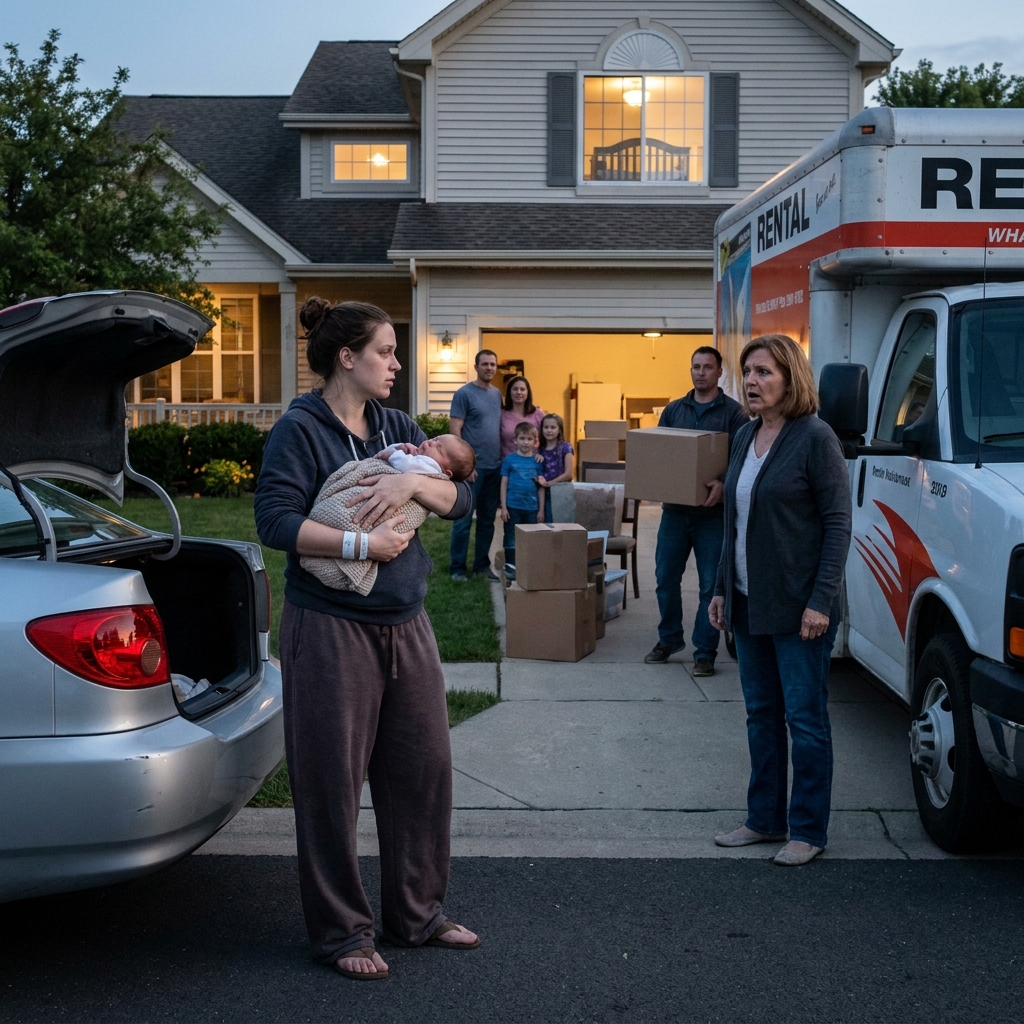
It was parked crookedly across my driveway, large enough that its rear end nearly blocked the mailbox. The engine was still running, and the faint vibration traveled through the pavement beneath my shoes.
For a few seconds, I simply stared through the windshield.
I was exhausted.
Not ordinary exhausted.
The kind of exhaustion that seemed to live inside my bones.
Thirty-six hours earlier, I had been rushed into an emergency C-section after my daughter’s heart rate dropped unexpectedly. I had spent the night in a hospital room learning how to hold a newborn without putting pressure on an incision that felt like someone had cut me open and forgotten to close me properly.
Now my daughter was asleep in the car seat beside me.
She was five days old.
Five days.
I had imagined this moment differently.
I had imagined carrying her through the front door while my husband took pictures. I had imagined crying over the nursery. I had imagined making coffee while she slept against my chest.
Instead, I was sitting in my driveway staring at a moving truck.
Then my mother stepped into view.
She wore the same confident expression she always wore when she had already made a decision for someone else.
She lifted one hand.
“Perfect timing.”
I lowered the window.
“Mom?”
She smiled.
“We’re moving in tonight.”
I actually laughed.
Not because it was funny.
Because my brain couldn’t process what she had just said.
Behind her, my stepfather was carrying a cardboard box.
My sister Brittany stood beside the garage with her boyfriend, Kyle. Two children I barely recognized as having grown so much since I had last seen them were running around the driveway.
There were already at least twenty boxes stacked near my garage door.
I looked at my mother.
Then at the boxes.
Then at the moving truck.
“What’s happening?”
Mom frowned.
“I just told you. We’re moving in.”
“Who is moving in?”
She gave me a look that made me feel like I was the one being unreasonable.
“All of us.”
My stomach tightened.
“All of you?”
“Me. Your stepfather. Brittany. Kyle. The children.”
She pointed toward my house.
“You have four bedrooms.”
I stared at her.
“Mom, I just had a baby.”
“I know.”
“You know I had surgery.”
“I know that too.”
“And you’re moving six people into my house?”
“Family helps family.”
There it was.
Those four words had controlled my childhood.
Family helps family.
Family doesn’t say no.
Family doesn’t ask questions.
Family doesn’t keep score.
Family doesn’t lock doors against each other.
Family doesn’t call the police.
My mother had used those sentences for years whenever she wanted something from me.
Money.
Favors.
A place to stay.
A signature.
A loan.
An apology.
A second chance.
And every time I resisted, she made me feel like I was betraying the family.
But something had changed.
Six months earlier, my mother had crossed a line she could not uncross.
She had used my old address to open a credit card.
She had listed me as guarantor.
Without asking.
Without telling me.
I discovered it when a collection notice arrived.
At first, I thought it was a mistake.
Then I called the card company.
They told me the account had been opened using information connected to me.
I asked who had submitted the application.
They wouldn’t tell me everything over the phone.
But I already knew.
My mother.
When I confronted her, she didn’t apologize.
She laughed.
“It was just temporary.”
“You used my information.”
“I used an old address.”
“You put me down as guarantor.”
“Because I knew you’d help me.”
“That’s not the same thing.”
She rolled her eyes.
“You’re making everything dramatic.”
That sentence had been the final crack.
I hired an attorney.
I installed cameras around my property.
I changed passwords.
I secured financial documents.
And I started saving every message.
Every text.
Every email.
Every voice message.
I stopped treating my mother like family.
I started treating her like a legal risk.
And tonight, she had just walked into the exact situation she had created.
I opened the car door carefully.
My incision pulled painfully when I stood.
My mother noticed.
“Don’t overdo it,” she said. “You should rest.”
Then she turned toward my stepfather.
“Start with the upstairs rooms.”
He nodded.
He reached for a box.
I stepped between him and the front door.
“Don’t.”
My stepfather froze.
Mom sighed.
“Oh, please.”
“This isn’t happening.”
She stared at me.
“You don’t mean that.”
“I do.”
Brittany crossed her arms.
“Seriously? You’re going to make us stand outside?”
“I didn’t invite you.”
She laughed.
“Mom said we could stay.”
“Mom doesn’t own this house.”
Silence.
My mother slowly smiled.
“Oh, sweetheart.”
She stepped closer.
“You really think this is about ownership?”
I looked at her.
“Yes.”
Her smile disappeared.
“No,” she said. “This is about family.”
I reached into my pocket.
Pulled out my phone.
And unlocked the screen.
Mom glanced at it.
“Who are you calling, your doctor?”
I looked directly into her eyes.
“No.”
I pressed a number.
“I’m calling the police.”
Part 2
For the first time that night, my mother stopped smiling.
Brittany looked at her.
Kyle looked at Brittany.
My stepfather slowly put the box back on the ground.
Nobody moved.
I kept the phone against my ear.
The dispatcher answered.
I gave my address.
I explained that several people had arrived without permission and were attempting to enter my home.
My mother immediately began shouting.
“She’s exaggerating!”
I turned away from her.
“Yes, they’re still here.”
Mom stepped toward me.
“Hang up.”
I didn’t.
“Please remain on the line.”
I nodded.
“I’m here.”
My daughter stirred inside the car.
That tiny sound cut through everything.
I looked at her.
Five days old.
Her face was still wrinkled from birth.
One little hand had escaped from the blanket.
Suddenly, I wasn’t thinking about my mother anymore.
I was thinking about the nursery upstairs.
The room Mom had casually decided belonged to Brittany’s children.
The room I had spent months preparing.
The pale walls.
The crib.
The rocking chair.
The tiny books arranged on a shelf.
The stuffed rabbit my husband had bought before we knew whether we were having a boy or girl.
The blanket my grandmother had knitted years before she died.
That room wasn’t a spare bedroom.
It was my daughter’s first home.
And my mother had decided it was available.
“You’ve lost your mind,” Brittany said.
I looked at her.
“No. I finally stopped letting you make decisions for me.”
She scoffed.
“You’re seriously calling the police on Mom?”
“She’s trespassing.”
“It’s our family home.”
“No.”
“You know what I mean.”
“I do.”
I looked toward the house.
“You mean the house you all decided belonged to you because I was the one who bought it.”
Mom interrupted.
“Bought it?”
She laughed.
“You didn’t build that house alone.”
“I paid for it.”
“With family support.”
I almost laughed.
Family support.
Another phrase.
She had helped me move into the house once.
That was the extent of her contribution.
She had brought three casseroles during the first week.
She had later started referring to it as “our family home.”
I had ignored it.
At first.
Because correcting her wasn’t worth the argument.
But after the credit-card incident, I had stopped ignoring things.
My attorney had discovered something my mother didn’t know.
The property wasn’t simply in my personal name.
Years earlier, before I married, my grandfather had established a family trust.
I had been the beneficiary.
The house had been purchased through that structure.
My mother had no ownership interest.
No right to occupy it.
No authority over it.
And absolutely no right to decide who lived there.
My mother knew none of this.
She thought because I was her daughter, she had some permanent claim on anything I owned.
That assumption had protected her for years.
Until tonight.
A police cruiser finally appeared at the end of the street.
My mother saw it.
Her face hardened.
“You actually did it.”
I nodded.
“Yes.”
She walked toward me.
“You embarrassed me.”
I looked down at my newborn.
“No, Mom.”
I raised my eyes.
“You embarrassed yourself.”
The officer approached.
“What’s going on?”
Mom immediately stepped forward.
“This is my daughter’s house.”
The officer looked at me.
“Are you the homeowner?”
“I am the legal occupant and beneficiary of the property.”
Mom interrupted.
“She’s my daughter.”
The officer remained calm.
“Ma’am, I’m asking her.”
Mom’s jaw tightened.
I handed him my identification.
Then I showed him the documentation my attorney had told me to keep accessible.
He examined everything.
Then he looked at the truck.
“Did these people have permission to move in?”
“No.”
Mom scoffed.
“Of course she gave permission.”
“I didn’t.”
“You told me last month that we could stay.”
“No.”
“You said we’d figure something out.”
“That’s not permission to move six people into my home.”
The officer asked Mom to step aside.
She refused.
Then another officer arrived.
The situation became painfully quiet.
My mother finally understood that the police weren’t going to force me to accept her version of events simply because she was my mother.
The officer explained that she needed to leave the property unless I gave permission for her to remain.
Mom stared at me.
“You’re throwing your own mother out.”
I felt something inside me break.
Not because I felt guilty.
Because I realized I didn’t.
“I didn’t throw you out,” I said quietly.
“You brought yourself here.”
My stepfather looked down.
Brittany began crying.
Kyle said nothing.
The children were confused.
And my mother stood in my driveway surrounded by boxes she had packed for a home that had never belonged to her.
The officers helped ensure everyone left the property.
The moving truck pulled away.
My mother remained in the passenger seat.
She lowered the window as they passed.
“You’ll regret this.”
I watched the truck disappear around the corner.
Then I carried my daughter inside.
For the first time that night, I locked the door.
Part 3
I thought that would be the end.
It wasn’t.
My mother had spent my entire childhood believing that if she pushed hard enough, eventually everyone would give in.
And she wasn’t about to stop now.
The next morning, I woke up to seventeen missed calls.
Fourteen were from Mom.
Two were from Brittany.
One was from an unknown number.
I didn’t answer any of them.
Instead, I called my attorney.
“She tried to move into the house last night.”
“I know.”
I paused.
“You know?”
“Your cameras recorded everything.”
I closed my eyes.
Of course they had.
Every entrance to the property was covered.
My attorney had recommended the cameras after the credit-card incident.
At the time, I had felt ridiculous installing them.
Now I was grateful.
“Can you send me the footage?”
“Already did.”
I opened the file.
There it was.
My mother arriving with the moving truck.
My stepfather carrying boxes.
Brittany entering the driveway.
Mom pointing toward the upstairs rooms.
Every word was captured.
Including the part where she said, “We’re moving in tonight.”
My attorney was silent for a moment.
Then he said, “This is useful.”
“Useful?”
“Very.”
I sat on the edge of the bed.
“What should I do?”
“Don’t respond emotionally.”
“I haven’t.”
“Good. Keep everything.”
He paused.
“There’s another issue.”
“What?”
“Your mother’s old credit account.”
My stomach dropped.
“What about it?”
“We received additional documentation.”
He emailed it to me.
I opened the attachment.
The application contained my old address.
My name.
My phone number.
And a digital signature that was not mine.
I stared at the screen.
My mother hadn’t simply made a mistake.
She had knowingly used my identity.
The account had been opened months before she admitted anything.
There were purchases I hadn’t made.
Late payments.
Cash advances.
A balance that was much larger than I expected.
And attached to the application was a document claiming I had agreed to guarantee the account.
I hadn’t.
My attorney said, “We’ve already disputed your responsibility.”
“Will it affect my credit?”
“Not if we handle it properly.”
I looked at the screen.
Then I remembered Mom’s words.
You’re family.
She had used that word like a shield.
Every time she crossed a boundary, she hid behind it.
Family helps family.
Family doesn’t say no.
Family doesn’t call the police.
But there was something she had never understood.
Family is supposed to mean trust.
It isn’t supposed to mean access.
That afternoon, my sister called again.
This time I answered.
“You really called the police?”
“Yes.”
“Mom’s devastated.”
I didn’t respond.
“She said you treated her like a criminal.”
“She used my information to open a credit card.”
Brittany went quiet.
“She said that was a misunderstanding.”
“It wasn’t.”
“She said you knew about it.”
“I didn’t.”
“She said you agreed.”
“I didn’t.”
Another silence.
Then Brittany said, “You’re different now.”
I looked toward the nursery.
Maybe I was.
“Yes.”
“Since the baby.”
“No.”
I shook my head.
“Since I realized being someone’s daughter doesn’t mean I have to surrender my life to them.”
Brittany sighed.
“Where are we supposed to go?”
“That’s not my decision.”
“Mom says the house has always been for all of us.”
“It was never hers.”
“But you’re our sister.”
“I know.”
“And family should help family.”
I almost smiled.
“Then help Mom find somewhere to live.”
She hung up.
That evening, I received a text from my mother.
Only one sentence.
You will hear from my lawyer.
I stared at it for several seconds.
Then I forwarded it to mine.
My attorney replied almost immediately.
“Good.”
I frowned.
“Good?”
“Let her send one.”
He paused.
“Because now we can respond with everything.”
Part 4
Three days later, my mother did exactly what she promised.
A letter arrived from an attorney.
It accused me of “unreasonably denying access to a family property.”
It claimed my mother had “long-standing residence rights.”
It described my house as a “shared family residence.”
And it demanded that I allow my mother, stepfather, Brittany, Kyle, and the children to occupy the property.
I read it twice.
Then I laughed.
Not because it was funny.
Because it was unbelievable.
My attorney read it too.
“Do you know what I love about this?”
“What?”
“They put everything in writing.”
He leaned back.
“Now we have their position documented.”
I asked him what would happen.
“We respond.”
The response was short.
It included the property records.
The trust documents.
The deed.
The security footage.
The credit-card application.
The disputed signature.
The text messages.
The moving-truck footage.
And a formal notice that my mother had no ownership, tenancy, or other legal right to occupy the property.
My attorney also sent a cease-and-desist regarding unauthorized financial activity using my personal information.
For the first time in my life, I watched my mother face consequences without stepping in to rescue her.
She called me that night.
I answered.
Her voice was cold.
“You hired a lawyer against me.”
“I hired a lawyer to protect myself.”
“From your mother?”
“Yes.”
She inhaled sharply.
“You’ve become cruel.”
“No.”
“Then why are you doing this?”
“Because you crossed every boundary I gave you.”
“I was trying to help Brittany.”
“By moving into my house?”
“She has children.”
“I know.”
“They need somewhere to live.”
“I know.”
“You have four bedrooms.”
“One is my daughter’s nursery.”
“You could use another room.”
“No.”
“You’re really choosing a room over your sister?”
I closed my eyes.
This was how she did it.
She never asked directly.
She changed the question.
She made refusal sound immoral.
She turned a property dispute into a question of love.
I spoke carefully.
“I’m choosing my home.”
“You’ve always been selfish.”
Maybe that sentence should have hurt.
Once, it would have.
Instead, I felt tired.
“Mom.”
“What?”
“I need you to understand something.”
“What?”
“You don’t get to decide what I’m allowed to keep.”
Silence.
Then she whispered, “After everything I’ve done for you.”
I remembered childhood birthdays.
School fees.
The nights she disappeared into her room after arguments.
The times she had borrowed money.
The times she had promised to pay it back.
The times I had forgiven her.
I remembered every moment I had confused guilt with love.
“You gave me a lot,” I said.
She softened.
“And I gave you everything I could.”
“No.”
Her voice sharpened.
“What?”
“You gave me responsibility.”
She said nothing.
“You taught me that keeping peace mattered more than telling the truth.”
I swallowed.
“You taught me that if someone called themselves family, I had to tolerate whatever they did.”
Her breathing changed.
“And now I have a daughter.”
I looked at the crib.
“I won’t teach her that.”
Mom hung up.
I sat there in silence.
My daughter began crying.
I picked her up.
She immediately settled against my chest.
I kissed her forehead.
“You’re never going to have to earn the right to feel safe,” I whispered.
For the first time, I understood that protecting my daughter wasn’t only about keeping dangerous people away.
Sometimes it meant breaking patterns before they reached her.
Part 5
Two weeks later, my mother tried another approach.
She sent flowers.
A huge arrangement.
There was a card.
I miss my baby girl.
I almost threw it away.
Then I noticed something.
The flowers were addressed to my daughter.
Not me.
Mom was trying to get around the boundary.
She knew I wouldn’t answer her calls.
So she started sending gifts.
Then packages arrived.
Baby clothes.
Toys.
A blanket.
A silver bracelet.
Each one came with a message.
Grandma loves you.
I didn’t return everything immediately.
Instead, I photographed each package and sent the pictures to my attorney.
He replied:
“Keep documenting.”
So I did.
Then came the social media posts.
My mother posted photographs from years ago.
Pictures of me as a child.
Pictures of Brittany and me.
Family vacations.
Birthdays.
And captions about how “some people forget who stood beside them when they had nothing.”
Relatives began messaging me.
“What’s going on?”
“Your mother is heartbroken.”
“You should talk to her.”
“Life is too short.”
I didn’t explain everything.
I didn’t want to turn my family into a courtroom.
But one message came from my aunt.
She wrote:
“Your mother told everyone you are trying to steal the house from her.”
I stared at that sentence.
Steal the house.
My house.
The house I had purchased.
The house my trust legally protected.
The house my daughter slept in.
I called my aunt.
“Can I ask you something?”
“Of course.”
“Did Mom ever tell you about the credit card?”
Silence.
“No.”
“Did she tell you she arrived with a moving truck?”
“No.”
“Did she tell you she planned to move six people into my house without asking?”
Another silence.
“No.”
I told her the truth.
Not dramatically.
Not emotionally.
Just facts.
When I finished, my aunt sighed.
“I didn’t know.”
“That’s why I stopped arguing.”
“What do you mean?”
“I don’t need everyone to choose my side.”
I looked at my daughter.
“I just need them to know the truth.”
My aunt cried.
Then she said something I hadn’t expected.
“Your grandmother would have understood.”
I closed my eyes.
My grandmother had been the person who established the trust.
She had seen the family differently.
She loved my mother.
But she knew my mother’s weaknesses.
Before she died, she had once held my hand and said, “Love someone without handing them the keys to your life.”
I had forgotten that sentence.
Until now.
That night, I opened the original trust documents.
I read them slowly.
My grandmother had anticipated exactly this kind of conflict.
The property was protected.
My mother had no claim.
The house was intended to provide stability for me and, eventually, my children.
I stared at the signature at the bottom.
Grandmother had known.
Maybe she hadn’t known this exact situation would happen.
But she knew someone might someday try to convince me that being family meant surrendering what had been entrusted to me.
My mother had spent years telling me that the house was proof I owed her.
The trust documents told a different story.
The house wasn’t a reward.
It was protection.
And now I finally understood why.
Part 6
The real confrontation came on a rainy Thursday afternoon.
I had just finished feeding my daughter when someone knocked on the door.
I checked the camera.
My mother.
Brittany.
And my stepfather.
No moving truck this time.
I opened the door but kept the security chain engaged.
“What do you want?”
Mom looked exhausted.
For a second, she looked like the mother I remembered.
Not the woman who had arrived with a truck.
Just my mother.
“Can I see the baby?”
I hesitated.
Then I said, “Not today.”
Her face fell.
“She’s my granddaughter.”
“I know.”
“I haven’t even held her.”
“You haven’t respected my boundaries.”
“I made a mistake.”
I stared at her.
“Which one?”
She looked away.
“The credit card.”
“And?”
“The moving truck.”
“And?”
She looked back at me.
“The lawyer.”
I nodded.
“And using my information?”
“I didn’t mean to hurt you.”
“That isn’t what I asked.”
She sighed.
“I shouldn’t have done it.”
Those words were small.
But they mattered.
It was the first time she had admitted wrongdoing without blaming someone else.
Brittany stepped forward.
“Mom wants to fix everything.”
I looked at her.
“What does fixing it mean?”
“Letting us stay.”
I almost laughed.
“That’s not fixing it.”
“It would solve everything.”
“It would solve your housing problem.”
Brittany’s face hardened.
“You have plenty.”
I shook my head.
“That’s exactly the problem.”
“What?”
“You all keep looking at what I have and deciding how much of it you deserve.”
She stared at me.
“You think we’re greedy?”
“I think you’ve forgotten that my life belongs to me.”
Mom whispered, “I just wanted my family together.”
“Then you should have asked.”
“I was afraid you’d say no.”
I looked at her.
“That’s the truth, isn’t it?”
She didn’t answer.
“You knew I might say no.”
She lowered her head.
“So you didn’t ask.”
Rain tapped against the porch roof.
I felt something inside me loosen.
Not forgiveness.
Understanding.
My mother hadn’t moved into my house because she misunderstood.
She had moved in because she believed my answer didn’t matter.
That was the part I couldn’t accept anymore.
“I love you,” I said.
She looked up.
“But you cannot live here.”
Her eyes filled.
“Brittany can’t afford another place.”
“Then help her.”
“How?”
“Sell something. Find work. Apply for assistance. Ask other relatives. I don’t know.”
I took a breath.
“But don’t make my daughter pay for an adult’s choices.”
Mom flinched.
“I would never hurt her.”
“I know.”
I touched the door.
“But you can still teach her the wrong lesson.”
“What lesson?”
“That love means letting people take what they want.”
My mother started crying.
For once, I didn’t rush to comfort her.
That was difficult.
But necessary.
She eventually nodded.
“Can I at least know her?”
“Yes.”
“When?”
“When I know you’re respecting the boundaries.”
She nodded again.
Then she turned around.
Before leaving, she looked back at me.
“You really changed.”
I held my daughter closer.
“I had to.”
Part 7
The legal dispute ended faster than I expected.
Once my mother’s attorney saw the documentation, he withdrew the claim for occupancy.
The credit-card investigation took longer.
The bank confirmed that the disputed signature was not mine.
My mother eventually admitted she had submitted the application.
She said she had been desperate.
She said she had believed she would pay everything back.
She said she never expected it to become serious.
But serious was exactly what it had become.
There were consequences.
My attorney helped resolve the fraudulent account and remove my name from the obligation.
My mother was required to deal with the financial consequences herself.
For the first time, I didn’t step in.
Not because I hated her.
Because rescuing her would only teach her that consequences were temporary as long as she could reach me.
Meanwhile, Brittany moved into a small apartment with Kyle.
It wasn’t glamorous.
It wasn’t close to my house.
But it was theirs.
She found part-time work.
Kyle eventually found a job.
The children adjusted.
And slowly, the family stopped talking about the house.
One afternoon, Brittany called.
“I owe you an apology.”
I didn’t answer immediately.
“For what?”
“For thinking I had a right to your house.”
I sat quietly.
“I was angry.”
“I know.”
“Mom told me you were being selfish.”
“I know.”
“I believed her.”
I looked at the nursery.
“Why are you telling me this now?”
“Because I finally realized something.”
“What?”
“You were the only person in the family who ever said no.”
I smiled sadly.
“That’s not something to be proud of.”
“It is when everyone else was afraid.”
She began crying.
“I was mad at you because you wouldn’t rescue me.”
“I couldn’t.”
“I know that now.”
We spoke for almost an hour.
When we hung up, I felt lighter.
Not because everything was fixed.
Because it didn’t have to be.
Some relationships don’t return to what they were.
They become something new.
Sometimes smaller.
Sometimes more honest.
Sometimes with doors that remain closed.
But still real.
My mother eventually asked to see my daughter.
I agreed.
She came alone.
No boxes.
No demands.
No paperwork.
Just a small gift.
A children’s book.
She stood on my porch.
“Can I come in?”
I looked at her.
“Yes.”
She stepped inside.
Her eyes moved around the house.
Then she stopped at the nursery door.
She didn’t enter.
She looked at me.
“Is that her room?”
“Yes.”
“It’s beautiful.”
I nodded.
She touched the doorframe.
“I would have taken this room.”
“I know.”
She looked down.
“I’m sorry.”
This time, I believed her.
Not because the apology erased anything.
But because she finally understood what she had almost taken.
She didn’t ask to stay.
She didn’t mention the house.
She didn’t mention family.
She simply sat beside me and held her granddaughter.
For twenty minutes, she was quiet.
Then she whispered to the baby:
“Your mother is stronger than I ever understood.”
I looked away.
Because hearing that from her hurt more than an insult.
It felt like grief.
Grief for the mother I had wanted.
And acceptance of the mother I actually had.
Part 8
Months passed.
The baby grew.
Her first smile came while my mother was visiting.
Mom was sitting in the rocking chair, holding her carefully.
Suddenly, the baby looked up and smiled.
My mother froze.
“Oh.”
She looked at me.
“Did you see that?”
I smiled.
“Yes.”
“She smiled at me.”
“She did.”
My mother began crying.
Not loudly.
Just tears running down her face.
She whispered, “I almost lost this.”
I didn’t correct her.
She had.
Not because I was cruel.
Because she had treated access to us like something she was entitled to.
That day, she stayed for lunch.
She brought food.
She washed dishes.
She asked before opening cabinets.
She asked before taking pictures.
She asked before picking up the baby.
Every small question told me more than her apology had.
She was learning.
Slowly.
Not perfectly.
But learning.
Then, one evening, she asked me something.
“Do you still have the cameras?”
“Yes.”
She nodded.
“Good.”
I looked at her.
She smiled sadly.
“I understand now.”
That sentence meant more than she knew.
The cameras weren’t there because I wanted to punish her.
They were there because trust had been damaged.
Trust isn’t repaired by demanding that someone forget.
It’s repaired by behaving differently long enough that forgetting becomes possible.
My mother was beginning to understand that.
Brittany began visiting too.
The children loved the baby.
They would sit on the floor and show her toys.
Kyle became more responsible.
Life became ordinary again.
But there was one thing I never changed.
The locks.
The passwords.
The legal documents.
The boundaries.
Because forgiveness didn’t mean removing every protection.
One afternoon, my attorney called.
“Everything is officially settled.”
I sat at the kitchen table.
“Everything?”
“Your credit dispute is resolved. The property issue is closed. There are no outstanding claims.”
I exhaled.
“Thank you.”
He paused.
“One more thing.”
“What?”
“You handled this correctly.”
I laughed.
“It didn’t feel correct.”
“It rarely does when family is involved.”
I looked through the window.
My mother was outside pushing my daughter’s stroller.
She had a scarf around her neck.
She was talking to the baby as though the baby could understand every word.
Maybe this was what family could look like.
Not people taking.
Not people demanding.
Not people assuming.
People asking.
People respecting.
People staying because they were invited.
I thought about the night of the moving truck.
How terrified I had been.
How vulnerable I had felt.
How easy it would have been to surrender.
I could have told myself that my mother was right.
That family helps family.
That six people needed a place.
That I had enough.
That one room didn’t matter.
But boundaries often disappear one small surrender at a time.
One room.
One signature.
One password.
One favor.
One secret.
Until one day you wake up and realize you no longer recognize your own life.
I wasn’t going to let that happen again.
Part 9
A year after the night my mother arrived with the moving truck, we had a family birthday party in my backyard.
My daughter was turning one.
There were balloons.
Cake.
Children running through the grass.
Music playing from a small speaker.
My mother arrived carrying a wrapped present.
She stopped at the gate.
Then she waited.
I smiled.
“Come in.”
She stepped through.
That simple moment reminded me of how much had changed.
A year earlier, she had walked onto my property assuming she owned the right to enter.
Now she waited for an invitation.
My daughter toddled across the grass.
Mom crouched down.
“Come here, sweetheart.”
The baby laughed.
Then she stumbled into my mother’s arms.
Everyone clapped.
My mother hugged her carefully.
I watched them.
There was no anger in me anymore.
But there was wisdom.
I knew what my mother was capable of.
I knew what she had done.
I also knew people could change.
Both things could be true.
Later, while everyone was eating cake, Mom pulled me aside.
“I need to tell you something.”
I nodded.
“What?”
“I was angry at you for months.”
“I know.”
“I thought you had abandoned the family.”
I waited.
“But then I realized something.”
“What?”
“You didn’t abandon us.”
She looked toward the house.
“You stopped abandoning yourself.”
I felt my eyes burn.
Mom continued.
“I spent years telling you family comes first.”
She smiled sadly.
“But I forgot that you are family too.”
That was the closest thing to an apology I had ever wanted.
Not because it changed the past.
Because it acknowledged the truth.
She reached into her purse.
“I brought you something.”
It was a small envelope.
I opened it.
Inside was a letter.
I read it silently.
My mother had written that she was sorry for using my information.
Sorry for assuming my home belonged to her.
Sorry for putting pressure on me after surgery.
Sorry for trying to take my daughter’s nursery.
Sorry for making love sound like an obligation.
At the bottom she had written:
I don’t expect you to forget. I only hope I can spend the rest of my life showing you that I learned.
I folded the letter.
Then I hugged her.
It wasn’t the kind of hug where everything disappeared.
It was the kind where two people admitted that something had happened between them.
Something painful.
Something permanent.
But something survivable.
“Thank you,” I whispered.
She held me tightly.
“I’m proud of you.”
I smiled.
“I know.”
And for the first time, those words didn’t sound like arrogance.
They sounded like peace.
Part 10
That night, after everyone left, the house became quiet again.
Toys were scattered across the living room.
There were crumbs beneath the table.
A half-deflated balloon floated near the ceiling.
My daughter was asleep upstairs.
I stood in the hallway outside her nursery.
The same room my mother had tried to claim.
The same room she had pointed toward when she arrived with a moving truck.
The same room she had called a spare bedroom.
Now there was a small photograph on the dresser.
My daughter at one year old.
Smiling.
Messy hair.
Cake on her cheek.
I picked up the picture.
For a moment, I remembered that night.
The truck.
The boxes.
My mother’s voice.
Family helps family.
I remembered how frightened I had been.
How vulnerable.
How exhausted.
And I remembered pulling out my phone.
“No,” I had said.
“I’m calling the police.”
At the time, it felt like the most difficult sentence I had ever spoken.
Now I understood that it wasn’t really about the police.
It wasn’t about the house.
It wasn’t even about the moving truck.
It was about finally saying no without apologizing for it.
My mother had believed that because she gave birth to me, she would always have access to every part of my life.
But becoming a mother myself taught me something different.
Love does not mean unlimited access.
Family does not mean ownership.
Forgiveness does not mean forgetting.
And helping someone does not require destroying yourself.
I turned off the nursery light.
Before closing the door, I looked back at my daughter’s crib.
She was sleeping peacefully.
Safe.
Home.
I smiled.
Then I closed the door.
Downstairs, my phone buzzed.
A message from Mom.
Made it home. Thank you for today. I love you.
I stared at the screen.
Then I typed:
Love you too. Drive safely.
I put the phone down.
No guilt.
No fear.
No argument.
Just a boundary that had finally become normal.
Outside, the street was quiet.
The driveway was empty.
There was no moving truck.
No boxes.
No shouting.
Just my home.
My family.
My life.
And for the first time, I understood something my mother had never taught me:
Sometimes protecting your family begins by protecting yourself.