Part 1
MY SON ANNOUNCED AT SUNDAY DINNER THAT HE’D ALREADY SIGNED THE TRANSITION PAPERS.
He said it with the same casual smile someone might use when announcing a vacation reservation.
“I’ve signed everything,” Daniel said, reaching for the serving bowl. “The transition is officially underway.”
My husband, Robert, stopped carving the pot roast.
I stopped chewing.
Across the table, my daughter-in-law, Melissa, smiled.
Their two children were arguing quietly about who had gotten the larger piece of bread.
The television in the next room was playing softly.
Everything about the evening looked ordinary.
Except for the sentence my son had just dropped into the middle of dinner.
“What transition?” Robert finally asked.
Daniel looked at him.
“The store.”
My husband slowly put down the knife.
“The store?”
“Our store,” Daniel said. “The business.”
I watched my son’s face.
He looked proud.
Almost relieved.
I didn’t understand why.
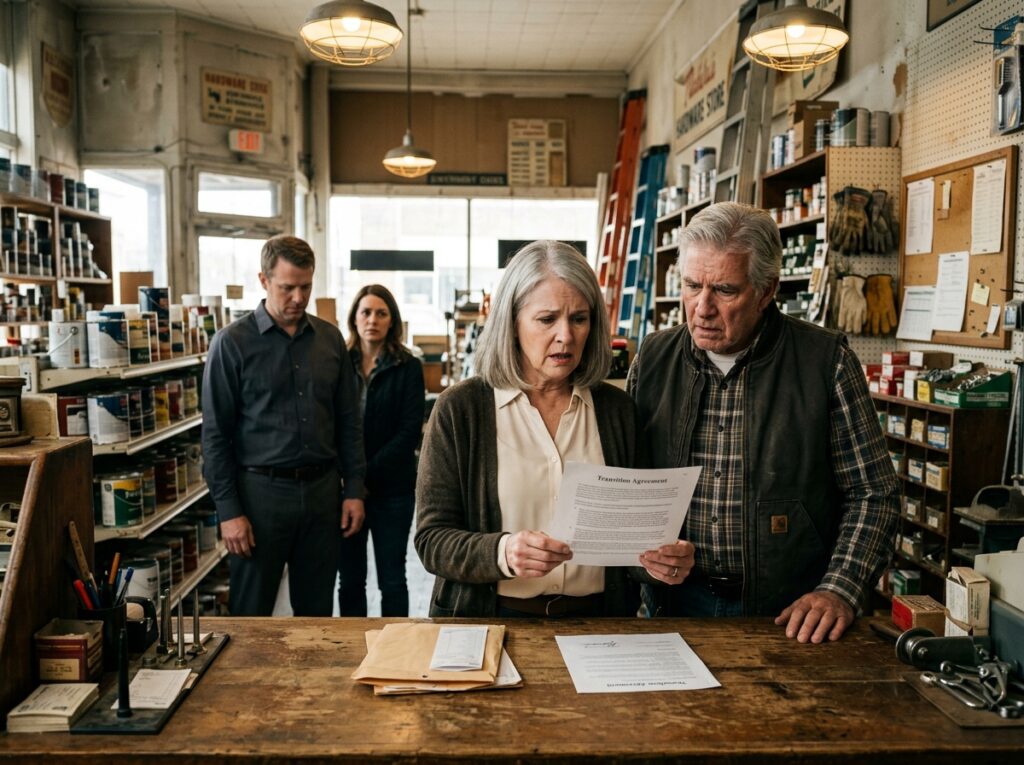
Robert and I had built that hardware store from one rented room in Dayton back in 1987.
One room.
Four walls.
A borrowed cash register.
Shelves my husband built himself because we couldn’t afford the commercial ones.
Our first inventory consisted of boxes of nails, screws, hinges, plumbing fittings, paint supplies, hand tools, and whatever else we could purchase without putting ourselves into debt.
We slept badly that first year.
We worried constantly.
Some nights, Robert would come home and put the day’s receipts on the kitchen table.
I’d count them.
He’d count them again.
Then we’d look at each other.
“Tomorrow will be better,” one of us would say.
Sometimes it was true.
Sometimes it wasn’t.
But we kept going.
Thirty-seven years later, the little store had grown into something neither of us had imagined.
Two locations.
A warehouse.
Twenty employees.
Long-standing contractors.
Homeowners who had been shopping with us since the early nineties.
A business valued at close to two million dollars.
It wasn’t a fortune to us.
It was our life.
Every wall carried a memory.
Every department reminded us of someone.
The first employee we hired.
The first major contractor account.
The winter a pipe burst and flooded half the stockroom.
The year Robert broke his wrist unloading a shipment and still came to work the next morning.
The Saturday Daniel, at nineteen, worked behind the counter and complained for eight straight hours.
We had raised our children around that store.
We had sacrificed for it.
And now our son was sitting at our dining table announcing that he had already signed papers transferring it.
I looked at Robert.
His jaw had tightened.
“What papers?” he asked.
Daniel shrugged.
“The transition agreement.”
“What transition agreement?”
“I’ve been working with the attorneys.”
“When?”
“A few weeks.”
I put down my fork.
“You’ve been working with attorneys about our business?”
Daniel smiled.
“Mom, don’t make it sound dramatic.”
“I’m asking a question.”
“It’s not dramatic.”
Melissa finally spoke.
“It’s actually a good thing.”
I looked at her.
“For whom?”
She laughed nervously.
“For everyone.”
Daniel nodded.
“The business needs younger leadership.”
Robert stared at him.
“You’re forty-two.”
“I know.”
“You’ve been managing the second location for four years.”
“I know.”
“Who said we were transferring ownership?”
Daniel’s expression changed.
“Nobody had to.”
I looked at him.
“Excuse me?”
“You and Dad have been talking about retiring for years.”
“We’ve talked about slowing down.”
“That’s what I mean.”
“That doesn’t mean you get to decide.”
He sighed.
“I knew you’d react this way.”
I felt something inside me go cold.
Not anger.
Not yet.
Something closer to disbelief.
My son had made a decision about the business my husband and I built for thirty-seven years.
And he had done it without asking us.
He smiled again.
“Anyway, it’s done.”
Nobody spoke.
I looked at my husband.
He looked back at me.
Neither of us knew what to say.
So I did the only thing I could think to do.
I finished my coffee.
“Thank you for letting me know,” I said.
Daniel smiled.
“You’re welcome.”
I said nothing else.
But inside, something had already changed.
Part 2
After dinner, I helped Robert clear the table.
Neither of us said much.
The children had gone upstairs.
Daniel and Melissa stayed in the living room for another twenty minutes, talking quietly.
Then they left.
The front door closed.
Robert stood at the sink.
“Did you know?”
“No.”
“Neither did I.”
He dried his hands.
“Did he say he signed something?”
“Yes.”
Robert shook his head.
“That boy.”
I turned toward him.
“Don’t call him that.”
He looked at me.
“He’s our son.”
“I know.”
“Then why are you defending him?”
“I’m not.”
“You looked calm.”
I sat down.
“I wasn’t calm.”
“What were you?”
I thought about it.
“Trying not to make a mistake.”
Robert sat across from me.
“What mistake?”
“Reacting before I know what happened.”
He nodded slowly.
That was the thing about Robert.
He had always understood when I needed silence.
We had survived thirty-seven years of business ownership because we learned early that panic was expensive.
When sales dropped, we didn’t panic.
When suppliers raised prices, we didn’t panic.
When the first big-box competitor opened outside town, we didn’t panic.
We looked at the numbers.
We checked the contracts.
We made decisions.
So that’s what I wanted to do now.
Look at the numbers.
Check the documents.
Find out what exactly my son meant when he said he’d signed the transition papers.
Robert reached across the table.
“What are you thinking?”
“I’m calling Susan tomorrow.”
Our accountant.
Susan had handled our books for eighteen years.
She knew the business almost as well as we did.
She had watched us expand.
She had helped us through audits.
She had warned us when we were taking too much inventory.
She had celebrated when we paid off the warehouse.
Most importantly, she knew exactly how ownership had been structured.
Robert nodded.
“Good.”
Then he looked toward the hallway.
“Do you think Daniel would actually try to take it?”
I didn’t answer.
Because I didn’t know.
That was what frightened me.
Not the possibility that my son wanted the store.
We had always expected the business to eventually pass to our children.
What frightened me was the way he had announced it.
As if the decision had already been made.
As if our agreement didn’t matter.
As if our signatures were merely formalities.
The next morning, I woke before six.
Robert was already downstairs.
I made coffee.
He was staring at the newspaper without turning a page.
“You didn’t sleep.”
“Neither did you.”
I poured his coffee.
Then I picked up my phone.
I called Susan.
She answered on the fourth ring.
“Good morning, Margaret.”
“Good morning.”
“You sound serious.”
“I need you to pull the current ownership filing for the business.”
There was a pause.
“Everything?”
“Everything.”
“What happened?”
“My son announced yesterday that he had already signed transition papers.”
Another pause.
“Daniel?”
“Yes.”
Her voice became careful.
“I wasn’t aware there was a completed transition.”
“Neither was I.”
“Let me check.”
“Please.”
She said she’d call back.
I expected it to take hours.
Instead, less than ten minutes later, my phone rang.
Susan’s name appeared on the screen.
I answered.
“Hello?”
There was a silence.
Not a normal silence.
A deliberate one.
“Susan?”
“Margaret.”
Her voice sounded different.
“What did you find?”
“I need you to sit down.”
I looked at Robert.
He immediately stood.
“What is it?”
Susan breathed in slowly.
“There’s a transition agreement.”
I closed my eyes.
“How long has it been there?”
“Three weeks.”
My hand tightened around the phone.
“Three weeks?”
“Yes.”
“Who filed it?”
“That’s not the part I’m concerned about.”
My heart began beating faster.
“Then what is?”
Susan’s voice dropped.
“Your signature.”
Part 3
I stood so quickly that my chair scraped backward.
“What about my signature?”
Susan was silent.
“The agreement contains a signature line for you.”
“I didn’t sign anything.”
“I know.”
Robert stared at me.
I put the phone on speaker.
Susan continued.
“That’s why I called you immediately.”
“What exactly does the filing say?”
“It identifies the transition as completed.”
“Completed by whom?”
“That’s complicated.”
“Susan.”
She sighed.
“The document states that you approved the transfer.”
“I didn’t.”
“I know.”
“And it says the document was notarized?”
“Yes.”
My husband looked at me.
“By whom?”
Susan gave us the name.
Neither of us recognized it.
“Is that person a licensed notary?”
“I checked.”
“And?”
“They are.”
Robert leaned closer.
“Then how could they notarize my wife’s signature if she never signed?”
Susan didn’t answer immediately.
“That’s what we need to determine.”
I felt strangely calm.
The same kind of calm I had felt during the store’s worst financial years.
The kind that comes when something is too serious for emotion.
“What does the agreement transfer?”
“Your ownership interest.”
“To Daniel?”
“Yes.”
“All of it?”
Susan hesitated.
“Almost.”
Robert’s face hardened.
“Almost?”
“There are some provisions.”
“What provisions?”
Susan said, “I think you should see the document before I explain.”
“Send it.”
“I already did.”
I checked my email.
There it was.
Three attachments.
Transition Agreement.
Ownership Schedule.
Notarization Certificate.
I opened the first document.
The words blurred for a moment.
Then I saw my name.
Margaret Ellis.
My full legal name.
Underneath it was a signature.
It looked like mine.
But it wasn’t.
Not exactly.
Someone had copied the shape.
The slant.
The first letter.
Even the way the final “t” crossed the line.
Robert leaned over my shoulder.
“That’s not your signature.”
“No.”
“But whoever did it has seen it.”
I stared at the page.
“Apparently.”
Susan said, “There’s more.”
“What?”
“The agreement also includes a statement saying you voluntarily surrendered operational control because of your intention to retire.”
I laughed.
It was the first sound I’d made in several minutes.
“Retire?”
“You told me last month you were working another five years.”
“I know.”
Susan was quiet.
Then she said, “Margaret, I need to ask you something.”
“What?”
“Did you ever sign anything blank?”
“No.”
“Give anyone a copy of your signature?”
“No.”
“Did Daniel ever have access to your business files?”
“Of course.”
“Could he access the office?”
“He’s been working there for years.”
Susan didn’t say anything.
But I knew what she was thinking.
“So you think Daniel did this.”
“I didn’t say that.”
“You don’t have to.”
Robert walked away from the table.
He looked out the kitchen window.
Our son.
Our business.
Our signature.
Three things that had never belonged together.
Until now.
I opened the notarization certificate.
The date was three weeks earlier.
The location was listed as a private office downtown.
The notary’s name was unfamiliar.
Then I saw something else.
A witness name.
I recognized it.
It belonged to Daniel’s attorney.
I stared at it.
“Susan.”
“Yes?”
“Who prepared this agreement?”
She paused.
“Daniel’s attorney.”
The room went silent.
“Did you know about it?”
“No.”
“Did anyone at the business know?”
“Not that I can tell.”
I closed the document.
“Then we have a problem.”
Susan’s voice was quiet.
“Yes.”
Robert came back to the table.
“What do we do?”
I looked at him.
“We don’t accuse anyone.”
He frowned.
“What?”
“Not yet.”
“Margaret.”
“We need proof.”
He stared at me.
Then he nodded.
That was why we’d survived.
We didn’t burn down the store because someone made a mistake.
We found out who had lit the match.
Then we dealt with it.
I looked again at the forged signature.
My son’s name appeared on the transfer.
And suddenly I remembered something Daniel had said at dinner.
It’s done.
He hadn’t been boasting.
He had believed it.
He had believed he had successfully taken control of our business.
But someone had forgotten one important thing.
The signature wasn’t mine.
Part 4
Susan told us not to contact Daniel until she had spoken with an attorney specializing in business ownership disputes.
We agreed.
That was harder than it sounds.
Daniel called that afternoon.
I watched his name appear on my phone.
Robert looked at me.
“Don’t answer.”
I let it ring.
A minute later, he called again.
Then he sent a message.
Mom, we need to talk.
I didn’t respond.
Ten minutes later:
Why are you ignoring me?
I put the phone face down.
Robert paced the kitchen.
“This doesn’t feel like our son.”
I understood what he meant.
But I also knew people could behave differently when money and fear entered the room.
That evening, Susan called again.
“I found something.”
“What?”
“The agreement isn’t the only document.”
My stomach tightened.
“What else?”
“There was a corporate resolution.”
“Who signed it?”
“Daniel.”
“Only Daniel?”
“And your husband.”
Robert looked at me.
“What?”
Susan continued.
“There’s a signature that appears to be yours as well.”
I closed my eyes.
“Robert?”
“I never signed anything.”
Susan said, “I believe you.”
“Then someone forged both of us.”
“Yes.”
The word landed heavily.
I had expected one dishonest document.
Now we had multiple.
“How was it submitted?”
“Electronically.”
“By whom?”
“Daniel’s attorney’s office.”
Robert sat down.
“Can they just transfer ownership like that?”
“No.”
Susan’s answer was firm.
“Not legally if the signatures were forged.”
I breathed again.
“What should we do?”
“Freeze everything that can be frozen.”
“Bank accounts?”
“Business accounts. Corporate records. Digital access.”
“Will that hurt the business?”
“It may cause inconvenience.”
“Then we’ll manage the inconvenience.”
Susan paused.
“There’s another concern.”
“What?”
“The agreement contains a provision transferring certain company assets separately.”
“Which assets?”
“Vehicles. Equipment. Warehouse inventory.”
Robert’s face hardened.
“All of it?”
“Not all.”
“What does Daniel get?”
Susan named several assets.
They weren’t random.
They were the most valuable equipment.
I looked at Robert.
“He planned this.”
Robert didn’t answer.
Maybe he couldn’t.
We spent the next two hours reviewing everything.
The more we found, the worse it became.
There were emails.
Drafts.
Meeting notes.
Internal messages.
Someone had been preparing for this for months.
And then we found the thing that hurt the most.
A spreadsheet.
At the top, Daniel had written:
Transition Plan.
Below it were columns.
Asset.
Value.
Transfer Date.
Owner After Transition.
I stared at it.
My son’s handwriting was in the notes.
I recognized it immediately.
There was a column labeled:
“Parent Resistance.”
I felt something inside me crack.
Under my name, Daniel had written:
“Mom will object emotionally but eventually accept it.”
Under Robert’s name:
“Dad will be harder, but Mom can convince him.”
I pushed the laptop away.
“He knows us.”
Robert sat beside me.
“That’s why it worked.”
“No.”
I shook my head.
“That’s why he thought it would.”
We sat in silence.
Then my phone rang.
It was Daniel.
This time, I answered.
“Hello?”
“Mom.”
“Yes.”
“Why aren’t you talking to me?”
“Because I need to understand something.”
“What?”
“Did you sign a transition agreement?”
He paused.
“Yes.”
“Did you sign my name?”
“What?”
“My signature is on it.”
“I didn’t sign your name.”
“Then who did?”
“I don’t know.”
His voice changed.
“Mom, I would never do that.”
“Then why did you announce that everything was already signed?”
“Because it was.”
“By whom?”
Silence.
“Daniel?”
He breathed heavily.
“I thought Dad and you had approved it.”
“We didn’t.”
“I was told you had.”
“By whom?”
Another silence.
Then he said something I wasn’t expecting.
“Melissa.”
I froze.
“Your wife?”
“Yes.”
“She told you we had agreed?”
“She said you were ready to retire.”
I looked at Robert.
“Did you ever tell Melissa that?”
“No.”
I returned to the phone.
“Daniel, I need you to answer one question.”
“What?”
“Who introduced you to the attorney?”
He hesitated.
Then said:
“Melissa’s brother.”
My stomach dropped.
“Your brother-in-law?”
“Yes.”
“Why?”
“I don’t know.”
But I knew something now.
The person who had been sitting at our Sunday dinner smiling while my son announced our business had already been transferred might not have been surprised at all.
Part 5
The next morning, Robert and I met with an attorney.
Her name was Elaine Carter.
She had handled commercial disputes for more than twenty years.
We brought every document Susan had found.
Elaine read silently for almost forty minutes.
She asked questions.
We answered.
She examined the signatures.
Then she looked at us.
“Neither of you signed these documents?”
“No.”
“Are you certain?”
“Absolutely.”
She nodded.
“Then this is not a transition dispute.”
Robert leaned forward.
“What is it?”
“Potential fraud.”
The word sounded enormous.
I had spent my entire adult life running a hardware store.
I understood invoices.
Inventory.
Payroll.
Mortgages.
Supplier agreements.
I understood customers.
I understood employees.
I understood what it meant to work until your hands hurt.
I did not understand fraud.
Elaine continued.
“Do not contact anyone involved until we have preserved the evidence.”
“Even our son?”
“Especially your son.”
That hurt.
But I nodded.
Elaine reviewed the notarization.
“Did either of you meet this notary?”
“No.”
“Did anyone witness you signing?”
“No.”
“Then we will request the notary’s records.”
Robert asked, “Can we reverse the filing?”
“If it was filed based on fraudulent signatures, we can challenge it.”
“How long?”
“That depends.”
I looked at her.
“Can they take the business?”
“Not lawfully through a forged document.”
That was the first sentence that gave me hope.
Then Elaine said:
“But we need to act quickly.”
We did.
By afternoon, the bank had been notified.
Corporate access was reviewed.
Digital permissions were changed.
The state filing was challenged.
The notary was contacted.
And Daniel was formally instructed not to transfer any business assets.
I felt sick doing it.
He was my son.
But the store belonged to more than us.
Twenty employees depended on it.
Their families depended on their paychecks.
Customers depended on us.
Suppliers trusted us.
We couldn’t let personal feelings destroy what thirty-seven years of work had built.
That evening, Daniel came to our house anyway.
He stood on the porch.
“I need to talk to you.”
I opened the door but didn’t invite him inside.
“Daniel.”
His face looked exhausted.
“I didn’t forge your signature.”
“I believe you.”
He looked surprised.
“You do?”
“I believe you didn’t personally write it.”
He swallowed.
“What does that mean?”
“It means I don’t yet know what you did.”
He looked away.
“I was trying to help.”
“By transferring our business?”
“I thought you were ready.”
“You never asked.”
“I was afraid you’d say no.”
“Then you knew it wasn’t your decision.”
He said nothing.
I continued.
“Who told you we had signed?”
“Melissa.”
“Why did she tell you that?”
“She said she had seen the documents.”
“Had she?”
“I thought so.”
“Did you see them?”
“Yes.”
“Before you signed?”
“Yes.”
I looked at him.
“Did you question why my signature wasn’t witnessed in front of you?”
“I didn’t think about it.”
That was the hardest thing to hear.
He hadn’t thought about it.
Because he wanted to believe it.
Because the outcome mattered more than the process.
“Daniel,” I said quietly, “you wanted the store.”
He looked down.
“Yes.”
“That’s not wrong.”
He looked at me.
“Wanting it isn’t wrong.”
“But?”
“But believing you were entitled to take it without asking us was.”
His eyes filled.
“I know.”
“Do you?”
He nodded.
“I do now.”
I wanted to hug him.
I wanted to send him away.
I wanted to believe everything would return to normal.
Instead, I said:
“Go home.”
He nodded.
Then he walked away.
I closed the door.
Robert stood behind me.
“You did the right thing.”
I leaned against the door.
“I don’t know.”
He put his hand on my shoulder.
“Neither do I.”
And for the first time since 1987, neither of us knew what the next morning would bring.
Part 6
The next morning, Elaine called.
“We found the notary.”
My stomach tightened.
“Who is it?”
“A professional notary who works out of a private office.”
“Does she remember us?”
“She remembers the appointment.”
I sat down.
“What did she say?”
“She says a man came with the documents.”
“Who?”
“Daniel.”
My heart sank.
“Did he tell her we had signed?”
“Yes.”
“Did she see us sign?”
“No.”
“Then how did she notarize it?”
Elaine paused.
“She says she believed the signatures had been executed previously.”
Robert shook his head.
“That’s impossible.”
“That’s what we thought.”
“What else?”
“She says Daniel presented identification and told her the documents had already been signed by the owners.”
“Did she verify the signatures?”
“Apparently not adequately.”
I closed my eyes.
“Did she identify anyone else?”
“Yes.”
“Who?”
“Melissa.”
I looked at Robert.
“She was there?”
“According to the notary, yes.”
The room went silent.
Everything was suddenly clearer.
Daniel might have been reckless.
He might have been manipulated.
But Melissa had been there.
The notary remembered her.
Elaine continued.
“There’s more.”
“What?”
“The notary’s office has security footage.”
My heart began beating faster.
“From three weeks ago?”
“Yes.”
“Can we get it?”
“We’re working on it.”
I didn’t sleep that night.
The following afternoon, Elaine sent us a still image from the footage.
I stared at the screen.
Daniel was standing beside the desk.
Melissa was beside him.
On the desk were the documents.
My signature was already there.
But the timestamp showed something important.
The documents had arrived unsigned.
At least, according to the notary’s statement.
Then came another piece of evidence.
An email.
Sent from Melissa’s personal account to her brother.
The subject line was:
“Once the papers are done.”
I opened it.
The message was short.
She wrote:
“Daniel thinks his parents have already agreed. He won’t ask too many questions. Once the transition is filed, they won’t want to fight their own son.”
I read it twice.
Then a third time.
Robert took the laptop from me.
He read it.
His face changed.
“She knew.”
“Yes.”
“She planned it.”
“I think so.”
Elaine said we should preserve everything.
We did.
Then came the part I dreaded.
Daniel found out.
He came to the house that evening.
He looked like a different man.
“She lied to me.”
I didn’t answer.
“Mom.”
I waited.
“She told me you had signed.”
“She did.”
“I believed her.”
“I know.”
“I never knew she had…”
He couldn’t finish.
I sat across from him.
“Why did you want the store so badly?”
He looked at the floor.
“Because I thought it was supposed to be mine.”
“Eventually.”
“I thought you and Dad were keeping me on a leash.”
I shook my head.
“We were training you.”
He looked up.
“There’s a difference.”
I continued.
“You were supposed to learn how to run it before you owned it.”
He wiped his eyes.
“I thought you didn’t trust me.”
“We didn’t trust your judgment yet.”
He looked down.
“That’s worse.”
“No.”
I leaned forward.
“It isn’t an insult to tell someone they aren’t ready.”
He nodded slowly.
Then he whispered:
“I almost destroyed everything.”
I didn’t correct him.
Because he almost had.
But he hadn’t done it alone.
Part 7
Melissa moved out that week.
At least temporarily.
Daniel stayed with us for several nights.
He slept in the guest room.
He barely ate.
Every morning, he went to the store with Robert.
Every evening, they returned exhausted.
I didn’t ask what they talked about.
I knew enough.
They were rebuilding something.
Not the business.
Trust.
Meanwhile, Elaine continued handling the legal process.
The state rejected the fraudulent transfer.
The ownership remained with Robert and me.
The bank accounts remained protected.
The employees were told there had been an administrative dispute and that operations would continue normally.
We didn’t tell customers.
We didn’t need to.
But there was one thing we couldn’t avoid.
The family.
News traveled.
Someone always talks.
A cousin called.
Then an aunt.
Then someone from church.
Everyone had a different version.
Some believed Daniel had tried to steal the store.
Others believed Melissa had forced him.
Some said we should give Daniel the business anyway.
Others said we should disown him.
I listened.
Then I stopped listening.
Because none of them had built that store with us.
They hadn’t stood beside Robert at midnight fixing broken shelving.
They hadn’t counted coins after the first month’s sales.
They hadn’t missed vacations because the supplier truck arrived late.
They hadn’t watched employees become part of the family.
Only we knew what the store meant.
One Saturday, I went to the business alone.
The front door opened with the same bell it had used for years.
A young employee greeted me.
“Morning, Mrs. Ellis.”
“Morning.”
I walked through the aisles.
Everything looked normal.
Paint cans.
Drill bits.
Plumbing supplies.
Work gloves.
Ladders.
Nails.
The smell of wood and metal.
I stopped near the original counter.
Robert had built it in 1987.
It was still there.
Scratched.
Worn.
Ugly.
Beautiful.
I ran my hand across it.
Daniel found me there.
“Mom.”
I turned.
“I didn’t know you were coming.”
“I wanted to see it.”
“The store?”
“Us.”
He looked confused.
“I don’t understand.”
I smiled.
“Neither do I.”
He sat beside me.
For several minutes, we said nothing.
Then he asked:
“Do you still want me here?”
I looked at him.
“Do you want to be here?”
“Yes.”
“Then prove it.”
“How?”
“Not by owning it.”
He looked at me.
“By earning the trust that comes with it.”
He nodded.
“I will.”
I reached into my purse.
I pulled out the original business license.
The first one.
The one from 1987.
I handed it to him.
He stared at it.
“Why are you giving me this?”
“I’m not.”
He looked confused.
“I’m showing you what you’re asking to inherit.”
His eyes filled.
“This piece of paper?”
“No.”
I pointed around us.
“That.”
“The store?”
“Everything.”
He looked around.
“People.”
“Yes.”
“Employees.”
“Yes.”
“Customers.”
“Yes.”
“Your life.”
I nodded.
“Your father’s life.”
He looked at the old counter.
“I understand now.”
“Good.”
He gave the license back.
I put it away.
“Then maybe someday you’ll be ready.”
He nodded.
“Maybe.”
That word didn’t frighten me anymore.
Because maybe meant there was still a future.
Part 8
Months passed.
The legal case moved forward.
The fraudulent documents were formally invalidated.
The notary cooperated.
Elaine handled everything.
Melissa eventually admitted she had arranged the meetings and had persuaded Daniel that we had already agreed.
She insisted she never intended to steal the store.
She said she thought she was securing the family’s future.
But intent didn’t erase consequences.
Daniel filed for separation.
That part broke my heart.
Not because I wanted Melissa back in the family.
Because their children were caught between them.
Sophie began spending more time with us.
One afternoon, she sat beside me on the porch.
“Grandma?”
“Yes?”
“Is Dad going to own the store?”
“Someday, maybe.”
“Why not now?”
“Because ownership isn’t just about having a name on a document.”
She thought about it.
“Then what is it?”
“Responsibility.”
She nodded.
“I think Dad understands.”
“I think so too.”
She looked at me.
“Are you mad at him?”
I answered honestly.
“Sometimes.”
“Do you still love him?”
“Always.”
She smiled.
“Good.”
I laughed.
“Why?”
“Because Dad thinks you don’t.”
I looked toward the house.
“Tell him he’s wrong.”
She nodded.
Then she said something that stayed with me.
“Grandma, I don’t think Dad wanted your store.”
“What do you mean?”
“I think he wanted you to be proud of him.”
My throat tightened.
Children sometimes see things adults are too proud to admit.
I had spent months thinking about ownership.
Papers.
Money.
Signatures.
Control.
Maybe Daniel had been thinking about something else.
Maybe he had spent years wondering whether he was enough.
Maybe the store had become a symbol.
If he owned it, perhaps he believed he had finally become the son his father would respect.
That didn’t excuse what happened.
But it explained something.
That evening, I went into the office.
Robert was reviewing inventory.
I said, “We need to talk about Daniel.”
He looked up.
“What now?”
“I think we should start training him again.”
Robert stared.
“After everything?”
“Yes.”
“Why?”
“Because someday we’re going to retire.”
He laughed.
“We said that twenty years ago.”
“I mean it this time.”
He smiled.
Then became serious.
“Do you trust him?”
I thought for a moment.
“I trust that he knows what he did was wrong.”
“That’s not the same.”
“No.”
“Then?”
“I think trust can be rebuilt.”
Robert leaned back.
“You’re softer than I am.”
“No.”
I smiled.
“I’m more stubborn.”
He laughed.
“That’s true.”
We called Daniel the next day.
He arrived at the office.
I put a binder on the table.
“What is this?”
“Your new training plan.”
He stared at it.
“What?”
“You wanted the business.”
“Yes.”
“Then learn every part of it.”
He opened the binder.
Accounting.
Inventory.
Payroll.
Supplier negotiations.
Legal compliance.
Customer relationships.
Employee management.
Everything.
He looked overwhelmed.
“How long will this take?”
“As long as it takes.”
He smiled.
“I’ll do it.”
And for the first time, I saw the son who had once worked behind our counter at nineteen.
Not a man trying to take something.
A man trying to become worthy of something.
Part 9
A year later, we held a family dinner.
Not at our house.
At the store.
We had renovated the back room and turned it into a small gathering space for employees.
There were tables.
Food.
Music.
Old photographs.
On one wall was a picture of Robert and me standing outside the original rented room in 1987.
We looked impossibly young.
Daniel stood in front of it for several minutes.
“I never knew this picture existed.”
“I did.”
“You look happy.”
“We were terrified.”
He laughed.
“Really?”
“Absolutely.”
Robert joined us.
“Your mother cried the first night.”
“I did not.”
“You did.”
“I was tired.”
“You cried.”
Daniel laughed.
Then he looked at the photograph again.
“I understand now.”
“Understand what?”
“Why you couldn’t just hand it over.”
I smiled.
“Good.”
He turned to Robert.
“And I understand why you were so angry.”
Robert nodded.
“I wasn’t angry because you wanted the store.”
“I know.”
“I was angry because you thought what we built was just an asset.”
Daniel looked down.
“I know.”
There was a long silence.
Then Robert said:
“You’re doing well.”
Daniel looked up.
It was the first time his father had said it.
Daniel’s eyes filled.
“Thank you.”
I watched them.
Father and son.
Both stubborn.
Both proud.
Both finally saying the things they should have said years earlier.
Later that evening, Daniel came to me.
“Mom.”
“Yes?”
“I want you to know something.”
“What?”
“I don’t want you to sign anything.”
I laughed.
“That’s reassuring.”
“I’m serious.”
He smiled.
“I want you to choose when you’re ready.”
I looked at him.
“That’s all I ever wanted.”
He nodded.
Then he handed me a folder.
I opened it.
Inside was a new succession plan.
This one had been prepared by our attorney.
No forged signatures.
No secret filings.
No surprises.
It clearly stated that Robert and I remained owners.
It included a gradual transfer plan based on performance, responsibility, and our approval.
I read every page.
Then I signed my name.
My real signature.
Slowly.
Carefully.
I looked at Daniel.
“Now that’s a transition agreement.”
He smiled.
“I thought you’d say that.”
Robert came over.
“What are you two smiling about?”
I handed him the folder.
He read it.
Then he looked at Daniel.
“Did your mother approve this?”
“Yes.”
“Did you ask her?”
“Yes.”
“Good.”
Robert closed the folder.
“Then we have a deal.”
Daniel smiled.
The store wasn’t being stolen.
It was being inherited.
There was a difference.
And that difference meant everything.
Part 10
Three years later, Robert and I finally stepped back from the daily operation of the store.
Not completely.
I don’t think either of us knew how to completely walk away.
I still came in twice a week.
Robert still complained about inventory.
Daniel ran both locations.
He knew every employee by name.
He knew which suppliers were reliable.
He knew which customers had been shopping with us for thirty years.
Most importantly, he understood that the business wasn’t just something with a dollar value.
It was something built through trust.
One afternoon, I stood near the original counter.
The same counter Robert had built in 1987.
Daniel walked over.
“You’re staring at that again.”
“I like it.”
“It’s ugly.”
“It has character.”
He laughed.
Then he handed me an envelope.
I looked at it.
“What is this?”
“The final transition papers.”
My heart skipped.
“Final?”
“Not the ownership transfer.”
He smiled.
“The retirement agreement.”
I opened it.
Everything was exactly as it should be.
My signature.
Robert’s signature.
Daniel’s signature.
No surprises.
No secret filings.
No missing pages.
No forged names.
I looked at my son.
“You did this correctly.”
“I learned.”
“From the best?”
He smiled.
“From the hardest way possible.”
I laughed.
Then he hugged me.
For a long time, neither of us spoke.
When he pulled away, he said:
“Mom?”
“Yes?”
“Are you proud of me?”
I looked at him.
There was something in his eyes that took me back to that nineteen-year-old boy behind the counter.
The boy who had once complained about working Saturdays.
The boy who had grown into a man.
The man who had made a terrible mistake.
And the man who had spent years earning back what he had nearly destroyed.
“I am.”
His eyes filled.
“Really?”
“Really.”
He hugged me again.
That night, Robert and I went home.
We sat at our kitchen table.
The same table where we’d once counted the first day’s receipts.
Robert poured two glasses of wine.
“Thirty-seven years.”
I smiled.
“Thirty-seven.”
“Would you do it again?”
I looked toward the photograph of our younger selves.
“Every time.”
He smiled.
Then he asked:
“Even knowing how it ends?”
I thought about Daniel.
About the forged papers.
The Sunday dinner.
The accountant’s changed voice.
The attorney.
The fear.
The betrayal.
The rebuilding.
The final agreement.
I smiled.
“I don’t think it ended.”
Robert looked at me.
“What do you mean?”
I took his hand.
“I think we just stopped being the owners.”
He smiled.
“And started being parents again?”
“Maybe.”
Outside, the evening settled over Dayton.
The store was no longer ours in the way it had once been.
But it was still there.
Still serving people.
Still employing families.
Still carrying the name we had built from one rented room.
And somewhere inside that business was every sacrifice we had ever made.
Every early morning.
Every late night.
Every argument.
Every paycheck.
Every Christmas we skipped.
Every time we told ourselves to keep going.
We had built more than a store.
We had built something our children could inherit.
But the greatest inheritance wasn’t the building.
It wasn’t the inventory.
It wasn’t the nearly two million dollars in value.
It was the lesson Daniel had finally learned.
You cannot inherit trust by signing your name beneath it.
You earn it.
And when my son finally understood that, I knew the business was finally safe in his hands.
Not because the papers said so.
Because he had finally learned what those papers were supposed to mean.