Part 1
The program fell into my lap on a Sunday in October, and I almost let it stay there.
I had gone to church the way I always went, early, alone, and sat in the third pew from the back where nobody expected me to say much. The bulletin was thick that week, stuffed with flyers for a fall bake sale and a sign-up sheet for the men’s breakfast. I was folding it in half to use as a fan, because the heater in that old building never knew when to quit, when a single glossy page slid out and landed face up on my knee.
It wasn’t ours. It was from some other church, some other service, carried in by somebody and tucked between our announcements by accident. At the top, in curling letters, it said Scholarship Recognition Ceremony.
I would have set it on the pew beside me. I truly would have. But a name near the middle of the page caught the corner of my eye the way a dropped glass catches your ear before you’ve looked down.
Under a small photograph of a woman in blue scrubs, holding a certificate the size of a dinner plate, were the words: Recipient of the $36,400 Nursing Excellence Scholarship.
And beneath that, her name.
My daughter’s name.
I read it once, and my mind refused it. Names repeat. There are a thousand women with that first name and a thousand more with that last. I told myself this, calmly, the way you talk to a horse that has spooked. Then I looked at the face.
She had her mother’s jaw. She had my mother’s eyes, wide and a little wary, as if she were bracing for the camera to say something unkind. Her hair was shorter than I remembered, and there were faint lines at the corners of her mouth that had not existed the last time I looked at her properly. Eleven years will do that. Eleven years will carve a whole stranger out of a girl.
“Sir? You all right?”
The usher had stopped at the end of my pew, a young man with a kind, uncertain face. I realized my hand was shaking so hard the paper rattled.
“Fine,” I said. “Just the cold.”
“It’s pretty warm in here, actually.”
“Then I’m getting old.” I tried to smile. It felt like pulling a nail out of wood.
He nodded and moved on. I turned the page over, and my throat closed.
On the back, in small print under a list of sponsors, someone had typed the recipients’ names and the towns where they lived. Hers had a street. A number. A town forty minutes from where I had sat for eleven years without once driving there.
I stared until the ink blurred and ran together, and it took me a moment to understand that the blurring was not the paper.
The choir stood up to sing. I did not stand.
All I could think was a sentence I had said on a spring afternoon in 2013, in my own kitchen, with my wife’s coffee cups still on the drying rack. A sentence I had polished and defended and repeated in my head for over a decade as though it were a rule of nature.
You embarrassed this family.
And beneath it, quieter, a new thought arrived that I had spent eleven years refusing to let in the door.
What if the one who embarrassed this family was me?
I folded the program along its crease, slid it into my breast pocket, and walked out of the sanctuary in the middle of the hymn. The parking lot was bright and cold. I sat in my truck with both hands on the wheel and did not start the engine.
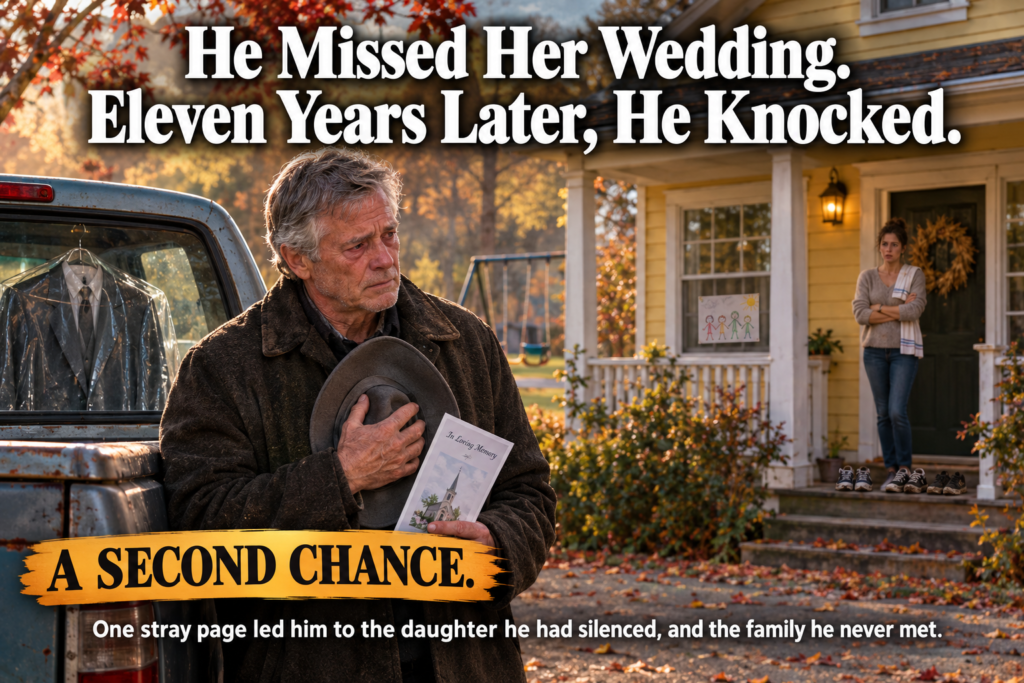
Somewhere in the back of my closet, there was a suit I had not touched in years. It was the one I had bought for her wedding, the one that had hung in plastic ever since, the one I had never worn.
I had never been able to throw it away.
Part 2
I should tell you what I told myself back then, because the story I told was a good one, and that was the danger of it.
She was twenty-two. Her name, the one I’ll keep to myself for now, because some things I have not earned the right to say aloud again, was Hannah to everyone who loved her, and I used to be one of them. She was my only child. She was the girl who read at the kitchen table with a flashlight after bedtime, who bandaged the neighbor’s dog with a sock, who told her mother at nine years old that she was going to work in a hospital “so I can fix people on the inside.”
When she came home that April, she did not sit down. She stood by the refrigerator holding her car keys like she might need them for protection.
“Dad, Mom, I have to tell you something.”
My wife had already known. I understood that later. Mothers always know. She was sitting very still with her hands around a mug that had gone cold.
“I’m pregnant.”
The word hung in the kitchen. I remember the hum of the refrigerator. I remember a fly walking slowly up the window over the sink.
“Whose is it?” I asked.
“His name is Daniel. You’ve met him. He came to the Fourth of July cookout.”
“The boy with the motorcycle.”
“He sold the motorcycle, Dad.” Her voice cracked on the last word, but she pushed through it. “He wants to marry me. He’s working two jobs. We’re not asking you for anything. We just wanted you to hear it from us.”
I could have said congratulations. I could have said sit down, honey, and let’s talk. I could have said I’m scared for you and I love you and we’ll figure it out.
Instead I said, “Before the wedding? Before there’s even a ring?”
“There’s going to be a ring.”
“People in this town talk, Hannah. Do you know what they’ll say? Do you know whose daughter they’ll say it about?”
“I don’t care what they say.”
“No,” I said. “You never did. That’s the problem.”
My wife whispered my name. It was not a plea. It was a warning, and I ignored it.
Hannah’s chin lifted, the way it did when she was small and about to be brave. “I thought you’d be disappointed. I didn’t think you’d be ashamed of me.”
And I said it. I said the thing. I watched it leave my mouth and cross the kitchen and land on her like a slap.
“You embarrassed this family.”
She did not cry. That is the part I could never forgive in myself. I would have borne it better if she had cried. She just nodded slowly, as if I had confirmed a diagnosis she’d been afraid of, and she set my spare house key on the counter. I hadn’t known she was carrying it.
“Okay,” she said softly. “I’ll go, then.”
“Hannah,” my wife said, standing too fast, the mug tipping over, coffee spreading across the table.
But the screen door had already clapped shut.
The wedding invitation came in June, cream-colored, with a pressed flower on the corner. Daniel’s mother had apparently helped with the printing. I read it standing at the mailbox. Then I put it in the drawer under the phone books, where I put the things I intended to deal with later.
On the day of the ceremony, I mowed the lawn. Twice. My wife sat in the passenger seat of her sister’s car in the driveway, wearing the blue dress she’d bought, looking at me through the windshield for a long time before she was driven away. She went without me. She never said a word about it afterward, but something between us got quieter that day and never got loud again.
In September, on Hannah’s birthday, I bought a card at the drugstore. I stood in the aisle for twenty minutes. I wrote Happy birthday, and then, under it, Dad, because I could not make myself write more. I mailed it with a stamp I had to lick twice.
Nothing came back. Not a call, not a note, not an angry letter that I could have answered with an angry letter of my own. Only silence, which is the cruelest answer there is, because it leaves you to write both sides of the argument yourself.
So I did. For eleven years I wrote it, and I always won.
Sitting in that truck outside the church, with the program warm in my pocket against my chest, I finally read the other side.
She had been a nurse the whole time. Right there, forty minutes away. Fixing people on the inside, just like she’d promised.
I turned the key in the ignition.
I did not go home to my empty house. I went to the closet.
Part 3
The suit was still in its plastic, hanging at the far end of the rod behind my winter coats, the way a secret hangs in a family.
I took it out and laid it across the bed. Charcoal gray, single-breasted, bought at a department store in the spring of 2013 while my wife held up two ties and asked which one made me look “like a man who is proud.” I had picked the navy one. I had never worn it. It still had the little paper tag stapled inside the pocket, a size and a price and a name of a salesclerk who had told me, shaking my hand, “Big day. Walking her down the aisle?”
“Wouldn’t miss it,” I had said, back when I thought I’d be that man.
My wife had died three winters ago.
I had not mentioned that yet, and I should have, because it matters. She was the one who kept the thread alive. She sent Christmas cards every year to Hannah’s old address, and later to a new one she found through a cousin, and I pretended not to notice. She never got an answer either. Near the end, in the hospital, with the monitors ticking like a patient clock, she had held my wrist and said, “You’ll go to her, won’t you? When you’re ready.”
“I don’t know that I’ll ever be ready,” I had said.
“Nobody ever is, Walter.” She smiled a little. “That’s not a reason.”
I had not gone. Three years I had not gone. I had told myself that Hannah hadn’t come to the funeral because she hadn’t known, because the notice had gone to the wrong place. It was easier than the other possibility, that she had known and chosen to stay away, which would have been only what I had taught her.
I pressed the suit with the iron that still stood in the hall where my wife had left it. My hands did not feel like mine. I burned the cuff once and swore, then dampened a cloth and tried again. I shaved twice. I found the navy tie in a drawer and knotted it three times, and each time the knot looked like the work of a frightened boy.
At the last moment I stood before the bedroom mirror. The man there was sixty-three, gray at the temples, his shoulders folded forward as if around a weight. He wore a suit meant for a wedding that was eleven years gone.
“This is foolish,” I told him. “You can’t show up in a suit.”
But I could not go in what I’d been wearing. A man who hadn’t come to the wedding could at least come dressed for it.
I folded the program carefully and put it on the passenger seat. I laid the suit across the back, in its plastic, with the jacket on a hanger hooked above the window. And I drove.
The road to her town ran through flat farmland, brown fields stubbled with the ghosts of corn. I had driven it once, long ago, to a feed store. I turned the radio off. I turned it on. I turned it off again. At a gas station halfway, I bought coffee I did not drink and stood by the pump rehearsing.
Hannah, I’m sorry.
No. Too small.
Hannah, I was wrong.
No. Too easy. As if I were admitting a wrong turn.
Hannah, I have thought about you every single day, and I didn’t know how to come home.
That one stuck in my throat, and I let it. It was true.
The town, when I reached it, was nothing like the picture I had made in my head. I had imagined something cramped and bitter, a place she’d fled to. Instead there were maple trees along the road, still holding some red, and a hardware store with pumpkins out front, and a brick library with a banner for a children’s reading hour. Somebody’s grandmother was sweeping a porch. Two boys passed me on bicycles, laughing at something I would never know.
The address from the program led me onto a quiet street of modest houses. I counted the numbers down. And there it was.
A yellow house with white trim and a wide front porch. A swing set in the side yard, one swing still twisting from some recent small body. Three pairs of muddy sneakers lined up beside the door, from big to small. A wreath of dried wheat hung on the frame, and in the window, taped crookedly, a child’s drawing of a stick-figure family holding hands under a sun with a smiling face.
I counted the stick figures. Five.
I parked across the street and killed the engine. The suit hung silent behind me. My heart was going so hard I could feel it in my teeth.
For a long while, I only sat. A woman might have come out, or a child, or a husband might have seen the old truck and wondered. None did. The street kept its ordinary Sunday peace around me while I tried to remember how to breathe.
Then the front door of the yellow house opened.
I knew her instantly, though the woman who stepped onto the porch was nothing like the girl in my kitchen. She was tall and tired and beautiful, a dish towel over her shoulder, her hair pinned up in a hurry. She was laughing over her shoulder at someone inside. Then she turned, and her eyes crossed the street and found my truck.
The laughter went out of her face like a lamp being switched off.
She stood perfectly still. I could not move. Neither of us did, with the whole width of the street between us and eleven years standing in the road.
Then she set down the towel, walked slowly down her porch steps, and started toward me.
Part 4
She did not run. She did not hurry. She crossed the street the way a person walks toward a dog she isn’t sure will bite, steady and watchful, her arms folded tight across her middle.
I got out of the truck because sitting there while she came to me felt like the last cowardice I could afford. My knees almost refused. I held the door for balance and stood in the cold with my hat in my hand, though I could not remember taking it off.
She stopped a few feet away. Up close, I saw the small scar through her left eyebrow, from the bicycle accident when she was seven. I had driven her to the emergency room that day, running two red lights, and she had held my hand and said, “Don’t be scared, Daddy. I’m okay.” She had been comforting me even then.
“Dad.”
Just that. Not angry. Not warm. A word set down carefully, like something that might break or might go off.
“Hannah.” My voice came out rusted. “I’m sorry to come without calling. I didn’t have a number. I only had…” I pulled the program from my pocket and held it out. My hand shook so badly the page fluttered. “This fell out of a bulletin at church. I don’t know how. I think maybe I was meant to find it.”
She looked at the paper but did not take it. Her eyes moved over her own photograph, her own name, and I watched something pass across her face that I could not read.
“The scholarship ceremony,” she said. “That was in September. They printed the addresses by mistake. I complained about it to three different people.”
“I’m glad they did.”
“Are you?”
It was a fair question. I deserved a harder one.
“I’m trying to be,” I said. “Honestly, I’m trying to be glad about everything I’m looking at right now. I’m also ashamed enough that I can barely stand here.”
She glanced past me then, to the truck, to the gray suit hanging in its plastic against the back window. I saw her see it. I saw her read the tag, the cleaner’s sleeve, the whole ridiculous, humiliating truth of it.
“What is that?”
“It’s the suit I bought for your wedding.”
The words hung between us. Somewhere down the block, a screen door slapped, and a child’s voice called out something about lunch.
Hannah’s mouth tightened, and for a moment her eyes shone, and she turned her face toward the maple trees until it passed.
“You kept it,” she said.
“I couldn’t throw it away.”
“You couldn’t come, either.”
“No.” I did not defend myself. I had no defenses left, only the plain fact. “I couldn’t do that, either.”
She breathed in slowly through her nose, the way her mother used to when she was deciding how much to say. Then she looked at me, really looked, at the gray in my hair and the way my coat hung looser than it should.
“Mom,” she said. “Where’s Mom?”
The question went through me like cold water. She did not know.
“Hannah,” I said. “Your mother died. Three winters ago. In February.”
Her hand rose to her mouth. The sound she made was small and broken and unlike anything I had ever heard from her. She took a step backward, and I reached for her out of pure instinct, and she flinched, and my hand fell.
“Nobody told me,” she whispered. “I sent her a card at Christmas. It came back. I thought… I thought she’d moved. I thought maybe you both…” She could not finish.
“I sent the notice to the old address,” I said. “I didn’t know yours. I should have found it. I could have asked her cousin. I didn’t, because I didn’t want to know whether you’d come.”
Her shoulders began to shake. She was crying now, silently, the way she had refused to cry in my kitchen, and I stood there with the useless program in my hand and understood that I had stolen something from her that could never be returned. I had stolen the chance to say goodbye.
Behind her, the door of the yellow house opened again.
A small voice called, bright and curious, across the whole quiet street.
“Mommy? Who’s the man in the driveway?”
Hannah wiped her face hard with both hands. She did not turn around. She kept her eyes on me, and her voice, when it came, was low and shaking and absolutely clear.
“Before I answer her,” she said, “you need to tell me one thing, Dad. Did you come here to ask me to forgive you?”
Part 5
I had rehearsed a hundred answers on that road, and every one of them left me in the time it took her to ask.
“No,” I said.
She blinked. Whatever she had braced for, it wasn’t that.
“I mean, yes. God, yes, I want it. I’d be lying if I said I didn’t.” I pressed the hat against my chest. “But I don’t think I have the right to ask. Asking would make it about what I need. I’ve made eleven years about what I needed. I came because your mother asked me to, at the end, and because I couldn’t stand being the man who never did.”
“Mom asked you?”
“In the hospital. She made me promise I’d come when I was ready. I told her I’d never be ready.” My mouth twisted. “She said that wasn’t a reason.”
A sound escaped Hannah, half laugh and half sob. “That sounds like her.”
“She was right about nearly everything. I was right about nothing that mattered.”
The small voice came again from the porch, closer now. “Mommy?”
Hannah turned at last. A little girl stood at the top of the steps in a purple sweatshirt and mismatched socks, one hand wrapped around the porch rail. She was perhaps nine. She had dark braids and a gap where a front tooth had been, and she had my wife’s eyes, the exact grave, curious eyes I had loved across a kitchen table for thirty-five years.
I felt my knees go.
“It’s okay, Lily,” Hannah called, and her voice was almost steady. “Go back inside and help Grandma Ruth with the plates. I’ll be there in a minute.”
“Is he a friend?”
Hannah hesitated. The pause was a small eternity. I did not breathe.
“He’s someone I used to know,” she said gently. “Go on, sweetheart.”
Lily studied me with the frank suspicion of a child who has been taught about strangers. Then she disappeared inside, and the door clicked behind her.
*Someone I used to know.* I told myself I had no right to flinch. I flinched anyway.
“Her name is Lily,” Hannah said, still facing the house. “Lillian, really. After Mom’s middle name.”
I had to look at the pavement. The cracks in the road swam.
“You named her after your mother.”
“I named her after the woman who kept writing me even when I didn’t write back.” She turned to me, and the anger arrived at last, clean and bright and long overdue. “Do you understand that? Mom wrote every year. Every Christmas, every birthday. I got those cards, Dad. I got every one that found me. I read them over and over, and I never answered, because I was so afraid that if I did, you’d be standing behind her with the same face you had in the kitchen.”
“I would have been,” I said quietly. “Probably, for a while.”
“I needed my father at my wedding. Do you know what it is to stand at the back of a church and look at the empty seat where your dad should be? Daniel’s father walked me down the aisle. A man I’d met four times. He was kind about it, and I smiled the entire way, and inside I felt like I was being carried out of a fire.”
Every word landed where it should, and I let it. I did not step back. I did not raise a hand. If this was what she had carried for eleven years, the least I could do was stand still while she set a piece of it down.
“I was twenty-two and scared and pregnant,” she went on, and her voice cracked, and she kept going. “I wasn’t ashamed of that. I was only ashamed of how you looked at me. I used to lie awake and wonder what I’d done that was so unforgivable. And then Lily was born, and I held her, and I understood that I hadn’t done anything. I had made a person. And you wouldn’t even come to see her.”
“I know.”
“You don’t. You can’t.”
“No,” I admitted. “You’re right. I can’t.”
We stood in the cold light, a daughter and her father, with the whole length of a decade between us. A gust moved through the maples and sent a few red leaves skittering across the road.
Then she wiped her eyes again, straightened her shoulders, and said something that I would remember for the rest of my life.
“There are four people in that house who don’t know you exist, Dad. Not because I hid you. Because I stopped being able to say your name.”
I closed my eyes.
“Then you decide,” I said. “Whatever you need. I’ll stand here, or I’ll leave and never come back, or I’ll wait a year. I won’t force a door you don’t want opened.”
She was quiet for so long I opened my eyes again to see if she was still there.
She was. She was looking at the suit.
“Can you really do that?” she asked. “Walk away if I say so?”
“I walked away once. I know exactly how. It’s staying that I haven’t learned.”
Something shifted in her face. Not forgiveness, not yet. But a door swinging on a hinge, one inch.
Then, from inside the yellow house, a man’s voice rang out, deep and warm and carrying, calling her name with the ease of someone who had said it ten thousand times.
“Hannah? Lunch is getting cold. Who’s out there?”
And she looked at me, and I saw the decision cross her face like weather.
Part 6
“Stay here,” she said.
It was not unkind, but it was not a request, either. I nodded like a soldier.
She crossed the road, climbed the porch steps, and went in. The door closed behind her. I was alone again in the cold with my hat and my program and the suit I had worn only in my imagination.
I do not know how long I waited. It might have been five minutes. It felt like the whole of those eleven years replayed at a walking pace. I watched a squirrel work its way down a maple trunk. I watched a curtain in the front window shift and fall still. I thought about getting back in the truck. I thought of it seriously, the way a man at the edge of a cold lake thinks about going back to the car.
I stayed.
Through the window I could hear, faintly, the murmur of voices rising and falling. A man’s, low and steady. Hannah’s, quick and strained. Once, a child’s high protest. Once, the clatter of a dropped dish and a burst of nervous laughter that cut itself short.
The front door opened.
A man stepped out onto the porch alone. He was broad through the shoulders, mid-thirties, with a close-cropped beard and the forearms of someone who worked with his hands. Daniel. I would have known him anywhere, though the boy with the motorcycle was long gone. This man had settled into himself. He walked down the steps without hurrying, wiping his palms on a dish towel, and he did not stop until he stood in front of me.
I put out my hand because I did not know what else to do. He looked at it for a moment. Then he took it, a firm shake, brief, neither warm nor cold.
“Mr. Whitaker.”
“Walter, please. Or whatever you’d rather call me.”
“I’d rather not call you anything yet,” Daniel said. “I think that’s fair.”
“It is.”
He studied me. He had steady brown eyes, and they carried no cruelty at all, which was somehow worse. I would have understood cruelty.
“I want to be straight with you,” he said. “Hannah’s told me what happened. Not often. Maybe three times in all those years. But I know what you said to her in that kitchen, and I know she cried in our car for an hour after the wedding, in her dress, with the flowers still in her hair.”
I had no answer. I nodded.
“I’m not going to pretend I’ve forgiven you,” he said. “It isn’t mine to forgive, first of all. And second, I watched what it did to her. She’s the strongest person I know, and she still goes quiet every September around her birthday. She checks the mail. Every year. She says she isn’t checking, and she checks.”
My chest folded around the words.
“I sent a card,” I said stupidly. “That first year. I didn’t write much.”
“She got it.” Daniel’s jaw moved. “She kept it. It’s in a shoebox in our closet. Eleven words, I think. She’s counted.”
I had written five. *Happy birthday.* And *Dad.* I did not correct him. Perhaps the number was not the point. Perhaps she had counted something else.
“Why are you telling me this?” I asked.
“Because you should know she didn’t forget you, either. And because I need to know whether you’re going to hurt her again.” He did not raise his voice. He did not need to. “I’ll give you the chance to walk in that house, Walter. Maybe. But I will not let you walk in there and make her carry your guilt for you. If you need to be forgiven so badly that you’ll put it on her, then get back in your truck, and I’ll thank you for coming, and that’s the end of it.”
The cold seemed to deepen. I looked at this man, this stranger who had stood where I should have stood, who had held my daughter’s hand through the childbirth I had missed and the funerals I had not known to send flowers to. He had done the work of a father and a husband for eleven years while I mowed the lawn.
“I don’t want her to carry anything for me,” I said. “I want to carry it. I want to carry all of it. If she lets me in the house, it will be to meet my grandchildren, and to sit at a table, and to be told where to put my coat. That’s all. If she never forgives me, I’ll still come when she says, and leave when she says.”
Daniel’s eyes searched mine for a long moment. Then something in his shoulders eased, barely.
“She said you might say something like that.”
“Did she?”
“She said, ‘He’ll mean it, and that’ll be the hard part.'”
I almost laughed. It broke in my throat instead.
Daniel glanced at the truck, at the gray suit behind the glass. “Is that really what I think it is?”
“Yes.”
“Then I guess you’d better bring it in. Might as well hang it somewhere.”
He turned and started back toward the house. I stood rooted, unable to believe the invitation, afraid that if I moved, it would dissolve.
On the porch, he paused with his hand on the door and looked back at me.
“One more thing. My mother is in there. She’s been sitting beside Lily the whole time, and she has a lot to say about a man who skipped his daughter’s wedding. I’d keep your hat in your hand.”
He opened the door. Warm light and the smell of roasting chicken spilled out, and with them a sound I had not heard in that many years, the noise of a family at a table, several voices at once, cutlery and laughter and a chair scraping.
And then the voices stopped, all of them, at the same moment.
I stepped up onto the porch with my heart in my throat and walked through the door.
Part 7
The silence in that house had weight, and it pressed on me from every side.
The front door opened directly onto a living room, and beyond it, through a wide archway, I could see the dining table. It was long and scarred, with mismatched chairs pulled up to it. There was a platter of roasted chicken, a bowl of green beans, and a basket of rolls with a cloth folded over them. Around the table sat a small crowd, every face turned toward me.
An older woman sat nearest the archway, straight-backed, silver hair cut short, a napkin tucked into her collar. Ruth. She had one hand flat on the table and the other resting on the shoulder of a small boy beside her. Her expression was the kind a person wears to a funeral for someone they never liked.
Across from her, a girl of about three sat in a booster seat with a spoon in her fist and gravy on her chin. Next to her sat a boy of six or seven, his hair sticking up in back, his mouth hanging open. And Lily, in her purple sweatshirt, had climbed onto her chair and stood on the seat, the better to see me.
Three children. I had seen it on the program, printed in a line of small type, and I had seen it in the drawing taped to the window. Yet nothing had prepared me for it. They had all been breathing and growing in this house, and I had known none of them.
“Take off your coat,” Daniel said quietly behind me. “You can hang it there.”
There was a row of hooks by the door, low ones, with a child’s jacket on each and a larger coat at the end. I hung mine beside a tiny yellow raincoat. My fingers fumbled the collar twice.
“So,” Ruth said.
Just that. The whole table seemed to lean on it.
“Mrs. Delaney,” I said. “I’m Walter.”
“I know who you are.” Her voice was dry and precise, like a teacher’s. “I held that girl’s hand in the hospital when she was in labor, because her mother couldn’t be there and her father wouldn’t. I know exactly who you are.”
“Mom,” Daniel said.
“I’ll say it once, and then I’ll pass the potatoes.” Ruth did not look away from me. “She asked for you, you know. In the middle of it. Fourteen hours in, exhausted, she said ‘I want my dad.’ Not her mother, her father. And I told her he was on his way.”
My throat closed. “Was that true?”
“No. I lied to her. It was the only kind lie I could think of.” Her mouth tightened. “I’ve regretted that lie every day since, because it was one more thing you made someone else carry.”
“Ruth,” Hannah said.
She had come in behind me without my hearing, and she stood now at the edge of the room with her arms folded and her eyes red. Ruth closed her mouth and gave a single short nod, the nod of a woman who has said her piece and will not apologize for it.
The little boy, whose grandmother’s hand still rested on his shoulder, stared at me with enormous eyes and said in a carrying whisper, “Is that the guy who didn’t come to the wedding?”
Someone made a strangled sound. Daniel put a fist against his mouth. Hannah closed her eyes.
“Owen,” she said. “We talked about this.”
“You said he might come someday.”
“I know what I said.”
I could have laughed or wept. I did neither. “He’s right,” I said, and my voice shook. “I’m the guy who didn’t come.”
Owen considered this with the solemnity of a judge. “Why not?”
Nobody breathed. Hannah’s hand found the back of a chair and gripped it. I understood that whatever I said next, I would say in front of three children who would remember it, and in front of a daughter who had waited eleven years to hear it.
“Because I was afraid,” I said. “And I was proud, and a man who is both of those things can do something very foolish and call it being right.”
“Were you wrong?” Owen asked.
“Owen,” Ruth murmured.
“Yes,” I said. “I was wrong.”
The silence that followed was different. It had shifted somehow, the way a room changes when a window opens.
Hannah stepped forward then. She crossed the living room and stopped in front of me, close enough that I could see the flecks of gold in her eyes, my wife’s eyes, grave and searching. The whole house waited with her.
“Dad,” she said. “I have to ask you something, and I want you to think before you answer. I don’t want the right answer. I want the true one.”
“All right.”
She drew a breath.
“Did you come to meet my family, or did you come to find out whether you still had a daughter?”
Part 8
It was the kind of question that has a trap built into either side.
If I said I had come to meet her family, I would be hiding behind the children, using their small faces as a shield. If I said I had come for her, I would be asking for the very thing I had sworn I would not ask. The kitchen table behind us went on holding its breath. A clock ticked somewhere. The chicken sent up a thread of steam.
I thought of my wife’s hand around my wrist. *That’s not a reason.*
“Both,” I said. “And I’m sorry, because I know that isn’t the clean answer.”
Hannah’s eyes narrowed slightly. She did not interrupt.
“I came for the daughter I lost,” I went on. “I won’t pretend otherwise. I’ve missed you for eleven years, and I didn’t have the courage to say it. But I also came because the program said you’d raised three children and I had no idea. Three people, Hannah. Three people who carry your mother’s eyes and your laugh and my mother’s chin, and I let them grow up in a world where I didn’t exist.”
I looked past her at Lily, still standing on her chair.
“I don’t get to have either of you just because I want to. I know that. I came to find out whether I might be allowed to try. That’s all. If the answer is no, then it’s no, and I’ll go. But I couldn’t go on not asking.”
Hannah studied me. The tears were running down her face, and she did nothing to stop them.
“You said ‘might be allowed,'” she said, very quietly.
“Yes.”
“Mom used to say you never asked permission for anything. You just decided, and everyone adjusted.”
“Your mother was right.”
“And now you’re asking.”
“Now I’m asking.”
She let out a long breath that shook on the way out. Then she turned and looked at the table, at Ruth’s stern face and Daniel’s steady one, at her three children watching with their mouths open.
“Okay,” she said. “Okay.”
I did not know what she meant. I did not dare to know. She wiped her face with the heel of her hand, and when she lowered it, she was almost smiling, the smallest crooked curve, tired and frightened and brave.
“Lunch is getting cold,” she said. “You can sit. Not at the head. That’s Daniel’s. Next to Lily, if she’ll have you.”
“Mommy,” Lily announced from her chair, “I haven’t decided.”
“Then decide quickly, because the rolls are getting hard.”
Lily climbed down. She walked around the table with enormous dignity, stopped a few feet in front of me, and tipped her head back to study my face. She looked at my forehead, my ears, my hands.
“You look like a grandpa,” she said.
My chest cracked quietly in half.
“Do I?”
“You have the white hair. And you’re sad.” She frowned in thought. “My teacher says grandpas are sad when they miss people.”
“I think your teacher is wise,” I said.
“Are you mine?”
I did not understand at first. Then I did, and I felt the room tilt. Hannah made a tiny sound beside me, a breath caught on something sharp.
“Are you my grandpa?” Lily repeated. “Mommy said I had one. She said he lived far away and was busy. But you’re here. So are you him?”
I looked at my daughter. I had no right to answer, and I knew it, and she knew I knew it. Every adult in that room had stopped moving.
Hannah’s lips parted. Her hand went to her mouth and came down again. Her eyes held mine for a long, trembling moment, and in them I saw the whole of what she was choosing, the eleven years, the cards, the empty chair at the back of the church.
Then she knelt beside her daughter and took both small hands in her own.
“Lily,” she said, her voice shaking, “this is the part where I tell you something true, and I need you to be very brave and very patient with me, because it’s complicated.”
“Okay.”
“This man…”
She looked up at me once more.
“…is my father.”
Part 9
Lily took it in the way children take in news that rearranges the universe, quickly and without drama, as if she had suspected all along.
“So you’re Mommy’s daddy,” she said to me.
“I am.”
“And you didn’t come to her wedding.”
“No.”
“Why didn’t she tell me?”
“That,” Hannah said gently, “is a very good question, and we’ll talk about it later. Right now, we’re going to eat.”
Lily nodded and, without another word, took my hand. Hers was warm and sticky with something that smelled of butter. She led me to the empty chair beside hers as though she were guiding a visitor to a seat at the school play. I sat. My legs had gone to water and I had no pride left to be embarrassed by it.
Plates were passed. Nobody spoke at first. Then Owen asked, with great seriousness, whether I liked chicken, and I said I liked it very much, and the whole table let go of a breath together. Daniel carved. Ruth passed the rolls without looking at me, which I understood was a kind of mercy. The little one, whose name I learned was Maisie, banged her spoon and demanded more gravy, and for a few minutes the ordinary noise of a family covered us all like a blanket.
I ate almost nothing. I watched.
I watched my daughter cut a roll in half for the three-year-old and butter it without looking. I watched her reach across Owen to wipe a smear from his cheek and sit down again in one practiced motion. I saw the way Daniel’s hand found her shoulder as he passed behind her chair and stayed one second longer than it needed to. I saw the way she leaned back into it. Eleven years of small gestures like those, every one of them made without me, every one of them a stitch in a life I had never seen.
“Do you still hunt?” Daniel asked eventually, offering me the beans. It was an olive branch, thin as a twig.
“Not since my wife died. I sold the rifle.”
“I’m sorry about Mrs. Whitaker,” Ruth said unexpectedly. Her voice had softened by a single degree. “Hannah told us she wrote. Every Christmas, even when there was no reply. That’s a woman who knew how to wait.”
“She did,” I said. “She waited longer than I ever should have made her.”
Hannah looked down at her plate.
After the meal, the children were sent to wash their hands, and Ruth began clearing dishes with a brisk, pointed efficiency that was clearly meant to give us room. Daniel took Maisie upstairs. The kitchen emptied, and the light through the window over the sink turned gold and low. I realized hours had passed.
Hannah stood at the counter, running water over a pot. I stood in the doorway with my hat still in my hand, because nobody had told me where to put it.
“I should go,” I said. “It’s getting late. I’ve asked more than I should.”
“Dad.”
“I don’t want to wear out whatever welcome…”
“Dad.” She turned off the tap. “Come with me.”
She dried her hands and led me up a narrow staircase, past framed photographs I could not make myself look at yet, down a short hall to a bedroom with a quilt I did not recognize and a closet door standing slightly open. She knelt and pulled a shoebox from the back shelf. It was an ordinary box, worn at the corners, tied with kitchen string.
“Daniel told you about this,” she said.
“He said you kept my card.”
“I kept more than that.”
She untied the string and lifted the lid.
They were all there. Dozens of cards in cream and red and pale green, stacked in order, the handwriting on the envelopes as familiar as my own heartbeat. My wife’s looping, impatient script. *Christmas. Your birthday. Easter. Happy anniversary, darling.* Every year, every holiday, in a pile that had clearly been read until the folds went soft.
Resting on top, alone, was a small drugstore envelope I knew instantly. The stamp had been licked twice. The single word on the card inside, I knew, was my own name.
But there was something else. Tucked in the lid, folded into quarters, was a sheet of lined notebook paper. It was yellowed at the edges and covered in handwriting that was not my wife’s. It was Hannah’s, young and rushed, slanting hard to the right, and the top line was addressed to me.
“I wrote it the night of my wedding,” she said. “In the car, on a gas receipt, at first. Then I copied it out. I never sent it.”
She held it out to me with a hand that would not stay still.
“I think,” she whispered, “it’s time you read it.”
Part 10
I read it standing, because I did not trust my knees to hold me down on that soft quilt.
The paper trembled so that for a moment the words would not stay in lines. I made myself breathe. I read it slowly, the way you walk across ice.
*Dad,*
*I got married today. I wore Grandma’s pearls. Daniel’s father walked me down the aisle, and he held my arm so gently I almost fell apart. Everyone says I was a beautiful bride. I don’t know. I looked at the back of the church the whole time, hoping the door would open.*
*I’m not writing to be angry. I tried. I can’t hold it. I keep remembering you teaching me to ride a bicycle, running behind me with your hand on the seat, saying “I’ve got you, I’ve got you.” And then letting go, because you knew I could do it. I think that’s the Dad I’m writing to. Not the one in the kitchen.*
*I’m going to have this baby. I’m going to be a good mother. I’m going to be a nurse someday, and I’m going to fix people the way I always said. I just wanted you to know that I’m not sorry. Not for any of it. But I am sad. I’m so sad, Dad. And if you ever walk through a door and say you were wrong, I think I would let you in. I don’t know how I’d say so. But I think I would.*
*I love you. I still do. That’s the worst part and the best part.*
*Hannah*
The page blurred, just as the program had blurred in the pew. This time I did not mistake it for anything but what it was.
I sat down on the edge of her bed with the letter in both hands, and my shoulders began to shake, and I made a sound I had not made since the night my wife died. Hannah knelt in front of me. She did not touch me at first. She waited, as her mother had always waited. When the worst had passed, she put her hand over both of mine, over the letter, over the old fear in them.
“I never sent it,” she said, “because I didn’t think you’d read it.”
“I’m reading it now.”
“I know.”
“I would have read it every day.” I could barely form the words. “Every single day, Hannah. If I’d known.”
“I know that too. That’s what I had to learn.” She squeezed my hands. “It wasn’t only your fault, Dad. I should have written back. I should have found a way to tell you. We were two stubborn people who loved each other and were too afraid to go first.”
“I went first, in the end,” I said, with a broken, ridiculous laugh. “It just took eleven years and a church bulletin.”
“It took a man in a gray suit,” she said, “sitting in a truck across the street.”
We both looked, then, at the window. Beyond it the sky had gone amber, and across the road my old truck sat patient in the last light. In the back window, hanging against the glass, the suit waited.
“Will you bring it in?” she asked. “I’d like to see it properly.”
Daniel went with me. He carried the jacket on its hanger and I carried the trousers folded over my arm, the two of us crossing the road in silence like pallbearers of something that was finally being laid to rest. In the front hall, Owen insisted on touching the sleeve. Maisie wanted to wear the tie. Lily pointed out, with scorn, that the little paper tag was still stapled inside the pocket.
“It’s brand new,” she said. “You never even wore it.”
“No,” I said. “I didn’t.”
“Why not?”
I knelt, which cost my old knees a great deal, until my eyes were level with hers.
“Because it was meant for a day I missed,” I said. “And I didn’t know how to wear it on any other.”
Lily thought about this. Then she took the tag in her small fingers and pulled it, hard, until the staple gave with a tiny pop. She held it up like a trophy.
“There,” she said. “Now it’s for today.”
Behind me, Hannah laughed, a wet, astonished, wonderful laugh, and I heard Ruth blow her nose in the kitchen and pretend it was a cough.
I put on the jacket in the front hall. It was a little loose across the shoulders now. Hannah straightened the lapels, her fingers quick and certain, a nurse’s fingers, and she tied the navy tie herself in a perfect knot, standing close enough that I could smell her shampoo and the faint, clean scent of soap that had always meant home.
“There,” she said, her eyes bright. “Now you look like a man who’s proud.”
“I am,” I said. “I am so proud of you I don’t have the words.”
“You don’t need them.” She smoothed my collar one last time. “You just have to keep coming.”
She did not say she forgave me. Not that night. Forgiveness, I have learned, is not a door that opens once. It is a road, and we walked the first few steps of it between the coat hooks and the muddy sneakers, under a child’s crooked drawing of five stick figures holding hands beneath a smiling sun.
Later, when the dishes were done and the children were drowsy, Lily crept to the edge of the porch where I stood in the cool dark, and slipped her hand into mine without a word. I looked down at her, at my wife’s eyes in her small, serious face.
Up in the yellow house, a light burned in the window. Somewhere inside, my daughter was singing softly to a sleepy child.
I had come that day wearing a suit for a wedding eleven years gone.
I stayed for dinner.
I came back on Sunday.