The Maid Who Opened the Door
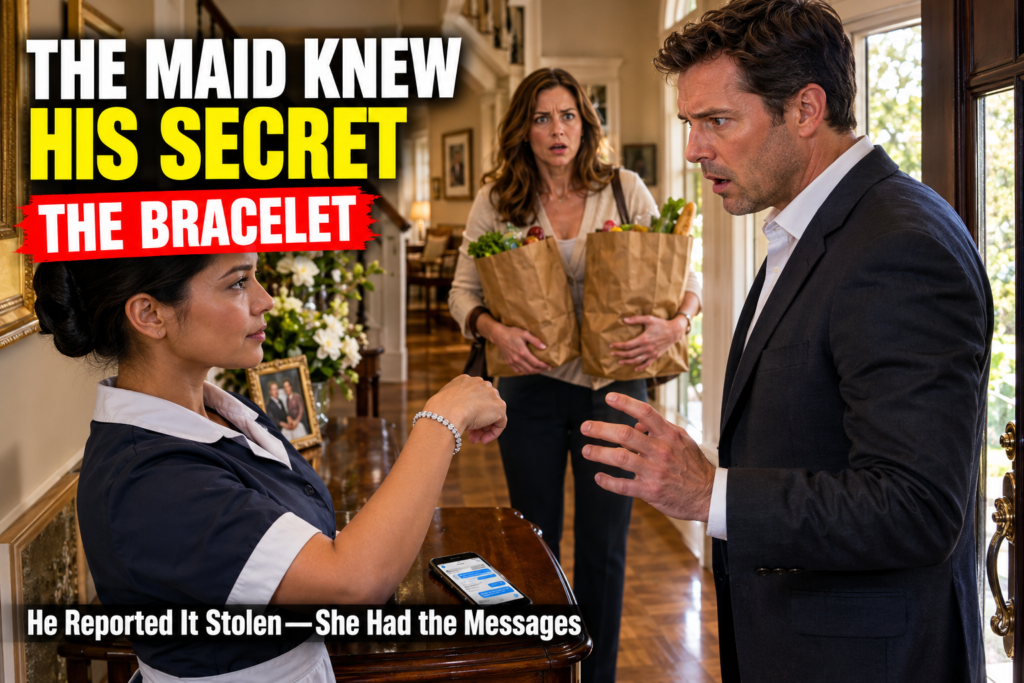
My husband screamed when he saw our maid answer the front door in a diamond bracelet, the one he’d reported stolen for insurance money. “Where did you get that?” he demanded, his face white. She didn’t flinch. She looked him dead in the eyes and said, “You gave it to me yourself, three weeks ago.”
I stood behind him holding grocery bags, watching twelve years of marriage rearrange itself in real time.
“I don’t know what you’re talking about,” he stammered, reaching for his phone. She calmly pulled out hers instead, opened a folder of messages, and set it on the hallway table between us without saying another word.
He stared at the screen for almost a minute. Then he looked at me, then back at her, and whispered something I never thought I’d hear him say to our housekeeper in our own home.
Part 1
The first thing I noticed was the bracelet.
Not my husband’s expression. Not the grocery bags cutting into my fingers. Not even the way he suddenly stopped walking as if someone had slammed an invisible door in front of him.
It was the diamond bracelet resting around our housekeeper’s wrist.
It caught the late-afternoon sunlight coming through the narrow glass panels beside our front door, scattering tiny flashes of white across the hallway wall. I recognized it immediately. The delicate platinum links, the unusual clasp, the three small diamonds set into the center—there was no mistaking it.
It was Daniel’s bracelet.
The same bracelet he had told me was stolen three weeks earlier.
The same bracelet he had spent an entire evening searching for before calling the police. The same one he had listed on an insurance claim, insisting that it had disappeared from the locked drawer in his home office.
And now it was on Maria’s wrist.
Maria had worked in our home for almost four years. She was quiet, dependable, and careful with other people’s belongings. She remembered how I liked my kitchen counters cleaned and which plants needed watering twice a week. When my father had been ill, she had quietly taken extra tasks off my hands without making me feel that I owed her anything.
I had trusted her.
I had trusted Daniel, too.
For twelve years, I had believed that whatever disagreements we had, whatever secrets we kept about birthday presents or surprise plans, our marriage rested on one unshakable agreement: we did not deliberately deceive each other.
Apparently, I had been wrong about at least one of those things.
Daniel stared at Maria’s wrist.
Then his face drained of color.
“Where did you get that?”
His voice was so sharp that I nearly dropped the grocery bags.
Maria glanced down at the bracelet, then raised her eyes to him.
“You gave it to me yourself, three weeks ago.”
The hallway became painfully quiet.
I looked at Daniel, waiting for him to laugh or explain that Maria had misunderstood something. I expected him to tell us there was another bracelet, a replica, or some innocent reason that would make the scene in front of me less impossible.
Instead, he shook his head.
“No. No, that’s not possible.”
Maria didn’t move.
Daniel took one step toward her.
“Take it off.”
She folded her arms.
“Why?”
“Because that’s mine.”
“You reported it stolen.”
His mouth opened, but no words came out.
I slowly set the grocery bags on the floor. One of them tipped over, and a few oranges rolled across the tile.
Neither of them looked down.
I could hear my own heartbeat.
“Daniel,” I said carefully, “what is she talking about?”
He turned toward me so quickly that I stepped back.
“Nothing. She’s confused.”
Maria let out a quiet breath.
“I’m not confused.”
“Stop talking,” Daniel snapped.
She looked at him with an expression I had never seen on her face before. It wasn’t fear. It wasn’t embarrassment.
It was disappointment.
Then she reached into the pocket of her uniform and pulled out her phone.
“I thought you might say that.”
She opened a folder, tapped the screen twice, and placed the phone on the hallway table between us.
“I saved everything.”
Daniel stared at the screen.
And for the first time in twelve years, I watched my husband look genuinely afraid of what another person might say.
Part 2
I didn’t touch Maria’s phone immediately.
I couldn’t.
The grocery bags sat abandoned beside my feet. My keys were still in my hand, pressing their edges into my palm. Somewhere outside, a car passed along the street, its tires making a soft sound against the pavement.
Inside our hallway, the three of us stood around a phone as if it were something dangerous.
Daniel reached for it.
Maria placed her hand over the device before his fingers could touch it.
“Don’t.”
His eyes narrowed.
“Give me the phone.”
“No.”
“I’m telling you to give it to me.”
“And I’m telling you that you don’t get to take my property because you don’t like what’s on it.”
The firmness in her voice startled me. Maria had always been polite, sometimes almost painfully so. She usually avoided arguments and apologized even when someone else bumped into her.
This was not the Maria I knew.
Or perhaps it was the Maria she had been forced to become after keeping something to herself for too long.
I looked at Daniel.
“What did you give her?”
“Nothing.”
Maria turned the phone so the screen faced me.
The first message showed Daniel’s name and a date from three weeks earlier.
*Keep it somewhere safe until I tell you otherwise. Don’t mention it to anyone.*
Below it was a photograph.
The diamond bracelet lay on a folded white towel, unmistakable even in the slightly blurry image.
I felt the floor shift beneath me.
Another message appeared beneath the photograph.
*If anyone asks, you haven’t seen it.*
Then another.
*I’ll explain everything when the insurance money comes through.*
My mouth went dry.
I read the messages again, hoping I had misunderstood them.
The words remained the same.
Daniel snatched at the phone, but Maria picked it up and held it close to her chest.
“Enough,” I whispered.
Neither of them looked at me.
“Daniel, did you give Maria the bracelet after telling me it had been stolen?”
He rubbed his forehead.
“It’s not what you think.”
I almost laughed.
The sentence was so familiar. I’d heard it when a business dinner ran late, when a credit-card statement contained charges he couldn’t explain, and when he insisted that a woman whose name I didn’t recognize was merely a colleague.
Every time, I had accepted an explanation because I wanted to believe my husband.
But this time, there was a photograph.
There were messages.
And there was the bracelet itself.
“What am I supposed to think?” I asked.
He lowered his voice.
“Can we discuss this privately?”
“We are in our own home.”
“Not with Maria standing here.”
Maria’s expression tightened.
“You’re the one who brought me into it.”
“I did not bring you into anything.”
“You gave me the bracelet and told me to hide it.”
Daniel looked at me again.
“She’s twisting things.”
Maria unlocked her phone and scrolled to another conversation.
“I have the messages from the day you brought it to me. I have the picture you sent afterward. I even have the message where you told me what to say if your wife asked.”
My stomach tightened.
I looked at Daniel.
“What did you tell her to say?”
He didn’t answer.
Maria read the message aloud.
“If your wife notices it, tell her it’s a cheap piece of jewelry you bought for a costume party.”
The hallway seemed to shrink around us.
I had never worn that bracelet. Daniel had purchased it years before our wedding, he said, as an investment. He kept it in a locked drawer and occasionally took it out to show visiting friends.
When he reported it missing, he had been furious.
He had insisted that someone must have entered the house while we were out. He had questioned Maria about the cleaning schedule and asked whether she had noticed anything unusual.
I remembered standing beside him as he made the report.
I remembered how convincing his anger had seemed.
Now I wondered whether I had been watching an actor perform a scene written specifically for me.
“Why?” I whispered.
Daniel stared at the floor.
For a moment, I thought he might finally tell the truth.
Instead, he looked up and said, “You don’t understand how complicated this is.”
That was when I realized he wasn’t preparing to explain himself.
He was preparing to explain why I should forgive him.
Part 3
My name is Evelyn Carter, and until that afternoon, I would have described my marriage as ordinary.
Not perfect, certainly. Daniel and I argued about money, family visits, and the amount of time he spent working. We had experienced the kind of disappointments that accumulate slowly over the years: missed anniversaries, forgotten promises, conversations postponed until both people were too tired to finish them.
But we had also built a life together.
We bought our house eleven years earlier, when the garden was little more than a patch of uneven grass. We renovated the kitchen, replaced the old windows, and planted hydrangeas along the driveway. We hosted Christmas dinners and celebrated birthdays around the same dining table.
We had friends who considered us a stable couple.
Some even called us lucky.
Daniel was confident, charming, and good at making people feel as though he had everything under control. He could calm an angry client in minutes and turn a disagreement at a dinner party into a joke that made everyone laugh.
I used to admire that quality.
Now, standing in our hallway, I wondered how much of his calmness came from knowing exactly what he wanted people to believe.
“Sit down,” I said.
Daniel blinked.
“What?”
“All three of us. Sit down and explain what happened.”
He looked toward the living room as if he were searching for an exit.
“I don’t think this is the right time.”
“When would be the right time? After the insurance company pays you?”
His expression changed.
Maria looked at me, then lowered her eyes.
Daniel’s silence answered more than his words had.
I walked into the living room and sat on the edge of the sofa. My hands were trembling, so I pressed them together.
Daniel remained standing.
“Please,” I said. “Tell me the truth once.”
He finally sat in the armchair opposite me.
Maria stayed near the doorway, holding her phone.
Daniel took a breath.
“The bracelet wasn’t stolen.”
I stared at him.
“I know.”
“I was going to explain.”
“When?”
He rubbed his hands together.
“I was dealing with some financial problems.”
“What financial problems?”
“Business expenses. A few investments that didn’t work out. Things I thought I could fix quickly.”
I knew Daniel’s business had been struggling. He had complained about delayed payments and a client who owed him money. But he had repeatedly assured me that our household finances were secure.
I had never agreed to risk our savings or mislead an insurance company.
“How much money are we talking about?”
He looked away.
“That’s not important right now.”
“It is very important to me.”
He sighed.
“I needed cash.”
“So you reported your bracelet stolen?”
“I thought the claim would help me get through a difficult period.”
I felt sick.
“Did you intend to tell the insurance company it was stolen when you knew it wasn’t?”
He didn’t answer.
“Daniel.”
“Yes.”
The word landed between us like a stone.
I had spent twelve years trusting this man with my home, my finances, my private fears, and the future I thought we were building together.
Now he had admitted to deliberately making a false claim.
“And you gave the bracelet to Maria to hide it?”
“I asked her to hold it temporarily.”
“You told me it was stolen.”
“I didn’t want you to worry.”
I looked at him in disbelief.
“You didn’t want me to worry, so you made me believe someone had broken into our home?”
His jaw tightened.
“I said I made a mistake.”
“No. You made a decision. Then you made another decision to hide it. Then another to keep lying.”
He flinched.
Maria shifted her weight near the doorway.
I turned to her.
“Maria, why didn’t you tell me?”
She looked uncomfortable.
“I wanted to.”
“Why didn’t you?”
She took a breath.
“Because he said he would lose everything if the insurance company found out. He told me the money was already arranged and that I only needed to keep the bracelet safe until everything was finished.”
“Did you believe him?”
“At first.”
“And later?”
Her eyes moved toward Daniel.
“Later, I realized he wasn’t telling me the whole story.”
Daniel stood abruptly.
“This is enough.”
“No,” I said. “It isn’t.”
For the first time, my voice rose.
“You made me believe our home wasn’t safe. You made Maria part of a secret. You involved an insurance company in a lie. And you expect me to stop asking questions because you’re uncomfortable?”
He stared at me.
Then he said something that chilled me more than his admission.
“You have no idea what I’ve done to keep this family comfortable.”
I looked at the man I had married.
And I began to wonder what else he believed he was entitled to do in my name.
Part 4
I asked Daniel to explain every message.
He refused at first, insisting that we could discuss the matter after Maria left. But Maria had already made it clear that she would not surrender her phone, and I had no intention of allowing the conversation to disappear behind another closed door.
Eventually, Daniel began talking.
Three months earlier, he had invested money in a small commercial property with two acquaintances. The deal had seemed promising, but one partner withdrew unexpectedly, and the projected income never materialized.
Daniel had borrowed money to cover the shortfall.
Then he borrowed more to pay the first loan.
By the time the bracelet went missing from its drawer, he was struggling to keep several financial obligations from becoming overdue.
“Why didn’t you tell me?” I asked.
“Because I thought I could fix it.”
“With an insurance claim?”
He pressed his lips together.
“I thought I’d have time to replace the money.”
“Replace it with what?”
He didn’t answer.
I knew enough about insurance to understand that a claim required accurate information. The fact that the bracelet still existed, and that Daniel had deliberately hidden it, made the situation far more serious than a desperate borrowing decision.
I wasn’t prepared to help him conceal what he had done.
But I also wasn’t ready to decide what it meant for our marriage.
“How much did you claim?” I asked.
He told me the amount.
It was more than I expected.
My fingers went cold.
“Did you use our joint financial information?”
“I listed the bracelet.”
“That’s not what I asked.”
He looked at me.
“The policy is under my name.”
“Did you use money from our joint account to pay anything related to this?”
He hesitated too long.
I stood.
“I want a copy of the policy and the claim documents.”
“Evelyn—”
“I want copies of everything you submitted, and I want to know whether any shared account or shared asset is involved.”
He rubbed his face.
“You’re making this sound like a criminal investigation.”
“You’re the one who reported an item stolen when you knew exactly where it was.”
He looked away.
Maria quietly placed her phone on the coffee table, with the relevant conversation open.
“I also have the messages from the day he gave me the bracelet,” she said. “And the messages from the day he told me not to speak about it.”
Daniel glared at her.
“You were supposed to keep this private.”
Maria straightened.
“You told me to hide a bracelet that you had reported stolen. You asked me to lie if anyone questioned me. I should never have agreed to keep it secret.”
Her voice shook slightly, but she didn’t back down.
“I made a mistake by not speaking up sooner. I’m not making it worse by deleting the proof.”
I looked at her with a new kind of respect.
She wasn’t pretending she had handled everything perfectly. She was acknowledging her part while refusing to continue participating.
Daniel sat back down.
For a moment, he seemed smaller than I had ever seen him.
Then his phone began vibrating.
He glanced at the screen and rejected the call.
It rang again.
He rejected it again.
“Who is that?” I asked.
“Nobody.”
I held out my hand.
“Daniel, I am not doing this anymore.”
He stared at my hand.
Then he turned the phone face down on the table.
“It’s the insurance investigator.”
The room went silent.
My pulse quickened.
“You’ve already spoken to an investigator?”
“They called this morning.”
“What did you tell them?”
He didn’t answer.
I felt a wave of disbelief so strong that I had to sit down again.
The bracelet had not simply been reported missing. The claim was already moving through a process in which people were checking the facts.
Daniel had been given an opportunity to tell the truth.
Instead, he had kept the bracelet hidden and continued pretending the theft was real.
“Have they paid you?” I asked.
“No.”
“Have you told them the bracelet is safe?”
“No.”
I stared at him.
He had been prepared to let the false claim continue.
I turned toward Maria’s phone, where his own messages remained visible.
For the first time, I understood why she had kept them.
She had realized that if the story ever came apart, Daniel might deny every word.
And she had been right.
Part 5
That evening, I didn’t prepare dinner.
I didn’t unpack the groceries or water the plants or ask Daniel whether he wanted coffee.
I walked upstairs, closed the bedroom door, and sat on the edge of the bed where I had spent twelve years believing I knew the man beside me.
The room looked exactly as it had that morning.
His watch lay on the dresser. My reading glasses sat beside a half-finished novel. The framed photograph from our tenth anniversary stood on the nightstand.
In the picture, Daniel had his arm around my shoulders. We were smiling at the camera beneath the lights of a restaurant terrace.
I remembered that evening clearly.
He had told me he was grateful for the life we had built. He had said that whatever happened in the future, we would face it together.
I had believed him.
Now I wondered whether he had been telling the truth that night or simply saying what a husband was expected to say.
My phone buzzed.
It was a message from Daniel.
*Please don’t make any decisions tonight. We can work this out.*
I stared at the words.
He had already made a series of decisions without me. He had concealed his financial trouble, hidden the bracelet, reported it stolen, and involved Maria in his plan.
Yet now that I knew the truth, he wanted me to slow down.
I didn’t respond.
Instead, I called my older friend and former colleague, Susan, who worked in financial compliance. I didn’t ask her to investigate Daniel or to give me legal conclusions. I simply explained what had happened and asked what steps a person should consider when a spouse admits to making a potentially fraudulent insurance claim.
She listened without interrupting.
When I finished, she said, “First, don’t sign anything you don’t understand. Keep copies of documents you already have lawful access to. Don’t destroy or alter messages. And speak with an independent lawyer before deciding how to protect yourself.”
I wrote down her advice.
She also reminded me that I didn’t need to become Daniel’s investigator, lawyer, or public defender.
“I know you’ve been married a long time,” she said. “But being loyal doesn’t mean you have to participate in a lie.”
I felt tears slip down my cheeks.
“I don’t know what to do about the marriage.”
“You don’t have to decide that tonight,” Susan replied. “Start by separating what you know from what you fear. Then get professional advice about the things that could affect you financially or legally.”
After we hung up, I opened the family financial folder on my laptop.
I reviewed the accounts I had access to and saved copies of recent statements. I made a list of questions about our shared finances and wrote down the dates I remembered from the bracelet incident.
I didn’t move money or make accusations to anyone. I wanted reliable information before making any decisions.
When I finally went downstairs, Daniel was sitting at the kitchen island.
The diamond bracelet lay on the counter between us.
“Why is that here?” I asked.
“I thought you should have it.”
I stared at him.
“You gave it to Maria to hide. Then you told everyone it was stolen. Now you’re handing it to me as if returning it makes the problem disappear?”
His shoulders sagged.
“I don’t know what else to do.”
“Tell the truth.”
He looked at the bracelet.
“I’ll contact the insurance company.”
“When?”
“Tomorrow.”
I didn’t nod or thank him.
“Please don’t wait for me to tell you again.”
He looked at me, and I saw something in his expression that I couldn’t immediately identify.
Fear, certainly.
But perhaps also the realization that I was no longer going to carry the emotional weight of his decisions.
I picked up the bracelet using a clean cloth and placed it in a small jewelry box.
Then I set the box on the table.
“Until this is resolved, I don’t want you asking Maria to do anything about it. No more messages telling her what to say. No more instructions to keep secrets.”
Daniel nodded.
“And I want you to understand something else,” I continued. “I am not promising that our marriage will survive this. I need honesty, and I need time.”
He swallowed.
“I understand.”
For the first time that evening, I believed he might understand the words.
Whether he was prepared to live by them was another question.
Part 6
The next morning, Daniel contacted the insurance company.
I didn’t sit beside him or tell him what to say. I asked him to handle his own disclosure honestly and to provide me with copies of any documents that could affect our shared finances.
He made the call from his home office with the door open.
I could hear only fragments of the conversation.
“Yes, I need to correct information in the claim.”
A pause.
“The item wasn’t stolen.”
Another pause, longer this time.
“I still have it.”
He sounded increasingly strained as the conversation continued.
When he finally came downstairs, he looked exhausted.
“They’ve suspended the claim,” he said.
I nodded.
“What happens now?”
“They want a written statement and supporting documents. They said the investigator will follow up.”
“Then give them accurate information.”
He stared at me.
“That’s all you have to say?”
“What do you want me to say, Daniel?”
He looked down.
“I don’t know.”
I felt no satisfaction in seeing him frightened. I wasn’t happy that he might face financial or legal consequences. I had no desire to humiliate him.
But I also refused to rescue him from the consequences of a decision he had made deliberately.
That afternoon, I contacted an independent lawyer for advice about protecting my interests and understanding whether the insurance claim had any implications for our household or shared assets. I brought the documents I had collected and explained the facts as clearly as I could.
The lawyer advised me to keep records, avoid signing anything connected to the claim, and make sure I understood the ownership and liability arrangements for our accounts and property.
I followed that advice.
Over the next few days, Daniel gathered the relevant records. He provided the messages, the original purchase documentation for the bracelet, and a written explanation of how it had come to be in Maria’s possession.
I did not help him construct a story.
I did not tell him which facts to emphasize or which ones to leave out.
If he wanted to begin repairing the damage, he had to start by being truthful when it was uncomfortable.
Maria continued working in our home during that period, although I offered her the option of taking time away if she felt uncomfortable. I also made it clear that she was free to speak with an independent adviser if she needed one.
She thanked me.
“I should have told you sooner,” she said one afternoon while we stood in the kitchen.
“Why didn’t you?”
She looked at the floor.
“He said his business would collapse if the claim failed. He made it sound as if I would be responsible for ruining everything.”
I understood how fear could make a person hesitate. That didn’t mean her silence had been harmless, but I could see that Daniel had placed her in an unfair position.
“You should never have been asked to carry that secret,” I told her.
She nodded.
“I know that now.”
After a pause, she added, “I kept the messages because I was afraid he would deny what happened. I didn’t want to lose my job over something I hadn’t done.”
That was when I fully understood the importance of the phone she had placed on the hallway table.
It wasn’t merely a weapon in an argument.
It was her protection against being made the scapegoat.
Daniel had expected her to remain silent because she worked for us. He had mistaken her politeness for helplessness and her employment for an obligation to obey.
But she had chosen to preserve the truth.
And when the moment came, she had placed the evidence where both of us could see it.
I didn’t know whether I could ever feel the same way about my marriage again.
I did know that Maria deserved to work in a home where she wasn’t asked to lie for the people who employed her.
That evening, I told Daniel that any future conversation about our marriage would need to include a serious discussion about trust, financial transparency, and the way he had treated Maria.
He agreed.
But I had learned that agreement was the easiest part.
The harder part would be what happened after nobody was watching.
Part 7
For the next two weeks, the house felt like a place where everyone was speaking too quietly.
Daniel moved through his usual routines, but his confidence had disappeared. He spent long hours in the home office, answering questions from the insurance company and gathering records related to his financial dealings.
Sometimes he tried to make small talk over breakfast.
Sometimes he asked whether I wanted to watch a movie with him.
I answered politely when I could, but I wasn’t ready to pretend we had returned to normal.
He seemed frustrated by that.
“I’ve admitted what I did,” he said one evening. “What else do you want from me?”
I put down my book.
“I want you to stop treating the admission as if it erases the decision.”
“I’ve corrected the claim.”
“That’s necessary. It doesn’t automatically repair our marriage.”
He rubbed his forehead.
“I made a terrible mistake.”
“You made several choices, Daniel. You hid the bracelet. You reported it stolen. You asked Maria to keep it secret. You continued the claim when the investigator contacted you. And you lied to me every time I asked what happened.”
He looked away.
“I know.”
“Do you? Because every time I bring it up, you talk about how hard this has been for you. I understand that you’re scared. But you haven’t asked what it has done to me.”
He was silent.
Then, unexpectedly, he sat down.
“I’m sorry.”
I waited.
“I’m sorry I made you feel unsafe in your own home. I’m sorry I involved Maria. And I’m sorry I made you question everything about our marriage.”
The apology was more specific than the ones he had offered before.
I wanted to believe it.
But I had also learned that the right words could be spoken in a moment of fear without becoming a lasting change.
“I appreciate the apology,” I said. “But I need more than that.”
“What?”
“Complete honesty about our finances. No secret borrowing that affects our household. No using another person to hide something from me. And no more treating questions as attacks.”
He nodded.
“We can do that.”
“Not because you want me to stop being upset. Because it’s what a marriage requires.”
He looked down at his hands.
“I understand.”
That weekend, Daniel disclosed the full extent of the financial trouble he had been hiding. There were outstanding debts and losses he had minimized in earlier conversations. Some were connected to his business, while others involved personal borrowing.
I listened, asked questions, and took notes.
It was painful to discover how much I hadn’t known.
I had believed we were making decisions together, but Daniel had been managing his problems alone and presenting me with a carefully edited version of our situation.
When I asked why, he said he had been ashamed.
“I didn’t want you to think I was a failure.”
I looked at him.
“I would rather have faced a financial problem with you than discover that you had built a lie around it.”
He nodded slowly.
For the first time, he didn’t argue.
We arranged a full review of our finances with independent professional guidance. I made sure I understood our shared obligations and what steps I needed to take to protect myself.
We also began marriage counseling.
The first sessions were difficult. Daniel often tried to explain his behavior before acknowledging its impact. I sometimes found myself slipping into the old habit of softening my words so he wouldn’t feel criticized.
The counselor helped us recognize that pattern.
I could express hurt without becoming responsible for managing his reaction.
Daniel could feel ashamed without turning that shame into defensiveness.
And neither of us could rebuild trust by pretending the past hadn’t happened.
Meanwhile, the insurance matter continued through the company’s review process. Daniel cooperated with the requests for information, and I left the matter to the appropriate professionals rather than trying to predict the outcome.
I did not know what consequences he might face.
I knew only that the claim had been made on false information, and the truth needed to be addressed properly.
One afternoon, Daniel came into the kitchen while I was preparing tea.
“Maria told me she’s considering looking for another job,” he said.
I turned toward him.
“Why?”
“She says she feels uncomfortable here.”
I thought about the messages, the bracelet, and the way he had tried to silence her in the hallway.
“Can you blame her?”
He looked down.
“No.”
“If she decides to leave, we’ll handle it respectfully. She shouldn’t have to stay in a place where she feels pressured because of what happened.”
He nodded.
That was the first time he acknowledged someone else’s needs without immediately bringing the conversation back to his own.
It was a small change.
But after everything that had happened, I had learned to notice the small things.
Part 8
Maria gave us three weeks’ notice.
She explained that she had found another position through a family she knew and wanted a fresh start. I thanked her for telling me directly and assured her that we would pay everything she was owed and provide a fair reference based on her work.
Before she left, I asked whether she wanted to talk about what had happened.
She sat across from me at the kitchen table.
“I was afraid,” she admitted. “When your husband gave me the bracelet, he said it was temporary. Then he told me about the insurance claim. I knew something was wrong, but I kept thinking he would fix it before anyone found out.”
“Why did you keep the messages?”
“Because his instructions kept changing. First, he said not to mention the bracelet. Then he said to tell you it was costume jewelry if you noticed it. Later, he asked me to confirm that I hadn’t seen anything unusual in the house.”
She paused.
“I started to worry that if the insurance company contacted me, he would say I had taken it.”
I felt a chill.
“Did he threaten you?”
“Not directly. He reminded me that I worked for your family and that he expected loyalty.”
I closed my eyes briefly.
Loyalty.
It was the word Daniel had used to make secrecy sound like a virtue.
“I am sorry you were put in that position,” I said. “You should never have been asked to protect him from the truth.”
Maria nodded.
“I should have told you when I first realized what was happening.”
“Perhaps. But the responsibility for the false claim belongs to the person who made it. You don’t have to carry his choices for him.”
She looked relieved, though still sad.
Before she left, she handed me a small envelope containing the final list of household supplies and the contact information for a replacement cleaning service she trusted. It was exactly the sort of practical detail she had always remembered.
I thanked her.
At the door, she turned back.
“I hope things get better for you.”
I wanted to say that I hoped the same for her, but the words caught in my throat.
“Thank you, Maria. For keeping the messages. And for telling the truth when it mattered.”
She gave me a small smile and walked down the front path.
I watched until she reached her car.
Then I closed the door.
The bracelet had started this crisis, but it was no longer the most important thing in my mind.
What mattered was the way Daniel had behaved when he thought he could control the story. He had relied on my trust, Maria’s fear, and the assumption that people would accept his version because it was easier than challenging him.
The bracelet was simply the object that made his story impossible to maintain.
That evening, Daniel and I sat down with the financial records.
We reviewed the debts, the outstanding obligations, and the steps he had taken to correct the insurance claim. I asked questions whenever I didn’t understand something. When he became defensive, I reminded him that transparency was a condition of continuing our work together.
He didn’t like it.
But he stayed at the table.
For the first time in months, we were discussing difficult facts without pretending they were something else.
It didn’t feel like reconciliation.
It felt like the beginning of an honest assessment.
And honesty, I discovered, could be painful without being destructive. It could expose the things a couple had hidden from each other, but it could also reveal what still had a chance of being repaired.
I was not ready to forgive Daniel completely.
I wasn’t even sure what forgiveness would look like.
But I was no longer willing to accept a marriage in which one person made the decisions and the other was expected to live with the consequences.
If we were going to continue, the truth would have to become something we practiced—not something we admitted only after being caught.
Part 9
Several months passed before our home began to feel familiar again.
The insurance company completed its review according to its procedures. Daniel provided the requested records and cooperated with the process. I did not involve myself in decisions that belonged to the company or to the legal professionals advising him.
The experience left him facing consequences he had once hoped to avoid.
It also forced us to confront the financial problems he had concealed for months.
We worked with independent advisers to understand our position and develop a realistic plan. I reviewed the accounts I was entitled to access, made sure I understood our household obligations, and insisted that any significant financial decision affecting us both be discussed openly.
The process was uncomfortable.
There were moments when I wanted to return to the easier version of our life—the one where Daniel handled the complicated things and I trusted him to make the right choices.
But that version had depended on me not asking too many questions.
I no longer wanted a comfortable life built on incomplete information.
Daniel began to change in ways I could measure.
He shared financial documents without being asked repeatedly. He told me when he was worried about a payment instead of hiding the problem until it became urgent. He stopped describing every difficult question as a lack of faith in him.
He also continued counseling, even when the conversations became uncomfortable.
None of those things erased what he had done.
They simply gave me something real to evaluate.
One evening, we sat on the back porch while rain moved across the garden.
Daniel looked toward the kitchen window.
“I still think about the day Maria opened the door.”
“So do I.”
“I remember seeing the bracelet and thinking everything was over.”
I watched the rain falling from the edge of the roof.
“You were afraid people would discover the truth.”
He nodded.
“I was afraid of losing everything.”
“You were already risking everything when you decided to lie.”
He accepted that without arguing.
After a long silence, he said, “I don’t know why I thought I could get away with it.”
I turned toward him.
“Because you thought you could control what everyone knew.”
He looked at me.
“And because you thought I would believe you.”
He lowered his eyes.
“Yes.”
That answer hurt more than I expected.
For years, I had thought trust meant believing my husband unless I had a compelling reason not to. I had treated doubt as something dangerous, a crack that could spread through a relationship if I allowed it to remain.
Now I understood that trust did not require ignoring evidence.
Trust required a person to behave in ways that made belief reasonable.
It required honesty even when the truth was embarrassing.
It required the courage to say, “I’ve made a mess, and I need help,” rather than forcing other people to live inside a lie.
“I don’t want to spend the rest of our marriage checking up on you,” I told him.
“I don’t want that either.”
“Then I need to be able to trust what you tell me.”
He nodded.
“I know I have to earn that.”
We sat quietly until the rain softened.
I didn’t take his hand. I wasn’t ready to make that gesture mean more than I felt.
But I didn’t leave the porch, either.
Our marriage was no longer the simple story I had told myself for twelve years. I could not return to the version in which Daniel’s confidence stood in for honesty and my loyalty meant never questioning him.
If we were going to build something lasting, it would have to be different.
It would have to make room for difficult truths, shared responsibility, and the understanding that love did not give either of us permission to deceive the other.
The bracelet remained in its box, no longer a symbol of luxury or an old purchase.
It reminded me of the moment the story Daniel had created collided with the truth Maria had preserved.
And it reminded me that sometimes the person with the least power in a room is the one who finally refuses to lie.
Part 10
A year after the day Maria opened our front door, I found myself standing in the hallway again.
The grocery bags were gone. The oranges had long since been eaten. The small table where Maria had placed her phone had been moved to the other side of the room.
The house looked ordinary.
But I was not the same woman who had walked through that door twelve months earlier.
I had learned more about our finances than I had ever expected to know. I had learned to ask questions without apologizing for them. I had learned that loving someone did not mean protecting them from every consequence of their own choices.
Most importantly, I had learned that trust was not something a person could demand after breaking it.
It was something they had to rebuild through consistent behavior.
Daniel and I were still working on our marriage. We had made progress, but we had not pretended that progress meant forgetting. There were conversations we still needed to have, and there were moments when an old memory returned unexpectedly.
Sometimes a delayed phone call made me remember the afternoon he reported the bracelet stolen.
Sometimes a financial document made me wonder what else I might have overlooked.
When that happened, I tried to tell him honestly rather than hide my feelings until they turned into resentment. He had learned that listening was not the same as admitting to something he hadn’t done. I had learned that being cautious was not the same as being cruel.
We were still learning how to live with the truth.
I never saw Maria again after she left, though I occasionally wondered how she was doing. I hoped her new position had given her the peace she deserved.
She had not been perfect. She had waited too long to tell me what she knew. But when the moment came, she had refused to destroy the evidence or pretend the bracelet had appeared on her wrist by accident.
She had chosen honesty when silence would have been easier.
I thought about that often.
Daniel had assumed that his position in our household gave him the power to direct the story. He was my husband. He was Maria’s employer. He had been the one who made the insurance claim, and he believed he could decide how the facts would be presented.
But he had forgotten that every person involved had their own choices to make.
Maria could keep the messages.
I could ask questions.
And the insurance company could examine the claim rather than simply accepting his word.
The truth did not belong to Daniel just because he had tried to control it.
One afternoon, while organizing a drawer in the home office, I found an old photograph from our fifth wedding anniversary. Daniel and I were standing on a beach, our shoes in our hands, laughing as the wind blew my hair across my face.
I sat with the photograph for a long time.
I didn’t hate the woman in it for believing in her husband. She had made the best decisions she could with what she knew. She had trusted someone she loved, and there was nothing shameful about that.
What I wished for her was not suspicion.
It was the confidence to know that if the truth ever changed, she would be allowed to change her decisions, too.
I placed the photograph back in the drawer.
Then I went downstairs.
Daniel was in the kitchen, making coffee. He looked up when I entered.
“Do you want some?”
“Yes, please.”
He poured a cup and handed it to me.
It was a small, ordinary gesture.
For a moment, I felt the sadness of everything that had happened. I wished we had never reached that hallway, never involved Maria in a lie, never had to learn so painfully what twelve years of marriage could conceal.
But wishing did not change the past.
What mattered was what we chose to do with the truth now.
Daniel sat across from me.
“How are you feeling?” he asked.
I considered the question before answering.
“Better than I was. Still cautious.”
He nodded.
“I understand.”
This time, he didn’t ask me to move on or tell me that we had already discussed it enough.
He let the answer stand.
And that mattered.
I cannot say that every marriage would survive a betrayal like ours. Some would end, and that would be a valid choice. Others might find a way to rebuild, provided both people accepted responsibility and made lasting changes.
There was no single answer that could fit every family.
But I knew one thing with certainty.
The day Maria opened our front door wearing that diamond bracelet, my life changed because I finally saw the difference between the story I had been told and the truth that had been hidden.
I had believed that loyalty meant standing beside my husband no matter what.
Now I understood that loyalty could not require me to abandon my judgment, ignore evidence, or participate in deception.
Love could survive mistakes, but only when the people involved were willing to face what they had done.
Trust could return, but not because someone demanded it.
And a home could look perfectly ordinary from the outside while holding secrets that changed everything within it.
Sometimes, the truth arrives with a shout.
Sometimes, it arrives in a message on a phone.
And sometimes, it appears quietly on the wrist of a woman who has been told to keep her mouth shut.
Maria had opened the door that afternoon.
But it was the truth she placed on the hallway table that opened my eyes.