PART 1
My name is Daniel, and for a long time, I believed my unhappiness was somebody else’s responsibility.
It was a convenient belief because it allowed me to feel trapped without asking myself who had locked the door.
I had Monica, our twin boys, a modest house in a quiet neighborhood, and a job that paid well enough for us to cover the mortgage and keep the refrigerator full. We were not wealthy, but we were comfortable. The boys had their own bedrooms, Monica drove a reliable car, and we could usually afford a family holiday if we planned ahead.
From the outside, our life looked like the kind of life people worked hard to build.
From the inside, I convinced myself it was slowly swallowing me.
The twins were eight when I began seriously thinking about leaving. Tyler was the more outgoing one, always asking questions and wanting to know how things worked. His brother, Ethan, was quieter, more observant, and perfectly capable of spending an entire afternoon building something out of cardboard boxes while the rest of the family made noise around him.
They were good kids. I knew that.
But I had started treating the ordinary demands of fatherhood as though they were interruptions to a life I was supposed to be enjoying.
The boys wanted me to watch them play football in the yard. Monica wanted me to fix the loose fence panel. There were school meetings, birthday parties, groceries to buy, and small household problems that never seemed to end.
I began measuring my days by what I believed I had sacrificed.
I couldn’t sleep late on weekends because the boys woke early. I couldn’t spend an entire evening with friends without checking the time. I couldn’t make a spontaneous purchase without considering the household budget. Every decision seemed connected to somebody else’s needs.
I never asked Monica how often she felt the same way.
She was the one who remembered the school schedules, bought the boys’ shoes before their toes reached the ends, and kept track of which permission slips needed signatures. She knew when Tyler had a difficult day and when Ethan was pretending not to be upset. She could tell from the way they entered the kitchen whether they wanted to talk or simply needed someone nearby.
I saw those things as tasks she was naturally good at.
I did not see how much effort they required.
Monica had once been adventurous, too. Before the boys were born, she liked hiking, taking photographs, and visiting small towns we had never heard of. She talked about learning to grow vegetables, partly because she loved fresh food and partly because she liked the idea of making something with her own hands.
She had a folder of garden ideas on her laptop. She showed me pictures of raised wooden beds, tomato plants, herbs, and climbing beans.
“One day,” she told me, “I want a proper vegetable garden in the backyard.”
I looked out at our patch of grass.
“Sure,” I said. “We’ll build one.”
“When?”
“When I have a free weekend.”
That answer became a running joke between us.
Monica would mention the garden, and I would tell her I was waiting for the right time. I had work deadlines, bills, errands, and a hundred reasons why the project could wait.
She never asked for anything elaborate. A few wooden beds, some soil, a hose, and enough time to learn what would grow in our yard.
But every time she brought it up, I felt as though she were adding another obligation to a life I already resented.
Eventually, she stopped asking.
I interpreted her silence as proof that the garden had never mattered very much.
Looking back, I suspect she simply got tired of asking me to care about something that mattered to her.
My job was another source of dissatisfaction. I had been with the same company for years, and the work had become predictable. I knew the procedures, understood the clients, and could handle most problems without much effort. That should have made me grateful.
Instead, I felt embarrassed by how ordinary my life seemed.
I watched younger colleagues arrive with ambitious ideas and talked myself into believing that I had missed my opportunity. I imagined that somewhere beyond my routine was a more exciting version of myself, a man who took risks and made decisions without having to consider the needs of a family.
I never stopped to ask whether I was bored because my life was too small or because I had stopped investing in it.
One evening, Monica found me sitting on the back steps while the boys played inside.
She sat beside me.
“You’ve been distant lately,” she said.
“I’m just tired.”
“You say that every night.”
“Because I am tired.”
She nodded and looked out at the yard.
“I know. I am, too.”
I waited for her to continue complaining about the house or the children. Instead, she asked a question that should have made me think.
“Do you ever miss us?”
I turned toward her.
“What do you mean?”
“I mean the way we used to be. Before everything became something to get through.”
I felt uncomfortable because I knew exactly what she meant. We used to talk about our hopes. We used to laugh at stupid things. We used to make plans that were not simply about keeping the household running.
I could have admitted that I missed those things, too.
Instead, I said, “People change, Monica.”
She looked at me quietly.
“Yes,” she said. “They do.”
I took her answer as acceptance. I did not understand that she was beginning to recognize how little I wanted to participate in repairing what had changed.
Over the following months, I became more withdrawn. I stayed late at work even when there was no urgent reason. I spent evenings scrolling through my phone, watching videos of people traveling and talking about reinvention. I began spending more time with colleagues who had fewer responsibilities and who treated my family life as something I had outgrown.
I wanted them to tell me I deserved more.
They did.
One friend told me that people often stayed in relationships long after they had stopped being happy. Another said that children adapted better than adults expected. Someone else joked that I was too young to spend the rest of my life living the same week over and over.
Each comment made leaving seem less selfish.
I did not notice that none of those people would be the ones helping Monica explain my absence to our sons.
I did not notice that they would not be there when the boys woke up asking why their father had gone.
I only noticed how good it felt to imagine walking away.
The thought grew until it no longer seemed like an impulse.
It seemed like a plan.
And once I began planning my departure, I stopped looking for reasons to stay.
# PART 2 — THE KEY ON THE COUNTER
The woman I left with was named Vanessa.
She worked in a department connected to mine, although we had not spoken much before we began spending time together. She was confident, funny, and spontaneous in ways I had forgotten how to be. She liked last-minute plans, crowded restaurants, and driving somewhere simply because the weather was good.
When she laughed, I felt interesting.
When she asked about my life, I told her the parts that made me sound trapped rather than the parts that revealed how much I had contributed to my own unhappiness.
I talked about responsibility, routine, and the feeling that every day had been decided for me years in advance.
Vanessa listened sympathetically.
“You deserve to have a life, too,” she said once.
The words landed exactly where I wanted them to.
I did not tell her that I already had a life. It was not the life I wanted at that moment, but it was one I had helped build. Monica had not forced me into marriage. The boys had not chosen to be born. The house, the mortgage, and the family responsibilities were not traps I had accidentally fallen into.
They were the consequences of choices I had once made willingly.
But that truth did not fit the story I was telling myself.
I started imagining a future with Vanessa. I thought about moving somewhere new, changing jobs, and beginning again before I became too old to do it. I told myself that leaving would be painful in the short term but honest in the long term.
Eventually, I told Monica I wanted to separate.
We were sitting at the kitchen table after the boys had gone upstairs. A stack of school papers sat between us. One of the boys had left a half-finished drawing beside a glass of water, and Monica had been sorting through the mail.
I had chosen the moment carefully because I wanted to avoid an audience, but I had not considered how much worse it might feel for her to hear those words in the ordinary place where we made our family decisions.
“Monica, I need to talk to you.”
She put down the envelope she was holding.
“All right.”
“I’ve been thinking about my life.”
She gave a small, tired smile.
“That sounds serious.”
“It is.”
Her smile faded.
I explained that I felt lost, that I needed to figure out who I was, and that I did not think I could continue living the way we had been living. I said we had become different people and that I needed to find myself again.
It was the phrase I had rehearsed because it sounded thoughtful rather than cruel.
Monica listened without interrupting.
When I finished, she looked down at the table.
“Are you leaving us?”
I felt the word *us* press against me.
“I’m leaving the marriage,” I said. “That doesn’t mean I don’t love the boys.”
She looked up.
“I didn’t ask whether you love them. I asked whether you’re leaving.”
I swallowed.
“Yes.”
For several seconds, she said nothing.
I had prepared for anger. I had prepared for accusations and tears. I had even prepared to defend myself against the possibility that she might discover Vanessa.
What I had not prepared for was Monica’s stillness.
She looked toward the stairs, where the boys were supposed to be getting ready for bed.
“Do they know?”
“No.”
“When are you planning to tell them?”
“I thought we could work that out together.”
She let out a quiet breath.
“You’ve decided to leave, and now you want me to help you explain it.”
I felt the familiar urge to defend myself.
“I’m trying to do this the right way.”
“The right way would have been to talk to me before you decided that our marriage was over.”
I looked away.
She was right, and I hated that I could not argue with her without revealing how little I had considered her feelings.
Monica did not ask me to stay.
She did not ask whether Vanessa was involved. She did not demand that I reconsider for the boys’ sake. She sat at the table with her hands folded and looked at me as though she were trying to understand how the man across from her had become someone she no longer recognized.
Finally, she stood.
“Leave your key on the counter when you go.”
That was all.
I watched her pick up the school papers and carry them toward the hallway. She paused near the stairs when one of the boys called her name.
Her voice changed immediately.
“I’m coming, sweetheart.”
Then she went upstairs.
I sat alone at the kitchen table, staring at the mail.
I had imagined that leaving would feel like stepping into an open space. Instead, the house felt unbearably familiar. The refrigerator hummed. The clock ticked above the doorway. Somewhere upstairs, one of the boys laughed at something his brother said.
I could hear the ordinary life I was about to abandon.
For a moment, I considered going upstairs and telling them goodnight. I imagined Tyler asking whether I would be home in the morning, and Ethan asking if we could finish the small model airplane we had started together.
I knew I could not answer those questions honestly without making the decision more difficult.
So I did what cowards often do when they cannot bear the immediate consequences of their own choices.
I left the difficult conversation for someone else to finish.
I packed while the boys slept.
I folded my clothes into a suitcase, collected my documents, and moved through the bedroom trying not to look at the family photographs. I told myself that I would see the boys regularly, that Monica and I could remain civil, and that I would still be an important part of their lives.
I did not ask what regular contact would look like once I was living hundreds of miles away.
I did not calculate how much money I would need to travel back and forth.
I did not consider what would happen if my new life became difficult.
I simply assumed that the arrangements would work out because I wanted them to.
Before leaving, I walked into the kitchen.
Monica’s mug sat beside the sink. A small shopping list was attached to the refrigerator, and the boys’ school calendars were pinned to the wall. A plastic container held the screws and brackets for the garden bed I had never built.
I remembered buying the materials months earlier after Monica mentioned the garden again.
I had placed them in the garage and promised to start the following weekend.
That weekend had become another weekend, and then another.
I picked up the key to the house.
For a moment, I held it in my palm, feeling its familiar weight.
Then I placed it on the counter.
I did not leave a note.
I told myself that we would talk the next day.
I walked out the front door, loaded my suitcase into the car, and drove away before the sun came up.
Monica had asked me to leave my key.
She had not asked me to leave my children.
But that was what I did.
# PART 3 — THREE STATES AWAY, A DIFFERENT MAN
Moving three states away felt like making a statement.
I chose a city where nobody knew Monica, where I could introduce myself without explaining the marriage that had ended or the children who lived hundreds of miles away. I found a small apartment, transferred what I could from my old bank account, and began searching for work.
Vanessa came with me.
At first, our life felt like the beginning I had imagined. We explored the city, tried restaurants, and talked about all the things we might do once I had settled into a new job. I bought clothes I had never worn before, changed my routine, and made an effort to appear more adventurous.
I wanted to believe I had become a new person.
In reality, I had changed my surroundings while carrying the same habits with me.
I was still impatient when things became inconvenient. I still avoided conversations that made me uncomfortable. I still wanted the people around me to understand my feelings without requiring me to understand theirs.
The difference was that Vanessa did not yet know me well enough to recognize the pattern.
We were happy for a while. Or perhaps we were excited. At the time, I did not understand that excitement could disguise the absence of deeper compatibility.
I found another job, and for several months, everything appeared to be working. I earned enough to cover rent and expenses, and Vanessa continued working as well. We went out on weekends and occasionally discussed the possibility of buying a place together.
Whenever I thought about the boys, I told myself I would arrange a visit soon.
I called them at first. The conversations were awkward, but I tried to sound cheerful. I asked about school, their friends, and whatever activity they were interested in that week.
Tyler wanted to tell me about a game he had been playing. Ethan wanted to show me a drawing. I promised to visit when work settled down.
Work rarely settled down in the way I imagined.
Sometimes I called when the boys were busy. Sometimes they were not in the mood to talk. Sometimes I was distracted and ended the conversation too quickly. I would feel guilty afterward, promise myself I would do better, and then return to my new routine.
Monica did not prevent me from speaking to them. She did not use the children to punish me, and she did not demand that I return.
She simply expected me to take responsibility for maintaining the relationship.
That turned out to be harder than I had anticipated.
I wanted to believe that being their father meant I would always have a special place in their lives, regardless of how often I showed up. I had not yet understood that the title of father does not automatically create the experience of being fathered.
The boys needed someone who could attend the school meeting, help with a difficult assignment, listen after a bad day, and remember that the science project was due on Thursday.
Monica was there.
I was a voice on the phone who occasionally promised to come home.
I began to feel uncomfortable whenever she mentioned the practical details of the boys’ lives. She would tell me that Tyler needed new sports equipment or that Ethan had an upcoming school event. I heard the information as a list of things I was failing to provide, so I responded defensively.
“I’ll see what I can do.”
“I’m busy this month.”
“Can you send me the details again?”
Monica rarely argued.
“All right,” she would say. “Let me know when you can.”
Her calmness made it easier for me to postpone things.
I told myself she had adjusted to the separation. I did not consider that she might have stopped relying on me because relying on me had become exhausting.
A year passed.
The newness of the city faded, and Vanessa and I developed routines of our own. We began arguing about money, household responsibilities, and my tendency to avoid difficult decisions until they became urgent.
She had initially admired my willingness to start over. Now she wanted to know what I was actually building.
“What do you want the next five years to look like?” she asked one evening.
I gave her a vague answer about career growth and financial stability.
She looked at me.
“That’s what you want. What are you doing to make it happen?”
I did not like the question because it reminded me of the difference between wanting a better life and taking consistent steps to create one.
I had spent years telling myself that my circumstances were holding me back. Once I changed those circumstances, I expected motivation and success to arrive automatically.
They did not.
My work became less stable as the company went through restructuring. I tried to convince myself that my position was secure, but the atmosphere changed. Managers began discussing budgets, departments were reorganized, and people who had been with the company for years suddenly disappeared from the office directory.
I had seen this sort of thing happen before, but I was unprepared for how much it would affect me.
My identity had become attached to the idea that I was a man who had taken a risk and was building a better future. Losing the job would mean facing the possibility that I had not moved forward at all.
I worked harder, volunteered for additional responsibilities, and tried to make myself indispensable.
For a while, it seemed to help.
Then my department was cut.
I received severance, and at first, I treated it as an opportunity to take a breath. I told Vanessa I would look for something better, perhaps even use the time to retrain for a different career.
I had enough savings to cover a few months of expenses.
I also had debts, rent, and a habit of spending as though the next paycheck was guaranteed.
I underestimated how quickly the money would disappear.
The first month felt manageable. The second was uncomfortable. By the third, I was checking my account before buying groceries.
Vanessa became increasingly concerned.
I reassured her that I would find another job. I sent applications, attended interviews, and tried to remain optimistic. But the market was difficult, and the positions I wanted were not appearing as quickly as I expected.
I began to feel the same restlessness I had experienced before leaving Monica.
I blamed my circumstances.
I blamed the economy.
I blamed the people who had made the decisions at work.
It was easier than admitting that I had built my life around the assumption that I would always have another opportunity before the consequences caught up with me.
The severance money dwindled.
And the woman who had once made me feel twenty-five again began looking at me as though she no longer recognized the man she had chosen.
# PART 4 — WHEN THE NEW LIFE STOPPED FEELING NEW
Vanessa did not lose interest in me overnight.
It happened gradually, through conversations that became shorter and evenings when she found reasons to stay out later. She stopped asking about my job applications because she had heard the same updates too many times. She stopped talking about buying a place together because we could barely agree on how to cover the rent.
I noticed the distance, but I did not know how to address it.
Instead, I became more sensitive to every sign that she was disappointed in me.
If she asked whether I had followed up on an application, I heard criticism. If she suggested that we reduce our spending, I felt humiliated. If she spent an evening with friends, I wondered whether she was avoiding me.
I was becoming the kind of partner I had once complained about: defensive, distracted, and increasingly difficult to reach.
One evening, Vanessa came home and found me sitting at the kitchen table with a laptop open in front of me.
“How many applications today?” she asked.
“Why does it matter?”
She stopped near the doorway.
“Because you told me you were going to make finding work your priority.”
“I am trying.”
“I know you’re trying. I’m asking what happened today.”
I closed the laptop.
“Nothing. No replies.”
She took off her coat and hung it on the back of a chair.
“Ross, we need to talk about what happens if this takes longer than you expect.”
“I’ll find something.”
“You keep saying that.”
“Because it’s true.”
She looked tired.
“You don’t know that.”
I felt anger rise in my chest.
“So what do you want me to do? Panic? Apologize every time you look at me?”
“No,” she said. “I want us to be honest about where we are.”
I stood up and walked to the window.
I wanted her to reassure me that she still believed in me. I wanted her to say that she loved me regardless of my job, that our relationship was more important than money, and that we would work through the problem together.
But I had never built the kind of trust that makes such reassurance feel safe.
Our relationship had begun with escape and excitement. We had talked about possibilities, but we had not spent enough time learning how to face disappointment together.
Now that disappointment had arrived, we were discovering how little we knew about one another under pressure.
Vanessa said she was going to stay with a friend for a few days.
I asked whether she was breaking up with me.
She said she needed time to think.
I treated that answer as a temporary inconvenience. I assumed she would return once she had calmed down, just as I had once assumed Monica would always be waiting for me to reconsider.
But Vanessa did not return to the apartment.
After several days, she called and told me she did not want to continue the relationship.
I asked whether there was someone else.
She said there was not.
I asked whether she was leaving because I had lost my job.
She sounded frustrated.
“Ross, this isn’t only about the job. I don’t want to keep building a future around promises that things will change. I need a relationship that feels like we’re facing life together, not one where every difficult conversation becomes a fight.”
I had heard a version of those words before.
Monica had tried to tell me that she felt alone while I was still living in our house. I had interpreted her loneliness as a demand I could not satisfy. Vanessa was telling me that she felt alone, too, and I was beginning to recognize the pattern.
I had left Monica because I thought she was part of what made me unhappy.
Now Vanessa was leaving because she could no longer build a relationship around my unhappiness.
I wanted to accuse her of abandoning me during a difficult time. I wanted to remind her that she had encouraged me to start over, that she had believed in my plans, and that she had promised we would build something together.
But promises made during excitement do not automatically survive a relationship in which neither person feels heard.
I could not make Vanessa stay by reminding her of what she had once wanted.
She packed her things over the next week. I watched her remove clothes from the closet and gather the small objects she had placed around the apartment. The space became emptier with each trip she made to the car.
On the final morning, she stood near the door with her bag over one shoulder.
“I hope you find what you’re looking for,” she said.
I almost laughed.
For years, I had told myself I needed to find myself. I had left my marriage, moved three states away, changed jobs, and built a new relationship around the promise that I would finally become the man I wanted to be.
Now I was standing in an apartment I could barely afford, watching another woman walk away.
I had not found myself.
I had simply carried myself somewhere else.
When Vanessa left, I sat on the floor because I had not yet found the motivation to clear the things she had left behind. The apartment was quiet, and for the first time in years, there was no one nearby to distract me from my own thoughts.
I thought about the boys.
I wondered how tall they were now, whether Tyler still loved football, and whether Ethan still drew pictures when he was thinking. I wondered whether they remembered the projects we had started together, or whether those memories had faded into the background of a childhood in which I appeared only occasionally.
I thought about Monica’s garden.
I remembered the folder of photographs she had shown me, the wooden frames I had bought and never assembled, and the way she had stopped asking when I would find time to build it.
I had always believed that a garden could wait.
I had treated so many things that way.
My marriage could wait until I felt happier. My children could wait until work settled down. Monica’s dream could wait until I had a free weekend. Difficult conversations could wait until I knew what I wanted to say.
I had spent years postponing the parts of life that required patience.
Now the things I had postponed were no longer waiting for me.
# PART 5 — THE MOTEL ROOM
The extended-stay motel was supposed to be temporary.
I told myself I would stay for two weeks, maybe three, while I found another job and secured a cheaper apartment. The room had a narrow bed, a small refrigerator, a microwave, and a table that wobbled if I leaned on it too heavily.
The carpet smelled faintly of detergent and old smoke. A television hung on the wall, and the curtains never quite closed at the center.
It was not the sort of place I had imagined living in when I left Monica.
I had once looked at our house and seen all the ways my life had become ordinary. Now I looked at the motel room and wished for the ordinary things I had dismissed: a kitchen table, a familiar bed, children’s drawings on the refrigerator, and someone who knew how I took my coffee.
But nostalgia can be dishonest.
It shows us the comfort we miss and hides the responsibilities we resented.
I remembered the good moments with Monica and the boys. I did not always remember how often I had been impatient, how many times I had avoided conversations, or how frequently I had treated their needs as interruptions.
The motel room forced me to sit with the parts of my life I could no longer distract myself from.
I spent mornings applying for jobs and afternoons trying to calculate how long my remaining money would last. I took occasional temporary work when I could find it. I stopped buying anything I did not absolutely need.
Every day, I promised myself that the next week would be better.
The promise sounded increasingly familiar.
One evening, I opened an old box of papers I had carried from one place to another. Inside were tax documents, employment records, photographs, and a few pieces of paper I had forgotten about.
Near the bottom was a picture of the boys when they were eight.
Tyler had his arm around Ethan’s shoulders. Both were grinning, their faces smeared with something that looked like chocolate. Monica stood behind them, laughing, while I held up a garden spade we had bought during a trip to the hardware store.
The picture had been taken on the day I promised to build the vegetable garden.
I could remember the conversation almost word for word.
Monica had pointed to the empty patch of ground and said she could imagine tomatoes growing there. The boys had become excited, suggesting carrots, strawberries, and pumpkins. I had laughed and told them we would grow enough vegetables to feed the entire neighborhood.
I remembered the promise.
I did not remember why I had never kept it until I looked at the picture and realized how many other things had seemed more important.
The garden was not simply a project I had failed to finish.
It represented the way I had treated the people I loved.
I had listened to their hopes, agreed that they mattered, and then left them waiting while I pursued something I considered more urgent.
I did not think I was being cruel. I thought I was busy.
I thought there would always be another weekend.
The realization made me uncomfortable because it stripped away the excuses I had used to explain my departure. I could no longer pretend that my family had demanded too much from me. They had asked for ordinary forms of care, and I had treated those requests as obstacles.
I had been chasing a dramatic transformation while refusing to do the small things that would have made my existing life better.
The next morning, I called Monica.
I had not spoken to her directly in several weeks. We had exchanged a few messages about the boys, but I had avoided calling because I did not want to admit how badly things had gone.
When she answered, her voice was cautious.
“Hello?”
“It’s me.”
“I know, Ross.”
I looked around the motel room.
“I wanted to ask about the boys.”
“They’re doing well.”
“Could I talk to them sometime?”
“You can ask them. They’re old enough to decide when they want to talk.”
I understood what she meant.
I had once expected her to manage the emotional consequences of my absence. Now she was making it clear that the boys had their own feelings, and she would not force them to perform affection for my comfort.
“That’s fair,” I said.
There was a pause.
“Is something wrong?” she asked.
The question surprised me.
For a moment, I wanted to tell her everything. I wanted to explain that I had lost my job, that Vanessa had left, and that I was living in a motel with no clear plan.
But I hesitated because I recognized the danger in what I wanted.
I wanted her to feel sorry for me.
I wanted her to offer a solution.
I wanted the woman I had left to become the person who helped me recover.
“Things have been difficult,” I admitted. “But I’m working on them.”
Monica was quiet.
“I hope you find your footing,” she said.
I waited for her to ask where I was staying.
She did not.
I waited for her to offer help.
She did not.
She was not being heartless. She was refusing to take responsibility for a problem I had created.
I told her I understood, thanked her for speaking with me, and ended the call.
For several minutes, I sat on the edge of the bed.
Then I looked at the photograph again.
I had once believed that leaving would give me the freedom to become someone new.
Now I understood that I had never needed a different state to begin changing.
I had needed honesty, patience, and the courage to remain present when life stopped being exciting.
Those were things I could have practiced in my marriage.
Instead, I had waited until I was alone to begin learning them.
# PART 6 — THE DRIVE HOME
I did not decide to return to Monica in a single moment.
The idea appeared slowly, beginning as a thought I tried to dismiss.
I wanted to see the boys. I wanted to know what their lives looked like now. I wanted to apologize to Monica without using the apology as a way to ask her to rescue me.
But beneath those reasons was another hope I was less willing to admit.
I wanted somewhere familiar to go.
I wanted to believe that the house I had left might still contain a place for me, even if that place was smaller than before. I imagined sitting at the kitchen table, hearing the boys talk about school, and perhaps staying in the guest room while I found work.
I told myself that I was not asking for much.
But I had not earned the right to treat Monica’s home as an emergency shelter simply because I was struggling.
I knew that, and I still wanted to try.
For several days, I rehearsed what I would say.
I would tell her I was sorry for leaving. I would admit that I had confused restlessness with unhappiness and that I had made promises without considering the people who would bear the consequences.
I would tell her I did not expect our marriage to return to what it had been.
Then I would ask whether I could see the boys.
I tried to keep the request simple.
But every version of the conversation included a small hope that she would recognize how much I had changed and offer me something more.
I wanted her to see the regret in my face and believe that I was no longer the man who had walked away.
The problem was that regret was the easiest part of change.
I could feel terrible about the past without becoming more dependable in the present. I could recognize my mistakes without knowing how to repair them. I could say the right words while still hoping someone else would make the consequences easier to bear.
I had spent years confusing the feeling of wanting to change with the work of actually changing.
The drive back took most of the day.
As the miles passed, I remembered the road trips we used to take as a family. The boys would argue about which music to play, and Monica would eventually put on something everyone could tolerate. We would stop for food, complain about traffic, and arrive tired but happy.
I remembered how I used to feel when we pulled into the driveway after a holiday.
I had thought of the house as an obligation.
Now I thought of it as the place where my children had grown up.
I wondered whether the boys still had the same bedrooms. I wondered whether Monica had rearranged the living room or replaced the old dining table. I wondered whether the garden had ever been built.
I had no way of knowing that the answer would be waiting for me through the kitchen window.
When I entered the neighborhood, I slowed down.
The houses looked familiar, but time had changed the details. A few gardens had been redesigned. Some trees were taller. New cars sat in driveways where I remembered older ones.
I turned onto our street and saw the house.
For a moment, I felt the old instinct to claim it.
I had helped choose the paint colors. I had paid part of the mortgage. I had carried furniture through the front door and assembled shelves in the bedrooms. I had been there when the boys took their first steps in the living room.
But I had also left.
Monica had remained, raising the children and managing the life I had abandoned. Whatever the legal arrangements were, the emotional truth was obvious: the house had continued being a home because someone had stayed to care for the people inside it.
I parked and sat behind the steering wheel.
I had brought a small bag because I did not know where I would sleep that night. I had told myself I could leave it in the car if necessary.
Still, the bag made my intentions look more desperate than I wanted them to.
I took a breath and stepped out.
The path to the front door looked different. The plants along the walkway were fuller, and a small wooden sign hung beside the porch. The windows were clean. Through the kitchen window, I could see movement in the backyard.
I stopped.
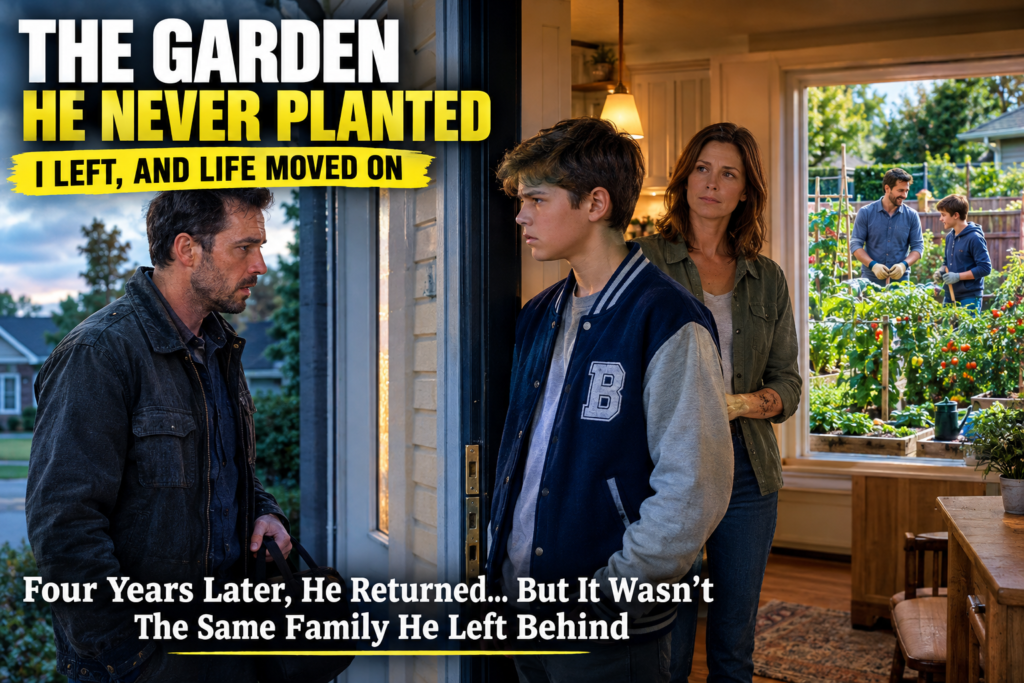
There was a vegetable garden.
Several raised wooden beds stood in neat rows, filled with green plants. A trellis supported climbing vines. Small labels marked the rows, and a watering can sat near the edge of the path.
It was exactly the sort of garden Monica had described for years.
For a moment, I could not move.
I imagined her choosing the plants, preparing the soil, and figuring out which vegetables would grow best. I imagined the boys helping her carry bags of compost, asking questions, and getting dirt on their clothes.
I imagined a man standing beside her, holding a shovel while she explained where she wanted the next bed.
The thought hurt.
Not because another man had done something I could not do, but because I had made something so simple feel impossible for so long.
I had always been too busy.
Too busy to build a garden.
Too busy to listen.
Too busy to notice that the people I loved were waiting for me to participate in the life I claimed to want.
I walked to the door and knocked.
Footsteps approached.
The door opened, and a teenage boy stood in front of me.
He was taller than I remembered, with broader shoulders and the beginnings of a young man’s face. He wore a varsity jacket I did not recognize.
For a second, I saw the eight-year-old boy who used to run toward me when I came home from work.
Then he looked at me with cautious politeness.
“Can I help you?”
My mouth went dry.
I had imagined this moment many times. I thought he might recognize me immediately. I thought he might look surprised, perhaps even happy.
Instead, he looked at me as though I were someone who had arrived at the wrong house.
Behind him, I could see the familiar hallway.
Before I could speak, a man’s voice called from the backyard.
“Tyler, who’s at the door?”
My son turned his head and answered without hesitation.
“Some guy asking for Mom.”
# PART 7 — “SOME GUY ASKING FOR MOM”
There are moments when a person’s entire life seems to collapse into a single sentence.
For me, it was hearing my son call me some guy.
Tyler did not say it angrily. He did not sneer or try to humiliate me. He simply answered the question he had been asked.
Some guy asking for Mom.
He did not recognize me as his father in that moment. Perhaps he recognized me but did not know what to do with the knowledge. Perhaps the years between us had become so large that the title felt unfamiliar.
I could not blame him for any of those possibilities.
I had been gone for four years.
Four years is a long time in the life of a child. It is long enough to move from elementary school into adolescence, to grow taller, to make new friends, and to develop interests that have nothing to do with the person you used to be.
I had missed the small changes that make a child familiar.
I knew Tyler’s name. I knew he was one of my sons. I remembered his laugh when he was little.
But I did not know the teenager standing in front of me.
I did not know what music he liked, what he worried about, which teacher he trusted, or whether he still wanted to play football. I did not know what he had become when I was not there to watch.
The realization was more painful than I expected.
The man in the yard called again.
“Tyler?”
“It’s fine,” Tyler replied. “Just someone asking for Mom.”
He turned back to me.
“Who should I tell her?”
I swallowed.
“I’m your dad, Tyler.”
The words came out quietly.
He stared at me.
For a moment, something shifted in his expression. Recognition, perhaps. Or uncertainty. I could see him searching through memories that might not have been used for a long time.
“Dad?”
He said it as a question.
I nodded.
“Yeah. It’s me.”
He stepped back slightly, but he did not immediately invite me inside.
I could not blame him.
I had imagined this reunion as a moment when my return would make everything feel right again. Instead, I had arrived as an unfamiliar man asking to enter a home where my children had learned to live without me.
“Mom!” Tyler called over his shoulder. “It’s Dad.”
I heard movement inside.
Then Monica appeared in the hallway.
She stopped when she saw me.
For a few seconds, neither of us spoke.
She looked older, as I did. Her hair was pulled back, and she wore a practical shirt with the sleeves pushed up. There was a faint streak of soil on one wrist.
She had probably been working in the garden.
That detail made me look past her toward the kitchen window, where the raised beds were visible in the afternoon light.
“You’re here,” she said.
It was not a question.
“I am.”
She looked at my bag, then at my face.
“Is everything all right?”
I almost laughed at the question.
For years, I had wanted people to believe I was all right even when I was not. Now I wanted Monica to understand that I was struggling without forcing me to explain every detail.
“No,” I admitted. “Not really.”
She nodded once.
“Would you like to come in?”
I hesitated, unsure whether the invitation meant anything beyond basic courtesy.
“Yes. If that’s okay.”
She stepped aside.
Tyler moved toward the living room, still watching me with an expression I could not read. I followed Monica into the house.
Everything seemed familiar and unfamiliar at once.
The living room furniture had changed. A new rug covered the floor. The photographs on the wall showed the boys at ages I had not seen them reach, and there were pictures of family outings I did not recognize.
One photograph showed Tyler and Ethan standing beside a man in the backyard. All three were holding gardening tools. Monica stood behind them, smiling.
I stared at the photograph.
The man was probably the voice I had heard from the yard.
I looked away before Monica noticed.
“Would you like some water?” she asked.
“Sure. Thank you.”
She went into the kitchen.
I remained near the doorway, uncertain where I was allowed to stand. I had once walked through this house without thinking about it. I knew which floorboards creaked and where Monica kept the extra towels. I could find the coffee mugs with my eyes closed.
Now I waited for permission to sit down.
That was when I understood how completely the meaning of a place can change.
The walls were the same. The hallway was the same. Even the light coming through the kitchen window looked familiar.
But the life inside the house had continued without me.
And I was no longer part of its ordinary rhythm.
# PART 8 — THE GARDEN I NEVER BUILT
Monica brought me a glass of water and gestured toward the kitchen table.
I sat down carefully.
She took the chair opposite me, leaving enough space between us that I could not pretend we had returned to the way things used to be.
“Why did you come back, Ross?”
I had rehearsed the question in my mind, but hearing it from her made every prepared answer feel inadequate.
“I wanted to see the boys.”
“You could have called.”
“I know.”
“Why didn’t you?”
I looked down at the glass.
Because I was ashamed.
Because I did not want her to hear how badly things had gone.
Because I was afraid she would ask whether I had finally learned what I should have known before I left.
Because I wanted to return when I had something to show for the years I had spent away, and when I had nothing, I could not bear the thought of facing her.
All of those answers were true.
“I was embarrassed,” I said. “Things didn’t work out the way I thought they would.”
Monica waited.
I told her about the job, the severance, and Vanessa. I did not make the story sound better than it was. I admitted that I was staying in an extended-stay motel and that I had been struggling to find stable work.
When I finished, Monica looked at me for a long moment.
“I’m sorry things have been difficult.”
I felt an immediate wave of relief.
Then she continued.
“But I need to ask you something. Did you come here because you want to rebuild a relationship with the boys, or because you need somewhere to stay?”
The question was direct, and I could not honestly say that only one answer was true.
“I want to see them,” I said. “I do.”
“That’s not quite what I asked.”
I swallowed.
“I was hoping I might be able to stay here for a little while. Until I get back on my feet.”
Monica looked down at the table.
There was no dramatic reaction. She did not tell me I was shameless. She did not raise her voice.
She simply took a breath.
“Ross, this is not your home anymore in the way it used to be.”
I felt the words land heavily.
“I know.”
“Do you?”
I looked toward the window.
The garden was visible beyond the glass. The wooden beds were neat and carefully arranged. Some plants had begun to climb the trellis, and a few small vegetables were visible beneath the leaves.
I pointed toward it.
“You built the garden.”
Monica followed my gaze.
“Yes.”
“It looks good.”
“Thank you.”
“I always meant to do that.”
“I know.”
Her answer was so simple that I felt ashamed.
She did not need to remind me how many times I had promised. She did not need to list the weekends I had spent doing other things or the times she had asked for help and received another excuse.
The garden stood outside, visible proof that she had wanted something, waited for me, and eventually done it without me.
“Did you build it yourself?” I asked.
“I started with the boys. Daniel helped with the heavier work.”
Daniel.
The name I had heard from the yard.
I looked toward the back door.
“Is he your partner?”
Monica nodded.
“Yes.”
I tried to keep my expression neutral.
“How long?”
“About two years.”
Two years.
The number was enough to make the relationship feel real, established, and entirely separate from the version of Monica I had carried in my head.
She had met someone. She had allowed him into her life. He had helped her build the garden. He knew the boys well enough to call to them from the yard.
I had been away during the years when those ordinary things became meaningful.
“Are you happy?” I asked.
Monica seemed surprised by the question.
“I’m doing well,” she said. “The boys are doing well. We have a good life.”
She did not say she was happier without me. She did not need to.
I looked at the garden again.
“I should have built that for you.”
Monica folded her hands.
“Yes, you should have.”
I had expected her to soften the statement, perhaps to tell me it did not matter anymore. Instead, she allowed the truth to remain exactly where it belonged.
I had promised to build the garden. I had not done it.
“I kept thinking I’d have time later,” I said.
“I remember.”
“I didn’t think it meant that much.”
Monica looked at me.
“It wasn’t only about vegetables, Ross.”
I nodded slowly.
“I know that now.”
She shook her head gently.
“I don’t think you do. Not completely.”
I waited.
“When I asked you to help me with the garden, I wasn’t asking for a project. I was asking you to spend a Saturday with me. I wanted us to make something together. I wanted the boys to see us working side by side. I wanted a reason to be outside with you that wasn’t another chore.”
She paused.
“Every time you said you were too busy, I understood that you had other things to do. But after a while, I started wondering whether the things I cared about would ever matter to you unless they were convenient.”
I looked at my hands.
The garden had seemed so insignificant to me. A weekend project. A few wooden beds. Something that could wait.
To Monica, it had been an invitation.
She had been asking me to join her in a small piece of the life we were building.
I had repeatedly declined, and then I had blamed the marriage for making me feel disconnected.
“I am sorry,” I said.
This time, I did not expect the apology to open a door.
“I know I can’t fix what happened,” I continued. “But I’m sorry I made you feel like you were asking too much.”
Monica’s expression softened slightly.
“Thank you for saying that.”
She did not reach across the table. She did not tell me that everything was forgiven.
She simply accepted the apology for what it was.
From the yard, Daniel called that the boys had finished what they were doing and asked whether Monica wanted him to bring in the tools.
She answered that she would be outside in a few minutes.
The conversation between them was easy, built on the familiarity of shared tasks.
I watched Monica stand and take the empty glass from the table.
For years, I had imagined that returning would allow me to recover a place in her life.
Now I was beginning to understand that I had come back to a woman who had stopped waiting for me to become the partner she needed.
She had not done it to punish me.
She had done it because she had a life to live.
# PART 9 — THE SONS WHO DIDN’T KNOW ME ANYMORE
Monica asked Tyler and Ethan whether they wanted to spend some time talking with me.
She did not tell them they should forgive me. She did not insist that they welcome me. She gave them the choice.
That mattered more than I understood at first.
I had spent years assuming that because I was their father, there would always be a place for me in their lives. I had treated that place as something permanent, like a title printed on a document.
But relationships do not remain strong simply because they once mattered.
They need attention.
They need ordinary contact, shared experiences, and the kind of reliability that makes a person feel safe depending on you.
I had not provided enough of those things.
Tyler agreed to talk with me first. Ethan joined us later, sitting in the chair beside his brother with his arms folded.
I looked at them and struggled to reconcile the teenagers in front of me with the boys I remembered.
Tyler had grown taller than Monica. Ethan had changed the shape of his face, and his expression was more guarded than I remembered. Their voices were deeper. Their interests had moved into areas I knew little about.
I wanted to ask them everything at once.
Instead, I started with the simplest question.
“How have you been?”
Tyler shrugged.
“Fine.”
Ethan said nothing.
I tried again.
“How’s school?”
“It’s okay,” Tyler replied.
The conversation felt like trying to cross a bridge that had been left unfinished for years.
I wanted them to tell me about their lives. I wanted them to be excited that I had returned. But they had no reason to trust that my arrival would lead to anything more than another disappointment.
I had to begin where they were, not where I wished they were.
“I know I haven’t been around much,” I said.
Tyler looked at me.
“You haven’t been around at all.”
The bluntness of his answer silenced me.
I could have pointed to the calls I had made, the occasional messages, and the money I had sent when I was able to. I could have explained how difficult the distance had been.
But none of those facts changed the central truth.
“I haven’t been there the way I should have,” I said.
“No,” Tyler replied. “You haven’t.”
Ethan shifted in his chair.
“Why did you leave?”
I looked at him.
I had expected the question, but I had never found an answer that did not make me sound selfish.
“I thought I needed a different life,” I said. “I felt unhappy, and I convinced myself that leaving was going to fix it.”
“Did we make you unhappy?”
The question came from Ethan, and his voice was quieter than his brother’s.
“No,” I said immediately. “You didn’t. Neither of you did.”
I took a breath.
“I was responsible for the way I felt, and I made the wrong decision about what to do with it. I should have talked honestly with your mom. I should have tried harder to fix things. And I should never have stopped being your dad just because I wasn’t living in the same house.”
Tyler looked away.
“You said you’d visit.”
“I know.”
“You said you’d come to my games.”
I remembered making that promise. I remembered believing that I could manage the distance if I organized my schedule properly.
I also remembered the excuses that followed.
“I did,” I said. “And I didn’t keep those promises.”
“You always said you were busy.”
I had no defense.
“I was busy sometimes. But I also made choices that meant I wasn’t there. I should have done better.”
Ethan stared at the floor.
“Mom said it wasn’t our fault.”
I felt something tighten in my chest.
“She was right.”
“Then why did it feel like you didn’t want us?”
I could not answer quickly.
I wanted to tell him that I had always loved him. That I had thought about the boys often. That leaving had not meant I wanted them out of my life.
But I knew that love could feel very different to the person who was waiting for you.
“I can understand why it felt that way,” I said. “I made decisions that probably looked like I didn’t want to be part of your lives. I was wrong to do that. You deserved better from me.”
Tyler’s expression remained guarded.
“Are you staying?”
There it was.
The question I had dreaded because I did not know how to answer it without making another promise.
“I don’t know yet,” I admitted. “I need to find work and somewhere to live. I don’t want to tell you something just because it sounds good and then disappoint you again.”
Tyler looked at his brother.
Ethan remained silent for a moment.
“That’s the first honest thing you’ve said today,” Tyler replied.
It hurt, but I could not argue with him.
I had come hoping to be welcomed back. Instead, I was being asked to face the consequences of years of absence.
I wanted to believe that a sincere conversation could begin repairing the damage. Perhaps it could.
But one conversation could not replace four years of missed birthdays, school events, ordinary evenings, and the countless small moments that make a parent familiar.
I would have to earn their trust through what I did next.
Before we finished talking, I told them I was sorry again.
This time, I did not ask them to forgive me.
I simply let the words stand.
Later, I sat alone in the car and watched the house through the windshield. I could see movement in the backyard. Daniel was carrying a tray of seedlings, and Monica was pointing toward one of the garden beds.
The boys stood nearby, talking with them.
It was an ordinary scene.
No one was trying to make me jealous. No one was displaying a perfect family for my benefit. They were simply living their lives.
That was what I had missed.
I had imagined fatherhood as a role I could return to whenever I was ready. I had not understood that childhood continues whether a father is present or not.
My sons had grown up.
They had learned how to live without me.
If they ever chose to make room for me again, it would not be because I had returned with a story about regret.
It would be because I had finally learned how to stay.
# PART 10 — THE GARDEN HE NEVER PLANTED
I did not stay at Monica’s house.
She was kind enough to let me sit with the boys for a while, but she made it clear that she could not offer me a place to live. Her home was shared with the children and Daniel, and the life they had built needed to remain stable.
I accepted that answer.
It would be dishonest to say I was not disappointed. I had driven back hoping for more than a conversation. Part of me had imagined that the house would open its doors, that Monica would recognize my regret, and that the boys would gradually return to the relationship we had shared when they were small.
But that was not what happened.
I had returned to ask for a place in a life I had abandoned.
Monica was not obligated to make that easy for me.
I went back to the motel and began looking for work with a different kind of urgency. I took temporary jobs, reduced my expenses, and stopped waiting for an opportunity that would restore the image of myself I had lost.
The work was not glamorous. Some days were exhausting. I had to accept that rebuilding my life would take longer than I wanted.
For the first time in years, I tried to stop treating ordinary responsibilities as evidence that I was trapped.
I found a small room I could afford and began saving what I could. I paid down my debts gradually and learned to live within a budget that did not depend on an imagined future paycheck.
I also began calling the boys more consistently.
I did not call every day or demand that they answer. I asked whether they wanted to talk, and when they did, I tried to listen more than I spoke.
At first, the conversations were short.
Tyler told me about school and football. Ethan sometimes sent me a photograph of something he had drawn. I asked questions, but I tried not to turn every conversation into an interrogation designed to prove that I was interested.
If they told me something I did not understand, I asked them to explain it.
If they did not want to talk, I respected that.
I made no promises about visits until I knew I could keep them. When I arranged to come back, I arrived on time. When I said I would call, I called.
These were small things.
They were also the things I had neglected when I believed that being a good father required only love and good intentions.
Monica and I remained civil. We talked about the boys and exchanged practical information when necessary. Sometimes our conversations included a little warmth. Sometimes they were brief.
I stopped interpreting her boundaries as rejection.
She had built a life after I left, and I had no right to demand that she reorganize it around my regret.
Occasionally, I saw Daniel when I visited the boys. He was polite, and I learned to be polite in return. We did not become friends, and we did not need to.
He had not taken my place by force.
He had been present when I was absent.
That truth was difficult to accept, but it was not unfair.
One afternoon, several months after my return, Tyler mentioned that they were working on the garden.
“Mom’s trying to grow tomatoes again,” he said over the phone. “The last ones didn’t do very well.”
I smiled.
“She always wanted to grow tomatoes.”
“Yeah. Daniel says the soil needs more work.”
I listened as Tyler described the garden beds, the plants they had moved, and the things they were trying this season. He spoke with the easy enthusiasm of someone describing an ordinary part of his life.
I realized that he had never known the garden as an unfinished promise.
For him, it was simply the garden in the backyard.
The place where he and his brother helped their mother. The place where Daniel taught them how to prepare the soil. The place where they sometimes worked after school, getting dirt beneath their fingernails and arguing about whose turn it was to carry the watering can.
I had spent years thinking about the garden as something I had failed to build.
They had grown up knowing it as something that existed.
The difference was important.
My regret was not the center of their world.
Their lives were full of things that had nothing to do with me.
I was grateful they were happy, even when happiness looked different from the family picture I had once imagined.
Sometimes I still wondered what would have happened if I had stayed. I wondered whether Monica and I might have repaired our marriage, whether the boys would have grown up with me at the dinner table, and whether I might have discovered that the life I wanted was already waiting for me in the backyard.
There is no way to know.
Perhaps we would have remained together. Perhaps we would have separated eventually. The past offers no reliable answer to questions built from possibilities.
What I do know is that I had chances to change before I left.
Monica had asked me to listen.
The boys had asked me to play.
She had asked me to build a garden.
I had treated those requests as things I could postpone until I had more time, more money, or more enthusiasm.
I thought the important part of life would begin after I had found myself.
I never understood that the person I was becoming was being shaped by the choices I made while I waited.
Every time I avoided a difficult conversation, I became a little less willing to face discomfort. Every time I broke a promise and offered an excuse, I became a little more comfortable with disappointing people. Every time I placed my own restlessness above the needs of my family, I made it easier to do the same thing again.
I had not become a stranger to my sons in a single dramatic act.
I had become a stranger one missed visit at a time.
One unanswered message at a time.
One promise at a time.
The garden taught me something I should have understood years earlier.
Living things need consistent care.
You cannot plant a seed, ignore it for months, and expect to return to a thriving garden simply because you remember how much you wanted it to grow.
You cannot neglect the soil, forget to water the plants, and then blame the garden for failing to become what you imagined.
Relationships are not identical to gardens, of course. People have their own choices, needs, and boundaries. But both remind us that good intentions cannot replace attention.
Love is not only what we feel when we remember someone.
It is what we do when they need us.
It is whether we listen when the conversation becomes uncomfortable. It is whether we show up when the event is ordinary. It is whether we keep a promise after the excitement has faded.
I had spent years chasing the feeling of being a new man.
I should have spent more time becoming a dependable one.
I do not know whether my sons will ever trust me the way they might have if I had stayed. I cannot ask them to forget the years I missed, and I cannot demand that my regret become their responsibility.
All I can do is continue showing up.
Maybe that will lead to a closer relationship. Maybe it will lead to something smaller and more cautious than I once imagined. That is no longer something I can control.
The important thing is that I have stopped treating the future as a place where all my mistakes will somehow be repaired.
The future is made of the choices I make now.
Sometimes I think about the key I left on Monica’s counter. I remember placing it there and walking out, convinced that I was beginning a better life.
I did not understand that I was also giving up access to countless ordinary moments: breakfast with the boys, conversations in the kitchen, muddy shoes by the door, and weekends spent building something that might not have been impressive to anyone else.
I thought freedom meant being able to leave whenever I wanted.
Now I understand that there is another kind of freedom in being able to stay when life becomes difficult.
I cannot return to the house as the husband Monica once knew. I cannot recover the boys’ childhoods. I cannot plant the garden that should have been planted years ago.
But I can stop running from the life I have now.
I can be honest when I am struggling. I can make promises carefully. I can learn to value small responsibilities instead of treating them as obstacles to something better.
And I can accept that the people I love may never give me exactly the place I once had in their lives.
That is part of the consequence of leaving.
The garden in Monica’s backyard continues to grow. The boys help when they can. Daniel works beside them. Monica gets to enjoy the thing she wanted for years.
I am glad she has it.
The thought still hurts sometimes, but it no longer feels like something was stolen from me.
It is something she built after I stopped helping.
The garden he never planted became a garden someone else helped bring to life.
And perhaps that is the lesson I needed most: the people we love should not have to wait forever for us to become the person we promised to be.
Sometimes they move forward.
Sometimes they build without us.
And sometimes, if we are fortunate, they leave a small door open—not so we can return to the past, but so we can begin showing them who we are willing to become.
I left Monica because I thought I needed to find myself.
Four years later, I returned and discovered that the real work had never been about finding a different man.
It had been about becoming someone who knew how to stay.