Part 1
The call came on a Tuesday afternoon, while I was standing in the middle of a bridal boutique holding two wedding dresses against my body.
One was ivory satin with delicate lace along the sleeves. The other was simpler, with a long flowing skirt and a neckline my mother had always said suited me. I had sent her pictures of both that morning, expecting the usual string of messages about which one made me look happier, which one would photograph better, and whether she thought Tristan would cry when he saw me walking down the aisle.
My mother loved weddings.
She had been planning mine almost as enthusiastically as I had.
“Sweetheart,” she had said over breakfast the previous Sunday, “I know you and Tristan have been together forever, but this is still your wedding. Don’t let everyone else’s opinions drown out what you want.”
I had laughed.
“Mom, you’re the one who keeps sending me flower arrangements.”
“Because the florist keeps sending me ugly ones.”
That was my mother. Even when she was trying to give me advice, she could find a way to make me laugh.
I was still smiling at the memory when my phone rang.
The number was unfamiliar.
I almost let it go to voicemail, but something made me answer.
“Hello?”
“Am I speaking with Claire Bennett?”
“Yes.”
“My name is Officer Harris with the county sheriff’s department. I’m calling about your parents, Daniel and Rebecca Bennett.”
Everything inside me went still.
“What happened?”
There was a pause. A small, terrible pause that seemed to stretch longer than it could possibly have lasted.
“There has been a serious motor vehicle accident. Your parents were involved in a collision on Route 16. Emergency services transported them to the hospital, but I’m very sorry to tell you that neither survived.”
I didn’t understand the sentence.
I heard the words. I knew what they meant individually. But my mind refused to assemble them into something real.
“No,” I whispered.
“I’m very sorry.”
“No, my mother called me this morning. She was going to pick up the boys from preschool. She said—”
My voice broke.
“Ma’am, I know this is difficult.”
“Where are my brothers?”
The officer’s tone changed.
“Your younger brothers were in the vehicle. They were transported to the children’s hospital. They are receiving emergency treatment.”
“Are they alive?”
“They were alive when they arrived. The medical team is treating them now.”
I dropped the dresses.
The boutique owner hurried toward me, but I barely saw her. I remember someone asking if I needed to sit down. I remember the floor feeling strangely soft beneath my feet. I remember trying to unlock my phone and entering the wrong passcode twice because my fingers wouldn’t cooperate.
Then I was running.
I drove to the hospital without remembering the journey. One moment I was in the parking lot of the bridal boutique, and the next I was standing at the emergency department reception desk, clutching my purse and asking for two little boys named Noah and Nathan Bennett.
My brothers were five years old.
They were identical twins, although my mother could distinguish them from across a crowded room. Noah had a tiny dimple in his left cheek and always wanted his toast cut into triangles. Nathan had a cowlick that refused to lie flat and insisted on wearing mismatched socks whenever he could get away with it.
They were small, noisy, curious little people who believed the world was safe because their parents were always there to protect them.
That afternoon, their world had shattered.
A nurse finally led me to a family consultation room. A doctor arrived several minutes later, still wearing his surgical cap.
“Are you their sister?”
“Yes. I’m Claire. Where are they? Can I see them?”
He sat down across from me.
“Both boys sustained significant injuries. They’re being monitored closely. We’ve stabilized them for now, but the next twenty-four to forty-eight hours will be important.”
“Will they live?”
He looked at me with the careful compassion of someone who knew how much his answer mattered.
“We’re doing everything we can. They’re young, and we’re encouraged by how they’ve responded to treatment. But I can’t promise you anything yet.”
I covered my mouth with both hands.
I wanted my mother.
I wanted my father.
I wanted someone older than me to walk into the room and explain what I was supposed to do, because I was twenty-six years old, and five minutes earlier I had been worrying about wedding flowers.
Now my parents were dead, and my brothers were fighting to survive.
The doctor gave me a moment.
Then he asked whether there was another adult he could contact.
I called Tristan.
He answered on the fourth ring.
“Hey, beautiful. Did you decide on the dress?”
I made a sound that wasn’t quite a word.
“Claire?”
“My parents,” I managed. “There was an accident.”
“What?”
“They’re gone, Tristan. Mom and Dad are gone. The boys are in the hospital. They’re hurt. I don’t know if they’re going to be okay.”
He went silent.
Then I heard him say my name, softly, as if speaking it might somehow pull me back from the edge.
“Where are you?”
I told him.
“I’m coming,” he said. “Don’t move. I’ll be there as fast as I can.”
For the next several hours, I sat outside the intensive care unit and watched the doors open and close.
A nurse brought me water. Someone asked whether I had eaten. I couldn’t answer either question properly.
At 10:43 that night, a doctor finally came out and told me that both boys were stable.
Not safe. Not fully recovered.
Stable.
I clung to that word as if it were a rope.
I was allowed to see them briefly. Noah lay beneath a white blanket with monitors attached to his small body. Nathan was in the next room, his face pale beneath the hospital lights.
I touched Noah’s hand.
“I’m here, sweetheart,” I whispered. “It’s Claire. I’m right here.”
His fingers moved slightly around mine.
I began crying so hard that the nurse gently asked me to step back.
Tristan arrived just after midnight.
He wrapped his arms around me in the hospital corridor, and for a moment I allowed myself to collapse against him.
“They’re going to be okay,” I whispered. “They have to be.”
He held me tightly.
“Of course they are. We’re going to get through this.”
I believed him.
I believed him because we had been together since high school. He had been there when I graduated college, when I got my first job, when I bought my little house, and when I had spent an entire weekend helping my mother paint the boys’ bedroom after she decided they needed a dinosaur-themed wall.
He had held my hand when my father underwent surgery. He had brought soup to my parents’ house when my mother caught the flu. He had helped me assemble birthday presents for the twins, even when Noah kept sneaking into the room to see what we were doing.
I thought I knew who Tristan was.
I thought the worst thing we would ever face together was grief.
I had no idea that the real test of our relationship had only just begun.
\
Part 2\
The twins survived.
Those two words became the center of my universe.
The first week was a blur of hospital corridors, medical updates, paperwork, and whispered prayers. Noah regained consciousness before Nathan, and when he finally opened his eyes, the first thing he asked was whether our mother was coming.
I had prepared myself for that question.
I had practiced answers in the bathroom mirror and in the car. I had asked the hospital social worker how to speak to children who had lost their parents. I had read everything I could find about explaining death to young children.
But when Noah looked at me with his enormous brown eyes and asked, “Where’s Mommy?” every prepared sentence vanished.
I sat beside his bed and held his hand.
“Mommy and Daddy were in a very bad accident, sweetheart.”
“Are they at home?”
I shook my head, fighting to keep my voice steady.
“No, baby. They’re not coming home.”
He stared at me.
Then his face crumpled.
“Did they leave us?”
The question broke something inside me.
“No. No, Noah. They didn’t leave you because they wanted to. They loved you more than anything. The accident hurt them very badly, and their bodies stopped working. They can’t come back, but they loved you every single day.”
He began to cry.
I climbed carefully onto the edge of the bed and held him as gently as I could.
“They loved you,” I repeated. “And I love you. I’m here.”
Nathan woke the following morning.
He was quieter than his brother, but his questions were harder.
“Who is going to make my breakfast?”
“I will.”
“Who will take us to school?”
“I will.”
“Who will read the dinosaur book?”
“I will.”
He considered that for a moment.
“Can you do all those things?”
I brushed his hair away from his forehead.
“I’ll learn.”
He stared at me, apparently evaluating whether I could be trusted with such important responsibilities.
Then he reached for my hand.
“Okay.”
I didn’t tell him that I was terrified.
I didn’t tell him that I had no idea how to become a mother overnight, or that I was still trying to understand how I would survive the loss of my own parents.
I simply held his hand and promised to learn.
When the twins were discharged several weeks later, they came home with medication schedules, follow-up appointments, and strict instructions about rest and recovery. Their little bodies were healing, but their grief was only beginning.
I turned the spare bedroom into a shared room for them. I bought night-lights shaped like stars, placed their favorite stuffed animals beside their pillows, and put a framed photograph of our parents on the dresser.
At bedtime, they wanted the same story their mother had read to them every night.
I tried to imitate her voice.
Noah corrected me.
“Mommy makes the dragon sound scarier.”
“I’ll practice.”
Nathan tucked his blanket beneath his chin.
“Can you sing the song too?”
I sang badly, forgot half the words, and had to start again.
They laughed.
For the first time since the accident, the sound of their laughter didn’t feel like a betrayal of my grief.
It felt like proof that life was still happening.
The legal process moved quickly because my parents had named me as the twins’ preferred guardian in documents they had prepared after Nathan’s birth. There were still interviews, court filings, home assessments, and meetings with a family services worker. Nothing happened automatically, and I had to demonstrate that I could provide a safe, stable home.
I cooperated with every requirement.
I adjusted my work schedule, arranged childcare for the hours I couldn’t be home, and spoke to my employer about working remotely when necessary. My savings were enough to cover immediate expenses, but I also met with a financial adviser to understand how the twins’ medical needs, education, and long-term care would affect my budget.
It was exhausting.
It was frightening.
But whenever I looked at the two small faces sleeping in the bedroom down the hall, I knew I had made the only decision I could live with.
They were my brothers.
They were five.
They had lost everything familiar in a single afternoon.
I would not make them lose me too.
Tristan helped during the first few weeks. He brought groceries, picked up prescriptions, and assembled the bunk beds I ordered after the doctor confirmed the boys could safely use them. He even drove me to one of the twins’ follow-up appointments when I was too tired to trust myself behind the wheel.
I was grateful.
I was also grieving too deeply to notice the small changes in him.
He stopped asking how the boys were feeling and began asking how long their appointments would take.
He sighed when I canceled a dinner reservation because Nathan had a nightmare.
He complained when I had to leave a movie early because Noah developed a fever.
Once, when I told him I needed to spend Saturday arranging the boys’ school enrollment, he said, “We haven’t had a normal weekend in months.”
I reminded him that the accident had happened only six weeks earlier.
He shrugged.
“I know. I’m just saying we can’t put our whole lives on hold forever.”
At the time, I thought he was struggling with the sudden changes. I told myself that grief affected everyone differently. I promised we would find a routine, that I would make time for us, that things would become easier once the boys settled into school.
I believed that if I loved him enough, we could adjust.
Then the guardianship paperwork was finalized.
I had been at the courthouse that morning, holding a folder of signed documents, when the judge formally confirmed that I would serve as the twins’ legal guardian. The social worker congratulated me and reminded me that the court could review the arrangement if circumstances changed, but for now, the boys had a stable home with someone they knew and trusted.
I cried in the courthouse parking lot.
Not because I was uncertain.
Because I was relieved.
I called Tristan to tell him the news.
“It’s official,” I said. “They’re staying with me.”
He was quiet for a moment.
“Okay. I’ll come over tonight. We need to talk.”
I assumed he wanted to discuss wedding plans.
I assumed he wanted to know how we would manage our future together.
I assumed, because I had loved him for nearly a decade, that he would be happy the boys were safe.
That evening, Tristan arrived at my house carrying no flowers, no groceries, and no sign of the man who had once promised that we would face every hardship as a team.
He stood in the living room, glanced toward the twins’ bedroom, and asked a question that changed the rest of my life.
“This is temporary, right? You’re eventually sending them somewhere?”
\
Part 3\
I thought I had misunderstood him.
The twins were upstairs, playing quietly with the magnetic building blocks my mother had bought them the previous Christmas. I could hear Noah making a spaceship sound and Nathan telling him that spaceships didn’t need wheels.
Their voices floated down the staircase, small and ordinary.
I looked at Tristan.
“What do you mean, sending them somewhere?”
He ran a hand through his hair.
“Claire, don’t make this harder than it has to be. I mean, you’re their sister. You’re not their mother. There are foster families, relatives, other arrangements.”
“They don’t have other relatives who can take them.”
“Then social services can find someone.”
I stared at him.
“They just lost our parents.”
“I know.”
“They were in a car accident. They were in intensive care. They’ve barely started sleeping through the night again.”
“I know all of that.”
“Then how can you talk about sending them away?”
His expression hardened.
“Because I need to know what our life is going to look like.”
“Our life?”
“Yes, our life. We’re supposed to be getting married. We’ve been planning this wedding for two years. I didn’t sign up to raise two children.”
“They’re not strangers, Tristan. They’re my brothers.”
“And I’m your fiancé.”
He said it as though the title gave him a greater claim on my future than the two little boys upstairs had on my heart.
I took a breath.
“I love them. They’re staying with us.”
He laughed once, without humor.
“You can’t be serious.”
“I’ve never been more serious.”
“What about our plans? What about the house? What about the trips we talked about? What about having our own children someday?”
“We can still have a life together.”
“Not the life we planned.”
I wanted to remind him that life had never asked our permission before changing. I wanted to tell him that the wedding flowers and the honeymoon could wait, that two grieving children mattered more than a carefully arranged schedule.
Instead, I tried to explain.
“They need stability. They need someone who loves them. I’m not going to abandon them because things became inconvenient.”
“Inconvenient?” he snapped. “You make it sound like I’m complaining about a broken washing machine.”
“Then tell me what you’re complaining about.”
He looked toward the stairs.
“I don’t want to spend the next fifteen years raising somebody else’s kids.”
The words were so cold that for a moment I couldn’t respond.
Somebody else’s kids.
He had watched Noah fall asleep on the hospital chair beside my bed because the little boy was afraid I might disappear if he closed his eyes. He had seen Nathan cling to the sleeve of my sweater whenever a nurse entered the room. He had watched me sit beside their beds night after night, trying to make promises I wasn’t sure I could keep.
And still, he could look at them as an unwanted burden.
“They’re five,” I whispered. “They need us.”
“They need a family. That doesn’t mean you have to be the one to provide it.”
“I am their family.”
“You’re their sister.”
“Yes.”
“Not their mother.”
I stared at him, feeling something inside me begin to crack.
He stepped closer, his voice rising.
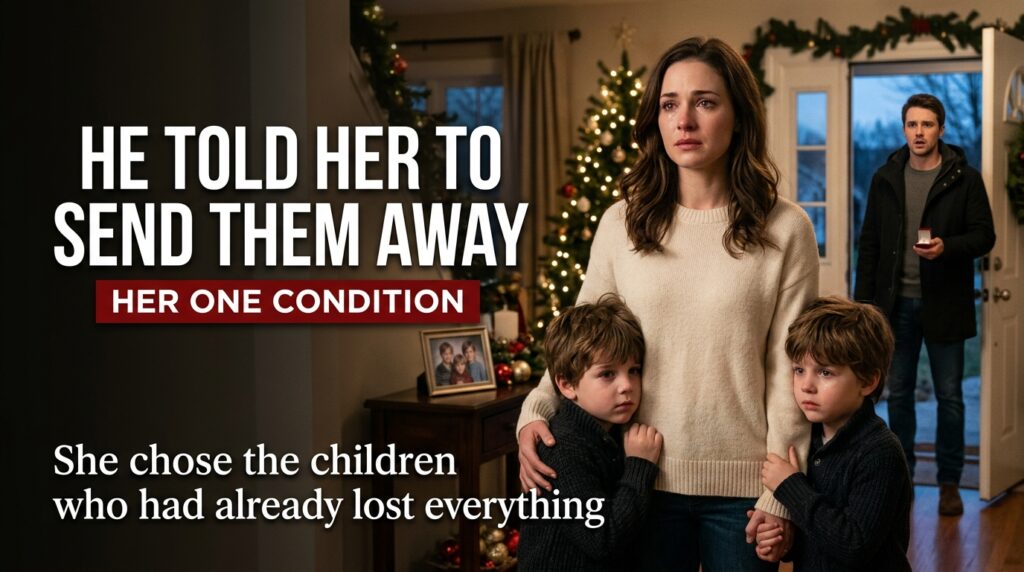
“Look, I’m trying to be reasonable. We can arrange a placement. You can visit them. You can still be their sister. But I’m not raising somebody else’s kids, Claire. Put them in foster care, or the wedding is off. I’m not running a charity.”
The room seemed to tilt.
I heard the refrigerator humming in the kitchen. I heard Noah laugh upstairs. I heard my own breathing, shallow and uneven.
I had imagined countless difficult conversations with Tristan over the years. I had imagined disagreements about money, careers, where we would live, whether we would eventually have children.
I had never imagined him asking me to surrender two traumatized five-year-olds because they did not fit into his preferred version of adulthood.
I wanted to scream.
I wanted to tell him to get out of my house.
I wanted to end the engagement that very second and never hear his name again.
But beneath the anger was a deeper feeling, something colder and more deliberate.
I had spent years believing that Tristan’s love was unconditional because we had grown up together. I had trusted the history between us as though the length of a relationship guaranteed the quality of the person inside it.
Now I understood that I had never seen him tested by a responsibility he couldn’t simply walk away from.
He watched my face.
“Say something.”
I looked at him.
“Do you really mean it?”
“Yes.”
“If I keep the boys, you’ll leave?”
He crossed his arms.
“If you choose them over us, yes.”
Choose them over us.
As if they were an obstacle I had placed between us.
As if their survival were a selfish preference.
As if love were a limited resource and I had to decide which people deserved to receive it.
I glanced toward the staircase.
Noah appeared at the top step, holding a blue dinosaur.
“Claire?” he called.
My expression changed immediately.
“Hey, sweetheart. What’s up?”
“Can Nathan have the green dinosaur? He says blue is for the bad guys.”
I smiled.
“I’m sure you can work it out. Why don’t you take both dinosaurs and make them friends?”
Noah considered that.
“Okay.”
He disappeared upstairs.
I waited until I could no longer hear his footsteps.
Then I turned back to Tristan.
“You’re right,” I said softly.
He blinked.
“What?”
“You’re right. This isn’t the life you planned.”
His shoulders relaxed slightly.
“Claire—”
“I’m going to do exactly what you told me to do.”
He looked relieved.
It was the first time since entering my house that his face had softened.
“Good,” he said. “I knew you’d see reason.”
I almost laughed at the word reason.
Then I smiled.
“But I have one condition.”
His relief faded.
“What condition?”
I walked toward the kitchen, picked up the folder containing the guardianship papers, and returned to the living room.
“You’ll find out tomorrow.”
He stared at me.
“Claire, don’t play games.”
“I’m not.”
“Then tell me what you mean.”
I placed the folder on the coffee table.
“I said I have one condition. If you want me to follow your instructions, you need to agree to it first.”
He glanced at the folder, then back at me.
“What is it?”
I met his eyes.
“You have to be there when I make the arrangements.”
He frowned.
“What arrangements?”
I smiled again.
“The ones you just told me to make.”
\
Part 4\
Tristan spent the next ten minutes trying to discover what I meant.
He asked whether I was going to call a social worker, whether I had another family member in mind, whether I was planning to postpone the wedding, and whether I was trying to punish him.
I answered each question with the same calm sentence.
“You’ll find out tomorrow.”
He finally left shortly after nine, telling me he expected us to discuss the matter properly the following morning.
I watched his car disappear down the street.
Then I locked the door and stood in the hallway, listening to the quiet house.
The twins were supposed to be asleep.
Instead, I found Nathan sitting on the bottom step with his blanket wrapped around his shoulders.
“Why was Tristan mad?” he asked.
I crouched beside him.
“He was upset about some grown-up things.”
“Did we do something bad?”
The question hit me harder than Tristan’s ultimatum.
“No, sweetheart. You didn’t do anything wrong.”
“Are we going somewhere?”
I held his face gently between my hands.
“No. You’re staying here with me.”
He searched my expression.
“Promise?”
“I promise that I’m going to do everything I can to keep us together.”
He leaned into me, and I wrapped my arms around him.
Noah appeared behind him, carrying his own blanket.
“Can we sleep in your room tonight?”
“Of course.”
They climbed into my bed between the pillows, and I lay beside them until their breathing became slow and even. Noah held my hand. Nathan rested his head against my shoulder.
I watched them sleep and thought about the condition I had given Tristan.
I wasn’t going to hand the boys to a stranger to satisfy his ultimatum.
I wasn’t going to use them to frighten him or stage some cruel performance.
But Tristan had demanded that I make a choice, and I intended to make one.
I wanted him to understand exactly what he was asking me to do.
The next morning, I called the family services worker assigned to our guardianship case. Her name was Melissa Grant. She had been patient throughout the legal process and had always spoken to the twins as people rather than paperwork.
I explained what had happened.
Melissa listened carefully.
“I’m glad you called,” she said. “But I want to be clear about something. You should not make a decision about the boys’ placement because a partner is pressuring you. If you are struggling, we can discuss support services, respite care, and practical assistance. A change in placement would need to be based on the children’s needs and the appropriate legal process.”
“I don’t want them placed anywhere else.”
“Then we should focus on what support will help you continue caring for them safely.”
I felt my eyes sting.
“I need Tristan to understand what he asked me to do.”
“That’s understandable. But the boys’ welfare has to come first. Don’t involve them in a confrontation or make them feel that their home depends on your relationship.”
“I won’t.”
Melissa arranged a meeting with me that afternoon to review the support available to guardians. She also explained that the twins could receive grief counseling and that I could access caregiver support through local family services.
When we finished, I felt more grounded.
I wasn’t going to turn this into a battle in which the boys became the prize.
I was going to make sure they were safe, then deal with Tristan as an adult who had revealed something important about himself.
That afternoon, I asked Tristan to meet me at my house at six.
He arrived early.
He brought flowers.
They were white roses, the kind I had once said would look beautiful at our wedding. Seeing them in his hands made me feel unexpectedly sad. There had been a time when those flowers would have made me happy.
Now they looked like a prop in a scene I no longer wanted to perform.
“Can we talk?” he asked.
“We are going to.”
He set the flowers on the kitchen counter.
“I’ve been thinking,” he said. “Maybe I was too harsh yesterday.”
I waited.
“I know the boys have been through a lot. I know you love them. I’m not asking you to stop loving them.”
“You asked me to put them in foster care.”
“I said we needed to consider every option.”
“No. You said, ‘Put them in foster care, or the wedding is off.’”
He looked irritated.
“You don’t have to repeat it like that.”
“Like what? Exactly as you said it?”
He rubbed his forehead.
“Claire, I’m trying to find a compromise.”
“What would the compromise be?”
“We could ask social services about a long-term placement. Maybe a family who already has children. You could remain involved.”
“Remain involved?”
“Yes.”
“As their sister?”
“Of course.”
I stared at him.
“They lost their parents. They nearly died. They wake up crying because they think someone is going to take them away. And you think I should let them go live with strangers so our wedding can happen on schedule?”
He exhaled.
“I’m trying to protect our future.”
“What future?”
“Our marriage. Our children. Our plans.”
“And what happens if our future becomes inconvenient again?”
His expression hardened.
“That’s unfair.”
“Is it?”
He looked away.
I walked to the living room and picked up the folder I had placed on the coffee table the night before.
“Come with me,” I said.
“Where?”
“To the place where we’ll discuss your condition.”
He followed me outside, still looking confused.
I drove us to the family services office where Melissa had arranged to meet me. Tristan asked three times whether I was really going to call someone about foster care.
I didn’t answer.
When we arrived, Melissa was waiting in a private meeting room. She had agreed to speak with us because I wanted Tristan to hear directly what guardianship involved and what support was available.
I had not asked her to arrange a placement.
I had not asked her to take the boys.
I had asked her to explain the reality of the decision Tristan wanted me to make.
He sat beside me, looking increasingly uncomfortable.
Melissa introduced herself and explained that the twins’ guardianship was legally established, that the boys were adjusting to their new home, and that there were services available to help them and me.
She also explained that any change in placement would need to be considered carefully and could not be treated as a simple administrative arrangement.
Then she asked Tristan why he had come.
He glanced at me.
“I suppose Claire wanted me to understand the situation.”
Melissa nodded.
“Then perhaps you could explain what concerns you most about the boys living with her.”
He hesitated.
“The financial responsibility. The time. The effect on our relationship. We were planning to get married, and now everything has changed.”
“Those are understandable concerns to discuss,” Melissa said. “But are you asking Claire to give up her guardianship?”
Tristan shifted in his chair.
“I don’t want to raise them.”
The words sounded even worse in that quiet room.
Melissa didn’t argue with him. She simply explained that the twins were not a temporary inconvenience. They were children who had already experienced a traumatic loss, and stability was particularly important while they recovered.
“If Claire remains their guardian,” she said, “the adults in her life need to make decisions that support the children’s safety and emotional well-being. No one should pressure them or make them feel unwanted.”
Tristan looked down at his hands.
For the first time, I saw him confronted with the actual consequence of his demand.
He had spoken about foster care as though it were a place where unwanted responsibilities disappeared.
Now he was sitting across from a professional who understood that any placement decision involved real children, real needs, and lasting consequences.
I turned toward him.
“This is my condition,” I said. “I needed you to hear what you were asking me to do from someone who understands the responsibility. The boys are staying with me. I’m not surrendering them to save a wedding.”
His face flushed.
“You tricked me.”
“No. I told you I had one condition.”
“You made me look like a monster.”
“I didn’t make you say those words.”
Melissa gently reminded us that the meeting was not about assigning blame, and that Tristan was free to decide whether he wanted to remain in the relationship.
I nodded.
That was exactly what I wanted him to understand.
He had a choice.
So did I.
\
Part 5\
Tristan barely spoke on the drive home.
He sat in the passenger seat with his arms folded, staring out the window as though the passing houses had personally offended him.
When we reached my driveway, he unfastened his seat belt and turned toward me.
“You humiliated me.”
I kept both hands on the steering wheel.
“I took you to a meeting so you could understand the situation.”
“You knew exactly what that woman would say.”
“She explained what guardianship means.”
“You made me look heartless.”
I looked at him.
“Tristan, you told me to put two five-year-old children in foster care or lose you. What did you expect her to say?”
He opened the door, then slammed it shut again.
“I thought you loved me.”
The words would once have broken me.
Now they made me tired.
“I do love you,” I said. “But loving you doesn’t mean I have to abandon my brothers.”
He shook his head.
“You’re making this into some kind of test.”
“No. Life made it a test. I didn’t choose for our parents to die. I didn’t choose for the boys to be hurt. I didn’t choose for my life to change overnight.”
“And I didn’t choose this either!”
“I know.”
“Then why am I the one who has to suffer?”
I stared at him.
Because the boys had lost their parents.
Because they were children.
Because I had promised them a home.
Because sometimes love meant accepting responsibilities you hadn’t planned for.
But I didn’t say any of that.
I was beginning to understand that Tristan knew the answers. He simply didn’t like what they required of him.
“You don’t have to stay,” I said quietly.
He looked at me as though I had slapped him.
“What?”
“You don’t have to marry me if this isn’t the life you want.”
He stared at me for several seconds.
Then he got out of the car and walked toward his vehicle.
“I need time,” he said.
“Take it.”
He drove away without taking the flowers he had left on my kitchen counter.
That night, I called my best friend, Olivia, and told her everything.
She listened without interrupting. When I finished, she was silent for a long moment.
“Claire,” she said, “I need you to answer one question honestly.”
“What?”
“If your parents hadn’t died, would you still want to marry him?”
I opened my mouth.
Nothing came out.
Olivia waited.
I thought about the man who had brought me coffee during exam week, who had kissed me in the rain after our high-school graduation, who had held me while I cried after my father’s diagnosis.
Then I thought about the man who had looked at two traumatized little boys and seen a threat to his lifestyle.
“I don’t know,” I admitted.
“That’s an answer.”
I pressed my fingers against my eyes.
“I thought I knew him.”
“You knew who he was when life was easy. Now you’re seeing who he is when love costs something.”
Her words stayed with me long after we hung up.
Over the following days, Tristan alternated between silence and messages insisting that we needed to discuss our future. He suggested hiring a nanny so I could spend less time with the boys. He suggested that I ask my aunt to take them temporarily. He even proposed that we postpone the wedding for six months and revisit the question of guardianship later.
Every proposal had the same hidden condition.
The boys were welcome only if I eventually agreed to stop being responsible for them.
I told him no.
He accused me of refusing to compromise.
I reminded him that compromise meant finding a solution that respected everyone’s needs, not asking me to sacrifice two children who had nowhere else to go.
He replied that I was choosing a life of hardship.
I didn’t answer.
Meanwhile, the twins were slowly finding their way back into the world.
Noah began sleeping through the night more often. Nathan started drawing pictures of our family, though for several weeks he left an empty space where our parents should have been.
Their grief counselor helped me understand that children might move between sadness and ordinary play without warning. One minute they could be laughing about a cartoon, and the next they might ask whether their mother could still see them.
I learned to answer honestly and gently.
I learned that a quiet afternoon could be a victory.
I learned that making dinner, reading bedtime stories, and remembering which twin preferred the red cup were not small responsibilities. They were the building blocks of safety.
One Saturday morning, Noah came into the kitchen while I was making pancakes.
“Claire?”
“Yes, sweetheart?”
“Are you going to get married?”
The spatula stopped in my hand.
“Why do you ask?”
“Because Nathan said Tristan is mad at us.”
I put the spatula down and crouched beside him.
“Tristan is upset because the grown-ups are trying to work out what the future will look like. But you haven’t done anything wrong.”
“Will he make us leave?”
“No.”
“Promise?”
I held his hands.
“I promise that I will always fight to keep you safe. You are not going anywhere because someone is upset with me.”
He stared at me, searching for certainty.
Then he threw his arms around my neck.
I held him tightly, breathing in the smell of shampoo and pancake batter.
After he returned to the table, I stood alone at the counter for a long time.
I had been so focused on the argument with Tristan that I hadn’t fully considered what the boys might be hearing or imagining. I had to protect them not only from the possibility of being moved, but from the fear that they were unwanted.
That afternoon, I called Melissa and asked for additional guidance on helping the twins through the uncertainty. She recommended maintaining predictable routines and limiting their exposure to adult conflict. She also reminded me that the boys did not need to understand every detail of my relationship to feel secure.
I thanked her.
Then I made a decision.
I would stop discussing my future with Tristan until I had decided what I wanted.
Not what would keep him.
Not what would make the wedding possible.
What I wanted.
For the first time since the accident, I allowed myself to imagine a future without him.
The thought hurt.
But beneath the hurt was a strange, quiet relief.
I could build a life around the boys. I could ask for help. I could return to the wedding plans someday if I wanted, or abandon them entirely. I could be frightened and exhausted and still be a good guardian.
I did not need a husband to make that life legitimate.
And I did not need to prove my love by giving up the people who needed me most.
\
Part 6\
Tristan came back two weeks later.
He arrived on a Sunday afternoon, carrying a cardboard box and wearing the expression he used when he wanted a conversation to begin on his terms.
The twins were at a supervised play session with Olivia’s family, so the house was quiet.
I opened the door and stepped aside.
“What is the box?”
“Some things from your parents’ house.”
My heart tightened.
After the accident, we had been too overwhelmed to sort through much of my parents’ belongings. Their house was being maintained while the estate matters were handled, and I had arranged for essential items to be collected for the boys.
I took the box from him.
Inside were two small photo albums, a stack of children’s books, and a blue sweater that had belonged to my father.
I touched the sleeve.
“Thank you.”
Tristan nodded.
“I thought you might want them.”
“I do.”
For a moment, we stood in silence.
Then he said, “I’ve been thinking about what happened.”
I waited.
“I shouldn’t have said it the way I did.”
“Which part?”
He looked uncomfortable.
“All of it.”
I wanted to believe him. I wanted to believe that the weeks apart had made him reconsider, that he had understood what he had asked me to do, and that the man I had loved for so long was still somewhere inside the person standing in my hallway.
But an apology without understanding was only a pause before the next demand.
“What have you been thinking?” I asked.
He rubbed his hands together.
“I’ve realized this situation isn’t going away. The boys are going to be here for years. Maybe forever.”
“Yes.”
“And if we’re going to get married, we need to decide how we’re going to handle that.”
I felt my hope begin to fade.
“Handle what?”
“The responsibilities. The money. The time. Everything.”
“Those are things we can discuss.”
“Good. Because I think we need some rules.”
I looked at him carefully.
“What kind of rules?”
He opened his mouth, then seemed to reconsider how he wanted to phrase his answer.
“We need to make sure the boys don’t take over our lives. The wedding still needs to happen. We still need time alone. And when we have children of our own, I don’t want your brothers taking priority over them.”
I stared at him.
“They’re five, Tristan.”
“I know.”
“They’ve lost both parents.”
“I know.”
“They need stability.”
“And I need a partner.”
I looked down at the blue sweater in my hands.
There it was again. His needs placed on one side of the scale, the boys’ needs on the other, as though a five-year-old’s grief were simply a competing claim on my attention.
“I can make time for our relationship,” I said. “I can arrange childcare when it’s appropriate. I can ask for support when I’m overwhelmed. But I won’t promise that the boys will never need me more than you do.”
He shook his head.
“That isn’t what I’m asking.”
“Then what are you asking?”
“I want to know that we’ll still come first as a couple.”
I thought about the hospital corridor, the night he had held me while I cried. I thought about the weeks when he had helped with groceries and appointments. I didn’t want to erase the good things he had done.
But the question was not whether Tristan had ever been kind.
It was whether I could trust him with the life I now had to build.
“I can’t promise that,” I said.
His face changed.
“Why not?”
“Because I don’t know what the future will require. One of the boys could get sick. One could struggle at school. One could have a difficult day and need me. I can’t promise that their needs will always come second so you never feel inconvenienced.”
“So I’m supposed to live with whatever happens?”
“We both would be. That’s what family means.”
He laughed bitterly.
“You keep using that word.”
“Because that’s what they are.”
He turned away and walked toward the window.
“Do you understand how much my life has changed too?”
“Yes,” I said. “I do. But the difference is that you can decide whether you want to stay. They can’t decide to have their parents back.”
He stood very still.
I could see him struggling to answer.
For a moment, I hoped he would finally understand.
Instead, he said, “You’re making me sound like a terrible person.”
“I’m telling you what the boys need and what I’m willing to do.”
“And what about what I need?”
“You need to decide whether you can love me without asking me to abandon them.”
He turned around.
“I do love you.”
“Then what does that mean to you?”
He opened his mouth, but no answer came.
I set the box on a small table beside the door.
“Tristan, I need you to understand something. I didn’t ask for this. I didn’t choose to lose my parents. I didn’t choose to become a guardian at twenty-six. I didn’t choose the hospital, the court hearings, or the nights when the boys wake up crying. But I chose them. I chose to keep them safe. And I will keep choosing them.”
He stared at me.
“I don’t want to lose you,” he said.
The sentence was quiet enough that I almost missed it.
“I don’t want to lose you either.”
“Then let’s fix this.”
I shook my head.
“We can’t fix it by pretending you never gave me that ultimatum.”
“I apologized.”
“You apologized for how you said it. I need to know whether you still believe it.”
He looked away.
That was my answer.
I walked him to the door.
He stopped on the porch and turned back.
“If you end this engagement, everyone will ask why.”
“Then I’ll tell them the truth.”
“You’d tell people what I said?”
“I won’t lie to protect the appearance of our relationship.”
His expression hardened.
“You really have changed.”
I thought about the girl I had been at seventeen, sitting beside him on the bleachers after school, believing that a first love could become a lifelong promise simply because neither person wanted to imagine an alternative.
Maybe I had changed.
Maybe tragedy had forced me to grow up in ways I hadn’t expected.
Or maybe I had finally stopped confusing familiarity with safety.
“Yes,” I said. “I have.”
He walked down the steps and left.
I closed the door, leaned against it, and cried.
Not because I was uncertain about the boys.
Because I was finally accepting that the man I had planned to marry might never become the person I needed him to be.
\
Part 7\
The wedding was scheduled for early autumn.
By the time the invitations should have been mailed, I had stopped looking at venues and started looking at the engagement ring on my hand as though it belonged to someone else.
Tristan still hadn’t officially ended the relationship. He continued sending messages about counseling, compromise, and the importance of not making decisions while we were emotional.
I agreed to one final conversation.
We met at a small park near the school where we had first met as teenagers. The benches were older now, the basketball court had been resurfaced, and the trees had grown tall enough to shade the path where we used to walk after class.
He arrived carrying two coffees.
For a moment, the sight of him made me ache with nostalgia.
“Do you remember our first date?” he asked.
“The school dance?”
“You wore that blue dress.”
“You spilled punch on it.”
He laughed softly.
“I did.”
We sat on the bench, remembering the easy things. The summer we both worked part-time jobs. The night we got lost driving home from a concert. The time he drove two hours to bring me a textbook I had forgotten before an exam.
Those memories mattered.
They were part of my life, and I didn’t want to pretend they hadn’t been good.
But they weren’t enough to decide the future.
Tristan turned toward me.
“I spoke to my parents,” he said. “They think we’re moving too quickly toward ending things.”
“Are we?”
He hesitated.
“They said we should try to make it work.”
“What do you think?”
“I think we can find a solution.”
“What solution?”
He looked down at his coffee.
“Maybe we could have the boys stay with your aunt for a few weeks while we get married and settle into the house.”
I felt the old anger rise, but I let it pass before I spoke.
“My aunt lives four hours away. She works full-time. She has never offered to take the boys, and they have only just started feeling safe in their own home.”
“It would only be temporary.”
“You said that before.”
“Because temporary arrangements can work.”
“Not when the purpose is to make children disappear until their existence becomes convenient again.”
He flinched.
“That isn’t fair.”
“Then tell me why this is necessary.”
“Because we need to start our marriage properly.”
I looked at him.
“What does properly mean?”
He sighed.
“Just us. A chance to become a couple without everything revolving around the boys.”
I thought about the months that had passed. I thought about how many times I had tried to find a compromise that didn’t involve abandoning them. I had offered to arrange childcare, to postpone the wedding, to attend counseling, and to build a schedule that protected time for our relationship.
But every conversation returned to the same point.
He wanted the boys’ needs to become smaller.
I wanted him to understand that they were children, not competitors.
“Tristan,” I said, “I don’t think you want the life I have now.”
He shook his head.
“I want you.”
“But not the responsibility that comes with me.”
He looked at me with frustration.
“Why do you keep separating those things? You’re still Claire. You’re still the woman I fell in love with.”
“Yes. But I’m also the guardian of two five-year-old boys who have lost their parents. That is part of my life now. You don’t get to love only the parts of me that are easy.”
He stared at the ground.
I waited.
Finally, he said, “I don’t know if I can do it.”
The honesty hurt more than his anger had.
I nodded slowly.
“Thank you for telling me.”
He looked up, startled.
“That’s it?”
“What else do you want me to say?”
“I thought you’d fight for us.”
“I have been fighting for us. I’ve been trying to find a way for us to have a future without asking you to become someone you aren’t. But I can’t keep fighting for a relationship in which my brothers are treated as a problem I should solve.”
He put his coffee down.
“Are you ending the engagement?”
I looked at the ring.
I had worn it for almost a year. It had been on my finger when my father hugged me at Thanksgiving, when my mother helped me choose a dress, and when I had sat in the hospital waiting room praying my brothers would survive.
It represented a future I had once wanted with my whole heart.
But a symbol couldn’t make that future real.
“Yes,” I said. “I am.”
Tristan stared at me.
“You’re throwing away ten years.”
“No. I’m accepting that ten years doesn’t guarantee another ten.”
His eyes filled with tears, and for the first time, I saw the fear beneath his anger.
He had expected me to be the one who begged. He had expected me to find a way to make his ultimatum painless for him. He had believed that our history would keep me from leaving.
Perhaps he had loved me.
Perhaps he still did.
But love was not enough if it required me to betray the people who depended on me.
I slipped the ring from my finger and placed it in his palm.
He closed his fingers around it.
“I never thought you’d choose them over me,” he whispered.
I stood.
“I didn’t choose them over you, Tristan. I chose not to abandon them.”
He remained on the bench.
I walked away without looking back.
When I reached my car, I sat behind the steering wheel and cried until my chest hurt. I cried for the wedding that would never happen, for the boy I had loved since high school, for the life I had imagined, and for the part of myself that had believed love could overcome any difference if I simply tried hard enough.
Then I wiped my face and drove home.
The twins were waiting at the kitchen table with a drawing.
Noah had drawn three stick figures beneath a giant yellow sun. Nathan had added two dinosaurs and a house with a red roof.
“Look!” Noah said. “It’s our family.”
I took the paper carefully.
“It’s beautiful.”
Nathan pointed at the smallest figure.
“That’s me.”
“And that’s Noah,” I said.
“And that’s you.”
I smiled.
“That’s right.”
He pointed toward the house.
“Can we keep living here?”
My throat tightened.
“Yes, sweetheart. We’re staying right here.”
Noah leaned against my arm.
“Good. I like our house.”
I hugged them both.
In that moment, the future didn’t look easy. It looked expensive, exhausting, and uncertain. I would need help. I would need patience. There would be days when I missed the freedom I had once taken for granted.
But I would never have to explain to my brothers why I had sent them away to preserve a wedding.
And I would never have to wonder whether the man beside me considered their pain an inconvenience.
That night, I took off the engagement ring’s matching necklace I had bought for the ceremony and placed it in a drawer.
Then I went downstairs, made three cups of hot chocolate, and sat with the twins while they watched their favorite dinosaur movie.
It wasn’t the future I had planned.
But it was a future I could stand behind.
\
Part 8\
The weeks after the breakup were harder than I expected.
Not because I regretted my decision, but because grief rarely arrives one feeling at a time.
I missed Tristan. I missed the familiar rhythm of our conversations and the comfort of knowing someone had been beside me for nearly half my life. I missed having another adult who knew my history without needing it explained.
Sometimes, when something funny happened, I still reached for my phone to tell him.
Then I remembered.
The wedding invitations remained in a box beneath my bed. I had to contact the venue, the florist, and the photographer to cancel the arrangements. Some deposits were refundable; others were not. I absorbed the losses and tried not to turn them into another reason to doubt myself.
My aunt helped me pack away the wedding decorations. Olivia organized a small dinner for friends who had already planned to attend the ceremony. My employer adjusted my schedule so I could take the twins to their appointments without worrying that every absence would threaten my job.
Help began arriving from places I hadn’t expected.
A neighbor offered to collect the boys from school on Thursdays. One of my colleagues shared information about a guardianship support group. Melissa helped me complete applications for services that could make the transition easier.
I had spent years thinking independence meant handling everything alone.
Now I was learning that responsible caregiving meant knowing when to ask for help.
The twins continued counseling. Their grief did not follow a straight line. Noah became clingy whenever I left the house, while Nathan sometimes withdrew into silence. Their counselor helped me understand that each child processed the loss differently, even though they were twins.
I stopped expecting them to heal on my schedule.
We developed small routines.
Sunday pancakes.
Wednesday library visits.
Friday movie nights.
Every month, we looked through photographs of our parents and talked about memories. Sometimes the boys laughed. Sometimes they cried. Sometimes they wanted to put the photographs away and play with their dinosaurs.
I let them decide.
One evening, Nathan brought me a picture he had drawn at school.
It showed two adults standing beside a car, with three children beneath a blue sky. Above them, his teacher had helped him write the words, *My family.*
“Can we put this on the refrigerator?” he asked.
“Of course.”
He watched as I attached it with a magnet.
“Do you think Mommy can see us?”
I knelt beside him.
“I don’t know exactly what happens after someone dies, sweetheart. Different people believe different things. But I know we can remember Mommy and Daddy, and we can keep loving them.”
He considered that.
“Can we tell Noah about them when we’re big?”
“Every time you want to.”
He hugged me.
I held him until he was ready to go back to his room.
That night, after the boys were asleep, I sat at the kitchen table with a stack of bills and the financial plan I had made after the accident. I had to account for school expenses, medical follow-ups, childcare, and the possibility that one of the boys might need additional support in the coming years.
The numbers were intimidating.
But they were manageable with planning, and I wasn’t alone.
For the first time, I began to imagine a life that wasn’t organized around whether Tristan might return.
I considered taking a professional certification course I had postponed before the wedding. I started exercising again. I accepted invitations to have coffee with friends without feeling that I was neglecting anyone.
I wasn’t trying to replace my old life.
I was learning how to live the new one.
Then, three months after the breakup, Tristan sent me a message.
*I miss you. Can we talk?*
I stared at it for several minutes.
Part of me wanted to answer immediately. Another part remembered the meeting at family services, the way he had looked at the boys’ future as a burden, and the repeated attempts to persuade me to make them someone else’s responsibility.
I wrote back:
*What do you want to talk about?*
His reply came almost instantly.
*Us. I made mistakes. I want to fix things.*
I didn’t agree to meet right away. I told him that if he wanted a conversation, he needed to be clear about what had changed.
He sent a longer message the next day.
He said he had been frightened by the sudden responsibility. He admitted that he had imagined our marriage would be uncomplicated, with children of our own arriving on a timeline we controlled. He said he had resented the way our lives changed without his consent.
Then he wrote:
*I understand now that the boys aren’t temporary. I shouldn’t have expected you to give them up.*
I read the message carefully.
It was the closest thing to an honest acknowledgment he had offered.
But I still needed to know whether he understood what that meant in practice.
I agreed to meet him at a café, in a public place, while the twins were with Olivia.
Tristan arrived looking nervous.
He apologized for the ultimatum. He admitted that he had treated the boys as obstacles rather than children who had suffered a devastating loss. He said he had been selfish and had focused on what he stood to lose instead of what they needed.
I listened.
When he finished, I asked, “What would you do if one of them needed me on our anniversary? Or if they struggled in school? Or if we had children of our own someday and one of the boys felt left behind?”
He looked down at his hands.
“I’d have to learn how to handle it.”
“Would you expect me to send them away?”
“No.”
“Would you resent them for needing me?”
He took a long breath.
“I can’t promise I’ll never struggle with it. But I wouldn’t ask you to abandon them.”
That was a better answer than he had ever given me before.
It still wasn’t enough to restore the relationship.
“I’m glad you’ve thought about it,” I said. “But I’m not ready to start again.”
His face fell.
“Is there no chance?”
“I don’t know what the future holds. But I can’t return to the relationship we had and pretend that what happened didn’t change me.”
“I understand.”
I hoped he did.
We finished our coffee and parted without anger.
I didn’t tell Olivia that I was considering taking him back, because I wasn’t. I was considering what it meant to forgive someone without reopening a door that had once led me away from my own judgment.
I could accept that Tristan had learned something.
I could wish him well.
I could even remember him with affection.
None of those things required me to marry him.
That evening, I picked up the twins from Olivia’s house. Noah ran toward me holding a paper airplane, while Nathan insisted on explaining the rules of a game they had invented.
I listened to both stories all the way home.
And for the first time in months, I didn’t feel as though I were choosing between my past and my future.
I was simply living the life I had chosen.
\
Part 9\
The following spring, the twins turned six.
We celebrated in the backyard with a dinosaur cake, paper streamers, and a group of children from their class. I had worried about the birthday for weeks because their fifth birthday had been the last one our parents celebrated with them.
But the boys were excited.
Noah wanted a volcano cake.
Nathan wanted two cakes because, according to him, identical twins deserved identical desserts.
We compromised with one large chocolate cake decorated with a volcano and two plastic dinosaurs.
Olivia came early to help me arrange the tables. My aunt brought fruit and sandwiches. A neighbor lent us extra chairs. The house filled with children’s laughter, running feet, and the kind of joyful chaos that made it impossible to keep anything perfectly arranged.
At one point, I stood near the kitchen window and watched Noah chase a balloon across the lawn.
He stumbled, laughed, and kept running.
Nathan followed him with a dinosaur tucked beneath his arm.
I thought about the night in the hospital when I had been terrified they would never come home. I thought about the first time Noah asked for his mother, the first time Nathan slept through the night, and the day I signed the final guardianship documents.
I had believed that becoming their guardian meant promising to protect them from every possible hurt.
I now understood that I couldn’t do that.
I could not erase their grief. I could not replace our parents. I could not guarantee that they would never feel afraid or abandoned again.
But I could be consistent.
I could tell them the truth in ways they could understand.
I could make sure they knew that their feelings were welcome in our home.
I could show them that love did not disappear when life became difficult.
After the party, when the other children had gone home, Noah sat on the back step with a piece of cake in his hand.
“Claire?”
“Yes?”
“Do you think Mommy would like my volcano cake?”
I sat beside him.
“I think she would have taken a picture of it from every possible angle and told everyone how clever you were.”
He smiled.
“She always took pictures.”
“She did.”
“Would Daddy have eaten two pieces?”
I laughed softly.
“Definitely.”
Nathan appeared in the doorway.
“Daddy would have eaten three.”
“That’s true,” I admitted.
They sat beside me, one on each side, and we talked about our parents. We remembered the way our father used to make silly faces when he thought no one was watching. We remembered our mother’s habit of singing along to the radio with the wrong lyrics. We remembered the dinosaur pajamas she had bought for the twins and the way our father had pretended to be frightened whenever they roared at him.
For a little while, the memories made us happy.
Then Nathan’s eyes filled with tears.
“I miss them.”
I pulled him close.
“I miss them too.”
Noah leaned against my other shoulder.
We stayed there until the sun began to set.
That night, after the twins were asleep, I found a letter in my mailbox.
It was from Tristan.
He had written several pages, apologizing again for the ultimatum and acknowledging that he had tried to make me choose between being the woman he wanted to marry and being the guardian my brothers needed.
He wrote that he had mistaken the future he imagined for a promise the world owed him. He had expected life to follow a plan, and when it didn’t, he had tried to force me to restore the plan by giving up something precious.
He did not ask me to come back.
He said he understood that an apology did not entitle him to another chance.
At the end, he wrote:
*I hope the boys grow up knowing that the person who loved them enough to stay is also the person who taught them what love should look like.*
I sat at the kitchen table and read the sentence again.
It hurt to see that he could finally understand something I had needed him to understand months earlier.
But the letter also gave me a kind of closure.
I didn’t need to make him the villain of every memory. I didn’t need to deny that he had once been kind or that our relationship had mattered. I could acknowledge that he had made a painful choice, learned from it, and moved on.
And I could move on too.
I put the letter in a drawer with the wedding photographs and the unused invitations. I wasn’t ready to throw them away, and I didn’t need to be.
The next morning, I returned to my ordinary routine.
I made breakfast. I packed school lunches. I checked the boys’ homework folders and reminded Noah to take his library book.
Nathan asked whether we could go to the park after school.
“If we finish our homework,” I said.
He grinned.
“Deal.”
As they climbed into the car, Noah reached for my hand.
“Claire?”
“Yes, sweetheart?”
“Are we always going to be a family?”
I looked at him in the rearview mirror.
“Yes,” I said. “We’ll always be a family.”
He smiled and buckled his seat belt.
I started the engine.
For a long time, I had thought the hardest part of my new life would be losing the future I had planned with Tristan. I had been afraid that choosing the twins would mean giving up the possibility of love, marriage, and happiness.
But happiness had never been a single doorway.
It was in the quiet routines, the friends who showed up, the children who felt safe enough to laugh again, and the knowledge that I had made a difficult decision for the right reasons.
I did not know whether I would marry someday. I did not know what kind of life I would build when the twins were older.
I no longer needed to know.
I had learned that a future did not have to look the way I once imagined it to be meaningful.
Sometimes, the life you never planned becomes the one you are most grateful to have.
\
Part 10\
Two years later, the twins were eight.
They had grown taller, louder, and more confident. Noah had developed a passion for drawing elaborate maps of imaginary worlds. Nathan had become fascinated by science and could spend an entire afternoon explaining why volcanoes erupted.
They still missed our parents.
Some days, the grief appeared without warning. A school assignment about family trees could leave one of them quiet for hours. A song on the radio could remind them of our mother. A certain smell of wood polish could make me think of our father so vividly that I would have to stop whatever I was doing.
We didn’t pretend those moments were problems to be solved.
We made room for them.
We kept photographs throughout the house. We celebrated our parents’ birthdays by making their favorite meals. Every year, on the anniversary of the accident, we visited the cemetery, brought flowers, and told the boys stories they were too young to remember clearly.
I also learned to give myself permission to have a life outside caregiving.
I returned to a professional course I had postponed. I traveled with friends for a weekend while my aunt cared for the boys. I started reading novels again, taking long walks, and making plans that didn’t require every hour to be organized around someone else’s needs.
I was still their guardian.
I was still responsible for their safety, their education, their emotional well-being, and the thousand small decisions that made up childhood.
But I was also Claire.
Not simply a replacement mother. Not a martyr. Not a woman whose future had ended when her parents died.
A person who had lost something precious and built something meaningful from what remained.
I hadn’t spoken to Tristan in more than a year.
I heard through mutual friends that he had moved to another city and was working in a new job. I wished him well. I no longer felt the urge to explain my decision or convince him that I had done the right thing.
I knew why I had stayed.
That was enough.
One afternoon, I was helping the twins prepare a school presentation about the people who had shaped their lives. Noah had chosen our father because he remembered the stories I told about his silly jokes. Nathan had chosen our mother because he wanted to write about the way she made every birthday feel special.
They asked me to help them find photographs.
We spread albums across the living room floor, sorting through pictures of holidays, school events, family dinners, and ordinary afternoons in the backyard.
At the back of one album, I found a photograph taken the summer before the accident.
My mother was sitting on the grass with the twins in her lap. My father stood behind them, smiling at the camera. I was beside him, holding a paper plate with a slice of watermelon.
Everyone looked happy.
Not perfectly happy. Not like the people in advertisements who never seemed to have a difficult day.
Just happy.
I handed the photograph to Noah.
“That’s the last summer we all spent at the lake,” I told him.
He studied the picture.
“Daddy looks funny.”
“He was making a face because he thought the camera was too serious.”
Nathan leaned over his brother’s shoulder.
“Can we put this in our presentation?”
“Of course.”
We spent the rest of the afternoon choosing photographs and writing captions. When the boys finally went upstairs to finish their homework, I stayed on the floor, surrounded by the albums.
I thought about the condition I had given Tristan.
At the time, I had wanted him to learn something he would never forget. I had wanted him to see the consequences of his ultimatum, to understand the weight of the decision he was asking me to make.
But I had learned something too.
I had learned that I could not force another person to understand love.
I could explain it. I could demonstrate it. I could ask for it.
But I could not make someone value the same things I valued.
Tristan had to decide what kind of man he wanted to be. I had to decide what kind of woman I wanted to be.
And when those decisions no longer fit together, I had to accept the truth.
The condition I gave him had never really been about making him suffer.
It was about refusing to make my brothers pay for his fear.
I would not send them away to prove I was a good fiancée.
I would not trade their security for the promise of a wedding.
I would not teach them that love was something you had to earn by being convenient.
Instead, I would show them, day after day, that they belonged.
That evening, I made dinner while the twins argued over who would set the table. Noah insisted that forks should go on the left. Nathan claimed the forks could go anywhere as long as everyone got food.
I let them argue for another thirty seconds before intervening.
“Gentlemen, the dinner is getting cold.”
They burst into laughter and hurried to their places.
We ate together, talking about school, a science experiment, and a book Noah wanted me to read at bedtime. After dinner, we washed the dishes, brushed our teeth, and settled into the living room with a blanket and three mugs of warm milk.
Nathan leaned against me.
“Claire?”
“Yes?”
“Do you ever wish things had been different?”
I knew what he meant.
I could have told him that I wished our parents were still alive. I wished they could have watched the boys grow up. I wished my father could have taught them to ride bicycles and my mother could have embarrassed them with photographs at every school event.
I wished I had never received that phone call.
I wished Tristan had been the man I believed he was.
I wished none of us had been forced to grow up through loss.
“Yes,” I said honestly. “Sometimes I wish things had been different.”
Nathan looked down.
“Me too.”
I wrapped my arm around him.
“But wishing things were different doesn’t mean I wish you weren’t here.”
Noah moved closer.
“Or me?”
“Especially you.”
He smiled and rested his head against my shoulder.
I looked at the two boys, now taller and stronger than the frightened children who had come home from the hospital. They still needed me, but they were beginning to discover their own independence. They had friends, interests, favorite books, and dreams that belonged to them.
They were not a burden.
They were not an interruption.
They were not somebody else’s children.
They were my brothers, and they were part of the family I had chosen to protect.
After they went to bed, I stepped outside onto the porch.
The night was cool and quiet. A few stars were visible above the rooftops, and the air smelled faintly of rain.
I thought about the wedding that never happened, the ring I had returned, and the life I had once believed I needed in order to be happy.
I didn’t hate Tristan.
I didn’t need to.
He had shown me the limits of his love, and I had finally respected the limits of my own willingness to compromise.
I could wish him a good life without wishing he were still part of mine.
I could mourn the future we had planned without regretting the future I had chosen.
And I could be proud of the woman who had stood in the living room, looked at the man she had loved since high school, and refused to abandon two little boys who had already lost too much.
The next morning, Noah came downstairs wearing one sock and carrying a dinosaur.
“Claire, where’s my other shoe?”
“By the front door.”
“Why is it there?”
“Because that’s where you left it.”
He considered that explanation, then nodded as though it were a mystery he might investigate later.
Nathan appeared behind him, holding a drawing of a house with three figures standing beneath a giant sun.
He handed it to me.
“This is us.”
I looked at the picture.
The house had a red roof. One figure was tall, with long brown hair. The other two were smaller, each holding a dinosaur. Above us, Nathan had drawn a yellow sun with a smiling face.
I felt my eyes fill.
“It’s wonderful,” I said.
He grinned.
“Can we put it on the refrigerator?”
I took his hand and walked with him into the kitchen.
We placed the picture beside the photographs of our parents, the school calendar, and a list of things we needed from the grocery store.
It was an ordinary morning in an ordinary home.
There would be hard days ahead. There would be questions I couldn’t answer, decisions I would struggle to make, and moments when I would wish someone else could carry the responsibility for a while.
But I no longer measured my life by the future I had lost.
I measured it by the people who were safe because I had stayed.
By the children who knew they were loved.
By the promises I could keep.
Tristan had once told me that I had to choose between him and my brothers.
He believed I would be terrified of losing him.
He was right about one thing.
I had been terrified.
I had loved him for most of my life. I had imagined walking toward him in a white dress, hearing him promise to stand beside me, and building a home where we would grow old together.
Letting go of that dream hurt more than I could explain.
But the choice itself was never difficult.
I didn’t send my brothers away.
I didn’t give up their home.
I didn’t teach them that they could be loved only when their needs were easy.
I chose them.
And in doing so, I chose the kind of life I could live with, even on the hardest days.
The wedding never happened.
But the family did.
And that was the condition Tristan never understood: **I would never trade the children who needed me for the man who demanded that I stop needing them.**
I lost the future I had planned.
I kept the people I loved.
And years later, when I watched my brothers race across the backyard, laughing beneath the summer sun, I knew I had made the right decision.
Not because it was easy.
Because they were worth it.