Part 1
The last deposit arrived on the first Monday of September.
I remember the date because I had circled it in red on the kitchen calendar, right beside my son’s first day of fifth grade. The calendar was cheap, with pictures of country cottages and gardens that looked nothing like our rented duplex, but I liked the way it made the months feel organized.
For seven years, the same deposit had appeared in my bank account without fail.
Eight hundred dollars.
Every month.
No greeting card. No note. No explanation. Just the money, arriving like clockwork, usually between the first and the third of the month.
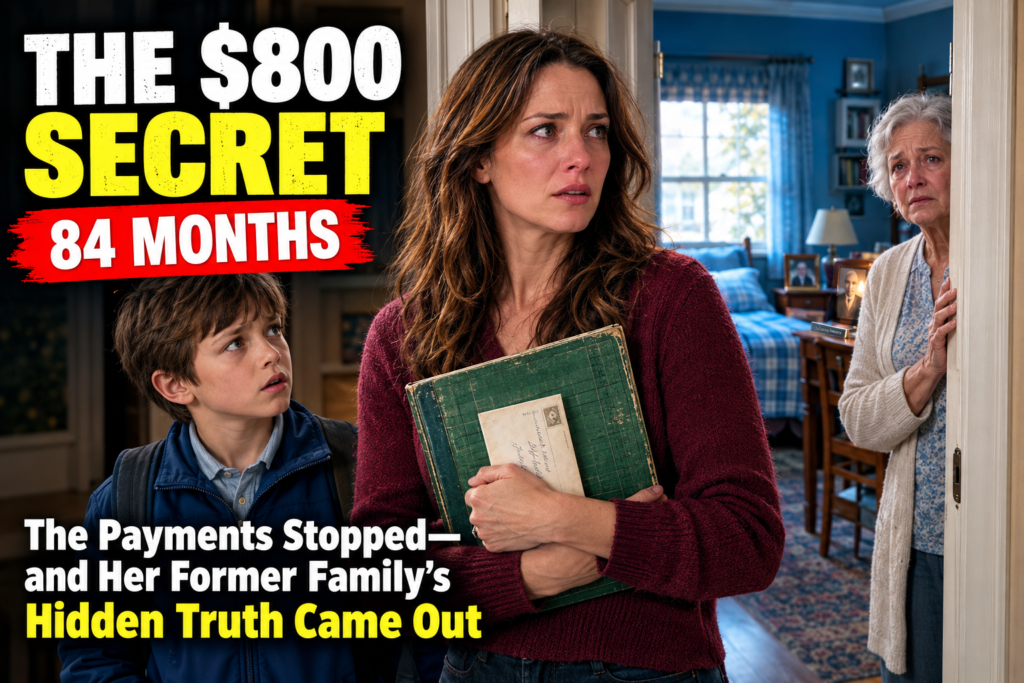
I called it the green-ledger money because every deposit had been written into the small green notebook I kept in the kitchen drawer beneath the potholders.
The first entry was dated September 1, seven years earlier.
$800 — received.
The handwriting was mine, hurried and uneven. I had written it while sitting on the floor of our nearly empty apartment, surrounded by cardboard boxes and the scattered pieces of the life I had thought I was building with my husband.
Back then, my son, Noah, was three years old.
He had slept on a mattress on the floor because I could not afford a bed frame. His favorite stuffed rabbit had one button eye, and he carried it everywhere, including the grocery store, where he once asked me whether the rabbit could have a birthday cake.
I had smiled at him and promised we would celebrate on Saturday.
Then I went into the bathroom, locked the door, and cried because I wasn’t sure I could afford the ingredients.
That was the kind of life my former husband, Daniel, had left us.
He had moved out three weeks before our divorce was finalized. He took his clothes, his expensive watch collection, his laptop, and the car we had bought together. The savings account was nearly empty by the time I realized how much money he had withdrawn.
He told me I was being dramatic when I asked where it had gone.
“You’ll figure it out,” he said, standing beside the front door with his suitcase.
I remember looking at him, waiting for him to say something else.
He didn’t.
“What about Noah?” I asked.
Daniel glanced toward the living room, where our little boy was stacking plastic blocks.
“He’s your responsibility too, Claire.”
“Too?”
“Don’t start.”
Those were the last words he spoke to me inside that apartment.
After the divorce, he missed his first child-support payment. Then the second. His phone number changed, and the address he had given the court turned out to be an apartment he had already left.
I worked mornings at a medical billing office and evenings three nights a week at a grocery store. My sister watched Noah when she could, but she had two children of her own and a husband who worked nights.
There were weeks when I survived on coffee and whatever Noah didn’t finish at dinner.
I never told my former in-laws how bad things were.
Margaret and Robert Hale had never been cruel to me. They had simply been distant, the kind of people who believed family problems should stay within the family. Margaret sent polite birthday cards. Robert shook hands instead of hugging. When Daniel and I divorced, they didn’t take sides in public.
They didn’t call to ask what their son had done.
They didn’t offer help.
So when the first $800 appeared in my account, I assumed it was a mistake.
I called the bank. They told me the transfer had been initiated through a recurring payment arrangement, but they couldn’t disclose the sender’s personal information.
I checked with the court. No payment had come from Daniel.
For a moment, I wondered whether it was Margaret and Robert.
Then I dismissed the idea. If they wanted to help, surely they would have said something.
The next month, another $800 arrived.
And then another.
By the sixth month, I had accepted that someone was helping us, even if I couldn’t understand why they wanted to remain anonymous.
I used the money for Noah’s daycare, winter boots, medicine, school supplies, and groceries. I paid the electric bill when my paycheck came up short. I bought him a proper bed and a secondhand bicycle with training wheels.
I recorded every dollar.
Not because I expected someone to demand it back, but because I wanted Noah to know, one day, exactly what had kept us going.
When he was old enough to understand, I intended to tell him that someone had cared enough to help us through the hardest years of our lives.
I just didn’t know who that someone was.
On the morning the final deposit arrived, I opened the banking app while Noah ate cereal at the kitchen table.
“Mom?” he asked.
I looked up. “What is it, sweetheart?”
“Can I get the blue shoes instead of the black ones? The blue ones are on sale, and they look better with my school uniform.”
I smiled. “We’ll look at them this weekend.”
He grinned and returned to his cereal.
I glanced back at the screen.
The deposit was there.
Eight hundred dollars.
I opened the green ledger, turned to the September page, and wrote the amount beneath the previous entry.
Then I closed the notebook and slid it into the drawer.
I had no idea that it was the last time I would ever record that familiar deposit.
\
Part 2\
October arrived with cold mornings and a broken washing machine.
I discovered the problem when I opened the lid and found Noah’s school uniform floating in a tub of gray water. The repair technician quoted me a price that made me laugh, although nothing about the situation was funny.
I bought a secondhand machine from a neighbor instead.
It was old, loud, and occasionally shook across the laundry room, but it worked. I paid for it with money from my grocery-store shifts, keeping the $800 deposit untouched until I knew what the month would bring.
On the third of October, I checked my bank account before leaving for work.
Nothing.
I checked again at lunch.
Nothing.
By the fifth, I had begun to worry.
I told myself the transfer might have been delayed. Banks had maintenance days. Weekends sometimes interfered with scheduled payments. Perhaps the person responsible was traveling or had changed accounts.
There were dozens of reasonable explanations.
I chose the one that frightened me least.
On the seventh, I called the bank.
A representative confirmed that no new transfer had arrived. She checked the previous months and told me the arrangement appeared to have been consistent, but she could not tell me who had initiated it.
“Is there any way to contact the sender?” I asked.
“Not through the information available on your account,” she replied. “If the payments were sent through an intermediary or a private arrangement, we may not have access to the original sender’s details.”
“What if the person has died?”
There was a pause.
“I’m sorry, ma’am. I wouldn’t be able to confirm that.”
I hung up and sat at the kitchen table.
The apartment was quiet except for the refrigerator humming in the corner. Noah was at school, and I had an hour before my shift began.
I took out the green ledger.
Eighty-four entries.
I counted them twice.
Seven years. Eighty-four months. Sixty-seven thousand two hundred dollars.
I had never calculated the total before. Seeing the number written on the back of an envelope made my hands feel strangely cold.
Sixty-seven thousand two hundred dollars had passed through my life without a face, without a name, without a single explanation.
It had helped me raise my son.
It had also become a promise I had quietly relied upon, even though I had never been foolish enough to consider it guaranteed.
I opened my laptop and searched through old emails. I looked for messages from the bank, notices about incoming transfers, anything that might contain a clue.
There was nothing.
Then I searched my old messages from Margaret.
Her last text was from Noah’s sixth birthday.
Happy birthday to our little grandson. We hope he has a wonderful day.
I had replied with a picture of him holding a chocolate cupcake.
Thank you. He loved it.
That was all.
I stared at the conversation for several minutes.
Could Margaret have been sending the money? Had Robert arranged it? If so, why had they never contacted me?
I remembered one Christmas when Margaret had mailed Noah a pair of wool gloves. They were expensive gloves, dark blue with leather palms, and they fit him perfectly. There was no note, only a card with his name written in her careful handwriting.
I had thanked her by text.
She had replied with a simple heart.
Perhaps that had been her way of telling me something.
Or perhaps I was inventing meaning because I desperately wanted an answer.
That evening, I picked Noah up from school and listened to him talk about a science project. He wanted to build a model of the solar system, complete with painted planets and a rotating sun.
“Can we get the supplies this weekend?” he asked.
“Of course,” I said automatically.
Then I looked at the grocery list in my purse and began calculating.
The electric bill was due in six days. The car needed an oil change. Noah had outgrown his winter coat, and my own shoes had developed a hole near the heel.
I could still manage without the deposit. I had always managed.
But the money had made it possible to give Noah more than survival.
It had allowed him to join a school club, attend birthday parties, and bring home permission slips without watching my face for signs of panic.
I hated how much I had come to depend on something I couldn’t explain.
That night, after Noah fell asleep, I sat beside his bed and watched his chest rise and fall beneath the blanket.
“Whoever you are,” I whispered into the darkness, “thank you.”
Then I added the words I had never dared to say aloud.
“Please don’t let anything happen to you.”
The next morning, I received a call from a number I didn’t recognize.
I nearly ignored it.
Instead, I answered.
“Hello?”
“Good morning. Is this Claire Bennett?”
“Yes.”
“My name is Evelyn Shaw. I’m calling from the bank’s customer support department. I need to speak with you about a recurring transfer arrangement associated with your account.”
I sat upright.
“Is the money coming back?”
“Not exactly,” Evelyn said carefully. “But I believe I may have found information that could explain why the transfers stopped.”
I gripped the edge of the table.
“What information?”
“Before I discuss the details, I need to verify a few things. And, Claire, I should warn you that this arrangement may involve a person who has recently passed away.”
For a moment, the room seemed to tilt.
“Who?” I whispered.
“I can’t disclose that over the phone until verification is complete. Could you visit one of our branches tomorrow morning?”
I looked toward the hallway, where Noah’s backpack lay beside the front door.
“Yes,” I said. “I’ll be there.”
After I ended the call, I opened the green ledger again.
For the first time in seven years, I wondered whether the money had been more than a gift.
Perhaps it had been a message.
And perhaps the person who had sent it had been waiting for me to understand something long before the payments stopped.
\
Part 3\
I arrived at the bank twenty minutes before my appointment.
The branch was located in a shopping plaza between a pharmacy and a small coffee shop. I had passed it hundreds of times without giving it a second thought. Now, sitting in the parking lot, I felt as though I were about to walk into a courtroom.
I brought the green ledger with me.
It was ridiculous, perhaps, to bring a notebook full of handwritten deposits to a bank appointment. But the ledger was the only proof I had that the past seven years had happened exactly as I remembered them.
Evelyn met me in a small office near the back.
She was a woman in her early fifties with silver-framed glasses and a kind, serious expression. She offered me coffee, which I declined, then placed a folder on the desk.
“Thank you for coming in,” she said. “I know this may be unsettling.”
“Please tell me who sent the money.”
She nodded, but she didn’t open the folder immediately.
“First, I need to explain something about the transfers. They weren’t sent directly from a personal checking account. They were administered through a financial arrangement that included instructions for monthly distributions.”
“So someone set it up in advance?”
“Yes.”
“Seven years ago?”
“Approximately seven years ago, yes.”
I pressed my palms against my knees.
“Was it my former husband?”
“No.”
I had expected that answer, but hearing it still hurt.
“Was it his parents?”
Evelyn paused.
“I believe the person most directly responsible for establishing the arrangement was Robert Hale.”
My former father-in-law.
For a moment, I couldn’t speak.
Robert had always been a difficult man to read. He was polite but reserved, generous in ways that rarely involved emotion. He believed people should work hard, pay their bills, and keep their private struggles to themselves.
During my marriage, I had sometimes mistaken his silence for disapproval.
After Daniel left, I had assumed his parents wanted nothing to do with me.
Yet Robert had apparently arranged for someone to send me money every month for seven years.
“Why didn’t he tell me?” I asked.
Evelyn folded her hands.
“I can’t answer that yet. The documents include instructions about when the arrangement should end and who should be contacted afterward.”
“Who should be contacted?”
“You.”
The room became very quiet.
Evelyn opened the folder and turned a document toward me. Most of the page was filled with formal language, dates, and account references. She pointed to a paragraph near the bottom.
“The monthly distributions were authorized for a fixed period of eighty-four months. The final transfer was scheduled for September. The arrangement has now reached its predetermined end date.”
“So the money didn’t stop because something went wrong?”
“Not according to the instructions we have.”
I stared at the document.
For seven years, I had imagined the payments would continue until someone decided otherwise. I had never considered that they might have been designed to stop on a specific date.
“Was Robert trying to help Noah?” I asked.
Evelyn’s expression softened.
“The instructions refer to a child, but I would prefer not to interpret the document beyond what it actually says.”
“Then what can you tell me?”
She turned another page.
“Robert Hale passed away six weeks ago.”
The words reached me slowly.
Six weeks.
I had not known.
I had not received a phone call, a letter, or a funeral announcement. I had learned of the death of a man who had quietly supported my son for seven years from a bank employee sitting across a desk.
“Did Margaret tell you to call me?”
“No. The instructions were part of the arrangement itself. There was a final notification scheduled after the last payment.”
“Why wait until the money stopped?”
“I don’t know.”
I looked down at the green ledger resting in my lap.
Robert was dead.
The person who might have explained everything was gone.
But there was something else in Evelyn’s words that I couldn’t ignore.
A fixed period of eighty-four months.
A final notification.
An instruction that I be contacted.
This had been planned.
“Is there a letter?” I asked. “Something he wrote?”
Evelyn hesitated, then removed a sealed envelope from the folder.
My name was written across the front.
Claire.
Not Mrs. Bennett. Not Daniel’s former wife. Just Claire.
I recognized the handwriting immediately.
It was Robert’s, the same neat, slightly slanted script that had once appeared on Christmas cards and birthday envelopes.
My fingers trembled as I reached for it.
Evelyn didn’t let go at first.
“There is one more thing,” she said. “The letter was not meant to be opened until after the final payment. Those were his explicit instructions.”
I looked at her.
“Why?”
“I think you’ll need to read it to understand.”
She placed the envelope in my hands.
The paper felt heavier than it should have.
I could have opened it right there. I could have torn the flap and read whatever Robert had left behind.
Instead, I slid it into my purse beside the green ledger.
I needed to go home.
I needed to sit somewhere familiar, where I could breathe, where I could read the words without a stranger watching my face.
Before I left, Evelyn gave me a copy of the arrangement’s final statement. It listed every distribution from the first month to the last.
The amount was exactly what I had recorded.
Eighty-four payments.
Sixty-seven thousand two hundred dollars.
No missed months. No errors. No unexplained withdrawals.
Someone had made certain that the money reached us every single time.
I drove home with the sealed envelope on the passenger seat.
At a red light, I glanced at it and imagined Robert sitting at his desk, writing the letter in his careful handwriting. I wondered whether he had been ill when he wrote it. Whether he had known he would never see Noah grow up. Whether he had thought of me at all, or only of his grandson.
When I arrived home, Noah was waiting at the kitchen table with a sheet of paper covered in pencil drawings.
“Mom, look! I figured out how to make the planets move.”
I smiled and kissed the top of his head.
“That’s wonderful, sweetheart.”
He studied my face.
“Are you okay?”
I set my purse down.
“I need to read something.”
“Is it bad?”
“I don’t know yet.”
He nodded solemnly, as though that answer made perfect sense.
I took the envelope into the living room and sat on the couch. For a long time, I simply held it.
Then I opened it.
The first line made my breath catch.
*Claire, if you’re reading this, the last payment has reached you, and I have kept my promise.*
I stopped.
My eyes blurred.
A promise.
What promise?
I turned the page.
And began to read.
\
Part 4\
*Claire,*
*You probably have questions, and I owe you answers. I should have given them to you years ago, but I was a coward in ways I didn’t recognize until it was almost too late.*
I read the first paragraph twice.
Robert Hale had never been a man who apologized easily. During the years I had known him, I had heard him say he was wrong only once, after he mistakenly accused a waiter of charging him twice.
Now he was apologizing to me from beyond the grave.
*When Daniel told us he was leaving, he said you had become irresponsible with money. He said you wanted a divorce, that you were trying to keep the house, and that you would use Noah to punish him if we helped you.*
I felt my stomach tighten.
That was not what had happened.
Daniel had left because he was tired of responsibility. He had said he wanted freedom, that he was too young to spend his life worrying about bills and school schedules. The house had been rented, not owned, and I had never asked to keep anything from him.
But I had never told his parents the truth in detail.
I had been too proud, too hurt, and too exhausted to explain myself to people who seemed determined to remain neutral.
Robert continued.
*Margaret believed him. I did too, at first. I was angry with you for making my son unhappy. I told myself there were two sides to every story, and that the safest thing was to stay out of it.*
*Then I saw Noah.*
I remembered the day.
It had been a few months after the divorce. Margaret had invited us to a family birthday party at their house. Daniel was supposed to be there, but he never arrived.
Noah had spent the afternoon sitting near the window, watching every car that passed.
When Margaret asked him why he wasn’t playing with the other children, he said he was waiting for his daddy.
I had wanted to take him home immediately.
Instead, I stayed until the cake was served because I didn’t want him to feel that his father’s absence had ruined another family gathering.
Robert wrote that he had watched Noah carefully that day.
*He was so excited when he heard a car door. He ran to the window, then came back to his chair when it wasn’t Daniel. He did this four times. When he finally asked whether his father was coming, no one answered him.*
*I saw the way you knelt beside him. You told him his father might not make it, but that it had nothing to do with whether he was loved.*
*You did not insult Daniel. You did not blame us. You simply held your little boy while he tried not to cry.*
I pressed the letter against my chest.
I remembered that afternoon with painful clarity.
Noah had cried in the car on the way home.
“Did Daddy forget me?” he had asked.
I had gripped the steering wheel so tightly my fingers hurt.
“No, sweetheart,” I had said, even though I no longer knew whether it was true. “Sometimes grown-ups make choices they don’t understand until later.”
I had lied because the truth was too cruel for a three-year-old.
Robert’s letter continued.
*That evening, I asked Daniel why he had not come. He told me he had other plans. When I asked whether he had paid his child support, he became angry and said you were perfectly capable of working.*
*I told him that being capable of working did not make his child less his responsibility.*
*He said I was taking your side.*
*I told him I was taking Noah’s side.*
For the first time since opening the envelope, I laughed through my tears.
I could almost hear Robert’s deep voice delivering those words. He had never been warm, but when he made up his mind, he could be immovable.
*Daniel left the house. Margaret was furious with me for arguing with him. She believed we had no right to interfere in your divorce.*
*I tried to explain that the divorce was no longer the issue. A little boy was being left without the father who had promised to love him.*
*Margaret did not want to hear it.*
I looked toward the kitchen, where Noah was humming as he colored a new planet blue.
The letter explained that Robert had begun looking into the family finances. He discovered that Daniel had withdrawn money from an account Margaret had set aside for Noah’s future. Daniel had claimed the money was needed for legal expenses, but the records showed payments to a new apartment, expensive dinners, and a vacation.
Robert confronted him.
Daniel denied everything until Robert placed the statements on the table.
Then he said the money had been his to use.
Robert asked whether he intended to repay it.
Daniel laughed.
He said Noah was too young to remember any of it.
That was the moment Robert decided to act.
*I could not force Daniel to become a father. I could not make him care about the consequences of his decisions. But I could prevent his choices from deciding Noah’s future.*
*I arranged for the monthly payments to begin. I made them anonymous because I did not want you to feel indebted to me, and because I feared Daniel would find a way to stop them if he knew.*
*I chose eighty-four months because that would carry Noah through the years when the costs of raising him were greatest. I wanted you to have time to build a stable life without wondering whether the help would disappear next month.*
I lowered the letter.
For seven years, I had thought the money was a mysterious kindness.
Now I understood that it had been a deliberate act of protection.
Robert had not simply sent money.
He had built a bridge across the years Daniel had abandoned.
And he had done it without asking me to thank him.
The next paragraph began with a sentence that changed the meaning of everything I had read.
*There is something else you need to know about Margaret.*
I sat up straighter.
*She did not know about the payments at first. When she found out, she demanded that I stop them. She said you were no longer part of our family, and that helping you would only encourage Daniel to avoid his responsibilities.*
My throat tightened.
*We argued about it for months. I told her the money was for Noah, not for you. She said that made no difference.*
*Eventually, she stopped arguing. I thought she had accepted my decision.*
*I was wrong.*
I read the final line of the page.
Then I turned it over.
The next sheet was covered in handwriting, but the first sentence was so unexpected that I forgot to breathe.
*The reason the payments ended when they did is not only because the arrangement reached its final date.*
*It is because Margaret asked me to make one last change.*
\
Part 5\
I read the sentence again.
Margaret had asked Robert to make one last change.
I wanted to know what it meant, but the letter didn’t explain immediately. Robert had written several paragraphs about the years after the payments began.
He described how he had checked on Noah through birthday photographs and occasional family visits. He had seen the boy grow taller, lose his baby teeth, learn to ride a bicycle, and begin reading chapter books.
He had also watched me change.
At first, I looked exhausted in every photograph. My smile was polite, my shoulders tense. By the third year, I had started wearing my hair differently and standing straighter. In the fifth year, I appeared in a picture with Noah at a school science fair, both of us grinning beside a cardboard volcano.
*I wanted to tell you what I was doing,* Robert wrote. *I wanted to explain why I had chosen to help. But I had already made the arrangement anonymous, and I did not want to turn it into a bargain. I did not want you to feel that you had to invite me into your life because I had paid for part of it.*
I wiped my eyes.
He had understood something that many people did not: help could become a chain if it came with expectations.
Robert’s letter went on.
*Then I became ill.*
He described the diagnosis briefly, without dramatic language. His heart was failing, and his doctors had explained that treatment could slow the decline but could not reverse it.
He did not want pity. He wanted time.
*I spent a great deal of that time thinking about what I had left unfinished. I thought about my son, who had become a man I barely recognized. I thought about Margaret, who had spent years protecting him from the consequences of his own behavior. And I thought about Noah, who deserved to know that his family had not entirely turned its back on him.*
I stopped reading.
Robert had been dying while I had been making grocery lists, packing school lunches, and trying to find affordable winter coats.
He had known the payments would eventually end.
He had known I would wonder why.
And he had planned for that moment.
*Margaret and I talked more honestly during my final months than we had in years. She admitted that she had been afraid of losing Daniel. She believed that if we supported you, he would see it as a betrayal and cut us out of his life.*
*She was right about that. He did cut us out.*
*What she did not understand was that we had already lost him in a more important way. He had stopped listening to us long before he stopped visiting.*
I looked toward the clock.
Noah would need dinner soon. I should have been preparing something, but I couldn’t move.
The next paragraph was shorter.
*When I told Margaret that the payments would end after the eighty-fourth month, she asked me to leave you something more important than money.*
*She asked me to give you the truth.*
I stared at those words.
Margaret had spent years opposing the payments, according to Robert. Why would she now ask him to reveal the secret?
The letter offered no immediate answer.
Instead, Robert wrote about his final visit with Daniel.
His son had arrived at the house demanding money. The business he had started with a friend was failing, and he wanted his parents to help him cover his debts.
Robert refused.
Daniel accused him of being sentimental about Noah and of allowing me to manipulate him.
Robert asked Daniel when he had last called his son.
Daniel could not remember.
Robert asked when he had last sent child support.
Daniel said he had other expenses.
Robert asked whether he had ever wondered how Noah was doing.
Daniel became furious.
He said that a child did not need a father who was forced to be present. He said Noah would understand when he was older.
Robert told him that children understood abandonment long before they understood its explanations.
Daniel left without saying goodbye.
That was the last time Robert saw him.
I folded the letter for a moment and pressed my fingertips against my eyes.
I had spent years wondering whether Daniel might someday return. Not because I wanted him back, but because I wanted Noah to stop looking at every man who resembled his father.
Whenever a dark-haired man walked past our apartment, Noah’s gaze followed him.
Whenever the school held a father-and-son event, he found a reason to stay home.
He never asked why his father didn’t call anymore. Eventually, he stopped asking about him at all.
I had thought silence meant he was healing.
Now I wondered whether he had simply learned not to hope.
The letter continued.
*Claire, I cannot undo what Daniel has done. I cannot give Noah the childhood he should have had. And I cannot ask you to forgive my family for the years we remained silent.*
*But I can make sure you understand why I helped you.*
*I did it because you never asked me to.*
I covered my mouth.
*You did not come to my house demanding money. You did not threaten us with lawyers or shame us in front of other relatives. You worked until your feet hurt, and you made certain Noah had what he needed. Even when you were struggling, you did not teach him to hate his father.*
*You taught him that another person’s failures do not have to become your own.*
I had to stop reading.
For years, I had worried that I wasn’t doing enough. I had measured motherhood in bills paid, lunches packed, school forms completed, and nights when I could afford to turn the heat up one more degree.
I had never imagined that anyone was watching closely enough to understand what those small things cost.
I looked at the last page.
Robert had written only one sentence at the top.
*Now you must decide whether you want to see what Margaret has been keeping from you.*
Beneath it was an address.
The address of the house where my former in-laws lived.
At the bottom of the page, Robert had added a date.
The date was the day before he died.
And below it, in smaller handwriting, were five words that made my heart pound.
*Ask her about the blue room.*
\
Part 6\
I didn’t sleep much that night.
Every time I closed my eyes, I saw the address at the bottom of Robert’s letter. I remembered Margaret’s house: the brick front, the white porch columns, the neat flower beds, and the blue room at the end of the upstairs hallway.
I had only been inside that room twice.
The first time was shortly after Noah was born. Margaret had shown me the nursery she had prepared for Daniel when he was a baby. The walls were painted pale blue, and the room contained an old wooden crib, a rocking chair, and a shelf of books.
She had said she wanted to preserve it for her grandchildren.
The second time was after the divorce, when she had asked me to bring Noah over for a family gathering. I had gone upstairs looking for a bathroom and found the door open.
The crib was gone.
In its place stood a desk, a filing cabinet, and several boxes.
I assumed Margaret had turned the room into an office.
I had never asked about it.
Now, as dawn spread across the bedroom curtains, I wondered what else I had failed to notice.
At breakfast, Noah studied me over his bowl of oatmeal.
“You’re thinking really hard,” he said.
“Am I?”
“You’ve stirred your oatmeal for five minutes, and you haven’t eaten any.”
I smiled faintly.
“I have something important to do today.”
“Is it about Grandpa Robert?”
I froze.
Noah had called Robert Grandpa when he was little, but after Daniel stopped visiting, the name had gradually disappeared from our conversations.
“Why do you ask?”
“You said his name last night when you were talking on the phone.”
I had forgotten that Noah was awake when Evelyn called.
“Grandpa Robert died,” I told him gently.
His spoon stopped halfway to his mouth.
“He did?”
“Yes, sweetheart. A few weeks ago.”
Noah looked down at his oatmeal.
“Did he know me?”
The question hurt more than I expected.
“Yes,” I said. “He knew you.”
“Did he like me?”
I moved around the table and sat beside him.
“He loved you.”
Noah looked at me as if he were deciding whether to believe it.
“Then why didn’t he visit?”
I had no easy answer.
“Sometimes adults make mistakes because they’re afraid or because they don’t know how to fix something they’ve done wrong,” I said. “That doesn’t mean you weren’t worth visiting.”
He thought about that.
“Okay.”
Then he returned to his oatmeal.
I wanted to tell him about the money, the letter, and the secret. But I didn’t know enough yet, and I had promised myself that I would never burden him with half a truth simply because I couldn’t bear to carry it alone.
After school, we would visit Margaret.
I called her just before noon.
She answered on the fourth ring.
“Claire?”
Her voice sounded thinner than I remembered.
“Margaret. I’m sorry I haven’t called sooner. I heard about Robert.”
There was a long silence.
“Thank you.”
“I found out through the bank. Robert arranged the monthly transfers to my account.”
Another silence.
“I see.”
“He left me a letter.”
I heard a small sound, almost a sigh.
“Then he told you.”
“Not everything.”
Margaret didn’t answer.
“He wrote something about the blue room,” I continued. “I’d like to understand what he meant.”
For several seconds, I heard only the faint crackle of the phone line.
Then she said, “When?”
“Could Noah and I come over this afternoon?”
“Why are you bringing Noah?”
“Because this concerns him.”
I expected her to object. Instead, she gave a tired little laugh.
“Yes,” she said. “Bring him.”
When I arrived, the house looked exactly as I remembered it, except the flower beds had grown wild around the edges. A stack of unopened mail lay on the porch table, and the brass knocker had lost its shine.
Margaret opened the door before I could knock a second time.
She had aged more than I expected. Her silver hair was pulled into a loose bun, and her cardigan hung from her shoulders. Her eyes moved from me to Noah, then back again.
For a moment, none of us spoke.
Noah stood beside me, holding the strap of his backpack.
“Hello, Grandma Margaret,” he said quietly.
Her face crumpled.
“Oh, sweetheart.”
She knelt in front of him and wrapped her arms around his shoulders. Noah looked surprised, then cautiously hugged her back.
I had never seen Margaret embrace him like that.
When she stood, she wiped her eyes with the heel of her hand.
“Come inside,” she whispered.
The house smelled faintly of lemon polish and old books. The hallway was crowded with family photographs, most of them showing Daniel at different ages. There were pictures of his school graduation, his wedding, and a fishing trip with Robert.
I searched for one of Noah.
There were only two.
One showed him as a toddler in a high chair. The other was the science-fair picture Robert had mentioned in his letter.
We sat in the living room while Margaret made tea. She asked Noah about school, his favorite subjects, and whether he still liked drawing planets.
He answered politely.
When she asked whether he had ever wanted to learn piano, he said he had, but lessons were too expensive.
Margaret looked at me.
I wondered whether she knew that the anonymous money had helped pay for other things, too.
After tea, I took Robert’s letter from my purse and placed it on the coffee table.
“He said I should ask you about the blue room.”
Margaret closed her eyes.
For a long moment, she looked like someone standing at the edge of a cliff, trying to decide whether to jump or turn back.
Then she rose.
“Come with me,” she said.
We followed her upstairs.
At the end of the hallway, she stopped in front of the blue room.
The door was closed.
She rested one hand on the knob, but she didn’t turn it.
“Before I open this door,” she said, “there is something you need to understand.”
Her eyes met mine.
“The money was not the only thing Robert arranged for Noah.”
\
Part 7\
Margaret opened the door.
The room was no longer an office.
It was a bedroom, carefully furnished in shades of blue and cream. A narrow bed stood beneath the window, covered with a quilt patterned with small stars. A wooden desk rested against one wall, and beside it was a bookcase filled with children’s books, puzzles, and framed photographs.
On the desk sat a small brass nameplate.
NOAH HALE.
I stared at it.
“Why is his name on that?” I whispered.
Margaret stepped into the room.
“Robert had it made a few months before he died.”
Noah wandered toward the bookshelf. He ran his fingers over the spines of the books, reading their titles under his breath.
“Is this my room?” he asked.
Margaret’s face tightened.
“It was supposed to be.”
“What does that mean?”
She looked at me.
“Your grandfather wanted you to have a place here. A room that would always be yours if you wanted to visit. He wanted you to know that you belonged to this family, even when your father stopped acting like it.”
Noah looked confused.
“Why didn’t anyone tell me?”
Margaret sat on the edge of the bed.
“Because I was wrong.”
The words seemed to cost her something.
She folded her hands in her lap and looked at me.
“When Robert first arranged the payments, I was furious. I thought he was interfering in Daniel’s life. I believed that if we helped you, Daniel would never take responsibility for what he had done.”
“You thought the money would let him off the hook,” I said.
“Yes.”
“But he wasn’t paying anything anyway.”
“I know that now.”
“Did you know it then?”
Margaret lowered her eyes.
“I knew he was not paying what he should have. I told myself he would eventually come around. I thought that if we kept quiet, he would realize what he was losing and return to Noah.”
I looked at the little bed.
“And did he?”
“No.”
The answer came out like a confession.
“Instead, he grew more distant. He stopped coming for holidays. He stopped answering Robert’s calls. When Robert asked him to visit, Daniel said he was tired of being judged.”
Margaret wiped her cheek.
“I kept making excuses for him. I told myself he was struggling, that he needed time, that he would become the father we wanted him to be.”
She looked at Noah.
“And all the while, you were growing up without him.”
Noah stood near the bookcase, holding a book about space.
“Mom says people can make mistakes,” he said.
Margaret gave a shaky nod.
“They can.”
“Can they fix them?”
The question hung in the room.
Margaret looked at him for a long time.
“Sometimes,” she said. “But first they have to admit what they’ve done.”
Noah considered that, then returned the book to the shelf.
Margaret took a deep breath.
“Robert wanted to leave you something that would last beyond the payments. He had spoken with an attorney about creating a small education fund. The money was intended for school expenses and, eventually, college or vocational training.”
My heart began to pound.
“An education fund?”
She nodded.
“He had already set aside the money before he died. It was separate from the monthly transfers. The bank employee should have explained it to you.”
“She didn’t mention a fund.”
“Perhaps the paperwork hasn’t been completed.”
I thought of the envelope, the final statement, and the careful language in Robert’s letter.
“Is it in Noah’s name?”
“Yes.”
“How much?”
Margaret hesitated.
“I don’t know the final amount. Robert handled most of the arrangements himself. I know he had been saving for years, and he added to it after he sold a small piece of land he owned outside the city.”
I felt dizzy.
For seven years, I had believed the $800 was the whole story.
Now there was another promise, another plan, another piece of Robert’s life that had been hidden from me.
“Why didn’t he tell me about this in the letter?”
“He wanted the money to remain separate from the relationship. He said he didn’t want you to feel that you had to bring Noah here just because there was something to inherit.”
I looked at Margaret sharply.
“Then why am I only learning about it now?”
She looked away.
“Because I was supposed to contact you after he died. I couldn’t make myself do it.”
“Why?”
Her voice broke.
“Because I was ashamed.”
The room seemed smaller.
Margaret rose and went to the desk. She opened the top drawer and took out a thick envelope, then returned to the bed.
“This is the part Robert wanted me to give you.”
Inside were photographs, handwritten notes, and copies of documents. The photographs showed Noah at different ages, taken during visits to family gatherings and school events. Some I recognized. Others had been taken from a distance, without my knowing.
One showed Noah at a school concert, standing onstage with a paper star pinned to his shirt. Another showed him sitting on the grass beside a cardboard volcano.
At the back was a photograph of Robert sitting in the blue room, his face pale but smiling. Noah stood beside him, holding a toy airplane.
I remembered the day.
It had been one of the rare times Daniel’s parents had invited Noah over while I worked a Saturday shift. I had dropped him off in the morning and collected him that afternoon. Robert had been in the room with him, showing him an old model airplane.
I hadn’t realized the photograph had been taken.
On the back, Robert had written:
*He asked whether his daddy would come next time. I told him I hoped so. I should have told him that his father was responsible for making that happen.*
I sat on the bed.
Margaret lowered herself beside me.
“There is one more thing,” she said. “Something Robert never wanted to put in writing.”
I turned toward her.
“What?”
She looked at Noah, who was now examining a wooden puzzle.
Then she leaned closer and spoke in a voice so quiet I almost didn’t hear it.
“Daniel knows about the education fund.”
\
Part 8\
I stood so quickly that the bed creaked beneath me.
“Daniel knows?”
Margaret nodded.
“When Robert told him about the fund, Daniel demanded that he change the beneficiary. He said the money should belong to him as Robert’s son.”
My hands began to shake.
“What did Robert say?”
“He refused.”
“And Daniel?”
“He threatened to challenge the arrangement.”
I stared at her.
“Why didn’t anyone tell me?”
Margaret looked down.
“Robert wanted the attorney to handle it. He said he would not allow Daniel to turn Noah’s future into another argument. He also believed that Daniel would eventually lose interest when he realized he couldn’t control the money.”
“Did he?”
“No.”
The word came with a tired exhale.
“Daniel called several times after Robert became ill. He asked about the will, the accounts, and the house. He rarely asked how his father was feeling.”
I felt anger rise through me, hot and immediate.
“Did he visit him?”
“Once.”
“And did he ask about Noah?”
Margaret didn’t answer.
She didn’t need to.
I looked toward my son. He was still playing with the wooden puzzle, unaware that the adults in the room were discussing the father who had left him behind.
I wanted to take him home.
I wanted to call Daniel and tell him exactly what I thought of him.
Instead, I forced myself to breathe.
“Do you have the attorney’s information?”
Margaret reached into the envelope and removed a business card.
“His name is Thomas Reed. He handled Robert’s estate.”
I took the card and placed it inside the green ledger.
“I’m going to contact him.”
“I think you should.”
I studied Margaret’s face.
“Why did you wait seven years to tell me any of this?”
Her expression crumpled again.
“I was angry with you for a long time.”
“Why?”
“Because you represented everything I was afraid of losing. When Daniel left, I thought that if I admitted he had done something wrong, I would have to accept that I had failed as a mother.”
“That wasn’t my fault.”
“I know.”
“You could have called. You could have asked about Noah. You could have told me Robert was helping us.”
“I know.”
“You let me believe your entire family had abandoned us.”
Margaret covered her mouth.
“I did.”
For the first time, I saw her not as the cold, formal woman who had stood beside her son during my divorce, but as someone who had spent years protecting a lie because the truth threatened the image she had built of her family.
It didn’t excuse what she had done.
But it explained the fear behind it.
“Robert said you asked him to make one last change,” I said.
Margaret nodded.
“He wanted to leave you the truth. I asked him to make sure you received it after the payments ended. I knew that if I contacted you while he was alive, he would have to defend his decision all over again. I was tired of fighting him, and I was afraid of what Daniel would do if he found out.”
“So you waited until Robert was gone.”
“Yes.”
I shook my head.
“That’s not the same as making things right.”
“No,” she whispered. “It isn’t.”
Noah approached us, holding the wooden puzzle.
“Grandma, look. I finished it.”
Margaret smiled through her tears.
“You did a wonderful job.”
He placed the puzzle on the desk, then looked between us.
“Are you two angry?”
I knelt in front of him.
“No, sweetheart. We’re talking about some things that should have been talked about a long time ago.”
“About Grandpa?”
“Yes.”
“About Dad?”
I swallowed.
“Yes.”
Noah looked down at his shoes.
“Did Dad know Grandpa was sick?”
Margaret’s face changed.
“Yes,” she said softly. “He knew.”
“Did he visit him?”
“Once.”
Noah nodded, as if confirming something he had suspected for years.
“Okay.”
He didn’t cry. He didn’t ask why.
He simply picked up his backpack.
“Can we go home now, Mom?”
I kissed his forehead.
“Of course.”
As we walked downstairs, Margaret followed us to the front door. She stood with one hand resting on the frame, looking at Noah as though she were trying to memorize him.
“Could I see you again?” she asked.
I wanted to say no.
I wanted to tell her that she had forfeited the right to ask for anything from us. But I also remembered Robert’s letter, the room upstairs, and the fact that Noah had spent seven years without knowing that his grandfather had been quietly fighting for him.
“I don’t know yet,” I said honestly.
Margaret nodded.
“I understand.”
Outside, Noah held my hand as we crossed the porch.
Halfway to the car, he stopped.
“Mom?”
“Yes?”
“Was Grandpa the person who sent the money?”
I crouched beside him.
“Yes, sweetheart.”
He looked back at the house.
“Why didn’t he tell us?”
I thought about Robert’s letter.
“Because he wanted to help without making us feel like we owed him something.”
Noah considered that.
“That’s a good reason.”
“It was,” I said. “But I wish he had told us sooner.”
Noah leaned against me.
“Can we keep the room?”
I closed my eyes for a moment.
“I don’t know, sweetheart.”
He nodded.
“Okay.”
Then he took my hand again, and we walked toward the car.
I had come to Margaret’s house to thank someone who had helped us survive.
I left carrying a dead man’s letter, an attorney’s business card, and the knowledge that my former husband might try to take away the one thing his father had meant for his son.
The money had stopped.
The truth had begun.
\
Part 9\
Thomas Reed called me two days later.
He was a calm, precise man who spoke as though he had spent his entire career delivering difficult information without allowing his emotions to interfere.
He confirmed that Robert had established an education trust for Noah. The documents had been properly prepared, and the fund was separate from the monthly payments.
“The trust is intended for Noah’s education and related expenses,” he explained. “Your former father-in-law was very clear about that.”
“Can Daniel take it?”
“Not simply because he is Robert’s son. The trust documents name Noah as the beneficiary and specify how the funds may be used. However, Daniel has made inquiries about the estate, and we are preparing for the possibility that he may challenge certain provisions.”
“Why would he do that?”
Thomas paused.
“I can’t speculate about his motives. But I can tell you that your former father-in-law anticipated questions and took steps to protect the arrangement.”
I sat at my kitchen table with the green ledger open beside me.
“How much is in the trust?”
Thomas gave me the amount.
I wrote it down, then stared at the number.
It was more than I had ever expected. Robert had not simply saved a little money for his grandson. He had built a substantial fund over many years, adding to it when he could and protecting it from anyone who might try to use it for another purpose.
I thought of Noah’s worn winter coat, the secondhand washing machine, and the times I had told him we couldn’t afford something he wanted.
The trust would not erase those years.
But it could give him choices I had never been able to offer.
“What do I need to do?” I asked.
“First, we need to complete the beneficiary documentation. Then we will arrange a meeting to explain the terms. You should also keep any records you have of the monthly payments.”
I glanced at the green ledger.
“I have every single one.”
“Good. Bring it with you.”
After the call, I sat quietly for a long time.
Then my phone rang again.
Daniel’s name appeared on the screen.
I hadn’t heard his voice in nearly two years.
I considered letting it go to voicemail. Instead, I answered.
“Hello?”
“Claire.”
His voice was familiar enough to make my shoulders tighten.
“Daniel.”
“I heard you went to my mother’s house.”
“Margaret invited me.”
“And you went with Noah?”
“Yes.”
He exhaled sharply.
“I don’t think that’s appropriate.”
I laughed once, without humor.
“You haven’t called your son in months, but you’re concerned about whether it’s appropriate for him to visit his grandmother?”
“Don’t start with me.”
“I haven’t started anything. You called me.”
There was a pause.
Then Daniel changed his tone.
“Look, I know Dad arranged some money for you. I don’t know what he told you, but there are things you need to understand about the estate.”
“What things?”
“I’m his son. I’m the closest living relative.”
“Noah is his grandson.”
“That doesn’t mean he gets everything.”
I felt a chill run through me.
“Is that why you’re calling? To ask about the education fund?”
Daniel said nothing.
I looked at the green ledger, its pages filled with eighty-four careful entries.
“You know about it,” I said.
“Dad made some questionable decisions near the end.”
“He made sure his grandson would have a future.”
“He was sick. He wasn’t thinking clearly.”
“He was thinking clearly enough to remember Noah’s name.”
Daniel’s breathing grew louder.
“Listen to me. I’m trying to handle this sensibly. If there’s money available, we should discuss how to divide it fairly.”
“Fairly?”
“Yes.”
“You took money from the account meant for Noah. You walked away without paying child support. You haven’t attended a single school event in years. And now you want to discuss fairness?”
“That’s not what happened.”
“Then explain what happened.”
He fell silent.
For seven years, I had wanted Daniel to explain himself. I had imagined a day when he would finally admit that he had been wrong, when he would look at the damage he had caused and understand that his son was not an inconvenience.
But listening to him now, I realized I no longer needed his explanation.
His choices had already answered every question that mattered.
“I’m not discussing the trust with you,” I said. “Thomas Reed is handling it.”
“You can’t shut me out.”
“I can protect my child.”
“He’s my son too.”
“Then you should have acted like his father.”
Daniel cursed under his breath.
“You’ve poisoned him against me.”
“No, Daniel. I’ve spent seven years refusing to do that. You have been given every opportunity to be part of his life. You chose not to take them.”
He started to speak, but I ended the call.
My hands were shaking, though I wasn’t afraid.
I was angry, and beneath the anger was a strange relief.
I had spent years keeping the peace with a man who treated every boundary as an attack. I had softened my words, made excuses, and tried to leave the door open for a relationship that he rarely bothered to enter.
I wouldn’t do that anymore.
The following week, I met with Thomas and signed the documents necessary to establish my role in managing Noah’s educational expenses until he reached adulthood.
He explained every clause, answered every question, and gave me copies of the records.
The trust was secure.
Daniel could make inquiries, but he could not simply claim the money for himself.
As I left the office, I called Margaret.
“I spoke to Thomas,” I told her. “The trust is protected.”
She exhaled with relief.
“Thank goodness.”
“Margaret, I need you to understand something. I’m not going to pretend the past seven years didn’t happen.”
“I know.”
“I can’t promise that everything will be normal between us.”
“I don’t expect you to.”
“But Noah deserves to know his family, if that family is willing to treat him with love and respect.”
Margaret’s voice trembled.
“I want that. I truly do.”
“Then start by showing up. Not with gifts or promises. Just show up.”
“I will.”
I hung up and drove home.
The green ledger sat on the passenger seat, its pages worn at the corners.
I had opened it that morning intending to show Thomas the deposits.
Before putting it away, I had turned to the final page and written one more entry.
$800 — September. Final payment.
Beneath it, I added a new line.
Robert Hale — truth received.
For the first time in seven years, I didn’t feel as though I was waiting for the next deposit.
I was ready to build a future that no anonymous payment could take away.
\
Part 10\
Six months later, Noah stood in the blue room with a paintbrush in his hand.
He had chosen a pale shade of green for the walls, explaining that blue was nice but green reminded him of trees, spring, and the little park near our apartment.
Margaret had agreed without argument.
We had spent the previous month cleaning the room, sorting through boxes, and deciding which of Robert’s things should remain. The old desk stayed by the window. So did the bookcase, the wooden puzzle, and the framed photograph of Robert holding the toy airplane.
The brass nameplate was still there, but Noah had asked the carpenter to add a second line beneath his name.
For Grandpa Robert.
Margaret had cried when she saw it.
I hadn’t.
Not because I wasn’t moved, but because something in me had finally settled. Robert’s absence would always hurt, and the seven years of silence could never be erased. But the room no longer felt like a monument to the family we had lost.
It felt like a beginning.
Margaret had started visiting us every other Sunday. At first, she brought groceries and offered to pay for Noah’s school supplies. I thanked her but declined the money.
She learned to ask before offering help.
She learned that Noah liked pancakes without syrup, that he needed quiet when he was doing homework, and that he hated being asked whether he missed his father.
She also learned to apologize without adding an excuse afterward.
It was not an easy transformation.
Sometimes she slipped into old habits, speaking about Daniel as though he were simply misunderstood. When that happened, I reminded her that loving someone did not require pretending they had done no harm.
She listened.
Not always immediately, but more often than before.
Daniel never apologized.
He sent a formal letter through an attorney asking for information about the trust. Thomas responded with the appropriate documents. After that, Daniel stopped contacting us about the money.
He did not call Noah.
He did not ask about school.
He did not send a birthday card.
At first, I was angry all over again. Then I realized that my son had stopped checking the mailbox for his father’s name. He had stopped looking up whenever a car slowed outside our apartment.
He had begun to understand that his father’s absence was not a verdict on his worth.
That mattered more than any apology Daniel might have offered.
The education trust paid for Noah’s music lessons, school programs, and the supplies he needed for a science competition. The rest remained invested for the future. I kept the records carefully, just as Robert had kept his.
I also continued working.
The money from the trust was not a replacement for my income, and I didn’t want Noah to grow up believing that his future depended on an inheritance. I wanted him to know that security came from preparation, effort, and people who kept their promises.
One Sunday afternoon, Margaret arrived carrying a small wooden box.
“I found this in Robert’s desk,” she said.
She placed it on the table.
Inside were eighty-four folded slips of paper.
Each one had a date written on it, matching the months when the payments had been sent. On some, Robert had added a brief note.
*Noah started preschool.*
*Claire found a better job.*
*Noah lost his first tooth.*
*He learned to ride a bicycle.*
*First day of second grade.*
*Science fair. He looked proud.*
I touched the paper with trembling fingers.
“You knew he kept these?”
Margaret shook her head.
“I found them after he died. He must have written them when he checked the records.”
I unfolded another slip.
*Noah asked whether his father would come to the school concert. Claire told him she hoped so, but she did not make a promise she couldn’t keep.*
I closed my eyes.
Robert had seen us more clearly than I had ever realized.
He had watched me protect Noah from disappointment, even when I couldn’t protect him from the person causing it.
At the bottom of the box lay one final note, written on thicker paper.
*Claire,*
*If you have found this, then I hope the money has done what I intended. I hope it gave you room to breathe, time to work, and a little peace when the world felt unfair.*
*But I hope you understand that the money was never the most important thing I wanted to leave Noah.*
*I wanted him to know that someone had seen him.*
*I wanted him to know that his father’s choices did not make him unworthy of love.*
*And I wanted you to know that you were never as alone as you believed.*
*You did the hardest part. You kept going.*
*Thank you for raising a boy who can ask difficult questions without becoming cruel, and who can accept kindness without believing it makes him weak.*
*Tell him that his grandfather loved him.*
*And tell him that when he grows up, he should measure his family not by the people who share his name, but by the people who show up when they are needed.*
*With gratitude,*
*Robert.*
I read the note twice.
Then I passed it to Noah.
He read slowly, moving his lips over the longer words. When he finished, he looked at the photograph on the desk.
“Grandpa really loved me?”
“Yes,” I said.
“Even when he didn’t see me very much?”
“Yes, sweetheart.”
He thought about it for a moment.
“I wish he had told me.”
“So do I.”
Noah folded the note carefully and returned it to the box.
Then he reached for the green ledger.
“Can I write something in here?”
I handed him the notebook.
He turned to the final page, where my last entry sat beneath the date of the final payment.
For a while, he held the pencil above the paper without writing.
Then he printed, in large uneven letters:
*We are going to be okay.*
He looked up at me.
“Is that true?”
I took his hand.
“Yes,” I said. “It is.”
And for the first time, I knew I wasn’t saying it simply because he needed to hear it.
We were going to be okay.
Not because a mysterious payment would arrive next month. Not because Daniel would finally become the father we had once hoped for. Not because the past could be repaired by a letter, a trust, or a room painted green.
We were going to be okay because we had survived the years when everything felt uncertain.
Because Noah had grown into a boy who still believed kindness mattered.
Because Robert had helped us without demanding that we belong to him.
And because I had finally learned that accepting help did not mean surrendering my independence. It meant allowing love to reach us in whatever form it could.
That evening, I closed the green ledger and placed it in the desk drawer.
For seven years, I had used it to record money that arrived from an unknown source.
Now it held something more valuable.
Proof that someone had cared.
Proof that silence did not always mean indifference.
And proof that even when a family failed us, the future could still be built by the people who chose to stay.
The next month, there was no $800 deposit.
There was no bank notification, no mysterious transfer, and no reason to check the account twice before breakfast.
Instead, Noah came home from school carrying a permission slip for a music program.
“Mom,” he said, “I want to learn piano.”
I looked at the paper, then at the boy standing in the doorway.
For seven years, the anonymous money had kept him warm, healthy, and in school.
Now he was asking for something more.
He was asking for a chance to discover who he might become.
I took the permission slip, signed my name, and handed it back.
“Then let’s get you started.”
He grinned and ran to his room.
I remained at the kitchen table for a moment, listening to his footsteps fade down the hallway.
Then I opened the drawer and took out the green ledger one last time.
I didn’t add a new deposit.
I simply turned to Noah’s words and traced them gently with my finger.
*We are going to be okay.*
Robert had sent us $67,200 over eighty-four months.
But the greatest gift he left behind was not the money.
It was the truth that my son had never been forgotten.
And sometimes, when a person has spent years believing they were abandoned, that truth is worth more than anything a bank account could ever hold.
\