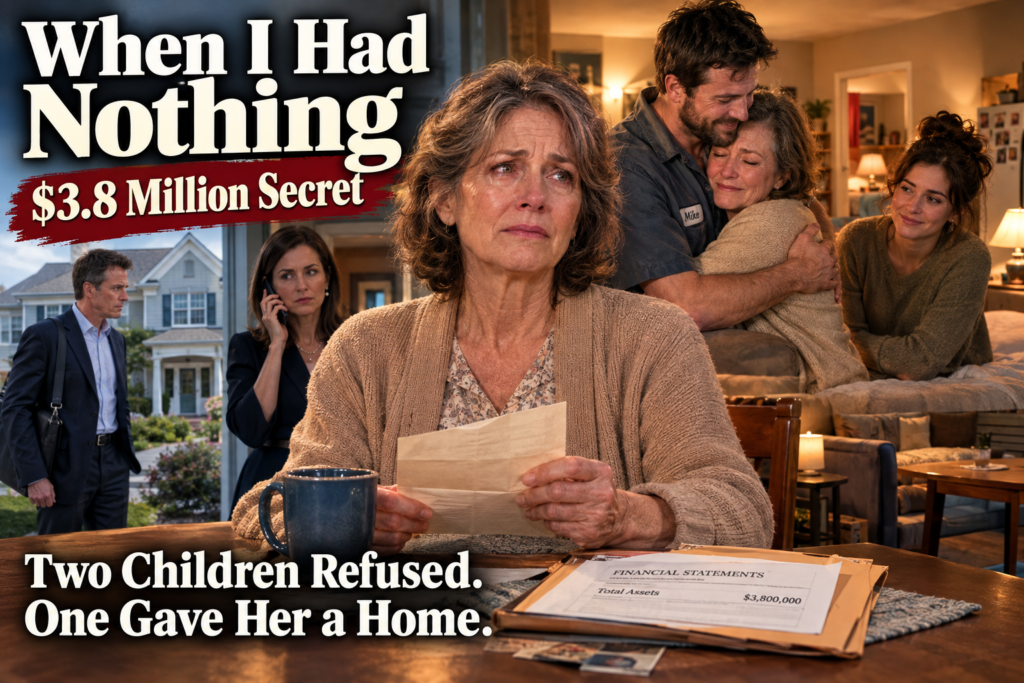
The morning after Walt’s funeral, I stood in the kitchen of the little house we’d shared for forty-three years, staring at his coffee mug.
It was still sitting beside the sink.
Walt had always used that chipped blue mug, even after I bought him a beautiful new set for our thirtieth anniversary. He’d smiled when he opened the box, kissed my cheek, and thanked me. Then, the following morning, he’d gone straight back to his old mug.
“Nothing wrong with the old one,” he’d told me.
That was Walt. He never needed things to be new simply because something better was available. If a shirt still fit, he wore it. If a car started reliably, he drove it. If a house was warm, dry, and filled with people he loved, he called it a good home.
Our house wasn’t much to look at. Two bedrooms, one bathroom, a narrow hallway, and a kitchen where the cabinets had begun peeling around the handles. The roof needed attention, and the front steps creaked whenever somebody climbed them.
But every inch of that place held a memory.
There was the pencil mark on the pantry door where we’d measured our oldest son’s height. There was the small crack beside the living room window from the winter our daughter threw a wooden toy in a temper tantrum. There was the faint grease stain on the garage wall where our youngest had tried to repair his first engine under his father’s supervision.
I could remember Walt laughing so hard that day he had to sit down.
Now the house was quiet enough for me to hear the refrigerator humming.
I touched the blue mug.
“Well, sweetheart,” I whispered, “what am I supposed to do without you?”
The question seemed to settle into the room.
For months, Walt had been growing weaker. His illness had taken his strength gradually, then all at once. There had been hospital visits, difficult conversations with doctors, and nights when I held his hand while he slept because I was afraid he might slip away if I let go.
Through it all, he had worried about me.
Not about himself.
“Promise me you’ll keep living, Margaret,” he’d said one evening, when the late sunlight spilled across our bedroom.
I had been folding his clean shirts.
“Don’t talk like that.”
“Promise me.”
I sat beside him and took his hand. “I’ll be fine.”
He gave me a tired smile. “That’s not a promise.”
So I promised.
I didn’t know then how difficult it would be to keep.
After the funeral, the sympathy cards arrived, casseroles appeared on the doorstep, and neighbors stopped by to tell me how sorry they were. For a few days, the house was full of people who spoke softly and hugged me before leaving.
Then the visits became less frequent.
People returned to their routines. Children returned to work, school, and their own families. The world kept turning, although mine seemed to have stopped.
I tried to maintain my usual habits. I made breakfast for one. I watered the plants. I swept the kitchen floor, even when there was nothing on it.
But the silence followed me everywhere.
One afternoon, I opened the drawer where Walt kept the household bills. Beneath the utility statements and old receipts lay an envelope with my name written across the front.
I recognized his handwriting immediately.
Margaret.
Inside was a brief note.
If you’re reading this, I’m not there to remind you how stubborn you are. Don’t let grief make your decisions for you. Take your time. Trust what we built together.
I read it twice, then folded it carefully and put it back.
Walt had always known me too well.
He also knew our children.
We had raised three of them to believe in hard work, honesty, and looking after the people who mattered. We had paid for school supplies, helped with their first cars, celebrated their marriages, and stayed awake worrying whenever one of them was struggling.
We hadn’t been perfect parents, but we had tried to be good ones.
And perhaps that was why I kept making excuses for them.
Our oldest, Richard, had a beautiful home with five bedrooms, a landscaped garden, and a driveway large enough for three cars. He had built a successful career in real estate and frequently posted photographs of family vacations and expensive restaurants.
Our daughter, Susan, lived in a comfortable house with her husband. She worked in administration and was careful about money, sometimes to the point of being rigid.
Our youngest, Michael, was different. He repaired cars at a local garage and lived with his wife, Emily, in a two-bedroom apartment. They didn’t have much, but when Walt and I visited, they always found something to feed us.
Michael still called me just to ask how my day had been.
Richard and Susan called when they needed information, a favor, or help organizing a family event.
I had noticed the difference for years.
I had simply never wanted to name it.
That evening, sitting alone at the kitchen table, I made a decision.
I would call my children.
I wouldn’t tell them about the money. I wouldn’t ask them to pay my bills. I wouldn’t demand anything.
I would tell them that I had lost everything and needed somewhere to live.
I wanted to know whether the lessons Walt and I had tried to teach them had survived their childhoods.
I picked up the telephone.
My hand trembled as I dialed Richard’s number.
He answered after several rings.
“Hi, Mom. Everything okay?”
I looked around the little kitchen.
“No, sweetheart. Not really. I’ve been trying to figure out what to do since your father passed away. Things are worse than I expected, and I don’t think I can manage the house anymore.”
There was a pause.
“What do you mean?”
“I mean I don’t have much money left. I may have to sell the house, and I don’t know where I’ll go. I was wondering whether I could stay with you for a while.”
Richard exhaled sharply.
“Mom, I don’t know if that’s possible.”
I closed my eyes.
“Why not, darling?”
And then he gave me his answer.
“Mom, you know we don’t have room.”
For a moment, I thought I’d misunderstood him.
Richard had five bedrooms in his house. I’d been there for Thanksgiving, Christmas, birthdays, and Sunday dinners. I’d seen the guest room with its king-sized bed, the spare bedroom his children barely used, and the upstairs room that had become a storage space for exercise equipment and unopened boxes.
“Richard,” I said carefully, “I wouldn’t need anything fancy. I could sleep in a small room. I’d help with groceries, and I’d stay out of everybody’s way.”
“That’s not the point.”
“What is the point, sweetheart?”
He lowered his voice, as though someone might overhear.
“Jennifer and I have a routine. The kids have their schedules. Having another person in the house would change everything.”
Another person.
I pressed the phone against my ear.
“I’m your mother.”
“I know that, Mom. Please don’t make this harder than it needs to be.”
I stared at the framed photograph on the kitchen wall. It showed Walt and me standing between our three children on the day Richard graduated from college. Richard was wearing his cap and gown, and Walt’s arm rested proudly around his shoulders.
We’d been so proud of him.
“How long would you need to stay?” Richard asked.
“I don’t know. Until I can find something affordable.”
“Well, that’s what I’m saying. We can’t make an open-ended commitment.”
I heard a child’s voice in the background, followed by Jennifer asking Richard something.
“Listen, Mom, I have to go. Maybe you could look into a senior community or something. They have places for people in your situation.”
People in your situation.
“All right,” I whispered.
“I’ll call you later.”
He hung up.
I sat motionless for several minutes, listening to the dead line.
I wasn’t angry yet. I was too shocked to be angry.
I told myself Richard had been caught off guard. Perhaps he’d misunderstood how desperate I was. Perhaps Jennifer had concerns. Perhaps there were reasons I didn’t know about.
A mother can invent a thousand explanations for a child’s coldness.
Sometimes she does it because the truth is too painful to face.
I waited until the following morning before calling Susan.
She answered while I could hear dishes clattering in the background.
“Hi, Mom. I’m about to head out. What’s up?”
“I need to talk to you, sweetheart.”
“Is something wrong?”
I took a breath.
“I don’t think I can keep the house. Your father’s medical expenses and the funeral have left me in a difficult position. I may have to sell it, and I don’t have anywhere to go afterward.”
“Oh, Mom.”
Her voice changed, but not in the way I had hoped. It became brisk and concerned, the voice she used when discussing an inconvenient problem that needed to be handled.
“What are you going to do?”
“That’s why I’m calling. I wondered whether I might stay with you and David for a little while.”
Silence.
Then Susan said, “Have you looked into charity housing?”
The words were so unexpected that I didn’t answer immediately.
“What?”
“Charity housing. Senior assistance programs. Places that help people who can’t afford accommodation. There must be something available.”
I felt my fingers tighten around the telephone.
“I wasn’t asking you to pay for anything, Susan. I just wondered whether I could stay with you.”
“Mom, I understand that, but it’s not that simple.”
“Why isn’t it?”
“We have our own responsibilities. David works from home several days a week, and the house isn’t set up for another person. And you know how much everything costs these days.”
I looked at the kitchen cabinets, the worn curtains, and the table where Walt and I had once helped Susan with her homework.
“I raised three children in a house smaller than yours,” I said quietly.
“That’s different.”
“How?”
“Because you and Dad chose to have children. You knew what you were taking on.”
The sentence struck me harder than she could have imagined.
I remembered sitting beside Susan’s bed when she had pneumonia at seven years old. I remembered driving through a snowstorm when she needed emergency treatment. I remembered staying awake before her wedding, sewing a loose button onto her dress while she slept.
I had never once thought of those things as obligations I needed to recover.
They were simply what love required.
“I see,” I said.
Susan sighed.
“Please don’t take this personally, Mom. I’m just trying to be realistic.”
“Of course.”
“You should call the local council. They may have a list of places.”
“Thank you for the suggestion.”
“Let me know how things work out.”
She ended the call.
I placed the telephone on the table and sat very still.
Two children.
Two beautiful homes.
Two different ways of telling their mother she was no longer their responsibility.
I walked to the bedroom and opened Walt’s wardrobe. His jackets still hung neatly on their wooden hangers. I pressed my face into one of them and breathed in the faint scent of his aftershave.
“I don’t understand,” I whispered.
I wasn’t asking him to explain the money. I wasn’t asking him to explain the business he had sold years before his illness.
I was asking how the children we had loved could hear that their mother might become homeless and respond as if she were a problem to be redirected.
I sat on the edge of the bed until the afternoon light began to fade.
There was one more child I needed to call.
And for the first time since Walt died, I found myself praying that at least one of my children would remember what family meant.
Michael answered on the second ring.
“Hey, Mom. How are you holding up?”
I nearly cried at the question.
Not because it was particularly profound, but because he sounded as though the answer mattered.
“I’m managing, sweetheart.”
“Have you eaten today?”
I glanced at the untouched bowl of soup on the kitchen counter.
“Not really.”
“Mom.”
There was affection in his gentle scolding.
“I know, I know. I’ll have something in a minute.”
“Promise?”
“I promise.”
He was quiet for a moment.
“Do you need anything? Groceries? Something fixed around the house? I can come over after work.”
I looked at the walls around me. At the photographs, the old furniture, and the little imperfections that had become part of my life.
“I need to ask you something, Michael.”
“Anything.”
The word came so quickly that I almost abandoned my plan.
Instead, I told him what I’d told his brother and sister.
I explained that the money I had available was nearly gone, that I couldn’t keep the house, and that I didn’t know where I would live.
Then I asked whether I could stay with him and Emily for a while.
There was no long silence.
No sigh.
No list of reasons it would be difficult.
“Come tonight, Mom.”
I gripped the edge of the table.
“What?”
“Come tonight. You’ll take our bed.”
I couldn’t speak.
Michael continued as if the solution were obvious.
“Emily and I can sleep on the sofa bed. It’s not the most comfortable thing in the world, but it’ll do. We’ll figure out the rest tomorrow.”
“Michael, you don’t have much space.”
“We have enough.”
“You’re working long hours. I don’t want to make life difficult for you.”
“You’re not making life difficult.”
“But—”
“Mom, listen to me.”
His voice softened.
“You took care of us when we were little. You stayed up when we were sick. You worked when Dad was building his business, and you made sure we never felt like we were missing anything, even when money was tight.”
I closed my eyes.
“I remember those years,” he continued. “I remember you cutting your own portions smaller so we could have more. I remember Dad fixing our old car in the driveway because he couldn’t afford to pay someone else. I remember both of you pretending everything was fine when I knew it wasn’t.”
I covered my mouth with my hand.
“We’re not rich, Mom,” Michael said. “You know that. But we have a roof, food, and a bed. You’re not going to be sleeping somewhere else while we have those things.”
A sob escaped me.
“Michael, darling…”
“Don’t worry about anything tonight. I’ll pick you up if you need me to. Just pack whatever you want to bring.”
I struggled to steady my voice.
“Are you sure Emily won’t mind?”
He laughed softly.
“She’ll probably be upset you didn’t call us sooner.”
That made me laugh through my tears.
“All right,” I whispered.
“All right?”
“I’ll come tonight.”
“Good. I’ll be home around six. Love you, Mom.”
“I love you too.”
After we hung up, I remained at the table for a long time.
Then I went to the bedroom and opened the wardrobe.
I took out a small suitcase and began packing. A few dresses. Two pairs of shoes. My toiletries. Some photographs. Walt’s blue mug, wrapped carefully in a dish towel.
I stood in the hallway, looking at the house one last time.
I had spent forty-three years making a home here. I had watched my children grow up, celebrated birthdays, nursed fevers, and kissed scraped knees. I had stood beside Walt as we welcomed grandchildren into the world.
Now I was leaving because I believed I had no money left.
But Michael had given me something that money could never buy.
A place where I was wanted.
At six o’clock, his old car pulled into the driveway.
He climbed out wearing his work trousers and a faded shirt with grease stains near the pocket. When he saw my suitcase, he hurried toward the front door.
“Mom, you should have called me. I’d have carried that.”
“It’s not heavy.”
He picked it up anyway.
Then he looked at my face.
“Have you been crying?”
“No, sweetheart.”
“You’re a terrible liar.”
I laughed, and he hugged me.
For a moment, I stood in his arms and felt like I could breathe again.
Emily met us at their apartment with a warm embrace and a pot of soup on the stove.
“We’ve made up the bed,” she said. “You can have the bedroom. We’ve got everything we need out here.”
“I don’t want to put you both out.”
She took my hands.
“You’re not putting us out. You’re family.”
Those three words nearly undid me.
That evening, after we’d eaten, Michael insisted on carrying my suitcase into the bedroom. He placed Walt’s mug on the bedside table.
“There,” he said. “Now it feels more like home.”
I sat on the edge of the bed and watched him straighten the blanket.
“Michael?”
He turned.
“Thank you.”
He smiled.
“You don’t have to thank me for being your son.”
When he left the room, I reached into my handbag and touched the folded note Walt had written.
Trust what we built together.
For the first time, I understood that the fortune Walt had left me was only part of what we had built.
The other part was sitting in the living room, arguing with Emily about whether they should order pizza for tomorrow’s dinner.
And neither of them knew what I was carrying.
I spent my first night in Michael and Emily’s apartment lying awake, listening to the unfamiliar sounds of their home.
The refrigerator clicked on and off. A car passed outside. Somewhere in the building, a baby cried before settling down again.
It wasn’t uncomfortable, exactly.
The bed was warm, the sheets were clean, and a folded blanket waited at the foot of the mattress. But every time I turned over, I thought about Michael and Emily sleeping on the sofa bed.
I had raised my children to share what they had.
I had never imagined that one day I would be the person receiving the kindness.
At seven the next morning, I heard Michael moving around in the kitchen.
I got up and found him making coffee while Emily packed a lunch container.
“Good morning,” I said.
Michael turned around.
“Mom! You should have slept longer.”
“I’m not used to sleeping in.”
“Well, you’re allowed to get used to it.”
Emily handed me a cup of tea.
“We were thinking about breakfast. Do you like eggs?”
“I do, but you don’t need to make anything special for me.”
“We’re making breakfast anyway,” she said. “You can either eat with us or sit there and watch us eat. Those are your choices.”
I laughed.
“All right, then.”
We ate together at their small table. Michael talked about a difficult repair job at the garage, and Emily told me about a customer who had spent twenty minutes arguing over a discount.
For a little while, I almost forgot why I was there.
Then Michael checked his phone.
“Mom, I have to leave in ten minutes. Do you need anything before I go?”
“No, sweetheart.”
“Are you sure?”
“Yes.”
He hesitated.
“You know you can tell me if you need something.”
I reached across the table and squeezed his hand.
“I know.”
After he left, Emily and I washed the dishes together.
She was a kind woman, but she wasn’t the sort who filled silence just to avoid it. She let me work beside her until I finally spoke.
“Emily, I hope you understand that I won’t be staying forever.”
She stopped rinsing a plate.
“Why would you say that?”
“Because you and Michael need your own space. You’re newly married. You have your routines.”
She dried her hands.
“Margaret, we’re married, not living in a museum. Our routines can change.”
I smiled faintly.
“You’re a good wife to him.”
“I’m lucky to have him.”
She paused.
“But he learned a lot from you and Walt. You should know that.”
I looked down at the dish towel.
“I hope we did some things right.”
“You did.”
I wanted to believe her.
Later that morning, I walked to the nearby shops to buy a few groceries. I had no intention of letting Michael and Emily pay for every meal. I selected bread, milk, vegetables, and a small packet of biscuits.
At the checkout, I reached for my purse and remembered that I had told my children I had almost nothing left.
I could have paid for the groceries without difficulty.
Instead, I used the small amount of cash I had set aside for ordinary expenses.
There was no reason to expose my secret before I was ready.
The money Walt had left me wasn’t something I wanted to use as a test of my children’s affection. Nor did I want it to become the reason they treated me differently.
Walt had spent his life believing that money was a tool, not a measure of a person’s worth.
We had sold our transport business years before his illness. The sale had changed our financial circumstances dramatically, but it hadn’t changed our habits.
We stayed in the same little house. We drove the same reliable sedan. We clipped coupons and waited for sales.
We didn’t want our children growing up believing that comfort was the same thing as happiness.
And we certainly didn’t want money to determine who called us, who visited us, or who offered us a place to sit at the dinner table.
That afternoon, I sat by the apartment window and watched the street below.
I thought about Richard’s five bedrooms.
I thought about Susan’s advice to look into charity housing.
Then I thought about Michael handing me the bedroom without asking whether I could repay him.
My phone rang.
Richard’s name appeared on the screen.
For a moment, I considered letting it ring.
Then I answered.
“Hello, sweetheart.”
“Mom, I heard you went to Michael’s.”
His voice was clipped, as if he had been expecting me to explain myself.
“Yes. He and Emily have been very kind.”
“Well, I hope you haven’t made a permanent arrangement.”
I stared out the window.
“Why would that matter?”
“Because, Mom, you need to think about the long term. Michael isn’t exactly in a position to support another person.”
“He hasn’t complained.”
“Not yet.”
I felt something inside me begin to harden.
“Your brother offered me his home, Richard. He didn’t ask me to justify why I needed it.”
Richard went quiet.
Then he said something that made me sit up straight.
“Mom, there’s something else we need to discuss. Dad’s estate may be more complicated than you realize.”
I held the phone tightly.
“What do you mean, Richard?”
He cleared his throat.
“Well, Dad handled most of the financial matters himself. You know that. I just think you should have someone look over everything before you make decisions.”
“What decisions?”
“Selling the house. Moving. Whatever you’re planning.”
I looked toward the bedroom where my suitcase sat beside the wardrobe.
“I haven’t made any decisions about selling the house yet.”
“Then you should be careful. There may be outstanding expenses or debts you haven’t considered.”
For a moment, I almost laughed.
Richard had never been particularly interested in his father’s finances until he believed there might be a problem.
Now, apparently, he was concerned.
“Thank you for the advice,” I said.
“I’m serious, Mom. You need to get a clear picture of what you have.”
“I have a clear picture.”
“Do you?”
The question hung between us.
I thought about the account statements in the safe deposit box. The paperwork from the sale of Walt’s business. The documents our solicitor had helped us prepare. The money that had been invested carefully for years.
I thought about the $3.8 million Walt had left me.
“I do,” I replied.
Richard sounded unconvinced.
“Well, just don’t rush into anything.”
“I won’t.”
When I ended the call, I sat quietly for several minutes.
The secret had begun to feel heavier than it had when Walt was alive.
We had never hidden the money because we wanted to deceive our children. We had hidden it because we wanted to see what kind of lives they would build without expecting an inheritance.
Walt had been especially concerned about that.
One evening, shortly after we sold the business, we had sat together in the garden behind our house.
He was holding two cups of tea while I watched the sunlight fade over the fence.
“Do you think we should tell them?” I had asked.
Walt shook his head.
“Not yet.”
“Richard keeps talking about investments. Susan worries about money all the time. Michael works so hard.”
“Exactly.”
I frowned.
“That doesn’t explain anything.”
He smiled.
“If they know we have money, every decision we make will become a discussion about money. They’ll wonder what we’re going to give them, when we’re going to give it, and how much.”
“They’re our children.”
“I know. That’s why I want them to learn how to stand on their own feet.”
I had looked at him for a long moment.
“And what about Michael? He could use some help.”
“Michael will ask if he needs help. And if he asks, we’ll decide what we can do without making him feel small.”
Walt had always believed that the best kind of help preserved a person’s dignity.
We agreed to keep living as we always had. We wouldn’t move into a bigger house or buy expensive cars. We wouldn’t announce the sale of the business or turn family gatherings into conversations about investments.
We would leave the children to build their own lives.
And we would leave our money out of it.
Now, after Walt’s death, I wondered whether our decision had revealed more than we intended.
Perhaps our children had become so accustomed to believing we had little that they had stopped imagining we might need them.
Or perhaps they had simply become accustomed to thinking about themselves first.
I didn’t know which possibility hurt more.
That evening, Michael came home with a paper bag from the bakery.
“I got you something.”
Inside was a small apple pie.
“You didn’t have to do that,” I said.
“I know.”
He took off his jacket and sat beside me.
“How was your day?”
“Fine.”
He studied my face.
“That means something happened.”
I smiled weakly.
“Your brother called.”
Michael waited.
“He was concerned about the estate.”
“Concerned how?”
“He thinks I might not understand my finances.”
Michael frowned.
“That’s strange. Dad always said you were the organized one.”
“He was being kind.”
“No, he wasn’t. He was telling the truth.”
I laughed softly.
Then Michael’s expression changed.
“Mom, can I ask you something?”
“Of course.”
“Are you really as short of money as you told us?”
The question caught me off guard.
I studied him carefully.
“Why do you ask?”
“Because I know you. You worry about everyone else before you worry about yourself. If you need more help than you’re telling us, I want you to say so.”
I looked at my youngest son and felt the familiar ache of wanting to protect him from every difficulty in the world.
He had so little compared with his brother and sister.
And yet he was the only one who had offered me a home without asking what it would cost him.
I reached for his hand.
“I’m managing, sweetheart.”
He nodded, though I could tell he wasn’t entirely satisfied.
“Okay. But the offer stands. Whatever happens, you won’t be alone.”
After he left the room, I opened the drawer beside the bed and took out Walt’s letter.
I read it once more.
Then I made a decision of my own.
I would not allow my children’s responses to determine what kind of mother I had been.
But neither would I pretend I hadn’t heard them.
Two days later, I called our solicitor.
His name was Mr. Harris, and he had known Walt for more than twenty years. He had helped us with the sale of the transport business, prepared our estate documents, and guided us through the complicated process of investing the proceeds.
When he answered, he sounded genuinely pleased to hear from me.
“Margaret. I’ve been meaning to call. How are you holding up?”
“As well as can be expected.”
“I’m glad you called. Is there something you need?”
I glanced toward the living room, where Emily was folding laundry.
“Yes. I think it’s time we reviewed Walt’s arrangements.”
There was a brief pause.
“Of course. We can arrange a meeting whenever you’re ready.”
“Could we meet this week?”
“Certainly.”
I gave him a day and time, then ended the call.
For the first time since Walt died, I felt a small measure of control returning to my life.
I hadn’t told my children the truth about the money. I hadn’t decided what I would do about the house. But I could make sure every document was in order and every decision reflected what Walt and I had agreed upon.
On the morning of the meeting, Michael offered to drive me.
“You don’t need to take time off work,” I said.
“I can spare an hour.”
“I can manage.”
He looked at me with the same stubborn expression Walt used to wear when he had made up his mind.
“Mom, I’m driving you.”
I smiled.
“All right, then.”
The solicitor’s office was on the second floor of an old brick building. The waiting room smelled faintly of polished wood and paper. I had sat there many times with Walt, usually discussing ordinary matters that had once seemed too boring to remember.
Now every familiar object seemed connected to a different lifetime.
Mr. Harris greeted me warmly and invited me into his office.
Michael offered to wait outside.
“Are you sure?” he asked.
“Yes, sweetheart. This is something I need to handle myself.”
He nodded and squeezed my shoulder before leaving.
Mr. Harris closed the door.
“Margaret, I want you to know that Walt was very thorough. He made sure your financial arrangements were secure.”
“I know.”
“Everything is in order. The business sale was completed well before his illness, and the investments were structured according to your instructions. The estate documents are clear.”
I folded my hands in my lap.
“And the inheritance?”
He looked at me carefully.
“As you know, the assets transferred to you total approximately $3.8 million, subject to the final accounting. The funds remain available according to the arrangements Walt made.”
I nodded.
There it was.
A number large enough to change almost every practical problem in my life.
And yet it couldn’t bring Walt back.
It couldn’t fill his place at the breakfast table or make the house feel warm again. It couldn’t erase the sound of Richard telling me there was no room for his mother in his five-bedroom home.
Money could buy a comfortable place to live.
It couldn’t make somebody want you there.
Mr. Harris slid a folder across the desk.
“There’s one other matter. Walt left a personal letter for you, separate from the formal estate documents. He asked me to make sure you received it after his passing.”
My throat tightened.
“Another letter?”
“Yes.”
He handed me a sealed envelope.
My name was written across it in Walt’s familiar handwriting.
I recognized the small upward curve at the end of the letter M.
For a moment, I couldn’t open it.
Mr. Harris waited quietly.
Finally, I broke the seal.
My darling Margaret,
If you are reading this, I hope you’ve had time to breathe. I know how you are. You’ll try to be strong for everyone, even when you’re hurting.
The money is yours. You earned your share of it long before the business was sold. You stood beside me when I had nothing but an old truck, a toolbox, and a plan that most people thought would fail.
You packed lunches. You kept the books when I couldn’t afford an accountant. You raised our children while I spent too many nights away on the road. Never let anyone make you feel that what we built belongs to anyone but you.
I stopped reading.
My eyes blurred.
I could still remember those early years. Walt leaving before sunrise, returning late with tired eyes and grease under his fingernails. Me sitting at the kitchen table with receipts and a calculator, trying to make the numbers work.
We hadn’t built the business alone.
We had built it together.
I continued.
I hope our children remember what matters. But if they don’t, please don’t spend the rest of your life trying to force them to become the people you hoped they would be.
Love them, Margaret. But love yourself enough to let them show you who they are.
Forever yours,
Walt.
I lowered the letter.
Mr. Harris passed me a tissue.
“Take your time.”
I pressed the tissue to my eyes.
Walt had known how much I would struggle to accept the truth about our children. He had known I would keep searching for excuses, trying to explain away the things they said and did.
He had also known that I needed permission to stop.
Not permission to stop loving them.
Permission to stop confusing love with endless sacrifice.
When I left the office, Michael was waiting in the corridor.
He stood up immediately.
“Everything okay?”
I folded the letter and placed it carefully in my handbag.
“Yes, sweetheart.”
He looked at my face.
“Are you sure?”
I smiled through the tears that still lingered in my eyes.
“Your father left me something important.”
Michael nodded.
“Then I’m glad.”
He didn’t ask what it was.
He simply walked beside me to the car.
And somehow, that small act of respect meant more than he could know.
The following week, Richard called again.
This time, he didn’t ask whether I was eating properly or sleeping well. He didn’t ask whether I had settled into Michael’s apartment or whether Emily was treating me kindly.
Instead, he asked about the estate.
“Mom, have you met with the solicitor?”
“Yes.”
“And everything’s sorted?”
“Everything is in order.”
He paused.
“Good. Because I was thinking we should all sit down and discuss Dad’s affairs.”
“What affairs?”
“His estate. The house. Whatever money is left. We need to make sure everything is handled fairly.”
I looked at the folded letter on the bedside table.
“Fairly for whom, Richard?”
He sounded irritated.
“For everyone, obviously.”
“Your father made his arrangements carefully.”
“Yes, but that doesn’t mean we shouldn’t talk about them.”
“There’s nothing to discuss at the moment.”
Silence.
Then Richard said, “Mom, I’m only trying to help.”
“I know.”
“Well, you don’t sound like you appreciate it.”
I closed my eyes.
“I appreciate genuine help, sweetheart. But I don’t need you to manage my affairs for me.”
He hung up shortly afterward.
I sat on the edge of the bed, feeling a mixture of sadness and relief.
For years, I had tried to avoid disappointing my children. If Richard wanted advice, I gave it. If Susan needed help, I found a way to provide it. If Michael was struggling, I offered what I could.
I had measured my success as a mother by how much I could do for them.
I had rarely asked what they were willing to do for me.
Now I was beginning to understand how easily that habit could become an expectation.
The next day, Susan called.
“Mom, Richard said you’ve been meeting with the solicitor.”
“I have.”
“Is everything okay?”
“Yes.”
“Did Dad leave any debts?”
“No.”
She was quiet for a moment.
“Well, that’s a relief.”
I waited.
“Are you still staying with Michael?”
“Yes.”
“How is that working out?”
“Very well. Emily has been wonderful.”
“That’s good. But you can’t stay there forever.”
I looked toward the living room, where Emily was helping Michael sort through a pile of laundry.
“Why not?”
Susan sighed.
“Mom, you need your own space. You need to make a plan.”
“I will.”
“Have you looked into housing assistance?”
The same question.
The same careful distance.
I felt an old ache rise in my chest, but it no longer controlled my voice.
“Susan, when you asked me whether I’d looked into charity housing, did you consider how that would feel to hear from your mother?”
She didn’t answer immediately.
“I wasn’t trying to hurt you.”
“I believe you.”
“Then why are you bringing it up now?”
“Because I need you to understand that I wasn’t asking you to solve every problem in my life. I was asking whether I could stay with you for a little while.”
“We have our own lives, Mom.”
“I know.”
“And you can’t expect us to change everything.”
“I didn’t ask you to change everything.”
Her voice sharpened.
“Well, what did you expect?”
I swallowed.
I could have told her about the $3.8 million. I could have explained that I wasn’t homeless, wasn’t destitute, and had more than enough money to find a beautiful home of my own.
I could have watched her expression change as she realized how badly she had misunderstood the situation.
But I didn’t.
Instead, I said, “I expected you to think about me as your mother before thinking about me as a problem.”
The silence that followed was longer than any pause we’d shared before.
Finally, Susan whispered, “I have to go.”
“I love you, sweetheart.”
“I know.”
She ended the call.
I sat quietly for a while, then walked to the kitchen.
Emily was making tea.
“Would you like a cup?” she asked.
“Yes, please.”
She poured the water and placed the cup in front of me.
I looked at her.
“Do you ever worry that being kind to people makes them take advantage of you?”
She considered the question.
“Sometimes.”
“And what do you do?”
“I try to be kind without forgetting that I’m a person too.”
I smiled faintly.
“That sounds difficult.”
“It is. But I think it’s better than becoming hard just because somebody else is.”
I held the warm cup between my hands.
Emily wasn’t giving me a lecture. She wasn’t telling me what to do. She was simply sharing something she had learned.
I thought about Walt’s letter.
Love them. But love yourself enough to let them show you who they are.
For the first time, I understood that setting boundaries didn’t mean abandoning my children.
It meant allowing our relationships to become honest.
And honesty, I was discovering, could be painful.
But it could also be the beginning of something better.
I remained with Michael and Emily for another week.
They never complained about the inconvenience. Michael made sure I had everything I needed, and Emily insisted that I choose whatever groceries I liked when we went shopping.
Still, I knew I couldn’t remain there indefinitely.
They deserved privacy. They deserved the chance to build their own home and routines without worrying about whether I was comfortable.
More importantly, I wanted to make a decision for myself rather than allowing my children’s responses to decide my future.
I began looking at houses.
Not enormous houses with swimming pools and marble floors. I didn’t need those things. I wanted a quiet place with a small garden, a comfortable kitchen, and a bedroom that caught the morning sunlight.
I wanted somewhere I could sit with a cup of tea and remember Walt without feeling that every object was waiting for him to return.
I found a modest house in a peaceful neighborhood, not far from Michael’s apartment.
It had two bedrooms, a little patio, and a mature tree beside the front gate. The kitchen needed new curtains, and the garden was overgrown, but I could imagine flowers growing along the fence.
The moment I walked through the front door, I felt something I hadn’t expected.
Possibility.
I asked the estate agent to arrange a second viewing.
Then I called Mr. Harris to discuss the purchase.
He reviewed the documents, confirmed the financial arrangements, and reminded me that I had no reason to rush.
“I know,” I told him. “But for the first time in weeks, I can picture myself living somewhere again.”
“Then that’s worth considering.”
I made the decision a few days later.
The house was mine.
I didn’t tell Richard or Susan immediately. There was no reason to. I wanted to arrange the practical details, buy furniture, and make the place feel like home before discussing my plans with anyone.
Michael, however, knew I was looking.
When I told him I had found somewhere, he looked delighted.
“Mom, that’s wonderful!”
“Do you think I’m making the right decision?”
He stared at me as if I’d asked whether the sky was blue.
“Of course. It’s your home. You should live somewhere you love.”
I smiled.
“I’d like you to come over when everything is ready.”
“Are you kidding? I’ll help you move.”
“And Emily?”
“She’ll probably arrive before I do.”
I laughed.
That weekend, they helped me choose curtains and carry boxes. Michael repaired a loose cupboard hinge while Emily arranged the kitchen shelves. They argued cheerfully about where the kettle should go, then asked me to settle the matter.
I stood in the middle of the kitchen and watched them.
It wasn’t a grand home.
It wasn’t expensive or impressive.
But it was mine.
When the last box had been carried inside, Michael stood on the patio with his hands on his hips.
“Well, Mom. What do you think?”
I looked at the tree beside the gate. A light breeze moved through its branches, scattering small patches of sunlight across the ground.
“I think your father would have liked it.”
Michael nodded.
“Yeah. He would’ve said the garden needed work.”
“He absolutely would have.”
We laughed together.
That evening, after they left, I sat alone in the living room.
For the first time since Walt’s death, the silence didn’t feel quite so cruel.
I unpacked his blue mug and placed it beside the kettle.
Then I framed his letter and set it on the bookshelf.
I had spent years believing that the strongest family was the one that stayed together no matter what happened.
Now I was learning that love could survive distance, disappointment, and difficult truths.
But it couldn’t thrive on pretending.
My phone rang just before bedtime.
It was Richard.
“Mom, I heard you’ve bought a house.”
I sat down slowly.
“Yes, sweetheart.”
“You bought a house?”
“I did.”
“With what money?”
The question came so quickly that I almost smiled.
I looked around the room, at the boxes still waiting to be unpacked and the small lamp glowing beside the sofa.
“I used my money, Richard.”
“But you told us you had nothing left.”
“I told you I was struggling and needed somewhere to live.”
“That’s not what you said.”
I took a breath.
“Richard, I think it’s time we had an honest conversation.”
He went quiet.
Then he said, “Mom, are you telling me Dad left you money?”
I closed my eyes.
“Yes.”
“How much?”
I looked at Walt’s letter on the shelf.
And for the first time, I decided I would no longer protect my children from the consequences of what they had chosen to believe.
“Three point eight million dollars,” I said.
Richard didn’t respond.
For several seconds, the only sound was the faint crackle of the telephone connection.
Then he laughed once, sharply.
“That’s impossible.”
“No, sweetheart. It isn’t.”
“Mom, you can’t be serious.”
“I am.”
“But you said you had nothing left.”
“I said I needed somewhere to live.”
“You let us believe you were broke!”
I looked at the framed photographs on the shelf.
“No, Richard. I let you decide what you were willing to do when you believed I had nothing.”
He began speaking quickly.
“Why would you do that? Why wouldn’t you tell us? We’re your children!”
“Because your father and I wanted you to build your own lives. We sold the business years ago, and we chose to keep living as we always had. We didn’t want money to become the center of our family.”
“That doesn’t make any sense.”
“It made sense to your father.”
Richard exhaled loudly.
“So you have millions of dollars, and you let me think you were going to be homeless?”
“I didn’t say I was going to be homeless. I said I needed a place to live.”
“Mom, that’s not fair.”
I felt a strange sadness settle over me.
Even now, Richard seemed more troubled by the way he had been tested than by the reason I had made the call.
“I wasn’t trying to punish you,” I said. “I wanted to know whether I could ask my children for help.”
“And you think I don’t care about you?”
“I think you told me you didn’t have room in your five-bedroom house.”
He went silent.
I continued before I could lose my courage.
“I offered to stay in a small room. I said I would help with groceries and stay out of the way. You told me you couldn’t make an open-ended commitment.”
“Jennifer was worried about the disruption.”
“I understand that.”
“Then you should understand why I said no.”
“I understand why having another person in your home might be difficult. What I don’t understand is why you couldn’t offer to help me find a temporary solution without making me feel like a burden.”
He didn’t answer.
I could almost hear him searching for a response that would make the conversation easier.
Finally, he said, “What about Susan? Does she know?”
“Yes.”
“And Michael?”
“Michael knows that his home is always open to me.”
Richard’s voice changed.
“So you’re going to give him everything?”
There it was.
The question I had feared, even though I had hoped I was wrong to expect it.
“Richard, your father and I made our arrangements carefully. I’m not going to discuss an inheritance as though it’s a reward for a particular response to one telephone call.”
“But he left you $3.8 million!”
“Yes.”
“That’s family money.”
“It is money your father earned through years of work, and it is mine to manage. I intend to do so responsibly.”
Richard began to argue, but I stopped him.
“I love you. That hasn’t changed. But I will not apologize for having enough money to support myself, and I will not pretend your response didn’t hurt me.”
He was quiet.
Then he said, “I need time to think about this.”
“Of course.”
We ended the call without saying much more.
I sat in the living room long after the phone went dark.
I had imagined many possible reactions. Surprise. Embarrassment. Even relief that I would be financially secure.
I hadn’t expected the first concern to be whether Michael would receive more than his siblings.
Perhaps I shouldn’t have been surprised.
The following afternoon, Susan called.
Her voice was strained.
“Mom, Richard told me about the money.”
“All right.”
“Why didn’t you tell us?”
“Your father and I agreed to keep it private.”
“But we’re your children.”
“I know.”
She hesitated.
“Do you understand how this looks?”
I stared at the little garden through the window.
“How does it look, Susan?”
“Like you were testing us.”
I took a slow breath.
“I was trying to understand something about our family. I told each of you that I needed a place to live. I didn’t ask for money. I didn’t ask anyone to buy me a house. I asked whether I could stay with you temporarily.”
Susan said nothing.
“I know you have responsibilities,” I continued. “I know you have your own families and your own lives. I wasn’t asking you to give those things up. But I hoped you might respond with a little kindness.”
“I was trying to help you find a solution.”
“Perhaps. But when you asked whether I’d looked into charity housing, you didn’t ask whether I was frightened or whether I had somewhere safe to sleep.”
Her voice softened slightly.
“I didn’t know what else to say.”
“I understand that now.”
There was a long pause.
Then Susan asked, “Are you angry with us?”
I looked at Walt’s photograph on the mantelpiece.
“I’m hurt,” I said. “Those aren’t the same thing.”
After we hung up, I walked into the garden and sat beneath the tree.
The evening air was cool against my face.
I didn’t feel triumphant.
I didn’t feel vindicated.
I felt like a mother who had finally stopped making excuses for the people she loved.
And I knew the hardest part was still ahead.
Because the truth had finally come out, but I had no idea whether my children would be willing to face what it meant.
The weeks that followed were quieter than I expected.
Richard didn’t call for several days. Susan sent a brief message asking whether I needed anything for the new house, but she didn’t mention our conversation. Michael continued to visit as usual, bringing groceries, repairing small things, and asking whether I had eaten.
He never asked how much money I had.
He never asked what Walt had left him.
He never asked whether he would receive anything from the estate.
One Sunday afternoon, he came over with Emily and a box of pastries.
“We thought we’d check on you,” he said.
I opened the door wider.
“You know you’re welcome anytime.”
Michael looked around the living room.
“Have you finished unpacking?”
“Almost.”
Emily noticed the framed letter on the bookshelf.
“Is that from Walt?”
I nodded.
“One of the letters he left me.”
She read the few lines visible through the glass, then looked at me.
“It’s beautiful.”
“It is.”
We sat together in the kitchen, drinking tea and eating pastries. Michael told me about a car he’d repaired that morning, and Emily described a plan to reorganize their apartment.
Ordinary things.
Wonderful things.
After a while, Michael put down his cup.
“Mom, I want you to know something.”
I looked at him.
“If you ever need to stay with us again, you can. Even if you have your own house. Even if you have a million houses.”
I laughed.
“I don’t think I’ll be buying a million houses, sweetheart.”
“Good. I don’t want to help you move that many times.”
Emily laughed, and I felt a warmth spread through my chest.
Then Michael became serious.
“You don’t have to prove anything to us. You’re our mom. That’s enough.”
I reached across the table and held his hand.
“I know.”
And for the first time, I truly did.
I had spent weeks wondering whether our little test had been fair. Whether I should have told my children the truth from the beginning. Whether the money had complicated something that might otherwise have been simple.
But I knew Walt’s intentions.
We hadn’t wanted to catch our children doing something wrong. We had wanted them to grow up believing that the value of a person had nothing to do with the size of their bank account.
We had hoped that, even if they became successful, they would remember the years when we had very little.
We had hoped they would remember that their father had once worked long hours in an old truck, that their mother had stretched every dollar, and that the family had survived because people helped one another.
I couldn’t make Richard and Susan remember those things.
I couldn’t make them understand my disappointment.
But I could decide what kind of life I wanted to live from that point forward.
I began volunteering at a local community center. I helped older people fill out forms, organized donated clothing, and sat with anyone who needed somebody to talk to. I discovered that many people were lonely, not because they lacked money, but because they had begun to believe their lives no longer mattered to anyone.
I knew that feeling.
I also knew how much a simple invitation could change it.
Sometimes, I invited Michael and Emily for dinner. Sometimes, I went to their apartment and helped Emily prepare a meal. We never discussed the inheritance unless I chose to bring it up, and I never felt that I had to explain myself.
As for Richard and Susan, I left the door open.
I didn’t stop loving them.
I didn’t erase their childhood photographs or pretend they had never made me proud. I remembered Richard learning to ride a bicycle, Susan singing in the school choir, and Michael falling asleep against Walt’s shoulder during long car journeys.
Those memories were real.
So was the hurt.
Both things could exist at once.
Eventually, Richard called and asked if he could visit.
I agreed.
He arrived one Saturday morning, carrying a bouquet of flowers. He looked uncomfortable as he stood in the doorway, glancing at the little house I had chosen for myself.
“Mom,” he said, “I’m sorry.”
I invited him inside.
We sat in the living room, and he placed the flowers on the table.
“I’ve been thinking about what you said.”
I waited.
“I don’t think I understood how it felt for you. I was worried about the disruption at home, and I reacted without thinking about what you were actually asking.”
I studied his face.
“Thank you for telling me.”
He rubbed his hands together.
“I still wish you’d told us about the money.”
“I understand.”
“But I know that’s not the point.”
For the first time in weeks, I felt a small opening between us.
Not a complete reconciliation. Not an instant return to the way things had been.
Just an opening.
We talked for a while. He asked about the house, the garden, and the community center. Before leaving, he hugged me.
“I’ll call you next week,” he said.
“I’d like that.”
Susan took longer to reach out. When she finally visited, she brought a homemade cake and sat with me in the kitchen. We talked about ordinary things at first, then gradually approached the conversation we had both been avoiding.
She apologized, though her words were hesitant.
I accepted the apology without pretending the hurt had disappeared.
Trust, I had learned, was not restored by a single sentence. It was rebuilt through choices, repeated over time.
I gave Richard and Susan the opportunity to make different choices.
What they did with that opportunity was up to them.
The $3.8 million remained in my care. I made sensible plans for my future, followed the advice of my solicitor, and considered how best to use what Walt and I had worked so hard to build.
I didn’t distribute money simply to purchase affection.
I didn’t withhold it to punish anyone.
I wanted my decisions to reflect my values, not my disappointment.
One evening, several months after Walt’s funeral, I sat in my garden with his blue mug resting on the table beside me.
The sky was turning gold behind the tree.
I could almost hear Walt telling me that the garden needed work.
I smiled.
“We’ll get to it, sweetheart.”
Then I thought about the day I had called my three children.
I remembered the fear in my voice when I asked for a place to live. I remembered Richard explaining why his five-bedroom house had no room. I remembered Susan suggesting charity housing. And I remembered Michael saying, without hesitation, that I could have his bed.
None of them had known about the money.
That was what made their responses so revealing.
The fortune had not made Michael generous. It had not made Richard selfish or Susan unkind. It had simply removed the possibility that money could explain everything.
People show us who they are in ordinary moments, when they believe no reward is waiting and no audience is watching.
Sometimes the truth hurts.
Sometimes it frees us.
I lifted Walt’s mug and took a sip of tea.
I had lost my husband, the person who had shared my life for more than four decades. I had discovered that my children were more complicated than I wanted to believe. I had learned that love could not always protect me from disappointment.
But I had also learned that kindness still existed in unexpected places.
It lived in a small apartment where two people gave up their bed without asking questions.
It lived in a warm meal, a repaired cupboard hinge, and a phone call asking whether I had eaten.
It lived in the quiet knowledge that I could build a new life without begging anyone to make room for me.
Walt had left me money, but he had also left me something far more important.
He had left me the freedom to choose what came next.
I looked toward the little house, where the evening light fell across the kitchen window.
For the first time in a long while, I felt at home.
And I knew that whatever happened with my children, I would never again mistake having a place in someone’s house for having a place in their heart.
After her husband dies, a mother asks her three children for shelter, unaware that their responses will reveal the truth about family and love.
widow-tests-three-children-after-husband-dies