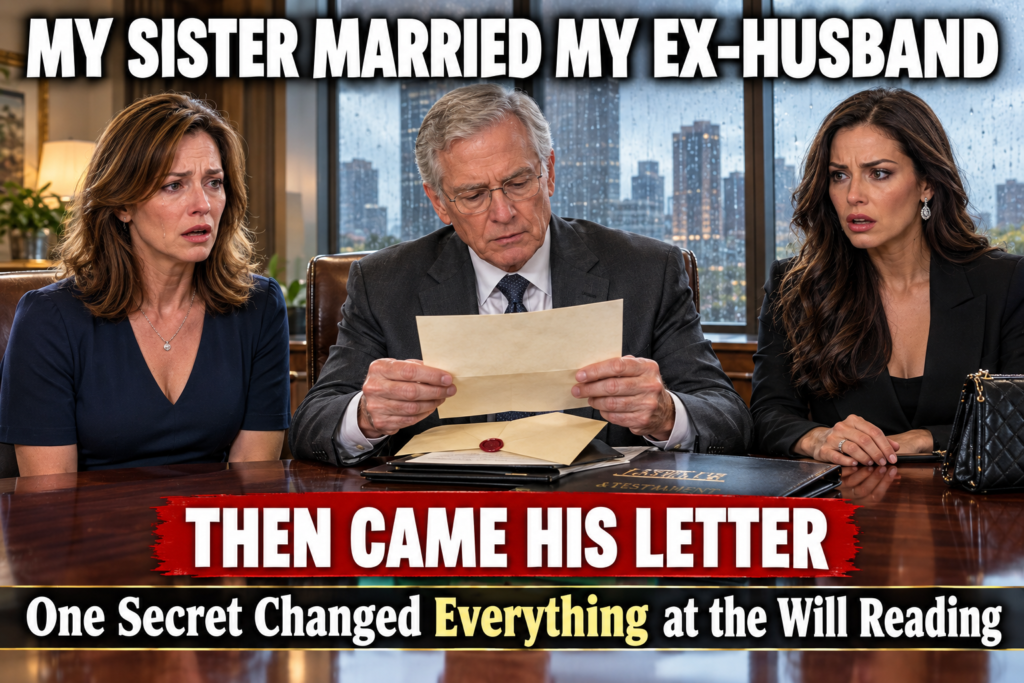
Part 1
The first time I heard that Daniel Whitmore was dead, I was standing in the kitchen with a cup of coffee in my hand.
It was a cold Tuesday morning, and rain tapped against the windows of my small apartment. I had been getting ready for work when my phone rang. My sister, Vanessa, appeared on the screen.
For a moment, I considered letting it go to voicemail.
We had not spoken properly in weeks. Since her marriage to Daniel four months earlier, our conversations had become strained, filled with polite questions and carefully chosen answers. She spoke as though nothing unusual had happened. I answered as though I had accepted everything.
Neither of us was telling the truth.
I picked up.
“Hello?”
Vanessa did not greet me.
“Daniel is dead.”
The words seemed to arrive from somewhere far away. I stared at the coffee in my hand, watching a thin ribbon of steam disappear into the cold air.
“What?”
“He died this morning,” she said. “It happened suddenly. The doctors couldn’t save him.”
“How?”
“I don’t know everything yet. There was an emergency, and then…” Her voice broke, but only for a second. “He’s gone, Eleanor.”
I put the cup down before it slipped from my fingers.
Daniel was forty-three. He was the kind of man people described as successful before they mentioned anything else about him. He had built a property investment business from almost nothing, acquired beautiful homes, and accumulated a fortune large enough to make his name familiar in financial magazines.
But before the money, before the business, before strangers started recognizing him in restaurants, he had been my husband.
For six years, we had shared a modest house, cheap furniture, difficult decisions, and dreams that seemed enormous when we were young. I had loved him when he drove an aging car and worked late nights at a desk covered with unpaid invoices.
I had loved him when his first business nearly failed.
I had loved him before anyone thought he was important.
Then success arrived, and somewhere along the way, we lost each other.
Our divorce had been finalized three years earlier. There had been no dramatic courtroom battle, no scandal splashed across newspapers. We had simply reached a point where the life we were building together no longer felt like a life we both wanted.
Daniel became consumed by his company. I became tired of waiting for him to come home.
We signed the papers quietly and went our separate ways.
At least, that was the story I told people.
The truth was more complicated. I had left because I felt invisible beside the man I loved. Daniel had become so determined to prove himself that he forgot I had once been the person who believed in him when he could barely believe in himself.
I never stopped wishing him well.
I simply stopped asking whether he wished me well, too.
And then Vanessa entered the story.
My younger sister had always possessed the kind of confidence that made people turn toward her when she entered a room. She was beautiful, charming, and skilled at making every conversation feel like an opportunity.
When she told me she was seeing Daniel, I thought she meant they had met casually.
When she told me they were serious, I asked whether she understood what that meant.
When she announced their engagement, she looked at me as if she were waiting for a fight.
“You divorced him, Eleanor,” she had said. “You can’t expect him to stay alone forever.”
“I don’t.”
“Then why do you look at me like that?”
Because he had been my husband, I wanted to say. Because you are my sister. Because there are some things a person should discuss before taking them from someone they claim to love.
Instead, I said, “I hope you know what you’re doing.”
She smiled.
“I know exactly what I’m doing.”
Now she was a widow.
“Eleanor?” Vanessa’s voice pulled me back into the present. “Are you still there?”
“Yes.”
“The funeral will probably be Friday. I’ll send you the details.”
“I’ll come.”
A pause followed.
“You don’t have to,” she said.
“I know.”
“Things might be uncomfortable.”
I almost laughed. Our relationship had become a long exercise in discomfort.
“Daniel mattered to me, Vanessa.”
“I know he did.”
But she said it as though my grief were an inconvenient fact.
After the call ended, I sat at the kitchen table until the coffee went cold.
I remembered Daniel sitting across from me years earlier, his sleeves rolled up, explaining a business plan with the enthusiasm of a man who believed the world could be persuaded to give him a chance.
“What happens if it fails?” I had asked.
He had taken my hand.
“Then we start again.”
We.
That word had once made me feel invincible.
Now I wondered when he had stopped meaning it.
Three days later, I attended his funeral.
Vanessa stood beside the coffin in a black dress that fit her perfectly. Her makeup was immaculate, her posture straight, and her expression carefully composed. Wealthy business associates surrounded her, offering condolences and discussing the arrangements in hushed voices.
I remained near the back.
When Vanessa noticed me, she approached with a tight smile.
“You came.”
“I said I would.”
She looked toward the people gathering around her.
“It’s been overwhelming. There are so many things to organize.”
“I can imagine.”
“The company, the properties, the accounts…” She stopped, perhaps realizing how her words sounded. “I’m sorry. I shouldn’t be talking about that today.”
“No,” I said gently. “You shouldn’t.”
Her cheeks reddened.
For one moment, I saw my little sister again—the girl who used to climb into my bed during thunderstorms and ask me to tell her stories until she fell asleep.
Then someone called her name, and she walked away.
As the service began, I looked at Daniel’s photograph beside the coffin.
He was smiling in it, his eyes bright, his expression familiar enough to hurt.
I wanted to tell him that I was sorry we hadn’t found our way back to friendship. I wanted to ask whether he had ever regretted the things we had lost.
Most of all, I wanted to tell him that beneath everything that had happened, a part of me had never stopped caring.
I kept those words to myself.
I believed that was the last time I would have anything to do with his life.
I was wrong.
That evening, an unfamiliar number appeared on my phone.
“Ms. Eleanor?” a man asked. “My name is Arthur Bennett. I’m Daniel Whitmore’s attorney.”
I straightened in my chair.
“Yes?”
“I need to speak with you regarding his estate.”
“His estate?”
“Yes. Mr. Whitmore left specific instructions concerning your presence at the reading of his last will and testament.”
My stomach tightened.
“I’m sorry, but I was his former wife. Surely this is a mistake.”
“No mistake, Ms. Eleanor.”
He paused.
“Daniel was very clear about this.”
I looked toward the dark window, where my reflection seemed to stare back at me.
“What did he leave me?”
“I am not authorized to discuss the contents of the will over the telephone.”
“Then why are you calling me?”
“To make certain you attend.”
He gave me the address of his law office and the time of the appointment.
Before ending the call, he added something that made my fingers tighten around the phone.
“There is also a sealed letter from Daniel. He instructed me to read it aloud at the meeting.”
“To whom is it addressed?”
Another pause.
“To you, Ms. Eleanor.”
That night, I lay awake thinking about a man I had not called my husband in three years.
I wondered whether the letter contained an apology.
A goodbye.
Or something far more painful.
Part 2
Vanessa called the next morning.
I was standing in the supermarket aisle, trying to remember whether I needed milk, when her name appeared on my screen. I almost ignored it, but curiosity won.
“Have you heard from Arthur Bennett?” she asked without saying hello.
“Yes.”
“How much did he tell you?”
“That Daniel wanted me at the will reading.”
Silence.
Then Vanessa laughed, a short, brittle sound.
“Well, that’s strange.”
“Why?”
“Because he was my husband, Eleanor. I’m the person who needs to be there.”
“I didn’t say you shouldn’t be.”
“Then why did his attorney contact you?”
“I don’t know. He said Daniel left a letter.”
“A letter?”
“Yes. Addressed to me.”
For several seconds, Vanessa said nothing.
When she spoke again, her voice had changed.
“What did Daniel have to say to you that he couldn’t say when he was alive?”
The question struck harder than she probably intended.
“I have no idea.”
“Did you know he was planning this?”
“No.”
“Did he tell you anything before he died?”
“Vanessa, I hadn’t spoken to him in months.”
“Not even once?”
“Not even once.”
She exhaled sharply.
“I just don’t understand why he would involve you.”
I looked at the shopping basket hanging from my arm. A little boy nearby was asking his mother for a packet of biscuits. His mother told him they would get some next time, and he accepted the answer without argument.
I wondered when my sister and I had become incapable of accepting anything from each other without suspicion.
“Maybe he had something he wanted to say,” I replied.
“Whatever it is, I hope you’re not expecting a share of his money.”
I closed my eyes.
There it was.
The fear beneath all her questions.
“I haven’t asked for anything.”
“You don’t need to ask if he has already arranged it.”
“Vanessa, I don’t want your money.”
“Then don’t make this difficult.”
She ended the call.
I remained in the aisle for a long time, holding a carton of milk I had forgotten to put in my basket.
When Daniel and I divorced, we had divided our belongings with little argument. He offered me more than I wanted, and I refused. I kept my savings, my old car, and the furniture we had bought before his company began making serious money.
People called me foolish for not asking for more.
My mother said I had been too proud.
A friend suggested I should have taken enough to secure my future.
But I hadn’t wanted to spend the rest of my life fighting over the remains of a marriage. I had wanted to leave with the knowledge that the years I had given Daniel were not a debt I needed him to repay.
Money could not make those years meaningful. They already were.
And money could not repair the loneliness that had ended them.
On the morning of the will reading, I chose a simple navy dress and a pair of black shoes. I brushed my hair, fastened a small silver necklace around my neck, and checked my reflection.
The necklace had belonged to my grandmother. Daniel had once told me it was his favorite thing I owned because I wore it on ordinary days rather than saving it for special occasions.
I hadn’t thought about that conversation in years.
I nearly took the necklace off.
Instead, I left it where it was.
Arthur Bennett’s office occupied the top floor of a stone building overlooking the city. The reception area smelled faintly of polished wood and coffee. Through tall windows, I could see cars moving along the wet streets below.
Vanessa arrived five minutes before the appointment.
She wore a tailored black suit, elegant heels, and diamond earrings I had never seen before her marriage. Her wedding ring flashed when she lifted a hand to greet the receptionist.
She glanced at me.
“You look tired.”
“I didn’t sleep well.”
“Neither did I.”
For the first time, I believed her.
Grief had left shadows beneath her eyes. Her lips were pressed together so tightly that they seemed almost colorless.
A man carrying a leather briefcase approached us. I recognized him from the funeral.
“Mrs. Whitmore,” he said, extending his hand to Vanessa. “Ms. Eleanor. Thank you for coming.”
Vanessa immediately took charge.
“Mr. Bennett, I assume this won’t take long. There are business matters waiting for me.”
“Of course,” he replied politely. “We will proceed as efficiently as possible.”
He led us into a conference room.
A long table stood in the center, surrounded by dark leather chairs. On one end sat a thick folder, several legal documents, and a small cream-colored envelope sealed with red wax.
I noticed the envelope immediately.
Daniel’s handwriting crossed the front.
Eleanor.
Just my name.
I could almost hear his voice saying it.
Vanessa followed my gaze and frowned.
“So that’s the letter?”
“Yes,” Arthur said.
“Why is it sealed?”
“Mr. Whitmore requested that it remain unopened until the reading.”
“And it is addressed to my sister?”
“It is.”
Vanessa pulled out a chair beside the attorney and sat down. She placed her handbag on the table and crossed her legs.
“Let’s get this over with. I have some things to do.”
She sounded like someone attending a meeting about a property she already owned.
Arthur took his seat.
“Before we begin, I must remind you that a will reading is not a negotiation. The document reflects the deceased’s legally recorded intentions, subject to the applicable law.”
“Of course,” Vanessa said. “Daniel and I discussed his affairs.”
I looked at her.
“You did?”
She gave me a warning glance.
“He was my husband, Eleanor.”
“I know.”
Arthur opened the folder.
The room became quiet.
He read the introductory statements, confirmed Daniel’s identity, and explained that the will had been properly executed. Then he began listing the provisions concerning the company, the properties, and several charitable donations.
Vanessa listened with a satisfied expression.
Whenever Arthur mentioned an asset, she nodded as though recognizing something already familiar.
Then he reached the section concerning the remainder of the estate.
“Under the terms of this document,” he said, “certain assets are to be transferred to the named beneficiaries, subject to the conditions specified herein.”
Vanessa leaned forward.
“And the balance?”
Arthur turned a page.
“We will come to that.”
Her smile faded slightly.
He continued reading. Daniel had established a trust for a charitable foundation supporting young entrepreneurs who lacked access to traditional financing. Several longtime employees would receive bonuses. A scholarship fund would be created in memory of Daniel’s parents.
Vanessa shifted in her chair.
“That is generous,” she said, “but what about the main estate?”
Arthur looked up.
“I’m coming to that, Mrs. Whitmore.”
He reached for the cream-colored envelope.
The sight of it made my heart pound.
Vanessa stared at the seal.
“Is that necessary?”
“It was Mr. Whitmore’s explicit instruction.”
Arthur broke the seal carefully and unfolded the letter.
For the first time that morning, Vanessa looked genuinely afraid.
Arthur cleared his throat.
“To my former wife—one person who loved me before I had money…”
He stopped.
The words seemed to settle over the room like dust.
I could no longer feel the chair beneath me.
Arthur continued.
“Eleanor, if you are hearing this letter, then I have left this world before finding the courage to tell you something I should have said years ago.”
My eyes filled.
Vanessa’s hand tightened around the edge of the table.
Arthur looked down at the page again.
“I know that my choices hurt you. I know that I allowed success to change the way I treated the people who mattered most. And I know that the day you left me, I lost something no fortune could ever buy.”
He paused.
Vanessa’s face had gone pale.
Arthur turned the page.
Then he read the sentence that changed everything in that room.
“Eleanor, I am asking you to protect the truth about what happened during the final months of my life, because the person who knows the truth has already begun to lie.”
Part 3
For several seconds, nobody spoke.
The rain outside the windows had grown heavier. Water streamed down the glass, blurring the buildings across the street into gray shapes.
Arthur held the letter in both hands.
Vanessa was the first to break the silence.
“What does that mean?”
Her voice was sharp enough to cut through the room.
Arthur looked at her. “I can only read what Mr. Whitmore wrote.”
“Then read the rest.”
He continued.
“I do not want Eleanor to carry the burden of my mistakes. She has already carried enough. But she deserves to know that my last decisions were made with a clearer understanding of my life than I possessed when I was younger.”
My fingers curled in my lap.
Daniel had never been a man who wrote long letters. When we were married, he communicated affection through small actions: repairing the loose handle on my suitcase, leaving a sandwich on my desk when I worked late, remembering how I liked my tea.
When words were necessary, he often struggled to find them.
Yet here he was, speaking to me from beyond the reach of any answer I could give.
Arthur turned another page.
“Vanessa came into my life at a time when I was lonely and ashamed of the man I had become. She made me feel admired. I mistook admiration for understanding, and attention for love.”
Vanessa pushed her chair backward.
“This is ridiculous.”
Arthur continued reading.
“I do not deny that I chose to marry her. I take responsibility for that decision. But I want Eleanor to understand that I did not marry Vanessa because I had forgotten my former wife. I married her because I had spent years running away from the person I had been when Eleanor loved me.”
“Stop reading,” Vanessa said.
Arthur looked up.
“Mrs. Whitmore, your husband specifically instructed me to read this letter in full.”
“He’s dead. He doesn’t get to embarrass me anymore.”
“No,” Arthur replied quietly. “But his wishes still matter.”
The words struck the room with unexpected force.
Vanessa looked toward me.
“Are you enjoying this?”
I stared at her in disbelief.
“My husband is dead,” she snapped. “My life has been turned upside down, and now I’m sitting here listening to him praise you like some saint.”
“I never asked him to write this.”
“You never have to ask for anything, do you? People simply give it to you.”
I felt something inside me break—not because I was angry, but because I finally understood how completely she had mistaken my silence for privilege.
“You think this is what I wanted?” I asked.
She looked away.
Arthur returned to the letter.
“Eleanor, I have made arrangements that may surprise you. They were not made to punish anyone, and they were not made to reward the past. I have tried to separate what I owe from what I wish, although I cannot pretend that I have done so perfectly.”
He took a breath.
“The primary residence in which I lived during my final years, together with the personal possessions specified in my attached inventory, is to be transferred to Vanessa, subject to the legal provisions of this will. She is also to receive the personal gifts I gave her during our marriage.”
Vanessa sat still.
The satisfaction that had animated her face returned, cautiously at first.
Arthur continued.
“However, the remaining controlling interest in Whitmore Holdings, the investment accounts listed in Schedule B, and the balance of my personal estate are to be administered according to the terms of the Eleanor Whitmore Trust, established for the benefit of Eleanor Whitmore.”
Vanessa stood.
“What?”
Arthur remained seated.
“The trust is legally documented. It provides for Ms. Eleanor’s financial security and gives her responsibility for the charitable and employee provisions outlined in the attached schedules.”
“You’re saying she gets the company?”
“Not precisely. The company remains subject to its corporate structure and existing obligations. The trust holds the controlling interest specified in the document.”
Vanessa stared at him.
“But I’m his wife.”
“Yes.”
“I was married to him when he died.”
“Yes, Mrs. Whitmore.”
“And you’re telling me that his ex-wife gets everything?”
“No,” Arthur said firmly. “I’m telling you what the will says.”
Vanessa turned to me.
“You knew.”
I shook my head.
“You knew he was going to do this.”
“I didn’t.”
“Don’t lie to me!”
Arthur placed the letter on the table.
“Ms. Eleanor did not receive the will in advance. I can confirm that.”
Vanessa looked as though she might throw something.
Then, suddenly, she began to laugh.
It was an ugly, frightened sound.
“He always did this,” she said. “He always made me feel like I was competing with you. Even when you weren’t there.”
I wanted to tell her that I had never competed with her.
I wanted to ask why she had needed Daniel to prove that she mattered more than I did.
Instead, I remained silent.
Arthur gathered several documents and placed them in front of us.
“There are additional conditions concerning the trust. I will explain them separately.”
Vanessa barely glanced at the paperwork.
“What conditions?”
“The trust requires Ms. Eleanor to oversee an independent review of certain financial transactions made during the final year of Mr. Whitmore’s life. It also requires the trustees to cooperate with the company’s auditors.”
“Why?”
“Because Mr. Whitmore requested it.”
Vanessa looked at me.
For the first time, her expression contained something more complicated than anger.
Fear.
Arthur explained that Daniel had become concerned about irregularities in the company’s financial records. He had instructed his accountant to preserve relevant documents and requested an independent review.
The investigation was not an accusation against any named person. It was a precaution written into the estate arrangements.
But Daniel’s letter contained another line.
“I cannot prove what I suspect. I will not condemn someone without evidence. Yet I refuse to leave Eleanor with an inheritance that may conceal obligations she never agreed to carry.”
I stared at the words.
“What obligations?”
Arthur folded his hands.
“That is what the review is intended to determine.”
Vanessa grabbed her handbag.
“This is absurd. I won’t sit here while everyone treats me like a criminal.”
“No one has accused you of a crime,” Arthur said.
“Not yet.”
She stormed toward the door.
Before leaving, she turned back to me.
“Enjoy your money, Eleanor.”
Then she disappeared into the corridor.
The door closed with a soft click.
Arthur waited until her footsteps faded.
“I’m sorry,” he said.
“For what?”
“For the circumstances in which you have been brought into this matter.”
I looked down at Daniel’s letter.
“Did he really believe I was the only person who loved him before he had money?”
Arthur considered his answer carefully.
“I believe he knew that you loved him in a way he did not fully appreciate until it was too late.”
I pressed my fingers against my lips.
That was worse than an insult.
Because it meant that Daniel had finally understood something I had spent years trying to explain, and I would never be able to ask him whether understanding had made him happy.
Arthur slid a final document across the table.
“There’s one more thing.”
“What?”
“Mr. Whitmore requested that you receive the key to a private study at his former home. He instructed me to give it to you after the reading.”
I looked at the small brass key resting on the paper.
“Why?”
“He wrote that you would understand when you entered the room.”
I closed my hand around it.
Outside, the rain continued falling.
And for the first time since Daniel’s death, I felt that the past was not finished with me.
Part 4
I waited two days before visiting Daniel’s house.
The decision was not easy. I had not been inside since our divorce, and the thought of walking through rooms that once belonged to our shared life filled me with a sadness I could not explain.
The house stood behind a row of old trees on a quiet street. Its white exterior had been repainted, and the garden was more carefully maintained than I remembered.
A dark car was parked beside the entrance.
Vanessa’s.
I almost turned around.
Then I remembered the key in my pocket and walked to the front door.
The housekeeper, Mrs. Collins, opened it before I could knock twice.
She had worked for Daniel for many years, beginning shortly before our separation. Her hair was now completely silver, but her eyes were as warm as I remembered.
“Eleanor,” she whispered.
I had not expected anyone to say my name with such tenderness.
“Hello, Mrs. Collins.”
She took both my hands.
“I was hoping you would come.”
“Why?”
Her gaze moved toward the staircase.
“Because there are things Daniel never managed to say.”
I swallowed.
“Did he tell you about the letter?”
“No. But I knew he had been preparing something. He spent many evenings in his study, writing and sorting papers.”
“Was he ill?”
“Not that I knew. He worked too much, as always. He seemed tired, but he was not someone who complained.”
I looked around the entrance hall.
The furniture had changed, but the old wooden clock still stood against the wall. Daniel had bought it from a small antique shop when we were newly married. It had never kept perfect time.
He used to joke that the clock was a reminder that being late was a family tradition.
I had forgotten that joke until I saw it.
“Is Vanessa here?” I asked.
Mrs. Collins hesitated.
“Upstairs.”
“I don’t want to cause trouble.”
“You haven’t caused any trouble, dear.”
She squeezed my hand.
“You never did.”
I climbed the stairs slowly.
Daniel’s study was at the end of the corridor. The door was closed, and the brass handle reflected the light from the window.
I inserted the key.
It turned smoothly.
The room smelled of paper, cedar, and the faint trace of the cologne Daniel had worn for years. Shelves covered two walls. A large desk stood beneath the window, and a framed photograph rested beside a lamp.
The photograph showed Daniel and me on our wedding day.
We were standing beneath a tree, laughing at something outside the frame. His tie was crooked. My hair had been ruined by the wind.
We looked young enough to believe that love could solve anything.
I lifted the frame.
On the back, in Daniel’s handwriting, were the words: We were happy before we learned to be afraid.
My throat tightened.
I set the photograph down and began examining the desk.
There were folders containing company documents, receipts, and handwritten notes. A small wooden box sat in the top drawer.
Inside it were ordinary things: an old train ticket, a faded restaurant receipt, a photograph of us at the seaside, and a folded piece of paper.
The paper contained a recipe for lemon cake.
My recipe.
I had written it for Daniel after he insisted that no cake tasted as good as the one I made when we were first married.
At the bottom, he had written, in small letters, Still the best.
I sat down.
It was a ridiculous thing to cry over. A recipe, a receipt, a photograph. Objects that would mean nothing to anyone who had not lived inside the life they represented.
Yet they carried more truth than the expensive things Daniel had accumulated afterward.
A knock sounded at the door.
I quickly wiped my eyes.
Vanessa stood in the doorway.
“What are you doing in here?”
“Arthur gave me the key.”
“I know that. I mean, what are you looking for?”
“Daniel said I would understand when I entered the room.”
She glanced at the photograph on the desk.
“Of course he kept that.”
“Why wouldn’t he?”
“Because you were divorced.”
I returned the photograph to its place.
“Divorce doesn’t erase a person’s history.”
Vanessa folded her arms.
“Easy for you to say. You’re the one he chose to reward.”
“I didn’t ask him to leave me anything.”
“But you accepted it.”
“Because refusing it wouldn’t change what happened.”
She walked farther into the room, her heels clicking against the floor.
“You have no idea what it was like being married to him.”
“Perhaps not.”
“He worked constantly. He barely slept. Every conversation was about the company or the next investment. I spent four months trying to make that house feel like a home.”
I looked at her carefully.
For the first time, she seemed less like a woman protecting a fortune and more like someone struggling to understand why the life she had wanted did not feel the way she imagined.
“Did he listen when you told him that?” I asked.
Her eyes flashed.
“Don’t turn this into a lesson about marriage.”
“I wasn’t.”
“You think you know him because you were there first.”
“No. I think I knew a part of him. You knew another part.”
She looked away.
“Then why did he write that letter?”
I had no answer.
Vanessa walked toward the desk and noticed the wooden box.
“What is that?”
“Things he kept.”
She lifted the photograph and stared at it.
“Did he ever talk about you?”
I hesitated.
“Not to me.”
“But to other people?”
“Sometimes.”
“What did he say?”
“That he hoped I was happy.”
Her mouth tightened.
“He told me once that he had never met anyone who made him feel as understood as you did.”
I felt the words land between us.
“Why would he tell you that?”
“I asked him whether he still loved you.”
I looked at her.
“And what did he say?”
“He said that love didn’t always mean wanting to go back.”
For a moment, neither of us spoke.
Then Vanessa put the photograph down.
“He said he wanted a different life. A life that didn’t remind him of his failures.”
I thought about the letter.
Perhaps Daniel had spent years trying to escape the man he had been when we were together. Perhaps he had believed that money would transform him into someone worthy of admiration.
But admiration was not the same as intimacy.
And a new marriage could not erase an old wound.
Vanessa turned toward the door.
“I don’t want you here.”
“I understand.”
“No, you don’t. You can walk away from this house whenever you want. You already have your own life. I have to wake up in this place every morning and remember that the man I married left most of his fortune to someone else.”
I stood.
“I’m sorry you’re hurting.”
She gave me a bitter smile.
“Keep your sympathy.”
She left.
I remained in the study, looking at the photograph.
Before leaving, I searched the desk once more. Beneath a stack of papers, I found a small notebook filled with Daniel’s handwriting.
Most pages contained business notes, but several entries concerned the financial review.
One name appeared repeatedly.
Martin Hale, the company’s longtime chief financial officer.
Beside the name, Daniel had written dates, amounts, and a question that made my stomach tighten.
Who authorized these transfers?
I turned another page.
There were several transfers to a consulting company I did not recognize. The amounts were large enough to require careful explanation, but the notes were incomplete.
A final entry had been written in red ink.
If anything happens to me, Arthur must ensure the records are preserved.
I closed the notebook.
Daniel’s death had been sudden. His will had been prepared carefully. His concern about the accounts had been serious enough to include a review in the estate arrangements.
I could not know whether these facts were connected.
But I could no longer pretend that the inheritance was the only mystery waiting for me.
Part 5
Arthur Bennett arranged for an independent accountant to review Daniel’s records.
His name was Samuel Price, a quiet man with rectangular glasses and a habit of listening without interrupting. He met me in a small conference room at his office and placed a stack of documents on the table.
“I understand that you weren’t involved in Whitmore Holdings,” he said.
“No. Daniel and I divorced before the company became what it is now.”
“That may be helpful. We need an independent perspective, and we don’t want assumptions to shape the review.”
I appreciated his honesty.
“Have you found anything?”
“Some transactions require further explanation. That doesn’t mean we have established wrongdoing.”
He showed me a list of payments made to a consulting firm over several months. The company had received substantial sums from Whitmore Holdings, but the supporting documents were incomplete.
“Who owns the consulting firm?” I asked.
“We’re verifying the ownership records.”
“And Martin Hale?”
“He has cooperated so far, although we still need documentation for several approvals.”
I thought of Daniel’s notebook.
“Did Daniel suspect him?”
“His notes indicate concern about the payments. They don’t establish what he believed had happened.”
I nodded.
For the first time, I understood the burden Daniel had left me. He had not given me a simple inheritance. He had given me a responsibility that required patience, fairness, and the willingness to tolerate uncertainty.
Those were not qualities I associated with wealth.
They were qualities I had learned by living without it.
Over the following weeks, I attended meetings, reviewed records, and learned enough about the company to understand the broad outlines of its operations. The employees were not merely names in a document. They were people who depended on their jobs to pay mortgages, buy groceries, and support children.
Daniel’s business had grown because he had taken risks. But it had survived because hundreds of people had helped him build it.
One afternoon, I visited the company’s main office.
The receptionist looked surprised when I introduced myself.
“Ms. Eleanor Whitmore?”
“Yes.”
“I’m sorry. I wasn’t expecting you.”
“That’s all right.”
She picked up the phone and spoke quietly to someone upstairs. A few minutes later, a woman in her forties came down to meet me.
“I’m Patricia Lewis,” she said. “I oversee human resources.”
We shook hands.
“I wanted to understand how the company works,” I explained. “Not just the financial side. Daniel left instructions concerning employee benefits, and I want to make sure we carry them out properly.”
Patricia studied me for a moment.
“Mr. Whitmore spoke about you.”
My heart gave an unexpected thump.
“He did?”
“Not often. But when he did, he sounded different.”
“Different how?”
She smiled faintly.
“Less like a businessman.”
She took me through the offices, introducing me to employees who had worked with Daniel for years. Some spoke of his ambition. Others remembered his impatience. One man described how Daniel had stayed late for three nights to help save a project that was about to collapse.
“He could be difficult,” the man admitted. “But he never forgot who had helped him.”
I wondered whether that was entirely true.
People were complicated. They could be generous in one moment and selfish in another. They could remember a kindness while forgetting the hurt they caused.
Daniel had been both.
So had I.
As I left the building, I saw Martin Hale standing beside a black car. He was in his fifties, neatly dressed, with silver hair and an expression that was difficult to read.
“Ms. Eleanor,” he said.
“Mr. Hale.”
“I understand you’re overseeing the estate review.”
“I’m working with the trustees and the accountant.”
He nodded.
“Daniel valued your judgment.”
I wondered whether he believed that or merely knew it was something I wanted to hear.
“Did he discuss the financial review with you?”
Martin adjusted his cuff.
“He had concerns about certain transactions. We were working through them.”
“Can you explain the consulting payments?”
“Of course. The records are being assembled.”
“Some documents are missing.”
“Old files get misplaced. It’s not unusual in a growing business.”
“Daniel didn’t think it was ordinary.”
His expression hardened slightly.
“Daniel could become suspicious when he was under pressure. He had a lot on his shoulders.”
“Perhaps.”
Martin looked toward the building.
“I hope you understand that an investigation can damage the company even when nothing improper has occurred.”
“I understand.”
“Employees could become frightened. Investors might lose confidence. We should be careful.”
“I agree. That’s why the review needs to be thorough and fair.”
He studied me for several seconds.
“You sound very much like him.”
I wasn’t sure whether it was a compliment.
That evening, Vanessa called.
“I need to talk to you.”
Her voice sounded strained.
“What’s happened?”
“Martin says you’re investigating the company.”
“I’m not investigating anyone personally. We’re reviewing the financial records.”
“People are talking. They’re saying there may have been money missing.”
“I haven’t said that.”
“But the accountant is looking into transfers.”
“Yes.”
“Do you realize what that could do to Daniel’s reputation?”
I thought about the notebook, the incomplete records, and the questions Daniel had written in red ink.
“His reputation matters,” I said. “So does the truth.”
“And what if the truth hurts people?”
“Then we have to deal with it carefully.”
She sighed.
“You always think there’s a right way to do everything.”
“No. I think there are wrong ways to avoid doing something.”
For a moment, I heard only her breathing.
Then she said, “I found something.”
My hand tightened around the phone.
“What?”
“Daniel kept a folder in his bedroom. There are bank statements and letters. I think some of them are connected to the payments.”
“Have you given them to Arthur?”
“No.”
“Vanessa, you need to preserve them.”
“I know that.”
“Then let the accountant review them.”
She hesitated.
“What if they prove something terrible?”
I thought of the little girl who had once hidden behind me when she was frightened.
“Then we’ll face it,” I said. “But we won’t know what we’re facing until we look.”
She ended the call without answering.
The next morning, Arthur contacted me.
Vanessa had delivered a folder of documents to his office.
Among them was a letter from Martin Hale to Daniel, dated two weeks before Daniel’s death.
The letter was brief.
It referred to a meeting, several disputed payments, and a promise to provide the missing records.
At the bottom, Daniel had written a note in the margin.
We need to speak before the board meeting.
No further explanation appeared.
Then Samuel Price called.
“We’ve found a discrepancy,” he said. “A substantial one.”
“How substantial?”
“I’d rather show you the records in person.”
“Is it connected to Martin?”
“Possibly. But there’s another issue.”
“What issue?”
He paused.
“Some of the payments appear to have been approved using Daniel’s credentials after the date he says he first questioned them.”
I felt cold.
“Are you saying someone used his account without permission?”
“I’m saying we need to establish who authorized those transactions and when. The records alone don’t tell us why.”
I looked out the window at the ordinary street below.
Cars passed. A delivery driver hurried through the rain. Somewhere, a child laughed.
The world had not changed, yet Daniel’s death seemed to be opening doors into a life I had never fully known.
And behind those doors, the questions were becoming more serious.
Part 6
The meeting with Samuel took place the following afternoon.
He spread the documents across a conference table and explained the discrepancy carefully. Several payments had been processed through the company’s accounting system using Daniel’s authorization credentials. The timing overlapped with the period when Daniel had begun questioning the consulting firm’s invoices.
“We cannot conclude from this alone that anyone acted improperly,” Samuel said. “Credentials can be shared, delegated, or misused. We need access logs, original correspondence, and independent confirmation from the relevant parties.”
“What happens now?”
“We preserve the evidence, notify the appropriate corporate authorities, and continue the review. If the findings suggest possible criminal conduct, the matter may need to be referred to the relevant authorities.”
I nodded.
I had expected an inheritance to involve lawyers and bank statements. I had not expected to sit in a room discussing authorization logs and potential financial misconduct.
Samuel handed me a copy of a message Daniel had sent to Martin shortly before his death.
We have to resolve this. I will not sign another report until I understand where the money went.
Martin’s reply was shorter.
We agreed to discuss this privately. There is no need to involve the board yet.
Daniel had responded with three words.
There is every need.
I read the exchange twice.
“What happened to the meeting?”
“We’re trying to establish that,” Samuel said.
That evening, I returned to Daniel’s house to speak with Vanessa.
She answered the door wearing a loose sweater and no makeup. She looked smaller than I remembered, as though the last few weeks had taken something from her that sleep could not restore.
“I brought the documents Arthur received,” I said.
She stepped aside.
We sat in the living room. The expensive furniture looked strangely impersonal beneath the evening light.
“I don’t know what I’m supposed to do,” she said.
“Neither do I.”
“You seem to know what to do all the time.”
“That’s because I don’t announce every time I’m frightened.”
She gave a tired laugh.
“Of course you don’t.”
I placed the copies on the table.
“Did Daniel tell you about the financial concerns?”
“Not directly. I knew he was worried about something at work. He spent hours on the phone, and whenever I asked him about it, he said he didn’t want to burden me.”
“Did he mention Martin?”
“Once. He said Martin had been with him since the early days of the company and that he hoped there had been a misunderstanding.”
“Did Daniel seem afraid?”
Vanessa thought for a moment.
“Not afraid. Disappointed, perhaps.”
She looked toward the dark windows.
“He told me that the hardest thing about becoming wealthy was learning how many people could tell him what he wanted to hear.”
I remembered Daniel saying something similar years earlier, after a business partner had broken a promise.
“He used to believe everyone meant what they said,” I replied.
“He still wanted to believe that.”
For a while, we sat in silence.
Then Vanessa asked, “Did you know he kept your wedding photograph?”
“Yes.”
“How did you feel when you saw it?”
I searched for an answer.
“Sad.”
“Not angry?”
“Not really.”
“Why not?”
“Because the photograph didn’t mean he wanted to come back to me. It meant that something important had happened in his life, and he hadn’t wanted to erase it.”
Vanessa looked down at her hands.
“I thought that if I married him, everything would be different.”
“What did you think would be different?”
“Everything.” She swallowed. “I thought we would travel, have beautiful dinners, entertain important people. I thought he would finally have time to enjoy what he had built.”
“Did he?”
“Sometimes. But even when we were sitting in a beautiful restaurant, he seemed to be thinking about something else.”
She looked up.
“I used to ask him whether he regretted marrying you.”
“What did he say?”
“He said he regretted the way he had treated you, not the fact that you had left.”
I felt tears gather behind my eyes.
“That sounds like Daniel.”
“He said you had given him a kind of peace he didn’t understand until it was gone.”
I turned toward the window.
There had been years when I wished Daniel would say those words to me. I had imagined conversations in which he finally admitted how lonely I had felt, how much his ambition had cost us, how often I had waited for him to notice that I was slipping away.
But now the words came through my sister, in a house where I no longer belonged, after a death that could not be undone.
They were not the apology I had once wanted.
They were simply the truth, arriving late.
Vanessa wiped her cheek.
“I don’t know whether he loved me.”
I turned back toward her.
“I can’t answer that for you.”
“Do you think he did?”
“I think he chose to marry you. I think he cared about you. I also think he carried feelings about our marriage that he never completely understood.”
“That isn’t a very comforting answer.”
“No.”
She stared at me.
“Were you happy with him?”
I considered the question.
“Yes,” I said. “And no. We had beautiful years, and we had lonely years. Loving someone doesn’t make every part of a relationship good.”
“Then why does everyone talk as though you were the great love of his life?”
“Because people like simple stories.”
“And our lives weren’t simple.”
“No.”
Vanessa leaned back.
For the first time since Daniel’s death, she did not look at me as though I had taken something from her.
She looked like a woman who had discovered that getting what she wanted did not necessarily mean she had received what she needed.
Before I left, she gave me a small envelope.
“I found this in his desk,” she said. “It was addressed to you, but it wasn’t with the sealed letter.”
Inside was a single sheet of paper.
Daniel’s handwriting filled the page.
Eleanor,
I have been trying to find a way to explain why I kept so much of our past. It isn’t because I want to return to it. I know that the life we had is gone, and I know that neither of us can become the people we were when we began.
I kept those things because they remind me that I was once loved without needing to prove I deserved it.
I wish I had understood that sooner.
There was no signature, only a final line.
I hope you have found the peace I failed to give you.
I folded the paper carefully.
Vanessa watched me.
“Do you forgive him?” she asked.
I thought of the years I had spent waiting for him to change, the years I had spent learning to live without him, and the strange ache of discovering that he had understood some of my pain after I had already healed from it.
“I’m trying to,” I said.
She nodded.
As I reached the door, she called after me.
“Eleanor?”
I turned.
“Whatever happens with the company, I don’t want Daniel remembered as a thief.”
“Neither do I.”
“And I don’t want you to think I married him just for his money.”
I looked at her for a long moment.
“Then tell the truth about why you married him.”
She lowered her eyes.
“I don’t know if I can.”
I left without answering.
Outside, the evening air smelled of wet leaves and distant rain.
I held Daniel’s letter against my chest for a moment before placing it in my bag.
For years, I had believed that the most painful thing about our marriage was the way it ended.
Now I was beginning to understand that the deeper pain was discovering how much we had misunderstood one another while we were still together.
Part 7
The independent review took another month.
During that time, Vanessa and I spoke more often than we had in the previous three years. Some conversations lasted only a few minutes. Others stretched late into the evening, moving between Daniel’s estate, the company, and memories we had never discussed honestly.
We were not suddenly close.
There were still moments when she became defensive, and there were times when I needed to end a conversation before old resentments took over.
But something had shifted.
We had stopped pretending that our relationship was healthy simply because we shared a family name.
One afternoon, Vanessa came to my apartment carrying a cardboard box.
“I found these in the guest room,” she said.
Inside were old photographs, several letters, and a small leather notebook.
“I thought you might want them.”
I lifted the notebook.
It was the one Daniel had used during the early years of his business. Its pages were crowded with plans, calculations, and hopeful declarations written in the margins.
I recognized my own handwriting on the last page.
Remember to eat. You can’t build an empire on coffee alone.
Below it, Daniel had written:
She believes in me even when I don’t.
I smiled despite myself.
“He kept this all these years.”
Vanessa sat on the edge of the sofa.
“He kept more than I realized.”
She picked up a photograph of the two of us as children. I was holding her hand, and she was missing one of her front teeth.
“I used to follow you everywhere,” she said.
“You used to hide my shoes when I wouldn’t take you with me.”
“You always found them.”
“Because you put them under your bed.”
She laughed.
For a few minutes, we were sisters again.
Then the laughter faded.
“I was jealous of you,” she admitted.
I looked at her.
“Of me?”
“You were always the responsible one. Everyone trusted you. Mum asked you for advice. Dad believed you could handle anything. Even when you made mistakes, people said you were trying your best.”
I thought about our childhood.
Vanessa had always been the more outgoing sister. She could charm teachers, make friends in minutes, and turn a bad day into a story that made everyone laugh. I had envied her ease.
“I was jealous of you, too,” I said.
She looked surprised.
“Why?”
“Because you could walk into a room and feel as though you belonged there. I spent half my life wondering whether I was enough.”
She looked down at the photograph.
“Then why did I spend so much time trying to take what you had?”
“I don’t know.”
“I thought if Daniel chose me, it would prove I was better than you.”
The admission hurt, but not in the way I expected.
It hurt because I understood how long she must have carried that insecurity.
“Daniel wasn’t a prize,” I said.
“I know that now.”
“Do you?”
She met my eyes.
“I think I do.”
We sat together until the light faded.
The following morning, Samuel called with the results of the initial review.
The consulting firm had received payments for services that could not be adequately documented. Several invoices contained inconsistencies. Electronic records suggested that some approvals had been entered using Daniel’s credentials while he was attending meetings elsewhere.
However, Samuel cautioned that the evidence did not yet establish who had entered the approvals or whether the transactions had been authorized through another process.
“The findings require further investigation,” he said. “We have referred the relevant material to the company’s independent board committee and the appropriate authorities for assessment.”
“Do you believe Martin was responsible?”
“I believe there are unanswered questions involving his department. I won’t make a personal accusation without evidence.”
I respected him for that.
When I told Vanessa, she became quiet.
“Martin visited the house yesterday,” she said.
“What did he want?”
“He said the company was in danger. He asked whether I would consider challenging the will.”
I felt my stomach tighten.
“Why?”
“He believes the trust will make the business unstable. He said Daniel was under emotional pressure when he changed his estate plans.”
“Did you agree?”
“No.”
I waited.
She rubbed her hands together.
“He told me that if I cooperated, the company could protect my financial future. He said I didn’t have to lose everything simply because Daniel made a mistake.”
“What did you tell him?”
“I told him I wasn’t going to challenge the will.”
I let out a breath.
“Thank you.”
“Don’t thank me. I did it because I didn’t trust him.”
“That is still a reason.”
She looked away.
“I also asked him about the consulting payments.”
“What did he say?”
“He said Daniel had approved everything and that the records would prove it.”
“Do you believe him?”
“I don’t know.”
That uncertainty frightened me more than any accusation.
If Martin was innocent, the investigation could damage his career and reputation. If he had misused company funds, ignoring the evidence could hurt employees and investors who had trusted Daniel’s business.
There was no easy path through the situation.
Two days later, Arthur called an estate meeting.
Martin attended with his own attorney. Vanessa sat beside me, her hands clasped tightly in her lap.
The company’s independent board committee had received the preliminary findings. Martin was asked to explain the payments and the electronic approvals.
He maintained that the consulting firm had performed legitimate work and that any missing documents were administrative problems.
His attorney emphasized that no final finding of wrongdoing had been made.
Arthur agreed.
“This meeting is not a criminal trial,” he said. “The purpose is to establish the estate’s obligations and protect the interests of the company while the review continues.”
Martin looked at me.
“You understand that Daniel’s decisions in his final months may not have reflected his usual judgment.”
I held his gaze.
“His judgment is not what we’re reviewing. We’re reviewing the records.”
His jaw tightened.
“You have no experience running a company.”
“That’s true.”
“Then perhaps you should leave this to the people who understand the business.”
“I have left the financial analysis to qualified professionals. My responsibility is to ensure the review proceeds independently.”
For a moment, the room was silent.
Then Vanessa spoke.
“I want the review to continue.”
Martin turned toward her.
“Mrs. Whitmore, I don’t think you understand the consequences.”
“I understand that Daniel asked for an independent review before he died. I understand that he wanted the employees protected. And I understand that we cannot resolve questions by pretending they don’t exist.”
Her voice shook, but she did not stop.
“I don’t want anyone blamed without evidence. But I won’t help conceal something simply because the truth might be uncomfortable.”
I looked at my sister.
I had spent years thinking she would never choose anything over her own advantage.
Now she was sitting in a room full of powerful people, refusing to let fear make her decision.
The meeting ended without a final resolution.
As we left, Martin approached me.
“You should be careful, Eleanor.”
I stopped.
“Is that a warning?”
“It’s advice. Daniel’s estate is more complicated than you realize.”
“Then we should make sure we understand it.”
He studied me, then walked away.
Vanessa touched my arm.
“Do you think he knows something?”
“I think he knows more about the company’s records than we do.”
“That isn’t an answer.”
“No,” I said. “It isn’t.”
That evening, Arthur emailed me a document that had been discovered among Daniel’s archived correspondence.
It was a draft of an unsent letter.
The date was two days before Daniel’s death.
The first paragraph was unfinished, but the last sentence was clear.
If Martin cannot explain the missing funds at our meeting tomorrow, I will have no choice but to bring the matter before the board.
I stared at the date.
Tomorrow.
The meeting Daniel had planned to attend.
The meeting he never reached.
Part 8
I read the letter so many times that its words began to blur.
Daniel had been preparing to confront Martin the day before he died. The information did not prove that his death was connected to the financial concerns, and nobody had suggested that it was. But the timing made it impossible to ignore the questions.
I called Arthur.
“Has anyone established what happened at that meeting?”
“Not yet,” he said. “The investigators are reviewing Daniel’s calendar and communications. His death was sudden, and the medical findings available to us have not indicated a connection to the company.”
“Then why did he leave instructions about preserving the records?”
“Because he was concerned about the transactions. We should not assume his concerns explain his death.”
I understood the distinction.
Still, I could not stop wondering what Daniel had intended to say when he walked into that meeting.
Had he expected Martin to explain everything?
Had he believed the problem was a misunderstanding?
Had he been preparing to end a professional relationship that had lasted for years?
I would never know unless the records revealed more.
Over the following week, the company cooperated with the investigation. Electronic logs were preserved, additional documents were recovered, and the consulting firm’s ownership records were examined.
Martin was placed on temporary leave while the board committee reviewed the findings.
He maintained that he had done nothing wrong.
Vanessa struggled with the public attention.
A local business publication had reported that Daniel’s estate was undergoing a financial review. The article did not accuse anyone of misconduct, but the headline was enough to provoke speculation.
People who had once congratulated Vanessa on her marriage now asked whether she had known about the disputed payments.
She stopped answering calls.
One evening, I found her sitting on the steps outside Daniel’s house.
She was holding her wedding ring between her fingers.
“I keep thinking about the day he proposed,” she said.
I sat beside her.
“What do you remember?”
“He took me to a restaurant overlooking the river. There were candles on the table, and the waiter brought out champagne. I thought it was the most romantic thing anyone had ever done for me.”
She turned the ring in her hand.
“He told me he wanted to build a life with me. I believed him.”
“I think he meant it.”
“Then why did I always feel as though I was waiting for him to become someone else?”
I didn’t answer immediately.
“Maybe because he was always waiting for himself to become someone else.”
She looked at me.
“What does that mean?”
“Daniel spent years believing that once he became successful enough, he would finally feel secure. Then he became successful, and he still felt he had something to prove.”
Vanessa’s eyes filled.
“I thought money would make him happy.”
“Money can make some things easier. It can’t tell you who you are.”
She gave a weak smile.
“You sound like Mum.”
“I’m sure she’d be delighted to hear that.”
We laughed quietly.
Then Vanessa began to cry.
“I loved him, Eleanor.”
I put my arm around her.
“I know.”
“I know I hurt you. I know what I did was selfish. But I loved him.”
“I believe you.”
She pressed the ring into her palm.
“Sometimes I wish I could go back and refuse him. Not because I wanted to give him back to you, but because I wish we had all been honest before anyone got hurt.”
I held her while she cried.
There was no way to undo what had happened. Daniel was gone. Our marriage was over. Her marriage had ended almost as soon as it began.
But grief had stripped away the competition between us, leaving behind the truth that neither of us had wanted to face.
We had both wanted to be chosen.
We had both mistaken being chosen for being loved enough.
And Daniel, for all his intelligence, had been unable to explain that love was not a contest he could win for us.
Several days later, Arthur informed me that the investigators had recovered additional electronic records.
The consulting firm had been paid for services that appeared to have been approved by Martin’s department. Some of the invoices were supported by contracts, while others lacked evidence that the stated work had been completed.
A preliminary review of the electronic logs suggested that several approvals had been entered through a system associated with Martin’s office. Further examination was needed to establish who had personally entered them and whether any authorization had been improperly obtained.
The board committee decided to pursue a formal independent investigation.
Martin’s attorney issued a statement denying wrongdoing and saying that his client would cooperate.
I felt no satisfaction.
The more we learned, the more I understood that the truth might be complicated. People could make mistakes without being criminals. They could conceal embarrassing decisions without having stolen money. They could also exploit trust while convincing themselves that their actions were justified.
Only evidence could distinguish those possibilities.
A week later, Martin requested a private meeting with me.
Arthur advised that I should not meet him alone, so we arranged a formal discussion with legal representatives present.
Martin looked older than he had at our first meeting. His face was drawn, and his hands remained folded tightly on the table.
“I want to explain my position,” he said.
“Please do.”
He acknowledged that he had overseen the department responsible for the disputed payments. He said the consulting firm had been engaged during a period of rapid expansion, when the company was pursuing several complicated property acquisitions.
“Some of the documentation should have been better,” he admitted. “I accept responsibility for the administrative failures.”
“Did you know that Daniel was questioning the payments?”
“Yes.”
“Why didn’t you provide the records?”
“I believed we could resolve the matter internally.”
“Daniel wrote that he intended to bring it before the board.”
Martin lowered his eyes.
“He had become distrustful of me.”
“Was that justified?”
He took a long breath.
“I don’t know how to answer that without sounding defensive.”
“Then answer without defending yourself.”
For several seconds, he said nothing.
Finally, he looked up.
“Some payments were approved before the supporting documentation was complete. I believed the work would be delivered. In several cases, it was delayed. In others, the work was not documented to the standard it should have been.”
“Did you authorize the payments?”
“I authorized some of them through my department.”
“Did you use Daniel’s credentials?”
“No.”
“Can you prove that?”
“The electronic records should help establish who entered the approvals.”
His answer was not enough to resolve the matter, but it was more direct than anything he had said before.
Arthur reminded him that all statements would be assessed against the records.
When the meeting ended, I walked outside with my hands trembling.
Vanessa was waiting by the entrance.
“What happened?”
“He admitted that some payments were approved before the records were complete.”
“Does that mean he stole the money?”
“No. Not by itself.”
She looked toward the street.
“I wish Daniel were here.”
“So do I.”
She slipped her arm through mine.
For a moment, we stood together without discussing money, the will, or the company.
Then Arthur came out carrying a sealed document envelope.
“Ms. Eleanor,” he said. “There is something else you should see.”
He handed it to me.
“Daniel asked that this remain with his private papers until the financial review had begun.”
Inside was a short memorandum written in Daniel’s handwriting.
It contained no accusation.
Only a sentence that made me stop breathing for a moment.
The person I trusted most may have disappointed me, but I must discover the truth before I decide what that means.
Daniel had not left me a verdict.
He had left me a question.
And I was finally beginning to understand why.
Part 9
The final report arrived six weeks after Daniel’s death.
By then, the company had begun to settle into a difficult routine. The board had appointed an interim financial officer, employees had received regular updates, and the independent investigators had examined the disputed payments in detail.
I read the report at Arthur’s office.
Samuel sat across from me, explaining the findings in careful language. The review had established that several payments to the consulting firm lacked sufficient supporting documentation. It had also found that Martin had authorized payments before all contractual requirements were satisfied.
However, the evidence did not establish that Martin had personally diverted the funds for his own benefit. Some services had been performed, some had been delayed, and some could not be verified. The investigators recommended further recovery efforts, stronger financial controls, and continued cooperation with the relevant authorities.
“Is the matter finished?” I asked.
“The internal review is complete,” Samuel replied. “Any further legal proceedings will depend on the authorities’ assessment and the evidence available to them.”
“And Martin?”
“He has resigned from his position while the company continues its recovery process. His resignation is not a finding of criminal wrongdoing.”
I nodded.
There was no dramatic confession, no single revelation that made every unanswered question disappear. The truth had emerged through records, interviews, and patient examination. Some questions had been answered. Others remained unresolved.
It was less satisfying than a simple story of innocence and guilt.
It was also more believable.
The report included recommendations for recovering payments where the company could establish that contracted services had not been delivered. It also recommended protecting employees from the financial consequences of management failures.
Daniel’s will had anticipated the possibility that the company might face uncertainty. The trust would provide oversight, but it could not erase the mistakes that had already occurred.
I thought about the letter.
He had asked me to protect the truth.
He had not asked me to protect his reputation at any cost.
Nor had he asked me to destroy someone else’s life to make his final decisions appear wise.
That distinction mattered.
After the meeting, Vanessa and I visited Daniel’s grave.
The sky was clear for the first time in days. Sunlight moved across the grass, and the trees cast long shadows over the quiet cemetery.
Vanessa carried a small bouquet of white flowers.
I brought a single yellow rose.
We stood together without speaking.
Then Vanessa placed her flowers beside the headstone.
“I don’t know what to say to you,” she whispered.
I looked at Daniel’s name.
Neither did I.
Vanessa knelt briefly to straighten one of the stems. When she stood, she turned toward me.
“Do you think he knew he was going to die?”
“I don’t know.”
“Do you think he was afraid?”
“I think he was worried about the things he hadn’t finished.”
She looked down.
“I wish he had told me more.”
“So do I.”
For a while, we watched the branches move in the breeze.
Then Vanessa said something I had not expected.
“I want to give you the house.”
I turned toward her.
“What?”
“The house Daniel left me. I don’t want it.”
“Vanessa, you don’t have to make a decision now.”
“I’ve been thinking about it for weeks. Every room reminds me of what I thought my life would become.”
“You could sell it.”
“I could. But I don’t want to spend the rest of my life trying to turn it into something else.”
She looked at the headstone.
“I thought marrying a wealthy man would mean I had finally become someone important. Then he died, and I discovered that I didn’t know how to live with the life I had chosen.”
I took her hand.
“You are important, Vanessa. You were important before Daniel. You were important before the money.”
She smiled sadly.
“I wish I had believed that.”
I squeezed her fingers.
“You can start believing it now.”
She decided to sell the house and keep the proceeds that legally belonged to her. Some of the money went toward securing her future. She also chose to make a voluntary contribution to the charitable foundation Daniel had established, after receiving independent advice.
It was not a grand gesture designed to impress anyone.
It was a decision she made quietly, without telling the newspapers or asking me to approve it.
For the first time, I believed she was beginning to understand the difference between giving something away to prove a point and giving because she genuinely wanted to help.
I remained involved with the trust.
We strengthened the company’s financial controls, supported the employee scholarship program, and funded grants for young entrepreneurs who had good ideas but lacked the resources to pursue them.
I did not become a businesswoman overnight. I relied on professionals, asked questions when I did not understand something, and accepted that responsible leadership meant admitting what I did not know.
Sometimes I wondered whether Daniel would have been proud of me.
Then I reminded myself that I was no longer living to earn his approval.
One afternoon, Arthur gave me the final page of Daniel’s sealed letter.
He had held it back because it contained instructions concerning a small personal bequest that required separate legal confirmation. The matter had now been resolved.
I sat in my apartment and unfolded the page.
Eleanor,
I cannot ask you to forgive me. Forgiveness is yours to give or withhold, and I have no right to demand it.
I only hope you understand that I have never forgotten the person I was when you first loved me. I lost sight of him while trying to become someone the world would admire.
If anything good comes from what I have left behind, I hope it is that someone else will have the chance to build a life without believing money is the price of being worthy.
Thank you for loving me when I had nothing impressive to offer.
And thank you for leaving when staying would have cost you yourself.
I folded the page and held it against my chest.
For years, I had imagined that if Daniel ever apologized properly, the pain of our marriage would finally make sense.
But the letter did not erase the loneliness. It did not return the years we had lost or change the choices that had brought us to this point.
It simply gave me something I had not possessed before.
The knowledge that he had finally understood.
I cried for the man I had loved, for the woman I had been, and for the life that might have existed if we had learned to speak honestly sooner.
Then I put the letter away.
Outside, the evening sun slipped behind the buildings, turning the windows gold.
For the first time since Daniel’s death, I did not feel as though I were waiting for something else to happen.
I felt ready to live.
Part 10
A year after Daniel’s death, the scholarship foundation awarded its first group of grants.
The ceremony took place in a modest auditorium at a community college. There were no extravagant decorations, no expensive champagne, and no rows of wealthy investors waiting to congratulate one another.
There were students.
Young people who had worked evening shifts, cared for family members, repaired old computers, and developed ideas they had been told were too ambitious for someone with their resources.
I sat in the front row beside Vanessa.
She had changed in ways that were difficult to describe. She still dressed elegantly and still knew how to make people smile, but she no longer seemed to measure every room by the people who held the most influence.
She had started volunteering with a local organization that helped women return to work after difficult life changes. She spoke about it without boasting, as though she had finally discovered that doing something meaningful did not require an audience.
When the first scholarship recipient stepped forward, a young woman named Grace, I watched her hands tremble as she accepted the certificate.
“My family thought I should find a safer job,” Grace said into the microphone. “They were afraid I’d spend money we didn’t have on something that might fail. I was afraid, too. But this grant means I can try.”
Her voice cracked.
“I don’t know whether my business will succeed. I only know that someone believed I deserved the chance.”
The audience applauded.
I felt Daniel’s absence beside me.
He would have liked Grace. He would have asked about her plans, challenged her assumptions, and probably offered advice she had not requested.
Then he would have told her to keep going.
For a moment, I could almost see him standing at the back of the room, his sleeves rolled up, watching the event with the quiet satisfaction he rarely allowed himself to show.
Vanessa leaned toward me.
“He would have been proud of this.”
I looked at her.
“Yes,” I said. “I think he would.”
After the ceremony, Grace approached us.
“Thank you,” she said.
I shook her hand.
“You earned this opportunity. Make the most of it.”
“I will.”
She hurried away, clutching her certificate.
Vanessa watched her go.
“Do you ever think about what would have happened if you hadn’t divorced Daniel?”
“Sometimes.”
“Would you have been happy?”
I considered the question.
“Maybe. Maybe not.”
“You don’t wish you had stayed?”
“I wish we had found a way to be honest before we hurt each other. But I don’t wish I had stayed in a marriage where I felt invisible.”
Vanessa nodded slowly.
“I used to think that being chosen meant you had won.”
I smiled faintly.
“And now?”
“Now I think being chosen only matters if you are allowed to be yourself once the choosing is over.”
I looked at my sister.
It was the kind of thing I had hoped she would understand for years, but I had never been able to teach it to her. She had needed to discover it herself.
We walked outside together.
The afternoon was warm, and the campus was filled with the ordinary sounds of people going about their lives. Students crossed the courtyard carrying books. A bicycle bell rang near the gate. Somewhere, a child was laughing.
Life continued without asking permission from grief.
A few weeks later, I returned to Daniel’s old house for the last time.
The sale had been completed, and the new owners were preparing to renovate it. Vanessa had asked whether I wanted anything from the remaining personal belongings.
I chose the old wooden clock.
It still ran several minutes late.
I also kept the recipe for lemon cake and the photograph of Daniel and me on our wedding day. I placed the photograph in a small box, not because I wanted to live in the past, but because I no longer needed to pretend the past had meant nothing.
The house was quiet when I entered.
I walked through the living room, paused at the foot of the stairs, and visited the study one final time.
The desk had been cleared. The shelves were empty. Sunlight fell across the floor where Daniel had spent so many evenings working.
I remembered the woman I had been when we lived here. She had believed that loving someone meant being patient enough to wait until they finally understood what they were doing to her.
She had believed that if she gave enough, explained enough, and forgave enough, she could keep a marriage from breaking.
I wished I could tell her that love was not measured by how much pain a person could endure.
I wished I could tell her that leaving was not always a failure.
Sometimes it was the first honest thing two people could do for each other.
I closed the study door and carried the clock outside.
Vanessa was waiting beside her car.
“Ready?” she asked.
“Yes.”
She opened the trunk for me.
Before I got in, she reached for my hand.
“Eleanor, I need to tell you something.”
I waited.
“I am sorry.”
The words were quiet, but there was no defensiveness in them.
She continued.
“I was jealous of you long before Daniel came into my life. When he chose me, I thought it meant I had finally become the person everyone would admire. I wanted you to see that I could have something you had once had.”
I swallowed.
“I should never have treated your marriage as something I could win. I should have spoken to you before I started seeing him seriously. I should have cared more about what it would do to us.”
She lowered her eyes.
“I know an apology doesn’t give us back the years we lost.”
“No,” I said. “It doesn’t.”
“But I wanted you to know that I understand.”
I looked at my younger sister.
For years, I had wanted her to admit that what she had done hurt me. I had imagined that hearing the words would make the hurt disappear.
It didn’t.
But it made room for something else.
“I forgive you,” I said.
Vanessa’s eyes filled.
“Really?”
“I forgive you for what happened. That doesn’t mean it didn’t matter. It means I don’t want to carry it into the rest of my life.”
She began to cry.
I pulled her into an embrace.
For a moment, we stood beside the car, two sisters who had spent too long mistaking love for a limited resource.
We had both wanted to be the one who mattered most.
We had both been afraid that someone else’s happiness would leave us with nothing.
And we had both learned, through a man we loved and a fortune neither of us could have imagined in our younger years, that affection was not something money could measure.
When we finally separated, Vanessa wiped her face.
“I wish Daniel could have seen us like this.”
“So do I.”
We drove away from the house without looking back.
That evening, I made lemon cake.
I followed the old recipe, measuring the flour carefully and adding the lemon zest exactly as I remembered. The kitchen filled with a familiar sweetness, and for a moment, I was transported to the small house where Daniel and I had once lived.
I remembered him stealing a piece before the cake had cooled.
I remembered pretending to be annoyed.
I remembered the way he used to smile when he thought I wasn’t looking.
The memories hurt, but they no longer felt like wounds that needed to be reopened.
They were simply memories.
I sat by the window with a slice of cake and the old wooden clock ticking beside me. Its hands were seven minutes behind, as always.
I decided not to correct it.
Some things could be allowed to remain imperfect without being broken.
Daniel had left me money, responsibility, difficult questions, and a letter that had arrived too late to change our marriage.
But the greatest thing his final words gave me was not wealth.
They gave me permission to stop wondering whether I had been enough.
I had been enough when I loved him.
I had been enough when I left.
I had been enough when I refused to turn our past into a battle over money.
And I was enough now, sitting alone in a quiet apartment, building a life that belonged entirely to me.
Vanessa and I were not the sisters we had been as children. We could not recover the innocence of those years, nor could we pretend that our choices had left no scars.
But we were learning to speak honestly.
We were learning to listen.
And, little by little, we were learning that forgiveness did not require us to erase the past. It required us to stop allowing the past to decide everything that came next.
Sometimes I still thought of Daniel when the rain began tapping against the windows.
Sometimes I wondered what he would have said about the foundation, the students, or the company we had helped stabilize.
Sometimes I wished I could tell him that I had read every word of his letter and that I understood what he had tried to give me.
I could not know whether he would have found peace in the end.
But I hoped he had.
Because I had finally found a little of my own.
And when I looked at the old clock, its hands moving steadily through another evening, I understood something I wished I had known years earlier.
A fortune can change the way people look at you.
A marriage can change the way you see yourself.
Betrayal can change the way you trust.
But none of those things can determine your worth unless you allow them to.
Daniel’s money had given me the means to help others. His letter had given me answers I had once desperately wanted. His death had forced me to confront the pain I had spent years learning to live with.
Yet my future belonged to me.
Not to the man I had loved.
Not to the sister who had hurt me.
Not to the fortune that had unexpectedly entered my life.
To me.
And that, at last, was enough.