Part 1
I had learned that the easiest way to survive a dinner with my wife’s brother was to keep my mouth shut.
For twenty-five years, I had practiced that skill until it had become almost automatic. When Richard made a cutting remark, I smiled. When he questioned my decisions, I changed the subject. When he suggested that my wife, Claire, could have done better than me, I pretended to be interested in whatever was happening on the other side of the table.
It wasn’t that I had nothing to say.
I had plenty.
I simply loved my wife more than I wanted to win an argument with her brother.
Richard, however, seemed determined to make that distinction impossible to ignore.
At family gatherings, he always found some way to remind everyone that Claire had once belonged to a family he believed I had taken from him. He never used those exact words, but the meaning was unmistakable.
When we first married, he called me an outsider.
A few years later, when we bought our first house, he joked that Claire had traded her childhood home for a mortgage and a man who couldn’t afford a better neighborhood.
When I received a promotion at work, he asked whether the company had lowered its standards.
And when Claire and I celebrated our twentieth anniversary, he arrived late, lifted a glass of wine, and announced that some marriages survived because one spouse had stopped expecting anything better.
Everyone laughed awkwardly.
Claire didn’t.
That evening, she squeezed my hand beneath the table and whispered, “You don’t have to listen to him.”
“I know.”
“Then why do you?”
I looked at her across the candlelight.
“Because he’s your brother.”
She shook her head, but she didn’t argue.
That was Claire. She could be gentle without being weak, patient without being blind. She had spent much of her life trying to preserve peace between people who seemed determined to make it impossible.
Richard was older than Claire by four years. Their father, Robert, had raised them after their mother died when Claire was still a teenager. According to Claire, her father had depended heavily on Richard during those difficult years. Richard had taken on responsibilities early, and he never stopped reminding people of it.
He believed that because he had helped protect his family, he had earned a permanent say in its decisions.
Claire’s marriage to me had been the first decision she made without asking for his approval.
Richard never forgave her for that.
Our twenty-fifth anniversary was supposed to be different.
Claire had booked a private dining room at a small restaurant we had visited during our first year together. The room had warm lighting, white tablecloths, and a long window overlooking the street. She invited a few close friends and family members, including Richard, because she still hoped that time might soften whatever had hardened inside him.
Before we left home, she stood in front of the mirror, adjusting the silver necklace I had given her for our tenth anniversary.
“Do you think he’ll behave tonight?” she asked.
I straightened my tie.
“Richard? On a special occasion?”
She laughed softly.
“I was trying to be optimistic.”
“Then let’s not ruin it before we get there.”
She turned toward me and studied my face.
“Twenty-five years,” she said.
“Twenty-five years.”
“Do you regret any of it?”
The question surprised me.
I crossed the room and took her hands.
“Not one day.”
Her eyes glistened, and for a moment I forgot about Richard entirely.
Then she kissed me and whispered, “Good. Because I don’t either.”
I believed her.
I had no idea that before the evening was over, a small cassette tape would force us to confront a part of her family’s history that had remained hidden for decades.
\
Part 2\
The first hour of our anniversary dinner was almost perfect.
Our friends told stories about our early years together. Someone remembered the apartment where Claire and I had lived after our wedding, with its unreliable heating and kitchen cabinets that refused to close properly. Another guest recalled the time we had driven through a thunderstorm to attend a family reunion, only to discover that Richard had given everyone the wrong address.
For once, even Claire laughed at that story.
Richard arrived forty minutes late.
He entered the room wearing an expensive dark jacket, carrying a bottle of wine he announced was too good for the restaurant’s ordinary glasses.
“Sorry,” he said, although he didn’t sound sorry at all. “Some of us still have responsibilities.”
He shook hands with our guests and took the empty chair beside Claire.
“Twenty-five years,” he said, looking at the decorations. “That’s quite a long time to tolerate someone.”
“It’s been a wonderful twenty-five years,” Claire replied.
“Of course it has.”
He poured himself wine.
“You always were good at convincing yourself of things.”
I felt Claire’s fingers brush my wrist beneath the table.
Not yet, the gesture seemed to say.
So I let it go.
Dinner arrived, and the conversation moved toward work, travel, and the ordinary changes that had taken place in everyone’s lives. Richard told a long story about a business deal, making himself the hero at every turn. When someone asked Claire about a recent project, he interrupted to explain what she had supposedly meant.
She waited until he finished.
“Actually, Richard, I was going to say something different.”
He waved a hand.
“Same difference.”
I watched her expression tighten.
Years ago, she would have challenged him. Lately, she had become quieter around her brother, as though she had finally realized that some arguments could consume an entire lifetime without producing a single honest answer.
Then the dessert arrived.
A small cake stood in the center of the table, decorated with silver lettering celebrating our twenty-fifth anniversary.
One of our friends raised a glass.
“To Claire and Daniel. May the next twenty-five years be every bit as happy as the first.”
Everyone lifted their glasses.
Everyone except Richard, who swirled his wine and examined the cake.
“Well,” he said, “I suppose we should congratulate Daniel.”
I smiled politely.
“Thank you, Richard.”
“No, really. Twenty-five years is impressive. Not everyone can persuade a woman to stay that long.”
A few people shifted in their chairs.
Claire placed her fork beside her plate.
Richard continued.
“Although, knowing my sister, perhaps she just settled for the first guy who asked.”
The laughter that followed was small and uncomfortable. It came mostly from Richard himself.
I felt heat rise into my face.
I could have answered him. I could have reminded him that I had worked two jobs when Claire returned to school, that I had spent sleepless nights beside her when she was ill, or that I had helped her through the hardest years of her life without ever demanding recognition.
But I didn’t want to turn our anniversary into another battle.
I drew a breath and reached for my water.
Then Claire stood up.
The movement was so unexpected that everyone stopped talking.
She didn’t look at me. She didn’t look at our friends.
She looked directly at Richard.
“Actually,” she said, “there’s something I’ve been meaning to show you.”
Richard’s smile remained in place, although uncertainty had begun to appear around his eyes.
“What now?”
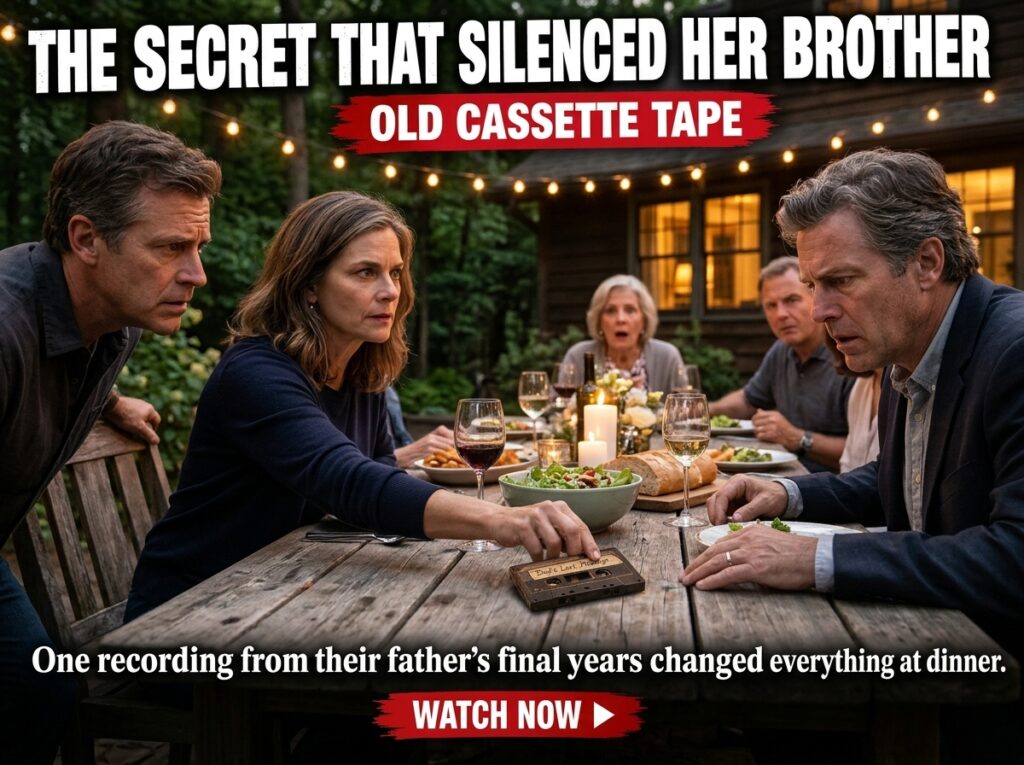
Claire reached into her handbag and removed a small, rectangular cassette tape.
Its plastic casing was scratched, and a strip of faded white tape had been fixed across the front. A few words were written on it in blue ink.
She walked around the table and placed it beside Richard’s plate.
“I found this while cleaning Dad’s garage.”
Richard glanced down.
For the first time that evening, he stopped laughing.
I leaned forward, trying to read the label, but he had already turned the cassette slightly away from me.
“What is that?” I asked.
Claire returned to her chair, but she didn’t sit.
“It’s Dad talking to Richard the night before our wedding.”
The room became completely silent.
Richard’s face had lost its color.
Claire looked at him, her voice steady.
“I heard it, too.”
And whatever Richard saw written on that faded label seemed to frighten him more than anything she had said.
\
Part 3\
For several seconds, nobody moved.
The restaurant’s music continued somewhere beyond the closed door. A waiter passed in the hallway, his shoes making a soft sound against the polished floor. Inside our private room, however, even the smallest movement seemed to demand attention.
Richard stared at the cassette.
“Where did you get that?” he asked.
“I just told you. Dad’s garage.”
“No. I mean, where exactly?”
“In the metal cabinet beside his workbench. It was inside an old box with his other tapes.”
Richard swallowed.
“Those things are ancient. They probably don’t even work anymore.”
“Maybe,” Claire said.
She sat down at last, but she kept her eyes on him.
“Do you remember what you and Dad talked about the night before my wedding?”
Richard gave a short, dismissive laugh.
“We talked about plenty of things.”
“Do you remember that particular conversation?”
“No.”
The answer came too quickly.
Claire opened her handbag again and took out a small portable cassette player. I hadn’t noticed it when she removed the tape.
Richard pushed his chair backward.
“You’re not seriously planning to play that here.”
“Why not?”
“Because this is supposed to be a celebration.”
“That’s what I thought, too.”
Her voice held no anger, which somehow made the exchange more uncomfortable.
She placed the player on the table and examined its buttons.
“I found the tape three weeks ago. I listened to it at home. Then I listened to it again because I thought I might have misunderstood what Dad said.”
She paused.
“I hadn’t.”
Richard looked around the table as though someone might come to his rescue.
Nobody did.
I turned toward my wife.
“Claire, what did you hear?”
She finally looked at me.
“Something I should have known twenty-five years ago.”
My stomach tightened.
There were many things a person could discover about a family after two and a half decades. Old resentments. Misunderstandings. Stories told differently by different people.
But Claire’s expression suggested something more serious.
I had met her father only briefly before his health began to decline. Robert had been a quiet, practical man who preferred repairing a broken chair to buying a new one. He kept old tools, labeled every drawer in his garage, and believed that people revealed themselves most clearly when they thought nobody was watching.
He had treated me kindly.
During our first meeting, he had asked about my work, my family, and my plans for marrying Claire. He listened carefully, then nodded.
“You’re not going to have an easy time with my son,” he had told me.
I assumed he meant Richard’s temper.
“I can handle disagreements,” I replied.
Robert had looked at me for a long moment.
“That’s not exactly what I mean.”
Before I could ask him to explain, Claire had returned from the kitchen, and her father had changed the subject.
At the time, I thought little of it.
Now, watching Richard react to the cassette, I wondered whether Robert had been trying to warn me about something I could not yet understand.
“Claire,” Richard said, lowering his voice, “put that away.”
“Why?”
“Because Dad isn’t here to explain himself.”
“That’s exactly why I want to hear what he said.”
Richard leaned toward her.
“You don’t know what you’re doing.”
She met his eyes.
“I think I’ve known what you were doing for twenty-five years.”
His mouth opened, but no words came out.
I reached for Claire’s hand.
“Whatever is on that tape, we can listen to it at home if you’d rather.”
She squeezed my fingers.
“I don’t want to wait another twenty-five years.”
Then she pressed PLAY.
At first, there was only static, followed by the faint mechanical hiss of an old recording. A chair scraped across a floor. Someone coughed.
Then a man’s voice emerged from the speaker.
Robert’s voice.
Older than I remembered, tired but unmistakably his.
“Richard, sit down. We need to talk about your sister.”
Richard closed his eyes.
The recording continued.
“And before you start arguing, I want you to listen to me until I’m finished.”
I looked at my brother-in-law.
He was no longer pretending that the cassette was meaningless.
He looked like a man who had spent twenty-five years hoping a particular night would never be remembered.
\
Part 4\
Robert’s voice filled the room, bringing with it the strange intimacy of a conversation never intended for anyone else.
“I know you’re angry about the wedding,” he said on the recording. “You’ve made that clear enough. But Claire is an adult, and she’s chosen the man she wants to marry.”
A rustling sound followed.
Then Richard’s younger voice answered, sharper and louder than his father’s.
“She doesn’t know what she’s doing.”
My wife went still.
I looked at her, but she kept her attention on the cassette player.
“She’s known him less than a year,” Richard continued. “What does she really know about him? He doesn’t have our connections. He doesn’t understand this family.”
Robert sighed.
“She knows him better than you think.”
“That’s not the point.”
“Then tell me what the point is.”
For a moment, the recording contained only silence.
Then Richard spoke again.
“You’re going to let her leave, just like that?”
“She’s getting married, Richard. She’s not disappearing.”
“You know what I mean.”
“I think I do. That’s why we’re having this conversation.”
At the table, Richard rubbed his forehead.
“Turn it off,” he muttered.
Claire didn’t respond.
On the tape, Robert continued.
“You’ve spent years acting as if Claire owes you something because you helped me after her mother died. I know those years were difficult. I know you took on responsibilities you weren’t ready for. I’ve never denied that.”
“I did everything for this family.”
“And I’m grateful for what you did. But gratitude is not ownership.”
The words landed heavily.
I glanced at Claire. Her eyes were bright, but her face remained composed.
Robert went on.
“Your sister loves this man. She’s chosen him freely. If you love her, too, you need to learn how to let her make a decision without punishing her for it.”
Richard’s recorded voice rose.
“So I’m supposed to stand there tomorrow and smile while she walks away from us?”
“You’re supposed to stand there and be her brother.”
“Easy for you to say.”
“No, Richard. It isn’t.”
The old man’s voice softened.
“Your mother wanted both of you to grow up and build lives of your own. She didn’t raise Claire to spend the rest of her life asking your permission.”
Claire closed her eyes.
Her mother had died when she was young enough that most of her memories came from photographs and family stories. Robert had been the person who kept those memories alive, telling the same stories at birthdays and holidays until Claire could recite them herself.
Richard had always presented himself as the keeper of the family.
He had decided which traditions mattered, which relatives deserved invitations, and which disagreements should never be discussed in public.
He had also decided, apparently, that Claire’s marriage was a betrayal.
The recording continued.
“There’s something else,” Robert said. “Something I want you to understand before tomorrow.”
Richard interrupted.
“I already know what you’re going to say.”
“No, you don’t.”
“You think he’s good enough for her.”
“I think Claire gets to decide that.”
“You’re choosing him over me.”
The silence that followed lasted several seconds.
When Robert finally answered, his voice sounded deeply disappointed.
“That’s what you always do. You turn every decision into a competition. If Claire is happy, you ask what that means for you. If I support her, you assume I’ve rejected you. You can’t allow the people you love to have something good without wondering whether you’re losing something yourself.”
Richard shifted in his chair.
“This is ridiculous.”
But nobody looked at him.
The younger Richard on the recording was breathing hard.
Then he said something that made my wife open her eyes.
“Fine. Let her marry him. But don’t expect me to pretend I approve.”
Robert answered quietly.
“I don’t expect you to approve of every choice she makes. I expect you to respect her.”
The tape clicked softly as someone moved near the recorder.
Then Robert spoke again, more firmly.
“And if you decide to make her husband pay for your disappointment, remember this conversation. Because I will not support you in hurting your sister just to make yourself feel important.”
The recording ended with a burst of static.
For several seconds, the cassette player continued turning.
Nobody spoke.
I had expected anger, perhaps an argument over something their father had said. Instead, I felt a deep sadness settle over me.
Robert had understood the problem before Claire and I were even married.
He had seen the resentment taking root.
And he had tried to stop it.
But the most painful part wasn’t what Robert had said.
It was what Richard had done with those words.
For twenty-five years, he had continued exactly as his father had warned him not to.
\
Part 5\
Richard reached across the table and stopped the cassette player.
“That proves nothing,” he said.
His voice was too loud for the room.
Claire stared at him.
“What do you mean, it proves nothing?”
“It was one conversation. Taken out of context.”
“You heard the entire recording.”
“Twenty-five years ago, Claire. Dad was upset. We were all upset.”
“You told me I was abandoning the family.”
“You were!”
The words burst out of him before he could stop himself.
Our guests exchanged uneasy glances.
Claire remained seated, her hands resting beside the cassette player.
“I was getting married.”
“You were leaving.”
“Those aren’t the same thing.”
Richard shook his head.
“You don’t understand what it was like back then.”
“Then explain it.”
He looked at her, apparently surprised by the invitation.
For the first time that evening, Claire wasn’t trying to smooth things over. She wasn’t asking him to calm down or reminding him that everyone was watching.
She wanted an answer.
Richard leaned back.
“After Mom died, Dad fell apart. You were still a teenager. Somebody had to help him. Somebody had to make sure the bills got paid, the house stayed together, and the family didn’t fall apart completely.”
“I know,” Claire said.
“No, you don’t. You went away to school. You had friends, plans, a future. I stayed.”
Her expression softened slightly.
“I know you did.”
“Do you? Because everyone acts like I was just some angry older brother who couldn’t stand seeing his little sister get married. Nobody remembers what I gave up.”
It was the first honest thing he had said all evening.
I could hear the pain beneath his resentment.
Richard had been young when their mother died. Their father had struggled with grief, and Richard had tried to fill the empty spaces. Perhaps he had missed opportunities. Perhaps he had carried responsibilities that should never have rested entirely on his shoulders.
I could understand why those years had changed him.
But understanding the source of someone’s bitterness did not make it acceptable to spend decades pouring that bitterness onto other people.
Claire nodded slowly.
“You’re right about one thing. You did a lot for Dad.”
Richard’s expression changed, as though he had expected another accusation.
She continued.
“I’ve never denied that. I was grateful. I still am. But you used what you did for him as a reason to control me.”
“I never controlled you.”
“You tried to decide where I lived, who I spent time with, and whether Daniel deserved to be part of the family.”
“I was protecting you.”
“From what?”
He didn’t answer.
Claire’s voice trembled, but she kept going.
“Every time I told you I was happy, you found a reason to make me feel guilty. When we bought our first house, you told me I’d abandoned Dad. When Daniel got promoted, you said I was living off his success. When Dad became ill, you told everyone I wasn’t doing enough, even though I was visiting him every week.”
Richard stared at the table.
“And whenever Daniel defended me, you treated him like an enemy.”
“I never asked him to do anything for me,” Richard muttered.
“No. You just expected him to accept whatever you said because he loved me.”
I felt her hand find mine.
For years, I had believed that silence was a way of protecting our marriage from Richard’s hostility. I hadn’t realized how often Claire had been left to face him alone.
“I should have stood up to him sooner,” I whispered.
She turned toward me.
“Daniel, this isn’t your fault.”
“Maybe not. But I watched you carry it.”
Her fingers tightened around mine.
Richard gave a bitter laugh.
“Wonderful. Now I’m the villain at your anniversary dinner.”
Claire shook her head.
“No one is asking you to be a villain. We’re asking you to take responsibility for what you’ve done.”
“After twenty-five years?”
“Especially after twenty-five years.”
Richard looked toward the door.
For a moment, I thought he would leave.
Instead, he reached for the cassette and turned it over in his hands.
“There’s a reason Dad kept this,” he said quietly.
Claire frowned.
“What do you mean?”
Richard looked down at the faded label.
“He knew I wasn’t going to listen to him.”
\
Part 6\
Claire’s expression changed.
“How could he have known that?”
Richard rubbed his thumb along the edge of the cassette.
“Because we had this conversation more than once.”
The admission surprised everyone.
He continued, speaking more slowly now.
“Dad talked to me after you announced the wedding. He talked to me again the next morning. He told me to stop making everything about myself. He told me that if I couldn’t be happy for you, I should at least keep my mouth shut.”
“Then why didn’t you?” Claire asked.
Richard looked at her.
“Because I thought you were making a mistake.”
“You didn’t know that.”
“I thought I did.”
“And when you realized I was happy?”
He gave a humorless smile.
“I told myself you were pretending.”
The answer was so revealing that nobody knew what to say.
Richard had spent years protecting his resentment by refusing to believe the evidence in front of him.
Whenever Claire smiled, he assumed she was hiding something. Whenever our marriage survived a difficult season, he claimed it was because I was lucky. Whenever she defended me, he accused me of turning her against him.
He had built a story in which he was the abandoned brother and I was the man responsible.
The truth had been more complicated from the beginning.
“Why keep the tape?” Claire asked.
Richard shook his head.
“I didn’t keep it. Dad did.”
“Then why are you so afraid of it?”
He didn’t answer immediately.
Finally, he looked toward me.
“Because he was right.”
The words came out barely above a whisper.
I sat motionless.
Richard continued.
“I knew he was right even then. I knew you loved Daniel. I knew you weren’t being forced into anything. But if I admitted that, I’d have to accept that you could build a life without needing me.”
Claire’s eyes filled with tears.
“Richard, I never stopped needing my brother.”
“Maybe not. But you didn’t need me to make your decisions.”
He looked down again.
“I didn’t know what to do with that.”
For a moment, the anger in the room gave way to something quieter.
I thought about the family gatherings, the jokes, the small humiliations. I remembered how often Richard had insisted that Claire was different since marrying me, as if happiness were proof of disloyalty.
Perhaps he had genuinely believed that being needed was the same as being loved.
Perhaps he had spent so long defining himself through responsibility that he no longer knew who he was when the responsibility ended.
But none of that erased what he had done.
Claire wiped her cheek.
“You could have told me you were scared.”
Richard let out a short breath.
“You would have told me everything was fine.”
“Because it was fine.”
“I know that now.”
“No,” she said gently. “You know it because Dad told you. And even then, you spent twenty-five years pretending he hadn’t.”
Richard flinched.
She wasn’t finished.
“You didn’t just dislike Daniel. You made me feel as if loving him meant betraying you. Every birthday, every holiday, every family dinner became another test I couldn’t pass.”
“I never wanted you to feel that way.”
“But you kept doing it.”
He looked at her for a long time.
Then he nodded once.
“I know.”
Those two words seemed to cost him more than all the arguments that had come before them.
Our friends remained quiet. Some looked uncomfortable witnessing such a private conversation. Others appeared relieved that something hidden for years was finally being said aloud.
Claire picked up the cassette player.
“There’s more,” she said.
Richard’s head snapped up.
“What?”
“The recording doesn’t end there. I listened to the whole thing.”
He stared at her.
She pressed PLAY again.
A soft crackle came from the speaker, followed by Robert’s voice.
“Richard, I need you to promise me something.”
The younger Richard answered, sounding exhausted.
“What now?”
“Promise me that if Claire ever comes to you because she’s unhappy, you’ll be there for her. Not because you get to say you were right. Not because you want her to come home. Because she’s your sister, and she deserves to know that she can count on you.”
There was a pause.
Then Richard’s recorded voice replied, “I promise.”
In the restaurant, the older Richard covered his face with one hand.
Claire stopped the tape.
Neither sibling spoke.
And suddenly, the question was no longer whether their father had understood the family conflict.
The question was whether Richard could finally become the brother he had promised to be.
\
Part 7\
We left the restaurant later than we had planned.
Our friends said their goodbyes gently, offering hugs and quiet wishes for the future. Nobody mentioned the cake that had been left half-eaten or the anniversary photographs we had forgotten to take.
The evening had become something none of us could have anticipated.
Outside, the night air was cool. Cars moved along the street, their headlights passing over the pavement in brief flashes of white.
Claire stood beside me while Richard remained near the restaurant entrance.
For a moment, I thought he might leave without saying anything.
Instead, he walked toward us.
“Claire.”
She turned.
He stopped a few feet away, his hands buried in his jacket pockets.
“I’m sorry.”
The words were quiet, almost awkward.
Claire didn’t answer immediately.
Richard swallowed.
“I’m sorry for what I said tonight. And for the things I’ve said over the years. About Daniel. About your marriage. About the way you’ve lived your life.”
I watched Claire’s face.
For twenty-five years, she had heard excuses disguised as apologies. Richard would say something cruel, then explain that he had been tired, worried, or misunderstood. He would offer a vague expression of regret before returning to the same behavior.
This time, however, he seemed to understand that the words alone would not settle anything.
“I can’t undo what I did,” he continued. “I know that.”
“No,” Claire said. “You can’t.”
He nodded.
“I don’t expect you to forgive me tonight.”
That surprised her.
Perhaps it surprised him, too.
He glanced at me.
“Daniel, I owe you an apology as well.”
I waited.
“I’ve treated you like you were responsible for something that was never your fault. I blamed you for taking Claire away when she was the one who chose to marry you.”
“Yes,” I said.
He winced slightly at my bluntness.
I hadn’t planned to answer so directly, but I was tired of pretending the truth was less painful than it was.
“You made our marriage harder than it needed to be,” I continued. “Not because you disagreed with me. You were entitled to your own opinion. It was because you kept treating Claire’s happiness as an insult to you.”
Richard looked down.
“I know.”
“And I kept quiet because I thought it would protect her. Sometimes I think it only made it easier for you to continue.”
Claire touched my arm.
“You were trying to keep the peace.”
“I was. But peace shouldn’t mean allowing someone to hurt the person you love.”
She looked at me for a long moment.
Then she turned back to Richard.
“I want you in my life,” she said. “I always have. But I can’t keep pretending everything is fine just because we’re family.”
Richard nodded slowly.
“What does that mean?”
“It means we start being honest. If you insult Daniel, I’ll tell you it’s unacceptable. If you try to make me feel guilty for my decisions, I’ll end the conversation. And if you want a relationship with us, it has to be a relationship between adults who respect each other.”
He absorbed her words.
“I can try.”
Claire’s expression softened, but only slightly.
“I need you to do more than try when it’s convenient.”
“Then I’ll work on it.”
She studied him.
“I hope you do.”
For several seconds, the three of us stood beneath the restaurant’s entrance lights.
Richard looked older than he had at dinner. Not physically older, but tired in a way that made me think of someone who had finally stopped running from a truth he had carried for too long.
“Can I ask you something?” he said.
Claire nodded.
“Why didn’t Dad give you the tape?”
She considered the question.
“I don’t know.”
“Maybe he wanted you to hear it before the wedding.”
“Maybe.”
Richard looked at the ground.
“Or maybe he thought I would eventually figure it out.”
Claire’s eyes softened.
“He probably hoped you would.”
Richard nodded.
Then, without another excuse or explanation, he turned and walked toward his car.
Claire watched him go.
“Do you think he’ll change?” I asked.
She leaned against me.
“I don’t know.”
“Are you hopeful?”
She was quiet for a moment.
“I’m willing to see what he does.”
It wasn’t forgiveness.
Not yet.
But for the first time in years, it was a beginning that didn’t require her to deny what had happened.
\
Part 8\
The cassette came home with us.
Claire placed it on the kitchen table, beside the bowl where we kept our keys. For a long time, neither of us touched it.
The house was quiet. Our anniversary flowers stood in a vase near the window, and the remains of the evening seemed to follow us from room to room.
I loosened my tie and sat beside my wife.
“Do you want to tell me what happened when you first found it?”
She nodded.
“I was looking for Dad’s old toolbox. You remember the one he gave us?”
“The wooden one with the brass hinges?”
“Yes. I thought it might still be in the garage.”
After Robert died, the family had divided many of his belongings. Richard had taken several pieces of furniture and most of the tools. Claire had kept photographs, a few books, and the small things that reminded her of their childhood.
But the garage had remained largely untouched.
“I found a box of tapes behind the cabinet,” she explained. “Most of them were labeled with dates or little notes. There were recordings of family gatherings, Dad talking about repairs he needed to make, and a few tapes of Mom.”
She smiled faintly.
“I didn’t know he had recorded her voice.”
“Did you listen to those?”
“Some of them. I haven’t finished.”
She looked toward the cassette on the table.
“This one was different. The label said your wedding date and Richard’s name.”
I stared at the faded writing.
“Why would your father label it that way?”
“I wondered the same thing.”
She had taken the tape home, found an old player, and listened alone.
The first time, she had sat on the living-room floor with the headphones pressed tightly against her ears. She had expected a private conversation about wedding arrangements or some disagreement between father and son.
Instead, she had heard her father defending a choice she had spent twenty-five years defending herself.
“What did you feel?” I asked.
Claire looked down at her hands.
“At first, I was angry. Then I felt relieved. And after that, I felt sad.”
“Because of Richard?”
“Because Dad knew. He knew what was happening, and he tried to stop it before it became part of our lives.”
She turned the cassette over.
“I kept thinking about all those dinners when Richard made a comment about you and I told myself it wasn’t worth responding. I kept thinking about how many times I asked you to ignore him because I didn’t want another family argument.”
I reached for her hand.
“You were trying to hold everyone together.”
“Maybe. But I was also teaching him that he could keep doing it.”
“You weren’t responsible for his choices.”
“I know that intellectually.”
She looked at me.
“But I still wonder whether things would have been different if I’d confronted him sooner.”
I thought carefully before answering.
“Maybe some things would have been different. But we can’t know that. What we do know is that you tried to preserve your relationship with your brother. You didn’t cause his resentment, and you couldn’t make him let it go.”
She leaned her head against my shoulder.
“I wish Dad were here.”
“So do I.”
Robert had died several years earlier, long before we discovered the tape. I regretted that I had never asked him about his warning, never learned what else he had understood about his son.
But the recording had given us something we hadn’t realized we were missing.
Not a solution.
Not an excuse.
A clearer understanding of the past.
Claire rose and went to the drawer where we kept old photographs. She returned with a picture taken on our wedding day.
We were young, standing outside the church beneath a pale afternoon sky. I wore a suit that didn’t quite fit, and Claire held a bouquet of white flowers. Her father stood beside her, smiling gently.
Richard was in the background.
He wasn’t smiling.
I’d noticed that expression in the photograph years ago, but I had never understood how much meaning it carried.
Claire ran her thumb along the edge of the picture.
“I remember Dad telling me that marriage wasn’t just about choosing someone you loved. It was about choosing someone you were willing to stand beside when life became difficult.”
She looked at me.
“I didn’t understand how important that would become.”
I kissed her forehead.
“Neither did I.”
She placed the photograph beside the cassette.
For the first time that evening, she smiled.
“Twenty-five years,” she whispered.
“Twenty-five years.”
“And we’re still here.”
I squeezed her hand.
“Yes. We are.”
\
Part 9\
Richard called four days later.
Claire was making coffee when her phone rang. She glanced at the screen, then looked at me.
“Do you want me to answer?” she asked.
“Only if you want to.”
She took a breath and accepted the call.
“Hello, Richard.”
I couldn’t hear his words clearly, but I could see her expression change as she listened.
“No,” she said after a moment. “I’m not angry that you called.”
Another pause.
“Yes, I understand.”
She leaned against the kitchen counter.
“I don’t want us to have another argument. I want us to be able to talk without either of us feeling as though we have to win.”
She listened again.
Then she said, “All right. We can have lunch next week.”
When she ended the call, she placed the phone on the counter and stared at it.
“What did he say?” I asked.
“He wants to meet.”
“How do you feel about that?”
“Uncertain.”
She gave a small laugh.
“I never thought I’d say this, but I almost prefer it when he makes a rude comment. At least then I know what to expect.”
I understood.
Anger could be exhausting, but uncertainty had its own weight. Richard had spent decades following a predictable pattern. A sincere apology was unfamiliar territory.
The following week, Claire met him at a quiet café near the park where they had spent time with their father as children.
She returned home with a thoughtful expression.
“He asked me about the tape,” she said.
“What did he want to know?”
“He wanted to know whether I had listened to it again.”
“And?”
“I told him I had.”
She sat beside me on the sofa.
“Then he said something I wasn’t expecting.”
I waited.
“He told me he remembered the conversation with Dad differently when he was younger. He thought Dad was choosing you over him. He thought every kind thing Dad said about our marriage was another way of telling him he wasn’t good enough.”
“Did he say he believed that now?”
“He said he knows it wasn’t true. But back then, he didn’t know how to separate his feelings from the facts.”
I considered that.
“It sounds as though he’s finally trying to understand himself.”
“Maybe.”
She looked out the window.
“He also admitted that he kept insulting you because he wanted me to defend him. He wanted me to say he was right about you. He thought if I did that, things would go back to the way they were before.”
“Before our wedding?”
“Before I became an adult who made her own decisions.”
The realization seemed to hurt her all over again.
“Imagine spending twenty-five years trying to prove that someone else’s happiness is a mistake.”
I took her hand.
“Imagine how much easier life would have been if he’d simply been happy for you.”
She nodded.
“He apologized again. Properly, this time. He didn’t say you were too sensitive. He didn’t blame Dad. He didn’t tell me I was remembering things incorrectly.”
“That’s progress.”
“It is.”
She was quiet for a moment.
“But I’m not ready to pretend everything is fixed.”
“You don’t have to.”
“I know.”
A week later, Richard sent us a short message inviting us to dinner. He offered to cook and specifically asked whether we would both be comfortable coming.
Claire read the message twice.
Then she replied that we would be happy to join him.
When the evening arrived, Richard greeted us at the door. The table was set for three, and the food was simple. There were no grand gestures, no speeches about family loyalty, and no jokes about our marriage.
At one point, he asked me about my work and listened to the answer without interrupting.
It was such a small thing that someone else might not have noticed.
I did.
After dinner, Richard brought out a box of photographs he had taken from their father’s house. He placed it on the table and invited Claire to look through it with him.
They sat shoulder to shoulder, remembering holidays, school events, and ordinary afternoons that had once seemed unimportant.
For a while, they were simply a brother and sister looking at old photographs.
Then Richard found a picture of their father standing in his garage, holding a screwdriver and looking impatiently at whoever was taking the photograph.
He laughed.
“That was the day he tried to fix the washing machine.”
Claire smiled.
“He made it worse.”
“He always said he was improving it.”
Their laughter filled the room.
I sat back and watched them.
It wasn’t a perfect reconciliation. Twenty-five years of resentment could not be erased by one recording, a handful of apologies, or a pleasant dinner.
But something had changed.
Richard was no longer asking Claire to prove that she loved him.
He was beginning to learn how to love her without demanding proof.
\
Part 10\
Our twenty-sixth anniversary arrived quietly.
There was no private dining room that year, no elaborate cake, and no gathering of friends waiting to raise their glasses. Claire and I spent the evening at home, cooking the meal we had eaten on our first anniversary.
The kitchen was warm, the windows were open, and music played softly from the living room.
While Claire stirred the sauce, I set the table.
“Do you remember our first anniversary?” she asked.
“Of course.”
“You burned the bread.”
“I did not burn it. I gave it character.”
She laughed.
“You turned it into charcoal.”
“It was an ambitious experiment.”
She shook her head, smiling.
I watched her for a moment and felt the familiar gratitude that had carried me through so many years.
We had experienced ordinary disappointments, difficult seasons, and moments when the future seemed less certain than we wanted it to be. We had learned that love wasn’t simply the feeling that brought two people together. It was the work of continuing to choose one another when life became complicated.
And sometimes, it meant learning to protect that choice from people who couldn’t accept it.
Richard arrived just before dinner with a small package.
“I brought something,” he said.
Claire opened the door wider.
“Come in.”
He handed her the package.
Inside was a framed photograph of Robert, taken in his garage years before either of his children had married.
Beside it was a handwritten note.
Claire read it silently, then passed it to me.
It said:
*I spent too long thinking that being needed was the same as being loved. I’m trying to learn the difference.*
There was no grand declaration beneath the words. No request for forgiveness. No demand that Claire forget the past.
Only an acknowledgment.
Richard stood near the doorway, looking uncomfortable.
“I found the photograph in Dad’s box,” he explained. “I thought you might like it.”
Claire held the frame against her chest.
“Thank you.”
He nodded.
Then he looked at me.
“Happy anniversary, Daniel.”
“Thank you, Richard.”
He hesitated.
“And I mean it.”
I believed that he did.
We sat down to dinner, and for the first time in a long while, the conversation moved naturally. Richard asked about our plans for the coming year. Claire told him about a project she had been considering. I mentioned a trip we hoped to take, and he offered a suggestion without turning it into a competition.
At one point, he made a joke about my cooking.
I looked at him.
He stopped, then shook his head.
“Sorry. Old habit.”
Claire raised an eyebrow.
“Very old.”
Richard smiled sheepishly.
“I’m working on it.”
We laughed, and the moment passed without leaving a bruise behind.
Later, after he had gone home, Claire placed the framed photograph beside the cassette on our living-room shelf.
For a while, she stood looking at both objects.
“Do you think Dad would be happy?” she asked.
I came to stand beside her.
“I think he would be relieved.”
She nodded.
“I wish he could have seen this.”
“So do I.”
She rested her head against my shoulder.
For years, we had believed that Richard’s resentment was something we simply had to endure. We had mistaken silence for peace and patience for the only possible form of kindness.
The cassette had not magically repaired our family. It had not erased the years of hurt or made every memory easier to carry.
What it had done was bring an old truth into the open.
Claire had never stolen anything from her brother by choosing me.
A marriage was not a theft. A sister’s happiness was not a betrayal. And love did not become smaller when someone built a life beyond the boundaries of their childhood home.
Robert had understood that long before we did.
He had tried to teach his son that family was not a claim to another person’s life. It was a relationship that survived because people chose to care for one another freely.
Richard had taken twenty-five years to begin understanding that lesson.
We couldn’t give those years back.
But we could decide what happened next.
Claire reached for my hand.
“Twenty-six years,” she whispered.
I smiled.
“And counting.”
She looked at the photograph of her father, then at the cassette that had finally allowed his voice to reach us again.
“I think he knew we’d be all right,” she said.
I wrapped my fingers around hers.
“Maybe he just hoped we’d find our way.”
Outside, the evening settled over the neighborhood. Somewhere down the street, a car door closed. A dog barked once, then fell silent.
Inside our home, the photograph and the cassette rested side by side.
One held the image of a father who had tried to protect his daughter’s freedom.
The other held the words he had left behind.
And between them stood twenty-six years of marriage, built not on winning arguments or proving anyone wrong, but on the quiet decision to keep choosing each other.
For the first time in a long time, I understood something I wished I had known on our wedding day.
You cannot make everyone approve of the life you choose.
You cannot force someone to understand your happiness.
And you cannot spend your entire life waiting for another person to give you permission to love the person you love.
Sometimes, the people who resent your choices are the very people who need to learn that your life belongs to you.
Claire had made her choice twenty-six years earlier.
And I would choose her again, without hesitation.