Part 1
The lawyer’s office smelled faintly of coffee, old carpet, and rain.
It was one of those gray Portland mornings when the sky seemed too low, pressing against the tops of the buildings as if the whole city had been wrapped in wet wool. I sat beside my Aunt Carol with my hands folded in my lap, listening to papers being shuffled across a polished wooden desk.
My father’s name was everywhere.
Richard Hale.
On the will.
On the folder.
On the envelope containing his death certificate.
Even on the brass plaque outside the office.
Seeing his name made my chest tighten.
Dad had been gone eleven days.
Eleven days since I had stood at the cemetery and watched cold Maine soil fall onto the lid of his coffin.
Eleven days since I had heard the words people always say at funerals.
He lived a good life.
He was a good man.
He’ll always be with you.
People said those things because silence made them uncomfortable.
I knew better.
My father had been complicated.
So had our family.
Martin sat across from me, dressed in a dark suit that looked expensive enough to make him feel important. He had his phone face down beside his elbow, although I noticed he checked it whenever the lawyer looked away.
He was forty years old.
Two years younger than me.
My half-brother.
We shared a father but not a mother, and perhaps that explained why Martin had always seemed to believe he owned a larger piece of Dad than I did.
Our father had never said that.
Martin had simply decided it.
The lawyer adjusted his glasses.
“Mr. Hale’s estate is straightforward.”
Martin leaned back.
“Good.”
The lawyer looked down at the document.
“The residence at 18 Willow Street, Portland, Maine, along with the personal property contained within it, passes to Martin Hale.”
Martin smiled.
I didn’t.
The lawyer continued.
“The savings accounts, totaling approximately sixty-three thousand dollars, are also designated to Martin.”
Martin’s smile widened.
Aunt Carol shifted in her chair.
I stared at the rain sliding down the window.
The house was worth around $410,000.
Dad had lived there for nearly thirty years.
I had painted the kitchen walls with him.
I had slept in the upstairs guest room through summers when I was young.
I had helped him shovel the driveway.
I had sat beside him at the kitchen table when Mom died.
The house wasn’t simply a property.
It was the physical shape of my childhood.
But I had known Dad’s will wasn’t going to divide things equally.
I’d known Martin was getting the house.
I’d known about the savings.
What I hadn’t known was what Dad intended for me.
The lawyer reached into a smaller folder.
“Ellen, there is one specific bequest to you.”
Martin looked up.
For the first time that morning, he seemed interested.
The lawyer placed a photograph on the desk.
It showed Dad’s small juniper bonsai.
I’d seen it thousands of times.
It had lived on the kitchen windowsill for twenty-six years.
I remembered Dad bringing it home when I was sixteen.
“That’s yours,” the lawyer said.
Martin laughed.
Not loudly.
Just enough.
Then he looked directly at me.
“You’re forty-two, Ellen, and you never gave Dad a single grandchild. The bonsai can keep you company.”
The room went completely still.
Aunt Carol whispered his name.
“Martin.”
He shrugged.
“What?”
I looked at my brother.
I could have argued.
I could have reminded him that I had spent years caring for Dad while he lived two states away. I could have reminded him who drove Dad to his appointments. Who brought groceries. Who sat beside his hospital bed.
Instead, I smiled.
“Thank you,” I said.
The lawyer blinked.
Martin looked almost disappointed.
I signed the receipt for the bonsai.
Then I carried it out to my car in both hands.
It was heavier than I remembered.
Or maybe grief had made everything heavier.
I placed it carefully on the passenger seat and drove home through the rain.
I didn’t know it then, but that little tree was the last thing my father had ever trusted me to protect.
And it was carrying a secret my brother was terrified I would find.
Part 2
Martin called me the next morning.
I watched his name appear on my phone.
I didn’t answer.
He called again.
Then again.
Finally, I turned the phone face down.
I had spent the night before sitting beside the bonsai.
That sounds ridiculous when I say it now.
A grown woman sitting on the floor of a small apartment, staring at a tree.
But there was something comforting about it.
The trunk was twisted and rough.
One branch leaned slightly toward the window.
Dad had always said that was because the tree was stubborn.
“Trees don’t always grow where you expect,” he’d told me once.
“Neither do people.”
I had laughed at the time.
Now I wondered whether he’d meant something more.
Every Sunday morning, Dad watered the bonsai with a tiny glass measuring cup.
He had taped the cup to the side of the pot with a strip of faded blue tape.
Exactly one cup.
Not more.
Not less.
He never trusted ordinary watering cans.
“Too easy to overdo it,” he’d say.
So on the first Sunday after his funeral, I filled the little measuring cup.
I poured the water slowly.
The soil darkened.
My eyes filled with tears.
“Morning, Dad,” I whispered.
It was the first time I’d spoken to him since the funeral.
I didn’t feel foolish.
I felt less alone.
Martin called again that afternoon.
This time I answered.
“What?”
There was silence.
Then he said, “How’s the tree?”
I frowned.
“The tree?”
“The bonsai.”
“Fine.”
“You’re taking care of it?”
“Yes.”
Another pause.
“Good.”
Something about his voice bothered me.
“You’ve asked me that twice.”
“I was just wondering.”
“You don’t wonder about plants.”
He laughed nervously.
“People change.”
“No, Martin. They usually don’t.”
He became quiet.
Then he said, “Dad cared about that tree.”
“I know.”
“You should probably keep it healthy.”
“I plan to.”
“Good.”
He hung up.
Three days later, he called again.
This time at eleven at night.
I almost ignored him.
But something made me answer.
“Ellen.”
His voice was different.
There was no sarcasm.
No anger.
He sounded frightened.
“Martin?”
“How is it?”
“The bonsai?”
“Yes.”
“It’s fine.”
“Can I buy it?”
I sat up.
“What?”
“I’ll give you five thousand.”
I actually laughed.
“Five thousand dollars for a plant?”
“It’s important to Dad.”
“Then why did you mock me for getting it?”
He didn’t answer.
I stood and walked toward the window.
The bonsai sat on the sill.
Streetlights reflected against its leaves.
“Ten thousand,” he said.
My smile disappeared.
“Martin, what is going on?”
“Fifteen.”
“You just inherited a house worth over four hundred thousand dollars.”
“I know.”
“And sixty-three thousand in savings.”
“I know.”
“So why are you offering me fifteen thousand dollars for a tree?”
Silence.
“Whatever you want,” he finally said.
My stomach tightened.
“Whatever I want?”
“Name the price.”
I looked at the bonsai.
For twenty-six years, Dad had treated that tree like something sacred.
But Martin had never cared about it.
Not once.
“Why?” I asked.
He breathed heavily into the phone.
“Just sell it to me.”
“No.”
“Ellen.”
“No.”
“You don’t understand.”
“Then explain.”
He hung up.
I stood there holding the phone.
The apartment was silent.
Rain tapped against the glass.
And for the first time, I looked at the bonsai differently.
Not as a plant.
Not as a keepsake.
As a message.
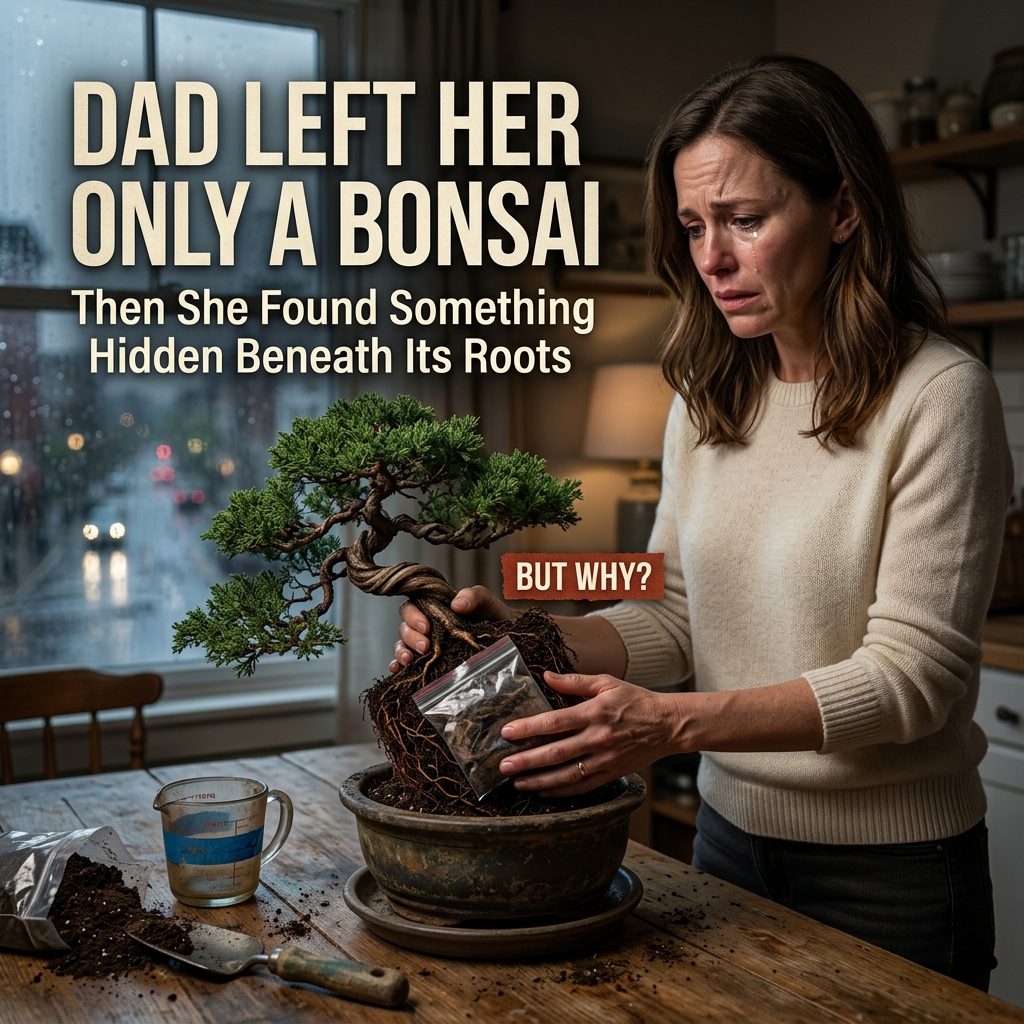
Nine weeks later, the roots pushed through the bottom of the pot.
I decided it was time to repot it.
I spread an old towel across my kitchen table.
I brought out fresh soil.
I loosened the container carefully.
The root ball resisted.
I pulled a little harder.
The tree finally came free.
Something white flashed beneath the roots.
I froze.
It wasn’t a root.
It was plastic.
I gently moved the soil aside.
My fingers touched tape.
Then a sealed plastic bag.
And beneath it, something solid.
My heart began pounding.
I lifted the bag from the root ball.
It was tightly wrapped.
Carefully hidden.
Deliberately placed.
Dad had put it there.
I knew it immediately.
And suddenly Martin’s late-night phone calls made sense.
Part 3
I didn’t open the bag immediately.
That is the truth.
I sat there for almost ten minutes with it in my hands.
My father’s handwriting was on the tape.
Just two words.
FOR ELLEN.
My hands started shaking.
Dad had never written anything like that on a package.
He’d left birthday cards.
Grocery lists.
Notes reminding me to pick up milk.
Once, when I was nineteen and away at college, he’d mailed me a letter because he’d decided my generation was becoming too dependent on phones.
But this was different.
This had been hidden.
Not stored.
Not placed in a drawer.
Hidden.
Inside the roots of a tree.
I reached for a pair of scissors.
Then stopped.
What if Martin had known?
What if this was why he had suddenly become desperate?
What if opening it changed everything?
I thought about Dad.
About the way he looked at me during his final weeks.
He had been weak then.
His voice had barely risen above a whisper.
But one afternoon, when Martin had visited, Dad had taken my hand.
“Don’t let anybody make you feel like you weren’t enough,” he’d said.
I hadn’t understood.
I’d assumed he was talking about grief.
Now I wasn’t so sure.
I opened the plastic bag.
Inside was a small envelope, a flash drive, and several folded documents sealed in another transparent sleeve.
The envelope had my name on it.
Ellen.
My breath caught.
I opened it.
The letter was only two pages.
The first line nearly broke me.
“My dear Ellen,
If you are reading this, then I am gone, and you have the bonsai.”
I covered my mouth.
He continued.
“I know what Martin will say. I know what he has said before. He has always believed that inheritance is measured in dollars, houses, and things that can be sold.”
My eyes blurred.
“But I have never measured my children that way.”
I stopped reading.
I couldn’t.
I pressed the letter against my chest.
Then I forced myself to continue.
“I am leaving Martin the house because he has spent years believing it is his rightful reward. I am leaving him the savings because I want no argument after I am gone.”
I frowned.
That didn’t sound like Dad.
Then I read the next sentence.
“But there are things about the house and about Martin that you deserve to know.”
My heart began pounding.
The flash drive was labeled:
BANK RECORDS.
The documents were property papers.
I unfolded the first.
It was a copy of a deed.
The second was a bank statement.
The third made my breath stop.
A handwritten accounting sheet.
Dates.
Amounts.
Transfers.
Signatures.
I recognized Dad’s handwriting.
Then I saw Martin’s name.
My chair scraped backward.
“No.”
I read it again.
The amounts weren’t small.
Over several years, money had been transferred from Dad’s account to an account I didn’t recognize.
At first, I thought Martin had borrowed it.
Then I saw the notes beside the transfers.
LOAN — MARTIN.
REPAID.
LOAN — MARTIN.
NOT REPAID.
LOAN — MARTIN.
NOT REPAID.
There were dozens.
I suddenly understood the house.
Dad hadn’t simply given Martin a valuable property.
He had created a trap Martin didn’t know existed.
The deed contained a condition.
I read it twice.
Then three times.
Martin could inherit the house.
But a separate lien remained attached to the property until certain debts were settled.
The amount was far greater than I had imagined.
The house wasn’t really the clean inheritance Martin thought it was.
Dad had documented everything.
The flash drive contained scans of bank statements, correspondence, and copies of messages.
There was even a recording.
I hesitated before opening it.
Dad appeared on my laptop screen.
He was sitting at his kitchen table.
The bonsai was behind him.
He looked tired.
But his eyes were clear.
“If you’re watching this, Ellen, then I didn’t get the chance to explain.”
I began crying.
Dad leaned toward the camera.
“I didn’t leave you the tree because I thought you needed company.”
A tiny smile crossed his face.
“I left it because you were the only person I trusted to look beneath the surface.”
The recording continued.
“Martin has spent years telling people that you chose your career over family. That you didn’t care about me. That you wasted your chance to give me grandchildren.”
Dad shook his head.
“He knows that’s not true.”
I stared at the screen.
“He knows you were here.”
Dad’s voice cracked.
“He knows who sat with me when I was sick.”
Then he said the words that changed everything.
“And he knows what he owes me.”
The video ended.
I sat in silence.
Outside, a car passed on the wet street.
Then my phone rang.
Martin.
Part 4
I let it ring.
It stopped.
Then rang again.
I didn’t touch it.
The third time, I answered.
“Hello?”
“Ellen.”
His voice sounded controlled again.
“You opened it.”
I said nothing.
He breathed into the phone.
“I know Dad left you something.”
“The bonsai?”
“Yes.”
“How do you know?”
Silence.
That was answer enough.
I stood beside the kitchen table.
“You knew.”
“I knew Dad had something.”
“You knew it was hidden in the tree.”
“I suspected.”
“And that’s why you offered me money.”
He didn’t deny it.
“Ellen, listen to me.”
“No.”
“You don’t understand what those documents mean.”
“I understand enough.”
“You don’t.”
“You borrowed money from Dad.”
His breathing changed.
“He gave me money.”
“The documents say loans.”
“Family doesn’t keep score.”
“Dad did.”
That silenced him.
I looked at the letter again.
“Why didn’t you tell me?”
“Because it wasn’t your business.”
“It became my business when you spent nine weeks trying to buy the thing Dad left me.”
“You don’t know what you’re doing.”
“Then tell me.”
“I can’t.”
“You mean you won’t.”
He cursed under his breath.
Then his voice softened.
“Please.”
That word frightened me more than his anger.
Martin had never said please to me.
Not like that.
“What did you do?” I asked.
“I made mistakes.”
“What kind?”
“Financial.”
“How much?”
Silence.
“Martin.”
“More than I should have.”
I looked at the documents.
“Did Dad know?”
“Of course he knew.”
“Did he know about the house?”
“Yes.”
“Did he know about the money?”
“Yes.”
“Then why did he leave you everything?”
Martin laughed bitterly.
“Because he was still my father.”
“No.”
I stared at the bonsai.
“He left you the house because he wanted you to think you won.”
Martin said nothing.
My voice became quieter.
“Didn’t he?”
The silence lasted so long I knew I’d struck something.
Finally, Martin said, “You always thought Dad loved you more.”
“I never said that.”
“You didn’t have to.”
“You mocked me for not having children.”
“You were always different.”
“No. I was just there.”
He hung up.
I didn’t sleep that night.
The next morning, I drove to Dad’s house.
The house looked exactly the same.
White siding.
Blue shutters.
The old porch railing Dad had repaired three times instead of replacing.
Martin’s car was parked outside.
He opened the door before I knocked.
“I didn’t think you’d come.”
“I need to see something.”
He stepped aside.
The smell hit me immediately.
Dad.
Coffee.
Pine cleaner.
Old books.
I closed my eyes.
For one second, I was sixteen again.
Dad was alive.
The kitchen was warm.
The bonsai sat in the window.
Then I opened my eyes.
Martin was watching me.
“What?”
“You look like him.”
I almost laughed.
“You’ve spent weeks trying to make me feel like I didn’t belong here.”
“I know.”
“Why?”
He looked away.
“Because I was angry.”
“At me?”
“At Dad.”
“Why?”
He rubbed his face.
“He trusted you.”
I didn’t understand.
“Why would that make you angry?”
“Because he knew.”
“Knew what?”
Martin walked toward the kitchen.
He stopped beneath the empty windowsill.
For twenty-six years, the bonsai had sat there.
Now there was only a pale rectangle where sunlight had faded the paint.
“I thought Dad was going to leave everything to you.”
“He didn’t.”
“No.”
Martin looked at me.
“He left me the house.”
“But you don’t have what you wanted.”
His jaw tightened.
“What did I want?”
“His approval.”
The words landed harder than I expected.
Martin looked down.
For the first time, I saw something beneath his arrogance.
Fear.
Not fear of losing the house.
Fear of losing the last story he’d told himself about our father.
Then he said quietly, “Dad knew I was in trouble.”
“I know.”
“He promised he wouldn’t expose me.”
“That wasn’t a promise.”
Martin looked at me.
“It was.”
“No,” I said. “It was a test.”
Part 5
The truth came out slowly.
Not because Martin wanted to tell me.
Because Dad had left enough evidence that there was nowhere left for him to hide.
We sat at the kitchen table where Dad had spent thousands of Sunday mornings watering the bonsai.
Martin looked older than he had at the lawyer’s office.
“You know about the loans,” he said.
“Yes.”
“You know I used the money to cover debts.”
“Yes.”
“You don’t know why.”
I waited.
He looked toward the window.
“I started a business.”
“I remember.”
“It failed.”
“I remember that too.”
“I borrowed from Dad.”
“How much?”
“At first, twenty thousand.”
“And then?”
“More.”
I said nothing.
He swallowed.
“I kept telling myself I’d pay him back when things improved.”
“They didn’t.”
“No.”
“So you borrowed again.”
“Yes.”
“How much?”
He stared at the table.
“One hundred and seventy-eight thousand over the years.”
My stomach tightened.
Dad had never mentioned it.
Not once.
I thought of the old truck he kept driving.
The patched roof.
The kitchen cabinets he refused to replace.
All those times he’d told me he didn’t need anything.
“He gave you that much money?”
Martin nodded.
“Why?”
“Because he loved me.”
I looked at him.
“And because he thought you could change.”
Martin’s eyes filled.
He quickly looked away.
I had expected anger.
Instead, I saw shame.
“Why the documents?” I asked.
“He wanted me to repay it.”
“Did you?”
“No.”
“So he put a lien on the house.”
Martin nodded.
“I didn’t know.”
“Until the lawyer?”
“Until after the funeral.”
That explained everything.
Martin had signed for the house thinking he’d inherited a fortune.
Then he’d discovered the legal documents.
The house was valuable, but the debt attached to it changed everything.
He needed the records hidden in the bonsai.
Without them, he believed he could challenge the lien.
Or at least delay it.
Dad had anticipated that.
“Why put them in the tree?” I asked.
Martin gave a humorless smile.
“Because nobody thought you would look.”
I felt something inside me crack.
He was right.
Everyone had assumed the tree was worthless.
Martin had called it a consolation prize.
He had laughed at it.
And yet Dad had chosen it because it was the one thing he knew I would care for.
I opened my father’s letter again.
There was one final paragraph I hadn’t fully understood.
“I want you to know that forgiveness does not mean pretending something never happened.”
I read it aloud.
Martin stared at the table.
Dad continued:
“If Martin comes to you, listen if you can. But don’t let his fear become your burden. He must answer for his choices.”
Martin closed his eyes.
“He knew.”
“Yes.”
“He knew I’d come looking.”
“Maybe.”
“No.”
He shook his head.
“He knew exactly what I would do.”
I folded the letter.
“He knew you.”
Martin laughed quietly.
“So did you.”
I didn’t answer.
After a moment, he said, “Did he leave you anything else?”
I thought of the bonsai.
“The tree.”
“That’s all?”
I looked at him.
“Isn’t it enough?”
He didn’t respond.
I stood and walked toward the kitchen window.
I remembered being sixteen.
Dad had brought the bonsai home in a cardboard box.
I had laughed because it was tiny.
“That thing?”
Dad had nodded.
“It’s older than you.”
“Then why does it look so small?”
“Because growing isn’t the same as getting bigger.”
I’d forgotten that conversation.
Until that moment.
Behind me, Martin whispered, “I was jealous of you.”
I turned.
“What?”
“All my life.”
“Why?”
“Because Dad trusted you.”
I stared at him.
“He trusted you too.”
“No.”
Martin’s eyes were wet.
“He gave me things. He gave you himself.”
Neither of us spoke.
The old kitchen seemed suddenly too quiet.
Then Martin reached into his pocket.
He placed a key on the table.
“I found this in Dad’s desk.”
I looked at it.
“What’s it for?”
“I don’t know.”
There was a small metal tag attached.
Seven.
Dad had always numbered things.
His tools.
His storage boxes.
Even the Christmas lights.
I picked up the key.
It was old.
And beneath the number seven was a tiny engraved word.
“Harbor.”
Part 6
The key led us to a storage facility near the Portland waterfront.
I almost turned around twice on the drive there.
Martin followed in his car.
Neither of us spoke when we arrived.
The facility was nearly empty that morning.
A woman behind the desk checked the number on the key and gave us directions.
Unit seven was at the end of a narrow corridor.
The lock opened easily.
Inside were several boxes.
Dad’s handwriting appeared on nearly every one.
ELLEN.
MARTIN.
TAXES.
PHOTOGRAPHS.
TOOLS.
MEMORIES.
Martin stood in the doorway.
“I didn’t know this existed.”
“Neither did I.”
We opened the box marked ELLEN first.
Inside were things I’d forgotten.
My high school graduation photograph.
A yellow scarf Mom had knitted.
Letters I’d sent Dad from college.
A birthday card I’d given him when I was twenty-three.
He had kept everything.
Even a movie ticket.
On the back of the ticket, he’d written:
“Ellen laughed through the entire second half.”
I laughed through my tears.
Martin looked away.
The next box contained photographs.
Dad holding me as a baby.
Dad teaching me to ride a bicycle.
Dad and Mom standing in front of the house.
Then photographs of Martin.
Dad holding him.
Dad at Martin’s graduation.
Dad beside Martin at his first business opening.
There were dozens.
For years, I’d thought Dad had somehow loved us differently.
Now I realized he had simply loved us differently because we had needed different things.
Martin found a letter.
“This is for me.”
He opened it.
I didn’t read over his shoulder.
I didn’t need to.
His face changed.
After several minutes, he folded it carefully.
“What did he say?”
Martin shook his head.
“He said he was proud of me.”
I smiled.
“That’s good.”
“He said he was sorry he couldn’t save me from every consequence.”
Martin’s voice broke.
I said nothing.
He continued reading.
“He said the house wasn’t a reward.”
I looked at him.
“What did he say it was?”
“A responsibility.”
That sounded exactly like Dad.
Martin sat on a box.
“He knew I would think I won.”
“Did he?”
Martin looked at me.
“Yes.”
He laughed through tears.
“He knew me too well.”
At the bottom of the box was another envelope.
This one was addressed to both of us.
We opened it together.
Dad’s handwriting filled two pages.
He wrote about the house.
About Mom.
About our childhood.
About the mistakes he’d made.
Then he wrote something neither of us expected.
“I know you both believe inheritance is about fairness.”
I looked at Martin.
He looked back.
“It isn’t.”
Dad explained that he had deliberately divided the estate the way he did because he wanted each of us to face something.
Martin had to face responsibility.
I had to face the belief that being overlooked meant being unloved.
That sentence made me cry.
Martin read it twice.
Then he looked at me.
“You believed that?”
“Sometimes.”
“Why?”
“Because you got the house.”
He shook his head.
“And you got Dad.”
I looked down.
Neither of us spoke.
At the very bottom of the envelope was a final note.
“Take care of the tree.”
Martin smiled sadly.
“He really loved that thing.”
“He loved what it meant.”
“What did it mean?”
I thought about the words he’d once said.
Growing isn’t the same as getting bigger.
“I think it meant patience.”
Martin nodded.
“Maybe forgiveness.”
“Maybe.”
We closed the box.
For the first time since Dad died, I didn’t feel as if I had lost him completely.
I felt as if he had left breadcrumbs.
Not to lead us to money.
To lead us back to each other.
But there was still one thing unresolved.
The house.
The debt.
Martin’s mistakes.
And the question of whether either of us could walk away without repeating the same family wounds.
As we left the storage unit, Martin stopped me.
“Ellen.”
I turned.
“I need your help.”
I waited.
“Not with the money.”
He looked embarrassed.
“With the truth.”
Part 7
We met with the lawyer two days later.
Martin brought every document.
I brought Dad’s letter.
The lawyer read everything carefully.
Then he explained what Dad had arranged.
The house could remain with Martin, but the outstanding debt had to be addressed.
The documents from the bonsai proved the original loans.
There was no secret fortune.
No magical inheritance.
No loophole that could make Martin’s debts disappear.
There was only the truth.
Martin had borrowed money.
Dad had documented it.
And Dad had decided that his son would have to take responsibility.
Martin signed the necessary paperwork.
His hands trembled.
When it was over, he sat quietly.
“I thought Dad hated me.”
The lawyer looked at him.
“Nothing in these documents suggests that.”
Martin laughed.
“I know.”
He turned to me.
“I just didn’t know how to hear love unless it came with something I could own.”
I didn’t know what to say.
So I said the only thing that felt honest.
“He was still your father.”
Martin nodded.
“And you’re still my sister.”
That surprised me.
He had called me half-sister for years.
Sometimes intentionally.
Sometimes casually.
But that day he didn’t.
We walked outside.
The rain had stopped.
Portland smelled of wet pavement and salt.
Martin stood beside his car.
“What are you going to do with the tree?”
“Keep it.”
He smiled.
“I figured.”
“I’ll probably repot it.”
“Don’t.”
I laughed.
“Why?”
“Dad said it liked that pot.”
I looked at him.
“You knew that?”
“He told me once.”
“Then why did you want it?”
Martin stared at the street.
“Because I thought there was something valuable inside.”
“And now?”
“Now I think I was wrong.”
He paused.
“There’s something valuable in it.”
I waited.
“Just not the thing I was looking for.”
We hugged.
It wasn’t a perfect hug.
We weren’t suddenly healed.
There were years between us.
Years don’t disappear because of one conversation.
But it was a beginning.
That Sunday morning, I placed the bonsai on my kitchen windowsill.
I filled Dad’s little measuring cup.
Exactly one cup.
I watered the soil slowly.
Then my phone buzzed.
A message from Martin.
How is it?
I smiled.
Alive.
His reply came almost immediately.
Good.
I put the phone down.
The apartment was quiet.
Sunlight touched the leaves.
I thought about Dad.
About the lawyer’s office.
About the cruel words Martin had spoken.
About the phone calls.
About the sealed bag.
About the letter.
And I realized something.
The bonsai hadn’t been a punishment.
It hadn’t been a consolation prize.
It had been an act of trust.
Dad had known that one day the tree might have to carry a truth too heavy for words.
So he had hidden that truth beneath something small enough for me to carry.
Something I would never abandon.
I touched the trunk gently.
“I’m still here,” I whispered.
For the first time, saying it didn’t feel like talking to an empty room.
Part 8
Six months passed.
The house remained in Martin’s name, but the responsibility changed him.
He sold several things he didn’t need.
He took a second job.
He negotiated repayment terms.
He stopped blaming Dad.
That was perhaps the biggest change.
He also started visiting me on Sundays.
The first time, he stood awkwardly in my doorway holding a paper bag.
“I brought coffee.”
I looked inside.
“Black?”
“Like Dad drank it.”
I smiled.
“Come in.”
We talked about ordinary things.
Work.
Weather.
Bills.
The neighbor’s dog.
Sometimes we talked about Dad.
Sometimes we didn’t.
There were days when Martin became angry again.
Days when I did too.
Grief wasn’t a staircase.
It was weather.
Some mornings were bright.
Others arrived with storms.
But we learned not to run from each other when the weather changed.
One Sunday, Martin looked at the bonsai.
“It’s growing.”
I smiled.
“Slowly.”
“Like Dad said.”
I nodded.
Then Martin reached into his coat.
“I found something.”
He handed me an old photograph.
It showed Dad at the kitchen table.
The bonsai was behind him.
I turned it over.
On the back, Dad had written a date.
Twenty-six years earlier.
The same year he brought the tree home.
Under the date were five words.
“For the daughter who stayed.”
I stared at them.
Martin read the words.
He became quiet.
“I think that’s why he gave it to you.”
I swallowed.
“I stayed because he was my father.”
“I know.”
He paused.
“But maybe he knew you’d stay even when staying became difficult.”
I looked at him.
“Did you ever wish you’d been the one who stayed?”
Martin’s eyes filled.
“Every day.”
The honesty hurt.
I reached across the table.
He took my hand.
For a while, neither of us spoke.
Then he said, “I used to think you had everything.”
“What did you think I had?”
“Dad’s attention.”
“You had it too.”
“I know that now.”
The bonsai sat between us.
Small.
Old.
Alive.
I remembered Martin’s cruel words at the lawyer’s office.
You’re forty-two, Ellen, and you never gave Dad a single grandchild.
At the time, I’d wondered whether those words were meant to hurt me.
Now I understood they had come from his own insecurity.
He had measured his worth through what he believed Dad wanted.
I had done something similar.
I had measured mine through what Dad had left me.
Neither of us had understood him.
Until the tree.
That evening, Martin helped me move it to a larger window.
He stopped before leaving.
“Can I ask you something?”
“Sure.”
“If Dad had left you the house instead, would you have given it to me?”
I thought carefully.
“No.”
He laughed.
“Fair.”
“I would’ve helped you.”
He nodded.
“That’s what I hoped you’d say.”
Then he left.
I stood by the window.
The bonsai cast a tiny shadow across the floor.
I thought about how easy it had been to believe that money was proof of love.
How quickly people measured inheritance in numbers.
$410,000.
$63,000.
$5,000.
$15,000.
Whatever you want.
But Dad had never measured love that way.
He had measured it in Sunday mornings.
In coffee.
In rides to the doctor.
In letters saved for decades.
In a tree watered one careful cup at a time.
Part 9
A year after Dad’s funeral, Martin and I returned to the cemetery together.
It was cold.
The kind of cold that made your breath visible.
Martin carried flowers.
I carried nothing.
I didn’t need to.
We stood beside Dad’s grave.
“I’m sorry,” Martin said.
I looked at him.
“For what?”
“For everything.”
I smiled faintly.
“You don’t have to apologize for everything.”
“I probably do.”
“No.”
He looked at the gravestone.
“I was cruel to you.”
“Yes.”
“I said things I knew would hurt.”
“Yes.”
“I told people you wasted your chances.”
I looked at him.
“That hurt the most.”
“I know.”
He swallowed.
“I was jealous.”
“I know.”
“I thought Dad loved you more.”
“He loved you.”
Martin nodded.
“I know.”
We stood in silence.
Then he placed the flowers down.
“Do you think he knew we’d come here together?”
I smiled.
“Probably.”
“Arrogant old man.”
I laughed.
Martin laughed too.
For a moment, it felt like childhood.
Then he became serious.
“Ellen?”
“Yes?”
“Did you ever regret not having children?”
The question didn’t hurt the way it once would have.
“No.”
“Never?”
“I’ve wondered what my life would have looked like.”
“That’s different.”
“Yes.”
He nodded.
“I shouldn’t have used it against you.”
“No.”
“I was wrong.”
“I know.”
The wind moved through the trees.
I looked at Dad’s name carved into the stone.
Richard Hale.
A husband.
A father.
A flawed man.
A loving man.
A man who had made mistakes and tried to correct them before he left.
I realized then that maybe the point of the bonsai had never been the secret.
Maybe the secret had simply been the road.
The documents had forced Martin to face himself.
The letter had forced me to face myself.
The tree had brought us both to the same place.
Home.
When we returned to my apartment, Martin noticed something.
The bonsai had new growth.
Tiny green shoots.
He stood beside the window.
“That’s new.”
“Very.”
“When did that happen?”
“I didn’t notice.”
He smiled.
“Maybe that’s how growing works.”
I looked at him.
“Dad?”
He shrugged.
“Maybe.”
That night, Martin stayed for dinner.
We cooked together.
We argued about the amount of salt.
We laughed when the smoke alarm went off.
And afterward, he washed the dishes.
I stood at the window with the bonsai.
My father’s tree.
My inheritance.
My reminder.
For twenty-six years, it had grown quietly on a windowsill.
It had survived winters.
Heat.
Neglect.
Moves.
Arguments.
Grief.
And now, somehow, it was still alive.
So were we.
Just barely at first.
Then a little more every day.
Part 10
Two years after Dad’s death, I moved the bonsai into a larger ceramic pot.
Martin helped.
We did it on a Sunday morning.
Exactly as Dad had taught me.
We spread newspaper across the table.
We loosened the roots carefully.
We replaced the soil.
And before placing the tree into its new home, I stopped.
For a moment, I couldn’t move.
Martin noticed.
“You okay?”
I touched the trunk.
“Yeah.”
I smiled.
“I just think Dad would complain about the soil.”
Martin laughed.
“He’d say we used too much.”
“And then he’d redo it.”
“Definitely.”
We finished together.
Then I filled the little measuring cup.
One cup.
Exactly.
I watered the bonsai.
Martin watched.
“You still use that?”
“Every Sunday.”
He smiled.
“Good.”
I looked at the old cup.
The blue tape had almost completely faded.
I could have replaced it years ago.
But I never had.
Some things were allowed to age.
Some things were allowed to carry the marks of the people who had touched them.
After watering the tree, I sat beside the window.
Martin sat across from me.
For a while, we watched the city wake.
“I’ve been thinking,” he said.
“That’s dangerous.”
He laughed.
“I want to keep the house.”
“I know.”
“But not for the reason I wanted it before.”
“What reason now?”
“I want to fix it.”
I looked at him.
“Fix it?”
“Yeah.”
He told me about the repairs.
The roof.
The kitchen.
The porch.
Then he said something that made my throat tighten.
“I want to make the kitchen window the same as it was when the bonsai lived there.”
“You don’t have to.”
“I know.”
He smiled.
“I want to.”
We were quiet.
Then he reached into his pocket.
He pulled out a small envelope.
My heart skipped.
“What is that?”
“A copy of something.”
I opened it.
It was a photograph.
Dad.
Martin.
Me.
The three of us standing beside the bonsai.
I didn’t remember the picture being taken.
I looked at the date.
Twenty years earlier.
Martin pointed to the tree.
“Look how small it was.”
I smiled.
“It was smaller than that.”
“No way.”
“It was.”
We laughed.
Then I noticed something written on the back.
Dad’s handwriting.
“Some things grow quietly until one day you realize how much they have become.”
I read it twice.
Then I cried.
Not because I was sad.
Not entirely.
Because I finally understood.
The bonsai had been Dad’s final lesson.
Love wasn’t always loud.
It didn’t always arrive wrapped in money.
Sometimes it sat quietly in a window for twenty-six years.
Sometimes it survived because someone remembered exactly how much water to give it.
Sometimes it carried a secret beneath its roots.
And sometimes, when everything else had been taken away, it reminded you that being overlooked was not the same as being unloved.
Martin reached across the table.
I took his hand.
“We’re okay,” he said.
I nodded.
“We’re getting there.”
That was enough.
Outside, sunlight touched the rooftops.
Inside, the bonsai stood quietly on the windowsill.
My father’s tree.
The inheritance he had chosen for me.
The thing Martin once mocked.
The thing he later tried desperately to buy.
The thing that had forced two broken siblings to stop measuring love in dollars.
I had once believed Dad left me only a plant.
I was wrong.
He left me proof.
Proof that he had seen me.
Proof that he had trusted me.
Proof that he knew the difference between being alone and being independent.
And most importantly, proof that love could survive even after the person who gave it was gone.
I looked at the tree and smiled.
“Good morning, Dad.”
The leaves moved slightly in the sunlight.
Maybe it was only the breeze.
Maybe it was nothing.
But I liked to believe he was still answering in the only language he had ever needed.
Patience.
Presence.
And love.
One careful cup at a time.