Part 1
The first time I saw Mrs. Hadley, I was twelve years old and convinced I was old enough to be independent.
That was how twelve-year-olds thought in 1998.
I had a bicycle with one working brake, a baseball glove that had belonged to my older brother, and a stubborn belief that if I could earn my own money, I could make my own decisions.
My parents had never been poor, exactly, but money was something we discussed carefully. My father worked long hours at a machine shop, and my mother kept track of every bill in a little notebook she carried from room to room.
So when summer arrived, I decided I would mow lawns.
Not because I loved grass.
Not because I had some entrepreneurial dream.
I wanted money.
Five dollars bought a lot when you were twelve.
A comic book was less than two dollars. A cold soda cost a fraction of that. I could save for baseball cards, movie tickets, or whatever else twelve-year-old boys convinced themselves they absolutely needed.
My first customers were neighbors.
Then neighbors told other neighbors.
By July, I had six regular lawns.
The seventh was Mrs. Hadley’s.
I almost didn’t take it.
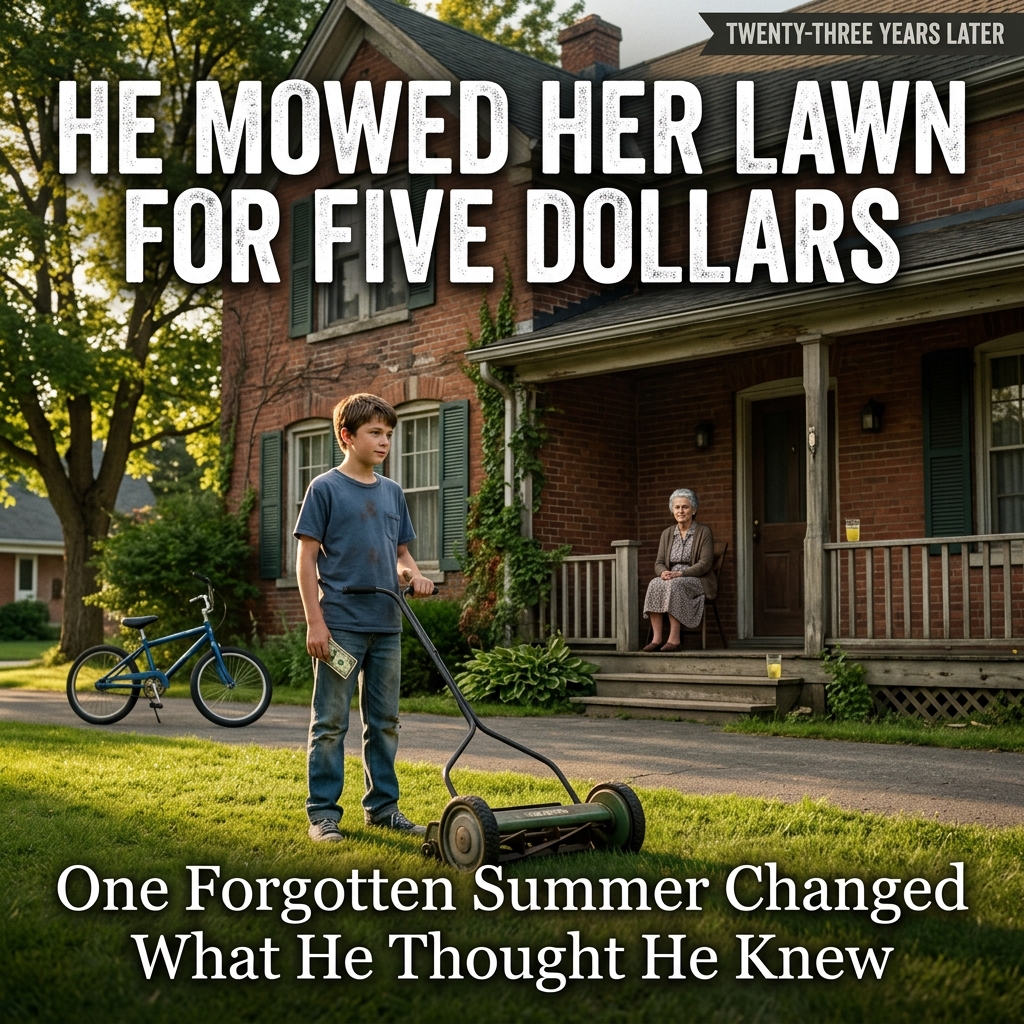
Her house stood at the very end of Ellison Road, separated from the others by a long driveway and a row of enormous maple trees. The lawn was wide and uneven, with patches of grass that seemed determined to grow faster than everything around them.
Everyone knew the house.
Everyone knew the woman who lived inside it.
“Don’t take that one,” my friend Daniel told me.
“Why?”
“Because she’s crazy.”
He said it with the certainty children used when repeating something they had heard adults say.
“She’s not crazy.”
“You’ve talked to her?”
“No.”
“Then how do you know?”
I shrugged.
The truth was, I didn’t.
That Saturday, I rode my bike to the end of Ellison Road and stopped at the bottom of the driveway.
The house was bigger than I remembered.
It wasn’t beautiful, exactly. It was an old two-story brick house with white trim and dark green shutters. The porch had two wooden chairs on it, but nobody ever sat in them.
I knocked.
Nothing.
I knocked again.
The door opened suddenly.
A thin elderly woman stood there.
She had silver hair pulled tightly behind her head and a face that looked as though it had forgotten how to smile.
“What do you want?”
I swallowed.
“My name’s—”
“I know who you are.”
That surprised me.
“You do?”
“You’ve been riding that bicycle past my house for weeks.”
“Oh.”
She looked at me for another moment.
“Why are you here?”
“I heard you need your lawn mowed.”
“I do.”
“I can do it.”
“How much?”
“Five dollars.”
She frowned.
I wondered if I had asked for too much.
Finally she said, “Saturday mornings.”
“Okay.”
“Seven o’clock.”
I blinked.
“Seven?”
“Did I stutter?”
“No, ma’am.”
“Then seven.”
She closed the door.
I stood there for several seconds.
Then I rode home.
At six-thirty the next Saturday morning, I was awake.
At six-forty-five, I was riding toward Ellison Road.
At exactly seven, I was standing beside my mower.
Mrs. Hadley opened the door.
She looked at the mower.
Then at me.
“You remembered.”
“Yes, ma’am.”
She stepped aside.
“Don’t leave grass on my sidewalk.”
That was my introduction to three summers of Saturday mornings.
She never became friendlier.
If anything, she became more particular.
The mower had to start on the first pull.
The grass had to be cut evenly.
The edges around the flower beds had to be trimmed.
The sidewalk had to be swept.
If a blade of grass landed on her front steps, she noticed.
If I finished three minutes late, she noticed.
If I accidentally left a wheel mark in the soft ground after rain, she noticed that too.
And every Saturday, when I finished, she handed me five dollars.
Never four.
Never six.
Always five.
She never said thank you.
I told myself I didn’t care.
But I did.
At twelve, I wanted to believe that adults noticed when you tried hard.
Mrs. Hadley seemed determined not to notice me at all.
And yet, every Saturday morning, before I even knocked on her door, I could hear something moving inside the house.
As if she had been waiting for me.
Part 2
By the end of that first summer, Mrs. Hadley and I had developed a strange routine.
I mowed.
She watched.
I swept.
She inspected.
She paid me five dollars.
Then I left.
There were almost never more than a few words between us.
One Saturday, I made the mistake of asking her why she didn’t hire someone older.
She was standing on the porch with her arms crossed.
“Because older people charge more.”
“I could charge more.”
She raised an eyebrow.
“You want more money?”
“Not exactly.”
“Then don’t ask for it.”
I stared at her.
She stared back.
Then, unexpectedly, the corner of her mouth moved.
It wasn’t a smile.
At least, I didn’t think it was.
But it was the closest thing to amusement I had ever seen on her face.
The next Saturday, I found a glass of lemonade sitting on the porch.
I stopped.
There was no note.
I looked toward the window.
Mrs. Hadley was watching me.
“Is that for me?”
“It’s getting hot.”
I picked it up.
“Thank you.”
She turned away.
I drank the lemonade.
It was warm.
And too sweet.
But I drank every drop.
After that, a glass appeared almost every Saturday.
She never mentioned it.
I never mentioned it either.
That was how our relationship worked.
Anything kind had to remain unspoken.
Once, during a thunderstorm, I arrived with my mower and stood under the porch roof.
The sky was black.
Rain came down so hard that the road looked like a river.
“You shouldn’t be here,” Mrs. Hadley said from the doorway.
“I thought it might stop.”
“It won’t.”
“I can wait.”
“No.”
She opened the door wider.
“Go home.”
“My dad said I should finish the job.”
“Your father is wrong.”
I looked at her.
She looked at me.
Then she sighed.
“Come inside until it passes.”
I froze.
I had never been inside her house.
Not once.
“Really?”
“Don’t make me change my mind.”
I stepped inside.
The house smelled like old wood, furniture polish, and something faintly floral.
There were photographs everywhere.
Black-and-white photographs.
A young woman standing beside a car.
A man in a military uniform.
Two children sitting on the steps.
A family gathered around a Christmas tree.
I didn’t know who any of them were.
Mrs. Hadley saw me looking.
“Don’t touch anything.”
“I won’t.”
“Good.”
We sat in the living room while rain hammered the windows.
She sat in one chair.
I sat on the edge of another.
Neither of us spoke.
After a while, I asked, “Were you always here?”
“What?”
“In this house.”
She looked toward the photographs.
“No.”
“Where did you live before?”
“Different places.”
“Did you like them?”
She looked at me as if I had asked an unusually complicated question.
“Some.”
Then silence.
A few minutes later, she said, “You remind me of someone.”
“Who?”
She didn’t answer.
The rain slowed.
I stood.
“I should go.”
She nodded.
At the door, she said, “Come back Saturday.”
I smiled.
“I will.”
She didn’t smile back.
But I remember those words.
Come back Saturday.
For some reason, they stayed with me.
The next summer, I returned.
Then the summer after that.
By then, I knew every crack in her driveway and every stubborn patch of grass in her yard.
I knew which part of the mower rattled.
I knew where the lemonade would be.
I knew she hated footprints on the flower beds.
And I knew that if I finished early, she would find some reason to keep me there for another few minutes.
Sometimes it was a question.
Sometimes it was an instruction.
Sometimes she simply stood on the porch while I put the mower away.
She never told me why.
I never asked.
Then came my final Saturday.
I was fifteen.
School was starting again, and my family was preparing to move.
My father had accepted a new job several hours away.
I had spent the week saying goodbye to friends without admitting how much I hated saying goodbye.
That morning, I mowed Mrs. Hadley’s lawn slowly.
I knew it was the last time.
When I finished, I cleaned the mower carefully.
She came outside holding the usual five dollars.
She placed it in my hand.
Then she said something I had never heard from her before.
“That’s all?”
I looked up.
“What?”
“You’re leaving.”
I stared at her.
“How did you know?”
“I know things.”
I laughed nervously.
“My family is moving.”
“When?”
“Tomorrow.”
She looked toward the road.
For a moment, she seemed older than ninety.
Then she looked back at me.
“Will you remember this house?”
I smiled.
“Probably.”
She nodded.
“Good.”
Then she went inside.
I stood there holding five dollars.
It was the same amount she had paid me every Saturday for three years.
But somehow, in that moment, it felt different.
I put the bill in my pocket.
Then I rode away.
I never saw her again.
At least, that’s what I believed.
Part 3
Twenty-three years is a long time.
Long enough for a boy to become a man.
Long enough for a neighborhood to change.
Long enough for the house at the end of Ellison Road to become nothing more than a forgotten detail.
I went to college.
Then law school.
Then I moved to Columbus and became a real estate attorney.
My work was mostly paperwork, contracts, negotiations, title issues, estate matters, and the endless stream of complications that appeared whenever property changed hands.
I became good at separating emotion from documents.
A house was a parcel number.
A will was an instruction.
A deed was a transfer.
A signature meant something because the law said it did.
People brought me complicated family stories every day.
Brothers who hadn’t spoken in years.
Children fighting over inherited houses.
Parents trying to divide property fairly.
Families arguing over things worth less than the memories attached to them.
I listened.
I advised.
I filed paperwork.
Then I went home.
Mrs. Hadley never entered my thoughts.
Not once.
Or if she did, I didn’t notice.
I had forgotten the smell of her house.
Forgotten the lemonade.
Forgotten the way she inspected the grass.
Forgotten the photographs.
I even forgot the exact sound of her voice.
The only thing I remembered clearly was five dollars.
It was strange.
Twenty-three years had passed, but if someone had asked me what Mrs. Hadley paid me for mowing her lawn, I could have answered immediately.
Five dollars.
Exactly five dollars.
Then, one Wednesday morning, my secretary walked into my office holding a yellow legal pad.
“There is a woman from the probate office on line two.”
I looked up from a contract.
“Which probate office?”
She told me the name of my hometown.
I frowned.
“Did they say what it’s about?”
“An estate.”
“Whose?”
She hesitated.
“Mrs. Hadley.”
The name meant nothing for half a second.
Then everything came back.
The house.
The driveway.
The porch.
The lemonade.
Five dollars.
I leaned back in my chair.
“Mrs. Hadley?”
“That’s what they said.”
I stared at my computer screen.
I hadn’t thought about her in years.
“Put her through.”
The probate clerk introduced herself and explained that Mrs. Hadley had died at ninety-four.
I remember looking at the clock while she spoke.
9:17 a.m.
Outside my office window, Columbus moved through another ordinary weekday.
Cars passed.
People walked along the sidewalk.
Someone in the building across the street carried a paper cup of coffee.
Everything looked normal.
But the moment she said Mrs. Hadley’s name, I was twelve years old again.
The clerk continued.
“My office is handling the estate.”
“Okay.”
“There is something you need to know.”
I waited.
“Your name appears in the will.”
I laughed.
It was automatic.
“Sorry?”
“Your name.”
“Are you sure?”
“Yes.”
“That doesn’t make sense.”
“I understand.”
“I haven’t spoken to her in twenty-three years.”
“I understand that as well.”
“Maybe there’s another person with my name.”
“No.”
She read my full name.
It was mine.
I sat forward.
“Could this be some kind of mistake?”
“That’s what I thought initially.”
My pulse had started beating harder.
“What exactly did she leave me?”
The clerk paused.
Then she answered.
“The house.”
I didn’t speak.
“The property on Ellison Road.”
I looked out the window again.
Three hundred and ten thousand dollars.
That was the appraised value.
I repeated the number in my head.
It didn’t feel real.
I had represented clients in transactions worth ten times that amount.
But this was different.
This was the house where I had spent Saturday mornings as a child.
The house of the woman everyone called mean.
The house of the woman who paid me five dollars every week.
“There’s a condition,” the clerk said.
My professional instincts returned immediately.
“What kind?”
“One that must be satisfied within thirty days.”
“What happens if it isn’t?”
“The property goes to the alternate beneficiary.”
I reached for a pen.
“Can you send me a copy of the will?”
“I already have it ready.”
“Email it.”
“I can.”
She hesitated.
“There is also a handwritten note attached to the condition.”
I stopped.
“A handwritten note?”
“Yes.”
“Whose handwriting?”
“Mrs. Hadley’s.”
The clerk’s voice changed slightly.
Almost as if she had been waiting to tell me this part.
“It appears she wrote the condition herself.”
I opened my email.
The document arrived less than a minute later.
I clicked the attachment.
There it was.
Her name.
Her signature.
The address I hadn’t seen in twenty-three years.
And beneath it, a condition written in shaky handwriting.
I read it once.
Then again.
My professional mind began analyzing the language.
My personal mind had already gone somewhere else.
To a Saturday morning in 1998.
To a twelve-year-old boy standing beside a lawn mower.
To five dollars placed in his hand.
And suddenly, the house at the end of Ellison Road wasn’t forgotten anymore.
It was waiting.
Part 4
I printed the will.
Then I printed it again.
The first copy came out crooked.
I don’t know why that bothered me.
Maybe because I needed something ordinary to focus on.
My secretary appeared at the door.
“Everything okay?”
I looked at the papers.
“No.”
She waited.
I had spent years telling clients not to react emotionally before reading legal documents carefully.
Now I was sitting in my office doing exactly what I told them not to do.
I forced myself to start at the beginning.
Mrs. Hadley’s full legal name.
Date of execution.
Witnesses.
Executor.
Property description.
And then the bequest.
The house was mine.
But the condition was unusual.
Very unusual.
It wasn’t complicated because of legal language.
It was complicated because it was personal.
She had written instructions that had nothing to do with selling the property, renovating it, donating it, or preserving it.
It required me to do something within thirty days.
Something specific.
Something connected to the house.
I read the condition again.
Then I stopped at the final line.
The alternate beneficiary was named there.
I knew the name.
Or, more accurately, I knew the connection.
I didn’t know the person well.
But I knew enough.
And that was when the uneasiness began.
Why would Mrs. Hadley leave her house to me?
Why would she attach a condition?
And why would that condition involve someone else?
I called the probate clerk.
“I have questions.”
“Of course.”
“Did Mrs. Hadley leave any other explanation?”
“Not with the will.”
“What about a letter?”
“There’s no formal letter.”
“Anything else?”
There was silence.
Then she said, “There are some personal papers.”
“What kind?”
“Photographs. Receipts. Notes. Old records.”
“Have those been inventoried?”
“Yes.”
“Anything mentioning me?”
Another pause.
“There is something.”
My chair seemed suddenly uncomfortable.
“What?”
“I can’t interpret it for you.”
“I’m not asking you to.”
“There is a box.”
“What kind of box?”
“Just a storage box.”
“Where is it?”
“At the house.”
I closed my eyes.
“Has anyone gone through it?”
“Only enough to inventory the contents.”
“Is there anything inside with my name?”
“I believe so.”
My heart beat faster.
“Can I see it?”
“You’re the beneficiary.”
“That wasn’t my question.”
The clerk laughed softly.
“You always were persistent.”
I froze.
“What?”
“Mrs. Hadley mentioned that about you.”
I stared at the phone.
“What did she say?”
“I don’t know. I’m just telling you what is in the file.”
I ended the call a few minutes later.
That afternoon, I drove home and sat at my kitchen table.
My wife asked what was wrong.
I told her about Mrs. Hadley.
She remembered the name because I had mentioned her once, years earlier, when we were talking about childhood jobs.
“The lawn lady?” she asked.
“Yeah.”
“The one who only paid you five dollars?”
“That’s her.”
She smiled.
“So what does she want?”
“I don’t know.”
“You inherited her house.”
“With a condition.”
“What condition?”
I looked at her.
“I don’t want to tell you until I understand it.”
She knew me well enough not to push.
That night, I couldn’t sleep.
I kept seeing the same thing.
A five-dollar bill.
A twelve-year-old hand.
An old woman’s fingers releasing the money.
Five dollars.
Exactly five.
The next morning, I called the probate office.
“I want to go to the house.”
The clerk gave me instructions.
The property had remained secured after Mrs. Hadley’s death.
The key was with the executor.
I drove back to my hometown that afternoon.
The farther I went, the more familiar the roads became.
A gas station where there used to be a hardware store.
A restaurant that hadn’t existed when I was twelve.
A school parking lot where a field had once been.
Then Ellison Road.
My hands tightened on the steering wheel.
The trees were larger.
The houses had changed.
But at the end of the road stood the brick house.
Exactly where it had always been.
I parked.
For several seconds, I didn’t get out.
I was thirty-eight years old.
A lawyer.
A husband.
A man who had handled estates and property disputes for years.
And yet I suddenly felt twelve.
I walked up the driveway.
The lawn was overgrown.
For the first time in my life, Mrs. Hadley’s grass was too long.
I almost laughed.
Then I reached the porch.
The wooden chair was still there.
So was the other one.
I touched the doorknob.
Cold metal.
I opened the door.
The smell hit me first.
Wood polish.
Dust.
Flowers.
Time.
I stepped inside.
And somewhere deep in the house, a memory I had buried for twenty-three years finally began to wake up.
Part 5
The house had changed less than I expected.
Or perhaps I had changed so much that everything inside seemed preserved.
The same hallway.
The same dark wood.
The same photographs.
The same living room where I had once waited out a thunderstorm.
I walked slowly.
I didn’t touch anything.
For the first few minutes, I simply looked.
There was the chair where Mrs. Hadley had sat.
There was the table where she had kept stacks of newspapers.
There was the window I had stared through while waiting for the rain to stop.
I remembered asking her where she had lived before this house.
Different places.
Some.
That had been the whole conversation.
At twelve, I hadn’t understood how much a person could hide inside two words.
Now I did.
I had spent my adult life listening to people explain their lives through documents.
Birth certificates.
Marriage licenses.
Divorce records.
Deeds.
Wills.
Court filings.
But paper rarely told the whole story.
A house sometimes did.
I entered the room containing the photographs.
There were more than I remembered.
I picked up one frame.
Mrs. Hadley as a young woman.
She was standing beside a man.
Both were smiling.
I placed it down.
Another showed two children.
I recognized neither.
Another showed a younger Mrs. Hadley sitting on the steps of the house.
She looked happy.
That surprised me.
I had never imagined her happy.
In my childhood memory, she had always been old.
Always stern.
Always standing on the porch with her arms crossed.
But photographs don’t care what children remember.
They preserve what actually happened.
I walked farther into the room.
Then I saw the box.
It sat on a lower shelf.
Plain cardboard.
My name was written on the top.
I stopped breathing for a moment.
My name.
Not typed.
Written.
In the same shaky handwriting from the will.
I didn’t open it immediately.
Instead, I sat on the floor.
I thought about all the Saturdays.
The first.
The second.
The tenth.
The last.
I thought about the lemonade.
I thought about the storm.
I thought about the way she had asked whether I would remember the house.
At fifteen, I had assumed she was simply curious.
Now I wasn’t so sure.
I opened the box.
Inside were ordinary things.
Receipts.
Old photographs.
A few newspaper clippings.
Notes.
Nothing dramatic.
Nothing that explained the house.
I picked up the first photograph.
It was a picture of me.
I was twelve.
I was standing beside the mower.
I didn’t remember anyone taking it.
I stared at it for a long time.
Then I found another.
Me at thirteen.
Another.
Fourteen.
Another.
Fifteen.
Every summer.
Every year.
Every version of me that had stood on that lawn.
My throat tightened.
She had kept them.
For twenty-three years.
I found a small stack of receipts.
Five dollars.
Each one dated.
Each one carefully preserved.
There were dozens.
She had written notes on some of them.
The handwriting was difficult to read.
I leaned closer.
One said:
“He came early.”
Another:
“Fixed the wheel himself.”
Another:
“He stayed during the storm.”
I turned another receipt over.
“He never complains.”
My eyes blurred.
I put it down.
For years, I had remembered her as the woman who never said thank you.
But now I wondered whether I had misunderstood the silence.
Maybe she had never known how to say it.
Maybe she had tried in other ways.
A glass of lemonade.
A porch chair.
Five dollars every Saturday.
A photograph.
A note.
I kept looking.
Then I found a folded piece of paper.
The date was from the summer I moved away.
I unfolded it.
Only one sentence had been written.
My hands began to shake.
I read it once.
Then again.
It wasn’t an explanation.
It wasn’t an apology.
It wasn’t even a thank-you.
But it told me something I had never known.
Something about those three summers.
Something about why she had insisted on paying me the same five dollars every single time.
I sat on the floor of that old house until the light outside began to fade.
And when I finally understood what she had been trying to protect, I realized the condition in her will was no accident.
It was the final part of a promise she had made decades earlier.
Part 6
I didn’t leave the house that evening.
I stayed until the executor called to check on me.
By then, the sun had disappeared behind the trees.
The rooms were dark except for the light from the hallway.
I had spent hours looking through the box.
I had learned pieces of Mrs. Hadley’s life.
Not everything.
But enough to realize that the woman I remembered was incomplete.
There had been a younger Mrs. Hadley.
A wife.
A mother.
A daughter.
A neighbor.
A woman who had once laughed easily.
Somewhere along the way, something had happened.
The photographs showed the change more clearly than any document could.
In the early pictures, she smiled.
In later ones, she didn’t.
I kept returning to the photographs of the children.
They were never identified.
I wondered whether I had seen them during those summers.
Maybe I had.
Maybe I hadn’t.
I was twelve.
Children assume the world begins and ends around them.
Adults carry histories children cannot see.
That realization hurt more than I expected.
I returned to the box.
At the bottom was another envelope.
My name was on it.
This time, I recognized the handwriting immediately.
I opened it.
The note was longer.
It described the first summer I had come to her house.
She remembered the exact date.
She remembered the mower.
She remembered that I had asked for five dollars.
She remembered that I had been nervous.
I smiled despite myself.
Then the note became harder to read.
Mrs. Hadley wrote that she had been watching the neighborhood for a long time.
She had seen children come and go.
She had seen families move.
She had seen people judge her without knowing her.
She admitted she had earned her reputation.
Not because she hated children.
Because she had learned that kindness attracted questions.
And questions led to things she wasn’t ready to answer.
I stopped reading.
The room felt very quiet.
I continued.
She wrote about the first time I had arrived.
She said she had expected me to give up.
Most people did.
The grass was difficult.
She was demanding.
The pay was small.
And yet I kept coming.
Saturday after Saturday.
Three summers.
She wrote that she had watched me grow.
She had noticed when I lost my front tooth.
She had noticed when my voice changed.
She had noticed when I stopped bringing the old bicycle and started walking.
I laughed quietly.
I hadn’t known any of that.
At the bottom of the page, she wrote something that made me put the letter down.
She said that the five dollars had never been payment for the lawn.
Not entirely.
It had been a reason to keep me coming back.
I stared at the sentence.
The lawn had been an excuse.
The five dollars had been an excuse.
The Saturdays had been the important part.
I remembered the lemonade.
The storm.
The questions she never answered.
The way she always seemed to know when I would arrive.
For twenty-three years, I had thought I had been working for her.
Now I wondered whether she had been waiting for me.
The executor called again.
This time I answered.
“Are you still there?”
“Yes.”
“Did you find the box?”
“Yes.”
“She wanted you to have it.”
“Why?”
“I don’t know.”
I looked at the papers scattered around me.
“Did she tell anyone?”
“No.”
“Not even you?”
“No.”
I sat quietly.
Then I asked, “What happens now?”
“You have thirty days.”
I knew what she meant.
The condition.
The thing I still couldn’t understand completely.
“Does the clock start from the date of death?”
“Yes.”
“Then I have less than thirty days.”
“Correct.”
I looked at the old photographs.
At the box.
At the house.
“What happens if I don’t do it?”
“The alternate beneficiary receives the property.”
There it was again.
The name.
The person.
I knew the connection.
I knew enough to understand why Mrs. Hadley had chosen that person as the alternative.
But I didn’t yet understand why she had chosen me first.
That was the question that kept me awake.
Not the value of the house.
Not the legal complexity.
Not the possibility of losing three hundred and ten thousand dollars.
The question was simpler.
Why me?
Why a twelve-year-old boy with a lawn mower?
Why five dollars?
Why three summers?
And why, after twenty-three years of silence, had she decided I was the person who needed to finish what she had started?
I looked toward the hallway.
For one strange moment, I imagined hearing her voice.
Seven o’clock.
Saturday morning.
I almost smiled.
Then I remembered the condition.
And the smile disappeared.
Part 7
The next morning, I began treating the inheritance like a legal matter.
It was easier that way.
I made a list.
Read the will.
Review the condition.
Confirm the deadline.
Identify all relevant documents.
Contact the executor.
Determine whether the condition was legally enforceable.
Then I stopped.
The problem was that I wasn’t dealing with an ordinary will.
Mrs. Hadley had known exactly what she was doing.
She had spent years owning that property.
She had every opportunity to leave it to someone else.
She could have sold it.
She could have donated it.
She could have divided it.
Instead, she had waited.
And then she had written my name.
I drove back to the house.
The lawn was still overgrown.
I stood on the porch and looked across the yard.
For the first time in twenty-three years, I wondered what it would feel like to start the mower again.
I didn’t have to.
Nobody had asked me to.
But I found myself opening the shed.
The mower was still there.
Old.
Dusty.
The metal handle was rusted.
I laughed when I saw it.
It couldn’t possibly work.
I pulled the cord.
Nothing.
Again.
Nothing.
Again.
The engine coughed.
I stepped back.
“Come on.”
I pulled again.
It sputtered.
Then stopped.
I pulled once more.
The engine roared.
The sound filled the yard.
For a moment, I was twelve years old again.
I pushed the mower across the grass.
The first row was crooked.
The second was worse.
I laughed.
I had forgotten how hard mowing could be.
The sun climbed higher.
Sweat ran down my face.
Grass clippings stuck to my shoes.
And for the first time since I had entered the house, I felt something other than confusion.
I felt peace.
I finished the lawn.
Then I swept the sidewalk.
When I looked up, I expected to see Mrs. Hadley at the window.
Of course she wasn’t there.
Still, I stood there for a while.
I thought about the woman everyone had called mean.
Maybe they had been right.
Maybe she had been difficult.
Maybe she had hurt people.
Maybe she had pushed people away.
But I also knew something they didn’t.
I knew about the lemonade.
I knew about the storm.
I knew about the photographs.
And I knew that every Saturday for three summers, she had opened the door.
That had to mean something.
I returned to the box.
I read every note.
Some were only a sentence.
Some were longer.
She had recorded small things.
The first time I came early.
The first time I asked about the photographs.
The first time I told her my family might move.
The final Saturday.
She had remembered everything.
Then I found a photograph I had never seen.
It was taken from inside the house.
I was on the lawn.
The mower was beside me.
I was looking toward the camera.
I couldn’t see who had taken it.
But I knew.
Mrs. Hadley.
I stared at the photograph.
She had been watching me from behind the window.
The thought made me emotional in a way I wasn’t prepared for.
All those years, I had thought she hadn’t cared.
Maybe she had cared too much.
Maybe caring had become dangerous for her.
Maybe the only way she knew how to express it was through rules.
Five dollars.
Lemonade.
Saturday mornings.
And silence.
I turned the photograph over.
There was writing on the back.
One sentence.
I read it.
Then I sat down.
The condition suddenly made more sense.
Not completely.
But enough.
It wasn’t really about the house.
The house was only the thing she could leave behind.
The real inheritance was something else.
And she was asking me to decide whether I was willing to carry it.
Part 8
I spent the next several days trying to understand what Mrs. Hadley had wanted from me.
The legal answer was simple.
The personal answer wasn’t.
I spoke with the probate clerk again.
She confirmed the deadline.
Thirty days.
I asked whether the condition could be modified.
“No.”
“Waived?”
“Not without following the terms of the will.”
“Was she advised by an attorney?”
“Yes.”
That didn’t surprise me.
Mrs. Hadley had been careful.
Everything was documented.
Everything had been signed properly.
Everything had been planned.
Except, perhaps, my reaction.
I returned to the house again.
This time I walked through every room.
I opened drawers.
I read labels.
I looked at old calendars.
There were traces of an entire life.
Christmas cards.
Birthday cards.
Receipts.
Old photographs.
Letters.
A life I had never known existed.
And slowly, the mystery became less about me.
Mrs. Hadley had spent years protecting something.
Something connected to the house.
Something connected to the person named as the alternate beneficiary.
And somehow, I had been placed between the past and the future.
The thought frightened me.
I had spent my career helping people navigate property disputes.
I knew how complicated family inheritance could become.
But this wasn’t a dispute.
Nobody had challenged the will.
Nobody was fighting me.
Mrs. Hadley had simply created a choice.
She had placed the house in my hands.
Then she had attached a condition.
The more I read, the more I realized that she wasn’t trying to give me something.
She was trying to make me do something.
There was a difference.
One evening, I sat on the front porch.
The sun was setting behind the trees.
I remembered sitting there as a teenager with my mower.
Back then, I had been eager to leave.
I wanted college.
Then a career.
Then a bigger city.
I wanted to become someone.
I had never considered that one day I would come back.
The porch boards creaked beneath me.
I looked at the front yard.
For three summers, I had measured my time there in rows of grass.
Now I measured it in memories.
The first lemonade.
The first photograph.
The storm.
The final five-dollar bill.
Then I remembered something else.
The day I left.
Mrs. Hadley had asked, “Will you remember this house?”
I had said, “Probably.”
She had said, “Good.”
At twelve, I thought she was being strange.
At thirty-eight, I finally understood that she had been asking for a promise.
Not a formal promise.
Not one I could sign.
A promise that something about that house would survive.
I went inside.
The box was still on the table.
I opened the last envelope.
There was no long letter.
Just a single page.
It explained why she had chosen me.
Not because I had been special.
Not because I had been the best child she knew.
Not because I had done anything extraordinary.
Because I had come back.
Every Saturday.
Even when the work was difficult.
Even when the pay was small.
Even when she was unpleasant.
She believed that meant something.
I read the page twice.
Then I understood the cruelest part.
She had never wanted to reward me for mowing her lawn.
She wanted to know whether the boy who had kept showing up was still inside the man I had become.
The condition was her final test.
Not of intelligence.
Not of wealth.
Not of legal knowledge.
Of whether I would show up again.
I looked at the calendar.
The deadline was approaching.
For the first time, I knew what I had to do.
But knowing and doing were not the same thing.
Because the person standing on the other side of the condition was someone whose name I knew.
Someone whose connection to Mrs. Hadley I could no longer ignore.
And before I could finish what she had asked, I would have to face the person she had spent decades trying to protect.
Part 9
I won’t pretend I wasn’t angry.
I was.
Not at Mrs. Hadley for leaving me the house.
Not even at the condition.
I was angry because I finally understood how much of her life had existed outside the version of her that I remembered.
I had spent years believing she was simply mean.
It was an easy explanation.
Children like easy explanations.
Adults should know better.
I went back through every memory.
The five dollars.
The lemonade.
The photographs.
The storm.
The final Saturday.
The question about whether I would remember.
None of it looked the same anymore.
The person named in the will’s condition remained the hardest part.
I knew the name.
I knew what that person meant to Mrs. Hadley’s story.
But I also knew I couldn’t make the decision based only on my own curiosity.
So I did what I had learned to do professionally.
I listened.
I gathered facts.
I stopped assuming.
The details I discovered made Mrs. Hadley’s behavior easier to understand, but they didn’t make it simple.
People rarely become complicated because of one event.
They become complicated because of years.
Years of grief.
Years of fear.
Years of regret.
Years of trying to protect something and sometimes hurting people in the process.
By the time I reached the final week of the thirty-day period, I had read every document in the box.
I knew what Mrs. Hadley had been asking.
I knew why she had chosen me.
And I knew what would happen if I refused.
The house would go to the alternate beneficiary.
Part of me wondered whether that was what she had wanted all along.
Maybe the condition wasn’t a test.
Maybe it was simply a path.
A way to make sure the house reached the right person if I couldn’t complete what she had asked.
That thought changed everything.
The house wasn’t a prize.
It was a responsibility.
I drove there one final time before the deadline.
I parked at the end of the driveway.
The lawn was green again.
I stood beside the mower.
For a moment, I almost expected a twelve-year-old boy to appear beside me.
I imagined him asking why I was standing there.
I imagined telling him everything.
That he would grow up.
That he would become a lawyer.
That he would move away.
That he would forget.
That he would come back.
That the woman who never said thank you had remembered every Saturday.
That the five dollars had meant more than money.
I wish I could say I understood everything.
I didn’t.
I don’t think anyone ever does.
But I understood enough.
I carried the box to the porch.
Then I sat down.
The evening air was warm.
Somewhere nearby, a dog barked.
A car passed on the road.
The town had changed.
I had changed.
But the house remained.
I opened the box one last time.
At the very bottom was the first five-dollar bill.
I recognized it immediately.
It was old.
Faded.
Folded.
But there it was.
The payment from my first Saturday.
She had kept it.
For twenty-three years.
I held it between my fingers.
Five dollars.
A ridiculous amount of money.
Almost nothing.
And yet it had carried me from twelve years old to thirty-eight.
I finally understood why she had never paid me more.
If she had paid ten dollars, twenty dollars, fifty dollars, maybe I would have remembered the job.
But five dollars had made me remember her.
Every time I thought about those summers, I remembered the same number.
Five.
She had made sure of it.
I put the bill back in the box.
Then I stood.
The deadline was tomorrow.
I had one final thing to do.
I walked to the front door.
Before I opened it, I stopped.
For the first time, I said the words aloud.
“Thank you, Mrs. Hadley.”
The house was silent.
But somehow, the silence no longer felt empty.
I stepped inside.
The final page of her instructions was waiting on the table.
I had read it many times.
Tomorrow, I would complete the condition.
Whatever happened after that, I knew one thing.
I would never again think of those three summers as three summers of mowing lawns.
They had been something else.
Something I hadn’t understood until it was almost too late.
And when I finally reached the final line of Mrs. Hadley’s instructions, I realized that the woman everyone in town remembered as the meanest person on Ellison Road had left me one last choice.
It wasn’t about the house.
It was about what I was willing to remember.
Part 10
The next morning, I woke before sunrise.
I didn’t need an alarm.
For the first time in twenty-three years, I knew exactly where I needed to be.
I drove to Ellison Road.
The streets were quiet.
The same trees stood along the road, although they were taller now.
The same houses faced one another.
The same morning light stretched across the pavement.
When I reached the end of the road, I slowed down.
Mrs. Hadley’s house stood there quietly.
For a moment, I imagined it was 1998.
I imagined being twelve again.
I imagined the mower.
The old bicycle.
The five-dollar bill.
The glass of lemonade.
Then I remembered the woman behind the front door.
I had spent most of my life believing she had been cold.
Now I understood that sometimes people become cold because warmth has cost them too much.
That didn’t erase the difficult parts of her.
It didn’t make every choice she had made right.
It simply made her human.
I parked.
Then I walked toward the house.
I carried the old box with me.
Inside was the photograph.
The receipts.
The notes.
And the first five-dollar bill.
I placed them carefully on the table.
Then I completed what she had asked me to do.
I won’t pretend there was some dramatic moment when everything became clear.
There wasn’t.
There was no thunder.
No sudden revelation.
No perfect explanation for twenty-three years of silence.
There was only a quiet sense that something unfinished had finally reached its proper place.
I understood why she had paid me five dollars.
I understood why she had never paid more.
I understood why she had kept the receipts.
I understood why she had taken the photographs.
And I understood why she had asked me, all those years ago, if I would remember the house.
She had known I would leave.
She had known I would grow up.
She had known I would build a life somewhere else.
What she didn’t know was whether I would ever come back.
I had.
That was enough.
Later that morning, I stood in the front yard.
The grass needed cutting again.
I looked at the old mower.
Then I laughed.
I was thirty-eight years old.
A real estate attorney.
A man with a mortgage, responsibilities, deadlines, and far too many emails.
And yet, pushing that mower across the lawn felt strangely familiar.
I made the first row.
Then another.
The lines weren’t perfect.
They didn’t need to be.
When I finished, I stood beside the sidewalk.
For three summers, I had waited for someone to tell me I had done a good job.
Mrs. Hadley never did.
But now, standing there alone, I realized I didn’t need her to.
I knew.
The house was quiet behind me.
The porch was empty.
The wooden chairs were still there.
I sat in one.
For a long time, I said nothing.
Then I reached into my pocket.
The five-dollar bill was there.
I had decided to keep it.
Not because it was valuable.
Because it wasn’t.
That was the point.
Some things are worth more precisely because they were never worth much money.
A glass of lemonade.
A Saturday morning.
A photograph.
A few handwritten words.
Five dollars.
Small things can carry enormous memories.
Before I left, I walked through the house one final time.
I stopped in the living room.
I looked at the photographs.
The young Mrs. Hadley.
The family.
The children.
The life that had existed before I knew her.
Then I looked at the photograph of myself.
Twelve years old.
Standing beside the mower.
Looking toward the house.
I wondered what that boy would have thought if someone had told him that twenty-three years later, he would return as a lawyer and inherit the property.
He probably would have laughed.
He might have asked whether the five-dollar payments had finally increased.
I smiled.
Then I put the photograph back.
I walked to the front door.
Before stepping outside, I turned around.
“Goodbye, Mrs. Hadley.”
The house gave no answer.
But I didn’t need one.
For years, I had thought the story was about a mean old woman who paid a boy five dollars to mow her lawn.
It wasn’t.
It was about two people who didn’t know how to say what they meant.
One was twelve.
One was old.
One was learning what it meant to leave.
The other was learning what it meant to let someone go.
Between them was a lawn.
A mower.
Three summers.
And five dollars.
Sometimes we spend our lives remembering the wrong part of a story.
We remember the harsh words and forget the lemonade.
We remember what someone didn’t say and forget what they did.
We remember being paid and forget why we kept coming back.
I had forgotten Mrs. Hadley.
She had never forgotten me.
And when I finally understood that, the house at the end of Ellison Road stopped being an inheritance.
It became a memory I was grateful to carry.