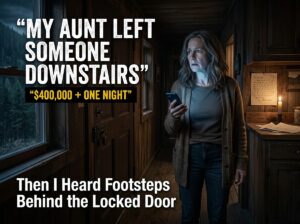
I was fifty-five when Aunt Clara died.
The news arrived on a Tuesday morning in a phone call from an attorney whose name I didn’t recognize.
For a few seconds after he introduced himself, I honestly thought he had the wrong person.
“I’m calling regarding the estate of Clara Bennett,” he said.
I stood beside my kitchen window, staring at the rain sliding down the glass.
I hadn’t heard Clara’s name spoken by a stranger in years.
“I’m sorry,” I said. “Who?”
There was a pause.
“Clara Bennett. Your aunt.”
“I know who she is.”
The words came out more sharply than I intended.
The attorney cleared his throat.
“My name is Richard Hale. I represent your aunt’s estate. She passed away several days ago.”
I closed my eyes.
Several days ago.
And somehow, that small sentence pulled seventeen years of memories out of a place I had tried very hard to keep locked away.
Clara had been my father’s younger sister.
When I was a child, she was the unusual aunt.
She never married.
She lived alone.
She spent long stretches of time away from the family and seemed happiest when she was somewhere no one else wanted to be.
Her favorite place had always been the mountains.
She owned a remote cabin several hours from the town where I grew up.
When I was young, I loved that cabin.
It smelled of pinewood, old books, coffee, and smoke from the stone fireplace.
Clara would take me hiking when I visited.
She taught me how to identify animal tracks in the mud.
She showed me how to split firewood.
She once told me that the mountains had a way of exposing people.
“You can pretend to be someone else in a city,” she had said.
“But not up here?”
“Not for long.”
I remembered laughing.
Back then, I thought she was simply being dramatic.
Then came the argument.
I was thirty-eight.
My father had already passed away.
My mother was struggling with the loss.
There had been an issue involving money, family property, and something Clara believed my father had done before his death.
I had defended my father.
Clara had accused me of refusing to see the truth.
The argument had become vicious.
Words were said that neither of us could take back.
She told me never to contact her again.
I told her I didn’t intend to.
Seventeen years passed.
Neither of us apologized.
Neither of us called.
There were birthdays.
Christmases.
Deaths in the family.
Illnesses.
Still nothing.
So when Richard Hale told me Clara had left me something, my first reaction wasn’t grief.
It was confusion.
“What did she leave me?”
“A property.”
I frowned.
“What kind?”
“A cabin.”
I looked toward the window.
For a moment, I could smell pine again.
“How much?”
There was another pause.
“Four hundred thousand dollars.”
I actually laughed.
Not because it was funny.
Because it was impossible.
“I’m sorry?”
“Your aunt left you the cabin and four hundred thousand dollars in cash assets.”
I sat down.
My aunt had never been wealthy.
At least, that’s what I had believed.
She had lived simply.
She drove old vehicles.
She repaired things instead of replacing them.
She rarely bought anything she didn’t need.
Apparently, she had also accumulated a substantial amount of money without anyone in the family realizing it.
“What do I have to do?”
Richard became quiet.
“There is one condition.”
Of course there was.
“What condition?”
“You must spend exactly one night at the cabin.”
I stared at the rain.
“One night?”
“Yes.”
“That’s it?”
“That’s it.”
“Why?”
“I don’t know.”
“You’re her attorney.”
“I was her attorney. I can tell you what the will says. I cannot tell you why she chose those terms.”
“How remote is this cabin?”
“Very remote.”
I sighed.
“Can I take someone with me?”
“No.”
That answer came too quickly.
“What?”
“The will specifically states that you must spend one night there alone.”
I rubbed my forehead.
I almost refused.
Four hundred thousand dollars was a lot of money, but it wasn’t worth reopening seventeen years of resentment.
Then I remembered the cabin.
The last time I had been there, I was thirty-eight.
Clara had stood on the porch while I walked away.
I hadn’t looked back.
Perhaps that was why I agreed.
Not for the money.
Not entirely.
I wanted to see the place one more time.
Maybe I wanted to understand why she had chosen me.
Maybe I simply wanted to finish something that had been unfinished for seventeen years.
Richard mailed me the documents.
The deed.
The will.
The instructions.
And a key.
At the bottom of the page was a handwritten note.
One sentence.
Spend the night.
Nothing more.
I read it several times.
I recognized Clara’s handwriting immediately.
Sharp.
Controlled.
Almost severe.
I placed the documents on my kitchen table.
For the next few days, I tried not to think about them.
That didn’t work.
Every night, I found myself imagining the cabin.
The old fireplace.
The narrow stairs.
The trees pressing close to the windows.
And the basement.
I remembered there had always been a basement.
Clara never liked me going down there.
When I was a child, I had once asked what was inside.
She had looked at me strangely.
“Nothing you need to worry about.”
At the time, I thought she was simply being protective.
Seventeen years later, I was beginning to wonder.
Last Tuesday, I packed a bag.
Then I drove up the mountain.
Part 2
The road became narrower after the final town.
Cell service disappeared almost twenty minutes later.
I noticed because my phone changed from two bars to one.
Then none.
I laughed quietly.
“Perfect.”
The road climbed steadily.
Trees surrounded me on both sides.
The farther I drove, the less evidence there was that anyone else lived nearby.
No houses.
No stores.
No streetlights.
Only mountains, trees, rock, and the occasional wooden sign pointing toward a trail or private road.
I remembered the route.
Not perfectly.
But enough.
Clara’s cabin was another thirty minutes beyond the last paved road.
When I finally turned onto the gravel road, my hands tightened around the steering wheel.
The road was rougher than I remembered.
Branches reached over the windshield.
The tires slipped slightly on loose stones.
Then, around a bend, I saw it.
The cabin.
It looked smaller.
That was the first thing I noticed.
When I was a child, the building had seemed enormous.
Now it looked almost fragile against the mountain.
Dark wooden siding.
Stone chimney.
A narrow porch.
Two windows facing the forest.
The roof needed work.
The gutters were filled with leaves.
But otherwise, it looked almost exactly as I remembered.
I parked beside the cabin.
For several seconds, I didn’t get out.
The engine ticked as it cooled.
The mountain was silent.
Not peaceful.
Silent.
There was a difference.
I opened the door.
Cold air rushed inside.
I stepped onto the gravel.
Then I looked toward the porch.
Clara’s old rocking chair was still there.
I remembered sitting in it as a teenager while she chopped vegetables in the kitchen.
“You’re thinking too much,” she had told me once.
“I wasn’t thinking.”
“You were staring at the forest.”
“Maybe I like looking at trees.”
“That’s thinking.”
I smiled despite myself.
Then the memory disappeared.
I unlocked the door.
The cabin smelled exactly the same.
Wood.
Dust.
Old fabric.
Pine.
And underneath everything, the faint scent of smoke.
I set my bag down.
The electricity worked.
The refrigerator hummed.
A small lamp near the fireplace turned on.
I walked through the rooms slowly.
The kitchen.
Living room.
Bathroom.
Two bedrooms.
The hallway.
At the end of the hallway was the basement door.
I stopped.
The door was heavier than I remembered.
It had always been painted dark brown.
Now there was a metal lock attached to it.
I touched the lock.
It was cold.
I tried the handle.
Locked.
I looked at the key ring Richard had given me.
There was only one key.
The front door key.
Nothing for the basement.
I stepped away.
Maybe Clara had changed the lock.
Maybe she had kept something downstairs.
It wasn’t my concern.
I had one night to spend there.
That was all.
I unpacked.
Around seven, I made dinner.
I found canned soup in the cupboard and bread in the freezer.
It felt strange eating Clara’s food.
She had always kept supplies stocked.
Even after seventeen years, there were things in the kitchen that seemed untouched.
A jar of coffee.
A chipped blue mug.
A wooden spoon with a crack down the handle.
I recognized them all.
After dinner, I washed the dishes.
Then I sat beside the fireplace.
I didn’t turn on the television.
There wasn’t much signal anyway.
Instead, I listened to the mountain.
Wind moved through the trees.
Occasionally, something tapped against the roof.
I checked my phone.
8:41 PM.
No service.
I opened the documents Richard had given me.
The will was straightforward.
Clara left the cabin and $400,000 to me.
There were no complicated family divisions.
No other beneficiaries mentioned in the pages I had.
Except for one paragraph.
I read it again.
The beneficiary must remain inside the property from sunset until sunrise without another person present.
I frowned.
That was more specific than Richard had made it sound.
I looked toward the windows.
Outside, darkness had settled over the mountain.
I suddenly felt very alone.
At 10:30, I went upstairs.
I checked the locks.
Front door.
Back door.
Windows.
Everything secure.
I brushed my teeth.
Changed into sweatpants.
Then climbed into bed.
For almost an hour, I couldn’t sleep.
Every sound seemed louder than it should.
The wind.
The roof.
The refrigerator downstairs.
At 11:47, I finally drifted off.
Then, at exactly midnight, the power went out.
Part 3
I woke instantly.
The cabin was completely dark.
For several seconds, I didn’t know where I was.
Then I remembered.
The mountain.
The cabin.
The inheritance.
I sat up.
The silence was enormous.
I reached for my phone on the nightstand.
No service.
The battery was at sixty-eight percent.
I turned on the flashlight.
The narrow beam cut across the bedroom.
Nothing.
I listened.
Wind.
Trees.
Then a faint creak somewhere downstairs.
I waited.
Another creak.
I told myself it was the building.
Old cabins make noises.
Wood contracts.
Pipes shift.
The roof moves in the wind.
I knew all of that.
Still, I couldn’t shake the feeling that something was wrong.
I got out of bed.
The floor was cold beneath my feet.
I grabbed my phone and walked downstairs.
The flashlight beam moved across the walls.
Family photographs.
Bookshelves.
Clara’s old coat hanging beside the door.
I reached the kitchen.
The refrigerator was silent.
The clock on the wall had stopped.
12:03.
I opened the electrical panel.
It was in the hallway beside the basement door.
I found the breaker box.
The main breaker had flipped.
I reached toward it.
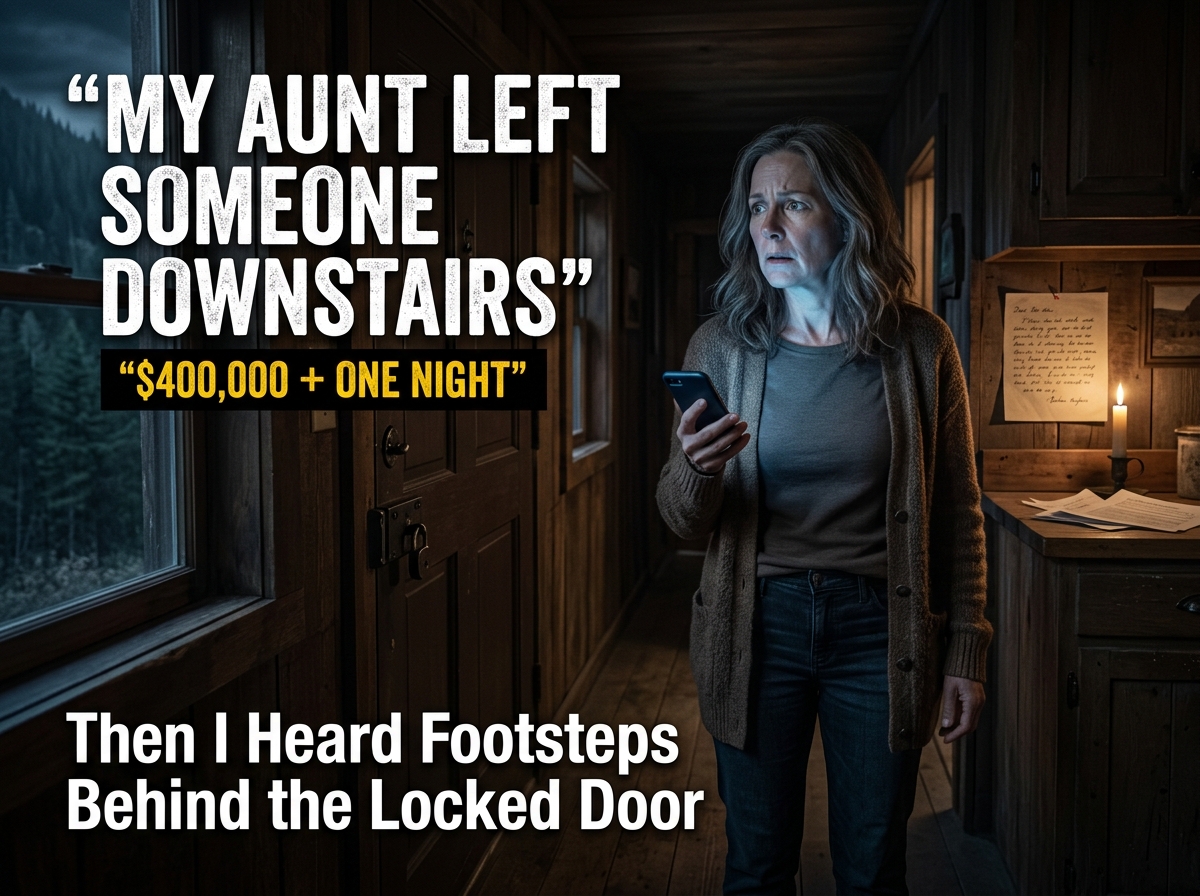
Then I heard the sound.
A footstep.
I froze.
It came from behind the basement door.
One slow step.
Then another.
I stared at the door.
My phone flashlight trembled in my hand.
Another step.
Someone was downstairs.
I knew it.
There was no mistaking it.
The basement was locked.
I had checked it.
I backed away.
My heart was pounding so hard I could feel it in my throat.
I thought about calling the police.
My thumb opened the phone.
No signal.
Of course.
I moved toward the kitchen.
Maybe I could get a signal near a window.
Maybe I could get outside.
Then my phone light swept across the counter.
Something was sitting there.
A piece of paper.
I hadn’t put it there.
I knew that.
I had cooked dinner at that counter.
I had washed dishes.
I had walked past it several times.
There had been nothing there.
Now there was an envelope.
My name was written on it.
My blood went cold.
The handwriting was Clara’s.
I picked it up.
The footsteps continued below me.
Slow.
Measured.
One.
Then another.
I opened the envelope.
Inside was a handwritten note.
If you are reading this, the power has gone out.
I stopped.
The footsteps ceased.
I looked toward the basement.
Nothing.
I continued reading.
I knew you would come alone.
I knew you would hear him.
My hands began to shake.
Him?
I read the next line.
Do not open the basement door until you know who is inside.
I looked toward the locked door.
The room seemed colder.
Then I read the final part.
The person downstairs is someone you knew.
I stared at the words.
Someone I knew.
The footsteps started again.
This time, they were directly beneath me.
I stepped backward.
The note continued.
Someone you believed was gone.
My breathing stopped.
Then Clara had written a name.
I read it once.
Then again.
My knees almost gave out.
The person downstairs was someone I thought had moved across the country a decade ago.
Someone I had not seen in years.
Someone whose disappearance from our family had always seemed strange.
And according to Clara, that person was locked beneath the cabin.
Part 4
I couldn’t move.
The name on the paper belonged to a man I hadn’t seen in more than ten years.
David Mercer.
Clara’s note didn’t explain who he was.
It didn’t need to.
I knew.
Everyone in the family had known David.
He had been close to Clara for years.
Not exactly a friend.
Not exactly a business partner.
Something in between.
He was older than me by perhaps fifteen years.
When I was young, he sometimes came to the cabin.
Clara trusted him.
Or at least, she appeared to.
Then, after the family argument, David disappeared from our lives too.
I remembered hearing that he had moved west.
Colorado, perhaps.
Or Oregon.
The details had never mattered.
What mattered was that he was gone.
And now Clara had written his name on a piece of paper and left it on the kitchen counter.
Inside a cabin in the middle of nowhere.
While footsteps came from the locked basement.
I looked at the basement door.
“David?”
Silence.
I stepped closer.
The footsteps stopped.
“David, is that you?”
Nothing.
I pressed my ear against the door.
For several seconds, I heard nothing.
Then came three knocks.
Slow.
Deliberate.
I stepped backward.
Three knocks again.
I looked at Clara’s note.
Do not open the basement door until you know who is inside.
But I already knew.
Or I thought I did.
The problem was that knowing a name wasn’t the same as knowing the truth.
I went back to the kitchen.
I searched the drawers.
Nothing.
Then I noticed a small metal flashlight beside the sink.
It wasn’t mine.
I picked it up.
It worked.
Underneath it was another folded piece of paper.
I opened it.
There was only one sentence.
He owes them more than money.
I stared at the words.
Who were “they”?
What had David done?
And why had Clara hidden him here?
I remembered the family argument.
At the time, I had thought Clara was angry because of money.
But maybe money had never been the real issue.
Maybe she had been trying to warn us.
Maybe I had been too angry to listen.
The basement door rattled.
I jumped.
Someone had grabbed the handle from the other side.
I backed away.
“David?”
A voice answered.
It was weak.
“Please.”
I froze.
I knew that voice.
It was older.
Rougher.
But I knew it.
David.
I moved closer.
“What happened?”
“Don’t open the door.”
His voice was barely audible.
I stopped.
“You just told me not to open it.”
“I mean it.”
“Why?”
Silence.
Then:
“They’re looking for me.”
I swallowed.
“Who?”
Another pause.
“I can’t tell you.”
I almost laughed.
The entire night had become absurd.
“Clara left me four hundred thousand dollars to spend one night here. The power goes out, I hear someone in the basement, and now you’re telling me dangerous people are looking for you.”
David said nothing.
I looked at Clara’s note.
Then at the locked door.
“What did you do?”
“I didn’t do what they think I did.”
“Who are they?”
“People you don’t want to meet.”
“David.”
His breathing sounded uneven.
“Listen to me.”
“I am listening.”
“If Clara gave you that money, take it.”
I stared at the door.
“What?”
“Take the money and leave.”
“I can’t.”
“You can.”
“The will says I have to stay until morning.”
“Then stay away from the basement.”
“Why did Clara lock you down there?”
He didn’t answer.
“David?”
Still nothing.
Then I heard him whisper:
“She was protecting me.”
I closed my eyes.
Suddenly, I remembered Clara’s words from seventeen years earlier.
You don’t know what you’re defending.
At the time, I had thought she was talking about my father.
Now I wasn’t so sure.
I walked away from the basement.
I needed to think.
But before I could reach the kitchen, headlights appeared through the window.
A vehicle was coming up the mountain road.
Part 5
I killed the flashlight.
The cabin disappeared into darkness.
Outside, headlights moved slowly between the trees.
One vehicle.
Then it stopped.
I stood completely still.
David had said they were looking for him.
Now someone was outside.
I moved toward the window and crouched beneath it.
The headlights remained on.
I couldn’t see the vehicle clearly.
Only the shape.
A dark SUV.
The engine idled.
My phone was still in my hand.
No service.
I looked toward the basement.
“David.”
No answer.
I whispered again.
“David, someone is outside.”
This time he responded.
“I know.”
“How?”
“I heard them.”
I felt a cold sensation move through my chest.
“How long have you been down there?”
No answer.
I tried the basement handle.
Locked.
“Clara locked you in.”
“Yes.”
“Why?”
“To keep them from finding me.”
“But they know you’re here.”
“I don’t think they know.”
“Then why are they here?”
Silence.
The SUV’s engine shut off.
A door opened.
I heard footsteps outside.
One.
Two.
Three.
Then they stopped.
Someone was standing near the cabin.
I backed away from the window.
David whispered from below.
“Don’t turn on any lights.”
I didn’t.
The cabin remained black.
A shadow moved past the window.
Then disappeared.
I could hear my own breathing.
A few seconds later, there was a knock on the front door.
Three slow knocks.
Exactly like the basement.
I didn’t move.
Another knock.
Then a man’s voice.
“Hello?”
I remained silent.
“Anyone home?”
The voice sounded calm.
Almost friendly.
That made it worse.
I looked at the basement door.
David was silent.
The man outside knocked again.
“We know someone is here.”
I felt my stomach tighten.
I stepped backward.
Then I remembered Clara’s note.
I searched the kitchen counter.
There was another piece of paper underneath the first.
I opened it.
If they arrive, do not answer.
I stared at the sentence.
The front door handle moved.
Someone tried to open it.
The lock held.
I moved toward the back door.
Maybe I could leave through there.
David spoke.
“No.”
I stopped.
“What?”
“They’re watching the back.”
“How do you know?”
“I saw them arrive.”
“You can see outside?”
“Not directly.”
He sounded exhausted.
“They told me they would find me.”
I whispered:
“Who are they?”
David finally answered.
“The people I owe.”
“Owe what?”
“Money.”
“How much?”
He laughed bitterly.
“Enough that four hundred thousand dollars wouldn’t save me.”
I thought about Clara’s inheritance.
Why four hundred thousand?
Why me?
Why this cabin?
The man outside spoke again.
“We’re not here for you.”
I froze.
The voice came through the door.
“We’re here for David.”
My heart dropped.
I looked at the basement.
The man continued.
“Tell him Clara is dead.”
I didn’t respond.
“We know she left you the cabin.”
I felt my blood run cold.
How did they know?
“We know about the money too.”
I stepped away from the door.
David whispered:
“They’re lying.”
“How do you know?”
“Because if they knew the truth, they wouldn’t be talking to you.”
I looked at the envelope.
The note.
The basement.
The money.
Everything was connected.
Then the man outside said something that made me realize just how much Clara had anticipated.
“Your aunt knew this night would happen.”
I stared at the door.
The footsteps outside moved away.
The SUV engine started.
I waited.
The vehicle slowly disappeared down the mountain road.
Only when the sound faded did I breathe.
I returned to the basement.
“David.”
He didn’t answer.
“David, they’re gone.”
Silence.
I tried the handle.
Locked.
“David?”
Then I heard something fall.
A heavy thud.
I froze.
“David!”
Nothing.
I searched for the key.
There had to be one somewhere.
I opened every drawer.
Every cabinet.
Nothing.
Then I remembered Clara’s note.
She had left the message on the counter.
Maybe she had left more.
I returned to the kitchen.
Under the table was a small wooden box.
Inside was a key.
I held it up.
My hand trembled.
I knew what it was for.
The basement.
Part 6
I stood in front of the basement door for nearly a minute.
The key was cold in my hand.
I could unlock the door.
I could find out who David had become.
I could find out why Clara had hidden him.
I could find out why dangerous people were searching for him.
But Clara had specifically told me not to open it until I knew who was inside.
Now I knew.
At least, I believed I did.
I inserted the key.
The lock turned.
The sound seemed impossibly loud.
I opened the door.
A staircase disappeared into darkness.
I pointed the flashlight downward.
The beam revealed concrete walls, old shelves, and a narrow floor.
“David?”
No answer.
I stepped down.
The air was colder.
The basement smelled like damp stone.
At the bottom, I saw a chair.
Then a table.
Then a man sitting against the wall.
David.
He looked nothing like the man I remembered.
His hair had turned gray.
His face was thinner.
There were deep lines around his eyes.
He looked exhausted.
But he was alive.
I stopped several feet away.
“David?”
He looked at me.
For a long moment, neither of us spoke.
Then he said:
“You shouldn’t have come.”
I almost laughed.
“Apparently, nobody wanted me to come.”
He lowered his eyes.
“I mean it.”
“Clara left me four hundred thousand dollars to come here.”
“I know.”
“How?”
“She told me.”
I stared at him.
“She knew you were going to inherit the cabin?”
“Yes.”
“When?”
“Months ago.”
“Why didn’t she tell me?”
“Because she didn’t know if you would come.”
I looked around the basement.
“Why were you locked down here?”
“Because it was the only place they wouldn’t search immediately.”
“They came here.”
“Yes.”
“They knew about the cabin.”
“They knew Clara had something.”
“What?”
David looked at me.
“Evidence.”
“What kind?”
He didn’t answer.
I crouched beside the table.
There was a folder.
I picked it up.
David immediately said:
“Don’t.”
I stopped.
“What is it?”
“Something that can get people killed.”
I stared at the folder.
“What did Clara know?”
David looked toward the ceiling.
“She knew who they were.”
“Who?”
“A group of people who have been moving money through businesses for years.”
I waited.
“They use legitimate companies as fronts. They pressure people into carrying debts. When someone can’t pay, they don’t simply take the money.”
“What do they do?”
David’s expression hardened.
“They make sure the person disappears from their lives.”
I thought about his supposed move across the country.
“You didn’t move.”
“No.”
“You hid.”
“Yes.”
“For ten years?”
“Almost.”
I sat down.
“Why?”
“Because I owed them.”
“How much?”
David told me.
The amount was enormous.
I understood then why he had disappeared.
But I still didn’t understand Clara.
“Why did she help you?”
David looked at me.
“Because she knew I wasn’t the person they thought I was.”
“What does that mean?”
“I was working with them.”
I stared at him.
“Then I tried to leave.”
“And they wanted their money.”
“They wanted more than that.”
“What?”
David looked toward the basement door.
“Names.”
I didn’t understand.
“Names of people who had helped them.”
“And Clara?”
“She found out.”
“How?”
“She had records from the hardware business.”
I frowned.
“My aunt’s hardware store?”
David nodded.
“Your grandfather’s business?”
“Yes.”
“My father?”
“No.”
He looked at me carefully.
“Your father was never involved.”
That sentence hit me harder than I expected.
For seventeen years, I had believed Clara’s accusations had something to do with my father.
But maybe I had misunderstood everything.
“What was the argument about?”
David hesitated.
“Clara wanted you to know.”
“Know what?”
“That your father had been trying to protect her.”
I stared at him.
The room seemed to tilt.
“What?”
“She believed someone was using the family business.”
“Who?”
David didn’t answer.
Instead, he pointed toward the folder.
“Clara left the evidence.”
I opened it.
Inside were bank records.
Names.
Dates.
Transactions.
Photographs.
Letters.
Everything was organized.
My aunt had spent years documenting something.
I looked at David.
“Why did she leave all this to me?”
He lowered his head.
“Because she trusted you.”
“After seventeen years of not speaking?”
“She never stopped caring about you.”
I looked away.
For the first time since arriving, I felt something other than fear.
I felt grief.
I had spent seventeen years believing Clara had chosen to abandon me.
Maybe she had been trying to protect me.
Then I heard something upstairs.
A floorboard creaked.
David looked at me.
Neither of us moved.
Another sound.
Someone was inside the cabin.
Part 7
We stayed completely silent.
The footsteps above us moved slowly.
One step.
Then another.
David reached for my arm.
“Turn off the flashlight.”
I did.
The basement disappeared into darkness.
Someone walked across the floor above.
I heard the kitchen floor creak.
Then the living room.
Then the hallway.
The person stopped above us.
I could hear breathing.
David leaned toward me.
“They came back.”
My heart hammered.
“How?”
“I don’t know.”
The footsteps moved toward the basement door.
I held my breath.
The handle turned.
The door didn’t open.
The person tried again.
Then stopped.
A long silence followed.
Finally, footsteps moved away.
David whispered:
“They’re waiting.”
“For what?”
“For us to come out.”
I looked at the folder.
The evidence Clara had left.
The money.
The will.
The strange condition.
None of it was random.
She had known someone might come.
Maybe she had known exactly who.
We waited.
Ten minutes.
Twenty.
Nothing.
Eventually, I whispered:
“What if they leave?”
“They might.”
“What if they don’t?”
David didn’t answer.
Then I noticed something on the wall.
A small wooden panel.
I moved toward it.
David whispered:
“What are you doing?”
I touched the panel.
It moved.
Behind it was a narrow passage.
I looked at him.
“You knew about this?”
“No.”
We opened it carefully.
The passage was barely wide enough for one person.
It led toward the rear of the cabin.
There was a small exit hidden behind a stack of old firewood.
Clara had built an escape route.
I suddenly understood why she had chosen this place.
She had prepared for emergencies.
Maybe for years.
We crawled through.
Cold air touched my face.
We emerged behind the cabin.
The forest was dark.
The vehicle was gone.
I looked back.
No one was visible.
David followed.
He stood beside me.
“I need to leave,” he said.
“Where?”
“Anywhere.”
“You can’t just disappear again.”
“I have no choice.”
I thought about Clara.
“No.”
David looked at me.
“No?”
“You owe me answers.”
He looked exhausted.
“I’ve given you enough.”
“You gave me fragments.”
“That may be all you get.”
I held up the folder.
“What is this?”
“The reason Clara died afraid.”
I froze.
“What do you mean?”
David looked toward the cabin.
“She knew they were coming.”
“When?”
“Before she died.”
“Did they kill her?”
He shook his head.
“No.”
“Then what happened?”
“She was sick.”
I stared at him.
“Then why were you hiding here?”
“Because she knew they would come looking for what she had.”
I looked down at the documents.
“Why me?”
David didn’t answer immediately.
Finally he said:
“Because they don’t know what Clara left you.”
“They know about the money.”
“They know about the money.”
“But not the evidence.”
“No.”
“Then why did Clara make me spend the night?”
David looked at me.
“To make sure you saw the truth before they could take it from you.”
I felt a chill.
“What truth?”
He pointed toward the folder.
“Read the last page.”
I opened it.
The final document was a handwritten letter.
Clara’s handwriting.
I read the first line.
I am sorry for the seventeen years.
My vision blurred.
She continued.
I thought distance would keep you safe.
It didn’t.
I thought silence would protect you.
It didn’t.
And then came a sentence that changed everything.
The family argument was never about what you thought it was about.
I stopped reading.
David watched me.
“What did she mean?”
He shook his head.
“Keep reading.”
I did.
Clara explained that she had tried to expose the people connected to the financial records.
She had believed the danger would pass.
It didn’t.
She had cut contact with me because she believed they were watching the family.
She had let me hate her because hatred was safer than knowing the truth.
I closed the letter.
For seventeen years, I had carried anger toward a woman who might have been carrying fear.
Then something caught my attention.
A name appeared repeatedly in the documents.
A name I recognized.
Someone who had been part of our family life.
Someone I had trusted.
I stared at it.
David looked at my face.
“You know him.”
I nodded.
“I do.”
Part 8
The name belonged to a man I had known for most of my adult life.
Someone who had attended family dinners.
Someone who had spoken at my father’s funeral.
Someone I had never once considered dangerous.
I read the documents again.
His name appeared beside dates.
Companies.
Transfers.
Meetings.
At first, I tried to explain it away.
There could be another person with the same name.
There had to be.
But the addresses matched.
The company matched.
Even the signature on one document looked familiar.
I sat on the ground behind the cabin.
David stood several feet away.
“Now you understand,” he said.
“I don’t.”
“You do.”
I looked at him.
“You knew?”
“Yes.”
“For how long?”
“Years.”
“Why didn’t you tell me?”
“Because I didn’t know who I could trust.”
I looked toward the mountain.
The sky was beginning to lighten.
Morning was approaching.
The one night I had been required to spend here was almost over.
But I didn’t feel relief.
I felt as though my entire understanding of my family had been dismantled in a few hours.
Clara.
My father.
David.
The argument.
The money.
The cabin.
Everything connected.
I returned inside.
The power was still out.
I lit the candle again.
The small flame moved with the draft.
On the kitchen counter was Clara’s original note.
I read it one more time.
The person downstairs is someone you knew.
Someone you believed was gone.
That had been the truth.
But there had been another truth underneath it.
Clara hadn’t simply wanted me to discover David.
She wanted me to understand why he had been there.
Why she had protected him.
Why she had hidden the evidence.
And why she had left everything to me.
David entered the kitchen.
“You need to leave before sunrise.”
“Why?”
“Because if they come back, you won’t have the darkness to hide in.”
I looked at him.
“Are you leaving?”
“Yes.”
“Where?”
“I don’t know.”
“You can’t keep running.”
“I’ve been doing it for ten years.”
“And has it worked?”
He smiled bitterly.
“I’m alive.”
“That isn’t the same thing.”
“No.”
We stood silently.
Then I asked the question I had been avoiding.
“Why did Clara trust you?”
David looked down.
“Because I told her the truth.”
“What truth?”
“That I was afraid.”
I waited.
He continued.
“I spent years pretending I was smarter than them. Stronger than them. I thought I could take their money, use their connections, and walk away whenever I wanted.”
He shook his head.
“I was wrong.”
“What happened?”
“I realized too late that once you owe people like that, the debt isn’t about money.”
I thought about the note.
He owes them more than money.
“What did you owe them besides money?”
David looked toward the folder.
“Loyalty.”
The word sat heavily between us.
I understood.
Clara had helped him because she believed he was trying to leave.
She had hidden him because she knew what would happen if they found him.
And she had chosen me because she believed I was the one person who could be trusted with what remained.
I looked at the clock.
5:41 AM.
Almost sunrise.
I had survived the night.
But I hadn’t claimed the inheritance yet.
I hadn’t decided whether I even wanted it.
The four hundred thousand dollars suddenly felt insignificant.
There were more important things now.
I wanted to know why Clara had waited seventeen years.
I wanted to know whether my father had known.
I wanted to know how deep the family’s connection to those people really went.
And I wanted to know why someone who had supposedly moved across the country had spent years hiding in my aunt’s basement.
David picked up his coat.
“It’s time.”
I nodded.
He moved toward the hidden exit.
Before he left, he turned around.
“There is one thing Clara never told you.”
“What?”
“She didn’t choose this cabin because it was remote.”
I waited.
“She chose it because nobody would think to look here.”
“Look for what?”
David glanced at the folder.
“For the person who had been hiding in plain sight.”
Then he disappeared into the trees.
Part 9
I remained inside the cabin after David left.
I didn’t follow him.
Partly because I knew I couldn’t.
Partly because I was exhausted.
And partly because I was finally beginning to understand the reason Clara had made me spend the night alone.
She hadn’t wanted someone else to explain the truth to me.
She wanted me to discover it.
The sun rose slowly behind the mountains.
Gray light entered through the windows.
The cabin looked completely different in daylight.
Less frightening.
More ordinary.
That almost made everything worse.
I made coffee.
Then I sat at Clara’s kitchen table.
For the first time in seventeen years, I allowed myself to think about our argument without anger.
I remembered her face.
The way she had looked at me.
The things she had tried to say.
The things I refused to hear.
I had spent years believing she had chosen money over family.
Now I wasn’t sure that was true.
Maybe she had chosen silence because she thought it would keep me alive.
Maybe she had expected me to hate her.
Maybe that was the price she accepted.
I opened her letter again.
The final paragraph was still unread.
I had stopped before the last page because David interrupted me.
Now I continued.
Clara wrote that she had never stopped watching over me.
She knew where I lived.
She knew when I married.
She knew when my children were born.
She had never contacted me.
She believed contact would put me at risk.
The words were difficult to read.
Not because they were complicated.
Because they were simple.
She had been there.
From a distance.
The entire time.
I closed my eyes.
For seventeen years, I had believed I was abandoned.
Maybe I had been protected.
I don’t know which possibility hurt more.
At the bottom of the letter, Clara had written:
If you hate me after reading this, I will understand.
If you forgive me, I will be grateful.
But neither matters as much as you knowing why.
I put the letter down.
The cabin was silent.
Then I heard something outside.
A vehicle.
I stood.
The sound came from the mountain road.
I looked through the window.
A truck was approaching.
I couldn’t tell who was driving.
The vehicle stopped near the gate.
I stepped away from the window.
My heart started racing again.
But the truck didn’t move.
A few seconds later, a man stepped out.
He wasn’t one of the men from the previous night.
He was older.
Gray hair.
Work jacket.
He walked slowly toward the cabin.
I opened the door before he reached it.
He stopped.
“You’re Clara’s nephew.”
It wasn’t a question.
“Yes.”
He nodded.
“My name is Frank.”
I didn’t recognize him.
“Did Clara send you?”
“No.”
He looked toward the cabin.
“I heard she died.”
“Yes.”
“I knew her for thirty years.”
He seemed uncomfortable.
Then he said something that made me step aside.
“She wanted me to tell you something if you ever came here.”
“What?”
He looked directly at me.
“She said you would probably be angry.”
I almost smiled.
“She was right.”
Frank nodded.
“She said you would think she had wasted your inheritance on some old cabin.”
“I did.”
“She said you would eventually understand.”
I looked at him.
“What did she want you to tell me?”
Frank hesitated.
“She said the cabin wasn’t the inheritance.”
I frowned.
“What does that mean?”
“The money isn’t the inheritance either.”
“Then what is?”
Frank looked toward the basement.
“The truth.”
I said nothing.
He continued.
“Clara believed money could be replaced.”
He tapped his chest.
“But once a family loses the truth, it can spend generations believing the wrong story.”
I thought about my father.
The argument.
Seventeen years.
Everything I had believed.
Frank handed me a small envelope.
“She told me to give you this only after sunrise.”
I opened it.
Inside was a photograph.
It showed Clara standing beside my father.
They were much younger.
On the back was a date.
The same year as the argument.
And beneath it, Clara had written:
He was trying to tell you.
My hands shook.
I looked at Frank.
“Tell me what?”
Frank shook his head.
“That part is yours to discover.”
Then he turned toward his truck.
“Wait.”
He stopped.
“Who was Clara afraid of?”
He looked at me for a long moment.
“People who don’t like being remembered.”
Then he drove away.
I stood on the porch.
The mountain was bright now.
Birds had begun to sing.
The night was over.
But I knew my life had changed.
I folded Clara’s letter.
I put the photograph into the folder.
Then I looked at the cabin.
I finally understood why she had left it to me.
It wasn’t simply a property.
It was the place where she had hidden the truth until I was ready to see it.
I wasn’t ready to forgive her.
Not yet.
I wasn’t ready to understand everything.
Not yet.
But I was ready to stop believing the story I had told myself for seventeen years.
I picked up my bag.
Before leaving, I walked toward the basement.
The door was open.
The room was empty.
David was gone.
But on the floor was one final piece of paper.
I picked it up.
It contained only one sentence.
You were never supposed to find him.
I stared at the words.
Then I looked toward the mountain road.
Someone had expected me to come.
Someone had expected David to remain hidden.
And someone had expected Clara’s secret to stay buried.
I folded the paper.
Then I walked outside.
Part 10
I drove down the mountain without stopping.
The cabin disappeared behind the trees.
For seventeen years, I had believed my relationship with Clara ended the night we argued.
I was wrong.
It had simply changed.
She had disappeared from my life, but she had never disappeared completely.
She had watched.
She had worried.
She had prepared.
And when she knew she was running out of time, she had left me a trail.
Not an explanation.
A trail.
Four hundred thousand dollars.
A remote cabin.
One night alone.
A locked basement.
A man I believed had moved across the country.
And a truth about my family that I had spent seventeen years refusing to question.
By the time I reached the bottom of the mountain, the sun was fully up.
My phone finally received service.
Messages flooded onto the screen.
Missed calls.
Emails.
Notifications.
But I ignored them.
I parked beside a small roadside café and sat in the car.
I thought about calling the attorney.
I thought about calling the police.
I thought about calling my children.
Instead, I opened Clara’s final letter.
I read every word again.
She had known I might never forgive her.
She had accepted that.
She hadn’t left the money because she thought I deserved it.
She had left it because she wanted me to have the freedom to decide what to do with the truth.
That was the real inheritance.
Not the cabin.
Not the four hundred thousand dollars.
The truth.
I finally understood why the will had required exactly one night.
If Clara had simply mailed me the documents, I might have thrown them away.
If she had called me, I might have refused to listen.
But by making me enter that cabin alone, she had forced me to confront the past without anyone else telling me what it meant.
She had given me one night to remember her.
One night to question everything.
One night to open the door.
And one night to discover the person she had hidden downstairs.
David had vanished again by sunrise.
I didn’t know whether I would ever see him.
I didn’t know whether he would survive.
I didn’t know who the dangerous people were or how far their influence reached.
I didn’t know what my father had tried to tell me seventeen years ago.
And I still didn’t know exactly why Clara had believed the truth would put me in danger.
But I knew something I hadn’t known when I drove up that mountain.
Clara had not forgotten me.
Not for one day.
The anger I had carried for seventeen years didn’t disappear immediately.
It didn’t transform into forgiveness.
Real life doesn’t work that neatly.
But it became something else.
A question.
And for the first time, I was willing to ask it.
I drove toward home.
The cabin was now behind me.
The money would eventually clear.
The deed would become mine.
The attorney would explain the legal details.
There would be phone calls.
Questions.
Decisions.
Perhaps consequences.
But none of that mattered yet.
Because there was one thing I could no longer ignore.
Clara had written a name on a piece of paper in the middle of the night.
A name belonging to someone I thought had moved across the country a decade ago.
Someone who had spent years hiding.
Someone who owed a dangerous group of people a tremendous amount of money.
And she had locked him downstairs because she believed the cabin was the only place where he could survive.
I had arrived expecting to spend one lonely night collecting an inheritance from a woman I had hated for seventeen years.
Instead, I left with something far more complicated.
A family secret.
A locked basement.
A man who had disappeared.
And a question my aunt had carried until the day she died.
Who could be trusted?
I didn’t have the answer yet.
But I was finally ready to look for it.