The building on Weller Street has four apartments, a slate roof that has been dying since the Clinton administration, and a front stoop I have swept nearly every Saturday morning for thirty years. I bought it in 1994, when I was thirty-six and my wife, Carol, was thirty-four and we had more hope than money. The previous owner numbered the units 1A, 1B, 4A and 4B, for reasons nobody ever explained, and I never bothered to fix it. Some things come with the mortgage.
I’m sixty-six now. Carol has been gone eight years. I still fix the boiler myself when I can, and I still wake at two every morning like a man whose alarm clock lives inside his ribs, which is how I came to spend so many nights driving past my own property in the dark.
Gregory Marsh rented 4B in the spring of 2021. He was in his forties, tall and a little stooped, with a trimmed beard going gray at the chin and the careful, tired eyes of a man who has learned not to take up more room than he’s been given. He shook my hand like he was being polite to a stranger’s dog. Then he told me what he wanted.
“I’d like to pay the first year up front. Cash.” He set an envelope on my kitchen table. Eighteen thousand dollars, in hundreds. “And I need you to promise me something. You don’t come into the unit. Not for inspections, not for repairs. Not unless I ask you to.”
I told him that wasn’t how leases worked. He said he understood. I told him I had a legal right of entry, and he said he’d sign any waiver I liked. I told him it sounded like the kind of arrangement that ended with a body in a bathtub. He didn’t smile.
“Mr. Brennan,” he said, “I’m not asking you to trust me. I’m asking you to keep your word. I was told you were a man who did.”
I should have asked who told him. But I was looking at eighteen thousand dollars and thinking about the bucket in 1B that caught rain every time it stormed, and the roofer who had quoted me sixteen-five.
I took the money. I shook his hand. I promised.
For three years, he was the best tenant I ever had. The rent came early, every month. No noise, no visitors, no complaints from the neighbors. Mrs. Pruitt in 1B, who has an opinion on everything, said she’d barely seen him. The only thing I ever noticed was the light. On my sleepless drives, around three in the morning, I would slow down in front of the building and see it: one yellow window on the top floor, glowing behind a curtain. Every night. Every single night, for three years. I told myself he was an insomniac like me, and it was a small comfort. Somebody else was awake.
Two weeks ago, the phone rang at seven in the morning. A deputy from a sheriff’s office in Tennessee, a woman with a soft, professional voice. Gregory Marsh had been found dead in his car, in the parking lot of a hospital in Nashville. He had no family listed anywhere. On every form in his wallet, under *emergency contact,* was my name and my number.
“Mr. Brennan,” she said, “I need someone to come identify his belongings.”
I said I would. Then I hung up and sat at my kitchen table for a long time, looking at my hands.
The next morning, before I drove south, I took my ring of keys and went to the building. I told myself I only wanted to know what I’d be walking into. I stood outside 4B for a full minute. Three years is a long time to keep a promise to a man you barely knew. But he was gone, and I was the only name he had.
I put the key in the lock, and for the first time in three years, I broke my word.
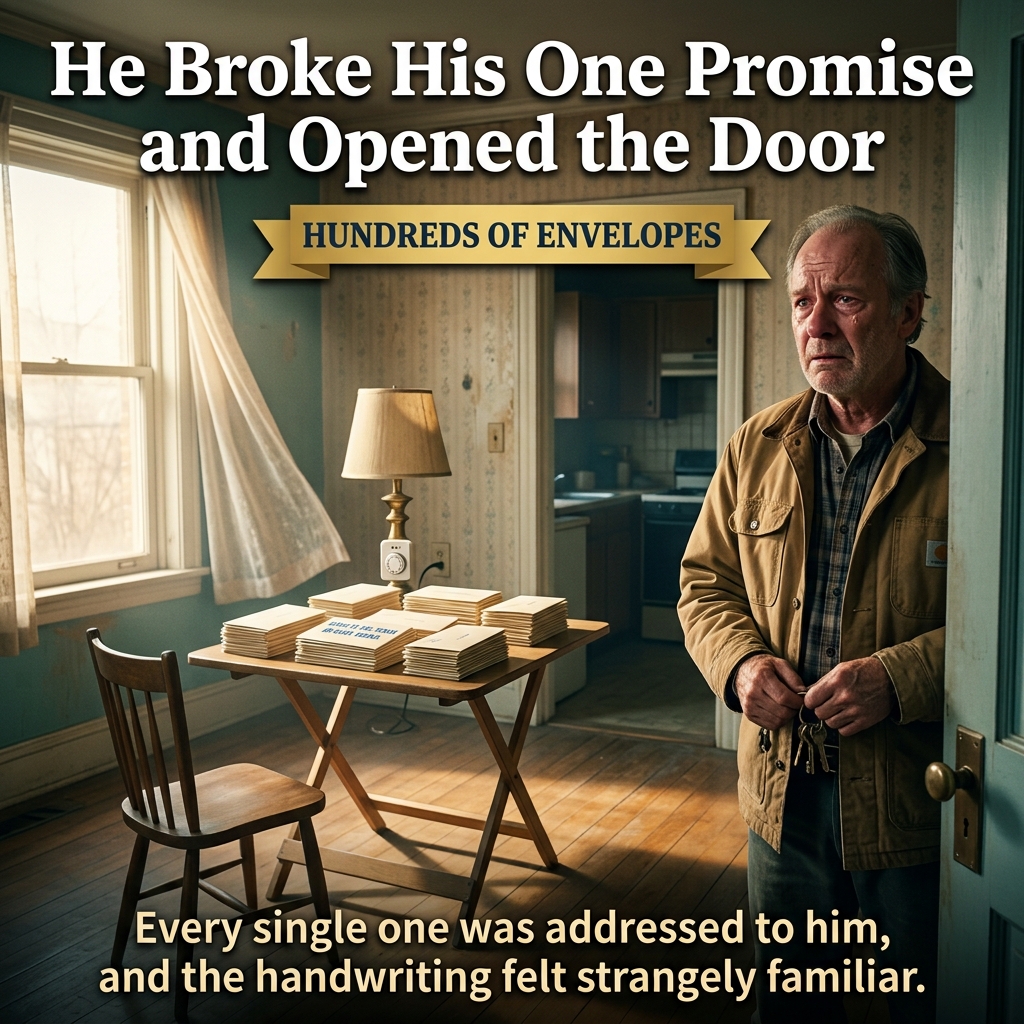
The door swung open on a room flooded with pale morning light. It was empty, almost. In the center stood a folding table, a single wooden chair, and a lamp. And on the table, in neat squared-off stacks, were hundreds of envelopes.
I walked closer. The one on top was cream-colored, and in careful blue block capitals it said *MR. HAROLD BRENNAN.* So did the one beneath it. And the one beneath that.
Every last one of them was addressed to me.
And I knew that handwriting. I just couldn’t think from where.
Part 2
I don’t know how long I stood there. Long enough for the furnace in the basement to cycle on and off beneath my feet.
I made myself walk through the rest of the apartment, the way a man checks a house after he hears a noise. The kitchen held a kettle, one mug, one spoon. The refrigerator was unplugged, its door propped open with a folded dish towel. In the bedroom, a thin mattress leaned against the wall, and beside it sat a zipped duffel bag and a pair of work shoes lined up with their toes touching the baseboard.
That was all. Three years, eighteen thousand dollars, and a man who had left behind less than a college kid carries into a dorm. It didn’t look like a place where someone had lived. It looked like a place where someone had *waited.*
I went back to the living room. The lamp sat at the corner of the folding table, an ordinary brass thing with a cloth shade, the kind you find in any thrift store. It was plugged into a little white timer, the sort you buy at the hardware store for two dollars to make a house look occupied while you’re on vacation. The pins on the dial were set to come on at three and go off at four.
I stared at it. Every night for three years, at three in the morning, I had driven past that window and felt a small, silly kinship with a man who couldn’t sleep. And he hadn’t been sleeping, or not sleeping, or anything at all. He hadn’t even been *there.* It was a timer.
I felt like the fool I was. Then I looked at the envelopes again, and I stopped feeling anything at all.
There were too many to count at a glance, so I did what I do with a box of bolts. I counted one stack, twenty-five, and multiplied by the number of stacks. Sixteen, and then a partial. Four hundred and some. Every envelope was the same cream stock, sealed, with my name in the same careful print. Each had a small number penciled in one corner. 1. 2. 3. All the way up.
Except one.
It sat apart, at the edge of the table in front of the chair, and it was fatter than the rest and had no number. Across the front, someone had written: *READ THIS ONE FIRST. THEN SIT DOWN. (SIT DOWN FIRST, ACTUALLY.)*
Under other circumstances I would have laughed. There was something in the joke, in that little parenthetical, that reached across a great many years and touched a nerve I hadn’t known was still live. I knew that kind of humor. I knew that handwriting. Somewhere, a long time ago, I had seen those same letters on the back of a school notebook, on a card stuck in my mailbox, on…
I couldn’t hold on to it. It slid away like a name on the tip of the tongue.
I sat down.
The chair was hard and a little too small for me, and it had been placed, I realized, so that whoever sat in it would face the door. Not the window. The door. Whoever chose that spot had wanted to see who came in.
My hands weren’t steady. It took two tries to work a finger under the flap. Inside were four or five pages torn from a legal pad, folded in thirds. The first line was underlined twice.
*Dear Mr. Brennan,*
*You won’t remember me. That’s all right. I counted on it. But I want you to know that in the twenty-eight years since I last saw you, there hasn’t been one night I didn’t think about the light you left on.*
I read that line three times.
The light. Not the lamp. *The light.*
And something opened in my chest, slowly, like a door in a house I had forgotten I owned.
Part 3
*My real name is Gregory Michael Doyle. I took my uncle’s last name when he adopted me at seventeen, and I’ve been Gregory Marsh ever since. But when you knew me, I was Greg. Greggy, if my mother was in a good mood. I was fourteen when you bought the building on Weller Street. I lived in 4B. I lived in this room.*
I put the pages down on the table. My hand had started to shake in a way I couldn’t blame on the cold.
Marianne Doyle. Greggy.
Some memories don’t come back so much as fall on you. Suddenly I was standing in the stairwell of this building in the winter of 1995, thirty-seven years old with a toolbox in my hand, and a skinny kid with a cowlick was holding the door for me and saying, “Mr. Brennan, you don’t have to fix the sink, my mom says she’ll pay you Friday.” He was about as wide as a broom handle. He carried himself like someone apologizing in advance for his own shadow.
I had forgotten his face. Not by accident. Some faces you set down on purpose because they weigh too much to carry. But now I laid that boy’s face over the bearded man who had sat at my kitchen table, and they lined up like two halves of a torn photograph. The same eyes. The same trick of making himself small. He had been sitting right across from me, and I had shaken his hand and counted his money.
I made myself keep reading.
*I know what you’re thinking. That I should have said something. That you’d have hugged me, or thrown me out for lying, or at the very least never taken my money. I’ve gone over it a thousand times. Here’s the truth. I didn’t come back to be recognized. I came back to find out whether the man I remembered was real, or whether I’d built him out of what a scared kid needed. I had to watch you first.*
*And you were real, Mr. Brennan. Every bit. You fixed Mrs. Pruitt’s radiator on Christmas Eve and told her the parts were free. You let the young couple in 4A pay late in the winter of 2022 and called it a clerical error. You kept your word to me for three years without once knocking on this door. Do you know what that means to someone like me? I’ve been keeping track of people’s promises my whole life. You were the only one who never missed.*
I looked at the door. The truth is, I *had* wanted to knock. More than once, standing in that hallway with a rent receipt in my hand, I had wanted to ask the quiet man what in God’s name he did in there all day. I never did. I told myself a promise was a promise. I had no idea I was passing a test I didn’t know I’d been given.
*But before you read another word, there’s something I have to say, because I know you’ve been carrying it, and I can’t stand the thought of you carrying it one more day.*
*I was at the cemetery in January of 1996. You thought I was too far off to hear. You stood beside my mother’s coffin with your hat in your hands, and you said, “I’m sorry, Marianne. I told you I’d look after him, and I let them take him.”*
*I was sixteen. I heard every word.*
*And I have spent twenty-eight years trying to work out how to tell you that you had it exactly backward.*
Part 4
I have never told anyone about that promise. Carol knew, because Carol knew everything about me, but she never spoke of it, and after she died there was no one left who did.
Marianne Doyle came with the building, the way the boiler did. She had lived in 4B since 1991, and she cleaned offices downtown six nights a week, from ten until two-thirty. Then she took the last bus and walked the four blocks from the stop. She got home around three. I learned that in my first month as her landlord, from Mrs. Pruitt, who also told me that a man had followed Marianne up the block one October night and that she’d come home shaking and told no one.
I had a floodlight installed over the front door that week. I wired the timer myself, on a ladder, in a cold rain, so it came on at two-thirty and burned until dawn. I paid the electric bill out of my own pocket. When Marianne thanked me, I told her the insurance company required it.
The insurance company had never required anything of me in its life. I just didn’t like the idea of a woman coming home in the dark.
That was the first of many things. I didn’t count them. You don’t count when you’re doing what seems decent, any more than you count the times you pick up a dropped glove.
In the spring of 1995, Marianne got sick. She hid it for months, and then she couldn’t. She missed the rent in June, and I told her not to worry. In July I told her again. Carol began cooking double portions and sending half upstairs, saying we’d made too much. By October, Marianne couldn’t work at all, and I stopped taking rent entirely and told no one. I covered her share of the mortgage from the money Carol and I had set aside for a new furnace. We wore sweaters that winter. It was worth it.
Greg was fifteen that year, and he grew up faster than any boy should. He carried out the trash without being asked. He learned to make soup. He’d meet me in the hallway with a face like a closed door and say, “Everything’s fine, Mr. Brennan,” and I would say, “Good,” and we both understood that neither of us was lying exactly.
In December, they took Marianne to Miami Valley Hospital. I went to see her on the second night. She was propped on pillows, thin as a coat on a hook, and she made me pull the chair close.
“Harold,” she said. “I’m going to ask you something, and you’re going to want to say no, because you’re a decent man and decent men say no to things they can’t afford.”
“Ask me.”
“My sister’s husband in Nashville will take Greg. Dennis. He’s kind enough. But they’re strangers to him, and he’s sixteen, and he’s going to spend the next few years feeling like a coat somebody left behind.” Her hand found mine. “Promise me he won’t be alone.”
I said I promised. I didn’t stop to ask how a man keeps a promise like that across five hundred miles. She said, “That’s all I needed,” and closed her eyes, and I sat there until Carol came to get me.
She died in the first week of January, at seven minutes past three in the morning. Greg had fallen asleep in a vinyl chair by the window, and Carol, who could not stay in the house that night, had sent me to sit with him. I found him at four. I had to be the one to wake him. “She waited until you were asleep,” I told him, because I could not think of anything else to say. “I think she wanted to spare you.”
I don’t know whether it was true. I believed it when I said it.
Dennis and Colleen arrived two days later in a brown Buick. Carol and I asked the county about taking the boy ourselves. A caseworker with a tired face and a kind voice explained that family came first, that we had no license and no standing, and that the boy needed kin. I wrote a letter of support for Dennis. That was the paper I signed.
I stood on the sidewalk in the rain as the Buick pulled away. Greg looked back once, through the rear window. I raised my hand. He didn’t raise his.
I wrote him eleven letters in the two years that followed. Not one came back, and not one was answered. So I let it be. I told myself the boy wanted a clean start. For twenty-eight years I told myself I had done the only thing I could, and for twenty-eight years I hadn’t believed it for a single day.
I turned to the second page, my thumb leaving a damp print on the paper. It began: *Let me tell you what happened to the boy in the back seat.*
Part 5
*I was angry at you for about a year. That’s how it works when you’re sixteen and standing near a catastrophe. You blame whoever’s closest. Then I got older, and I understood, and it was too late to say so.*
*Your letters came. I need you to know that. Eleven of them, in 1996 and 1997. My uncle meant well. He thought a clean break would heal faster, and he kept them in a shoebox in the garage. I found them when I was twenty-two, helping my aunt clear out for a move. I read every one sitting on the concrete floor.*
*By then I was a mess, and no one’s fault but mine. I’d dropped out of school and drifted and done things I’m not proud of. I was in no shape to write to the one person who had ever assumed I’d amount to something. So I waited. I told myself I’d write when I’d earned it.*
*It took a long time. I became a nurse, of all things. Hospice, in the end. You know why. A hospital room in Dayton, and a woman who died at 3:07 in the morning while her son slept in a vinyl chair.*
*You told me she waited until I was asleep. You said, “I think she wanted to spare you.” I’ve held on to that sentence for twenty-eight years. I don’t know if it’s true. I’ve decided it is. And every time I sit with someone who has nobody, in the small hours when people tend to go, I say a version of it to their empty room. It has helped more people than I can count. It came from you.*
*I’ve sat with two hundred and twelve people at the end. Not one of them died alone. I’m not saying that to brag. I’m telling you so you understand where the number comes from.*
*In 2020, a cardiologist in Nashville told me I had the kind of heart you’re born with and that waits. Three years, maybe five. I did what people do. I sat in my car for an hour. Then I made a list of what I still owed, and your name was at the top.*
*So I came back to Weller Street. I asked for the promise because I needed a place to write where nobody would knock, and because I didn’t want to be found out before I’d finished. I paid the year up front because your roof was falling in. Mrs. Pruitt told me about the bucket. And I’d rather you spent your worry on the shingles than on me. I’m sorry for the deceit. I hope, in time, you’ll consider it rent.*
*If you’re reading this, it means you broke your promise. Good. It means I’m gone, and you had a reason. I’d hoped to sit across a table from you and hand these over myself. It seems I ran out of time.*
*There are four hundred and twelve envelopes, Mr. Brennan. Each one is something you did. You won’t remember most of them. I remember every one. Don’t read them all at once. But read number one now, so you’ll know I’m not exaggerating.*
I held the pages for a long time. Outside, a truck went by, the window rattled, and the room dimmed as a cloud crossed the sun.
Then I stood, crossed to the table, and lifted the envelope from the top of the first stack. In the corner, in pencil, was a small *1.*
My thumb found the flap.
Part 6
*1. October 1994. The light over the front door.*
*I was fourteen. My mother told me the landlord’s insurance company made him put up a floodlight. I watched you put it up. I watched you wire the timer yourself, on a ladder, in the rain. And I watched your face when she thanked you. I knew there was no insurance company. I decided right then that I wanted to grow up to lie that well, for reasons that good.*
I laughed out loud in that empty room, a short cracked bark of a laugh. The insurance company. I had told her the insurance company required it.
I opened the second one before I could stop myself.
*2. November 1994. Two grocery bags outside our door with a note that said “from St. Anne’s.” Mom cried and said she’d thank the priest. I had seen your truck. St. Anne’s does not drive a blue Ford with a cracked taillight. I never told her. I ate the peaches.*
I read the third, and the fourth. Some I remembered once I saw them, the way you remember a song by its first two notes. Most I didn’t. *19. The sneakers, size nine, that Mom said were a “returns bin miracle.” 77. The Christmas tree that leaned against our door on the twenty-third, a little bald on one side, and the note that said the lot was throwing it out. 131. The night you caught me in the basement, taking cans of soup from the storage room, and said nothing at all. The next morning there was a shelf by the boiler labeled TENANT OVERFLOW, stocked with soup and a note that read, “Take what you need. Don’t count.”*
*233. The night Mom went into the hospital, you sat in your car outside for eight hours in your good coat. I saw you from the window. You never came in until it was time. You never told me you’d been there since midnight.*
I sat down in the small chair and put my hand over my eyes.
I had forgotten the soup. I had forgotten the sneakers. I had truly forgotten nearly all of it, because nothing I did in that building ever felt like a thing to remember. That was the whole trouble. He had kept the ledger I never kept.
I have no idea how long I sat there. When I finally looked up, the light had moved halfway across the floor, my knees ached, and I had read forty-one letters. There were three hundred and seventy-one to go.
“Harold Brennan.”
I nearly came out of the chair.
Mrs. Pruitt stood in the open doorway. She’s eighty-one years old and four foot eleven in her good shoes, and she wore a housecoat under a cardigan and held her cane like a conductor’s baton. “I have been sitting behind my door for an hour listening to a grown man cry through the wall,” she said, “and I would like it noted that I lasted longer than I thought I could.”
“I’m sorry, Mrs. Pruitt.”
“Don’t be. You look like something the cat wouldn’t finish.” She leaned on the frame. She did not come in. It occurred to me that she, too, had been keeping his rules. “He told me, you know. Two years ago. He said that if you ever went in there, I was to keep my nose out of it until you’d had your morning. And then I was to tell you about 305.”
“Three-oh-five.”
“Third stack from the left. About halfway down. There’s a red dot on it.” She sniffed. “Don’t ask what’s in it. I don’t know. He said you’d need it around lunchtime.”
“You knew who he was?”
“I knew he was somebody’s boy,” she said. “It took me a year to work out whose. I’m old, Harold, I’m not blind. And I was the one who told him you were a man who kept his word. Before he signed. He asked, and I told him the truth, and I’d do it again.”
I stared at her. She pointed her cane at the table, and then, more gently than I’d ever seen her do anything, she pulled the door nearly closed and left me there.
The third stack from the left. I ran my finger down the edges until I found it. Thicker than the rest, with a single red dot in the corner and a number in pencil. *305.* And underneath, in that careful blue print:
*OPEN WHEN YOU THINK YOU FAILED.*
Part 7
*305.*
*I know you, Mr. Brennan. I know that right about now you’re standing in my mother’s old kitchen thinking about a brown Buick pulling away in the rain. So here it is, the last thing she said to me, in the week she still had breath for it.*
*She said, “Greggy, Mr. Brennan is going to feel like he let us down. He’s the kind who does. Promise me you won’t let him.”*
*I didn’t understand. I was sixteen. I said okay. It took me twenty-eight years to understand what I had promised. She wasn’t asking me to comfort you. She was asking me to tell you the truth. You did not fail us. You promised my mother that I wouldn’t be alone, and you kept that promise better than anyone alive could have. Because I wasn’t. Not for one night in twenty-eight years, in every dark room and hospital corridor. There was always a floodlight over a door in my head. There was always a man on a ladder in the rain.*
*You kept it, Mr. Brennan. That’s the whole of it. You kept it.*
I set the page against my knee and cried the way you cry at sixty-six, which is not gracefully. I cried for a boy in a rear window and a woman on a pillow and eight years of an empty seat in my own kitchen. It was a long time before I could see the page again.
*Now, the lamp.*
*Mrs. Pruitt told me about your drives. Three in the morning, most nights, for years now, since Carol. I’m so sorry about Carol. I would have liked to meet her properly. Everything I know about her I learned from soup.*
*I worked twelve-hour nights in Nashville and was hardly ever home. The light in that window was never for me. Someone once left a light on for my mother every night at the hour she came home, and I figured somebody ought to do the same for the man who did it. I set the timer for three, when I heard you’d be driving by. I don’t know if you ever noticed. Some nights I hoped you would. Some nights I hoped you wouldn’t need to.*
*You weren’t awake alone. That was the point of the lamp.*
I thought of a thousand nights. A thousand slow rolls down Weller Street in the dark, my headlights sweeping the curb, and that one yellow window on the top floor. I had thought it was company. I had been right. It just hadn’t been the company I thought.
*There’s one more thing, and then I’ll let you have the rest of your day.*
*The deputy asked you to come and identify my belongings. That’s a fine phrase for it. I’ve never owned much. But there is one thing I couldn’t bring to you, because she’s still breathing, and she isn’t mine to give. Her name is Lillian Toomey. She’s in Room 6 at Cumberland Hospice House. She has no one. I promised her I’d be there at the end. I don’t think I’m going to make it, so I’m asking you.*
*You’ll know what to do. You always do.*
*Go to Nashville, Mr. Brennan. Somebody needs a light on.*
Part 8
I left at noon. I didn’t go home first. I carried all four hundred and twelve envelopes down to the car in two liquor boxes borrowed from the corner store, and I set them on the passenger seat and buckled the belt across them like a child. I’m not ashamed of that. Mrs. Pruitt watched from her window with her arms folded, and when I looked up, she gave one short nod and let the curtain fall.
It’s five hours from Dayton to Nashville. Ohio, then Kentucky, then Tennessee, and the land gets softer and the trees get greener and I did not notice any of it. At a rest stop outside Louisville I parked in the shade and read one more. *388. The day you told me I had good hands and should think about doing something with them. I was sixteen, holding a wrench, and I thought you were joking. I’ve been using them ever since.*
I drove the rest of the way with the window down.
The sheriff’s deputy was named Renata Coleman, a broad, calm woman in her fifties who met me at the impound lot behind the county building and shook my hand like she meant it. “You’re the landlord,” she said. “I’m sorry for your loss, Mr. Brennan.”
I started to say he was only a tenant. Then I stopped. “Thank you,” I said.
The car was a gray Honda with two hundred and twelve thousand miles on it. I thought, absurdly, of the number of people he had sat with, and then I understood it was coincidence, and it undid me anyway. The deputy had laid his belongings out on a folding table in a clear plastic bag. A stethoscope with the tubing wrapped in tape. A steel thermos. A paperback western with a cracked spine and a bookmark two-thirds through. A photograph, clipped to the sun visor and now loose in the bag, of a laughing woman in a cheap winter coat, standing in front of a familiar brick building with a familiar front door.
And a brass key on a length of red string.
I knew the key before I touched it. It was the copy I’d had cut in 1995, when Marianne worked nights and Greg kept losing his, for the old lock that I replaced in 1997. I had forgotten I ever made it. He hadn’t. He’d kept it on a string for twenty-nine years.
“Anything here yours, Mr. Brennan?”
“The key,” I said. My voice didn’t work right. “I gave it to him a long time ago.”
She nodded and didn’t ask more. Then, gently, she said, “I don’t know if this matters. The dome light in his car was on when they found him. The battery was dead by morning. He’d been sitting there since the evening, sir. The night nurses said he was due to start his shift at seven and never came in. They figured he was finishing a letter.”
“He was,” I said.
“The coroner says it would’ve been quick,” she said. “Most likely just sleep.”
I signed where she showed me. I don’t remember what I signed.
Cumberland Hospice House was a low, warm building at the edge of a hospital campus, with a garden out front and a lamp lit in every window. The parking lot had a strip of grass at one end. That’s where they’d found him. I stood there for a moment before I went in.
Inside, a gray-haired woman in her fifties came down the hall with her hand out. “Hal,” she said, as if she’d known me for years. “I’m Naomi Barrett. I run the house. He talked about you like scripture.”
“I didn’t know he talked about me at all.”
“Only every shift.” She smiled, and her eyes were wet. “There are a few people who would like to meet you.”
They were waiting in the lobby, eleven of them, nurses and aides and a night janitor named Ozzie, half of them in scrubs and half in street clothes because it was their day off and they had come anyway. Nobody made a speech. A young nurse with a braid stepped forward and put something in my hand. It was a small paper bag, and inside was a dozen mismatched sticky notes in Greg’s handwriting, the kind he stuck on the break room fridge. *Don’t forget: say their name. Don’t forget: turn a lamp on. Don’t forget: it’s never too late to be somebody’s person.*
I couldn’t say anything. They didn’t seem to need me to.
Naomi took my arm and walked me down the long quiet corridor, past doors with soft light under them. “She’s been asking for him every hour since the morning he didn’t come,” she said. “We keep telling her he’s been delayed. She doesn’t believe us. She’s ninety-one, and she’s no fool.”
We stopped at a door marked with a small brass 6.
Naomi knocked once and opened it. The room was dim, lit only by a single lamp on the nightstand. A woman lay propped in the bed, tiny as a bird, her hair a white halo on the pillow, an oxygen line curling under her nose. She turned her head slowly and looked at me, up and down, from my shoes to my face.
“Well,” said Lillian Toomey, in a voice like gravel wrapped in silk. “You’re late. And you’re taller than he said.”
Part 9
I sat down in the chair beside her bed. Nobody had to tell me to. It was the same kind of chair, in the same kind of light, that I had sat in twenty-eight years ago, and my body knew what to do.
“You’re the landlord,” Lillian said.
“I am.”
“The one with the light.”
I swallowed. “That’s what I’m told.”
“Hm.” She studied me. She had been a schoolteacher for forty-one years, Naomi had told me in the hall, and she still had the look. “He said you’d be shy. He said you’d sit there like a man in a waiting room, not saying anything, and it wouldn’t matter, because you’re the kind of quiet that fills up a room.” She patted the blanket, twice. “He was right about that, too.”
I laughed, and it broke in the middle.
She had no one, just as he’d written. A husband dead thirty years. No children. A sister gone last spring. Her neighbors had moved away or died, and the church had folded, and one morning she had woken up in a house full of people’s photographs and understood that she was the last one who knew who they were. Greg had been her night nurse since March. He read to her. He brought her the westerns she liked, the trashy ones, and argued with her about the endings. He told her, on the third night, about a boy and a floodlight.
“I’ll tell you the part that isn’t in his letters,” she said, “because you’ll want to know it. My window looks out on the parking lot. Room 6. I asked for it. I like to see the cars come in.” She turned her face toward the glass. “He came in at a quarter past six that night. He parked at the far end, under the light pole. And he didn’t get out.”
I held very still.
“I saw the little light come on inside the car. The dome light. I said to the night girl, ‘He’s writing something,’ and she said, ‘Let him be, Lillian,’ so I did. I watched that little yellow light all night.” Her voice thinned. “It was the only thing out there. I thought, that boy is keeping a light on for me. I didn’t know until the morning.”
She turned back to me, and her face was very steady. “I want you to know he wasn’t alone, either. I was watching. It’s an odd sort of thing to be able to do for somebody, but I did it. He was watched over all night.”
There are no words for what I did next. I put my head down on the edge of her mattress like a boy, and she put a thin, cool hand on my hair and left it there.
It was a long time before I could sit up.
“Read me one,” she said, after a while. “One of the letters. I want to hear his voice.”
I had brought the boxes in from the car. I found number 233, the one about the man in the good coat outside the hospital. I read it aloud, slowly, in the dim room. *You sat in your car outside for eight hours. I saw you from the window. You never came in until it was time.* When I got to the end, Lillian closed her eyes.
“That’s you,” she said. “You know that. You’re doing it again.”
I stayed all night. We talked when she woke and were silent when she slept. Around two she asked whether the lamp was still on, and I said yes, and she said good, and she asked whether I’d mind not going anywhere. I told her I had nowhere to be.
At ten minutes to four, she opened her eyes and looked past me at the corner of the ceiling, and smiled at something I couldn’t see. “There you are,” she whispered. “You came.” Then, to me, very clearly: “The drawer, Hal. The nightstand. He left it with me in June. He said to give it to you after.”
She did not say anything else.
I sat there with her hand in mine until Naomi came in and turned the lamp low and put a hand on my shoulder. I don’t know how long. Long enough to keep a promise.
When I opened the drawer, there was one envelope inside, cream-colored, sealed, thicker than the rest. There was no number on it.
It was addressed, in that careful blue print, not to *Mr. Harold Brennan,* but to *HAL.*
Part 10
I read it in the garden, on a stone bench, as the sun came up behind the hospice and turned the lamps in the windows pale and unnecessary.
*Hal,*
*I saved this one for last because it’s the only one that isn’t a memory. It’s a request. Two of them, actually.*
*First, there are two plots at Woodland Cemetery in Dayton. My mother’s, with the little flat marker the county gave her, a stone with a number on it. I bought the one beside it in 2022. Please put me there. I’ve had the stone ordered. It’s paid for.*
*Second, and this is the harder one. Write back.*
*I know what you’ll say. You’ll say you don’t have the words. Hal, you have four hundred and twelve reasons and you have always had the words. You said them with groceries. You said them with a floodlight. Sit at the folding table. Keep the lamp on. Tell me how it went.*
*And thank you. I’m sorry that’s all I have. It’s the only thing I ever really wanted to say, and it took me twenty-eight years and a shoebox of letters to say it. Thank you for keeping the light on. It’s the only thing I ever needed you to do.*
*Somebody is always coming home. Leave it burning.*
*Greg*
We buried him on a Saturday, under a sky the color of dishwater, beside a woman who had been waiting twenty-eight years for her son to come back to her.
I had expected four or five people. A dozen came. Mrs. Pruitt arrived in a hat with a veil, on the arm of the young couple from 4A, whose baby slept through it all. Deputy Coleman drove up from Nashville in her own car and stood at the back with her hands folded. Naomi came with nine of the nurses, in their own cars, in their good black clothes, and Ozzie the janitor brought a folding chair for anyone who needed one. The man from the funeral home told me, afterward, that in twenty years he had never seen that many people at a plot with only one name on the order.
The new stones were already in place. The old flat county marker had been replaced by black granite, and I read it twice, because the first time I couldn’t.
*MARIANNE DOYLE. 1957–1996. She always got home.*
And beside it, newer, still raw at the edges:
*GREGORY MICHAEL DOYLE. 1979–2024. Never alone.*
When the minister paused and asked if anyone wished to speak, I stepped forward. I am not a man who speaks at things. I had a page in my pocket, and I didn’t take it out.
“He kept a count,” I said. “Four hundred and twelve things I did for him and his mother, and I’ll be honest, I remembered about eight of them. I never counted. I never thought anything I did was worth counting.” I looked at the two stones. “I want to correct the record. I’m sure he’d have caught the mistake. Nobody ever counted what he did for *me.* I’m going to start.”
Then I put a letter on his grave. It was short.
*Dear Greg,*
*I got your mail. All of it. I’m reading one a night, in the chair, at three in the morning, with the lamp on. I’ve promised to finish. I keep my promises. I learned that from a boy.*
*You had it backward, too. I’m the one who was never alone. The light’s on, son. Come on home.*
*Hal*
The roof on Weller Street was replaced that September. It was Greg’s rent that paid for it, like he said, and Mrs. Pruitt stood on the sidewalk with her cane and supervised every shingle.
Apartment 4B stayed empty for six months. I couldn’t bring myself to rent it. Then one afternoon in the spring, a young woman came to look at it, a night-shift nurse at the hospital across town, with a small daughter on her hip and a look I recognized from the inside. She asked about the light over the front door, because it was still on a timer, and still burned from two-thirty until dawn.
“Insurance requires it,” I said.
She looked at me. Then she laughed, the kind of laugh that costs something, and she signed the lease.
I took the folding table home. It stands in my kitchen now, with the brass lamp and the small wooden chair, and the two liquor boxes on the floor beside it. I sit there at three every morning, and I read one letter, and I write one back. I am on number 251. I know what I’ll do when I reach the end. There is a chair by the window at Cumberland House, and a night shift with too few volunteers, and a great many people who tend to go in the small hours, when the dark is deepest and someone should be there.
I still drive past the building. I can’t help it. The window on the top floor is lit now, some nights, because there’s a woman up there who works nights and a little girl who doesn’t like the dark.
I understand it now. I spent twenty-eight years believing I had failed a promise. Greg spent twenty-eight years proving I hadn’t. What he built in that empty room, with a table and a lamp and four hundred and twelve envelopes, was never a debt.
It was a light. And you don’t repay a light. You keep it burning for the next person coming home.