Part 1
My father, Walt Novak, kept bees the way other men keep a truck running past its time: out of stubbornness, and love, and because some machines aren’t meant to be replaced. He had three hives at the back edge of the orchard in Door County, Wisconsin, tucked against a stand of birches where the morning sun hit first, and I don’t have a memory of that orchard that doesn’t have the low hum of them running underneath it, like a second kind of quiet.
I’m forty-four. I’ve lived forty minutes from that orchard my whole life, in a rented farmhouse with a leaning porch and two dogs and a job doing the books for the co-op in town. My father taught me to work the hives when I was nineteen, the same summer my mother left, because he said a person needed something to tend that would sting you fair and square if you got scared and pulled your hand back too fast. “Bees don’t hold grudges,” he used to say. “They just don’t forgive stupid.”
My half-sister Renee is thirty-nine, my father’s daughter from his second marriage, and she has never once in her life put on a veil. She lives two hours south, in a subdivision with a pool she complains about maintaining, with two kids and a husband who sells commercial HVAC systems and calls my father “Pop” in a way that always sounded borrowed to me. Renee visited on holidays. I drove out every Sunday for twenty years and helped him split firewood and pull honey and, at the end, change the dressing on the sore that wouldn’t heal on his shin, because that’s the kind of nurse a man gets when his daughter lives forty minutes away and loves him past the point of squeamishness.
The lawyer’s office was in Sturgeon Bay, above a bait shop, with a window unit rattling in the August heat. My father had been gone nine days. Renee wore sunglasses she didn’t take off, even inside, and checked her phone twice during the reading.
“To my daughter Renee,” the lawyer read, “the house on Cherry Road, the eleven acres of orchard, and the remaining balance of my accounts, currently one hundred ninety-one thousand four hundred dollars.”
Renee didn’t gasp. She’d known. I understood later that she’d known for longer than any of us.
“To my daughter Diane,” he went on, “my three beehives, the equipment shed contents related to beekeeping, and my father’s smoker and hive tool.”
That was all. No dollar figure. No apology folded into the language. Renee took off her sunglasses for the first time and looked at me, and there was something in her face that wasn’t quite triumph. It took me weeks to understand it was relief.
“You’re forty-four, Diane,” she said, in the parking lot afterward, with the bait shop’s flag snapping overhead, “and you never gave Dad grandkids to carry the name forward. I guess the bees can keep you company.” She said it lightly, like a joke you’re supposed to laugh at so nobody has to feel bad about telling it.
I have a rule about people who need you to laugh at the thing that hurt you. I smiled instead. “Thank you, Renee,” I said. “I’ll take good care of them.”
I drove out to Cherry Road that evening at dusk, when the bees are calm and slow and ready for the night, and I moved all three hives myself, one at a time, in the bed of my truck, the way my father had taught me. Lift from the bottom. Never jostle the frames. Talk to them low the whole way, so they know the hands are the same hands. I set them up behind my own house before midnight, under a stand of maples that didn’t have quite the same morning light, and I stood there in the dark for a long time, listening to them resettle.
Renee called me eleven days later. It was a Tuesday, seven in the evening, and her voice had lost every trace of the parking lot.
“Diane,” she said. “I need to buy the hives back.”
Part 2
“You need to what?”
“The hives. I’ll pay you. Good money.” She was talking fast, the way people talk when they’ve rehearsed something and the rehearsal is already coming apart. “Four thousand a box. Twelve thousand for all three. I’ll come get them myself, I’ll rent a truck, you don’t have to do anything.”
I stood in my kitchen with the phone against my ear and looked out the window at the three white boxes in the blue evening light. “Renee, you have a four-bedroom house and an orchard and almost two hundred thousand dollars. Why would you pay twelve thousand dollars for three old bee boxes?”
“It’s not about the money.”
“That’s usually what people say right before it turns out to be exactly about the money.”
“Diane, please.” Something cracked in her voice, just slightly, like a seam giving under pressure it wasn’t built for. “I’ll explain everything, I promise, just let me come get them. This week. Please.”
I thought about the way she’d looked in the parking lot. Not triumphant. Relieved. I thought about the sunglasses that came off a half second too late.
“No,” I said.
“Diane—”
“You had your chance to explain in the truck on the way to the lawyer’s office, or at the funeral, or literally any of the last eleven days. You didn’t. So no. The hives stay with me.”
She hung up without saying goodbye, which was unlike her. Renee likes the last word the way some people like the last bite of dessert, carefully saved. I stood in the kitchen and listened to the dogs bark at something in the yard, and I thought about calling her back. I didn’t.
She called again the next night, and the night after that. Twenty-five hundred more per box. Then she offered to just buy the equipment shed contents, whatever that meant, “for sentimental value.” When I asked her again why, she said, “Because they were his, and I want something of his that isn’t just a house,” which might have moved me if I hadn’t heard, underneath it, the particular tightness of a person doing arithmetic in real time.
I called my aunt Sylvie, my father’s older sister, who lives in Egg Harbor and has never in her eighty-one years said a diplomatic sentence when a blunt one would do.
“She’s been out at that house every day since the funeral,” Sylvie told me. “I drove past Thursday and her car was in the driveway at seven in the morning. Marion next door says she’s seen her out in that orchard at all hours, walking the rows like she’s counting trees.”
“Counting for what?”
“I don’t know, honey. But I’ll tell you something. Your father called me in March, before he got real sick, and he said something strange. He said, ‘Syl, if anything ever happens to me sudden, don’t let Renee near the hives till Diane’s had a look at them first.'” Sylvie’s voice went careful. “I told him that was an odd thing to say about bee boxes, and he laughed and said, ‘You’d be surprised what a man can hide in a hive if he takes his time about it.'”
I sat very still in my kitchen.
“Diane,” Sylvie said, “your father did not say things he didn’t mean. Not once, in seventy years, that I ever saw.”
I thought about the fall inspection coming up in a few weeks, the one my father did every year before the first hard frost, checking the brood boxes for rot and mice and the health of the colony going into winter. I had done it beside him a dozen times. I had never once, in all those years, thought to look underneath.
Part 3
To understand what my father hid, you have to understand who he was before I ever knew him, and that took me most of my adult life to learn, in pieces, at kitchen tables and on tractor rides and once, memorably, at two in the morning over a bottle of brandy the week after my mother left.
Walt Novak grew up poor in Kewaunee County, the son of a man who worked the shipyards and drank away most of what he earned. Walt kept bees as a boy, he told me once, because his own father, a hard, silent man, had kept two hives behind their tenant house, the only gentle thing about him, and Walt had inherited the habit the way you inherit a scar: without asking for it, and unable to set it down.
He married young, to a woman named Carol, my mother, and they built the orchard together from nothing, eleven acres of cherry and apple trees on land they bought for almost nothing because nobody else wanted rocky ground that far from the water. I was born in the second year of that marriage. My mother left in my nineteenth summer, not out of cruelty, I came to understand later, but because she had married a man who loved his land and his bees with a devotion he never quite had left over for people, and she had spent two decades starving for the part of him that went to the orchard first.
He married Renee’s mother, Patrice, four years later. Patrice was warm where my mother had been quiet, and Renee was born the following year, and for a while, I’ll admit, it stung to watch him be a different, softer kind of father the second time. He came to Renee’s dance recitals. He hadn’t come to mine. I told myself it didn’t matter. It mattered.
Patrice left too, eventually, when Renee was twelve, for reasons I never fully learned and never asked about, because by then I had made a kind of peace with my father that didn’t require understanding all of him, only the parts he showed me. He kept the orchard. He kept the bees. Renee visited on holidays and grew up mostly two hours away with Patrice and a stepfather Walt never spoke of by name.
I moved back to Door County when I was twenty-six, after a marriage of my own ended without children, quietly and without much drama, the way some marriages simply run out of road. I took the bookkeeping job at the co-op, and I started driving out to Cherry Road on Sundays, and somewhere in those years my father and I built something neither of us had managed the first time around: an ordinary, steady closeness, made of firewood and hive smoke and long silences that didn’t need filling.
He told me things in those years he never told Renee, I think because I was there and she wasn’t, and because grief and proximity make a person talkative in a way that guilt cannot always afford. He told me about a lean year in the nineties when the orchard nearly failed and he’d borrowed money from a man in Green Bay he wished he’d never met. He told me, once, brandy-soft and two in the morning, that he had done “one thing in my life I’m not proud of, and it cost a man everything, and it’s the reason I sleep bad.” I asked what it was. He looked at me for a long moment and said, “Someday you’ll know. Not tonight,” and never brought it up again, and I, respecting the shape of the silence, never asked.
He got sick in the spring. Pancreatic, fast and final, the kind of diagnosis that gives you a calendar instead of hope. In the last month, when the hospice nurse came three times a week and he slept more than he woke, he grabbed my wrist one gray Tuesday afternoon with a strength that startled me and said, “Diane. The bees are yours. Not Renee’s. Mine’s already made sure of that in the will, but I need you to hear it from me, not a lawyer. The bees are yours, and you take care of the fall inspection yourself, this year and every year, you understand? Don’t let anybody rush you through it. Take your time on the bottom boxes especially.”
“I always take my time, Dad.”
“I know.” His eyes were wet, and afraid, in a way I’d never seen on him. “I know you do. That’s why it has to be you.”
I thought it was the fever talking. I know now it wasn’t.
Part 4
Renee found me on a Thursday afternoon at the co-op, standing at the loading dock going over an invoice, and I heard the click of her heels on the concrete before I saw her.
“I know you’re mad,” she said. “I’m not here to fight.”
“You said that on the phone too, and then you offered me twelve thousand dollars for three bee boxes.”
“Fourteen, now.” She said it like a woman laying down a losing hand and hoping the dealer wouldn’t notice. “Diane, please. I’ll go to sixteen.”
I set down my clipboard. “Renee, I want you to actually answer me this time. Why do you want them so badly? And don’t say sentiment. You’ve never once put on a veil in your life. You told me at Christmas the smell of the smoker made you sick to your stomach.”
She looked away, out toward the highway, and for the first time since the funeral, something in her face came apart a little at the seams.
“I’m in trouble, Diane.”
“What kind of trouble?”
“The kind where a man calls my house.” Her voice dropped, and she glanced around the loading dock like the man in question might be standing behind a pallet of feed sacks. “Craig’s business isn’t what he’s told you it is. What he’s told anyone. The HVAC company’s been underwater for two years, and he borrowed against things he shouldn’t have borrowed against, and there’s a man, a private lender, who’s very patient right up until he isn’t.” She wrapped her arms around herself. “We need money by the end of the month, Diane, or he’s going to do something with the paperwork on our house that I don’t fully understand, and I am terrified.”
“Then take a loan against the farmhouse you just inherited. Sell some of the orchard acreage. You have a hundred and ninety thousand dollars, Renee, you don’t need three bee boxes.”
“The estate’s frozen in probate for another six weeks, at least. Sandra Whitfield told me herself.” She rubbed her face. “I don’t have six weeks. I have until the twenty-eighth.”
I stood there on the loading dock with the invoice fluttering in my hand and felt the first cold thread of understanding work its way down my spine. “Renee. Why would money to save your husband’s business be sitting inside my father’s beehives?”
She went very still. It was the same stillness I’d seen in the parking lot outside the lawyer’s office, the relief that wasn’t quite relief.
“He told you about them,” she said. “Didn’t he. Before he died.”
“He told me the bees were mine, and to take my time on the fall inspection, and not let anyone rush me through it.” I watched her face carefully. “That’s all he said. What am I supposed to be looking for, Renee?”
She shook her head, fast, like she was shaking off water. “I can’t. I promised him I wouldn’t say anything unless he was the one to tell you.” Her eyes filled. “But Diane, I need you to trust me on one thing. Whatever you find in there, when you find it — it isn’t only yours to decide about. It affects both of us. It affects people who aren’t even in this family.”
“What people?”
She was already walking back to her car, heels loud and quick on the concrete, and she didn’t answer.
Part 5
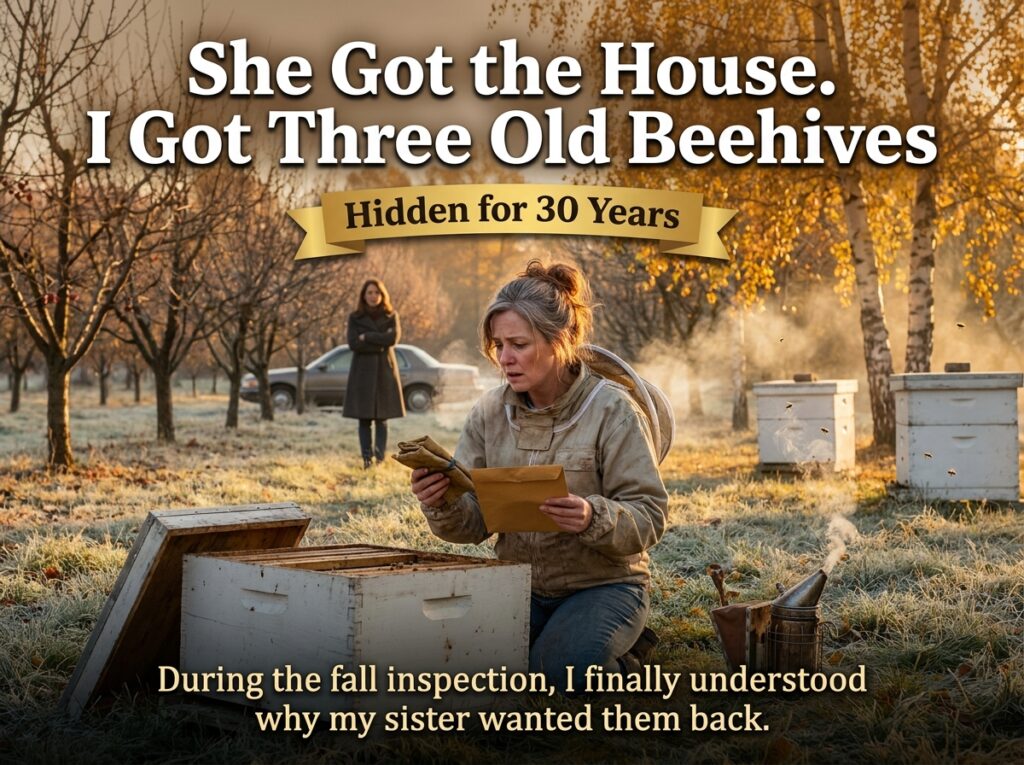
I did the fall inspection on the second Saturday of October, the way my father had taught me, on a still, cold morning with the birches gone gold behind the hives and my breath showing in the air.
I’d been putting it off, if I’m honest, not out of avoidance but out of a strange, superstitious care, the way you handle a letter you know contains bad news and want to read only once you’re ready. I lit the smoker the way he’d shown me, cool white puffs of pine needle smoke, and worked from the top down, the way he always had. Outer cover. Inner cover. The honey supers, heavy and gold and humming faintly even in the cold. The queen excluder. Down through the layers of a hive the way you’d go down through the layers of a life, if a life were built in stackable boxes and you had all the time in the world to be careful.
The first hive was ordinary. The second was ordinary. It was the third hive, the one my father always called “the old one,” built from lumber he’d milled himself in the seventies, that gave me pause.
The bottom brood box sat lower on its stand than the others, and when I lifted it to check the underside for rot, the way he’d taught me, it was heavier than it should have been. Not by a little. By a lot, the kind of extra weight that makes your shoulders register a mistake before your mind catches up.
I set it down on the grass and knelt beside it in the cold, and I ran my hand along the underside, and I felt it: a seam that shouldn’t have been there, running along the base in a rectangle, sealed with a dark, waxy substance that had gone brittle with age but hadn’t quite let go.
I got my father’s hive tool from my back pocket, the same flat steel bar he’d carried in his own for forty years, and I worked the edge into the seam the way you’d work a paint scraper, slow and careful, my heart going harder than the cold morning accounted for. The wax gave in flakes. Beneath it, a thin sheet of tin had been fitted into a shallow cavity cut into the wood, and beneath the tin, wrapped twice in oiled cloth gone stiff with years, was a bundle about the size of a shoebox.
I sat back on my heels in the wet grass with the bundle in my lap and the bees moving, calm and slow, in the cold morning air around me, and for a long moment I didn’t open it. I thought about my father grabbing my wrist and saying *don’t let anybody rush you through it.* I thought about Renee saying *it affects people who aren’t even in this family.* I thought about a brandy-soft two in the morning and a man saying *one thing in my life I’m not proud of, and it cost a man everything.*
I unwrapped the cloth.
Inside was a manila envelope, brittle at the folds, and a smaller bundle wrapped in a plastic freezer bag that had been sealed with wax around its edges the way you’d seal a jar for canning, to keep out thirty years of Wisconsin winters. Inside the plastic bag, when I finally worked it open with cold, clumsy fingers, was a stack of cash, bound with old rubber bands that snapped when I touched them, and beneath the cash, a photograph, and beneath the photograph, folded into eighths, a letter in my father’s hand.
The cash alone was enough to explain twelve thousand dollars a box. It was far more than that. But it was the photograph that made my breath catch, because it showed a man I didn’t recognize, standing in front of a hardware store I didn’t know, with a boy of about ten on his shoulders, and on the back, in a hand that wasn’t my father’s, was written a name.
*Earl Petrakis and son, 1979.*
I turned the letter over in my hands. On the outside fold, in my father’s careful print, it said: *For Diane. Read this before you decide anything. And forgive me if you can.*
Part 6
*Diane,*
*If you’re reading this, you did the fall inspection yourself, and you took your time on the bottom boxes, which means you did exactly what I asked and I can finally stop worrying about that, at least. I’ve been worrying about it for thirty years. A little longer won’t have killed me, but I’m glad it’s over.*
*I need to tell you about a man named Earl Petrakis, and I need you to hear the whole thing before you judge me, though I’ll understand if you judge me anyway. I’ve had thirty years to judge myself and I haven’t been gentle about it.*
*In 1979, I borrowed eleven thousand dollars from Earl to keep the orchard from going under. It was a bad year — a late frost took half the blossoms, and the bank had already turned me down twice. Earl ran a hardware store two towns over and did small private loans on the side, informal, no paperwork beyond a handshake and his word, which back then was worth more than most banks’ contracts. I paid him back on time, every month, for two years. Then, in 1981, I had a chance to buy the eleven acres north of the orchard — the ones that are half the property now — from a widow who needed to sell fast, and I needed cash faster than the bank could move.*
*I borrowed from Earl again. Fifteen thousand this time. And I did something I am not proud of. I told him it was for equipment repairs, because I knew if I told him the truth, that I was buying land out from under a grieving widow at a price that wasn’t quite fair to her either, he might have said no, and I wanted that land badly enough to lie for it.*
*The land deal went through. But that same year, Earl’s hardware store caught fire — faulty wiring, nothing to do with me — and he lost almost everything. He came to me for the fifteen thousand early, because he needed it to rebuild, and Diane, I didn’t have it. I’d put it all in the land and the new trees. I told him I needed more time. He gave me two years. I gave him nine months of payments and then the orchard had another bad year, and I stopped paying.*
*I never paid Earl Petrakis back. Not one more dollar. He lost the hardware store for good in 1984. He and his son, the boy in that photograph, moved to Illinois, and I heard, years later, secondhand, that Earl died in 1998, in debt, having never rebuilt anything. I have carried what I did to that man for thirty years, and it is, without question, the thing I am least proud of in my whole life.*
*The money in this hive is what I owed him, with what I judged to be fair interest, set aside a little at a time over fifteen years, in cash, because I did not trust myself to keep it in an account I might one day dip into during a bad year. I could never bring myself to just mail it to a widow and a grown son I’d wronged and never properly apologized to. I told myself I was waiting for the right moment. I have told myself that about a great many things in my life, and I am telling you now, Diane, so that you don’t make the same mistake: there is no right moment. There is only the moment you’re brave enough to use, and every other one you let slide by.*
*Earl had one son. His name was Danny Petrakis. I believe he’s still alive, somewhere near Rockford, Illinois. I never worked up the courage to find him.*
*This is what I am asking of you, and I am asking, not demanding, because it was never your debt to carry: find Danny Petrakis. Give him this money, with my apology, in whatever words feel true to you. I trust you to find the right ones more than I ever trusted myself.*
I sat in the wet grass with the letter shaking in my hands, the bees moving unbothered around me, and I understood, all at once, why Renee had gone so pale in the parking lot, and why she’d been so desperate, and why my father had told her something and sworn her to a silence she was clearly unraveling under.
I turned the page.
*Now, about your sister.*
Part 7
*Now, about your sister.*
*Renee knows part of this story, though not all of it, and she has known for longer than you’d think. Three years ago, when Craig’s business first started to wobble, Renee came to me quietly, the way she does when she’s frightened, and asked if I had any money set aside that could help. I told her I did not, which was a lie. I had this. But I had already decided, by then, what it was for, and I was ashamed to tell my own daughter that I’d rather pay a dead man’s debt than help her keep her house.*
*I did tell her, that same year, in a weak moment, where the money was and why. I made her promise not to touch it and not to tell you until I was ready, because I was afraid, if she knew the whole of it too soon, she would talk herself into believing the debt to Earl mattered less than the debt to her own family. I don’t think she’s wrong to feel that way, Diane. I think I would have felt the same, in her position. I only knew that if I let the money go to Craig’s business, I would die having broken the one promise to myself that mattered most, and having taught both my daughters that a debt only matters if the person you owe is still around to collect it.*
*I know Craig’s troubles have gotten worse since. I know Renee is frightened, possibly more frightened than either of us understands from the outside. I am not asking you to let your sister suffer for my sins. I am asking you to do what I could never manage: find a way to be fair to a dead stranger and to your own family, in the same breath, without thirty years of cowardice getting in between.*
*I don’t know how to tell you to split what can’t really be split. I only know that Earl Petrakis’s family got nothing for thirty years, while mine got an orchard and a house and, eventually, whatever’s left in my accounts. That math has never once sat right with me, and I would like it, finally, to sit right with someone.*
*I love you both. I loved your mother, and I loved Patrice, in the ways I knew how, which were never quite enough for either of them, and I suspect that’s the real inheritance I’ve left you both, more than any house or hive: the job of learning to love better than I did, and paying debts before they turn into thirty years of a bad taste in your mouth.*
*Take your time deciding, Diane. You’re good at that. It’s the thing I admired most about you, watching you work a hive all those years — you never once let anybody rush you into a mistake with the bees, and I was hoping, right to the end, that it would turn out to be true about the rest of your life too.*
*I’m sorry it took a bee box to say the things I should have said out loud.*
*I love you.*
*Dad*
I sat there for a long time after I finished reading, long enough that the cold worked its way up through the wet grass and into my knees, long enough that one of the bees landed on the back of my hand and walked a slow, unbothered circuit before lifting off again.
Then I called Renee.
She picked up on the first ring, which told me she’d been waiting for this call for eleven days.
“You found it,” she said. It wasn’t a question.
“I found it,” I said. “And I read the letter. All of it. Renee, why didn’t you just tell me?”
“Because I promised him,” she said, and her voice cracked wide open. “And because I was so ashamed, Diane. I’ve known about that money for three years, and I let my own father die still owing a dead man, because some part of me kept hoping he’d change his mind and give it to Craig and me instead. I hated myself for hoping that. I still do.”
“Come out to the orchard,” I said. “Tonight. We need to figure this out together. Both of us. That’s what he wanted.”
There was a long silence, and then, very small: “You’re not going to just keep it? You’d have every right to. It’s your hive. Your inheritance.”
“Renee,” I said, looking out at the three white boxes and the gold birches and the low autumn sun, “it stopped being mine to keep the second I read his handwriting. It’s ours to figure out. Come out tonight.”
Part 8
She arrived at Cherry Road — my house, not the farmhouse she’d inherited — a little after seven, with her headlights sweeping across my dark yard and the dogs going wild on the porch. She’d been crying in the car; I could tell from the redness around her eyes and the tissue balled up in her fist when she got out.
We sat at my kitchen table with the letter, the photograph, and the cash between us, twenty-six thousand dollars in old bills that smelled faintly of beeswax and pine smoke, and for a long time neither of us said anything at all.
“Twenty-six thousand,” Renee finally said. “I need eighteen by the twenty-eighth or Craig loses the house entirely, not just the business.”
“And Danny Petrakis’s father lost his hardware store, his savings, and eventually his whole life over money Dad borrowed and never paid back,” I said. “I keep doing the math on both of those numbers and neither one comes out feeling like a small thing to walk away from.”
“I know.” She pressed her palms against her eyes. “I’ve hated this money for three years, Diane. I’ve hated knowing about it and not being allowed to touch it and watching my own father decide a stranger’s ghost mattered more than watching his grandchildren stay in their house.”
“He didn’t decide that,” I said, gentler than I expected to manage. “Read the letter again. He says it kept him up at night. He wasn’t choosing Earl Petrakis over you out of spite. He was trying to fix the one thing he thought he could still fix, and he ran out of time to figure out how to fix both.”
“So what do we do?”
I’d been thinking about it since the moment I put the letter down in the wet grass, and the answer that kept surfacing wasn’t clever or clean, but it felt like the only one that let me sleep that night.
“We find Danny Petrakis,” I said. “First. Before anything else happens with this money. I want to look him in the eye, or hear his voice on the phone, at minimum, before I decide what’s fair to keep back for you and Craig. I’m not doing this behind his back the way Dad kept it behind ours for thirty years.”
Renee nodded slowly. “And if he needs all of it?”
“Then he gets all of it, and you and I figure out another way for Craig, even if that way is harder and slower and doesn’t solve everything by the twenty-eighth.” I reached across the table and took her hand, something I don’t think I’d done since we were teenagers. “But Renee, I don’t actually think it’ll come to that. I think when he hears what happened to his father, and where this money’s been sitting, and for how long, he’s going to have his own thoughts on what’s fair. People usually do, when you finally just tell them the truth instead of managing it for them.”
It took four days to find him. Sylvie, of all people, cracked it open, calling an old friend who’d grown up two towns from the Petrakis hardware store and remembered the family moving to Rockford in ’85. From there it was one phone call to a library reference desk, a city directory search, and an afternoon of Renee, oddly steady now that there was a task in front of her instead of a debt hanging over her head, working the phone like she used to work sales calls for Craig’s company in its better years.
Danny Petrakis was sixty-one, retired from thirty years as a high school shop teacher, living alone in a small house outside Rockford since his wife had passed two years earlier. When Renee finally got him on the phone and explained, haltingly, who she was and why she was calling, there was a very long silence on the other end.
Then he said, “Novak. I haven’t heard that name out loud since I was a kid.”
Part 9
We drove down together, Renee and I, on a Saturday morning three weeks later, in my truck, with the money in a lockbox on the bench seat between us and neither of us saying much for the first hour of the drive.
Danny Petrakis’s house was small and neat, with a woodshop visible through the garage’s open door, half-built birdhouses lined up on a workbench like a small silent flock. He met us on the porch, a solid, weathered man with his father’s jaw, I thought, though I only knew that from a thirty-year-old photograph, and he shook both our hands with a careful formality that told me he’d rehearsed this too.
We sat in his kitchen, which smelled like sawdust and coffee, and I told him everything, start to finish, the way I’d promised myself I would: the loan, the fire, the unpaid debt, the thirty years my father had carried it, the hive, the letter. I put the photograph on the table between us, the one of Earl with a young Danny on his shoulders, and watched Danny’s face crumple and steady itself twice before he could speak.
“I remember that day,” he said finally, running one finger along the photograph’s brittle edge. “The hardware store’s grand reopening, before the fire. Dad was so proud. He’d borrowed to make it happen, but he never told me from who. I always figured it was the bank.” He looked up at me. “He talked about your father sometimes, you know. Not angry, exactly. Just — sad. He’d say, ‘Walt was a good man who did one bad thing to me,’ and then he’d change the subject. I don’t think he ever stopped believing that, even after we lost everything.”
“I’m so sorry,” I said, and meant it more completely than I think I’d ever meant three words in my life. “There’s twenty-six thousand dollars here. It’s not going to undo what happened to your father, or give you back the years you lost. But it’s what my father set aside, with what he judged was fair interest, and it should have come to your family a long time ago.”
Danny sat quietly for a moment, looking at the lockbox, and then, unexpectedly, he laughed — a short, surprised sound, more relief than humor.
“You know what’s strange,” he said. “My dad used to say the worst part wasn’t losing the store. It was wondering, every year after, whether Walt Novak ever thought about him at all, or whether he’d just moved on and built his life on top of it and never looked back.” He looked at the photograph again, and then at me. “I think you just answered that question better than any amount of money could have. Thirty years, and he never stopped thinking about it. He hid the money in a beehive rather than spend it on himself. That’s not nothing, Diane. That’s not nothing at all.”
He didn’t take all of it. That surprised both of us. He took twelve thousand, “for the memory of the store, and because I won’t pretend it wouldn’t help,” and asked that the remaining fourteen go toward something he called “finishing the math the right way”: half to a scholarship fund at the trade school where he’d taught shop for three decades, in his father’s name, and half back to Renee, “for whatever trouble brought two sisters to my kitchen table together instead of just one lawyer’s letter.”
“You don’t have to do that,” Renee said, her voice thick.
“I know I don’t,” Danny said. “But your father carried this for thirty years so it would land right eventually. Let it land right the rest of the way. I think that’s what he’d have wanted, and frankly, it’s what I want too. I’ve done fine. I taught kids to build things for thirty years. I’m not hungry for a stranger’s guilt money. I just wanted somebody to finally say the truth out loud.”
We stayed for two hours. He showed us the birdhouses in his workshop, sturdy little things with steep-pitched roofs, and gave one to each of us before we left, “for the road,” he said, though I think he meant for something else too.
Part 10
Renee and Craig kept the house. The fourteen thousand from Danny, combined with a hard, honest conversation Craig finally had with the private lender, bought them enough time to restructure the business debt properly instead of running from it, and though the following year was lean and humbling for both of them, Renee told me at Thanksgiving that it was the first year in three that she’d slept through a full night.
“I used to think Dad leaving you the hives instead of money was him punishing you,” she told me that day, drying dishes in my kitchen while the dogs circled underfoot. “I actually believed that, at the funeral. I was so sure of it I built a whole ugly little speech around it in the lawyer’s parking lot.”
“I remember,” I said.
“I’m sorry for that. Truly.” She set down the dish towel. “I think now he gave you the hives because he knew you were the only one of us patient enough to find what was really inside them, and honest enough to do something fair with it once you did. That’s not a punishment, Diane. That’s the biggest compliment he ever paid anybody.”
I do the fall inspection alone now, every October, the way my father taught me, working from the top down, slow and unhurried, and I always spend a little extra time on that third hive, the old one he milled himself in the seventies, though the wax seal is long gone and there’s nothing left underneath but a clean, resealed compartment of cedar and tin, empty and waiting, in case there’s ever anything else worth hiding carefully and giving away honestly, a little at a time, over however many years it takes.
Renee’s kids come out most Sundays now, the way I used to. Her youngest, Wyatt, who’s seven, wanted a veil of his own this spring, and I made him one out of an old bit of mosquito netting and my father’s spare hat, and I stood behind him with my hands over his while he worked his first frame, the way my father once stood behind me.
“Bees don’t hold grudges,” I told him, the exact words my father gave me thirty years ago, standing in that same orchard. “They just don’t forgive stupid.”
He looked up at me very seriously, the smoker heavy in his small hands. “Did somebody do something stupid, Aunt Diane?”
I thought about a hardware store fire in 1981, and a debt thirty years unpaid, and a man who hid his shame in a beehive because he couldn’t stand to look at it in a bank statement, and two sisters who nearly let a joke about grandchildren define the whole rest of their relationship.
“A long time ago,” I said. “But it got fixed. That’s the important part. It just took somebody patient enough to look underneath.”
Danny Petrakis’s birdhouse hangs from the biggest maple behind my house now, steep-roofed and sturdy, and every spring a pair of wrens moves in and raises a brood inside it, loud and unbothered, the way life tends to go on doing, once the old debts are finally, properly, set down.