Part 1
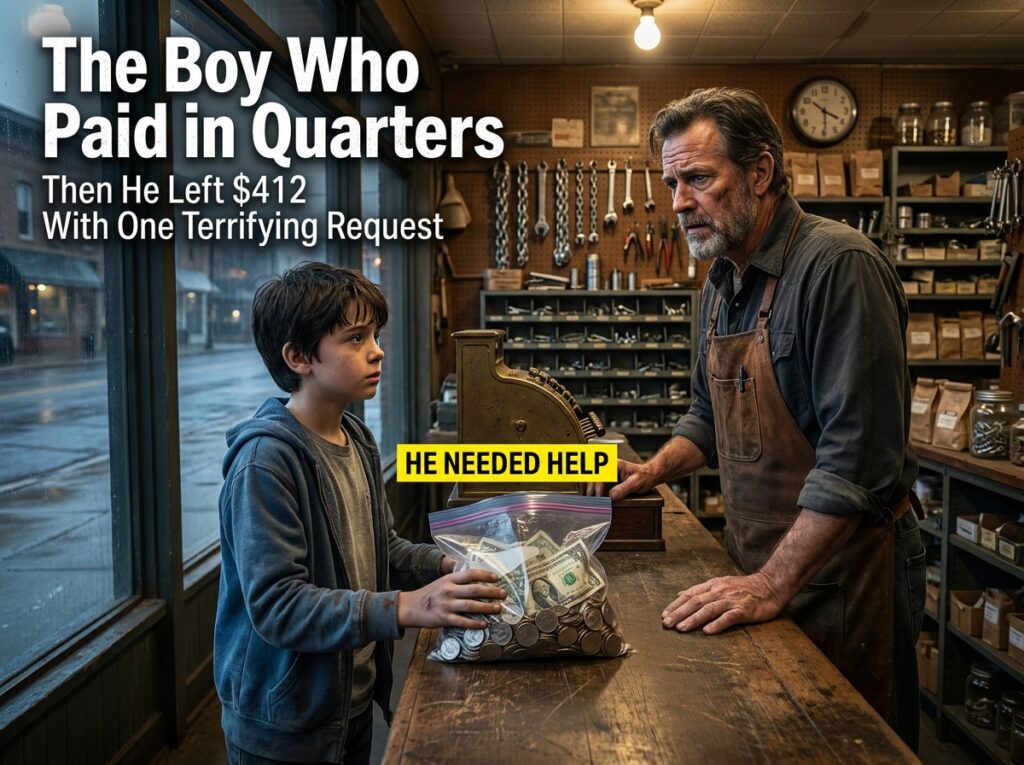
I had owned Miller’s Hardware in Akron for twenty-six years, long enough to know that people usually told you what they needed without actually saying it.
A man buying three different sizes of screws was usually fixing something he had already broken.
A woman buying a gallon of paint on a Tuesday morning was often trying to make a room look different before someone came home.
And a kid buying one bolt at a time?
That was almost always a story.
I first noticed the boy on a Friday afternoon in October.
He was maybe twelve.
Small for his age, with dark hair that needed cutting and a blue jacket that had seen better days. He stood outside the front window for nearly five minutes before finally pushing open the door.
The little bell above it rang.
“Afternoon,” I said.
He nodded.
He didn’t look at me.
Instead, he walked slowly through the aisles.
I let him.
He eventually came back with a single three-inch carriage bolt.
“How much?”
“Forty-five cents.”
He reached into his pocket and pulled out a sandwich bag.
Quarters.
Dimes.
Nickels.
He counted forty-five cents onto the counter.
I looked at the coins.
Then at him.
“You building something?”
He shrugged.
“Maybe.”
I smiled.
“That’s a very specific answer.”
He gave me the faintest smile.
I put the bolt in a small paper bag.
“Here.”
He took it.
“Thank you.”
Then he left.
The next Friday, he came back.
Same blue jacket.
Same careful walk.
This time he bought six inches of small chain.
Seventy cents.
Exact change.
The Friday after that, it was two washers.
Then a small eye hook.
Always something different.
Always cheap.
Always exact change.
After the fourth visit, I stopped charging him full price.
He noticed.
“You forgot the tax.”
“No.”
“You did.”
“I own the store.”
He frowned.
“That doesn’t mean you can forget.”
I laughed.
“Kid, I’m giving you a discount.”
“Why?”
“Because I like what you’re building.”
He stared at me.
“I’m not building anything.”
“Then why do you keep buying hardware?”
He looked down.
“I need it.”
“Fair enough.”
That was all I said.
His name was Caleb.
I learned that on the fifth Friday.
He was standing at the counter with another little bag of coins.
“Caleb,” he said when I asked.
“I’m Ray.”
“I know.”
That surprised me.
“You know my name?”
“It’s on the receipt.”
I laughed.
“Good observation.”
He nodded.
Then he put the hardware on the counter.
A short piece of copper wire.
I rang it up.
“Thirty-five cents.”
He began counting.
His hands were clean, but his fingernails were dark with dirt.
He counted slowly.
One quarter.
One dime.
Then five pennies.
I pushed the coins back toward him.
“Keep the pennies.”
He shook his head.
“I have to pay exactly.”
Something about the way he said it made me stop smiling.
“Okay.”
He gathered the pennies again.
Then he left.
I watched him through the window.
He crossed the street alone.
No parent waiting.
No bicycle.
No one calling after him.
Just a twelve-year-old boy walking home with thirty-five cents’ worth of hardware in his pocket.
That night, I wondered what he was building.
I should have asked.
I wish I had.
Because the following Friday, Caleb came into my store carrying a paper grocery bag that looked far too heavy for him.
He placed it on my counter.
The sound it made when it landed wasn’t the sound of hardware.
It was the unmistakable clatter of money.
“What’s this?” I asked.
He looked toward the front door.
Then back at me.
“I need you to hold it.”
I stared at the bag.
“Why?”
“And don’t tell my dad.”
That was when I stopped thinking about bolts.
Part 2
I pulled the grocery bag closer.
It was heavy.
Much heavier than anything a twelve-year-old should have been carrying around town.
“Caleb,” I said, “what’s in here?”
“Money.”
“I can hear that.”
He didn’t smile.
I opened the top.
Quarters.
Dimes.
A few nickels.
And crumpled dollar bills folded into tiny squares.
I looked at him.
“How much?”
“Four hundred twelve dollars.”
I stopped.
“Exactly?”
He nodded.
I counted enough to know he hadn’t guessed.
There was $412 in that bag.
Mostly coins.
Some of the quarters were dirty.
Some of the dollar bills were wrinkled and soft from being handled too often.
“Where did you get this?”
“I earned it.”
The answer came too quickly.
I knew a lie when I heard one.
I’d been married for thirty-one years.
I had raised two children.
I’d been lied to by customers about broken tools, by employees about missed shifts, and once by my own wife when she told me she hadn’t eaten the last piece of pie.
But Caleb’s lie was different.
It was the kind children tell when the truth feels dangerous.
“Doing what?”
“Jobs.”
“What kind?”
He looked at the floor.
“Different stuff.”
I leaned against the counter.
“Caleb, I’m not asking because I want your money.”
“I know.”
“I’m asking because four hundred dollars is a lot of money for a kid.”
He swallowed.
“I need to keep it somewhere.”
“Why here?”
He looked around the store.
“Because you won’t steal it.”
The words hit me harder than they should have.
“I wouldn’t steal your money.”
“I know.”
“Does your dad steal from you?”
His eyes snapped up.
“No.”
Too fast again.
I didn’t push.
Instead, I tied the bag shut.
“I’ll keep it in the back.”
He nodded.
“And I won’t tell your father.”
“Promise?”
“I promise.”
He looked relieved.
Then he turned toward the door.
“Caleb.”
He stopped.
“Whatever you’re doing, if somebody is making you afraid, you can tell me.”
His shoulders stiffened.
“I’m not afraid.”
Then he left.
I stood behind the counter for a long time.
The store was quiet.
The fluorescent lights hummed overhead.
Outside, the October wind pushed dry leaves along the sidewalk.
I went into the back office and put the bag inside the locked drawer beneath my desk.
Then I returned to the front.
And that was when I remembered his sleeve.
When he’d placed the bag on the counter, his jacket had ridden up.
I’d seen his wrist.
There had been a mark there.
Not a scrape.
Not the kind of bruise a kid gets falling off a bike.
It had been narrow and dark, circling partway around his wrist.
Like fingers.
I told myself I had imagined it.
I told myself children got bruises.
I told myself I was overreacting.
But that night, I couldn’t sleep.
I kept seeing the boy’s face.
The careful way he counted coins.
The way he had asked me to promise.
The way he’d said his father wouldn’t steal from him.
I got out of bed at two in the morning and walked downstairs.
The store was dark.
I unlocked the drawer.
The grocery bag was still there.
$412.
I touched it.
Then I remembered Caleb’s voice.
Because you won’t steal it.
I closed the drawer.
The next Friday, I expected him.
He didn’t come.
I waited until closing.
Still nothing.
At seven-thirty, I locked the front door.
At seven-forty-five, someone knocked.
I looked through the glass.
A man stood outside.
Work jacket.
Boots.
Late thirties, maybe forty.
He looked tired.
And strangely familiar.
I opened the door.
“Can I help you?”
He smiled politely.
“I’m looking for my son.”
Something inside me tightened.
“What’s his name?”
“Caleb.”
The man’s eyes moved past me.
Toward the counter.
Toward the register.
Toward the back hallway.
He already knew there was something there.
“I haven’t seen him today,” I said.
He kept smiling.
“Are you sure?”
“Yes.”
He nodded.
Then he looked directly at me.
“Because Caleb told me he comes here every Friday.”
I said nothing.
The man’s smile disappeared.
“He’s got something of mine.”
I felt the blood drain from my face.
Then he left.
I locked the door.
And for the first time, I wondered whether my promise to Caleb had put him in more danger—or whether breaking it might.
Part 3
I waited until I heard the man’s truck disappear before I went into the back room.
My hands were shaking.
I unlocked the drawer.
The bag was still there.
But something had changed.
There was a folded piece of paper tucked underneath it.
I knew immediately it hadn’t been there before.
I picked it up.
The handwriting was unmistakably Caleb’s.
Small letters.
Careful letters.
The kind a child writes when he wants every word to be understood.
I unfolded the note.
It said:
Mr. Ray,
If my dad comes, don’t give him the money.
Please.
I read it twice.
Then a third time.
At the bottom, Caleb had written:
I didn’t steal it.
I sat down.
For several minutes, I simply stared at the page.
The store felt different.
The shelves seemed darker.
The ticking clock above the office door sounded impossibly loud.
I thought about calling the police.
Then I stopped.
What if I was wrong?
What if Caleb really had stolen the money?
What if his father wasn’t dangerous?
What if I turned a family problem into something much worse?
But then I remembered the mark around his wrist.
I remembered the man’s eyes.
And I remembered Caleb saying, “Because you won’t steal it.”
I called my daughter.
She answered on the third ring.
“Hi, Dad.”
“Can I ask you something?”
“Sure.”
“What would you do if a twelve-year-old came into your store every week and started paying for things with coins?”
She laughed.
“That’s oddly specific.”
“Just answer.”
“Is he in trouble?”
“I don’t know.”
“Then find out.”
“How?”
“Ask him.”
“He hasn’t come back.”
There was a pause.
“Why are you worried?”
I told her.
Not everything.
Just enough.
When I finished, she was quiet.
“Dad?”
“Yeah?”
“That doesn’t sound like a kid saving for a science project.”
“I know.”
“Call someone.”
“Who?”
“Someone who knows what they’re doing.”
She gave me the number of a woman she knew who worked with families in difficult situations.
I wrote it down.
But before I could call, headlights appeared outside the store.
The same truck.
The man was back.
This time he didn’t knock.
He stood beneath the streetlight and stared through the glass.
At me.
Then at the back of the store.
Then back at me.
My phone buzzed.
A text.
Unknown number.
You have something that belongs to my family.
I looked at the grocery bag.
Then at the man outside.
Another message arrived.
Don’t make this harder than it needs to be.
I locked the drawer.
The man eventually drove away.
I called the number my daughter had given me.
A woman named Dana answered.
I explained everything.
She didn’t tell me what to do with certainty.
She asked questions.
When had I first seen Caleb?
What did he buy?
Did he seem frightened?
Had I seen injuries?
Did I know where he lived?
Did his father know Caleb came to my store?
I answered as best I could.
Then she said something I’ll never forget.
“Mr. Miller, you don’t need to solve this yourself.”
“I promised him.”
“Then keep him safe.”
“I don’t know where he is.”
“Does he have a school?”
“Probably.”
“Then start there.”
The next morning, I called the school.
I explained that I was a family acquaintance and asked whether Caleb had attended.
The secretary wouldn’t tell me much.
But after I mentioned that I was concerned for his safety, she transferred me to the counselor.
The counselor recognized his name.
“Caleb hasn’t been in school since Thursday.”
My stomach dropped.
“Do you know why?”
There was a pause.
“His father called.”
“What did he say?”
“He said Caleb was sick.”
“Is he?”
Another pause.
“I can’t discuss his records.”
“I understand.”
I thanked her and hung up.
Then I looked at the note again.
I didn’t steal it.
That afternoon, I went home early.
I sat at my kitchen table with my grandson’s old baseball glove in front of me.
I kept thinking about how easy it would have been to tell myself this wasn’t my problem.
But there are moments when being a decent person requires more than staying out of trouble.
Sometimes it requires stepping into it.
I called the police.
I told them everything I knew.
And that evening, while I was locking the store, a small figure appeared across the street.
Caleb.
He was alone.
And he wasn’t carrying a bag.
He was carrying nothing at all.
When he saw me, he didn’t come closer.
He simply pointed toward the alley behind my store.
Then he disappeared.
Part 4
I ran.
Not because I thought I could catch him.
Because something in the way he had pointed told me there was no time to stand there asking questions.
I went through the back door.
The alley was empty.
A dumpster stood beneath a security light.
A row of old pallets leaned against the brick wall.
“Caleb?”
Nothing.
Then I heard a sound.
A cough.
Behind the pallets.
I moved closer.
“Caleb?”
He stepped out.
His face was pale.
His jacket was gone.
He wore a thin gray sweatshirt despite the cold.
“What happened?”
He shook his head.
“Where’s your dad?”
“I don’t know.”
“Are you hurt?”
He hesitated.
“No.”
I looked at his wrist.
The mark was darker now.
I didn’t ask about it.
Not yet.
“Come inside.”
He followed me.
I locked the back door.
Then I gave him a bottle of water.
He drank half of it without stopping.
“Where have you been?”
“At my aunt’s.”
“Which aunt?”
He looked at me.
“She doesn’t know I’m here.”
That answer told me more than he realized.
“Caleb, your dad came here.”
“I know.”
“He said he was looking for you.”
“I know.”
“He knows about the money.”
Caleb closed his eyes.
“I knew he would.”
“Why did you leave the note?”
“Because I didn’t know where else to put it.”
I sat across from him.
“Tell me the truth.”
He looked down.
“I’ve been saving it.”
“How did you get it?”
“Doing jobs.”
“What jobs?”
He started counting them on his fingers.
Mowing lawns.
Taking out trash.
Cleaning garages.
Carrying boxes.
Walking dogs.
Whatever people would pay him for.
“And the hardware?”
“I was building something.”
“What?”
He didn’t answer.
“Caleb.”
He reached into his pocket.
Then he placed a small photograph on the counter.
It showed a little girl.
Maybe seven years old.
She was smiling.
She had two missing front teeth.
“Who’s she?”
“My sister.”
I looked at him.
“I didn’t know you had a sister.”
“Her name’s Lily.”
“What happened to her?”
He swallowed.
“She’s sick.”
The words came out almost too quietly to hear.
“How sick?”
“She needs medicine.”
My chest tightened.
“Does your dad know?”
“He knows.”
“Then why are you saving money?”
Caleb stared at the photograph.
“Because sometimes he uses the money for other things.”
I didn’t ask what other things meant.
I already had a feeling.
“How much does her medicine cost?”
“Every month?”
He nodded.
“About four hundred.”
I looked toward the locked drawer.
The exact amount he’d saved.
$412.
He had been trying to make sure his sister got what she needed.
The bolts.
The chain.
The wire.
None of it had been random.
He had been making small things for neighbors to earn enough money to buy her medicine.
I felt my throat tighten.
“Why didn’t you ask someone for help?”
“I did.”
“Who?”
“My dad.”
“And?”
“He said we couldn’t afford it.”
“Did he tell you where the money was going?”
Caleb shook his head.
Then he whispered:
“I found the bottles.”
“What bottles?”
He looked toward the back door.
“The ones he drinks.”
Everything fell silent.
I understood then.
The man in the work jacket wasn’t simply looking for his son.
He was looking for the money his son had worked months to save.
Money meant for a sick child.
“Where is Lily now?”
“With my aunt.”
“Is she safe?”
“I think so.”
“What’s your aunt’s name?”
“Marissa.”
I reached for my phone.
Caleb flinched.
“I’m not calling your dad.”
He stared at me.
“I’m calling someone who can help.”
He nodded.
Before I could dial, the back door handle moved.
Once.
Twice.
Someone was trying the lock.
Caleb went white.
“It’s him.”
I moved him behind me.
The handle stopped.
Then came a knock.
Three slow knocks.
A man’s voice came through the door.
“Caleb.”
He whispered my name.
“Don’t let him in.”
I didn’t.
Then the voice outside changed.
It became calm.
Almost gentle.
“Ray, we need to talk.”
I looked at Caleb.
He was trembling.
Then his father’s voice came through the door again.
“I know you’re in there.”
Part 5
I had never been particularly brave.
I was a hardware store owner.
I’d spent most of my adult life fixing leaky pipes, replacing broken locks, and telling people which drill bit they needed.
I wasn’t trained to deal with frightened children and angry fathers.
But I knew locks.
And I knew that the back door was solid.
I had installed it myself.
“Go into the office,” I whispered to Caleb.
“What about you?”
“I’m going to talk to your dad.”
“No.”
“He doesn’t get inside.”
I moved toward the door.
“Ray,” the man said.
“My name is Mr. Miller.”
A pause.
“Mr. Miller, my son is scared and confused.”
Caleb looked at me.
I could see the question in his eyes.
“Please,” his father continued. “Let him come home.”
I opened the door just enough to speak through the gap.
“You need to leave.”
His face was tired.
Not angry.
That somehow made it worse.
“He’s my son.”
“And he’s twelve.”
“I know.”
“He says he’s afraid of you.”
The man’s jaw tightened.
“Kids say things.”
“Kids also write notes asking strangers not to give their fathers their money.”
His expression changed.
There it was.
Fear.
He knew.
“You have no idea what you’re talking about.”
“I know about the money.”
He looked past me.
“You don’t understand.”
“Then explain.”
He didn’t.
Instead, he said, “That money belongs to me.”
“No.”
His eyes hardened.
“My son took it.”
“He earned it.”
“He’s a child.”
“Which is why he shouldn’t have had to earn it.”
The man looked away.
For several seconds, neither of us spoke.
Then he said something I hadn’t expected.
“I’m trying.”
I studied him.
“What?”
“I’m trying to keep this family together.”
“By taking money from your son?”
“I didn’t take it.”
“You came here for it.”
“I need it.”
“For what?”
He didn’t answer.
I thought of the bottles Caleb had mentioned.
Then the man whispered:
“You don’t know what it’s like.”
“You’re right.”
“My wife left.”
I said nothing.
“She took Lily.”
“His sister?”
“Yes.”
“Why?”
He rubbed his face.
“Because she said I was drinking too much.”
Caleb was listening from the office doorway.
His father saw him.
For a moment, something changed in the man’s face.
He looked like a father.
Not a threat.
Just a tired man who had lost control of his life.
“Caleb,” he said softly.
The boy didn’t move.
“I love you.”
Caleb’s eyes filled.
“Then why do you keep taking the money?”
His father looked down.
That question broke something open.
“I don’t know.”
It was the first honest answer I’d heard from him.
He stepped back from the door.
“I don’t know anymore.”
I kept the door closed.
“Your son has been working to buy medicine for Lily.”
The man’s face went pale.
“She needs medicine?”
“Yes.”
He looked genuinely shocked.
“Marissa told me you knew.”
“I knew she was sick.”
“Did you know how much the medicine costs?”
He shook his head.
“Did you know Caleb was saving for it?”
“No.”
His voice cracked.
I believed him.
Not completely.
But enough to understand that the family had been drowning in problems nobody knew how to name.
Then Caleb came out of the office.
“She’s getting worse.”
His father looked at him.
“Who told you?”
“Aunt Marissa.”
The man closed his eyes.
“I’m sorry.”
Caleb didn’t move.
“I don’t want your money,” he said.
His father looked at him.
“I just want Lily to get better.”
The man wiped his face.
“I know.”
I opened the door.
He didn’t step inside.
Instead, he sat on the concrete outside.
I called Marissa.
She answered immediately.
When I explained what had happened, she said she was on her way.
The police were already coming because of my earlier call.
Everything was finally moving.
But before anyone arrived, Caleb did something I hadn’t expected.
He walked outside.
He sat beside his father.
They didn’t touch.
They simply sat there.
Two people who had been carrying too much alone.
Then Caleb whispered:
“I saved $412.”
His father nodded.
“I know.”
“It’s for Lily.”
“I know.”
“I didn’t steal it.”
His father looked at him.
“I know.”
The boy started crying.
His father did too.
And neither of them tried to hide it.
Part 6
Marissa arrived first.
She got out of her car and ran toward Caleb.
He stood up.
“Aunt Marissa.”
She hugged him so tightly his feet nearly left the ground.
Then she looked at his father.
The two adults stared at each other.
No shouting.
No accusations.
Just exhaustion.
The police arrived a few minutes later.
I told them everything.
The money.
The note.
The bruises.
The missing school days.
The conversation at the back door.
Marissa confirmed that Lily was sick and that Caleb had been trying to raise money because he believed the adults couldn’t afford the medicine.
She also told them something that changed the situation.
Caleb’s father had been struggling with addiction for months.
He hadn’t deliberately planned to hurt his children.
But he had been making decisions that put them in danger.
That distinction mattered.
It didn’t excuse what happened.
But it explained why Caleb had become responsible for things no twelve-year-old should have carried.
The officers spoke with everyone separately.
Caleb went with Marissa.
His father remained outside.
Before they left, Caleb came back into the store.
He looked at the locked drawer.
“The money.”
I opened it.
The bag was still there.
I placed it on the counter.
He touched it.
“I thought it was gone.”
“I promised.”
He nodded.
Then he did something that surprised me.
He pushed the bag toward me.
“Keep it.”
“I can’t.”
“Please.”
“Caleb, it’s yours.”
“I don’t need it now.”
I looked at Marissa.
She shook her head.
“He’s been planning this for months.”
I looked back at Caleb.
“What do you want to do with it?”
He thought.
“Buy Lily’s medicine.”
“Then that’s what we’ll do.”
The next morning, Marissa and I went to the pharmacy.
The money wasn’t enough for everything.
But it was enough to start.
I added what was missing.
Marissa tried to stop me.
I told her not to.
The pharmacist filled the prescription.
I watched Caleb’s face when Marissa handed him the bag.
He smiled.
Not the nervous little smile he’d given me on his first Friday.
A real smile.
The kind that reached his eyes.
But the story didn’t end there.
Over the next few weeks, social workers became involved.
Caleb stayed with Marissa.
Lily received her medicine.
His father entered treatment.
There were meetings.
Paperwork.
Hard conversations.
None of it was simple.
But for the first time, the adults were carrying the weight.
Caleb was allowed to be twelve.
And that mattered.
He still came into my store.
But not every Friday.
Sometimes he came after school.
Sometimes he simply sat on the stool behind the counter and did his homework.
One afternoon, he asked me a question.
“Mr. Ray?”
“Yeah?”
“Why did you help me?”
I thought about it.
“Because someone should have.”
He nodded.
Then he said:
“My dad wasn’t always bad.”
“I believe you.”
“He used to build things with me.”
“What kind?”
“Birdhouses.”
I smiled.
“Maybe someday you can build another one.”
He looked at the shelves.
“Can I use your tools?”
“When you’re old enough.”
He laughed.
“How old?”
“Thirty.”
“That’s not fair.”
“Twenty.”
“Still not fair.”
I laughed.
For the first time, the store felt warm again.
Then he reached into his backpack.
He pulled out a small wooden box.
“I made this.”
It was rough.
Uneven.
The corners didn’t match perfectly.
But it was clearly made by hand.
He handed it to me.
“What is it?”
“Coin box.”
I opened it.
Inside was a single quarter.
“For the first thing I ever bought here.”
I looked at him.
“You kept it?”
He nodded.
“I wanted to remember.”
“Remember what?”
He smiled.
“That somebody believed me.”
Part 7
Winter came early that year.
Snow piled along the sidewalks outside the store.
The windows fogged whenever customers came in.
Caleb continued visiting.
His life slowly became more ordinary.
School.
Homework.
Aunt Marissa.
Visits with his father under supervision.
And sometimes, after school, an hour at Miller’s Hardware.
He liked the back room.
He liked organizing screws.
He liked the old radio.
And he loved asking questions about tools.
“What does this do?”
“Why does this have two settings?”
“Why are these more expensive?”
I answered every question.
One afternoon, he came in carrying a wooden birdhouse.
It was beautiful.
Not perfect.
But beautiful.
He had painted it blue.
“For Lily,” he said.
“She’ll love it.”
“She picked the color.”
I hung it outside the store.
A few days later, a sparrow moved in.
Caleb thought that was the funniest thing in the world.
“You didn’t even advertise.”
“I guess birds don’t need signs.”
He laughed.
Things were getting better.
Not fixed.
Better.
Then one afternoon, his father came into the store.
I recognized him immediately.
He looked different.
Thinner.
Tired.
But sober.
He stood near the door.
“Mr. Miller.”
“Ray.”
He nodded.
“I wanted to thank you.”
“You don’t owe me thanks.”
“I do.”
He looked around.
“Caleb talks about this place.”
“Good things, I hope.”
“Mostly.”
I smiled.
He hesitated.
Then said:
“I didn’t know about the money.”
“I believe you.”
“But I should have known.”
I said nothing.
He looked down.
“I was sick.”
“I know.”
“I’m still sick.”
“Then keep getting help.”
He nodded.
“I am.”
He reached into his pocket.
Pulled out a quarter.
Placed it on the counter.
I looked at him.
“What’s this?”
“The first money I earned at my new job.”
I shook my head.
“You don’t have to pay me.”
“I’m not paying you.”
He looked toward the door.
“I’m just trying to remember that money can mean something different.”
I understood.
He left.
I picked up the quarter.
It was warm from his pocket.
That evening, I put it beside Caleb’s coin box.
A few months later, Caleb came in with his sister.
Lily was small and pale, but she smiled when she saw the birdhouse.
“Is this where Caleb bought the chain?”
“Some of it.”
She looked at him.
“You bought chain?”
Caleb shrugged.
“I was building stuff.”
She laughed.
Then she pointed at the shelves.
“Can I have a screwdriver?”
I looked at Caleb.
He grinned.
“She likes tools.”
“Apparently.”
I gave Lily a small screwdriver.
She held it proudly.
“How much?”
I laughed.
“Free.”
Caleb shook his head.
“She needs to pay.”
“With what?”
Lily searched her pocket.
She found a penny.
She placed it on the counter.
“There.”
I looked at the penny.
“Exact change.”
She smiled.
I put it in the cash drawer.
Then Caleb whispered:
“Mr. Ray?”
“Yeah?”
“Can I ask you something?”
“Sure.”
“Do you remember the first day I came here?”
“Of course.”
“I almost didn’t come inside.”
“Why?”
“I thought you would tell me to leave.”
I looked at him.
“Why would I do that?”
“Because people usually don’t want problems.”
I leaned against the counter.
“Maybe sometimes people come into our lives looking like problems.”
He waited.
“And they’re actually asking us for help.”
He nodded.
Then he smiled.
Part 8
The following October, exactly one year after Caleb first walked into my store, I found a familiar sandwich bag on the counter.
It was empty.
I looked at Caleb.
“What’s this?”
He smiled.
“Remember?”
“I remember.”
He reached into his pocket.
Pulled out a quarter.
Placed it inside the bag.
Then another.
Then another.
“What’s going on?”
“I’m starting over.”
“Starting what?”
He grinned.
“You said I could build something.”
“I said you could build a birdhouse.”
“I built that.”
“Yes.”
“I want to build something bigger.”
“Like what?”
He pulled out a folded piece of paper.
It was a drawing.
A small workshop.
There was a workbench.
Shelves.
Tools.
A sign above the door.
CAL’S SHED.
I laughed.
“That’s ambitious.”
“I’ve been saving.”
“For how long?”
“Three months.”
“How much?”
He shook the bag.
“Thirty-seven dollars.”
I smiled.
“That’s a start.”
“My dad says I can use some of his tools when he’s home.”
I paused.
“That’s good.”
He nodded.
“He says he wants to teach me.”
Something in my chest tightened.
That was the part nobody had expected.
Recovery didn’t erase what had happened.
It didn’t make the past harmless.
But it gave people a chance to become different from the worst thing they’d done.
Caleb’s father was trying.
Caleb was learning to trust slowly.
Lily was getting healthier.
And I was learning something too.
Sometimes help doesn’t look dramatic.
Sometimes it’s a locked drawer.
A phone call.
A prescription.
A birdhouse.
A quarter.
The little things matter because lives are usually changed by little things long before anyone notices.
That evening, Caleb stayed after closing.
We sat outside on the steps.
The sky was turning orange.
He asked about my grandson.
I showed him pictures.
He laughed at one where the boy had chocolate all over his face.
“How old is he?”
“Eight.”
“Does he help you here?”
“Sometimes.”
“Could he help me build the shed?”
“Probably.”
Caleb smiled.
Then he became quiet.
“Mr. Ray?”
“Yeah?”
“Do you think my dad is proud of me?”
I didn’t answer immediately.
Because I knew the question wasn’t really about pride.
It was about whether Caleb could finally believe he had done something good.
“I think he is.”
“How do you know?”
“Because he brought me that quarter.”
Caleb smiled.
“Yeah.”
We sat in silence.
Then he said:
“I used to think adults always knew what to do.”
I laughed.
“Most adults are just guessing.”
“Really?”
“All the time.”
He looked relieved.
“Good.”
“Why?”
“Because I thought I was supposed to know.”
I looked at him.
“You were twelve.”
He nodded.
“I know that now.”
Then he put the sandwich bag into his backpack.
“See you Friday.”
“See you Friday.”
He walked away.
I watched him go.
The boy who once carried a bag of quarters because he thought he had to save his family was now carrying a bag of quarters because he had learned that saving could be something joyful.
I thought that was worth more than $412.
Part 9
Five years passed faster than I expected.
Caleb grew.
He got taller.
His voice changed.
His hair finally got cut.
He still came into the store.
Not every Friday anymore.
But often enough.
He finished school.
Started taking vocational classes.
And eventually began working part-time at Miller’s Hardware.
The first day I put him behind the counter, he looked terrified.
“What if I mess up?”
“You will.”
He stared at me.
“Thanks.”
“Everybody does.”
“What if I give someone the wrong part?”
“You’ll learn.”
“What if I break something?”
“You’ll pay for it.”
His eyes widened.
I laughed.
“I’m kidding.”
He smiled.
“You sound like my dad.”
“That’s unfortunate.”
He laughed.
His father had stayed sober.
Not perfectly.
There had been one relapse.
One terrible week.
But he had gone back into treatment.
He kept going.
Lily grew healthier.
She became obsessed with science.
She wanted to become a doctor.
Caleb wanted to build things.
One sibling wanted to heal people.
The other wanted to make things that lasted.
Maybe that was their way of answering everything they’d lived through.
One Friday evening, after closing, Caleb handed me an envelope.
“What’s this?”
“Open it.”
Inside was a check.
I stared at the amount.
“What is this?”
“Repayment.”
“For what?”
“The medicine.”
I shook my head.
“You don’t owe me.”
“I know.”
“Then why?”
“Because I want to.”
I looked at him.
He was no longer the frightened twelve-year-old who had stood in my store with coins in his pocket.
He was seventeen now.
Almost a man.
“I kept track,” he said.
“Of what?”
“Everything.”
He had calculated the amount I’d contributed toward Lily’s medicine that first year.
He’d been saving.
Not because I asked.
Because he wanted to repay kindness.
I tore the check in half.
His eyes widened.
“Mr. Ray!”
“You don’t repay family.”
He looked at me.
“I’m not family.”
I smiled.
“Yes, you are.”
His eyes filled.
He looked down.
“I don’t have a grandpa.”
“I know.”
“My dad’s dad died before I was born.”
I nodded.
“So?”
Caleb smiled through tears.
“Can I call you Grandpa Ray?”
I had to look away.
The store suddenly became very bright.
I cleared my throat.
“You’d better not tell my actual grandson.”
Caleb laughed.
“I won’t.”
Then he hugged me.
It was the kind of hug that makes an old man remember why he kept opening the doors every morning.
After he left, I went into the back room.
The little wooden coin box was still there.
The quarter Caleb had saved was inside.
So was the quarter his father had given me.
I had never spent either.
They weren’t worth much.
But they reminded me of something money had never taught me.
A person can be rich and still be desperate.
A child can be poor and still be generous.
And sometimes the smallest thing someone gives you is the thing you remember for the rest of your life.
I closed the box.
Then I heard the front door open.
Caleb shouted:
“Grandpa Ray!”
I laughed.
“You’re back already?”
He called from the counter.
“You forgot to tell me something.”
“What?”
“I need a discount on a drill.”
I walked toward him.
“Absolutely not.”
He grinned.
“You gave me discounts when I was twelve.”
“That was charity.”
“This is employee appreciation.”
I laughed.
“Get out of my store.”
He laughed too.
And for the first time, I realized the boy who had once entered my store alone no longer needed to be watched.
He had become someone who knew how to watch over others.
Part 10
I am sixty-three now.
Miller’s Hardware is still open.
The sign outside is older.
The floorboards creak more.
My knees complain when I climb the ladder.
But the bell above the door still rings.
And every Friday afternoon, I still think about the boy who walked through it carrying a sandwich bag full of quarters.
Caleb is twenty-one now.
He works with his hands.
He builds furniture.
Sometimes he fixes things around the store just because he says the place deserves to be taken care of.
Lily is in medical school.
His father has been sober for years.
They don’t pretend the past didn’t happen.
They simply refuse to let it decide what happens next.
The little birdhouse Caleb built is still outside the store.
The paint has faded.
The sparrow’s nest is long gone.
But I never took it down.
And behind my desk sits a small wooden coin box.
Inside are two quarters.
One from a frightened boy.
One from a father trying to begin again.
And beneath them is a note written in Caleb’s handwriting when he was twelve.
I didn’t steal it.
I keep that note because it reminds me of something important.
Sometimes children tell the truth in ways adults are too afraid to.
Sometimes a bag of coins is not just money.
Sometimes it is a cry for help.
Sometimes a hardware store isn’t just a place where people buy nails and bolts.
Sometimes it becomes the one place where a child feels safe enough to leave something behind.
And sometimes, if you’re lucky, you get to see what happens when someone finally carries the burden for them.
A few weeks ago, Caleb came into the store with his own son.
The boy was about five.
He walked straight to the counter.
“Are you Grandpa Ray?”
I laughed.
“Who told you that?”
“My dad.”
Caleb stood behind him, smiling.
The little boy reached into his pocket.
He pulled out a quarter.
“I brought this.”
I looked at Caleb.
He shrugged.
“Tradition.”
I held out my hand.
The boy placed the quarter in my palm.
“What are you buying?”
He thought seriously.
“A bolt.”
“One bolt?”
He nodded.
“Exactly.”
I handed him the smallest bolt on the shelf.
“Twenty-five cents.”
He put the quarter on the counter.
Exact change.
I looked at Caleb.
He was trying not to laugh.
I smiled.
For a moment, I saw the twelve-year-old boy again.
The blue jacket.
The nervous eyes.
The sandwich bag.
The secret he had been too young to carry.
But that boy was gone.
In his place stood a father who had brought his own child into the same little hardware store.
A child who had no idea how much a quarter could mean.
I put the bolt in a paper bag.
Then I handed it to him.
“Take care of that.”
He nodded solemnly.
“I will.”
The bell rang as they walked out.
I watched them cross the sidewalk.
Caleb held his son’s hand.
The boy held the little paper bag.
And I stood behind the counter, looking at the quarter still resting in my palm.
It was only twenty-five cents.
It couldn’t buy much.
But sometimes you don’t measure the value of something by what it can purchase.
Sometimes you measure it by what it represents.
A child asking for help.
A stranger choosing to listen.
A father finding his way back.
A family learning that love does not erase mistakes, but it can give people the courage to face them.
I put the quarter in the wooden box.
Then I closed the lid.
Outside, the afternoon sun fell across the old blue birdhouse.
The bell above the door moved slightly in the breeze.
And somewhere down the street, I heard a little boy laughing.
I smiled.
Then I turned the sign on the door to OPEN.
Because after all these years, I had learned something.
You never really know who is going to walk through that door.
And sometimes the person carrying the smallest thing is carrying the biggest story.