Part 1
The word was barely louder than a breath.
“Anna.”
I had worked for Margarethe Aigner for fourteen years, and I had heard her say thousands of words in that office.
Instructions.
Complaints.
Names.
Numbers.
Once, memorably, she had spent ten uninterrupted minutes explaining why a vase in the lobby had been placed three centimeters too far to the left.
But I had never heard her say a word like that.
Not with that voice.
Not as though the name had been buried somewhere so deep that speaking it had torn through fourteen years of silence.
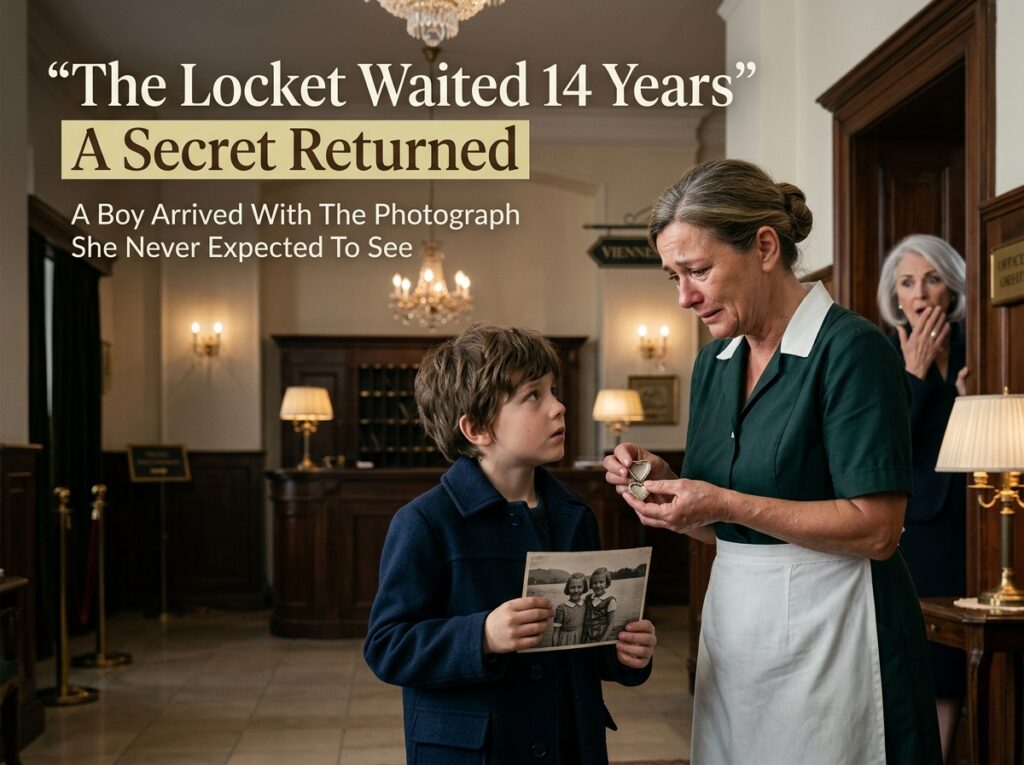
The boy stood beside me, clutching his photograph with both hands.
He was small for nine. His brown hair had been combed neatly, but a stubborn piece at the front had escaped and hung over his forehead. His coat was too thin for the November cold outside, and one of his shoelaces was loose.
Margarethe stared at him.
Then at the locket.
Then back at him.
“What is your name?” she asked.
The boy swallowed.
“Emil.”
“Emil what?”
“Emil Weiss.”
Something changed in her face.
It was so slight that another person might not have noticed.
I did.
Housekeepers notice small things.
A guest who suddenly stops humming.
A couple who no longer sleeps in the same bed.
A hand that trembles while placing a suitcase on the floor.
A woman who says she’s fine while staring at the window for ten minutes.
Margarethe’s fingers tightened around the locket.
“Who sent you here?”
“My mother.”
“Your mother?”
Emil nodded.
“She died in March.”
Margarethe lowered herself slowly into her chair.
For a moment, she looked older than her fifty-eight years.
“What’s your mother’s name?”
Emil looked down at the photograph.
“Anna.”
The room went completely still.
I felt a chill move across my shoulders.
Margarethe closed her eyes.
I thought she might cry.
Instead, she whispered, “No.”
Emil frowned.
“She told me to find you.”
Margarethe opened her eyes.
“I don’t know you.”
“But she knew you.”
The boy said it without accusation.
That somehow made it worse.
He simply stated it as a fact.
Children don’t understand the complicated rules adults create around old pain. They don’t know when a name is dangerous. They don’t know when a door should remain closed.
Emil reached into his coat pocket and pulled out a folded piece of paper.
“My mother wrote this before she died.”
He held it toward Margarethe.
She didn’t take it.
“What does it say?”
“She said I should only give it to the woman with silver hair.”
His eyes moved toward her head.
Margarethe had once been completely dark-haired. I knew because I had seen photographs of her in the hotel’s old administrative files.
Now silver ran through every strand.
“I didn’t know your name,” Emil continued. “So I asked people.”
“People?”
“At the train station. At the hospital. My mother’s friend said there was a hotel where important people stayed. She said if my mother was telling the truth, maybe the woman would still be there.”
Margarethe looked at me.
For the first time since I had known her, there was fear in her eyes.
Not anger.
Not irritation.
Fear.
“Leave us,” she said.
I hesitated.
“Mrs. Aigner—”
“Please.”
That last word stopped me.
Margarethe Aigner did not say please.
I looked at Emil.
The boy was staring at her as if she were the answer to a question he had been carrying for months.
I put my hand gently on his shoulder.
“We’ll wait outside.”
Margarethe nodded.
I turned toward the door.
Then I heard her say, “Wait.”
I stopped.
She looked at the locket.
“Where did you get that?”
“It was left at the front desk,” I said. “In 2011.”
Her face went white.
I suddenly understood something.
She had not forgotten Anna.
She had been waiting for her.
For fourteen years.
And whatever was inside that locket had just brought the past back through the door.
Part 2
I didn’t leave.
Neither did Emil.
Margarethe sat behind her desk, holding the locket in one hand and the boy’s folded note in the other.
She stared at both as if they belonged to different worlds that should never have met.
Finally, she said, “Give me the photograph.”
Emil handed it over.
Margarethe looked at the woman in the picture.
I had seen that face before.
Fourteen years earlier.
A young woman standing at the Grand Meridian’s front desk with rainwater darkening the shoulders of her coat.
She had been perhaps twenty-six then.
Pale.
Thin.
Exhausted.
I remembered her because she had kept looking toward the hotel’s entrance as if she expected someone to come through it.
Her hands had shaken when she placed the silver locket on the counter.
“Please,” she had said.
I had been thirty-eight then, with a bad knee and two children still living at home.
“Who should I give it to?” I had asked.
“The woman who runs this place.”
I had almost laughed.
At the Grand Meridian, everyone knew Margarethe.
Everyone also knew that you did not approach her unless necessary.
“What should I tell her?”
The woman had looked around.
Then she leaned closer.
“If she ever asks about Anna.”
“Anna?”
She nodded.
“Just give her this.”
“What is your name?”
She had hesitated.
Then she shook her head.
“I can’t.”
I remembered the fear in her face.
I remembered promising.
And I remembered failing to keep the promise.
Not deliberately.
That was the part that had troubled me most after finding the envelope again.
Life simply swallowed the moment.
A wedding anniversary.
A broken boiler.
My daughter’s pregnancy.
My husband’s surgery.
Staff changes.
Long shifts.
One year became five.
Five became ten.
The brown envelope became part of the wall behind my locker.
Until the boy appeared.
Now, sitting across from Margarethe, I wondered what would have happened if I had remembered.
Margarethe unfolded Emil’s note.
Her eyes moved across the page.
Then she stopped.
“What does it say?” I asked.
She didn’t answer.
Emil stepped closer.
“Is it her handwriting?”
Margarethe looked at him.
“Yes.”
“Did you know my mother?”
Margarethe took a long breath.
“I knew a girl named Anna.”
“My mother.”
“I don’t know.”
Emil’s face fell.
“But you said her name.”
“I said Anna because that was the name in the locket.”
“You knew her.”
Margarethe stood.
She walked to the window overlooking the courtyard.
For several seconds, neither of us spoke.
Then she said, “Your mother came here in October of 2011.”
Emil nodded.
“She stayed?”
“No.”
“Why?”
Margarethe turned.
“She was frightened.”
“Of what?”
“I don’t know.”
I knew that was a lie.
Perhaps Emil knew too.
He looked at me.
I couldn’t bear it.
“Mrs. Aigner,” I said softly, “you should tell him.”
Margarethe’s expression hardened.
“You don’t know what you’re talking about.”
“I know what I saw.”
“You saw a frightened young woman.”
“I saw her give me the locket.”
“And then?”
“And then I forgot.”
The words sounded shameful when spoken aloud.
Margarethe looked at the floor.
“I didn’t forget,” she said.
Emil’s eyes widened.
“What happened?”
Margarethe came back to the desk.
She sat down.
Then she placed the locket in front of her.
“Your mother wasn’t looking for me.”
“Then who was she looking for?”
Margarethe looked directly at him.
“Her sister.”
I felt the air leave the room.
Emil frowned.
“My mother didn’t have a sister.”
Margarethe closed her eyes.
“She did.”
The boy’s voice became almost a whisper.
“Where is she?”
Margarethe didn’t answer.
Instead, she opened the silver locket.
Inside was a tiny photograph.
Two little girls stood together in front of a lake.
One had dark hair.
The other had a crooked smile.
On the back, written in faded blue ink, were two words.
Anna and Greta.
Emil stared.
Margarethe touched the photograph with trembling fingers.
Then she said something that made my stomach tighten.
“The girl beside your mother was me.”
Part 3
Nobody spoke for several seconds.
Outside the office, a trolley rattled down the corridor.
Somewhere below us, a telephone rang.
The hotel continued doing what hotels always do.
Doors opened.
Doors closed.
Guests complained about breakfast.
Someone asked for another towel.
Someone else laughed in the lobby.
And inside Margarethe’s office, fourteen years disappeared.
“You’re my mother’s sister?” Emil asked.
“Yes.”
“But my mother never told me.”
“I know.”
“Why?”
Margarethe looked at the locket.
“Because she was angry with me.”
“For what?”
She didn’t answer immediately.
Instead, she opened a drawer and took out a small photograph.
It was old.
Much older than the one Emil had brought.
Two girls sat on a stone wall beside a lake.
One was perhaps eight.
The other six.
Their arms were wrapped around each other.
Margarethe placed it beside the locket.
“That was us.”
Emil leaned forward.
“My mother is Anna.”
“Yes.”
“And you’re Greta.”
Margarethe nodded.
“Why did she leave you?”
“She didn’t.”
That answer surprised all of us.
Margarethe continued.
“We were raised by our grandmother. Our parents died when Anna was five and I was three.”
Her voice was steady now, but her hands weren’t.
“We were inseparable. Anna was brave. I wasn’t. She would climb trees, swim in the lake, sneak apples from the neighbor’s garden. I followed her everywhere.”
She smiled faintly.
It was the first real smile I had ever seen from her.
Then it disappeared.
“When we were teenagers, things changed.”
“How?” Emil asked.
“Anna wanted to leave Vienna. She wanted to study music. She had a voice like her mother.”
“Did she?”
Margarethe nodded.
“She could sing in a way that made people stop talking.”
Emil looked at the photograph again.
“What happened?”
“I stayed.”
“Why?”
“Because our grandmother became sick.”
Margarethe paused.
“Someone had to remain.”
“So your mother left?”
“She tried.”
The office suddenly felt colder.
“She got an opportunity to travel with a small music group. I told her she couldn’t go. I told her our grandmother needed her.”
“But she went?”
“Yes.”
Margarethe looked at Emil.
“And I never forgave her.”
“For leaving?”
“For choosing herself.”
She looked away.
“That was my mistake.”
Emil was silent.
I watched Margarethe’s face.
I understood then why people called her cold.
Sometimes coldness isn’t the absence of feeling.
Sometimes it’s what happens when feeling has nowhere safe to go.
“What happened to Anna?” Emil asked.
“She came back.”
“When?”
“Years later.”
“Why?”
Margarethe looked at the boy.
“Because she was pregnant.”
Emil froze.
“She was pregnant with me?”
“Yes.”
“And she came to you?”
“No.”
Margarethe’s eyes lowered.
“She came to the hotel.”
I remembered the young woman at the front desk.
The rain.
The trembling hands.
The locket.
My heart began pounding.
“She was trying to reach you,” I whispered.
Margarethe nodded.
“She had heard I owned the Grand Meridian.”
“Why didn’t you see her?”
“I refused.”
Emil stared at her.
“You refused?”
Margarethe nodded.
“I told the receptionist I didn’t want to speak with her.”
“Why?”
“Because I was angry.”
Her voice cracked.
Just once.
Then she continued.
“Anna had disappeared for years. She came back when she needed something. I assumed she wanted money.”
“Did she?”
“No.”
“What did she want?”
Margarethe looked at the locket.
“She wanted to tell me she had a son.”
Emil’s face changed.
“I didn’t know,” he whispered.
“I know.”
“And you never met me?”
“No.”
“Until now.”
“Yes.”
He looked down.
For a moment, I thought he might cry.
Instead, he asked, “Why did she come here again in 2011?”
Margarethe didn’t answer.
I did.
“She left the locket with me.”
Margarethe looked at me.
“And she asked you to give it to me if I ever asked about Anna.”
“Yes.”
“Did she say anything else?”
I searched my memory.
Then I remembered.
“She said she couldn’t give me her surname.”
Margarethe closed her eyes.
“And you forgot.”
“Yes.”
“I don’t blame you.”
The words surprised me.
“I blame myself.”
Emil looked between us.
“What was inside the locket?”
Margarethe turned it over.
“Something Anna wanted me to see.”
She reached inside.
There was something behind the photograph.
A tiny folded strip of paper.
I had never known it was there.
Margarethe unfolded it.
Her eyes moved over the words.
Then she began to cry.
Not dramatically.
No sobbing.
Just tears running silently down the face of the woman who had spent decades teaching the world that she needed nothing from anyone.
Emil stood beside her.
“What does it say?”
Margarethe looked at him.
“It says, ‘Greta, if you are reading this, I finally found the courage to come home.’”
Part 4
Emil sat down.
The room seemed too small for what had just been uncovered.
“My mother came home,” he said.
Margarethe nodded.
“But you weren’t here.”
“No.”
“Where were you?”
“Upstairs.”
“You didn’t know she came.”
“I knew.”
Emil looked up sharply.
“You knew?”
Margarethe pressed her palms against the desk.
“Someone told me Anna was in the lobby.”
“Then why didn’t you go down?”
“Because I was afraid.”
It was such a simple answer.
And somehow the saddest.
Margarethe Aigner, owner of one of Vienna’s most respected hotels, woman who could dismiss an employee with one sentence, woman who had survived decades without showing weakness, admitted she had been afraid to open a door.
“What were you afraid of?” Emil asked.
“That she would hate me.”
“She was your sister.”
“That doesn’t mean she couldn’t.”
Emil looked at the floor.
“Did she?”
Margarethe shook her head.
“No.”
“How do you know?”
“She left the locket.”
The boy stared at it.
“Why didn’t you find her afterward?”
“I tried.”
“When?”
“Several times.”
“Did you know where she lived?”
“No.”
“Then how?”
Margarethe hesitated.
“She left a name with the hotel receptionist.”
“Whose name?”
“A hospital.”
My stomach tightened.
“The same hospital where she died?”
Margarethe nodded.
“She had been sick for years.”
Emil looked startled.
“She told me she was sick.”
Margarethe closed her eyes.
“She had a heart condition.”
The boy looked away.
“My mother said she was tired.”
“That was true.”
“Was she in pain?”
“I don’t know.”
Margarethe’s voice broke.
“I wasn’t there.”
Emil stared at the photograph in his hands.
Then he asked the question that seemed to hurt Margarethe most.
“Why didn’t she tell me about you?”
“I don’t know.”
“You’re her sister.”
“I know.”
“She should have told me.”
“She was ashamed.”
“Of what?”
“Of coming back.”
Emil shook his head.
“That doesn’t make sense.”
“It will when you’re older.”
“No.”
He stood.
“It doesn’t make sense now.”
Margarethe looked at him.
“You’re right.”
She took a breath.
“Your mother believed she had ruined everything.”
“She didn’t.”
“I know.”
“Then why did everyone let her think that?”
Margarethe had no answer.
I thought about how often people carry old stories alone.
Someone says something cruel at seventeen.
Someone walks away at twenty-two.
Someone waits until thirty-five.
Then forty.
Then fifty.
And eventually everyone involved is old enough to understand that the original wound could have been healed years earlier.
If only one person had spoken.
Margarethe opened another drawer.
This one contained dozens of envelopes.
She pulled out a bundle tied with ribbon.
“I wrote to her.”
Emil stared.
“Letters?”
“Yes.”
“Did you send them?”
“No.”
“Why?”
“Because I didn’t know where she lived.”
“Then why write them?”
Margarethe looked embarrassed.
“Because I didn’t know what else to do.”
She untied the ribbon.
The letters were yellowed around the edges.
Some had dates.
2004.
2005.
2006.
2007.
And one from 2011.
“I wrote this after I heard she had been at the hotel.”
Margarethe held it out.
Emil didn’t take it.
“Read it.”
“You should.”
“I can’t.”
“Why?”
“Because I never had the courage to finish it.”
Emil looked at me.
Then back at his aunt.
Finally, he took the letter.
He unfolded it.
His lips moved silently.
Then he looked up.
“What does this mean?”
Margarethe frowned.
“What?”
“You wrote, ‘If I had known, I would have opened the door.’”
Margarethe’s eyes filled.
“I would have.”
“But you did know.”
“Yes.”
“And you still didn’t open it.”
“No.”
Emil folded the letter.
“My mother waited.”
Margarethe nodded.
“I know.”
“For you.”
“Yes.”
The boy’s face crumpled.
For the first time, he looked nine.
Not brave.
Not composed.
Just a child who had lost his mother and had spent months believing there was some unfinished task he needed to complete.
He whispered, “She told me I had to come here.”
Margarethe reached for him.
He hesitated.
Then he stepped forward.
She wrapped her arms around him.
And I watched the woman who had spent fourteen years hiding from one sister finally hold what was left of her.
Part 5
The next morning, Emil returned to the hotel.
He came with a small backpack.
Margarethe had arranged for him to stay with his maternal aunt while they sorted out the paperwork, but he insisted on seeing the hotel again.
“Why?” I asked.
He shrugged.
“My mother liked it.”
“You remember her telling you?”
“No.”
“Then how do you know?”
He smiled faintly.
“She kept the hotel postcard.”
That afternoon, Margarethe showed him the old guestbook.
The Grand Meridian had changed considerably since 2011.
New carpets.
New lighting.
A renovated lobby.
Different staff.
But some things remained.
The old brass elevator.
The walnut staircase.
The clock behind reception.
And the small fountain in the courtyard.
Emil stood beside it.
“My mother came through here?”
“Yes.”
“Where did she sit?”
I pointed.
“Over there.”
He sat on the same bench.
For a while, he said nothing.
Then he pulled a folded piece of paper from his backpack.
“There’s something else.”
“What?”
“My mother gave me this before she died.”
He handed it to me.
It was a photocopy of an old photograph.
Two girls by a lake.
The same girls from the locket.
On the back, Anna had written:
“Some people spend their whole lives waiting for permission to come home.”
I looked at Emil.
“Did she explain that?”
“No.”
He folded the paper.
“She told me that if anything happened to her, I should find Greta.”
He hesitated.
“She said Greta would know what to do.”
I looked toward Margarethe’s office.
“She was right.”
Emil nodded.
But the expression on his face told me something else.
He wasn’t sure.
That evening, Margarethe asked me to stay after my shift.
“I need to tell you something,” she said.
I sat across from her.
She looked exhausted.
“Anna came to the hotel three times in 2011.”
I stared at her.
“Three?”
“Yes.”
“Why didn’t I know?”
“You weren’t always at reception.”
“What happened?”
“The first time, she left the locket.”
“The second?”
“She left a letter.”
“And the third?”
Margarethe looked down.
“She left nothing.”
“Why?”
“She saw me.”
My breath caught.
“You saw her?”
Margarethe nodded.
“She was standing outside the hotel.”
“You didn’t speak?”
“No.”
“Did she see you?”
“Yes.”
“What happened?”
“She smiled.”
Margarethe’s voice became very quiet.
“Then she walked away.”
I felt anger rise inside me.
“You could have stopped her.”
“Yes.”
“You could have called her.”
“Yes.”
“Why didn’t you?”
“I don’t know.”
She looked at me.
“Maybe I thought there would always be another day.”
That sentence stayed with me.
There are so many tragedies built around another day.
Another conversation.
Another apology.
Another visit.
Another chance.
We imagine tomorrow is a place we are guaranteed to reach.
It isn’t.
Margarethe wiped her eyes.
“I spent fourteen years believing I had failed my sister.”
“You did.”
She looked at me.
I almost regretted saying it.
But I continued.
“And you still have time not to fail her son.”
Margarethe nodded.
“I know.”
The next day, she went to court.
She began the process of becoming Emil’s legal guardian.
Not because she wanted to replace his mother.
She knew no one could.
She did it because Anna had asked her, in the only way she knew how, to make sure her son wasn’t alone.
Months passed.
The hotel changed again.
Emil came every Saturday.
Sometimes he helped me fold towels.
Sometimes he sat in the lobby and did his homework.
Sometimes he and Margarethe argued about vegetables.
Once, I heard him say, “You can’t tell me to eat broccoli when you drink black coffee all day.”
Margarethe stared at him.
Then, unexpectedly, laughed.
It was the first time I heard that sound.
A real laugh.
The kind that escapes before you can stop it.
And slowly, the hotel changed too.
Not because the building was different.
Because we were.
Part 6
One rainy Saturday, Emil asked me why I had kept the locket for fourteen years.
I thought about giving him a simple answer.
“I forgot.”
But that wasn’t entirely true anymore.
“I remembered sometimes,” I said.
“Then why didn’t you give it to her?”
“I was embarrassed.”
“About what?”
“About forgetting.”
He frowned.
“That doesn’t make sense.”
“It does when you’re older.”
“You always say that.”
“I suppose I do.”
He smiled.
Then he asked, “Did my mother know you?”
“I don’t think so.”
“But she trusted you.”
“She didn’t know me.”
“She gave you the locket.”
“She needed someone.”
Emil looked toward the lobby.
“Maybe she knew you’d keep it.”
I laughed softly.
“That’s giving me far too much credit.”
“No.”
He was serious.
“She knew.”
“Why?”
“Because my mother always said people show you who they are.”
I looked at him.
“What else did she say?”
“That if someone keeps a promise even after everyone forgets about it, they’re a good person.”
I swallowed.
“I don’t think I kept the promise.”
“You did.”
“I forgot.”
“But you kept it.”
“How?”
“You didn’t throw it away.”
That stopped me.
For fourteen years, I had considered the envelope a failure.
Something forgotten.
Something neglected.
But perhaps there was another way to see it.
The locket had survived.
I had moved lockers twice.
The housekeeping department had renovated the staff corridor.
The hotel had changed management systems.
People had come and gone.
Yet that little brown envelope had remained taped behind my locker.
Waiting.
Not because I was especially responsible.
Perhaps because some promises refuse to disappear completely.
Later that afternoon, Margarethe joined us.
She was carrying a box.
“What’s that?” Emil asked.
“Your mother’s things.”
He stopped smiling.
“Where did you get them?”
“The hospital kept some belongings.”
She placed the box on the table.
Inside were ordinary things.
A scarf.
A notebook.
Two books.
A pair of earrings.
A photograph.
And a small wooden music box.
Emil touched it carefully.
“She had this.”
Margarethe nodded.
“She gave it to me when we were children.”
“You kept it?”
“For fifty-two years.”
Emil looked at her.
“You kept something from her too.”
“Yes.”
“Why?”
Margarethe smiled sadly.
“Because I couldn’t throw away everything.”
He wound the music box.
A soft melody filled the room.
Margarethe’s face changed.
“You remember it?” Emil asked.
“Yes.”
“What song is it?”
“Our mother’s favorite.”
Emil listened.
Then he said, “Can I keep it?”
Margarethe hesitated.
“Yes.”
The boy smiled.
“Thank you.”
Margarethe reached into the box again.
There was one final envelope.
This one had Emil’s name on it.
He stared.
“That’s mine?”
Margarethe nodded.
He opened it.
Inside was a letter.
His mother’s handwriting.
He began reading.
Then stopped.
“Can you read it with me?”
Margarethe’s lips trembled.
“Yes.”
They sat together.
I stood nearby, pretending to organize the box.
But I heard every word.
Anna had written about her childhood.
About the lake.
About Greta.
About the years they had been angry with each other.
About becoming a mother.
And about the fear that one day Emil would grow up believing he had been abandoned.
Then came the line that broke Margarethe.
“I want my son to know that I never stopped loving you.”
Margarethe covered her mouth.
Emil looked at her.
“She loved you.”
Margarethe nodded.
“I know.”
“She wanted you to know.”
“I know.”
“And she wanted me to find you.”
“Yes.”
Emil folded the letter.
Then he leaned against Margarethe.
She put her arm around him.
No dramatic speech followed.
No miracle.
No way to bring Anna back.
Only two people sitting beside a box of old belongings, trying to build something new from a life that had ended too soon.
Sometimes healing isn’t a door opening.
Sometimes it is simply two people deciding not to walk away from each other.
Part 7
By spring, Emil knew the hotel better than some of the staff.
He knew which elevator made a strange clicking sound.
He knew the kitchen kept the best pastries behind the second refrigerator.
He knew I hated folding fitted sheets.
He knew Margarethe pretended not to like chocolate.
And he knew exactly where his mother had once stood.
The spot beside the old front desk.
One afternoon, he asked me to show him.
I did.
“This is where she gave you the locket?”
“Yes.”
“What did she look like?”
I thought about it.
“Scared.”
He nodded.
“Was she crying?”
“No.”
“My mother didn’t cry much.”
“I don’t remember seeing tears.”
“She said crying made people think they could hurt you.”
I looked at him.
“That sounds like something she would say.”
He smiled.
Then his expression changed.
“Do you think she was angry at Greta?”
“Yes.”
“Do you think she forgave her?”
I paused.
“I think she came back.”
He looked at me.
“Is that the same thing?”
“No.”
“Then what does it mean?”
“It means forgiveness doesn’t always arrive in a sentence.”
He thought about that.
“What does it arrive in?”
“Sometimes a photograph.”
He touched the locket hanging around his neck.
Margarethe had given it to him.
She had repaired the clasp and polished the silver, but she left the small scratches untouched.
He wore it beneath his shirt.
A private connection to the mother he had lost.
A reminder that her story had not ended with death.
That summer, Margarethe took Emil to the lake.
The same lake in the photographs.
I wasn’t there.
She told me about it later.
They found the old stone wall.
The trees had grown taller.
The path had changed.
But the water was the same.
Emil stood beside her.
“Did you and my mother sit here?”
“Yes.”
“What did you talk about?”
“Everything.”
“Do you remember?”
“Some things.”
“Tell me.”
Margarethe smiled.
“She once told me she would become famous.”
“Did she?”
“Not in the way she imagined.”
“She became my mother.”
Margarethe looked at him.
“Yes.”
“That sounds more important.”
Margarethe cried then.
She told me she didn’t try to hide it.
For years, she had believed tears were proof of weakness.
At the lake, she finally understood they could also be proof of love.
When they returned to Vienna, Emil brought me a small stone.
“For your locker,” he said.
“What am I supposed to do with it?”
“Keep it.”
“Why?”
“So you remember.”
I put it beside my locker.
It stayed there.
Years later, it still would.
Because by then I had learned something about keepsakes.
They aren’t valuable because they are rare.
They are valuable because someone trusted you with their meaning.
Part 8
Two years after Emil first appeared in the staff corridor, Margarethe called a meeting.
Everyone thought she was going to announce renovations.
Instead, she stood in the lobby and said, “I have something to tell you.”
The hotel staff gathered around.
Margarethe looked nervous.
That alone was extraordinary.
“I have spent much of my life believing that this hotel belonged to me.”
Nobody moved.
She continued.
“I was wrong.”
Emil stood beside her.
“This hotel has been a place where people arrive carrying secrets, grief, hope, fear, and sometimes things they cannot say aloud.”
She looked at me.
Then at the staff.
“I forgot that the people who work here carry those things too.”
Someone coughed.
Margarethe smiled.
“I would like to change something.”
She announced a new employee assistance fund.
No one would have to know who used it.
No explanations required.
Medical emergencies.
Family crises.
Unexpected expenses.
A private application.
It was not charity.
She called it responsibility.
Then she turned to me.
“I would also like to thank someone.”
I shook my head immediately.
“Don’t.”
She smiled.
“You’ve never liked attention.”
“No.”
“You kept a promise for fourteen years.”
“I forgot about it.”
“You remembered enough to keep it.”
I looked down.
The staff applauded.
I felt my face become hot.
Emil grinned.
Later, when everyone had left, he asked me something.
“Why did you really keep it?”
“The locket?”
“Yes.”
I thought for a long time.
“Because every time I saw that envelope, I remembered a woman who was frightened.”
He nodded.
“And?”
“And I think some part of me always hoped she’d come back.”
“She did.”
I looked at him.
“Yes.”
“But she couldn’t stay.”
“No.”
He touched the locket beneath his shirt.
“She left me.”
“She left you a path.”
“To Greta.”
“Yes.”
He smiled.
“Do you think she knew Greta would help me?”
“I think she hoped.”
“What if Greta hadn’t?”
I looked at him.
“Then someone else would have.”
“How do you know?”
“Because your mother kept looking for someone.”
He nodded slowly.
Then he said, “Maybe that’s what people do.”
“What?”
“Leave little pieces of themselves where someone else can find them.”
I smiled.
“Maybe.”
He ran toward the lobby.
I watched him go.
For the first time, I realized the hotel had become something different for me.
I had spent fourteen years thinking I worked there because I needed a job.
That was true.
But it wasn’t the whole truth.
I had spent fourteen years watching people pass through doors.
Some stayed one night.
Some stayed a week.
Some never returned.
And sometimes, without realizing it, we became part of each other’s stories.
The hotel remembered what people thought they had left behind.
A scarf.
A wedding ring.
A letter.
A photograph.
A locket.
A promise.
That was why the lost-and-found room had always fascinated me.
People called it a place for forgotten things.
I no longer believed that.
Some things weren’t forgotten.
They were simply waiting for the right person to come looking.
Part 9
Four years after Emil first walked into the staff corridor, I found a new envelope taped inside my locker.
This one was blue.
My hands shook when I pulled it down.
I already knew who had left it.
Emil was sixteen by then.
He had grown taller than me.
His voice had deepened.
He had his mother’s habit of tilting his head when thinking.
He had Margarethe’s stubbornness.
And, fortunately for everyone, he had my ability to complain about housekeeping schedules.
I opened the envelope.
Inside was a photograph.
A young man stood beside an older woman with silver hair.
They were smiling.
On the back, Emil had written:
“For the woman who kept the promise.”
I laughed.
Then I cried.
When I found him in the lobby, I held the photograph up.
“You’re getting sentimental.”
He shrugged.
“Must be the family.”
Margarethe was sitting nearby.
She smiled.
“She gets sentimental every time she sees that photograph.”
“I do not.”
“You do.”
“I have allergies.”
“To photographs?”
“Old photographs.”
Emil laughed.
Then he grew serious.
“I got accepted.”
Margarethe stood.
“Accepted where?”
“The music program.”
She froze.
“Music?”
He nodded.
“My mother wanted to sing.”
Margarethe looked at him.
“Yes.”
“I want to learn.”
Margarethe’s eyes filled.
“What instrument?”
“Piano.”
For a moment, neither of them spoke.
Then Margarethe walked over and hugged him.
He hugged her back.
I stood there, watching.
Anna had wanted to study music.
She had not been given enough time.
But something of her was continuing.
Not because Emil was obligated to become her.
He wasn’t.
He was simply carrying forward something she had loved.
That evening, he asked me to come with him to the old lake.
Margarethe came too.
We stood beside the stone wall.
Emil took the locket from his neck.
“I think I know why she left this.”
Margarethe looked at him.
“Why?”
“To remind you that you were sisters before you were angry.”
Margarethe looked down.
He continued.
“She didn’t want you to remember the last time you saw each other.”
Margarethe’s eyes filled.
“She wanted you to remember this.”
He opened the locket.
The two girls were still there.
Young.
Smiling.
Before grief.
Before anger.
Before distance.
Before regret.
Margarethe touched the photograph.
“I wasted so much time.”
Emil shook his head.
“You came back.”
“I should have come sooner.”
“Yes.”
She looked at him.
He smiled.
“But you came.”
That was all.
No grand forgiveness.
No perfect ending.
Just the truth.
People cannot change the years behind them.
They can only decide what to do with the years ahead.
I looked across the water.
The evening light had turned the lake silver.
For a moment, I imagined Anna standing beside us.
Not as a ghost.
Not as something supernatural.
Just as she had been.
A young woman with frightened eyes, holding a silver locket and hoping someone would finally open a door.
I wished I could tell her.
We did.
It just took too long.
Part 10
I retired from the Grand Meridian when I was sixty.
Margarethe tried to convince me to stay.
Emil said the hotel wouldn’t survive without me.
I told them both that the hotel had survived perfectly well before I arrived and would survive after I left.
That was partly true.
But leaving was harder than I expected.
On my final morning, I walked through every floor.
I touched the brass railings.
I checked the laundry room.
I stood in the staff corridor behind the laundry room.
Then I opened my locker.
The old brown envelope was gone.
So was the stone Emil had given me.
But the photograph remained.
The one he had given me years earlier.
I carried it downstairs.
Margarethe was waiting in the lobby.
She had silver hair now.
More silver than before.
But her face was softer.
She hugged me.
“Thank you,” she whispered.
“For what?”
“For remembering.”
I smiled.
“I forgot.”
“You remembered eventually.”
“Yes.”
Emil arrived a few minutes later.
He was twenty-one.
He had finished his music studies and had begun performing in small venues around Vienna.
He still wore the locket.
He hugged me so tightly that my feet nearly left the floor.
“You’re really leaving?”
“Yes.”
“Who’s going to tell me I’m doing everything wrong?”
“Margarethe.”
“She agrees with me.”
“I’ll miss you too.”
He smiled.
Then he reached into his coat.
“I brought you something.”
It was a small silver frame.
Inside was a photograph of four people.
Margarethe.
Emil.
Me.
And Anna.
The photograph of Anna had been placed between us.
My throat tightened.
“You shouldn’t have.”
“I wanted you to have it.”
I looked at Anna’s face.
She was young.
So young.
You could still see the uncertainty in her eyes.
But there was something else there too.
Hope.
I finally understood why the locket had mattered.
It had never been about jewelry.
It had never been about secrets.
It had never even been about the hotel.
It was a message that had taken fourteen years to arrive.
A sister telling another sister:
I came back.
I was afraid.
I loved you.
Please don’t let my son grow up thinking he was alone.
And somehow, despite all the mistakes, the message had reached its destination.
I left the Grand Meridian that morning carrying the photograph against my chest.
Outside, Vienna was cold.
The sky was pale.
People hurried past me with their coats pulled tight.
Cars moved through the street.
A tram bell sounded in the distance.
Ordinary life.
That is the strange thing about grief.
The world does not stop when someone dies.
It keeps moving.
The coffee shops open.
The trains arrive.
The hotel beds are made.
People laugh.
People fall in love.
People leave.
And sometimes, years later, someone finds a small forgotten object and realizes that love had been waiting there all along.
I never learned exactly what Anna had hoped would happen when she placed that silver locket into my hands in 2011.
Maybe she hoped Margarethe would forgive her.
Maybe she hoped her sister would forgive herself.
Maybe she simply wanted Emil to have someone who knew where he came from.
I only know what happened in the end.
A boy came looking for a woman with silver hair.
He found her.
A sister came home too late.
But not so late that her love couldn’t still reach the person she had left behind.
And a forgotten housekeeper’s promise finally found its way to where it belonged.
Years later, I visited the Grand Meridian one afternoon.
I stood outside the entrance for a moment before going in.
The lobby looked different.
The furniture had changed.
The flowers were different.
But the clock still hung behind reception.
And beside it, in a small glass display, was something I recognized immediately.
A silver locket.
Not the original.
A replica.
Underneath it was a small brass plaque.
It read:
“For the things we are afraid to say before it is too late.”
I stood there for a long time.
Then someone touched my shoulder.
I turned.
Emil.
He was carrying his piano music.
He smiled.
“You came back.”
“Yes.”
“Why?”
I looked toward the locket.
“To see if it was still there.”
He followed my eyes.
“It is.”
I smiled.
“So am I.”
And for the first time, I understood that lost things don’t always return the way we expect.
Sometimes they return as people.
Sometimes as memories.
Sometimes as forgiveness.
And sometimes, after fourteen long years, they return as a nine-year-old boy standing in a hotel corridor with a photograph in his hands, asking for someone he has never met.
I had spent years believing the locket had been lost.
I was wrong.
It had never been lost.
It had simply been waiting.