Part 1
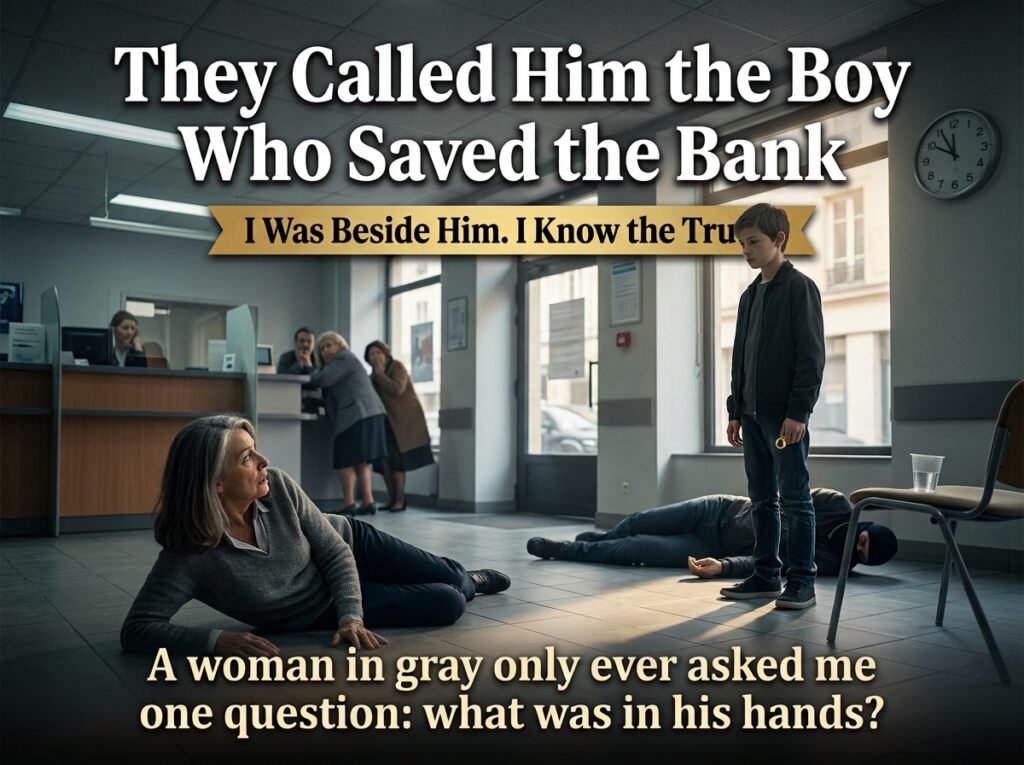
They said the boy saved everyone. I was the woman lying next to him on the floor, and I know that isn’t true, because he wasn’t trying to save anyone. He was trying to stop one specific man.
My name is Élise Vasseur, I am sixty-four years old, and for thirty-one years I taught literature to teenagers at a lycée in the seventh arrondissement of Lyon, a career I loved with the particular exhaustion of someone who has read the same essays on Camus a thousand times and still finds, occasionally, one student who understands him. I retired four years ago. My husband, Marcel, died eleven months ago, quietly, of the same slow heart failure that had been announcing itself for a decade, and I had gone into the Crédit Lyonnais branch on Rue de la République that Thursday morning to withdraw nine hundred euros in cash, because the funeral home handling my sister’s arrangements, she had died the week before, a fall on wet stairs, sudden and stupid and entirely unfair, required a portion of their fee in cash before they would release the body for the service.
I want to explain, before I describe what happened, that I am not by nature an especially observant woman, or I did not believe myself to be, before that morning. I taught literature, not investigation. But grief, I have since decided, does something strange to attention. It hollows you out in a way that makes room for noticing things you would otherwise let pass, because you have already been forced, by loss, to look closely at ordinary objects and wonder why they still exist when the person who mattered does not.
The boy was sitting two orange plastic chairs away from me in the small waiting area near the counter, a paper cup of water in his hands, untouched. He looked perhaps sixteen, though I would learn later he was younger, seated with a stillness that struck me even before anything happened, a stillness that had nothing to do with shyness or boredom, the two states I associated, from three decades of teaching, with silent adolescents in waiting rooms. He was alone. I remember thinking, in the ordinary, mildly curious way you think about strangers when you have nothing else to occupy your mind, that it was strange nobody had come with him, that a boy his age in a bank on a Thursday morning, without a parent, without a phone in his hand the way every teenager I had ever taught seemed surgically attached to one, was itself a small anomaly worth noting and then, naturally, forgetting.
I did not forget it. I have turned it over in my mind every day since.
The doors burst open at 10:47 in the morning. I know the exact time because I had been checking my watch every few minutes, a habit from thirty-one years of managing classroom periods down to the minute, anxious about making it to the funeral home before their lunch closure. Three men came in, dressed in dark clothing, faces covered, moving with the particular controlled chaos of people who had rehearsed this, shouting in French with heavy accents I couldn’t place, ordering everyone to the floor.
Everyone in that small branch dropped immediately, myself included, the reflexive obedience of frightened bodies. Everyone except the boy.
He did not flinch. He set the paper cup down on the little table beside his chair, carefully, the way you set something down when you intend to come back for it later, and he stood up.
Part 2
I was on the floor by then, my cheek pressed against cold tile that smelled faintly of industrial cleaner, and from that angle, from the floor, I had an unobstructed view of the boy’s shoes and lower legs as he walked forward, unhurried, toward the men who had just burst through the doors shouting for everyone to get down.
What I noticed, and what no officer ever asked me about afterward, though I offered it twice unprompted and watched it be written down without any apparent interest, was that in the twenty minutes before the men arrived, the boy had been watching the clock mounted above the teller counter. Not glancing at it the way a bored person glances at time passing. Watching it, steadily, the particular fixed attention I recognized from thirty-one years of monitoring students who were counting down toward an exam’s end, except sharper than that, more purposeful, the attention of someone with a specific appointment he did not want to miss.
When the second hand swept up to the top of its circle at what I now know was 10:47, he stood.
He walked toward the men, not away from them, not toward the exit the way every instinct in a normal human body screams to do, and he said something. I did not recognize the language. It was not French, not English, not the Arabic I had grown accustomed to hearing throughout my career teaching in a multicultural school in Lyon. It was something older-sounding to my ear, guttural in places, with a rhythm I associate, though I could be wrong, with certain Balkan or Caucasian languages I have heard in films but never studied.
One of the masked men, the one nearest the center of the room, the one who seemed, by the way the others deferred to his small gestures, to be in charge, went very still. And then he answered the boy, in the same language.
I do not know what either of them said. I have thought about this every single day for the eleven weeks since it happened, turning the sounds over in my memory, trying to reconstruct even a syllable I might describe to someone who could translate it, and I have failed every time, because trauma, I have learned, does not preserve sound the way it preserves image. I can describe the boy’s shoes, scuffed brown leather, a size that suggested he had not yet finished growing into his adult feet. I cannot reproduce a single word of what passed between him and that armed man in the ninety seconds that followed.
What happened next happened very fast, and very quietly, in a way that still strikes me as strange when I describe it to people who ask, because they expect gunfire, shouting, the noise of the films. What actually happened was closer to a negotiation conducted at a volume just above a whisper, two men, one of them a boy of perhaps fifteen, speaking a language none of the terrified adults lying on the floor around them could understand, while the other two masked men stood frozen, clearly waiting for some signal from their leader that never quite arrived the way, I sensed even then, they expected it to.
Then there was a single gunshot, and the leader fell, and the other two men, after a confused, frozen moment, turned and ran, and it was over.
The official reports say a customer, a minor whose identity has been withheld, produced a concealed weapon and shot the lead gunman in self-defense during the chaos of the robbery, an act that allowed the remaining assailants to flee without further violence and prevented, in the assessment of the responding police commander, what could have been a significantly worse outcome for the eleven hostages inside.
I do not believe that account. I was on the floor. I saw his hands.
Part 3
The gun, when I finally allowed myself to look at it properly, in the chaos of the minutes immediately following, was small, the kind of compact object that could be concealed easily in a jacket pocket, and it was not, I am quite certain, the kind of weapon a French teenager acquires through any ordinary or legal channel. It looked old. Not old in the sense of poorly maintained, but old in the sense of an object with history, a metal finish worn smooth in places by decades of handling, the way my grandfather’s pocket watch had been worn smooth along its edges by a lifetime spent in his trouser pocket.
The boy did not run. He did not attempt to hide the weapon or himself. He stood very still in the center of that small banking hall, the gun held loosely at his side, looking down at the man he had just shot with an expression I have struggled for eleven weeks to properly describe to anyone, including myself. It was not triumph. It was not horror, exactly, though there was something adjacent to horror in it. It was closer, I think, to the particular exhausted stillness of someone who has just finished a task they had been dreading and preparing for over a very long time, a stillness I recognized, oddly, from watching my own students in the final moments of an exam they had studied for obsessively, the strange flatness that arrives after tension finally resolves.
The other hostages began screaming, scrambling for the doors once the two remaining gunmen fled. I stayed where I was, on the floor, closer to the boy than anyone else in the room, and I watched him kneel down beside the man he had shot, not to check on him, not with any apparent concern for whether the man lived or died, but to retrieve something from the man’s jacket pocket, quickly, efficiently, the motion of someone completing a checklist rather than someone in the grip of adrenaline.
He took a small object from the dead man’s pocket. I could not see clearly what it was at that distance, only that it was small enough to close entirely within his fist, and metallic, catching the fluorescent light of the banking hall for just a moment before he closed his hand around it.
Police arrived within perhaps four minutes of the shot. In the confusion of their arrival, in the shouting and the securing of the scene and the eventual arrival of medical personnel for the two customers who had been struck by flying glass from a shattered display case, the boy simply became one figure among many being processed, questioned, and eventually, I was told later by an officer who seemed slightly embarrassed to be explaining it, released into the custody of “an appropriate guardian” who arrived at the scene with documentation the officer described, without elaborating, as “sufficient and properly executed.”
I gave my statement to two young officers perhaps forty minutes after the event, in a side office of the bank branch that smelled of the same industrial cleaner as the tile floor. They asked me to describe what I had witnessed. I told them about the boy standing calmly, about the strange language, about the gunshot. I mentioned, twice, unprompted, the twenty minutes he had spent watching the clock before he stood. Both times, the officer taking notes wrote something down without comment and moved to the next question, as though the detail held no more significance than my description of the color of the boy’s shirt.
They thanked me. They gave me a card with a case reference number. And then, extraordinarily, given what I had just witnessed, no one from the police ever contacted me again.
Part 4
I buried my sister three days later, using the nine hundred euros I had, remarkably, still managed to withdraw before the robbers arrived, since I had completed my transaction perhaps ninety seconds before the doors burst open. I stood at her graveside in the same coat I had worn on the floor of that bank, and I found myself, absurdly, thinking not about my sister but about a fifteen-year-old boy’s hands closing around a small metal object taken from a dead man’s pocket.
Four days after the robbery, on a gray Monday afternoon, my apartment buzzer sounded, and a woman I did not recognize introduced herself through the intercom as being from “the insurance consortium handling the incident claims” and asked whether she might come up to ask a few brief follow-up questions related to my witness statement. I want to be honest that I nearly refused her. I was exhausted, freshly grieving a second loss atop the first, and had no particular appetite for reliving the events of that Thursday morning yet again for an insurance form.
But something in her voice, a careful precision that did not quite match the bureaucratic blandness of her stated purpose, made me buzz her up.
She introduced herself as Inès Calvet, a woman perhaps fifty, dressed in a well-tailored gray coat that she did not remove even once she was seated in my small living room, with the particular composed stillness of someone whose profession has trained the fidget entirely out of her body. She had a leather notebook, not the standardized form clipboard I associated with insurance adjusters, and a pen that she held without ever quite writing very much with, mostly listening, her eyes on my face with an attentiveness that felt, increasingly as our conversation continued, entirely disproportionate to the stated purpose of her visit.
She asked me to describe the sequence of events again, briefly, and I did, abbreviated, exhausted by then of retelling it. She listened without interrupting until I reached the part where the boy knelt beside the man he had shot.
“You said, in your statement to the police, that he took something from the man’s pocket,” she said. Her French was precise, faintly accented in a way I could not place any more successfully than I had placed the language the boy had spoken to the gunman, some careful, cultivated neutrality that had smoothed away whatever native inflection might otherwise have been detectable.
“Yes,” I said. “A small object. Metal. I couldn’t see it clearly.”
“Can you describe his hands,” she asked, “as he took it? Not his face. I have his face from the security footage already, of course. I need to know about his hands specifically. How he held them. Whether they were steady.”
It was, I want to be clear, a strange question, and I noted the strangeness of it even as I answered. “They were very steady,” I said. “Steadier than mine were, certainly. He held the object carefully. The way you hold something you’ve been told to be careful with, not the way you hold something you’ve just grabbed in a panic.”
Madame Calvet’s pen, which had been moving in small, unhurried notes throughout our conversation, went completely still.
“Madame Vasseur,” she said carefully, “I need you to think back very precisely, and tell me, if you can, whether you saw any markings on that object. Any engraving. Even a fragment of one.”
Part 5
I closed my eyes, the way I used to instruct my students to do during exercises in close recollection, a technique from decades of teaching literary analysis that required students to reconstruct sensory detail from memory with precision rather than impression.
“There were letters,” I said slowly. “Very small. I only saw it for a moment, when he turned it slightly in his hand before closing his fist around it. I remember thinking it looked like a signet, the kind of small emblem you’d find on an old ring or a cufflink, not writing exactly, more like an insignia, with perhaps three letters worked into it, though I could not tell you what they were. It was gold, or gold-colored, catching the light.”
Madame Calvet set down her pen entirely.
“Three letters,” she repeated, very quietly, almost to herself. “Worked into an insignia.”
“Yes.”
She was silent for a long moment, and in that silence, I watched something pass across her carefully composed face that I recognized, with a shiver, from thirty-one years of watching students receive news they had been dreading and half-expecting in equal measure. Not surprise. Confirmation.
“Madame Vasseur,” she said finally, “I must tell you that I am not, in fact, employed by any insurance consortium, and I must ask you, before I explain anything further, whether you are willing to hear something that will complicate considerably what you believe you witnessed that Thursday morning, and whether you are willing to keep what I tell you strictly confidential, for reasons that will become clear.”
I told her, with more steadiness than I actually felt, that I had already buried a sister that week and survived an armed robbery, and that very little she could say would frighten me more than the events of the preceding days already had.
She almost smiled at that, a brief, tired expression that suggested she had heard some version of that particular bravado many times before.
“The boy’s name,” she said, “is Nikolai. He goes, informally, by Niko. He is fourteen years old, not sixteen, as most witnesses have assumed. And the man he shot, the leader of the three men who entered that bank, was not a random criminal engaged in an ordinary robbery.” She paused, choosing her next words with evident care. “He was Niko’s father’s murderer, Madame Vasseur. And Niko had been looking for him, in one country and then another, for the better part of three years.”
Part 6
I want to describe, as precisely as I can, what Inès Calvet told me over the following hour, because I have turned every piece of it over so many times since that I believe I could recite it now nearly word for word, the way I once recited passages of Camus to bored teenagers who would, decades later, tell me at chance encounters in the street that they still remembered a line or two.
Niko’s father, she told me, had been a man named Anton Rusev, a jeweler and, in a quieter and more dangerous secondary occupation, an appraiser and broker of recovered antiquities, primarily items of significant historical and financial value that had gone missing during the chaos of various Balkan and Caucasian conflicts over the preceding three decades, objects whose provenance made them impossible to sell through any legitimate auction house but valuable enough to command extraordinary black-market prices among a very specific, very wealthy, and very discreet clientele. Anton had operated, for nearly twenty years, as a trusted middleman in this shadow trade, valued precisely because of his reputation for scrupulous honesty within an entirely dishonest industry, a reputation that had made him, in the end, both extremely useful and extremely dangerous to certain people.
Three years earlier, Anton had been contracted to authenticate and broker the sale of a particular object, a small gold signet ring bearing an insignia connected to a Georgian noble family whose descendants had been attempting, quietly and for years, to recover items looted from their estate during the chaos following the Soviet collapse. The ring, Inès explained, had extraordinary sentimental and moderate financial value to the family seeking its return, but considerably greater value to a separate, criminal buyer who wished to use it, along with several related items, as part of an elaborate fraud involving fabricated claims of noble lineage, a scheme Anton had apparently discovered and refused, at the last moment, to participate in.
The man Anton refused, a broker operating under several names but known within these circles, Inès said, simply as “Vidal,” did not accept refusal gracefully. Anton was killed in his own workshop in Sofia, made to look, initially, like a burglary gone wrong, the ring and several related items stolen in the process. Niko, then eleven years old, had been in the next room, and had seen enough of what happened, through a gap in a poorly hung door, to understand exactly who had killed his father, even if the details of the criminal trade underlying it took him years afterward to fully piece together.
“He has spent three years,” Inès said, “moving between family contacts across four countries, learning, piece by piece, the language and habits of the world his father operated within, tracking Vidal’s movements through an network of increasingly desperate and increasingly reliable informants, waiting for an opportunity that would allow him to confront the man directly, in a setting where Vidal would not expect to encounter a fourteen-year-old boy he likely did not even remember having orphaned.”
“You’re describing a child,” I said, “who spent three years planning to murder a man.”
“I am describing a child,” Inès said carefully, “who spent three years planning to recover a stolen object that represented, to him, the only tangible proof remaining that his father had been an honest man in a fundamentally dishonest trade, murdered specifically because he refused to become more dishonest than he already was. The killing itself, I believe, based on everything I’ve since learned, was not the primary objective. It was, tragically, an outcome Niko had prepared for as a possibility, without necessarily planning it as his singular goal.”
Part 7
“How do you know all of this,” I asked. “Who are you, actually, Madame Calvet, if not an insurance investigator?”
She considered the question for a long moment before answering, the careful consideration of someone deciding, in real time, exactly how much truth a stranger’s living room could reasonably hold.
“I work,” she said finally, “for an organization that assists families attempting to recover cultural property looted during conflicts, primarily across Eastern Europe and the Caucasus, working alongside law enforcement in several countries where such recoveries intersect with ongoing criminal investigations too sensitive for conventional public process. Anton Rusev was, before his death, an informal source for our organization, providing information about black-market movements of looted items in exchange for a kind of professional protection we could offer him, though evidently not enough protection, in the end, to save his life.”
“And Niko?”
“Niko approached us eight months ago,” Inès said, “having tracked Vidal’s movements independently for over two years using contacts his father had left behind, some of them contacts we ourselves had cultivated with Anton over the years. He did not ask for our help in confronting Vidal. He asked, specifically, only for information: Vidal’s likely location, his known associates, his patterns of movement. We debated, for a long time, whether providing that information to a fourteen-year-old constituted an unconscionable risk or a reasonable acknowledgment that he would find the information regardless, with or without us, given the evident thoroughness he had already demonstrated on his own.”
“You gave a child information that led him to commit murder in a bank,” I said, unable to keep the horror fully out of my voice.
“We gave a child information,” Inès said, and for the first time, something like genuine strain showed in her careful composure, “believing, I want to be honest with you, Madame Vasseur, that we could manage the situation more safely by knowing where he was and what he intended than by leaving him entirely alone in a search we knew, with total certainty, he was going to continue regardless of our involvement. We were wrong about our ability to manage it. Vidal’s associates arranged the robbery at that specific branch, on that specific morning, as cover for a different, unrelated transaction they had planned for weeks, entirely unaware that Niko had also, independently, traced Vidal to that same location on that same morning, for his own entirely separate purpose. Two plans converged in that bank by a coincidence none of us anticipated or could have prevented.”
I sat with that for a long moment, feeling the strange vertigo of understanding that the horror I had witnessed had been, in some sense, an accident layered on top of an intention, two separate stories crashing into the same twenty square meters of banking hall on the same Thursday morning.
“What happens to him now,” I asked finally. “To Niko.”
Inès Calvet closed her leather notebook, a gesture that felt, somehow, final.
“That,” she said, “is precisely why I am here, Madame Vasseur. Because we need your help to make sure the right thing happens to him now, and there are very few people who can provide what we need.”
Part 8
What Inès needed, it emerged over the following half hour, was more delicate than I had anticipated, and considerably more consequential for me personally than a follow-up witness statement.
Niko, she explained, had been taken into a form of informal protective custody immediately following the shooting, facilitated by documentation her organization had prepared in advance, precisely because they had feared, correctly, that his search for Vidal might eventually end in exactly the kind of violent confrontation that had, in fact, occurred. But the shooting itself, however it might be quietly managed within the private channels her organization maintained with certain sympathetic elements of French and international law enforcement, still required a plausible, legally sound public narrative, one that would prevent Niko, a minor with no legal guardian in France, no documented immigration status, and a demonstrated history of tracking and ultimately killing a man, from becoming the subject of a formal criminal investigation that could result in his detention, deportation, or worse, discovery by the very criminal network that had killed his father and would, Inès was certain, still consider a surviving witness with intimate knowledge of their operations to be an unacceptable loose thread.
“The current public account,” she said, “describes an unidentified minor customer who acted in self-defense during a robbery, an account vague enough to protect his identity while satisfying the basic requirements of a police report. It is not, however, an account that will hold indefinitely under any serious scrutiny, and it is considerably strengthened, from a legal standpoint, if witnesses present at the scene describe events in a manner consistent with self-defense rather than, as you yourself described to me just now, evident premeditation.”
“You’re asking me to lie,” I said.
“I am asking you,” Inès said carefully, “to consider what you actually witnessed, weighed against what you believe you understood about it. You saw a boy stand up during an armed robbery, exchange words with an armed man in a language you could not identify, and then a gunshot occurred amid general chaos, followed by the boy retrieving an object from the fallen man’s pocket. Every observable fact in that account is entirely consistent with a frightened boy attempting to negotiate or distract an armed assailant, a situation that escalated unpredictably, resulting in a gunshot whose precise circumstances, given the panic and confusion of an active robbery, are genuinely difficult for any single witness to reconstruct with total certainty.”
I understood, sitting in my own living room with a woman whose actual employer I could not verify and whose actual purpose I could only partially trust, that she was offering me a version of events I could tell myself honestly believing it, a reasonable doubt constructed carefully enough to let me sleep at night without technically requiring me to state anything I knew to be false.
“What happens to him,” I asked again, “if I don’t help maintain that account?”
“If the true sequence of events becomes part of an official record,” Inès said, “a fourteen-year-old boy with no legal guardian, no verified nationality, and a documented, premeditated killing becomes, at minimum, a ward of a French juvenile justice system entirely unequipped to understand or protect him, and, at worst, a discoverable name and location for a criminal network that has already demonstrated its willingness to murder anyone who threatens its operations. I am not asking you to protect a murderer, Madame Vasseur. I am asking you to protect an orphaned child who has already suffered more than any fourteen-year-old should be asked to survive, from consequences that would compound tragedy rather than deliver anything resembling justice.”
Part 9
I did not answer her immediately. I asked, instead, if I might meet him.
Inès considered the request for a long moment, longer than I expected, and then, to my genuine surprise, agreed, though she insisted the meeting take place under careful, controlled circumstances, and not for several more days, while certain arrangements, as she put it, were finalized.
I met Niko eleven days after the robbery, in a quiet, unremarkable apartment in the third arrondissement that I understood, without being told directly, belonged to Inès’s organization rather than to any family of his own. He looked, in person, even younger than fourteen, small for his age, with dark, careful eyes that reminded me, uncomfortably, of certain students I had taught over the decades who had arrived in my classroom already having survived things no child should survive, refugee students, mostly, whose essays about ordinary subjects, a summer holiday, a favorite meal, would occasionally, without warning, reveal some buried fragment of horror they had learned, very young, to describe in the same flat, careful tone they used for everything else.
“You are the woman from the floor,” he said, in careful, accented French, before I had said anything at all. “You were close to me. I remember your coat.”
“Yes,” I said. “I taught literature, for many years, before I retired. I am very sorry about your father.”
Something moved across his face at that, brief and complicated, gone before I could fully name it.
“Everyone wants to know if I feel guilty,” he said. “The woman in gray does not ask me that, which is why I trust her more than the others. But I think you are not asking me that either.”
“I am not,” I agreed. “I am asking what I can do, if anything, to help you now.”
He considered this for a long moment, with a gravity that unsettled me more than any of his other responses, a fourteen-year-old weighing a question the way I imagined his father, the jeweler, might have weighed the authenticity of some contested object.
“I would like,” he said finally, “not to disappear entirely. I understand I cannot go back to being a person with a normal name and a normal school and a normal life, not yet, maybe not for a long time. But I do not want to become only a case file, either. A name in a report that people discuss without ever actually seeing me.”
I thought of thirty-one years of students, some of whom had arrived in my classroom already halfway to disappearing into exactly that kind of anonymous case-file existence, refugee children whose files followed them from country to country while their actual, particular, unrepeatable selves went largely unwitnessed by the adults managing their paperwork.
“I taught literature for a reason,” I told him. “I believe, stubbornly, after thirty-one years, that being properly witnessed, by even one person willing to actually see you clearly, matters more than most people give it credit for.” I hesitated, then added, “I am recently retired, and I live alone, in an apartment considerably larger than I currently need. I do not know what arrangements Madame Calvet’s organization has in mind for you, but I would be willing, if it were permitted and if you wanted it, to be someone who visits. Regularly. Not out of any official capacity. Simply as someone who saw what happened, and who does not require you to explain any of it in order to still see you clearly.”
Part 10
It took Inès Calvet and her organization nearly four months to finalize what she called, with careful bureaucratic vagueness, “an appropriate resolution,” a process I was permitted only glimpses of, involving, I gathered, discreet cooperation between several countries’ juvenile protection services, a sympathetic French judge briefed on portions of the situation under conditions of strict confidentiality, and a legal guardianship arrangement that eventually, remarkably, named me, a sixty-four-year-old retired schoolteacher with no living family of my own remaining after my sister’s death, as Niko’s officially sanctioned temporary guardian within France, pending a longer-term resolution of his immigration status.
I do not fully understand, even now, every mechanism by which this became possible, and I have learned, over these months, not to ask Inès Calvet more questions than she is willing to answer, a discipline that comes, I find, more easily to a retired teacher than it once might have to my younger, more insistently curious self.
Niko lives with me now, in the same apartment where Marcel and I raised no children of our own, a choice we made deliberately decades ago that I had long since stopped examining for regret, until a fourteen-year-old boy with careful dark eyes moved into what had been, for thirty years, simply an unused second bedroom.
He is, I want to be honest, not an easy child to know. He does not speak, even now, about his father, or about the three years he spent tracking a man across four countries, or about the ninety seconds in a Lyon bank that ended one story and began, however strangely, another. Some nights he wakes from dreams he refuses to describe, and I sit with him at the kitchen table, making tea neither of us particularly wants, until his hands stop trembling enough that he can sleep again.
But he is also, slowly, becoming something more than the boy who watched a clock for twenty minutes waiting for the right moment to stand. He has enrolled, under a carefully constructed name and history that Inès’s organization arranged, in a lycée not far from the one where I once taught, and he has discovered, to my quiet and considerable delight, an interest in mathematics that reminds me, in its careful, patient logic, of the same three-year methodical patience he once devoted to a far darker purpose.
I still do not know what was engraved on that small gold ring, the one Inès Calvet asked me about so carefully in my living room, the one Niko took from a dead man’s pocket in the ninety seconds after everyone else in that bank was screaming toward the doors. I asked Inès, once, months later, whether the ring had eventually been returned to the Georgian family who had spent years searching for it.
“It has,” she told me. “Quietly. Through channels that will never appear in any public record. Niko insisted on it, before anything else was settled, before his own guardianship, before his own safety was even finalized. He said his father would never have forgiven him for keeping something that was never actually his to keep, whatever it had ultimately cost to recover it.”
I think of that, often, watching him now at my kitchen table, bent over mathematics homework with the same careful, patient concentration he once brought to a bank’s clock, twenty minutes at a time. The newspapers called him a hero who saved a room full of strangers, an account I have never corrected and, I suspect, never will, because Inès was right about one thing above all else: some truths protect no one by being spoken aloud, and some kinds of protection are worth the quiet, permanent burden of a story slightly less complete than the truth actually was.
He did not save everyone in that bank. I know that better than anyone, because I was the woman lying beside him on the floor. But I have come to believe, watching him slowly, carefully, learn to be fourteen again instead of only the boy who watched a clock for three years, that somewhere in the space between the story the newspapers told and the truth I alone witnessed, something worth calling salvation actually happened after all. Just not the kind anyone expected, and not, in the end, only for the strangers in that room.