
Part 1
My name is Priya Nakamura, I’m thirty-nine, and I want to explain, before describing that group chat message, exactly what four years of quiet financial support actually looked like inside my family, because the word “charity” never once came up in any of it, not from me and certainly not from the three people who’d spent those four years receiving it.
My brother, Dustin, is thirty-six, married with one daughter, Winnie, who is five, and he works as a regional sales manager for a flooring distributor, a steady but unremarkable income that has, for most of his adult life, run slightly behind his own family’s spending habits. My parents, Herb and Lorraine, are both in their late sixties, retired, living in the same modest house in Dayton where my brother and I grew up, a house that had, four years ago, come within two missed payments of foreclosure before I quietly stepped in.
I run a successful medical billing consultancy I built from nothing over fifteen years, work that has made me, by any reasonable measure, the financial center of gravity in my own family, a role nobody ever formally asked me to accept but one I fell into gradually, the way a person falls into any role that nobody else is willing to fill.
It started four years ago, when my father needed emergency triple bypass surgery, a procedure that revealed, in its aftermath, that my parents’ retirement savings had been quietly depleted over the preceding decade by a series of financial decisions neither of them had ever disclosed to me: a reverse mortgage taken out to cover my brother’s failed attempt at a flooring business of his own, a series of loans to cover gaps in their own monthly budget that had simply compounded, year over year, into something considerably larger than either of them had the capacity to manage on a fixed income.
I covered the mortgage shortfall that first year, a modest sum I told myself was simply helping my parents through a medical crisis. I added both of them as authorized users on two of my own credit cards the following spring, “for emergencies,” a arrangement that quietly expanded, over the following three years, into covering considerably more than emergencies: groceries, utility bills during lean months, and, eventually, my brother’s own car payment, after his flooring business finally and fully collapsed and he found himself, at thirty-two, unable to cover a lease he’d signed during his brief period of entrepreneurial optimism.
Nobody in my family ever once called any of this charity. My mother referred to it, consistently, as “family helping family.” My father thanked me exactly twice in four years, both times in the particular brief, uncomfortable way of a proud man who hated needing anything from anyone, let alone his own daughter. My brother never thanked me at all, treating the arrangement, I came to understand only gradually, as something closer to an ordinary feature of family life rather than a significant, ongoing sacrifice I was quietly making on his behalf.
Part 2
My own children, Sasha, eleven, and Milo, eight, had been coming to our family’s regular Sunday dinners for the entirety of their lives, a tradition my own mother had established decades earlier and that I had continued, faithfully, even through the particular exhaustion of raising two kids while running a demanding business and quietly managing my entire extended family’s finances on the side.
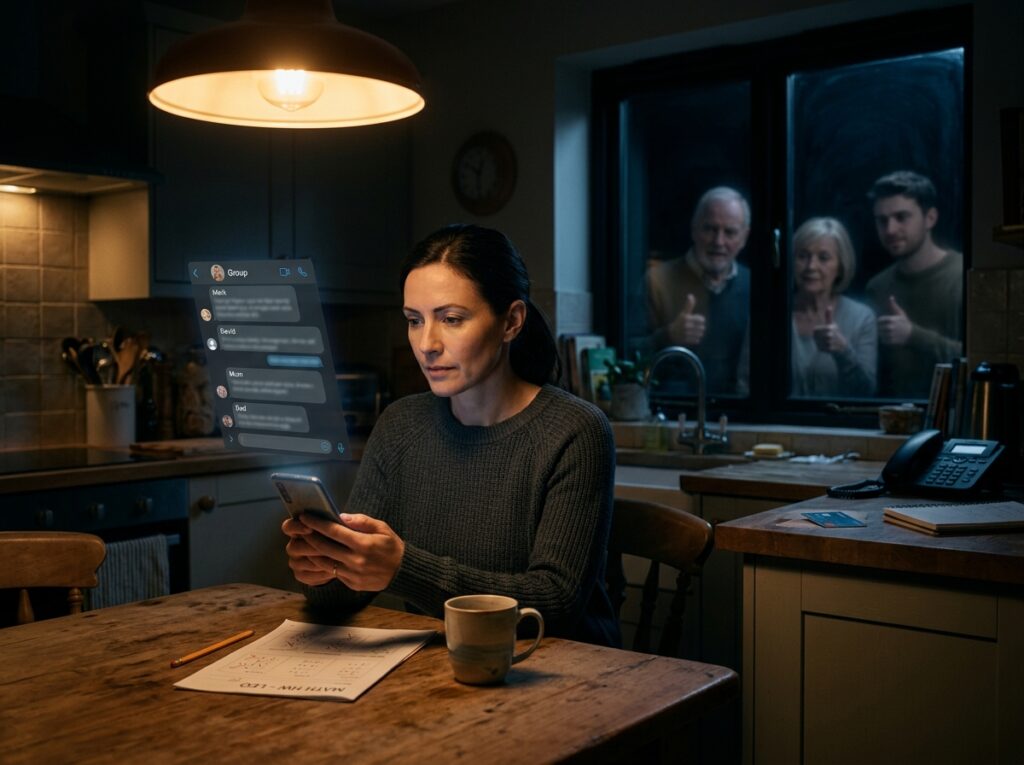
The text arrived on a Tuesday evening in September, while I was helping Milo with a math worksheet at our kitchen table, my phone buzzing against the counter with the particular insistent rhythm of our family group chat, a thread I’d learned, over the years, to check with a certain low-grade dread given how frequently it carried some new financial request disguised as casual family conversation.
*Dustin: New rule: no kids at family dinners except mine. Winnie needs more one-on-one time with Grandma and Grandpa and honestly the dinners get too chaotic with 3 kids running around.*
I stared at that message for a long moment, waiting, foolishly, for some clarification that would make it mean something other than exactly what it appeared to say.
*Mom: 👍*
*Dad: Finally. Been saying this for months.*
I sat at my own kitchen table, my son’s math worksheet still open in front of me, and felt something cold and absolute settle into my chest, a particular clarity that arrived considerably faster than the hurt I knew was coming right behind it.
Sasha and Milo had been attending those Sunday dinners for six years, since Milo was old enough to sit in a high chair at my parents’ own kitchen table. My father had never once, in six years, expressed any concern about “chaos.” My mother had never once suggested the dinners needed to be reorganized around Winnie’s specific developmental needs. This was not, I understood immediately, actually about one-on-one time or chaos management. This was about my brother deciding, unilaterally, that his daughter deserved a kind of exclusive attention my own children had apparently never been considered worthy of receiving in the first place, and my parents agreeing, instantly and without hesitation, the moment he suggested it.
I took a screenshot of the entire exchange, my hands steady in a way that surprised me, and forwarded it to my accountant, a careful, meticulous woman named Deborah Castellanos who had managed my business finances for nine years and who, I knew, maintained a complete record of every single dollar I had quietly funneled toward my family over the preceding four years.
Then I typed my own reply into that same group chat, considered it for exactly as long as it took to read it back once, and sent it before I could talk myself into something gentler.
*Priya: New rule: no family lives on my money except mine.*
Part 3
I did not wait for a response. I set my phone face-down on the kitchen table, finished helping Milo with his worksheet, made dinner, got both kids through their evening routines with a composure that felt, in retrospect, almost eerie given what I knew I was about to do once they were asleep.
At nine-fifteen that evening, once the house was quiet, I called my bank’s dedicated business line, a number I used often enough for Deborah’s various requests that the representative who answered recognized my account on sight.
“I need to remove four authorized users from my personal credit cards,” I said, “effective immediately. And I need to cancel the automatic mortgage assistance transfer that goes out to a secondary account every month.”
The representative, a patient man named Trevor, walked me through the process with the careful, procedural calm of someone handling a request he’d clearly processed many times before, for many different reasons, none of which he had any interest in asking about.
“I’ve removed Herbert Nakamura, Lorraine Nakamura, Dustin Nakamura, and Winnie Chen from the authorized user list on both cards,” he confirmed, reading back the names I’d provided. “That takes effect within the hour. And I’ve canceled the recurring transfer you mentioned. Is there anything else?”
“That’s everything,” I said.
I did not send a text explaining what I’d done. I did not call my parents or my brother to warn them the following morning’s grocery run, or gas fill-up, or whatever ordinary transaction they’d grown accustomed to simply charging without a second thought, was about to fail. I had spent four years quietly absorbing every financial consequence of my family’s choices without ever once being asked whether I minded. I decided, that evening, that they could absorb the consequences of mine without a warning either.
I slept, that night, considerably better than I expected to, a particular deep, dreamless sleep that I understood, waking the following morning, had been the direct result of finally setting down a weight I hadn’t even fully realized I’d been carrying until the moment I actually put it down.
My phone, when I finally checked it at six-thirty the next morning, showed sixty-one missed calls.
Part 4
I want to describe the specific texture of those sixty-one calls, because they arrived, I noticed scrolling through the log, in a particular escalating pattern that told its own story even before I listened to a single voicemail.
The first calls, beginning around ten-thirty the previous night, clustered around my mother’s number, four calls in rapid succession, presumably once she’d discovered her card declined at some late errand or simply attempted to check her own account balance online. My father’s calls began shortly after, a steadier, more measured rhythm that suggested a man methodically trying different approaches to reach me rather than my mother’s apparent panic. Dustin’s calls began closest to midnight, considerably more frequent and considerably more clustered than either parent’s, forty-one calls total from his number alone, interspersed with seventeen text messages whose previews I could see without even opening the thread.
*Dustin: Priya what did you do*
*Dustin: My card just got declined at the gas station this is insane*
*Dustin: Call me back right now*
*Dustin: This is completely out of line, we’re FAMILY*
*Dustin: Mom’s freaking out, dad’s furious, you need to fix this immediately*
I made coffee before I called anyone back. I got both kids up, fed, and dressed for school with the same deliberate calm I’d maintained the previous evening, understanding that whatever conversation was about to unfold would require considerably more composure than I currently possessed, and that composure, I’d learned over thirty-nine years, came more reliably after coffee and a proper breakfast than it did in the immediate, reactive heat of sixty-one missed calls.
I called my mother first, once the kids were at school and I had a clear hour before my own first client call of the day.
“Priya,” she said, answering before the first ring had even finished, her voice carrying a particular raw panic I’d rarely heard from her in thirty-nine years. “What is happening? My card was declined at the pharmacy, I had to leave my prescriptions at the counter, I was so embarrassed, Priya, what did you do?”
“I removed you from my credit cards,” I said evenly. “And canceled the mortgage transfer.”
“Why would you do that,” she said, her voice climbing toward something considerably more frantic. “Without any warning? We rely on that money, Priya, you know we rely on that money!”
“I know you do,” I said. “The same way I know my own children have been coming to Sunday dinner for six years without a single complaint from anyone, until my brother decided, last night, that his daughter deserved exclusive attention and you both agreed with him instantly, without a moment’s hesitation, as though Sasha and Milo had simply never mattered at all.”
Part 5
“That’s completely different,” my mother said, her voice shifting into something defensive now. “That’s just about dinner, Priya, this is about our entire financial situation. You can’t punish us over a family dinner scheduling decision.”
“I’m not punishing you over a scheduling decision,” I said. “I’m responding to what that scheduling decision actually revealed, which is that in this family, my children’s presence is apparently negotiable and disposable the moment Dustin decides he’d prefer things arranged differently, while my money has been treated, for four years, as an unconditional, permanent feature of this family that nobody ever needs to actually acknowledge or thank me for.”
“We do appreciate it,” my mother said, though something in her voice suggested she was saying what she understood she was supposed to say rather than something she’d ever actually considered deeply before that moment. “Your father and I are very grateful, Priya, we always have been.”
“When was the last time either of you actually said that to me directly,” I said, “rather than simply accepting the help as though it were owed to you? Mom, I have covered your mortgage shortfall for four years. I added you to two credit cards. I have never once asked for a single dollar back, and I have never once asked for anything in return beyond the most basic, ordinary courtesy of treating my own children as equally welcome in this family as Dustin’s daughter. Last night, you couldn’t even manage that much.”
My mother was quiet for a long moment, and when she spoke again, her voice had lost some of its earlier panic, replaced by something that sounded, cautiously, like the beginning of genuine reflection rather than pure self-interest.
“I didn’t think about it that way,” she said slowly. “When Dustin sent that message, I just, I reacted without really thinking about what it actually meant for your kids. I’m sorry, Priya. That was thoughtless of me.”
“I appreciate you saying that,” I said. “But I need you to understand something else, Mom. This isn’t just about one group chat message. This is about four years of a pattern where my support has been assumed rather than acknowledged, while my own family’s basic dignity gets treated as negotiable the moment Dustin decides he wants something different. I’m not willing to continue funding a family dynamic where that’s the accepted arrangement.”
Part 6
My father called forty minutes later, having apparently waited, deliberately, for my conversation with my mother to end before attempting his own, a particular strategic patience that I recognized as entirely consistent with how he’d navigated difficult conversations throughout my entire life.
“Priya,” he said, his voice carrying considerably more measured control than my mother’s panic had, “I want to understand exactly what happened here, because your mother says you removed us from your accounts over something Dustin said in the group chat.”
“That’s correct,” I said.
“That seems like an extreme response,” he said, “to a comment about dinner arrangements.”
“Dad,” I said, “I want you to actually hear what I’m about to say, rather than simply waiting for your turn to respond the way you usually do in conversations like this. For four years, I have quietly kept this family financially afloat. Your mortgage. Your emergency credit cards after your surgery. Dustin’s car payment. I have never once complained about any of it, never once asked for acknowledgment, never once treated it as anything other than simply taking care of the people I love. Last night, in the span of about ninety seconds, both of you agreed, instantly and without any hesitation whatsoever, that my own children should be excluded from a family tradition they’ve participated in for six years, the moment Dustin suggested it would be more convenient for his daughter. I watched, in real time, exactly how much my children’s basic belonging in this family actually weighs, compared to Dustin’s preferences, and I decided I wasn’t willing to keep financially supporting a family structure that treats my kids as disposable while treating my money as permanent.”
There was a long silence on the line, considerably longer than my mother’s earlier pause.
“I didn’t think of it that way,” my father said finally, his voice carrying something I rarely heard from him, a genuine, uncomfortable self-examination rather than his usual reflexive defensiveness. “I’ve been so focused on just agreeing with Dustin lately, on keeping things peaceful with him, I think I stopped actually considering what agreeing meant for your own family.”
“Why have you been so focused on keeping things peaceful with Dustin specifically,” I asked, genuinely curious now, “rather than with me?”
My father was quiet for a long moment. “Because you’ve never once given us a reason to worry you’d pull away,” he said finally, his voice heavy with the particular weight of a realization arriving considerably too late. “Dustin’s always been more, I don’t know, more fragile about feeling slighted. We’ve spent years managing around his feelings because he makes a bigger production out of being upset. You’ve just quietly handled everything, without complaint, so I think we genuinely stopped noticing you needed anything from us at all.”
Part 7
“That’s the exact problem, Dad,” I said. “You managed around Dustin’s feelings for years because he made noise about them, while I absorbed four years of financial responsibility without complaint, and the unspoken lesson both of you apparently learned from that was that my feelings, and my children’s basic belonging in this family, simply didn’t require the same careful management, because I’d never once given you a reason to think they did.”
“I hear what you’re saying,” my father said slowly. “I don’t know how to fix four years of that pattern in a single phone call, Priya, but I want you to know I’m actually hearing it, rather than just waiting for this conversation to end so things can go back to normal.”
“I appreciate that,” I said. “But I need you to understand something clearly before we go any further. I’m not restoring the financial support, not immediately, and not without some actual, demonstrated change in how this family treats my children going forward. I’m not interested in punishing you indefinitely, Dad. I’m interested in making sure the next four years look considerably different than the last four did.”
Dustin’s call came last, nearly two hours after my conversations with our parents, his voice carrying a fury that had clearly had considerable time to build rather than diminish.
“Are you serious right now,” he said, the moment I answered. “You cut off Mom and Dad’s mortgage help, over a dinner scheduling thing? Do you understand how insane that is? They could lose their house, Priya!”
“The mortgage shortfall they could lose their house over,” I said evenly, “exists because you ran a flooring business into the ground using a reverse mortgage you took out against their home without fully explaining the risk to them. I’ve been quietly covering that consequence for four years, Dustin. I think it’s worth noting that the crisis you’re currently panicking about was originally created by you, not by me.”
“That’s not fair,” he said. “That business failure wasn’t my fault, the market shifted, I couldn’t have predicted—”
“I’m not interested in relitigating your business decisions,” I said. “I’m interested in understanding why you felt entitled to send a message excluding my children from a family tradition they’ve participated in for six years, with absolutely no advance conversation, no consideration for how it might land, simply because you decided your own daughter deserved something my kids apparently didn’t.”
Part 8
“Winnie’s an only grandchild on my side,” Dustin said, his voice shifting into something defensive now. “I just think she deserves some focused time with Mom and Dad without a bunch of chaos.”
“Sasha and Milo are my only children,” I said, “and they’ve been part of this family’s Sunday dinners since before Winnie was even born. You didn’t propose adding a separate occasion for Winnie to have focused time with our parents. You proposed removing my children entirely from an existing tradition, and you did it in a group text, without ever once discussing it with me privately first, and both of our parents agreed instantly, without a single question about how it might affect me or my kids.”
“I didn’t think it would be this big a deal,” Dustin said, though something in his voice suggested he understood, even as he said it, exactly how inadequate that explanation actually sounded.
“It’s a big deal,” I said, “because it revealed something I’d apparently been willfully ignoring for four years: that in this family, my children’s belonging is negotiable, dependent on your preferences, while my money has been treated as an unconditional, permanent resource nobody needs to think twice about. I removed you from my accounts because I’m no longer willing to fund a family dynamic that treats my kids as disposable.”
“So what, you’re just cutting us all off completely?” Dustin said. “After everything, you’re just done?”
“I’m not done with this family,” I said. “I’m done funding this specific version of it, the one where my support is assumed and my children are excluded the moment it’s convenient. If you want my continued help going forward, Dustin, that starts with you retracting that message publicly, in the same group chat where you sent it, and apologizing to my kids directly, not just to me.”
Part 9
What followed, over the subsequent two weeks, unfolded with a particular slow, uncomfortable honesty that I hadn’t fully expected, given how reflexively my family had always managed conflict through avoidance rather than direct confrontation.
Dustin did, eventually, send a retraction to the group chat, three days after our phone call, a message considerably more grudging than genuinely remorseful, though it did include, at the end, an acknowledgment that excluding my children “wasn’t fair” and an invitation for Sasha and Milo to return to the following Sunday’s dinner.
I did not immediately restore the financial arrangements, a decision I maintained deliberately, wanting to see, over a longer stretch of time than a single apologetic text message, whether anything about my family’s underlying dynamic had actually shifted or whether the apology represented simply the fastest available route back to resumed financial convenience.
My parents, to their credit, made considerably more sustained efforts than Dustin did. My mother called me twice a week over the following month, conversations that felt, gradually, considerably more genuine than our usual exchanges, actual check-ins about my own life and my children’s wellbeing rather than updates on whatever financial need had prompted the call. My father, during a visit roughly six weeks after the group chat incident, sat down with Sasha and Milo specifically, apologized to them directly for the message, in language carefully calibrated to be understandable to an eleven-year-old and an eight-year-old, and asked, with a sincerity I hadn’t seen from him in years, whether they’d be willing to keep coming to Sunday dinners.
“Of course, Grandpa,” Sasha said, with the particular easy forgiveness children often extend more readily than adults manage. “We like coming to dinner.”
I restored the credit card authorization and the mortgage assistance transfer three months after that initial group chat message, not because I’d forgotten what had prompted the suspension, but because I had watched, over those three months, genuine, sustained effort from my parents specifically, a demonstrated willingness to actually examine and adjust the pattern that had allowed Dustin’s preferences to consistently outweigh my children’s basic belonging in the family.
Part 10
I am forty now, one year past that group chat message, and my relationship with my parents has settled into something considerably more balanced than the four preceding years had been, built on a foundation of actual, ongoing acknowledgment rather than simply quiet, unexamined financial dependency.
My relationship with Dustin remains, deliberately, considerably more distant, a choice I’ve made consciously rather than one that simply happened through drift or circumstance. I did not resume covering his car payment, a decision he initially resisted with considerable frustration before eventually, through his own efforts, managing to refinance the loan into something his own income could actually sustain without my continued support. We speak civilly at family gatherings now, a careful, polite distance that I understand may never fully resolve into genuine warmth, given how clearly that group chat message revealed something about how he’d always actually valued my children relative to his own.
Sasha and Milo still come to Sunday dinners, now firmly and permanently reestablished as an unquestioned feature of our family’s weekly rhythm rather than something that could simply be legislated away in a group text the moment it became inconvenient for someone else’s preferences.
I think, often, about the particular clarity of that evening, sitting at my own kitchen table with my son’s math worksheet in front of me, watching my entire family agree, instantly and without hesitation, that my children’s six-year presence at Sunday dinner was less important than my brother’s momentary preference, and understanding, in that single moment, exactly how much four years of quiet, unacknowledged financial support had actually purchased: not gratitude, not genuine partnership, but simply an assumption that my resources, unlike my children’s belonging, would always remain conveniently, permanently available without requiring any thought at all.
I keep, still, a screenshot of that original group chat message saved in a folder on my phone, not out of any lingering desire for vindication, but as a private reminder of exactly the moment I finally understood the difference between genuinely helping family and quietly, invisibly subsidizing a dynamic that had stopped seeing me, or my children, as equally deserving of basic consideration. I removed four names from my accounts that night without warning or explanation, and I have never, in the year since, regretted the particular clarity that single, decisive action finally brought to a pattern I’d spent four years failing to fully see.