Part 1
The first thing I noticed was the boat.
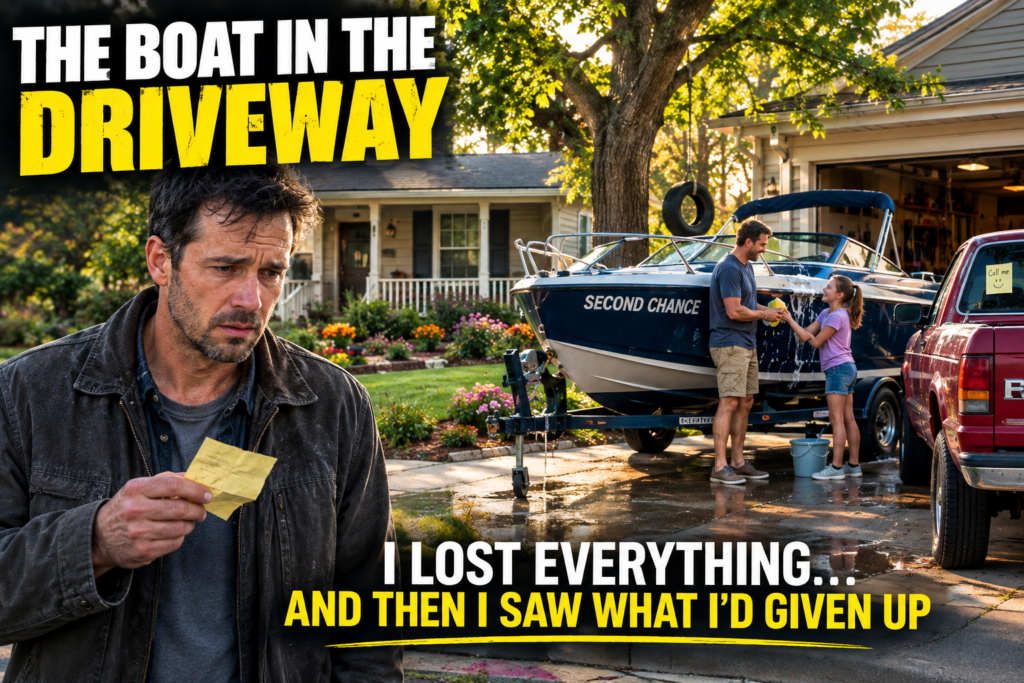
It sat in the driveway of the house I had once called home, its dark-blue hull gleaming beneath the late-afternoon sun. The trailer was angled toward the street, and a pair of rubber boots rested beside one of its wheels. A garden hose snaked across the concrete, sending a thin stream of water toward the curb.
Someone had painted a name on the side of the boat in neat white letters.
**SECOND CHANCE.**
I stared at those words for so long that I almost missed the sound of my daughter laughing.
Lily stood beside the boat with a yellow sponge in her hand. At eleven, she was taller than I remembered, her brown hair pulled into a loose ponytail. She wore shorts, an oversized T-shirt, and the same determined expression she used to get whenever she tried to convince me to let her stay up past bedtime.
The man washing the boat said something I couldn’t hear.
Lily laughed again.
It was a full, unguarded laugh. The kind children give when they aren’t thinking about whether anyone is watching them.
I hadn’t heard that laugh in person for months.
The man beside her was probably in his early forties. He had dark hair, a broad back, and a faded scar near his elbow. He wore jeans and no shirt, and he seemed entirely comfortable in the driveway. When Lily handed him the sponge, he accepted it without looking, as if they had performed the same small exchange a hundred times before.
Perhaps they had.
I sat behind the steering wheel of my aging sedan and watched them.
I told myself I was only curious.
I told myself I wanted to know whether Renée was doing all right.
I told myself I had every right to see how my daughters were living.
But the truth was less flattering.
I wanted to discover that my old life hadn’t improved without me.
I wanted the flower beds to be dead, the porch paint to be peeling, and the oak tree to remain exactly as neglected as I had left it. I wanted Renée to look tired, the girls to look unhappy, and the house to seem a little smaller than I remembered.
Instead, the house looked beautiful.
The porch railing had been repaired. Fresh flowers filled the beds along the front windows. The lawn was trimmed, and a tire swing hung from the oak tree I had spent years promising to prune.
A small wooden ladder leaned against the trunk. Someone had sanded the rough edges of the porch steps. Even the old basketball hoop beside the driveway had been straightened.
The house looked cared for.
That was what bothered me most.
I had always thought I was the ambitious one in our marriage. I was the man with plans, the man who wanted more, the man who believed our lives were too ordinary to be satisfying.
Renée had been the one who kept the ordinary things working.
She remembered dentist appointments, school projects, birthdays, car inspections, and the precise date when the insurance premium came due. She knew which grocery store marked down meat on Thursdays and which daughter needed extra encouragement before a school presentation.
I had called her predictable.
I had mistaken her reliability for a lack of imagination.
Now another man stood in the driveway, washing a boat I had never owned while my daughter passed him a sponge as naturally as if he had always belonged there.
I looked away.
That was when I noticed the sign.
It leaned against the garage wall beside a stack of folded lawn chairs. A sheet of white paper was taped to the windshield of the red pickup parked inside the garage.
The truck was mine.
Or it had been mine.
I recognized the dent in the passenger door, the faded paint near the rear bumper, and the small crack in the dashboard that had appeared during a particularly hot summer. I had bought that truck when Emily was a baby, and for years it had carried groceries, camping equipment, soccer bags, and two sleepy girls who used to fight over the window seat.
I had left it behind when I moved out.
At the time, I told Renée I would collect it once I found a better place to live.
I had imagined a large house, a successful business, and a garage where the truck could sit as a reminder of how far I had come.
Three years later, I was sleeping on a friend’s couch.
The franchise business I had invested in had failed. My savings were gone. The woman I had left my marriage for had walked away when the bills began arriving faster than I could pay them.
And now the truck I had forgotten was apparently being sold.
I crossed the street before I could talk myself out of it.
The paper on the windshield wasn’t a formal sales notice. It was a yellow sticky note, slightly curled at one corner.
I knew the handwriting immediately.
Renée.
I pulled it from the glass.
The message was short.
**If you’re finally ready to take responsibility for something, start here.**
I read it twice.
Then I heard a voice behind me.
“Can I help you?”
I turned.
The man from the boat stood near the garage, a towel draped over one shoulder. Up close, he looked neither threatening nor smug. He simply looked like someone who had discovered an unexpected stranger standing beside his home.
My daughter’s home.
“Who are you?” I asked.
He glanced at the truck.
“Marcus.”
“I know your name. Lily called you that.”
His expression changed slightly.
“And you are?”
I should have answered immediately.
Instead, I looked toward the driveway.
Lily had stopped washing the boat. She stood with the sponge hanging from one hand, staring at me as if she were trying to place a face from an old photograph.
Then she whispered the word that turned my stomach cold.
“Dad?”
Part 2
I had rehearsed this moment during the drive.
I would pull up, see the house, and perhaps catch a glimpse of Renée. If the girls were outside, I would wave. I would tell them I had been in the neighborhood and wanted to see how they were doing.
If Renée came out, I would be polite.
If she seemed angry, I would apologize.
If she seemed lonely, I would try not to look too pleased.
I had prepared for almost every possibility except the one in which my daughter looked at me as though she hadn’t expected me to be real.
“Hi, sweetheart,” I said.
Lily didn’t move.
For a moment, I could see the little girl she had been when I left: eight years old, missing a front tooth, clutching a stuffed rabbit while I carried my suitcase toward the front door.
She had stood in the hallway and asked whether I was coming back after the weekend.
I had told her I was moving into an apartment.
“Just for now,” I had added, because I couldn’t bear to watch her face change.
She had asked whether she could visit.
“Of course.”
She had asked whether I still loved her.
I had knelt, kissed her forehead, and promised that nothing would ever change that.
I had believed the promise when I made it.
But love, I had since learned, could remain in a person’s heart while disappearing from their daily life. I had loved my daughters from a distance, sending messages, birthday money, and occasional gifts. I had told myself those gestures mattered.
They did matter.
They simply weren’t enough.
Now Lily stood in the driveway, taller and more guarded than I remembered.
“Why are you here?” she asked.
“I was driving past.”
“You didn’t call.”
“No. I didn’t know I was going to stop.”
She looked down at the sponge in her hand.
“You could have called.”
There was no anger in her voice. That made it worse.
“I know,” I said. “I’m sorry.”
Marcus glanced between us.
“I’ll give you two a minute,” he said.
He walked toward the side gate, leaving us alone beside the boat. Lily watched him go, then turned back to me.
“Are you here to see Mom?”
“I wanted to see you.”
“You could have called me, too.”
I rubbed the back of my neck.
“You’re right.”
She seemed to be waiting for me to say something else. When I didn’t, she asked, “How long are you staying?”
“I don’t know. I just wanted to say hello.”
“Okay.”
She turned toward the house.
“Wait,” I said.
She stopped, but she didn’t face me.
“Can I give you a hug?”
The question sounded ridiculous the moment it left my mouth. I was her father. I had held her when she was born, carried her when she fell asleep in the car, and sat beside her bed through fevers and nightmares.
But I had also missed three years of ordinary life.
She hesitated.
Then she stepped forward and gave me a quick hug.
Her arms barely touched my back.
Before I could hold on, she had already stepped away.
“Mom’s inside,” she said. “You should talk to her.”
She went through the front door.
I remained in the driveway, feeling as if I had just been dismissed from a meeting I had arrived late to attend.
The front door opened again a minute later.
Renée stepped onto the porch.
Her hair was shorter than I remembered, cut just above her shoulders. She wore jeans and a pale green blouse, and the silver watch I had given her for our tenth anniversary still circled her wrist.
She looked older.
So did I, I supposed.
But she didn’t look defeated.
Her face was calm, her posture relaxed. When she saw me, she didn’t gasp or freeze. She simply looked at me as if an unexpected delivery had arrived at the wrong time.
“Daniel,” she said.
“Renée.”
Her eyes moved to the sticky note in my hand.
“I see you found it.”
“What does this mean?”
She came down the porch steps.
“It means the truck needs to be sold, and you haven’t done anything about it.”
“I was going to come for it.”
“When?”
I had no answer.
She continued, “I contacted you about the truck last year. You said you would arrange transportation. I contacted you again in the spring. You said you were busy.”
“I had a lot going on.”
“So did I.”
Her voice remained even.
“Daniel, I can’t keep a vehicle in my garage indefinitely because you might decide someday that you’re ready to deal with it.”
I looked toward the house.
“You’re really selling it?”
“Unless you want it and can arrange to collect it.”
I wanted to say that she couldn’t sell my property without my permission. Then I remembered the documents I had signed during the divorce, authorizing her to deal with belongings I left behind if I failed to collect them.
I had signed them without reading carefully.
I had wanted the divorce finished.
I had wanted to start over.
I had wanted everything behind me to disappear without requiring another decision.
Now those decisions had returned.
“Can we talk?” I asked.
Renée studied me.
“About the truck?”
“About everything.”
She glanced at the house.
“Emily is home, and Lily has homework. If you want to sit down for a few minutes, we can. But you need to call before visiting in the future.”
“I understand.”
“Do you?”
The question stung.
I looked at the sticky note again.
“I think I’m starting to.”
Renée nodded toward the door.
“Come inside, then.”
I followed her into the house, carrying the note as though it were something more valuable than paper.
I had come expecting to discover what my family had become without me.
I hadn’t expected to be asked to explain what I wanted from them now.
Part 3
The kitchen was familiar enough to hurt.
The same window overlooked the backyard. The same narrow cabinet stood beside the refrigerator. The table where Renée and I had paid bills, helped with homework, and argued about money was still there, although the chairs had been replaced.
A ceramic bowl of apples sat beneath the window. School photographs covered the refrigerator. Emily appeared in a graduation gown in one picture, smiling with her arm around Renée. Lily stood beside a science-fair display in another, holding a ribbon and looking proud.
I searched for a photograph of myself.
There wasn’t one.
I tried not to let Renée notice.
She poured coffee into two mugs and sat across from me.
“How have you been?” she asked.
“Fine.”
She waited.
I looked down at the coffee.
“Not fine, actually.”
“All right.”
“I lost the franchise.”
“I’m sorry to hear that.”
“I lost most of my savings, too.”
Renée nodded slowly.
“I’m sorry about that.”
I expected more. I expected her to ask what had happened, whether I had made mistakes, or whether Vanessa was still around.
Instead, she took a sip of coffee.
I realized that I had come here wanting her concern to prove that I still mattered to her.
It was a selfish thing to want.
“I didn’t expect things to turn out this way,” I said.
“Neither did I.”
“I thought the business would work.”
“I remember.”
“You remember?”
“You talked about it for months. You showed me the projections, the brochures, and the photographs of the first location.”
I felt a faint flush of embarrassment.
“You were against it.”
“I was worried about the amount of money you planned to invest. I wasn’t against you succeeding.”
“You kept asking questions.”
“Because we had two children and a mortgage. Questions seemed reasonable.”
I stared into my mug.
I remembered those conversations. I remembered the way she had spread the business documents across the table and asked whether the projected revenue included rent, insurance, staff wages, maintenance, and the franchise fees.
I had accused her of expecting me to fail.
She had replied that she expected me to plan.
At the time, I had thought she lacked faith in me.
Now I wondered how many times I had confused someone else’s caution with a personal insult.
“What happened with Vanessa?” Renée asked.
I looked up, surprised.
“How did you know?”
“I didn’t know. You just mentioned that the relationship was over when you called about the truck.”
I rubbed my face.
“It didn’t work out.”
Renée didn’t respond.
“We wanted different things,” I continued. “She didn’t want to deal with the business problems. She moved out when I started running out of money.”
“That must have been difficult.”
I nodded.
Then, because I couldn’t seem to stop myself, I said, “She told me she loved the man I was going to become.”
Renée looked at me for a long moment.
“What did you tell her?”
“That she had encouraged me to start the business.”
“And?”
“I told her she had said she believed in me.”
Renée set her mug down.
“Did she?”
“I thought she did.”
“Maybe she did, Daniel. But believing in someone doesn’t mean agreeing with every decision they make.”
I looked away.
The sentence felt like an echo from a conversation I had once refused to hear.
Renée leaned back in her chair.
“I don’t want to lecture you. Your business is your business now. But I need you to understand something about the girls.”
I looked at her.
“They spent a long time wondering why you left. Emily was old enough to understand that you had chosen someone else. Lily was too young to understand the difference between a failed marriage and a father leaving his family.”
“I never stopped loving them.”
“I know you believe that.”
“I do love them.”
“I’m not questioning your feelings. I’m telling you what your absence looked like from their side.”
She paused.
“Lily used to ask when you were coming home. She asked whether she should call you more often. She thought maybe you were too busy because she wasn’t interesting enough.”
My throat tightened.
“She was eight.”
“Yes.”
I looked at the photographs on the refrigerator.
“I didn’t know she thought that.”
“She didn’t tell you because she was afraid you’d feel bad and stop talking to her altogether.”
I closed my eyes.
For years, I had used my intentions as evidence that I was a good father. I had never stopped to consider what my daughters experienced when those intentions failed to become actions.
Renée continued.
“Emily eventually stopped asking for anything. She didn’t want to be disappointed. She got used to making plans without you.”
“I didn’t mean for that to happen.”
“I believe you.”
I looked at her, grateful for those words.
Then she added, “But the girls had to live with what happened, not what you meant.”
I sat very still.
Outside, I heard Marcus laughing at something Lily said. A moment later, the hose started again.
The sound was ordinary, almost comforting.
It was the sound of someone doing a small task because it needed doing.
I used to think those tasks were beneath me. I had wanted bigger things, more exciting things, things that proved I was capable of a remarkable life.
I hadn’t realized how much of a family was built from ordinary acts repeated until they became trust.
“How long have you been with Marcus?” I asked.
“Almost two years.”
The answer made my chest tighten.
Two years.
I had been trying to rescue my failing business during those months, telling people I was on the verge of success. Renée had been building a new life while I was still insisting that mine was about to become extraordinary.
“Are you happy with him?”
She considered the question.
“Yes.”
The honesty hurt.
But I had no right to punish her for it.
“I’m glad,” I said, and this time I tried to mean it.
Renée watched me carefully.
“I don’t need you to like Marcus immediately. But I need you to respect the fact that he’s part of our lives.”
“I can do that.”
“And I need you to stop appearing without warning.”
“I will.”
She nodded.
We sat in silence for a few moments.
Then I finally said what I should have said when I first entered the house.
“I’m sorry, Renée.”
She looked down at her hands.
“For what, specifically?”
I took a breath.
“For having the affair. For making you feel like our life was too small for me. For treating your concerns as if they were obstacles instead of attempts to protect our family. For leaving you to explain to the girls why their father had decided he wanted something else.”
My voice became unsteady.
“And for thinking that signing the house over to you made me generous, when you were the one who had to keep living with the consequences of my choices.”
Renée was quiet.
Finally, she said, “Thank you for saying that.”
I waited for something more.
She didn’t offer it.
“I know an apology doesn’t fix everything,” I said.
“No, it doesn’t.”
“But I wanted you to hear it.”
She nodded.
“I heard you.”
For the first time, I didn’t ask whether she missed me. I didn’t ask whether she ever regretted the divorce. I didn’t ask whether she had thought about giving our marriage another chance.
I had spent years treating her life as a story that should remain unfinished until I decided to return.
Now I was beginning to understand that she had every right to write the rest of it herself.
Part 4
I called Emily the following Wednesday.
She answered while walking somewhere, and I could hear traffic behind her.
“Hey, Dad.”
“Hi, Em. Do you have a minute?”
“Sure. What’s up?”
I had planned a speech about how much I missed her. I had prepared an explanation for the failed franchise and the financial problems that followed. I had even considered telling her that the business had been a mistake from the beginning, as though admitting it now would somehow make the mistake less damaging.
Instead, I asked whether she would like to have lunch with me.
There was a pause.
“Why?”
“Because I want to spend time with you.”
“You’ve said that before.”
“I know.”
“And then something comes up.”
I closed my eyes.
“You’re right.”
She went quiet.
I continued before I could retreat into excuses.
“I’m not asking you to forget that. I’d just like the chance to try again. If you don’t want to, I’ll understand.”
“Saturday,” she said eventually. “There’s a diner near campus.”
“Saturday works.”
“Don’t be late.”
“I won’t.”
I arrived twenty minutes early.
Emily came in wearing a navy jacket and carrying a backpack. She looked so much like Renée that I briefly forgot what I had planned to say.
We ordered sandwiches.
At first, we talked about safe subjects. Her classes. Her part-time job. The price of textbooks. A group project that had gone badly.
I asked questions and listened to the answers.
It should not have felt like an achievement, but it did.
When she told me about her interest in pediatric nursing, I asked what had inspired it.
She looked down at her drink.
“I remember when Lily had asthma attacks. Mom always knew what to do, even when she was scared. I want to be able to help people when they’re scared.”
“That’s a good reason.”
She smiled faintly.
Then the conversation slowed.
I could have filled the silence with jokes, the way I used to. I could have told her about the franchise and blamed the corporate office, the landlord, and the suppliers.
Instead, I said, “I’m sorry I wasn’t there for you.”
Emily stopped turning her straw.
“Which time?”
The question hurt because it was fair.
“All the times I promised to call and didn’t. The school events I missed. The birthdays when I sent money instead of making time. The times you tried to tell me you were upset and I made you feel like you were being unreasonable.”
She studied me.
“Mom used to say you loved us even when you were being selfish.”
“She was right.”
“I know you love us,” Emily said. “That’s why it’s confusing.”
I didn’t interrupt.
“When you left, I thought maybe you’d come back if we were good enough. Lily tried really hard. She got better grades. She cleaned her room without being asked. She even stopped asking for things because she thought you might have to spend money on them.”
I felt as if the room had become smaller.
“She was eight,” Emily said. “She thought if she made life easier for you, you’d want to be around more.”
I pressed my hands together beneath the table.
“I didn’t know.”
“No. You didn’t.”
She wasn’t being cruel. She was explaining the part of the story I had never bothered to learn.
“I’m not telling you this so you’ll feel bad,” she continued. “I’m telling you because you keep acting surprised that things changed while you were gone.”
I nodded.
“You’re right.”
Emily looked at me carefully.
“I don’t hate you, Dad. I just don’t want to keep getting my hopes up.”
I wanted to promise her everything would be different.
I wanted to tell her that I would never miss another important moment, never forget a call, never let work or money or a new relationship come between us again.
But I had made promises before.
This time, I chose something smaller.
“Then I won’t ask you to trust me right away. I’ll try to earn it.”
She didn’t embrace me when we left the diner. She didn’t tell me everything was forgiven.
But she let me walk her to her car.
Before she drove away, she said she might have time for lunch again in a couple of weeks.
It was a small opening.
I had once considered small openings beneath me.
Now I understood that a small opening could be the beginning of something I had almost lost forever.
That evening, I sent Lily a message asking whether she would like to get ice cream on Sunday.
She replied three hours later.
**Maybe. Can Marcus come too?**
I stared at the screen.
My first instinct was to say no. I wanted a chance to be her father without another man standing nearby, reminding me of the years I had missed.
Then I remembered that this was not about what I wanted.
**Of course,** I wrote. **If you’d like him there.**
She sent back a simple thumbs-up.
It wasn’t much.
But it was the first time I had accepted that my daughters’ lives didn’t need to be arranged around my comfort.
Part 5
On Sunday, I met Lily and Marcus at a small ice-cream shop near the park.
Lily chose chocolate with rainbow sprinkles. Marcus ordered vanilla. I picked coffee because it sounded like something a man my age should order, then regretted it when I tasted it.
Lily laughed.
“You always choose things you don’t like.”
I looked at her.
“Do I?”
“You used to order black coffee at breakfast and then drink Mom’s orange juice when you thought nobody was looking.”
Marcus chuckled.
I laughed, too, although the memory caught me by surprise.
For a few minutes, we were almost a family again—not the family we had been, but a group of people sharing a table, telling stories, trying to understand one another.
Then Lily asked me a question.
“Why did you leave?”
Marcus stopped eating.
I set my spoon down.
“I was unhappy with the marriage,” I said carefully. “And I handled it badly.”
“Because of Vanessa?”
“Partly.”
“Was she better than Mom?”
“No.”
The answer came out more quickly than I expected.
Lily watched me.
“Then why did you choose her?”
I could have given her a complicated explanation about excitement, ambition, attraction, and the mistakes people make when they confuse attention with love.
But she was eleven.
She deserved a truth she could understand.
“Because I wanted to feel special,” I said. “And I was selfish enough to believe that wanting something meant I was entitled to take it.”
She looked down at her ice cream.
“Did you stop loving us?”
“No. Never.”
“Then why didn’t you come home?”
I felt my chest tighten.
“Because I thought I could build a different life and still be the same dad. I thought I could send money, call when I had time, and everything would stay the way it was.”
“That didn’t work.”
“No,” I said. “It didn’t.”
She pushed a sprinkle around with her spoon.
“Mom said you were having a hard time.”
I looked at Marcus, who remained quiet.
“She didn’t have to tell you that.”
“She said you lost your business and didn’t have much money.”
I nodded.
“That’s true.”
Lily considered this.
“Are you poor now?”
The question was so direct that I almost smiled.
“I’m having financial problems.”
“That’s what Mom calls it when she doesn’t want to say something bad in front of me.”
Marcus coughed into his napkin.
I couldn’t help laughing.
“Well, yes. I guess I’m having a pretty bad time with money.”
Lily looked thoughtful.
“You could have lived here.”
The words struck me harder than she could have known.
“What do you mean?”
“When you and Mom got divorced. You could have stayed in the house, and we could have all lived here.”
I looked at her small face.
“Your mom and I couldn’t do that. We weren’t happy together anymore.”
“But you were happy with us.”
I had no answer.
She was right, of course.
I had treated the marriage as though every part of my life had to be exciting for it to be worth keeping. I had failed to understand that the quiet parts were not empty. They were the places where people grew up, where they learned to trust, where ordinary memories became the foundation of belonging.
“I was happy with you,” I said. “And I’m sorry I made you feel like you weren’t enough.”
Lily’s eyes filled with tears, but she quickly looked away.
“I didn’t say that.”
“I know.”
“Then don’t make it weird.”
I nodded.
“Okay.”
Marcus stood and offered to get her another napkin. Lily went with him to the counter, leaving me alone at the table.
When they returned, Marcus sat down beside her.
“You know,” he said, “Lily talks about you more than you probably realize.”
I looked at him.
“She does?”
“Sometimes. She remembers things you did when she was little. The time you built that crooked bookshelf. The camping trip where you forgot the tent poles and had to tie a tarp between two trees.”
Lily groaned.
“Marcus!”
He smiled.
“She tells the story better than I do.”
I felt something loosen inside me.
I had spent so long imagining Marcus as the man who had taken my place that I hadn’t considered the possibility that he had simply become someone my daughter could trust.
“Thank you,” I said quietly.
He nodded.
“I’m not trying to replace you, Daniel.”
I looked at him.
“I know.”
It was the first time I’d said those words and actually meant them.
Marcus continued.
“The girls have a father. That’s not something I can change. But I can be another person who shows up for them.”
I thought of the boat in the driveway, the tire swing, and the repaired porch railing.
All the small things I had meant to do someday.
“You’re good with them,” I said.
“I try to be.”
I wanted to ask whether Renée loved him, whether he planned to marry her, whether he would be at the girls’ graduations and weddings. I wanted to know how much of their future belonged to him.
But I didn’t ask.
That future wasn’t mine to approve.
When we left the shop, Lily hugged Marcus without thinking. Then she turned toward me.
For a second, she hesitated.
I stayed still.
She stepped forward and wrapped her arms around my waist.
It was a brief, awkward hug. Her head barely reached my chest, and she released me almost immediately.
“See you next Sunday?” she asked.
“If your mom says it’s okay.”
Lily rolled her eyes.
“You can ask her yourself, Dad.”
Then she ran ahead toward the parking lot.
I watched her go, feeling grateful for a hug that lasted only a few seconds.
It was more than I had earned.
And I knew it.
Part 6
The following Sunday, I returned to the house.
I called first, as promised. Renée said the girls were home and that I could stop by for an hour. I arrived carrying a bag of groceries because I had no idea what else to bring.
When Renée saw it, she raised an eyebrow.
“Are you planning to feed everyone?”
“I wasn’t sure what you needed.”
“We have food, Daniel.”
“I know. I just thought I’d bring something.”
She took the bag from me.
“Thank you.”
There was no sarcasm in her voice, and that made me feel even more foolish. I had spent years imagining that kindness was something I could earn with a grand gesture. I had forgotten that sometimes it was simply a small, ordinary act.
Marcus was repairing the latch on the backyard gate. He greeted me and went back to work.
I stood beside him for a moment.
“Need a hand?”
He glanced at me.
“Do you know how to fix a gate?”
“Of course.”
He handed me a screwdriver.
“Then hold this.”
I held the latch while he tightened the screws.
It was an absurdly simple task. We worked without much conversation, and when the gate finally closed properly, Marcus tested it twice.
“Good enough,” he said.
I almost told him I had always meant to fix that gate.
The words rose to my mouth and stopped there.
It didn’t matter what I had meant to do.
The gate was fixed now.
Inside, Emily was studying at the kitchen table. She looked up when I came in.
“Hi, Dad.”
“Hey, Em.”
I sat across from her and asked about her classes. This time, I listened to the answers. I learned about an instructor who assigned too much reading, a group project that had gone badly, and a clinical placement she hoped to get next semester.
When she finished, she looked surprised.
“What?”
“Nothing,” she said. “You actually remembered what I said last time.”
I felt the shame of how low her expectations had fallen.
“I’m trying.”
“I can tell.”
It wasn’t forgiveness.
It was recognition.
That afternoon, Lily asked me to help her with a school project about local history. We spread papers across the living-room floor and searched through old photographs. She wanted to make a display about the neighborhood and how it had changed over the years.
We found a picture of the house from the year we bought it. The oak tree was thinner, the driveway was cracked, and the porch railing was painted a faded brown.
In the photograph, I stood beside Renée, holding a toddler-aged Emily on my shoulders. Renée had one hand on my arm and the other resting on her pregnant belly.
I stared at it longer than I intended.
Lily sat beside me.
“You look happy,” she said.
“I was.”
“Then why weren’t you happy anymore?”
I took a breath.
“I think I started believing that if my life looked ordinary, it meant I wasn’t doing enough. I wanted to be successful in a way that other people could see. I stopped paying attention to the things that were already good.”
Lily studied the photograph.
“Mom says people don’t always notice what they have until it’s gone.”
“Your mom is right.”
“She says that about her favorite mug, too.”
I laughed.
“She was always losing that mug.”
“She still has it. It’s chipped.”
“She should throw it away.”
Lily gave me a look of exaggerated disappointment.
“You really haven’t changed.”
The joke made me smile, but it also made me think.
Perhaps she was right.
Perhaps the part of me that wanted to declare a problem and fix it immediately was still there. Perhaps I still wanted to be the person who knew best, who could turn every uncomfortable feeling into an argument.
But I was learning to stop before speaking.
I was learning to ask questions without expecting the answers to flatter me.
I was learning that being present was not the same as being in charge.
When it was time to leave, Renée walked me to the porch.
“I think the girls enjoyed today,” she said.
“I did, too.”
She folded her arms.
“Daniel, I want to be clear about something.”
I braced myself.
“This doesn’t mean we’re going to get back together.”
“I know.”
“And Marcus isn’t temporary. He’s part of our lives.”
“I know that, too.”
She watched me carefully.
“Do you?”
I looked through the open doorway. Emily was helping Lily gather her project papers. Marcus was stacking the tools he had used to repair the gate.
“I think I’m finally beginning to,” I said.
Renée’s shoulders relaxed slightly.
“Good.”
I took a breath.
“I owe you an apology, too. Not just for the affair. For the years I made you feel like the life we had wasn’t enough.”
She said nothing.
“I treated your stability like it was a lack of imagination. I treated your questions like they were obstacles. And when you asked me to think about our family, I acted as if you were trying to stop me from becoming someone important.”
My voice cracked, and I hated that I couldn’t control it.
“You were trying to protect what we had. I just couldn’t see that.”
Renée looked down at the porch boards.
“Thank you for saying that.”
“I know it doesn’t change anything.”
“No,” she said gently. “It doesn’t.”
I nodded.
“But it matters that you finally understand.”
For the first time, I didn’t ask whether there was still a chance for us.
I didn’t ask whether she missed me.
I didn’t ask if she ever wondered what might have happened if I had stayed.
I simply said, “I’m sorry.”
And when I left, I felt lighter than I had in months.
Not because Renée had forgiven everything.
Because I had stopped asking her to carry the weight of my regret for me.
Part 7
A month later, Marcus called me.
I nearly didn’t answer because his name on my phone made me nervous. I assumed something had happened with one of the girls, or that Renée wanted me to stop visiting.
Instead, he asked if I had time to come by on Saturday.
“What’s going on?”
“Nothing bad,” he said. “I could use your help with something.”
I agreed before I could overthink it.
When I arrived, the boat was sitting in the driveway again. The name SECOND CHANCE gleamed along its side, and a folded tarp lay across the rear seats.
Marcus was checking the trailer lights.
“What’s the job?” I asked.
He pointed toward the garage.
“The truck.”
I looked at my old pickup.
It had been cleaned out. The dashboard had been wiped down, the tires inflated, and a new battery sat on the workbench.
“You fixed it?”
“Mostly. The engine runs, but the brakes need attention. The mechanic says it could be worth restoring, depending on how much work you want to put into it.”
I stared at the truck.
“Why?”
Marcus shrugged.
“Renée said you might want it. I thought I’d find out whether it was worth saving.”
I felt a complicated mixture of gratitude and embarrassment.
“You didn’t have to do that.”
“I know.”
He wiped his hands on a rag.
“Look, Daniel, I want to say something, and I don’t want you to take it the wrong way.”
“Okay.”
“The girls care about you. They need you to keep showing up. Not because you can buy things for them or fix things around the house. Just because you’re their dad.”
I looked at the truck.
“I know.”
“I’m not sure you do yet.”
The honesty stung, but I respected him for it.
He continued.
“You’ve spent a lot of time trying to explain why you left. I understand that. But the girls don’t need a perfect explanation. They need to know they can count on you now.”
I thought about all the times I had promised to call, all the events I had missed, all the little disappointments I had dismissed as unimportant.
“What if I mess up again?” I asked.
“You probably will. Everybody does.”
He gave me a small smile.
“The question is whether you own it when you do.”
I nodded.
We spent the next two hours checking the truck’s condition. Marcus knew far more about engines than I did, so I mostly handed him tools and listened while he explained what needed replacing.
When we finished, he took a step back.
“She’s not ready for the road yet.”
I ran a hand along the faded hood.
“She’s been sitting here a long time.”
“Long time doesn’t mean she’s finished.”
I looked at him.
He seemed to realize what he had said and laughed.
“Sorry. That sounded like a speech.”
“No,” I said. “It was a good one.”
We stood quietly for a moment.
Then I asked him about the boat.
He told me he’d bought it from a family who were moving away. He had spent years saving for it, and he planned to take Renée and the girls out on the lake during the summer.
“The girls love it,” he said. “Lily keeps asking when she can learn to steer.”
I imagined my daughter sitting at the boat’s controls, the sun on her face, the water stretching toward the horizon.
I wanted to be there.
But I didn’t assume I would be.
“That sounds wonderful,” I said.
Marcus looked at me as though he hadn’t expected that answer.
“You’re welcome to come along sometime,” he said. “If the girls want you there and Renée is comfortable with it.”
I swallowed.
“Thank you.”
“Don’t thank me yet. You haven’t seen how bad I am at packing sandwiches.”
We laughed.
When I left, I didn’t take the truck. It needed more work, and I couldn’t afford the repairs yet. I also didn’t ask Marcus to hold it for me indefinitely.
I called the mechanic and arranged a realistic estimate. Then I created a savings plan, small enough that I could follow it without pretending my finances were better than they were.
I found a steady job in a warehouse office, handling customer orders and deliveries. It paid less than my old sales position, but it offered reliable hours and a paycheck I could count on.
I stopped telling people I was rebuilding toward something bigger.
For a while, I focused on making my life stable.
I rented a small room of my own. I paid my debts according to the agreements I’d made. I called Emily every Wednesday and Lily every Friday, even when our conversations lasted only a few minutes.
If I couldn’t make a planned visit, I told them as early as possible and explained why. When I made a mistake, I apologized without turning it into a speech about how hard I was trying.
Slowly, things changed.
Emily began sending me photographs from school. Lily started telling me stories about her friends. Sometimes she called just to ask a question about something she’d seen online.
I stopped measuring progress by whether they said they loved me.
I measured it by whether they felt comfortable reaching for me.
One evening, Renée sent me a message.
**The girls asked if you’d like to come to the lake with us next Saturday. Marcus says the boat is ready. Let me know if you’re interested.**
I read it twice.
Then I wrote back.
**I’d love to come. Thank you for asking.**
I set the phone down and looked around my small rented room.
There was no balcony. No designer furniture. No view of the city.
But my bills were paid, my next paycheck was coming, and my daughters had invited me somewhere.
For the first time in years, I felt no need to pretend that my life was impressive.
It was simply my life.
And I was finally learning how to live it.
Part 8
The lake was quieter than I expected.
I arrived early on Saturday morning with a bag of sandwiches and a cooler full of drinks. Marcus was already checking the boat, and Renée was arranging towels in a canvas bag.
Emily came down the driveway wearing sunglasses and carrying a book. Lily ran past her, calling out that she wanted the front seat.
I stood near the gate, uncertain whether to help or stay out of the way.
Renée noticed me.
“You can put the cooler on the boat,” she said.
I did.
Marcus greeted me with a handshake, then handed me a life jacket.
“Safety first.”
“Always.”
Lily appeared beside us.
“Dad, you have to sit where I can see you.”
I looked down at her.
“Why?”
“Because I want to show you something.”
She ran toward the boat before I could ask what it was.
We spent the morning on the water. Marcus showed Lily how to steer under his supervision, while Emily read in the shade and Renée sat near the bow with her face turned toward the sun.
I helped with the cooler, passed out sandwiches, and held a rope while Marcus secured the boat at a small dock.
Nothing extraordinary happened.
Nobody made a speech about forgiveness.
Nobody announced that the past was behind us.
But Lily laughed when the wind blew her hair into her mouth. Emily showed me a photograph she had taken for class. Renée asked whether my new job was going well, and I answered honestly.
It was a good day.
Not because I had reclaimed my old place in the family.
Because I had been invited into the life they had built without me.
On the way back, Lily sat beside me at the stern. Her legs dangled over the bench, and she watched the water trail behind the boat.
“Can I ask you something?” she said.
“Anything.”
“Do you miss living here?”
I looked toward the shoreline.
The question could have been about the house. It could have been about Renée, the girls, or the version of myself who had once believed everything was waiting for him to become someone better.
“Yes,” I said. “I miss it.”
“Do you wish you’d never left?”
I thought carefully before answering.
“I wish I’d handled things differently. I wish I hadn’t hurt your mom. I wish I hadn’t made you and Emily feel like you weren’t important enough for me to show up.”
Lily looked at me.
“But you can’t go back?”
“No.”
“Even if you really want to?”
“Even then.”
She considered that.
“That’s sad.”
“It is.”
She leaned against my shoulder.
“At least you’re coming now.”
I closed my eyes for a moment.
At least you’re coming now.
It was not the grand forgiveness I had once imagined. It wasn’t a promise that everything would return to the way it had been.
It was something better because it was real.
When we returned to the house, I helped unload the cooler. Emily carried the towels inside, and Marcus began rinsing the boat. Renée stood near the garage, watching Lily chase a ball across the lawn.
I looked at the oak tree.
The tire swing moved gently in the breeze.
Three years earlier, I had driven past this house expecting to see evidence of what Renée had lost. I had imagined a lonely woman struggling to maintain a place that had once belonged to both of us.
Instead, I had found a home that had continued to grow.
The porch was repaired. The flowers were thriving. The girls had memories I hadn’t been present for, and Marcus had become part of their everyday world.
The boat in the driveway had seemed like an insult when I first saw it.
Now I understood that it was simply a boat.
It belonged to a man who had saved for something he loved. It carried a woman who had learned to live without waiting for me. It gave my daughters afternoons they would remember long after the details of the divorce faded.
I had mistaken their happiness for proof that I had been replaced.
But a family isn’t a chair with one place at the table. Someone else being loved doesn’t mean there is less love available. And the fact that my daughters trusted Marcus did not mean they could never trust me again.
It meant I had to stop competing with the life they had built.
I had to become someone they could count on, whether or not I ever felt like the most important man in their world.
Part 9
A month later, I returned to the house to collect the truck’s paperwork.
I had saved enough to cover the mechanic’s initial work, but I still wasn’t sure whether I could afford to restore it. I had spent the previous week reviewing the numbers and trying to be honest with myself about what made sense.
For the first time in my life, I didn’t treat a practical limitation as an insult.
If the truck was too expensive to repair, I would sell it. If it could be restored gradually, I would do that. Either way, I would make the decision instead of leaving it for someone else to handle.
Marcus was in the driveway when I arrived.
He had spread the paperwork across a folding table beside the garage.
“Look at you,” he said. “Making decisions.”
I laughed.
“I’m trying something new.”
“How’s it going?”
“Turns out numbers are less frightening when I stop pretending they’re going to change because I want them to.”
He nodded thoughtfully.
“That’s a useful discovery.”
We reviewed the mechanic’s estimate together. Marcus pointed out a few questions I should ask before approving the work, and I wrote them down.
Then he leaned against the table.
“Can I ask you something?”
“Sure.”
“When you first saw the boat, what did you think?”
I glanced at the blue hull.
“Honestly?”
“Honestly.”
“I thought you’d taken my place.”
Marcus looked toward the house.
“I figured.”
“I thought the tire swing, the flowers, the repairs—everything—was proof that Renée had built a better life with someone else.”
He waited.
“But now I think I was looking at it backward,” I continued. “The house wasn’t a competition. You weren’t trying to prove anything to me. You were just living there.”
Marcus smiled faintly.
“That’s generally the idea.”
“I know. I just took a while to understand it.”
He looked down at the papers.
“Look, Daniel, I know I’m in a position you used to have. I spend time with the girls. I help Renée around the house. We make plans together. But I didn’t come here to take anything from you.”
“I know that now.”
“And I don’t need you to like me. I just need us to be decent to each other for the girls.”
“I can do that.”
He offered his hand.
I shook it.
The gesture felt strangely important. It wasn’t a friendship forged in a single afternoon, and it didn’t erase the complicated feelings I still carried. But it was an agreement to stop treating each other as enemies in a contest neither of us needed to win.
Later, Lily came out with her school backpack.
“Dad, are you staying for dinner?”
I looked at Renée, who was standing by the kitchen door.
“If that’s okay with your mom.”
Renée nodded.
“You’re welcome to stay.”
I helped Lily with her math homework while dinner cooked. Emily arrived late from class and told us about a presentation she had given. Marcus asked questions. Renée listened while stirring a pot on the stove.
I sat at the same table where I had once announced that our marriage was too predictable.
The conversation was ordinary.
Someone had forgotten to buy bread. Lily complained about an assignment. Emily laughed at a story Marcus told about getting lost on the way to a hardware store.
Nobody was performing.
Nobody was trying to prove that life had become extraordinary.
And I realized I had once mistaken that kind of ordinary happiness for something I needed to escape.
After dinner, I helped clear the table. Renée handed me a stack of plates, and for a second, the movement felt so familiar that I almost forgot the years between us.
Then she smiled politely and returned to the kitchen.
We were not a couple anymore.
We were two people who had once shared a home, raising two daughters who deserved the best of us, even if the best of us no longer belonged together.
That was enough.
When I left, Lily followed me to the front door.
“Are you coming next week?”
“If your mom says it’s okay.”
She rolled her eyes.
“She already said you can.”
“Then yes. I’ll be here.”
“Good.”
She hugged me, longer this time.
I held her gently and resisted the urge to ask whether she missed me, whether she was happy I had returned, whether she thought I was becoming a better father.
I didn’t need her to reassure me.
I needed to keep earning the right to be there.
On the drive back to my room, I passed a car dealership with a banner advertising a new luxury SUV. Once, I would have stopped to look at it. I would have imagined myself driving it, imagined the admiration it might attract, imagined how different my life would look from the driver’s seat.
This time, I kept going.
I had work in the morning. I had bills to pay. I had a daughter who expected me to arrive next Sunday.
Those things might not have impressed the man I used to be.
But they mattered to the man I was trying to become.
Part 10
The following spring, I finally made a decision about the truck.
I sold it.
The mechanic had explained that restoring it properly would cost more than I could reasonably afford. I could have kept it as a project, but I knew how easily a project could become another excuse to avoid the life in front of me.
So I signed the papers, accepted a fair price, and watched the truck drive away.
I felt a small ache as it turned the corner.
Then I went to work.
There was no dramatic transformation after that. I didn’t suddenly become wealthy. I didn’t buy a house or start a successful company. I didn’t find another woman who made me feel like the most fascinating man in the room.
I built a smaller, steadier life.
I kept my job. I paid down my debts. I learned to cook a few meals instead of ordering food whenever I felt lonely. I began taking evening walks, not because I was trying to reinvent myself, but because I slept better afterward.
Most importantly, I kept showing up.
I attended Emily’s college presentation, even though she had warned me that it might be boring. I arrived early, found a seat near the back, and listened as she explained her project to a room full of students and instructors.
Afterward, she walked toward me with a nervous smile.
“You came.”
“I said I would.”
“I know.”
She looked down at the folder in her hands.
“I just wanted to say thank you.”
I hugged her when she leaned forward.
For the first time in a long while, she didn’t seem uncertain about whether she wanted to be there.
Lily’s life changed, too. She grew taller, grew more independent, and developed opinions about everything from music to school uniforms. She still asked Marcus to help her with boat projects, and she still called me when she wanted advice about something she didn’t want to discuss with her mother.
I stopped treating those calls as evidence of my importance.
I answered because she needed someone to answer.
One Saturday afternoon, Renée invited me to a family barbecue in the backyard.
I nearly declined.
Not because I didn’t want to go, but because I worried that seeing her happy with Marcus would reopen feelings I had spent months learning to manage.
Then I remembered what I had promised myself.
I would stop running away from ordinary discomfort.
When I arrived, the tire swing was moving gently beneath the oak tree. The flower beds were full again, and the porch rail had been painted a warm cream color.
The boat sat in the driveway.
SECOND CHANCE.
Lily was arranging paper plates on a table while Emily helped Marcus carry food from the kitchen. Renée stood beside the grill, laughing at something he had said.
I felt the old ache.
I let myself feel it without turning it into anger.
I had loved Renée. I had loved the life we built. I had also hurt her, and I had left. Those truths could exist together.
I didn’t have to pretend the marriage had been meaningless just because it was over. I didn’t have to resent the life she had built afterward just because I wasn’t the man beside her.
I walked into the yard.
“Need a hand?” I asked.
Marcus pointed toward the cooler.
“Could you move that closer to the table?”
“Absolutely.”
I carried it over.
Lily looked up.
“Dad, you’re late.”
I checked my watch.
“I’m five minutes early.”
“That’s late for you.”
Everyone laughed.
I laughed, too.
It was a small joke, but it reminded me of the person I used to be—the man who could turn a simple moment into something warm when he wasn’t busy trying to make his life look impressive.
After dinner, I sat beneath the oak tree while Lily swung gently back and forth. Emily was telling Renée about an upcoming exam, and Marcus was packing away the leftover food.
The sky turned pink above the rooftops.
Lily slowed the swing and looked at me.
“Do you ever wish you could change everything?”
I knew what she meant.
“Sometimes,” I said.
“What would you change?”
I considered giving her a perfect answer. Something wise enough to make the years of pain sound meaningful.
Instead, I told her the truth.
“I’d have been more honest with your mom. I’d have listened when she tried to talk to me. I’d have thought more carefully before I left. And I’d have spent more time with you and Emily, even when I was busy or worried about money.”
She looked at the ground.
“Would you still have been unhappy?”
“Maybe. I can’t promise that everything would have worked out. But I could have handled it without making so many people hurt.”
Lily nodded slowly.
“That’s fair.”
I looked at the house.
The windows glowed with warm light. The kitchen door was open, and I could hear Emily laughing inside. Marcus stepped onto the porch with a stack of plates, and Renée followed him, carrying a dish towel over one shoulder.
For years, I had imagined that returning to this house would mean reclaiming something.
Now I understood that the house wasn’t waiting for me.
It was living.
The girls were growing up. Renée had found happiness. Marcus had become part of the family in ways that had nothing to do with replacing me. The boat had carried them across the lake, the tire swing had held Lily through countless afternoons, and the porch had been repaired by hands that had simply been willing to do the work.
I couldn’t reclaim those moments.
I could only be present for the ones still ahead.
Lily climbed off the swing and stood beside me.
“Are you coming next weekend?”
“Yes.”
“Really?”
“Really.”
She leaned against my shoulder.
“Okay.”
We sat quietly for a while.
Then she said, “I like it when you come.”
I closed my eyes.
It was a simple sentence, offered without ceremony. But it held more meaning than any grand forgiveness I could have imagined.
“I like being here,” I told her.
And I did.
Not because the house was mine again.
Not because Renée might change her mind.
Not because I had found a way to erase the mistakes I made.
I liked being there because my daughter had asked me to come, and I had finally learned to understand what that invitation meant.
Before I left that evening, I noticed a small piece of paper taped inside the garage window.
It wasn’t the old yellow sticky note.
It was a photograph of the truck, taken years earlier, with Emily and Lily sitting in the back and Renée standing beside me. We were all squinting into the sun, smiling at something outside the frame.
I stared at it for a long time.
For one moment, I wished I could step into the photograph and tell that man to pay attention. To put down the phone. To listen to his wife. To sit on the floor with his daughters instead of telling them he was busy. To understand that a quiet life was not a failed life.
But the photograph couldn’t change.
Neither could the past.
I stepped away from the garage and walked toward my car.
The boat was still in the driveway, its name visible beneath the porch light.
SECOND CHANCE.
Once, I had thought those words meant getting back what I had lost.
Now I knew better.
A second chance wasn’t a return to the old house, the old marriage, or the man I had been before I left. It wasn’t a promise that everyone would forgive me, or that the people I hurt would make room for me exactly where I used to stand.
It was the chance to become someone who no longer took love for granted.
Someone who called when he said he would.
Someone who listened.
Someone who showed up.
I started the engine and checked my phone before pulling away.
There was a message from Lily.
**Don’t forget next Sunday. We’re going to the lake again.**
I smiled and typed back.
**I won’t forget. See you Sunday.**
Then I drove home.
Not to the house I had abandoned, but to the small room where I was building a life I could finally afford, a life that no longer depended on impressing anyone.
I had once left Renée because our marriage felt too predictable.
Three years later, I learned that predictability had never been the enemy.
It had been the steady call returned, the promised visit kept, the gate repaired, the dinner shared, the daughter who knew she could count on her father.
I had spent years chasing a life that looked extraordinary.
Now I was grateful for the ordinary moments I still had the chance to live.
And this time, I didn’t need a boat in the driveway to remind me what a second chance was worth.