Part 1
My uncle passed away at ninety-six years old.
He was a proud Marine who had returned from the Pacific in 1945, carrying memories of a war he never once spoke about. Not during family gatherings, not around the Thanksgiving table, and not even in his final years.
After his funeral, I was left with the responsibility of clearing out his old house just outside Huntsville, Alabama.
That was when I noticed something strange.
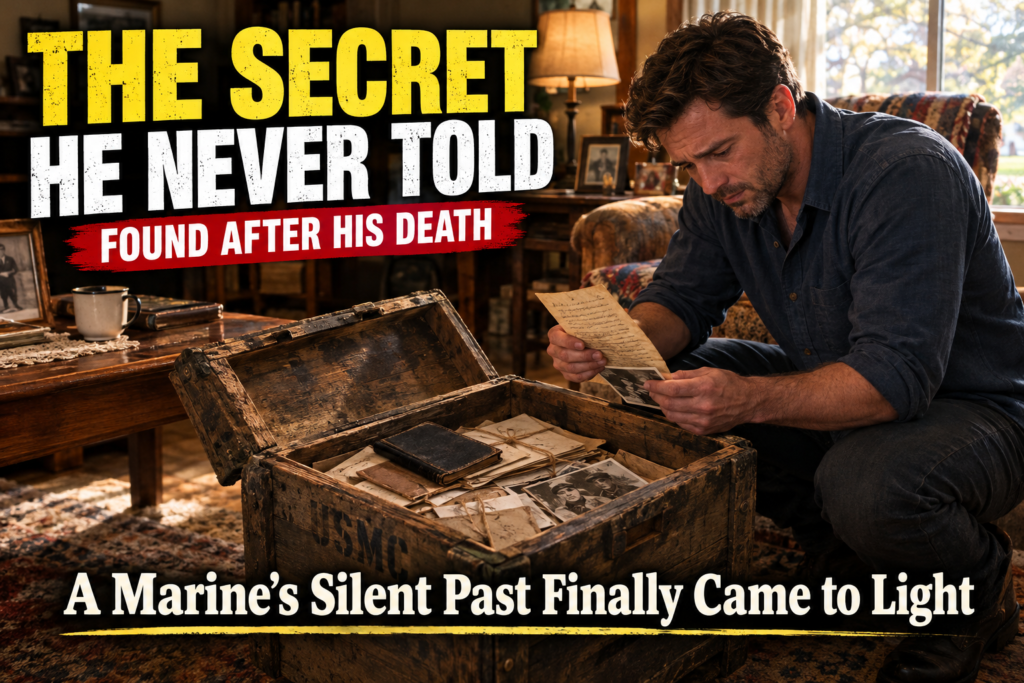
Beside his favorite armchair sat an old wooden ammunition crate. Its edges were worn, the wood had darkened with age, and the faded letters “USMC” were barely visible on one side.
For as long as I could remember, that crate had been his footrest.
As children, we’d sat on the living room floor while he watched television, our legs stretched beneath the coffee table. Sometimes, we’d climb onto the armchair beside him and ask him to tell us stories about his younger days.
He would tell us about fishing, working hard, and the trouble he had gotten into as a boy.
But whenever anyone mentioned the war, his expression changed.
Not dramatically. He never slammed his fist against the table or ordered us to leave. He simply became quiet, as if someone had closed a door inside him.
“Uncle, were you scared when you went overseas?” I once asked him when I was about twelve.
He had been sitting in that same armchair, his hands resting on the wooden crate.
For a moment, he stared at the television without seeming to see it.
“Everybody gets scared sometimes,” he finally replied.
Then he asked whether I wanted another slice of apple pie.
That was how he handled the subject. He redirected the conversation, found a task that needed doing, or excused himself to check something in the garage.
As I grew older, I stopped asking.
I convinced myself that his silence meant he had nothing he wanted to share. Perhaps the war had been ordinary to him in the way difficult work becomes ordinary after enough years. Perhaps he simply preferred remembering the life he had built afterward.
I never considered that silence might be the only way he knew to carry something too heavy to explain.
Now the house was quiet.
His coffee mug remained on the kitchen counter. A pair of reading glasses sat beside the newspaper he had been working through before his health declined. His old jacket hung behind the bedroom door, and his slippers were positioned beside the bed as neatly as if he planned to return that evening.
I stood in the living room, surrounded by the belongings of a man who had occupied the same rooms for most of my life.
The ammunition crate was the one thing I could not stop looking at.
I knelt beside it and ran my hand across the rough lid. The wood smelled faintly of dust and old varnish. Small scratches crossed its surface, and one corner had been repaired with a piece of metal that looked much newer than the rest.
I remembered resting my feet on it when I was a boy.
I remembered my uncle tapping its side with his shoe whenever he wanted me to move out of the way.
I remembered how carefully he had kept it.
What I could not remember was ever seeing him open it.
The thought seemed insignificant at first. He had owned plenty of old things. Maybe the crate held tools, photographs, or papers he had never gotten around to sorting.
Still, something about it bothered me.
I leaned closer and examined the metal fastener along the front edge.
It was closed.
I looked around the room, suddenly aware that I was about to open something my uncle had kept beside him for decades.
Then I stopped.
He had never told me what was inside.
And for the first time in my life, I wondered whether that silence had been a request.
Part 2
I spent the next hour clearing the kitchen cabinets, but my thoughts kept returning to the crate.
There were ordinary explanations for my curiosity. I was responsible for sorting the house, deciding what could be donated, and determining which belongings should stay with the family. The crate was part of that responsibility.
At least, that was what I told myself.
I found his old service photographs in a desk drawer upstairs. Most showed young men standing in rows, their faces serious beneath their military caps. A few were faded almost beyond recognition, and some had names written on the back in careful handwriting.
My uncle appeared in several of them.
He looked impossibly young.
The man in those pictures had the same eyes as the uncle I knew, but his face was thinner, his shoulders straighter, and his expression harder to read.
I sat at the desk and examined the photographs one by one.
There were no dramatic descriptions on the backs. No accounts of battles or lists of heroic deeds. Just names, dates, and occasional notes about where a picture had been taken.
One photograph showed my uncle standing with three other Marines. They were outdoors, their uniforms dusty, their faces turned toward the camera.
I recognized my uncle immediately.
The other men were strangers to me.
On the back, he had written four names. His own appeared first, followed by three others. Beneath them was a date from 1945.
I stared at the handwriting.
My uncle had preserved this photograph for more than eighty years, yet he had never shown it to us. I had grown up hearing stories about his childhood and his working years, but these men had never entered our family conversations.
I wondered whether any of them had survived the war.
I wondered whether my uncle had kept in touch with them.
Most of all, I wondered why a man who rarely discussed his military service had held on to so many photographs.
I returned downstairs carrying the small stack.
The living room looked different in the afternoon light. Dust floated near the window, and the armchair cast a long shadow across the floor.
The crate sat where it had always been.
I placed the photographs on the coffee table and knelt beside it again.
This time, I examined the repaired corner. The metal strip had two small screws, both darkened with age. I pressed gently against the lid, expecting it to shift, but it remained firmly closed.
I considered looking for a key, although I had no reason to believe it required one. I checked the nearby drawers and the cabinet beneath the television.
Nothing.
In the kitchen, I found a small tin filled with spare screws, old batteries, and miscellaneous hardware. I carried it into the living room, then stopped before opening the tin.
What was I doing?
My uncle was gone. He could not explain his intentions or tell me whether the contents belonged to him alone. I had spent my childhood respecting his boundaries without understanding why they existed.
Now I was preparing to cross one.
I sat back on my heels.
“All right, Uncle,” I whispered. “I’ll be careful.”
It was not an answer, but saying it made the room feel less empty.
I searched the desk again, this time checking beneath the papers and inside a small wooden box that held his old medals. Among the documents was an envelope containing military records and several folded sheets of paper.
I read the first page, which confirmed details of his service. The language was formal and impersonal. It recorded dates, units, and other information, but nothing that explained the private man who had returned home and spent the rest of his life avoiding the subject.
At the bottom of the envelope lay a photograph I had not noticed earlier.
It showed a group of Marines standing beside a low wooden structure. My uncle was near the center. He had one arm around a younger man whose face was partly obscured by the angle of the camera.
On the back, he had written a single sentence:
“Some things must never be forgotten.”
I read it again.
Then I looked toward the ammunition crate.
For the first time, I understood that whatever lay inside might not be a collection of ordinary belongings.
Part 3
By late afternoon, I had stopped pretending that I could finish clearing the house in a single day.
I put the photographs into a folder and placed the military records on the coffee table. Then I walked through the rooms, trying to separate the things that mattered from the things that simply occupied space.
The bedroom held the familiar evidence of a long life: folded shirts, a wooden dresser, old shoes polished more often than they were worn, and a bedside clock that ticked steadily even though no one was left to hear it.
In the closet, I found a cardboard box filled with letters.
Some were birthday cards from relatives. Others came from friends whose names I barely recognized. A few were official envelopes, their paper yellowed around the edges.
I read only enough to identify them before putting them aside.
One letter, however, had been kept inside a separate envelope. There was no stamp or address, and the paper had been folded into thirds.
The handwriting was not my uncle’s.
I unfolded it carefully.
The message was brief. It thanked him for something he had done many years earlier and mentioned a promise that had not been forgotten. The writer referred to a difficult time in the Pacific, but the letter contained no details about what had happened.
At the bottom was a name.
It matched one of the names written on the back of the photograph.
I sat on the edge of the bed.
The connection was small, but it changed the way I looked at everything. My uncle had not simply kept old military memorabilia. He had preserved photographs, records, and personal correspondence connected to people he had never mentioned.
I returned to the living room with the letter.
The ammunition crate waited beside the armchair, its weathered surface catching the last warm light of the day.
I placed the letter beside the photograph and compared the names. The handwriting on the envelope was different, but the name itself was unmistakable.
I tried to imagine the circumstances under which the letter had been written.
Had the two men met again after the war? Had they exchanged letters for years? Or had this single message arrived long after they had lost contact?
I had no way of knowing.
My uncle had been a private man, but privacy was not the same as loneliness. He had maintained friendships, answered correspondence, and kept objects that mattered to him. He had simply chosen not to make those parts of his life available to everyone.
That distinction mattered.
I knew I could not assume the crate contained a confession or a secret. The photographs and letter suggested that it might hold personal memories, but they did not tell me what those memories meant.
I sat in his armchair.
The cushion had softened over decades, and the fabric carried the faint scent of the house. From that position, I could see the entire living room, including the doorway to the kitchen and the window overlooking the yard.
I tried to imagine him sitting there after returning from the Pacific in 1945.
The country had moved forward. Families reunited. People found jobs, bought houses, raised children, and learned to speak about the future again.
My uncle had done those things, too.
He had worked, paid his bills, helped relatives, and shown up whenever the family needed him. He had attended birthdays and funerals. He had repaired broken chairs and driven through bad weather to deliver groceries to an elderly neighbor.
He had lived a full life.
Yet the man who could tell a funny story about a broken lawn mower had never offered more than a few words about the years that preceded that life.
Perhaps he believed his experiences belonged to another time.
Perhaps he thought his family would never understand.
Or perhaps he had made a promise.
That last possibility stayed with me.
I looked again at the words on the photograph.
Some things must never be forgotten.
Outside, the sky darkened, and the first porch light came on across the road. I switched on the lamp beside the armchair.
Then I heard a small metallic click as I shifted my foot against the crate.
I froze.
The sound had come from inside the lid.
I bent forward and pressed the wood gently. Something seemed to move beneath it, though I could not tell whether it was a loose object or merely the old boards settling.
For several seconds, I did not move.
Then I noticed a narrow gap along the back edge of the lid.
It was barely visible.
But it had not been there when I first examined the crate.
Part 4
I did not open the crate that night.
Instead, I covered it with an old sheet, turned off the living room lamp, and went to sleep in the guest room.
Sleep came slowly.
Every time I closed my eyes, I pictured my uncle sitting in the armchair, his feet resting on the crate, his gaze fixed on a television program he barely seemed to follow.
I wondered how many evenings he had spent there.
How many times had he looked down at the lid and decided not to open it? How many memories had he carried into that room without allowing them to enter the conversations around him?
I knew the questions were impossible to answer, but my mind kept returning to them.
The next morning, I made coffee and opened the curtains.
The yard was damp from overnight dew. My uncle had maintained it himself until his health made the work difficult. The grass was cut short, the hedges were trimmed, and a row of old shrubs followed the fence.
He had always liked things in their proper place.
That was why the crate had surprised me so much. It was old, battered, and clearly important to him, yet he had never explained its purpose.
After breakfast, I returned to the living room and removed the sheet.
In daylight, the crate looked less mysterious. It was simply an old wooden box, its corners worn smooth by years of use. The faded military lettering was nearly indistinguishable from the grain of the wood.
I crouched beside it.
The narrow gap remained.
I examined the lid and discovered that one of the wooden slats had lifted slightly near the back. It appeared to have warped over time, leaving a small space between the boards.
I pressed it gently.
The board moved.
A quiet creak came from within.
I drew my hand away.
The sensible explanation was that the crate contained objects that had shifted over the years. Whatever was inside, I could not imagine that it would explain everything I had been wondering about.
Still, I felt a reluctance that was difficult to justify.
I had never seen my uncle open it. Even when we helped him move furniture, he had insisted that the crate remain beside the armchair.
“Leave that where it is,” he had said once when I was helping him rearrange the living room.
I had obeyed without asking why.
At the time, his request had seemed no different from his preference for keeping the television remote on the left side of the coffee table.
Now I wondered whether I had misunderstood the importance of that instruction.
I went to the kitchen and returned with a small screwdriver. I loosened the old fastener carefully, taking care not to split the wood.
The first screw resisted. The second turned more easily.
I set both aside.
Then I lifted the lid.
The hinges complained with a long, dry creak.
Inside, the crate was not filled with tools or household supplies. A layer of faded cloth covered most of its contents. Beneath the cloth lay several carefully arranged bundles, each tied with string.
I did not touch them immediately.
I simply stared.
There were papers, photographs, and what appeared to be a small notebook. A narrow envelope rested near one corner, its edges softened by age.
Everything had been placed deliberately.
I lifted the cloth by its edge.
The notebook had a dark cover, worn smooth at the corners. Beside it were several folded documents and a small cloth pouch.
I picked up the notebook first.
Its cover bore no title.
When I opened it, I found rows of handwritten dates and brief entries. Some were difficult to read because the ink had faded. Others were clear enough to make out names and places.
The first pages contained information about military service, but the later entries became more personal.
I read a few lines, then stopped.
These were not official records.
They were my uncle’s private words.
I closed the notebook and held it in both hands.
For ninety-six years, he had lived with experiences I could only imagine. He had returned from the Pacific, built a home, and become the man our family knew.
Now, after his death, I was holding something he had never offered to share.
I could not decide whether opening the crate had been an act of discovery or an act of disobedience.
Then I noticed the envelope beneath the notebook.
Written across its front, in my uncle’s unmistakable handwriting, were five words:
“For the family, when I’m gone.”
Part 5
I stared at the envelope for a long time.
The words were simple, but they changed everything.
My uncle had known that someone would eventually open the crate. He had not left it locked away in a storage room or hidden behind furniture. He had kept it beside the armchair where everyone could see it.
Perhaps he had wanted the family to discover it.
Perhaps he had simply been unable to decide what should happen to it while he was alive.
I turned the envelope over. It had been sealed, and my uncle had written nothing else on it.
My first instinct was to open it immediately.
Instead, I placed it on the coffee table and returned to the notebook.
The earliest entries were short and factual. They recorded dates, movements, and names. My uncle’s handwriting was controlled, with each line occupying almost exactly the same amount of space.
As I turned the pages, I noticed that the entries became less regular. Some dates had several lines beneath them, while others were followed by blank spaces.
The notebook was not a complete diary. It seemed to be a collection of moments he had decided to preserve.
One entry mentioned a conversation with another Marine. Another referred to a photograph that had been taken shortly before the men moved to a different location.
Several pages contained names.
Some matched the names on the photographs I had found upstairs.
I recognized the man who had written the letter thanking my uncle for something he had done long ago.
I still did not know what that something was.
The entries did not offer an easy explanation. They were brief, sometimes unfinished, and often concerned with ordinary details: a meal, a letter, a day of waiting, the sound of rain.
That ordinariness affected me more than I expected.
I had always imagined that a soldier’s memories of war would be dominated by dramatic moments. But my uncle’s notebook preserved small details that might have seemed unimportant to anyone else.
A name.
A promise.
A photograph.
A message from someone who had survived.
I turned another page.
Near the bottom was a sentence written in darker ink.
“I thought coming home would mean leaving everything behind.”
I read it twice.
There was no further explanation.
I sat back and looked around the living room. My uncle’s ordinary belongings surrounded me, each one a reminder of the life he had built after returning home.
His favorite mug.
His reading glasses.
The old armchair.
The crate.
I had spent years believing that his silence meant the war was a closed chapter. The notebook suggested something more complicated. Perhaps he had tried to leave the past behind and discovered that memories did not obey the same rules as physical objects.
They could remain even when everything else changed.
I picked up the sealed envelope.
My hands trembled slightly as I slid a finger beneath the flap.
Inside was a folded sheet of paper.
The writing was large and deliberate, as though my uncle had taken special care with every word.
I unfolded it.
The first line read:
“If you’re reading this, I’ve finally run out of time to tell you what I should have said years ago.”
I stopped.
For a moment, I could not continue.
The room was silent except for the ticking clock in the kitchen.
I had heard my uncle speak thousands of times. I knew the sound of his laughter, the dry humor he used when someone complained about the weather, and the gentle way he spoke to children.
But I had never heard him speak like this.
The letter continued with an explanation of why he had kept the crate. He wrote that the objects inside belonged to a part of his life he had never learned how to discuss.
He acknowledged that his silence had sometimes confused the people who loved him.
Then he wrote something that made me lower the page.
“I did not keep quiet because I had forgotten. I kept quiet because I remembered.”
I read the sentence again.
Outside, a car passed along the road.
The ordinary sound seemed impossibly distant.
I looked down at the letter, understanding that the crate was not merely a container for old military belongings.
It was the place where my uncle had kept the words he could not say aloud.
Part 6
I continued reading.
My uncle’s letter did not begin with a dramatic account of battle. It began with an apology.
He apologized for the questions he had never answered, for the conversations he had avoided, and for the times his silence had made him seem distant.
He explained that he had wanted to protect his family from the burden of his memories.
At first, he had believed the silence would be temporary. He would return home, find work, settle into ordinary life, and eventually discover a way to talk about what he had experienced.
But the years passed.
The longer he remained silent, the more difficult speaking became.
He wrote that people often asked whether the war had made him brave. He never knew how to answer. He did not think of himself as brave, and he had never believed that surviving something automatically made a person courageous.
He had simply been young, far from home, and surrounded by other young men who were trying to make it through each day.
The letter did not describe the details of every experience. Instead, it explained what had happened afterward.
He had returned to Alabama and found that the world expected him to resume his life. People wanted to hear that the war was over, that he was safe, and that the future looked bright.
He wanted those things to be true, too.
So he worked.
He learned new routines, repaired things around the house, and helped the people around him. He found comfort in practical tasks because they gave his hands something to do when his thoughts became difficult to manage.
He discovered that he could talk about almost anything except the past.
When relatives asked about his service, he offered a short answer. When someone wanted a story, he told them something harmless. When a conversation moved toward a memory he did not wish to revisit, he changed the subject.
Eventually, everyone stopped asking.
That was when the silence became permanent.
I lowered the letter.
I remembered all the times I had watched him turn away from a conversation. I remembered how quickly he could move from a question about the war to a question about school, work, or the weather.
I had thought he was avoiding us.
Now I wondered whether he had been trying to remain present with us by keeping certain memories elsewhere.
The letter described the crate as a collection of things he could not bear to discard. It contained reminders of people who had mattered to him and moments he feared might otherwise disappear.
He wrote that the objects had become a way of honoring the past without allowing it to dominate the present.
The crate had sat beside his armchair because he wanted it close.
He did not explain every detail, and I did not expect him to. Some experiences remained private even in a letter intended for the family.
But he offered one final explanation.
He had kept the crate because the men whose names appeared in his notebook deserved to be remembered as people, not merely as names in an old photograph.
I returned to the notebook.
The names were written in neat columns. Beside some were dates. Beside others were brief descriptions or notes about correspondence.
I began copying them onto a separate sheet of paper.
I wanted to know who these men had been.
I wanted to understand whether they had families, whether they had returned home, and whether anyone still remembered them.
My uncle had preserved their names for decades.
I could not bear the thought of allowing them to disappear simply because I had never known to ask.
As the afternoon light faded, I placed the notebook, photographs, and letter in a careful stack.
For the first time since arriving at the house, I no longer felt that I was merely clearing out a dead man’s belongings.
I was learning how he had carried his life.
And I had only begun to understand what he had left behind.
Part 7
The following morning, I called my mother.
She had known my uncle far longer than I had, and I thought she might recognize the names in the notebook.
“Did he ever talk to you about the men he served with?” I asked.
There was a pause.
“Not really,” she said. “Why?”
I explained what I had found.
She listened without interrupting. When I mentioned the letter, her voice softened.
“He never talked about it with me, either. I used to think he just wanted to forget those years.”
“That’s what I thought.”
“Maybe he did want to forget some of it,” she replied. “But I don’t think he ever forgot the people.”
I looked at the photograph on the table.
“Did you know he kept a military crate beside his chair?”
“Of course. It was always there.”
“Did you ever ask him what was inside?”
“I asked once when I was younger. He told me it was something he wanted to keep.”
“That was all?”
“That was all.”
Her answer reminded me that I was not the only person who had lived beside the mystery. The crate had been visible to everyone, but no one had understood its importance.
My mother asked me to read part of the letter aloud.
I did.
When I finished, neither of us spoke for several seconds.
“I wish he’d told us,” she finally said.
“So do I.”
“But maybe he couldn’t.”
There was no accusation in her voice. Only sadness.
We talked for nearly an hour about the uncle we remembered. She told me about the times he had helped her through difficult years, the practical advice he had offered, and the small ways he had shown affection without making a show of it.
He was not a man who spoke easily about feelings. He showed love by fixing things, keeping promises, and arriving when someone needed help.
I had always known that.
What I had not understood was how much he might have been carrying while he did those ordinary things.
After the call, I returned to the photographs.
I began researching the names, using the dates and available military records to narrow the possibilities. Some names were common, and I could not confidently identify the men. Others led to records that might have belonged to the people in the photographs, but I refused to assume that every match was correct.
I wrote down what I could verify and left the uncertain details blank.
My uncle had taken care to preserve these materials. I wanted to treat them with the same care.
By midday, I had made a list of questions.
Who were the men in the photograph?
Where had they gone after the war?
Had they remained in contact?
Were any relatives still alive who might know more?
The questions no longer felt like an attempt to uncover a scandal or expose a hidden truth. They felt like an effort to complete something my uncle had begun.
I returned to the letter and read it from the beginning.
Near the end, he had written that he did not expect his family to understand everything. He only hoped that we would understand why he had kept the crate and why the people represented by its contents mattered to him.
He asked that the photographs and notebook not be thrown away.
Then he added a sentence that stayed with me throughout the day.
“Remembering someone is one of the few things we can still give them when everything else is gone.”
I placed the letter beside the notebook.
The house was quiet, but it no longer felt empty in the same way.
I could almost picture my uncle sitting in the armchair, one hand resting on the lid, the television murmuring in the background.
He had not been waiting for someone to discover a treasure.
He had been keeping faith with memories that mattered.
Now the responsibility had passed to me.
Part 8
Over the next several days, I worked through the crate’s contents slowly.
I photographed the documents before moving them and recorded where each item had been placed. I used separate folders for the photographs, letters, and military papers, taking care not to discard anything simply because its significance was unclear.
The work changed my understanding of the house.
At first, every room had seemed like a collection of chores. I had planned to empty the cupboards, sort the furniture, and arrange for the things no one wanted to be donated.
Now I found myself pausing over ordinary objects.
A repaired chair reminded me of how often my uncle had fixed things instead of replacing them. A stack of old envelopes showed how carefully he had maintained contact with people. His neatly arranged tools reflected the same patience I saw in the way he had organized the crate.
The more I learned, the less I believed that the crate contained a single dramatic secret.
Its importance lay in the accumulation of small things.
A photograph taken decades earlier.
A letter sent across a great distance.
A notebook filled with names and brief observations.
Each item preserved a connection that time might otherwise have erased.
I contacted a local veterans’ organization and asked whether someone could advise me on preserving the military materials. I explained that I was not trying to establish a public account of my uncle’s service. I simply wanted to make sure the documents were handled appropriately.
The person I spoke with recommended keeping the original materials in a dry, stable environment and avoiding unnecessary cleaning or repairs.
I followed that advice.
I also continued researching the names.
Some searches led nowhere. Others produced possibilities that required further confirmation. I learned quickly that an old photograph rarely provides enough information to reconstruct an entire life.
I could identify a date, a place, or a unit, but I could not know what a particular man had felt or what had happened to him afterward without reliable evidence.
That uncertainty became part of the process.
My uncle had preserved the names because he did not want them forgotten. I could honor that intention without pretending to know everything about the people behind them.
One evening, I called my mother again.
“I think he wanted us to know these men existed,” I told her.
“That sounds like him,” she said.
“Not necessarily every detail of what happened. Just that they mattered.”
She was quiet for a moment.
“He always remembered people,” she replied. “Even people he hadn’t seen in years.”
I thought about the old letters.
Perhaps that was what the crate had meant to him. It was not simply a record of the war. It was a record of relationships that had survived distance, time, and silence.
My uncle had returned to civilian life, but he had never completely separated himself from the people who had shared those years with him.
He had carried their names into his home.
He had placed them beside the chair where he sat every evening.
And when visitors came, he had allowed the crate to remain visible without explaining it.
I wondered whether he had hoped someone would eventually ask.
Or perhaps he had been content to know that the objects were safe.
I could not answer that question.
But I began to understand that I did not need to.
The letter had given me enough to recognize the care behind his silence. It had not given me permission to invent the missing parts of his life.
As I finished organizing the documents, I prepared a separate folder for the letter addressed to the family. I placed it with the notebook and photographs, then returned the items to a secure storage box.
The ammunition crate itself remained beside the armchair.
I had considered moving it to the garage, where it would be out of the way while I finished clearing the house.
Instead, I left it where my uncle had kept it.
For the first time, I understood that its place in the room had never been accidental.
Part 9
The final days of clearing the house were harder than I expected.
I had thought the most difficult part would be deciding what to keep. In reality, the hardest moments came when I encountered something that had belonged to my uncle so naturally that I had never thought of it as an object that could be lost.
His favorite cup was one example.
It was an ordinary ceramic mug, slightly chipped near the handle. I remembered him using it every morning, holding it in both hands while he looked out the kitchen window.
I could have donated it without a second thought.
Instead, I washed it carefully and placed it in a box with a few photographs.
The same thing happened with his old jacket, his reading glasses, and the small radio he kept in the garage.
None of these objects explained the war.
But together, they reminded me that the man who had carried those memories was also the uncle who had made breakfast for visiting children and repaired bicycles in the driveway.
His life was larger than the silence surrounding one part of it.
I began to think about how often families misunderstand one another.
We assume that people who do not speak about something have nothing to say. We assume that an unanswered question means indifference, or that a closed door means rejection.
Sometimes those assumptions are correct.
Other times, silence is simply the only form of protection someone knows how to offer.
My uncle’s letter did not erase the years when I had wondered why he refused to discuss his service. It did not make every unanswered question disappear.
But it helped me see those years differently.
He had not been obligated to tell us everything.
We had not been wrong to wonder.
Both things could be true.
On the last afternoon, I stood in the living room and looked at the empty shelves. The television had been removed, the coffee table was gone, and the curtains had been taken down.
Only the armchair and the ammunition crate remained.
I sat in the chair one final time.
Without the familiar clutter, the room seemed larger. The window overlooked the same yard I had seen countless times as a child, but the house no longer felt like the place where my uncle might return at any moment.
It had become a place of memory.
I rested my hand on the crate.
For years, I had thought of it as a footrest, an old military object that had survived because my uncle was too stubborn to replace it.
Now I knew that it had held something more personal.
I thought about the men in the photographs. I thought about the letters and the names in the notebook. I thought about the young Marine who had returned home in 1945 and spent the next decades building a life that looked ordinary from the outside.
I wished I could have asked him one more question.
Not about a battle or a particular day in the Pacific.
I would have asked him what he wanted us to remember.
Would he have wanted us to remember the war itself? The men who served beside him? The years he spent rebuilding his life? Or simply the fact that people can carry painful memories while still finding ways to love those around them?
Perhaps he would have told me that the answer was all of those things.
Perhaps he would have changed the subject, as he had done so many times before.
I smiled at that thought, though my eyes filled with tears.
Then I stood and lifted the crate carefully.
It was heavier than I expected.
I placed it beside the boxes I planned to take home, making sure that the lid remained secure and the contents stayed protected.
Before leaving, I walked through the house once more.
I checked the kitchen, the bedrooms, and the garage. I turned off the lights and locked the doors.
Then I returned to the living room.
The armchair stood alone.
For a moment, I imagined my uncle sitting there again, his feet resting on the crate, his face turned toward the window.
I wanted to tell him that I understood a little more now.
I wanted to tell him that his silence had not erased the people he remembered.
But there was no one left to hear me.
So I said it anyway.
“I’ll take care of it, Uncle.”
Then I closed the door.
Part 10
Months passed before I felt ready to revisit the materials.
At first, I kept the crate and its contents in a quiet corner of my home. I did not want to rush into making decisions about something that had mattered so deeply to my uncle.
Whenever I walked past it, I remembered the afternoon I had discovered the envelope.
I remembered the sentence that had changed the way I understood him: “I did not keep quiet because I had forgotten. I kept quiet because I remembered.”
The words stayed with me because they described something I had never fully considered.
Memory is not always a story people can tell from beginning to end. Sometimes it is a photograph kept inside a drawer, a name written on the back of a page, or an old wooden crate that remains beside an armchair long after its practical purpose has disappeared.
Sometimes memory is simply the decision not to throw something away.
I continued researching the names in my uncle’s notebook. I confirmed a few details and left others unresolved. I contacted people who might be able to offer reliable information, but I resisted the temptation to fill gaps with guesses.
The unknown parts of his story remained unknown.
That was difficult at times.
I wanted to understand everything. I wanted to know what each photograph represented and why certain names appeared repeatedly in the notebook. I wanted to reconstruct the experiences that had shaped the man I had loved.
But the more I worked, the more I realized that understanding someone does not require possessing every detail of their life.
I had known my uncle through the years we shared.
I knew his habits, his humor, his stubbornness, and his quiet generosity. I knew that he remembered birthdays even when he pretended not to care about them. I knew that he could repair almost anything and that he always offered practical help before advice.
Those memories were real.
The crate had not replaced them. It had added another layer.
It had shown me that a person could be both familiar and unknowable, that love could exist alongside unanswered questions, and that silence did not always mean an absence of feeling.
One evening, I took the letter from its protective folder and read it again.
The paper had softened along its folds. My uncle’s handwriting remained steady, though a few words were difficult to make out.
I placed the letter beside the photograph of the four Marines.
For a long time, I studied their faces.
I wondered what they had talked about when the camera was not pointed toward them. I wondered what they had hoped to do after returning home. I wondered how many ordinary lives had been built around memories that never appeared in family stories.
I could not answer those questions.
But I could preserve the photograph.
I could keep the names legible.
I could make sure that the notebook and letters survived for another generation.
And I could tell the story of a man who had served his country, returned home, and spent a lifetime trying to find a way to live with what he remembered.
Not every part of that story needed to be revealed.
Some details belonged to him.
Others had been entrusted to the family.
The difference was something I had learned to respect.
I eventually placed the crate in a safe place where it would remain protected. I kept the original materials together and made copies for family members who wanted to learn more about the people my uncle had remembered.
When relatives asked about the crate, I no longer described it as an old ammunition box that had served as a footrest.
I told them that it had been important to him.
I explained that it contained photographs, letters, and a notebook that preserved names from his years in the Pacific. I told them that he had chosen not to discuss those memories openly, but he had made sure that the evidence of those connections remained.
I did not claim to know everything he had experienced.
I did not pretend that I could explain his silence completely.
I simply shared what he had left behind.
Sometimes, that was enough.
My uncle lived to ninety-six years old. He survived a war, returned home, and built a life that stretched across decades. He became an uncle, a relative, a neighbor, and a man whose ordinary kindness shaped the people around him.
For most of my life, I believed that the old crate was simply part of his furniture.
I was wrong.
It was a reminder that the people we love carry histories we may never fully see. They have memories from before we knew them, relationships we never witnessed, and private struggles that do not always find their way into conversation.
We cannot force every silence to open.
We cannot demand that another person explain everything they have survived.
But we can pay attention to what they choose to preserve.
We can listen when they are ready to speak.
And when they leave something in our care, we can treat it with respect.
My uncle never told me everything about the Pacific.
He never sat me down and explained what happened in 1945. He never described every man in his photographs or every reason he had kept their names.
For years, I thought those unanswered questions meant I had missed something important.
Now I understand that I had been given something important all along.
I had known the man who came home.
I had known the man who built a quiet life.
And, through the crate, I had been allowed to glimpse the young Marine who had carried memories across an ocean and kept them close for the rest of his life.
I still wish we had talked about it.
But I no longer mistake his silence for forgetting.
The old wooden crate remains a part of our family story, not because it revealed every secret, but because it reminded us that a life can contain far more than the stories a person tells.
Sometimes, the most meaningful things are the ones someone spends a lifetime protecting.
And sometimes, the responsibility of remembering passes quietly to the people left behind.