Part 1
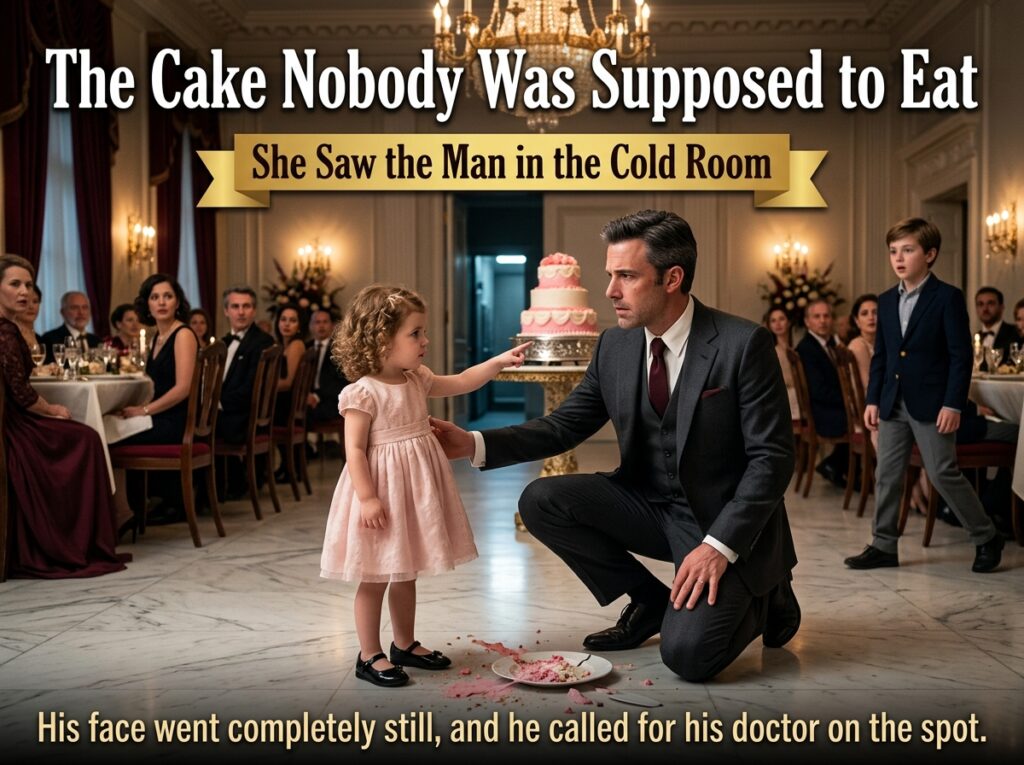
The first bite never reached Ethan Moretti’s mouth. My three-year-old daughter, Lily, slipped from behind my skirt and knocked the plate from his hands before I could stop her, a movement so fast and so unlike her usual shy caution around strangers that I had no chance to intervene before pink frosting hit the marble floor of the Westchester mansion’s grand dining hall, the sound of shattering china cutting cleanly through the low murmur of more than a hundred guests celebrating Ethan’s tenth birthday.
I’m Marisol Ortega, thirty-one years old, and I had managed the Moretti household for six years by that point, since Lily was barely walking, brought into the position through an agency that specialized in placing domestic staff with families who required, alongside the usual competencies, a certain discretion about what they saw and heard within a household that carried, in the whispered assessment of everyone from the local grocery delivery drivers to the more gossip-inclined members of my own extended family, a reputation considerably darker than the tasteful Westchester estate and its careful landscaping ever suggested to the casual observer.
I had never asked Dominic Moretti what those rumors actually meant. That was, in some ways, the entire unspoken contract of my employment: I managed his household, his schedules, his son’s care during the hours his own considerable business obligations pulled him elsewhere, and I did not ask questions about the men who occasionally visited his study late at night, about the sudden departures of certain staff members who left without notice and were never discussed again, about the particular tension that sometimes moved through the house like weather in the days before or after Dominic traveled somewhere he never specified in advance.
The room went completely silent after the plate shattered, the particular absolute stillness of a hundred wealthy, careful people simultaneously deciding not to react visibly to something that had clearly, obviously, gone wrong. I dropped to my knees beside Lily immediately, my hands already reaching to gather her against me, some instinct screaming that whatever she had just done, in this house, in front of these particular guests, carried consequences considerably beyond a simple broken dessert plate.
“Mr. Moretti, please,” I said, looking up at Dominic, who had risen from his seat at the head table, his face unreadable in the way I’d learned, over six years, to recognize as considerably more dangerous than open anger. “She’s only three. She doesn’t understand what she just did.”
He didn’t answer me at all. Instead, in a gesture I had genuinely never once seen him make in six years of managing his household, not for his own son, not for any child at any event I’d ever staffed, Dominic Moretti knelt down on the marble floor directly in front of my three-year-old daughter, bringing his considerable height and presence down to her eye level with a stillness that felt, in that silent room, like something enormous holding itself very carefully in check.
“Why did you do that?” he asked her, his voice quiet, entirely without the anger I’d braced for.
Lily, entirely unbothered by the silence, by the hundred watching guests, by the man kneeling in front of her whom every adult in that room treated with a caution bordering on fear, simply pointed one small finger toward the service corridor leading back toward the kitchens.
“There was a man,” she said. “In the cold room. He put white stuff on his finger.”
Part 2
Dominic’s face, hearing that, went completely still, a stillness I had seen only once before in six years, on the afternoon a business associate of his had called the house asking, in a tone I hadn’t understood at the time, whether Dominic had “handled the Rourke situation,” a phone call that had preceded, by roughly a week, the abrupt and permanent disappearance of a man named Rourke from every conversation in that house afterward.
“The cold room,” Dominic repeated, his voice very quiet, still crouched at Lily’s eye level. “You mean the walk-in refrigerator, off the kitchen?”
Lily nodded, entirely matter-of-fact, the way small children describe things they’ve witnessed without any framework for understanding their significance. “The big silver door. I went in there because Mrs. Petrova said the extra cake was in there, and I wanted to see it before the party, and there was a man already in there, and he had a knife and he was putting white stuff on his finger from a little bag, and then he touched the cake with his finger, and I got scared and I ran away.”
I felt my stomach drop entirely, understanding, in fragments, exactly what my daughter appeared to be describing, though my mind, in that moment, refused to fully assemble the pieces into their most obvious and horrifying conclusion.
“Which cake,” Dominic said, his voice now carrying an edge I’d genuinely never heard from him before, sharp and controlled in a way that made several nearby guests visibly shift backward, “which cake did he touch, Lily? Do you know?”
Lily pointed, without hesitation, at the elaborate three-tier cake still displayed on its stand near the head table, the one from which Ethan’s now-shattered plate had been cut moments earlier.
Dominic rose slowly to his feet, and I watched him scan the room with an intensity that felt considerably more frightening than any shouting could have been, his eyes moving across the assembled guests with the particular calculating focus of a man rapidly narrowing down possibilities.
“Where is Mrs. Petrova,” he said, his voice carrying now, not shouting, but pitched to reach the entire silent room.
The household’s head chef, a heavyset woman in her fifties who had run the Moretti kitchens for nearly as long as I’d managed the household staff, emerged from near the service corridor, her face already pale, clearly having overheard enough of the exchange to understand something had gone badly wrong within her own domain.
“Mr. Moretti,” she said, “I don’t understand, I’ve been in the kitchen all evening, I would have seen anyone—”
“Who else has access to that refrigerator,” Dominic said. “Who besides kitchen staff has had reason to be in that corridor this evening?”
Part 3
The question hung in that silent room for perhaps three full seconds before Dominic, apparently deciding this conversation required considerably more privacy than a hundred birthday guests currently provided, turned to the room at large with an expression that had shifted, almost instantly, into something considerably more composed and hostlike, a mask I recognized from six years of watching him manage difficult business calls in front of his own family.
“Ladies and gentlemen,” he said, his voice carrying easily, “I apologize for this interruption. I need a few minutes to address a small matter with my staff, and I’d ask that no one touch the cake until I return. Please, enjoy your desserts, there are additional trays being brought out momentarily.”
The performance was, I recognized even in my own shock, remarkably smooth, the kind of practiced social recovery that suggested a man who had managed considerably worse public moments than a toddler’s disrupted birthday cake service. Guests, taking their cue, began, with visible relief, to return to their own conversations, the particular practiced obliviousness of people who understood, whatever else was true about this family, that noticing too much carried its own risks.
Dominic gathered myself, Lily, Mrs. Petrova, and, with a small gesture, two men I recognized as part of his personal security detail, into his study off the main hall, closing the heavy door behind us with a finality that made the room feel considerably smaller than its actual generous proportions.
“Lily,” he said, crouching down to her level again, his voice gentle now in a way that struck me as genuinely careful rather than performed. “I need you to think very hard, sweetheart. Can you tell me what the man looked like? Was he wearing a uniform, like the other kitchen helpers?”
Lily considered this with the particular serious concentration small children bring to questions they sense matter, even without understanding why. “He had a black shirt,” she said. “Not like Mrs. Petrova’s white shirt. And he had a beard, kind of short, and a ring on his hand, a big gold one.”
Dominic’s jaw tightened almost imperceptibly at that detail. “Was he one of the men who came earlier, in the black cars? Before the party started?”
Lily shook her head. “I don’t know. I was playing with my dolls.”
Dominic straightened, turning to one of his security men. “Pull every camera feed from the service entrance and the kitchen corridor for the last three hours. I want to know who came through that door who wasn’t on the catering staff list.”
“On it,” the man said, already moving toward the door.
“And call Dr. Renwick,” Dominic added. “Tell him I need him here within the hour, and tell him to bring his field testing kit, not just his bag.”
Part 4
I want to explain, because it matters to everything that happened afterward, exactly who Dr. Renwick was within the strange, careful ecosystem of the Moretti household. He was not, as his title casually suggested, simply a family physician making routine house calls. Dr. Alistair Renwick had, in the six years I’d worked in that house, appeared perhaps a dozen times, always summoned with the same particular urgency Dominic had just used, always departing after brief, closed-door consultations that left the household staff with the distinct impression that his actual expertise ran considerably deeper than pediatric checkups and seasonal flu shots.
He arrived within forty minutes, a lean, precise man in his sixties carrying a metal case that looked, when he opened it in Dominic’s study, considerably more sophisticated than anything I’d seen in a typical doctor’s bag, containing small vials, testing strips, and equipment I didn’t recognize but that Dr. Renwick handled with the practiced efficiency of someone who used it considerably more often than his official medical practice would suggest.
He took a sample of the frosting from the cake, scraped carefully from an untouched section near where Lily had indicated the man’s finger had made contact, and ran it through a portable testing device that hummed quietly for what felt, in that tense study, like an unbearably long several minutes.
“There’s a foreign substance present,” Dr. Renwick said finally, his voice carefully neutral in the way I imagined medical professionals learned to cultivate for exactly this kind of moment. “I’ll need to run a more thorough analysis at my lab to identify it precisely, but the preliminary reading suggests something considerably more concerning than a simple contamination or allergen.”
“How concerning,” Dominic said.
“The reading pattern is consistent with certain synthetic compounds used in controlled sedation,” Dr. Renwick said carefully. “Or, depending on concentration, something considerably more dangerous than sedation. I won’t know the specific compound or the intended dosage until I’ve run a complete analysis.”
Dominic was very quiet for a long moment, and I watched something move across his face that I had genuinely never seen in six years of working in that house, something that looked, unmistakably, like fear, quickly suppressed but not quickly enough to escape my notice entirely.
“Ethan was going to eat that cake,” he said, more to himself than to anyone else in the room. “In front of a hundred guests. At his own birthday party.”
“Mr. Moretti,” I said carefully, understanding, with a dawning horror, exactly what my daughter’s small, unthinking act had actually prevented, “if that plate had reached him, if he’d eaten even one bite—”
“I know exactly what would have happened,” Dominic said, cutting me off, his voice very controlled. “I’ve seen what these compounds do at various concentrations, in circumstances I won’t discuss in front of your daughter.”
Part 5
The security footage arrived within the hour, and Dominic, myself, and his head of security, a broad, careful man named Grigor whom I’d worked alongside for years without ever fully understanding the actual scope of his responsibilities within the household, reviewed it together in the study while Mrs. Petrova took Lily to the kitchen for hot cocoa, ostensibly to calm her after the excitement, though I understood, watching them go, that Dominic also wanted her out of the room for whatever conversation was about to follow.
The footage, once Grigor located the correct timestamp, showed clearly what Lily had described: a man in a black shirt, matching her description precisely down to the short beard and the gold ring, entering the kitchen’s cold storage room roughly twenty minutes before the cake was scheduled to be cut, remaining inside for approximately ninety seconds, and exiting with the particular unhurried casualness of someone who believed, correctly until that moment, that no one had witnessed what he’d just done.
“Who is he,” Dominic said, his voice flat.
Grigor ran the footage through a facial recognition system I hadn’t previously known the household security setup included, the process taking perhaps three minutes before a match populated on the screen alongside a name and a considerable amount of background information that told me, immediately, this was not the first time Grigor’s systems had needed to identify this particular man.
“Yevgeni Sorokin,” Grigor said. “He’s worked, on and off, for the Basco family out of New Jersey. Low-level muscle mostly, some logistics work, nothing that would typically put him inside a private catering operation like tonight’s event.”
“The Bascos,” Dominic said slowly, and something in the way he said the name told me this represented an answer he’d already half-suspected before the footage confirmed it. “They’ve been unhappy about the shipping contract renegotiation for three months now. Marco Basco made it fairly clear, at our last meeting, that he considered my terms an insult to his family’s historical position in that arrangement.”
“You think Basco sent a man to poison your son’s birthday cake over a shipping contract,” Grigor said, his tone carefully neutral, though I could hear, underneath it, a genuine disbelief at the scale of the accusation.
“I think,” Dominic said slowly, “that Marco Basco has never once, in the fifteen years I’ve known him, been a man who limits his responses to the actual scale of whatever offense he believes he’s suffered. And I think a message delivered through my son, at his own birthday party, in front of a hundred witnesses who would spend the following weeks whispering about exactly how far the Bascos were willing to go, would strike him as an entirely proportionate response to a contract dispute he considers a personal insult.”
Part 6
The conversation that followed, over the next several hours, unfolded with a careful, methodical intensity that revealed, to me, considerably more about the actual mechanics of Dominic Moretti’s business than six years of managing his household had ever exposed me to directly.
Grigor made a series of calls, his voice pitched low, using terminology I only partially understood, arranging, as far as I could piece together, for Yevgeni Sorokin to be located and detained before he could report back to whoever had sent him, an operation that unfolded, over the following two hours, with a professional efficiency that told me this household maintained resources considerably beyond what any ordinary wealthy family’s private security typically possessed.
Dr. Renwick’s more thorough lab analysis, completed by nearly two in the morning, confirmed the compound as a synthetic opioid derivative, applied to the frosting in a concentration that, given the size of the slice originally cut for Ethan, would very likely have proven fatal to a child his size and weight within twenty to thirty minutes of consumption, presented in a manner, Dr. Renwick noted carefully, designed to resemble a tragic, accidental overdose from some contaminated ingredient, rather than an obvious and traceable poisoning.
“It would have looked like an accident,” Dominic said, reading the full report Dr. Renwick had prepared, his voice very quiet. “A ten-year-old boy, dead at his own birthday party from some contaminated batch of frosting, an ingredient recall, a tragic story that would have generated considerable sympathy rather than suspicion.”
“And sent an unmistakable message to anyone who understood the actual circumstances,” Grigor added, “about exactly how far the Bascos were willing to reach, into the one part of your life you’ve always kept most carefully protected.”
I sat through much of this exchange in a state of genuine shock, understanding only slowly, over those long overnight hours, exactly what my daughter’s small, unthinking curiosity about an extra cake had actually accomplished. Lily had wandered into that cold storage room looking for dessert, had witnessed something she had no framework to understand as sinister, had simply reported it, matter-of-factly, the moment the plate landed in Ethan’s hands and some small, wordless instinct told her something was wrong with it.
“Mrs. Ortega,” Dominic said, turning to me sometime past two in the morning, his voice considerably softer than the controlled intensity he’d maintained through most of the preceding hours, “your daughter saved my son’s life tonight. I understand you likely have no idea what to do with that information, and honestly, neither do I, fully, but I want you to understand that I recognize it clearly, and I intend to make sure it’s properly honored, whatever form that ends up taking.”
Part 7
Yevgeni Sorokin was located within four hours, at a motel roughly twenty miles from the estate, apparently waiting, Grigor’s investigation would later confirm, for a call confirming the “incident” had occurred before he made his way back across state lines. What happened to him following his detention, I want to be honest, remains something I never asked Dominic to explain in detail, understanding, by that point in the evening, that some aspects of what I’d witnessed belonged to a part of this household’s operations I had spent six years deliberately not examining too closely, and that this particular crisis, however much it had involved and endangered my own daughter, did not change the fundamental wisdom of that longstanding arrangement.
What I do know is that law enforcement was never formally involved, that the story circulated among the party’s hundred guests, in the days following, remained exactly the version Dominic had presented that evening: a small mishap with a young child, a dropped plate, nothing more significant than an amusing anecdote about an overprotective toddler that made its rounds through Westchester’s social circles as a minor curiosity rather than the attempted assassination it had actually represented.
I do know, because Dominic told me directly, roughly a week after the party, sitting in his study with a formality he’d never previously extended to conversations with household staff, that the situation with the Basco family had been “resolved comprehensively,” a phrase he offered without elaboration and that I did not ask him to expand upon.
“I want to discuss your daughter’s future,” he said instead, changing the subject with a deliberateness that told me this was the actual purpose of our meeting. “I’ve set up an educational trust in Lily’s name, fully funded, covering her schooling from this point forward through any graduate program she eventually chooses to pursue. This isn’t charity, Mrs. Ortega, and it isn’t a payment I expect you to feel obligated by in any way regarding your continued employment here. It’s simply an acknowledgment of a debt I intend to honor properly.”
“Mr. Moretti, that’s an enormous gift,” I said, genuinely uncertain how to respond to a gesture of that scale. “I don’t know how to properly thank you for something like that.”
“You don’t need to thank me,” he said. “Your daughter saved my son’s life with nothing more than an unthinking, honest reaction to something she found frightening. I’ve spent fifteen years building an operation designed, at every level, to anticipate and neutralize exactly this kind of threat, employing men whose entire professional purpose is precisely the security failure that nearly killed Ethan tonight. A three-year-old accomplished, purely by instinct and honesty, what an entire security apparatus failed to prevent. I find that considerably more humbling than I know how to properly express, Mrs. Ortega, and the trust is the smallest, most inadequate gesture I can offer in response.”
Part 8
Ethan Moretti, for his part, developed over the following months a particular attachment to Lily that struck me, watching it unfold, as genuinely touching rather than merely a rich family’s performed gratitude toward useful staff. He was, I’d observed over the preceding years, a somewhat solitary child, his father’s considerable wealth and evident danger keeping him at a careful remove from ordinary friendships that other ten-year-olds took for granted, his social circle limited largely to the carefully vetted children of his father’s business associates, relationships that carried, even at that young age, an unmistakable undercurrent of calculation rather than genuine affection.
Lily, three years old and entirely unaware of any of the complicated social and criminal architecture surrounding her small act of curiosity, simply liked Ethan because he built elaborate block towers with her and let her win at the simple card games he taught her, and Ethan, in turn, seemed to find in her uncomplicated affection something he genuinely craved, an unguarded relationship entirely free of the careful calculation that characterized most of his interactions with other children his father’s world had put in his path.
“She doesn’t know what I almost was,” Ethan told me once, months later, with a gravity that struck me as considerably beyond his ten years, watching Lily construct a wobbling tower of blocks in the estate’s playroom. “She’s not nice to me because of who my dad is, or because she’s scared of him, or because her parents told her to be nice to the rich boy. She’s just nice to me because she likes building towers. I don’t think anyone’s ever been nice to me just because of that before.”
I found myself, hearing that, considerably more moved than I expected, understanding, in that quiet moment, something about the particular loneliness of growing up inside Dominic Moretti’s careful, dangerous world that I’d never previously had reason to fully consider, six years of managing that household’s logistics having somehow never brought me to genuinely examine what it actually felt like to be the child at its center.
Dominic himself changed, in small, careful ways, over the following year, ways that I noticed primarily because six years of close observation had made me unusually attuned to the smaller shifts in his typically controlled demeanor. He attended more of Ethan’s school events personally, rather than sending a driver and a careful excuse. He asked me, on several occasions, genuine questions about how I was managing Lily’s early education, questions that carried none of the performative interest wealthy employers sometimes extend toward staff’s family matters, but something closer to actual, considered curiosity.
“I keep thinking about what Renwick said,” he told me once, nearly a year after the party, during one of our now more frequent conversations that had drifted, gradually, from purely professional household matters into something considerably more personal. “Twenty to thirty minutes, he said. That’s how long I would have had, once Ethan took that bite, before there was nothing left for any doctor to do. I’ve spent fifteen years building layers of protection around my son, and it came down, in the end, to twenty to thirty minutes that a three-year-old’s curiosity happened to interrupt at exactly the right moment.”
Part 9
The Basco situation, whatever “resolved comprehensively” had actually meant in practice, appeared, over the following two years, to have genuinely settled into something considerably quieter than the tension that had preceded that birthday party. Dominic never discussed the specifics with me, and I never asked, maintaining, even after everything, the careful boundary that had defined my six years of employment in that household. But the particular watchfulness that had characterized his demeanor in the weeks following the incident gradually softened, replaced by something closer to his previous, more relaxed baseline, and business associates I’d previously understood to represent some ongoing tension with the Bascos began appearing, occasionally, at estate functions with an ease that suggested whatever conflict had nearly cost Ethan his life had genuinely, if mysteriously, been laid to rest.
I want to be honest that I’ve thought, often, in the years since, about the particular strangeness of my own position within all of this: a household manager who had spent six years deliberately not asking questions about the family employing her, whose own daughter’s unthinking act of childhood curiosity had ended up exposing, and apparently resolving, a conflict operating at a scale and danger I’d never previously allowed myself to fully acknowledge, despite six years of quiet, accumulating evidence that something considerably darker than ordinary wealth underpinned the household’s daily operations.
I made a decision, in the months following the party, that I’ve never regretted, though it required a conversation with Dominic I approached with considerably more nervousness than our now-comfortable working relationship might have suggested was necessary.
“I need to understand something clearly, Mr. Moretti,” I told him, roughly eight months after the party, sitting in his study with a directness I’d never previously extended to him in six years of careful, professional distance. “I’m grateful for everything you’ve done for Lily’s future, genuinely grateful, in a way I don’t think I can fully express. But I need to understand whether continuing to work in this household means continuing to raise my daughter inside the kind of danger that nearly killed Ethan that night. I need to know if this is a household where that kind of thing could happen again, where my own daughter might not be so fortunate a second time.”
Dominic was quiet for a long moment, considering the question with the same careful gravity he brought to his most significant business decisions.
“I can’t promise you it will never happen again,” he said finally. “I would be lying if I claimed my world carries zero risk to the people within it, including children who have nothing to do with the choices that create that risk. What I can promise you is that I have restructured, considerably, how this household manages security following that night, closing exactly the kind of gap that allowed Sorokin into that kitchen in the first place. And I can promise you that I understand, now, in a way I perhaps hadn’t fully internalized before, exactly what’s actually at stake in every security decision I make, because I came within twenty to thirty minutes of losing my son.”
Part 10
I stayed. I want to be honest that the decision surprised even me, given everything I’d learned about the actual scope of danger surrounding that household, but the security changes Dominic described proved, over the following years, to be genuine rather than merely performed for my benefit: a considerably expanded and more carefully vetted household staff, new protocols for catering and outside vendors at any event held on the estate, a level of careful attention to exactly the kind of vulnerability that had nearly killed his son that I watched implemented, methodically, over the following months.
Lily is nine now, and Ethan sixteen, and their friendship has evolved, over the intervening years, into something considerably more complicated and interesting than the simple childhood attachment that began over block towers in a playroom. Ethan has become, in his own careful way, something like an older brother to her, a role I’ve watched him embrace with a seriousness that suggests he understands, at some level even I don’t fully have access to, exactly what her small, unthinking act of curiosity actually preserved for him.
The educational trust Dominic established remains fully funded, untouched by any of the complicated business fluctuations that occasionally, over the years, affect the rest of the Moretti family’s considerable holdings, a fact Dominic has mentioned to me, on several occasions, with a particular deliberate emphasis that tells me he considers it among the most important financial commitments he currently maintains, regardless of whatever else shifts in his considerably more volatile business world.
I still manage the Moretti household, twelve years into a position I originally expected, when I began it at twenty-five, to hold for perhaps two or three years before moving on to something else entirely. I stayed, in part, for reasons considerably more complicated than the generous compensation and benefits the position now carries. I stayed because I watched a household transform, in the aftermath of nearly losing its youngest member, into something genuinely more careful about the people within its walls, both the powerful adults navigating a dangerous business and the children who deserved, whatever else was true about their family’s circumstances, to grow up as safely as any child anywhere should be entitled to expect.
I think, often, about that silent room, the shattered plate, the pink frosting on cold marble, and about my daughter’s small, matter-of-fact pointing finger, entirely unaware that her simple, honest report of something strange she’d witnessed had just prevented what would have been, for a hundred guests and a family and a household I’d spent six years quietly serving, an unthinkable tragedy disguised as a tragic accident. She has no memory of it now, too young at the time for the moment to have lodged itself in her own recollection the way it remains, permanently and vividly, in mine.
But I remember. And Dominic Moretti remembers. And somewhere in that careful, dangerous, complicated world he built and maintains, there remains a small, permanent debt owed to a three-year-old’s honest curiosity, one that neither of us has ever needed to discuss again directly, because some debts, I’ve come to understand, are simply carried quietly forward, honored in daily, careful ways, rather than repaid in any single transaction significant enough to ever feel fully complete.