Part 1
Bleach hit me first, before I’d even set my duffel bag down in the entryway. I’m Staff Sergeant Marcus Kellan, thirty-one years old, and I had cut my deployment short by two days, a small administrative favor called in through a sympathetic gunnery sergeant who understood exactly how much two days can matter to a man who’s been counting them anyway, all to surprise my wife, Sophia, on our third wedding anniversary.
The house was quiet when I let myself in, quieter than I expected for four in the afternoon on a Thursday, and the smell reached me before anything else registered, a sharp, burned-throat chemical smell that had no business existing in a kitchen at that hour, the specific overwhelming concentration of bleach used considerably beyond any normal cleaning purpose. I found the kitchen floor scrubbed raw, the grout between the tiles gone pale and stripped in a rectangular patch near the island, the kind of obsessive, repeated scrubbing that suggested someone had been trying to erase something considerably more significant than an ordinary spill.
I called Sophia’s name through the house, getting no answer, my training already, without my full permission, cataloging the wrongness of the scene: no purse by the door where she always kept it, no shoes in their usual spot, a kitchen chair pushed back at an angle that didn’t match how Sophia left rooms, careful and precise in a way I’d loved about her since we’d met.
My phone rang before I’d finished my second lap through the house, Sophia’s father’s name lighting up the screen, and something in my chest went very cold before I’d even answered.
“Marcus,” Richard Thornbury said, his voice carrying an urgency that didn’t match the careful, controlled man I’d known for the five years since Sophia and I had started dating. “Thank God, I’ve been trying to reach your command for three days.”
“Richard, where’s Sophia? The kitchen floor, there’s bleach everywhere, what happened?”
“She’s at Fairview Memorial,” he said. “The ICU. She was attacked, Marcus, three nights ago, in the alley behind the Wexford building downtown. Some kind of mugging that went badly wrong. She’s been unconscious since they brought her in.”
I don’t fully remember the drive to the hospital, only fragments: running a yellow light I shouldn’t have run, my hands shaking on the wheel in a way four combat deployments had never once produced, the particular white noise of pure fear drowning out every other thought except the need to reach her.
“Three days ago,” I said, once I’d parked, once Richard had met me in the hospital lobby, his face carefully composed in a way that struck me, even through my own panic, as slightly too composed. “Richard, why didn’t anyone call me three days ago?”
“We tried,” Richard said. “Your command told us you were unreachable overseas, some kind of communications blackout. I’ve been managing everything myself, the doctors, the decisions, everything. I didn’t want to leave her without someone making sure she got the best care.”
I stood in that hospital lobby, my duffel bag still slung over one shoulder, and felt something small and cold begin to unspool in the back of my mind, because I had called Sophia every single week of that deployment, every Sunday without fail, and there had been no communications blackout, not for one single day.
Part 2
The ICU attending physician, a tired, precise woman named Dr. Okonkwo who’d clearly been managing Sophia’s case since admission, met me outside the unit’s double doors with a manner that struck me, in retrospect, as carrying more caution than the situation obviously warranted.
“Sergeant Kellan,” she said, “I want to walk you through her condition before you go in, and I also want to note, for the record, that Mr. Thornbury has been making all the medical decisions on your wife’s behalf since admission, based on the information we received that you were unreachable.”
“I wasn’t unreachable,” I said. “I called Sophia every week. There was no blackout on my end at all.”
Dr. Okonkwo’s expression flickered, something careful and assessing passing behind her eyes before she continued. “That’s useful for me to know, Sergeant. Your wife suffered blunt force trauma to the head and torso, consistent with a violent assault. She’s been in a medically induced coma to reduce brain swelling, and we’re cautiously optimistic about her prognosis, though the coming days will tell us considerably more.”
“Consistent with an alley mugging?” I asked. “That’s what her father told me happened.”
“I can only speak to the injuries themselves,” Dr. Okonkwo said carefully. “The specific circumstances of how they occurred came to us secondhand, through the information Mr. Thornbury provided at admission. I wasn’t present for whatever happened before she arrived here.”
I filed that particular careful phrasing away, my training kicking in fully now, the specific attentiveness I’d learned to bring to any account that didn’t quite line up, and pushed through the ICU doors to see my wife.
Sophia looked smaller than I remembered, tubes and monitors surrounding her in the particular sterile chaos of intensive care, a bruise along her temple gone yellow-green at its edges, suggesting an injury already several days into healing. I sat beside her bed for nearly an hour, holding her hand, talking to her the way the nurses encouraged, before I finally made my way back out toward the waiting area, my mind still turning over Richard’s careful composure, the missing communications blackout that had apparently never happened, the bleach scrubbed raw into our kitchen grout.
That’s when I noticed a man standing near the ICU’s exterior doors, watching me with a particular focused attention that felt entirely different from the ordinary distracted waiting of other families in that corridor. He was perhaps fifty, dressed in a worn canvas jacket that had seen considerably better years, with the weathered look of someone who spent most of his time outdoors rather than in offices or hospital waiting rooms.
“Are you her husband?” he asked, as I approached. “The Marine?”
“I am,” I said carefully. “Who are you?”
“My name is Samuel,” he said. “I need to tell you something, and I need you to actually listen, because I don’t think anyone else in this hospital is going to tell you the truth about what happened to your wife.”
Part 3
“I’ve been trying to figure out how to reach you since it happened,” Samuel said, glancing past me toward the ICU doors with a wariness that made me instinctively check my own surroundings, “but I didn’t have a way to contact you directly, and I wasn’t sure anyone would believe a stranger showing up with a story like this.”
“What story,” I said. “Richard told me she was attacked in an alley downtown.”
“Your wife was never in that alley,” Samuel said, his voice dropping to something barely above a whisper. “She was attacked in your house.”
I felt the ground tilt slightly beneath me, the bleach smell from that afternoon returning to my memory with new and terrible weight.
“How would you know that,” I said. “Who are you, actually?”
“I do landscaping work on your street,” Samuel said. “Three houses down, the Pemberton place, I’ve been doing their yard every Thursday for going on two years now. I was there that night, working late because Mrs. Pemberton wanted the hedges done before a party that weekend, and I heard screaming coming from your house. A woman’s voice, and then a man’s voice, shouting, and then it went quiet very suddenly, in a way that made my stomach drop.”
“What did you do?”
“I called out, from the property line, asked if everything was all right,” Samuel said. “Nobody answered, but a few minutes later I saw someone leaving through the side door, carrying something, moving fast toward a car parked down the block, not in your driveway. I didn’t get a clear look at his face, it was dark, and I’ll admit I didn’t think to memorize a license plate at the time, because I had no idea yet how serious what I’d just heard actually was.”
“Why didn’t you call the police that night?”
Samuel’s face went through a complicated series of expressions, something like shame settling into the weathered lines around his eyes. “I’ve got some history with the police in this town that makes me considerably less eager to insert myself into their business than most people would be, Sergeant. Old charges, some of them fair, some of them not, but the kind of history that means a landscaper showing up with a story about screaming he heard from a house he wasn’t invited into doesn’t get taken seriously, gets taken suspicious instead. I told myself it was probably nothing, some kind of argument that got heated, and I went back to the Pembertons’ hedges and finished my work.”
“But you’re here now,” I said. “What changed?”
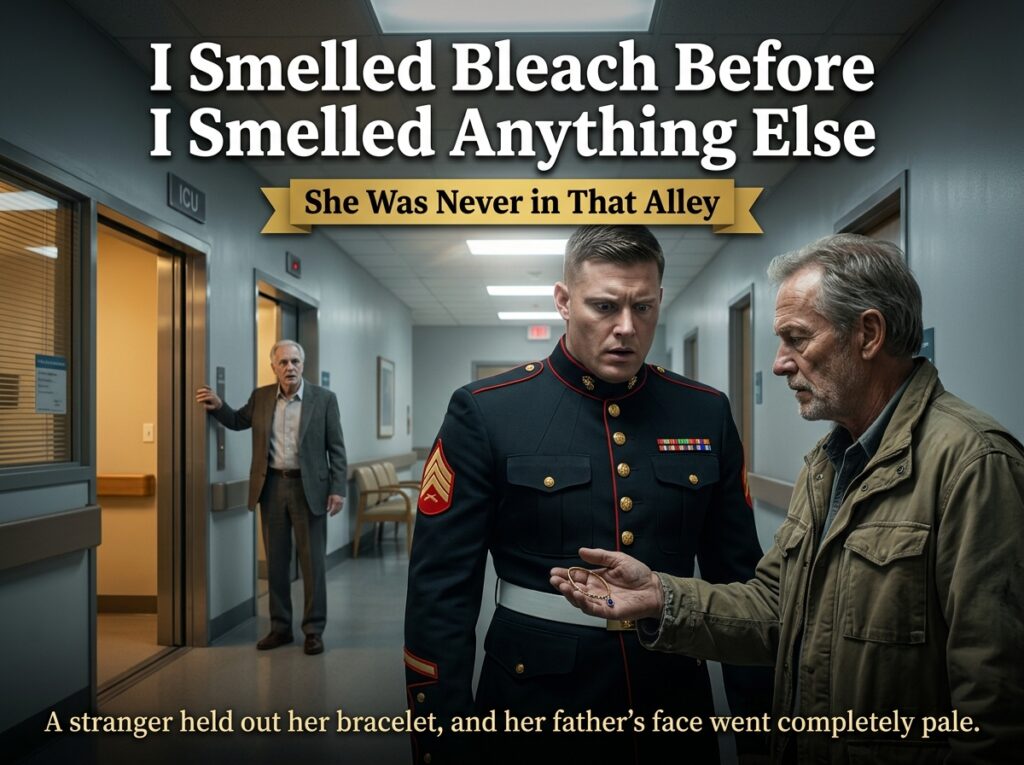
Samuel reached into a worn backpack slung over one shoulder, and pulled out a small, delicate object, holding it out toward me with a hand that trembled slightly.
It was Sophia’s anniversary bracelet, a thin gold chain with a small sapphire charm I’d given her on our first wedding anniversary, the clasp broken, one link snapped clean through.
“I found this in the Pembertons’ side yard the next morning,” Samuel said. “Right along the property line between our two houses, like it had come loose during a struggle and gotten thrown, or dropped, while whoever was carrying something ran for that car. I heard the news, a couple days later, about a woman found in an alley downtown, and something about it didn’t sit right with me, because I never once heard a car leave from downtown that night. I heard it leave from right outside my own work site.”
I stared at the bracelet in his outstretched hand, feeling something cold and absolute settle into my chest.
“I heard her screaming,” Samuel said again, quieter now, and his eyes moved past me, toward the corridor beyond, toward the elevator bank at its far end.
I turned to follow his gaze, and saw Richard Thornbury stepping out of the elevator, his face going completely, unmistakably pale at the sight of the bracelet in Samuel’s outstretched hand.
Part 4
Richard’s composure, so carefully maintained through our entire conversation in the lobby, cracked visibly in that moment, his eyes fixed on the bracelet with an expression I could only describe as pure, unguarded terror, before he managed to smooth his features back into something considerably more controlled.
“Marcus,” he said, approaching us with a deliberate steadiness that felt, now, entirely different than it had an hour earlier. “Who is this? What’s going on here?”
“This is Samuel,” I said, watching Richard’s face carefully, my training kicking fully into a mode I hadn’t used since my last deployment, cataloging micro-expressions, reading a man’s body for the truth underneath his words. “He does landscaping three houses down from us. He says he heard Sophia screaming from inside our house the night she was supposedly attacked in an alley downtown. He found her bracelet in the side yard the next morning.”
“That’s absurd,” Richard said, but his voice carried a tightness that undermined the dismissiveness he was clearly attempting. “This man is a stranger making up a story for God knows what reason. Sophia was attacked downtown, the police report says—”
“What police report,” I said. “I haven’t seen any police report, Richard. I’ve been home for two hours and everyone keeps telling me things happened, but nobody’s shown me a single piece of actual documentation. Where’s the police report? Who’s the detective assigned to the case? What precinct handled it?”
Richard’s mouth opened, then closed, and I watched him search, visibly, for an answer that didn’t immediately arrive.
“I’ll have to check my paperwork,” he said finally. “It’s at my house. I’ve been so overwhelmed managing everything, I’m not certain exactly which precinct—”
“You don’t know which precinct is investigating your daughter’s violent assault,” I said slowly, “three days into managing every single detail of her care?”
“Marcus, I understand you’re upset—”
“I want to see the police report,” I said, my voice coming out considerably more controlled than the fury building underneath it. “Today. Right now. And I want to know why our kitchen floor was scrubbed with enough bleach to strip the grout, if my wife was attacked three blocks from here, downtown, in an alley she had no reason to be in on a Tuesday night.”
Richard’s face, hearing that, went through another rapid transformation, and this time, watching him closely, I saw something considerably more revealing than mere surprise: the particular calculating panic of a man realizing his careful story had just encountered an obstacle he hadn’t adequately prepared for.
“I think,” Richard said, his voice gone very quiet, “we should discuss this somewhere more private.”
Part 5
I did not go somewhere more private with Richard. Instead, I turned to Samuel, who had watched this entire exchange with the careful, wary attention of a man who understood, better than most, exactly how dangerous it could be to have inserted himself into a family’s carefully constructed lie.
“Will you talk to the actual police,” I asked him, “if I call them right now? Tell them exactly what you told me?”
Samuel hesitated, his eyes flicking toward Richard, then back to me. “I told you, Sergeant, I’ve got history that makes me nervous about police involvement generally. But I heard a woman screaming and then go silent in a house three doors down from where I was working, and I’ve been carrying that for three days now, wondering if I should have done something different that night. I’ll talk to them. I should have talked to them three days ago.”
I called the police from the hospital corridor, standing perhaps ten feet from Richard Thornbury, who made no move to leave, his face arranged now into something considerably more composed than the panic I’d witnessed minutes earlier, though I noticed his hands, when I glanced at them, were not entirely steady.
Detective Miriam Castellano arrived at the hospital within forty minutes, a sharp, unhurried woman in her forties who listened to Samuel’s account with a careful, professional attention that made clear, within the first several minutes, that she was taking this considerably more seriously than a stranger’s uncorroborated story might otherwise warrant.
“There’s no report on file,” she told me, quietly, pulling me aside after a preliminary conversation with dispatch confirmed what I’d already begun to suspect. “No alley assault matching this description was reported to this department, or to any neighboring precinct, in the timeframe Mr. Thornbury described. If your wife was attacked downtown three nights ago, Sergeant, it was never reported to any law enforcement agency in this city.”
“Then how did she end up in the ICU,” I said, “with a story about an alley attack that Richard’s been telling everyone for three days?”
“That,” Detective Castellano said, “is exactly what I intend to find out.” She turned toward Richard, who had been watching our quiet conversation with an expression of careful, controlled dread. “Mr. Thornbury, I’d like you to come down to the station with me, voluntarily, to answer some questions about the circumstances surrounding your daughter’s admission to this hospital.”
“I don’t need to answer anything,” Richard said, his composure finally beginning to genuinely crack. “I’m her father. Everything I’ve done has been to protect her.”
“Protect her from what, exactly,” Detective Castellano said, her voice very level, “if she was never actually in that alley?”
Part 6
Richard did not go voluntarily to the station that evening. Instead, watching Detective Castellano’s expression harden into something considerably more official, he made a decision that told me, more clearly than any confession could have, exactly how much he had to lose.
He ran.
It happened fast, a sudden lunge past Samuel toward the elevator bank, Detective Castellano shouting something into her radio as she moved to intercept him, and I found myself, four combat deployments of training overriding every civilian instinct toward caution, closing the distance between us before conscious thought had fully caught up with my body.
I caught him at the elevator doors, my hand closing around his arm with considerably more force than I’d consciously intended, and Richard Thornbury, sixty-two years old and considerably less physically capable than the panic driving him suggested, went down hard against the corridor’s tile floor, my knee finding his back before Detective Castellano reached us, her own weapon drawn, though not aimed, in the careful, controlled manner of an officer managing a situation that had suddenly turned considerably more dangerous.
“Don’t move,” she said, to both of us, though her attention was clearly on Richard now, cuffing him with the practiced efficiency of someone who’d done this many times before, hospital security arriving moments later to help clear the corridor of the small crowd of stunned onlookers our sudden struggle had attracted.
“Sergeant Kellan,” Detective Castellano said, once Richard was secured, “I need you to step back now. You’ve done what you needed to do. Let me handle the rest of this properly.”
I stepped back, my hands shaking now with the full delayed impact of adrenaline, watching two officers who’d arrived alongside hospital security lead Richard Thornbury, his careful composure entirely gone now, replaced by something raw and frightened, toward the elevator.
“Marcus,” he said, as they walked him past me, his voice breaking in a way I’d never once heard from the controlled, precise man I’d known for five years. “I never meant for it to go this far. I need you to understand that. I never meant for it to go this far.”
“Understand what,” I said, my voice coming out considerably colder than I felt. “What did you do to my wife, Richard?”
He didn’t answer, the elevator doors closing on his stricken face before he could form any response, and I turned to find Samuel standing quietly against the corridor wall, watching the entire scene unfold with an expression that suggested he understood, considerably better than I did in that moment, exactly what kind of confession we’d just witnessed the beginning of.
Part 7
Richard Thornbury’s interrogation, which I learned about only in careful, official pieces over the following days, revealed a story considerably darker than a simple attempt to cover up an accident.
Sophia had called her father three nights earlier, according to what Detective Castellano eventually pieced together, deeply distressed about financial discrepancies she’d discovered while helping manage some of his business paperwork during my deployment, a favor she’d offered him for years, given his own limited comfort with the accounting software his small investment firm relied on.
What she’d found, going through those records, was evidence that Richard had been quietly siphoning funds from a trust his late wife, Sophia’s mother, had established years earlier for Sophia’s eventual inheritance, funds Richard had apparently been drawing against for nearly three years to cover mounting personal debts he’d kept carefully hidden from everyone, including his own daughter.
Sophia had confronted him about it that night, at our house, having invited him over specifically to discuss what she’d found before deciding whether to involve a lawyer or simply confront him privately first, giving him, in her characteristic generosity, a chance to explain himself before anything more formal became necessary.
The confrontation had escalated, according to Richard’s eventual statement to Detective Castellano, into something he described, even in confession, as an accident, a shove that sent Sophia stumbling into the edge of our kitchen island, her head striking the marble countertop with a force that rendered her instantly unconscious, blood pooling on the floor in a spreading stain that Richard, in his subsequent panic, had spent hours trying to scrub away entirely, the bleach I’d smelled the moment I walked through our door representing the physical evidence of his desperate three-hour attempt to erase what had happened.
He had loaded Sophia’s unconscious body into his own car, driven her to an alley downtown he’d selected specifically for its distance from any security cameras he was aware of, and left her there, calling emergency services from a payphone rather than his own cell, before constructing the story about an alley mugging that he’d then maintained, with increasing desperation, over the following three days, using his position as her father, and my genuine unavailability during those first crucial hours, to control every aspect of the narrative before I could return and start asking the kind of questions that had, eventually, unraveled the entire fabrication.
Part 8
Sophia woke from her induced coma nine days after I’d found our kitchen floor scrubbed raw, disoriented and in considerable pain, but alive, her prognosis, Dr. Okonkwo told me with evident relief, considerably better than the initial days of uncertainty had suggested.
I was there when she woke, holding her hand the way I had every day since Richard’s arrest, and I watched her confusion slowly resolve into memory, her eyes finding mine with a dawning horror that told me, before she’d said a single word, that she remembered exactly what had happened that night.
“He hit me,” she whispered, her voice raw from the ventilator tube that had only recently been removed. “Marcus, my own father hit me, and I don’t even know what happened after that, I just remember falling, and then nothing, and then I woke up here.”
“I know,” I told her, my own voice not entirely steady. “I know what happened, Sophia. He’s under arrest. You’re safe now.”
I told her everything, over the following days, as her strength gradually returned: the bleach, the fabricated alley story, Samuel’s account, the bracelet, Richard’s attempted flight through the hospital corridor. She listened, her face cycling through grief and fury and a particular devastated betrayal that I understood, watching her, would take considerably longer to heal than her physical injuries.
“He’s my father,” she said, more than once, in the weeks that followed, the particular disbelief of someone confronting a betrayal too large to fully process all at once. “I confronted him about stealing from my own trust, and he decided covering that up mattered more than whether I lived or died. I don’t know how to hold both of those things at the same time, Marcus. That he’s my father, and that he was willing to let me die in an alley to protect himself.”
“You don’t have to hold both of those things at the same time,” I told her, during one of these conversations, sitting beside her hospital bed in the ordinary recovery unit she’d been transferred to once her condition stabilized. “You’re allowed to just be furious. You’re allowed to grieve the father you thought you had, separately from being angry at the man who actually did this.”
Part 9
Samuel became, over the following months, an unexpected fixture in our lives, a man whose small act of courage in coming forward, despite his own carefully described history with law enforcement, had ultimately saved Sophia’s life by unraveling Richard’s fabrication before it could fully calcify into an accepted, permanent story.
I learned, over several long conversations at our kitchen table, that Samuel’s history with police involved a stretch in his twenties, considerably decades behind him now, connected to substance addiction he’d been in recovery from for nearly fifteen years, a past that had made him understandably wary of any interaction with law enforcement, however innocent his own involvement in a given situation might be.
“I almost didn’t come forward at all,” he told me once, several months after Sophia’s release from the hospital, sitting at our kitchen table over coffee, the grout near the island finally replaced entirely, the last physical trace of that terrible afternoon removed. “I told myself, for two days, that it wasn’t my business, that getting involved would only bring trouble down on me for no good reason. It was your wife’s bracelet, sitting in a drawer in my own house, that finally changed my mind. I kept looking at it, thinking about a woman screaming and then going silent, and I understood I couldn’t just let that sit quietly in a drawer while everyone believed a story I knew wasn’t true.”
Sophia, once she was strong enough, insisted on meeting him properly, thanking him in person for a courage that had, quite literally, saved her life by exposing a fabrication that would very likely have hardened, over time, into an unchallengeable official story.
“You didn’t have to get involved,” she told him, gripping his weathered hand across our kitchen table. “You could have stayed quiet and none of this would have touched your own life at all.”
“I heard you screaming,” Samuel said simply. “Some things, once you’ve heard them, you can’t just pretend you didn’t. I’m only sorry it took me three days to work up the courage to actually do something about it.”
Part 10
Richard Thornbury pleaded guilty, roughly eight months after that terrible afternoon, to charges of aggravated assault, evidence tampering, and financial fraud connected to the trust embezzlement that had precipitated the entire confrontation, accepting a plea agreement that would keep him incarcerated for a minimum of twelve years, a sentence Sophia described, on the day of his sentencing, as “considerably shorter than I’ll spend recovering from what he did, but at least it’s something.”
She did not attend the sentencing hearing itself, choosing instead to spend that day with me and with Samuel, who had become, by then, a regular presence at our dinner table, at the small backyard barbecue we hosted that same evening, a quiet, deliberate choice to build something warm and chosen on a day that could otherwise have been consumed entirely by her father’s formal disgrace.
“I keep thinking,” Sophia told me, that evening, watching Samuel help our neighbor’s kids with a game of cornhole in our backyard, the late summer light turning everything gold, “about how close it came to just being the story everyone believed. If you hadn’t come home two days early. If Samuel hadn’t found the bracelet, or hadn’t worked up the courage to say something. My father would have gotten away with it entirely, and I’d have spent whatever time I had left believing I’d been attacked by a stranger in an alley, never knowing the truth.”
“But none of those things didn’t happen,” I told her. “I did come home early. Samuel did find the bracelet, and he did find the courage. The story that was supposed to bury the truth couldn’t hold together against all of that.”
I finished my remaining service commitment eighteen months later and transitioned fully to civilian life, taking a position with a veteran’s services organization that let me stay close to home, close to Sophia, in a way my previous deployments never had. We renovated the kitchen fully that following spring, tearing out the marble island entirely, replacing it with something Sophia chose herself, a warm butcher block surface that held no memory of anything except the meals we’ve cooked on it since.
Samuel still comes by most Thursdays, ostensibly to help with our own yard now alongside the Pembertons’, though our conversations have long since moved past landscaping into something considerably closer to family. He was there, this past spring, when Sophia and I welcomed our first child, a daughter we named, with Samuel’s quiet, tearful permission, after his own late mother, a woman he described to us, one evening at our kitchen table, as the only person who’d ever fully believed in his capacity for exactly the kind of courage he’d eventually found the night he decided a stranger’s bracelet mattered more than his own careful, understandable caution.
I think, often, about the particular fragility of the truth in those first hours after I came home, how easily an entire fabricated story might have simply hardened into permanent fact if a single element had gone differently: if I hadn’t smelled the bleach, if Sophia had died before waking to confirm her own memory, if Samuel had decided, after all, that a landscaper’s uncorroborated story wasn’t worth the risk of reopening old wounds with the police. Instead, a bracelet, a broken clasp, and one man’s quiet, hard-won courage unraveled a lie that might otherwise have buried the truth forever, and gave my wife back both her life and, eventually, something considerably harder to reclaim: a clear, unclouded understanding of exactly what had actually happened to her, rather than a comfortable fiction constructed by the one person she should have been able to trust completely.