Part 1
My daughter Sophia has been unconscious for three days, and I have told the same story to the police, to the doctors, and to my son-in-law: she was attacked in an alley near Route 9, three nights ago, on her way home from a late meeting at the accounting firm where she works. I’ve said it so many times now, in so many small variations designed to sound natural rather than rehearsed, that some traitorous part of my own mind has begun to accept it as fact, the way a lie told often enough eventually wears a groove into the shape of the truth.
My name is Gerald Voss. I’m sixty-three years old, a retired construction estimator, widowed nine years, and I moved into the small guest house behind Sophia and Ethan’s property two years ago, at their invitation, after my hip surgery made living alone in my own two-story house considerably more dangerous than either of them was comfortable with. I want to explain that context clearly, because everything that happened three nights ago happened inside a family arrangement built, ostensibly, on care and closeness, which makes what I actually did considerably harder to hold steady in my own mind than if we’d simply been strangers who happened to share a property line.
Sophia had discovered, three nights ago, going through some of my old financial paperwork at my own request, because my hands don’t manage small print and spreadsheets the way they used to, evidence of exactly what I’d been doing for nearly three years with the trust her mother had established before she died, a modest but meaningful sum meant to eventually pass to Sophia intact, which I had been quietly drawing against, a little at a time, to cover gambling debts I’d never once told anyone about, debts that had, by that point, grown considerably larger than my own retirement income could ever hope to cover honestly.
She’d confronted me about it in my own guest house kitchen, gentle at first, the way Sophia has always approached difficult conversations, giving me space to explain myself before she decided what to do with what she’d found. I had panicked. I want to be honest, in this account, about exactly how ordinary and unheroic the panic actually was, nothing dramatic or calculated, simply a cornered man’s instinctive, catastrophic overreaction to the threat of exposure, a shove I told myself, in the seconds immediately afterward, had been smaller than it actually was, before she stumbled backward into the corner of my kitchen counter and went entirely, terribly still.
I called the ambulance myself, twenty minutes later, after I had already loaded her into my own car and driven her three miles to the alley behind the old Wexford building near Route 9, a location I’d chosen specifically because I remembered, from years of driving that route to my old job site, that the alley had no security cameras covering its length, and because it was far enough from our property that no one would think to connect the two locations.
I have thought, every single hour of these three days, about the particular monstrousness of what I did in that alley: leaving my own unconscious daughter on cold pavement, calling for help from a payphone rather than my own cell, and then driving home to spend the following three hours scrubbing bleach into a kitchen floor that had never, in twenty years of that guest house’s existence, needed anything beyond ordinary cleaning.
Part 2
Ethan was deployed with his Marine unit that entire week, a fact that had made my fabrication considerably easier to construct and maintain, since I could tell everyone, truthfully, that I was managing things on his behalf because he was unreachable overseas, a lie layered carefully atop the larger one, because I knew, even as I said it, that Sophia called him every single Sunday without fail, that there had been no actual communications blackout at all.
I had not expected him to come home early. I don’t know, even now, exactly what arrangement he made with his command to cut his deployment short by two days, only that I received a call from the hospital’s front desk informing me my son-in-law had arrived and was asking for the attending physician, a call that landed in my stomach like a stone dropped into still water.
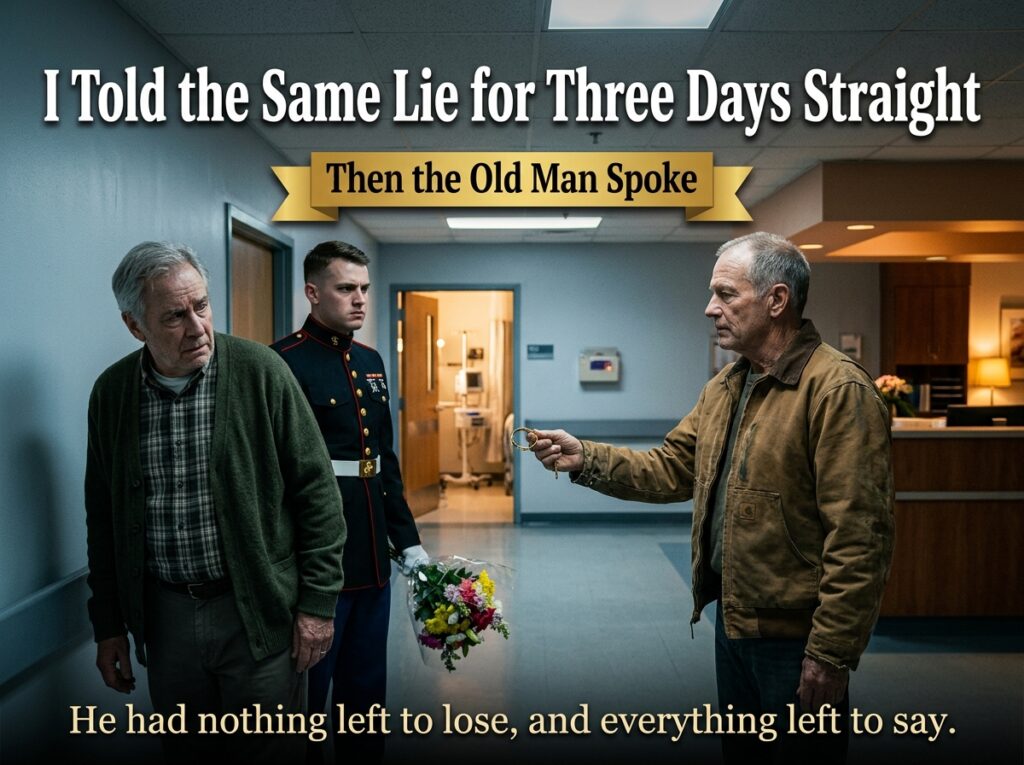
I met him in the ICU waiting area, and I want to describe, honestly, what I felt watching him walk toward me, because I have turned it over so many times in these three days that I no longer entirely trust my own memory of the moment, only the shape of what I believe I felt. He was carrying flowers, an ordinary, absurd bouquet from the hospital gift shop downstairs, clutched in one hand with the particular careful gentleness of a man trying to hold something steady while everything else about him was visibly shaking. Something tightened in my chest, seeing that, a feeling I hadn’t experienced in years, not since watching my own wife’s casket lowered into ground nine years earlier, a specific, suffocating grief that I understood, even as it moved through me, I had absolutely no right to claim, having caused this exact devastation with my own two hands.
“Richard, what happened,” he said, using my given name in the clipped, urgent way he only ever used when something had genuinely frightened him. “The hospital said an attack, an alley, I don’t understand, Sophia doesn’t go anywhere near Route 9, why would she have been down there at that hour?”
“She had a late meeting,” I said, the lie arriving smoothly, the way it had arrived smoothly for three straight days now, each repetition wearing the falsehood into something that felt, disturbingly, considerably easier to say than it had the first time. “She must have taken a shortcut home through that area. The police think it was a mugging that went wrong.”
“What did they take?”
I hadn’t fully prepared for that question, and I heard my own hesitation before I managed an answer. “Her purse. Some jewelry, I believe.”
Ethan’s face, hearing that, carried an expression I couldn’t fully read, something beyond simple grief, something closer to a careful, methodical processing that reminded me, uncomfortably, of exactly the kind of attention his military training would have taught him to bring to a scene that didn’t quite add up.
Part 3
I had not accounted for Walter.
Walter Prentiss had been sleeping, on and off, in the small detached garage at the back of our property for nearly four months by that point, an arrangement Sophia had quietly established, against my own initial objections, after finding him sheltering there one particularly cold February night, a man in his seventies who had, from what little he’d shared with her, lost his own housing somewhere in the tangled bureaucracy of a fixed income that hadn’t kept pace with rising costs, and who had, in the months since, become something like a quiet, permanent fixture on our property, doing small yard work in exchange for the garage’s use and whatever meals Sophia occasionally brought out to him.
I had barely registered his presence most days, a weathered, careful old man who kept largely to himself, and I had certainly never once considered, in three days of constructing and maintaining my careful fabrication, that he might have been awake and present in that garage on the exact night everything happened, close enough to our kitchen window to hear whatever had carried through it.
I saw him in the ICU corridor perhaps twenty minutes after Ethan’s arrival, standing near Sophia’s door with an expression of careful, deliberate purpose that told me, immediately, something had gone badly, irreversibly wrong with everything I’d spent three days building.
I know what he saw that night. I have known since the moment I called the ambulance from that payphone, some part of me registering, even through my own panic, that the garage’s small side window faced directly toward our kitchen, that any raised voices, any sound of a struggle, would have carried clearly across the short distance between the main house and that detached structure.
I had told myself, over these three days, that Walter’s own precarious circumstances, his history of housing insecurity, his evident wariness around any authority that might complicate his tenuous arrangement on our property, would keep him silent, whatever he’d heard or seen. I had convinced myself, in the particular self-serving logic of a desperate man, that a homeless stranger’s word would carry no weight at all against a grieving father’s carefully constructed grief.
I had not accounted for the particular, terrible courage of a man who had nothing left to lose, and everything, in his own quiet way, to finally set right.
“Mr. Kellan,” Walter said, using Ethan’s surname with a formal carefulness that told me he’d been waiting, deliberately, for exactly this moment, “I need to tell you something, and I need you to actually listen, because I don’t believe anyone else in this family is going to tell you the truth about what happened to your wife.”
Part 4
I want to describe, honestly, the particular paralysis that gripped me in that corridor, watching Walter begin to speak, because I had rehearsed, over three sleepless nights, various scenarios in which my fabrication might unravel: a security camera I hadn’t known about, a witness near the alley who’d seen the timing didn’t match, some forensic detail the doctors might notice that contradicted the story I’d constructed. I had never once rehearsed this particular scenario, an old man I’d barely acknowledged in four months of quiet cohabitation on my own property, finding, at exactly the moment my son-in-law returned home, the courage to speak.
“Your wife was never in that alley,” Walter said, his voice carrying the particular steady quality of a man who had decided, finally, that whatever risk speaking carried for his own precarious situation mattered less than the truth he’d been sitting on for three days. “She was attacked inside your own house.”
Ethan’s face went through a rapid, visible transformation, confusion sliding into something considerably more alert and dangerous, his eyes moving from Walter to me with a focus I recognized, even in my own panic, as the particular sharpened attention of a man whose training had taught him exactly how to read a lie unraveling in real time.
“What are you talking about,” Ethan said, though something in his voice suggested he was already, in some part of his mind, assembling pieces that had never quite fit the story I’d told him.
“I sleep in the garage behind the main house,” Walter said. “Three nights ago, I heard raised voices from the kitchen, a woman’s voice, and then a man’s, and then a sound I recognized, even from that distance, as someone falling hard against something solid. Then it went quiet, in a way that made my stomach drop.”
“Whose voices,” Ethan said, his eyes now fixed entirely on me, and I felt, in that moment, every careful construction of the previous three days beginning to collapse at once, the particular sensation of watching a structure I’d built with such desperate care simply give way beneath its own accumulated weight.
“Your wife’s,” Walter said. “And her father’s.”
Part 5
I want to be honest about what happened in the seconds immediately following Walter’s words, because I have relived them so many times since that I no longer trust my memory to distinguish precisely between what I actually said and what I only wished, in retrospect, I had said instead.
“That’s absurd,” I heard myself say, my voice arriving considerably less steady than I intended. “This man sleeps in a garage, Ethan, he’s clearly confused, or looking for some kind of attention, I don’t understand why you’d give any credence at all to—”
“I found something,” Walter said, cutting through my protest with a quiet, unhurried certainty that felt, in that moment, considerably more devastating than any shouted accusation could have been. He reached into a canvas bag he’d been carrying, one I hadn’t previously registered, and withdrew, carefully, a thin gold bracelet, its clasp broken, one delicate link snapped clean through.
I recognized it immediately. Sophia’s anniversary bracelet, the one Ethan had given her on their first wedding anniversary, the one I had genuinely not realized was missing until that exact moment, watching it emerge from a stranger’s canvas bag in a hospital corridor.
“I found this in the side yard the next morning,” Walter said, “near the property line, right where I would have expected something to land if it came loose during a struggle inside that kitchen, and someone carried her out through the side door shortly afterward. I saw Mr. Voss’s car in the driveway, running, its lights on, sometime after midnight, though I didn’t think, at the time, to note the exact minute. I only understood, days later, hearing the story about an alley attack downtown, that I had never once heard a car leave from anywhere except right here, on this property.”
Ethan turned to look at me fully then, the flowers still clutched in one hand, his face carrying an expression I had genuinely never seen from him in five years of knowing him, something beyond grief, beyond shock, arriving instead at a particular, controlled fury that I understood, watching it settle across his features, represented considerably more danger to me than any of the fabricated police reports or doctor’s questions I’d managed to navigate over the preceding three days.
“Richard,” he said, his voice gone very quiet, very level, “is that true?”
Part 6
I did not answer him immediately. I stood in that corridor, watching my son-in-law’s face, watching Walter’s steady, unwavering certainty, feeling every careful lie I’d constructed over three days simply dissolve in the space of perhaps ninety seconds, and I understood, with a clarity that arrived too late to change anything, exactly how thoroughly and completely I had already lost everything I’d been so desperately trying to protect.
“I never meant for it to go this far,” I said finally, my voice breaking in a way I hadn’t allowed myself in three days of carefully maintained composure. “I need you to understand that, Ethan. I never meant for it to go this far.”
“What does that mean,” Ethan said, his voice still very quiet, very controlled, in a way that frightened me considerably more than shouting would have. “What did you do to my wife, Richard?”
I told him, standing in that corridor, the words arriving in a broken, halting rush that felt, finally, like some enormous weight lifting even as it simultaneously destroyed every remaining piece of my relationship with this family: the trust I’d been embezzling for three years, the gambling debts that had driven it, Sophia’s confrontation in my own kitchen, the shove I had told myself, in the immediate aftermath, had been smaller and more accidental than it actually was, her fall against the counter’s edge, the three hours of bleach and desperate scrubbing, the drive to that alley near Route 9, the payphone call I’d made specifically to avoid any trace connecting back to my own cell number.
Ethan listened to all of it without interrupting, his face gone increasingly pale and still, the flowers finally slipping from his hand entirely, forgotten on the corridor’s tile floor, and when I finished, the silence that followed felt considerably worse than anything he might have said instead.
“You left her,” he said finally, “unconscious, bleeding, in an alley, and then you drove home and cleaned your kitchen floor, rather than calling for help immediately, from your own house, where she actually needed it.”
“I was afraid,” I said. “I know how that sounds now, I know how inadequate it sounds, but in that moment, all I could think about was what would happen to me if the truth came out, and I made a decision I have regretted every single hour since.”
“You made a decision,” Ethan said, his voice finally cracking, all the careful control finally giving way to something raw and furious, “to protect yourself, instead of getting your own daughter, my wife, medical help as quickly as possible. Every minute you spent scrubbing that floor, every minute you spent driving her somewhere further from help instead of closer to it, was a minute that could have cost her everything.”
Part 7
Detective Miriam Castellano arrived at the hospital within the hour, summoned by hospital security after Ethan, understandably, had immediately alerted the front desk to what he’d just learned, and I found myself, over the following two hours, recounting the same confession I’d given Ethan in that corridor, now formally, to a detective whose careful, patient questioning revealed, gradually, every detail I’d initially hoped might remain buried.
I want to describe, honestly, the particular strange relief that arrived alongside the arrest, the handcuffs, the careful reading of my rights, a sensation I hadn’t expected and still don’t fully understand, except that I believe some exhausted part of me had simply run out of capacity to maintain the lie any further, and its collapse, however devastating, carried with it a kind of terrible, unwelcome peace.
Walter gave his own statement to Detective Castellano that same evening, his account matching, in every meaningful detail, what I had already confessed, the timing of the voices, the sound of the fall, the car in the driveway, the bracelet found the following morning in the side yard where it had apparently come loose during whatever final moments of the struggle he’d overheard but not directly witnessed.
“I almost didn’t say anything,” he told Ethan, in a conversation I overheard from the small holding area where I waited for transport to the county facility, my own presence in that corridor apparently no longer requiring the careful management it had demanded for three preceding days. “I’ve got history with police that made me wary of getting involved in anything that might draw their attention toward my own situation. But I kept that bracelet in a drawer in the garage for three days, and every time I looked at it, I thought about a woman screaming and then going quiet, and I understood I couldn’t just let that sit while everyone believed a story I knew wasn’t true.”
“Thank you,” Ethan told him, his voice carrying a gratitude I understood I would never again be entitled to receive from him myself. “I don’t know how to properly thank you for finally saying something.”
“Your wife’s kindness gave me a place to sleep when I had nowhere else to go,” Walter said. “The least I could do was make sure the truth about what happened to her actually reached the people who deserved to hear it.”
Part 8
Sophia woke from her medically induced coma six days after the confrontation in my kitchen, and I learned, through the careful, formal channels of my attorney rather than any direct contact the court had ordered me to avoid, that her recovery, while difficult, progressed considerably better than the initial uncertainty had suggested it might.
I have not been permitted to see her since my arrest, a condition of the charges against me that I understand completely, however much the absence itself has become its own particular, ongoing punishment, considerably more painful, in its quiet way, than anything the formal legal proceedings have yet demanded of me.
My attorney relayed, some weeks later, a single message Sophia had asked to be passed along, delivered without any additional context or softening, exactly as she’d apparently insisted it be conveyed: *I confronted you because I loved you enough to give you a chance to make it right before I told anyone else. You answered that love by leaving me to die in an alley so you could protect yourself. I don’t know if I will ever be able to forgive that, and I need you to understand that any forgiveness, if it ever comes, will happen entirely on my own timeline, not yours, and not because you deserve it, but because I might, eventually, need it for my own healing rather than for your comfort.*
I have read that message more times than I can accurately count, in the months since, sitting in a county holding facility awaiting formal sentencing, and I have come to understand, slowly and painfully, exactly how thoroughly my own fear and desperation transformed a daughter’s generous, loving confrontation into the worst possible version of every consequence I had been so frantically trying to avoid.
Part 9
I pleaded guilty, eventually, to charges of aggravated assault, evidence tampering, and financial fraud connected to the trust embezzlement that had precipitated the entire confrontation, accepting a plea agreement that would keep me incarcerated for a minimum of twelve years, a sentence my own attorney described as consistent with the severity of what I’d actually done, however much some small, self-pitying part of me had hoped, in the weeks before sentencing, for something considerably more lenient.
I did not ask Sophia to attend the sentencing hearing, understanding, by that point, that any presumption on my part regarding what she owed me, even something as small as her physical presence in a courtroom, represented exactly the kind of self-centered entitlement that had led me into that kitchen confrontation in the first place, demanding, without fully realizing it, that her love and loyalty toward me should outweigh her own need for justice and safety.
She did not attend. I understood, reading the formal record afterward, that she had spent that day instead with Ethan and, I later learned, with Walter, who had become, in the months following his testimony, a genuine and welcomed presence in their household, no longer merely a quiet tenant of their garage but something considerably closer to family, a relationship built on exactly the kind of honest courage I had so completely failed to offer my own daughter when it mattered most.
Part 10
I am sixty-four now, one year into a twelve-year sentence, and I spend a great deal of my time in this facility turning over the same exhausted, useless question: whether there existed some other version of that terrible night where I might have chosen differently, where fear of exposure might have yielded, even briefly, to the more basic, more human instinct to simply get my daughter help immediately rather than spending three precious hours protecting my own reputation with a bottle of bleach.
I do not have an answer that offers me any comfort. I understand, with a clarity that arrived considerably too late to matter, that the version of myself capable of making that different choice would have needed to exist well before that particular night, a version built through years of honesty about my own failures rather than the careful accumulated concealment that had, by the time Sophia confronted me, become so thoroughly practiced that lying, even about something as monstrous as her own safety, arrived as my first and only instinct.
Walter Prentiss, I’ve learned through occasional, carefully limited updates my attorney passes along, still lives in that garage, still does small work around the property, has become, in the year since his testimony, something considerably closer to a grandfather figure for the child Sophia and Ethan are, I understand, now expecting. I think of him often, a man with every reason to have stayed silent, whose own precarious circumstances might have justified, to almost anyone’s understanding, a decision to simply protect himself rather than risk whatever consequences speaking up might have brought down on his own tenuous situation.
He chose, instead, considerably more courage than I managed in that kitchen, standing in a hospital corridor, telling a grieving husband a truth that cost him nothing tangible but risked, in his own accounting, everything he had left to lose. I think, often, in the long quiet hours this facility affords me, about the particular difference between his choice and mine: a man with nothing, offering the one thing he still possessed, the truth, freely and at genuine risk to himself, against a man with everything, a daughter, a family, a comfortable retirement, who chose, instead, to protect all of it with a lie that very nearly cost the one person who actually mattered her entire life.
I do not expect forgiveness, not from Sophia, not from Ethan, not from myself. I have come to understand, in this quiet year of consequence, that some debts are not designed to ever be fully repaid, only carried, honestly and without further evasion, for whatever remains of the time I have left to carry them.