Five minutes after midnight, my phone vibrated against the wooden desk beside my bed.
I had been trying to sleep for nearly two hours, but sleep had become difficult lately. Every time I closed my eyes, I saw lines of server logs, failed backup notifications, and the same warning messages I had sent to my boss earlier that week. I had done everything I could to make him understand what was happening. I had documented the failures, explained the risks, and recommended a solution.
His response had been the same every time.
Stop creating problems.
Now, with the room dark around me and the clock glowing 12:05 a.m., I reached for my phone.
The message was from my boss.
**The server outage is now costing $600 an hour. You’d better fix it fast.**
I read it once, then again.
For several seconds, I simply stared at the screen. The words seemed almost absurd. There was no question about what had happened, no acknowledgment of the warnings I had sent, and certainly no apology for dismissing them. There was only a number, a demand, and the unmistakable expectation that I would somehow make the consequences disappear.
Six hundred dollars an hour.
I knew the system well enough to understand that the financial damage might be real. The company depended on its servers for essential operations, and an extended outage could disrupt more than a few employees’ work. Customers could be affected. Orders could be delayed. Data might become difficult to recover.
That was exactly why I had warned him.
Twice that week, I had explained that the backups were no longer running properly. The automated process had been failing, and the warnings were appearing more frequently. I had told him that we needed to investigate immediately, verify the most recent recoverable data, and resolve the underlying problem before it became a crisis.
He had treated my concerns as an inconvenience.
The first time, he had barely looked up from his computer.
“We don’t have time to chase every little warning,” he had said.
“It isn’t every little warning,” I had replied. “The backup process is failing. If something happens to the primary system, we could lose information we can’t replace.”
He had sighed as though I were deliberately making his day harder.
“Then make sure it doesn’t happen.”
The second conversation had been worse.
I had prepared a short report showing the failures and the potential consequences. I thought that if he could see the information in one place, he would understand that this wasn’t a matter of personal preference. It was a technical risk that required attention.
Instead, he glanced at the report and pushed it back across the desk.
“You’re always finding something wrong,” he said. “Stop creating problems.”
I remembered the sentence now with a clarity that made my jaw tighten.
I had wanted to defend myself. I had wanted to tell him that identifying a problem was not the same as creating one, and that ignoring a warning didn’t make the danger disappear.
But I had swallowed those words.
I had returned to my desk, recorded the conversation in my notes, and continued doing my job.
That was what I had always done.
When a system failed, I investigated. When someone made a mistake, I helped repair the damage. When an urgent request arrived after working hours, I usually answered it before anyone else had a chance to complain.
Over time, the distinction between being dependable and being permanently available had disappeared. My boss had learned that he could send a message at almost any hour and expect a response. I had taught him that lesson myself, one late night at a time.
I looked at his latest message again.
The server was down. The company was losing money. And suddenly, the warnings I had given him were no longer theoretical.
They were expensive.
I sat up, pushed the blanket aside, and placed my feet on the cold floor.
There was no point pretending I could sleep now. My mind had already returned to the office, to the server room, to the familiar hum of equipment I had spent years maintaining.
I knew what needed to be checked first. I knew which logs might reveal the failure. I knew the difference between a temporary interruption and a deeper problem that could take hours to resolve.
What I didn’t know was whether the company would finally listen.
I dressed in the dark, took my keys, and checked that my old business card was still in my wallet. Then I grabbed my laptop bag and stepped outside.
The night air was cool. The street was quiet, and most of the windows in the neighboring buildings were dark. Somewhere in the distance, a vehicle passed through an intersection, its headlights briefly sweeping across the empty road.
I started the car.
I could have ignored the message. I could have replied that I had already raised the issue and that someone else would need to take responsibility. I could have turned off my phone and allowed the people who had dismissed my warnings to face the consequences.
But that wasn’t how I had operated for years.
Some part of me still believed that doing the right thing mattered, even when nobody appreciated it. Another part simply couldn’t stand the thought of a preventable disaster growing worse while I sat at home knowing I might be able to help.
I pulled onto the road and headed toward the office.
At that moment, I still believed I was driving there to fix a server.
I had no idea that, before the night was over, I would discover a much bigger problem—one that had nothing to do with machines and everything to do with the people who controlled my life at work.
The drive to the office took twenty-three minutes.
I knew because I watched the clock on the dashboard almost the entire way.
At 12:28 a.m., I passed the closed coffee shop where I used to stop before early shifts. At 12:36, I turned onto the road leading to the business district. By 12:49, I was pulling into the familiar parking lot beneath the office building.
The building looked different at night.
During the day, it was all movement and noise. Employees hurried through the entrance with coffee cups and laptops. Delivery drivers stopped near the loading area. People gathered outside to take calls, complain about deadlines, or discuss meetings they didn’t want to attend. The glass doors reflected a busy world that always seemed to be running several minutes behind schedule.
Now, the windows were dark, the parking spaces were mostly empty, and the illuminated company logo above the entrance seemed strangely disconnected from the place I had known for years.
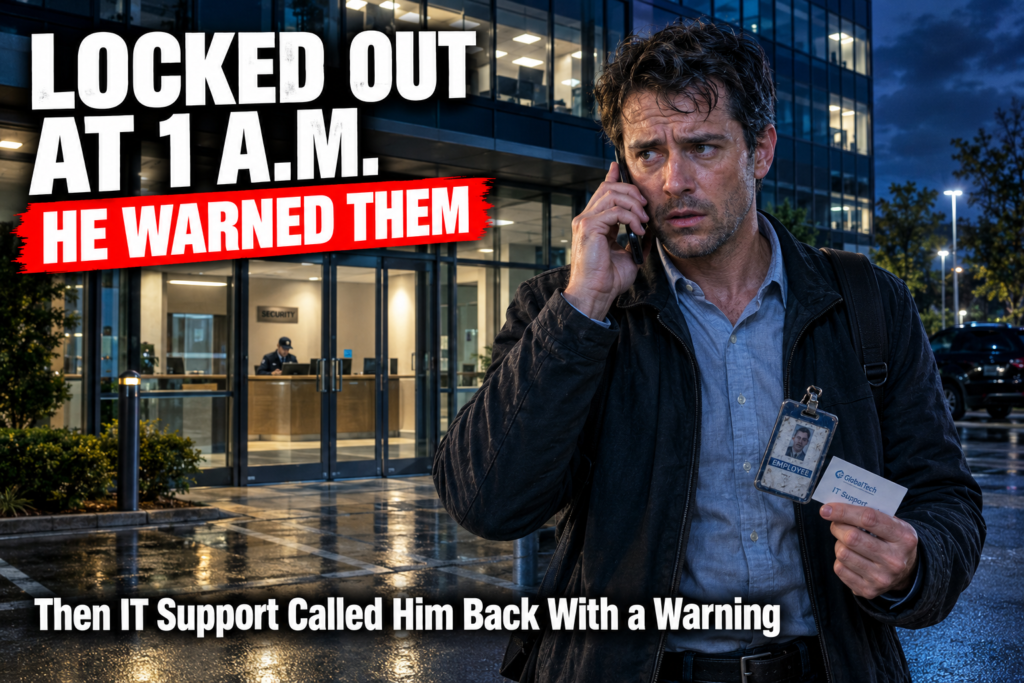
I parked near the entrance and reached for my security badge.
The plastic card was worn around the edges. My photograph was several years old, taken shortly after I had joined the company. Back then, I had looked younger, thinner, and considerably more optimistic. I remembered being proud when they handed me that badge. I had believed that getting the job was the beginning of something meaningful.
I had stayed late during my first month to help resolve a database problem. Nobody had asked me to remain after hours, but I wanted to prove that I could be trusted with responsibility.
The next week, my manager thanked me in front of the team.
A few months later, staying late became normal.
Then answering weekend calls became normal.
Eventually, even being blamed for problems I had warned people about began to feel like an ordinary part of the job.
I pushed those memories aside and walked toward the entrance.
A security guard sat behind the desk near the glass doors. He looked up as I approached.
“Evening,” I said.
He glanced at my badge, then at my face.
“Can I help you?”
“I’m here about the server outage. My manager contacted me.”
I held up the badge.
“I work in IT.”
He didn’t reach for the door controls.
Instead, he looked down at the screen in front of him and began typing.
“Your name?”
I told him.
He entered it, waited a moment, and checked the screen again.
Then he looked at me with an expression I couldn’t quite read.
“I’m sorry,” he said, not meeting my eyes. “You’re not on the list anymore.”
For a moment, I thought I had misunderstood him.
“What list?”
“The authorized access list.”
“But my badge is still active.”
He looked at the card in my hand.
“I understand.”
“I’ve been working here for years. My manager just texted me about the outage.”
He hesitated.
“I’m sorry, sir. I can’t let you through.”
I stared at him, waiting for the explanation that would make the conversation reasonable.
Perhaps there had been a temporary security update. Perhaps my access had been suspended accidentally. Perhaps someone had made a mistake while trying to resolve the outage.
There had to be an ordinary explanation.
“Can you call someone?” I asked. “My manager, maybe? Or someone from IT?”
“I can only follow the instructions I’ve been given.”
“Who gave you the instructions?”
He glanced at the screen again.
“I’m not authorized to discuss that.”
Something inside me went quiet.
Not angry. Not yet.
Just quiet.
I had spent years entering this building without thinking twice. I knew which elevator moved fastest, which conference room had the unreliable projector, and which door needed an extra push before the lock would release. I had worked through holidays, missed family dinners, and answered emergency calls while standing in grocery-store lines.
I had never imagined that I could arrive one night and find myself treated like a stranger.
I looked at the badge again.
“Can you at least tell me when my access was removed?”
The guard seemed uncomfortable.
“I don’t have that information.”
I almost laughed.
My boss had told me the server outage was costing six hundred dollars an hour. He had ordered me to fix it quickly. Yet the company had apparently removed my access, and the person standing between me and the server room couldn’t tell me why.
I took a step back.
“All right,” I said.
The guard nodded, looking relieved that I wasn’t going to argue.
I turned toward the parking lot.
Behind me, the doors remained closed.
Outside, the cold air hit my face. I stood beside my car, listening to the faint sound of traffic moving along the road beyond the building.
I took out my phone.
My boss’s message was still there.
The server outage is now costing $600 an hour. You’d better fix it fast.
I opened our conversation and began typing.
Security won’t let me in. My badge access has been removed. Can you explain what’s happening?
I read the message twice.
Then I deleted it.
I didn’t know why I hesitated. Perhaps I wanted to give him one final opportunity to explain himself without forcing him into a defensive response. Perhaps I was simply tired of asking questions that nobody seemed willing to answer.
I slipped the phone into my pocket and leaned against the car.
For the first time that night, I considered going home.
The server was not my responsibility anymore if I had no authorized access. I couldn’t repair a system I wasn’t permitted to reach. If management had decided to remove me, then management could find someone else to handle the consequences.
That was the reasonable conclusion.
But before I opened the driver’s door, I remembered the old business card in my wallet.
The number printed on it belonged to IT support, a number I had used years earlier when the company first outsourced part of its infrastructure support. I wasn’t even certain it still worked. The support arrangement had changed more than once, and the people answering those calls had changed with it.
Still, I took out the card.
The paper was creased, and the ink had begun to fade.
I looked at the number.
Then, standing alone in the parking lot at nearly one in the morning, I decided to call it.
Not because I knew what would happen.
Not because I expected anyone to help.
I called because I wanted to understand how a company could demand that I fix its most expensive problem while apparently making sure I could no longer enter the building.
I pressed the call button.
The phone rang once.
Then twice.
Someone answered.
And the first thing I heard was not a greeting I recognized.
It was a question that made me straighten away from the car.
“Can you confirm that you’re calling about the incident reported earlier today?”
The voice was calm, professional, and unfamiliar.
I glanced at the phone to make sure I had dialed the correct number.
“This is IT support, isn’t it?”
“Yes.”
“Then I need to speak to someone about a server outage at my company.”
There was a brief pause.
“May I have your employee identification number?”
I frowned.
“Why do you need that?”
“It’s part of our verification procedure.”
I gave him the number.
He didn’t ask for my name.
He didn’t ask which department I worked in.
Instead, I heard the faint clicking of a keyboard on the other end of the line. A few seconds passed, followed by the sound of someone opening what seemed to be another application.
Then the man spoke again.
“Thank you.”
I waited.
He continued, “We’ve actually been trying to reach you since four this afternoon.”
For a moment, I forgot about the cold, the parking lot, and the locked doors behind me.
“What?”
“We’ve been attempting to contact you since approximately four p.m.”
“Who has?”
“Our incident response team.”
I looked toward the building.
“What incident response team? And why would you be trying to reach me?”
The man took a measured breath.
“I need to confirm a few details before I can explain the situation.”
“Look, I’m standing outside my office at one in the morning. My boss says the servers are down and the company is losing six hundred dollars an hour. Security won’t let me inside because apparently I’m no longer on the access list. Now you’re telling me people have been trying to reach me since this afternoon. Can somebody please tell me what’s happening?”
Silence.
Not the silence of a person who hadn’t heard me.
The silence of someone deciding how much he was permitted to say.
“First,” he said, “are you currently inside the company network?”
“No. I’m in the parking lot.”
“Do you have access to your company email?”
I checked my phone.
“I haven’t tried.”
“Please do.”
I opened the email application and waited for it to load.
My inbox appeared, but several folders failed to refresh. I tapped the screen again, then opened the company portal.
I stared at it.
“I can’t get in.”
“That is consistent with the information we have.”
“What information?”
“I can see that your credentials were disabled earlier this evening.”
“By whom?”
“I’m not able to identify the individual who initiated the change over this call.”
I rubbed my forehead.
“Was I fired?”
The question came out more quietly than I expected.
The man didn’t answer immediately.
“I can confirm that your account status changed. I cannot confirm the employment decision behind that change.”
I looked at the old badge in my hand.
Its photograph stared back at me, a younger version of myself who had no idea how much time he would spend trying to prove his usefulness.
“Then why did my boss text me about the outage?”
“Who is your manager?”
I told him.
He typed something.
“Thank you.”
Another pause.
“Did you receive any communication today regarding a security incident, a change in your responsibilities, or a request to preserve technical records?”
“No.”
“Did you receive any instructions to alter, disable, or delete any backup systems?”
“No. Quite the opposite. I warned my manager that the backups weren’t running properly.”
The typing stopped.
“You warned him?”
“Twice this week. I have the messages on my phone. I told him the automated backup process was failing and that we needed to investigate.”
“And what did he say?”
I hesitated, feeling foolish for a reason I couldn’t explain.
“He told me to stop creating problems.”
The man didn’t respond.
I wondered whether he had muted the call. I checked the screen, but the timer continued counting.
“Are you still there?” I asked.
“Yes.”
“Can you tell me what this is about?”
“I need to review the incident record before I can discuss the details. But I want you to understand something important.”
His voice had changed. It was still professional, but the careful neutrality had given way to something more serious.
“Do not attempt to access the company network using another person’s credentials. Do not delete any messages or files you still possess. And do not try to bypass the security restrictions.”
“I wasn’t planning to.”
“I’m telling you because the system shows that your access was revoked, and we need to preserve the integrity of the investigation.”
The word investigation seemed to hang in the air.
I straightened.
“What investigation?”
“I can’t discuss the full scope yet.”
“Is this about the outage?”
“It may be connected to the outage.”
“May be?”
“I’m reviewing the available information as we speak.”
I paced beside the car, my shoes scraping against the pavement.
For years, I had been the person called when something went wrong. I knew the usual pattern: someone reported a problem, I gathered evidence, and we worked through the possible causes. The answers might take time, but the process was familiar.
This was different.
I was being told to preserve evidence for an investigation I knew nothing about, by a person who had recognized my employee ID before I had explained who I was.
“Listen,” I said, trying to keep my voice steady. “I just want to help fix the outage. If the system is down, I can probably identify the problem faster than someone who doesn’t know the infrastructure.”
“I understand.”
“Then let me in.”
“I can’t authorize your access.”
“Can someone else?”
“Not until the incident response team has clarified the situation.”
I looked up at the dark windows.
Somewhere inside that building were the servers I had maintained for years. I knew their configuration, their dependencies, and the mistakes that had accumulated through countless rushed changes. I knew which systems depended on others and which failures could create problems that looked unrelated until someone traced them back to their source.
I could probably help.
But for the first time, my knowledge was not enough to get me through the door.
The support technician returned to his keyboard.
“There’s one more thing,” he said.
“What?”
“Do you have any records of the backup warnings you mentioned?”
“Yes. Emails, messages, and a report I prepared.”
“Keep them exactly as they are.”
“Why?”
“Because we may need them to establish the timeline of events.”
My stomach tightened.
“Are you saying somebody is blaming me for the outage?”
“I haven’t said that.”
“But you’re asking me to preserve evidence.”
“Because we need to understand what happened, and the timeline matters.”
I looked at the clock on my dashboard.
1:07 a.m.
Less than an hour earlier, I had been lying in bed, annoyed by another message from my boss. Now I was standing outside my workplace, locked out of the network, speaking to a stranger who knew details about my account and an investigation that apparently began hours before the server outage became a financial emergency.
“What happens now?” I asked.
“For now, remain available by phone. I’ll document your statement and escalate your information to the incident response team.”
“And the server?”
“Other personnel are handling the technical response.”
I almost asked whether they knew what they were doing.
Instead, I said, “All right.”
Before ending the call, the technician gave me a reference number.
I wrote it on the back of the business card.
Then he said something I couldn’t stop thinking about.
“One last question. When was the last time you personally verified that the backups had completed successfully?”
I closed my eyes.
I knew the answer.
And I knew why he was asking.
I didn’t drive home immediately.
Instead, I sat in the car with the engine off, looking at the reference number I had written on the back of my business card.
The support technician had asked when I last verified a successful backup. It was a straightforward technical question, but it carried a weight that made it difficult to answer casually.
I had been checking the backup reports for months.
At first, the failures had been intermittent. A scheduled job would run late, a service would fail to respond, or a report would arrive with incomplete information. Each time, I investigated the cause and documented what I found.
Some issues were minor. Others required adjustments to the schedule or additional monitoring.
But the failures had gradually become more frequent.
I had begun raising the matter with my manager because the backup process was no longer something I could trust without verification.
The most recent successful backup I could personally confirm was not as recent as I wanted it to be.
I opened my phone and searched through my saved messages.
There they were.
The first warning had been sent several days earlier. I had explained that the scheduled process was failing and that the team needed to investigate before the problem became more serious.
My manager had replied that we were too busy to deal with unnecessary complications.
The second warning was more detailed. I had included the relevant dates, the recurring errors, and a recommendation to verify the recovery process.
His response had been short.
Stop creating problems.
I had saved the conversation because I had learned that technical problems could become personal arguments when something went wrong. Keeping records was part of my job, but it had also become a form of self-protection.
I had never imagined those messages might become important in an investigation.
I took screenshots of the conversations and saved copies of the relevant emails. I didn’t alter the files or remove anything from the original records. I simply organized the information so I could find it if the response team needed it.
Then I opened the folder containing my technical notes.
The entries were ordinary, almost painfully so.
Dates. Times. Error messages. Recommendations. Follow-up attempts.
A note that I had checked the backup status.
Another recording that the process had failed again.
A reminder to review the configuration if management approved the required maintenance.
There was no dramatic discovery waiting in those files. No single document that explained everything. Just the quiet accumulation of warnings that had been acknowledged, dismissed, and left unresolved.
I wondered whether anyone else had been documenting the same problems.
I wondered whether anyone had listened to the warnings after I was removed from the system.
Most of all, I wondered why my access had been revoked before the outage.
I checked the time of the message my boss had sent me.
12:05 a.m.
Then I remembered the technician’s words.
They had been trying to reach me since four that afternoon.
That meant something had happened hours before my boss texted me about the server. Perhaps the investigation had begun before the outage was fully understood. Perhaps the access change had been part of a larger response. Or perhaps the two events were connected in a way nobody had explained.
I didn’t have enough information to know.
At 1:19 a.m., my phone rang again.
The number was unfamiliar.
I answered immediately.
“Hello?”
“Is this the employee who called IT support a few minutes ago?”
“Yes.”
“My name is Daniel. I’m coordinating the incident response review.”
His voice was different from the first technician’s. Lower, slightly tired, with the careful pace of someone who had spent too many hours discussing a problem that kept growing.
“I’ve received the information from your call,” he continued. “I want to clarify a few things directly with you.”
“Please.”
“First, I need you to understand that we’re not asking you to diagnose the outage from outside the building. We need to establish what happened before the outage, what warnings were raised, and what changes were made to the system.”
“Why can’t I access the building?”
“Your access was disabled as part of a security control. I’m not in a position to reverse that decision.”
“Was it because of the outage?”
“I can’t give you a definitive answer yet.”
I stared through the windshield.
“Then why are you contacting me?”
“Because your employee account appears in the records we’re reviewing, and your name was included in the information provided to our team.”
“Included how?”
“I’d rather not speculate before we’ve verified the details.”
I took a slow breath.
“Daniel, I’ve been responsible for maintaining that infrastructure for years. If something went wrong, I want to help. But I need to understand why I’m being treated like someone who shouldn’t be trusted.”
“I understand why you’re asking.”
“Do you?”
The question came out sharper than I intended.
Daniel paused.
“Yes,” he said. “And I can tell you that your account of the warnings is important. That’s why I want the records preserved.”
For the first time that night, I felt something resembling relief.
Not because I knew I would be believed, but because someone was at least asking questions before reaching a conclusion.
Daniel asked me to describe the backup failures.
I explained the sequence as accurately as I could. I told him when the warnings began, how they had changed, and what I had recommended. I explained that I had not deliberately disabled any backup process and had not been instructed to do so.
He listened without interrupting.
When I finished, he asked, “Did anyone else have authority to make changes to those systems?”
“Yes. Several administrators had different levels of access.”
“Could your manager authorize changes?”
“Depending on the system and the approval process, yes.”
“Do you know whether any changes were made after your warnings?”
“Not after my access was revoked. Before that, I would need to check the logs.”
“Do you still have a copy of the logs?”
“Some records, yes. Not the complete server logs.”
“That’s fine. Don’t try to obtain anything you no longer have authorized access to. We’ll collect the system records through the appropriate process.”
I nodded, even though he couldn’t see me.
“Understood.”
Then Daniel asked the question that changed the direction of the conversation.
“Before your account was disabled, did anyone ask you to approve a maintenance change or confirm that a backup had completed successfully?”
I looked down at the phone.
I had been so focused on the warnings that I hadn’t considered that possibility.
I searched my memory, moving through the last few days one conversation at a time.
Then I remembered an email I had received earlier that week.
An email I had answered.
An email that might have seemed ordinary at the time.
“I need to check something,” I told him.
“Take your time.”
I opened the saved messages and searched for the date.
When I found the conversation, I felt my hands grow cold.
Because the message wasn’t about fixing a failed backup.
It was about confirming that the system was working.
And I had never actually given the confirmation it appeared to request.
The email had arrived two days before the outage.
Its subject line was ordinary enough: Backup Status Confirmation.
I had received similar requests throughout my time at the company. Managers needed updates for reports, maintenance records, and internal reviews. Sometimes they wanted a brief explanation of a technical issue. Sometimes they needed written confirmation that a scheduled task had completed.
The message asked me to verify the backup status and confirm that the system was operating as expected.
I had replied with the facts.
The scheduled backups were not completing reliably. The recent failures needed investigation, and I could not certify that the process was working as expected until the problem had been resolved and a successful recovery test had been verified.
I had included a recommendation to review the logs and confirm the integrity of the available backup data.
There had been no response.
At least, not one I remembered.
I read the exchange again while Daniel waited on the phone.
“Are you still there?” he asked.
“Yes.”
“Did you find something?”
“I found an email asking me to confirm the backup status.”
“And what did you say?”
“I said I couldn’t confirm that everything was working because the backup process was failing.”
“Did you approve the maintenance change?”
“No. I didn’t approve anything. I reported the problem.”
Daniel asked me to read the date and time of the exchange. I gave him the details, then explained that I still had the original message and my reply.
“Please preserve both,” he said. “We’ll compare them with the system records.”
“Does this mean somebody submitted a confirmation anyway?”
“I haven’t established that.”
“But if somebody did, the email would show I refused to confirm it.”
“It would show what you communicated. We still need to determine what happened afterward.”
I understood the distinction, but it didn’t make the situation less unsettling.
For years, I had assumed that documenting a problem was enough to protect the company from making a bad decision. If I explained the risks clearly, someone with the authority to act would eventually take responsibility.
That was how I believed a workplace was supposed to function.
Now I was discovering that documentation could become important for another reason: it could establish what I had and hadn’t done when the people responsible for making decisions began asking questions.
I had no idea whether the company was investigating a technical failure, a security breach, a procedural violation, or some combination of problems. Daniel wasn’t making accusations, and I didn’t want to invent them in my head.
Still, one thought kept returning.
If someone had told the company that the backups were functioning properly, why had my own warnings been ignored?
And if the company had known the process was failing, why had my access been removed before anyone asked me to explain what I knew?
“Daniel,” I said, “can I ask you something?”
“Of course.”
“Was my account disabled before the outage was reported?”
He didn’t answer immediately.
“I’m looking at the event timeline,” he said. “I don’t want to give you a time until I’ve verified the record.”
“All right.”
“I can tell you that the account status change is one of the events we’re reviewing.”
That was not the answer I wanted, but it was an answer.
I sat back against the driver’s seat.
“What should I do now?”
“Remain available. Keep the original records. If you remember anything else relevant, write it down with the approximate date and time. Don’t access systems you’re no longer authorized to use.”
“And if my manager contacts me?”
“Keep the communication. If he asks you to provide information, answer accurately. If you’re unsure about a technical detail, say so rather than guessing.”
I agreed.
Before ending the call, Daniel told me that the review was continuing and that someone would contact me when they had verified more of the timeline.
I thanked him.
Then I sat in silence for several minutes.
The parking lot had become colder. A thin layer of mist was beginning to form near the far end of the road, and the lights above the entrance cast pale reflections across the pavement.
I had arrived believing I was the person who could solve the crisis.
Now I was a person whose own actions were being examined, even though I had not been told what I was suspected of doing.
I looked at the original email again.
My response was calm, precise, and unambiguous.
I could not confirm that the backups were working.
I had said exactly what I meant.
I had done my job.
And yet, somehow, I had ended up outside the building while the people inside tried to determine what had happened.
At 1:46 a.m., my phone vibrated.
A message from my boss appeared on the screen.
Where are you? The outage is still ongoing. We need this fixed immediately.
I stared at it for a long moment.
He had apparently forgotten that security had refused me entry. Or perhaps he had never known. Either possibility seemed absurd.
I typed a reply.
I’m outside the building. Security says my access has been removed. IT support has confirmed that my account was disabled earlier this evening. I cannot access the servers.
I sent it.
The message showed as delivered.
Then I waited.
A minute passed.
Then another.
Finally, three dots appeared on the screen.
My boss was typing.
His reply arrived.
What did you tell IT support?
I read the sentence twice.
He hadn’t asked whether I was all right. He hadn’t asked why my access had been removed or whether I knew what had happened.
He wanted to know what I had told the support team.
I felt the last of my uncertainty begin to settle into something harder.
I replied with the truth.
I explained the backup warnings I reported earlier this week and provided the dates of my messages.
His response came almost immediately.
You need to be careful about what you say.
I stared at the screen.
The words were short, but they carried a warning I couldn’t ignore.
And for the first time, I began to wonder whether my boss was more concerned about the outage—or about what the investigation might uncover.
I didn’t reply to his last message.
I put the phone down on the passenger seat and watched the time change to 1:52 a.m.
There was a point at which answering every demand stopped being helpful. I had reached it without realizing how long I had been walking toward it.
My boss had asked me to fix a server I couldn’t access. When I explained why, he asked what I had told IT support. When I answered honestly, he warned me to be careful.
I couldn’t decide whether he was trying to protect himself, protect the company, or simply control a situation that was slipping away from him.
I didn’t know enough to accuse him of anything.
But I knew enough not to pretend that the conversation was normal.
I started the car and drove home.
The streets were almost empty, and the traffic lights seemed to take longer than usual to change. At every red light, I found myself replaying the night’s conversations.
The security guard’s apology.
The unfamiliar technician who knew my employee ID.
Daniel’s questions about the backup confirmation.
My boss’s sudden concern about what I had said.
I kept returning to the same practical thought: I needed to make sure I had preserved the records I was entitled to keep.
When I arrived home, I carried my laptop bag inside and placed it on the kitchen table. The house was silent. I didn’t turn on the television or make coffee. I opened my laptop and reviewed the documents I had already saved.
I created a simple timeline for myself.
The first backup warning.
The second warning.
The report I had prepared.
The email requesting confirmation.
My response explaining that I could not verify successful operation.
The message from my boss about the outage.
The failed attempt to enter the office.
The calls with IT support.
I included approximate times where I could establish them and marked anything I wasn’t certain about. I didn’t try to draw conclusions. I didn’t speculate about who had changed what.
I wanted the facts to remain separate from my feelings.
That was something I had learned from troubleshooting systems: a theory could be useful, but only if you didn’t mistake it for evidence.
At 2:18 a.m., I saved the timeline.
Then I made a copy of the relevant correspondence in its original form, preserving the messages and their timestamps. I didn’t access the company network or attempt to recover anything from the disabled account. I worked only with information already available to me.
I was about to close the laptop when a new email arrived on my personal account.
The sender was Daniel.
The subject line read: Follow-Up Regarding Incident Review.
I opened it.
The message was brief. Daniel thanked me for speaking with the team and asked me to confirm whether I could provide the warning messages and the backup status email I had described. He also reminded me not to attempt to access any restricted company systems.
I replied that I had preserved the relevant communications and could provide them through an approved process.
Then I waited.
At 2:31 a.m., my phone rang.
It was my boss.
I considered letting it go to voicemail.
Instead, I answered.
“What is going on?” he demanded.
“I’m not sure what you mean.”
“IT support has contacted me.”
I sat down.
“About the outage?”
“About your access and some messages you’ve been sending.”
“I haven’t been sending messages to anyone except you and the support team.”
He exhaled sharply.
“You should have brought this to me.”
“I did. Twice this week. I told you the backups were failing.”
“That’s not what I’m talking about.”
“Then what are you talking about?”
He was silent for a moment.
“You’re making a difficult situation worse.”
I closed my eyes.
There it was again. The same accusation, only with different words.
“How am I making it worse?”
“By involving people who don’t understand the internal situation.”
“They contacted me.”
“Because you called them.”
“Because you told me to fix the outage, but security wouldn’t let me inside.”
“I didn’t tell security to stop you.”
“Then who did?”
He didn’t answer.
I waited.
Finally, he said, “There are things happening that you don’t understand.”
“Then explain them to me.”
“Now isn’t the time.”
“When is the time?”
Another silence.
I could hear faint background noise on his end, perhaps an office or another room where someone was still awake. I wondered whether he was sitting at his desk, watching the same outage reports I had been trying to get him to examine days earlier.
“I need you to cooperate,” he said.
“I am cooperating. I’m answering their questions honestly.”
“You need to be careful.”
“You’ve already told me that.”
“Because you don’t seem to understand what’s at stake.”
I looked at the timeline on my laptop.
“I understand what’s at stake. That’s why I raised the backup failures before the outage.”
His voice hardened.
“Don’t turn this into an argument about old emails.”
“They aren’t old emails. They’re the warnings I sent before the problem became an emergency.”
He said nothing.
I continued, more quietly, “If I missed something, I’ll explain it. If I made a mistake, I’ll take responsibility for it. But I can’t say the backups were working when I knew they weren’t.”
For several seconds, neither of us spoke.
Then he said, “We’ll discuss this in the morning.”
The call ended.
I held the phone in my hand, listening to the silence that followed.
For years, I had imagined that if I worked hard enough, stayed calm enough, and solved enough problems, I would eventually earn a kind of professional security. I believed that being useful would make me difficult to replace and that telling the truth would make me trustworthy.
But the events of that night had exposed the weakness in both assumptions.
Being useful didn’t mean I would be protected.
And telling the truth didn’t mean everyone would welcome it.
At 2:47 a.m., I returned to my laptop and reviewed the email requesting backup confirmation one more time.
This time, I noticed a detail I had overlooked earlier.
The sender had asked me to confirm the backup status, but the message had also referenced a maintenance review I didn’t remember attending.
I searched my calendar.
There was an entry for the review.
I had been invited.
But the meeting had been canceled before it took place.
I checked the invitation again, then opened the cancellation notice.
It had been sent by my manager.
The reason given was brief: the review was no longer required.
I leaned back in my chair.
That didn’t prove anything by itself. Meetings were canceled for ordinary reasons every day.
But it raised another question.
If the backup process was important enough to require formal confirmation, why had the review been canceled before the status could be verified?
I wrote the question into my timeline.
Then I saved the file and closed the laptop.
Morning was approaching.
And I had the growing feeling that the server outage was only the beginning of a much longer conversation.
I slept for less than two hours.
At 5:14 a.m., I woke to the sound of my phone vibrating against the kitchen table. For a few seconds, I couldn’t remember where I was or why the laptop was open beside me.
Then I saw the messages.
My boss had sent another text.
Call me when you wake up.
There was no mention of the outage. No explanation of the access restriction. No acknowledgment of the warnings I had documented.
I left the message unanswered for the moment and made coffee.
By six, the sky outside the kitchen window had begun to brighten. The ordinary morning light made the previous night’s events feel strangely unreal. The locked doors, the investigation, and the unfamiliar voice on the telephone seemed like things that should have happened to someone else.
I sat at the table and tried to decide what to do next.
I could resign immediately. I could refuse to answer another message. I could tell my boss that the company had made its decision when it removed my access, and that any further questions should go through the appropriate channels.
But I didn’t want to make a decision while I was exhausted and angry.
I wanted to understand what had happened.
At 6:22 a.m., Daniel sent another email.
He thanked me for preserving the records and said the response team was comparing the information I had described with the available system logs. He didn’t offer a conclusion, and he didn’t ask me to make one.
That restraint made me trust the process a little more.
At 6:40, I replied to my boss.
I’m available to discuss the situation. Please send any specific questions in writing so I can respond accurately.
I chose those words carefully.
I wasn’t trying to provoke him. I wasn’t refusing to cooperate. I simply wanted a record of what was being asked and what I was expected to answer.
His response arrived three minutes later.
Come to the office at nine.
I stared at the message.
Then another arrived.
We’ll sort this out in person.
I didn’t know whether he expected me to walk through the same doors where security had turned me away a few hours earlier. I didn’t know whether my access had been restored or whether he intended to meet me outside.
I replied with one question.
Has my building access been reinstated?
He didn’t answer.
At 7:15 a.m., I called the support number again.
A different person answered, but after I provided the reference number, she transferred me to Daniel.
“Good morning,” he said.
“Sorry to call again. I have a meeting request from my manager for nine, but I still don’t know whether I’m authorized to enter the building.”
“Let me check.”
I heard the familiar keyboard sounds.
“Your access remains restricted.”
“Then I shouldn’t go inside?”
“You should not attempt to enter a restricted area. If your manager wants to meet with you, he can arrange an appropriate location or contact you through an approved channel.”
“All right.”
I hesitated before asking the next question.
“Have you found anything in the logs?”
“We’re still reviewing them.”
“Does the review show that I disabled the backups?”
“I can’t make that determination based on the information currently available to me.”
I felt my shoulders tense.
“Does it show anything about when my account was disabled?”
“I can confirm that the timing is part of the review. I’m not able to share the full technical record while the investigation is ongoing.”
I understood.
Still, I wanted one piece of information that would allow me to stop imagining the worst.
“Daniel, I need to ask you something directly. Am I being investigated because someone believes I caused the outage?”
He paused.
“You are one of the people whose access and communications are relevant to the incident review. That doesn’t mean we’ve reached a conclusion about responsibility.”
I let out a breath.
“Thank you for being clear.”
“Please keep doing what you’ve been doing. Preserve your records, avoid restricted systems, and respond to specific questions honestly.”
After the call, I sent my manager another message.
My access remains restricted, according to IT support. Please confirm where you would like to meet and whether the meeting has been approved.
He didn’t respond.
At 8:03 a.m., I opened the document containing my timeline and read it from beginning to end.
The facts remained the same.
The warnings had been sent.
The backup status had not been confirmed.
The review meeting had been canceled.
My account had been disabled.
The outage had occurred.
And now the company was investigating.
I couldn’t establish a direct connection between every event, and I refused to pretend otherwise.
But the sequence was becoming impossible to ignore.
At 8:37 a.m., an unfamiliar number called.
“Hello?”
“Is this the employee who reported the backup failures?”
“Yes.”
“My name is Rachel. I’m contacting you on behalf of the incident review team. Daniel asked me to arrange a formal interview so we can document your account of the events.”
I sat up straighter.
“When?”
“Today, if you’re available.”
“I am.”
“We can conduct the interview remotely. You’ll receive a written invitation with the details.”
“Will my manager be there?”
“The interview will be conducted by the review team. Your manager may be contacted separately as part of the process.”
I nodded.
“Understood.”
Rachel explained that I should have my timeline available and be prepared to discuss the warnings, the backup confirmation request, and the work I had performed before my account was disabled.
I agreed.
Then she added, “There’s one other matter we’d like to clarify.”
I waited.
“The records indicate that the backup status may have been reported differently in another part of the company’s documentation. We need to establish how that information was recorded and who was responsible for it.”
I looked at the email on my laptop.
My own reply had been clear.
I had refused to confirm that the process was functioning properly because I couldn’t verify it.
“All right,” I said. “I’ll explain exactly what I know.”
“That’s all we’re asking.”
The call ended.
I sat quietly for several seconds, then looked at the time.
8:42 a.m.
In less than an hour, I would be asked to explain the events that had led to a crisis I had warned people about before it happened.
I had spent years believing my work would speak for itself.
Now I understood that I would have to speak for it, too.
The formal interview began at ten o’clock.
Rachel joined the call first, followed by Daniel and another member of the review team whose role was to record the discussion. They introduced themselves, explained the purpose of the meeting, and confirmed that I understood the process.
I had my timeline open on one screen and the original messages available on another.
Rachel began with the simplest questions.
How long had I worked for the company?
What were my responsibilities?
Which systems did I maintain?
Who had authority to approve changes?
I answered each question as accurately as I could.
I explained that my responsibilities included monitoring the infrastructure, reviewing scheduled tasks, investigating failures, and reporting risks that required decisions beyond my authority. I described the difference between identifying a problem and authorizing a change to the system.
I made it clear that I could investigate and recommend a solution, but certain changes required approval.
Rachel took notes.
Daniel occasionally asked for clarification.
Then we reached the backup warnings.
I walked them through the dates and described what I had observed. I explained how the errors had become more frequent and why I believed the company needed to verify the recovery process before relying on the backups.
“Did you consider the situation urgent at the time?” Rachel asked.
“Yes. I didn’t know exactly when a larger failure might occur, but the purpose of backups is to make recovery possible when something goes wrong. If the process is failing, you don’t wait for a disaster to find out whether you have usable copies of your data.”
“Did you communicate that concern to your manager?”
“Twice that week, directly. I also sent a written report.”
“How did he respond?”
I looked at the messages.
“He told me to stop creating problems.”
Rachel didn’t react to the wording. She asked me to identify the relevant message and confirm that it was an accurate copy of the original exchange.
I did.
Then Daniel asked about the email requesting confirmation of the backup status.
I explained that I had not confirmed successful operation because the process had not been verified. I described the canceled review meeting and provided the relevant dates.
“Did you ever tell anyone that the backups were functioning properly?” he asked.
“Not to my knowledge. I reported that they were failing. I wouldn’t have certified that they were working without evidence.”
“Did you make any changes to the backup configuration after sending those warnings?”
I thought carefully before answering.
“I performed routine checks within my authorized responsibilities, but I didn’t deliberately disable the backup process. If you’re asking about a specific configuration change, I’d need to see the relevant records before I could answer accurately.”
Daniel nodded.
“That’s fair.”
The interview continued for nearly an hour.
They asked about access permissions, the systems I could manage, and whether other administrators could make changes without my involvement. I explained what I knew and acknowledged where my knowledge was incomplete.
I didn’t accuse my manager of falsifying anything.
I didn’t speculate about why my account had been disabled.
I didn’t claim that the outage had a single cause.
I simply described what I had observed, what I had reported, and what I could verify.
Near the end, Rachel returned to the message from my boss.
“He contacted you after midnight and asked you to fix the outage?”
“Yes.”
“Did he know you no longer had access?”
“I don’t know. I told him security wouldn’t let me inside, and he didn’t explain why my access had been removed.”
“Did you attempt to bypass the restriction?”
“No.”
“Did you try to use another employee’s credentials?”
“No.”
“Did you access any company systems after your account was disabled?”
“No. I preserved the records already available to me and contacted support through the number on my old business card.”
Rachel nodded and looked at her notes.
“Thank you. That addresses our immediate questions.”
I felt a small release of tension in my chest.
Then Daniel spoke.
“Before we conclude, there’s something I want you to understand. The technical review is still ongoing. We haven’t completed the timeline, and we haven’t reached a final conclusion about the cause of the outage.”
“I understand.”
“Your account has been useful, particularly because you raised the backup concerns before the incident.”
I looked at him.
“Does that mean you believe me?”
Daniel paused, choosing his words carefully.
“It means your statements are being compared with the available records. Your warnings are documented, and we’re taking them seriously.”
It wasn’t the reassurance I had hoped for, but it was honest.
I thanked the team, and the call ended.
For several minutes, I remained seated at the kitchen table.
I had prepared myself for accusations. I had expected someone to suggest that I had failed to do my job or neglected a responsibility. Instead, I had spent an hour explaining the work I had done and the concerns I had tried to raise.
I felt exhausted.
I also felt something I hadn’t felt since arriving at the office the previous night.
I felt that I had finally been heard.
At 11:24 a.m., my boss sent an email asking me to provide a written explanation of the backup warnings and my actions before the outage.
I forwarded the request to myself, added it to my records, and began preparing a factual response.
I described the warnings, the report, and the email requesting confirmation. I explained that I had not certified the backup process as operational and that I had repeatedly recommended further investigation.
I kept the tone professional.
I didn’t write that I had been ignored.
I included the messages showing that my concerns had been raised and the responses I had received.
When I finished, I read the document twice before sending it through the appropriate channel.
Then I closed the laptop.
For the first time in years, I had no technical task to complete, no system to monitor, and no immediate emergency to resolve.
I should have felt relieved.
Instead, I felt the emptiness that comes when a person realizes how much of his life has been organized around a responsibility that may no longer belong to him.
My phone rang at 12:06 p.m.
It was Daniel.
“We’ve confirmed part of the access timeline,” he said.
I sat down.
“What did you find?”
“Your account was disabled before the server outage was reported to you.”
I closed my eyes.
“How long before?”
“We’re still verifying the full sequence, but it was earlier that evening.”
“So when my boss texted me, he may already have known I couldn’t get into the system.”
“We haven’t established what he knew at that time.”
I appreciated the distinction, even though it left the question unresolved.
“Is there anything else?”
Daniel hesitated.
“Yes. The team has identified a discrepancy between the backup status you reported and the status recorded in a separate internal document.”
I looked at the laptop.
“What kind of discrepancy?”
“I can’t provide the full details over the phone. We’ll need to review the relevant records with you through the appropriate process.”
I felt my pulse quicken.
“Does the document say the backups were working?”
Daniel didn’t answer immediately.
Then he said, “That’s one of the issues we’re examining.”
The call ended a few minutes later.
I remained at the table, staring at the closed laptop.
My warnings had been written down.
My response had been preserved.
And somewhere in the company’s records, there was another account of the backup system’s condition.
One that didn’t match mine.
The next two days passed slowly.
I received occasional emails from the incident review team, each asking for a specific clarification or confirming that another part of the timeline was being checked. I answered the questions as accurately as possible and avoided guessing when I didn’t know something.
My manager sent fewer messages than I expected.
When he did contact me, his wording was formal. He asked for documents, requested confirmation of dates, and reminded me that the company was reviewing the outage.
He never explained why my access had been removed.
He never apologized for dismissing my warnings.
And he never asked me to return to my previous responsibilities.
I didn’t know whether that silence meant anything. I had learned enough during the previous forty-eight hours to understand that silence could have several explanations, and I wasn’t going to choose one simply because it fit my anger.
On the third morning, Rachel contacted me with an invitation to a follow-up meeting.
The message said the review team had verified additional records and wanted to discuss the timeline with me.
I accepted.
The meeting began at eleven.
Daniel and Rachel were present, along with a representative responsible for documenting the findings. They explained that they had compared the backup warnings, the account access records, and the internal status documentation.
They were careful not to describe the review as complete.
“There are still technical details being examined,” Rachel said. “But we can clarify several points that were uncertain during the first interview.”
I nodded.
Daniel shared a timeline on the screen.
The first entries were familiar. They showed the backup warnings I had reported, followed by my written recommendation to investigate the failures.
Then came the email requesting confirmation.
My reply appeared beneath it.
The wording was exactly as I remembered.
I could not confirm that the backup process was functioning properly because the failures remained unresolved.
Daniel moved to the next entry.
It showed that my account had been disabled later that evening.
Then he displayed a separate internal record documenting the backup status.
I leaned toward the screen.
The record indicated that the system had been reported as operational.
I read it again.
“Who entered that status?” I asked.
“The review team is verifying the approval and reporting chain,” Rachel said. “We don’t want to attribute responsibility before the records are fully reconciled.”
“Was it entered after my email?”
“The timestamp indicates that the document was updated later. We’re still establishing the sequence of the related changes.”
I looked at the screen.
My own words were on one side of the timeline. The internal status record was on the other.
One said the backup process had not been verified.
The other indicated that it was operational.
I felt an uncomfortable pressure behind my eyes.
“I want to make sure I’m understanding this correctly,” I said. “I told my manager that I couldn’t confirm the backups were working. The record later showed them as operational. Is that right?”
“That is the discrepancy we’re investigating,” Daniel replied.
“Did anyone verify that the backups had completed successfully?”
“We’re examining the available evidence to determine what verification occurred.”
I nodded slowly.
There was a temptation to turn the discrepancy into a conclusion. I wanted to say that somebody had ignored my warnings, recorded a false status, and left me to face the consequences.
But I didn’t know enough to make those claims.
I knew only what the records showed.
And that was already troubling.
Rachel continued the review.
She explained that the team was also examining the sequence of access changes and the process used to authorize them. The purpose was to determine how the technical issue, the account restrictions, and the internal reporting had intersected.
I asked whether I was still considered a suspect in the outage.
“The review hasn’t reached a final conclusion about individual responsibility,” she said. “We are examining the actions of everyone whose work is relevant to the incident.”
I appreciated the answer, but it didn’t remove the uncertainty.
At the end of the meeting, Daniel asked if I had any additional information.
I thought about the first warning, the report I had prepared, and the canceled meeting.
“No new information,” I said. “But I want the team to know that I raised the concern because I believed the company needed to act before the problem became more serious. I wasn’t trying to create trouble. I was trying to prevent it.”
Daniel nodded.
“That is reflected in the records you’ve provided.”
The meeting ended.
I closed my laptop and walked to the kitchen.
Outside, the afternoon sun was shining across the street. People were returning from lunch, carrying bags and talking on their phones. The world seemed to be carrying on as though nothing unusual had happened.
I stood at the window for a long time.
I had spent years believing that good work would eventually lead to respect. I had believed that if I took responsibility seriously, the people around me would do the same.
The past few days had not proved that those beliefs were entirely wrong.
But they had shown me that responsibility and authority were not always held by the same people.
I had been responsible for monitoring the backups.
I had not been authorized to make every decision about the systems.
I had raised the warnings.
Other people had decided what to do with them.
And now the records were being examined because the consequences had become too serious to ignore.
At 3:17 p.m., I received an email from my manager.
It contained no greeting.
The message asked me to attend another meeting the following morning and bring any remaining technical records relevant to the outage.
I forwarded it to the review team and asked whether the meeting was part of their process.
Rachel replied that she would confirm the arrangements.
A few minutes later, my phone rang.
It was Daniel.
“The review team is arranging the next meeting,” he said. “You don’t need to attend an informal meeting about the incident without knowing its purpose.”
“Thank you.”
“There is one additional issue we need to clarify before tomorrow.”
I sat down.
“What is it?”
“We’ve identified another timestamp in the records. It appears to relate to the period between the backup status update and the time your account was disabled.”
I waited.
“We’re checking whether that timestamp corresponds to a configuration change, a reporting action, or another administrative event. We don’t want to draw a conclusion until the technical evidence is complete.”
I looked toward the laptop.
“Does it involve my account?”
“Your account is part of the timeline, but we haven’t established that you initiated the event.”
The distinction mattered.
“All right,” I said.
Daniel thanked me for my patience and ended the call.
I opened my timeline and added a note about the new information.
Then I sat quietly, hands resting on the keyboard.
For the first time since the outage, I understood that the truth might not arrive as a single dramatic revelation.
It might emerge slowly, through records, timestamps, and the comparison of what people said with what the system actually showed.
I had spent years fixing problems by finding the point where something had gone wrong.
Now I was waiting for someone to find that point in my own workplace.
And I couldn’t shake the feeling that, when they did, the consequences would reach far beyond the server room.
The meeting took place the following morning.
By then, I had stopped checking my phone every few minutes. I had learned that no amount of refreshing an inbox could make the investigation move faster, and that worrying about every possible outcome did nothing to change the evidence.
I arrived at the scheduled call a few minutes early.
Daniel joined first, followed by Rachel and the representative who had documented the previous meetings.
They explained that the review had progressed, although some technical work remained incomplete. They had compared the backup warnings, the internal status report, the access records, and the communications surrounding the outage.
I listened carefully.
The timeline confirmed that I had reported the backup failures before the outage. It confirmed that I had declined to certify the process as operational without verification. It also confirmed that my account had been disabled before my manager contacted me about the emergency.
The discrepancy between my warnings and the separate status record remained an important part of the review.
The team was still examining the circumstances surrounding that record and the related administrative events. They did not claim to have established every detail, and they did not assign responsibility for matters that had not been fully verified.
I appreciated that.
I had spent enough time being told what I should have done by people who hadn’t listened when I explained what needed to be done.
I didn’t want the review to repeat that mistake in the opposite direction.
I wanted the facts.
Rachel explained that the company would continue its technical investigation and that any employment decisions would be handled through the appropriate process. She confirmed that my account of the warnings had been documented and that the messages I had preserved were being considered alongside the system records.
Then Daniel asked if I had anything else to add.
I thought about the question for a moment.
There were many things I could have said.
I could have described the late nights, the weekend calls, and the years I had spent making sure other people’s mistakes didn’t become disasters. I could have talked about the conversations in which my concerns had been dismissed, or the way my boss had expected me to solve a crisis after my access had been removed.
I could have told them how strange it felt to stand outside a building where I had worked for years and be treated as though I had never belonged there.
But the meeting wasn’t about every disappointment I had carried.
It was about what had happened.
So I said the one thing that mattered most.
“I raised the warnings because I believed the company needed to know the backups weren’t reliable. I wanted the problem fixed before something worse happened. I didn’t have the authority to make every decision, but I did what I could within my responsibilities. When I couldn’t verify the system was working, I said so.”
Nobody interrupted.
I continued.
“I understand that the investigation needs to establish exactly what happened. I’m willing to answer questions and provide any information I still have. I just don’t want the fact that I reported a problem to be confused with causing it.”
Daniel nodded.
“That distinction is important.”
The meeting ended shortly afterward.
There was no dramatic announcement. No sudden declaration that everything had been resolved. No moment when every unanswered question disappeared.
The review was continuing, and the company still had work to do.
But something had changed.
My warnings were no longer buried in an inbox that nobody wanted to read. They were part of the official record. The sequence of events was being examined, and the people responsible for understanding the outage had access to information they had previously overlooked.
I couldn’t control what they would ultimately decide.
I could only make sure I had told the truth.
Later that afternoon, I received a message from my manager.
He asked whether I was available to discuss my employment status and the restrictions on my account.
I read it twice.
For a moment, I considered replying immediately. The old instinct was still there: answer quickly, make yourself available, remove the obstacle, keep everything moving.
Then I remembered standing outside the office at one in the morning.
I remembered the guard saying he was sorry without meeting my eyes.
I remembered calling a number from an old business card because I had no other way to understand why I was being asked to fix a problem I couldn’t access.
I remembered my boss asking what I had told IT support before asking why I had been locked out.
I placed the phone on the table and took a breath.
Then I replied that I was available for a properly arranged meeting and would cooperate with the ongoing review.
It was a simple message.
No anger. No accusation. No attempt to predict what would happen next.
Just a clear answer.
For years, I had believed that being a good employee meant being the person who never said no. The person who stayed late, answered every message, and took responsibility even when the problem had begun somewhere else.
I had thought that if I kept proving my value, people would eventually recognize it.
But the events of that week had forced me to confront a difficult truth.
You can be dependable without being respected.
You can be competent without being protected.
And you can warn people about a problem so clearly that they have no excuse for ignoring it—and still find yourself standing outside when the consequences arrive.
I didn’t know what would happen to my job.
I didn’t know whether the investigation would reveal every detail of the outage or whether the company would acknowledge all the decisions that had contributed to it.
Those answers would come through a process I could no longer control.
For the first time in a long while, I decided to let them.
I closed my laptop and walked outside.
The afternoon was quiet. A neighbor was watering plants near the front steps, and somewhere down the street, a child was laughing. Ordinary sounds, the kind I had often missed while sitting at my desk late at night, convinced that every problem required my immediate attention.
I stood in the sunlight and let my phone remain in my pocket.
The server outage had begun as a technical failure. It had become a financial emergency, an access problem, and an investigation into what had happened before the system went down.
But for me, the most important change had begun in the parking lot.
It began when the door wouldn’t open.
When I realized that years of loyalty could not guarantee me a place inside the building.
When I called an old number because I needed answers more than I needed to appear agreeable.
And when a stranger on the other end of the line told me that people had been trying to reach me since four that afternoon.
I had driven to the office believing that I was the person who could fix the problem.
I left that night understanding that fixing a problem and being responsible for it were not the same thing.
Sometimes the person who raises the warning is the only one who understands how serious it is.
Sometimes the people who dismiss the warning are the ones who later demand an explanation.
And sometimes, when the crisis finally arrives, the most important thing you can do is preserve the truth and refuse to let someone else’s urgency turn it into your confession.
I still had the old business card.
It sat on the kitchen table beside the notes I had written during the first night. The paper was creased, the edges worn, and the number had almost faded away.
I picked it up and turned it over.
The reference number from my first call was written on the back.
For a moment, I thought about throwing it away.
Instead, I placed it inside a drawer.
Not because I wanted to remember the fear of that night, or the humiliation of being refused entry to a place where I had spent so much of my life.
I kept it because it reminded me of something I should have understood long before the server went down.
A warning is not the problem.
The problem is what happens when nobody listens.
And sometimes, the moment you finally understand that difference comes five minutes after midnight, when the message on your phone demands that you fix everything—and the door you have opened a thousand times no longer opens for you.