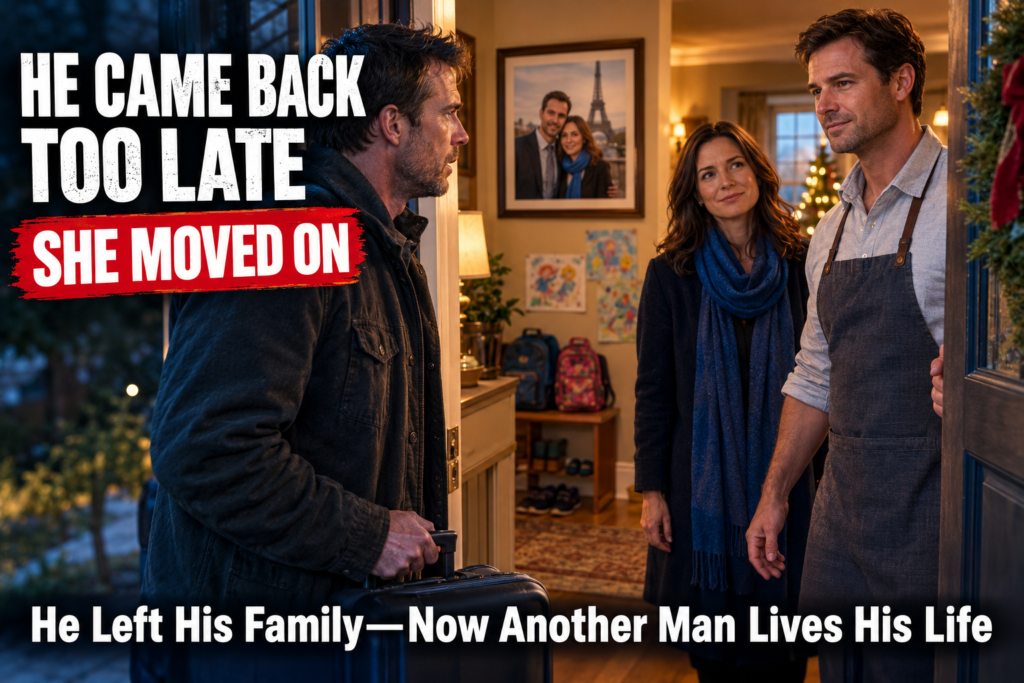
PART 1
For eleven years, I told myself I was a good husband.
Not a perfect one, obviously. Nobody is. I worked long hours, paid the bills when business was good, attended school events when I could, and occasionally surprised Helena with flowers from the grocery store on my way home. I knew how to change a tire, fix a leaking tap, and assemble the furniture that arrived in boxes with instructions written by someone who apparently hated human beings.
I was useful. I was responsible. I was the sort of man who believed those things should count for something.
What I never understood was that a marriage could survive a thousand small inconveniences and still be slowly destroyed by one person refusing to pay attention.
Helena paid attention to everything.
She knew which child needed a little extra encouragement before school, which one pretended not to be frightened of thunderstorms, and which one would suddenly decide that a perfectly ordinary dinner was disgusting because the peas had touched the potatoes. She remembered birthdays, permission slips, dentist appointments, grocery lists, and the names of teachers I had met several times but somehow never retained.
She knew when I was worried before I admitted it. She could recognize the particular silence that meant I had a problem at work, and she had learned that asking me about it immediately usually made me defensive.
Sometimes, she would simply put a cup of coffee beside me and sit down without asking anything.
For a long time, I mistook that patience for an absence of needs.
Our house was not luxurious, but it was ours. We had chosen the kitchen cabinets together, argued about the color of the living room walls, and spent an entire Saturday assembling a dining table that arrived with one missing screw. Helena had laughed when I insisted I could make it work anyway.
“You say that about everything,” she had told me.
“And I’m usually right.”
“You’re usually loud.”
We had laughed until one of the children came running in to find out what was so funny.
Those memories were real. That was what made everything that followed so difficult to explain, even to myself.
I had loved Helena. I believed I still loved her, in some distant and familiar way. But somewhere between the school runs, the bills, the tired evenings, and the ordinary repetition of family life, I began to feel that my life had become too small.
I watched old friends travel, change careers, start businesses, and post photographs from restaurants where the menus did not have children’s meals. I saw people my age buying expensive cars and talking about opportunities. I listened to their stories and imagined that somewhere, just beyond the boundaries of my ordinary life, there was a version of me who had never become so predictable.
I began to resent the things I had once wanted.
The children’s noise irritated me more than it should have. Helena’s questions felt like demands. The grocery shopping, the mortgage, the weekend plans, and the constant negotiations about time all seemed to be evidence that my life belonged to everyone except me.
I never asked myself whether Helena felt trapped, too.
I never wondered how often she had postponed something she wanted because one of the children needed her, because I had to work, or because the family budget could not accommodate another expense.
I only noticed my own dissatisfaction.
The dangerous thing about dissatisfaction is that it can turn an ordinary life into a prison without changing a single fact about it. Once I started thinking of my family as the reason I could not be happy, every inconvenience became another piece of evidence.
Helena noticed me withdrawing.
At first, she tried to bring me back with small gestures. She suggested we have dinner together after the children went to bed. She asked whether I wanted to take a weekend trip somewhere nearby. She began leaving little notes beside my keys, reminders that sometimes included a joke only we understood.
I answered those efforts with excuses.
Work was exhausting. Money was tight. I needed time to think. We could do something next month.
There was always a next month.
One evening, she found me sitting at the kitchen table, staring at my phone while the children watched television in the next room.
“Ross, can I ask you something?”
I looked up reluctantly. “What?”
“Are you happy?”
It was such a simple question that I should have been able to answer honestly.
Instead, I felt accused.
“Why are you asking me that?”
“Because I don’t know where you are anymore. You’re here, but you’re not really here.”
I leaned back in my chair. “I’m tired, Helena. That’s all.”
“I know you’re tired. I’m tired, too.”
“Then maybe you understand.”
She looked at me for a moment. “I don’t think you understand what I’m trying to say.”
I did understand. Some part of me understood perfectly. She was telling me that she missed me, that our marriage needed attention, and that she was frightened by the distance growing between us.
But understanding would have required me to accept responsibility.
It was easier to tell myself she was overreacting.
“I just need some space,” I said.
Helena nodded slowly. “How much space?”
I had no answer.
She did not argue. She did not cry. She simply returned to the living room, where one of our children called her name, and I heard her voice change as she answered.
That was the first time I noticed how easily she could hide her sadness when the children needed her.
I should have followed her.
I should have put my phone away, walked into that room, and sat beside my wife. I should have admitted that I felt restless and frightened by the life I had built, and that I did not know how to feel grateful for it without feeling as though I had surrendered every other possibility.
Instead, I began looking for a way out.
Not a way to repair the marriage. Not a way to become a better father. A way out.
And once I had decided that leaving would solve my unhappiness, I began interpreting everything Helena did as another reason I needed to go.
I did not realize that I was not escaping my life.
I was escaping the person I needed to become.
# PART 2 — THE NIGHT I WALKED AWAY
By the time I finally told Helena I wanted to leave, I had rehearsed the conversation so many times that I had convinced myself it would be almost painless.
I would explain that things had changed. I would say that I no longer felt the same way about our marriage. I would tell her that pretending would only hurt us both more in the long run.
I had prepared all the reasonable phrases a person can use when he wants to make a selfish decision sound like an act of honesty.
The one sentence I never rehearsed was the truth.
I wanted something different, and I had become impatient with the people whose lives depended on me.
It was a Thursday evening. The children had finished dinner, and Helena was putting leftovers into containers while I stood at the kitchen counter pretending to read a message on my phone.
“I need to talk to you,” I said.
She glanced over her shoulder. “Is everything okay?”
“No. I mean, nothing terrible has happened. I just need to tell you something.”
She put the lid on a container and turned toward me.
I could have stopped then. I could have told her that I was unhappy and confused, that I had been distant, and that I wanted us to find a way to understand what had happened between us.
Instead, I delivered the sentence that would divide our lives into before and after.
“I’ve lost interest in our marriage.”
Helena did not move.
For several seconds, she looked at me as if she had heard the words but could not understand how they belonged in our kitchen, beside the children’s lunch boxes and the family calendar.
“What does that mean?” she asked.
“It means I don’t think I can keep doing this.”
“Doing what?”
“This marriage. This routine. Everything.”
Her expression changed, not dramatically, but enough that I noticed. The hope in her eyes seemed to withdraw behind something more cautious.
“Do you mean you want a divorce?”
“I think we should separate.”
She lowered her gaze to the counter.
I had expected anger. I had prepared answers for accusations. I had imagined her asking whether there was someone else, and I had decided in advance that I would not let the conversation become an argument about blame.
But Helena did not shout.
She did not ask me to reconsider.
She asked, “Have you been thinking about this for a long time?”
“Yes.”
“How long?”
I hesitated.
“Months,” I admitted.
She nodded once, as though the answer explained something she had been trying to understand.
“Have you been unhappy for months, or have you been planning to leave for months?”
I looked away.
“I don’t know.”
That was not entirely true. I knew enough to understand that I had been making choices long before I announced them. I had been emotionally absent. I had stopped trying to solve our problems. I had allowed resentment to grow because resentment was easier than admitting my own failures.
Helena rested both hands on the counter.
“I wish you had told me you were struggling before you decided I was no longer worth trying for.”
I felt an immediate urge to defend myself.
“It’s not about you being worth anything.”
“Then what is it about, Ross?”
I had no answer that did not sound cruel.
She looked toward the hallway. One of the children was moving around upstairs, and the floorboards creaked beneath small footsteps.
“Are you leaving tonight?”
“I think I should.”
She closed her eyes briefly.
When she opened them, her voice was quieter.
“Please don’t wake the children while you pack.”
That was all.
She did not beg me to stay. She did not threaten to make me regret it. She did not tell me that I would never see the children again.
She simply asked me not to disturb their sleep.
I mistook her composure for acceptance. I thought perhaps she had been unhappy, too, and that my departure would give her a chance to build a better life.
I never considered that she might be trying to protect the children from a pain she had not yet had time to understand herself.
I packed a suitcase in our bedroom while she stayed downstairs. Every few minutes, I stopped to listen, expecting her to come up and ask me to reconsider.
She never did.
I folded shirts into the suitcase, collected my toiletries, and stood looking at the room we had shared for eleven years. Helena’s book was on her bedside table. A photograph of the five of us stood on the dresser. In it, I was holding one child while the other two leaned against Helena, all of us squinting in bright sunlight.
I remember thinking that I would take a photograph like that again someday.
I remember believing there would be time.
When I carried the suitcase downstairs, Helena was sitting at the kitchen table. Her hands were wrapped around a mug that had probably gone cold.
She looked up.
“Where will you go?”
“I’ll find somewhere.”
“What should I tell the children in the morning?”
I had not thought that far ahead.
“Tell them we need some time apart.”
“How much time?”
“I don’t know.”
She nodded, and I hated how reasonable she was being. Her calmness made it difficult for me to cast myself as the victim of an unbearable situation.
At the front door, I turned around.
“I don’t want us to hate each other.”
Helena looked at me with an expression I could not interpret.
“Then don’t make me do all the work of loving you from a distance, too.”
I left before I could answer.
Outside, the night air felt cold against my face. I put the suitcase in the car, started the engine, and sat in the driveway longer than necessary.
I expected relief to arrive immediately.
Instead, I felt a strange emptiness, like stepping out of a crowded room and realizing I had forgotten why I wanted to leave.
I told myself it was temporary. I told myself that once I had settled into my new life, everything would make sense.
Then I drove away from the house we had built together, leaving Helena to face the morning and three children who would wake up wondering why their father was gone.
# PART 3 — THE EXCITEMENT OF STARTING OVER
At first, being away from my family felt like proof that I had made the right decision.
I rented a small apartment across town. It had clean walls, a balcony, and no toys beneath the sofa. Nobody asked me to pick up milk on my way home. Nobody needed help with homework while I was trying to watch television. I could eat whenever I wanted, stay out as late as I liked, and spend a Saturday morning doing absolutely nothing without feeling that I was neglecting somebody.
I called it freedom.
For the first few weeks, the silence felt luxurious. I slept without being woken by children coming into the bedroom. I bought food that I liked and left dishes in the sink until I felt like washing them. I stayed out with friends, talked about work, and listened to stories about people who had reinvented themselves.
Whenever someone asked about Helena and the children, I gave the same polished explanation.
“We grew apart.”
It was convenient because it made the separation sound like something that had happened to both of us, rather than a decision I had made and imposed on everyone else.
Some friends accepted the explanation. Others looked uncomfortable.
One old friend, Marcus, asked me directly, “Did you try to fix things before you left?”
I became defensive.
“You don’t know what the marriage was like.”
“That’s true,” he said. “I don’t.”
I waited for him to continue arguing, but he did not.
He only added, “I hope you know what you’re doing.”
I resented him for that more than I would have resented a lecture.
A few months later, I met the woman who would become my girlfriend.
Her name was Claire. She was lively, confident, and interested in the version of me that I was trying to become. When I talked about business ideas, she listened. When I complained about the limitations of family life, she did not remind me of my responsibilities. She laughed at my jokes and told me I deserved to be happy.
I found her attention intoxicating.
With Claire, I could imagine myself as a man who had escaped an ordinary existence and was finally discovering what he wanted. We went to restaurants I could not have afforded regularly when I was paying the mortgage and supporting three children. We took spontaneous weekend trips. We talked about building something together.
She did not know the small details of my old life, and I did not volunteer them unless necessary.
I did not tell her how Helena used to leave the porch light on when I worked late. I did not mention the way our youngest child used to insist that I read the same bedtime story twice, even when I was exhausted. I rarely talked about the school concerts, the family holidays, or the ordinary moments that had once made our home feel complete.
Those memories complicated the story I wanted to believe.
Claire represented possibility. Helena represented responsibility.
I told myself that there was nothing wrong with wanting more from life.
That part was true.
What I refused to acknowledge was that wanting more did not require abandoning the people who had trusted me.
I continued to see the children, although the arrangements were often awkward. I told myself I was doing my best. I attended some events, missed others, and made promises that seemed reasonable when I made them but became inconvenient when the day arrived.
Sometimes I arrived late because work ran over. Sometimes I cancelled because Claire and I had plans. Sometimes I called the children and ended the conversation quickly because I did not know what to say when they asked when I was coming home.
I never intended to become an absent father.
I simply kept choosing the things that made absence easier.
One afternoon, my daughter asked whether I would be there for something at school. I cannot remember the exact event now, only the way she paused before asking, as if she had learned that hope needed to be handled carefully.
“Of course,” I told her.
She sounded pleased.
I forgot the event until Helena sent me a message that evening asking whether I had meant to come.
I offered an apology and blamed work.
Helena did not argue. She replied that the children had waited for me and that she had eventually taken them home.
That message stayed with me longer than I wanted it to.
For a moment, I felt ashamed. Then Claire called, excited about an opportunity she had found, and I pushed the feeling aside.
I told myself I would make it up to the children.
I said that often.
Months became a year, and the excitement of my new life began to settle into a different routine. The apartment no longer felt like a symbol of freedom. It was simply a place where I slept. The restaurants became familiar. The trips ended, and the workdays returned.
Claire and I started talking about money.
I had always wanted to own a business. The idea appealed to the part of me that wanted to prove I had made something of myself. I imagined becoming financially independent, making my own decisions, and building a future that no one could accuse me of taking for granted.
When an opportunity appeared, I seized it with the confidence of a man who had spent too long imagining his potential.
I invested my savings.
At first, everything seemed promising. I studied the numbers, talked to suppliers, and convinced myself that the risks were manageable. I imagined the business becoming successful enough to erase the financial anxiety that had followed me since leaving home.
Claire encouraged me.
“You’ve always wanted this,” she said. “You should give yourself a chance.”
I took her encouragement as evidence that she believed in me.
I did not realize how much of my confidence depended on being admired by someone who had not yet seen me fail.
The first problems were small. Expenses were higher than expected. Customers took longer to arrive. A supplier changed its terms, forcing me to find additional money. I reassured myself that every new business went through difficult periods.
I put more savings into it.
Then I borrowed.
Then I began telling myself that the next month would be different.
I had made a decision based on the promise of a better future, and I was becoming increasingly unwilling to admit that the future might not arrive.
The irony was that I had left a stable family life because I felt trapped by routine, only to create a new life in which every day was consumed by financial worry.
I had escaped one set of responsibilities and chosen another.
But I was still the same man.
# PART 4 — THE BUSINESS THAT TOOK EVERYTHING
The business did not collapse in one dramatic moment.
There was no single morning when I walked into the office and discovered that everything had disappeared. Instead, it failed slowly, in a series of decisions that each seemed defensible when I made them.
A bad month became a bad quarter. A temporary cash-flow problem became a growing debt. The customers I expected did not materialize in the numbers I had projected, and the costs I had underestimated continued to arrive with brutal regularity.
I began waking before dawn to check the accounts.
The figures never looked as bad at midnight as they did in the morning, so I developed the habit of staying awake late, reviewing spreadsheets until I was too tired to think clearly. I told myself that hard work would save the business.
Sometimes, I caught myself thinking about the house I had left behind.
I remembered the kitchen table where Helena used to sort bills. I remembered complaining about the mortgage, the school expenses, and the fact that we could not afford every holiday we wanted.
At the time, those obligations had seemed like chains.
Now I would have given almost anything to exchange the uncertainty of my business for the predictability of a monthly mortgage payment shared with someone who trusted me.
But regret did not solve the immediate problems.
I needed money, and I had less of it every week.
Claire noticed the change before I admitted it. Our conversations became dominated by practical questions. She wanted to know whether the business would recover, how much debt I had accumulated, and whether I had a plan.
I answered with projections.
“The next contract should help.”
“We’re close to turning a corner.”
“I just need a little more time.”
The words sounded familiar because I had used the same logic when my marriage was failing. I kept promising that something would improve later, believing that the promise itself could hold the situation together.
Claire tried to be supportive at first, but uncertainty began to affect everything between us.
We stopped taking trips. We ate at home more often. I became irritable when she asked about expenses, and she grew frustrated when I treated reasonable questions as personal attacks.
One evening, she sat across from me at the small dining table in our apartment.
“Ross, I need you to tell me the truth.”
“I have been telling you the truth.”
“No. You’ve been telling me what you hope will happen.”
I stared at her.
She continued carefully. “How bad is it?”
I wanted to give her a number that would frighten her into understanding me, but I also wanted to conceal the full extent of the damage.
“It’s bad,” I admitted.
“How bad?”
I finally told her.
She sat quietly for a long time. I could see her trying to understand what the information meant for her own future.
“Why didn’t you tell me sooner?”
“I didn’t want you to worry.”
“That isn’t an answer.”
I felt anger rising because she was asking the same kind of question Helena had once asked. Both women wanted me to stop hiding behind vague explanations. Both wanted me to admit what was happening before the consequences became impossible to ignore.
I had once interpreted Helena’s concern as pressure.
Now I interpreted Claire’s concern as a lack of faith.
“I thought I could fix it,” I said.
Claire rubbed her forehead. “And what happens if you can’t?”
I had no answer.
The business continued to deteriorate. I tried to negotiate with creditors, reduce expenses, and find someone willing to invest. Every possible solution seemed to require money I no longer had or confidence I could no longer convincingly offer.
Eventually, I had to accept what I had been avoiding.
The business was finished.
Closing it was humiliating in a way I had never anticipated. I had imagined failure as a temporary setback, something successful people survived before telling inspirational stories about perseverance. I had not imagined the quiet administrative work of admitting defeat, notifying people, settling what I could, and calculating how much of my future had already been spent.
When it was over, I sat alone in the office.
The furniture looked smaller than I remembered. The empty shelves seemed to mock the plans I had once made. I had spent years telling myself that I was building a future, but I had placed so much of my identity in the business that I could barely distinguish financial failure from personal worthlessness.
I was broke, exhausted, and embarrassed.
Worse, I had no one I felt comfortable telling.
My friends had heard me talk confidently about the opportunity. I did not want to face their questions. My family had their own lives. Helena was no longer the person I called when something went wrong.
I had removed myself from the place where my problems once had a witness.
Now I had to carry them alone.
Claire stayed for a little while after the business failed, but the relationship had become strained long before its final days. She had loved the hopeful man who talked about possibility. I had become someone who checked bank balances, worried about debt, and could not promise when life would improve.
I wanted her to reassure me.
I wanted her to say that money did not matter, that we would work through it, and that the man she loved was still there beneath the disappointment.
But I had built our relationship around excitement and the promise of a better life. When the promise disappeared, neither of us knew what remained.
I did not blame her for leaving.
At least, that is what I told myself.
The truth was more complicated. I felt abandoned, even though I had spent years abandoning people in quieter ways. I felt betrayed by circumstances, even though I had made choices that contributed to them. I wanted someone to recognize how much I had lost without asking what I had done to create the loss.
I had become very good at wanting understanding.
I had never become equally good at offering it.
# PART 5 — WHEN CLAIRE LEFT
Claire did not leave during a screaming argument.
There was no slammed door, no dramatic declaration, and no final insult that either of us could later use to justify everything.
She left after a long conversation in which we both seemed to understand the conclusion before either of us said it aloud.
We were sitting in the apartment on a gray afternoon. The room was untidy, and the air felt stale. A pile of unopened letters lay on the counter. I had been avoiding them because I already knew that none would contain good news.
Claire had been quiet for most of the morning.
Finally, she said, “I don’t think we can keep living like this.”
I looked at her. “Like what?”
“Like every day is a crisis. Like we’re waiting for something to go wrong before we can decide what to do next.”
“We’ve been through a difficult time.”
“I know.”
“Things won’t always be this bad.”
She looked at me with tired eyes.
“Ross, that’s what you’ve been saying for months.”
I wanted to argue. I wanted to remind her that I had not chosen to lose the business, that I was trying to recover, and that things had happened beyond my control.
But she was not accusing me of causing every problem.
She was telling me that she could no longer build her life around the expectation that the next day might finally be different.
“What do you want me to do?” I asked.
“I want you to stop asking me to live on promises.”
The sentence struck me harder than I expected.
I had made promises to Helena, too. Not always explicit ones. Sometimes the promise had been as simple as saying I would be home for dinner, that I would attend an event, or that we would take the trip we had postponed. I had broken those promises one by one, usually with an explanation that sounded reasonable enough to postpone the consequences.
I had thought that because I never intended to hurt anyone, the hurt should count less.
But intentions did not erase the experience of being disappointed.
Claire looked down at her hands.
“I care about you,” she said. “But I don’t know how to help you anymore.”
I felt the old fear rising inside me: the fear of being left, of being seen as inadequate, of discovering that I was not the person I had spent so long trying to become.
“So that’s it?” I asked. “You’re leaving because I lost my business?”
“No,” she said. “I’m leaving because I don’t think either of us knows how to live in this relationship anymore.”
I could have accepted that answer.
Instead, I tried to make her decision about money because money was easier to understand than character. If she was leaving because I was broke, I could call her shallow. If she was leaving because our relationship had become unhealthy, I would have to look at my part in it.
She packed her things over the next few days.
I watched the apartment gradually return to the emptiness I had once celebrated. Her books disappeared from the shelves. Her clothes vanished from the closet. The small objects she had placed around the room were removed until the space looked less like a home and more like a temporary arrangement that had reached its end.
When she carried the last bag to the door, she paused.
“I hope things get better for you, Ross.”
I nodded because I could not think of anything else to say.
After she left, I sat on the sofa and listened to the silence.
It was different from the silence of my first apartment, when freedom had felt new. This silence seemed to contain every decision I had made to avoid being uncomfortable. I had wanted a life without demands, but I had also wanted to be admired, desired, and reassured. I had wanted to leave when people needed something from me and return when I needed something from them.
I had wanted independence without accepting loneliness as one of its possible costs.
For the first time, I began to understand that the problem was not simply that my relationships had failed.
The problem was that I had expected other people to keep offering me stability while I reserved the right to walk away whenever life became difficult.
That realization did not instantly make me a better person. It made me ashamed.
Shame is not the same as responsibility. Shame says that you are terrible and should hide. Responsibility asks what you have done, whom it affected, and what you must do next.
I spent several days doing the first.
I replayed conversations, remembered arguments, and imagined all the ways my life might have turned out differently if I had stayed with Helena. I wondered whether she had met someone else, whether the children still talked about me, and whether she had told them the truth about why I left.
I considered calling her.
I picked up my phone several times, searched for her name, and put it down again.
What could I say?
That I was sorry? That I had made mistakes? That I had finally realized my new life had not delivered the happiness I expected?
Those statements might have been honest, but I knew how they could sound to someone who had spent years raising our children without me beside her.
They could sound like an invitation for her to comfort me.
I was not entitled to that comfort.
Eventually, I called to ask how the children were doing.
Helena answered after several rings.
“Hello?”
Her voice was familiar, but there was a distance in it that I could not cross simply because I remembered how things used to be.
“It’s Ross.”
“I know.”
I swallowed.
“I wanted to see how the children were.”
“They’re doing well.”
“Can I speak to them?”
“They’re out at the moment. I can ask them to call you when they get back.”
“Okay.”
A silence followed.
I wanted her to ask how I was. I wanted her to ask whether I had found work or whether I was managing. I wanted some sign that I still occupied a place in her mind beyond the practical arrangements of our children.
She did not offer one.
“Is there anything else?” she asked.
“No.”
“All right, Ross.”
She ended the call politely.
I stared at the phone, feeling rejected by the very distance I had created.
For years, I had imagined that leaving meant I could return whenever I wanted. I had assumed that the history between us would remain intact, waiting for me like a room I had temporarily stopped using.
I was beginning to learn that a person can leave a relationship without immediately losing access to its memories.
But memories do not grant permanent access to another person’s life.
# PART 6 — THE DRIVE BACK TO THE HOUSE
The idea of returning to Helena did not arrive as a grand revelation.
It began as a practical thought.
I needed somewhere to go. My finances were a mess. My business was gone, Claire had left, and the future I had once imagined was no longer available to me in the form I expected.
I began thinking about the old house because it had been the last place where I felt certain of anything.
I remembered the spare key we used to keep in a small container outside. I remembered the hallway, the kitchen, and the uneven step near the back door. I remembered the children running through the living room and Helena calling after them to slow down before someone got hurt.
I remembered the life I had once described as a trap.
Now those memories seemed like evidence of a home I had thrown away.
At first, I told myself I wanted to apologize. I would explain how wrong I had been, admit that I had mistaken restlessness for a reason to abandon my family, and ask Helena whether there was any way to repair what remained.
I practiced the conversation while driving.
“I know I hurt you.”
Too weak.
“I made a terrible mistake.”
Too easy.
“I understand now what I threw away.”
That sounded as though I was asking her to feel sorry for me.
I tried again.
“I don’t expect you to forgive me. I just want you to know that I’m sorry.”
That was closer to the truth, but even that sentence contained a hidden request. I wanted her to hear my apology and recognize the man I believed I could still become.
I wanted her to give me a chance to prove that I had changed.
The problem was that I had only just begun to understand what change would require.
I had not spent years becoming more patient. I had not demonstrated consistent responsibility to the children. I had not rebuilt the trust I had damaged. I had simply reached a point where the consequences of my decisions had become painful enough that I wanted to return to the life I had abandoned.
I knew that distinction in theory.
I did not yet know how to live with it.
As I drove through familiar streets, I noticed how little the neighborhood had changed. The same trees stood along the sidewalks. The same corner shop had faded signs in the window. The road near the school still narrowed where parked cars crowded the curb.
I passed the place where I used to buy coffee before work.
I passed the park where the children had played while Helena and I sat on a bench, talking about what we wanted our future to look like.
At the time, we had talked about traveling. Paris had been one of Helena’s dreams. She loved the idea of walking through unfamiliar streets, sitting at a little café, and seeing the city from the river.
We had promised ourselves that we would go when the children were older and we had saved enough money.
I had always treated that promise as something we could postpone indefinitely.
There was always a bill, a work deadline, a practical reason to wait.
I had forgotten how often Helena said that she did not want to spend her entire life waiting for the right moment.
Now I wondered how many moments she had stopped waiting for.
When I turned onto our old street, my hands tightened around the steering wheel.
The house appeared at the end of the road, familiar in shape but strangely distant. I slowed down, looking at the windows and the front garden.
I noticed that the flowers Helena used to plant near the walkway had changed. The fence had been repaired. A bicycle stood near the side of the house, and a pair of shoes rested beside the front door.
Small details, but they made the place look inhabited in a way that went beyond the memory I had carried.
I parked across the street and sat for several minutes.
I had imagined that the house would still feel like mine.
Instead, it looked like a life that had continued without asking my permission.
I walked up the path, rehearsing my apology one final time. I told myself that Helena would at least let me explain. Eleven years of marriage could not mean nothing. Three children connected us forever. Surely there would be some place for a conversation.
I reached the door and knocked.
Footsteps approached from inside.
The door opened.
A man I did not recognize stood in front of me.
He wore an apron, and there was a faint smudge of something flour-like near one pocket. He looked neither suspicious nor startled. He looked like someone who had been interrupted while doing an ordinary household task.
“Can I help you?” he asked.
I stared at him.
Behind him, I could see part of the hallway. The walls looked different. There was a small shelf where I remembered a coat rack, and a framed picture hung above it.
I tried to speak, but the words came slowly.
“I’m looking for Helena.”
The man studied my face for a moment.
“Who should I say is here?”
Before I could answer, a familiar voice called from deeper inside the house.
“Daniel, do you know where my glue is?”
The man turned his head slightly.
“Check the drawer beside the printer,” he called back without hesitation. “I think you left it there after your project.”
The casualness of his answer unsettled me more than hostility would have.
He knew where things belonged.
He knew the rhythm of the house.
He was not a visitor waiting for permission to move through someone else’s life.
He lived there.
And before I could prepare myself for that truth, I saw the photograph on the living room wall.
# PART 7 — THE PHOTOGRAPH FROM PARIS
The photograph was visible over Daniel’s shoulder.
I could not see every detail from the doorway, but I could see Helena’s face. She was smiling in a way I had not seen for years, not because she had never smiled after I left, but because I had not been there to witness it.
The Eiffel Tower stood behind her.
She wore the blue scarf I had given her a decade earlier.
I remembered buying it during a winter shopping trip, back when money was tight but not yet a constant source of anxiety. Helena had stopped beside a shop window and admired the color. She had not asked me to buy it. She had simply said that it reminded her of the sky just before sunset.
I bought it for her as a surprise.
She wore it the following week and thanked me several times. Then, one evening, she stood in front of the bedroom mirror and said, almost shyly, “One day, I’m going to wear this in Paris.”
I laughed and stepped behind her, putting my hands on her shoulders.
“Then we’ll take you there.”
“Promise?”
“Promise.”
We had meant it.
That was what made the photograph hurt.
I had not given her the scarf as a symbol of the marriage we would abandon. I had given it to her as a promise about a future we imagined sharing.
For years, the promise remained unfinished. We postponed the trip because the children were young, because the mortgage needed attention, because work became busy, because something else always seemed more urgent.
I had treated the dream as a luxury.
Helena had apparently found a way to make it real.
Without me.
I stared at the photograph and felt a wave of emotions that I could not separate. There was sadness, because I remembered the life we had once imagined. There was jealousy, because another man had stood beside her in a place I had promised to take her. There was shame, because the photograph suggested that she had continued living instead of remaining frozen in the moment I left.
And beneath all of it was the frightening realization that she had not needed me to complete the promise.
The man at the door noticed where I was looking.
“That’s Helena,” he said.
“I know.”
He paused.
Something in my voice must have told him that I was not a stranger who had come to deliver a package.
Before he could ask another question, Helena appeared behind him.
She was holding a folded dish towel. Her hair was different from how I remembered it, and there were small lines near her eyes that had not been there when I left. She looked older, of course. So did I.
But what struck me most was that she looked settled.
She was not standing in the doorway as someone waiting for an explanation. She looked like a woman who had been in the middle of her own afternoon when an unexpected visitor arrived.
Then she saw me.
“Ross? What are you doing here?”
I had rehearsed an apology for the entire drive.
Every sentence disappeared.
“Helena,” I said.
She looked at me, then at the suitcase in my hand.
I had brought it because I was not sure where I would stay if the conversation went badly. I had told myself it was practical. Standing there, I realized how it might look.
“Is everything okay?” she asked.
The question was polite. It was not the worried question she used to ask when I came home late and she could tell something had gone wrong.
“I wanted to talk to you.”
“About what?”
I glanced at Daniel.
Helena followed my gaze.
“This is Daniel,” she said. “Daniel, this is Ross.”
Daniel nodded once.
“Hello.”
I managed a stiff greeting.
There was no dramatic confrontation. Daniel did not square his shoulders or demand to know why I had come. He did not need to. His calmness made the situation more uncomfortable because he seemed secure in his place.
Helena stepped slightly into the hallway.
“Would you like to come in?”
For a moment, I felt relief.
Then I realized she had offered me the courtesy she might offer any unexpected guest.
I entered the house.
The hallway smelled faintly of food and laundry detergent. On the wall were photographs I did not recognize. One showed the children standing beside Helena. Another showed them outside somewhere, squinting into the sun. There were small signs of everyday life: a basket of shoes, a school bag, a stack of mail, and a list of things to buy attached to the refrigerator.
The house was familiar enough to hurt and different enough to make it clear that I had no claim over its present.
Daniel returned to the kitchen.
“I’ll give you two a moment,” he said.
Helena thanked him.
The ease of their exchange made me feel like an outsider in a place I had once called home.
She gestured toward the living room.
“Sit down, if you like.”
I sat on the edge of the sofa. Helena remained standing for a moment before choosing the chair opposite me.
I looked at her hands.
I remembered the ring she had worn during our marriage. I remembered how she used to twist it slightly when she was thinking.
She no longer wore it.
“I didn’t know you were seeing someone,” I said.
Her expression changed only slightly.
“You didn’t ask.”
The words were not cruel.
They were simply true.
I looked down.
“No. I suppose I didn’t.”
Helena folded the dish towel and placed it beside her.
“Ross, why are you here?”
This time, I understood that she was not asking for the story I had rehearsed.
She wanted to know what I expected from her.
And I was beginning to realize that I had driven there without a clear answer.
# PART 8 — THE APOLOGY THAT COULD NOT UNDO THE PAST
“I’ve made mistakes,” I began.
Helena waited.
I had expected that sentence to open a door. In my imagination, once I admitted that I had been wrong, she would soften. We would talk about the years we had shared, and the hurt between us would become something we could examine together.
But she did not rush to make the conversation easier.
“I shouldn’t have left the way I did,” I continued. “I was selfish. I thought I needed a different life, and I convinced myself that leaving was the answer.”
Helena looked at me for a long moment.
“Do you know what I remember about the night you left?”
I shook my head.
“I remember asking you not to wake the children. I remember thinking that if they saw you packing, they would ask questions I couldn’t answer. I remember standing in the kitchen after you drove away, trying to decide whether to tell them in the morning or wait until they asked.”
She paused.
“And I remember being angry with myself because a part of me still hoped you would come back inside.”
I felt my throat tighten.
“I didn’t know.”
“No,” she said quietly. “You didn’t.”
I wanted to tell her that I had been unhappy, that I had felt lost, that I had not understood what I was doing. All of that was true. But sitting across from her, I began to understand that the truth about my feelings did not erase the truth about her experience.
I had been unhappy.
She had been abandoned.
Those things were not interchangeable.
“I thought I would be happier,” I said.
“Were you?”
I hesitated.
“No.”
She looked down at her hands, then back at me.
“I’m sorry you went through a difficult time, Ross. I really am. But I need you to understand something. I spent a long time trying to make sense of why you left. I wondered what I had failed to give you. I wondered whether I had become boring, whether I had asked too much of you, whether I had stopped being the woman you wanted.”
I stared at her.
“I never wanted you to think that.”
“But I did think it. For a while.”
Her voice remained steady, which somehow made it harder to listen to.
“I was raising three children and trying to keep our lives stable. I was answering their questions, dealing with their disappointment, and making sure they understood that your leaving wasn’t their fault. I had to keep functioning even when I didn’t know how to explain what had happened.”
She stopped for a moment.
“And then, eventually, I had to stop making your decision the center of my life.”
I felt ashamed.
“I know I hurt you.”
“I believe you know that now.”
There was a difference between those words and forgiveness. I could hear it.
I tried to explain the business. I told her about the investment, the debt, and the way everything had fallen apart. I admitted that Claire had left and that I was struggling to find a direction.
Helena listened without interrupting.
When I finished, she said, “That sounds difficult.”
For a moment, I was relieved.
Then she added, “But it doesn’t explain why you came here.”
I opened my mouth and closed it again.
I had wanted to believe I came because I loved her. There was truth in that, but not the whole truth. I had also come because I was lonely, frightened, and financially vulnerable. I had come because the house represented a life in which I once had a place, and I wanted to know whether any part of that place still existed.
I had hoped that the family I left might become a refuge from the consequences of leaving them.
“I don’t know how to answer that,” I admitted.
Helena nodded slowly.
“Then perhaps you need to think about it before asking me to answer anything for you.”
I looked at the photograph again.
“Paris,” I said. “You went.”
“Yes.”
“I’m glad.”
The words sounded small.
She studied my face.
“Are you?”
I took a breath.
“I think I am. It was something you always wanted.”
“It was.”
“I’m sorry I never took you.”
Helena’s expression softened, but not in the way I had hoped. It was the expression of someone remembering a promise that had mattered once.
“We waited a long time,” she said. “I kept telling myself we’d go when things settled down. There was always a reason to postpone it.”
“I know.”
“No, Ross. I don’t think you did. Not then.”
She looked toward the photograph.
“When I finally went, I realized I had spent years treating happiness like something I could only have after everything else was taken care of. After the bills were paid. After the children were older. After work became less demanding. After life became easier.”
She smiled faintly.
“Life doesn’t always become easier. Sometimes you have to stop waiting for permission to live it.”
I thought about the years I had spent chasing a different life, convinced that happiness waited somewhere beyond the responsibilities I had resented.
I had been so desperate to escape the ordinary that I had overlooked the extraordinary things hidden inside it.
But recognizing that truth now did not mean Helena owed me another chance.
“I wish I could go back,” I said.
“So do I, sometimes.”
Her answer surprised me.
She continued, “Not because I want our marriage back exactly as it was. There were things I wish we had done differently. I wish we had talked more honestly. I wish you had told me how unhappy you were before deciding that leaving was the only option.”
She took a breath.
“But I can’t go back, Ross. Neither can you.”
I felt the apology I had rehearsed begin to crumble. Not because she had rejected it, but because I had imagined an apology as a bridge that would carry me back to the past.
It could not do that.
An apology could acknowledge the damage. It could make room for a different future. It could not force another person to reopen a life they had worked hard to rebuild.
“I don’t expect you to forgive me,” I said.
Helena looked at me.
“I hope you learn to take responsibility for what happened. Forgiveness isn’t something you can collect from me like a debt.”
I nodded.
For the first time since arriving, I stopped trying to persuade her.
I sat quietly and allowed her words to remain in the room without searching for a way to make them easier for me.
From the kitchen, Daniel called to ask whether she wanted him to keep dinner warm.
Helena answered that she would be there shortly.
The exchange was ordinary. That was what made it unmistakable.
Her life was continuing.
My arrival had not stopped it.
# PART 9 — THE CHILDREN WHO GREW UP WHILE I WAS GONE
I asked Helena whether I could see the children.
She did not answer immediately.
“They’re not little anymore,” she said.
“I know.”
“Do you?”
The question hurt because I knew what she meant.
I knew their ages. I knew their birthdays. I knew which school they attended and could name some of their interests. I had not forgotten that they existed.
But knowing facts about children was not the same as knowing them.
I had missed the slow changes that turned their childhoods into something new. I had missed the conversations that happened after school, the jokes that became family traditions, the moments when they needed reassurance but were too embarrassed to ask directly.
I had missed ordinary days, and ordinary days were where relationships were built.
Helena explained that the children were older now and that each had developed their own feelings about my absence. She did not offer to speak for them.
“You should talk to them directly,” she said. “But you need to let them decide what they’re comfortable with.”
“I understand.”
“Don’t promise them things you can’t deliver. Don’t tell them you’ll be there every week unless you know you can be. And don’t ask them to make you feel better about what happened.”
I felt defensive for a moment.
“I wouldn’t do that.”
Helena looked at me, and I remembered how many times I had believed myself incapable of something until I had done it.
I lowered my eyes.
“I’ll try not to.”
“That isn’t the same as promising.”
“No,” I admitted. “It isn’t.”
She helped arrange a conversation with the children, but it did not become the reunion I had imagined during the drive.
They were polite. They were cautious. One asked me about work. Another wanted to know whether I was still living in the same apartment. The youngest, who had been small when I left, seemed unsure what to say to me.
I wanted to hug them.
I wanted to tell them that I had missed them every day, that I had always loved them, and that I was sorry for the time I had lost.
But I knew that saying I had missed them could sound strange when I had chosen not to be present for so much of their lives.
I had loved them from a distance.
They had needed a father in the room.
One of them eventually asked the question I had dreaded.
“Why did you leave?”
I had prepared several answers over the years. I could say that adults sometimes made mistakes, that the marriage had become difficult, or that I thought separation would make everyone happier.
All of those explanations would have softened the truth.
“I left because I thought I would be happier somewhere else,” I said. “I convinced myself that the life we had built was the reason I was unhappy. I didn’t think enough about what leaving would do to you.”
The child looked at me carefully.
“Were we the reason you were unhappy?”
“No.”
I answered quickly, then slowed down.
“No. You weren’t. I was unhappy, and I made the wrong decision about what to do with that feeling. You did not cause it.”
I could see that the answer did not erase anything.
I did not expect it to.
“I should have handled things differently,” I continued. “And I should have been a more reliable father after I left. I’m sorry.”
There was a long silence.
I wanted to fill it with reassurance, but I remembered Helena’s warning. I had to allow the children to have their own reactions without demanding that they comfort me.
Eventually, one of them spoke about school. Another mentioned a friend. The conversation moved forward, not because everything had been repaired, but because life continued to offer ordinary things to talk about.
When the call ended, I sat in my car for a long time.
I had imagined that seeing the children would make me feel like a father again.
Instead, I understood that being their father was a responsibility I had never stopped having, even when I stopped fulfilling it properly.
I could not reclaim the years I had missed. I could not demand that they remember me as the man I thought I had been before I left. I could not use my regret as a reason they should trust me immediately.
The only thing I could do was begin behaving differently.
That meant making smaller promises and keeping them. It meant listening without turning every difficult conversation toward my own pain. It meant accepting that some days they might not want to speak to me, and that their boundaries were not punishments I had a right to challenge.
It also meant finding work, managing my finances, and building a life that did not depend on Helena rescuing me.
I had come to her house with an apology and an unspoken hope that she might help me recover what I had lost.
I left that conversation understanding that the first person I needed to stop deceiving was myself.
I had not returned because I had suddenly become the man Helena deserved.
I had returned because I had run out of places to hide from the man I had become.
Whether I could change him was something I would have to prove over time.
# PART 10 — SHE DIDN’T WAIT FOR ME
I did not move back into the house.
For a while, I had to resist the temptation to interpret every kind gesture from Helena as a sign that our old life might still be waiting for me. She was civil when we spoke. She answered practical questions about the children. Occasionally, she even laughed at something I said.
But kindness was not an invitation to return to our marriage.
I began to understand that Helena could wish me well without wanting me back. She could remember our eleven years together without believing they were a reason to sacrifice the life she had built afterward.
Daniel remained part of that life.
I learned more about him gradually, mostly through the children. He was not a perfect man, and Helena did not pretend that he was. But he was present. He helped with ordinary household responsibilities, remembered things that mattered to the children, and made himself available without needing applause for doing so.
At first, I hated hearing about him.
I compared myself with him in ways that were neither fair nor useful. I wondered whether he was more patient, more successful, or more attentive than I had been. I searched for reasons to believe that what Helena had found with him was not as good as it appeared.
Then I realized that I was still trying to turn my own failure into a competition.
Daniel had not stolen my family.
I had left it.
He had not forced me to abandon my responsibilities. He had simply become part of a life that continued after I walked away.
That distinction took time to accept.
I found work, reduced my expenses, and began paying down my debts. The process was slow and humiliating at times. I had to ask for help, accept jobs that did not match the ambitions I once had, and learn to live without the image of success I had tried so hard to maintain.
I stopped pretending that every setback was temporary.
When I made a mistake, I tried to admit it before someone else had to force me to. When I promised the children I would call, I set aside the time. If something genuinely prevented me from being there, I told them as early as possible rather than offering a last-minute excuse.
The changes were not dramatic enough to become a story people would admire.
They were ordinary.
That was the point.
Trust is not usually rebuilt by one magnificent gesture. It grows through repeated experiences that show a person what to expect from you. I had spent years making myself unpredictable. I could not expect a few sincere apologies to reverse that history.
Some conversations with the children became easier. Others remained awkward. I learned to accept both without demanding a particular outcome.
Helena and I developed a more practical relationship as parents. We discussed schedules, school matters, and family events. Sometimes we remembered something from our marriage and shared a brief smile. Sometimes the conversation was difficult.
Neither of us pretended that the past had disappeared.
I never asked her to leave Daniel.
I never asked her to take me back.
There were moments when I wanted to ask whether she had ever considered what might have happened if I had stayed. I wanted to know whether she had missed me when she went to Paris, whether she had thought about the promise attached to the blue scarf, and whether any part of her still remembered the man she had married.
But those questions were not necessary for my future.
They would only have asked her to revisit a past she had already learned to live with.
One afternoon, I visited the children and noticed a photograph of Helena and Daniel on a shelf. They were standing near the Eiffel Tower, both smiling into the sunlight. The blue scarf was around her neck.
I studied the photograph for a moment.
For years, I had thought of that scarf as a symbol of the future Helena and I had failed to reach together. Now I understood that it could mean something else, too.
It could be a reminder of a dream that survived disappointment.
It could be evidence that a promise does not have to remain unfinished simply because the person who first made it is no longer beside you.
Helena had gone to Paris.
She had stood beneath the tower, felt the unfamiliar air, walked through streets she had once imagined, and experienced something she had postponed for years.
She had done it without me.
That fact would always hurt a little.
But it no longer felt like an insult.
It felt like the truth.
I had once believed that leaving Helena would give me the freedom to discover who I was. I had imagined that a new relationship, a successful business, and a different routine would reveal a better version of myself.
Instead, I discovered that I could change my circumstances without changing my habits. I could leave one home and build another life around the same impatience. I could call myself independent while depending on other people to protect me from the consequences of my decisions.
I had confused novelty with happiness.
I had confused being wanted with being loved.
Most of all, I had confused the presence of responsibility with the absence of freedom.
Helena’s life was not perfect after I left. I know she struggled. I know there were difficult nights and decisions she never wanted to make alone. I know that building a new life required courage, patience, and a willingness to keep going when the future was uncertain.
But she did not allow my departure to become the final definition of her life.
She raised our children. She kept moving. She found new reasons to laugh. She made plans that did not depend on me. Eventually, she allowed herself to love someone who was there.
I used to think that if I ever returned, our history would give me a place in the future.
I understand now that history gives us memories, not ownership.
The years Helena and I shared will always be part of our story. The children we raised together will always connect us. Nothing can erase the good moments or excuse the painful ones.
But the house is no longer mine in the way I once imagined. The life inside it belongs to the people who continued living there.
I still feel regret when I think about the night I packed my suitcase. I remember Helena asking me not to wake the children. I remember how easily I interpreted her restraint as proof that leaving would not hurt her as much as it would have hurt me to stay.
I was wrong.
She was not asking me to leave because she did not care.
She was trying to protect the children while her own world was falling apart.
And when I finally returned, she was no longer the woman standing in the kitchen, wondering what she had failed to give me.
She was a woman who had learned to stop measuring her life by the person who walked away.
I cannot ask her to become that earlier version of herself again.
I can only respect the person she became.
Sometimes I wonder what would have happened if I had stayed, if I had admitted my unhappiness honestly, if I had asked for help instead of looking for an escape. Perhaps we would still have separated eventually. Perhaps we would have found a way to rebuild our marriage. I will never know.
What I do know is that I had choices long before the night I left.
I could have listened.
I could have changed.
I could have taken the woman beside me seriously when she said she was lonely.
I could have understood that a family does not become worthless simply because its ordinary responsibilities stop feeling exciting.
Instead, I waited until I had lost almost everything before I began to understand what mattered.
Helena did not wait for me.
She went to Paris. She built a life. She loved again.
And I had to learn that the most painful consequence of leaving someone is not always that they stop loving you.
Sometimes it is that they learn how to live without needing you to return.